Sigmund Freud
By Sofia, Pinar and Tom
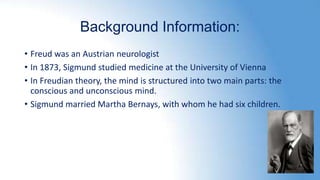
Background Information:
• Freud was an Austrian neurologist
• In 1873, Sigmund studied medicine at the University of Vienna
• In Freudian theory, the mind is structured into two main parts: the
conscious and unconscious mind.
• Sigmund married Martha Bernays, with whom he had six children.
Description of his theory:
Freud believed that:
• Our unconscious minds influence the way we behave, as well as conscious
thoughts
• Also, that psychoanalytic group of theories proposes that children’s
development unfolds in definite stages that everyone shares within
childhood.
• Our early experiences cause later adult behaviour
• Symbolic behaviour is important, and he tried to interpret dreams
• Freud linked thinking, feelings, and sexual and social relationships with
early physical behaviour such as breast feeding, toilet training and
separation from parents.
How did Sigmund Freud influence current
practice?
• A key person in the work setting – important to a healthy
environment
• Staff discussion help raise awareness of feelings
• A child’s comforter such as a teddy bear or toy, can help make a link
with comfortable and familiar people
Positive aspects of his theory:
• Drew attention to peoples unconscious mind and their problems
• Inspired other people to research the unconscious mind
• Helped people with psychological problems
• Children with emotional needs are encouraged creative expression
through free play and providing art material
Negative aspects of his theory:

Sigmund freud

  • 1.
  • 2.
    Background Information: • Freudwas an Austrian neurologist • In 1873, Sigmund studied medicine at the University of Vienna • In Freudian theory, the mind is structured into two main parts: the conscious and unconscious mind. • Sigmund married Martha Bernays, with whom he had six children.
  • 3.
    Description of histheory: Freud believed that: • Our unconscious minds influence the way we behave, as well as conscious thoughts • Also, that psychoanalytic group of theories proposes that children’s development unfolds in definite stages that everyone shares within childhood. • Our early experiences cause later adult behaviour • Symbolic behaviour is important, and he tried to interpret dreams • Freud linked thinking, feelings, and sexual and social relationships with early physical behaviour such as breast feeding, toilet training and separation from parents.
  • 4.
    How did SigmundFreud influence current practice? • A key person in the work setting – important to a healthy environment • Staff discussion help raise awareness of feelings • A child’s comforter such as a teddy bear or toy, can help make a link with comfortable and familiar people
  • 5.
    Positive aspects ofhis theory: • Drew attention to peoples unconscious mind and their problems • Inspired other people to research the unconscious mind • Helped people with psychological problems • Children with emotional needs are encouraged creative expression through free play and providing art material
  • 6.