Minerals  By: Rabbi Goldberg
Introduction  The lithosphere is made of one or more naturally formed materials called ROCK.  All Rocks are made up minerals  Monominerelic – made up of one mineral  Polymineralic- a rock made up of more than one mineral  One  Mineral
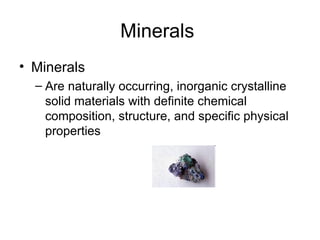
Minerals  Minerals  Are naturally occurring, inorganic crystalline solid materials with definite chemical composition, structure, and specific physical properties
Scientist have discovered over 2,400 minerals in the world.  Around 12 of them make up 90% of all the rocks  These minerals are nicknamed rockformers.
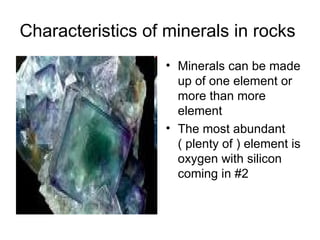
Characteristics of minerals in rocks  Minerals can be made up of one element or more than more element  The most abundant ( plenty of ) element is oxygen with silicon coming in #2
How can we tell what type of mineral were are looking at? Minerals are identified based upon physical and chemical properties  Color  Luster  Cleavage vs fracture  Streak  Crystal form  Etc…….
Color  The outside color of the mineral can help identify very few minerals.  Such as  Sulfur  This is most minerals have more than one color and very few have a distinct color
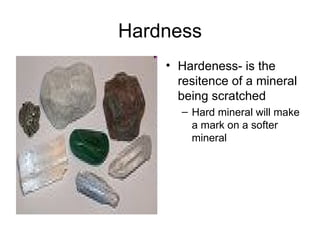
Hardness Hardeness- is the resitence of a mineral being scratched  Hard mineral will make a mark on a softer mineral
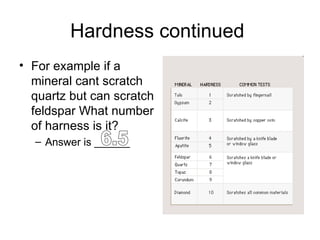
Hardness continued  Moh’  Scale of Hardness  List 10 minerals from soft to the hardest  #1 is talc with is the softect mineral  #10 is diamonds which is the hardest mineral  By using this list we can determine which minerals will scratch the other
Hardness continued  For example if a mineral cant scratch quartz but can scratch feldspar What number of harness is it? Answer is ______  6.5
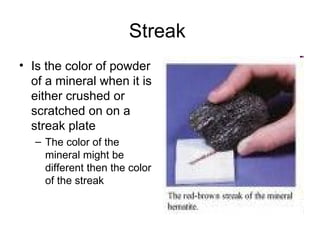
Streak  Is the color of powder of a mineral when it is either crushed or scratched on on a streak plate  The color of the mineral might be different then the color of the streak
Luster  Luster  If you would look at the mineral in light what type reflection would it give off  It might shine like metal and therefore would have a metallic luster OR it might not shine like metal and therefore would be called non metallic luster
Cleavage vs.  Fracture  Lets say I would break a mineral  If the mineral breaks with smooth edges or surfaces it is said to have _______________ If the mineral has jaggered or rough surface by the break then it is said to be _______________.  cleavage fractured  cleavage fractured
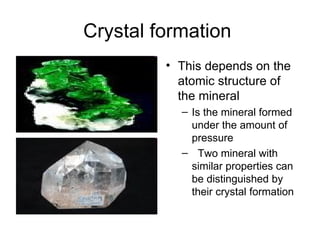
Crystal formation  This depends on the atomic structure of the mineral  Is the mineral formed under the amount of pressure  Two mineral with similar properties can be distinguished by their crystal formation
Specific gravity  The ratio of the weight of a mineral to equal volume of water  A mineral with specific gravity 3.0 will be 3x heavier then the equal volume of water  Specific gravity = density
Special Properties  Some mineral have special properties  Calcite will bubble carbon dioxide when dropped in hydrochloric acid  Halite – tastes salty  Magnetite – is magnetic
Mineral Properties  Minerals are crystalline  The atoms inside are bonded in a particular way  Two mineral with the same chemical composition (make up) CAN HAVE DIFFERENT PROPERTIES  Graphite and diamonds are both chemically made up the same materials  Diamonds are under extreme pressure and therefore their crystalline composition is closer together and stronger than graphite

Minerals

  • 1.
    Minerals By:Rabbi Goldberg
  • 2.
    Introduction Thelithosphere is made of one or more naturally formed materials called ROCK. All Rocks are made up minerals Monominerelic – made up of one mineral Polymineralic- a rock made up of more than one mineral One Mineral
  • 3.
    Minerals Minerals Are naturally occurring, inorganic crystalline solid materials with definite chemical composition, structure, and specific physical properties
  • 4.
    Scientist have discoveredover 2,400 minerals in the world. Around 12 of them make up 90% of all the rocks These minerals are nicknamed rockformers.
  • 5.
    Characteristics of mineralsin rocks Minerals can be made up of one element or more than more element The most abundant ( plenty of ) element is oxygen with silicon coming in #2
  • 6.
    How can wetell what type of mineral were are looking at? Minerals are identified based upon physical and chemical properties Color Luster Cleavage vs fracture Streak Crystal form Etc…….
  • 7.
    Color Theoutside color of the mineral can help identify very few minerals. Such as Sulfur This is most minerals have more than one color and very few have a distinct color
  • 8.
    Hardness Hardeness- isthe resitence of a mineral being scratched Hard mineral will make a mark on a softer mineral
  • 9.
    Hardness continued Moh’ Scale of Hardness List 10 minerals from soft to the hardest #1 is talc with is the softect mineral #10 is diamonds which is the hardest mineral By using this list we can determine which minerals will scratch the other
  • 10.
    Hardness continued For example if a mineral cant scratch quartz but can scratch feldspar What number of harness is it? Answer is ______ 6.5
  • 11.
    Streak Isthe color of powder of a mineral when it is either crushed or scratched on on a streak plate The color of the mineral might be different then the color of the streak
  • 12.
    Luster Luster If you would look at the mineral in light what type reflection would it give off It might shine like metal and therefore would have a metallic luster OR it might not shine like metal and therefore would be called non metallic luster
  • 13.
    Cleavage vs. Fracture Lets say I would break a mineral If the mineral breaks with smooth edges or surfaces it is said to have _______________ If the mineral has jaggered or rough surface by the break then it is said to be _______________. cleavage fractured cleavage fractured
  • 14.
    Crystal formation This depends on the atomic structure of the mineral Is the mineral formed under the amount of pressure Two mineral with similar properties can be distinguished by their crystal formation
  • 15.
    Specific gravity The ratio of the weight of a mineral to equal volume of water A mineral with specific gravity 3.0 will be 3x heavier then the equal volume of water Specific gravity = density
  • 16.
    Special Properties Some mineral have special properties Calcite will bubble carbon dioxide when dropped in hydrochloric acid Halite – tastes salty Magnetite – is magnetic
  • 17.
    Mineral Properties Minerals are crystalline The atoms inside are bonded in a particular way Two mineral with the same chemical composition (make up) CAN HAVE DIFFERENT PROPERTIES Graphite and diamonds are both chemically made up the same materials Diamonds are under extreme pressure and therefore their crystalline composition is closer together and stronger than graphite