UNIT
2
PPT
8
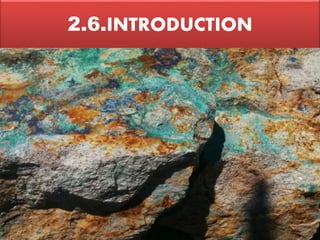
2.6.INTRODUCTION
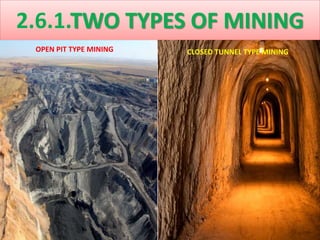
2.6.1.TWO TYPES OF MINING
OPEN PIT TYPE MINING CLOSED TUNNEL TYPE MINING
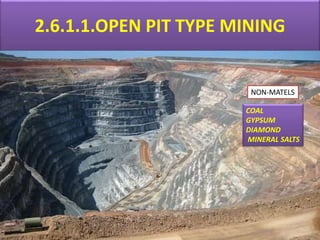
2.6.1.1.OPEN PIT TYPE MINING
NON-MATELS
COAL
GYPSUM
DIAMOND
MINERAL SALTS
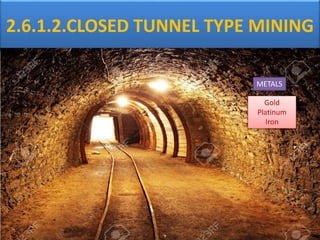
2.6.1.2.CLOSED TUNNEL TYPE MINING
Gold
Platinum
Iron
METALS
2.6.2.CATEGORIES OF MINERAL
RESOURCES
GOLD ROCKS COAL
METTALIC MINERALS NON-MATTALIC MINERALS FUEL MINERALS
2.6.2.1.METTALIC MINERALS
Gold, Chromium, Nickel, Platinum, etc., are found
as particles embedded in hard rocks.
Metals like Aluminum, manganese, iron, copper
etc., are not found as metallic particles but found
in the form of their respective compounds.
Iron, Aluminum, Chromium, Manganese,
Titanium and Magnesium are abundant.
Copper, Lead, Zinc, Tin, Gold, Silver, Platinum,
Uranium, Mercury, Molybdenum are scarce
2.6.2.2.NON-MATTALIC MINERALS
Non Mettalic minerals range form silicate
minerals to Sand, Gravel, Salts, Soils,
Diamond, Limestone, Asbestos, Gypsum, etc.
These kinds of mineral resources are found in
Karnataka, Rajasthan and Bihar.
Gypsum and mica are found in TamilNadu.
Diamond is found to some extent in Madhya
Pradesh
2.6.2.3. FUEL MINERALS
Coal, Petroleum and Amber belong to the category of
Fuel Minerals.
In India coal is available in abundance, particularly in West
Bengal, Orissa, Bihar, Assam, Madhya Pradesh,
Maharashtra, Meghalaya , Nagaland and Uttar Pradesh.
Lignite (Brown Coal) is available in Neyveli, Tamilnadu.
Petroleum is found in Assam and Gujarat states as well as in
Godavari basin and Bombay high seas.
Plutonium is found in the Trivandrum beach.
2.6.3. USES OF MINERALS RESOURCES
2.6.3.1.Gold, Silver, Diamond
Copper, Aluminum, Iron, Nickel
2.6.3.2.Diamond, Platinum
For Industrial Use
2.6.3.3.Aluminum
2.6.3.4.Coal and Petroleum
2.6.3.5.Iron is referred to as Black
Gold
2.6.3.6.Various inorganic minerals
2.6.4.Adverse effects of mining on
environment
2.6.4.1.Air Pollution
2.6.4.2.Water Pollution
2.6.4.3.Land Pollution
2.6.4.4.Noise Pollution
2.6.4.5.Deforestation
2.8.Ways and means of Preventing over
Exploitation of Mineral Resources
Wildlife (Protection) act 1972(Amended in 1991)
Water (Prevention and Control of Pollution) act,
1974 (Amended in 1988)
Forest (Conservation) act, 1980 (Amended in 1988)
Environment (Protection) act 1986.
National mineral policy of India(1993), (Amended
in 2008)
2.8.1.National Mineral Policy,2008
Insist on the following:
National mineral policy, 1993 forbids mining operations in the reserve forests for wildlife as well as the wildlife
sanctuaries.
Search of mineral resources insea beds with the help of remote sensing satellite.
Application of advanced technologies to be used inminingout minerals and modernization of the miningindustry
Preservation of wildlife forests and sanctuaries.
Miningleases are to be granted in such a way, not to disturb the eco-system of a region severely.
Permitting export of minerals to other countries only in value added forms.
Dr. R.Ramamoorthy M.Sc.,M.Ed.,M.Phil.,Ph.D.,
Assistant Professor in Biological Science
Arasan Ganesan College of Preceptors,
Sivakasi

MINERAL RESOURCES