Strategies for Developing
Creativity and Critical
Thinking
Joey D. Footman
University of Phoenix
MED 560 – Secondary Teaching Methods
Scott Brewer
October 27, 2013

1
Strategies for Developing Creativity and Critical
Thinking

The information shared is an aid for
new faculty in implementing
strategies for developing creativity
and critical thinking. Please note
that this does not represent a
conclusive list, rather a brief
collection of approaches that may be
of benefit.
2
Strategy #1 - Creativity
Do not always provide students with
all the information. Require them to
think, discover, apply, and create.

3
Strategy #2 - Creativity


Starting with the end in mind, or
backwards design is one way to spark
creativity in your students. Once you
realize what you want them to learn and
be able to do, you then design meaningful
learning tasks and assessments. Allowing
students to provide input into possible
tasks and assessments will foster
creativity.
4
Strategy #3 - Creativity


Encourage risk-taking. When
students do not feel restricted or
inhibited, they will often do some of
their best and most creative
thinking. Teach them that it is not
always the answer that is important,
but the process by which they
derived the answer.
5
Strategy #4 - Creativity


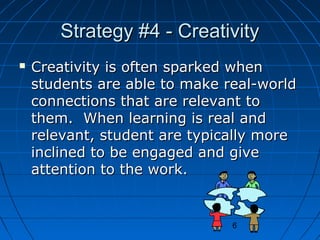
Creativity is often sparked when
students are able to make real-world
connections that are relevant to
them. When learning is real and
relevant, student are typically more
inclined to be engaged and give
attention to the work.

6
Strategy #5 - Creativity
Integrating information technology is part
of 21st century learning. Today’s students
are digital natives, and being such means
that they often times utilize technology in
ways that their teachers would never think
of. Teachers should capitalize on these
strengths and allow students to use their
digital knowledge creatively.

7
Strategy #1 – Critical Thinking
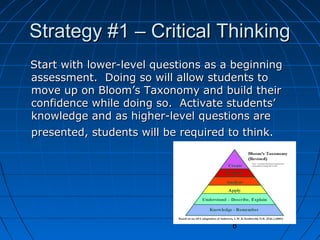
Start with lower-level questions as a beginning
assessment. Doing so will allow students to
move up on Bloom’s Taxonomy and build their
confidence while doing so. Activate students’
knowledge and as higher-level questions are
presented, students will be required to think.

8
Strategy #2 – Critical Thinking
Reading for understanding is
important. Students cannot think
deeply and critically if they do not
truly know what a question is asking.
Require students to read and reread before attempting to answer
questions and require them to prove
their answers.
9
Strategy #3 – Critical Thinking
Vary your instructional strategies.
Varying the ways students are
provided information requires that
they also vary their levels of thinking
when providing information back to
you.

10
Strategy #4 – Critical Thinking
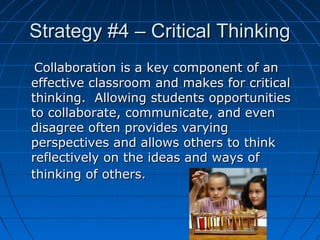
Collaboration is a key component of an
effective classroom and makes for critical
thinking. Allowing students opportunities
to collaborate, communicate, and even
disagree often provides varying
perspectives and allows others to think
reflectively on the ideas and ways of
thinking of others.

11
Strategy #5 – Critical Thinking
Act as a facilitator. As a practitioner, while
you are full of knowledge, so are students.
Allowing them to share and apply their
knowledge helps them to be active
learners, and allows you to be a facilitator
of learning.

12
References
Anderson, L. W. & Krathwohl, D. R. (2001). A taxonomy for learning, teaching, and
assessing: A revision of Bloom’s taxonomy of educational objectives. New York, NY:
Longman.
Pearson Learning Solutions, (2013). Encouraging high school students to think.
Retrieved October 25, 2013, from
http://media.pearsoncmg.com/pcp/pls_1256499544/video/index.html?wf=1&item=1

13

Strategies for Developing Creativity and Critical Thinking

  • 1.
    Strategies for Developing Creativityand Critical Thinking Joey D. Footman University of Phoenix MED 560 – Secondary Teaching Methods Scott Brewer October 27, 2013 1
  • 2.
    Strategies for DevelopingCreativity and Critical Thinking The information shared is an aid for new faculty in implementing strategies for developing creativity and critical thinking. Please note that this does not represent a conclusive list, rather a brief collection of approaches that may be of benefit. 2
  • 3.
    Strategy #1 -Creativity Do not always provide students with all the information. Require them to think, discover, apply, and create. 3
  • 4.
    Strategy #2 -Creativity  Starting with the end in mind, or backwards design is one way to spark creativity in your students. Once you realize what you want them to learn and be able to do, you then design meaningful learning tasks and assessments. Allowing students to provide input into possible tasks and assessments will foster creativity. 4
  • 5.
    Strategy #3 -Creativity  Encourage risk-taking. When students do not feel restricted or inhibited, they will often do some of their best and most creative thinking. Teach them that it is not always the answer that is important, but the process by which they derived the answer. 5
  • 6.
    Strategy #4 -Creativity  Creativity is often sparked when students are able to make real-world connections that are relevant to them. When learning is real and relevant, student are typically more inclined to be engaged and give attention to the work. 6
  • 7.
    Strategy #5 -Creativity Integrating information technology is part of 21st century learning. Today’s students are digital natives, and being such means that they often times utilize technology in ways that their teachers would never think of. Teachers should capitalize on these strengths and allow students to use their digital knowledge creatively. 7
  • 8.
    Strategy #1 –Critical Thinking Start with lower-level questions as a beginning assessment. Doing so will allow students to move up on Bloom’s Taxonomy and build their confidence while doing so. Activate students’ knowledge and as higher-level questions are presented, students will be required to think. 8
  • 9.
    Strategy #2 –Critical Thinking Reading for understanding is important. Students cannot think deeply and critically if they do not truly know what a question is asking. Require students to read and reread before attempting to answer questions and require them to prove their answers. 9
  • 10.
    Strategy #3 –Critical Thinking Vary your instructional strategies. Varying the ways students are provided information requires that they also vary their levels of thinking when providing information back to you. 10
  • 11.
    Strategy #4 –Critical Thinking Collaboration is a key component of an effective classroom and makes for critical thinking. Allowing students opportunities to collaborate, communicate, and even disagree often provides varying perspectives and allows others to think reflectively on the ideas and ways of thinking of others. 11
  • 12.
    Strategy #5 –Critical Thinking Act as a facilitator. As a practitioner, while you are full of knowledge, so are students. Allowing them to share and apply their knowledge helps them to be active learners, and allows you to be a facilitator of learning. 12
  • 13.
    References Anderson, L. W.& Krathwohl, D. R. (2001). A taxonomy for learning, teaching, and assessing: A revision of Bloom’s taxonomy of educational objectives. New York, NY: Longman. Pearson Learning Solutions, (2013). Encouraging high school students to think. Retrieved October 25, 2013, from http://media.pearsoncmg.com/pcp/pls_1256499544/video/index.html?wf=1&item=1 13