Honorable Educator: Dr. Donald TreffingerUniversity of Buffalo, Advanced Graduate Certificate: Gifted Education—Online September 2011Presented by Andrea Yawman
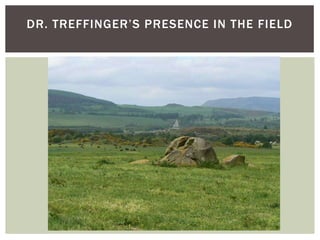
A rock is something stable, firm and dependable. Treffinger’s work spans 50+ years.His work builds on others before him.A rock can act as a foundation.Treffinger is referenced numerous times in other researchers’ work.Prolific author and collaborator.A rock can yield untold riches and beauty.Creativity is one of Treffinger’s main focuses. Creative minds can yield untold riches and beauty.Why a rock?
Dr. Treffinger’s Background:Stepping Stones on His Career PathBackground
Stepping Stones on Dr. Treffinger’s Career PathBorn March 9, 1941Attended public schools in Buffalo, NYBS in Sociology, 1961 from Buffalo State CollegeMS, PhD in Educational Psychology from Cornell UniversityTaught at the elementary, junior high and university levelsProfessor at Purdue University, University of Kansas and Buffalo State CollegeCurrently president of the Center for Creative Learning, Inc. in Sarasota, Florida
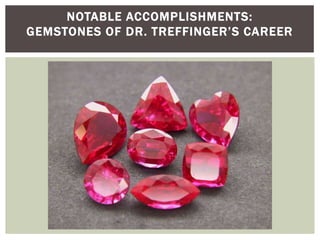
Notable Accomplishments:Gemstones of Dr. Treffinger’s Career
Gemstones of CareerDistinguished Service Award, NAGC—1984E. Paul Torrance Creativity Award, NAGC—1995Risorgimento Award for contribution to creativity, Destination ImagiNation—2005Creativity Research Award, World Council on Gifted and Talented Children—2005Honorary Doctor of Laws degree, University of Winnipeg—2009 At the 2011 NAGC annual convention, The Legacy Series will tape “The Creative Voice of Don Treffinger.” The Legacy Series creates a permanent record in image and voice of individuals who have dedicated themselves to most able learners.
Dr. Treffinger’s Presence in the Field
Presence in the FieldDr. Treffinger is known in the field for:Assessing and nurturing creativityCreative Problem SolvingTalent Development, specifically the Levels of Service ApproachHe has authored or co-authored 60 books and monographs; written or co-written more than 350 articlesMember of the Gifted Child Quarterly Editorial Advisory Board
Historical Significance:contributions to many layers of research
1. Assessing and Nurturing CreativityCreativity must be nurtured to help people deal with change; it’s a “must have” 21st century skill.Non-debatable: we can teach people to be creative.Old question: How creative are you? New question: How are you creative?Other new questions: What works best for whom, under what conditions?How do we differentiate?How do we personalize?There is no “one way” to assess creativity
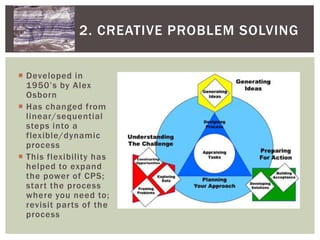
2. Creative Problem SolvingDeveloped in 1950’s by Alex OsbornHas changed from linear/sequential steps into a flexible/dynamic processThis flexibility has helped to expand the power of CPS; start the process where you need to; revisit parts of the process
Creative problem solving continued1. UNDERSTAND THE PROBLEM/OPPORTUNITY/CHALLENGEMess Findinglook for many messes and articulate a broad, brief, beneficial goal, then choose which mess to work onData Findinglook at the mess from many points of view using sources of data; decide what part of data demonstrates the heart of the messProblem Findinginvite ideas free of criteria; then find a way to best state the problem: “How might we do something to achieve our goal?”2. GENERATE IDEASIdea Findinginvite varied, unusual, unique possibilities; then choose ideas that seem to have the most appeal3. PREPARING FOR ACTIONSolution Findingmake good ideas into the best solutions using specific criteria: Cost, Acceptance, Resources, Time, SpaceAcceptance Findingcreate a plan of action to bridge solutions to actions
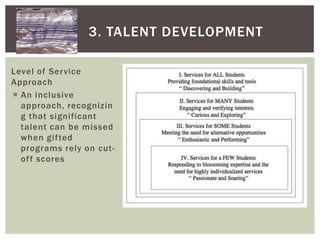
3. Talent DevelopmentLevel of Service ApproachAn inclusive approach, recognizing that significant talent can be missed when gifted programs rely on cut-off scores
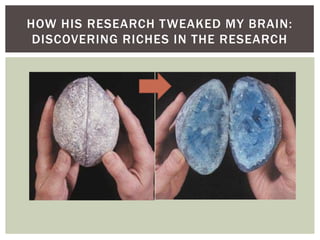
How His Research Tweaked my Brain:Discovering Riches in the Research
Discovering Riches in the ResearchCreativityPreviously I thought of people as being creative or not.
We can teach creativity—powerful notion!2.  Creative Problem SolvingPowerful, dynamic
Can be used in so many situations: school, business, home, relationships
A crucial life skill—let’s teach this instead of busy work and test prep!3. Talent DevelopmentThis speaks to my inner conviction that as teachers we need to bring out the best in everyone—the struggling student, the on-grade-level student, the gifted student.
Treffinger’s Level of Services Approach addresses the dilemma of using a cut-off test score for inclusion in gifted programs.

Treffinger power point

  • 1.
    Honorable Educator: Dr.Donald TreffingerUniversity of Buffalo, Advanced Graduate Certificate: Gifted Education—Online September 2011Presented by Andrea Yawman
  • 2.
    A rock issomething stable, firm and dependable. Treffinger’s work spans 50+ years.His work builds on others before him.A rock can act as a foundation.Treffinger is referenced numerous times in other researchers’ work.Prolific author and collaborator.A rock can yield untold riches and beauty.Creativity is one of Treffinger’s main focuses. Creative minds can yield untold riches and beauty.Why a rock?
  • 3.
    Dr. Treffinger’s Background:SteppingStones on His Career PathBackground
  • 4.
    Stepping Stones onDr. Treffinger’s Career PathBorn March 9, 1941Attended public schools in Buffalo, NYBS in Sociology, 1961 from Buffalo State CollegeMS, PhD in Educational Psychology from Cornell UniversityTaught at the elementary, junior high and university levelsProfessor at Purdue University, University of Kansas and Buffalo State CollegeCurrently president of the Center for Creative Learning, Inc. in Sarasota, Florida
  • 5.
    Notable Accomplishments:Gemstones ofDr. Treffinger’s Career
  • 6.
    Gemstones of CareerDistinguishedService Award, NAGC—1984E. Paul Torrance Creativity Award, NAGC—1995Risorgimento Award for contribution to creativity, Destination ImagiNation—2005Creativity Research Award, World Council on Gifted and Talented Children—2005Honorary Doctor of Laws degree, University of Winnipeg—2009 At the 2011 NAGC annual convention, The Legacy Series will tape “The Creative Voice of Don Treffinger.” The Legacy Series creates a permanent record in image and voice of individuals who have dedicated themselves to most able learners.
  • 7.
  • 8.
    Presence in theFieldDr. Treffinger is known in the field for:Assessing and nurturing creativityCreative Problem SolvingTalent Development, specifically the Levels of Service ApproachHe has authored or co-authored 60 books and monographs; written or co-written more than 350 articlesMember of the Gifted Child Quarterly Editorial Advisory Board
  • 9.
  • 10.
    1. Assessing andNurturing CreativityCreativity must be nurtured to help people deal with change; it’s a “must have” 21st century skill.Non-debatable: we can teach people to be creative.Old question: How creative are you? New question: How are you creative?Other new questions: What works best for whom, under what conditions?How do we differentiate?How do we personalize?There is no “one way” to assess creativity
  • 11.
    2. Creative ProblemSolvingDeveloped in 1950’s by Alex OsbornHas changed from linear/sequential steps into a flexible/dynamic processThis flexibility has helped to expand the power of CPS; start the process where you need to; revisit parts of the process
  • 12.
    Creative problem solvingcontinued1. UNDERSTAND THE PROBLEM/OPPORTUNITY/CHALLENGEMess Findinglook for many messes and articulate a broad, brief, beneficial goal, then choose which mess to work onData Findinglook at the mess from many points of view using sources of data; decide what part of data demonstrates the heart of the messProblem Findinginvite ideas free of criteria; then find a way to best state the problem: “How might we do something to achieve our goal?”2. GENERATE IDEASIdea Findinginvite varied, unusual, unique possibilities; then choose ideas that seem to have the most appeal3. PREPARING FOR ACTIONSolution Findingmake good ideas into the best solutions using specific criteria: Cost, Acceptance, Resources, Time, SpaceAcceptance Findingcreate a plan of action to bridge solutions to actions
  • 13.
    3. Talent DevelopmentLevelof Service ApproachAn inclusive approach, recognizing that significant talent can be missed when gifted programs rely on cut-off scores
  • 14.
    How His ResearchTweaked my Brain:Discovering Riches in the Research
  • 15.
    Discovering Riches inthe ResearchCreativityPreviously I thought of people as being creative or not.
  • 16.
    We can teachcreativity—powerful notion!2. Creative Problem SolvingPowerful, dynamic
  • 17.
    Can be usedin so many situations: school, business, home, relationships
  • 18.
    A crucial lifeskill—let’s teach this instead of busy work and test prep!3. Talent DevelopmentThis speaks to my inner conviction that as teachers we need to bring out the best in everyone—the struggling student, the on-grade-level student, the gifted student.
  • 19.
    Treffinger’s Level ofServices Approach addresses the dilemma of using a cut-off test score for inclusion in gifted programs.
  • 20.
    The Level ofServices Approach also embodies Dr. Callard-Szulgit’s quote, “What works for gifted, works for all;” all students are part of the model.What would I like to see Dr. Treffinger do next?
  • 21.
    It’s time toform an educational system that makes sense for all children. Let’s create a system where all children actually learn as deeply and fully as possible.Put together a “dream team” to mesh their ideas and create a Symposium by SkypeThis “dream team” would reach out to lawmakers and policymakers across the countryPossible team members and their roles:Dr. Treffinger: What is really important for the 21st century? Creativity!Carol Tomlinson: Differentiation is a must for all classrooms; what would this look like and how can we make it happen?Ellen Winner: Advocate for the gifted and for elevating the level of instruction for allA Testing Expert: Describe what tests can and cannot do; why our focus needs to changeAn Economic Guru: Let’s make decisions that truly support learning and show how proper decisions can save money; let’s choose to allocate our money so that it supports LEARNING; do not distribute just to certain states/districts that can jump through the current hoops The Dream for the Future
  • 22.
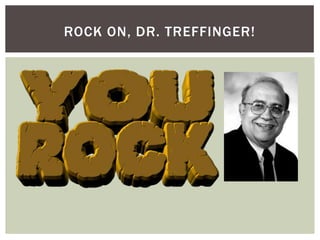
    Rock On, Dr.Treffinger!
  • 23.
    Davis, G.A., Rimm,S. B., Siegle, D. (2011). Education of the Gifted and Talented, 6th edition. Boston: Pearson.Dr. Donald J. Treffinger: Introduction to Creative Problem Solving [video]. (1993) (Available from GCT Inc., PO Box 6448, Mobile AL 36660-0448)Green, N. (June 2009). An Interview with Dr. Don Treffinger: More Than Cupcakes: Supporting Your Child’s Creative Potential. Retrieved from http://www.nagc.org/php_june09/web/Interview_files/Interview.pdfHenshon, S.E., (March 22, 2006). Creative exploration: an interview with Don Treffinger. Retrieved from http://www.thefreelibrary.com/Creative+exploration%3A+an+interview+with+Don+TreffingerTreffinger, D. J., ed. (2004). Creativity and Giftedness. Thousand Oaks, CA: Corwin Press. Treffinger, D. J. Talents and Gifts: The Levels of Service (LoS) Approach. Retrieved from http://creativelearning.com/talent-development/about-los.htmlTreffinger, D. J. (August 23, 2011). The Exciting New Challenge of Talents. Retrieved from http://creativelearning.com/component/easyblog/entry/the-exciting-new-challenge-of-talents.htmlResources