Outline
Introduction
Types of Smart Antenna
Switched beam antenna system
Adaptive arrays
Advantages
Drawbacks
Conclusion
References
INTRODUCTION
 MIMO is an acronym that stands for Multiple Input Multiple Output.
 It is an antenna diversity technology that is used both in transmission and
receiver equipment for wireless radio communication.
 Here can be various MIMO configurations. For example, a 2x2 MIMO
configuration is 2 antennas to transmit signals (from base station) and 2 antennas
to receive signals (mobile terminal).
 Exploit multipath instead of mitigating it.
Types of Smart antennas
 There are two types of smart antennas are there:
1. Adaptive array antenna
2. Switched beam array antenna
Different MIMO Configurations
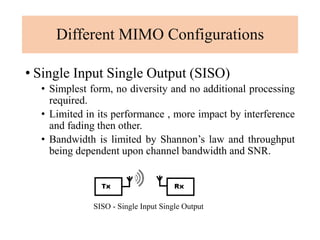
• Single Input Single Output (SISO)
• Simplest form, no diversity and no additional processing
required.
• Limited in its performance , more impact by interference
and fading then other.
• Bandwidth is limited by Shannon’s law and throughput
being dependent upon channel bandwidth and SNR.
SISO - Single Input Single Output
Cont..
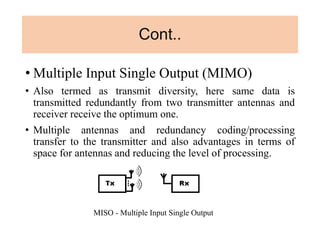
• Multiple Input Single Output (MIMO)
• Also termed as transmit diversity, here same data is
transmitted redundantly from two transmitter antennas and
receiver receive the optimum one.
• Multiple antennas and redundancy coding/processing
transfer to the transmitter and also advantages in terms of
space for antennas and reducing the level of processing.
MISO - Multiple Input Single Output
Advantages
■ Improved system capacities
■ Higher permissible signal bandwidths
■ Space division multiple access (SDMA)
■ Higher signal-to-interference ratios
■ Increased frequency reuse
■ Sidelobe canceling or null steering
■ Multipath mitigation
■ Constant modulus restoration to phase modulatedsignals
■ Blind adaptation
■ Improved angle-of-arrival estimation and directionfinding
■ Instantaneous tracking of moving sources
■ Reduced speckle in radar imaging
■ Clutter suppression
■ Increased degrees of freedom
■ Improved array resolution
■ MIMO compatibility in both communications and radar
Drawbacks
■ There transceivers are much more complex than traditional
• base station
■ The antenna needs separate transceiver chains for each array
antenna element and accurate real-time calibration for each of
them
■ The antenna beam forming is computationally intensive, i.e., smart
antenna base stations must be equipped withvery powerful digital
signal processors
• This leads to increase the system costs in short term, but since the benefits
outweigh the costs, it will be less expensive in long run
Conclusion
• MIMO systems have enabled a huge step forward since they can increase
significantly both the coverage and the capacity of cellular systems.
• The performance improvements resulting from the use of MIMO systems are due
to array gain, diversity gain, spatial multiplexing gain, and interference
reduction.
• The capacity of Receive or Transmit Diversity grows logarithmically with the
number of antennas
• Capacity of MEMO increases linearly with the number of antennas.
• Using Spatial Diversity:
• The SNR increases and Pe decreases when using MIMO
• There is a trade off between Spatial Multiplexing and Spatial Diversity gain.
References
• Ahmed El Zooghby, Smart Antenna Engineering; Artech House, Inc.: 2005.
• C.A. Balanis “Antenna theory analysis and design”, John Wiley and Sons
• Allen, B.; Ghavami, M. Adaptive Array Systems: Fundamentals and Applications;
John Wiley & Sons Inc.: 2005.
• Liberti, J., and T. Rappaport, Smart Antennas for Wireless Communications: IS-95
and Third Generation CDMAApplications, Prentice Hall New York, 1999.
• Lehne, PH & Pettersen, M & Telenor R&D. 1999, An overview of smart antenna
technology for mobile communications systems, IEEE Communications Surveys,
http://www.comsoc.org/pubs/surveys.
• Martin Cooper, Marc Goldburg, ”Intelligent Antennas: Spatial Division Multiple
Access” Annual Review of Communications,1996.
• Jack H. Winters “Smart Antenna Techniques and Their Application to Wireless Ad
Hoc Networks” .
• Murali Kiruba “Smart Antennas for Wireless Mobile Communication” ITtoolbox
Wireless- 15592, 22 Oct 2004.
Seminar.pptx
Seminar.pptx

Seminar.pptx

  • 1.
    Outline Introduction Types of SmartAntenna Switched beam antenna system Adaptive arrays Advantages Drawbacks Conclusion References
  • 2.
    INTRODUCTION  MIMO isan acronym that stands for Multiple Input Multiple Output.  It is an antenna diversity technology that is used both in transmission and receiver equipment for wireless radio communication.  Here can be various MIMO configurations. For example, a 2x2 MIMO configuration is 2 antennas to transmit signals (from base station) and 2 antennas to receive signals (mobile terminal).  Exploit multipath instead of mitigating it.
  • 3.
    Types of Smartantennas  There are two types of smart antennas are there: 1. Adaptive array antenna 2. Switched beam array antenna
  • 4.
    Different MIMO Configurations •Single Input Single Output (SISO) • Simplest form, no diversity and no additional processing required. • Limited in its performance , more impact by interference and fading then other. • Bandwidth is limited by Shannon’s law and throughput being dependent upon channel bandwidth and SNR. SISO - Single Input Single Output
  • 6.
    Cont.. • Multiple InputSingle Output (MIMO) • Also termed as transmit diversity, here same data is transmitted redundantly from two transmitter antennas and receiver receive the optimum one. • Multiple antennas and redundancy coding/processing transfer to the transmitter and also advantages in terms of space for antennas and reducing the level of processing. MISO - Multiple Input Single Output
  • 7.
    Advantages ■ Improved systemcapacities ■ Higher permissible signal bandwidths ■ Space division multiple access (SDMA) ■ Higher signal-to-interference ratios ■ Increased frequency reuse ■ Sidelobe canceling or null steering ■ Multipath mitigation ■ Constant modulus restoration to phase modulatedsignals ■ Blind adaptation ■ Improved angle-of-arrival estimation and directionfinding ■ Instantaneous tracking of moving sources ■ Reduced speckle in radar imaging ■ Clutter suppression ■ Increased degrees of freedom ■ Improved array resolution ■ MIMO compatibility in both communications and radar
  • 8.
    Drawbacks ■ There transceiversare much more complex than traditional • base station ■ The antenna needs separate transceiver chains for each array antenna element and accurate real-time calibration for each of them ■ The antenna beam forming is computationally intensive, i.e., smart antenna base stations must be equipped withvery powerful digital signal processors • This leads to increase the system costs in short term, but since the benefits outweigh the costs, it will be less expensive in long run
  • 9.
    Conclusion • MIMO systemshave enabled a huge step forward since they can increase significantly both the coverage and the capacity of cellular systems. • The performance improvements resulting from the use of MIMO systems are due to array gain, diversity gain, spatial multiplexing gain, and interference reduction. • The capacity of Receive or Transmit Diversity grows logarithmically with the number of antennas • Capacity of MEMO increases linearly with the number of antennas. • Using Spatial Diversity: • The SNR increases and Pe decreases when using MIMO • There is a trade off between Spatial Multiplexing and Spatial Diversity gain.
  • 10.
    References • Ahmed ElZooghby, Smart Antenna Engineering; Artech House, Inc.: 2005. • C.A. Balanis “Antenna theory analysis and design”, John Wiley and Sons • Allen, B.; Ghavami, M. Adaptive Array Systems: Fundamentals and Applications; John Wiley & Sons Inc.: 2005. • Liberti, J., and T. Rappaport, Smart Antennas for Wireless Communications: IS-95 and Third Generation CDMAApplications, Prentice Hall New York, 1999. • Lehne, PH & Pettersen, M & Telenor R&D. 1999, An overview of smart antenna technology for mobile communications systems, IEEE Communications Surveys, http://www.comsoc.org/pubs/surveys. • Martin Cooper, Marc Goldburg, ”Intelligent Antennas: Spatial Division Multiple Access” Annual Review of Communications,1996. • Jack H. Winters “Smart Antenna Techniques and Their Application to Wireless Ad Hoc Networks” . • Murali Kiruba “Smart Antennas for Wireless Mobile Communication” ITtoolbox Wireless- 15592, 22 Oct 2004.