Introduction
• Some of the constraints related to product and financial markets that
smallholders face can be mitigated using value chain approach.
• It brings chain actors including farmers, aggregators, traders, processors,
and financial institutions together to gain control over the processes of
production, marketing, processing, and distribution so as to reduce
transaction costs and enhance competitiveness of the entire chain
• For financial institutions, value chains can serve an important entry point
to enhance their outreach to chain actors, mainly small-scale producers
and entrepreneurs, and to reduce transaction costs and risks associated
with small-sized loans.
• Through value chain, a financial institution can obtain information on
potential borrowers at a little or no cost
Introduction
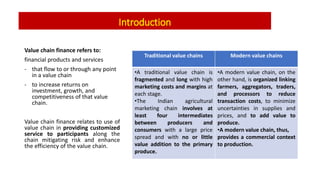
Value chain finance refers to:
financial products and services
- that flow to or through any point
in a value chain
- to increase returns on
investment, growth, and
competitiveness of that value
chain.
Value chain finance relates to use of
value chain in providing customized
service to participants along the
chain mitigating risk and enhance
the efficiency of the value chain.
4
htsxnrgjsfhmfbxgnxgfxhm
Traditional value chains Modern value chains
•A traditional value chain is
fragmented and long with high
marketing costs and margins at
each stage.
•The Indian agricultural
marketing chain involves at
least four intermediates
between producers and
consumers with a large price
spread and with no or little
value addition to the primary
produce.
•A modern value chain, on the
other hand, is organized linking
farmers, aggregators, traders,
and processors to reduce
transaction costs, to minimize
uncertainties in supplies and
prices, and to add value to
produce.
•A modern value chain, thus,
provides a commercial context
to production.
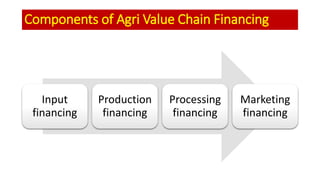
Components of Agri Value Chain Financing
Input
financing
Production
financing
Processing
financing
Marketing
financing
5
htsxnrgjsfhmfbxgnxgfxhm
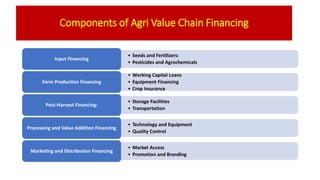
• Seeds and Fertilizers:
• Pesticides and Agrochemicals
Input Financing
• Working Capital Loans
• Equipment Financing
• Crop Insurance
Farm Production Financing
• Storage Facilities
• Transportation
Post-Harvest Financing:
• Technology and Equipment
• Quality Control
Processing and Value Addition Financing
• Market Access
• Promotion and Branding
Marketing and Distribution Financing
Components of Agri Value Chain Financing
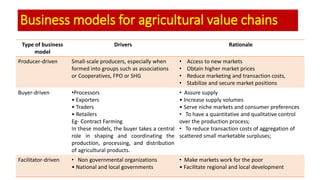
Business models for agricultural value chains
Type of business
model
Drivers Rationale
Producer-driven Small-scale producers, especially when
formed into groups such as associations
or Cooperatives, FPO or SHG
• Access to new markets
• Obtain higher market prices
• Reduce marketing and transaction costs,
• Stabilize and secure market positions
Buyer-driven •Processors
• Exporters
• Traders
• Retailers
Eg- Contract Farming
In these models, the buyer takes a central
role in shaping and coordinating the
production, processing, and distribution
of agricultural products.
• Assure supply
• Increase supply volumes
• Serve niche markets and consumer preferences
• To have a quantitative and qualitative control
over the production process;
• To reduce transaction costs of aggregation of
scattered small marketable surpluses;
Facilitator-driven • Non governmental organizations
• National and local governments
• Make markets work for the poor
• Facilitate regional and local development
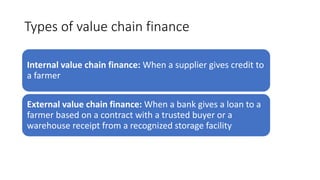
Types of value chain finance
Internal value chain finance: When a supplier gives credit to
a farmer
External value chain finance: When a bank gives a loan to a
farmer based on a contract with a trusted buyer or a
warehouse receipt from a recognized storage facility
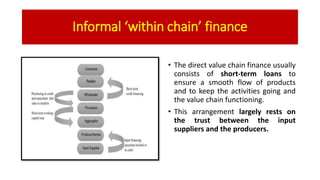
Informal ‘within chain’ finance
• The direct value chain finance usually
consists of short-term loans to
ensure a smooth flow of products
and to keep the activities going and
the value chain functioning.
• This arrangement largely rests on
the trust between the input
suppliers and the producers.
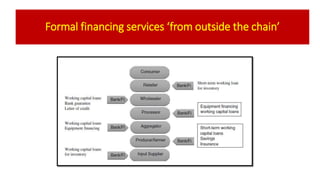
Formal financing services ‘from outside the chain’
Value Chain Models and Financial Instruments
1. Product Financing
(A)Aggregator Credit: Aggregator provides advance loans to producer and these
loans are repaid just after the harvest. Under this kind of system, the
aggregator provides insurance to producer that he will procure product by
financing the production. Aggregators may be medium or large farmers or
cooperatives or other farmer producer organization.
(B) Input Supplier Credit: Input supplier credit is the primary source of credit to
small and poor farmers. Under this system, input suppliers provide
agricultural inputs such as chemicals, seeds, fertilizers and equipment as a
loan to the producer, and this loan must be repaid by the producer just
after the harvest or any other mutually decided time.
2. LeadFirm Financing/Contract Farming
• In this system, a lead firm gives direct credit to foundation player in
the chain including producers.
• In this the farmer produces crop under guaranteed buyback agreement
and the lead firm finances all requirements at the production stage.
The lead firm not only supplies inputs and working capital but also
finances extension services, high-quality crop seeds, technology
transfer, training and supervision of production.
• The lead firm plays a very crucial and central role in the production
cycle
3. Receivable Financing
• Receivables finance is generally used for immediate cash flow by
businesses to convert sales on credit terms
• Receivable finance, also known as accounts receivable financing, is a
financial arrangement where a business (such as a participant in the
agricultural value chain) uses its outstanding receivables as collateral
to secure financing.
4. Physical-asset collateralization
(A) Warehouse receipts: Farmers or other value chain enterprises receive a
receipt from a certified warehouse that can be used as collateral to
access a loan from third-party financial institutions against the security
of goods in an independently controlled warehouse
(B) Financial lease: The financier retains ownership of the goods until full
payment is made, making it easy to recover goods if payment is not
made, while allowing agribusinesses and farmers to use and purchase
machinery, vehicles and other large-ticket items without requiring the
collateral otherwise needed for such a purchase
5. Risk Mitigation products
(A) Insurance: Insurance products are used to reduce risks by pooling regular
payments of many clients and paying out to those affected by losses
(B)Forward contract: It is a contract between two parties to buy or sell
goods/asset at a specified price on a future date. These are not traded
on centralized exchanges.
( C) Futures: Futures are financial contracts between buyer and seller to buy
or sell commodities/asset at a predetermined future date and price.
Futures contract details specify quality and quantity of the
commodities/asset and are standardized to facilitate trading on futures
exchange.
6. Financial enhancements
• (A) Loan guarantees: Third-party loan guarantees to agriculture loans by
public or private organizations reduce lending risks to banks and other
lending entities. This facilitates increased lending to agriculture sector
• (B) Joint-venture finance: Joint-venture finance is a form of shared-owner
equity finance between private and/or public partners or shareholders.
Joint-venture finance creates opportunities for shared ownership,
returns and risks. Partners also often bring complementary technical
expertise and natural, financial and market access resources
Value chain Financing.pptxjfjffjfjcjfjfju

Value chain Financing.pptxjfjffjfjcjfjfju

  • 1.
    Introduction • Some ofthe constraints related to product and financial markets that smallholders face can be mitigated using value chain approach. • It brings chain actors including farmers, aggregators, traders, processors, and financial institutions together to gain control over the processes of production, marketing, processing, and distribution so as to reduce transaction costs and enhance competitiveness of the entire chain • For financial institutions, value chains can serve an important entry point to enhance their outreach to chain actors, mainly small-scale producers and entrepreneurs, and to reduce transaction costs and risks associated with small-sized loans. • Through value chain, a financial institution can obtain information on potential borrowers at a little or no cost
  • 2.
    Introduction Value chain financerefers to: financial products and services - that flow to or through any point in a value chain - to increase returns on investment, growth, and competitiveness of that value chain. Value chain finance relates to use of value chain in providing customized service to participants along the chain mitigating risk and enhance the efficiency of the value chain. 4 htsxnrgjsfhmfbxgnxgfxhm Traditional value chains Modern value chains •A traditional value chain is fragmented and long with high marketing costs and margins at each stage. •The Indian agricultural marketing chain involves at least four intermediates between producers and consumers with a large price spread and with no or little value addition to the primary produce. •A modern value chain, on the other hand, is organized linking farmers, aggregators, traders, and processors to reduce transaction costs, to minimize uncertainties in supplies and prices, and to add value to produce. •A modern value chain, thus, provides a commercial context to production.
  • 3.
    Components of AgriValue Chain Financing Input financing Production financing Processing financing Marketing financing 5 htsxnrgjsfhmfbxgnxgfxhm
  • 4.
    • Seeds andFertilizers: • Pesticides and Agrochemicals Input Financing • Working Capital Loans • Equipment Financing • Crop Insurance Farm Production Financing • Storage Facilities • Transportation Post-Harvest Financing: • Technology and Equipment • Quality Control Processing and Value Addition Financing • Market Access • Promotion and Branding Marketing and Distribution Financing Components of Agri Value Chain Financing
  • 5.
    Business models foragricultural value chains Type of business model Drivers Rationale Producer-driven Small-scale producers, especially when formed into groups such as associations or Cooperatives, FPO or SHG • Access to new markets • Obtain higher market prices • Reduce marketing and transaction costs, • Stabilize and secure market positions Buyer-driven •Processors • Exporters • Traders • Retailers Eg- Contract Farming In these models, the buyer takes a central role in shaping and coordinating the production, processing, and distribution of agricultural products. • Assure supply • Increase supply volumes • Serve niche markets and consumer preferences • To have a quantitative and qualitative control over the production process; • To reduce transaction costs of aggregation of scattered small marketable surpluses; Facilitator-driven • Non governmental organizations • National and local governments • Make markets work for the poor • Facilitate regional and local development
  • 6.
    Types of valuechain finance Internal value chain finance: When a supplier gives credit to a farmer External value chain finance: When a bank gives a loan to a farmer based on a contract with a trusted buyer or a warehouse receipt from a recognized storage facility
  • 7.
    Informal ‘within chain’finance • The direct value chain finance usually consists of short-term loans to ensure a smooth flow of products and to keep the activities going and the value chain functioning. • This arrangement largely rests on the trust between the input suppliers and the producers.
  • 8.
    Formal financing services‘from outside the chain’
  • 9.
    Value Chain Modelsand Financial Instruments 1. Product Financing (A)Aggregator Credit: Aggregator provides advance loans to producer and these loans are repaid just after the harvest. Under this kind of system, the aggregator provides insurance to producer that he will procure product by financing the production. Aggregators may be medium or large farmers or cooperatives or other farmer producer organization. (B) Input Supplier Credit: Input supplier credit is the primary source of credit to small and poor farmers. Under this system, input suppliers provide agricultural inputs such as chemicals, seeds, fertilizers and equipment as a loan to the producer, and this loan must be repaid by the producer just after the harvest or any other mutually decided time.
  • 10.
    2. LeadFirm Financing/ContractFarming • In this system, a lead firm gives direct credit to foundation player in the chain including producers. • In this the farmer produces crop under guaranteed buyback agreement and the lead firm finances all requirements at the production stage. The lead firm not only supplies inputs and working capital but also finances extension services, high-quality crop seeds, technology transfer, training and supervision of production. • The lead firm plays a very crucial and central role in the production cycle
  • 11.
    3. Receivable Financing •Receivables finance is generally used for immediate cash flow by businesses to convert sales on credit terms • Receivable finance, also known as accounts receivable financing, is a financial arrangement where a business (such as a participant in the agricultural value chain) uses its outstanding receivables as collateral to secure financing.
  • 12.
    4. Physical-asset collateralization (A)Warehouse receipts: Farmers or other value chain enterprises receive a receipt from a certified warehouse that can be used as collateral to access a loan from third-party financial institutions against the security of goods in an independently controlled warehouse (B) Financial lease: The financier retains ownership of the goods until full payment is made, making it easy to recover goods if payment is not made, while allowing agribusinesses and farmers to use and purchase machinery, vehicles and other large-ticket items without requiring the collateral otherwise needed for such a purchase
  • 13.
    5. Risk Mitigationproducts (A) Insurance: Insurance products are used to reduce risks by pooling regular payments of many clients and paying out to those affected by losses (B)Forward contract: It is a contract between two parties to buy or sell goods/asset at a specified price on a future date. These are not traded on centralized exchanges. ( C) Futures: Futures are financial contracts between buyer and seller to buy or sell commodities/asset at a predetermined future date and price. Futures contract details specify quality and quantity of the commodities/asset and are standardized to facilitate trading on futures exchange.
  • 14.
    6. Financial enhancements •(A) Loan guarantees: Third-party loan guarantees to agriculture loans by public or private organizations reduce lending risks to banks and other lending entities. This facilitates increased lending to agriculture sector • (B) Joint-venture finance: Joint-venture finance is a form of shared-owner equity finance between private and/or public partners or shareholders. Joint-venture finance creates opportunities for shared ownership, returns and risks. Partners also often bring complementary technical expertise and natural, financial and market access resources

Editor's Notes

  • #5 © Copyright Showeet.com – Free PowerPoint Templates