AGRICULTURAL
VALUE CHAIN FINANCE
A GUIDE FOR BANKERS
© 2016 World Bank Group
1818 H Street NW
Washington, DC 20433
Telephone: 202-473-1000
Internet: www.worldbank.org
Email: feedback@worldbank.org
All rights reserved
This volume is a product of the staff of the World Bank Group. The findings, interpretations,
and conclusions expressed in this volume do not necessarily reflect the views of the Executive
Directors of World Bank Group or the governments they represent. The World Bank Group
does not guarantee the accuracy of the data included in this work. The boundaries, colors,
denominations, and other information shown on any map in this work do not imply any judgment
on the part of World Bank Group concerning the legal status of any territory or the endorsement
or acceptance of such boundaries.
Rights and Permissions
The material in this publication is copyrighted. Copying and/or transmitting portions or all of this
work without permission may be a violation of applicable law. World Bank Group encourages
dissemination of its work and will normally grant permission to reproduce portions of the work
promptly.
For permission to photocopy or reprint any part of this work, please send a request with
complete information to the Copyright Clearance Center, Inc., 222 Rosewood Drive, Danvers, MA
01923, USA, telephone: 978-750-8400, fax: 978-750-4470, http://www.copyright.com/.
All other queries on rights and licenses, including subsidiary rights, should be addressed to the
Office of the Publisher, World Bank Group, 1818 H Street NW, Washington, DC 20433, USA, fax:
202-522-2422, e-mail: pubrights@worldbank.org.
Cover photo: World Bank Flickr
AGRICULTURAL
VALUE CHAIN FINANCE
A GUIDE FOR BANKERS
Carlos Cuevas and Maria Pagura
iAgricultural Value Chain Finance - A Guide for Bankers
Table of Contents
Acknowledgements...............................................................................................................................................................ii
Introduction...........................................................................................................................................................................1
Chapter 1:The Business Case for Value Chain Finance.....................................................................................................6	
Chapter 2:Identifying a Target Value Chain ........................................................................................................................9
Chapter 3:Mapping the Value Chain – Market Intelligence.............................................................................................15
Chapter 4:Entry Points for Financial Institutions............................................................................................................23
Chapter 5:Value Chain Financial Products.......................................................................................................................29
Chapter 6:Risk Management, Costs and Returns............................................................................................................32
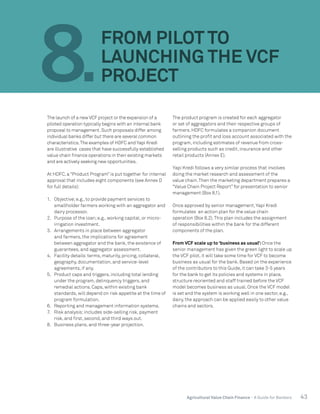
Chapter 7:Adapting the Bank Structure and Operations to the VCF Model...................................................................37	
Chapter 8:From Pilot to VCF Launch.................................................................................................................................43
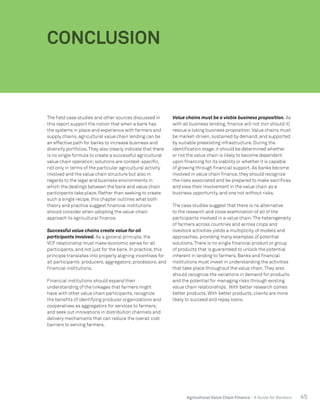
Conclusions..........................................................................................................................................................................45
Annex A:Basic Concepts and Principles...........................................................................................................................49
Annex B:Assessing Commercial Criteria in Value Chain Selection.................................................................................56
Annex C:Agriculture Value Chain Financial Products......................................................................................................59
Annex D:Internal Bank Proposal to Management............................................................................................................65
Annex E:VCF profit and loss account template................................................................................................................69
References ..........................................................................................................................................................................70
 
List of Tables
Table 1:Value chain participants. Main features and typical demand for financial services.........................................3
Table 4.1:Value chain organizational structures...............................................................................................................24
List of Boxes
Box 2.1:Building upon existing relationships with HDFC in India ...................................................................................10
Box 2.2:Partnering with large processors to pilot VC interventions in Pakistan...........................................................10
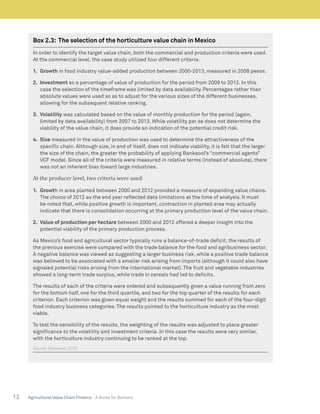
Box 2.3:The selection of the horticulture value chain in Mexico.....................................................................................12
Box 3.1:Research and development and biotechnology in input supply........................................................................17
Box 3.2:What defines an anchor company?......................................................................................................................19
Box 7.1:Roles for monitoring...............................................................................................................................................41
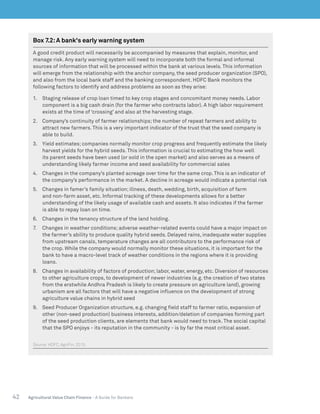
Box 7.2:Bank’s early warning system ................................................................................................................................42
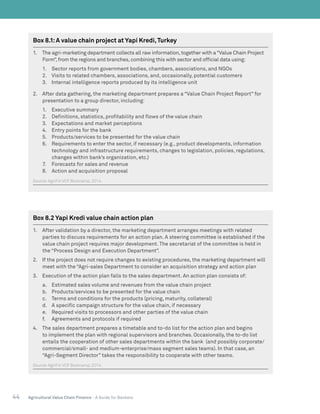
Box 8.1:A value chain project at Yapi Kredi,Turkey...........................................................................................................44
Box 8.2:Yapi Kredi value chain action plan.......................................................................................................................44
List of Figures
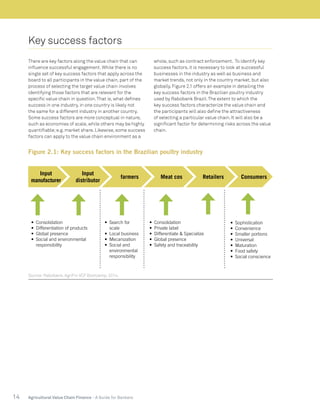
Figure 2.1:Key success factors in the Brazilian poultry industry....................................................................................14
Figure 3.1:Turkish poultry value chain...............................................................................................................................17
Figure 3.2:Mexico tomato production...............................................................................................................................18
Figure 4.1:Financial flows within the value chain ............................................................................................................24
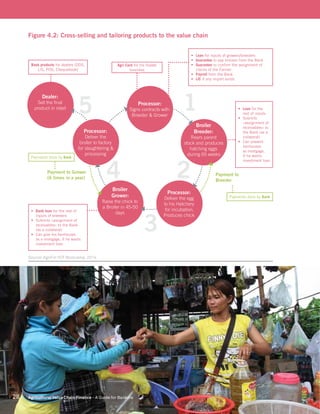
Figure 4.2:Cross-selling and tailoring products to the value chain................................................................................28
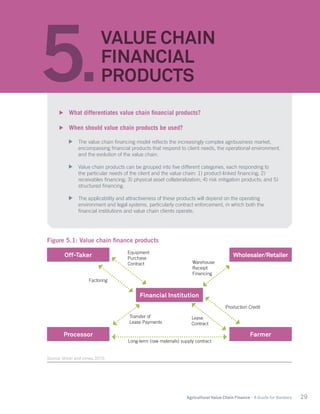
Figure 5.1:Value chain finance products.......................................................................................................................... 29
Figure 6.1:Costs and rates to borrower (gross return for bank) ..................................................................................... 35
Figure 7.1:Industry analysis for a value chain in Yapi Kredi.............................................................................................38
Figure 7.2:Credit evaluation of a Turkish poultry operator............................................................................................. 39
ii Agricultural Value Chain Finance - A Guide for Bankers
Acknowledgements
The Agricultural Value Chain Finance - A Guide for
Bankers has been developed under the Agriculture
Finance Support Facility (AgriFin) of the World Bank.
Funding for this activity was provided by the Bill and
Melinda Gates Foundation without which this activity
would not have been possible.
This Guide would also not have been possible without
the contributions and frank collaboration of three
leading banks in agricultural finance:Bankaool,
Mexico;HBL, Pakistan;and HDFC, India.Their senior
representatives, Francisco Meré, Kashif Thanvi, and
Michael Andrade and their respective teams in Mexico,
Pakistan and India, have been a permanent source
of wisdom and insight throughout the development
of this Guide. Michael Andrade has been particularly
generous with his time during the writing of the Guide.
The document has also benefitted from inputs coming
from presentations at the AgriFin “Boot Camp” value
chain financing training in Johannesburg, South Africa,
October 2014, notably those by Ömer Demirhan, at the
time with Yapi Kredi,Turkey.
At AgriFin, the team has worked under the leadership
of Maria Pagura,Task Team Leader for this activity.
Carlos Cuevas, Senior Technical Advisor, coordinated
the case study work with the banking partners and
led the drafting of the Guide. Senior consultants, Ken
Shwedel in Mexico, Nico van Wageningen in Pakistan,
and Raman Ahuja in India, provided quality inputs and
insightful analysis of the respective value chain case
studies. Patrick Flajole provided research assistance
and editorial support throughout the drafting of the
case studies and the Guide.
The team would like to acknowledge and thank the
following individuals for their input to the development
of the Guide. Roy Parizat, AgriFin Project Coordinator,
provided valuable feedback throughout the entire
project.The peer reviewers,Jamie Anderson,John
Blanchfield,Juan Buchenau, Hans Dellien and Panos
Varangis, contributed with comments and suggestions
that greatly improved the original draft.The current
version is better focused on the intended audience –
bankers – than the initial draft thanks to the reviewers’
inputs. Damian Milverton of globaleditor.org completed
the review and refined the final document.
Lastly, the team is particularly grateful for the
assistance provided by Marc Sadler, Advisor, Agriculture
Global Practice, for his leadership and guidance on this
project.
1Agricultural Value Chain Finance - A Guide for Bankers
INTRODUCTION
The perceptions of serious lending risks and high costs
of service delivery, among other limitations, are well-
known barriers to the financing of smallholders. These
barriers make it difficult and sometimes impossible
for farmers to get a loan, therefore denying them a
chance to grow their businesses and incomes. Clearly,
traditional banking does not meet the needs of the
smallholder. Experience suggests that value chain
finance is arguably one of the most sustainable and
effective ways of reaching smallholder farmers with the
potential to benefit a significantly greater proportion of
the 450 million smallholders worldwide.1
This Guide to agriculture value chain finance (AVCF) is
based on existing good-practice knowledge, and the
experience and insights of well-recognized bankers
partnering with AgriFin. It represents a “how-to”
approach to enable other banks to engage in value
chain finance with a much better understanding of what
works, and what to avoid.
The main objectives of the Guide are:
a.	 To provide practical, evidence-based guidance to
financial institutions engaging in AVCF.
b.	 To offer a comprehensive picture of agricultural
value chains so as to enable financial institutions
to work with different segments of the value
chain and adapt financial products to the specific
demands of value chain participants.
c.	 To provide examples of field-tested AVCF products
and procedures that have shown value or promise.
While value chains can finance internally with loans
from one participant to another, this Guide emphasizes
the role and challenges of “external” value chain finance,
i.e., the financing arrangements that include banks
and other financial institutions. External finance not
1. See Christen and Anderson, 2013, for detailed estimates.
only expands credit use along the value chain, but also
makes available a number of other services such as
payments, deposits, and insurance that were previously
beyond the reach of producers and other value chain
participants. By taking a value chain approach,
banks can benefit from such portfolio expansion and
diversification by bundling and cross-selling products
and services.
The Guide has been created by bankers for bankers.
The Guide has been developed by practitioners carrying
out field experiments (in partnerships with AgriFin) that
involve new agricultural value chains in their relevant
markets.These field case studies have been supported
by a comprehensive review of existing literature and
experiences worldwide, and the drafting of this Guide
has been assisted by expert advice.
The intended audience. The Guide will be useful
to financial institutions and practitioners already
engaged in agricultural lending and rural finance who
are interested in improving outreach and profitability.
Information contained within the guide will also be
useful to those not currently active in agricultural
lending, but who might be considering a strategy to
enter this market.
By combining a review of good practice models in
several countries with three individual case studies
(field experiments in India, Mexico and Pakistan), the
methodology aims to answer the following questions
most relevant to bankers:
1.	 What works in value-chain finance?
2.	 Why it works?
3.	 Where does it work? Under what conditions?
4.	 What are the finance instruments that make it work
(risk-sharing, structured finance, others)?
5.	 What factors deter success in VCF?
2 Agricultural Value Chain Finance - A Guide for Bankers
Organization of the Guide
This Introduction deals mainly with the question of“why”
value chain finance is important,and summarizes a few
basic concepts on value chain finance.The subsequent
chapters,the core of the Guide,focuses on practical
questions in implementing value chain finance models.
Its contents derive primarily from the three value chain
case studies,and other field-based evidence from banks
actively employing a value chain financing approach.The
Conclusion addresses the guiding questions above,and
highlights lessons from the field.
Why should the value chain matter to bankers?
Understanding the structure, relationships, and drivers
of an agriculture value chain can shed light on the
opportunities for a bank to profitably penetrate or
expand its presence in specific market segments. It is
important to recognize some key ways in which value
chain analysis differs from examinations of traditional
commodity systems or industries:
•	 It focuses on net value added;
•	 It recognizes that linkages between activities and
participants vary according to the product, even if
the participants are the same;
•	 It recognizes that there are different kinds of
value chains depending on their “drivers” and the
associated governance relationships;and
•	 It looks beyond physical flows to include
informational flows
In contrast to conventional direct lending to individual
participants in a value chain, AVCF is characterized
by a comprehensive assessment and understanding
of the entire chain and the use of (and in some cases
development of) specially tailored financial products
that meet the needs of the chain. Rather than a
simple credit risk assessment of the borrower, AVCF
requires an assessment of the broader risks of the
value chain. Agricultural value chain finance often
prioritizes bringing together individual farmers and
their productive capacity via producer associations,
cooperatives, and other forms of collective enterprise,
thereby greatly improving their access to methods
of diversifying and transferring risk. It also leads to
economies of scale in market transactions and greater
bargaining power to form more reliable and profitable
relationships with other market participants.
By focusing on agriculture value chain finance, banks
can develop a long-term strategy for growth in lending
to other market segments and increased adoption of
banking services leading to large increases in deposit
balances, and payment services. Costs and risks can
be reduced through AVCF, offering a means to reach
smallholder farmers who may have otherwise been
excluded from formal financial services.
Key value chain participants and
financial interactions
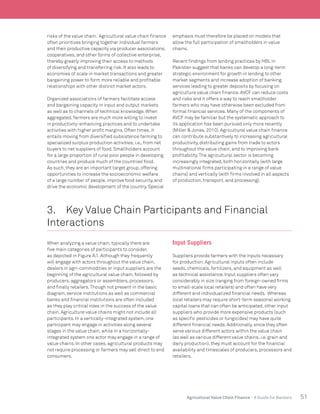
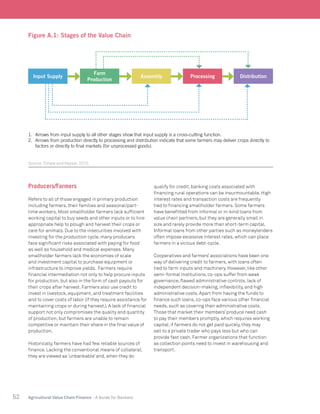
There are five main categories of participants in a value
chain.Their main features, as well as the relationships
among them, are summarized below. A comprehensive
discussion of these participants is included in Annex A.
Participants
Input suppliers and providers of agricultural equipment
represent the beginning or upstream section of a value
chain, while retail distributors to end consumers are
at the tail or downstream part.Table 1 summarizes
the features and typical demands of the five main
categories. It is common, in practice, to find the same
individual/firm in more than one role, e.g., a trader/
aggregator can be an input supplier;a processor might
also be a wholesaler or exporter.
3Agricultural Value Chain Finance - A Guide for Bankers
Participant Main features
Typical demand for financial
services
Input suppliers Provide farmers with the inputs necessary for
production. These include seeds, chemicals, fertilizers
and equipment, as well as technical assistance. Input
suppliers often vary in size, and have different and
individualized financial needs.
•	 Short-term working capital
•	 Mid-term financing (equipment
dealers)
•	 Payments, transfers
Producers/farmers All of those engaged in primary production including
farmers, their families and seasonal/part-time workers.
Many producers face significant risks associated with
agricultural production, such as predictable and stable
income, and household and medical expenses.
•	 Short-term working capital
•	 Mid-term financing (equipment,
livestock)
•	 Deposit accounts (value storage,
commitment savings)
•	 Payments, transfers
Aggregators, service
providers, traders2
Buy produce from the farmers or co-ops and bulk it
before selling it on. Their success hinges on making their
working capital flow as quickly as possible in buying and
reselling produce. Every transaction offers an opportunity
to make a profit (or incur a loss). Small rural traders have
to stop buying when they run out of cash, leaving farmers
stranded with their products.
•	 Short-term working capital
•	 Mid-term financing (storage
facilities, vehicles)
•	 Deposit accounts (checking)
•	 Payments, transfers
Processors Add value to a raw product during the processing stage.
Small-scale processors may lack the working capital they
need to buy products in bulk from a farmer group or
trader. They often lack the money to invest in equipment,
leading to losses, lower quality, and higher processing
costs.
•	 Short-term working capital
•	 Mid-term financing (equipment)
•	 Deposit accounts (checking)
•	 Payments, transfers
Retailers,
wholesalers,
exporters
Sell the processed product to local and global retailers,
supermarkets, and smaller storefront retailers, which
in turn, sell to consumers. Wholesalers often manage
credit relations in two directions: they provide funding to
trusted traders so they can buy on their behalf, and they
may provide products to retailers on credit, expecting to
be paid after the retailer has sold the goods. In this way,
wholesalers often act as a de facto bank for other actors
in the chain. They often need more capital than other
traders in the value chain.
•	 Short-term working capital
•	 Mid-term financing (equipment)
•	 Deposit accounts (checking)
•	 Payments, transfers
Table 1. Value chain participants. Main features and typical demand for financial services
In traditional finance, several banks might lend to
various actors along the chain, with no coordination of
services and knowledge. AVCF can create efficiencies
by promoting coordination of a variety of financing
services along the chain. While much of the interest in
AVCF focuses on its potential to expand credit access
to smallholder producers, there may also be downward
flows in the chain;that is, producers finance buyers and
processors by accepting delayed payments or delivering
products on consignment.
2.“Aggregators” are often also referred to “off-takers” by agribusiness partners in
the value chain.“Aggregators” has been favored throughout this Guide given it is
more familiar to those in the financial sector.
Participants’ relationships
Value chain types have been characterized by several
sources according to which participants “drive” or
initiate systematic cooperation within the value chain.
Its connection with the identification of entry points
for financial institutions is developed in Chapter 4.The
focus here is on what determines the “tightness” of
value chain relationships, since this is a rather critical
principle to consider. We also summarize the notion of
internal versus external VCF.
4 Agricultural Value Chain Finance - A Guide for Bankers
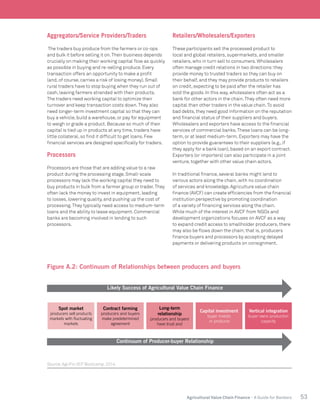
Tight versus loose value chains. Commercial
relationships between producers and buyers take place
along a continuum from spot market transactions
(usually local) to full vertical integration (e.g., the
broiler value chain;see Annex A). Tight value chains
are those with clearly established relationships and a
single channel, usually involving contracts or formal
agreements. Often these involve what are called “closed
marketed crops”, which pose transportation challenges
due to bulk or perishability, thus making side selling
costly and unlikely. In these value chains, producers
have few or only one option to sell their products.Tight
value chains may include export commodities, highly
perishable crops, and those that require commercial
processing. Sources of internal conflict in tight value
chains can arise from a lack of transparency in
contracts and uneven negotiating power among the
parties.The stability of the chain is contingent upon
these factors, and bankers need to understand the
likelihood of breakdowns in value chain relationships
before engaging.
By contrast, in loose value chains (often involving “open
marketed crops”) farmers have a variety of marketing
options and may sell to various buyers. In addition to
a range of marketing options, open marketed crops
may also be stored for home consumption. Loose value
chains present more opportunities for competition and
may present producers with a variety of options for
marketing their crops. However, loose value chains are
not necessarily better for smallholders. Such chains
present fewer opportunities to forge long-lasting
relationships where credit, inputs, extension, and sector
knowledge flow between participants in the chain.
While the tightness of a value chain is often based
on crop characteristics, specific context analysis
is necessary to determine how a particular chain
functions.
Internal vs. external value chain finance
Internal value chain finance. Finance will flow in value
chains regardless of the presence of formal financial
institutions. Participants further down the value chain
provide loans to smallholders with or without the
involvement of financial institutions. Forms of internal
value chain financing include aggregator credit, input
supplier credit, marketing company credit, and “lead
firm” financing.This lead firm may borrow from a
financial institution but there is no connection between
the financial institutions and upstream value chain
participants (i.e. farmers, aggregators).
While internal value chain finance offers the advantage
of utilizing relationships and transaction mechanisms
already in place, there are also drawbacks:working
capital is tied up in finance;farmers may not
understand the costs of finance (as it is deducted from
payment for products, or hidden in price discounts);and
agribusinesses must allocate resources to financing
suppliers, rather than to their core business.
External value chain finance. When actors outside
the value chain, such as financial institutions, provide
finance to the value chain based on relationships within
the chain, this finance may be referred to as “external”
financing. A typical example is when a bank provides a
loan to a producer based on a contract with a buyer.The
entry of financial institutions and external financing can
benefit all value chain participants:buyers do not need
to use working capital to provide finance to producers;
producers can access finance without meeting typical
collateral requirements;and banks can enter profitable
new markets without the risk and transaction costs
associated with lending to smallholders directly.
Guide Overview
This introductory chapter focused on why value chain
finance is important for bankers. It also provided a
brief overview of value chain financing concepts and
principles.The remainder of the guide focuses on the
information and inputs that a bank requires to design
and implement value chain financing models. A brief
overview of each chapter is provided as follows:
•	 Making the Business Case for Value Chain
Finance:Why diversify into agricultural value
chain finance? How can a financial institution use
information about the value chain to inform their
lending practices? This chapter outlines the main
components of the business case for financial
institutions.
•	 Identifying a Target Value Chain: What is the
basis for identifying a value chain? This chapter
explores the qualitative and quantitative criteria for
evaluating the viability of financing a value chain.
•	 Mapping the Value Chain - Market Intelligence:
What exchanges take place within a value chain?
Mapping of the value chain implies identifying and
quantifying the flows and relationships that make
the provision of inputs, production, processing and
distribution possible.This chapter discusses the
relationships, and charts the various participants of
the value chain.
5Agricultural Value Chain Finance - A Guide for Bankers
•	 Entry Points for a Financial Institution:Where
should the bank come in? With a value chain
identified and a successful mapping of the internal
and external flows completed, the next step is
to determine the appropriate points to target for
financial services.The success of a value chain does
not imply successful financing unless appropriate
partnerships are in place.
•	 Value Chain Financial Products: How are traditional
financing products different than value chain
products? Many of the products used in value chain
finance are very similar to traditional financial
products except that they leverage the information
and relationships already in place within the value
chain.There are a host of products that can be
tailored to the specific needs of the value chain and
the participant being targeted for financial services.
•	 Risk Management, Costs and Returns: How does
the value chain approach make agricultural lending
feasible? When banks partner with participants
within the value chain, it is possible to share
the risks and costs associated with lending to
smallholder producers and other value chain
participants.
•	 Adapting Bank Structure and Operations:What
changes are necessary in the structure and
practices of the financial institution? Banks
need to be prepared to manage their value chain
clients slightly differently. Not only will products
be different, but monitoring services and review
processes also should reflect the different risks and
costs associated with the VCF approach.
•	 From Pilot Project to Value Chain Finance Launch:
What information does senior management require
for approving the scale-up of a VCF pilot? What
information goes into a VCF proposal and business
plan? How long does it take a VCF project to become
‘business as usual’?
6 Agricultural Value Chain Finance - A Guide for Bankers
The value chain finance model presents a compelling
business case given that it reduces information
asymmetries it is and lowers transaction costs. If
implemented wisely,VCF can be a profitable line of
business for commercial banks.
Reduced information asymmetries
Information asymmetries are substantially reduced
because the bank – through partnerships or contracts
with value chain participants such as aggregators
and processors – is able to utilize information that
otherwise would have been unavailable or expensive to
obtain.This information encompasses:
•	 Agronomic technical/engineering knowledge of
the crop(s) or livestock involved in the value chain
encompassing yields, desirable practices, input
demands, and timing of input delivery.The bank does
not need to have in-house expertise to collect this
information. It is merely enough to interact with the
value chain participant who has that expertise and
well-established business relationships with other
participants (usually upstream).
•	 Profiles of participants/customers engaged in the
value chain, such as primary producers, small-scale
traders and collectors, mid-level and wholesale
aggregators, processors and exporters.
•	 Region-specific and cultural factors, e.g., dominant
local language, and customary trade relationships.
•	 Market intelligence, including price behavior, market
shares of different buyers, and input suppliers.
Channeling loans for crop or livestock production
through the buyers eliminates or reduces the need for
the bank to have full information about all value chain
participants. In fact, extensive due-diligence may be
needed mainly at the outset of the relationship and will
likely focus on the main buyer or buyers.
There are a number of elements that need to be in place
to drive a successful VCF experience, beginning with the
existence of a structured process for the commodity and
a clear understanding of participants and relationships.
1.
THE BUSINESS CASE
FOR VALUE CHAIN
FINANCE
	 Why diversifying into value chain finance makes business sense.
	 Reduced credit risk through leveraging existing information inside the value chain.
Information on where value is added along the chain – as well as the identification of key
participants, intermediate and ultimate markets, and the nature of customer demand –
helps financial institutions make better informed lending decisions.
	 Substantially lowers transaction costs in lending and other services.
	 Greater profitability is possible through economies of scale in market transactions and the
provision of multiple financial services using value chain connections.
7Agricultural Value Chain Finance - A Guide for Bankers
There should be a large number (typically thousands) of
producers, as well as traders (buyers) willing to set up
long-term relationships with the producers.
The bank should set out to engage key suppliers of farm
inputs and verify the track record of aggregators and
producers in honoring contracts. It also needs to ensure
an availability of technological solutions to reduce
transaction costs associated with service delivery.
When all or most of these elements are present, then
the specific commodity within the value chain is less
relevant;it could range from grains, to tropical fruits or
industrial crops.
Reduced transaction costs
Banks can see substantially lower transaction costs
in delivering and servicing multiple financial products
by relying upon the existing networks or transaction
platforms of VCF partners. In some cases, financial
institutions have created payment platforms around
those existing relationships, allowing them to operate
as if they had an extensive branch network but without
the fixed costs of having established one.3
Connecting the bank with the lead buyer or trader in
an already-established commercial relationship is
a preferable starting point. Once this relationship is
created and well understood, the bank can design and
introduce financing vehicles priced to reflect the cost-
sharing and risk-sharing arrangements between the
bank and the value chain business partners.
3. The experiences of HDFC, India, and Yapi Kredi, Turkey, offer examples of these
platforms in the dairy and the broiler industries, respectively. Bankaool, Mexico,
and Habib Bank Ltd. (HBL) in Pakistan are also employing this model.
It is also important to be able to deliver services up
and down the chain in a cost-effective manner.While
production financing can be achieved through the buyer,
other services require a different delivery method.The
choice of delivery mechanism becomes a decision
between direct provision through bank branches,or the
use of agent networks (e.g.,business correspondents)4
.
The latter seems to be the preferred means for creating
such a VCF platform.It not only allows better servicing of
the VCF participants,it also makes the services available
to other farmers or rural clients outside the value chain
who reside or work within reach of the agents.
4. Business correspondents conduct business transactions, accept deposits and
gather documents on behalf of the financial institution.
8 Agricultural Value Chain Finance - A Guide for Bankers
Multiple services expand bank business
The benefits of an agent-based delivery network become
more apparent when considering that farmers who have
been able to receive financing from within the value
chain tend to lose financial access once their produce
is delivered,the loan is repaid and the surplus revenue
to the producer is paid out.Smallholder farmers are
more likely to benefit from financial inclusion (and
remain active financial product consumers) if they
have additional options,such as savings accounts,
particularly if they can choose from among a few types
of accounts that meet their needs and preferences (e.g.,
term deposits).That way,the farmers develop the ability
to pay providers as needed or transfer funds to relatives
through the financial institution.At the same time,those
additional non-lending services bring additional revenue
to the bank.
Making the case
Broadly speaking, there are two principal business case
scenarios in support of a bank adopting a VCF approach
to broadening its agriculture lending base:
•	 Expanding the coverage of a value chain in which the
bank already maintains some established business
relationships (e.g., with an aggregator or processor)
yet only limited outreach upstream to producers and
input suppliers.
•	 Establishing a presence in a value chain new to
the bank’s portfolio, using market intelligence and
research (such as that carried out by AgriFin and its
selected partner banks).This could be initiated on a
pilot basis within the bank’s existing standards (e.g.,
loan caps;see Chapter 6 below).
In both scenarios, the bank will need to establish
relationships using conventional banking techniques,
i.e., dealing with each client individually. Illustrative
internal proposals are outlined in Chapter 8.
Regardless of the selected business case imperative,
successful adoption of VCF hinges upon a clear
understanding the target segment (based upon
market intelligence and value chain mapping) and the
identification of appropriate entry points and products.
Of the field case studies considered here, the example
from India has perhaps succeeded more than others in
incorporating the various VCF components by analyzing
incentives for the main key participants (farmers, seed
producer organizers, and hybrid seed companies) and
drawing conclusions about unsecured lending based on
the information available inside the value chain.
While the India study’s conclusion that such an
approach requires a higher degree of supervision and
therefore additional costs may be correct, it should be
understood that those costs are shared across the value
chain participants and do not necessarily accrue in full
to the bank.This ability to defray loan transaction costs,
including client screening and selection, monitoring and
supervision, and loan recovery, is a key aspect of the
business case for VCF.
Of course, success of the VCF approach obviously
requires an appreciation of its merits by members of the
value chain in addition to the financial institution. In the
three field case studies associated with this Guide, this
would mean creating plausible business cases for seed
production organizers in India5
, dairy collectors (and
possibly larger collectors and small-scale processors)
in Pakistan6
, and vegetable processors in Mexico7
.
There is the principal argument that wider access to
financing and financial services for the producers will
generate more business for the upstream aggregators
and processors, an expansion that they can support
and accelerate through investment of the funds that
they otherwise would have provided as loans to the
producers.
5. HDFC Bank, AgriFin. 2015. Creating Value Chain Finance for Farmers – A
Summary of HDFC’s Market Study on the Hybrid Seed Production Chains. World
Bank.
6. HBL. 2015. Structure and Performance of the Dairy Value Chain in Pakistan – A
Summary of HBL’s Case Study on the Dairy Value Chain in Pakistan. World Bank.
7. Bankaool, AgriFin. 2015. Selecting a Target Value Chain – A Summary of
Bankaool’s Market Study on the Vegetable Value Chains in Mexico.
9Agricultural Value Chain Finance - A Guide for Bankers
The choice of a target value chain can be approached
in one of two ways:by building upon existing business
relationships within a value chain, or selecting a new
value chain to expand the bank’s portfolio. In the case
study from Mexico, Bankaool took the second approach
as it sought to identify and rank new opportunities that
fit their existing VCF business model and agribusiness
banking practices.This involved developing a
methodology to identify food industry sectors with
characteristics similar to other segments in the bank’s
existing portfolio, thereby requiring minimal adaptation
of its business model.
By contrast, India’s HDFC sought to deepen its
understanding and presence in one sector in which it
already operated – the seed industry – to identify new
opportunities for value chain financing (see Box 2.1).
2.
IDENTIFYING
A TARGET
VALUE CHAIN
	 Where does the process begin?
	 What is the basis for targeting a value chain for financial services?
	 What criteria and indicators can help determine the health and viability of an
existing value chain?
	 This section outlines a procedure for identifying a target value chain through a selection
process based on both quantitative and qualitative criteria.
	 Commercial viability should be evaluated through a holistic perspective, taking into
consideration industry growth, investment, fluctuations in price and production volume,
variations in size of operations, and trends in international trade.
	 Each value chain should also be assessed at the farm-level, considering annual growth in
size of operation, yields (technology is often an important factor), value of production per
growing unit, and the proportion of area planted that is ultimately harvested.
	 Scores in each category can be tallied to compare and contrast value chains. The specific
preferences and market orientation of the financial institution should be used in weighting
these criteria as well other qualitative criteria, including the policy environment and
structural changes in the market.
	 Key success factors and risks associated with the selection process are highlighted.
10 Agricultural Value Chain Finance - A Guide for Bankers
In the Pakistan case study, the objective was to better
understand the commercial relationships and structure
of the dairy value chain in order to identify options
for entry. In this case, the bank (HBL) had an initial
understanding with a potential agribusiness partner, a
large dairy processor (see Box 2.2).
In the India and Pakistan cases, although the value
chains had been previously selected, an important part
of each analysis focused on the commercial nature and
viability of the respective value chains. Each of the case
studies reveals a slightly different motivation for value
chain analysis.
There is a recognized set of criteria that provides
the basic building blocks for analysis in identifying
a prospective value chain opportunity.The choice of
criteria (which often is limited by both the availability
and quality of the data) used in evaluating the viability
and relative ranking of the agri-food industry sectors
is also important for understanding the potential risks
associated with financing the specific value chain. What
follows is a summary of the main criteria and key factors
in selecting a value chain.
Box 2.1:Building upon existing relationships with HDFC in India
Banks will often start a value chain targeting process based on information available from
preexisting business relationships. HDFC in India was already working with seed companies and
aggregators by the time it initiated research to identify specific seed value chains in an effort
to extend the bank outreach upstream to producers. The following is an excerpt from HDFC’s
presentation at the Istanbul AgriFin Forum 2015.
Why the Seed Industry?
In 2012 HDFC Bank came upon seed companies looking for payment solutions. Off-balance sheet
transactions for advances made to seed organizers (aggregators) followed. The next logical step
for the bank was to take credit to farmers but to do so it needed to select the best VCF partners
within the seed industry. There was, therefore, a need for a deep understanding of the dynamics
and processes of the industry. What followed was a joint HDFC-AgriFin market study that mapped
the main hybrid seed production chains and that profiled the key participants. The bank has
defined next steps to work with selected seed chains.
Source:HDFC. AgriFin Forum 2015.
Box 2.2:Partnering with large processors to pilot value chain interventions in
Pakistan
The significance of the dairy sector in Pakistan made it a logical choice for Habib Bank. (HBL)
to design a pilot value chain intervention that leveraged the dominance of established major
processors. The dairy sector accounts for (11 percent) of Pakistan’s GDP and is critically important
to smallholders, who own close to 90 percent of the dairy cattle (with herd sizes of 3-5 animals
per household).
Therefore, while there was no process to identify a value chain as such, HBL still needed to gain
a large volume of specific knowledge about dairy sector participants, paths to market, and the
nature and terms of transactions. This extensive mapping exercise is outlined in the Chapter 3.
Source:HBL. 2015.
11Agricultural Value Chain Finance - A Guide for Bankers
Commercial (quantitative) criteria
The first step focuses on the commercial viability of the
industry in which the value chain operates.Although this
may seem obvious,it is often overlooked and is essential
in determining a successful business proposition for
value chain finance.8
The selection process takes on
added significance in agricultural value chain finance
where establishing long-term relationships and
developing future clientele are important supplementary
objectives for financial institutions.
Commercial viability is assessed using the following
criteria (see Annex B for greater detail):
a.	 Growth in industry, measured by both the value and
volume of production over a specific period of time.
b.	 Investment in the industry, which is also an
important indicator of how the market perceives the
specific risks and potential of an industry.
c.	 Price volatility and changes in production volume
(adjusted for seasonality), which provide an
indication of potential operational risks.
d.	 Size (measured as the value of production), which
can be used to determine the attractiveness of a
specific industry.
e.	 Trends in international trade.These provide an
indication of both the potential and the vulnerability of
an agri–food industry sector and can offer particularly
relevant insight regarding value chain financing.
f.	 Financial flows into the industry, as these provide
insight into how the financial market views the
specific industry.
8. The term “industry” is used here in a broad sense given that, depending on the
particular market, it may refer to the farm activities, companies, and products
within an entire country, or limited to a geographical region or sub-sector.
Ranking the value chains can be done by using
quantitative scores. When choosing between different
value chains, the financial institution can use a scoring
method that ranks the results each of the criteria listed
above. In the Mexico case study, a scale of values was
assigned to the results for each criterion (Box 2.3).
As such, each value chain was measured against its
peers. The results for each agri-food industry were then
compared to determine the most attractive value chain
for further analysis.The weighting process is largely
subjective, both within each criterion and between the
different criteria. Weighting can be adjusted to reflect
the individual financial institution’s appetite for risk
and/or specific market conditions.
 
12 Agricultural Value Chain Finance - A Guide for Bankers
Box 2.3: The selection of the horticulture value chain in Mexico
In order to identify the target value chain, both the commercial and production criteria were used.
At the commercial level, the case study utilized four different criteria:
1.	 Growth in food industry value-added production between 2000-2013, measured in 2008 pesos.
2.	 Investment as a percentage of value of production for the period from 2009 to 2012. In this
case the selection of the timeframe was limited by data availability. Percentages rather than
absolute values were used so as to adjust for the various sizes of the different businesses,
allowing for the subsequent relative ranking.
3.	 Volatility was calculated based on the value of monthly production for the period (again,
limited by data availability) from 2007 to 2013. While volatility per se does not determine the
viability of the value chain, it does provide an indication of the potential credit risk.
4.	 Size measured in the value of production was used to determine the attractiveness of the
specific chain. Although size, in and of itself, does not indicate viability, it is felt that the larger
the size of the chain, the greater the probability of applying Bankaool’s “commercial agents”
VCF model. Since all of the criteria were measured in relative terms (instead of absolute), there
was not an inherent bias toward large industries.
At the producer level, two criteria were used:
1.	 Growth in area planted between 2000 and 2012 provided a measure of expanding value chains.
The choice of 2012 as the end year reflected data limitations at the time of analysis. It must
be noted that, while positive growth is important, contraction in planted area may actually
indicate that there is consolidation occurring at the primary production level of the value chain.
2.	 Value of production per hectare between 2000 and 2012 offered a deeper insight into the
potential viability of the primary production process.
As Mexico’s food and agricultural sector typically runs a balance-of-trade deficit, the results of
the previous exercise were compared with the trade balance for the food and agribusiness sector.
A negative balance was viewed as suggesting a larger business risk, while a positive trade balance
was believed to be associated with a smaller risk arising from imports (although it could also have
signaled potential risks arising from the international market). The fruit and vegetable industries
showed a long-term trade surplus, while trade in cereals had led to deficits.
The results of each of the criteria were ordered and subsequently given a value running from zero
for the bottom half, one for the third quartile, and two for the top quarter of the results for each
criterion. Each criterion was given equal weight and the results summed for each of the four-digit
food industry business categories. The results pointed to the horticulture industry as the most
viable.
To test the sensibility of the results, the weighting of the results was adjusted to place greater
significance to the volatility and investment criteria. In this case the results were very similar,
with the horticulture industry continuing to be ranked at the top.
Source: Bankaool, 2015.
13Agricultural Value Chain Finance - A Guide for Bankers
Qualitative considerations
Even though the value chains can be quantitatively
ranked,the final selection process must take into
consideration other factors that might have an impact on
the attractiveness of the business proposition in relation
to the value chain.Since value chain finance is often
structured around developing long-term relationships
as a strategy to mitigate risks and offer a wider range
of financial products,the more important qualitative
criteria are:1) the policy environment;and 2) structural
changes taking place within the agri-food sector.
Policy environment. Food and agriculture value
chains often operate in highly politically-charged
environments, both in developing countries as well as
in the more developed nations. As a result, government
policies and actions can impact both the attractiveness
and the risk profile of the value chain. Accordingly, it is
important to understand types of policy measures, any
changes in government support, and their implications
for the value chain. Relevant examples include input
subsidies, price subsidies and price controls, credit
subsidies, and consumer protection interventions (food
availability and safety), among others.
Structural change. The food and agricultural system is
constantly evolving and structural changes having far-
reaching implications for a financial institution’s value
chain business propositions. One of the major recent
changes, for example, has been an increase in the power
of retailers, especially large national and multinational
retail firms9
.Their concerns about quality, food safety,
and traceability have driven the development of tighter
value chains10
.To the extent, therefore, that large
retailers take a greater share of the food market from
the smaller retailers, the need for value chain financing
may actually increase.
9. Reardon, T. and B. Minten. 2011.“Surprised by Supermarkets: Diffusion of
Modern Food Retail in India,” Journal of Agribusiness in Developing and Emerging
Economies 1(2). October: 134-161.
10. Tight value chains are those that are characterized by formal relationships,
often through contracts, between chain participants. Contracts will not only
refer to delivery and – possibly – pricing but also may include requirements for
production practices. Technical assistance, marketing advice as well as financing
may be provided.
The India study identifies a number of structural issues
affecting agriculture that deserve attention in the value
chain identification process:
1.	 Rising labor costs
2.	 Increasing pressure on land use (from agriculture,
housing, industrial, and mining sectors)
3.	 Growing energy costs and deficient energy
infrastructure
4.	 Widely scattered pockets of demand, leading to high
distribution costs.11
Another factor to consider is consolidation at the
aggregator level.This increases opportunities for value
chain financing and value chain products, even though
in the short-term this may increase the risk profile of a
value chain.
11. HDFC Bank. 2015. Creating Value Chain Finance for Farmers – A Summary of
HDFC’s Case Study on the Hybrid Seed Value Chain. World Bank.
14 Agricultural Value Chain Finance - A Guide for Bankers
Key success factors
There are key factors along the value chain that can
influence successful engagement. While there is no
single set of key success factors that apply across the
board to all participants in the value chain, part of the
process of selecting the target value chain involves
identifying those factors that are relevant for the
specific value chain in question.That is, what defines
success in one industry, in one country is likely not
the same for a different industry in another country.
Some success factors are more conceptual in nature,
such as economies of scale, while others may be highly
quantifiable;e.g. market share. Likewise, some success
factors can apply to the value chain environment as a
whole, such as contract enforcement. To identify key
success factors, it is necessary to look at successful
businesses in the industry as well as business and
market trends, not only in the country market, but also
globally. Figure 2.1 offers an example in detailing the
key success factors in the Brazilian poultry industry
used by Rabobank Brazil.The extent to which the
key success factors characterize the value chain and
the participants will also define the attractiveness
of selecting a particular value chain. It will also be a
significant factor for determining risks across the value
chain.
Figure 2.1: Key success factors in the Brazilian poultry industry
Source: Rabobank. AgriFin VCF Bootcamp, 2014.
Input
manufacturer
Input
distributor
farmers Meat cos Retailers Consumers
•	 Consolidation
•	 Differentiation of products
•	 Global presence
•	 Social and environmental
responsibility
•	 Search for
scale
•	 Local business
•	 Mecanization
•	 Social and
environmental
responsibility
•	 Consolidation
•	 Private label
•	 Differentiate & Specialize
•	 Global presence
•	 Safety and traceability
•	 Sophistication
•	 Convenience
•	 Smaller portions
•	 Universal
•	 Maturation
•	 Food safety
•	 Social conscience
15Agricultural Value Chain Finance - A Guide for Bankers
Once the target value chain has been identified, an in-
depth analysis that goes beyond the concepts included
in a traditional credit application becomes imperative
for evaluating credit worthiness and risk profile.The
financial institution should “map” the value chain,
identifying the participants, the links among them (both
strong and weak), as well as the key players operating in
the value chain. At the same time, the evaluation should
identify those relationships that impact both product
and credit flows.This takes on particular significance
given that value chain finance facilitates the extension
of formal banking operations to large numbers of small
producers building upon existing internal linkages in the
value chain.
It is important to recognize that the relationships can
be both formal and informal. Formal relationships are
those that are grounded in a contract, spelling out
obligations of the parties to the agreement. Formal
agreements imply legal recourse for non-compliance.
Informal agreements are built on an understanding
between the participants of their obligations and
responsibilities, which may or may not be in writing, and
that typically has no formal recourse in case of non-
compliance.These informal pacts are usually the result
of an ongoing interaction and confidence between the
participants in the value chain.This tends to be the way
local moneylenders and first stage intermediaries or
rural collectors operate. Established value chains rely
on both formal contractual agreements and informal
agreements among participants in the value chain.
When engaging with small farmers, buyers may depend
on informal relationships or, as is the case with the
Indian hybrid seed value chain, companies will work
through an intermediary (in that case, a seed production
organizer) whose interaction with producers is largely
based on informal relationships.
Determining relations of resource controls (negotiating
power) is another key objective in mapping the value
3.
MAPPING THE VALUE
CHAIN – MARKET
INTELLIGENCE
	 What are the primary participant types involved in the value chain approach?
	 What is exchanged between participants?
	 Are certain relationships stronger than others?
	 Though the exact structure and organization varies considerably from value chain to value
chain, we can identify four key participant types in each: input suppliers, producers,
aggregators, and retailers/consumers.
	 Mapping the interactions and relationships of these participants can provide a wealth of
knowledge and confidence for a financial institution.
	 Mapping of a value chain implies an understanding of the flows of products, finance,
information, and services.
	 This chapter explores the process of mapping and provides key insights from current case
studies of how mapping knowledge can inform decision-making.
16 Agricultural Value Chain Finance - A Guide for Bankers
chain. Agricultural financing is often provided in-kind;
buyers will supply inputs into the production process
with the expectation that reimbursement will occur only
upon delivery of production from farmers. Additionally,
buyers will set production requirements and standards,
which determine the type and levels of technology used
in production. Understanding how information moves
through the value chain is a key determinant of both the
chain’s competitive position and inherent risk profile,
as well as an indicator of power within the chain.This
understanding must include the consumer market
to reduce the credit risk from downstream market
adjustments.12
The value chain is about market-focused collaboration
among participants, hence mapping focuses primarily
on the participants and their inter-relationships. This
recognizes the importance for effective risk
12. For example, in the cut flower market for roses the dominant color for the
end market changes practically from year to year. This means that the producer’s
financial success is dependent on Information about the changing market
dynamics. And the buyer power is partially based on the knowledge of what the
market is demanding in terms of the colors of the flowers.
management that the relationships between
participants represent;particularly in environments
where formal contracts are not the norm or where
contract enforcement is weak.
These concepts within the mapping stage should be
understood as a supplement, rather than substitute,
to the traditional analysis involved in credit decisions.
These would include, among others, the competitive
position (e.g. cost of production, competitors, etc.),
potential risks and mitigation, and the chain’s product
position in reference to the end consumer market.The
mapping of the value chain not only strengthens the
traditional analysis, but also supports the financial
institution’s evaluation of the entry points in the value
chain, as well as the potential financial products that
can be offered to the participants along the value chain.
Participants in the value chain – real flows (inputs
and product)
From the general categories of participants enunciated
in the introductory chapter, four key participant types
can be identified for mapping purposes along the value
chains:1) input suppliers;2) producers;3) aggregators;
and 4) retailers and consumers.
Input suppliers. Traditionally, inputs into the production
process have been sourced from separate, identifiable
suppliers. For crop agriculture these often include,
seed, fertilizer, and agrochemicals. As for animal
agriculture, key inputs in the production process are
feed ingredients, feeder stock, and medicine.The types
of technology and their availability depend on the
relations, including financing, between the supplier and
producer. Often this does not ensure the most up-to-
date technology or the lowest cost of credit.The result
is higher input costs with the ensuing negative impact
on margins and competitiveness. Furthermore, these
relations are not focusing on or promoting aggregation
of the financial process.
Within the more structured value chains, the input
supply function is changing from direct in-kind
provision of inputs by aggregators (to reduce diversion),
to aggregators entering into agreements with input
suppliers to supply these to producers. Production
parameters are also commonly specified in these
aggregator-producer agreements. Depending on
the role of the input in the production process, the
aggregator may actually produce the input and/or enter
into an alliance with a specialized firm to produce
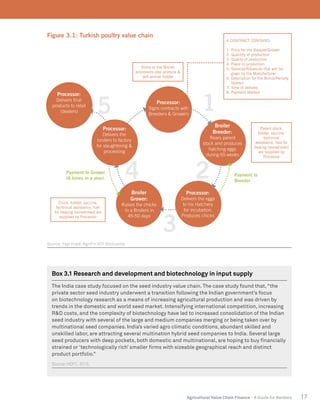
and supply it.This is the case in the Turkish poultry
value chain, which is typical of many poultry value
chains (Figure 3.1).The processor enters into formal
agreements with breeders and growers.The breeder
produces hatching eggs for the processor. In this portion
of the value chain, the breeder is the input supplier.The
transaction is commercial, i.e. the processor pays the
breeder for the hatching eggs. In the next stage in the
value chain, the processor will supply the inputs – day-
old chicks – to the grower, as well as other inputs, such
as vaccine and feed.The grower will deliver the grown
chick – a broiler – to the processor in 45 to 50 days.
The supply of inputs may itself be a context specific
value chain, especially when it involves research and
development (R&D), and biotechnology.The India case
study is a good example of this evolution (Box 3.1).
17Agricultural Value Chain Finance - A Guide for Bankers
Figure 3.1: Turkish poultry value chain
Source: Yapi Kredi. AgriFin VCF Bootcamp.
Box 3.1 Research and development and biotechnology in input supply
The India case study focused on the seed industry value chain. The case study found that,“the
private sector seed industry underwent a transition following the Indian government’s focus
on biotechnology research as a means of increasing agricultural production and was driven by
trends in the domestic and world seed market. Intensifying international competition, increasing
R&D costs, and the complexity of biotechnology have led to increased consolidation of the Indian
seed industry with several of the large and medium companies merging or being taken over by
multinational seed companies. India’s varied agro climatic conditions, abundant skilled and
unskilled labor, are attracting several multination hybrid seed companies to India. Several large
seed producers with deep pockets, both domestic and multinational, are hoping to buy financially
strained or ‘technologically rich’ smaller firms with sizeable geographical reach and distinct
product portfolio.”
Source:HDFC. 2015.
15
24
3
Processor:
Signs contracts with
Breeders & Growers
Broiler
Breeder:
Rears parent
stock and produces
hatching eggs
during 65 weeks
Processor:
Delivers the
broilers to factory
for slaughtering &
processing
Processor:
Delivers the eggs
to his Hatchery
for incubation.
Produces chicks
Broiler
Grower:
Raises the chicks
to a Broilers in
45-50 days
Processor:
Delivers final
products to retail
(dealers)
Payment to
Breeder
Payment to Grower
(6 times in a year)
Chick, fodder, vaccine,
technical assistance, fuel
for heating (sometimes) are
supplied by Processor
Parent stock,
fodder, vaccine,
technical
assistance, fuel for
heating (sometimes)
are supplied by
Processor
Some of the Broiler
processors also produce &
sell animal fodder
A CONTRACT CONTAINS:
1.	Price for the Breeder/Grower
2.	Quantity of production
3.	Quality of production
4.	Place of production
5.	Services/Advances that will be
given by the Manufacturer
6.	Description for the Bonus/Penalty
System
7.	Time of delivery
8.	Payment Method
18 Agricultural Value Chain Finance - A Guide for Bankers
Producers. At the producers’ level, mapping involves
developing an understanding of their operations, and
the first-level marketing structure, i.e., the producers’
relationship with the immediate purchaser(s) of their
products. Optimally, this would include collecting
information on farm size, average production, yields,
yearly production variations, production costs, and
prices received. Existing relations with input suppliers
and aggregators should be identified, including both
formal and informal arrangements, particularly if
they impact the prices farmers receive. Given that
the agricultural industry operates in an information
economy, it is also important to identify market and
technology information flows.The results of the
mapping exercise should allow the financial institution
to estimate the changes in costs and returns that may
be possible with improved access to formal credit.
Additionally, due to the extent of governmental support
to agriculture in many countries, it is important to
identify the types of support to producers in the value
chain, including impacts and limitations.
Markets throughout the developing world tend to be
characterized by large numbers of small producers.
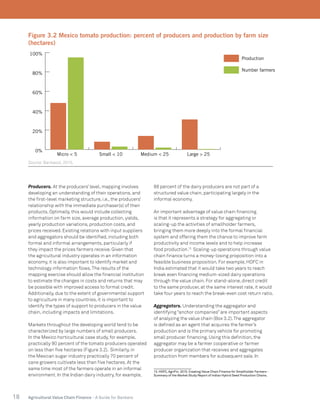
In the Mexico horticultural case study, for example,
practically 90 percent of the tomato producers operated
on less than five hectares (Figure 3.2). Similarly, in
the Mexican sugar industry practically 70 percent of
cane growers cultivate less than five hectares. At the
same time most of the farmers operate in an informal
environment. In the Indian dairy industry, for example,
88 percent of the dairy producers are not part of a
structured value chain, participating largely in the
informal economy.
An important advantage of value chain financing
is that it represents a strategy for aggregating or
scaling-up the activities of smallholder farmers,
bringing them more deeply into the formal financial
system and offering them the chance to improve farm
productivity and income levels and to help increase
food production.13
Scaling-up operations through value
chain finance turns a money-losing proposition into a
feasible business proposition. For example, HDFC in
India estimated that it would take two years to reach
break even financing medium-sized dairy operations
through the value chain. For stand-alone, direct credit
to the same producer, at the same interest rate, it would
take four years to reach the break-even cost return ratio.
Aggregators. Understanding the aggregator and
identifying “anchor companies” are important aspects
of analyzing the value chain (Box 3.2).The aggregator
is defined as an agent that acquires the farmer’s
production and is the primary vehicle for promoting
small producer financing. Using this definition, the
aggregator may be a farmer cooperative or farmer
producer organization that receives and aggregates
production from members for subsequent sale. In
13. HDFC, AgriFin. 2015. Creating Value Chain Finance for Smallholder Farmers -
Summary of the Market Study Report of Indian Hybrid Seed Production Chains.
0%
20%
40%
60%
80%
100%
Number farmers
Production
Large > 25Medium < 25Small < 10Micro < 5
Figure 3.2 Mexico tomato production: percent of producers and production by farm size
(hectares)
Source:Bankaool, 2015.
19Agricultural Value Chain Finance - A Guide for Bankers
this case, the aggregator takes possession but not
ownership.The aggregator may be a distributor/
trader or processor that will turn around and sell the
production to another buyer or aggregator.The number
of aggregators in the market may be significant.The
Pakistan case study identified the number of milk
collectors at an estimated 300,000 agents, sometimes
collecting as little as a bucket full of milk.
Alternatively, farmers may be the final seller, as is the
case in Mexico’s vegetable industry where retailers
have established direct relationships with producers
for delivery of their production. On the other hand, it is
frequently the case that producers are “represented”
by aggregators with regard to other downstream
participants or a financial institution.The aggregator
may be a company operating in the domestic market, or
perhaps even in a foreign market.
The relationship between the aggregator and the
producer plays an integral part in defining the risk
profile for value chain financing. Ultimately, the
producer’s ability to repay a loan will, of course, depend
on payment from the aggregator.The aggregator
conversely depends on producers honoring their
commitments to deliver their production. In many
developing country markets, transactions are based on
informal agreements.This was identified in the Pakistan
case study on the dairy industry, which is characterized
by unwritten, year-long agreements.The quality of the
milk is based on trust, rather than laboratory analysis,
with payments made on a monthly basis. Similarly, in
the Mexican vegetable industry, trust based on long-
term relationships is the operating norm since cross-
border financing is used for harvesting and packing.14
In the India seed case study, the relationship is
somewhat more complicated as seed companies
depend on seed production organizers (SPO).The SPOs
provide several services, including farmer selection,
seed production management on behalf of the seed
company, and technical and financial support to the
farmers.The seed production process and the success
of crops are heavily dependent on the technical inputs
provided by the company and the organizer, as well as
the financial assistance provided at the appropriate
time.The SPO was found to be a nerve center in the
value chain.The majority of payments made by the
company to farmers are routed through the SPO, which
often also fulfilled the role of a moneylender.The SPO is
generally a local villager who is financially stable. From
a banker’s perspective, this is a relatively safe avenue
for extending collateral-based agriculture credit, as
the SPO is usually a landowner with diversified sources
of income.The nature of the transactions between the
SPOs and the seed farmers depend largely on informal
relationships. With multinational seed companies,
transactions are based on formal contracts whereas
these are scarcer when considering regional and
national Indian companies.
14. HBL/AgriFin. Structure and Performance of the Dairy Value Chain in Pakistan.
Implications for Value Chain Finance. Draft June 2015.
Box 3.2. What defines an anchor company?
What makes a firm an “anchor company” in a value chain? Anchor companies are the prominent
companies in the value chain that drive the volume of production and value-added products.
The value chain mapping should seek to highlight prominent companies in the value chain by a
number of criteria:
1.	 Market share in final product
2.	 Market share in critical intermediate outputs
3.	 Number of suppliers as a proportion of total producers
4.	 Stability of supplier relationships (e.g., percent of repeat suppliers each season)
5.	 Financial performance and credit rating
Where there are several companies active in the area in which the bank operates, the mapping
exercise should build a score for each company using all five criteria, to facilitate comparisons
and to define negotiating approaches as needed. In the extreme case in which there is only one
anchor firm present in the bank’s field of operations, the criteria addressing stability of supply
and financial performance/credit rating should be the key determinants of whether to engage in a
formal partnership with the anchor firm.
20 Agricultural Value Chain Finance - A Guide for Bankers
Where the aggregator is an intermediary or trader, the
credit risk exists not only between the producer and
the aggregator but also between the aggregator and
the client. In fact, the weak point in the value chain may
actually lay in the transactions between the aggregator
and its client.This is often overlooked in credit analysis,
and when mapping the relationships in the value chain.
It is the aggregator that often performs the role as the
anchor company.That is, they represent the point of
contact, or entry point, between the financial institution
and the value chain in general and, in particular, the
farmers.Typically, the aggregator/anchor company or
farmer organization has a preexisting relationship with
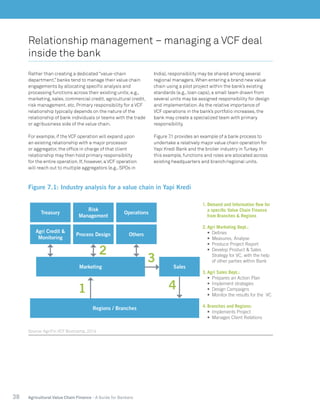
the financial institution, which can be leveraged through
a value chain financing strategy.This is of particular
importance since the ongoing financial relationship
helps to validate, at least partially, the financial viability
of the value chain. At the same time, the aggregator can
undertake the role of a financial agent for the financial
institution and/or even provide a first loss guarantee
(i.e., a secondary source of repayment), thereby partially
sharing the risk involved in the financial operation.
End-market participants. A common mistake by financial
institutions is to make a credit decision solely on the
basis of production and productivity. An important part of
reducing risk is that the mapping of the value chain should
identify the participants and the role they play as well as
what is happening at the consumer level.This is especially
important when the market is situated partially or entirely
outside the country.In the Mexico case study,for example,
it is estimated that 45 percent of 2013 production was
exported,up from 34 percent in 2000.Greenhouse
production was a significant contributor to this growth,
as the area in greenhouse production went from
approximately 9,000 hectares to 30,000 hectares over the
same period.A key driver for the growth in greenhouse
area was an increase in consumer demand and premium
prices for greenhouse produce in the U.S.market (which
receives 90 percent of Mexico’s vegetable exports).
The agri-food system has evolved from being production-
oriented to one that is demand-focused.In the Mexican
vegetable industry,for example,it is estimated that
supermarkets account for 27 percent of the vegetables
purchased by consumers.With the supermarket segment
dominated by a relatively small number of retailers,
this suggests that only a few retailers control almost a
quarter of the Mexican domestic vegetable market.
The consumer market for food is rapidly changing,
reflecting a greater focus on health and concerns about
the impact of food production on the environment.
Accordingly,profitability and credit risk hinge to far
greater extent on the ability to meet changing market
tastes and demands.For example,another factor
stimulating the growth of greenhouse production in
Mexico is its ability to ensure the quality (i.e.,food safety)
of produce.In the Turkish poultry industry,market
demands directly influence the decision by the processor
as to which breed of chickens to provide to the grower.
Changes in the agri-food system has shifted power to
those participants in the value chain that are closest
to the final consumer. At the same time, many markets
have seen consolidation at the retail, trader, and food
service levels, further enhancing their power in the
value chain. As highlighted above, retailers (particularly
large retailers) will buy directly from producers to
ensure that they have products that meet consumer
demand. However, even when retailers buy directly from
producers they will not typically provide financing or
technical support. Instead, they often set standards
that must be met for the products that they purchase.
In the Mexican vegetable industry, where technical
support and financing from retailers is uncommon,
large retailers have begun to provide contracts to large
suppliers. Notably, this type of arrangement has been
limited to cross-border transactions between U.S.
retailers and Mexican export producers.
Financial flows – intra- and extra-value chain
transactions
Mapping of the value chain not only focuses on the
participants and the product flow but also on the
sources of financing inside and outside the value chain.
As indicated, formal bank financing for smallholder
farmers is frequently absent. In some cases, it is the
input supplier or the aggregator that supplies credit to
these producers, while local moneylenders are often
the main source of financing. Mapping the financial
flows, while pairing them with the product flows and
participants in the value chain, represents an important
tool for recognizing risks and identifying potential entry
points for financial institutions.
21Agricultural Value Chain Finance - A Guide for Bankers
During the field research associated with the value
chain mapping, creating a profile (however approximate)
of financial flows for each main participant in the value
chain is crucial to understanding the potential demand
for financial products a bank may be able to offer.These
profiles could be based on field surveys of a sample of
participants, as was done in India for the seed value
chain, or on key-informant interviews, which were used
in Pakistan and Mexico.
The weak links. As indicated throughout this chapter,
mapping the value chain provides important insights
into the risk points or weak links within an industry. The
mapping not only looks at the relationship between the
participants but the numbers of participants and their
impact on the business proposition of the value chain.
For example, an important criterion in successful value
chain financing is the ability to dilute risk. As such, when
working with an aggregator the number of farmers must
be large enough so that non-repayment by a single
or even a small number of farmers will not seriously
damage the quality of the transaction.
Besides the nature of the transactions between
the aggregator and its clients, the other areas of
vulnerability are extra-value chain transactions in which
the supplier fails to sell or deliver the product to the
aggregator (known as side selling).This is a risk to the
aggregators with clear implications for the recuperation
of credit. In some cases, this risk can be addressed
by having no other aggregators in the operating area
and/or the setting of extremely high transportation
costs, resulting in a cash loss to the producer. Supply
contracts are not a particularly attractive option given
the costs involved in establishing a large quantity of
contracts with many small farmers who are outside the
formal market system. Informal agreements among
aggregators to respect the each other’s suppliers in
the Mexican vegetable industry have been reported.
However, since these agreements are informal, and
might be considered to be collusive, they are hardly
enforceable. Once again, the quality and understanding
of the relationship between the aggregator and the
supplier becomes crucial for compliance and risk
mitigation.
Risks across the value chain
The final piece in the mapping process involves identifying
the risks inherent in the value chain and understanding
their implications for the financial institution’s value chain
business opportunities.Among the more important risk
categories that financial institutions should consider
for selection of the target value chain,in addition to the
political and structural risks discussed above,are:1)
production-level risks;2) side-selling risk 3) aggregator
risks;4) downstream market-level risks;5) client-level
risks;and (6) reputation risks.15
Primary production level risks. Production-related
risks include changes in both expected output and
product prices.They typically stem from weather
effects, disease or insects, food safety scares or
changes in the international market environment. Many
of these can be mitigated through risk management
products, such as crop insurance. Understanding
what steps a producer can take to mitigate price risk
is important in selecting a value chain. Sophisticated
instruments, such as derivatives, are usually beyond the
reach of smallholder farmers (or most farmers, for that
matter) but may be an option for large aggregators or
processors downstream.
15. Standard credit risk assessment may also be modified when dealing with VCF
lending. See Chapter 6.
Side-selling risks. Side selling, in which suppliers fail
to honor delivery commitments to the aggregator or the
processor and therefore imperil loan repayment, is a
significant risk.To the extent that there is a high level of
competition (a large number of buyers), the risk of side
selling increases. Given that formal contracts might
not exist or might be unenforceable, past experience
or track record with regard to honoring delivery
commitments provides an indication of the extent of
financial risk. Hence, gathering existing information on
past transactions in a manageable, useable way is of
high value for the stability of the value chain finance
relationship.
Aggregator risk. While primary production risks and
producer creditworthiness are important, the weakest
link in value chain finance may in fact be the aggregator.
The financial institution’s business model and the
aggregator’s primary interest and standard operating
procedures should be aligned with the market. Similarly,
when the aggregator has a commitment to provide
inputs to producers, risks include not only failure to
deliver but also delayed delivery.This is particularly
important given that delayed delivery of inputs may
result, for example, in extemporaneous planting by
farmers, impacting negatively on productivity. Similarly,
there is the risk that the aggregator may not comply
22 Agricultural Value Chain Finance - A Guide for Bankers
with the agreement to acquire farm production in its
entirety or in the agreed-upon proportion. At the same
time, delay in payment to producers increases the
financial risk, particularly when unsecured credit is
provided to producers. When the aggregator assumes a
commitment in the credit delivery or recovery process,
credit risk relies to a large extent upon aggregator
performance.
Downstream market-level risk.There are three types of
downstream market risks:compliance risk;competitive
risk;and management risk.Many of the risks that exist
between aggregators and producers also arise as the
aggregator sells or moves product downstream,be it
processed or not.These include payment and contract
compliance,among others.In fact,the true risk in the
value chain may reside with the aggregator’s buyer.
The second source of risk has to do with competition
in the market.The more sellers there are,the greater
the competition and,subsequently,the greater the
market risk related to the specific aggregator.Similarly,
the existence of imports and/or similar-type products
impacts the competitive environment.Finally,there is
the ability of the participants to deal with market-related
developments.For example,market risk is heightened
where there is a marked seasonality of production and/or
demand.Here,effective inventory management becomes
important in controlling market risk.
Systemic risk/systemic default. Most value chains
are by nature subject to covariance risks, usually
associated with weather phenomena, or pests/diseases
(e.g., coffee rust in Latin America) that affect the chain’s
base commodity. Market developments, such as price
fluctuations may also create conditions for widespread/
systemic failures that will result in systemic default.
A common related aggravating factor is government
intervention through debt relief or forgiveness,
which, while alleviating the effects for farmers,
makes the effects on financial service providers even
more significant. An obvious mitigation for weather
related systemic risk (drought, floods) is geographic
diversification. Indeed, the two partner banks that had
already selected a value chain had used geographic
diversification of hybrid seed production (HDFC, India)
and dairy production (HBL, Pakistan) as a risk-reducing
criterion. Portfolio diversification and specific-crops
lending caps are commonly used for the coffee-rust
type risk, where disease damage occurs across different
geographies. Price-related systemic default is usually
more predictable, and its mitigation can take advantage
of hedging and insurance instruments (if available), in
addition to diversification to other value chains.
Client-level risks. At the client level (e.g., large
aggregator or processor), typically the financial
institution looks at the client’s financial situation,
concentrating on cash flow criteria.These include:
•	 Liquidity, which shows how the amount of assets
that can be converted into cash compares to
payables within the year, with a minimum ratio of 1;
•	 Leverage of cash flow, which considers how debt
(bank, supplier, or land) compares to sales and to
operating cash flow (using a conservative scenario of
a maximum of 60 percent of net sales and debt less
than three-times earnings before interest, taxes,
depreciation, and amortization);
•	 Payment capacity, which evaluates the relationship
between expected operating cash compared to debt
service (interest plus installments), with a minimum
of 1:2;
•	 Solvency, which reveals how total debt compares
to total assets, looking for a maximum ratio of 40
percent. At the client level, the financial institution
often fails to look at the adequacy of the financial
operations.
Reputation risks. Reputation risk in value chain finance
may emerge in different ways. If, for example, a bank
is financing an aggregator who in turn exercises bad
practices with the upstream customers (farmers), the
bank will get negative publicity and, possibly, regulatory
attention. As such, due diligence by the bank on the
different partners it may have in the value chain is
important. If, for example, the bank is extending non-
lending services to value chain customers, compliance
with “know your client” requirements – even for small
farmers – will be important to protect the bank’s
reputation.
23Agricultural Value Chain Finance - A Guide for Bankers
Organizational structure
The organization of the value chain provides an
indication of where the financial institution should
place its emphasis in developing products for
value chain products.There are essentially four
organizational structures for value chains, each with
its own rationale, opportunities and risks.These
organizational structures are summarized in Table 4.1
in order of significance as entry points for financial
institutions. A comprehensive description is included
in Annex C.
4.
ENTRY POINTS
FOR FINANCIAL
INSTITUTIONS
	 How are value chains organized?
	 How can financial products be designed according to the value chain structures?
	 What can flows of finance and product in the value chain tell us about potential
financing opportunities and risk mitigation?
	 Financial institutions evaluating entry points into a value chain should consider: 1) the
organizational structure of the value chain; 2) financial flows with the associated risks; and
3) key players, lead firms.
	 When looking at an entry point, there are important considerations beyond financial
performance when determining the key participants. Financial institutions should look for
leaders in the field and participants with positive relations with other actors in the chain,
especially producers.
24 Agricultural Value Chain Finance - A Guide for Bankers
Value chain
type Main features
Key factors for banks to
consider in assessment of
potential partners
Leading firm-
coordinated
value chains
Value chains where there is one firm or only few companies
downstream that constitute the “ultimate buyer” or “super
aggregator.” Typical examples of lead firms are found in industrial
crops such as sugar cane, cotton, palm oil, and breweries. Lead
companies tend to be retailers, large processors, and export-
oriented food businesses. Perhaps the best examples of anchor or
lead firms are found in the broiler industry (see Annex C).
•	 Strength, organizational and
financial
•	 Strength, reliability of
upstream contracts (with
aggregators, with producers,
if applicable)
•	 Solvency and reliability of
aggregators involved
Value chains
centered on
aggregators
This value chain structure is centered on buyers of agricultural
products. They may be: a) local traders who will bundle products
for onward sale into the domestic market; b) commodity traders,
which can either be local or multinational firms, that intend to
sell primarily into the export markets; c) processors who require
farmer production as a key input; d) wholesalers who specialize
in the product or rely upon the product for a significant portion of
their product mix; or e) retailers who have special needs for the
product.
•	 Information aggregators
hold about producers
•	 Ability of aggregators
to share in lending
administration costs
•	 Solvency and reliability of
aggregators
Value chains
centered around
producer
organizations
Value chains developed around farmer-based organizations (FBOs)
established with the purpose of marketing members’ production,
among other objectives. The marketing objective is generally to
obtain higher prices for their members through joint selling and/
or coordinating market access. In terms of legal status, these
organizations may be farmer cooperatives or (registered) producer
associations.
•	 Information FBOs manage
about producers
•	 Ability of FBOs to share in
lending administration costs
•	 Solvency and reliability of
FBOs
•	 Governance and
management of FBOs
Value chains
driven by
outside
“facilitator”
organizations
Where there is a concern for rural development, financial
inclusion, or other social and policy objectives, governments
as well as non-governmental organizations will facilitate the
organization of value chains as part of a strategy used in achieving
these objectives.
•	 Ability of facilitator to
provide credit guarantees
•	 Exit strategy of facilitator
Table 4.1 Value chain organizational structures
Examples and lessons from the case studies
As mentioned earlier, within an industry there may
be more than one value chain, defined as a path from
producer to consumer. Frequently, small farmers
operate in a value chain in ways that differ from
large producers. Similarly, there may be different
organizational structures of the same value chain
across different regions in the same country;or the
organizational structure may be influenced by the
nature of the end market. In the Mexico horticulture
study, for example, large producers in the country’s
northwest that are focused on the export market are
organized in a “leading firm-coordinated value chain”.
In fact, in a number of cases the largest producers
frequently are the leading firm. Produce is typically
sold through a contract or on consignment. Production
financing is sourced through commercial banks,
supplemented by financing from wholesalers for use
in harvesting and packing. In some cases, the producer
has become integrated downstream, assuming the
role of wholesaler to serve the U.S. market. In contrast,
Mexican small farms producing for the domestic market
operate in a value chain centered on aggregators, and
financing largely comes from local moneylenders.
Farmers will generally sell to local collectors, who
will take the produce to a wholesale market.The local
collectors tend to be small business operators;they
often do not provide financing, and will pay producers
only after they sell the produce.
The Pakistan dairy study identifies a large number
of paths to market within the overall value chain,
beginning with the relationship between milk collectors
and small producers. Approximately 90 percent of the
marketed milk in the country is channeled through milk
25Agricultural Value Chain Finance - A Guide for Bankers
collectors.The smaller collectors will buy from a small
number of producers, pool the milk, transport it and sell
it either to consumers directly or to larger collectors.
Typically, the collector will enter into an arrangement
with the producer on a yearly basis, buying the milk on
an agreed price per liter with payments made at the
end of a month’s delivery. Side selling is not considered
a serious risk, since this arrangement is based on a
strong relationship between producer and collector.
When producers sell to a different collector it is when
the collector’s operations are temporarily disrupted or
inadequate. At times, large dairy stores (open milk-
selling shops) will operate as a collector for their own
use. An alternate value chain exists that is organized by
leading firms through collection centers.Typically, large
producers will deliver their own milk to the collection
centers, which will also purchase milk from local
collectors.
Of the three case studies, the Indian hybrid seed value
chain, which is organized around leading companies
is the tightest. In this case, the anchor companies are
national and multinational seed companies.Their
central role in the value chain is the result of the
regulatory environment and their development and
control of seed variety-specific technology.They do not
deal directly with the producers of their hybrid seeds;
rather they depend on seed producer organizers (SPO)
that may be considered the nerve centers in the value
chain.The SPO – essentially a major aggregator – is
generally a local villager who is financially stable.The
SPO selects the producers and provides both technical
and financial assistance to farmers and most often
fulfills the role of a moneylender. Most companies do
not give direct financial support to farmers. Payments
made by the company to farmers in most cases are
routed through the SPO, including advance payments
by seed companies. A small number of the companies
will provide financial support to farmers at the time of
sowing and cross-pollination, but many do not offer
any such assistance. A formal contract exists between
the SPO and the multinational seed companies, which
is not always the case with the SPO and regional seed
companies.
Financial flows and associated risks
In contrast to product flows, which move from upstream
(primary producers) to downstream (processors and
consumers), financing flows within the value chain
move in both directions (Figure 4.1).The magnitude
and direction of these flows are important factors
in determining a suitable entry point for a financial
institution.
Financial flows from downstream participants within
the value chain typically finance primary production.
It is much less common for downstream participants
to provide financing to intermediaries, unless there is
a formal agreement for them to operate as purchasing
agents. Likewise, downstream participants rarely
finance non-corporate affiliate processing companies.
This, of course, opens opportunities for financial
institutions to enter into the value chain through
products such as bonded warehouse financing.
In many cases, payment to farmers is not made at the
time they deliver their production. Rather they are paid
after the aggregator sells the product. In the more
formally structured value chains, such as with Mexico’s
horticulture exporters, the packer (leading firm) will
sell to national and international retailers on credit.
The duration of this type of financial flow is usually
the number of days between delivery of the product
and payment, although it can be as long as 90 days
or more.16
This creates additional opportunities for
financial institutions to enter the value chain by offering
factoring products.
In the value chains where the focus is on financing
producers, the basic model has the financial institution
working with the aggregator to supply credit to
producers. When the producer sells the product, the
aggregator retains a portion for loan repayment, which
is sent to the financial institution.
A common entry point for a bank is its relationship with
one or more (usually only a few) aggregators.The major
variation of the basic financial flow relates to the role
of the aggregator.The aggregator sometimes acts as
a commercial or bank agent.This involves identifying
those producers that are acceptable credit risks.The
selection is made in accordance with the financial
institution’s policy. While the aggregator acting as the
bank agent identifies the creditworthy farmers, the final
decision is made by the financial institution.The two
16. A variation of this form of seller financing takes place within the Mexican
vegetable industry. The producer will deliver the produce on consignment to the
wholesaler/broker. The wholesaler, in turn, will pay the producer upon sale of the
product. While technically the producer is not financing the wholesaler/broker
(who, in fact, has taken delivery of the produce), for all practical purposes this is a
form of producer providing financing.
26 Agricultural Value Chain Finance - A Guide for Bankers
banks financing sugar producers in Mexico (Bankaool
and Finterra) rely on a pre-established list of criteria
to make the final decision. Among the criteria is size of
operation, credit history, and average yields.
A similar scheme for financing dairy producers existed
in Pakistan.The country’s largest public bank providing
agricultural credit entered into a strategic partnership
with a major aggregator, Nestlé, to provide credit to
dairy farmers.The farmers in Pakistan were identified
by Nestlé, while the lending instructions and guidelines
were provided by the State Bank of Pakistan, an
approach that stands in contrast with the Mexico case.
When functioning as a commission agent,
the aggregator will also collect the necessary
documentation, which is usually forwarded to the
financial institution.This reflects bank policy as well
as regulatory requirements.The financial institution
will typically pay the aggregator for performing these
services.The payment typically is not a fixed amount,
but rather is set according to the financial institution’s
perception of the aggregator and the quality and
amount of work required.
The aggregator sometimes will provide a guarantee (a
first-loss guarantee) to the financial institution.The
size of the first-loss guarantee is negotiated and set
according to the financial institution’s assessment of
the aggregator and an appreciation of the risk.This
negotiation is usually part of a broader agreement
between the bank and the aggregator that includes the
loan terms and the commission for administering the
lending to producers (see Chapter 6). In the cases from
Mexico and Pakistan, government programs provided
additional guarantees. In Mexico, financial institutions
are able to rediscount loans through a government trust
fund.
Occasionally, the aggregator acting as a commercial
agent will deliver the financing to the producers. In the
Indian seed value chain, the collectors provide technical
assistance in addition to dispersing financing sourced
from the seed companies.
Figure 4.1: Financial flows within the value chain
Source:AgriFin VCF Bootcamp, 2014.
Financial
Products
Working capital Production &
Consumption loans
Working capital
Warehouse finance
Working capital
Equipment finance
& leasing Factoring
Factoring
Warehouse
financing
Equipment leasing
Risk Medium High Medium Low Low
Need Medium High High Medium Medium
Type Formal Informal Informal Formal/contract Formal/contract
Input supply
Agricultural
production
Trading &
logistics
Processing
Distribution &
Retailing
Financial flows: production, working capital, leasing, etc.
Financial flows: credit sales, factoring
Food & Ag Product flows
27Agricultural Value Chain Finance - A Guide for Bankers
Key players
A common strategy for financial institutions is to enter
a value chain business through a key player or lead/
anchor company in the value chain.Three criteria are
commonly used by financial institutions to select the
leading player:
Strong financial performance. Staying power
and financial responsibility provide an element
of confidence, indicating that the leading player
understands and successfully manages its role in the
market and meets its financial commitments. Sound
financial performance also suggests that the leading
player is adept at managing risks within the agri-food
system.This takes on added importance when the
leading player assumes the role of credit distributer, or
provides a guarantee, such as a first-loss guarantee.
Leading role in the value chain. The food and
agricultural markets are dynamic. New technologies,
policy adjustments, consolidation and changing
consumer preferences, among others, drive their
evolution. Leading players are able to recognize
changes, adjust their business model, and transmit
these changes to other participants in the value chain,
bolstering the value chain’s sustainability.
Close to producers. As pointed out above, demand
for credit is generally strongest at the producer level.
Working with a leading player that is close to producers
is positive for financial institutions and makes the
greatest use of information available. Being close to
producers suggests more than merely performing as
an aggregator;it implies deep understanding of the
production process and strong relationships based on
trust with producers.
All three criteria where evident among the
characteristics of key players in the case studies of
various value chains. In the Indian hybrid seed value
chain, the SPOs are generally local villagers who are
financially stable and many have a degree in agriculture.
In the Pakistan case, the collectors as a whole are
responsible for 90 percent of the marketed milk in the
country. Collectors, however, vary in scale and market
coverage, from small-scale collectors (known locally as
“khatcha doddis”) carrying milk cans on motorcycles and
collecting from small producers, to large trucks serving
sizeable dairy farmers.They are also close to producers,
with commercial dealings based on strong relationships
with the farmers. In Mexico, the sugar cane value chain
is structured around the sugar mills.The banks only
work with those mills that are financially sound.The
banks are able to leverage the mills’ relationships with
the growers, who number in the hundreds for every mill.
In the case studies, the primary entry point was a
leading firm, or a small number of large aggregators.
The initial financial product in the case studies was
credit to farmers, based on a strategy using aggregators
or key players to reduce risks as well as lower delivery
costs.Value chain finance, however, is a holistic and
encompassing framework touching on all the links in
the chain of activities, from the primary producer to the
consumer. What this implies is that credit to farmers is
not the only product that can be offered to value chain
participants (Figure 4.2). Similarly, a number of financial
institutions that have been studied have indicated that
they plan to leverage interest in their loan products to
eventually offer additional tailored finance products,
further incorporating farmers into the formal credit
market. For example, some banks, like HDFC Bank in
India, started by offering dairy processors a payment
platform to facilitate payments to their suppliers.
This involved setting up deposit accounts with several
thousand dairy producers and linking the accounts
to the processor’s payment platform. Over time, with
a better understanding of how the dairy value chain
functioned and the behaviors of the milk collectors and
producers, HDFC was able to offer cow loans, first loss
guarantees, and insurance products. The following
chapter covers value chain financial products in detail.
28 Agricultural Value Chain Finance - A Guide for Bankers
Figure 4.2: Cross-selling and tailoring products to the value chain
Source:AgriFin VCF Bootcamp, 2014.
15
24
3
Processor:
Signs contracts with
Breeder & Grower
Broiler
Breeder:
Rears parent
stock and produces
hatching eggs
during 65 weeks
Processor:
Deliver the
broiler to factory
for slaughtering &
processing
Processor:
Deliver the egg
to his Hatchery
for incubation.
Produces chick
Broiler
Grower:
Raise the chick to
a Broiler in 45-50
days
Dealer:
Sell the final
product in retail
Payment to
Breeder
Payment to Grower
(6 times in a year)
•	 Bank loan for the rest of
inputs of breeders
•	 Submits «assignment of
receivables» to the Bank
(as a collateral)
•	 Can give his henhouses
as a mortgage, if he wants
investment loan
Bank products for dealers (DDS,
L/G, POS, Chequebook)
Payments done by Bank
Agri Card for his fodder
business
•	 Loan for inputs of growers/breeders
•	 Guarantee to pay broilers from the Bank
•	 Guarantee to confirm the assignment of
claims of the Farmer
•	 Payroll from the Bank
•	 L/C if any import exists
•	 Loan for the
rest of inputs
•	 Submits
«assignment of
receivables» to
the Bank (as a
collateral)
•	 Can present
henhouses
as mortgage,
if he wants
investment loan
29Agricultural Value Chain Finance - A Guide for Bankers
5.
VALUE CHAIN
FINANCIAL
PRODUCTS
	 What differentiates value chain financial products?
	 When should value chain products be used?
	 The value chain financing model reflects the increasingly complex agribusiness market,
encompassing financial products that respond to client needs, the operational environment,
and the evolution of the value chain.
	­Value chain products can be grouped into five different categories, each responding to
the particular needs of the client and the value chain: 1) product-linked financing; 2)
receivables financing; 3) physical asset collateralization; 4) risk mitigation products; and 5)
structured financing.
	 The applicability and attractiveness of these products will depend on the operating
environment and legal systems, particularly contract enforcement, in which both the
financial institutions and value chain clients operate.
Figure 5.1: Value chain finance products
Source:Miller and Jones, 2010.
Off-Taker
Processor
Wholesaler/Retailer
Financial Institution
Farmer
Equipment
Purchase
Contract
Factoring
Warehouse
Receipt
Financing
Production Credit
Lease
Contract
Transfer of
Lease Payments
Long-term (raw materials) supply contract
30 Agricultural Value Chain Finance - A Guide for Bankers
Once established, the value chain relationship gives
the bank opportunities to extend conventional loan
products and services to all parties in the chain. Most
of the financial products outlined here are familiar
to bankers, and so require only a brief description.
The emphasis is on their relevance to a value chain
financing approach (Figure 5.1). A more extensive
description of each product is included in Annex C.
Product-linked financing
These are products that directly relate to financing
production as well as the aggregator and processing
or marketing company for the purpose of acquiring
farmer’s production.In this case,the aggregator uses
financing or advance payments to producers as a way to
secure product.Essentially,this works to deleverage the
aggregator’s supply risk.This can allow the aggregator to
guarantee or even formally contract downstream sales.
Banks should structure the financial product to attract
a significant number of farmers, ensuring it can defray
repayment risk by limiting the potential impact from
a default of individual or small groups of producers.
Further, the smaller the value chain (in terms of number
of farmer participants), the more bank oversight is
required. By working with an aggregator (also referred
within the industry to as an aggregator/off-taker),
financial institutions are able to penetrate further
upstream in the value chain to offer financial services
to smallholder farmers.The commercial relationship
between the off-taker/aggregator varies according to
the financial institution’s objectives and the structure
of the value chain. In the Indian dairy and Mexican
sugar cases, the aggregator also assumed the role
of the bank’s agent. In the Mexican case, the credit is
documented with the individual farmer.The sugar mill
(the aggregator in this case), undertakes a number
of operational functions (i.e. identifying the farmer,
preparing the documentation, and
supervision). For this, the financial institution pays the
mill a commission for their involvement.Through this
arrangement, the financial institution has turned what
would have been a fixed cost structure into a variable
cost structure.
Receivables financing
These products are largely used as a means for
providing working capital to aggregators, marketing
companies, and processors.They include bill
discounting, factoring, and forfaiting (the purchase of
receivables from an exporter, for a margin). Although
all three products revolve around the conversion of
receivables, they differ in their method of managing
risk and collection payments. Receivables can also
be structured as collateral. In a well-established VCF
operation, farmers should be able to benefit from this
form of financing to the extent that their contracts with
aggregators are recognized as equally enforceable as
with receivables further downstream.
Physical asset collateralization
These financial products rely on a physical asset as a
guarantee or collateral.The two most common products,
warehouse receipts and repurchase agreements, are
used largely for working capital. Financial leasing, by
contrast, involves the use of an asset over a fixed period
of time, after which the client may or may not eventually
take ownership.
As with the other value chain products, the legal system
has to recognize the rights and obligations inherent
in the control of the assets as a precondition for the
development and use of these products. Additionally,
there should be a known market for pricing the assets
(mark-to-market), as well as a fairly liquid resale market
for the assets. For agricultural commodities and foods,
the markets should also reflect the types and grades
used commercially for the assets under control.
31Agricultural Value Chain Finance - A Guide for Bankers
Risk mitigation products
These are financial products used to reduce risk by
transferring it to a third party.This is achieved through
the use of insurance, futures, and forward contracts.
For the financial institution, risk mitigation products
are particularly attractive as they can be offered to
participants across the entire value chain.The role that
financial institutions play varies depending on both an
institution’s structure and the regulations in the country
in which it operates. As a result, financial institutions
may acquire the risk directly or through a subsidiary,
or alternatively sell part of the risk to a specialized
company or broker. In some instances or products, the
financial institution’s role will be limited to providing
financing for the operation.
Structured financing
These are specialized products that facilitate and
deepen financial availability, frequently involving third
parties outside the value chain. Of these products,
the most common for primary producers are loan
guarantees. In this case, a third party will provide a
guarantee to the lender, shifting the risk (partially or
wholly) from the primary producer to the third party.The
assumption is that the third party guarantor represents
less of a risk than that of the primary producer.The third
party will charge the producer a fee for the guarantee.
The producer is willing to pay the fee when it is required
in order for banks to grant them a loan. The option of
paying a fee is also attractive when this results in a
lower cost of credit.The third party can be a private firm
or even a government institution. In fact, governments
(e.g., Mexico) have used this as a policy instrument to
entice financial institutions to lend to agriculture.
Cross-selling
Cross-selling is the selling of more than one financial
product to an individual client, or, in the case of value
chain finance, to multiple value chain participants.
This should be an important part of a financial
institution’s business strategy, turning a potentially
attractive business into a highly valuable one.The
business strategy of value chain financing, as such,
is to focus on the entire value chain, identifying or
creating opportunities for selling multiple products that
satisfy the value chain’s financial needs, while further
enhancing the financial institution’s bottom line. Typical
products and services that banks cross sell include:
payroll and supplier payments, credit cards, short to
medium term loans, insurance, letters of credit.
32 Agricultural Value Chain Finance - A Guide for Bankers
The observed reluctance among banks to lend to
agriculture and especially to small farmers is based on
the perception that agriculture is a high-risk business,
and that smallholder farmers represent a high cost
per client, with small returns. Essentially, banks have
tended to avoid the majority of this market segment
because it is not seen as a viable business proposition.
When banks have financed small farmers, they often
rely on government programs to limit repayment risks
and reduce costs. Even these programs have had
limited success because they fail to address the banks’
fundamental structural concerns when building a
sustainable business model for financing agriculture. As
the HDFC Bank in India has commented:“Smallholder
farms require markets, credit, inputs, and advice to
improve productivity and income levels. Standalone
credit is not enough. Standalone credit to smallholder
farmers is not viable or sustainable.” 17
17. HDFC Bank. 2015. White Paper: Supply Chain Tool Kit, unpublished.
Value chain financing, however, represents a viable
alternative business model for financing agriculture.
By focusing on the entire value chain, it addresses
financial institutions’ basic concerns and redefines
the risk-return assumption. Chapter 3 addressed risk
factors across the value chain and these are revisited in
further detail here in order to explain how the financial
institution can manage those risks.The emphasis here
is upon those aspects that are particular to the value
chain approach, since most other factors in pricing
and risk management are well within the domain of
conventional commercial banking.
6.
RISK MANAGEMENT,
COSTS AND RETURNS
	 How does value chain financing impact risk?
	 What procedures should be in place for effective monitoring?
	 Partnering with aggregators or commission agents in value chain financing creates
opportunities for risk- and cost-sharing mechanisms in which banks and their partners can
negotiate mutually beneficial terms that would not be available in conventional lending.
	 Nonetheless, it is still important for financial institutions to perform due diligence and have
proper monitoring mechanisms.
	 When assessing the reliability of aggregators or commission agents, necessary attributes
include: (a) evidence of a process and capacity to manage the collection and distribution
functions within the chain; (b) access to accurate data and farmer profiles; and (c) stable
finances.
	 Financial institutions typically pay a commission to the aggregator that performs a number
of the credit process functions, including (but not limited to) identification of farmers for
credit, document processing, supervision, and payment retention.
33Agricultural Value Chain Finance - A Guide for Bankers
Risk management
The first step in risk management is the determination
that the financing is going to a creditworthy party within
the value chain.Three criteria are crucial in determining
creditworthiness:
•	 The first (referenced earlier) is that the lending
decision is based on how the borrower relates to the
sector or industry’s key success factors;
•	 The second is that the loan reflects value chain
participants’ business needs. Among the more
common purposes are:a) capacity expansion;b) crop
finance;c) support for growth of working capital;
d) equipment finance;e) inventory finance;and f)
to move transactions off the balance sheet. For
example, in the Pakistan study, the loan product
would be targeted to market-oriented farmers who
are eager to improve productivity through better
quality animals;
•	 The third factor that must be considered is cash
flow;in short, verification that the client will have the
ability to repay the financing.
If the loan product is improperly structured, the
probability of loan forfeiture increases. For agricultural
lending, the structure has to be designed in accordance
with seasonality and the crop or animal cycle.The
Pakistan credit project provides an example whereby
the calving cycle of livestock was deemed a crucial
factor for the success of the project and repayment
cycles were aligned with this cycle by starting the
project in the winter, rather than in summer.
A significant characteristic of value chain finance is
that banks work through an aggregator or commission
agent to finance large numbers of small farmers. In the
India hybrid seed case, the SPO (often working with up
to 500 small seed producers) played a key role in the
value chain, assisting in the farmer selection process
and providing seed production management on behalf
of the seed companies. In Mexico, financial institutions
collaborate with millers as commission agents who
deal with more than a thousand producers, and reach
large numbers of small growers.This mitigates the
risks and costs associated with financing individual
producers.The financial institution is able to build on
the aggregator’s knowledge of the farmers that are good
producers and those who are likely to be repayment
risks. When the aggregator provides a first loss
guarantee, risks are further mitigated.
Aggregator risk. Due to the importance of the
aggregator (particularly when it assumes the role of
commission agent or business correspondent), financial
institutions conduct thorough due diligence.There are a
number of criteria commonly used for selection:
	 Process Management. Evaluation of the systems
and the process that the aggregator/commission
agent has in place for interaction with farmers and
other downstream value chain participants.These
include both formal and informal interactions.
	 Credit management experience. Related to the
above, and given that the aggregator/commission
agent performs a number of the credit process
functions, it is important that the company has
had experience, and success, in such work. Positive
factors would include, among others, a high
percentage of completed supply commitments
and the retention of, and successful payback to,
suppliers.
	 Data quality. The financial institution must be
assured that the aggregator/commission agent has
accurate farm-related information that is available,
verifiable, and reliable.
34 Agricultural Value Chain Finance - A Guide for Bankers
	 Dependence within the chain.The caggregator/
commission agent should have an acceptable degree
of maneuverability (they are not overly dependent on
other participants within the value chain), as well as
internal mitigation strategies.
	 Financial strength. The financial institution should
undertake a review of the commission agent’s
financial situation and reputation.This becomes
particularly important when the company provides a
first-loss guarantee.
	 Farm-level losses. Although this is not necessarily
a aggregator/commission agent characteristic,
it is important for:a) measuring the risk related
to the primary production process;b) identifying
risk-mitigating strategies;and c) determining the
products and costs for mitigating risks.
	 Contracts. The financial institution should
determine whether formal contracts exist between
the aggregator/commission agent and the farmers.
If formal arrangements are in existence, it should be
verified as to whether the contracts are enforceable.
If contracts are not used or are unenforceable, the
financial institution should explore the compliance
mechanisms that the commission agent has at its
disposal.
	 Reputation. The aggregator/commission agentt
must have a good reputation within the community. A
track record of fair dealing with farmers is important,
given the bank assumes the reputation risk of its
associated agents.
Market risks can also be moderated when working with
a leading firm that is able to transmit market signals
along the value chain;this serves to ensure that the
financial services reflect and meet market demand. In
the Mexican horticulture industry, support to broccoli
producers was structured through leading companies,
many of which required strict standards for the export
market.
Price and foreign exchange risks can be managed
through hedging and swap products.18
Likewise,
production risks can be mitigated through facilitating
access to modern inputs and technical support.
Financing input suppliers will facilitate small farmer
access to inputs, while off-takers/aggregators are in a
good position to provide technical support.
18. Several of the many products reviewed in the previous chapter can be used to
manage and mitigate risks within the value chain. See Annex C for more detail.
Insurance products can be used to compensate for
production losses. By offering these products and
strategies within the context of an AVCF business
model, financial institutions can not only increase
profits, they can also effectively reduce risks in
financing agriculture.
In some of the case studies the aggregator provided
technical support to small producers. For example,
in the India hybrid seed value chain, the technical
assistance that the seed producer organizer provides
is crucial to the success of the value chain proposition.
In the credit project for the Pakistan milk value chain,
the technical assistance role is included as an integral
part of the structure. Personnel of the milk collecting/
processing company provide advice on feeding
practices, vaccination and deworming, and general
management of the more demanding animal(s). At the
same time, the processor is involved in selection and
purchase of the animals.
Smallholder farmers can be characterized as risk
adverse because of the implications for their wellbeing
and that of their family from a market or production
failure. Insurance and hedging products can protect
farmers from significant losses, reducing resistance to
change.
35Agricultural Value Chain Finance - A Guide for Bankers
Pricing and returns
Pricing of financial products (simplifying somewhat) is the
result of the sum of cost of funds,operating costs,delivery
costs,a risk premium,and a margin or (net) return;the
latter set by the financial institution’s objective earnings
ratio and market conditions (Figure 6.1).
The value chain finance model, as described, has the
potential for reducing delivery costs, and for mitigating
many of the risks associated with financing agriculture,
and therefore the size of the risk premium that financial
institutions build into their cost models.
Working with an aggregator is the central strategy that
financial institution can employ to diminish the costs
associated with financing large numbers of small farms.
In some cases,the aggregator will provide credit to
farmers;in others the aggregator assumes the costly
task of dispersing and supervising credit that banks may
have documented separately to each farmer. Although
banks will depend on the aggregator to identify farmers,
they will often use the bank’s own scorecards or similar
methodology before documenting the individual loans.
When the aggregator performs a number of the
credit process functions (including but not limited to,
identification of farmers for credit,document processing,
supervision,and payment retention),financial
institutions will pay a commission to the aggregator.
The commission is typically a percentage of the credit
extended.Often the entire commission is not paid in
full at the time of disbursement,with the final payment
subject to adjustment based on loan repayment rates.
Financial institutions have found that using the
aggregator as a commission agent works best when
they are already performing some of the functions. In
this case the aggregator is performing a task that was
already underway. It also means that the aggregator
has some experience in the credit process. For the
financial institution, the commission should be less
than the costs involved in promoting, processing,
supervising, and collecting the loan through the bank’s
own operations.The commission system also has the
advantage of turning a fixed cost into a variable cost,
strengthening the institution’s balance sheet.
First -loss guarantee. The first-loss guarantee has
the potential to be a win-win situation. Many times,
financing to small producers is absent because neither
the financial institution nor the aggregator wants to
assume the credit risk.The first-loss guarantee is
an option that allows for risk sharing between the
financial institution and the aggregator and, in some
cases, the input supplier.This works effectively when:
a) the aggregator is able to perceive the potentially
increased business benefits from agreeing to assume
part of the risks;and/or b) the aggregator is already
financing growers. In the second case, having the
financial institution provide credit to producers frees
the aggregator to use its resources for other purposes.
Additionally, the risk is smaller than that the aggregator
would have assumed being the sole credit provider.
Using the case studies as a benchmark, financial
institutions ask for between 10-30 percent coverage
for the first-loss guarantee.The size varies according
to both the appreciation of the risks involved and
the perception of aggregator/commission agent
creditworthiness.
Most financial institutions have pricing models that
adjust for the type and quality of the risk involved. When
the aggregator provides a first-loss guarantee, the
quality of the loan structure should improve, thereby
reducing the risk premium. Given that the aggregator
should identify the most creditworthy producers, this
mitigates part of the primary-level production risk
(although this may not be captured by the financial
institution’s pricing model).This then tends to have more
of a qualitative impact on the financial institution’s
decisions to participate in value chain financing than a
quantitative impact on pricing.
Figure 6.1: Costs and rates to borrower
(gross return for bank)
Source:AgriFin VCF Bootcamp, 2014.
Funding costs
Operating costs
Delivery costs
Risk premium
Margin
Traditional
Finance Model
Value Chain
Finance Model
36 Agricultural Value Chain Finance - A Guide for Bankers
In the value chain financing model, back office costs
(i.e., cost of funding and operating) remain the same.19
However, the total cost is lower, including the charge for
the risk premium.This presents the financial institution
with two strategic options:it can either reduce the
pricing to the value chain, thereby gaining market share;
or conversely, it could maintain pricing to clients at
existing levels, thereby increasing margins.The financial
institution might also opt for a strategy that lowers
pricing while retaining a higher margin than that under
the traditional business model.
The value chain finance business model, it should be
remembered, increases the awareness and, as such,
the opportunity for cross-selling.This has the potential
of increasing the return on equity. Additionally, some
products and services generate fees that do not involve
using solvency, which further improves the financial
institution’s balance sheet.
In short, partnering with aggregators or leading firms
in value chain financing creates opportunities for
risk-sharing and cost-sharing mechanisms through
which banks and their partners can negotiate mutually-
beneficial terms that would not be available in
conventional lending. Negotiable items include:
•	 Extent (percentage) and coverage of the first-loss
guarantee
•	 Terms of the bank’s financing to the aggregator’s
own operations
•	 Size of commission to the aggregator for identifying
borrowers, disbursing credit, and loan recovery
Terms of funding to producers and other upstream
participants (e.g., input suppliers)
•	 Use of the payments platform for cross-selling bank
products
19. If the financial institution documents each farmer as it expands its business,
operating costs may increase but not to the extent that they will significantly
diminish the attractiveness of the financial operation.
Financial institutions have found that aggregators
perform best as commission agents when they are already
performing some of the associated functions and have
some experience in the credit process.For the financial
institution,the commission it pays should be less than
the costs it would incur if it undertook loan promotion,
processing,supervision,and collection itself.At the same
time,the commission system has the advantage of turning
a fixed cost into a variable cost,which strengthens the
financial institution’s balance sheet.
In short, partnering with aggregators or leading firms
in value chain financing creates opportunities to
establish risk-sharing and cost-sharing mechanisms
through which banks and their partners can negotiate
mutually beneficial terms that would not be available in
conventional lending. Negotiable items include:
•	 Extent (in percentage terms) and coverage of the
first-loss guarantee
•	 Terms of the bank’s financing of the aggregator’s
individual operations
•	 Size of commission to the aggregator for identifying
borrowers, disbursing credit, and loan recovery
•	 Terms of funding to producers and other upstream
participants (e.g., input suppliers)
•	 Use of the payments platform for cross-selling bank
products
 
37Agricultural Value Chain Finance - A Guide for Bankers
This chapter examines the adjustments the banks make
when adopting the VCF approach. While the mainstream
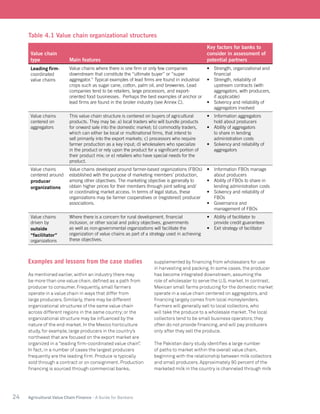
functions of the bank remain, the scope of their work
changes due to the need to incorporate the intra-value
chain relationships among the bank’s partners in the
chain and among other participants.20
20. This chapter draws primarily upon presentations at the AgriFin Bootcamp
2014 by Ömer Demirhan, with Yapi Kredi Bank of Turkey. Personal exchanges
with and contributions from Michael Andrade, HDFC Bank, India are gratefully
acknowledged.
7.
ADAPTING BANK
STRUCTURE AND
OPERATIONS TO
THE VCF MODEL
	 How does a bank adapt to the services associated with VCF?
	 What procedures need does a bank need to put in place?
	 What are critical contract clauses in VCF?
	 With a value chain approach, financial institutions can obtain a holistic view of the
connections their clients have with other value chain actors and use this knowledge to offer
services and tailored financial products to address and mitigate risks traditionally associated
with the agricultural sector.
	 Monitoring and maintaining clear means of collecting payments are crucial. Sales forecasts,
profitability, and capital flows help anticipate loan repayment issues that may arise.
	 Internal bank proposals are prepared based on an evaluation of the value chain as well as
client’s analyses and are submitted for approval. Sometimes these proposals represent pilot
projects within existing bank standards (e.g., loan amount caps) or they might be expanded
and revised iterations of previous pilots.
38 Agricultural Value Chain Finance - A Guide for Bankers
Relationship management – managing a VCF deal
inside the bank
Rather than creating a dedicated “value-chain
department,” banks tend to manage their value chain
engagements by allocating specific analysis and
processing functions across their existing units;e.g.,
marketing, sales, commercial credit, agricultural credit,
risk management, etc. Primary responsibility for a VCF
relationship typically depends on the nature of the
relationship of bank individuals or teams with the trade
or agribusiness side of the value chain.
For example, if the VCF operation will expand upon
an existing relationship with a major processor
or aggregator, the office in charge of that client
relationship may then hold primary responsibility
for the entire operation. If, however, a VCF operation
will reach out to multiple aggregators (e.g., SPOs in
India), responsibility may be shared among several
regional managers. When entering a brand new value
chain using a pilot project within the bank’s existing
standards (e.g., loan caps), a small team drawn from
several units may be assigned responsibility for design
and implementation. As the relative importance of
VCF operations in the bank’s portfolio increases, the
bank may create a specialized team with primary
responsibility.
Figure 7.1 provides an example of a bank process to
undertake a relatively major value chain operation for
Yapi Kredi Bank and the broiler industry in Turkey. In
this example, functions and roles are allocated across
existing headquarters and branch/regional units.
Figure 7.1: Industry analysis for a value chain in Yapi Kredi
Source:AgriFin VCF Bootcamp, 2014
Treasury
Agri Credit &
Monitoring
Marketing
Regions / Branches
Risk
Management
Process Design
Operations
Others
Sales
1.	Demand and Information flow for
a specific Value Chain Finance
from Branches & Regions
2.	Agri Marketing Dept.:
•	 Defines
•	 Measures, Analyse
•	 Produce Project Report
•	 Develop Product & Sales
Strategy for VC, with the help
of other parties within Bank
3.	Agri Sales Dept.:
•	 Prepares an Action Plan
•	 Implement strategies
•	 Design Campaigns
•	 Monitor the results for the VC
4.	Branches and Regions:
•	 Implements Project
•	 Manages Client Relations
1
2
3
4
39Agricultural Value Chain Finance - A Guide for Bankers
Critical clauses in contractual arrangements
The nature of contractual arrangements between the
bank and its value chain clients vary widely depending
upon the legal environment for business transactions.
In the VCF model, the quality (i.e. enforceability) of
contracts between value chain participants impacts
how the bank will set collateral requirements
for aggregators and farmers (including first-loss
guarantees from processors).
Risk management provisions (discussed in Chapter 6
above) make reference to formal contracts between
aggregators and producers and their enforceability as
part of the criteria in evaluating aggregators. If formal
contracts between producers and an aggregator
exist and are enforceable, then an “assignment of
claim” is introduced in favor of the bank at the time
the bank assumes the funding role.This means that
Credit policy and processes
As suggested earlier,value chain finance does not
necessarily require major changes in credit policies
and processes,albeit loan contracts with different
value chain participants can include special clauses
grounded on value chain relationships.What differs
from conventional loans are analysis of credit proposals
and client assessments.The stability of the processor/
aggregator relationship with suppliers is evaluated and
production risks are usually taken into account,going
beyond the traditional assessment of the viability of
the client’s business.A bank may collect and analyze
information for a value chain as a“project”and create
forms and pro-forma reports for internal processing.An
example is provided by the case of Yapi Kredi (Figure 7.2).
Figure 7.2: Credit evaluation of a Turkish poultry operator
Source: AgriFin VCF Bootcamp, 2014
Profit of a Broiler Farmer of 20K chicken capacity
REVENUES
Weight per mature Broiler 2.5 kg
Payment for 1 kg (avg.) 0.4
Duration for 1 period of production 60 days
# of production periods within a year 6 times
Sales Revenue (TL, yearly) 120.000
COSTS Unit Cost TL/Unit)
Labor 0,07
Electricity, Fuel and Water 0,2
Repair and Maintenence 0,02
Underlay (wood shavings) 0,15
Others(General - Unexpected
Expenses)
0,016
Total Cost Per Unit 0.46
Total Cost for 20K Broiler (x6 period) 55.200 TL
NET PROFIT 64.800 TL
The Bank plans to serve below
products to this farmer:
Bank Products/Services TL
Operating Loan (revolving/
installment)
41.400
Agri Card limit 4.140
Investment Loan (5years maturity) 290.000
Create cash flow from broiler
payments*
720.000
+ Products/Services to other parties
of VC
(value)
* 120K TL for 6 times in a year
Data for VC Broiler production is
embedded in the Bank’s Agri Loans
Evaluation System also, with a «Broiler
Questionnaire» for efficiency and quality
40 Agricultural Value Chain Finance - A Guide for Bankers
the aggregator (or processor) will play the role of loan
collector for the bank as part of their agreement.
Legal contracts between bank and aggregator will typically
make reference to the assignment of claim as an obligation
of the aggregator and include subsidiary clauses that
ensure repayment,even in the case the producers have
defaulted on their contracts with the aggregators.The
contract may also establish claims on aggregator property
(e.g.,mortgage on buildings or other tangible assets) even
when the aggregator provides a first-loss guarantee,or
when there are other guarantees in place.
It is important to remember that the strengths of
the contractual relationships and legal agreements
will typically influence the structure of any pact
with the main anchor firms or aggregators;i.e., the
terms (interest rates, maturity) under which they
receive financing, the revenue sharing in the form
of commissions or fees, the coverage of first-loss
guarantees, etc. If all goes well and a stable relationship
is created after a couple of business cycles, terms can
be softened and revenue sharing adjusted.
VCF loan management
VCF loan implementation and monitoring typically
follows the bank’s established practices, albeit with
the recognition of the value chain context.Turkey’s
Yapi Kredi, for example, has defined criteria for
placing customers on a watch list in cases of delayed
repayment. It also has created a list of basic principles
to follow in such a situation that consider whether
the problem temporary or permanent, and if the
problem affects only one party in the value chain or
all participants. Information is subsequently entered
into the risk monitoring system (Box 7.1), and in the
customer’s file.
Loan monitoring and early warning systems under the
VCF approach will include consideration of the overall
value chain risks, and not just those directly associated
with the individual client. Box 7.2 offers an example from
the India case study.
41Agricultural Value Chain Finance - A Guide for Bankers
Box 7.1:Roles for monitoring
Yapi Kredi has developed RiskMon, a centralized, automated monitoring system for all customers,
connected to three different inter-bank bureaus (Central Bank, Retail and Corporate Credit
Bureau, Ministry of Finance). The system retains historical data, facilitates analysis, derives
strategies and takes action.
What does RiskMon do?
1. Monitors 34 types of customer anomalies, including:
•	 Delinquency in all types of loans and credit, including value chain loans and agriculture cards
•	 Unpaid checks, fees
•	 Payments not received to “transfer account”
•	 Stagnation/increase/decrease in credit balances
•	 Loan default/restructuring
•	 Delinquency in tax, social security payments, notes
•	 Deficit in collaterals
•	 Negative balance in revolving loans/overdraft account for consecutive 180/90 days,
respectively
2. Produces behavioral scores looking at:
•	 All anomalies
•	 Discrepancies in financial figures
•	 All delinquencies
•	 Demographic figures
3. Determines the customer classification (rating)
4. Determines strategy and action (with due dates) for customers: close monitoring, assistance,
freezing/contraction of limits, amortization, liquidation
5. Processes data from credit bureaus, the risk management unit and other units in the bank, and
checks data from the central bank, the the Ministry of Finance (for arrestments and encumbrance
of tax, social security, and note payments), and retail and corporate credit bureaus that collect
all information for consumer and commercial loans and agriculture loans evaluation systems
(connected to farmer registry databases).
Roles for Monitoring – Intelligence and sector reports
•	 Intelligence Dept. the Credit Group of the bank has to produce a special report for limits
above US$350,000. Regardless of the amount, the unit with loan authority (branch, regional
manager, head office) may want an intelligence report for any customer
−− Intelligence Dept. consists of credit specialists, each of whom are experienced in
specific regions and sectors (no special personnel for value chains)
−− Intelligence reports contains nearly the same headlines of Customer Intelligence Report,
with two extra sections (mystery shopping from the market, and the financial institutions)
Agri News Bulletin prepared by Underwriting Team through news, national statistics, agriculture
chambers’ reports
Sector outlook is reported by Agri-Banking Marketing Dept. to explain the effects of below cases
(bank’s consultant also produce, upon request):
•	 Drought, floods, hail, heavy rains & snow
•	 Dramatic price changes in a region or at a specific agri-product
•	 Government regulation / intervention for a specific sub-sector or product.
42 Agricultural Value Chain Finance - A Guide for Bankers
Box 7.2:A bank's early warning system
A good credit product will necessarily be accompanied by measures that explain, monitor, and
manage risk. Any early warning system will need to incorporate both the formal and informal
sources of information that will be processed within the bank at various levels. This information
will emerge from the relationship with the anchor company, the seed producer organization (SPO),
and also from the local bank staff and the banking correspondent. HDFC Bank monitors the
following factors to identify and address problems as soon as they arise:
1.	 Staging release of crop loan timed to key crop stages and concomitant money needs. Labor
component is a big cash drain (for the farmer who contracts labor). A high labor requirement
exists at the time of ‘crossing’ and also at the harvesting stage.
2.	 Company’s continuity of farmer relationships; the number of repeat farmers and ability to
attract new farmers. This is a very important indicator of the trust that the seed company is
able to build.
3.	 Yield estimates; companies normally monitor crop progress and frequently estimate the likely
harvest yields for the hybrid seeds. This information is crucial to estimating the how well
its parent seeds have been used (or sold in the open market) and also serves as a means of
understanding likely farmer income and seed availability for commercial sales
4.	 Changes in the company’s planted acreage over time for the same crop. This is an indicator of
the company’s performance in the market. A decline in acreage would indicate a potential risk
5.	 Changes in famer’s family situation; illness, death, wedding, birth, acquisition of farm
and non-farm asset, etc. Informal tracking of these developments allows for a better
understanding of the likely usage of available cash and assets. It also indicates if the farmer
is able to repay loan on time.
6.	 Changes in the tenancy structure of the land holding.
7.	 Changes in weather conditions; adverse weather-related events could have a major impact on
the farmer’s ability to produce quality hybrid seeds. Delayed rains, inadequate water supplies
from upstream canals, temperature changes are all contributors to the performance risk of
the crop. While the company would normally monitor these situations, it is important for the
bank to have a macro-level track of weather conditions in the regions where it is providing
loans.
8.	 Changes in availability of factors of production; labor, water, energy, etc. Diversion of resources
to other agriculture crops, to development of newer industries (e.g. the creation of two states
from the erstwhile Andhra Pradesh is likely to create pressure on agriculture land), growing
urbanism are all factors that will have a negative influence on the development of strong
agriculture value chains in hybrid seed
9.	 Seed Producer Organization structure, e.g. changing field staff to farmer ratio, expansion of
other (non-seed production) business interests, addition/deletion of companies forming part
of the seed production clients, are elements that bank would need to track. The social capital
that the SPO enjoys - its reputation in the community - is by far the most critical asset.
Source:HDFC, AgriFin. 2015.
43Agricultural Value Chain Finance - A Guide for Bankers
The launch of a new VCF project or the expansion of a
piloted operation typically begins with an internal bank
proposal to management.Such proposals differ among
individual banks differ but there are several common
characteristics.The examples of HDFC and Yapi Kredi
are illustrative cases that have successfully established
value chain finance operations in their existing markets
and are actively seeking new opportunities.
At HDFC, a “Product Program” is put together for internal
approval that includes eight components (see Annex D
for full details):
1.	 Objective;e.g., to provide payment services to
smallholder farmers working with an aggregator and
dairy processor.
2.	 Purpose of the loan;e.g., working capital, or micro-
irrigation investment.
3.	 Arrangements in place between aggregator
and farmers, the implications for agreement
between aggregator and the bank, the existence of
guarantees, and aggregator assessment.
4.	 Facility details:terms, maturity, pricing, collateral,
geography, documentation, and service-level
agreements, if any.
5.	 Product caps and triggers, including total lending
under the program, delinquency triggers, and
remedial actions. Caps, within existing bank
standards, will depend on risk appetite at the time of
program formulation.
6.	 Reporting and management information systems.
7.	 Risk analysis;includes side-selling risk, payment
risk, and first, second, and third ways out.
8.	 Business plans, and three-year projection.
The product program is created for each aggregator
or set of aggregators and their respective groups of
farmers. HDFC formulates a companion document
outlining the profit and loss account associated with the
program, including estimates of revenue from cross-
selling products such as credit, insurance and other
retail products (Annex E).
Yapi Kredi follows a very similar process that involves
doing the market research and assessment of the
value chain.Then the marketing department prepares a
“Value Chain Project Report” for presentation to senior
management (Box 8.1).
Once approved by senior management,Yapi Kredi
formulates an action plan for the value chain
operation (Box 8.2).This plan includes the assignment
of responsibilities within the bank for the different
components of the plan.
From VCF scale up to ‘business as usual’:Once the
senior management has given the green light to scale up
the VCF pilot, it will take some time for VCF to become
business as usual for the bank. Based on the experience
of the contributors to this Guide, it can take 3-5 years
for the bank to get its policies and systems in place,
structure reoriented and staff trained before the VCF
model becomes business as usual. Once the VCF model
is set and the system is working well in one sector, e.g.,
dairy, the approach can be applied easily to other value
chains and sectors.
8.
FROM PILOT TO
LAUNCHING THE VCF
PROJECT
44 Agricultural Value Chain Finance - A Guide for Bankers
Box 8.1:A value chain project at Yapi Kredi,Turkey
1.	 The agri-marketing department collects all raw information,together with a“Value Chain Project
Form”,from the regions and branches,combining this with sector and official data using:
1.	 Sector reports from government bodies, chambers, associations, and NGOs
2.	 Visits to related chambers, associations, and, occasionally, potential customers
3.	 Internal intelligence reports produced by its intelligence unit
2.	 After data gathering, the marketing department prepares a “Value Chain Project Report” for
presentation to a group director, including:
1.	 Executive summary
2.	 Definitions, statistics, profitability and flows of the value chain
3.	 Expectations and market perceptions
4.	 Entry points for the bank
5.	 Products/services to be presented for the value chain
6.	 Requirements to enter the sector, if necessary (e.g., product developments, information
technology and infrastructure requirements, changes to legislation, policies, regulations,
changes within bank’s organization, etc.)
7.	 Forecasts for sales and revenue
8.	 Action and acquisition proposal
Source:AgriFin VCF Bootcamp, 2014.
Box 8.2 Yapi Kredi value chain action plan
1.	 After validation by a director, the marketing department arranges meetings with related
parties to discuss requirements for an action plan. A steering committee is established if the
value chain project requires major development. The secretariat of the committee is held in
the “Process Design and Execution Department”.
2.	 If the project does not require changes to existing procedures, the marketing department will
meet with the “Agri-sales Department to consider an acquisition strategy and action plan
3.	 Execution of the action plan falls to the sales department. An action plan consists of:
a.	 Estimated sales volume and revenues from the value chain project
b.	 Products/services to be presented for the value chain
c.	 Terms and conditions for the products (pricing, maturity, collateral)
d.	 A specific campaign structure for the value chain, if necessary
e.	 Required visits to processors and other parties of the value chain
f.	 Agreements and protocols if required
4.	 The sales department prepares a timetable and to-do list for the action plan and begins
to implement the plan with regional supervisors and branches. Occasionally, the to-do list
entails the cooperation of other sales departments within the bank (and possibly corporate/
commercial/small- and medium-enterprise/mass segment sales teams). In that case, an
“Agri-Segment Director” takes the responsibility to cooperate with other teams.
Source:AgriFin VCF Bootcamp, 2014.
45Agricultural Value Chain Finance - A Guide for Bankers
The field case studies and other sources discussed in
this report support the notion that when a bank has
the systems in place and experience with farmers and
supply chains, agricultural value chain lending can be
an effective path for banks to increase business and
diversify portfolios.They also clearly indicate that there
is no single formula to create a successful agricultural
value chain operation;solutions are context-specific,
not only in terms of the particular agricultural activity
involved and the value chain structure but also in
regards to the legal and business environments in
which the dealings between the bank and value chain
participants take place. Rather than seeking to create
such a single recipe, this chapter outlines what both
theory and practice suggest financial institutions
should consider when adopting the value-chain
approach to agricultural finance.
Successful value chains create value for all
participants involved. As a general principle, the
VCF relationship must make economic sense for all
participants, and not just for the bank. In practice, this
principle translates into properly aligning incentives for
all participants:producers, aggregators, processors, and
financial institutions.
Financial institutions should expand their
understanding of the linkages that farmers might
have with other value chain participants, recognize
the benefits of identifying producer organizations and
cooperatives as aggregators for services to farmers,
and seek out innovations in distribution channels and
delivery mechanisms that can reduce the overall cost
barriers to serving farmers.
Value chains must be a viable business proposition. As
with all business lending, finance will not (nor should it)
rescue a losing business proposition.Value chains must
be market-driven, sustained by demand, and supported
by suitable preexisting infrastructure. During the
identification stage, it should be determined whether
or not the value chain is likely to become dependent
upon financing for its viability or whether it is capable
of growing through financial support. As banks become
involved in value chain finance, they should recognize
the risks associated and be prepared to make sacrifices
and view their involvement in the value chain as a
business opportunity, and one not without risks.
The case studies suggest that there is no alternative
to the research and close examination of all of the
participants involved in a value chain.The heterogeneity
of farmers across countries and across crops and
livestock activities yields a multiplicity of models and
approaches, providing many examples of potential
solutions.There is no single financial product or group
of products that is guaranteed to unlock the potential
inherent in lending to farmers. Banks and financial
institutions must invest in understanding the activities
that take place throughout the value chain.They also
should recognize the variations in demand for products
and the potential for managing risks through existing
value chain relationships. With better research comes
better products. With better products, clients are more
likely to succeed and repay loans.
CONCLUSION
46 Agricultural Value Chain Finance - A Guide for Bankers
1.	 What works in value chain finance
What follows is a brief account of the factors found
to be conducive to success in agricultural value chain
operations. Examples from the field case studies
illustrate some of these points.
Partnering with aggregators or lead-firms. Value
chain participants have different drivers for supplying
credit, most often the desire to increase production
and efficiency, and/or to expand their markets. As a
result, they are more willing than financial institutions
to accept the risks associated with agricultural finance.
In addition, value chain actors have more information
as to business activity, cash flows, and firms within
the value chain than financial institutions, which
lowers their transaction costs and reduces risk.The
interdependence of value chain actors further reduces
credit risks. In the case of value chain finance for a
key input, such as seedlings or fertilizer, non-payment
would likely result in losing access to the input as well
as the related financing.
LESSON 1:HDFC. Partnering with value chain participants - the importance of
seed producer organizers (SPOs)
The SPO was found to be a nerve center in the value chain. All payments made by the company
to farmers in most cases were routed through the SPO, who also provided both technical and
financial assistance to farmers and often acted as a moneylender. Given that the SPOs had a
very tight relationship with the farmer, their horizons for farmer financial exposure were longer
than might be expected from banks. An SPO’s risk assessment capability, its knowledge about
the viability of the farming operations for a particular farmer, and its supervision during the crop
stages resulted in better management of farmer credit. For all these activities and the potential
risk that an SPO carried (farmer default on production, quality issues with hybrid seed, etc.), the
SPO would charge farmers higher rates of interest on advances.
LESSON 2:HDFC. A bank's early warning system
A good credit product will necessarily be accompanied by measures to understand the risk and
monitor and interpret signals that will facilitate risk management. Any early warning system will
need to incorporate both the formal and informal sources of information that will be processed
within the bank at various levels. This information will emerge from the relationship with the
anchor company, the SPO, and from local bank staff and the banking correspondent.
Formal contracts facilitate access to finance. Despite
the fact that contract enforcement is challenging in
some countries, farmers with contracts that defined
the terms for which they would be able to sell goods
had significantly greater access to finance than those
who did not. In vegetable value chains, the use of
written contracts solidified the backward and forward
linkages between the processors and wholesalers and
processors and farmers by clarifying prices per quality
level. Some formal financial institutions are more
willing to lend to producers when they have defined
sales terms and fixed market prices for their products
than when they do not. It is important to note than in
the value chain context, contracts offer an opportunity
to formally assign claims and reduce repayment risks,
and/or introduce factoring solutions.
47Agricultural Value Chain Finance - A Guide for Bankers
Information flows from agricultural value chains to
financial markets reduce real and perceived risks of
agricultural finance. As consumer preferences become
more refined and differentiated, agricultural markets
become more segmented and specialized. For example,
as with the Bankaool case study, most of the vegetables
exported to the U.S. from Mexico are closely regulated.
Financial institutions can forge strategic relationships
with dynamic agricultural value chain actors, such as
large processing firms, to expand their loan portfolio
by either lending directly to its related producers or
by making larger loans for the processor to on-lend to
producers.
VCF works where market opportunities exist but
supply is lagging. The Pakistan dairy value chain case
highlighted producers that were already delivering
quality products but without strong connections to the
consumer market, collectors/processors were unable to
keep up.VCF is likely to be the best solution to improve
collection and processing, while also increasing small
farm productivity.
LESSON 3:HBL. Use preexisting participants as conduits for technical
assistance
Channeling credit and repayments through milk processors had an advantage that it was not an
isolated activity but one embedded in the routine of milk processors. Their technical field services
were essential to guide farmers on management issues for their new animals (if animals are
purchased under the loan), for example.
LESSON 4:HDFC. Extending the bank’s agricultural outreach
Presence and reach remain important considerations. India’s HDFC has been engaged in pioneering
work developing a suite of structured products to support value chain finance in agriculture. HDFC
Bank has an extensive network on the ground – branches and ATMs – and is aggressively expanding
its footprint in agricultural areas by relying upon the business correspondents (authorized under
India’s regulations) and digital technology (mobile- and card-based).
VCF succeeds where value chains lack working capital.
For many small-scale farmers, traders and processors,
a lack of working capital is the principal constraint to
growth and to increasing supply to the market.The
VCF approach addresses this constraint through two
mutually reinforcing channels:
•	 Lead-firm strategy. When there is a strong lead firm
in the chain, this company can be used as a vector
to reach non-bankable suppliers.The lead firm is
the collateral for providing finance to the suppliers;
it provides the lender the information needed on
the suppliers, and performs payment retention.
Examples of this mechanism are provided by
Bankaool in sugar,Yapi Kredi in broiler chickens and
HDFC Bank in dairy.
•	 Capacity-building/banking infrastructure strategy.
Another approach is to build the capacities of
the suppliers to make them bankable. When
the suppliers are trained and supported in their
businesses for a couple of years, they can build a
proven credit history and then become eligible for
financial services from mainstream banks.
48 Agricultural Value Chain Finance - A Guide for Bankers
VCF facilitates investments in the chain. Besides the
lack of working capital, another key reason value chains
may not realize their full potential is through a lack of
investment capital. Entrepreneurs in the chain need
to invest to upgrade their technologies, introduce new
products, develop new markets, and pursue other mid-
to long-term ventures.Value chain finance is found to be
a viable means of funding medium-term investments,
such as improved breeds of cattle (Pakistan), or storage
facilities (India).
2.	 What factors deter success in VCF?
What can go wrong?
While the cases reviewed for this Guide were primarily of
successful value chain finance operation, experiences
suggest that specific features of the value chain may
conspire against a strong VCF operation. Aside from
the obvious importance of the legal environment for
commercial contracts and contract enforcement, a few
features of the value chain can be listed as potential
weaknesses and these need to be considered before
testing a new value chain operation.
Too many small aggregators. The Pakistan study
identified small milk collectors as a key component of
the path to market. However, each collector covered a
relatively small number of producers, and they posed
the risk of possible reverse-financing given the collector
paid the producer at the end of each monthly collection.
A VCF intervention would likely need to establish its
primary connection with larger collectors or processors
further downstream.
Weak relationships within the value chain. A history
of short-term or sporadic transactions between
aggregators and producers represent a risk the bank
needs to assess and mitigate. Poor quality of aggregator
information on suppliers would constitute a warning
sign;the financial institution would need to audit
information quality before engaging.
Generalized crop failure. This is obviously a nearly
universal risk but one that banks might mitigate by
entering a value chain that boasts sufficient geographic
diversification, as well as reliable access to guarantees
and insurance.
 
LESSON 5:Bankaool. Aggregator roles are important.
One major difference between Mexico’s vegetable value chain and the cane sugar value chain in
which Bankaool had already been operating was that small farmers sold to small aggregators
(collectors or acopiadores), the majority of whom were on the margin of the formal economy.
The ability of these aggregators to be the main entry point was limited given they frequently did
not have a credit record, making taking a first loss guarantee from them a high risk proposition.
Similarly, their ability to provide the legal documentation was unlikely. Even adjusting the model
to work with wholesalers offered very limited opportunities, since the relationship between the
collector and wholesaler was in cash. Even where there is credit, it is often the collector who will
provide “financing” by waiting until the wholesaler makes the sale in order to be paid.
49Agricultural Value Chain Finance - A Guide for Bankers
Nearly every commodity exchanged in the global
marketplace is subject to a series of value-creating
activities that transform raw commodities into a
multitude of products available for consumption
worldwide. The segmentation of the various activities
or processes, which add value to a product or service
at each step along the way, is commonly referred to as
‘value chain analysis’.Value chain analysis attempts
to capture, holistically, the chain itself rather than
emphasize the significance of any one individual actor,
focusing upon the connections between actors within
the value chain and the ways in which value is added to
a product.Value chain analysis considers the system as
a single structural unit, albeit often times with various
pathways through which inputs to production are
processed for final markets.
1.	 Defining the Value Chain
A large body of theoretical and applied literature has
focused on value chains – agriculture or otherwise
– since Michael Porter’s 1985 seminal work on firm
competitive advantage. Value chain analysis is
deemed useful at many levels. Businesses use it to
devise competitive strategies and to guide product and
process innovations. Governments and donors have
recently shown interest in value chain analysis to inform
interventions aimed at repositioning entire industries,
building competitiveness, and support economic
growth.Value chain analysis can shed light on the size
of firms participating in each link, and on potential
improvements in their participation, which makes it
an appealing tool for governments and aid agencies
concerned with the inclusion of smallholder farmers in
modern value chains.
ANNEX A.
BASIC CONCEPTS
AND PRINCIPLES
The Introduction provided readers with an overview of the basic concepts and issues
that arise in value chain financing. The basic concepts discussed in this annex aim
to provide readers greater detail that will be useful in becoming familiar with the
terms and processes of value chain financing.
	 Agriculture value chains overview. What is a value chain? What are the basic concepts that
make up a value chain financing model? This introductory section outlines the fundamental
concepts of agricultural value chain finance. In addition to categorizing the various actors
along a value chain, this section offers some tools for determining sources of finance and
the level of integration within a given chain.
	 Financing agriculture value chains – Summary of main issues. What drives bankers to
consider value chains in their agriculture finance portfolio? Value chain finance is intended
to address some crucial issues that arise when financing agricultural operations. The topics
of information asymmetry, entry points and products (which are all discussed in-depth
throughout the guide) are mentioned briefly.
50 Agricultural Value Chain Finance - A Guide for Bankers
Why it matters to bankers? For the purposes of this
Guide, understanding the structure, relationships, and
drivers of an agricultural value chain can shed light on
the opportunities for a bank to profitably penetrate or
expand its presence in specific market segments. It is
important to recognize at the outset some important
ways in which value chain analysis differs from
traditional commodity system or industry analyses.
Namely it:
•	 focuses on net value added;
•	 recognizes that linkages between activities and
participants vary according to the product, even if
the participants are the same;
•	 recognizes that there are different kinds of value
chains depending on the “driver” and the associated
governance relationships;and
•	 looks beyond physical flows to include information
flows
2.	 Defining Value Chain Finance
Value chain finance relies upon the relationships
throughout the system in order to determine
appropriate flows of capital.The value chain approach
to finance actively engages the connections between
actors within a value chain and the ways in which value
is added to products at each step along the way.
By systematically approaching the value chain as
a single unit, financial institutions are able to more
effectively mitigate risk (Box A.1) by encouraging new
and leveraging preexisting value chain relationships.
With information pertaining to where value is added
along the chain as well as identification of vital actors,
intermediate and ultimate markets, and understanding
customer demand, financial institutions are better
informed to make decisions regarding the credit risk
of those to whom they lend. Agriculture value chain
finance (AVCF) has increasingly been adopted by
development practitioners as a means of substantively
contributing to smallholder food security, effectively
growing incomes by increasing agricultural
productivity, and improving efficiency of smallholders
and small and medium enterprise producers
throughout the value chain.
It is important to note that agricultural value chain
finance is primarily a demand-based approach that
leverages relationships to address the inherent risks
in agricultural finance. While AVCF may provide loans
to farmers, traders, and processors, its value is in
understanding the relationships between actors in the
value chain and how they share risks and benefits (or do
not). A value chain is not an entire sector or subsector.
It involves a specific group of interrelated producers
and other actors who supply a particular end-market.
The relationships between buyers and sellers can be
described through various types of linkages along a
continuum.This definition of value chain finance does
not include conventional agricultural financing from
financial institutions such as banks and credit unions
to actors in a chain unless there is a direct link with the
value chain.
AVCF is characterized by a comprehensive assessment
and understanding of the entire chain and the use of
and in some cases development of specially tailored
financial products that meet the needs of the chain.
Rather than a simple credit risk assessment of the
borrower, AVCF requires an assessment of the broader
Box A.1 Pathways to improving quality and efficiency
Banks can provide financial services to spread risk and reward in a manner than incentivizes
quality production so that all actors in the chain, including the bank, benefit.
1.	 Identifying needs for finance that will strengthen the value chain as a whole
2.	 Modifying existing financial products and designing new ones tailored to the specific needs of
those in the value chain
3.	 Reducing transaction costs of providing financial services
4.	 Mitigating risk through information sharing and relationships
Source:Miller, 2010.
51Agricultural Value Chain Finance - A Guide for Bankers
risks of the value chain. Agricultural value chain finance
often prioritizes bringing together individual farmers
and their productive capacity via producer associations,
cooperatives, and other forms of collective enterprise,
thereby greatly improving their access to methods
of diversifying and transferring risk. It also leads to
economies of scale in market transactions and greater
bargaining power to form more reliable and profitable
relationships with other distinct market actors.
Organized associations of farmers facilitate access
and bargaining capacity in input and output markets
as well as to channels of technical knowledge. When
aggregated, farmers are much more willing to invest
in productivity-enhancing practices and to undertake
activities with higher profit margins. Often times, it
entails moving from diversified subsistence farming to
specialized surplus production activities;i.e., from net
buyers to net suppliers of food. Smallholders account
for a large proportion of rural poor people in developing
countries and produce much of the countries’ food.
As such, they are an important target group, offering
opportunities to increase the socioeconomic welfare
of a large number of people, improve food security, and
drive the economic development of the country. Special
emphasis must therefore be placed on models that
allow the full participation of smallholders in value
chains.
Recent findings from lending practices by HBL in
Pakistan suggest that banks can develop a long-term
strategic environment for growth in lending to other
market segments and increase adoption of banking
services leading to greater deposits by focusing on
agriculture value chain finance. AVCF can reduce costs
and risks and it offers a way to reach smallholder
farmers who may have otherwise been excluded from
formal financial services. Many of the components of
AVCF may be familiar but the systematic approach to
its application has been pursued only more recently
(Miller & Jones, 2010). Agricultural value chain finance
can contribute substantively to increasing agricultural
productivity, distributing gains from trade to actors
throughout the value chain, and to improving bank
profitability.The agricultural sector is becoming
increasingly integrated, both horizontally (with large
multinational firms participating in a range of value
chains) and vertically (with firms involved in all aspects
of production, transport, and processing).	
3.	 Key Value Chain Participants and Financial
Interactions
When analyzing a value chain, typically there are
five main categories of participants to consider,
as depicted in Figure A.1. Although they frequently
will engage with actors throughout the value chain,
dealers in agri-commodities or input suppliers are the
beginning of the agricultural value chain, followed by
producers, aggregators or assemblers, processors,
and finally retailers.Though not present in the basic
diagram, service institutions as well as commercial
banks and financial institutions are often included
as they play critical roles in the success of the value
chain. Agriculture value chains might not include all
participants. In a vertically-integrated system, one
participant may engage in activities along several
stages in the value chain, while in a horizontally-
integrated system one actor may engage in a range of
value chains. In other cases, agricultural products may
not require processing or farmers may sell direct to end
consumers.
Input Suppliers
Suppliers provide farmers with the inputs necessary
for production. Agricultural inputs often include
seeds, chemicals, fertilizers, and equipment as well
as technical assistance. Input suppliers often vary
considerably in size (ranging from foreign-owned firms
to small-scale local retailers) and often have very
different and individualized financial needs. Whereas
local retailers may require short-term seasonal working
capital loans that can often be anticipated, other input
suppliers who provide more expensive products (such
as specific pesticides or fungicides) may have quite
different financial needs. Additionally, since they often
serve various different actors within the value chain
(as well as various different value chains, i.e. grain and
dairy production), they must account for the financial
availability and timescales of producers, processors and
retailers.
52 Agricultural Value Chain Finance - A Guide for Bankers
Producers/Farmers
Refers to all of those engaged in primary production
including farmers, their families and seasonal/part-
time workers. Most smallholder farmers lack sufficient
working capital to buy seeds and other inputs or to hire
appropriate help to plough and harvest their crops or
care for animals. Due to the insecurities involved with
investing for the production cycle, many producers
face significant risks associated with paying for food
as well as household and medical expenses. Many
smallholder farmers lack the economies of scale
and investment capital to purchase equipment or
infrastructure to improve yields. Farmers require
financial intermediation not only to help procure inputs
for production, but also in the form of cash payouts for
their crops after harvest. Farmers also use credit to
invest in livestock, equipment, and treatment facilities
and to cover costs of labor (if they require assistance for
maintaining crops or during harvest.). A lack of financial
support not only compromises the quality and quantity
of production, but farmers are unable to remain
competitive or maintain their share in the final value of
production.
Historically, farmers have had few reliable sources of
finance. Lacking the conventional means of collateral,
they are viewed as ‘unbankable’ and, when they do
qualify for credit, banking costs associated with
financing rural operations can be insurmountable. High
interest rates and transaction costs are frequently
tied to financing smallholder farmers. Some farmers
have benefitted from informal or in-kind loans from
value chain partners, but they are generally small in
size and rarely provide more than short-term capital.
Informal loans from other parties such as moneylenders
often impose excessive interest rates, which can place
farmers in a vicious debt-cycle.
Cooperatives and farmers’ associations have been one
way of delivering credit to farmers, with loans often
tied to farm inputs and machinery. However, like other
semi-formal institutions, co-ops suffer from weak
governance, flawed administrative controls, lack of
independent decision-making, inflexibility, and high
administrative costs. Apart from having the funds to
finance such loans, co-ops face various other financial
needs, such as covering their administrative costs.
Those that market their members’ produce need cash
to pay their members promptly, which requires working
capital;if farmers do not get paid quickly, they may
sell to a private trader who pays less but who can
provide fast cash. Farmer organizations that function
as collection points need to invest in warehousing and
transport.
Figure A.1: Stages of the Value Chain
Source: Tchale and Keyser, 2010.
Farm
Production
Assembly Processing DistributionInput Supply
1.	 Arrows from input supply to all other stages show that input supply is a cross-cutting function.
2.	 Arrows from production directly to processing and distribution indicate that some farmers may deliver crops directly to
factors or directly to final markets (for unprocessed goods).
53Agricultural Value Chain Finance - A Guide for Bankers
Aggregators/Service Providers/Traders
The traders buy produce from the farmers or co-ops
and bulk it before selling it on.Their business depends
crucially on making their working capital flow as quickly
as possible in buying and re-selling produce. Every
transaction offers an opportunity to make a profit
(and, of course, carries a risk of losing money). Small
rural traders have to stop buying when they run out of
cash, leaving farmers stranded with their products.
The traders need working capital to optimize their
turnover and keep transaction costs down.They also
need longer-term investment capital so that they can
buy a vehicle, build a warehouse, or pay for equipment
to weigh or grade a product. Because so much of their
capital is tied up in products at any time, traders have
little collateral, so find it difficult to get loans. Few
financial services are designed specifically for traders.
Processors
Processors are those that are adding value to a raw
product during the processing stage. Small-scale
processors may lack the working capital they need to
buy products in bulk from a farmer group or trader.They
often lack the money to invest in equipment, leading
to losses, lowering quality, and pushing up the cost of
processing.They typically need access to medium-term
loans and the ability to lease equipment. Commercial
banks are becoming involved in lending to such
processors.
Retailers/Wholesalers/Exporters
These participants sell the processed product to
local and global retailers, supermarkets, and smaller
retailers, who in turn sell to consumers. Wholesalers
often manage credit relations in two directions:they
provide money to trusted traders so they can buy on
their behalf, and they may provide products to retailers
on credit, expecting to be paid after the retailer has
sold the goods. In this way, wholesalers often act as a
bank for other actors in the chain.They often need more
capital than other traders in the value chain.To avoid
bad debts, they need good information on the reputation
and financial status of their suppliers and buyers.
Wholesalers and exporters have access to the financial
services of commercial banks.These loans can be long-
term, or at least medium-term. Exporters may have the
option to provide guarantees to their suppliers (e.g., if
they apply for a bank loan), based on an export contract.
Exporters (or importers) can also participate in a joint
venture, together with other value chain actors.
In traditional finance, several banks might lend to
various actors along the chain, with no coordination
of services and knowledge. Agriculture value chain
finance (AVCF) can create efficiencies from the financial
institution perspective by promoting coordination
of a variety of financing services along the chain.
While much of the interest in AVCF from NGOs and
development organizations focuses on AVCF as a way
to expand credit access to smallholder producers, there
may also be flows down the chain;that is, producers
finance buyers and processors by accepting delayed
payments or delivering products on consignment.
Figure A.2: Continuum of Relationships between producers and buyers
Source:AgriFin VCF Bootcamp, 2014.
Likely Success of Agricultural Value Chain Finance
Continuum of Producer-buyer Relationship
Spot market
producers sell products
markets with fluctuating
markets
Contract farming
producers and buyers
make predetermined
agreement
Long-term
relationship
producers and buyers
have trust and
Capital investment
buyer invests
in producer
Vertical integration
buyer owns production
capacity
54 Agricultural Value Chain Finance - A Guide for Bankers
4.	 Variations in Value Chains – The Importance of
Participants’ Relationships
Value chains types have been characterized by several
sources according to which participants “drive” or
initiate systematic cooperation within the value
chain. While useful as a categorizing framework, this
classification does not lead to practical implications.
Its connection with the identification of entry points for
financial institutions was developed in Chapter 4.The
focus here is what determines the ‘tightness’ of value
chain relationships, as this is a critical principle within
the AVCF model.
Tight Versus Loose Value Chains
Value chains exist along a continuum depending on
the market.Tight value chains are those with clearly
established relationships and a single channel. Often
these involve what are called “closed marketed crops”;
those that pose transportation challenges due to bulk
or perishability, thus making side-selling costly and
unlikely. In these value chains, producers have few or
only one option to sell their products.Tight value chains
may include export commodities, highly perishable
crops, and those that require commercial processing.
In contrast, in loose value chains (often involving “open
marketed crops”) farmers have a variety of marketing
options and may sell to various buyers. In addition to
a range of marketing options, open marketed crops
may also be stored for home consumption. Loose value
chains present more opportunities for competition
and may present producers with a variety of options
for marketing their crops. However, loose value chains
are not necessarily better for smallholders. Such
chains present fewer opportunities to forge long-
lasting relationships where credit, inputs, extension,
and sector knowledge flows between participants in
the chain. While the tightness of a value chain is often
based on crop characteristics, specific context analysis
is necessary to determine how a particular chain
functions. In contract or out-grower arrangements, side-
selling is a risk for loose, but not tight, value chains.
Value chains may be tight due to incentives and trade
arrangements that favor farmers, or farmers may be
penalized or unable to sell outside the chain.
Internal vs. External Value Chain Finance
Internal value chain finance
Depending on the nature of the value chain, financial
institutions may provide services directly to a “lead
firm”, which in turn serves farmers and others along the
value chain. In other cases, a lead firm may facilitate
the direct provision of financial services to other actors.
Finance flows in value chains regardless of the presence
of formal financial institutions. Participants further
down the value chain provide loans to smallholders
with or without the involvement of financial institutions.
Internal or “within chain” value chain finance refers
to various participants providing loans and other
financial services up and down the value chain. Forms
of internal value chain financing include aggregator
credit, input supplier credit, marketing company credit,
lead firm (contract or out-grower farms) financing, and
warehouse receipts financing , as depicted in Figure A.3.
Figure A.3: Internal Value Chain Finance
Source: AgriFin VCF Bootcamp, 2014.
Farm
Production
Assembly Processing DistributionInput Supply
Bank Bank
Finance Finance
55Agricultural Value Chain Finance - A Guide for Bankers
While internal value chain finance offers the advantage
of utilizing relationships and transaction mechanisms
already in place,there are also drawbacks.When
financial institutions are not involved,working capital is
tied up in finance,farmers may not understand the costs
of finance (as it is deducted from payment for products),
and agribusinesses must devote resources for financial
service provision,rather than their core business.
Value chain finance without bank involvement may
provide what an ACDI/VOCA report calls a“demonstration
effect”whereby banks may be encouraged to expand
services to agricultural enterprises based on the track
record of internal financing within to the value chain.
Because financial services are typically bundled with
other services in AVCF,buyers may regard the benefits
of strengthened ties with producers and other actors as
being more important than the profitability of a particular
loan.An interview with Starbucks revealed the company
is providing substantial credit to farmers,motivated by
a need to secure long-term supply of coffee and other
products,rather than by the returns they receive for
loans.21
External value chain finance
When actors outside the value chain, such as financial
institutions, provide finance to the value chain based
21. Personal communication with authors, May 2014.
on relationships within the chain, this finance may be
referred to as “external” financing. A typical example
is a bank that provides a loan to a producer based
on a contract with a buyer. External value chain
finance can provide benefits for all stakeholders by
including financial institutions in value chain finance.
Milder (2008) notes the following primary benefits:
firms do not need to use working capital to provide
finance to producers, producers can access finance
without meeting typical collateral requirements,
banks can enter new profitable markets without the
risk and transaction costs associated with lending to
smallholders directly (Figure A.4).
From a financial institution’s perspective, connecting
the bank with the lead buyer or trader in an already-
established commercial relationship is a preferable
starting point (Bankers, 2014). In some cases,
smallholder producer organizations may be in a position
to play this role. Once the bank and the lead value chain
actor establish a relationship and share information,
financing vehicles can be designed and introduced, their
pricing reflecting the cost-sharing and risk-sharing
arrangements between the bank and the business
partners. Other formal financing options include
secured transactions, equity finance and joint ventures,
commodity exchanges, and government liquidity
support (African Development Bank, 2013).
Source: AgriFin VCF Bootcamp, 2014.
Figure A.4: External Value Chain Finance
FinanceFinance
Information about farmers
Farm
Production
Assembly Processing DistributionInput Supply
Bank Bank
56 Agricultural Value Chain Finance - A Guide for Bankers
Commercial viability is assessed using the following
downstream criteria:
1.	 Growth in industry should be measured by
both the value and volume of production over
a specific period of time. Using the real rather
than nominal currency value of production
eliminates inflationary distortions. Measuring
growth using volumetric data offers additional
insights into product availability and procurement
potential, which can help in developing value chain
relationships. Additionally, when the product is
exported, using long-term volume data provides a
measure of performance independent of foreign
exchange movements. The operating hypothesis
is that the higher the growth rate, the higher the
probability of the viability of a specific value chain
within the given industry. Specific agricultural
production criteria used in ascertaining industry
growth are outlined below.
2.	 Investment is an important indicator of the way the
market perceives the specific risks and potential
of an industry.The use of this criterion is based
on the assumption that entrepreneurs would be
reluctant to invest in businesses in which they saw
limited growth potential. Rather than absolute
values of investment over a specific period, the ratio
of investment to the value of production should
be used in order to adjust for variations in size of
the different businesses.This makes it easier to
establish a relative ranking across industries.
3.	 Price volatility and changes in production volume
(adjusted for seasonality) provide an indication
of the potential operational risks. Success in a
highly volatile market depends on a special set
of business skills, frequently supported through
policies and financial instruments designed to
mitigate and facilitate volatility management and
its associated risks. At the same time, volatility
provides an indication of the potential business and
financial success, i.e. payback risk. The operating
hypothesis is that a high level of volatility increases
both the operational and credit risks22
.
4.	 Size – measured as the value of production – can
be used to determine the attractiveness of a
specific industry. Although when considered by
itself, size may not indicate a healthy agri-food
industry sector, the hypothesis is that the larger
the size of the chain, the greater the attractiveness
and opportunity may be for developing and
promoting value chain financial products.
5.	 Trends in international trade provide an indication
of both the potential and the vulnerability of
an agri–food industry sector and can offer
particularly relevant insight regarding value chain
financing. Sustained export growth suggests that
the industry maintains a competitive advantage
in the international market. However, exposure
to international markets changes the risk profile
since the industry is subject to an additional set
of variables, including movements in exchange
rates and shifting foreign trade policies. Even if the
primary orientation of an industry is to the domestic
market, if imports comprise an increasingly larger
share of the domestic market the value chain is
considered particularly vulnerable at the primary
production level.
6.	 Financial flows provide insight into how the
financial market views the specific industry. Since
credit availability is finite, changes over time in
the share of total formal credit directed toward a
specific industry indicate a growing or decreasing
business potential/risk. Additionally, changes in
past due loans as a percentage of total lending offer
an indication of the credit worthiness of the value
chain.
22. While this does suggest a high level of risk, it can also be considered as an
indicator of demand for risk management products.
ANNEX B. ASSESSING
COMMERCIAL CRITERIA IN
VALUE CHAIN SELECTION
57Agricultural Value Chain Finance - A Guide for Bankers
Assessing industry growth – upstream criteria23
While the basic conceptual criteria for evaluation
are similar for field and fruit crops and for animal
husbandry, due to the differences in production
systems, the specific measures and indicators tend to
be different.
Field and fruit crops
1.	 Growth is measured as the change in area
planted over a certain period of time.The working
hypothesis is that an increase in planted area
is indicative of a more dynamic industry. Since
agriculture is frequently the beneficiary of targeted
government support, the period of analysis should
be long enough to cover more than one change in
administration to account for changes in policy that
may have an impact on the economic perspective of
the industry.
2.	 Changes in yield offer a vision of the availability
and application of technology to the production
process.The use of this criteria is based on the
assumption that sustained growth in yields is
consistent with investment in a healthy industry.
Since investment data is usually difficult to obtain,
yield growth can serve as a proxy for investment.
Given that long-term crop budgets are often
unavailable in many developing economies,
sustained growth in productivity and planted area
would suggest that returns have been positive.
3.	 Value of production per hectare offers a deeper
understanding of the potential viability of the
primary production process. Changes in value
of production combine yield fluctuations with
(sometimes counterbalancing) price changes.
As mentioned previously, real rather than nominal
23.“Upstream” is used here to refer to the origin of the product flow, i.e., the
producer. The product flows “downstream” towards the consumer through the
different components of the value chain.
values should be used to eliminate inflationary
distortions. Due to short-term variations in
production and market conditions, at least a decade-
long trend should be considered.
4.	 The difference between planted and harvested
area provides an indication of the on-going
production risk. Large differences and/or
significant variations from year-to-year indicate an
unstable or sub-optimal production system. While
this might suggest that crop insurance products
could be offered (due to ongoing and large losses),
the costs associated with purchasing crop insurance
would most likely be too high to be an affordable
component of producers’ risk management
strategies. Again, the period evaluated should be
sufficiently long (at least a decade) in order to
account for one-off climatic effects, and disease
and/or insect infestation.
Animal husbandry
1.	 Growth is measured by the change in the animal
population over a certain time period. Much like
the criteria for crop and fruit production, the
working hypothesis is that an increase in the
animal numbers is consistent with the profile of
a dynamic industry. By way of contrast, a decline
in animal numbers may be an indication of loss of
competitive advantage to foreign competitors or of
a structural change in the market with consumers
eating less meat or favoring a different source of
animal protein.
2.	 In the case of animal husbandry, yield is considered
to be the conversion of feed to weight gain, or,
in the case of the dairy industry, to milk volume.
Changes in yields reflect the willingness to
invest in and apply technology to the production
process. The basic assumption is that increasing
yields or conversion ratios suggest an industry with
sustained potential. It should be noted that changes
58 Agricultural Value Chain Finance - A Guide for Bankers
in slaughter weight do not necessarily reflect an
improvement in conversion ratios.They may instead
be indicative of a response to economic conditions,
with producers adjusting slaughter weight to
improve profitability or cut losses.
3.	 The size of the operating unit provides an insight
into the changing structure of the industry. In
many markets, heard size (i.e. the number of
animals managed/produced), has increased
while the number of farms/feed operations has
decreased. While a trend to larger-sized units may
be considered as a positive indication of growth
within an industry, there are cautionary factors to
consider. If growth and consolidation is occurring
rapidly, it may result in more difficult conditions
for value chain financing in the short run due to
structural changes occurring in the value chain.
Interestingly, when the industry is characterized by a
large number of smaller units, the opportunities for
value chain financing may actually be greater, since
the aggregator will necessarily need to aggregate
supply.This indicator offers important insights
into the viability of a given value chain, but should
not be considered in isolation of the rest of the
measurements provided.
For both agriculture and animal protein operations, the
technical coefficients should be benchmarked against
the larger national market as well as international
farm operations, particularly if the product is to be
exported or has to compete with foreign imports.This
is important when the macroeconomic environment
is characterized by instability and/or the currency
is subject to frequent volatility. When the results of
the comparison are favorable, they suggest that the
industry is sustainable and capable of growing under
suboptimal economic conditions.
59Agricultural Value Chain Finance - A Guide for Bankers
This Annex covers in further detail the value chain
finance products summarized in Chapter 5. A synthesis
diagram is included below in Figure C.1.
1.	 Product-linked Financing
These are products that directly relate to financing
production,as well as financing the aggregator and
processing or marketing company for the purpose of
acquiring farm production.In this case,the aggregator
uses financing or advance payment to producers as a
form of securing production.Essentially,this works to de-
leverage the supply risk to the aggregator (see Figure C.1).
Product-linked financing may also be an option in
working with trader-suppliers. Additionally, product-
linked finance can be tailored to input suppliers, who in
turn will finance producers.The underlying advantage
of input-supplier credit is that it works to assure the
timely availability of inputs.This is especially important
in agriculture where plantings, fertilizing, and other
ANNEX C. AGRICULTURE
VALUE CHAIN FINANCIAL
PRODUCTS
Figure C.1: Producer financing
Source:AgriFin VCF Bootcamp, 2014
Primary goods
(e.g., meats,
produce, grains)
Purchase
contract
Advance on
contract
Payment
for goods
less
amount
owed to
the bank
Guarantee (whole or partial)
Repayment of loans
Large Processor
“Off-Taker”
Farmer
Financial
Institution
60 Agricultural Value Chain Finance - A Guide for Bankers
practices have to be carried out at fixed times. If not
appropriately timed, production can be negatively
impacted. By the careful selection of the input supplier,
the financial institution can assure that the producer
is getting proper, quality inputs, which should result in
improved productivity.
For the financial institution, the pre-conditions for
mitigating the risks related to product financing revolve
around assuring that the aggregator-client (whether or
not acting as a commission agent) is able to work with
reliable supplier producers. Even when contracts are
signed, the key element is the relationship and trust
between the producer and the off-taker/aggregator.
Additionally, it is important to know the aggregators’
clients and their financial reputation. Furthermore,
the financial institution should verify that the use of
financing adequately reflects the market demand for
the farmer’s production. When the off-taker/aggregator
is the leading player in the value chain, as indicated
in the previous chapter, this can provide an additional
degree of confidence for the financial institution in
offering these financial products.
When the aggregator acts as the conduit for credit to
producers, including as a commission agent, typically
the financial institution will put a risk-sharing structure
in place.This is usually requires the aggregator to
provide a first-loss guarantee.
As mentioned, it is important that a large number
of farmers are participating in the value chain when
structuring the financial product.This has the effect
of limiting the risks from a default of an individual or
small groups of producers. At the farm level, supervision
plays a key role in risk mitigation, by ensuring that
good farming practices are employed.These include
sustainability practices, which are being included in
credit evaluation criteria.
2.	 Receivables Financing	
These products are largely used as a means of providing
working capital to aggregators, marketing companies
and processors.They include bill discounting, factoring,
and forfaiting. Although all three products revolve
around the conversion of receivables, they differ in
their means of managing risk and collection payments.
Receivables can also be structured as collateral.
In the case of bill discounting, the financial institution
will advance (i.e. essentially lend) to the client a
percentage of the value of the receivables. In this case,
the client has the collection risk, which means that the
financial institution’s repayment risk remains with the
client. As such, the financial institution will use similar
criteria as with a “typical” credit loan.
For factoring, the financial institution will purchase
the receivable and be responsible for collection.
The financial institution will typically purchase the
receivable at a discount, and may also charge an up-
front fee.Types of factoring vary with the either client
assuming the risk of losses from non-payment or the
financial institution taking the repayment risk without
holding the client responsible.The discount is larger in
the latter case than in the former. If there is any follow-
up legal action for collection, it becomes solely the
responsibility of the financial institution.
Forfaiting can be considered as a form of factoring used
largely in international trade,and/or when repayment
is expected over an extended period of time (often six
months or longer).Typically the forfaiting company will
undertake the collection and assume the repayment risk.
For the client,the advantage is not necessarily that the
process is more agile than the normal credit process.
The advantage lies in that the“all-in”cost may be lower
than an actual credit line for working capital.Given that
receivables financing is not a debt,it does not impact the
client’s borrowing capacity,as opposed to working capital
credit.It has the advantage of partially eliminating
business risk for the client,depending on the particular
receivables financing product.When that is the case,the
financial institution will have to evaluate the repayment
risk and will often adjust the discount accordingly. Many
financial institutions require that the legal system
provide for strict payment enforcement mechanisms as a
precondition for offering receivables financing products.
One variation of receivables financing uses receivables
as loan collateral.The financial institution will create
a fiduciary-type account.The account is pledged to
the financial institution, with the buyer paying directly
into the account. This type of structure can be used to
manage aggregator risk by ensuring that the financial
institution will be paid first.
61Agricultural Value Chain Finance - A Guide for Bankers
This is also an attractive structure to balance risk
mitigation with the client’s need for working capital.
As products are sold with payment going into the
fiduciary-type account, the financial institution will
withhold funds according to the amortization schedule,
with the remaining difference going to the client for
working capital.
This type of structure can be adapted to input-supply
financing.In this case,the input supplier,the producer,and
the aggregator would agree to the fiduciary-type account
pledged to the financial institution.The input supplier
would provide inputs to the producers.In this arrangement
the aggregator would not typically retain payment,rather
the proceeds from the sales of the product would go into
the fiduciary account pledged to the financial institution.
The financial institution would retain loan repayment and
pay the input suppliers;the remaining proceeds would
go to the aggregator.The advantage for the financial
institution is that both the input supplier and aggregator
potentially share in the risk.
Interestingly, the financial institution may actually find
it more appealing to take the repayment risk than the
original client risk.This could be the case when the
receivable is from a highly reputable company with
strong financial credibility. Where there is a secondary
market, the financial institution has the option of selling
the receivable, thereby offloading risk and making the
receivable financing potentially more attractive.
3.	 Physical Asset Collateralization
These financial products center on the use of a
physical asset as a guarantee, or collateral.The two
most common products – warehouse receipts and
repurchase agreements – are largely used for working
capital. Financial leasing, by contrast, involves the use
of an asset over a fixed period of time, after which the
client may or may not eventually take ownership.
As with the other value chain products, the legal system
has to recognize the rights and obligations inherent
in the control of the assets as a precondition for the
development and use of these products. Additionally,
there should be a known market for pricing the assets
(mark-to-market), as well as a fairly liquid resale market
for the assets. For agricultural commodities and foods,
the markets should also reflect the types and grades
commercially used for the assets under control.
Warehouse receipt products are fairly common around
the world.The farmer or other participant in the value
chain will receive a receipt for the products upon
placing them in a warehouse.The receipts are then used
as collateral for a loan.The loan, in turn, is often used
to pay off an existing debt (e.g., a production loan) or
for working capital (Figure C.2).The size of the loan is
related to the value of the products, with the financial
institutions requiring that value of the product under
guarantee be a specific percentage above the amount
of the credit. Part of the loan supervision is the ongoing
valuation of the product stored.Typically, the loan
agreement will contain a provision for changes in the
amount warehoused in relation to changes in the price
of the product. For example, the loan agreement may
stipulate that if the price of the product increases by
five percent over one week then the value of the product
used as a guarantee has to be adjusted accordingly.
The warehouses are generally bonded or certified;
nevertheless, the financial institution making the
loan on the certificate will often indicate in which
warehouse the asset should be placed. Working with
a known warehouse company provides an additional
layer of confidence for the financial institution. Where
the legal system allows, a particular advantage of
warehouse receipts is the flexibility in defining what is
a “warehouse”. It may be a fenced-in field where grain
is stored under a tarpaulin, or even a corral in a feedlot.
Whether it is a formal warehouse building, or one of
these ad hoc type structures, the risk is associated with
the performance of the warehouse company.
Where the warehouse is an ad hoc structure, periodic
inspections should be built into the loan document.
Typically, the client absorbs the costs of inspections.
It should be recognized that even the use of a trusted
warehouse company does not mean that the financial
institution need not perform inspections of the
existence and quality of the product.
Repurchase agreements tend to be more frequently
used by traders and processors in the value chain.The
product is sold to a third party, with the agreement that
the seller will buy back the product after a given period
of time.The third party may be a company created by
the financial institution to take possession.The product
will typically be stored in a bonded warehouse during
the course of time that the third party owns the product.
Here again the financial institution has to take into
62 Agricultural Value Chain Finance - A Guide for Bankers
consideration the performance of the storage company.
For the seller (client), the advantage of a repurchase is
that it often results in a lower cost of money than a bank
loan.The sale of the product, however, may result in the
seller incurring a tax obligation in the short run. For the
financial institution, the fact that the client does not
own the collateralized asset facilitates the disposal of
the asset in case of non-payment.
Financial leasing is a product that the financial
institution can tailor to the needs of all the participants
along the value chain. As indicated above, leasing
involves the use of an asset without ownership, akin to
renting. Where there is a purchase agreement at the end
of the agreed-upon period, the net result is equivalent
to the asset having been purchased on credit. For the
client, in many countries, the payment for the leased
asset is considered as a deductible business expense.
It also has a favorable balance sheet effect, since the
client does not incur debt, as would have been the case
if the asset had been purchased. Since the financial
institution maintains ownership of the asset, there is no
collateral issue.
Generally, leased assets are likely to be machinery
or vehicles, yet practically anything can be leased
to participants in the value chain (e.g., factories
and feedlots).This creates interesting business
opportunities for financial institutions. However, as
these become more esoteric, the financial institution’s
risk increases in case of default.
4.	 Risk Mitigation Products
These are financial products used to reduce risk by
transferring it to a third party.This is achieved through
the use of insurance, futures, and forward contracts. For
the financial institution, risk mitigation products are a
particularly attractive business proposition since they
can be offered to participants throughout the entire
value chain.The role that financial institutions play
varies depending on both institutional structure and
the regulations in the country in which the institution
operates. As a result, financial institutions may acquire
the risk directly, through a subsidiary, or alternatively
sell part of the risk to a specialized company or broker.
In some cases or products, the financial institution’s role
will be limited to providing financing for the operation.
Insurance tends to be more widely used and accepted
by downstream participants.This reflects the fact that
most insurance products are designed to insure fixed
Figure C.2: Warehouse receipts
Source:Miller and Jones, 2010.
Payment
Finance Contracts
Product Product
Payment
Pledged Note
Bank
Buyers
Trade co./ co./
warehouse
Farmers
63Agricultural Value Chain Finance - A Guide for Bankers
assets as well as other goods, which can be priced
in the market and damage or loss can be accurately
quantified. Likewise, downstream participants are
better able to quantify the relationship of the cost of
insurance to the impact that loss or damage would have
on their businesses. At the farm level, besides insurance
for fixed assets (e.g., barns, tractors), producers can
be insured for crop or animal loss.These specific
agricultural insurance products tend to be somewhat
costly since the pool of insured farmers may be quite
limited and losses due to weather or disease impact a
large number of farms in a given area, which may make
up a large percentage of the insured pool. Increasingly,
though, banks will require that crops or animals be
insured as a precondition for production loans, with the
bank as the beneficiary up to the amount of the credit.
Likewise, as a precondition for insurance products to
be successful, the legal structure has to be in place to
support the claims adjustment process.
Futures and options. Whereas insurance products
provide the ability to reduce risks related to the loss
of a physical product, hedging through futures and
options allow for price risk mitigation.These products
do not involve delivery, although in some markets with
forward contracts, delivery may be an alternative but
not an obligation.The major difference between the
two is that futures involve the buying and selling of
forward contracts at a price for the agricultural product
set by the market. Options, by contrast, are the right
but not the obligation to buy or sell a futures contract.
Options price the specific forward contract through a
range of prices related to the perception of risk. Options
have recently become popular as they allow for greater
flexibility and do not tie up working capital for margin
calls. Since hedging products are priced using specific
– and frequently foreign – markets, a strong correlation
between prices in the local market and the market
where the futures contracts are priced is a precondition
for their effective use.
Swaps are financial products that can be offered
as a standalone, risk-mitigating product or as part
of a cross-sell strategy. Generally, these products
are offered to larger clients in the form of two types
of swaps, focused on interest rates or currency.The
interest rate swap allows for switching (or swapping) the
variable interest rate on a loan for a fixed rate, or a fixed
rate for a variable rate.The decision to enter into an
interest rate swap is based on the perception of future
costs and the client’s risk profile.The other type of swap
is a cross-currency swap.This involves a contract to
exchange one currency for another at a specific point
in time.This is frequently used as a part of export trade
finance.This approach is particularly attractive when a
loan is in a currency different from that of the country
where the client operates. In effect, the use of cross
currency swaps eliminates the foreign exchange risk.
For swaps to be an effective risk management tool there
has to be a strong legal and regulatory environment in
the markets in which the swaps take place to ensure
commitment by the involved parties.
Forward contracts involve the actual transaction of a
food or agricultural product at a set price for delivery
in the future. In some cases, the contract will allow for
a degree of flexibility according to market conditions
at the time of delivery. Likewise, there may be some
flexibility in the delivery date in order to account for
growing conditions.The use of forward contracts
essentially eliminates the market risk for the seller,
transferring it to the buyer. However, when the contract
includes product specifications, some risk does remain
with the seller. Because the forward contract involves
delivery, contract delivery mechanisms have to be in
place as a precondition for this to be an effective risk
mitigation strategy. Although financial institutions are
not typically involved in forward contracts, significant
business opportunities exist. For example, the buyer
may wish to offload some of the future price risk
through futures or options products. Likewise, the seller
may wish to use the contract as collateral for working
capital.
Market-based research, produced internally by financial
institutions and sold to clients, also representative a
third risk mitigation product that does not shift risk to a
third party.
64 Agricultural Value Chain Finance - A Guide for Bankers
5.	 Structured Financing
These are specialized products that facilitate and deepen
financial availability,which frequently involve third
parties outside the value chain.Of these products,the
most common for primary producers are loan guarantees.
In this case,a third party will provide a guarantee to the
lender,shifting the risk (either partially or wholly) from
the primary producer to the third party.The assumption
is that the third party guarantor represents less of a risk
than that of the primary producer.The third party will
charge the producer a fee for the guarantee.The producer
is willing to pay the fee when it is required in order
for banks to grant them a loan. Paying the fee is also
attractive when this results in a lower cost of credit.The
third party can be a private firm or even a government
institution. In fact,governments,such as Mexico,have
used this as a policy instrument to entice financial
institutions to lend to agriculture.
Another structured financing product involves pooling
and packaging financial assets that are in turn sold to
investors. What makes these attractive to investors is
that the financial assets typically produce a cash flow.
Theoretically, the risk associated with the repackaged
product is reduced through the pooling of assets,
conceptually.This type of structure is particularly
advantageous for facilitating financing to large
numbers of small farmers.The financial institution
may actually do the lending and packaging, selling all
or part of the new security to investors. Likewise, the
financial institution may be a buyer of the loan package
from either another financial institution or an agent
specializing in lending and packaging.The underlying
risk, as was seen in the housing crisis in the last decade,
resides in adequately identifying the true quality of the
packaged asset.
More often than not, opportunities for joint ventures
occur in the value chain. The joint ventures may be
between existing participants or a participant and a
third party that will use this as a means for joining the
value chain. For the companies involved, there are many
objectives that may make a joint venture attractive.
These include enhancing economies of scale, bringing
in expertise, injections of capital, improving competitive
position by expanding up or down stream in the value
chain, among others. For the financial institution, this
is an especially attractive option since it can generate
income by charging an advisory fee.The financial
institution may cross sell by also providing financing to
one of the parties in the joint venture.
65Agricultural Value Chain Finance - A Guide for Bankers
ANNEX D. INTERNAL BANK
PROPOSAL TO MANAGEMENT
(ILLUSTRATIVE)
1. Objective:
State the objectives here (e.g. to provide credit and
payment services to smallholder farmers working
with off taker ‘ABC company’ through its aggregators
recommended by the company). Objective may include
general information about the industry of the off taker
company and the rural areas in which they source the
raw materials through the supply chain, as well as the
motivation for value chain financing as opposed to a
direct lending program to smallholder farmers.
2. Purpose of the loan:
State the nature of the service being provided to the
farmers. For example, working capital for fertilizer or
investment credit for micro-irrigation in coordination
with the company.This section should include
estimations of the benefits of the credit expected to
accrue to the farmer, off-taker company or aggregator
over a given period of time
3. Arrangement in place between off-taker,
aggregator and farmer(s):
Summary of the nature of the agreement between the
aggregator and the bank, including details of guarantees
and service level agreements, if applicable:
Credit, market, history and solvency of aggregators
(standard credit assessment of ratios for long term
facilities):
The degree of specialization in production that is required
by the company:
Details of the agreement, which should include; selection
procedure for aggregators and history of aggregators
being connected to the aggregator company (2 years
minimum, average net-worth of aggregators). This step
is unnecessary if farmers are directly associated with
the company under consideration through their own
collection outlets:
Any arrangements (formal and informal) between
aggregators and farmers:
Insurance, technical support and infrastructure already
in place:
66 Agricultural Value Chain Finance - A Guide for Bankers
4. Facility details:
Facility:
Working capital/term loan:
Term/Maturity:
Average ticket size:
Proposed pricing:
Collateral if any:
Term/ moratorium/servicing cycle:
Non-performing asset classification norm (if left to the
discretion of the bank):
Selection criteria for farmers:
Define the geography being covered, distance from the
branch:
List of aggregators whose arrangements will be
considered:
List of commodities produced:
Borrower (Farmer) eligibility:
Earning capacity; estimated annual income (including
income from other sources), net of loan installments,
savings available for sustaining daily activities:
Land under cultivation; define minimum criteria
proposed:
Payments received through the supply chain and/or
company records of supplies delivered over the last 2-3
years or certification from the aggregator if data is not
available from the company aggregator:
Age of the farmer (specify maximum age):
House ownership, time in the village, referral from other
farmers in the village:
Recommendation by the aggregator (or aggregator
company in the case of a direct arrangement between
farmers and off takers):
Other standard requirements, if any, as per regulators or
bank policy:
Loan documentation (simplify):
Guarantor assessment (assessment of aggregators):
Agreement/arrangement with the company:
Time in this line of business, history with the company
and recommendation by the company:
67Agricultural Value Chain Finance - A Guide for Bankers
Income, net-worth, tax returns, bank statement
assessment (if any) or estimates of income, details of
other business interests (income from the aggregator
should be the main business interest to keep the
aggregator totally engaged):
First-loss deficiency guarantee; % negotiated and nature
of collateral:
Commercial agreements between the bank and the
aggregator:
Documentation between bank and aggregator (similar to
SME or guarantee document):
Company/Aggregator:
MOU/Agreement to route payments delivered through the
bank accounts of the individual farmers/aggregators:
Service level agreement or document defining the
technical support provided by the off-taker directly or
through the aggregator or any third party to provide
technical support to farmers to increase productivity or
quality (traceability or certification, etc.):
5. Product Caps and Triggers
Caps; Total lending to be provided under the produce
program (can be assessed for increasing caps based on
portfolio performance):
Triggers; define % of delinquency levels in various
buckets (90 days, 180 days), where the product program
will be reviewed before booking further new business.
Define the level of the officers who will review and take
decisions, along with an escalation matrix:
Remedial action; define who is responsible for collections
and remedial action when triggers are breached:
6. Reporting & Management Information System (MIS)
Customer visits by field staff before or after disbursement;
every customer or sample basis:
Periodic customer visits by field staff during the term
of the loan to check on the process between farmer-
aggregator-off-taker as defined above and evaluate the
productivity estimates of the farmers to provide an early
warning system:
Early warning reporting:
Back office MIS on volumes, assets, liabilities, cross
sales, delinquencies, income, costs of the project:
68 Agricultural Value Chain Finance - A Guide for Bankers
7. Risk Analysis
Performance risk: determine the technical support from
the off-taker or aggregator by way of inputs or package
of practice that helps farmer deliver produce +/- 20%
quality yield:
Side selling risk: this is to be managed by the aggregator
and covered by guarantee/first-loss guarantee:
Payment risk: the solvency risk of the off-taker and its
ethics and transparency in keeping the chain together:
Primary source of repayment:
Secondary source of repayment:
Any additional sources of repayment (including market
value of any collateral):
8. Business Plans
Year 1: Assets, liabilities, possibility of cross-selling,
income, cost-to-income ratio and delinquency estimates:
Year 2: Assets, liabilities, possibility of cross-selling,
income, cost-to-income ratio and delinquency estimates:
Year 3: Assets, liabilities, possibility of cross-selling,
income, cost-to-income ratio and delinquency estimates:
69Agricultural Value Chain Finance - A Guide for Bankers
ANNEX E.VCF PROFIT AND
LOSS ACCOUNT TEMPLATE
(ILLUSTRATIVE)
Month 1 Plan Plan
Number of farmer accounts opened
Number of farmer accounts activated receiving
VCF payments
Payment throughput turnover
Cumulative float in all the accounts
Number of activated accounts converted to loans
during the month
Cumulative value of loans disbursed during the
month
Cumulative loans outstanding (asset book)
Float income ( float x transfer pricing )
Asset income (average asset X net interest
margin for assets )
Commission Income on loans disbursed
Cross sell Income
- Insurance
- Other retail products
Total income
Costs
Cost of field staff at actuals + overheads
Cost of business correspondents, if any
Commissions paid to Aggregator -
Service division costs for accounts opened/loans
booked
Total Cost
Gross Revenue
Provisions for Bad loans
Net Revenue
Ratios
% of accounts activated to accounts opened
% of activated accounts converted to loans
Cost-to-income ratio
Units of cross sell/number of activated accounts
70 Agricultural Value Chain Finance - A Guide for Bankers
References
ADB (African Development Bank). 2013. Agricultural Value Chain Financing (AVCF) and Development for Enhanced
Export Competitiveness. [Online] Available:
http://www.afdb.org/en/documents/document/agricultural-value-chain-financing-avcf-and-development-for-
enhanced-export-competitiveness-47028/
Agar,Jason. ACDI/VOCA. 2011. Rural and Agricultural Finance. USAID.
---. 2011. Rural and Agricultural Finance:Taking Stock of Five Years of Innovation. USAID.
AgriFin. 2012. Lessons from the Learning Visit to Banco Oportunidade Mozambique. Results Story, Maputo and
Chimoio:AgirFin.
Bankaool, AgriFin. 2016. Selecting a Target Value Chain – A Summary of Bankaool’s Market Study on the Vegetable
Value Chains in Mexico
Barrett, Christopher et al. 2012.“Smallholder participation in contract farming:comparative evidence from five
countries.” World Dev. 40(4):715–30.
Beaudoin, Christopher, and Esther Thorson. 2004.“Social capital in rural and urban communities:Testing
differences in media effects and models.” Journalism & Mass Communication Quarterly, 81(2), 378-399.
Bellemare, Marc F. 2012.“As You Sow, So Shall You Reap:The Welfare Impacts of Contract Farming.” World
Development, 40(7), 1418–1434.
Bernhardt,Jennifer, Stephanie Grell Azar, and Janette Klaehn. 2009. Integrated Financing for Value Chains.Technical
Guide, World Coucil of Credit Unions.
Christen, Robert, P. and Jamie Anderson, 2013.“Segmentation of Smallholder Households:Meeting the Range
of Financial Needs in Agricultural Families.” Washington, D.C.:CGAP. http://www.cgap.org/sites/default/files/
Focus-Note-Segmentation-of-Smallholder-Households-April-2013_0.pdf.
GIZ. 2013. Value chain development by the private sector in Africa:Lessons learned and guidance notes. [Online]
Available:http:// ccps-africa.org.winhost.wa.co.za/dnn7/Portals/0/VCP%20web%20en%2018-07-13m.pdf
Bogaard, Hans. 2014.“Value Chain Finance and the Importance of Understanding the Value Chain.” Presentation at
Revolutionising Finance for agri-value chains.
Colbert, Ross. 2013.“Winning Through the Supply Chain:Strategic Issues in Managing Food and Agri Suply and
Supply Chains.” AgriFin Presentation. Colombo:AgriFin.
Collier, Paul and Stefan Dercon. 2013.“African Agriculture in 50 Years :Smallholders in a Rapidly Changing World?”
World Development, xx.
Dalberg Global Development Advisors. 2012.“Catalyzing Smallholder Agricultural Finance.”
Deininger, Klaus, and Derek Byerlee. (2012).The rise of large farms in land abundant countries:Do they have a
future?. World Development, 40(4), 701-714.
Demirhan, Ömer. 2013.“Execution of ALES :Yapı Kredi Case.” Presentation at Agrifin Boot Camp.
---.2014a“Industry and Customer Analysis:Analyzing Specific Value Chains inTurkey.”Presentation at Agrifin Boot Camp.
Doran, Alan, Ntongi McFayden, and Robert C.Vogel. 2009.The Missing Middle in Agricultural Finance:Relieving the
capital constraint on smallholder groups and other agricultural SMEs. Oxfam Policy and Practice:Agriculture,
Food and Land, 9(7), 65-118.
71Agricultural Value Chain Finance - A Guide for Bankers
Dries, Liesbeth, and Johan Swinnen. 2004. Foreign direct investment, vertical integration and local suppliers:
evidence from the Polish dairy sector. World Dev. 32(9):1525–44.
Fries, Robert, and Banu Akin. 2004.Value Chains and Their Significance for Addressing the Rural Finance Challenge.
microReport, Washington, D.C.:Accelerated Microenterprise Advancement Project (AMAP), USAID, ACDI/VOCA.
Haggblade, Steven. 2007.“Subsector supply chains:operational diagnostics for a complex rural economy. In
Transforming the Rural Nonfarm Economy:Opportunities and Threats in the Developing World.” pp. 352–80.
Baltimore, MD:Johns Hopkins Univ. Press.
Haggblade, Steven, Peter Hazell and Thomas Reardon (eds.). 2007. Transforming the Rural Nonfarm Economy:
Opportunities and Threats in the Developing World.Johns Hopkins University Press. October.
HBL, AgriFin. 2016. Structure and Performance of the Dairy Value Chain in Pakistan – A Summary of HBL’s Market
Study on the Dairy Value Chain in Pakistan.
HDFC Bank, AgriFin. 2016. Creating Value Chain Finance for Farmers – A Summary of HDFC’s Market Study on the
Hybrid Seed Production Chains. World Bank.
HDFC Bank. 2015. White Paper:Supply Chain Tool Kit, unpublished.
IFC. 2011. Scaling Up Access to Finance forAgricultural SMEs:Policy Review and Recommendations. Washington
DC:IFC.
Jayne,T. S., David Mather, and Elliot Mghenyi. 2010.“Principal Challenges Confronting Smallholder Agriculture in
Sub-Saharan Africa.” World Development, 38(10), 1384–1398.
Kaplinsky, Raphael. 2004.“Spreading the Gains from Globalization:What Can Be Learned from Value-Chain
Analysis?” Problems of Economic Transition, 47(2), 74–115.
Kopparthi, Murty. 2012. Is value chain financing a solution to the problems and challenges of access to finance of
small-scale farmers in Rwanda 38(10), 993–1004.
Lee,Joonkoo, Gary Geref, and Janet Beauvais. 2012. Global value chains and agrifood standards :Challenges
and possibilities for smallholders in developing countries. Edited by Prabhu Pingali, Bill and Melinda Gates
Foundation, Seattle, WA, and approved October 12, 2010 (received for review November 26, 2009.)
Macharia, George. 2013. Financing Dairy Sector Equity Bank. AgriFin Webinar Presentation.
Mcmichael, Philip. 2013.“Value-chain Agriculture and Debt Relations:contradictory outcomes.” Third World
Quarterly, 34(4), 671–690.
Meyer, Richard. 2011.“Subsidies as an Instrument in Agriculture Finance:A Review.” The World Bank, BMZ, FAO, GIZ,
IFAD and UNCDF, (June), 1–72.
Miller, Calvin. (IFAD). 2010. A Baker’s Dozen Lessons of Value Chain Financing in Agriculture, 19(4).
---. 2011. Agricultural value chain finance strategy and design.
---. 2012. Agricultural value chain finance strategy and design Technical Note.
Miller, Calvin. and Carlos da Silva. 2007.“Value chain financing in agriculture.” Enterprise Development
Miller, Calvin. and Linda Jones. 2010.“Agricultural Value Chain Finance:Tools and Lessons.” Practical Action
Publishing. Rugby, UK.
Nang, Eddah, Dagmar Mithöfer, and Steven Franzel. 2011. Review of guidelines and manuals for value chain analysis
for agricultural and forest products. ICRAF Occasional Paper No. 17. Nairobi:World Agroforestry Centre.
72 Agricultural Value Chain Finance - A Guide for Bankers
Porter, M. E.. 1985.The Competitive Advantage:Creating and Sustaining Superior Performance. NY: Free Press.
Quiros, Rodolfo. 2010.“Agricultural Value Chain Finance. Proceedings of the Conference ‘Agricultural Value Chain
Finance’.” San José:FAO and Academia de Centroamérica.
Rashid Shahidur, Nigussie Tefera, Nicholas Minot and Gezahegn Ayele. 2013.“Can modern input use be promoted
without subsidies? An analysis of fertilizer in Ethiopia.” Agricultural Economics, 44(6), 595–611.
Reardon,Thomas, Christopher Barrett,Julio Berdegué and Johan Swinnen. 2009.“Agrifood industry transformation
and small farmers in developing countries.” World Dev. 37(11):1717–27.
Reardon,Thomas, and Julio Berdegué . 2002.“The rapid rise of supermarkets in Latin America:challenges and
opportunities for development.” Dev. Policy Rev. 20(4):317–34
Reardon,Thomas and Bart Minten. 2011.“Surprised by Supermarkets:Diffusion of Modern Food Retail in India,”
Journal of Agribusiness in Developing and Emerging Economies 1(2). October:134-161.
Reardon,Thomas and C. Peter Timmer. 2012.“The Economics of the Food System Revolution,” Annual Review of
Resource Economics,” 14:225-264.
Swinnen Johan F.M., ed. 2007. Global Supply Chains, Standards and the Poor. Wallingford, UK:CABI.
Swinnen,Johan F. M., and Miet Maertens. 2010. Finance Through Food and Commodity Value Chains in a Globalized
Economy. Prepared for the KfW Financial Sector Development Symposium 2010 “Finance For Food – Towards
New Agricultural and Rural Finance”
Tchale, Hardwick and John Keyser. 2010.“Quantitative Value Chain Analysis – An Application to Malawi.”
Washington, D.C. World Bank. http://www-wds.worldbank.org/external/default/WDSContentServer/WDSP/IB/20
10/03/22/000158349_20100322091715/Rendered/PDF/WPS5242.pdf
Technoserve. 2014. A Guide to Working with Informal Financial Institutions.
Technoserve-IFAD. 2011.“Outgrower Schemes — Enhancing Profitability.” Rome:IFAD.Telecom
UNIDO. 2011. Pro-poor Value Chain Development:25 guiding questions for designing and implementing
agroindustry projects. United Nations Industrial Development Organization (UNIDO).Vienna, Austria.
Vermeulen, Sonja and Lorenzo Cotula. 2010. Making the Most of Agricultural Investment:A Survey of Business
Models that Provide Opportunities for Smallholders. Washington, D.C. and London:FAO and IIED.
World Bank. 2005. Agriculture Investment Sourcebook. Washington, DC. http://www-wds.worldbank.org/
external/default/WDSContentServer/WDSP/IB/2005/11/18/000011823_20051118163155/Rendered/
PDF/343920PAPER0Ag101OFFICIAL0USE0ONLY1.pdf
---. 2005a.The Dynamics of Vertical Coordination in Agrifood Chains in Eastern Europe and Central Asia.
Implications for Policy Making and World Bank Operations.
---. 2005b. Rural Finance Innovations – Topics and Case Studies. World Bank, Washington, D.C.
---. 2008. Agriculture for Development. World Development Report 2008. Washington:The World Bank.
---. 2011. ICT in Agriculture:Connecting Smallholders to Knowledge, Networks, and Institutions. Washington, DC.
Available at:http://www.ictinagriculture.org/ictinag/node/105
---. 2013. Growing Africa:Unlocking the Potential of Agribusiness.
Bankers Guide to AVCF

Bankers Guide to AVCF

  • 1.
  • 2.
    © 2016 WorldBank Group 1818 H Street NW Washington, DC 20433 Telephone: 202-473-1000 Internet: www.worldbank.org Email: feedback@worldbank.org All rights reserved This volume is a product of the staff of the World Bank Group. The findings, interpretations, and conclusions expressed in this volume do not necessarily reflect the views of the Executive Directors of World Bank Group or the governments they represent. The World Bank Group does not guarantee the accuracy of the data included in this work. The boundaries, colors, denominations, and other information shown on any map in this work do not imply any judgment on the part of World Bank Group concerning the legal status of any territory or the endorsement or acceptance of such boundaries. Rights and Permissions The material in this publication is copyrighted. Copying and/or transmitting portions or all of this work without permission may be a violation of applicable law. World Bank Group encourages dissemination of its work and will normally grant permission to reproduce portions of the work promptly. For permission to photocopy or reprint any part of this work, please send a request with complete information to the Copyright Clearance Center, Inc., 222 Rosewood Drive, Danvers, MA 01923, USA, telephone: 978-750-8400, fax: 978-750-4470, http://www.copyright.com/. All other queries on rights and licenses, including subsidiary rights, should be addressed to the Office of the Publisher, World Bank Group, 1818 H Street NW, Washington, DC 20433, USA, fax: 202-522-2422, e-mail: pubrights@worldbank.org. Cover photo: World Bank Flickr
  • 3.
    AGRICULTURAL VALUE CHAIN FINANCE AGUIDE FOR BANKERS Carlos Cuevas and Maria Pagura
  • 5.
    iAgricultural Value ChainFinance - A Guide for Bankers Table of Contents Acknowledgements...............................................................................................................................................................ii Introduction...........................................................................................................................................................................1 Chapter 1:The Business Case for Value Chain Finance.....................................................................................................6 Chapter 2:Identifying a Target Value Chain ........................................................................................................................9 Chapter 3:Mapping the Value Chain – Market Intelligence.............................................................................................15 Chapter 4:Entry Points for Financial Institutions............................................................................................................23 Chapter 5:Value Chain Financial Products.......................................................................................................................29 Chapter 6:Risk Management, Costs and Returns............................................................................................................32 Chapter 7:Adapting the Bank Structure and Operations to the VCF Model...................................................................37 Chapter 8:From Pilot to VCF Launch.................................................................................................................................43 Conclusions..........................................................................................................................................................................45 Annex A:Basic Concepts and Principles...........................................................................................................................49 Annex B:Assessing Commercial Criteria in Value Chain Selection.................................................................................56 Annex C:Agriculture Value Chain Financial Products......................................................................................................59 Annex D:Internal Bank Proposal to Management............................................................................................................65 Annex E:VCF profit and loss account template................................................................................................................69 References ..........................................................................................................................................................................70   List of Tables Table 1:Value chain participants. Main features and typical demand for financial services.........................................3 Table 4.1:Value chain organizational structures...............................................................................................................24 List of Boxes Box 2.1:Building upon existing relationships with HDFC in India ...................................................................................10 Box 2.2:Partnering with large processors to pilot VC interventions in Pakistan...........................................................10 Box 2.3:The selection of the horticulture value chain in Mexico.....................................................................................12 Box 3.1:Research and development and biotechnology in input supply........................................................................17 Box 3.2:What defines an anchor company?......................................................................................................................19 Box 7.1:Roles for monitoring...............................................................................................................................................41 Box 7.2:Bank’s early warning system ................................................................................................................................42 Box 8.1:A value chain project at Yapi Kredi,Turkey...........................................................................................................44 Box 8.2:Yapi Kredi value chain action plan.......................................................................................................................44 List of Figures Figure 2.1:Key success factors in the Brazilian poultry industry....................................................................................14 Figure 3.1:Turkish poultry value chain...............................................................................................................................17 Figure 3.2:Mexico tomato production...............................................................................................................................18 Figure 4.1:Financial flows within the value chain ............................................................................................................24 Figure 4.2:Cross-selling and tailoring products to the value chain................................................................................28 Figure 5.1:Value chain finance products.......................................................................................................................... 29 Figure 6.1:Costs and rates to borrower (gross return for bank) ..................................................................................... 35 Figure 7.1:Industry analysis for a value chain in Yapi Kredi.............................................................................................38 Figure 7.2:Credit evaluation of a Turkish poultry operator............................................................................................. 39
  • 6.
    ii Agricultural ValueChain Finance - A Guide for Bankers Acknowledgements The Agricultural Value Chain Finance - A Guide for Bankers has been developed under the Agriculture Finance Support Facility (AgriFin) of the World Bank. Funding for this activity was provided by the Bill and Melinda Gates Foundation without which this activity would not have been possible. This Guide would also not have been possible without the contributions and frank collaboration of three leading banks in agricultural finance:Bankaool, Mexico;HBL, Pakistan;and HDFC, India.Their senior representatives, Francisco Meré, Kashif Thanvi, and Michael Andrade and their respective teams in Mexico, Pakistan and India, have been a permanent source of wisdom and insight throughout the development of this Guide. Michael Andrade has been particularly generous with his time during the writing of the Guide. The document has also benefitted from inputs coming from presentations at the AgriFin “Boot Camp” value chain financing training in Johannesburg, South Africa, October 2014, notably those by Ömer Demirhan, at the time with Yapi Kredi,Turkey. At AgriFin, the team has worked under the leadership of Maria Pagura,Task Team Leader for this activity. Carlos Cuevas, Senior Technical Advisor, coordinated the case study work with the banking partners and led the drafting of the Guide. Senior consultants, Ken Shwedel in Mexico, Nico van Wageningen in Pakistan, and Raman Ahuja in India, provided quality inputs and insightful analysis of the respective value chain case studies. Patrick Flajole provided research assistance and editorial support throughout the drafting of the case studies and the Guide. The team would like to acknowledge and thank the following individuals for their input to the development of the Guide. Roy Parizat, AgriFin Project Coordinator, provided valuable feedback throughout the entire project.The peer reviewers,Jamie Anderson,John Blanchfield,Juan Buchenau, Hans Dellien and Panos Varangis, contributed with comments and suggestions that greatly improved the original draft.The current version is better focused on the intended audience – bankers – than the initial draft thanks to the reviewers’ inputs. Damian Milverton of globaleditor.org completed the review and refined the final document. Lastly, the team is particularly grateful for the assistance provided by Marc Sadler, Advisor, Agriculture Global Practice, for his leadership and guidance on this project.
  • 7.
    1Agricultural Value ChainFinance - A Guide for Bankers INTRODUCTION The perceptions of serious lending risks and high costs of service delivery, among other limitations, are well- known barriers to the financing of smallholders. These barriers make it difficult and sometimes impossible for farmers to get a loan, therefore denying them a chance to grow their businesses and incomes. Clearly, traditional banking does not meet the needs of the smallholder. Experience suggests that value chain finance is arguably one of the most sustainable and effective ways of reaching smallholder farmers with the potential to benefit a significantly greater proportion of the 450 million smallholders worldwide.1 This Guide to agriculture value chain finance (AVCF) is based on existing good-practice knowledge, and the experience and insights of well-recognized bankers partnering with AgriFin. It represents a “how-to” approach to enable other banks to engage in value chain finance with a much better understanding of what works, and what to avoid. The main objectives of the Guide are: a. To provide practical, evidence-based guidance to financial institutions engaging in AVCF. b. To offer a comprehensive picture of agricultural value chains so as to enable financial institutions to work with different segments of the value chain and adapt financial products to the specific demands of value chain participants. c. To provide examples of field-tested AVCF products and procedures that have shown value or promise. While value chains can finance internally with loans from one participant to another, this Guide emphasizes the role and challenges of “external” value chain finance, i.e., the financing arrangements that include banks and other financial institutions. External finance not 1. See Christen and Anderson, 2013, for detailed estimates. only expands credit use along the value chain, but also makes available a number of other services such as payments, deposits, and insurance that were previously beyond the reach of producers and other value chain participants. By taking a value chain approach, banks can benefit from such portfolio expansion and diversification by bundling and cross-selling products and services. The Guide has been created by bankers for bankers. The Guide has been developed by practitioners carrying out field experiments (in partnerships with AgriFin) that involve new agricultural value chains in their relevant markets.These field case studies have been supported by a comprehensive review of existing literature and experiences worldwide, and the drafting of this Guide has been assisted by expert advice. The intended audience. The Guide will be useful to financial institutions and practitioners already engaged in agricultural lending and rural finance who are interested in improving outreach and profitability. Information contained within the guide will also be useful to those not currently active in agricultural lending, but who might be considering a strategy to enter this market. By combining a review of good practice models in several countries with three individual case studies (field experiments in India, Mexico and Pakistan), the methodology aims to answer the following questions most relevant to bankers: 1. What works in value-chain finance? 2. Why it works? 3. Where does it work? Under what conditions? 4. What are the finance instruments that make it work (risk-sharing, structured finance, others)? 5. What factors deter success in VCF?
  • 8.
    2 Agricultural ValueChain Finance - A Guide for Bankers Organization of the Guide This Introduction deals mainly with the question of“why” value chain finance is important,and summarizes a few basic concepts on value chain finance.The subsequent chapters,the core of the Guide,focuses on practical questions in implementing value chain finance models. Its contents derive primarily from the three value chain case studies,and other field-based evidence from banks actively employing a value chain financing approach.The Conclusion addresses the guiding questions above,and highlights lessons from the field. Why should the value chain matter to bankers? Understanding the structure, relationships, and drivers of an agriculture value chain can shed light on the opportunities for a bank to profitably penetrate or expand its presence in specific market segments. It is important to recognize some key ways in which value chain analysis differs from examinations of traditional commodity systems or industries: • It focuses on net value added; • It recognizes that linkages between activities and participants vary according to the product, even if the participants are the same; • It recognizes that there are different kinds of value chains depending on their “drivers” and the associated governance relationships;and • It looks beyond physical flows to include informational flows In contrast to conventional direct lending to individual participants in a value chain, AVCF is characterized by a comprehensive assessment and understanding of the entire chain and the use of (and in some cases development of) specially tailored financial products that meet the needs of the chain. Rather than a simple credit risk assessment of the borrower, AVCF requires an assessment of the broader risks of the value chain. Agricultural value chain finance often prioritizes bringing together individual farmers and their productive capacity via producer associations, cooperatives, and other forms of collective enterprise, thereby greatly improving their access to methods of diversifying and transferring risk. It also leads to economies of scale in market transactions and greater bargaining power to form more reliable and profitable relationships with other market participants. By focusing on agriculture value chain finance, banks can develop a long-term strategy for growth in lending to other market segments and increased adoption of banking services leading to large increases in deposit balances, and payment services. Costs and risks can be reduced through AVCF, offering a means to reach smallholder farmers who may have otherwise been excluded from formal financial services. Key value chain participants and financial interactions There are five main categories of participants in a value chain.Their main features, as well as the relationships among them, are summarized below. A comprehensive discussion of these participants is included in Annex A. Participants Input suppliers and providers of agricultural equipment represent the beginning or upstream section of a value chain, while retail distributors to end consumers are at the tail or downstream part.Table 1 summarizes the features and typical demands of the five main categories. It is common, in practice, to find the same individual/firm in more than one role, e.g., a trader/ aggregator can be an input supplier;a processor might also be a wholesaler or exporter.
  • 9.
    3Agricultural Value ChainFinance - A Guide for Bankers Participant Main features Typical demand for financial services Input suppliers Provide farmers with the inputs necessary for production. These include seeds, chemicals, fertilizers and equipment, as well as technical assistance. Input suppliers often vary in size, and have different and individualized financial needs. • Short-term working capital • Mid-term financing (equipment dealers) • Payments, transfers Producers/farmers All of those engaged in primary production including farmers, their families and seasonal/part-time workers. Many producers face significant risks associated with agricultural production, such as predictable and stable income, and household and medical expenses. • Short-term working capital • Mid-term financing (equipment, livestock) • Deposit accounts (value storage, commitment savings) • Payments, transfers Aggregators, service providers, traders2 Buy produce from the farmers or co-ops and bulk it before selling it on. Their success hinges on making their working capital flow as quickly as possible in buying and reselling produce. Every transaction offers an opportunity to make a profit (or incur a loss). Small rural traders have to stop buying when they run out of cash, leaving farmers stranded with their products. • Short-term working capital • Mid-term financing (storage facilities, vehicles) • Deposit accounts (checking) • Payments, transfers Processors Add value to a raw product during the processing stage. Small-scale processors may lack the working capital they need to buy products in bulk from a farmer group or trader. They often lack the money to invest in equipment, leading to losses, lower quality, and higher processing costs. • Short-term working capital • Mid-term financing (equipment) • Deposit accounts (checking) • Payments, transfers Retailers, wholesalers, exporters Sell the processed product to local and global retailers, supermarkets, and smaller storefront retailers, which in turn, sell to consumers. Wholesalers often manage credit relations in two directions: they provide funding to trusted traders so they can buy on their behalf, and they may provide products to retailers on credit, expecting to be paid after the retailer has sold the goods. In this way, wholesalers often act as a de facto bank for other actors in the chain. They often need more capital than other traders in the value chain. • Short-term working capital • Mid-term financing (equipment) • Deposit accounts (checking) • Payments, transfers Table 1. Value chain participants. Main features and typical demand for financial services In traditional finance, several banks might lend to various actors along the chain, with no coordination of services and knowledge. AVCF can create efficiencies by promoting coordination of a variety of financing services along the chain. While much of the interest in AVCF focuses on its potential to expand credit access to smallholder producers, there may also be downward flows in the chain;that is, producers finance buyers and processors by accepting delayed payments or delivering products on consignment. 2.“Aggregators” are often also referred to “off-takers” by agribusiness partners in the value chain.“Aggregators” has been favored throughout this Guide given it is more familiar to those in the financial sector. Participants’ relationships Value chain types have been characterized by several sources according to which participants “drive” or initiate systematic cooperation within the value chain. Its connection with the identification of entry points for financial institutions is developed in Chapter 4.The focus here is on what determines the “tightness” of value chain relationships, since this is a rather critical principle to consider. We also summarize the notion of internal versus external VCF.
  • 10.
    4 Agricultural ValueChain Finance - A Guide for Bankers Tight versus loose value chains. Commercial relationships between producers and buyers take place along a continuum from spot market transactions (usually local) to full vertical integration (e.g., the broiler value chain;see Annex A). Tight value chains are those with clearly established relationships and a single channel, usually involving contracts or formal agreements. Often these involve what are called “closed marketed crops”, which pose transportation challenges due to bulk or perishability, thus making side selling costly and unlikely. In these value chains, producers have few or only one option to sell their products.Tight value chains may include export commodities, highly perishable crops, and those that require commercial processing. Sources of internal conflict in tight value chains can arise from a lack of transparency in contracts and uneven negotiating power among the parties.The stability of the chain is contingent upon these factors, and bankers need to understand the likelihood of breakdowns in value chain relationships before engaging. By contrast, in loose value chains (often involving “open marketed crops”) farmers have a variety of marketing options and may sell to various buyers. In addition to a range of marketing options, open marketed crops may also be stored for home consumption. Loose value chains present more opportunities for competition and may present producers with a variety of options for marketing their crops. However, loose value chains are not necessarily better for smallholders. Such chains present fewer opportunities to forge long-lasting relationships where credit, inputs, extension, and sector knowledge flow between participants in the chain. While the tightness of a value chain is often based on crop characteristics, specific context analysis is necessary to determine how a particular chain functions. Internal vs. external value chain finance Internal value chain finance. Finance will flow in value chains regardless of the presence of formal financial institutions. Participants further down the value chain provide loans to smallholders with or without the involvement of financial institutions. Forms of internal value chain financing include aggregator credit, input supplier credit, marketing company credit, and “lead firm” financing.This lead firm may borrow from a financial institution but there is no connection between the financial institutions and upstream value chain participants (i.e. farmers, aggregators). While internal value chain finance offers the advantage of utilizing relationships and transaction mechanisms already in place, there are also drawbacks:working capital is tied up in finance;farmers may not understand the costs of finance (as it is deducted from payment for products, or hidden in price discounts);and agribusinesses must allocate resources to financing suppliers, rather than to their core business. External value chain finance. When actors outside the value chain, such as financial institutions, provide finance to the value chain based on relationships within the chain, this finance may be referred to as “external” financing. A typical example is when a bank provides a loan to a producer based on a contract with a buyer.The entry of financial institutions and external financing can benefit all value chain participants:buyers do not need to use working capital to provide finance to producers; producers can access finance without meeting typical collateral requirements;and banks can enter profitable new markets without the risk and transaction costs associated with lending to smallholders directly. Guide Overview This introductory chapter focused on why value chain finance is important for bankers. It also provided a brief overview of value chain financing concepts and principles.The remainder of the guide focuses on the information and inputs that a bank requires to design and implement value chain financing models. A brief overview of each chapter is provided as follows: • Making the Business Case for Value Chain Finance:Why diversify into agricultural value chain finance? How can a financial institution use information about the value chain to inform their lending practices? This chapter outlines the main components of the business case for financial institutions. • Identifying a Target Value Chain: What is the basis for identifying a value chain? This chapter explores the qualitative and quantitative criteria for evaluating the viability of financing a value chain. • Mapping the Value Chain - Market Intelligence: What exchanges take place within a value chain? Mapping of the value chain implies identifying and quantifying the flows and relationships that make the provision of inputs, production, processing and distribution possible.This chapter discusses the relationships, and charts the various participants of the value chain.
  • 11.
    5Agricultural Value ChainFinance - A Guide for Bankers • Entry Points for a Financial Institution:Where should the bank come in? With a value chain identified and a successful mapping of the internal and external flows completed, the next step is to determine the appropriate points to target for financial services.The success of a value chain does not imply successful financing unless appropriate partnerships are in place. • Value Chain Financial Products: How are traditional financing products different than value chain products? Many of the products used in value chain finance are very similar to traditional financial products except that they leverage the information and relationships already in place within the value chain.There are a host of products that can be tailored to the specific needs of the value chain and the participant being targeted for financial services. • Risk Management, Costs and Returns: How does the value chain approach make agricultural lending feasible? When banks partner with participants within the value chain, it is possible to share the risks and costs associated with lending to smallholder producers and other value chain participants. • Adapting Bank Structure and Operations:What changes are necessary in the structure and practices of the financial institution? Banks need to be prepared to manage their value chain clients slightly differently. Not only will products be different, but monitoring services and review processes also should reflect the different risks and costs associated with the VCF approach. • From Pilot Project to Value Chain Finance Launch: What information does senior management require for approving the scale-up of a VCF pilot? What information goes into a VCF proposal and business plan? How long does it take a VCF project to become ‘business as usual’?
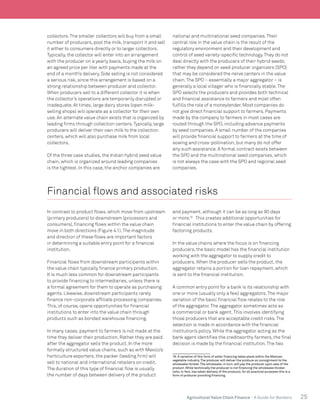
  • 12.
    6 Agricultural ValueChain Finance - A Guide for Bankers The value chain finance model presents a compelling business case given that it reduces information asymmetries it is and lowers transaction costs. If implemented wisely,VCF can be a profitable line of business for commercial banks. Reduced information asymmetries Information asymmetries are substantially reduced because the bank – through partnerships or contracts with value chain participants such as aggregators and processors – is able to utilize information that otherwise would have been unavailable or expensive to obtain.This information encompasses: • Agronomic technical/engineering knowledge of the crop(s) or livestock involved in the value chain encompassing yields, desirable practices, input demands, and timing of input delivery.The bank does not need to have in-house expertise to collect this information. It is merely enough to interact with the value chain participant who has that expertise and well-established business relationships with other participants (usually upstream). • Profiles of participants/customers engaged in the value chain, such as primary producers, small-scale traders and collectors, mid-level and wholesale aggregators, processors and exporters. • Region-specific and cultural factors, e.g., dominant local language, and customary trade relationships. • Market intelligence, including price behavior, market shares of different buyers, and input suppliers. Channeling loans for crop or livestock production through the buyers eliminates or reduces the need for the bank to have full information about all value chain participants. In fact, extensive due-diligence may be needed mainly at the outset of the relationship and will likely focus on the main buyer or buyers. There are a number of elements that need to be in place to drive a successful VCF experience, beginning with the existence of a structured process for the commodity and a clear understanding of participants and relationships. 1. THE BUSINESS CASE FOR VALUE CHAIN FINANCE Why diversifying into value chain finance makes business sense. Reduced credit risk through leveraging existing information inside the value chain. Information on where value is added along the chain – as well as the identification of key participants, intermediate and ultimate markets, and the nature of customer demand – helps financial institutions make better informed lending decisions. Substantially lowers transaction costs in lending and other services. Greater profitability is possible through economies of scale in market transactions and the provision of multiple financial services using value chain connections.
  • 13.
    7Agricultural Value ChainFinance - A Guide for Bankers There should be a large number (typically thousands) of producers, as well as traders (buyers) willing to set up long-term relationships with the producers. The bank should set out to engage key suppliers of farm inputs and verify the track record of aggregators and producers in honoring contracts. It also needs to ensure an availability of technological solutions to reduce transaction costs associated with service delivery. When all or most of these elements are present, then the specific commodity within the value chain is less relevant;it could range from grains, to tropical fruits or industrial crops. Reduced transaction costs Banks can see substantially lower transaction costs in delivering and servicing multiple financial products by relying upon the existing networks or transaction platforms of VCF partners. In some cases, financial institutions have created payment platforms around those existing relationships, allowing them to operate as if they had an extensive branch network but without the fixed costs of having established one.3 Connecting the bank with the lead buyer or trader in an already-established commercial relationship is a preferable starting point. Once this relationship is created and well understood, the bank can design and introduce financing vehicles priced to reflect the cost- sharing and risk-sharing arrangements between the bank and the value chain business partners. 3. The experiences of HDFC, India, and Yapi Kredi, Turkey, offer examples of these platforms in the dairy and the broiler industries, respectively. Bankaool, Mexico, and Habib Bank Ltd. (HBL) in Pakistan are also employing this model. It is also important to be able to deliver services up and down the chain in a cost-effective manner.While production financing can be achieved through the buyer, other services require a different delivery method.The choice of delivery mechanism becomes a decision between direct provision through bank branches,or the use of agent networks (e.g.,business correspondents)4 . The latter seems to be the preferred means for creating such a VCF platform.It not only allows better servicing of the VCF participants,it also makes the services available to other farmers or rural clients outside the value chain who reside or work within reach of the agents. 4. Business correspondents conduct business transactions, accept deposits and gather documents on behalf of the financial institution.
  • 14.
    8 Agricultural ValueChain Finance - A Guide for Bankers Multiple services expand bank business The benefits of an agent-based delivery network become more apparent when considering that farmers who have been able to receive financing from within the value chain tend to lose financial access once their produce is delivered,the loan is repaid and the surplus revenue to the producer is paid out.Smallholder farmers are more likely to benefit from financial inclusion (and remain active financial product consumers) if they have additional options,such as savings accounts, particularly if they can choose from among a few types of accounts that meet their needs and preferences (e.g., term deposits).That way,the farmers develop the ability to pay providers as needed or transfer funds to relatives through the financial institution.At the same time,those additional non-lending services bring additional revenue to the bank. Making the case Broadly speaking, there are two principal business case scenarios in support of a bank adopting a VCF approach to broadening its agriculture lending base: • Expanding the coverage of a value chain in which the bank already maintains some established business relationships (e.g., with an aggregator or processor) yet only limited outreach upstream to producers and input suppliers. • Establishing a presence in a value chain new to the bank’s portfolio, using market intelligence and research (such as that carried out by AgriFin and its selected partner banks).This could be initiated on a pilot basis within the bank’s existing standards (e.g., loan caps;see Chapter 6 below). In both scenarios, the bank will need to establish relationships using conventional banking techniques, i.e., dealing with each client individually. Illustrative internal proposals are outlined in Chapter 8. Regardless of the selected business case imperative, successful adoption of VCF hinges upon a clear understanding the target segment (based upon market intelligence and value chain mapping) and the identification of appropriate entry points and products. Of the field case studies considered here, the example from India has perhaps succeeded more than others in incorporating the various VCF components by analyzing incentives for the main key participants (farmers, seed producer organizers, and hybrid seed companies) and drawing conclusions about unsecured lending based on the information available inside the value chain. While the India study’s conclusion that such an approach requires a higher degree of supervision and therefore additional costs may be correct, it should be understood that those costs are shared across the value chain participants and do not necessarily accrue in full to the bank.This ability to defray loan transaction costs, including client screening and selection, monitoring and supervision, and loan recovery, is a key aspect of the business case for VCF. Of course, success of the VCF approach obviously requires an appreciation of its merits by members of the value chain in addition to the financial institution. In the three field case studies associated with this Guide, this would mean creating plausible business cases for seed production organizers in India5 , dairy collectors (and possibly larger collectors and small-scale processors) in Pakistan6 , and vegetable processors in Mexico7 . There is the principal argument that wider access to financing and financial services for the producers will generate more business for the upstream aggregators and processors, an expansion that they can support and accelerate through investment of the funds that they otherwise would have provided as loans to the producers. 5. HDFC Bank, AgriFin. 2015. Creating Value Chain Finance for Farmers – A Summary of HDFC’s Market Study on the Hybrid Seed Production Chains. World Bank. 6. HBL. 2015. Structure and Performance of the Dairy Value Chain in Pakistan – A Summary of HBL’s Case Study on the Dairy Value Chain in Pakistan. World Bank. 7. Bankaool, AgriFin. 2015. Selecting a Target Value Chain – A Summary of Bankaool’s Market Study on the Vegetable Value Chains in Mexico.
  • 15.
    9Agricultural Value ChainFinance - A Guide for Bankers The choice of a target value chain can be approached in one of two ways:by building upon existing business relationships within a value chain, or selecting a new value chain to expand the bank’s portfolio. In the case study from Mexico, Bankaool took the second approach as it sought to identify and rank new opportunities that fit their existing VCF business model and agribusiness banking practices.This involved developing a methodology to identify food industry sectors with characteristics similar to other segments in the bank’s existing portfolio, thereby requiring minimal adaptation of its business model. By contrast, India’s HDFC sought to deepen its understanding and presence in one sector in which it already operated – the seed industry – to identify new opportunities for value chain financing (see Box 2.1). 2. IDENTIFYING A TARGET VALUE CHAIN Where does the process begin? What is the basis for targeting a value chain for financial services? What criteria and indicators can help determine the health and viability of an existing value chain? This section outlines a procedure for identifying a target value chain through a selection process based on both quantitative and qualitative criteria. Commercial viability should be evaluated through a holistic perspective, taking into consideration industry growth, investment, fluctuations in price and production volume, variations in size of operations, and trends in international trade. Each value chain should also be assessed at the farm-level, considering annual growth in size of operation, yields (technology is often an important factor), value of production per growing unit, and the proportion of area planted that is ultimately harvested. Scores in each category can be tallied to compare and contrast value chains. The specific preferences and market orientation of the financial institution should be used in weighting these criteria as well other qualitative criteria, including the policy environment and structural changes in the market. Key success factors and risks associated with the selection process are highlighted.
  • 16.
    10 Agricultural ValueChain Finance - A Guide for Bankers In the Pakistan case study, the objective was to better understand the commercial relationships and structure of the dairy value chain in order to identify options for entry. In this case, the bank (HBL) had an initial understanding with a potential agribusiness partner, a large dairy processor (see Box 2.2). In the India and Pakistan cases, although the value chains had been previously selected, an important part of each analysis focused on the commercial nature and viability of the respective value chains. Each of the case studies reveals a slightly different motivation for value chain analysis. There is a recognized set of criteria that provides the basic building blocks for analysis in identifying a prospective value chain opportunity.The choice of criteria (which often is limited by both the availability and quality of the data) used in evaluating the viability and relative ranking of the agri-food industry sectors is also important for understanding the potential risks associated with financing the specific value chain. What follows is a summary of the main criteria and key factors in selecting a value chain. Box 2.1:Building upon existing relationships with HDFC in India Banks will often start a value chain targeting process based on information available from preexisting business relationships. HDFC in India was already working with seed companies and aggregators by the time it initiated research to identify specific seed value chains in an effort to extend the bank outreach upstream to producers. The following is an excerpt from HDFC’s presentation at the Istanbul AgriFin Forum 2015. Why the Seed Industry? In 2012 HDFC Bank came upon seed companies looking for payment solutions. Off-balance sheet transactions for advances made to seed organizers (aggregators) followed. The next logical step for the bank was to take credit to farmers but to do so it needed to select the best VCF partners within the seed industry. There was, therefore, a need for a deep understanding of the dynamics and processes of the industry. What followed was a joint HDFC-AgriFin market study that mapped the main hybrid seed production chains and that profiled the key participants. The bank has defined next steps to work with selected seed chains. Source:HDFC. AgriFin Forum 2015. Box 2.2:Partnering with large processors to pilot value chain interventions in Pakistan The significance of the dairy sector in Pakistan made it a logical choice for Habib Bank. (HBL) to design a pilot value chain intervention that leveraged the dominance of established major processors. The dairy sector accounts for (11 percent) of Pakistan’s GDP and is critically important to smallholders, who own close to 90 percent of the dairy cattle (with herd sizes of 3-5 animals per household). Therefore, while there was no process to identify a value chain as such, HBL still needed to gain a large volume of specific knowledge about dairy sector participants, paths to market, and the nature and terms of transactions. This extensive mapping exercise is outlined in the Chapter 3. Source:HBL. 2015.
  • 17.
    11Agricultural Value ChainFinance - A Guide for Bankers Commercial (quantitative) criteria The first step focuses on the commercial viability of the industry in which the value chain operates.Although this may seem obvious,it is often overlooked and is essential in determining a successful business proposition for value chain finance.8 The selection process takes on added significance in agricultural value chain finance where establishing long-term relationships and developing future clientele are important supplementary objectives for financial institutions. Commercial viability is assessed using the following criteria (see Annex B for greater detail): a. Growth in industry, measured by both the value and volume of production over a specific period of time. b. Investment in the industry, which is also an important indicator of how the market perceives the specific risks and potential of an industry. c. Price volatility and changes in production volume (adjusted for seasonality), which provide an indication of potential operational risks. d. Size (measured as the value of production), which can be used to determine the attractiveness of a specific industry. e. Trends in international trade.These provide an indication of both the potential and the vulnerability of an agri–food industry sector and can offer particularly relevant insight regarding value chain financing. f. Financial flows into the industry, as these provide insight into how the financial market views the specific industry. 8. The term “industry” is used here in a broad sense given that, depending on the particular market, it may refer to the farm activities, companies, and products within an entire country, or limited to a geographical region or sub-sector. Ranking the value chains can be done by using quantitative scores. When choosing between different value chains, the financial institution can use a scoring method that ranks the results each of the criteria listed above. In the Mexico case study, a scale of values was assigned to the results for each criterion (Box 2.3). As such, each value chain was measured against its peers. The results for each agri-food industry were then compared to determine the most attractive value chain for further analysis.The weighting process is largely subjective, both within each criterion and between the different criteria. Weighting can be adjusted to reflect the individual financial institution’s appetite for risk and/or specific market conditions.  
  • 18.
    12 Agricultural ValueChain Finance - A Guide for Bankers Box 2.3: The selection of the horticulture value chain in Mexico In order to identify the target value chain, both the commercial and production criteria were used. At the commercial level, the case study utilized four different criteria: 1. Growth in food industry value-added production between 2000-2013, measured in 2008 pesos. 2. Investment as a percentage of value of production for the period from 2009 to 2012. In this case the selection of the timeframe was limited by data availability. Percentages rather than absolute values were used so as to adjust for the various sizes of the different businesses, allowing for the subsequent relative ranking. 3. Volatility was calculated based on the value of monthly production for the period (again, limited by data availability) from 2007 to 2013. While volatility per se does not determine the viability of the value chain, it does provide an indication of the potential credit risk. 4. Size measured in the value of production was used to determine the attractiveness of the specific chain. Although size, in and of itself, does not indicate viability, it is felt that the larger the size of the chain, the greater the probability of applying Bankaool’s “commercial agents” VCF model. Since all of the criteria were measured in relative terms (instead of absolute), there was not an inherent bias toward large industries. At the producer level, two criteria were used: 1. Growth in area planted between 2000 and 2012 provided a measure of expanding value chains. The choice of 2012 as the end year reflected data limitations at the time of analysis. It must be noted that, while positive growth is important, contraction in planted area may actually indicate that there is consolidation occurring at the primary production level of the value chain. 2. Value of production per hectare between 2000 and 2012 offered a deeper insight into the potential viability of the primary production process. As Mexico’s food and agricultural sector typically runs a balance-of-trade deficit, the results of the previous exercise were compared with the trade balance for the food and agribusiness sector. A negative balance was viewed as suggesting a larger business risk, while a positive trade balance was believed to be associated with a smaller risk arising from imports (although it could also have signaled potential risks arising from the international market). The fruit and vegetable industries showed a long-term trade surplus, while trade in cereals had led to deficits. The results of each of the criteria were ordered and subsequently given a value running from zero for the bottom half, one for the third quartile, and two for the top quarter of the results for each criterion. Each criterion was given equal weight and the results summed for each of the four-digit food industry business categories. The results pointed to the horticulture industry as the most viable. To test the sensibility of the results, the weighting of the results was adjusted to place greater significance to the volatility and investment criteria. In this case the results were very similar, with the horticulture industry continuing to be ranked at the top. Source: Bankaool, 2015.
  • 19.
    13Agricultural Value ChainFinance - A Guide for Bankers Qualitative considerations Even though the value chains can be quantitatively ranked,the final selection process must take into consideration other factors that might have an impact on the attractiveness of the business proposition in relation to the value chain.Since value chain finance is often structured around developing long-term relationships as a strategy to mitigate risks and offer a wider range of financial products,the more important qualitative criteria are:1) the policy environment;and 2) structural changes taking place within the agri-food sector. Policy environment. Food and agriculture value chains often operate in highly politically-charged environments, both in developing countries as well as in the more developed nations. As a result, government policies and actions can impact both the attractiveness and the risk profile of the value chain. Accordingly, it is important to understand types of policy measures, any changes in government support, and their implications for the value chain. Relevant examples include input subsidies, price subsidies and price controls, credit subsidies, and consumer protection interventions (food availability and safety), among others. Structural change. The food and agricultural system is constantly evolving and structural changes having far- reaching implications for a financial institution’s value chain business propositions. One of the major recent changes, for example, has been an increase in the power of retailers, especially large national and multinational retail firms9 .Their concerns about quality, food safety, and traceability have driven the development of tighter value chains10 .To the extent, therefore, that large retailers take a greater share of the food market from the smaller retailers, the need for value chain financing may actually increase. 9. Reardon, T. and B. Minten. 2011.“Surprised by Supermarkets: Diffusion of Modern Food Retail in India,” Journal of Agribusiness in Developing and Emerging Economies 1(2). October: 134-161. 10. Tight value chains are those that are characterized by formal relationships, often through contracts, between chain participants. Contracts will not only refer to delivery and – possibly – pricing but also may include requirements for production practices. Technical assistance, marketing advice as well as financing may be provided. The India study identifies a number of structural issues affecting agriculture that deserve attention in the value chain identification process: 1. Rising labor costs 2. Increasing pressure on land use (from agriculture, housing, industrial, and mining sectors) 3. Growing energy costs and deficient energy infrastructure 4. Widely scattered pockets of demand, leading to high distribution costs.11 Another factor to consider is consolidation at the aggregator level.This increases opportunities for value chain financing and value chain products, even though in the short-term this may increase the risk profile of a value chain. 11. HDFC Bank. 2015. Creating Value Chain Finance for Farmers – A Summary of HDFC’s Case Study on the Hybrid Seed Value Chain. World Bank.
  • 20.
    14 Agricultural ValueChain Finance - A Guide for Bankers Key success factors There are key factors along the value chain that can influence successful engagement. While there is no single set of key success factors that apply across the board to all participants in the value chain, part of the process of selecting the target value chain involves identifying those factors that are relevant for the specific value chain in question.That is, what defines success in one industry, in one country is likely not the same for a different industry in another country. Some success factors are more conceptual in nature, such as economies of scale, while others may be highly quantifiable;e.g. market share. Likewise, some success factors can apply to the value chain environment as a whole, such as contract enforcement. To identify key success factors, it is necessary to look at successful businesses in the industry as well as business and market trends, not only in the country market, but also globally. Figure 2.1 offers an example in detailing the key success factors in the Brazilian poultry industry used by Rabobank Brazil.The extent to which the key success factors characterize the value chain and the participants will also define the attractiveness of selecting a particular value chain. It will also be a significant factor for determining risks across the value chain. Figure 2.1: Key success factors in the Brazilian poultry industry Source: Rabobank. AgriFin VCF Bootcamp, 2014. Input manufacturer Input distributor farmers Meat cos Retailers Consumers • Consolidation • Differentiation of products • Global presence • Social and environmental responsibility • Search for scale • Local business • Mecanization • Social and environmental responsibility • Consolidation • Private label • Differentiate & Specialize • Global presence • Safety and traceability • Sophistication • Convenience • Smaller portions • Universal • Maturation • Food safety • Social conscience
  • 21.
    15Agricultural Value ChainFinance - A Guide for Bankers Once the target value chain has been identified, an in- depth analysis that goes beyond the concepts included in a traditional credit application becomes imperative for evaluating credit worthiness and risk profile.The financial institution should “map” the value chain, identifying the participants, the links among them (both strong and weak), as well as the key players operating in the value chain. At the same time, the evaluation should identify those relationships that impact both product and credit flows.This takes on particular significance given that value chain finance facilitates the extension of formal banking operations to large numbers of small producers building upon existing internal linkages in the value chain. It is important to recognize that the relationships can be both formal and informal. Formal relationships are those that are grounded in a contract, spelling out obligations of the parties to the agreement. Formal agreements imply legal recourse for non-compliance. Informal agreements are built on an understanding between the participants of their obligations and responsibilities, which may or may not be in writing, and that typically has no formal recourse in case of non- compliance.These informal pacts are usually the result of an ongoing interaction and confidence between the participants in the value chain.This tends to be the way local moneylenders and first stage intermediaries or rural collectors operate. Established value chains rely on both formal contractual agreements and informal agreements among participants in the value chain. When engaging with small farmers, buyers may depend on informal relationships or, as is the case with the Indian hybrid seed value chain, companies will work through an intermediary (in that case, a seed production organizer) whose interaction with producers is largely based on informal relationships. Determining relations of resource controls (negotiating power) is another key objective in mapping the value 3. MAPPING THE VALUE CHAIN – MARKET INTELLIGENCE What are the primary participant types involved in the value chain approach? What is exchanged between participants? Are certain relationships stronger than others? Though the exact structure and organization varies considerably from value chain to value chain, we can identify four key participant types in each: input suppliers, producers, aggregators, and retailers/consumers. Mapping the interactions and relationships of these participants can provide a wealth of knowledge and confidence for a financial institution. Mapping of a value chain implies an understanding of the flows of products, finance, information, and services. This chapter explores the process of mapping and provides key insights from current case studies of how mapping knowledge can inform decision-making.
  • 22.
    16 Agricultural ValueChain Finance - A Guide for Bankers chain. Agricultural financing is often provided in-kind; buyers will supply inputs into the production process with the expectation that reimbursement will occur only upon delivery of production from farmers. Additionally, buyers will set production requirements and standards, which determine the type and levels of technology used in production. Understanding how information moves through the value chain is a key determinant of both the chain’s competitive position and inherent risk profile, as well as an indicator of power within the chain.This understanding must include the consumer market to reduce the credit risk from downstream market adjustments.12 The value chain is about market-focused collaboration among participants, hence mapping focuses primarily on the participants and their inter-relationships. This recognizes the importance for effective risk 12. For example, in the cut flower market for roses the dominant color for the end market changes practically from year to year. This means that the producer’s financial success is dependent on Information about the changing market dynamics. And the buyer power is partially based on the knowledge of what the market is demanding in terms of the colors of the flowers. management that the relationships between participants represent;particularly in environments where formal contracts are not the norm or where contract enforcement is weak. These concepts within the mapping stage should be understood as a supplement, rather than substitute, to the traditional analysis involved in credit decisions. These would include, among others, the competitive position (e.g. cost of production, competitors, etc.), potential risks and mitigation, and the chain’s product position in reference to the end consumer market.The mapping of the value chain not only strengthens the traditional analysis, but also supports the financial institution’s evaluation of the entry points in the value chain, as well as the potential financial products that can be offered to the participants along the value chain. Participants in the value chain – real flows (inputs and product) From the general categories of participants enunciated in the introductory chapter, four key participant types can be identified for mapping purposes along the value chains:1) input suppliers;2) producers;3) aggregators; and 4) retailers and consumers. Input suppliers. Traditionally, inputs into the production process have been sourced from separate, identifiable suppliers. For crop agriculture these often include, seed, fertilizer, and agrochemicals. As for animal agriculture, key inputs in the production process are feed ingredients, feeder stock, and medicine.The types of technology and their availability depend on the relations, including financing, between the supplier and producer. Often this does not ensure the most up-to- date technology or the lowest cost of credit.The result is higher input costs with the ensuing negative impact on margins and competitiveness. Furthermore, these relations are not focusing on or promoting aggregation of the financial process. Within the more structured value chains, the input supply function is changing from direct in-kind provision of inputs by aggregators (to reduce diversion), to aggregators entering into agreements with input suppliers to supply these to producers. Production parameters are also commonly specified in these aggregator-producer agreements. Depending on the role of the input in the production process, the aggregator may actually produce the input and/or enter into an alliance with a specialized firm to produce and supply it.This is the case in the Turkish poultry value chain, which is typical of many poultry value chains (Figure 3.1).The processor enters into formal agreements with breeders and growers.The breeder produces hatching eggs for the processor. In this portion of the value chain, the breeder is the input supplier.The transaction is commercial, i.e. the processor pays the breeder for the hatching eggs. In the next stage in the value chain, the processor will supply the inputs – day- old chicks – to the grower, as well as other inputs, such as vaccine and feed.The grower will deliver the grown chick – a broiler – to the processor in 45 to 50 days. The supply of inputs may itself be a context specific value chain, especially when it involves research and development (R&D), and biotechnology.The India case study is a good example of this evolution (Box 3.1).
  • 23.
    17Agricultural Value ChainFinance - A Guide for Bankers Figure 3.1: Turkish poultry value chain Source: Yapi Kredi. AgriFin VCF Bootcamp. Box 3.1 Research and development and biotechnology in input supply The India case study focused on the seed industry value chain. The case study found that,“the private sector seed industry underwent a transition following the Indian government’s focus on biotechnology research as a means of increasing agricultural production and was driven by trends in the domestic and world seed market. Intensifying international competition, increasing R&D costs, and the complexity of biotechnology have led to increased consolidation of the Indian seed industry with several of the large and medium companies merging or being taken over by multinational seed companies. India’s varied agro climatic conditions, abundant skilled and unskilled labor, are attracting several multination hybrid seed companies to India. Several large seed producers with deep pockets, both domestic and multinational, are hoping to buy financially strained or ‘technologically rich’ smaller firms with sizeable geographical reach and distinct product portfolio.” Source:HDFC. 2015. 15 24 3 Processor: Signs contracts with Breeders & Growers Broiler Breeder: Rears parent stock and produces hatching eggs during 65 weeks Processor: Delivers the broilers to factory for slaughtering & processing Processor: Delivers the eggs to his Hatchery for incubation. Produces chicks Broiler Grower: Raises the chicks to a Broilers in 45-50 days Processor: Delivers final products to retail (dealers) Payment to Breeder Payment to Grower (6 times in a year) Chick, fodder, vaccine, technical assistance, fuel for heating (sometimes) are supplied by Processor Parent stock, fodder, vaccine, technical assistance, fuel for heating (sometimes) are supplied by Processor Some of the Broiler processors also produce & sell animal fodder A CONTRACT CONTAINS: 1. Price for the Breeder/Grower 2. Quantity of production 3. Quality of production 4. Place of production 5. Services/Advances that will be given by the Manufacturer 6. Description for the Bonus/Penalty System 7. Time of delivery 8. Payment Method
  • 24.
    18 Agricultural ValueChain Finance - A Guide for Bankers Producers. At the producers’ level, mapping involves developing an understanding of their operations, and the first-level marketing structure, i.e., the producers’ relationship with the immediate purchaser(s) of their products. Optimally, this would include collecting information on farm size, average production, yields, yearly production variations, production costs, and prices received. Existing relations with input suppliers and aggregators should be identified, including both formal and informal arrangements, particularly if they impact the prices farmers receive. Given that the agricultural industry operates in an information economy, it is also important to identify market and technology information flows.The results of the mapping exercise should allow the financial institution to estimate the changes in costs and returns that may be possible with improved access to formal credit. Additionally, due to the extent of governmental support to agriculture in many countries, it is important to identify the types of support to producers in the value chain, including impacts and limitations. Markets throughout the developing world tend to be characterized by large numbers of small producers. In the Mexico horticultural case study, for example, practically 90 percent of the tomato producers operated on less than five hectares (Figure 3.2). Similarly, in the Mexican sugar industry practically 70 percent of cane growers cultivate less than five hectares. At the same time most of the farmers operate in an informal environment. In the Indian dairy industry, for example, 88 percent of the dairy producers are not part of a structured value chain, participating largely in the informal economy. An important advantage of value chain financing is that it represents a strategy for aggregating or scaling-up the activities of smallholder farmers, bringing them more deeply into the formal financial system and offering them the chance to improve farm productivity and income levels and to help increase food production.13 Scaling-up operations through value chain finance turns a money-losing proposition into a feasible business proposition. For example, HDFC in India estimated that it would take two years to reach break even financing medium-sized dairy operations through the value chain. For stand-alone, direct credit to the same producer, at the same interest rate, it would take four years to reach the break-even cost return ratio. Aggregators. Understanding the aggregator and identifying “anchor companies” are important aspects of analyzing the value chain (Box 3.2).The aggregator is defined as an agent that acquires the farmer’s production and is the primary vehicle for promoting small producer financing. Using this definition, the aggregator may be a farmer cooperative or farmer producer organization that receives and aggregates production from members for subsequent sale. In 13. HDFC, AgriFin. 2015. Creating Value Chain Finance for Smallholder Farmers - Summary of the Market Study Report of Indian Hybrid Seed Production Chains. 0% 20% 40% 60% 80% 100% Number farmers Production Large > 25Medium < 25Small < 10Micro < 5 Figure 3.2 Mexico tomato production: percent of producers and production by farm size (hectares) Source:Bankaool, 2015.
  • 25.
    19Agricultural Value ChainFinance - A Guide for Bankers this case, the aggregator takes possession but not ownership.The aggregator may be a distributor/ trader or processor that will turn around and sell the production to another buyer or aggregator.The number of aggregators in the market may be significant.The Pakistan case study identified the number of milk collectors at an estimated 300,000 agents, sometimes collecting as little as a bucket full of milk. Alternatively, farmers may be the final seller, as is the case in Mexico’s vegetable industry where retailers have established direct relationships with producers for delivery of their production. On the other hand, it is frequently the case that producers are “represented” by aggregators with regard to other downstream participants or a financial institution.The aggregator may be a company operating in the domestic market, or perhaps even in a foreign market. The relationship between the aggregator and the producer plays an integral part in defining the risk profile for value chain financing. Ultimately, the producer’s ability to repay a loan will, of course, depend on payment from the aggregator.The aggregator conversely depends on producers honoring their commitments to deliver their production. In many developing country markets, transactions are based on informal agreements.This was identified in the Pakistan case study on the dairy industry, which is characterized by unwritten, year-long agreements.The quality of the milk is based on trust, rather than laboratory analysis, with payments made on a monthly basis. Similarly, in the Mexican vegetable industry, trust based on long- term relationships is the operating norm since cross- border financing is used for harvesting and packing.14 In the India seed case study, the relationship is somewhat more complicated as seed companies depend on seed production organizers (SPO).The SPOs provide several services, including farmer selection, seed production management on behalf of the seed company, and technical and financial support to the farmers.The seed production process and the success of crops are heavily dependent on the technical inputs provided by the company and the organizer, as well as the financial assistance provided at the appropriate time.The SPO was found to be a nerve center in the value chain.The majority of payments made by the company to farmers are routed through the SPO, which often also fulfilled the role of a moneylender.The SPO is generally a local villager who is financially stable. From a banker’s perspective, this is a relatively safe avenue for extending collateral-based agriculture credit, as the SPO is usually a landowner with diversified sources of income.The nature of the transactions between the SPOs and the seed farmers depend largely on informal relationships. With multinational seed companies, transactions are based on formal contracts whereas these are scarcer when considering regional and national Indian companies. 14. HBL/AgriFin. Structure and Performance of the Dairy Value Chain in Pakistan. Implications for Value Chain Finance. Draft June 2015. Box 3.2. What defines an anchor company? What makes a firm an “anchor company” in a value chain? Anchor companies are the prominent companies in the value chain that drive the volume of production and value-added products. The value chain mapping should seek to highlight prominent companies in the value chain by a number of criteria: 1. Market share in final product 2. Market share in critical intermediate outputs 3. Number of suppliers as a proportion of total producers 4. Stability of supplier relationships (e.g., percent of repeat suppliers each season) 5. Financial performance and credit rating Where there are several companies active in the area in which the bank operates, the mapping exercise should build a score for each company using all five criteria, to facilitate comparisons and to define negotiating approaches as needed. In the extreme case in which there is only one anchor firm present in the bank’s field of operations, the criteria addressing stability of supply and financial performance/credit rating should be the key determinants of whether to engage in a formal partnership with the anchor firm.
  • 26.
    20 Agricultural ValueChain Finance - A Guide for Bankers Where the aggregator is an intermediary or trader, the credit risk exists not only between the producer and the aggregator but also between the aggregator and the client. In fact, the weak point in the value chain may actually lay in the transactions between the aggregator and its client.This is often overlooked in credit analysis, and when mapping the relationships in the value chain. It is the aggregator that often performs the role as the anchor company.That is, they represent the point of contact, or entry point, between the financial institution and the value chain in general and, in particular, the farmers.Typically, the aggregator/anchor company or farmer organization has a preexisting relationship with the financial institution, which can be leveraged through a value chain financing strategy.This is of particular importance since the ongoing financial relationship helps to validate, at least partially, the financial viability of the value chain. At the same time, the aggregator can undertake the role of a financial agent for the financial institution and/or even provide a first loss guarantee (i.e., a secondary source of repayment), thereby partially sharing the risk involved in the financial operation. End-market participants. A common mistake by financial institutions is to make a credit decision solely on the basis of production and productivity. An important part of reducing risk is that the mapping of the value chain should identify the participants and the role they play as well as what is happening at the consumer level.This is especially important when the market is situated partially or entirely outside the country.In the Mexico case study,for example, it is estimated that 45 percent of 2013 production was exported,up from 34 percent in 2000.Greenhouse production was a significant contributor to this growth, as the area in greenhouse production went from approximately 9,000 hectares to 30,000 hectares over the same period.A key driver for the growth in greenhouse area was an increase in consumer demand and premium prices for greenhouse produce in the U.S.market (which receives 90 percent of Mexico’s vegetable exports). The agri-food system has evolved from being production- oriented to one that is demand-focused.In the Mexican vegetable industry,for example,it is estimated that supermarkets account for 27 percent of the vegetables purchased by consumers.With the supermarket segment dominated by a relatively small number of retailers, this suggests that only a few retailers control almost a quarter of the Mexican domestic vegetable market. The consumer market for food is rapidly changing, reflecting a greater focus on health and concerns about the impact of food production on the environment. Accordingly,profitability and credit risk hinge to far greater extent on the ability to meet changing market tastes and demands.For example,another factor stimulating the growth of greenhouse production in Mexico is its ability to ensure the quality (i.e.,food safety) of produce.In the Turkish poultry industry,market demands directly influence the decision by the processor as to which breed of chickens to provide to the grower. Changes in the agri-food system has shifted power to those participants in the value chain that are closest to the final consumer. At the same time, many markets have seen consolidation at the retail, trader, and food service levels, further enhancing their power in the value chain. As highlighted above, retailers (particularly large retailers) will buy directly from producers to ensure that they have products that meet consumer demand. However, even when retailers buy directly from producers they will not typically provide financing or technical support. Instead, they often set standards that must be met for the products that they purchase. In the Mexican vegetable industry, where technical support and financing from retailers is uncommon, large retailers have begun to provide contracts to large suppliers. Notably, this type of arrangement has been limited to cross-border transactions between U.S. retailers and Mexican export producers. Financial flows – intra- and extra-value chain transactions Mapping of the value chain not only focuses on the participants and the product flow but also on the sources of financing inside and outside the value chain. As indicated, formal bank financing for smallholder farmers is frequently absent. In some cases, it is the input supplier or the aggregator that supplies credit to these producers, while local moneylenders are often the main source of financing. Mapping the financial flows, while pairing them with the product flows and participants in the value chain, represents an important tool for recognizing risks and identifying potential entry points for financial institutions.
  • 27.
    21Agricultural Value ChainFinance - A Guide for Bankers During the field research associated with the value chain mapping, creating a profile (however approximate) of financial flows for each main participant in the value chain is crucial to understanding the potential demand for financial products a bank may be able to offer.These profiles could be based on field surveys of a sample of participants, as was done in India for the seed value chain, or on key-informant interviews, which were used in Pakistan and Mexico. The weak links. As indicated throughout this chapter, mapping the value chain provides important insights into the risk points or weak links within an industry. The mapping not only looks at the relationship between the participants but the numbers of participants and their impact on the business proposition of the value chain. For example, an important criterion in successful value chain financing is the ability to dilute risk. As such, when working with an aggregator the number of farmers must be large enough so that non-repayment by a single or even a small number of farmers will not seriously damage the quality of the transaction. Besides the nature of the transactions between the aggregator and its clients, the other areas of vulnerability are extra-value chain transactions in which the supplier fails to sell or deliver the product to the aggregator (known as side selling).This is a risk to the aggregators with clear implications for the recuperation of credit. In some cases, this risk can be addressed by having no other aggregators in the operating area and/or the setting of extremely high transportation costs, resulting in a cash loss to the producer. Supply contracts are not a particularly attractive option given the costs involved in establishing a large quantity of contracts with many small farmers who are outside the formal market system. Informal agreements among aggregators to respect the each other’s suppliers in the Mexican vegetable industry have been reported. However, since these agreements are informal, and might be considered to be collusive, they are hardly enforceable. Once again, the quality and understanding of the relationship between the aggregator and the supplier becomes crucial for compliance and risk mitigation. Risks across the value chain The final piece in the mapping process involves identifying the risks inherent in the value chain and understanding their implications for the financial institution’s value chain business opportunities.Among the more important risk categories that financial institutions should consider for selection of the target value chain,in addition to the political and structural risks discussed above,are:1) production-level risks;2) side-selling risk 3) aggregator risks;4) downstream market-level risks;5) client-level risks;and (6) reputation risks.15 Primary production level risks. Production-related risks include changes in both expected output and product prices.They typically stem from weather effects, disease or insects, food safety scares or changes in the international market environment. Many of these can be mitigated through risk management products, such as crop insurance. Understanding what steps a producer can take to mitigate price risk is important in selecting a value chain. Sophisticated instruments, such as derivatives, are usually beyond the reach of smallholder farmers (or most farmers, for that matter) but may be an option for large aggregators or processors downstream. 15. Standard credit risk assessment may also be modified when dealing with VCF lending. See Chapter 6. Side-selling risks. Side selling, in which suppliers fail to honor delivery commitments to the aggregator or the processor and therefore imperil loan repayment, is a significant risk.To the extent that there is a high level of competition (a large number of buyers), the risk of side selling increases. Given that formal contracts might not exist or might be unenforceable, past experience or track record with regard to honoring delivery commitments provides an indication of the extent of financial risk. Hence, gathering existing information on past transactions in a manageable, useable way is of high value for the stability of the value chain finance relationship. Aggregator risk. While primary production risks and producer creditworthiness are important, the weakest link in value chain finance may in fact be the aggregator. The financial institution’s business model and the aggregator’s primary interest and standard operating procedures should be aligned with the market. Similarly, when the aggregator has a commitment to provide inputs to producers, risks include not only failure to deliver but also delayed delivery.This is particularly important given that delayed delivery of inputs may result, for example, in extemporaneous planting by farmers, impacting negatively on productivity. Similarly, there is the risk that the aggregator may not comply
  • 28.
    22 Agricultural ValueChain Finance - A Guide for Bankers with the agreement to acquire farm production in its entirety or in the agreed-upon proportion. At the same time, delay in payment to producers increases the financial risk, particularly when unsecured credit is provided to producers. When the aggregator assumes a commitment in the credit delivery or recovery process, credit risk relies to a large extent upon aggregator performance. Downstream market-level risk.There are three types of downstream market risks:compliance risk;competitive risk;and management risk.Many of the risks that exist between aggregators and producers also arise as the aggregator sells or moves product downstream,be it processed or not.These include payment and contract compliance,among others.In fact,the true risk in the value chain may reside with the aggregator’s buyer. The second source of risk has to do with competition in the market.The more sellers there are,the greater the competition and,subsequently,the greater the market risk related to the specific aggregator.Similarly, the existence of imports and/or similar-type products impacts the competitive environment.Finally,there is the ability of the participants to deal with market-related developments.For example,market risk is heightened where there is a marked seasonality of production and/or demand.Here,effective inventory management becomes important in controlling market risk. Systemic risk/systemic default. Most value chains are by nature subject to covariance risks, usually associated with weather phenomena, or pests/diseases (e.g., coffee rust in Latin America) that affect the chain’s base commodity. Market developments, such as price fluctuations may also create conditions for widespread/ systemic failures that will result in systemic default. A common related aggravating factor is government intervention through debt relief or forgiveness, which, while alleviating the effects for farmers, makes the effects on financial service providers even more significant. An obvious mitigation for weather related systemic risk (drought, floods) is geographic diversification. Indeed, the two partner banks that had already selected a value chain had used geographic diversification of hybrid seed production (HDFC, India) and dairy production (HBL, Pakistan) as a risk-reducing criterion. Portfolio diversification and specific-crops lending caps are commonly used for the coffee-rust type risk, where disease damage occurs across different geographies. Price-related systemic default is usually more predictable, and its mitigation can take advantage of hedging and insurance instruments (if available), in addition to diversification to other value chains. Client-level risks. At the client level (e.g., large aggregator or processor), typically the financial institution looks at the client’s financial situation, concentrating on cash flow criteria.These include: • Liquidity, which shows how the amount of assets that can be converted into cash compares to payables within the year, with a minimum ratio of 1; • Leverage of cash flow, which considers how debt (bank, supplier, or land) compares to sales and to operating cash flow (using a conservative scenario of a maximum of 60 percent of net sales and debt less than three-times earnings before interest, taxes, depreciation, and amortization); • Payment capacity, which evaluates the relationship between expected operating cash compared to debt service (interest plus installments), with a minimum of 1:2; • Solvency, which reveals how total debt compares to total assets, looking for a maximum ratio of 40 percent. At the client level, the financial institution often fails to look at the adequacy of the financial operations. Reputation risks. Reputation risk in value chain finance may emerge in different ways. If, for example, a bank is financing an aggregator who in turn exercises bad practices with the upstream customers (farmers), the bank will get negative publicity and, possibly, regulatory attention. As such, due diligence by the bank on the different partners it may have in the value chain is important. If, for example, the bank is extending non- lending services to value chain customers, compliance with “know your client” requirements – even for small farmers – will be important to protect the bank’s reputation.
  • 29.
    23Agricultural Value ChainFinance - A Guide for Bankers Organizational structure The organization of the value chain provides an indication of where the financial institution should place its emphasis in developing products for value chain products.There are essentially four organizational structures for value chains, each with its own rationale, opportunities and risks.These organizational structures are summarized in Table 4.1 in order of significance as entry points for financial institutions. A comprehensive description is included in Annex C. 4. ENTRY POINTS FOR FINANCIAL INSTITUTIONS How are value chains organized? How can financial products be designed according to the value chain structures? What can flows of finance and product in the value chain tell us about potential financing opportunities and risk mitigation? Financial institutions evaluating entry points into a value chain should consider: 1) the organizational structure of the value chain; 2) financial flows with the associated risks; and 3) key players, lead firms. When looking at an entry point, there are important considerations beyond financial performance when determining the key participants. Financial institutions should look for leaders in the field and participants with positive relations with other actors in the chain, especially producers.
  • 30.
    24 Agricultural ValueChain Finance - A Guide for Bankers Value chain type Main features Key factors for banks to consider in assessment of potential partners Leading firm- coordinated value chains Value chains where there is one firm or only few companies downstream that constitute the “ultimate buyer” or “super aggregator.” Typical examples of lead firms are found in industrial crops such as sugar cane, cotton, palm oil, and breweries. Lead companies tend to be retailers, large processors, and export- oriented food businesses. Perhaps the best examples of anchor or lead firms are found in the broiler industry (see Annex C). • Strength, organizational and financial • Strength, reliability of upstream contracts (with aggregators, with producers, if applicable) • Solvency and reliability of aggregators involved Value chains centered on aggregators This value chain structure is centered on buyers of agricultural products. They may be: a) local traders who will bundle products for onward sale into the domestic market; b) commodity traders, which can either be local or multinational firms, that intend to sell primarily into the export markets; c) processors who require farmer production as a key input; d) wholesalers who specialize in the product or rely upon the product for a significant portion of their product mix; or e) retailers who have special needs for the product. • Information aggregators hold about producers • Ability of aggregators to share in lending administration costs • Solvency and reliability of aggregators Value chains centered around producer organizations Value chains developed around farmer-based organizations (FBOs) established with the purpose of marketing members’ production, among other objectives. The marketing objective is generally to obtain higher prices for their members through joint selling and/ or coordinating market access. In terms of legal status, these organizations may be farmer cooperatives or (registered) producer associations. • Information FBOs manage about producers • Ability of FBOs to share in lending administration costs • Solvency and reliability of FBOs • Governance and management of FBOs Value chains driven by outside “facilitator” organizations Where there is a concern for rural development, financial inclusion, or other social and policy objectives, governments as well as non-governmental organizations will facilitate the organization of value chains as part of a strategy used in achieving these objectives. • Ability of facilitator to provide credit guarantees • Exit strategy of facilitator Table 4.1 Value chain organizational structures Examples and lessons from the case studies As mentioned earlier, within an industry there may be more than one value chain, defined as a path from producer to consumer. Frequently, small farmers operate in a value chain in ways that differ from large producers. Similarly, there may be different organizational structures of the same value chain across different regions in the same country;or the organizational structure may be influenced by the nature of the end market. In the Mexico horticulture study, for example, large producers in the country’s northwest that are focused on the export market are organized in a “leading firm-coordinated value chain”. In fact, in a number of cases the largest producers frequently are the leading firm. Produce is typically sold through a contract or on consignment. Production financing is sourced through commercial banks, supplemented by financing from wholesalers for use in harvesting and packing. In some cases, the producer has become integrated downstream, assuming the role of wholesaler to serve the U.S. market. In contrast, Mexican small farms producing for the domestic market operate in a value chain centered on aggregators, and financing largely comes from local moneylenders. Farmers will generally sell to local collectors, who will take the produce to a wholesale market.The local collectors tend to be small business operators;they often do not provide financing, and will pay producers only after they sell the produce. The Pakistan dairy study identifies a large number of paths to market within the overall value chain, beginning with the relationship between milk collectors and small producers. Approximately 90 percent of the marketed milk in the country is channeled through milk
  • 31.
    25Agricultural Value ChainFinance - A Guide for Bankers collectors.The smaller collectors will buy from a small number of producers, pool the milk, transport it and sell it either to consumers directly or to larger collectors. Typically, the collector will enter into an arrangement with the producer on a yearly basis, buying the milk on an agreed price per liter with payments made at the end of a month’s delivery. Side selling is not considered a serious risk, since this arrangement is based on a strong relationship between producer and collector. When producers sell to a different collector it is when the collector’s operations are temporarily disrupted or inadequate. At times, large dairy stores (open milk- selling shops) will operate as a collector for their own use. An alternate value chain exists that is organized by leading firms through collection centers.Typically, large producers will deliver their own milk to the collection centers, which will also purchase milk from local collectors. Of the three case studies, the Indian hybrid seed value chain, which is organized around leading companies is the tightest. In this case, the anchor companies are national and multinational seed companies.Their central role in the value chain is the result of the regulatory environment and their development and control of seed variety-specific technology.They do not deal directly with the producers of their hybrid seeds; rather they depend on seed producer organizers (SPO) that may be considered the nerve centers in the value chain.The SPO – essentially a major aggregator – is generally a local villager who is financially stable.The SPO selects the producers and provides both technical and financial assistance to farmers and most often fulfills the role of a moneylender. Most companies do not give direct financial support to farmers. Payments made by the company to farmers in most cases are routed through the SPO, including advance payments by seed companies. A small number of the companies will provide financial support to farmers at the time of sowing and cross-pollination, but many do not offer any such assistance. A formal contract exists between the SPO and the multinational seed companies, which is not always the case with the SPO and regional seed companies. Financial flows and associated risks In contrast to product flows, which move from upstream (primary producers) to downstream (processors and consumers), financing flows within the value chain move in both directions (Figure 4.1).The magnitude and direction of these flows are important factors in determining a suitable entry point for a financial institution. Financial flows from downstream participants within the value chain typically finance primary production. It is much less common for downstream participants to provide financing to intermediaries, unless there is a formal agreement for them to operate as purchasing agents. Likewise, downstream participants rarely finance non-corporate affiliate processing companies. This, of course, opens opportunities for financial institutions to enter into the value chain through products such as bonded warehouse financing. In many cases, payment to farmers is not made at the time they deliver their production. Rather they are paid after the aggregator sells the product. In the more formally structured value chains, such as with Mexico’s horticulture exporters, the packer (leading firm) will sell to national and international retailers on credit. The duration of this type of financial flow is usually the number of days between delivery of the product and payment, although it can be as long as 90 days or more.16 This creates additional opportunities for financial institutions to enter the value chain by offering factoring products. In the value chains where the focus is on financing producers, the basic model has the financial institution working with the aggregator to supply credit to producers. When the producer sells the product, the aggregator retains a portion for loan repayment, which is sent to the financial institution. A common entry point for a bank is its relationship with one or more (usually only a few) aggregators.The major variation of the basic financial flow relates to the role of the aggregator.The aggregator sometimes acts as a commercial or bank agent.This involves identifying those producers that are acceptable credit risks.The selection is made in accordance with the financial institution’s policy. While the aggregator acting as the bank agent identifies the creditworthy farmers, the final decision is made by the financial institution.The two 16. A variation of this form of seller financing takes place within the Mexican vegetable industry. The producer will deliver the produce on consignment to the wholesaler/broker. The wholesaler, in turn, will pay the producer upon sale of the product. While technically the producer is not financing the wholesaler/broker (who, in fact, has taken delivery of the produce), for all practical purposes this is a form of producer providing financing.
  • 32.
    26 Agricultural ValueChain Finance - A Guide for Bankers banks financing sugar producers in Mexico (Bankaool and Finterra) rely on a pre-established list of criteria to make the final decision. Among the criteria is size of operation, credit history, and average yields. A similar scheme for financing dairy producers existed in Pakistan.The country’s largest public bank providing agricultural credit entered into a strategic partnership with a major aggregator, Nestlé, to provide credit to dairy farmers.The farmers in Pakistan were identified by Nestlé, while the lending instructions and guidelines were provided by the State Bank of Pakistan, an approach that stands in contrast with the Mexico case. When functioning as a commission agent, the aggregator will also collect the necessary documentation, which is usually forwarded to the financial institution.This reflects bank policy as well as regulatory requirements.The financial institution will typically pay the aggregator for performing these services.The payment typically is not a fixed amount, but rather is set according to the financial institution’s perception of the aggregator and the quality and amount of work required. The aggregator sometimes will provide a guarantee (a first-loss guarantee) to the financial institution.The size of the first-loss guarantee is negotiated and set according to the financial institution’s assessment of the aggregator and an appreciation of the risk.This negotiation is usually part of a broader agreement between the bank and the aggregator that includes the loan terms and the commission for administering the lending to producers (see Chapter 6). In the cases from Mexico and Pakistan, government programs provided additional guarantees. In Mexico, financial institutions are able to rediscount loans through a government trust fund. Occasionally, the aggregator acting as a commercial agent will deliver the financing to the producers. In the Indian seed value chain, the collectors provide technical assistance in addition to dispersing financing sourced from the seed companies. Figure 4.1: Financial flows within the value chain Source:AgriFin VCF Bootcamp, 2014. Financial Products Working capital Production & Consumption loans Working capital Warehouse finance Working capital Equipment finance & leasing Factoring Factoring Warehouse financing Equipment leasing Risk Medium High Medium Low Low Need Medium High High Medium Medium Type Formal Informal Informal Formal/contract Formal/contract Input supply Agricultural production Trading & logistics Processing Distribution & Retailing Financial flows: production, working capital, leasing, etc. Financial flows: credit sales, factoring Food & Ag Product flows
  • 33.
    27Agricultural Value ChainFinance - A Guide for Bankers Key players A common strategy for financial institutions is to enter a value chain business through a key player or lead/ anchor company in the value chain.Three criteria are commonly used by financial institutions to select the leading player: Strong financial performance. Staying power and financial responsibility provide an element of confidence, indicating that the leading player understands and successfully manages its role in the market and meets its financial commitments. Sound financial performance also suggests that the leading player is adept at managing risks within the agri-food system.This takes on added importance when the leading player assumes the role of credit distributer, or provides a guarantee, such as a first-loss guarantee. Leading role in the value chain. The food and agricultural markets are dynamic. New technologies, policy adjustments, consolidation and changing consumer preferences, among others, drive their evolution. Leading players are able to recognize changes, adjust their business model, and transmit these changes to other participants in the value chain, bolstering the value chain’s sustainability. Close to producers. As pointed out above, demand for credit is generally strongest at the producer level. Working with a leading player that is close to producers is positive for financial institutions and makes the greatest use of information available. Being close to producers suggests more than merely performing as an aggregator;it implies deep understanding of the production process and strong relationships based on trust with producers. All three criteria where evident among the characteristics of key players in the case studies of various value chains. In the Indian hybrid seed value chain, the SPOs are generally local villagers who are financially stable and many have a degree in agriculture. In the Pakistan case, the collectors as a whole are responsible for 90 percent of the marketed milk in the country. Collectors, however, vary in scale and market coverage, from small-scale collectors (known locally as “khatcha doddis”) carrying milk cans on motorcycles and collecting from small producers, to large trucks serving sizeable dairy farmers.They are also close to producers, with commercial dealings based on strong relationships with the farmers. In Mexico, the sugar cane value chain is structured around the sugar mills.The banks only work with those mills that are financially sound.The banks are able to leverage the mills’ relationships with the growers, who number in the hundreds for every mill. In the case studies, the primary entry point was a leading firm, or a small number of large aggregators. The initial financial product in the case studies was credit to farmers, based on a strategy using aggregators or key players to reduce risks as well as lower delivery costs.Value chain finance, however, is a holistic and encompassing framework touching on all the links in the chain of activities, from the primary producer to the consumer. What this implies is that credit to farmers is not the only product that can be offered to value chain participants (Figure 4.2). Similarly, a number of financial institutions that have been studied have indicated that they plan to leverage interest in their loan products to eventually offer additional tailored finance products, further incorporating farmers into the formal credit market. For example, some banks, like HDFC Bank in India, started by offering dairy processors a payment platform to facilitate payments to their suppliers. This involved setting up deposit accounts with several thousand dairy producers and linking the accounts to the processor’s payment platform. Over time, with a better understanding of how the dairy value chain functioned and the behaviors of the milk collectors and producers, HDFC was able to offer cow loans, first loss guarantees, and insurance products. The following chapter covers value chain financial products in detail.
  • 34.
    28 Agricultural ValueChain Finance - A Guide for Bankers Figure 4.2: Cross-selling and tailoring products to the value chain Source:AgriFin VCF Bootcamp, 2014. 15 24 3 Processor: Signs contracts with Breeder & Grower Broiler Breeder: Rears parent stock and produces hatching eggs during 65 weeks Processor: Deliver the broiler to factory for slaughtering & processing Processor: Deliver the egg to his Hatchery for incubation. Produces chick Broiler Grower: Raise the chick to a Broiler in 45-50 days Dealer: Sell the final product in retail Payment to Breeder Payment to Grower (6 times in a year) • Bank loan for the rest of inputs of breeders • Submits «assignment of receivables» to the Bank (as a collateral) • Can give his henhouses as a mortgage, if he wants investment loan Bank products for dealers (DDS, L/G, POS, Chequebook) Payments done by Bank Payments done by Bank Agri Card for his fodder business • Loan for inputs of growers/breeders • Guarantee to pay broilers from the Bank • Guarantee to confirm the assignment of claims of the Farmer • Payroll from the Bank • L/C if any import exists • Loan for the rest of inputs • Submits «assignment of receivables» to the Bank (as a collateral) • Can present henhouses as mortgage, if he wants investment loan
  • 35.
    29Agricultural Value ChainFinance - A Guide for Bankers 5. VALUE CHAIN FINANCIAL PRODUCTS What differentiates value chain financial products? When should value chain products be used? The value chain financing model reflects the increasingly complex agribusiness market, encompassing financial products that respond to client needs, the operational environment, and the evolution of the value chain. ­Value chain products can be grouped into five different categories, each responding to the particular needs of the client and the value chain: 1) product-linked financing; 2) receivables financing; 3) physical asset collateralization; 4) risk mitigation products; and 5) structured financing. The applicability and attractiveness of these products will depend on the operating environment and legal systems, particularly contract enforcement, in which both the financial institutions and value chain clients operate. Figure 5.1: Value chain finance products Source:Miller and Jones, 2010. Off-Taker Processor Wholesaler/Retailer Financial Institution Farmer Equipment Purchase Contract Factoring Warehouse Receipt Financing Production Credit Lease Contract Transfer of Lease Payments Long-term (raw materials) supply contract
  • 36.
    30 Agricultural ValueChain Finance - A Guide for Bankers Once established, the value chain relationship gives the bank opportunities to extend conventional loan products and services to all parties in the chain. Most of the financial products outlined here are familiar to bankers, and so require only a brief description. The emphasis is on their relevance to a value chain financing approach (Figure 5.1). A more extensive description of each product is included in Annex C. Product-linked financing These are products that directly relate to financing production as well as the aggregator and processing or marketing company for the purpose of acquiring farmer’s production.In this case,the aggregator uses financing or advance payments to producers as a way to secure product.Essentially,this works to deleverage the aggregator’s supply risk.This can allow the aggregator to guarantee or even formally contract downstream sales. Banks should structure the financial product to attract a significant number of farmers, ensuring it can defray repayment risk by limiting the potential impact from a default of individual or small groups of producers. Further, the smaller the value chain (in terms of number of farmer participants), the more bank oversight is required. By working with an aggregator (also referred within the industry to as an aggregator/off-taker), financial institutions are able to penetrate further upstream in the value chain to offer financial services to smallholder farmers.The commercial relationship between the off-taker/aggregator varies according to the financial institution’s objectives and the structure of the value chain. In the Indian dairy and Mexican sugar cases, the aggregator also assumed the role of the bank’s agent. In the Mexican case, the credit is documented with the individual farmer.The sugar mill (the aggregator in this case), undertakes a number of operational functions (i.e. identifying the farmer, preparing the documentation, and supervision). For this, the financial institution pays the mill a commission for their involvement.Through this arrangement, the financial institution has turned what would have been a fixed cost structure into a variable cost structure. Receivables financing These products are largely used as a means for providing working capital to aggregators, marketing companies, and processors.They include bill discounting, factoring, and forfaiting (the purchase of receivables from an exporter, for a margin). Although all three products revolve around the conversion of receivables, they differ in their method of managing risk and collection payments. Receivables can also be structured as collateral. In a well-established VCF operation, farmers should be able to benefit from this form of financing to the extent that their contracts with aggregators are recognized as equally enforceable as with receivables further downstream. Physical asset collateralization These financial products rely on a physical asset as a guarantee or collateral.The two most common products, warehouse receipts and repurchase agreements, are used largely for working capital. Financial leasing, by contrast, involves the use of an asset over a fixed period of time, after which the client may or may not eventually take ownership. As with the other value chain products, the legal system has to recognize the rights and obligations inherent in the control of the assets as a precondition for the development and use of these products. Additionally, there should be a known market for pricing the assets (mark-to-market), as well as a fairly liquid resale market for the assets. For agricultural commodities and foods, the markets should also reflect the types and grades used commercially for the assets under control.
  • 37.
    31Agricultural Value ChainFinance - A Guide for Bankers Risk mitigation products These are financial products used to reduce risk by transferring it to a third party.This is achieved through the use of insurance, futures, and forward contracts. For the financial institution, risk mitigation products are particularly attractive as they can be offered to participants across the entire value chain.The role that financial institutions play varies depending on both an institution’s structure and the regulations in the country in which it operates. As a result, financial institutions may acquire the risk directly or through a subsidiary, or alternatively sell part of the risk to a specialized company or broker. In some instances or products, the financial institution’s role will be limited to providing financing for the operation. Structured financing These are specialized products that facilitate and deepen financial availability, frequently involving third parties outside the value chain. Of these products, the most common for primary producers are loan guarantees. In this case, a third party will provide a guarantee to the lender, shifting the risk (partially or wholly) from the primary producer to the third party.The assumption is that the third party guarantor represents less of a risk than that of the primary producer.The third party will charge the producer a fee for the guarantee. The producer is willing to pay the fee when it is required in order for banks to grant them a loan. The option of paying a fee is also attractive when this results in a lower cost of credit.The third party can be a private firm or even a government institution. In fact, governments (e.g., Mexico) have used this as a policy instrument to entice financial institutions to lend to agriculture. Cross-selling Cross-selling is the selling of more than one financial product to an individual client, or, in the case of value chain finance, to multiple value chain participants. This should be an important part of a financial institution’s business strategy, turning a potentially attractive business into a highly valuable one.The business strategy of value chain financing, as such, is to focus on the entire value chain, identifying or creating opportunities for selling multiple products that satisfy the value chain’s financial needs, while further enhancing the financial institution’s bottom line. Typical products and services that banks cross sell include: payroll and supplier payments, credit cards, short to medium term loans, insurance, letters of credit.
  • 38.
    32 Agricultural ValueChain Finance - A Guide for Bankers The observed reluctance among banks to lend to agriculture and especially to small farmers is based on the perception that agriculture is a high-risk business, and that smallholder farmers represent a high cost per client, with small returns. Essentially, banks have tended to avoid the majority of this market segment because it is not seen as a viable business proposition. When banks have financed small farmers, they often rely on government programs to limit repayment risks and reduce costs. Even these programs have had limited success because they fail to address the banks’ fundamental structural concerns when building a sustainable business model for financing agriculture. As the HDFC Bank in India has commented:“Smallholder farms require markets, credit, inputs, and advice to improve productivity and income levels. Standalone credit is not enough. Standalone credit to smallholder farmers is not viable or sustainable.” 17 17. HDFC Bank. 2015. White Paper: Supply Chain Tool Kit, unpublished. Value chain financing, however, represents a viable alternative business model for financing agriculture. By focusing on the entire value chain, it addresses financial institutions’ basic concerns and redefines the risk-return assumption. Chapter 3 addressed risk factors across the value chain and these are revisited in further detail here in order to explain how the financial institution can manage those risks.The emphasis here is upon those aspects that are particular to the value chain approach, since most other factors in pricing and risk management are well within the domain of conventional commercial banking. 6. RISK MANAGEMENT, COSTS AND RETURNS How does value chain financing impact risk? What procedures should be in place for effective monitoring? Partnering with aggregators or commission agents in value chain financing creates opportunities for risk- and cost-sharing mechanisms in which banks and their partners can negotiate mutually beneficial terms that would not be available in conventional lending. Nonetheless, it is still important for financial institutions to perform due diligence and have proper monitoring mechanisms. When assessing the reliability of aggregators or commission agents, necessary attributes include: (a) evidence of a process and capacity to manage the collection and distribution functions within the chain; (b) access to accurate data and farmer profiles; and (c) stable finances. Financial institutions typically pay a commission to the aggregator that performs a number of the credit process functions, including (but not limited to) identification of farmers for credit, document processing, supervision, and payment retention.
  • 39.
    33Agricultural Value ChainFinance - A Guide for Bankers Risk management The first step in risk management is the determination that the financing is going to a creditworthy party within the value chain.Three criteria are crucial in determining creditworthiness: • The first (referenced earlier) is that the lending decision is based on how the borrower relates to the sector or industry’s key success factors; • The second is that the loan reflects value chain participants’ business needs. Among the more common purposes are:a) capacity expansion;b) crop finance;c) support for growth of working capital; d) equipment finance;e) inventory finance;and f) to move transactions off the balance sheet. For example, in the Pakistan study, the loan product would be targeted to market-oriented farmers who are eager to improve productivity through better quality animals; • The third factor that must be considered is cash flow;in short, verification that the client will have the ability to repay the financing. If the loan product is improperly structured, the probability of loan forfeiture increases. For agricultural lending, the structure has to be designed in accordance with seasonality and the crop or animal cycle.The Pakistan credit project provides an example whereby the calving cycle of livestock was deemed a crucial factor for the success of the project and repayment cycles were aligned with this cycle by starting the project in the winter, rather than in summer. A significant characteristic of value chain finance is that banks work through an aggregator or commission agent to finance large numbers of small farmers. In the India hybrid seed case, the SPO (often working with up to 500 small seed producers) played a key role in the value chain, assisting in the farmer selection process and providing seed production management on behalf of the seed companies. In Mexico, financial institutions collaborate with millers as commission agents who deal with more than a thousand producers, and reach large numbers of small growers.This mitigates the risks and costs associated with financing individual producers.The financial institution is able to build on the aggregator’s knowledge of the farmers that are good producers and those who are likely to be repayment risks. When the aggregator provides a first loss guarantee, risks are further mitigated. Aggregator risk. Due to the importance of the aggregator (particularly when it assumes the role of commission agent or business correspondent), financial institutions conduct thorough due diligence.There are a number of criteria commonly used for selection: Process Management. Evaluation of the systems and the process that the aggregator/commission agent has in place for interaction with farmers and other downstream value chain participants.These include both formal and informal interactions. Credit management experience. Related to the above, and given that the aggregator/commission agent performs a number of the credit process functions, it is important that the company has had experience, and success, in such work. Positive factors would include, among others, a high percentage of completed supply commitments and the retention of, and successful payback to, suppliers. Data quality. The financial institution must be assured that the aggregator/commission agent has accurate farm-related information that is available, verifiable, and reliable.
  • 40.
    34 Agricultural ValueChain Finance - A Guide for Bankers Dependence within the chain.The caggregator/ commission agent should have an acceptable degree of maneuverability (they are not overly dependent on other participants within the value chain), as well as internal mitigation strategies. Financial strength. The financial institution should undertake a review of the commission agent’s financial situation and reputation.This becomes particularly important when the company provides a first-loss guarantee. Farm-level losses. Although this is not necessarily a aggregator/commission agent characteristic, it is important for:a) measuring the risk related to the primary production process;b) identifying risk-mitigating strategies;and c) determining the products and costs for mitigating risks. Contracts. The financial institution should determine whether formal contracts exist between the aggregator/commission agent and the farmers. If formal arrangements are in existence, it should be verified as to whether the contracts are enforceable. If contracts are not used or are unenforceable, the financial institution should explore the compliance mechanisms that the commission agent has at its disposal. Reputation. The aggregator/commission agentt must have a good reputation within the community. A track record of fair dealing with farmers is important, given the bank assumes the reputation risk of its associated agents. Market risks can also be moderated when working with a leading firm that is able to transmit market signals along the value chain;this serves to ensure that the financial services reflect and meet market demand. In the Mexican horticulture industry, support to broccoli producers was structured through leading companies, many of which required strict standards for the export market. Price and foreign exchange risks can be managed through hedging and swap products.18 Likewise, production risks can be mitigated through facilitating access to modern inputs and technical support. Financing input suppliers will facilitate small farmer access to inputs, while off-takers/aggregators are in a good position to provide technical support. 18. Several of the many products reviewed in the previous chapter can be used to manage and mitigate risks within the value chain. See Annex C for more detail. Insurance products can be used to compensate for production losses. By offering these products and strategies within the context of an AVCF business model, financial institutions can not only increase profits, they can also effectively reduce risks in financing agriculture. In some of the case studies the aggregator provided technical support to small producers. For example, in the India hybrid seed value chain, the technical assistance that the seed producer organizer provides is crucial to the success of the value chain proposition. In the credit project for the Pakistan milk value chain, the technical assistance role is included as an integral part of the structure. Personnel of the milk collecting/ processing company provide advice on feeding practices, vaccination and deworming, and general management of the more demanding animal(s). At the same time, the processor is involved in selection and purchase of the animals. Smallholder farmers can be characterized as risk adverse because of the implications for their wellbeing and that of their family from a market or production failure. Insurance and hedging products can protect farmers from significant losses, reducing resistance to change.
  • 41.
    35Agricultural Value ChainFinance - A Guide for Bankers Pricing and returns Pricing of financial products (simplifying somewhat) is the result of the sum of cost of funds,operating costs,delivery costs,a risk premium,and a margin or (net) return;the latter set by the financial institution’s objective earnings ratio and market conditions (Figure 6.1). The value chain finance model, as described, has the potential for reducing delivery costs, and for mitigating many of the risks associated with financing agriculture, and therefore the size of the risk premium that financial institutions build into their cost models. Working with an aggregator is the central strategy that financial institution can employ to diminish the costs associated with financing large numbers of small farms. In some cases,the aggregator will provide credit to farmers;in others the aggregator assumes the costly task of dispersing and supervising credit that banks may have documented separately to each farmer. Although banks will depend on the aggregator to identify farmers, they will often use the bank’s own scorecards or similar methodology before documenting the individual loans. When the aggregator performs a number of the credit process functions (including but not limited to, identification of farmers for credit,document processing, supervision,and payment retention),financial institutions will pay a commission to the aggregator. The commission is typically a percentage of the credit extended.Often the entire commission is not paid in full at the time of disbursement,with the final payment subject to adjustment based on loan repayment rates. Financial institutions have found that using the aggregator as a commission agent works best when they are already performing some of the functions. In this case the aggregator is performing a task that was already underway. It also means that the aggregator has some experience in the credit process. For the financial institution, the commission should be less than the costs involved in promoting, processing, supervising, and collecting the loan through the bank’s own operations.The commission system also has the advantage of turning a fixed cost into a variable cost, strengthening the institution’s balance sheet. First -loss guarantee. The first-loss guarantee has the potential to be a win-win situation. Many times, financing to small producers is absent because neither the financial institution nor the aggregator wants to assume the credit risk.The first-loss guarantee is an option that allows for risk sharing between the financial institution and the aggregator and, in some cases, the input supplier.This works effectively when: a) the aggregator is able to perceive the potentially increased business benefits from agreeing to assume part of the risks;and/or b) the aggregator is already financing growers. In the second case, having the financial institution provide credit to producers frees the aggregator to use its resources for other purposes. Additionally, the risk is smaller than that the aggregator would have assumed being the sole credit provider. Using the case studies as a benchmark, financial institutions ask for between 10-30 percent coverage for the first-loss guarantee.The size varies according to both the appreciation of the risks involved and the perception of aggregator/commission agent creditworthiness. Most financial institutions have pricing models that adjust for the type and quality of the risk involved. When the aggregator provides a first-loss guarantee, the quality of the loan structure should improve, thereby reducing the risk premium. Given that the aggregator should identify the most creditworthy producers, this mitigates part of the primary-level production risk (although this may not be captured by the financial institution’s pricing model).This then tends to have more of a qualitative impact on the financial institution’s decisions to participate in value chain financing than a quantitative impact on pricing. Figure 6.1: Costs and rates to borrower (gross return for bank) Source:AgriFin VCF Bootcamp, 2014. Funding costs Operating costs Delivery costs Risk premium Margin Traditional Finance Model Value Chain Finance Model
  • 42.
    36 Agricultural ValueChain Finance - A Guide for Bankers In the value chain financing model, back office costs (i.e., cost of funding and operating) remain the same.19 However, the total cost is lower, including the charge for the risk premium.This presents the financial institution with two strategic options:it can either reduce the pricing to the value chain, thereby gaining market share; or conversely, it could maintain pricing to clients at existing levels, thereby increasing margins.The financial institution might also opt for a strategy that lowers pricing while retaining a higher margin than that under the traditional business model. The value chain finance business model, it should be remembered, increases the awareness and, as such, the opportunity for cross-selling.This has the potential of increasing the return on equity. Additionally, some products and services generate fees that do not involve using solvency, which further improves the financial institution’s balance sheet. In short, partnering with aggregators or leading firms in value chain financing creates opportunities for risk-sharing and cost-sharing mechanisms through which banks and their partners can negotiate mutually- beneficial terms that would not be available in conventional lending. Negotiable items include: • Extent (percentage) and coverage of the first-loss guarantee • Terms of the bank’s financing to the aggregator’s own operations • Size of commission to the aggregator for identifying borrowers, disbursing credit, and loan recovery Terms of funding to producers and other upstream participants (e.g., input suppliers) • Use of the payments platform for cross-selling bank products 19. If the financial institution documents each farmer as it expands its business, operating costs may increase but not to the extent that they will significantly diminish the attractiveness of the financial operation. Financial institutions have found that aggregators perform best as commission agents when they are already performing some of the associated functions and have some experience in the credit process.For the financial institution,the commission it pays should be less than the costs it would incur if it undertook loan promotion, processing,supervision,and collection itself.At the same time,the commission system has the advantage of turning a fixed cost into a variable cost,which strengthens the financial institution’s balance sheet. In short, partnering with aggregators or leading firms in value chain financing creates opportunities to establish risk-sharing and cost-sharing mechanisms through which banks and their partners can negotiate mutually beneficial terms that would not be available in conventional lending. Negotiable items include: • Extent (in percentage terms) and coverage of the first-loss guarantee • Terms of the bank’s financing of the aggregator’s individual operations • Size of commission to the aggregator for identifying borrowers, disbursing credit, and loan recovery • Terms of funding to producers and other upstream participants (e.g., input suppliers) • Use of the payments platform for cross-selling bank products  
  • 43.
    37Agricultural Value ChainFinance - A Guide for Bankers This chapter examines the adjustments the banks make when adopting the VCF approach. While the mainstream functions of the bank remain, the scope of their work changes due to the need to incorporate the intra-value chain relationships among the bank’s partners in the chain and among other participants.20 20. This chapter draws primarily upon presentations at the AgriFin Bootcamp 2014 by Ömer Demirhan, with Yapi Kredi Bank of Turkey. Personal exchanges with and contributions from Michael Andrade, HDFC Bank, India are gratefully acknowledged. 7. ADAPTING BANK STRUCTURE AND OPERATIONS TO THE VCF MODEL How does a bank adapt to the services associated with VCF? What procedures need does a bank need to put in place? What are critical contract clauses in VCF? With a value chain approach, financial institutions can obtain a holistic view of the connections their clients have with other value chain actors and use this knowledge to offer services and tailored financial products to address and mitigate risks traditionally associated with the agricultural sector. Monitoring and maintaining clear means of collecting payments are crucial. Sales forecasts, profitability, and capital flows help anticipate loan repayment issues that may arise. Internal bank proposals are prepared based on an evaluation of the value chain as well as client’s analyses and are submitted for approval. Sometimes these proposals represent pilot projects within existing bank standards (e.g., loan amount caps) or they might be expanded and revised iterations of previous pilots.
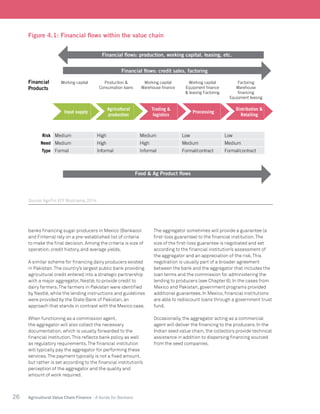
  • 44.
    38 Agricultural ValueChain Finance - A Guide for Bankers Relationship management – managing a VCF deal inside the bank Rather than creating a dedicated “value-chain department,” banks tend to manage their value chain engagements by allocating specific analysis and processing functions across their existing units;e.g., marketing, sales, commercial credit, agricultural credit, risk management, etc. Primary responsibility for a VCF relationship typically depends on the nature of the relationship of bank individuals or teams with the trade or agribusiness side of the value chain. For example, if the VCF operation will expand upon an existing relationship with a major processor or aggregator, the office in charge of that client relationship may then hold primary responsibility for the entire operation. If, however, a VCF operation will reach out to multiple aggregators (e.g., SPOs in India), responsibility may be shared among several regional managers. When entering a brand new value chain using a pilot project within the bank’s existing standards (e.g., loan caps), a small team drawn from several units may be assigned responsibility for design and implementation. As the relative importance of VCF operations in the bank’s portfolio increases, the bank may create a specialized team with primary responsibility. Figure 7.1 provides an example of a bank process to undertake a relatively major value chain operation for Yapi Kredi Bank and the broiler industry in Turkey. In this example, functions and roles are allocated across existing headquarters and branch/regional units. Figure 7.1: Industry analysis for a value chain in Yapi Kredi Source:AgriFin VCF Bootcamp, 2014 Treasury Agri Credit & Monitoring Marketing Regions / Branches Risk Management Process Design Operations Others Sales 1. Demand and Information flow for a specific Value Chain Finance from Branches & Regions 2. Agri Marketing Dept.: • Defines • Measures, Analyse • Produce Project Report • Develop Product & Sales Strategy for VC, with the help of other parties within Bank 3. Agri Sales Dept.: • Prepares an Action Plan • Implement strategies • Design Campaigns • Monitor the results for the VC 4. Branches and Regions: • Implements Project • Manages Client Relations 1 2 3 4
  • 45.
    39Agricultural Value ChainFinance - A Guide for Bankers Critical clauses in contractual arrangements The nature of contractual arrangements between the bank and its value chain clients vary widely depending upon the legal environment for business transactions. In the VCF model, the quality (i.e. enforceability) of contracts between value chain participants impacts how the bank will set collateral requirements for aggregators and farmers (including first-loss guarantees from processors). Risk management provisions (discussed in Chapter 6 above) make reference to formal contracts between aggregators and producers and their enforceability as part of the criteria in evaluating aggregators. If formal contracts between producers and an aggregator exist and are enforceable, then an “assignment of claim” is introduced in favor of the bank at the time the bank assumes the funding role.This means that Credit policy and processes As suggested earlier,value chain finance does not necessarily require major changes in credit policies and processes,albeit loan contracts with different value chain participants can include special clauses grounded on value chain relationships.What differs from conventional loans are analysis of credit proposals and client assessments.The stability of the processor/ aggregator relationship with suppliers is evaluated and production risks are usually taken into account,going beyond the traditional assessment of the viability of the client’s business.A bank may collect and analyze information for a value chain as a“project”and create forms and pro-forma reports for internal processing.An example is provided by the case of Yapi Kredi (Figure 7.2). Figure 7.2: Credit evaluation of a Turkish poultry operator Source: AgriFin VCF Bootcamp, 2014 Profit of a Broiler Farmer of 20K chicken capacity REVENUES Weight per mature Broiler 2.5 kg Payment for 1 kg (avg.) 0.4 Duration for 1 period of production 60 days # of production periods within a year 6 times Sales Revenue (TL, yearly) 120.000 COSTS Unit Cost TL/Unit) Labor 0,07 Electricity, Fuel and Water 0,2 Repair and Maintenence 0,02 Underlay (wood shavings) 0,15 Others(General - Unexpected Expenses) 0,016 Total Cost Per Unit 0.46 Total Cost for 20K Broiler (x6 period) 55.200 TL NET PROFIT 64.800 TL The Bank plans to serve below products to this farmer: Bank Products/Services TL Operating Loan (revolving/ installment) 41.400 Agri Card limit 4.140 Investment Loan (5years maturity) 290.000 Create cash flow from broiler payments* 720.000 + Products/Services to other parties of VC (value) * 120K TL for 6 times in a year Data for VC Broiler production is embedded in the Bank’s Agri Loans Evaluation System also, with a «Broiler Questionnaire» for efficiency and quality
  • 46.
    40 Agricultural ValueChain Finance - A Guide for Bankers the aggregator (or processor) will play the role of loan collector for the bank as part of their agreement. Legal contracts between bank and aggregator will typically make reference to the assignment of claim as an obligation of the aggregator and include subsidiary clauses that ensure repayment,even in the case the producers have defaulted on their contracts with the aggregators.The contract may also establish claims on aggregator property (e.g.,mortgage on buildings or other tangible assets) even when the aggregator provides a first-loss guarantee,or when there are other guarantees in place. It is important to remember that the strengths of the contractual relationships and legal agreements will typically influence the structure of any pact with the main anchor firms or aggregators;i.e., the terms (interest rates, maturity) under which they receive financing, the revenue sharing in the form of commissions or fees, the coverage of first-loss guarantees, etc. If all goes well and a stable relationship is created after a couple of business cycles, terms can be softened and revenue sharing adjusted. VCF loan management VCF loan implementation and monitoring typically follows the bank’s established practices, albeit with the recognition of the value chain context.Turkey’s Yapi Kredi, for example, has defined criteria for placing customers on a watch list in cases of delayed repayment. It also has created a list of basic principles to follow in such a situation that consider whether the problem temporary or permanent, and if the problem affects only one party in the value chain or all participants. Information is subsequently entered into the risk monitoring system (Box 7.1), and in the customer’s file. Loan monitoring and early warning systems under the VCF approach will include consideration of the overall value chain risks, and not just those directly associated with the individual client. Box 7.2 offers an example from the India case study.
  • 47.
    41Agricultural Value ChainFinance - A Guide for Bankers Box 7.1:Roles for monitoring Yapi Kredi has developed RiskMon, a centralized, automated monitoring system for all customers, connected to three different inter-bank bureaus (Central Bank, Retail and Corporate Credit Bureau, Ministry of Finance). The system retains historical data, facilitates analysis, derives strategies and takes action. What does RiskMon do? 1. Monitors 34 types of customer anomalies, including: • Delinquency in all types of loans and credit, including value chain loans and agriculture cards • Unpaid checks, fees • Payments not received to “transfer account” • Stagnation/increase/decrease in credit balances • Loan default/restructuring • Delinquency in tax, social security payments, notes • Deficit in collaterals • Negative balance in revolving loans/overdraft account for consecutive 180/90 days, respectively 2. Produces behavioral scores looking at: • All anomalies • Discrepancies in financial figures • All delinquencies • Demographic figures 3. Determines the customer classification (rating) 4. Determines strategy and action (with due dates) for customers: close monitoring, assistance, freezing/contraction of limits, amortization, liquidation 5. Processes data from credit bureaus, the risk management unit and other units in the bank, and checks data from the central bank, the the Ministry of Finance (for arrestments and encumbrance of tax, social security, and note payments), and retail and corporate credit bureaus that collect all information for consumer and commercial loans and agriculture loans evaluation systems (connected to farmer registry databases). Roles for Monitoring – Intelligence and sector reports • Intelligence Dept. the Credit Group of the bank has to produce a special report for limits above US$350,000. Regardless of the amount, the unit with loan authority (branch, regional manager, head office) may want an intelligence report for any customer −− Intelligence Dept. consists of credit specialists, each of whom are experienced in specific regions and sectors (no special personnel for value chains) −− Intelligence reports contains nearly the same headlines of Customer Intelligence Report, with two extra sections (mystery shopping from the market, and the financial institutions) Agri News Bulletin prepared by Underwriting Team through news, national statistics, agriculture chambers’ reports Sector outlook is reported by Agri-Banking Marketing Dept. to explain the effects of below cases (bank’s consultant also produce, upon request): • Drought, floods, hail, heavy rains & snow • Dramatic price changes in a region or at a specific agri-product • Government regulation / intervention for a specific sub-sector or product.
  • 48.
    42 Agricultural ValueChain Finance - A Guide for Bankers Box 7.2:A bank's early warning system A good credit product will necessarily be accompanied by measures that explain, monitor, and manage risk. Any early warning system will need to incorporate both the formal and informal sources of information that will be processed within the bank at various levels. This information will emerge from the relationship with the anchor company, the seed producer organization (SPO), and also from the local bank staff and the banking correspondent. HDFC Bank monitors the following factors to identify and address problems as soon as they arise: 1. Staging release of crop loan timed to key crop stages and concomitant money needs. Labor component is a big cash drain (for the farmer who contracts labor). A high labor requirement exists at the time of ‘crossing’ and also at the harvesting stage. 2. Company’s continuity of farmer relationships; the number of repeat farmers and ability to attract new farmers. This is a very important indicator of the trust that the seed company is able to build. 3. Yield estimates; companies normally monitor crop progress and frequently estimate the likely harvest yields for the hybrid seeds. This information is crucial to estimating the how well its parent seeds have been used (or sold in the open market) and also serves as a means of understanding likely farmer income and seed availability for commercial sales 4. Changes in the company’s planted acreage over time for the same crop. This is an indicator of the company’s performance in the market. A decline in acreage would indicate a potential risk 5. Changes in famer’s family situation; illness, death, wedding, birth, acquisition of farm and non-farm asset, etc. Informal tracking of these developments allows for a better understanding of the likely usage of available cash and assets. It also indicates if the farmer is able to repay loan on time. 6. Changes in the tenancy structure of the land holding. 7. Changes in weather conditions; adverse weather-related events could have a major impact on the farmer’s ability to produce quality hybrid seeds. Delayed rains, inadequate water supplies from upstream canals, temperature changes are all contributors to the performance risk of the crop. While the company would normally monitor these situations, it is important for the bank to have a macro-level track of weather conditions in the regions where it is providing loans. 8. Changes in availability of factors of production; labor, water, energy, etc. Diversion of resources to other agriculture crops, to development of newer industries (e.g. the creation of two states from the erstwhile Andhra Pradesh is likely to create pressure on agriculture land), growing urbanism are all factors that will have a negative influence on the development of strong agriculture value chains in hybrid seed 9. Seed Producer Organization structure, e.g. changing field staff to farmer ratio, expansion of other (non-seed production) business interests, addition/deletion of companies forming part of the seed production clients, are elements that bank would need to track. The social capital that the SPO enjoys - its reputation in the community - is by far the most critical asset. Source:HDFC, AgriFin. 2015.
  • 49.
    43Agricultural Value ChainFinance - A Guide for Bankers The launch of a new VCF project or the expansion of a piloted operation typically begins with an internal bank proposal to management.Such proposals differ among individual banks differ but there are several common characteristics.The examples of HDFC and Yapi Kredi are illustrative cases that have successfully established value chain finance operations in their existing markets and are actively seeking new opportunities. At HDFC, a “Product Program” is put together for internal approval that includes eight components (see Annex D for full details): 1. Objective;e.g., to provide payment services to smallholder farmers working with an aggregator and dairy processor. 2. Purpose of the loan;e.g., working capital, or micro- irrigation investment. 3. Arrangements in place between aggregator and farmers, the implications for agreement between aggregator and the bank, the existence of guarantees, and aggregator assessment. 4. Facility details:terms, maturity, pricing, collateral, geography, documentation, and service-level agreements, if any. 5. Product caps and triggers, including total lending under the program, delinquency triggers, and remedial actions. Caps, within existing bank standards, will depend on risk appetite at the time of program formulation. 6. Reporting and management information systems. 7. Risk analysis;includes side-selling risk, payment risk, and first, second, and third ways out. 8. Business plans, and three-year projection. The product program is created for each aggregator or set of aggregators and their respective groups of farmers. HDFC formulates a companion document outlining the profit and loss account associated with the program, including estimates of revenue from cross- selling products such as credit, insurance and other retail products (Annex E). Yapi Kredi follows a very similar process that involves doing the market research and assessment of the value chain.Then the marketing department prepares a “Value Chain Project Report” for presentation to senior management (Box 8.1). Once approved by senior management,Yapi Kredi formulates an action plan for the value chain operation (Box 8.2).This plan includes the assignment of responsibilities within the bank for the different components of the plan. From VCF scale up to ‘business as usual’:Once the senior management has given the green light to scale up the VCF pilot, it will take some time for VCF to become business as usual for the bank. Based on the experience of the contributors to this Guide, it can take 3-5 years for the bank to get its policies and systems in place, structure reoriented and staff trained before the VCF model becomes business as usual. Once the VCF model is set and the system is working well in one sector, e.g., dairy, the approach can be applied easily to other value chains and sectors. 8. FROM PILOT TO LAUNCHING THE VCF PROJECT
  • 50.
    44 Agricultural ValueChain Finance - A Guide for Bankers Box 8.1:A value chain project at Yapi Kredi,Turkey 1. The agri-marketing department collects all raw information,together with a“Value Chain Project Form”,from the regions and branches,combining this with sector and official data using: 1. Sector reports from government bodies, chambers, associations, and NGOs 2. Visits to related chambers, associations, and, occasionally, potential customers 3. Internal intelligence reports produced by its intelligence unit 2. After data gathering, the marketing department prepares a “Value Chain Project Report” for presentation to a group director, including: 1. Executive summary 2. Definitions, statistics, profitability and flows of the value chain 3. Expectations and market perceptions 4. Entry points for the bank 5. Products/services to be presented for the value chain 6. Requirements to enter the sector, if necessary (e.g., product developments, information technology and infrastructure requirements, changes to legislation, policies, regulations, changes within bank’s organization, etc.) 7. Forecasts for sales and revenue 8. Action and acquisition proposal Source:AgriFin VCF Bootcamp, 2014. Box 8.2 Yapi Kredi value chain action plan 1. After validation by a director, the marketing department arranges meetings with related parties to discuss requirements for an action plan. A steering committee is established if the value chain project requires major development. The secretariat of the committee is held in the “Process Design and Execution Department”. 2. If the project does not require changes to existing procedures, the marketing department will meet with the “Agri-sales Department to consider an acquisition strategy and action plan 3. Execution of the action plan falls to the sales department. An action plan consists of: a. Estimated sales volume and revenues from the value chain project b. Products/services to be presented for the value chain c. Terms and conditions for the products (pricing, maturity, collateral) d. A specific campaign structure for the value chain, if necessary e. Required visits to processors and other parties of the value chain f. Agreements and protocols if required 4. The sales department prepares a timetable and to-do list for the action plan and begins to implement the plan with regional supervisors and branches. Occasionally, the to-do list entails the cooperation of other sales departments within the bank (and possibly corporate/ commercial/small- and medium-enterprise/mass segment sales teams). In that case, an “Agri-Segment Director” takes the responsibility to cooperate with other teams. Source:AgriFin VCF Bootcamp, 2014.
  • 51.
    45Agricultural Value ChainFinance - A Guide for Bankers The field case studies and other sources discussed in this report support the notion that when a bank has the systems in place and experience with farmers and supply chains, agricultural value chain lending can be an effective path for banks to increase business and diversify portfolios.They also clearly indicate that there is no single formula to create a successful agricultural value chain operation;solutions are context-specific, not only in terms of the particular agricultural activity involved and the value chain structure but also in regards to the legal and business environments in which the dealings between the bank and value chain participants take place. Rather than seeking to create such a single recipe, this chapter outlines what both theory and practice suggest financial institutions should consider when adopting the value-chain approach to agricultural finance. Successful value chains create value for all participants involved. As a general principle, the VCF relationship must make economic sense for all participants, and not just for the bank. In practice, this principle translates into properly aligning incentives for all participants:producers, aggregators, processors, and financial institutions. Financial institutions should expand their understanding of the linkages that farmers might have with other value chain participants, recognize the benefits of identifying producer organizations and cooperatives as aggregators for services to farmers, and seek out innovations in distribution channels and delivery mechanisms that can reduce the overall cost barriers to serving farmers. Value chains must be a viable business proposition. As with all business lending, finance will not (nor should it) rescue a losing business proposition.Value chains must be market-driven, sustained by demand, and supported by suitable preexisting infrastructure. During the identification stage, it should be determined whether or not the value chain is likely to become dependent upon financing for its viability or whether it is capable of growing through financial support. As banks become involved in value chain finance, they should recognize the risks associated and be prepared to make sacrifices and view their involvement in the value chain as a business opportunity, and one not without risks. The case studies suggest that there is no alternative to the research and close examination of all of the participants involved in a value chain.The heterogeneity of farmers across countries and across crops and livestock activities yields a multiplicity of models and approaches, providing many examples of potential solutions.There is no single financial product or group of products that is guaranteed to unlock the potential inherent in lending to farmers. Banks and financial institutions must invest in understanding the activities that take place throughout the value chain.They also should recognize the variations in demand for products and the potential for managing risks through existing value chain relationships. With better research comes better products. With better products, clients are more likely to succeed and repay loans. CONCLUSION
  • 52.
    46 Agricultural ValueChain Finance - A Guide for Bankers 1. What works in value chain finance What follows is a brief account of the factors found to be conducive to success in agricultural value chain operations. Examples from the field case studies illustrate some of these points. Partnering with aggregators or lead-firms. Value chain participants have different drivers for supplying credit, most often the desire to increase production and efficiency, and/or to expand their markets. As a result, they are more willing than financial institutions to accept the risks associated with agricultural finance. In addition, value chain actors have more information as to business activity, cash flows, and firms within the value chain than financial institutions, which lowers their transaction costs and reduces risk.The interdependence of value chain actors further reduces credit risks. In the case of value chain finance for a key input, such as seedlings or fertilizer, non-payment would likely result in losing access to the input as well as the related financing. LESSON 1:HDFC. Partnering with value chain participants - the importance of seed producer organizers (SPOs) The SPO was found to be a nerve center in the value chain. All payments made by the company to farmers in most cases were routed through the SPO, who also provided both technical and financial assistance to farmers and often acted as a moneylender. Given that the SPOs had a very tight relationship with the farmer, their horizons for farmer financial exposure were longer than might be expected from banks. An SPO’s risk assessment capability, its knowledge about the viability of the farming operations for a particular farmer, and its supervision during the crop stages resulted in better management of farmer credit. For all these activities and the potential risk that an SPO carried (farmer default on production, quality issues with hybrid seed, etc.), the SPO would charge farmers higher rates of interest on advances. LESSON 2:HDFC. A bank's early warning system A good credit product will necessarily be accompanied by measures to understand the risk and monitor and interpret signals that will facilitate risk management. Any early warning system will need to incorporate both the formal and informal sources of information that will be processed within the bank at various levels. This information will emerge from the relationship with the anchor company, the SPO, and from local bank staff and the banking correspondent. Formal contracts facilitate access to finance. Despite the fact that contract enforcement is challenging in some countries, farmers with contracts that defined the terms for which they would be able to sell goods had significantly greater access to finance than those who did not. In vegetable value chains, the use of written contracts solidified the backward and forward linkages between the processors and wholesalers and processors and farmers by clarifying prices per quality level. Some formal financial institutions are more willing to lend to producers when they have defined sales terms and fixed market prices for their products than when they do not. It is important to note than in the value chain context, contracts offer an opportunity to formally assign claims and reduce repayment risks, and/or introduce factoring solutions.
  • 53.
    47Agricultural Value ChainFinance - A Guide for Bankers Information flows from agricultural value chains to financial markets reduce real and perceived risks of agricultural finance. As consumer preferences become more refined and differentiated, agricultural markets become more segmented and specialized. For example, as with the Bankaool case study, most of the vegetables exported to the U.S. from Mexico are closely regulated. Financial institutions can forge strategic relationships with dynamic agricultural value chain actors, such as large processing firms, to expand their loan portfolio by either lending directly to its related producers or by making larger loans for the processor to on-lend to producers. VCF works where market opportunities exist but supply is lagging. The Pakistan dairy value chain case highlighted producers that were already delivering quality products but without strong connections to the consumer market, collectors/processors were unable to keep up.VCF is likely to be the best solution to improve collection and processing, while also increasing small farm productivity. LESSON 3:HBL. Use preexisting participants as conduits for technical assistance Channeling credit and repayments through milk processors had an advantage that it was not an isolated activity but one embedded in the routine of milk processors. Their technical field services were essential to guide farmers on management issues for their new animals (if animals are purchased under the loan), for example. LESSON 4:HDFC. Extending the bank’s agricultural outreach Presence and reach remain important considerations. India’s HDFC has been engaged in pioneering work developing a suite of structured products to support value chain finance in agriculture. HDFC Bank has an extensive network on the ground – branches and ATMs – and is aggressively expanding its footprint in agricultural areas by relying upon the business correspondents (authorized under India’s regulations) and digital technology (mobile- and card-based). VCF succeeds where value chains lack working capital. For many small-scale farmers, traders and processors, a lack of working capital is the principal constraint to growth and to increasing supply to the market.The VCF approach addresses this constraint through two mutually reinforcing channels: • Lead-firm strategy. When there is a strong lead firm in the chain, this company can be used as a vector to reach non-bankable suppliers.The lead firm is the collateral for providing finance to the suppliers; it provides the lender the information needed on the suppliers, and performs payment retention. Examples of this mechanism are provided by Bankaool in sugar,Yapi Kredi in broiler chickens and HDFC Bank in dairy. • Capacity-building/banking infrastructure strategy. Another approach is to build the capacities of the suppliers to make them bankable. When the suppliers are trained and supported in their businesses for a couple of years, they can build a proven credit history and then become eligible for financial services from mainstream banks.
  • 54.
    48 Agricultural ValueChain Finance - A Guide for Bankers VCF facilitates investments in the chain. Besides the lack of working capital, another key reason value chains may not realize their full potential is through a lack of investment capital. Entrepreneurs in the chain need to invest to upgrade their technologies, introduce new products, develop new markets, and pursue other mid- to long-term ventures.Value chain finance is found to be a viable means of funding medium-term investments, such as improved breeds of cattle (Pakistan), or storage facilities (India). 2. What factors deter success in VCF? What can go wrong? While the cases reviewed for this Guide were primarily of successful value chain finance operation, experiences suggest that specific features of the value chain may conspire against a strong VCF operation. Aside from the obvious importance of the legal environment for commercial contracts and contract enforcement, a few features of the value chain can be listed as potential weaknesses and these need to be considered before testing a new value chain operation. Too many small aggregators. The Pakistan study identified small milk collectors as a key component of the path to market. However, each collector covered a relatively small number of producers, and they posed the risk of possible reverse-financing given the collector paid the producer at the end of each monthly collection. A VCF intervention would likely need to establish its primary connection with larger collectors or processors further downstream. Weak relationships within the value chain. A history of short-term or sporadic transactions between aggregators and producers represent a risk the bank needs to assess and mitigate. Poor quality of aggregator information on suppliers would constitute a warning sign;the financial institution would need to audit information quality before engaging. Generalized crop failure. This is obviously a nearly universal risk but one that banks might mitigate by entering a value chain that boasts sufficient geographic diversification, as well as reliable access to guarantees and insurance.   LESSON 5:Bankaool. Aggregator roles are important. One major difference between Mexico’s vegetable value chain and the cane sugar value chain in which Bankaool had already been operating was that small farmers sold to small aggregators (collectors or acopiadores), the majority of whom were on the margin of the formal economy. The ability of these aggregators to be the main entry point was limited given they frequently did not have a credit record, making taking a first loss guarantee from them a high risk proposition. Similarly, their ability to provide the legal documentation was unlikely. Even adjusting the model to work with wholesalers offered very limited opportunities, since the relationship between the collector and wholesaler was in cash. Even where there is credit, it is often the collector who will provide “financing” by waiting until the wholesaler makes the sale in order to be paid.
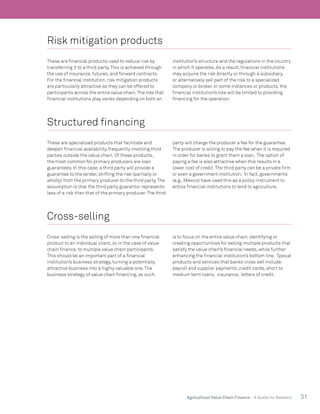
  • 55.
    49Agricultural Value ChainFinance - A Guide for Bankers Nearly every commodity exchanged in the global marketplace is subject to a series of value-creating activities that transform raw commodities into a multitude of products available for consumption worldwide. The segmentation of the various activities or processes, which add value to a product or service at each step along the way, is commonly referred to as ‘value chain analysis’.Value chain analysis attempts to capture, holistically, the chain itself rather than emphasize the significance of any one individual actor, focusing upon the connections between actors within the value chain and the ways in which value is added to a product.Value chain analysis considers the system as a single structural unit, albeit often times with various pathways through which inputs to production are processed for final markets. 1. Defining the Value Chain A large body of theoretical and applied literature has focused on value chains – agriculture or otherwise – since Michael Porter’s 1985 seminal work on firm competitive advantage. Value chain analysis is deemed useful at many levels. Businesses use it to devise competitive strategies and to guide product and process innovations. Governments and donors have recently shown interest in value chain analysis to inform interventions aimed at repositioning entire industries, building competitiveness, and support economic growth.Value chain analysis can shed light on the size of firms participating in each link, and on potential improvements in their participation, which makes it an appealing tool for governments and aid agencies concerned with the inclusion of smallholder farmers in modern value chains. ANNEX A. BASIC CONCEPTS AND PRINCIPLES The Introduction provided readers with an overview of the basic concepts and issues that arise in value chain financing. The basic concepts discussed in this annex aim to provide readers greater detail that will be useful in becoming familiar with the terms and processes of value chain financing. Agriculture value chains overview. What is a value chain? What are the basic concepts that make up a value chain financing model? This introductory section outlines the fundamental concepts of agricultural value chain finance. In addition to categorizing the various actors along a value chain, this section offers some tools for determining sources of finance and the level of integration within a given chain. Financing agriculture value chains – Summary of main issues. What drives bankers to consider value chains in their agriculture finance portfolio? Value chain finance is intended to address some crucial issues that arise when financing agricultural operations. The topics of information asymmetry, entry points and products (which are all discussed in-depth throughout the guide) are mentioned briefly.
  • 56.
    50 Agricultural ValueChain Finance - A Guide for Bankers Why it matters to bankers? For the purposes of this Guide, understanding the structure, relationships, and drivers of an agricultural value chain can shed light on the opportunities for a bank to profitably penetrate or expand its presence in specific market segments. It is important to recognize at the outset some important ways in which value chain analysis differs from traditional commodity system or industry analyses. Namely it: • focuses on net value added; • recognizes that linkages between activities and participants vary according to the product, even if the participants are the same; • recognizes that there are different kinds of value chains depending on the “driver” and the associated governance relationships;and • looks beyond physical flows to include information flows 2. Defining Value Chain Finance Value chain finance relies upon the relationships throughout the system in order to determine appropriate flows of capital.The value chain approach to finance actively engages the connections between actors within a value chain and the ways in which value is added to products at each step along the way. By systematically approaching the value chain as a single unit, financial institutions are able to more effectively mitigate risk (Box A.1) by encouraging new and leveraging preexisting value chain relationships. With information pertaining to where value is added along the chain as well as identification of vital actors, intermediate and ultimate markets, and understanding customer demand, financial institutions are better informed to make decisions regarding the credit risk of those to whom they lend. Agriculture value chain finance (AVCF) has increasingly been adopted by development practitioners as a means of substantively contributing to smallholder food security, effectively growing incomes by increasing agricultural productivity, and improving efficiency of smallholders and small and medium enterprise producers throughout the value chain. It is important to note that agricultural value chain finance is primarily a demand-based approach that leverages relationships to address the inherent risks in agricultural finance. While AVCF may provide loans to farmers, traders, and processors, its value is in understanding the relationships between actors in the value chain and how they share risks and benefits (or do not). A value chain is not an entire sector or subsector. It involves a specific group of interrelated producers and other actors who supply a particular end-market. The relationships between buyers and sellers can be described through various types of linkages along a continuum.This definition of value chain finance does not include conventional agricultural financing from financial institutions such as banks and credit unions to actors in a chain unless there is a direct link with the value chain. AVCF is characterized by a comprehensive assessment and understanding of the entire chain and the use of and in some cases development of specially tailored financial products that meet the needs of the chain. Rather than a simple credit risk assessment of the borrower, AVCF requires an assessment of the broader Box A.1 Pathways to improving quality and efficiency Banks can provide financial services to spread risk and reward in a manner than incentivizes quality production so that all actors in the chain, including the bank, benefit. 1. Identifying needs for finance that will strengthen the value chain as a whole 2. Modifying existing financial products and designing new ones tailored to the specific needs of those in the value chain 3. Reducing transaction costs of providing financial services 4. Mitigating risk through information sharing and relationships Source:Miller, 2010.
  • 57.
    51Agricultural Value ChainFinance - A Guide for Bankers risks of the value chain. Agricultural value chain finance often prioritizes bringing together individual farmers and their productive capacity via producer associations, cooperatives, and other forms of collective enterprise, thereby greatly improving their access to methods of diversifying and transferring risk. It also leads to economies of scale in market transactions and greater bargaining power to form more reliable and profitable relationships with other distinct market actors. Organized associations of farmers facilitate access and bargaining capacity in input and output markets as well as to channels of technical knowledge. When aggregated, farmers are much more willing to invest in productivity-enhancing practices and to undertake activities with higher profit margins. Often times, it entails moving from diversified subsistence farming to specialized surplus production activities;i.e., from net buyers to net suppliers of food. Smallholders account for a large proportion of rural poor people in developing countries and produce much of the countries’ food. As such, they are an important target group, offering opportunities to increase the socioeconomic welfare of a large number of people, improve food security, and drive the economic development of the country. Special emphasis must therefore be placed on models that allow the full participation of smallholders in value chains. Recent findings from lending practices by HBL in Pakistan suggest that banks can develop a long-term strategic environment for growth in lending to other market segments and increase adoption of banking services leading to greater deposits by focusing on agriculture value chain finance. AVCF can reduce costs and risks and it offers a way to reach smallholder farmers who may have otherwise been excluded from formal financial services. Many of the components of AVCF may be familiar but the systematic approach to its application has been pursued only more recently (Miller & Jones, 2010). Agricultural value chain finance can contribute substantively to increasing agricultural productivity, distributing gains from trade to actors throughout the value chain, and to improving bank profitability.The agricultural sector is becoming increasingly integrated, both horizontally (with large multinational firms participating in a range of value chains) and vertically (with firms involved in all aspects of production, transport, and processing). 3. Key Value Chain Participants and Financial Interactions When analyzing a value chain, typically there are five main categories of participants to consider, as depicted in Figure A.1. Although they frequently will engage with actors throughout the value chain, dealers in agri-commodities or input suppliers are the beginning of the agricultural value chain, followed by producers, aggregators or assemblers, processors, and finally retailers.Though not present in the basic diagram, service institutions as well as commercial banks and financial institutions are often included as they play critical roles in the success of the value chain. Agriculture value chains might not include all participants. In a vertically-integrated system, one participant may engage in activities along several stages in the value chain, while in a horizontally- integrated system one actor may engage in a range of value chains. In other cases, agricultural products may not require processing or farmers may sell direct to end consumers. Input Suppliers Suppliers provide farmers with the inputs necessary for production. Agricultural inputs often include seeds, chemicals, fertilizers, and equipment as well as technical assistance. Input suppliers often vary considerably in size (ranging from foreign-owned firms to small-scale local retailers) and often have very different and individualized financial needs. Whereas local retailers may require short-term seasonal working capital loans that can often be anticipated, other input suppliers who provide more expensive products (such as specific pesticides or fungicides) may have quite different financial needs. Additionally, since they often serve various different actors within the value chain (as well as various different value chains, i.e. grain and dairy production), they must account for the financial availability and timescales of producers, processors and retailers.
  • 58.
    52 Agricultural ValueChain Finance - A Guide for Bankers Producers/Farmers Refers to all of those engaged in primary production including farmers, their families and seasonal/part- time workers. Most smallholder farmers lack sufficient working capital to buy seeds and other inputs or to hire appropriate help to plough and harvest their crops or care for animals. Due to the insecurities involved with investing for the production cycle, many producers face significant risks associated with paying for food as well as household and medical expenses. Many smallholder farmers lack the economies of scale and investment capital to purchase equipment or infrastructure to improve yields. Farmers require financial intermediation not only to help procure inputs for production, but also in the form of cash payouts for their crops after harvest. Farmers also use credit to invest in livestock, equipment, and treatment facilities and to cover costs of labor (if they require assistance for maintaining crops or during harvest.). A lack of financial support not only compromises the quality and quantity of production, but farmers are unable to remain competitive or maintain their share in the final value of production. Historically, farmers have had few reliable sources of finance. Lacking the conventional means of collateral, they are viewed as ‘unbankable’ and, when they do qualify for credit, banking costs associated with financing rural operations can be insurmountable. High interest rates and transaction costs are frequently tied to financing smallholder farmers. Some farmers have benefitted from informal or in-kind loans from value chain partners, but they are generally small in size and rarely provide more than short-term capital. Informal loans from other parties such as moneylenders often impose excessive interest rates, which can place farmers in a vicious debt-cycle. Cooperatives and farmers’ associations have been one way of delivering credit to farmers, with loans often tied to farm inputs and machinery. However, like other semi-formal institutions, co-ops suffer from weak governance, flawed administrative controls, lack of independent decision-making, inflexibility, and high administrative costs. Apart from having the funds to finance such loans, co-ops face various other financial needs, such as covering their administrative costs. Those that market their members’ produce need cash to pay their members promptly, which requires working capital;if farmers do not get paid quickly, they may sell to a private trader who pays less but who can provide fast cash. Farmer organizations that function as collection points need to invest in warehousing and transport. Figure A.1: Stages of the Value Chain Source: Tchale and Keyser, 2010. Farm Production Assembly Processing DistributionInput Supply 1. Arrows from input supply to all other stages show that input supply is a cross-cutting function. 2. Arrows from production directly to processing and distribution indicate that some farmers may deliver crops directly to factors or directly to final markets (for unprocessed goods).
  • 59.
    53Agricultural Value ChainFinance - A Guide for Bankers Aggregators/Service Providers/Traders The traders buy produce from the farmers or co-ops and bulk it before selling it on.Their business depends crucially on making their working capital flow as quickly as possible in buying and re-selling produce. Every transaction offers an opportunity to make a profit (and, of course, carries a risk of losing money). Small rural traders have to stop buying when they run out of cash, leaving farmers stranded with their products. The traders need working capital to optimize their turnover and keep transaction costs down.They also need longer-term investment capital so that they can buy a vehicle, build a warehouse, or pay for equipment to weigh or grade a product. Because so much of their capital is tied up in products at any time, traders have little collateral, so find it difficult to get loans. Few financial services are designed specifically for traders. Processors Processors are those that are adding value to a raw product during the processing stage. Small-scale processors may lack the working capital they need to buy products in bulk from a farmer group or trader.They often lack the money to invest in equipment, leading to losses, lowering quality, and pushing up the cost of processing.They typically need access to medium-term loans and the ability to lease equipment. Commercial banks are becoming involved in lending to such processors. Retailers/Wholesalers/Exporters These participants sell the processed product to local and global retailers, supermarkets, and smaller retailers, who in turn sell to consumers. Wholesalers often manage credit relations in two directions:they provide money to trusted traders so they can buy on their behalf, and they may provide products to retailers on credit, expecting to be paid after the retailer has sold the goods. In this way, wholesalers often act as a bank for other actors in the chain.They often need more capital than other traders in the value chain.To avoid bad debts, they need good information on the reputation and financial status of their suppliers and buyers. Wholesalers and exporters have access to the financial services of commercial banks.These loans can be long- term, or at least medium-term. Exporters may have the option to provide guarantees to their suppliers (e.g., if they apply for a bank loan), based on an export contract. Exporters (or importers) can also participate in a joint venture, together with other value chain actors. In traditional finance, several banks might lend to various actors along the chain, with no coordination of services and knowledge. Agriculture value chain finance (AVCF) can create efficiencies from the financial institution perspective by promoting coordination of a variety of financing services along the chain. While much of the interest in AVCF from NGOs and development organizations focuses on AVCF as a way to expand credit access to smallholder producers, there may also be flows down the chain;that is, producers finance buyers and processors by accepting delayed payments or delivering products on consignment. Figure A.2: Continuum of Relationships between producers and buyers Source:AgriFin VCF Bootcamp, 2014. Likely Success of Agricultural Value Chain Finance Continuum of Producer-buyer Relationship Spot market producers sell products markets with fluctuating markets Contract farming producers and buyers make predetermined agreement Long-term relationship producers and buyers have trust and Capital investment buyer invests in producer Vertical integration buyer owns production capacity
  • 60.
    54 Agricultural ValueChain Finance - A Guide for Bankers 4. Variations in Value Chains – The Importance of Participants’ Relationships Value chains types have been characterized by several sources according to which participants “drive” or initiate systematic cooperation within the value chain. While useful as a categorizing framework, this classification does not lead to practical implications. Its connection with the identification of entry points for financial institutions was developed in Chapter 4.The focus here is what determines the ‘tightness’ of value chain relationships, as this is a critical principle within the AVCF model. Tight Versus Loose Value Chains Value chains exist along a continuum depending on the market.Tight value chains are those with clearly established relationships and a single channel. Often these involve what are called “closed marketed crops”; those that pose transportation challenges due to bulk or perishability, thus making side-selling costly and unlikely. In these value chains, producers have few or only one option to sell their products.Tight value chains may include export commodities, highly perishable crops, and those that require commercial processing. In contrast, in loose value chains (often involving “open marketed crops”) farmers have a variety of marketing options and may sell to various buyers. In addition to a range of marketing options, open marketed crops may also be stored for home consumption. Loose value chains present more opportunities for competition and may present producers with a variety of options for marketing their crops. However, loose value chains are not necessarily better for smallholders. Such chains present fewer opportunities to forge long- lasting relationships where credit, inputs, extension, and sector knowledge flows between participants in the chain. While the tightness of a value chain is often based on crop characteristics, specific context analysis is necessary to determine how a particular chain functions. In contract or out-grower arrangements, side- selling is a risk for loose, but not tight, value chains. Value chains may be tight due to incentives and trade arrangements that favor farmers, or farmers may be penalized or unable to sell outside the chain. Internal vs. External Value Chain Finance Internal value chain finance Depending on the nature of the value chain, financial institutions may provide services directly to a “lead firm”, which in turn serves farmers and others along the value chain. In other cases, a lead firm may facilitate the direct provision of financial services to other actors. Finance flows in value chains regardless of the presence of formal financial institutions. Participants further down the value chain provide loans to smallholders with or without the involvement of financial institutions. Internal or “within chain” value chain finance refers to various participants providing loans and other financial services up and down the value chain. Forms of internal value chain financing include aggregator credit, input supplier credit, marketing company credit, lead firm (contract or out-grower farms) financing, and warehouse receipts financing , as depicted in Figure A.3. Figure A.3: Internal Value Chain Finance Source: AgriFin VCF Bootcamp, 2014. Farm Production Assembly Processing DistributionInput Supply Bank Bank Finance Finance
  • 61.
    55Agricultural Value ChainFinance - A Guide for Bankers While internal value chain finance offers the advantage of utilizing relationships and transaction mechanisms already in place,there are also drawbacks.When financial institutions are not involved,working capital is tied up in finance,farmers may not understand the costs of finance (as it is deducted from payment for products), and agribusinesses must devote resources for financial service provision,rather than their core business. Value chain finance without bank involvement may provide what an ACDI/VOCA report calls a“demonstration effect”whereby banks may be encouraged to expand services to agricultural enterprises based on the track record of internal financing within to the value chain. Because financial services are typically bundled with other services in AVCF,buyers may regard the benefits of strengthened ties with producers and other actors as being more important than the profitability of a particular loan.An interview with Starbucks revealed the company is providing substantial credit to farmers,motivated by a need to secure long-term supply of coffee and other products,rather than by the returns they receive for loans.21 External value chain finance When actors outside the value chain, such as financial institutions, provide finance to the value chain based 21. Personal communication with authors, May 2014. on relationships within the chain, this finance may be referred to as “external” financing. A typical example is a bank that provides a loan to a producer based on a contract with a buyer. External value chain finance can provide benefits for all stakeholders by including financial institutions in value chain finance. Milder (2008) notes the following primary benefits: firms do not need to use working capital to provide finance to producers, producers can access finance without meeting typical collateral requirements, banks can enter new profitable markets without the risk and transaction costs associated with lending to smallholders directly (Figure A.4). From a financial institution’s perspective, connecting the bank with the lead buyer or trader in an already- established commercial relationship is a preferable starting point (Bankers, 2014). In some cases, smallholder producer organizations may be in a position to play this role. Once the bank and the lead value chain actor establish a relationship and share information, financing vehicles can be designed and introduced, their pricing reflecting the cost-sharing and risk-sharing arrangements between the bank and the business partners. Other formal financing options include secured transactions, equity finance and joint ventures, commodity exchanges, and government liquidity support (African Development Bank, 2013). Source: AgriFin VCF Bootcamp, 2014. Figure A.4: External Value Chain Finance FinanceFinance Information about farmers Farm Production Assembly Processing DistributionInput Supply Bank Bank
  • 62.
    56 Agricultural ValueChain Finance - A Guide for Bankers Commercial viability is assessed using the following downstream criteria: 1. Growth in industry should be measured by both the value and volume of production over a specific period of time. Using the real rather than nominal currency value of production eliminates inflationary distortions. Measuring growth using volumetric data offers additional insights into product availability and procurement potential, which can help in developing value chain relationships. Additionally, when the product is exported, using long-term volume data provides a measure of performance independent of foreign exchange movements. The operating hypothesis is that the higher the growth rate, the higher the probability of the viability of a specific value chain within the given industry. Specific agricultural production criteria used in ascertaining industry growth are outlined below. 2. Investment is an important indicator of the way the market perceives the specific risks and potential of an industry.The use of this criterion is based on the assumption that entrepreneurs would be reluctant to invest in businesses in which they saw limited growth potential. Rather than absolute values of investment over a specific period, the ratio of investment to the value of production should be used in order to adjust for variations in size of the different businesses.This makes it easier to establish a relative ranking across industries. 3. Price volatility and changes in production volume (adjusted for seasonality) provide an indication of the potential operational risks. Success in a highly volatile market depends on a special set of business skills, frequently supported through policies and financial instruments designed to mitigate and facilitate volatility management and its associated risks. At the same time, volatility provides an indication of the potential business and financial success, i.e. payback risk. The operating hypothesis is that a high level of volatility increases both the operational and credit risks22 . 4. Size – measured as the value of production – can be used to determine the attractiveness of a specific industry. Although when considered by itself, size may not indicate a healthy agri-food industry sector, the hypothesis is that the larger the size of the chain, the greater the attractiveness and opportunity may be for developing and promoting value chain financial products. 5. Trends in international trade provide an indication of both the potential and the vulnerability of an agri–food industry sector and can offer particularly relevant insight regarding value chain financing. Sustained export growth suggests that the industry maintains a competitive advantage in the international market. However, exposure to international markets changes the risk profile since the industry is subject to an additional set of variables, including movements in exchange rates and shifting foreign trade policies. Even if the primary orientation of an industry is to the domestic market, if imports comprise an increasingly larger share of the domestic market the value chain is considered particularly vulnerable at the primary production level. 6. Financial flows provide insight into how the financial market views the specific industry. Since credit availability is finite, changes over time in the share of total formal credit directed toward a specific industry indicate a growing or decreasing business potential/risk. Additionally, changes in past due loans as a percentage of total lending offer an indication of the credit worthiness of the value chain. 22. While this does suggest a high level of risk, it can also be considered as an indicator of demand for risk management products. ANNEX B. ASSESSING COMMERCIAL CRITERIA IN VALUE CHAIN SELECTION
  • 63.
    57Agricultural Value ChainFinance - A Guide for Bankers Assessing industry growth – upstream criteria23 While the basic conceptual criteria for evaluation are similar for field and fruit crops and for animal husbandry, due to the differences in production systems, the specific measures and indicators tend to be different. Field and fruit crops 1. Growth is measured as the change in area planted over a certain period of time.The working hypothesis is that an increase in planted area is indicative of a more dynamic industry. Since agriculture is frequently the beneficiary of targeted government support, the period of analysis should be long enough to cover more than one change in administration to account for changes in policy that may have an impact on the economic perspective of the industry. 2. Changes in yield offer a vision of the availability and application of technology to the production process.The use of this criteria is based on the assumption that sustained growth in yields is consistent with investment in a healthy industry. Since investment data is usually difficult to obtain, yield growth can serve as a proxy for investment. Given that long-term crop budgets are often unavailable in many developing economies, sustained growth in productivity and planted area would suggest that returns have been positive. 3. Value of production per hectare offers a deeper understanding of the potential viability of the primary production process. Changes in value of production combine yield fluctuations with (sometimes counterbalancing) price changes. As mentioned previously, real rather than nominal 23.“Upstream” is used here to refer to the origin of the product flow, i.e., the producer. The product flows “downstream” towards the consumer through the different components of the value chain. values should be used to eliminate inflationary distortions. Due to short-term variations in production and market conditions, at least a decade- long trend should be considered. 4. The difference between planted and harvested area provides an indication of the on-going production risk. Large differences and/or significant variations from year-to-year indicate an unstable or sub-optimal production system. While this might suggest that crop insurance products could be offered (due to ongoing and large losses), the costs associated with purchasing crop insurance would most likely be too high to be an affordable component of producers’ risk management strategies. Again, the period evaluated should be sufficiently long (at least a decade) in order to account for one-off climatic effects, and disease and/or insect infestation. Animal husbandry 1. Growth is measured by the change in the animal population over a certain time period. Much like the criteria for crop and fruit production, the working hypothesis is that an increase in the animal numbers is consistent with the profile of a dynamic industry. By way of contrast, a decline in animal numbers may be an indication of loss of competitive advantage to foreign competitors or of a structural change in the market with consumers eating less meat or favoring a different source of animal protein. 2. In the case of animal husbandry, yield is considered to be the conversion of feed to weight gain, or, in the case of the dairy industry, to milk volume. Changes in yields reflect the willingness to invest in and apply technology to the production process. The basic assumption is that increasing yields or conversion ratios suggest an industry with sustained potential. It should be noted that changes
  • 64.
    58 Agricultural ValueChain Finance - A Guide for Bankers in slaughter weight do not necessarily reflect an improvement in conversion ratios.They may instead be indicative of a response to economic conditions, with producers adjusting slaughter weight to improve profitability or cut losses. 3. The size of the operating unit provides an insight into the changing structure of the industry. In many markets, heard size (i.e. the number of animals managed/produced), has increased while the number of farms/feed operations has decreased. While a trend to larger-sized units may be considered as a positive indication of growth within an industry, there are cautionary factors to consider. If growth and consolidation is occurring rapidly, it may result in more difficult conditions for value chain financing in the short run due to structural changes occurring in the value chain. Interestingly, when the industry is characterized by a large number of smaller units, the opportunities for value chain financing may actually be greater, since the aggregator will necessarily need to aggregate supply.This indicator offers important insights into the viability of a given value chain, but should not be considered in isolation of the rest of the measurements provided. For both agriculture and animal protein operations, the technical coefficients should be benchmarked against the larger national market as well as international farm operations, particularly if the product is to be exported or has to compete with foreign imports.This is important when the macroeconomic environment is characterized by instability and/or the currency is subject to frequent volatility. When the results of the comparison are favorable, they suggest that the industry is sustainable and capable of growing under suboptimal economic conditions.
  • 65.
    59Agricultural Value ChainFinance - A Guide for Bankers This Annex covers in further detail the value chain finance products summarized in Chapter 5. A synthesis diagram is included below in Figure C.1. 1. Product-linked Financing These are products that directly relate to financing production,as well as financing the aggregator and processing or marketing company for the purpose of acquiring farm production.In this case,the aggregator uses financing or advance payment to producers as a form of securing production.Essentially,this works to de- leverage the supply risk to the aggregator (see Figure C.1). Product-linked financing may also be an option in working with trader-suppliers. Additionally, product- linked finance can be tailored to input suppliers, who in turn will finance producers.The underlying advantage of input-supplier credit is that it works to assure the timely availability of inputs.This is especially important in agriculture where plantings, fertilizing, and other ANNEX C. AGRICULTURE VALUE CHAIN FINANCIAL PRODUCTS Figure C.1: Producer financing Source:AgriFin VCF Bootcamp, 2014 Primary goods (e.g., meats, produce, grains) Purchase contract Advance on contract Payment for goods less amount owed to the bank Guarantee (whole or partial) Repayment of loans Large Processor “Off-Taker” Farmer Financial Institution
  • 66.
    60 Agricultural ValueChain Finance - A Guide for Bankers practices have to be carried out at fixed times. If not appropriately timed, production can be negatively impacted. By the careful selection of the input supplier, the financial institution can assure that the producer is getting proper, quality inputs, which should result in improved productivity. For the financial institution, the pre-conditions for mitigating the risks related to product financing revolve around assuring that the aggregator-client (whether or not acting as a commission agent) is able to work with reliable supplier producers. Even when contracts are signed, the key element is the relationship and trust between the producer and the off-taker/aggregator. Additionally, it is important to know the aggregators’ clients and their financial reputation. Furthermore, the financial institution should verify that the use of financing adequately reflects the market demand for the farmer’s production. When the off-taker/aggregator is the leading player in the value chain, as indicated in the previous chapter, this can provide an additional degree of confidence for the financial institution in offering these financial products. When the aggregator acts as the conduit for credit to producers, including as a commission agent, typically the financial institution will put a risk-sharing structure in place.This is usually requires the aggregator to provide a first-loss guarantee. As mentioned, it is important that a large number of farmers are participating in the value chain when structuring the financial product.This has the effect of limiting the risks from a default of an individual or small groups of producers. At the farm level, supervision plays a key role in risk mitigation, by ensuring that good farming practices are employed.These include sustainability practices, which are being included in credit evaluation criteria. 2. Receivables Financing These products are largely used as a means of providing working capital to aggregators, marketing companies and processors.They include bill discounting, factoring, and forfaiting. Although all three products revolve around the conversion of receivables, they differ in their means of managing risk and collection payments. Receivables can also be structured as collateral. In the case of bill discounting, the financial institution will advance (i.e. essentially lend) to the client a percentage of the value of the receivables. In this case, the client has the collection risk, which means that the financial institution’s repayment risk remains with the client. As such, the financial institution will use similar criteria as with a “typical” credit loan. For factoring, the financial institution will purchase the receivable and be responsible for collection. The financial institution will typically purchase the receivable at a discount, and may also charge an up- front fee.Types of factoring vary with the either client assuming the risk of losses from non-payment or the financial institution taking the repayment risk without holding the client responsible.The discount is larger in the latter case than in the former. If there is any follow- up legal action for collection, it becomes solely the responsibility of the financial institution. Forfaiting can be considered as a form of factoring used largely in international trade,and/or when repayment is expected over an extended period of time (often six months or longer).Typically the forfaiting company will undertake the collection and assume the repayment risk. For the client,the advantage is not necessarily that the process is more agile than the normal credit process. The advantage lies in that the“all-in”cost may be lower than an actual credit line for working capital.Given that receivables financing is not a debt,it does not impact the client’s borrowing capacity,as opposed to working capital credit.It has the advantage of partially eliminating business risk for the client,depending on the particular receivables financing product.When that is the case,the financial institution will have to evaluate the repayment risk and will often adjust the discount accordingly. Many financial institutions require that the legal system provide for strict payment enforcement mechanisms as a precondition for offering receivables financing products. One variation of receivables financing uses receivables as loan collateral.The financial institution will create a fiduciary-type account.The account is pledged to the financial institution, with the buyer paying directly into the account. This type of structure can be used to manage aggregator risk by ensuring that the financial institution will be paid first.
  • 67.
    61Agricultural Value ChainFinance - A Guide for Bankers This is also an attractive structure to balance risk mitigation with the client’s need for working capital. As products are sold with payment going into the fiduciary-type account, the financial institution will withhold funds according to the amortization schedule, with the remaining difference going to the client for working capital. This type of structure can be adapted to input-supply financing.In this case,the input supplier,the producer,and the aggregator would agree to the fiduciary-type account pledged to the financial institution.The input supplier would provide inputs to the producers.In this arrangement the aggregator would not typically retain payment,rather the proceeds from the sales of the product would go into the fiduciary account pledged to the financial institution. The financial institution would retain loan repayment and pay the input suppliers;the remaining proceeds would go to the aggregator.The advantage for the financial institution is that both the input supplier and aggregator potentially share in the risk. Interestingly, the financial institution may actually find it more appealing to take the repayment risk than the original client risk.This could be the case when the receivable is from a highly reputable company with strong financial credibility. Where there is a secondary market, the financial institution has the option of selling the receivable, thereby offloading risk and making the receivable financing potentially more attractive. 3. Physical Asset Collateralization These financial products center on the use of a physical asset as a guarantee, or collateral.The two most common products – warehouse receipts and repurchase agreements – are largely used for working capital. Financial leasing, by contrast, involves the use of an asset over a fixed period of time, after which the client may or may not eventually take ownership. As with the other value chain products, the legal system has to recognize the rights and obligations inherent in the control of the assets as a precondition for the development and use of these products. Additionally, there should be a known market for pricing the assets (mark-to-market), as well as a fairly liquid resale market for the assets. For agricultural commodities and foods, the markets should also reflect the types and grades commercially used for the assets under control. Warehouse receipt products are fairly common around the world.The farmer or other participant in the value chain will receive a receipt for the products upon placing them in a warehouse.The receipts are then used as collateral for a loan.The loan, in turn, is often used to pay off an existing debt (e.g., a production loan) or for working capital (Figure C.2).The size of the loan is related to the value of the products, with the financial institutions requiring that value of the product under guarantee be a specific percentage above the amount of the credit. Part of the loan supervision is the ongoing valuation of the product stored.Typically, the loan agreement will contain a provision for changes in the amount warehoused in relation to changes in the price of the product. For example, the loan agreement may stipulate that if the price of the product increases by five percent over one week then the value of the product used as a guarantee has to be adjusted accordingly. The warehouses are generally bonded or certified; nevertheless, the financial institution making the loan on the certificate will often indicate in which warehouse the asset should be placed. Working with a known warehouse company provides an additional layer of confidence for the financial institution. Where the legal system allows, a particular advantage of warehouse receipts is the flexibility in defining what is a “warehouse”. It may be a fenced-in field where grain is stored under a tarpaulin, or even a corral in a feedlot. Whether it is a formal warehouse building, or one of these ad hoc type structures, the risk is associated with the performance of the warehouse company. Where the warehouse is an ad hoc structure, periodic inspections should be built into the loan document. Typically, the client absorbs the costs of inspections. It should be recognized that even the use of a trusted warehouse company does not mean that the financial institution need not perform inspections of the existence and quality of the product. Repurchase agreements tend to be more frequently used by traders and processors in the value chain.The product is sold to a third party, with the agreement that the seller will buy back the product after a given period of time.The third party may be a company created by the financial institution to take possession.The product will typically be stored in a bonded warehouse during the course of time that the third party owns the product. Here again the financial institution has to take into
  • 68.
    62 Agricultural ValueChain Finance - A Guide for Bankers consideration the performance of the storage company. For the seller (client), the advantage of a repurchase is that it often results in a lower cost of money than a bank loan.The sale of the product, however, may result in the seller incurring a tax obligation in the short run. For the financial institution, the fact that the client does not own the collateralized asset facilitates the disposal of the asset in case of non-payment. Financial leasing is a product that the financial institution can tailor to the needs of all the participants along the value chain. As indicated above, leasing involves the use of an asset without ownership, akin to renting. Where there is a purchase agreement at the end of the agreed-upon period, the net result is equivalent to the asset having been purchased on credit. For the client, in many countries, the payment for the leased asset is considered as a deductible business expense. It also has a favorable balance sheet effect, since the client does not incur debt, as would have been the case if the asset had been purchased. Since the financial institution maintains ownership of the asset, there is no collateral issue. Generally, leased assets are likely to be machinery or vehicles, yet practically anything can be leased to participants in the value chain (e.g., factories and feedlots).This creates interesting business opportunities for financial institutions. However, as these become more esoteric, the financial institution’s risk increases in case of default. 4. Risk Mitigation Products These are financial products used to reduce risk by transferring it to a third party.This is achieved through the use of insurance, futures, and forward contracts. For the financial institution, risk mitigation products are a particularly attractive business proposition since they can be offered to participants throughout the entire value chain.The role that financial institutions play varies depending on both institutional structure and the regulations in the country in which the institution operates. As a result, financial institutions may acquire the risk directly, through a subsidiary, or alternatively sell part of the risk to a specialized company or broker. In some cases or products, the financial institution’s role will be limited to providing financing for the operation. Insurance tends to be more widely used and accepted by downstream participants.This reflects the fact that most insurance products are designed to insure fixed Figure C.2: Warehouse receipts Source:Miller and Jones, 2010. Payment Finance Contracts Product Product Payment Pledged Note Bank Buyers Trade co./ co./ warehouse Farmers
  • 69.
    63Agricultural Value ChainFinance - A Guide for Bankers assets as well as other goods, which can be priced in the market and damage or loss can be accurately quantified. Likewise, downstream participants are better able to quantify the relationship of the cost of insurance to the impact that loss or damage would have on their businesses. At the farm level, besides insurance for fixed assets (e.g., barns, tractors), producers can be insured for crop or animal loss.These specific agricultural insurance products tend to be somewhat costly since the pool of insured farmers may be quite limited and losses due to weather or disease impact a large number of farms in a given area, which may make up a large percentage of the insured pool. Increasingly, though, banks will require that crops or animals be insured as a precondition for production loans, with the bank as the beneficiary up to the amount of the credit. Likewise, as a precondition for insurance products to be successful, the legal structure has to be in place to support the claims adjustment process. Futures and options. Whereas insurance products provide the ability to reduce risks related to the loss of a physical product, hedging through futures and options allow for price risk mitigation.These products do not involve delivery, although in some markets with forward contracts, delivery may be an alternative but not an obligation.The major difference between the two is that futures involve the buying and selling of forward contracts at a price for the agricultural product set by the market. Options, by contrast, are the right but not the obligation to buy or sell a futures contract. Options price the specific forward contract through a range of prices related to the perception of risk. Options have recently become popular as they allow for greater flexibility and do not tie up working capital for margin calls. Since hedging products are priced using specific – and frequently foreign – markets, a strong correlation between prices in the local market and the market where the futures contracts are priced is a precondition for their effective use. Swaps are financial products that can be offered as a standalone, risk-mitigating product or as part of a cross-sell strategy. Generally, these products are offered to larger clients in the form of two types of swaps, focused on interest rates or currency.The interest rate swap allows for switching (or swapping) the variable interest rate on a loan for a fixed rate, or a fixed rate for a variable rate.The decision to enter into an interest rate swap is based on the perception of future costs and the client’s risk profile.The other type of swap is a cross-currency swap.This involves a contract to exchange one currency for another at a specific point in time.This is frequently used as a part of export trade finance.This approach is particularly attractive when a loan is in a currency different from that of the country where the client operates. In effect, the use of cross currency swaps eliminates the foreign exchange risk. For swaps to be an effective risk management tool there has to be a strong legal and regulatory environment in the markets in which the swaps take place to ensure commitment by the involved parties. Forward contracts involve the actual transaction of a food or agricultural product at a set price for delivery in the future. In some cases, the contract will allow for a degree of flexibility according to market conditions at the time of delivery. Likewise, there may be some flexibility in the delivery date in order to account for growing conditions.The use of forward contracts essentially eliminates the market risk for the seller, transferring it to the buyer. However, when the contract includes product specifications, some risk does remain with the seller. Because the forward contract involves delivery, contract delivery mechanisms have to be in place as a precondition for this to be an effective risk mitigation strategy. Although financial institutions are not typically involved in forward contracts, significant business opportunities exist. For example, the buyer may wish to offload some of the future price risk through futures or options products. Likewise, the seller may wish to use the contract as collateral for working capital. Market-based research, produced internally by financial institutions and sold to clients, also representative a third risk mitigation product that does not shift risk to a third party.
  • 70.
    64 Agricultural ValueChain Finance - A Guide for Bankers 5. Structured Financing These are specialized products that facilitate and deepen financial availability,which frequently involve third parties outside the value chain.Of these products,the most common for primary producers are loan guarantees. In this case,a third party will provide a guarantee to the lender,shifting the risk (either partially or wholly) from the primary producer to the third party.The assumption is that the third party guarantor represents less of a risk than that of the primary producer.The third party will charge the producer a fee for the guarantee.The producer is willing to pay the fee when it is required in order for banks to grant them a loan. Paying the fee is also attractive when this results in a lower cost of credit.The third party can be a private firm or even a government institution. In fact,governments,such as Mexico,have used this as a policy instrument to entice financial institutions to lend to agriculture. Another structured financing product involves pooling and packaging financial assets that are in turn sold to investors. What makes these attractive to investors is that the financial assets typically produce a cash flow. Theoretically, the risk associated with the repackaged product is reduced through the pooling of assets, conceptually.This type of structure is particularly advantageous for facilitating financing to large numbers of small farmers.The financial institution may actually do the lending and packaging, selling all or part of the new security to investors. Likewise, the financial institution may be a buyer of the loan package from either another financial institution or an agent specializing in lending and packaging.The underlying risk, as was seen in the housing crisis in the last decade, resides in adequately identifying the true quality of the packaged asset. More often than not, opportunities for joint ventures occur in the value chain. The joint ventures may be between existing participants or a participant and a third party that will use this as a means for joining the value chain. For the companies involved, there are many objectives that may make a joint venture attractive. These include enhancing economies of scale, bringing in expertise, injections of capital, improving competitive position by expanding up or down stream in the value chain, among others. For the financial institution, this is an especially attractive option since it can generate income by charging an advisory fee.The financial institution may cross sell by also providing financing to one of the parties in the joint venture.
  • 71.
    65Agricultural Value ChainFinance - A Guide for Bankers ANNEX D. INTERNAL BANK PROPOSAL TO MANAGEMENT (ILLUSTRATIVE) 1. Objective: State the objectives here (e.g. to provide credit and payment services to smallholder farmers working with off taker ‘ABC company’ through its aggregators recommended by the company). Objective may include general information about the industry of the off taker company and the rural areas in which they source the raw materials through the supply chain, as well as the motivation for value chain financing as opposed to a direct lending program to smallholder farmers. 2. Purpose of the loan: State the nature of the service being provided to the farmers. For example, working capital for fertilizer or investment credit for micro-irrigation in coordination with the company.This section should include estimations of the benefits of the credit expected to accrue to the farmer, off-taker company or aggregator over a given period of time 3. Arrangement in place between off-taker, aggregator and farmer(s): Summary of the nature of the agreement between the aggregator and the bank, including details of guarantees and service level agreements, if applicable: Credit, market, history and solvency of aggregators (standard credit assessment of ratios for long term facilities): The degree of specialization in production that is required by the company: Details of the agreement, which should include; selection procedure for aggregators and history of aggregators being connected to the aggregator company (2 years minimum, average net-worth of aggregators). This step is unnecessary if farmers are directly associated with the company under consideration through their own collection outlets: Any arrangements (formal and informal) between aggregators and farmers: Insurance, technical support and infrastructure already in place:
  • 72.
    66 Agricultural ValueChain Finance - A Guide for Bankers 4. Facility details: Facility: Working capital/term loan: Term/Maturity: Average ticket size: Proposed pricing: Collateral if any: Term/ moratorium/servicing cycle: Non-performing asset classification norm (if left to the discretion of the bank): Selection criteria for farmers: Define the geography being covered, distance from the branch: List of aggregators whose arrangements will be considered: List of commodities produced: Borrower (Farmer) eligibility: Earning capacity; estimated annual income (including income from other sources), net of loan installments, savings available for sustaining daily activities: Land under cultivation; define minimum criteria proposed: Payments received through the supply chain and/or company records of supplies delivered over the last 2-3 years or certification from the aggregator if data is not available from the company aggregator: Age of the farmer (specify maximum age): House ownership, time in the village, referral from other farmers in the village: Recommendation by the aggregator (or aggregator company in the case of a direct arrangement between farmers and off takers): Other standard requirements, if any, as per regulators or bank policy: Loan documentation (simplify): Guarantor assessment (assessment of aggregators): Agreement/arrangement with the company: Time in this line of business, history with the company and recommendation by the company:
  • 73.
    67Agricultural Value ChainFinance - A Guide for Bankers Income, net-worth, tax returns, bank statement assessment (if any) or estimates of income, details of other business interests (income from the aggregator should be the main business interest to keep the aggregator totally engaged): First-loss deficiency guarantee; % negotiated and nature of collateral: Commercial agreements between the bank and the aggregator: Documentation between bank and aggregator (similar to SME or guarantee document): Company/Aggregator: MOU/Agreement to route payments delivered through the bank accounts of the individual farmers/aggregators: Service level agreement or document defining the technical support provided by the off-taker directly or through the aggregator or any third party to provide technical support to farmers to increase productivity or quality (traceability or certification, etc.): 5. Product Caps and Triggers Caps; Total lending to be provided under the produce program (can be assessed for increasing caps based on portfolio performance): Triggers; define % of delinquency levels in various buckets (90 days, 180 days), where the product program will be reviewed before booking further new business. Define the level of the officers who will review and take decisions, along with an escalation matrix: Remedial action; define who is responsible for collections and remedial action when triggers are breached: 6. Reporting & Management Information System (MIS) Customer visits by field staff before or after disbursement; every customer or sample basis: Periodic customer visits by field staff during the term of the loan to check on the process between farmer- aggregator-off-taker as defined above and evaluate the productivity estimates of the farmers to provide an early warning system: Early warning reporting: Back office MIS on volumes, assets, liabilities, cross sales, delinquencies, income, costs of the project:
  • 74.
    68 Agricultural ValueChain Finance - A Guide for Bankers 7. Risk Analysis Performance risk: determine the technical support from the off-taker or aggregator by way of inputs or package of practice that helps farmer deliver produce +/- 20% quality yield: Side selling risk: this is to be managed by the aggregator and covered by guarantee/first-loss guarantee: Payment risk: the solvency risk of the off-taker and its ethics and transparency in keeping the chain together: Primary source of repayment: Secondary source of repayment: Any additional sources of repayment (including market value of any collateral): 8. Business Plans Year 1: Assets, liabilities, possibility of cross-selling, income, cost-to-income ratio and delinquency estimates: Year 2: Assets, liabilities, possibility of cross-selling, income, cost-to-income ratio and delinquency estimates: Year 3: Assets, liabilities, possibility of cross-selling, income, cost-to-income ratio and delinquency estimates:
  • 75.
    69Agricultural Value ChainFinance - A Guide for Bankers ANNEX E.VCF PROFIT AND LOSS ACCOUNT TEMPLATE (ILLUSTRATIVE) Month 1 Plan Plan Number of farmer accounts opened Number of farmer accounts activated receiving VCF payments Payment throughput turnover Cumulative float in all the accounts Number of activated accounts converted to loans during the month Cumulative value of loans disbursed during the month Cumulative loans outstanding (asset book) Float income ( float x transfer pricing ) Asset income (average asset X net interest margin for assets ) Commission Income on loans disbursed Cross sell Income - Insurance - Other retail products Total income Costs Cost of field staff at actuals + overheads Cost of business correspondents, if any Commissions paid to Aggregator - Service division costs for accounts opened/loans booked Total Cost Gross Revenue Provisions for Bad loans Net Revenue Ratios % of accounts activated to accounts opened % of activated accounts converted to loans Cost-to-income ratio Units of cross sell/number of activated accounts
  • 76.
    70 Agricultural ValueChain Finance - A Guide for Bankers References ADB (African Development Bank). 2013. Agricultural Value Chain Financing (AVCF) and Development for Enhanced Export Competitiveness. [Online] Available: http://www.afdb.org/en/documents/document/agricultural-value-chain-financing-avcf-and-development-for- enhanced-export-competitiveness-47028/ Agar,Jason. ACDI/VOCA. 2011. Rural and Agricultural Finance. USAID. ---. 2011. Rural and Agricultural Finance:Taking Stock of Five Years of Innovation. USAID. AgriFin. 2012. Lessons from the Learning Visit to Banco Oportunidade Mozambique. Results Story, Maputo and Chimoio:AgirFin. Bankaool, AgriFin. 2016. Selecting a Target Value Chain – A Summary of Bankaool’s Market Study on the Vegetable Value Chains in Mexico Barrett, Christopher et al. 2012.“Smallholder participation in contract farming:comparative evidence from five countries.” World Dev. 40(4):715–30. Beaudoin, Christopher, and Esther Thorson. 2004.“Social capital in rural and urban communities:Testing differences in media effects and models.” Journalism & Mass Communication Quarterly, 81(2), 378-399. Bellemare, Marc F. 2012.“As You Sow, So Shall You Reap:The Welfare Impacts of Contract Farming.” World Development, 40(7), 1418–1434. Bernhardt,Jennifer, Stephanie Grell Azar, and Janette Klaehn. 2009. Integrated Financing for Value Chains.Technical Guide, World Coucil of Credit Unions. Christen, Robert, P. and Jamie Anderson, 2013.“Segmentation of Smallholder Households:Meeting the Range of Financial Needs in Agricultural Families.” Washington, D.C.:CGAP. http://www.cgap.org/sites/default/files/ Focus-Note-Segmentation-of-Smallholder-Households-April-2013_0.pdf. GIZ. 2013. Value chain development by the private sector in Africa:Lessons learned and guidance notes. [Online] Available:http:// ccps-africa.org.winhost.wa.co.za/dnn7/Portals/0/VCP%20web%20en%2018-07-13m.pdf Bogaard, Hans. 2014.“Value Chain Finance and the Importance of Understanding the Value Chain.” Presentation at Revolutionising Finance for agri-value chains. Colbert, Ross. 2013.“Winning Through the Supply Chain:Strategic Issues in Managing Food and Agri Suply and Supply Chains.” AgriFin Presentation. Colombo:AgriFin. Collier, Paul and Stefan Dercon. 2013.“African Agriculture in 50 Years :Smallholders in a Rapidly Changing World?” World Development, xx. Dalberg Global Development Advisors. 2012.“Catalyzing Smallholder Agricultural Finance.” Deininger, Klaus, and Derek Byerlee. (2012).The rise of large farms in land abundant countries:Do they have a future?. World Development, 40(4), 701-714. Demirhan, Ömer. 2013.“Execution of ALES :Yapı Kredi Case.” Presentation at Agrifin Boot Camp. ---.2014a“Industry and Customer Analysis:Analyzing Specific Value Chains inTurkey.”Presentation at Agrifin Boot Camp. Doran, Alan, Ntongi McFayden, and Robert C.Vogel. 2009.The Missing Middle in Agricultural Finance:Relieving the capital constraint on smallholder groups and other agricultural SMEs. Oxfam Policy and Practice:Agriculture, Food and Land, 9(7), 65-118.
  • 77.
    71Agricultural Value ChainFinance - A Guide for Bankers Dries, Liesbeth, and Johan Swinnen. 2004. Foreign direct investment, vertical integration and local suppliers: evidence from the Polish dairy sector. World Dev. 32(9):1525–44. Fries, Robert, and Banu Akin. 2004.Value Chains and Their Significance for Addressing the Rural Finance Challenge. microReport, Washington, D.C.:Accelerated Microenterprise Advancement Project (AMAP), USAID, ACDI/VOCA. Haggblade, Steven. 2007.“Subsector supply chains:operational diagnostics for a complex rural economy. In Transforming the Rural Nonfarm Economy:Opportunities and Threats in the Developing World.” pp. 352–80. Baltimore, MD:Johns Hopkins Univ. Press. Haggblade, Steven, Peter Hazell and Thomas Reardon (eds.). 2007. Transforming the Rural Nonfarm Economy: Opportunities and Threats in the Developing World.Johns Hopkins University Press. October. HBL, AgriFin. 2016. Structure and Performance of the Dairy Value Chain in Pakistan – A Summary of HBL’s Market Study on the Dairy Value Chain in Pakistan. HDFC Bank, AgriFin. 2016. Creating Value Chain Finance for Farmers – A Summary of HDFC’s Market Study on the Hybrid Seed Production Chains. World Bank. HDFC Bank. 2015. White Paper:Supply Chain Tool Kit, unpublished. IFC. 2011. Scaling Up Access to Finance forAgricultural SMEs:Policy Review and Recommendations. Washington DC:IFC. Jayne,T. S., David Mather, and Elliot Mghenyi. 2010.“Principal Challenges Confronting Smallholder Agriculture in Sub-Saharan Africa.” World Development, 38(10), 1384–1398. Kaplinsky, Raphael. 2004.“Spreading the Gains from Globalization:What Can Be Learned from Value-Chain Analysis?” Problems of Economic Transition, 47(2), 74–115. Kopparthi, Murty. 2012. Is value chain financing a solution to the problems and challenges of access to finance of small-scale farmers in Rwanda 38(10), 993–1004. Lee,Joonkoo, Gary Geref, and Janet Beauvais. 2012. Global value chains and agrifood standards :Challenges and possibilities for smallholders in developing countries. Edited by Prabhu Pingali, Bill and Melinda Gates Foundation, Seattle, WA, and approved October 12, 2010 (received for review November 26, 2009.) Macharia, George. 2013. Financing Dairy Sector Equity Bank. AgriFin Webinar Presentation. Mcmichael, Philip. 2013.“Value-chain Agriculture and Debt Relations:contradictory outcomes.” Third World Quarterly, 34(4), 671–690. Meyer, Richard. 2011.“Subsidies as an Instrument in Agriculture Finance:A Review.” The World Bank, BMZ, FAO, GIZ, IFAD and UNCDF, (June), 1–72. Miller, Calvin. (IFAD). 2010. A Baker’s Dozen Lessons of Value Chain Financing in Agriculture, 19(4). ---. 2011. Agricultural value chain finance strategy and design. ---. 2012. Agricultural value chain finance strategy and design Technical Note. Miller, Calvin. and Carlos da Silva. 2007.“Value chain financing in agriculture.” Enterprise Development Miller, Calvin. and Linda Jones. 2010.“Agricultural Value Chain Finance:Tools and Lessons.” Practical Action Publishing. Rugby, UK. Nang, Eddah, Dagmar Mithöfer, and Steven Franzel. 2011. Review of guidelines and manuals for value chain analysis for agricultural and forest products. ICRAF Occasional Paper No. 17. Nairobi:World Agroforestry Centre.
  • 78.
    72 Agricultural ValueChain Finance - A Guide for Bankers Porter, M. E.. 1985.The Competitive Advantage:Creating and Sustaining Superior Performance. NY: Free Press. Quiros, Rodolfo. 2010.“Agricultural Value Chain Finance. Proceedings of the Conference ‘Agricultural Value Chain Finance’.” San José:FAO and Academia de Centroamérica. Rashid Shahidur, Nigussie Tefera, Nicholas Minot and Gezahegn Ayele. 2013.“Can modern input use be promoted without subsidies? An analysis of fertilizer in Ethiopia.” Agricultural Economics, 44(6), 595–611. Reardon,Thomas, Christopher Barrett,Julio Berdegué and Johan Swinnen. 2009.“Agrifood industry transformation and small farmers in developing countries.” World Dev. 37(11):1717–27. Reardon,Thomas, and Julio Berdegué . 2002.“The rapid rise of supermarkets in Latin America:challenges and opportunities for development.” Dev. Policy Rev. 20(4):317–34 Reardon,Thomas and Bart Minten. 2011.“Surprised by Supermarkets:Diffusion of Modern Food Retail in India,” Journal of Agribusiness in Developing and Emerging Economies 1(2). October:134-161. Reardon,Thomas and C. Peter Timmer. 2012.“The Economics of the Food System Revolution,” Annual Review of Resource Economics,” 14:225-264. Swinnen Johan F.M., ed. 2007. Global Supply Chains, Standards and the Poor. Wallingford, UK:CABI. Swinnen,Johan F. M., and Miet Maertens. 2010. Finance Through Food and Commodity Value Chains in a Globalized Economy. Prepared for the KfW Financial Sector Development Symposium 2010 “Finance For Food – Towards New Agricultural and Rural Finance” Tchale, Hardwick and John Keyser. 2010.“Quantitative Value Chain Analysis – An Application to Malawi.” Washington, D.C. World Bank. http://www-wds.worldbank.org/external/default/WDSContentServer/WDSP/IB/20 10/03/22/000158349_20100322091715/Rendered/PDF/WPS5242.pdf Technoserve. 2014. A Guide to Working with Informal Financial Institutions. Technoserve-IFAD. 2011.“Outgrower Schemes — Enhancing Profitability.” Rome:IFAD.Telecom UNIDO. 2011. Pro-poor Value Chain Development:25 guiding questions for designing and implementing agroindustry projects. United Nations Industrial Development Organization (UNIDO).Vienna, Austria. Vermeulen, Sonja and Lorenzo Cotula. 2010. Making the Most of Agricultural Investment:A Survey of Business Models that Provide Opportunities for Smallholders. Washington, D.C. and London:FAO and IIED. World Bank. 2005. Agriculture Investment Sourcebook. Washington, DC. http://www-wds.worldbank.org/ external/default/WDSContentServer/WDSP/IB/2005/11/18/000011823_20051118163155/Rendered/ PDF/343920PAPER0Ag101OFFICIAL0USE0ONLY1.pdf ---. 2005a.The Dynamics of Vertical Coordination in Agrifood Chains in Eastern Europe and Central Asia. Implications for Policy Making and World Bank Operations. ---. 2005b. Rural Finance Innovations – Topics and Case Studies. World Bank, Washington, D.C. ---. 2008. Agriculture for Development. World Development Report 2008. Washington:The World Bank. ---. 2011. ICT in Agriculture:Connecting Smallholders to Knowledge, Networks, and Institutions. Washington, DC. Available at:http://www.ictinagriculture.org/ictinag/node/105 ---. 2013. Growing Africa:Unlocking the Potential of Agribusiness.