Products. Tools. Sanitation. Color Theory
MILADY
MAKEUP
OBJECTIVE
• Guests will rely on you to advise them on tips and techniques that will help them look their best.
• Understanding of basic makeup techniques will allow you to enhance the hair and chemical services
you provide for clients, offering them a total look !
• Knowing facial makeup products allows you to know when and on whom they should be used
• Learning how to properly enhance/camouflage face shapes, structure and challenges will ensure guest
retention, revenue and trust!!!
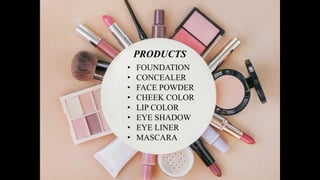
• FOUNDATION
• CONCEALER
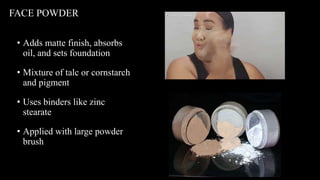
• FACE POWDER
• CHEEK COLOR
• LIP COLOR
• EYE SHADOW
• EYE LINER
• MASCARA
PRODUCTS
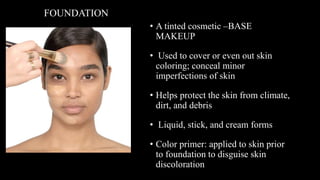
FOUNDATION
• A tinted cosmetic –BASE
MAKEUP
• Used to cover or even out skin
coloring; conceal minor
imperfections of skin
• Helps protect the skin from climate,
dirt, and debris
• Liquid, stick, and cream forms
• Color primer: applied to skin prior
to foundation to disguise skin
discoloration
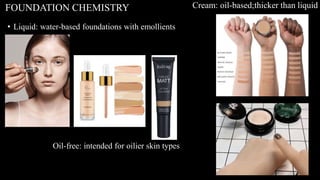
FOUNDATION CHEMISTRY
• Liquid: water-based foundations with emollients
Cream: oil-based;thicker than liquid
Oil-free: intended for oilier skin types
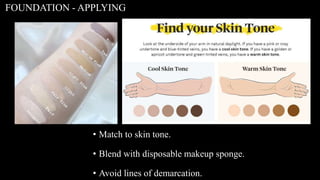
• Match to skin tone.
• Blend with disposable makeup sponge.
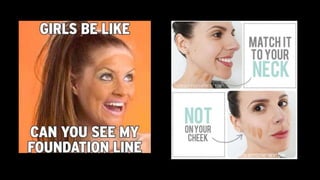
• Avoid lines of demarcation.
FOUNDATION - APPLYING
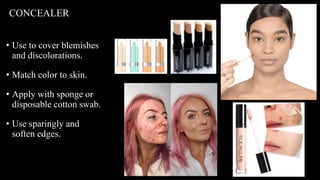
CONCEALER
• Use to cover blemishes
and discolorations.
• Match color to skin.
• Apply with sponge or
disposable cotton swab.
• Use sparingly and
soften edges.
• Adds matte finish, absorbs
oil, and sets foundation
• Mixture of talc or cornstarch
and pigment
• Uses binders like zinc
stearate
• Applied with large powder
brush
FACE POWDER
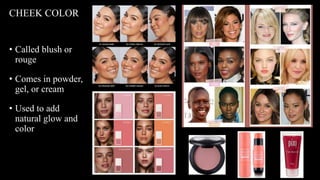
• Called blush or
rouge
• Comes in powder,
gel, or cream
• Used to add
natural glow and
color
CHEEK COLOR
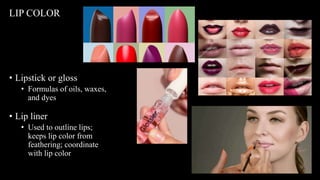
• Lipstick or gloss
• Formulas of oils, waxes,
and dyes
• Lip liner
• Used to outline lips;
keeps lip color from
feathering; coordinate
with lip color
LIP COLOR
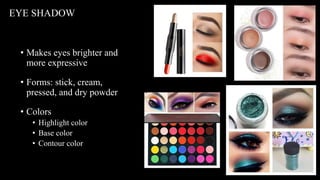
• Makes eyes brighter and
more expressive
• Forms: stick, cream,
pressed, and dry powder
• Colors
• Highlight color
• Base color
• Contour color
EYE SHADOW
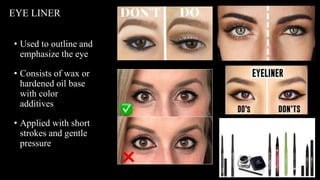
• Used to outline and
emphasize the eye
• Consists of wax or
hardened oil base
with color
additives
• Applied with short
strokes and gentle
pressure
EYE LINER
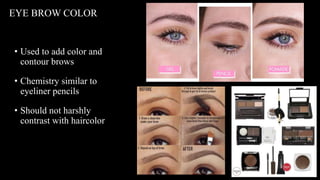
• Used to add color and
contour brows
• Chemistry similar to
eyeliner pencils
• Should not harshly
contrast with haircolor
EYE BROW COLOR
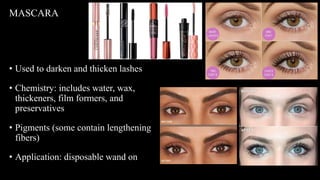
• Used to darken and thicken lashes
• Chemistry: includes water, wax,
thickeners, film formers, and
preservatives
• Pigments (some contain lengthening
fibers)
• Application: disposable wand on all
lashes (no double dipping)
MASCARA
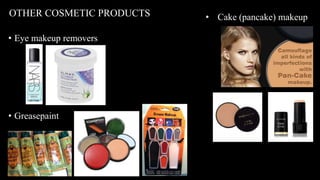
• Eye makeup removers
• Greasepaint
OTHER COSMETIC PRODUCTS • Cake (pancake) makeup
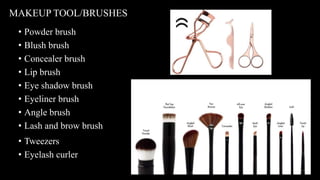
• Powder brush
• Blush brush
• Concealer brush
• Lip brush
• Eye shadow brush
• Eyeliner brush
• Angle brush
• Lash and brow brush
MAKEUP TOOL/BRUSHES
• Tweezers
• Eyelash curler
• Tweezers
• Eyelash curler
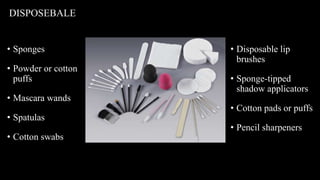
• Sponges
• Powder or cotton
puffs
• Mascara wands
• Spatulas
• Cotton swabs
• Disposable lip
brushes
• Sponge-tipped
shadow applicators
• Cotton pads or puffs
• Pencil sharpeners
DISPOSEBALE
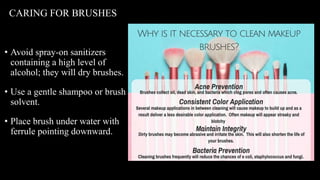
• Avoid spray-on sanitizers
containing a high level of
alcohol; they will dry brushes.
• Use a gentle shampoo or brush
solvent.
• Place brush under water with
ferrule pointing downward.
CARING FOR BRUSHES
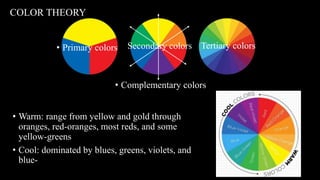
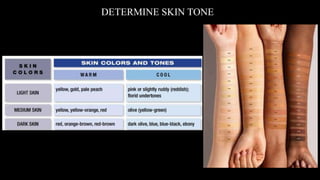
• Complementary colors
• Warm: range from yellow and gold through
oranges, red-oranges, most reds, and some
yellow-greens
• Cool: dominated by blues, greens, violets, and
blue-reds
COLOR THEORY
Secondary colors• Primary colors Tertiary colors
DETERMINE SKIN TONE
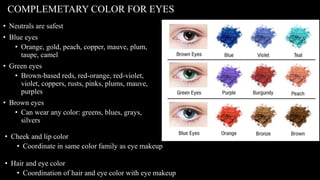
• Neutrals are safest
• Blue eyes
• Orange, gold, peach, copper, mauve, plum,
taupe, camel
• Green eyes
• Brown-based reds, red-orange, red-violet,
violet, coppers, rusts, pinks, plums, mauve,
purples
• Brown eyes
• Can wear any color: greens, blues, grays,
silvers
COMPLEMETARY COLOR FOR EYES
• Cheek and lip color
• Coordinate in same color family as eye makeup
• Hair and eye color
• Coordination of hair and eye color with eye makeup
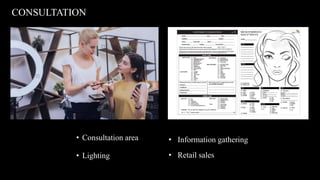
• Consultation area
• Lighting
CONSULTATION
• Information gathering
• Retail sales
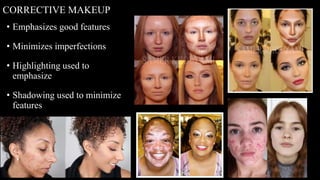
• Emphasizes good features
• Minimizes imperfections
• Highlighting used to
emphasize
• Shadowing used to minimize
features
CORRECTIVE MAKEUP
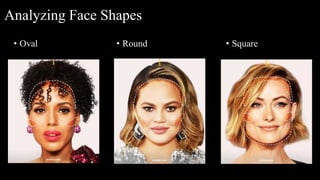
Analyzing Face Shapes
• Oval • Round • Square
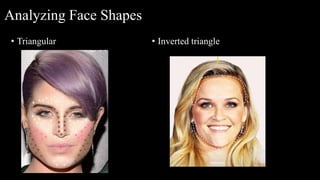
• Triangular
Analyzing Face Shapes
• Inverted triangle
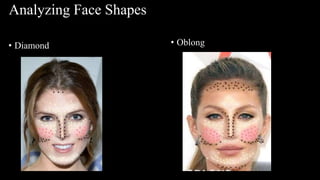
• Diamond
Analyzing Face Shapes
• Oblong
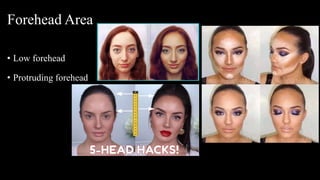
Forehead Area
• Low forehead
• Protruding forehead
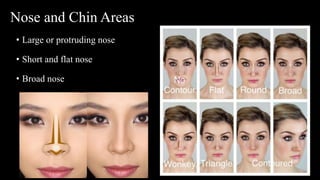
Nose and Chin Areas
• Large or protruding nose
• Short and flat nose
• Broad nose
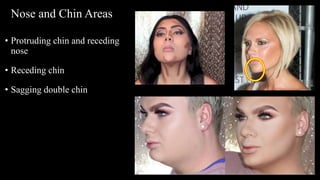
• Protruding chin and receding
nose
• Receding chin
• Sagging double chin
Nose and Chin Areas
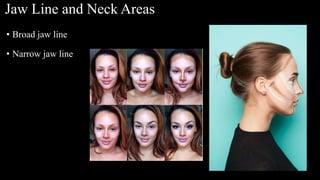
Jaw Line and Neck Areas
• Broad jaw line
• Narrow jaw line
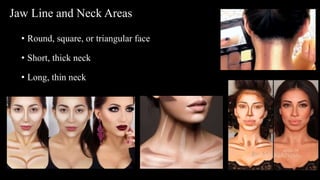
• Round, square, or triangular face
• Short, thick neck
• Long, thin neck
Jaw Line and Neck Areas
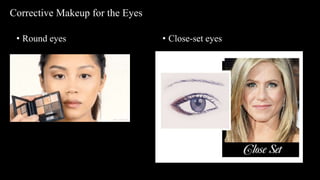
Corrective Makeup for the Eyes
• Round eyes • Close-set eyes
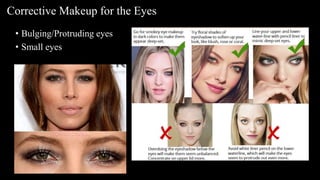
• Bulging/Protruding eyes
• Small eyes
Corrective Makeup for the Eyes
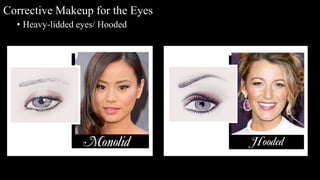
• Heavy-lidded eyes/ Hooded
Corrective Makeup for the Eyes
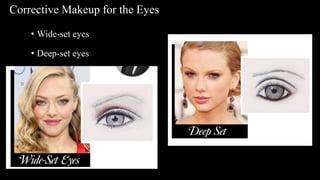
• Wide-set eyes
• Deep-set eyes
Corrective Makeup for the Eyes
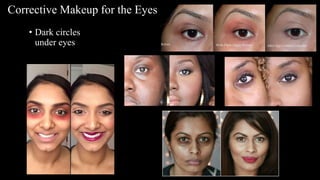
• Dark circles
under eyes
Corrective Makeup for the Eyes
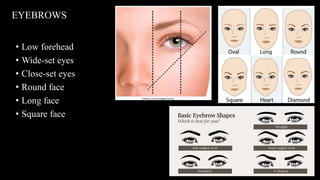
• Low forehead
• Wide-set eyes
• Close-set eyes
• Round face
• Long face
• Square face
EYEBROWS
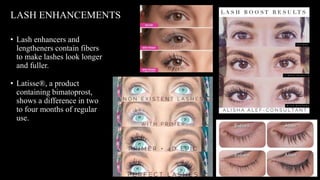
• Lash enhancers and
lengtheners contain fibers
to make lashes look longer
and fuller.
• Latisse®, a product
containing bimatoprost,
shows a difference in two
to four months of regular
use.
LASH ENHANCEMENTS
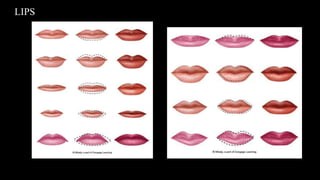
LIPS
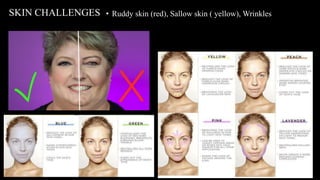
• Ruddy skin (red), Sallow skin ( yellow), WrinklesSKIN CHALLENGES
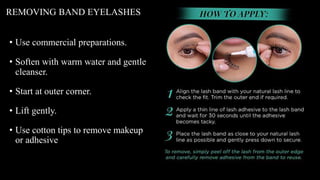
• Use commercial preparations.
• Soften with warm water and gentle
cleanser.
• Start at outer corner.
• Lift gently.
• Use cotton tips to remove makeup
or adhesive.
REMOVING BAND EYELASHES
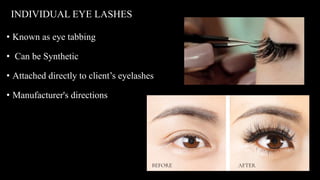
• Known as eye tabbing
• Can be Synthetic
• Attached directly to client’s eyelashes
• Manufacturer's directions
INDIVIDUAL EYE LASHES
REVIEW
• What are key point to a makeup consultation?
• What are some makeup products?
• What is the difference between Concealer and
Foundation?
• What is corrective makeup?
• How does Color Theory apply to Makeup
applications?
• What is the difference between grease paint and
pancake makeup?
• What are some reusable tools? What is considered
deposable?
• What are the face shapes? How does that help you
with contouring?
• What is the difference between band lashes and
individual lashes?
• What is another name for individual lashes?
• Review the eye shapes and applications

Milady makeup

  • 1.
    Products. Tools. Sanitation.Color Theory MILADY MAKEUP
  • 2.
    OBJECTIVE • Guests willrely on you to advise them on tips and techniques that will help them look their best. • Understanding of basic makeup techniques will allow you to enhance the hair and chemical services you provide for clients, offering them a total look ! • Knowing facial makeup products allows you to know when and on whom they should be used • Learning how to properly enhance/camouflage face shapes, structure and challenges will ensure guest retention, revenue and trust!!!
  • 3.
    • FOUNDATION • CONCEALER •FACE POWDER • CHEEK COLOR • LIP COLOR • EYE SHADOW • EYE LINER • MASCARA PRODUCTS
  • 4.
    FOUNDATION • A tintedcosmetic –BASE MAKEUP • Used to cover or even out skin coloring; conceal minor imperfections of skin • Helps protect the skin from climate, dirt, and debris • Liquid, stick, and cream forms • Color primer: applied to skin prior to foundation to disguise skin discoloration
  • 5.
    FOUNDATION CHEMISTRY • Liquid:water-based foundations with emollients Cream: oil-based;thicker than liquid Oil-free: intended for oilier skin types
  • 6.
    • Match toskin tone. • Blend with disposable makeup sponge. • Avoid lines of demarcation. FOUNDATION - APPLYING
  • 8.
    CONCEALER • Use tocover blemishes and discolorations. • Match color to skin. • Apply with sponge or disposable cotton swab. • Use sparingly and soften edges.
  • 9.
    • Adds mattefinish, absorbs oil, and sets foundation • Mixture of talc or cornstarch and pigment • Uses binders like zinc stearate • Applied with large powder brush FACE POWDER
  • 10.
    • Called blushor rouge • Comes in powder, gel, or cream • Used to add natural glow and color CHEEK COLOR
  • 11.
    • Lipstick orgloss • Formulas of oils, waxes, and dyes • Lip liner • Used to outline lips; keeps lip color from feathering; coordinate with lip color LIP COLOR
  • 12.
    • Makes eyesbrighter and more expressive • Forms: stick, cream, pressed, and dry powder • Colors • Highlight color • Base color • Contour color EYE SHADOW
  • 13.
    • Used tooutline and emphasize the eye • Consists of wax or hardened oil base with color additives • Applied with short strokes and gentle pressure EYE LINER
  • 14.
    • Used toadd color and contour brows • Chemistry similar to eyeliner pencils • Should not harshly contrast with haircolor EYE BROW COLOR
  • 15.
    • Used todarken and thicken lashes • Chemistry: includes water, wax, thickeners, film formers, and preservatives • Pigments (some contain lengthening fibers) • Application: disposable wand on all lashes (no double dipping) MASCARA
  • 16.
    • Eye makeupremovers • Greasepaint OTHER COSMETIC PRODUCTS • Cake (pancake) makeup
  • 17.
    • Powder brush •Blush brush • Concealer brush • Lip brush • Eye shadow brush • Eyeliner brush • Angle brush • Lash and brow brush MAKEUP TOOL/BRUSHES • Tweezers • Eyelash curler • Tweezers • Eyelash curler
  • 18.
    • Sponges • Powderor cotton puffs • Mascara wands • Spatulas • Cotton swabs • Disposable lip brushes • Sponge-tipped shadow applicators • Cotton pads or puffs • Pencil sharpeners DISPOSEBALE
  • 19.
    • Avoid spray-onsanitizers containing a high level of alcohol; they will dry brushes. • Use a gentle shampoo or brush solvent. • Place brush under water with ferrule pointing downward. CARING FOR BRUSHES
  • 20.
    • Complementary colors •Warm: range from yellow and gold through oranges, red-oranges, most reds, and some yellow-greens • Cool: dominated by blues, greens, violets, and blue-reds COLOR THEORY Secondary colors• Primary colors Tertiary colors
  • 21.
  • 22.
    • Neutrals aresafest • Blue eyes • Orange, gold, peach, copper, mauve, plum, taupe, camel • Green eyes • Brown-based reds, red-orange, red-violet, violet, coppers, rusts, pinks, plums, mauve, purples • Brown eyes • Can wear any color: greens, blues, grays, silvers COMPLEMETARY COLOR FOR EYES • Cheek and lip color • Coordinate in same color family as eye makeup • Hair and eye color • Coordination of hair and eye color with eye makeup
  • 23.
    • Consultation area •Lighting CONSULTATION • Information gathering • Retail sales
  • 24.
    • Emphasizes goodfeatures • Minimizes imperfections • Highlighting used to emphasize • Shadowing used to minimize features CORRECTIVE MAKEUP
  • 25.
    Analyzing Face Shapes •Oval • Round • Square
  • 26.
    • Triangular Analyzing FaceShapes • Inverted triangle
  • 27.
    • Diamond Analyzing FaceShapes • Oblong
  • 28.
    Forehead Area • Lowforehead • Protruding forehead
  • 29.
    Nose and ChinAreas • Large or protruding nose • Short and flat nose • Broad nose
  • 30.
    • Protruding chinand receding nose • Receding chin • Sagging double chin Nose and Chin Areas
  • 31.
    Jaw Line andNeck Areas • Broad jaw line • Narrow jaw line
  • 32.
    • Round, square,or triangular face • Short, thick neck • Long, thin neck Jaw Line and Neck Areas
  • 33.
    Corrective Makeup forthe Eyes • Round eyes • Close-set eyes
  • 34.
    • Bulging/Protruding eyes •Small eyes Corrective Makeup for the Eyes
  • 35.
    • Heavy-lidded eyes/Hooded Corrective Makeup for the Eyes
  • 36.
    • Wide-set eyes •Deep-set eyes Corrective Makeup for the Eyes
  • 37.
    • Dark circles undereyes Corrective Makeup for the Eyes
  • 38.
    • Low forehead •Wide-set eyes • Close-set eyes • Round face • Long face • Square face EYEBROWS
  • 39.
    • Lash enhancersand lengtheners contain fibers to make lashes look longer and fuller. • Latisse®, a product containing bimatoprost, shows a difference in two to four months of regular use. LASH ENHANCEMENTS
  • 40.
  • 41.
    • Ruddy skin(red), Sallow skin ( yellow), WrinklesSKIN CHALLENGES
  • 42.
    • Use commercialpreparations. • Soften with warm water and gentle cleanser. • Start at outer corner. • Lift gently. • Use cotton tips to remove makeup or adhesive. REMOVING BAND EYELASHES
  • 43.
    • Known aseye tabbing • Can be Synthetic • Attached directly to client’s eyelashes • Manufacturer's directions INDIVIDUAL EYE LASHES
  • 44.
    REVIEW • What arekey point to a makeup consultation? • What are some makeup products? • What is the difference between Concealer and Foundation? • What is corrective makeup? • How does Color Theory apply to Makeup applications? • What is the difference between grease paint and pancake makeup? • What are some reusable tools? What is considered deposable? • What are the face shapes? How does that help you with contouring? • What is the difference between band lashes and individual lashes? • What is another name for individual lashes? • Review the eye shapes and applications