Milady
CHEMISTRY
The roles of Chemistry in Cosmetology
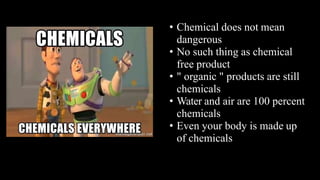
• Chemical does not mean
dangerous
• No such thing as chemical
free product
• " organic " products are still
chemicals
• Water and air are 100 percent
chemicals
• Even your body is made up
of chemicals
• MOST COSMETOLOGY SERVICES DEPEND ON
CHEMICALS
• GAIN KNOWLEDGE TO UNDERSTAND THE HOW
AND WHY OF PRODUCTS YOU AREUSING
RECOGNIZE HOW THE SCIENCE OF CHEMISTRY INFLUENCES
COSMETOLOGY
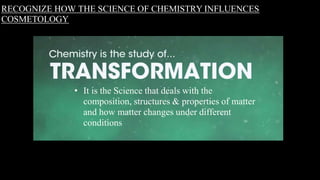
• It is the Science that deals with the
composition, structures & properties of matter
and how matter changes under different
conditions
RECOGNIZE HOW THE SCIENCE OF CHEMISTRY INFLUENCES
COSMETOLOGY
RECOGNIZE HOW THE SCIENCE OF CHEMISTRY INFLUENCES
COSMETOLOGY
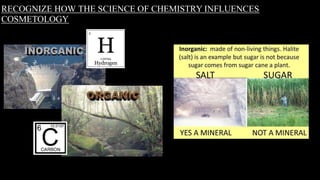
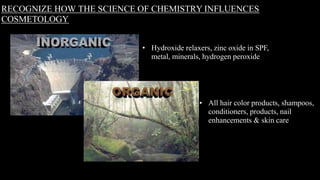
• Hydroxide relaxers, zinc oxide in SPF,
metal, minerals, hydrogen peroxide
• All hair color products, shampoos,
conditioners, products, nail
enhancements & skin care
DEFINE MATTER
•
•
•
•
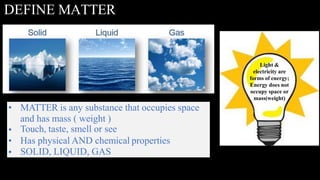
MATTER is any substance that occupies space
and has mass ( weight )
Touch, taste, smell or see
Has physical AND chemical properties
SOLID, LIQUID, GAS
Light &
electricity are
forms of energy;
Energy does not
occupy space or
mass(weight)
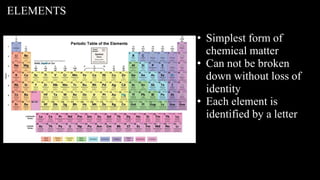
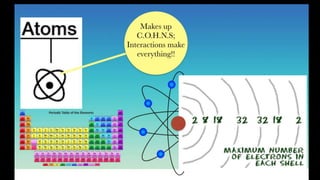
ELEMENTS
• Simplest form of
chemical matter
• Can not be broken
down without loss of
identity
• Each element is
identified by a letter
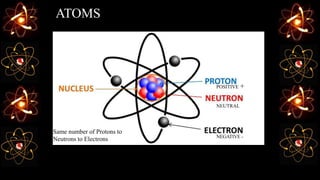
ATOMS
NEGATIVE -
POSITIVE +
NEUTRAL
Same number of Protons to
Neutrons to Electrons
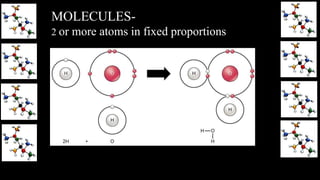
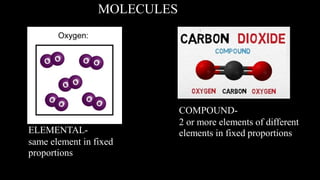
MOLECULES-
2 or more atoms in fixed proportions
MOLECULES
ELEMENTAL-
same element in fixed
proportions
COMPOUND-
2 or more elements of different
elements in fixed proportions
• Why is chemistry important to our industry?
• What is the difference between organic and non
organic?
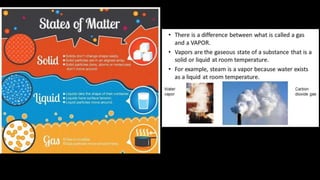
• Matter exists in 3 forms: what are they?
• Does energy take up space?
• The simplest form of matter is?
• Smallest part of an element?
• 2 types of molecules?
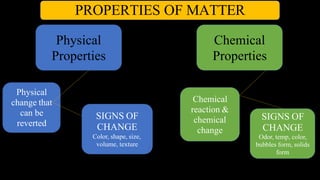
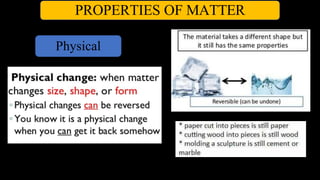
Physical
Properties
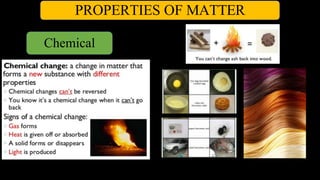
Chemical
Properties
SIGNS OF
CHANGE
Odor, temp, color,
bubbles form, solids
form
Chemical
reaction &
chemical
change
SIGNS OF
CHANGE
Color, shape, size,
volume, texture
Physical
change that
can be
reverted
PROPERTIES OF MATTER
Physical
PROPERTIES OF MATTER
Chemical
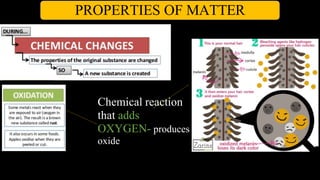
PROPERTIES OF MATTER
Chemical reaction
that adds
OXYGEN- produces
oxide
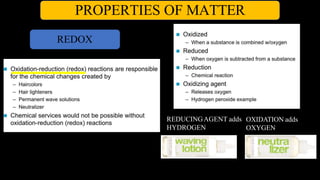
PROPERTIES OF MATTER
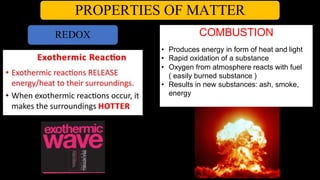
REDOX
REDUCINGAGENT adds OXIDATION adds
HYDROGEN OXYGEN
PROPERTIES OF MATTER
REDOX COMBUSTION
• Produces energy in form of heat and light
• Rapid oxidation of a substance
• Oxygen from atmosphere reacts with fuel
( easily burned substance )
• Results in new substances: ash, smoke,
energy
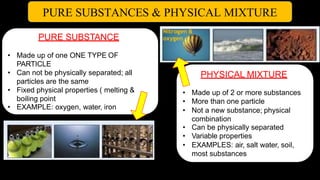
PURE SUBSTANCES & PHYSICAL MIXTURE
PURE SUBSTANCE
• Made up of one ONE TYPE OF
PARTICLE
• Can not be physically separated; all
particles are the same
• Fixed physical properties ( melting &
boiling point
• EXAMPLE: oxygen, water, iron
PHYSICAL MIXTURE
• Made up of 2 or more substances
• More than one particle
• Not a new substance; physical
combination
• Can be physically separated
• Variable properties
• EXAMPLES: air, salt water, soil,
most substances
Nitrogen &
oxygen
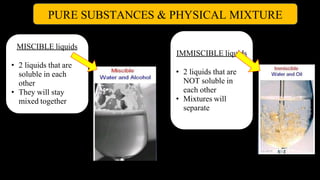
PURE SUBSTANCES & PHYSICAL MIXTURE
MISCIBLE liquids
• 2 liquids that are
soluble in each
other
• They will stay
mixed together
IMMISCIBLE liquids
• 2 liquids that are
NOT soluble in
each other
• Mixtures will
separate
•
•
•
•
•
•
•
•
•
•
•
•
What is the difference between a physical and chemical change? Examples of each
Oxidation reduction is REDOX is what type of change?
Oxidizing agent releases what? Example
Reducing agent adds hydrogen or subtracts what?
Can reduction reaction and oxidation occur at the same time? If so in what
cosmetology service ?
Difference between EXOTHERMIC and COMBUSTION
Matter is either a pure substance or what?
Pure substance is in proportions
Physical mixtures are in proportions
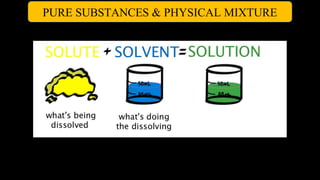
Put in order: SOLUTE, SOLUTION, SOLVENT
Universal solvent?
Difference between miscible and solution?
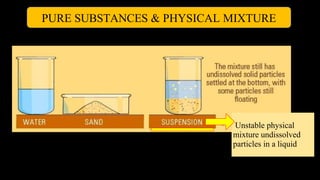
PURE SUBSTANCES & PHYSICAL MIXTURE
Unstable physical
mixture undissolved
particles in a liquid
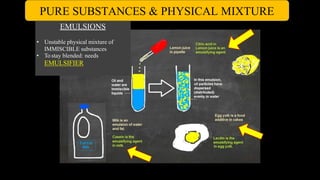
PURE SUBSTANCES & PHYSICAL MIXTURE
EMULSIONS
• Unstable physical mixture of
IMMISCIBLE substances
• To stay blended: needs
EMULSIFIER
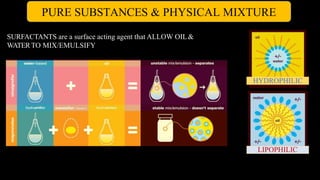
PURE SUBSTANCES & PHYSICAL MIXTURE
SURFACTANTS are a surface acting agent that ALLOW OIL&
WATERTO MIX/EMULSIFY
HYDROPHILIC
LIPOPHILIC
PURE SUBSTANCES & PHYSICAL MIXTURE
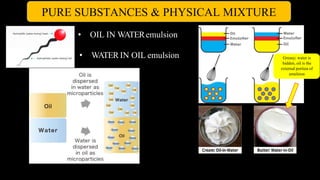
• OIL IN WATERemulsion
• WATERIN OIL emulsion Greasy; water is
hidden, oil is the
external portion of
emulsion
PURE SUBSTANCES & PHYSICAL MIXTURE
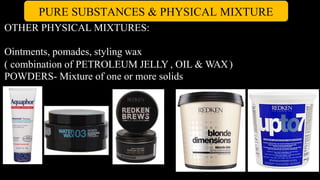
OTHER PHYSICAL MIXTURES:
Ointments, pomades, styling wax
( combination of PETROLEUM JELLY , OIL & WAX)
POWDERS- Mixture of one or more solids
COMMON CHEMICAL PRODUCT INGREDIENTS
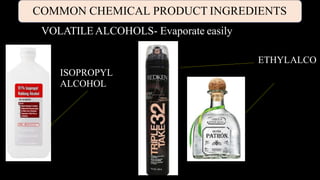
VOLATILE ALCOHOLS- Evaporate easily
ETHYLALCO
ISOPROPYL
ALCOHOL
COMMON CHEMICAL PRODUCT INGREDIENTS
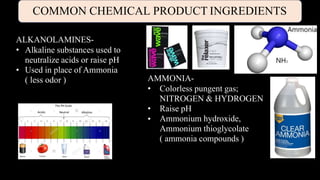
AMMONIA-
•
•
• Colorless pungent gas;
NITROGEN & HYDROGEN
Raise pH
Ammonium hydroxide,
Ammonium thioglycolate
( ammonia compounds )
ALKANOLAMINES-
•
• Alkaline substances used to
neutralize acids or raise pH
Used in place of Ammonia
( less odor )
COMMON CHEMICAL PRODUCT INGREDIENTS
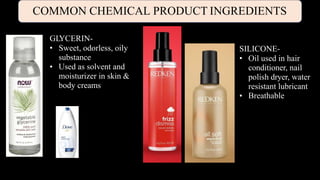
GLYCERIN-
•
• Sweet, odorless, oily
substance
Used as solvent and
moisturizer in skin &
body creams
SILICONE-
•
• Oil used in hair
conditioner, nail
polish dryer, water
resistant lubricant
Breathable
COMMON CHEMICAL PRODUCT INGREDIENTS
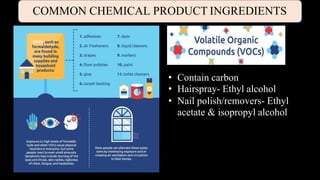
• Contain carbon
• Hairspray- Ethyl alcohol
• Nail polish/removers- Ethyl
acetate & isopropyl alcohol
• What is the difference between a solution and a suspension?
• What does an emulsifier do? ;Brings together what 2 types of
liquids?
• 2 parts of the surfactant ?
• Difference between Oil in water and Water in oil?
• What are some other types of chemical products?
• What is an alkalomine?
• What does VOC stand for
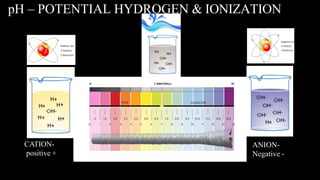
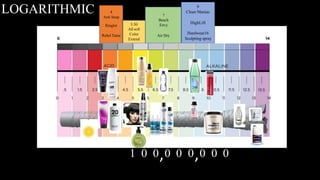
pH – POTENTIAL HYDROGEN & IONIZATION
CATION-
positive +
ANION-
Negative -
9
Clean Maniac
HighLift
Hardwear16
Sculpting spray
4
Anti Snap
Ringlet
Rebel Tame
7
Beach
Envy
Air Dry
5.50
All soft
Color
Extend
LOGARITHMIC
1 0 0 0 0 0 0 0 0, ,
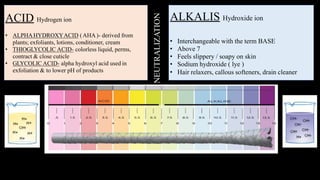
ACID Hydrogen ion
• ALPHAHYDROXYACID (AHA)- derived from
plants; exfoliants, lotions, conditioner, cream
• THIOGLYCOLIC ACID- colorless liquid, perms,
contract & close cuticle
• GLYCOLIC ACID- alpha hydroxyl acid used in
exfoliation & to lower pH of products
ALKALIS Hydroxide ion
• Interchangeable with the term BASE
• Above 7
• Feels slippery / soapy on skin
• Sodium hydroxide ( lye )
• Hair relaxers, callous softeners, drain cleaner
NEUTRALIZATION
• What does pH stand for?
• Why is pH important?
• Acidic has what types of ions?
• The more alkaline the more ions?
• Terms for positive and negative ions?
• Base can also mean?
• What is logarithmic?
• What does AHA standfor?
• What is a acid that is colorless and found in perms?
Milady   chemistry-2019 (2)

Milady chemistry-2019 (2)

  • 1.
    Milady CHEMISTRY The roles ofChemistry in Cosmetology
  • 3.
    • Chemical doesnot mean dangerous • No such thing as chemical free product • " organic " products are still chemicals • Water and air are 100 percent chemicals • Even your body is made up of chemicals
  • 4.
    • MOST COSMETOLOGYSERVICES DEPEND ON CHEMICALS • GAIN KNOWLEDGE TO UNDERSTAND THE HOW AND WHY OF PRODUCTS YOU AREUSING
  • 5.
    RECOGNIZE HOW THESCIENCE OF CHEMISTRY INFLUENCES COSMETOLOGY • It is the Science that deals with the composition, structures & properties of matter and how matter changes under different conditions
  • 6.
    RECOGNIZE HOW THESCIENCE OF CHEMISTRY INFLUENCES COSMETOLOGY
  • 7.
    RECOGNIZE HOW THESCIENCE OF CHEMISTRY INFLUENCES COSMETOLOGY • Hydroxide relaxers, zinc oxide in SPF, metal, minerals, hydrogen peroxide • All hair color products, shampoos, conditioners, products, nail enhancements & skin care
  • 8.
    DEFINE MATTER • • • • MATTER isany substance that occupies space and has mass ( weight ) Touch, taste, smell or see Has physical AND chemical properties SOLID, LIQUID, GAS Light & electricity are forms of energy; Energy does not occupy space or mass(weight)
  • 9.
    ELEMENTS • Simplest formof chemical matter • Can not be broken down without loss of identity • Each element is identified by a letter
  • 10.
    ATOMS NEGATIVE - POSITIVE + NEUTRAL Samenumber of Protons to Neutrons to Electrons
  • 11.
    MOLECULES- 2 or moreatoms in fixed proportions
  • 13.
    MOLECULES ELEMENTAL- same element infixed proportions COMPOUND- 2 or more elements of different elements in fixed proportions
  • 14.
    • Why ischemistry important to our industry? • What is the difference between organic and non organic? • Matter exists in 3 forms: what are they? • Does energy take up space? • The simplest form of matter is? • Smallest part of an element? • 2 types of molecules?
  • 16.
    Physical Properties Chemical Properties SIGNS OF CHANGE Odor, temp,color, bubbles form, solids form Chemical reaction & chemical change SIGNS OF CHANGE Color, shape, size, volume, texture Physical change that can be reverted PROPERTIES OF MATTER
  • 17.
  • 18.
  • 19.
    PROPERTIES OF MATTER Chemicalreaction that adds OXYGEN- produces oxide
  • 20.
    PROPERTIES OF MATTER REDOX REDUCINGAGENTadds OXIDATION adds HYDROGEN OXYGEN
  • 21.
    PROPERTIES OF MATTER REDOXCOMBUSTION • Produces energy in form of heat and light • Rapid oxidation of a substance • Oxygen from atmosphere reacts with fuel ( easily burned substance ) • Results in new substances: ash, smoke, energy
  • 22.
    PURE SUBSTANCES &PHYSICAL MIXTURE PURE SUBSTANCE • Made up of one ONE TYPE OF PARTICLE • Can not be physically separated; all particles are the same • Fixed physical properties ( melting & boiling point • EXAMPLE: oxygen, water, iron PHYSICAL MIXTURE • Made up of 2 or more substances • More than one particle • Not a new substance; physical combination • Can be physically separated • Variable properties • EXAMPLES: air, salt water, soil, most substances Nitrogen & oxygen
  • 23.
    PURE SUBSTANCES &PHYSICAL MIXTURE
  • 24.
    PURE SUBSTANCES &PHYSICAL MIXTURE MISCIBLE liquids • 2 liquids that are soluble in each other • They will stay mixed together IMMISCIBLE liquids • 2 liquids that are NOT soluble in each other • Mixtures will separate
  • 25.
    • • • • • • • • • • • • What is thedifference between a physical and chemical change? Examples of each Oxidation reduction is REDOX is what type of change? Oxidizing agent releases what? Example Reducing agent adds hydrogen or subtracts what? Can reduction reaction and oxidation occur at the same time? If so in what cosmetology service ? Difference between EXOTHERMIC and COMBUSTION Matter is either a pure substance or what? Pure substance is in proportions Physical mixtures are in proportions Put in order: SOLUTE, SOLUTION, SOLVENT Universal solvent? Difference between miscible and solution?
  • 26.
    PURE SUBSTANCES &PHYSICAL MIXTURE Unstable physical mixture undissolved particles in a liquid
  • 27.
    PURE SUBSTANCES &PHYSICAL MIXTURE EMULSIONS • Unstable physical mixture of IMMISCIBLE substances • To stay blended: needs EMULSIFIER
  • 28.
    PURE SUBSTANCES &PHYSICAL MIXTURE SURFACTANTS are a surface acting agent that ALLOW OIL& WATERTO MIX/EMULSIFY HYDROPHILIC LIPOPHILIC
  • 29.
    PURE SUBSTANCES &PHYSICAL MIXTURE • OIL IN WATERemulsion • WATERIN OIL emulsion Greasy; water is hidden, oil is the external portion of emulsion
  • 30.
    PURE SUBSTANCES &PHYSICAL MIXTURE OTHER PHYSICAL MIXTURES: Ointments, pomades, styling wax ( combination of PETROLEUM JELLY , OIL & WAX) POWDERS- Mixture of one or more solids
  • 31.
    COMMON CHEMICAL PRODUCTINGREDIENTS VOLATILE ALCOHOLS- Evaporate easily ETHYLALCO ISOPROPYL ALCOHOL
  • 32.
    COMMON CHEMICAL PRODUCTINGREDIENTS AMMONIA- • • • Colorless pungent gas; NITROGEN & HYDROGEN Raise pH Ammonium hydroxide, Ammonium thioglycolate ( ammonia compounds ) ALKANOLAMINES- • • Alkaline substances used to neutralize acids or raise pH Used in place of Ammonia ( less odor )
  • 33.
    COMMON CHEMICAL PRODUCTINGREDIENTS GLYCERIN- • • Sweet, odorless, oily substance Used as solvent and moisturizer in skin & body creams SILICONE- • • Oil used in hair conditioner, nail polish dryer, water resistant lubricant Breathable
  • 34.
    COMMON CHEMICAL PRODUCTINGREDIENTS • Contain carbon • Hairspray- Ethyl alcohol • Nail polish/removers- Ethyl acetate & isopropyl alcohol
  • 35.
    • What isthe difference between a solution and a suspension? • What does an emulsifier do? ;Brings together what 2 types of liquids? • 2 parts of the surfactant ? • Difference between Oil in water and Water in oil? • What are some other types of chemical products? • What is an alkalomine? • What does VOC stand for
  • 36.
    pH – POTENTIALHYDROGEN & IONIZATION CATION- positive + ANION- Negative -
  • 37.
    9 Clean Maniac HighLift Hardwear16 Sculpting spray 4 AntiSnap Ringlet Rebel Tame 7 Beach Envy Air Dry 5.50 All soft Color Extend LOGARITHMIC 1 0 0 0 0 0 0 0 0, ,
  • 38.
    ACID Hydrogen ion •ALPHAHYDROXYACID (AHA)- derived from plants; exfoliants, lotions, conditioner, cream • THIOGLYCOLIC ACID- colorless liquid, perms, contract & close cuticle • GLYCOLIC ACID- alpha hydroxyl acid used in exfoliation & to lower pH of products ALKALIS Hydroxide ion • Interchangeable with the term BASE • Above 7 • Feels slippery / soapy on skin • Sodium hydroxide ( lye ) • Hair relaxers, callous softeners, drain cleaner NEUTRALIZATION
  • 39.
    • What doespH stand for? • Why is pH important? • Acidic has what types of ions? • The more alkaline the more ions? • Terms for positive and negative ions? • Base can also mean? • What is logarithmic? • What does AHA standfor? • What is a acid that is colorless and found in perms?