Week 1
Our first CSI class was conducted in the lecture theatre where we were given a brief introduction to the subjectas well as a motivational speech to encourage us to
do well for this subject.We were then informed that consecutive classes would be conducted online through TIMES and we were asked to form groups of five as
well as choose a theme for our CSI project.
The theme chosen by my group was Self Sustaining Centre for The Communityand the communitythat we chose to focus on was the orang asli community.The
reason we chose this theme and communityis because we were excited to get to know the orang asli communitywhich we were not familiar with and also we felt
that the orang asli communitywould benefitthe mostfrom a communityservice projectsuch as this where we are given the opportunity to design to improve their
living conditions.
For the first week we were only required to confirm our chosen theme and communityas well as postour group member name list on the Padlet wall in TIMES.
Week 2
This week was our firstonline class where we were required to posta group photo with all our members and upload iton our Padletwall as proof of our
attendance.Furthermore,we were also required to update our progress where we were to inform on our chosen site and SWOT analysis for that site.Also, we
were required to propose a design for our chosen communityand elaborate on the aims of that design.
The site that we chose was Kampung Kemensah as through our online research we discovered thatthere is an orang asli communityliving in rural conditions that
could benefitfrom our communityservice project. The design thatwe proposed was to design a charity space to displayand se ll handmade crafts ofthe orang asli
and we also proposed conducting activities to educate the orang asli children.
Individually, we were required to postaboutour expectations from the communityservice projectand my response to this was thatI wanted to be able to better
understand the orang asli communityand help them in some way.
Week 3
For our third class,we were required to postour improved design based on the previous week and also our research ofthe site and precedentstudies.
Developing from our previous session,we decided to design a shelter where the orang asli could have activities such as hunting lessons,survival skills,language
centre, food preparation and cultural events.This shelter would allow touristto learn more about the orang asli and also ge nerate income for the orang asli
community.
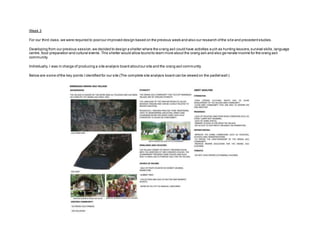
Individually, I was in charge of producing a site analysis board aboutour site and the orang asli community.
Below are some ofthe key points I identified for our site (The complete site analysis board can be viewed on the padletwall ):
Week 4
After receiving comments for our previous session we were told that our site was appropriate for our project however the design had to be more manageable such
that it could be carried out easily. Furthermore,the tutorial session was to be conducted as a physical meeting for this week.
During our session,we presented our new design which was a rainwater harvesting planter box.Through discussion with our tutor we decided to design rainwater
harvesting vertical garden instead as we were told it would be more interesting.Furthermore,we were given advice to simplifyour design such thatit would be
easier to construct.
The reason we wanted to create a place for the orang asli to plantvegetables is because we identified the main issue ofthe orang asli communityto be the lack of
self-sustaining activities.Furthermore,rainwater harvesting is beneficial for the communitybecause the river is located far fro m the village and it would be difficult
for them to obtain water to maintain the planted vegetables.
Week 5
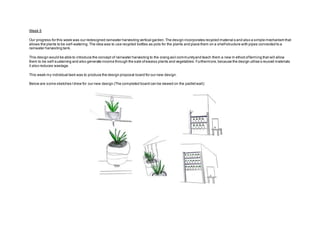
Our progress for this week was our redesigned rainwater harvesting vertical garden.The design incorporates recycled material s and also a simple mechanism that
allows the plants to be self-watering.The idea was to use recycled bottles as pots for the plants and place them on a shelfstructure with pipes connected to a
rainwater harvesting tank.
This design would be able to introduce the concept of rainwater harvesting to the orang asli communityand teach them a new m ethod offarming that will allow
them to be self-sustaining and also generate income through the sale ofexcess plants and vegetables.Furthermore,because the design utilise s reused materials
it also reduces wastage.
This week my individual task was to produce the design proposal board for our new design.
Below are some sketches Idrew for our new design (The completed board can be viewed on the padletwall):
Week 6
This week is our interim submission.Our design has been approved however we were told to further improve the rainwater harvesting mechanism used in our
design.Thus,we have produced an A0 board for our new design in preparation for the final submission and also a mock up mode l to further understand how the
design will work.
Furthermore,my individual task for this week was to complete the article writing for our project.
Week 6
Later this week (Friday), we had a physical meeting with our tutor, Pn. Yati. We updated her on our progress and showed her p ictures ofour completed model.Our
design was approved and we visited our site to carry out the installation ofour project on Sunday.
Week 6
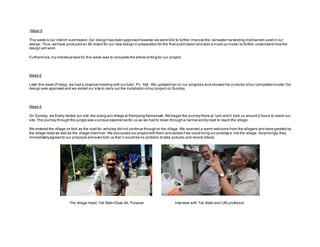
On Sunday, we finally visited our site,the orang asli village at Kampung Kemensah.We began the journey there at 1pm and it took us around 2 hours to reach our
site.The journey through the jungle was a unique experience for us as we had to travel through a narrow windy road to reach the village .
We entered the village on foot as the road for vehicles did not continue through to the village. We received a warm welcome from the villagers and were greeted by
the village head as well as the village chairman.We discussed our projectwith them and asked if we could bring our prototyp e into the village. Surprisingly,they
immediatelyagreed to our proposal and even told us that it would be no problem to take pictures and record videos.
The village head,Tok Batin Ebak A/L Pulasan Interview with Tok Batin and UM professor
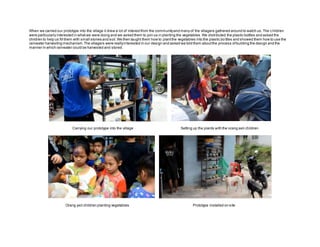
When we carried our prototype into the village it drew a lot of interestfrom the communityand many of the villagers gathered around to watch us.The children
were particularly interested in whatwe were doing and we asked them to join us in planting the vegetables.We distributed the plastic bottles and asked the
children to help us fill them with small stones and soil.We then taught them how to plantthe vegetables into the plastic bo ttles and showed them how to use the
rainwater harvesting mechanism.The villagers were reallyinterested in our design and asked we told them aboutthe process ofbuilding the design and the
manner in which rainwater could be harvested and stored.
Carrying our prototype into the village Setting up the plants with the orang asli children
Orang asli children planting vegetables Prototype installed on site
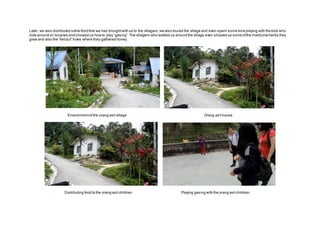
Later, we also distributed some food that we had broughtwith us to the villagers,we also toured the village and even spent some time playing with the kids who
rode around on bicycles and showed us how to play “gasing”.The villagers who walked us around the village even showed us some ofthe medicinal herbs they
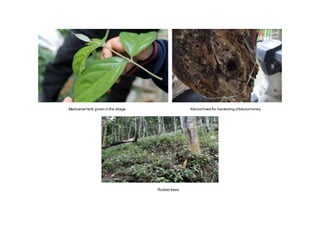
grew and also the “kelulut” hives where they gathered honey.
Environmentof the orang asli village Orang asli house
Distributing food to the orang asli children Playing gasing with the orang asli children
Medicanal herb grown in the village Keluluthives for harvesting ofkeluluthoney
Rubber trees
All in all, it was a really exciting experience and we were very happy to receive the positive response to our des ign.We were not only able to successfullycarry out
our projectbut were also able to experience first-hand the orang asli community.We learntthat the orang asli are a very friendly and welcoming people and also
although they are still living in rural conditions we learntthatthey have a lot of their own knowledge and values to share.
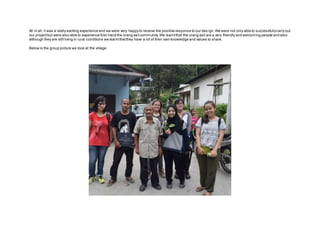
Below is the group picture we took at the village:

CSI Journal

  • 1.
    Week 1 Our firstCSI class was conducted in the lecture theatre where we were given a brief introduction to the subjectas well as a motivational speech to encourage us to do well for this subject.We were then informed that consecutive classes would be conducted online through TIMES and we were asked to form groups of five as well as choose a theme for our CSI project. The theme chosen by my group was Self Sustaining Centre for The Communityand the communitythat we chose to focus on was the orang asli community.The reason we chose this theme and communityis because we were excited to get to know the orang asli communitywhich we were not familiar with and also we felt that the orang asli communitywould benefitthe mostfrom a communityservice projectsuch as this where we are given the opportunity to design to improve their living conditions. For the first week we were only required to confirm our chosen theme and communityas well as postour group member name list on the Padlet wall in TIMES. Week 2 This week was our firstonline class where we were required to posta group photo with all our members and upload iton our Padletwall as proof of our attendance.Furthermore,we were also required to update our progress where we were to inform on our chosen site and SWOT analysis for that site.Also, we were required to propose a design for our chosen communityand elaborate on the aims of that design. The site that we chose was Kampung Kemensah as through our online research we discovered thatthere is an orang asli communityliving in rural conditions that could benefitfrom our communityservice project. The design thatwe proposed was to design a charity space to displayand se ll handmade crafts ofthe orang asli and we also proposed conducting activities to educate the orang asli children. Individually, we were required to postaboutour expectations from the communityservice projectand my response to this was thatI wanted to be able to better understand the orang asli communityand help them in some way.
  • 2.
    Week 3 For ourthird class,we were required to postour improved design based on the previous week and also our research ofthe site and precedentstudies. Developing from our previous session,we decided to design a shelter where the orang asli could have activities such as hunting lessons,survival skills,language centre, food preparation and cultural events.This shelter would allow touristto learn more about the orang asli and also ge nerate income for the orang asli community. Individually, I was in charge of producing a site analysis board aboutour site and the orang asli community. Below are some ofthe key points I identified for our site (The complete site analysis board can be viewed on the padletwall ):
  • 3.
    Week 4 After receivingcomments for our previous session we were told that our site was appropriate for our project however the design had to be more manageable such that it could be carried out easily. Furthermore,the tutorial session was to be conducted as a physical meeting for this week. During our session,we presented our new design which was a rainwater harvesting planter box.Through discussion with our tutor we decided to design rainwater harvesting vertical garden instead as we were told it would be more interesting.Furthermore,we were given advice to simplifyour design such thatit would be easier to construct. The reason we wanted to create a place for the orang asli to plantvegetables is because we identified the main issue ofthe orang asli communityto be the lack of self-sustaining activities.Furthermore,rainwater harvesting is beneficial for the communitybecause the river is located far fro m the village and it would be difficult for them to obtain water to maintain the planted vegetables.
  • 4.
    Week 5 Our progressfor this week was our redesigned rainwater harvesting vertical garden.The design incorporates recycled material s and also a simple mechanism that allows the plants to be self-watering.The idea was to use recycled bottles as pots for the plants and place them on a shelfstructure with pipes connected to a rainwater harvesting tank. This design would be able to introduce the concept of rainwater harvesting to the orang asli communityand teach them a new m ethod offarming that will allow them to be self-sustaining and also generate income through the sale ofexcess plants and vegetables.Furthermore,because the design utilise s reused materials it also reduces wastage. This week my individual task was to produce the design proposal board for our new design. Below are some sketches Idrew for our new design (The completed board can be viewed on the padletwall):
  • 5.
    Week 6 This weekis our interim submission.Our design has been approved however we were told to further improve the rainwater harvesting mechanism used in our design.Thus,we have produced an A0 board for our new design in preparation for the final submission and also a mock up mode l to further understand how the design will work. Furthermore,my individual task for this week was to complete the article writing for our project. Week 6 Later this week (Friday), we had a physical meeting with our tutor, Pn. Yati. We updated her on our progress and showed her p ictures ofour completed model.Our design was approved and we visited our site to carry out the installation ofour project on Sunday. Week 6 On Sunday, we finally visited our site,the orang asli village at Kampung Kemensah.We began the journey there at 1pm and it took us around 2 hours to reach our site.The journey through the jungle was a unique experience for us as we had to travel through a narrow windy road to reach the village . We entered the village on foot as the road for vehicles did not continue through to the village. We received a warm welcome from the villagers and were greeted by the village head as well as the village chairman.We discussed our projectwith them and asked if we could bring our prototyp e into the village. Surprisingly,they immediatelyagreed to our proposal and even told us that it would be no problem to take pictures and record videos. The village head,Tok Batin Ebak A/L Pulasan Interview with Tok Batin and UM professor
  • 6.
    When we carriedour prototype into the village it drew a lot of interestfrom the communityand many of the villagers gathered around to watch us.The children were particularly interested in whatwe were doing and we asked them to join us in planting the vegetables.We distributed the plastic bottles and asked the children to help us fill them with small stones and soil.We then taught them how to plantthe vegetables into the plastic bo ttles and showed them how to use the rainwater harvesting mechanism.The villagers were reallyinterested in our design and asked we told them aboutthe process ofbuilding the design and the manner in which rainwater could be harvested and stored. Carrying our prototype into the village Setting up the plants with the orang asli children Orang asli children planting vegetables Prototype installed on site
  • 7.
    Later, we alsodistributed some food that we had broughtwith us to the villagers,we also toured the village and even spent some time playing with the kids who rode around on bicycles and showed us how to play “gasing”.The villagers who walked us around the village even showed us some ofthe medicinal herbs they grew and also the “kelulut” hives where they gathered honey. Environmentof the orang asli village Orang asli house Distributing food to the orang asli children Playing gasing with the orang asli children
  • 8.
    Medicanal herb grownin the village Keluluthives for harvesting ofkeluluthoney Rubber trees
  • 9.
    All in all,it was a really exciting experience and we were very happy to receive the positive response to our des ign.We were not only able to successfullycarry out our projectbut were also able to experience first-hand the orang asli community.We learntthat the orang asli are a very friendly and welcoming people and also although they are still living in rural conditions we learntthatthey have a lot of their own knowledge and values to share. Below is the group picture we took at the village: