Architecture
Trends In
20th century
Architecture Theories 3
Introduction
We can identify the emergence of architecture in the twentieth
century in general by dividing it into the first two periods
representing the first half of the twentieth century. It is a period

constituting and experimenting with what was discovered in the
nineteenth century and the second half of the twentieth century
after the end of the Second World War.
Architecture in the first half of the twentieth
century
This period saw an experimental phase, the second phase,
preceded by the discovery phase, where structural systems
evolved, as well as implementation methods and systems
evolved as a direct result of technological development at
the time.
Factors shaping architecture in the first
half of the twentieth century
❑Developing building materials technology and understanding the enormous potential of building materials such as
iron, concrete and other materials of a multiple nature produced by the architect and placed at the architect's
disposal.
❑Revisiting the definition of form, composition, function and the role of architecture in society, which led to the
development of analytical studies and logical philosophical foundations, later served as the basis for the
architecture
❑Social and industrial volatility, the reality has become in need of many buildings of different kinds that are more
complex in their design requirements. This has led to the emergence of new types of buildings with previously
unrecognized design programs, resulting in a breakthrough in architectural thought that has secreted the concepts
of modern architecture
❑The economic factor increased the importance of the economic factor so that it became of great importance to
the business class and traders and demanded to reduce the costs of buildings and dispense with everything that
has no practical benefite we know today.
❑ The impact of the First and Second World Wars on the development of
architecture around the world, world conferences to study the many trends
that have been put forward to address the negative effects of war on different
cities and nations, which have led to the development of new concepts in
addressing the design process and the diversity of architecture and
architectural product, have emerged a new concept that preceded
industrialization (Pre-Fabrication), which began at the end of the 19th century
and grew during the two world wars, then spread after the Second World War
as a result of the need for rapid reconstruction of what was destroyed by the
war
Some architectural schools in the first
half of the twentieth century
Modernism Architecture:
It is one of the earliest architectural trends of the twentieth century and was formed by previous factors surrounding
architecture in the first half of the twentieth century, technological development in all fields in general, and in the field of
architecture in particular and is considered an extension of the Bouhaus School 1906 in Germany and was one of the
main pioneers of this trend (Mies Van Der Rohe) He was also director of the Bouhaus school after Walter Gropius.
Modernism has formed the foundations and principles of architecture in the late 20th century, especially in terms of
technology and advanced thought, which in turn will form the entrance to the architecture of the 21st century.

The most important features of modernity architecture:
•Expression of the elements of creation
•I took on a more liberal and simplistic character.
•Give up everything that has no practical benefit.
•Give up old foundations like ornaments and others.
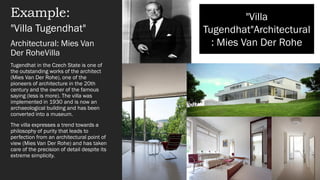
Example:
"Villa Tugendhat"
Architectural: Mies Van
Der RoheVilla
Tugendhat in the Czech State is one of
the outstanding works of the architect
(Mies Van Der Rohe), one of the
pioneers of architecture in the 20th
century and the owner of the famous
saying (less is more). The villa was
implemented in 1930 and is now an
archaeological building and has been
converted into a museum.
The villa expresses a trend towards a
philosophy of purity that leads to
perfection from an architectural point of
view (Mies Van Der Rohe) and has taken
care of the precision of detail despite its
extreme simplicity.
"Villa
Tugendhat"Architectural
: Mies Van Der Rohe
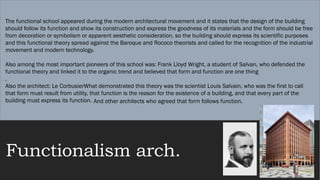
Functionalism arch.
The functional school appeared during the modern architectural movement and it states that the design of the building
should follow its function and show its construction and express the goodness of its materials and the form should be free
from decoration or symbolism or apparent aesthetic consideration, so the building should express its scientific purposes
and this functional theory spread against the Baroque and Rococo theorists and called for the recognition of the industrial
movement and modern technology.
Also among the most important pioneers of this school was: Frank Lloyd Wright, a student of Salvan, who defended the
functional theory and linked it to the organic trend and believed that form and function are one thing
.
Also the architect: Le CorbusierWhat demonstrated this theory was the scientist Louis Salvain, who was the first to call
that form must result from utility, that function is the reason for the existence of a building, and that every part of the
building must express its function. And other architects who agreed that form follows function.
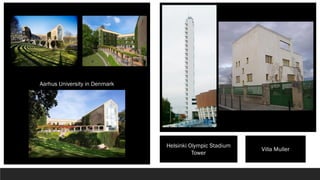
Aarhus University in Denmark
Helsinki Olympic Stadium
Tower
Villa Muller
Helsinki Olympic Stadium
Tower
Villa Muller
□The concept
It is architecture concerned with preserving the environment through designs that are compatible with
nature
And by Frank Lloyd Wright
Organic architecture develops from the inside out in harmony with its surrounding conditions
That is, architecture that adapts to nature like a living organism
□ Architectural design
It is considered one of the first theories that were able to remove architecture from classical
trends
ORGANIC ARCHITECTURETHROUGH.
through :-
Reducing the internal division of the building. Air and light must permeate the entire building
0Use to the maximum extent natural materials
0Make the furnishings part of the building itself
□The most
important
pioneers and
their works
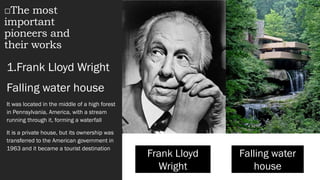
1.Frank Lloyd Wright
Falling water house
It was located in the middle of a high forest
in Pennsylvania, America, with a stream
running through it, forming a waterfall
It is a private house, but its ownership was
transferred to the American government in
1963 and it became a tourist destination
Frank Lloyd
Wright
Falling water
house
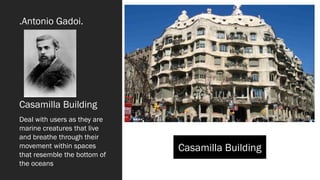
.Antonio Gadoi.
Casamilla Building
Deal with users as they are
marine creatures that live
and breathe through their
movement within spaces
that resemble the bottom of
the oceans
Casamilla Building
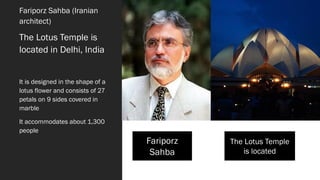
Fariporz Sahba (Iranian
architect)
The Lotus Temple is
located in Delhi, India
It is designed in the shape of a
lotus flower and consists of 27
petals on 9 sides covered in
marble
It accommodates about 1,300
people
Fariporz
Sahba
The Lotus Temple
is located
Architecture in the second half of the twentieth
century
Modern architecture reached its peak in the 1950s, and by the late 1960s, it lost much
of its ideological power. With the death of one of its pioneers, Le Corbusier, it also lost
much of its emotional strength. The beginning of architects’ withdrawal from it coincided
with the demolition of the Pruitt-Igoe housing complex in St. Louis, USA, in 1972, when
the government decided to blow it up in response to residents’ wishes. Critics of
architecture consider this incident a moment marking the end of modern architecture.
With technological advancements and numerous discoveries in the construction field, as
well as the emergence of information technology as a significant reality, the world
entered a new phase that witnessed unprecedented forms in overall architecture. It can
be said that the second half of the 20th century represents a period of maturity and
impactful construction that influenced architectural creativity through the maximum and
optimal exploitation of modern construction technologies.
Factors Shaping Architecture in the Second Half of the 20th Century
❑ The Need for Reconstruction After World War II: The war served as a catalyst for scientists to explore new
innovations for military superiority. However, after the war, these advancements were redirected toward civil
applications, particularly in architecture. The urgent need for rapid reconstruction became a primary reason for
the emergence of various concepts and trends, such as ( prefabrication),( typification ).
❑ Changing Dominant Concepts: This change can be attributed to numerous transformations that affected all
aspects of life, leading to shifts in political, economic, cultural, and social systems. Consequently, these changes
reflected in architectural outputs, which expressed the prevailing ideas. This resulted in the emergence of two
main directions in architecture :
• Evolved Modern Architecture: This includes high-tech architecture and deconstructivism architecture.
• Postmodern Architecture.
❑ Advancements in Construction Technology: Innovations in building materials, construction systems, and
execution methods emerged, leading to the development of new building materials and various
applications.
❑ Impact of Political System Changes: Particularly after World War II and the fall of colonial powers,
significant changes occurred in cultural and social systems. This also affected economic systems, which
had a direct impact on architectural products.
❑ Emergence of Information Technology: Information technology became one of the influencing factors in
the evolution of architectural products, especially toward the end of the 20th century, which witnessed
the onset of the information revolution and the impact of computers on architecture.
High-tech architecture
It is an architectural technique characterized by the integration of high-tech
industrial and technological components into the building structure
Characteristics and features
_This trend emerged as a result of high technological progress
_ The buildings consist of transparent glass facades or steel frames
_It uses highly technical vocabulary in terms of material and functional work
_Adapting the use of modern construction materials such as steel, glass and plastic
Disadvantages
_Architects abandoned traditional materials such as stone, wood, bronze, and natural shapes
_The architect’s separation from the environment in exchange for the industrial appearance in the composition
_Using mainly pre-fabricated elements that may harm the environment
The most
important
pioneers and
examples of
projects
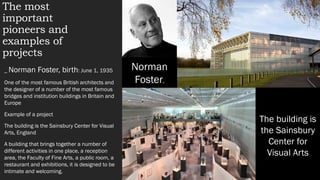
_ Norman Foster, birth: June 1, 1935
One of the most famous British architects and
the designer of a number of the most famous
bridges and institution buildings in Britain and
Europe
Example of a project
The building is the Sainsbury Center for Visual
Arts, England
A building that brings together a number of
different activities in one place, a reception
area, the Faculty of Fine Arts, a public room, a
restaurant and exhibitions, it is designed to be
intimate and welcoming.
Norman
Foster,
The building is
the Sainsbury
Center for
Visual Arts
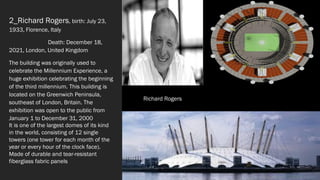
2_Richard Rogers, birth: July 23,
1933, Florence, Italy
Death: December 18,
2021, London, United Kingdom
The building was originally used to
celebrate the Millennium Experience, a
huge exhibition celebrating the beginning
of the third millennium. This building is
located on the Greenwich Peninsula,
southeast of London, Britain. The
exhibition was open to the public from
January 1 to December 31, 2000
It is one of the largest domes of its kind
in the world, consisting of 12 single
towers (one tower for each month of the
year or every hour of the clock face).
Made of durable and tear-resistant
fiberglass fabric panels
Richard Rogers
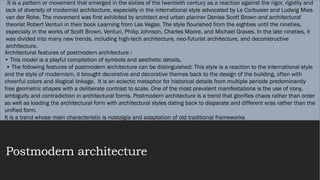
Postmodern architecture
It is a pattern or movement that emerged in the sixties of the twentieth century as a reaction against the rigor, rigidity and
lack of diversity of modernist architecture, especially in the international style advocated by Le Corbusier and Ludwig Mies
van der Rohe. The movement was first exhibited by architect and urban planner Denise Scott Brown and architectural
theorist Robert Venturi in their book Learning from Las Vegas. The style flourished from the eighties until the nineties,
especially in the works of Scott Brown, Venturi, Philip Johnson, Charles Moore, and Michael Graves. In the late nineties, it
was divided into many new trends, including high-tech architecture, neo-futurist architecture, and deconstructive
architecture.
Architectural features of postmodern architecture :
• This model is a playful compilation of symbols and aesthetic details,
• The following features of postmodern architecture can be distinguished: This style is a reaction to the international style
and the style of modernism, it brought decorative and decorative themes back to the design of the building, often with
cheerful colors and illogical linkage. It is an eclectic metaphor for historical details from multiple periods predominantly
free geometric shapes with a deliberate contrast to scale. One of the most prevalent manifestations is the use of irony,
ambiguity and contradiction in architectural forms. Postmodern architecture is a trend that glorifies chaos rather than order
as well as loading the architectural form with architectural styles dating back to disparate and different eras rather than the
unified form.
It is a trend whose main characteristic is nostalgia and adaptation of old traditional frameworks
To suit current needs and contents.
Emphasizing the need for buildings to be created as part of the medium and the environment, and
creating architectural forms without quotation, but rather drawing inspiration from heritage through the
use of
Symbolic connotations and the revival of decorating as an important basis for the formulation of the
figure.
The art of historical architecture and its structural forms, especially those associated with the models of
rational examples of the second half of the eighteenth century, which carried with them pure solid forms.
His architecture was also characterized by its high renewal in the degree of its association
With history as characterized by reduced language that was reflected in extreme simplicity with pure
references in the level of extreme abstraction of the historical sources adopted by .
Critics have differed in describing Aldo Rossi's works, with some suggesting that they approached
engineering construction works such as canals and road works, while others described them as closer to
prison buildings and others linked them to fascist architecture.
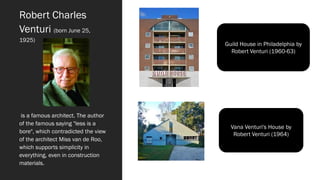
Robert Charles
Venturi (born June 25,
1925)
is a famous architect. The author
of the famous saying "less is a
bore", which contradicted the view
of the architect Miss van de Roo,
which supports simplicity in
everything, even in construction
materials.
Guild House in Philadelphia by
Robert Venturi (1960-63)
Vana Venturi's House by
Robert Venturi (1964)
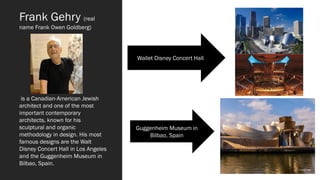
Frank Gehry (real
name Frank Owen Goldberg)
is a Canadian-American Jewish
architect and one of the most
important contemporary
architects, known for his
sculptural and organic
methodology in design. His most
famous designs are the Walt
Disney Concert Hall in Los Angeles
and the Guggenheim Museum in
Bilbao, Spain.
Wallet Disney Concert Hall
Guggenheim Museum in
Bilbao, Spain
Deconstruction Arch
A path of architecture is parallel to postmodern architecture in that it tends to complexity and fragmentation in mass as
well as manipulation of the external surfaces or the outer cover of the building in exchange for the simplicity that
characterized modernity. Which turns the surface into a problem difficult to distinguish and gives a sense that the
architectural elements of the blocks out of place familiar most architects deconstruction use the cover "envelop" which is
seen from the outside and does not affect the internal structure and difficult to predict the orientation of the form or the
beginning and end and the formation in the block is a controlled chao
Its most important features are as follows:
• Free expression.
• Flexibility in formation.
• An expression of the high technology of the times.
• Creation is the decoration unit in design.
• Distance from historical and past architecture.
• The design contains the desired functional solutions.
• Architecture is skin and bone.
• Transparency is the main feature of design.
Sub-directions
of the
deconstructive
school
2- Direction: Abstraction
Architecture
Pioneer Architects:
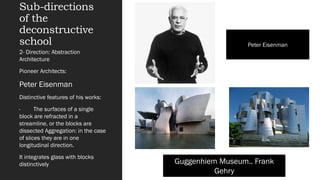
Peter Eisenman
Distinctive features of his works:
· The surfaces of a single
block are refracted in a
streamline, or the blocks are
dissected Aggregation: in the case
of slices they are in one
longitudinal direction.
It integrates glass with blocks
distinctively Guggenhiem Museum.. Frank
Gehry
Peter Eisenman
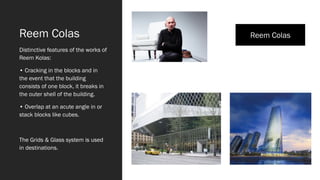
Reem Colas
Distinctive features of the works of
Reem Kolas:
• Cracking in the blocks and in
the event that the building
consists of one block, it breaks in
the outer shell of the building.
• Overlap at an acute angle in or
stack blocks like cubes.
The Grids & Glass system is used
in destinations.
Reem Colas
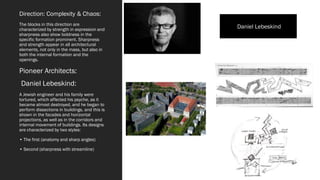
Direction: Complexity & Chaos:
The blocks in this direction are
characterized by strength in expression and
sharpness also show boldness in the
specific formation prominent. Sharpness
and strength appear in all architectural
elements, not only in the mass, but also in
both the internal formation and the
openings.
Pioneer Architects:
Daniel Lebeskind:
A Jewish engineer and his family were
tortured, which affected his psyche, as it
became almost destroyed, and he began to
perform dissections in buildings, and this is
shown in the facades and horizontal
projections, as well as in the corridors and
internal movement of buildings. Its designs
are characterized by two styles:
• The first (anatomy and sharp angles)
• Second (sharpness with streamline)
Daniel Lebeskind
Submitted to
Dr.Vitta Abd El , Rahim
Eng. Aya wahed
Eng .Fatma elzahraa
mahmoude
Eng. Enass ashraf
Submitted by
Shehab ahmed
Mahmoud Abdelmoezz
Kerolos Yousef
Nariman adel
Aya Hanafi
Yara mousa
Basmala ayman
Abdelrahman abdelaleem
THANK YOU

الأتجاهات المعمارية في القرن العشرين.pdf

  • 1.
  • 2.
    Introduction We can identifythe emergence of architecture in the twentieth century in general by dividing it into the first two periods representing the first half of the twentieth century. It is a period constituting and experimenting with what was discovered in the nineteenth century and the second half of the twentieth century after the end of the Second World War.
  • 3.
    Architecture in thefirst half of the twentieth century This period saw an experimental phase, the second phase, preceded by the discovery phase, where structural systems evolved, as well as implementation methods and systems evolved as a direct result of technological development at the time.
  • 4.
    Factors shaping architecturein the first half of the twentieth century ❑Developing building materials technology and understanding the enormous potential of building materials such as iron, concrete and other materials of a multiple nature produced by the architect and placed at the architect's disposal. ❑Revisiting the definition of form, composition, function and the role of architecture in society, which led to the development of analytical studies and logical philosophical foundations, later served as the basis for the architecture ❑Social and industrial volatility, the reality has become in need of many buildings of different kinds that are more complex in their design requirements. This has led to the emergence of new types of buildings with previously unrecognized design programs, resulting in a breakthrough in architectural thought that has secreted the concepts of modern architecture ❑The economic factor increased the importance of the economic factor so that it became of great importance to the business class and traders and demanded to reduce the costs of buildings and dispense with everything that has no practical benefite we know today.
  • 5.
    ❑ The impactof the First and Second World Wars on the development of architecture around the world, world conferences to study the many trends that have been put forward to address the negative effects of war on different cities and nations, which have led to the development of new concepts in addressing the design process and the diversity of architecture and architectural product, have emerged a new concept that preceded industrialization (Pre-Fabrication), which began at the end of the 19th century and grew during the two world wars, then spread after the Second World War as a result of the need for rapid reconstruction of what was destroyed by the war
  • 6.
    Some architectural schoolsin the first half of the twentieth century
  • 7.
    Modernism Architecture: It isone of the earliest architectural trends of the twentieth century and was formed by previous factors surrounding architecture in the first half of the twentieth century, technological development in all fields in general, and in the field of architecture in particular and is considered an extension of the Bouhaus School 1906 in Germany and was one of the main pioneers of this trend (Mies Van Der Rohe) He was also director of the Bouhaus school after Walter Gropius. Modernism has formed the foundations and principles of architecture in the late 20th century, especially in terms of technology and advanced thought, which in turn will form the entrance to the architecture of the 21st century. The most important features of modernity architecture: •Expression of the elements of creation •I took on a more liberal and simplistic character. •Give up everything that has no practical benefit. •Give up old foundations like ornaments and others.
  • 8.
    Example: "Villa Tugendhat" Architectural: MiesVan Der RoheVilla Tugendhat in the Czech State is one of the outstanding works of the architect (Mies Van Der Rohe), one of the pioneers of architecture in the 20th century and the owner of the famous saying (less is more). The villa was implemented in 1930 and is now an archaeological building and has been converted into a museum. The villa expresses a trend towards a philosophy of purity that leads to perfection from an architectural point of view (Mies Van Der Rohe) and has taken care of the precision of detail despite its extreme simplicity. "Villa Tugendhat"Architectural : Mies Van Der Rohe
  • 9.
    Functionalism arch. The functionalschool appeared during the modern architectural movement and it states that the design of the building should follow its function and show its construction and express the goodness of its materials and the form should be free from decoration or symbolism or apparent aesthetic consideration, so the building should express its scientific purposes and this functional theory spread against the Baroque and Rococo theorists and called for the recognition of the industrial movement and modern technology. Also among the most important pioneers of this school was: Frank Lloyd Wright, a student of Salvan, who defended the functional theory and linked it to the organic trend and believed that form and function are one thing . Also the architect: Le CorbusierWhat demonstrated this theory was the scientist Louis Salvain, who was the first to call that form must result from utility, that function is the reason for the existence of a building, and that every part of the building must express its function. And other architects who agreed that form follows function.
  • 10.
    Aarhus University inDenmark Helsinki Olympic Stadium Tower Villa Muller Helsinki Olympic Stadium Tower Villa Muller
  • 11.
    □The concept It isarchitecture concerned with preserving the environment through designs that are compatible with nature And by Frank Lloyd Wright Organic architecture develops from the inside out in harmony with its surrounding conditions That is, architecture that adapts to nature like a living organism □ Architectural design It is considered one of the first theories that were able to remove architecture from classical trends ORGANIC ARCHITECTURETHROUGH. through :- Reducing the internal division of the building. Air and light must permeate the entire building 0Use to the maximum extent natural materials 0Make the furnishings part of the building itself
  • 12.
    □The most important pioneers and theirworks 1.Frank Lloyd Wright Falling water house It was located in the middle of a high forest in Pennsylvania, America, with a stream running through it, forming a waterfall It is a private house, but its ownership was transferred to the American government in 1963 and it became a tourist destination Frank Lloyd Wright Falling water house
  • 13.
    .Antonio Gadoi. Casamilla Building Dealwith users as they are marine creatures that live and breathe through their movement within spaces that resemble the bottom of the oceans Casamilla Building
  • 14.
    Fariporz Sahba (Iranian architect) TheLotus Temple is located in Delhi, India It is designed in the shape of a lotus flower and consists of 27 petals on 9 sides covered in marble It accommodates about 1,300 people Fariporz Sahba The Lotus Temple is located
  • 15.
    Architecture in thesecond half of the twentieth century Modern architecture reached its peak in the 1950s, and by the late 1960s, it lost much of its ideological power. With the death of one of its pioneers, Le Corbusier, it also lost much of its emotional strength. The beginning of architects’ withdrawal from it coincided with the demolition of the Pruitt-Igoe housing complex in St. Louis, USA, in 1972, when the government decided to blow it up in response to residents’ wishes. Critics of architecture consider this incident a moment marking the end of modern architecture. With technological advancements and numerous discoveries in the construction field, as well as the emergence of information technology as a significant reality, the world entered a new phase that witnessed unprecedented forms in overall architecture. It can be said that the second half of the 20th century represents a period of maturity and impactful construction that influenced architectural creativity through the maximum and optimal exploitation of modern construction technologies.
  • 16.
    Factors Shaping Architecturein the Second Half of the 20th Century ❑ The Need for Reconstruction After World War II: The war served as a catalyst for scientists to explore new innovations for military superiority. However, after the war, these advancements were redirected toward civil applications, particularly in architecture. The urgent need for rapid reconstruction became a primary reason for the emergence of various concepts and trends, such as ( prefabrication),( typification ). ❑ Changing Dominant Concepts: This change can be attributed to numerous transformations that affected all aspects of life, leading to shifts in political, economic, cultural, and social systems. Consequently, these changes reflected in architectural outputs, which expressed the prevailing ideas. This resulted in the emergence of two main directions in architecture : • Evolved Modern Architecture: This includes high-tech architecture and deconstructivism architecture. • Postmodern Architecture.
  • 17.
    ❑ Advancements inConstruction Technology: Innovations in building materials, construction systems, and execution methods emerged, leading to the development of new building materials and various applications. ❑ Impact of Political System Changes: Particularly after World War II and the fall of colonial powers, significant changes occurred in cultural and social systems. This also affected economic systems, which had a direct impact on architectural products. ❑ Emergence of Information Technology: Information technology became one of the influencing factors in the evolution of architectural products, especially toward the end of the 20th century, which witnessed the onset of the information revolution and the impact of computers on architecture.
  • 18.
    High-tech architecture High-tech architecture Itis an architectural technique characterized by the integration of high-tech industrial and technological components into the building structure Characteristics and features _This trend emerged as a result of high technological progress _ The buildings consist of transparent glass facades or steel frames _It uses highly technical vocabulary in terms of material and functional work _Adapting the use of modern construction materials such as steel, glass and plastic Disadvantages _Architects abandoned traditional materials such as stone, wood, bronze, and natural shapes _The architect’s separation from the environment in exchange for the industrial appearance in the composition _Using mainly pre-fabricated elements that may harm the environment
  • 19.
    The most important pioneers and examplesof projects _ Norman Foster, birth: June 1, 1935 One of the most famous British architects and the designer of a number of the most famous bridges and institution buildings in Britain and Europe Example of a project The building is the Sainsbury Center for Visual Arts, England A building that brings together a number of different activities in one place, a reception area, the Faculty of Fine Arts, a public room, a restaurant and exhibitions, it is designed to be intimate and welcoming. Norman Foster, The building is the Sainsbury Center for Visual Arts
  • 20.
    2_Richard Rogers, birth:July 23, 1933, Florence, Italy Death: December 18, 2021, London, United Kingdom The building was originally used to celebrate the Millennium Experience, a huge exhibition celebrating the beginning of the third millennium. This building is located on the Greenwich Peninsula, southeast of London, Britain. The exhibition was open to the public from January 1 to December 31, 2000 It is one of the largest domes of its kind in the world, consisting of 12 single towers (one tower for each month of the year or every hour of the clock face). Made of durable and tear-resistant fiberglass fabric panels Richard Rogers
  • 21.
    Postmodern architecture It isa pattern or movement that emerged in the sixties of the twentieth century as a reaction against the rigor, rigidity and lack of diversity of modernist architecture, especially in the international style advocated by Le Corbusier and Ludwig Mies van der Rohe. The movement was first exhibited by architect and urban planner Denise Scott Brown and architectural theorist Robert Venturi in their book Learning from Las Vegas. The style flourished from the eighties until the nineties, especially in the works of Scott Brown, Venturi, Philip Johnson, Charles Moore, and Michael Graves. In the late nineties, it was divided into many new trends, including high-tech architecture, neo-futurist architecture, and deconstructive architecture. Architectural features of postmodern architecture : • This model is a playful compilation of symbols and aesthetic details, • The following features of postmodern architecture can be distinguished: This style is a reaction to the international style and the style of modernism, it brought decorative and decorative themes back to the design of the building, often with cheerful colors and illogical linkage. It is an eclectic metaphor for historical details from multiple periods predominantly free geometric shapes with a deliberate contrast to scale. One of the most prevalent manifestations is the use of irony, ambiguity and contradiction in architectural forms. Postmodern architecture is a trend that glorifies chaos rather than order as well as loading the architectural form with architectural styles dating back to disparate and different eras rather than the unified form. It is a trend whose main characteristic is nostalgia and adaptation of old traditional frameworks
  • 22.
    To suit currentneeds and contents. Emphasizing the need for buildings to be created as part of the medium and the environment, and creating architectural forms without quotation, but rather drawing inspiration from heritage through the use of Symbolic connotations and the revival of decorating as an important basis for the formulation of the figure. The art of historical architecture and its structural forms, especially those associated with the models of rational examples of the second half of the eighteenth century, which carried with them pure solid forms. His architecture was also characterized by its high renewal in the degree of its association With history as characterized by reduced language that was reflected in extreme simplicity with pure references in the level of extreme abstraction of the historical sources adopted by . Critics have differed in describing Aldo Rossi's works, with some suggesting that they approached engineering construction works such as canals and road works, while others described them as closer to prison buildings and others linked them to fascist architecture.
  • 23.
    Robert Charles Venturi (bornJune 25, 1925) is a famous architect. The author of the famous saying "less is a bore", which contradicted the view of the architect Miss van de Roo, which supports simplicity in everything, even in construction materials. Guild House in Philadelphia by Robert Venturi (1960-63) Vana Venturi's House by Robert Venturi (1964)
  • 24.
    Frank Gehry (real nameFrank Owen Goldberg) is a Canadian-American Jewish architect and one of the most important contemporary architects, known for his sculptural and organic methodology in design. His most famous designs are the Walt Disney Concert Hall in Los Angeles and the Guggenheim Museum in Bilbao, Spain. Wallet Disney Concert Hall Guggenheim Museum in Bilbao, Spain
  • 25.
    Deconstruction Arch A pathof architecture is parallel to postmodern architecture in that it tends to complexity and fragmentation in mass as well as manipulation of the external surfaces or the outer cover of the building in exchange for the simplicity that characterized modernity. Which turns the surface into a problem difficult to distinguish and gives a sense that the architectural elements of the blocks out of place familiar most architects deconstruction use the cover "envelop" which is seen from the outside and does not affect the internal structure and difficult to predict the orientation of the form or the beginning and end and the formation in the block is a controlled chao Its most important features are as follows: • Free expression. • Flexibility in formation. • An expression of the high technology of the times. • Creation is the decoration unit in design. • Distance from historical and past architecture. • The design contains the desired functional solutions. • Architecture is skin and bone. • Transparency is the main feature of design.
  • 26.
    Sub-directions of the deconstructive school 2- Direction:Abstraction Architecture Pioneer Architects: Peter Eisenman Distinctive features of his works: · The surfaces of a single block are refracted in a streamline, or the blocks are dissected Aggregation: in the case of slices they are in one longitudinal direction. It integrates glass with blocks distinctively Guggenhiem Museum.. Frank Gehry Peter Eisenman
  • 27.
    Reem Colas Distinctive featuresof the works of Reem Kolas: • Cracking in the blocks and in the event that the building consists of one block, it breaks in the outer shell of the building. • Overlap at an acute angle in or stack blocks like cubes. The Grids & Glass system is used in destinations. Reem Colas
  • 28.
    Direction: Complexity &Chaos: The blocks in this direction are characterized by strength in expression and sharpness also show boldness in the specific formation prominent. Sharpness and strength appear in all architectural elements, not only in the mass, but also in both the internal formation and the openings. Pioneer Architects: Daniel Lebeskind: A Jewish engineer and his family were tortured, which affected his psyche, as it became almost destroyed, and he began to perform dissections in buildings, and this is shown in the facades and horizontal projections, as well as in the corridors and internal movement of buildings. Its designs are characterized by two styles: • The first (anatomy and sharp angles) • Second (sharpness with streamline) Daniel Lebeskind
  • 30.
    Submitted to Dr.Vitta AbdEl , Rahim Eng. Aya wahed Eng .Fatma elzahraa mahmoude Eng. Enass ashraf Submitted by Shehab ahmed Mahmoud Abdelmoezz Kerolos Yousef Nariman adel Aya Hanafi Yara mousa Basmala ayman Abdelrahman abdelaleem
  • 31.