2857 Transworld Drive
Stockton, CA 95206
www.teacherscollegesj.edu (209) 468-9116
Teachers College of San Joaquin Syllabus
Course Code and Title
STEM 352: STEM 2
Dates and Times of Course:
TBA
Instructors Contact Information:
Tim Welsh
(209)603-9985
timwelsh@sjcoe.net
tjwelsh09@gmail.com
tjwelsh@mgrmi.org
Missionof Teachers College of San Joaquin (TCSJ)
To develop a workforce of teachers and school leaders that are comfortable with collaboration,
understand the need to prepare students for both work and higher education, and have the skills
to develop, implement and sustain innovative educational ideas.
TCSJ’s Program Learning Outcomes
TCSJ exemplifies the notion of learning opportunities that are rigorous, provide relevance, are
relationship-driven and incorporate reflection for professional growth.
TCSJ’s Core Learning Outcomes
1. TCSJ graduates have expertise in developing relevant and rigorous curriculum. Graduates
design systems for effective leadership in the classroom, campus, and educational community
to ensure the success of all students.
2. TCSJ graduates have expertise in the implementation of relevant and rigorous curriculum.
Graduates implement systems for effective leadership in the classroom, campus, and
educational community to ensure the success of all students.
3. TCSJ graduates sustain a practice of innovation and reform.
4. TCSJ graduates understand the power of research. They critically analyze and synthesize
findings to support the development and implementation of rigorous and relevant curriculum
and plans. Graduates develop and implement research to contribute to the wider body of
knowledge as well as to reflect on and inform personal practice.
5. TCSJ graduates are collaborative, reflective practitioners who are committed to providing
rigorous, relevant, and innovative educational experiences for all students.
Course Description
Students will examine and experience samples of STEM curriculum, active learning strategies,
and student learning assessment in STEM courses. The course will highlight pedagogical
practices for teaching and learning within introductory STEM courses and connections to the
Common Core and Next Generation Science Standards.
Teachers College of San Joaquin Page 2 of 4 Syllabus
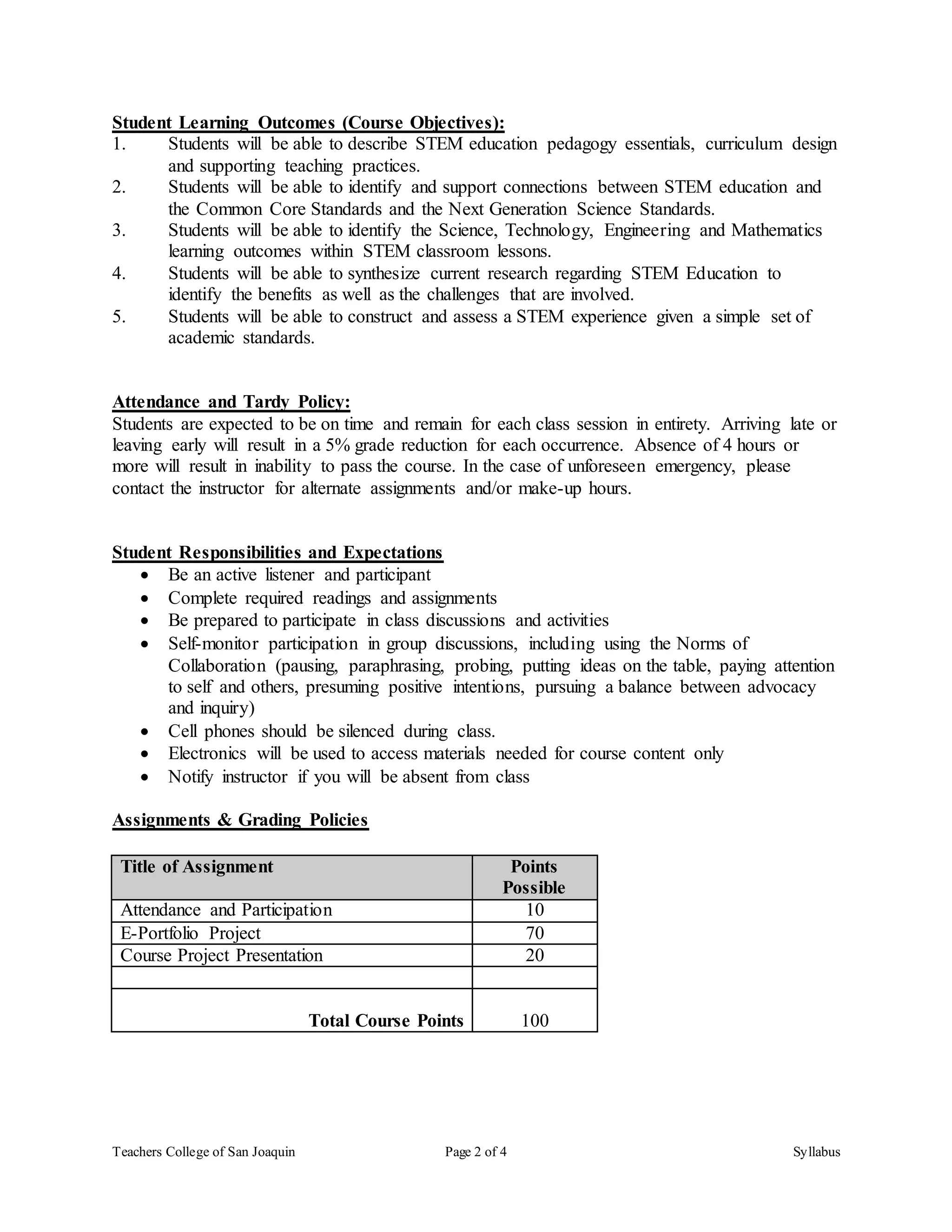
Student Learning Outcomes (Course Objectives):
1. Students will be able to describe STEM education pedagogy essentials, curriculum design
and supporting teaching practices.
2. Students will be able to identify and support connections between STEM education and
the Common Core Standards and the Next Generation Science Standards.
3. Students will be able to identify the Science, Technology, Engineering and Mathematics
learning outcomes within STEM classroom lessons.
4. Students will be able to synthesize current research regarding STEM Education to
identify the benefits as well as the challenges that are involved.
5. Students will be able to construct and assess a STEM experience given a simple set of
academic standards.
Attendance and Tardy Policy:
Students are expected to be on time and remain for each class session in entirety. Arriving late or
leaving early will result in a 5% grade reduction for each occurrence. Absence of 4 hours or
more will result in inability to pass the course. In the case of unforeseen emergency, please
contact the instructor for alternate assignments and/or make-up hours.
Student Responsibilities and Expectations
 Be an active listener and participant
 Complete required readings and assignments
 Be prepared to participate in class discussions and activities
 Self-monitor participation in group discussions, including using the Norms of
Collaboration (pausing, paraphrasing, probing, putting ideas on the table, paying attention
to self and others, presuming positive intentions, pursuing a balance between advocacy
and inquiry)
 Cell phones should be silenced during class.
 Electronics will be used to access materials needed for course content only
 Notify instructor if you will be absent from class
Assignments & Grading Policies
Title of Assignment Points
Possible
Attendance and Participation 10
E-Portfolio Project 70
Course Project Presentation 20
Total Course Points 100
Teachers College of San Joaquin Page 3 of 4 Syllabus
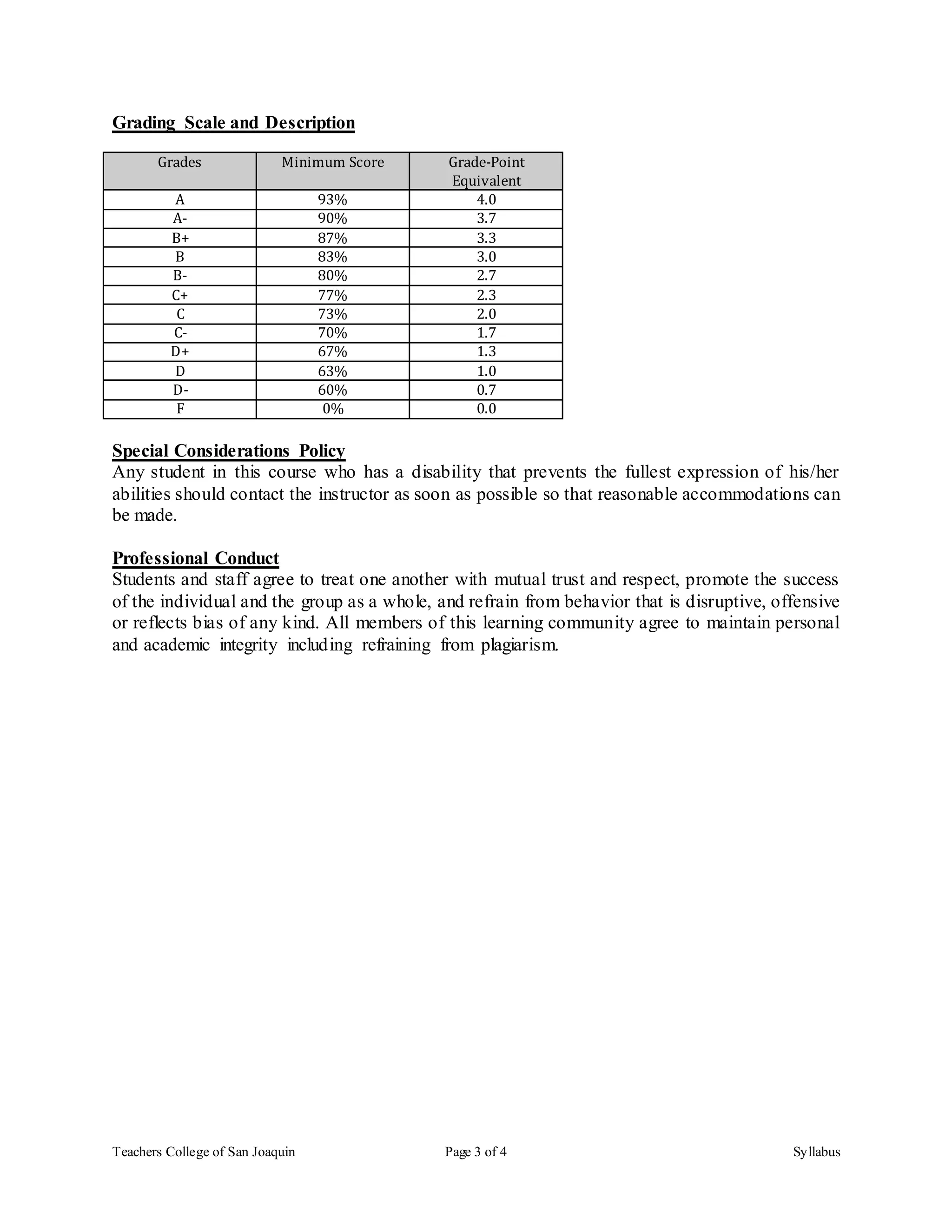
Grading Scale and Description
Grades Minimum Score Grade-Point
Equivalent
A 93% 4.0
A- 90% 3.7
B+ 87% 3.3
B 83% 3.0
B- 80% 2.7
C+ 77% 2.3
C 73% 2.0
C- 70% 1.7
D+ 67% 1.3
D 63% 1.0
D- 60% 0.7
F 0% 0.0
Special Considerations Policy
Any student in this course who has a disability that prevents the fullest expression of his/her
abilities should contact the instructor as soon as possible so that reasonable accommodations can
be made.
Professional Conduct
Students and staff agree to treat one another with mutual trust and respect, promote the success
of the individual and the group as a whole, and refrain from behavior that is disruptive, offensive
or reflects bias of any kind. All members of this learning community agree to maintain personal
and academic integrity including refraining from plagiarism.
Teachers College of San Joaquin Page 4 of 4 Syllabus
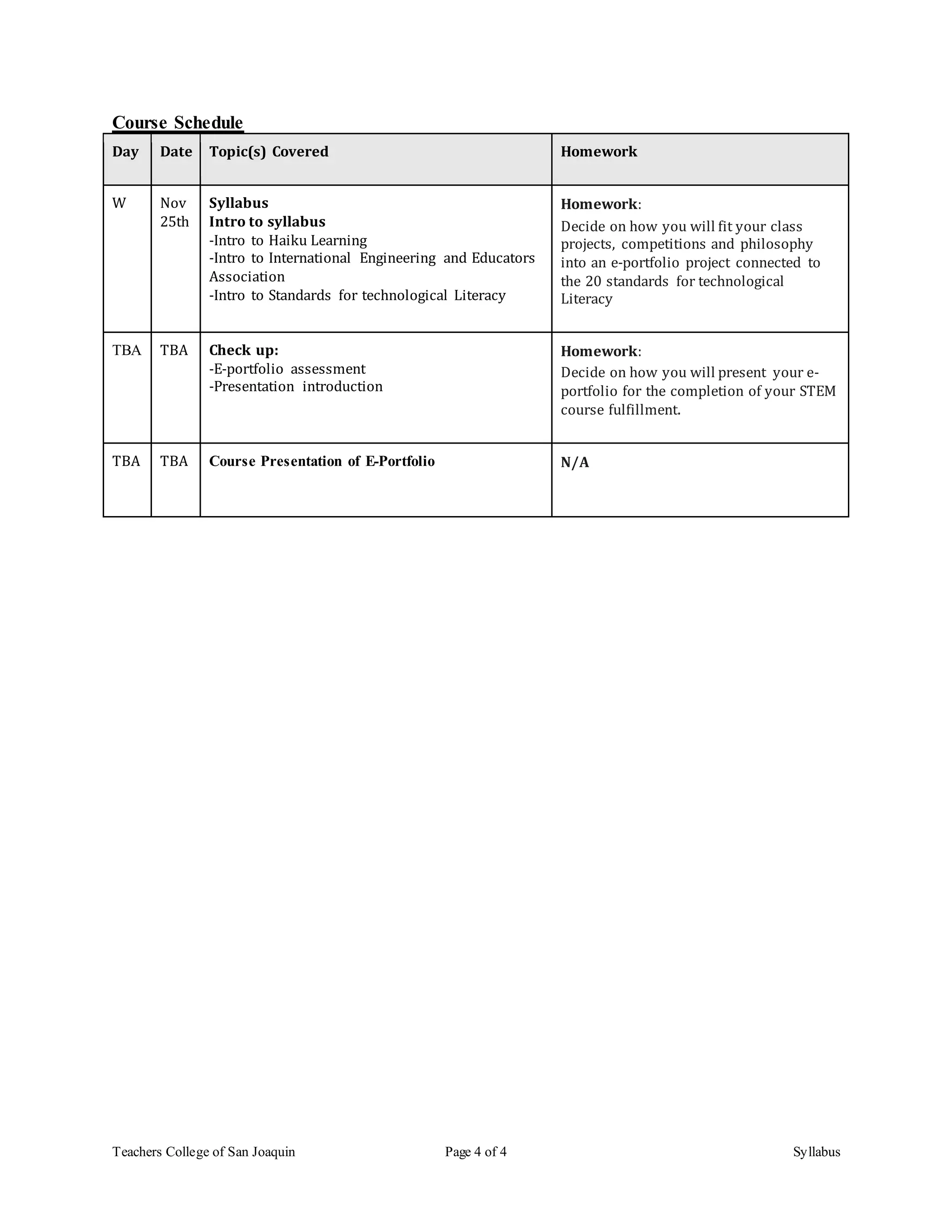
Course Schedule
Day Date Topic(s) Covered Homework
W Nov
25th
Syllabus
Intro to syllabus
-Intro to Haiku Learning
-Intro to International Engineering and Educators
Association
-Intro to Standards for technological Literacy
Homework:
Decide on how you will fit your class
projects, competitions and philosophy
into an e-portfolio project connected to
the 20 standards for technological
Literacy
TBA TBA Check up:
-E-portfolio assessment
-Presentation introduction
Homework:
Decide on how you will present your e-
portfolio for the completion of your STEM
course fulfillment.
TBA TBA Course Presentation of E-Portfolio N/A

Industrial technology stem syllabus

  • 1.
    2857 Transworld Drive Stockton,CA 95206 www.teacherscollegesj.edu (209) 468-9116 Teachers College of San Joaquin Syllabus Course Code and Title STEM 352: STEM 2 Dates and Times of Course: TBA Instructors Contact Information: Tim Welsh (209)603-9985 timwelsh@sjcoe.net tjwelsh09@gmail.com tjwelsh@mgrmi.org Missionof Teachers College of San Joaquin (TCSJ) To develop a workforce of teachers and school leaders that are comfortable with collaboration, understand the need to prepare students for both work and higher education, and have the skills to develop, implement and sustain innovative educational ideas. TCSJ’s Program Learning Outcomes TCSJ exemplifies the notion of learning opportunities that are rigorous, provide relevance, are relationship-driven and incorporate reflection for professional growth. TCSJ’s Core Learning Outcomes 1. TCSJ graduates have expertise in developing relevant and rigorous curriculum. Graduates design systems for effective leadership in the classroom, campus, and educational community to ensure the success of all students. 2. TCSJ graduates have expertise in the implementation of relevant and rigorous curriculum. Graduates implement systems for effective leadership in the classroom, campus, and educational community to ensure the success of all students. 3. TCSJ graduates sustain a practice of innovation and reform. 4. TCSJ graduates understand the power of research. They critically analyze and synthesize findings to support the development and implementation of rigorous and relevant curriculum and plans. Graduates develop and implement research to contribute to the wider body of knowledge as well as to reflect on and inform personal practice. 5. TCSJ graduates are collaborative, reflective practitioners who are committed to providing rigorous, relevant, and innovative educational experiences for all students. Course Description Students will examine and experience samples of STEM curriculum, active learning strategies, and student learning assessment in STEM courses. The course will highlight pedagogical practices for teaching and learning within introductory STEM courses and connections to the Common Core and Next Generation Science Standards.
  • 2.
    Teachers College ofSan Joaquin Page 2 of 4 Syllabus Student Learning Outcomes (Course Objectives): 1. Students will be able to describe STEM education pedagogy essentials, curriculum design and supporting teaching practices. 2. Students will be able to identify and support connections between STEM education and the Common Core Standards and the Next Generation Science Standards. 3. Students will be able to identify the Science, Technology, Engineering and Mathematics learning outcomes within STEM classroom lessons. 4. Students will be able to synthesize current research regarding STEM Education to identify the benefits as well as the challenges that are involved. 5. Students will be able to construct and assess a STEM experience given a simple set of academic standards. Attendance and Tardy Policy: Students are expected to be on time and remain for each class session in entirety. Arriving late or leaving early will result in a 5% grade reduction for each occurrence. Absence of 4 hours or more will result in inability to pass the course. In the case of unforeseen emergency, please contact the instructor for alternate assignments and/or make-up hours. Student Responsibilities and Expectations  Be an active listener and participant  Complete required readings and assignments  Be prepared to participate in class discussions and activities  Self-monitor participation in group discussions, including using the Norms of Collaboration (pausing, paraphrasing, probing, putting ideas on the table, paying attention to self and others, presuming positive intentions, pursuing a balance between advocacy and inquiry)  Cell phones should be silenced during class.  Electronics will be used to access materials needed for course content only  Notify instructor if you will be absent from class Assignments & Grading Policies Title of Assignment Points Possible Attendance and Participation 10 E-Portfolio Project 70 Course Project Presentation 20 Total Course Points 100
  • 3.
    Teachers College ofSan Joaquin Page 3 of 4 Syllabus Grading Scale and Description Grades Minimum Score Grade-Point Equivalent A 93% 4.0 A- 90% 3.7 B+ 87% 3.3 B 83% 3.0 B- 80% 2.7 C+ 77% 2.3 C 73% 2.0 C- 70% 1.7 D+ 67% 1.3 D 63% 1.0 D- 60% 0.7 F 0% 0.0 Special Considerations Policy Any student in this course who has a disability that prevents the fullest expression of his/her abilities should contact the instructor as soon as possible so that reasonable accommodations can be made. Professional Conduct Students and staff agree to treat one another with mutual trust and respect, promote the success of the individual and the group as a whole, and refrain from behavior that is disruptive, offensive or reflects bias of any kind. All members of this learning community agree to maintain personal and academic integrity including refraining from plagiarism.
  • 4.
    Teachers College ofSan Joaquin Page 4 of 4 Syllabus Course Schedule Day Date Topic(s) Covered Homework W Nov 25th Syllabus Intro to syllabus -Intro to Haiku Learning -Intro to International Engineering and Educators Association -Intro to Standards for technological Literacy Homework: Decide on how you will fit your class projects, competitions and philosophy into an e-portfolio project connected to the 20 standards for technological Literacy TBA TBA Check up: -E-portfolio assessment -Presentation introduction Homework: Decide on how you will present your e- portfolio for the completion of your STEM course fulfillment. TBA TBA Course Presentation of E-Portfolio N/A