FIRST, A SHOUT OUT
www.Maryville-schools.org/mjhs
Technology Tab
Video Help 101
Videos are created due to what you asked for on the PD survey last
spring and were made in video form because a majority asked for it
to be that way
Where to find How Tos:
Instruction Sheets for Teachers: Go to Blackboard --> Community --
> MJHS Faculty --> Instructions
Videos: http://www.mjhsrebels.org/helpdesk/about-helpdesk/ <---
The video section is still heavily under construction, but there is
content there at the moment.
AND AN IMPORTANT
ANNOUNCEMENT
Per the SLT Meeting on 7/24/2015, no formal midterm exams will be
given at MJHS (nothing goes in the E1 category in the gradebook).
This aligns us with a recent change at Maryville High, due to time
constraints associated with TNReady.
So … e-mail me your username and password for PowerTeacher, so
that I may make the necessary changes to the PowerTeacher
gradebook setup. It will be easier for all of us if we do it that way.
I promise I won’t give out your info or mess with your gradebooks! 
RTI HELPS STUDENTS AND
TEACHERS
OBJECTIVES
You will be able to:
*Explain how to use RTI-informed
principles to differentiate instruction
*Plan RTI-informed units,
interventions, and assessments
*List evaluation measures RTI
practices address
TEACHER RESOURCE NOTEBOOK
Given to all teachers on my evaluation caseload last year.
A toolkit and survival guide for classroom teachers for all things RTI.
See me if you would like a copy.
We have copies of the books referenced in our library (see Alicia for
help).
SOMETHING DR. WINSTEAD SAID …
If you think Common Core is just an English and math thing … you
missed it.
If you think RTI is just a SPED/English/Math thing … you missed it.
DRILLING DEEPER INTO THE CRITICAL
QUESTIONS
STUDENT FOR LEARNING
1. What do we expect students to learn?
Essential outcomes, power standards, what would the standard—if met—look like in
student work, daily learning targets, pacing, common scoring
2. How will we know if they learn it?
Common assessments, quick checks for understanding, collaborative analysis of
results—kid by kid, skill by skill, district benchmark assessments, school review
processes.
3. How do we respond when students experience
difficulty in learning?
Differentiated instruction, pyramids of intervention, response to intervention, positive
behavior intervention systems, etc.
4. How do we respond when students do
learn?
Differentiated instruction, student placement, project learning, cooperative learning
groups, etc.
LEARNING FOCUSED
To have a learning-focused school culture, we must commit to two
fundamental assumptions:
1. We assume that all students can learn at high levels.
2. We, as educators, accept responsibility to ensure high levels of
learning for every
child.
STUDENTS FAIL TO ACHIEVE
BECAUSE
1) Some lack important prior skills
2) Some need additional time and practice
3) Some receive teaching that does not match their needs
4) Some fail to give the effort needed to succeed
5) Some do not have critical basic needs sufficiently met
ESSENTIAL ELEMENTS FOR
TEACHERS
•Focus on learning more than content coverage
•Create a collaborative culture within your
department
•Clearly define what all students must learn
•Constantly measure your effectiveness
(If you don’t do bullet 4 then your department is not a PLC)
GREATER CLARITY OF THE RIGHT
WORK
Meet at least weekly to collaborate on the right work during the
professional day (common departmental planning period where
available, skype with other teachers)
Department members will support each person’s assigned work
Department members will follow department created norms and
resolve conflicts in a professional manner—per department created
Conflict Resolution Plan
Department will focus on learning—not just covering content –there is
no research that supports the more a teacher covers the more
students learn and achieve to high levels
Department will clearly define what all students will learn (the
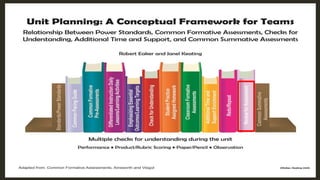
essential standards)
PLC CRITICAL QUESTIONS
What do we expect students to learn?
How do we know when they have learned it?
How will we respond when students don’t
learn?
How will we respond when students have
learned ahead of schedule?
THE RIGHT WORK
Educators work in collaborative teams and take
collective responsibility for student learning rather
than work in isolation.
Collaborative teams implement a guaranteed and
viable curriculum, unit by unit.
Collaborative teams monitor student learning
through an ongoing assessment process that includes
frequent, team-developed common formative
assessments.
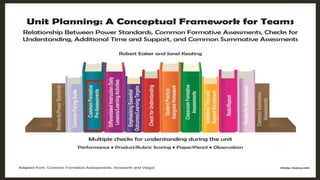
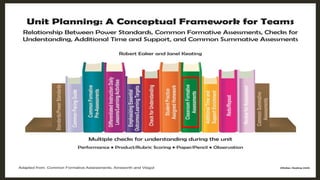
STANDARDS/POWER STANDARDS
What do we expect students to learn?
Which concepts are “Nice to Know” versus “Got to Know”
What gives us the most bang for our buck?
Essential standards do not represent all that you are going to teach.
They represent the minimum a student must learn to reach high
levels of learning, regardless of level of course. (The essentials all
basic, standard, and honors students must learn from the course—for
example Algebra 1)
We are not making a list. It is a process!
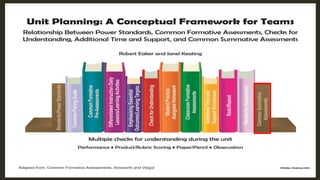
***Essential Learning Chart***
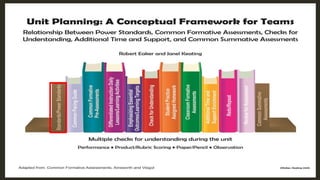
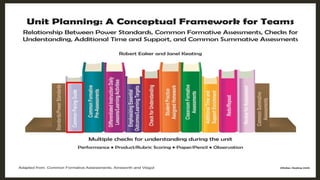
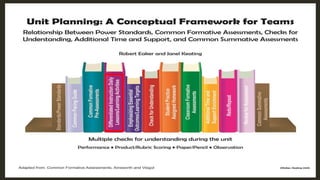
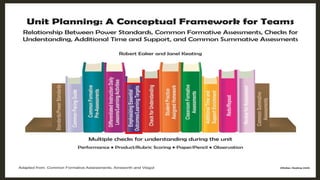
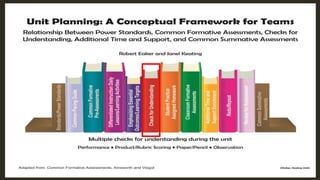
COMMON PACING GUIDES
Let the essential standards and your knowledge of assessment-
covered topics drive the pacing guide
Be flexible – the guide is only a guide (focus on learning more than
content coverage)
Build in flex time for interventions and enrichment and don’t cut
them
COMMON FORMATIVE
ASSESSMENTS (ROUND 1)
Pre-assess students at the beginning of a unit to determine which
students have mastered key prerequisite skills already
If you wish to pre-assess mastery of the standards you are about to
teach, that is okay, but …
You want to know from day 1 of the unit which students are predicted
to struggle and which students are predicted to succeed with the
content of the upcoming unit.
Think medically, different treatments for different needs and more
progressive and targeted approaches for those with the worst
symptoms
PRE-ASSESSMENT LOGISTICS
Pre-assessment can take place on the previous unit’s summative test
or just after it on the same day. Ten questions should be sufficient.
Make sure that the pre-assessment informs the students about how
the results will affect the future instruction and learning activities.
“If you score below an 80% on this pre-assessment, you will also be
required to complete the following activities …”
“If you score between 80% and 90% on this pre-assessment, you will
complete the following activities …”
“If you score above 90% on this pre-assessment, you will complete
the following enrichment activities …”
DIFFERENTIATE INSTRUCTION AND
ACTIVITIES
Do it often, informed with the pre-assessment results
List for students the “must-do first” versus the “may-do afterward”
dependent upon pre-assessment results
Padlet and other tools can be used to provide differentiated content
tasks from the same link.
Differentiation can occur in small spurts, but those chunks should be
frequent
EMPHASIZE ESSENTIAL OUTCOMES
Let students know those things you think matter most in student-
friendly language
“I can” statements
Often remind students of “the why” of the learning (include samples
of exemplary work and future application as appropriate)
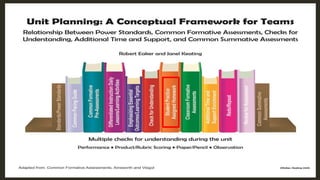
CHECK FOR UNDERSTANDING
Short, informal learning assessment at key transition points in daily
lessons
Lessons need closure and students need to know if they have the
learning of the day down before they leave the class
Lesson pacing, plan closures and don’t cut them
STUDENT PRACTICE/ASSIGNED
HOMEWORK
Manageable and focused on the essential learning targets
Appropriately rigorous, little fluff
Can be differentiated based upon pre-assessment results
Providing examples of quality work is really helpful (to students and
parents)
“Help me solve this”
Homework should feel like helpful practice, not like “game day”
Remember not every student will have a device at home …
REPEAT
Repeat lesson step through homework step until …
COMMON FORMATIVE
ASSESSMENT (ROUND 2)
Think “mid-chapter quiz”
Focused on key learning targets
Really helps if all teachers who teach the same level of course give
this at approximately the same day of the school year (for later
portions of the unit)
Keep it short and simple (about 6 questions per learning target)
Appropriately rigorous
Common scoring guidelines
Again, let students know on the assessment how the results will be
used for future grouping
THE RIGHT WORK
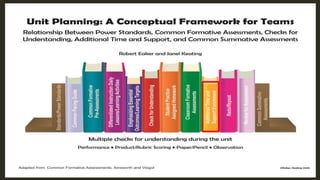
Educators use the results of common assessments to:
1. Improve individual practice
2. Build the team’s capacity to achieve its goals
3. Intervene and extend on behalf of students
The school provides a systematic process for intervention and
extension.
ESSENTIAL QUESTIONS
Have we created common assessments that measure
student mastery of each essential standard?
Do we compare results to identify the most effective
teaching strategies?
Do we use this information to guide our interventions?
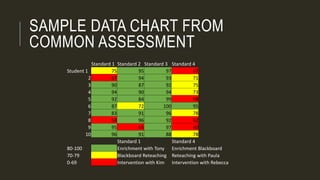
SAMPLE DATA CHART FROM
COMMON ASSESSMENT
Standard 1 Standard 2 Standard 3 Standard 4
Student 1 75 95 97 67
2 67 94 93 71
3 90 87 92 75
4 94 90 94 73
5 92 84 99 68
6 87 72 100 95
7 83 91 96 78
8 58 96 92 62
9 95 65 97 60
10 96 91 88 78
Standard 1 Standard 4
80-100 Enrichment with Tony Enrichment Blackboard
70-79 Blackboard Reteaching Reteaching with Paula
0-69 Intervention with Kim Intervention with Rebecca
INTERVENTION, EXTENSION,
ENRICHMENT
Classroom-based, built into the pacing guide for each unit
Intervention activities for those students who performed below
expectations on the common formative assessment
Extension activities for those students who performed at expectations
Enrichment activities for those students who performed above
expectations
Can be on the same platform, but students are doing things targeted
to their skill level
It is about additional time for those who need it and additional
experiences for those who do not
Regroup students into other teachers’ classes to help with
intervention logistics
REDO AND REPEAT
Repeat previous steps until students have been exposed to all new
learning for the unit
REVIEW FOR SUMMATIVE
ASSESSMENT
Practice test with detailed answer key showing high-quality responses
works best
We want to avoid students earning “A Six-hour D”
http://www.psywww.com/discuss/chap00/6hourd.htm
It is not a bad thing if the review is a slightly more rigorous flavor of
the upcoming summative assessment
COMMON SUMMATIVE
ASSESSMENT
Focused on key learning targets (listing the standards at the top of
the test is not the worst idea)
Really helps if all teachers who teach the same level of course give
this at approximately the same day of the school year (for later work)
Keep it short and simple (about 6 questions per learning
target/standard)
Appropriately rigorous
Common scoring guidelines
Again, let students know on the assessment how the results will be
used for future grouping
Summative assessments can be exams, projects, etc. Make them rich!
WHAT DO WE NEED TO DO?
Meet weekly during common plan
Build Team Norms and Conflict Resolution Plans
Determine Essential Standards (start from Pacing Guides) (cp just essentials, CP
and Honors teach essentials and additional to extend and enrich)
Teach the essentials as you wish—activities as you wish.
Develop Common Assessments to Evaluate Student Learning of Essential
Standards (build out in BB, too)
Analyze the Assessment Results (compare to determine effective teaching
strategies) and identify kids that need more time and support
Determine department intervention strategies to reteach/reassess on essentials
(kid by kid)
Divide and conquer to ensure all students learn the essentials to high levels
Repeat the process—it is ongoing—see Book Ends (evidence will be required)
DRILLING DEEPER INTO THE CRITICAL
QUESTIONS
STUDENT FOR LEARNING
1. What do we expect students to learn?
Essential outcomes, power standards, what would the standard—if met—look like in
student work, daily learning targets, pacing, common scoring
2. How will we know if they learn it?
Common assessments, quick checks for understanding, collaborative analysis of
results—kid by kid, skill by skill, district benchmark assessments, school review
processes.
3. How do we respond when students experience
difficulty in learning?
Differentiated instruction, pyramids of intervention, response to intervention, positive
behavior intervention systems, etc.
4. How do we respond when students do
learn?
Differentiated instruction, student placement, project learning, cooperative learning
groups, etc.
IMPACT ON TEACHER
EVALUATION
HARD TO HIT LEVEL 5
DESCRIPTORS
Instructional Plans: Instructional plans include evidence that the plan
provides regular opportunities to accommodate individual student
needs
Assessment: Assessment plans include descriptions of how
assessment results will be used to inform future instruction
Lesson Structure and Pacing: Pacing is brisk and provides many
opportunities for individual students who progress at different
learning rates
Grouping students: The instructional grouping arrangements
consistently maximize student understanding and learning efficiency
HARD TO HIT LEVEL 5
DESCRIPTORS
Teacher Content Knowledge: Teacher regularly implements a variety
of subject-specific instructional strategies to enhance student
content knowledge.
Teacher Knowledge of Students (Differentiating Instruction): Teacher
practices display understanding of each student’s anticipated
learning difficulties
Teacher Knowledge of Students (Differentiating Instruction): Teacher
regularly provides differentiated instructional methods and content to
ensure children have the opportunity to master what is being taught.
Use of Data: Systematically and consistently utilizes formative and
summative
Using this process consistently hits all of these indicators (power
MY HOPE FOR YOU AND THIS
SCHOOL
May the doors of this school be wide enough to receive all who
hunger for love and all who are lonely for fellowship
May it welcome all who have cares to unburden, thanks to express,
hopes to nurture
May the doors of this school be narrow enough to shut out pettiness,
pride, envy, and anger
May its threshold be no stumbling block to young or straying feet
May it be too high to admit complacency, selfishness, and harshness
May these doors open the way to our search for Truth and our
commitment to our fellow man
May this school be, for all who enter, the doorway to a richer and
more meaningful life
BE BLESSED IN ALL YOU
DO

Rti inservice training 2015

  • 1.
    FIRST, A SHOUTOUT www.Maryville-schools.org/mjhs Technology Tab Video Help 101 Videos are created due to what you asked for on the PD survey last spring and were made in video form because a majority asked for it to be that way Where to find How Tos: Instruction Sheets for Teachers: Go to Blackboard --> Community -- > MJHS Faculty --> Instructions Videos: http://www.mjhsrebels.org/helpdesk/about-helpdesk/ <--- The video section is still heavily under construction, but there is content there at the moment.
  • 2.
    AND AN IMPORTANT ANNOUNCEMENT Perthe SLT Meeting on 7/24/2015, no formal midterm exams will be given at MJHS (nothing goes in the E1 category in the gradebook). This aligns us with a recent change at Maryville High, due to time constraints associated with TNReady. So … e-mail me your username and password for PowerTeacher, so that I may make the necessary changes to the PowerTeacher gradebook setup. It will be easier for all of us if we do it that way. I promise I won’t give out your info or mess with your gradebooks! 
  • 3.
    RTI HELPS STUDENTSAND TEACHERS
  • 4.
    OBJECTIVES You will beable to: *Explain how to use RTI-informed principles to differentiate instruction *Plan RTI-informed units, interventions, and assessments *List evaluation measures RTI practices address
  • 5.
    TEACHER RESOURCE NOTEBOOK Givento all teachers on my evaluation caseload last year. A toolkit and survival guide for classroom teachers for all things RTI. See me if you would like a copy. We have copies of the books referenced in our library (see Alicia for help).
  • 6.
    SOMETHING DR. WINSTEADSAID … If you think Common Core is just an English and math thing … you missed it. If you think RTI is just a SPED/English/Math thing … you missed it.
  • 7.
    DRILLING DEEPER INTOTHE CRITICAL QUESTIONS STUDENT FOR LEARNING 1. What do we expect students to learn? Essential outcomes, power standards, what would the standard—if met—look like in student work, daily learning targets, pacing, common scoring 2. How will we know if they learn it? Common assessments, quick checks for understanding, collaborative analysis of results—kid by kid, skill by skill, district benchmark assessments, school review processes. 3. How do we respond when students experience difficulty in learning? Differentiated instruction, pyramids of intervention, response to intervention, positive behavior intervention systems, etc. 4. How do we respond when students do learn? Differentiated instruction, student placement, project learning, cooperative learning groups, etc.
  • 8.
    LEARNING FOCUSED To havea learning-focused school culture, we must commit to two fundamental assumptions: 1. We assume that all students can learn at high levels. 2. We, as educators, accept responsibility to ensure high levels of learning for every child.
  • 9.
    STUDENTS FAIL TOACHIEVE BECAUSE 1) Some lack important prior skills 2) Some need additional time and practice 3) Some receive teaching that does not match their needs 4) Some fail to give the effort needed to succeed 5) Some do not have critical basic needs sufficiently met
  • 10.
    ESSENTIAL ELEMENTS FOR TEACHERS •Focuson learning more than content coverage •Create a collaborative culture within your department •Clearly define what all students must learn •Constantly measure your effectiveness (If you don’t do bullet 4 then your department is not a PLC)
  • 11.
    GREATER CLARITY OFTHE RIGHT WORK Meet at least weekly to collaborate on the right work during the professional day (common departmental planning period where available, skype with other teachers) Department members will support each person’s assigned work Department members will follow department created norms and resolve conflicts in a professional manner—per department created Conflict Resolution Plan Department will focus on learning—not just covering content –there is no research that supports the more a teacher covers the more students learn and achieve to high levels Department will clearly define what all students will learn (the essential standards)
  • 12.
    PLC CRITICAL QUESTIONS Whatdo we expect students to learn? How do we know when they have learned it? How will we respond when students don’t learn? How will we respond when students have learned ahead of schedule?
  • 13.
    THE RIGHT WORK Educatorswork in collaborative teams and take collective responsibility for student learning rather than work in isolation. Collaborative teams implement a guaranteed and viable curriculum, unit by unit. Collaborative teams monitor student learning through an ongoing assessment process that includes frequent, team-developed common formative assessments.
  • 15.
    STANDARDS/POWER STANDARDS What dowe expect students to learn? Which concepts are “Nice to Know” versus “Got to Know” What gives us the most bang for our buck? Essential standards do not represent all that you are going to teach. They represent the minimum a student must learn to reach high levels of learning, regardless of level of course. (The essentials all basic, standard, and honors students must learn from the course—for example Algebra 1) We are not making a list. It is a process! ***Essential Learning Chart***
  • 17.
    COMMON PACING GUIDES Letthe essential standards and your knowledge of assessment- covered topics drive the pacing guide Be flexible – the guide is only a guide (focus on learning more than content coverage) Build in flex time for interventions and enrichment and don’t cut them
  • 19.
    COMMON FORMATIVE ASSESSMENTS (ROUND1) Pre-assess students at the beginning of a unit to determine which students have mastered key prerequisite skills already If you wish to pre-assess mastery of the standards you are about to teach, that is okay, but … You want to know from day 1 of the unit which students are predicted to struggle and which students are predicted to succeed with the content of the upcoming unit. Think medically, different treatments for different needs and more progressive and targeted approaches for those with the worst symptoms
  • 20.
    PRE-ASSESSMENT LOGISTICS Pre-assessment cantake place on the previous unit’s summative test or just after it on the same day. Ten questions should be sufficient. Make sure that the pre-assessment informs the students about how the results will affect the future instruction and learning activities. “If you score below an 80% on this pre-assessment, you will also be required to complete the following activities …” “If you score between 80% and 90% on this pre-assessment, you will complete the following activities …” “If you score above 90% on this pre-assessment, you will complete the following enrichment activities …”
  • 22.
    DIFFERENTIATE INSTRUCTION AND ACTIVITIES Doit often, informed with the pre-assessment results List for students the “must-do first” versus the “may-do afterward” dependent upon pre-assessment results Padlet and other tools can be used to provide differentiated content tasks from the same link. Differentiation can occur in small spurts, but those chunks should be frequent
  • 24.
    EMPHASIZE ESSENTIAL OUTCOMES Letstudents know those things you think matter most in student- friendly language “I can” statements Often remind students of “the why” of the learning (include samples of exemplary work and future application as appropriate)
  • 26.
    CHECK FOR UNDERSTANDING Short,informal learning assessment at key transition points in daily lessons Lessons need closure and students need to know if they have the learning of the day down before they leave the class Lesson pacing, plan closures and don’t cut them
  • 28.
    STUDENT PRACTICE/ASSIGNED HOMEWORK Manageable andfocused on the essential learning targets Appropriately rigorous, little fluff Can be differentiated based upon pre-assessment results Providing examples of quality work is really helpful (to students and parents) “Help me solve this” Homework should feel like helpful practice, not like “game day” Remember not every student will have a device at home …
  • 29.
    REPEAT Repeat lesson stepthrough homework step until …
  • 31.
    COMMON FORMATIVE ASSESSMENT (ROUND2) Think “mid-chapter quiz” Focused on key learning targets Really helps if all teachers who teach the same level of course give this at approximately the same day of the school year (for later portions of the unit) Keep it short and simple (about 6 questions per learning target) Appropriately rigorous Common scoring guidelines Again, let students know on the assessment how the results will be used for future grouping
  • 32.
    THE RIGHT WORK Educatorsuse the results of common assessments to: 1. Improve individual practice 2. Build the team’s capacity to achieve its goals 3. Intervene and extend on behalf of students The school provides a systematic process for intervention and extension.
  • 33.
    ESSENTIAL QUESTIONS Have wecreated common assessments that measure student mastery of each essential standard? Do we compare results to identify the most effective teaching strategies? Do we use this information to guide our interventions?
  • 34.
    SAMPLE DATA CHARTFROM COMMON ASSESSMENT Standard 1 Standard 2 Standard 3 Standard 4 Student 1 75 95 97 67 2 67 94 93 71 3 90 87 92 75 4 94 90 94 73 5 92 84 99 68 6 87 72 100 95 7 83 91 96 78 8 58 96 92 62 9 95 65 97 60 10 96 91 88 78 Standard 1 Standard 4 80-100 Enrichment with Tony Enrichment Blackboard 70-79 Blackboard Reteaching Reteaching with Paula 0-69 Intervention with Kim Intervention with Rebecca
  • 36.
    INTERVENTION, EXTENSION, ENRICHMENT Classroom-based, builtinto the pacing guide for each unit Intervention activities for those students who performed below expectations on the common formative assessment Extension activities for those students who performed at expectations Enrichment activities for those students who performed above expectations Can be on the same platform, but students are doing things targeted to their skill level It is about additional time for those who need it and additional experiences for those who do not Regroup students into other teachers’ classes to help with intervention logistics
  • 37.
    REDO AND REPEAT Repeatprevious steps until students have been exposed to all new learning for the unit
  • 39.
    REVIEW FOR SUMMATIVE ASSESSMENT Practicetest with detailed answer key showing high-quality responses works best We want to avoid students earning “A Six-hour D” http://www.psywww.com/discuss/chap00/6hourd.htm It is not a bad thing if the review is a slightly more rigorous flavor of the upcoming summative assessment
  • 41.
    COMMON SUMMATIVE ASSESSMENT Focused onkey learning targets (listing the standards at the top of the test is not the worst idea) Really helps if all teachers who teach the same level of course give this at approximately the same day of the school year (for later work) Keep it short and simple (about 6 questions per learning target/standard) Appropriately rigorous Common scoring guidelines Again, let students know on the assessment how the results will be used for future grouping Summative assessments can be exams, projects, etc. Make them rich!
  • 42.
    WHAT DO WENEED TO DO? Meet weekly during common plan Build Team Norms and Conflict Resolution Plans Determine Essential Standards (start from Pacing Guides) (cp just essentials, CP and Honors teach essentials and additional to extend and enrich) Teach the essentials as you wish—activities as you wish. Develop Common Assessments to Evaluate Student Learning of Essential Standards (build out in BB, too) Analyze the Assessment Results (compare to determine effective teaching strategies) and identify kids that need more time and support Determine department intervention strategies to reteach/reassess on essentials (kid by kid) Divide and conquer to ensure all students learn the essentials to high levels Repeat the process—it is ongoing—see Book Ends (evidence will be required)
  • 43.
    DRILLING DEEPER INTOTHE CRITICAL QUESTIONS STUDENT FOR LEARNING 1. What do we expect students to learn? Essential outcomes, power standards, what would the standard—if met—look like in student work, daily learning targets, pacing, common scoring 2. How will we know if they learn it? Common assessments, quick checks for understanding, collaborative analysis of results—kid by kid, skill by skill, district benchmark assessments, school review processes. 3. How do we respond when students experience difficulty in learning? Differentiated instruction, pyramids of intervention, response to intervention, positive behavior intervention systems, etc. 4. How do we respond when students do learn? Differentiated instruction, student placement, project learning, cooperative learning groups, etc.
  • 44.
  • 45.
    HARD TO HITLEVEL 5 DESCRIPTORS Instructional Plans: Instructional plans include evidence that the plan provides regular opportunities to accommodate individual student needs Assessment: Assessment plans include descriptions of how assessment results will be used to inform future instruction Lesson Structure and Pacing: Pacing is brisk and provides many opportunities for individual students who progress at different learning rates Grouping students: The instructional grouping arrangements consistently maximize student understanding and learning efficiency
  • 46.
    HARD TO HITLEVEL 5 DESCRIPTORS Teacher Content Knowledge: Teacher regularly implements a variety of subject-specific instructional strategies to enhance student content knowledge. Teacher Knowledge of Students (Differentiating Instruction): Teacher practices display understanding of each student’s anticipated learning difficulties Teacher Knowledge of Students (Differentiating Instruction): Teacher regularly provides differentiated instructional methods and content to ensure children have the opportunity to master what is being taught. Use of Data: Systematically and consistently utilizes formative and summative Using this process consistently hits all of these indicators (power
  • 47.
    MY HOPE FORYOU AND THIS SCHOOL May the doors of this school be wide enough to receive all who hunger for love and all who are lonely for fellowship May it welcome all who have cares to unburden, thanks to express, hopes to nurture May the doors of this school be narrow enough to shut out pettiness, pride, envy, and anger May its threshold be no stumbling block to young or straying feet
  • 48.
    May it betoo high to admit complacency, selfishness, and harshness May these doors open the way to our search for Truth and our commitment to our fellow man May this school be, for all who enter, the doorway to a richer and more meaningful life
  • 49.
    BE BLESSED INALL YOU DO