MIDDLEWARE
by
-N.Syam Prakash
Contents
• Introduction
• History and Orgin
• Need for Middleware
• Types of Middleware
• Advantages and Uses of Middleware
• Future of Middleware
• Conclusion
• References
Introduction
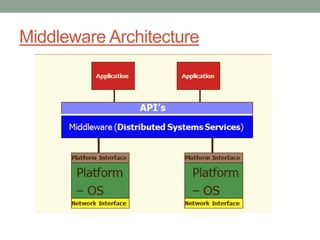
 It takes two or more different applications and makes
them work seamlessly together.
 This is accomplished by placing middleware between
layers of software to make the layers below and on the
sides work with each other
 It is connectivity software that provides a mechanism for
processes to interact with other processes.
Middleware Architecture
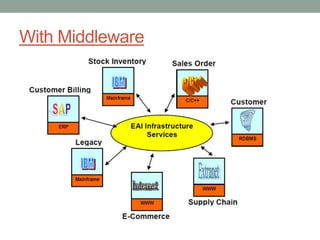
Need for Middleware
• Enterprise applications, from as early as the 1960s
through the late 1970s, were simple in design and
functionality, developed largely in part to end repetitive
tasks.
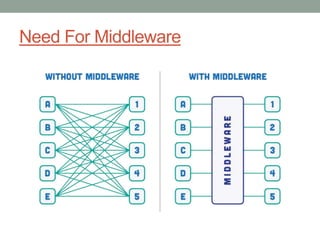
Need For Middleware
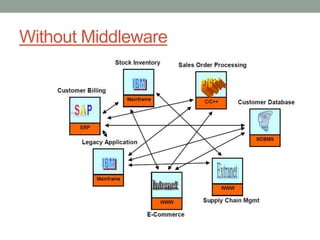
Without Middleware
With Middleware
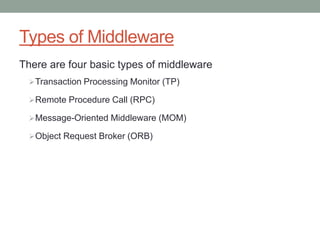
Types of Middleware
There are four basic types of middleware
Transaction Processing Monitor (TP)
Remote Procedure Call (RPC)
Message-Oriented Middleware (MOM)
Object Request Broker (ORB)
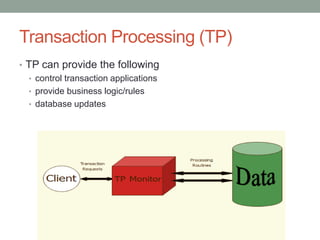
Transaction Processing (TP)
• TP can provide the following
• control transaction applications
• provide business logic/rules
• database updates
Remote Procedure Call (RPC).
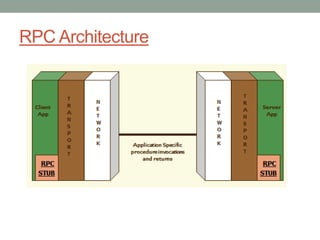
• RPC is a client/server mechanism that allows the program
to be distributed across multiple platforms.
• RPC’s reduce the complexity of a system that spans
multiple operating systems and network protocols by
hiding OS and network interface details from the
programmer.
Remote Procedure Call (cont’d)
• RPC’s are usually implemented by:
• proprietary products
• proprietary development tools that create client server stubs
• Most RPC implementations use a synchronous (call/wait)
protocol to communicate between client and server.
RPC Architecture
Message Oriented Middleware(MOM)
• Message-oriented middleware
• functionality similar to RPC
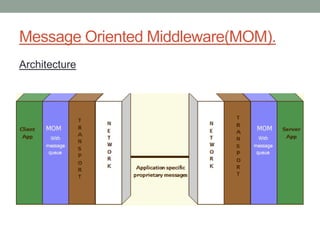
• provides asynchronous communication between client and server
applications by queueing messages temporarily when one or the
other is busy or not connected.
Message Oriented Middleware(MOM).
Architecture
Object Request Broker (ORB)
• ORB’s overcome; machine, software and vendors are no
boundaries for the ORB.
• Major functionality includes:
• interface definition
• location and activation of remote objects
• communication between clients and objects
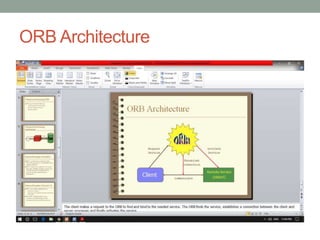
ORB Architecture
Future of Middleware
• The Future of Middleware/EAI IDC Research expects
the EAI services market to become the most important
and fastest- growing IT sector in the next three to five
years. According to IDC research, "worldwide revenues in
this market will jump from $5 billion in 2000 to nearly $21
billion in 2005. This increase represents a strong
compound annual growth rate (CAGR) of over 30%. IDC
also reports that North America and Western Europe will
generate more than 90% of the demand for global EAI
services through 2005, with Japan and Latin America
driving the remainder of this service demand. Issues that
may inhibit the growth of EAI include, "cost of services,
human issues regarding EAI engagements, and business-
to-business integration challenges."
Conclusion
• Middleware technologies are very important to succeed
with an incremental migration of legacy systems into
client/server systems, but that it is hard to find the correct
tools and people to accomplish the work.
References
• A. Carragra et al. A Middleware for Mobile Edge
Computing
[http://ieeexplore.ieee.org/document/8066002/]
• Markus Wutzler et al. RoleDiSCo: A Middleware
Architecture and Implementation for Coordinated On-
Demand Composition of Smart Service Systems in
Decentralized Environments
[http://ieeexplore.ieee.org/document/8064094/]
THANK YOU!
.

Middleware final

  • 1.
  • 2.
    Contents • Introduction • Historyand Orgin • Need for Middleware • Types of Middleware • Advantages and Uses of Middleware • Future of Middleware • Conclusion • References
  • 3.
    Introduction  It takestwo or more different applications and makes them work seamlessly together.  This is accomplished by placing middleware between layers of software to make the layers below and on the sides work with each other  It is connectivity software that provides a mechanism for processes to interact with other processes.
  • 4.
  • 5.
    Need for Middleware •Enterprise applications, from as early as the 1960s through the late 1970s, were simple in design and functionality, developed largely in part to end repetitive tasks.
  • 6.
  • 7.
  • 8.
  • 9.
    Types of Middleware Thereare four basic types of middleware Transaction Processing Monitor (TP) Remote Procedure Call (RPC) Message-Oriented Middleware (MOM) Object Request Broker (ORB)
  • 10.
    Transaction Processing (TP) •TP can provide the following • control transaction applications • provide business logic/rules • database updates
  • 11.
    Remote Procedure Call(RPC). • RPC is a client/server mechanism that allows the program to be distributed across multiple platforms. • RPC’s reduce the complexity of a system that spans multiple operating systems and network protocols by hiding OS and network interface details from the programmer.
  • 12.
    Remote Procedure Call(cont’d) • RPC’s are usually implemented by: • proprietary products • proprietary development tools that create client server stubs • Most RPC implementations use a synchronous (call/wait) protocol to communicate between client and server.
  • 13.
  • 14.
    Message Oriented Middleware(MOM) •Message-oriented middleware • functionality similar to RPC • provides asynchronous communication between client and server applications by queueing messages temporarily when one or the other is busy or not connected.
  • 15.
  • 16.
    Object Request Broker(ORB) • ORB’s overcome; machine, software and vendors are no boundaries for the ORB. • Major functionality includes: • interface definition • location and activation of remote objects • communication between clients and objects
  • 17.
  • 18.
    Future of Middleware •The Future of Middleware/EAI IDC Research expects the EAI services market to become the most important and fastest- growing IT sector in the next three to five years. According to IDC research, "worldwide revenues in this market will jump from $5 billion in 2000 to nearly $21 billion in 2005. This increase represents a strong compound annual growth rate (CAGR) of over 30%. IDC also reports that North America and Western Europe will generate more than 90% of the demand for global EAI services through 2005, with Japan and Latin America driving the remainder of this service demand. Issues that may inhibit the growth of EAI include, "cost of services, human issues regarding EAI engagements, and business- to-business integration challenges."
  • 19.
    Conclusion • Middleware technologiesare very important to succeed with an incremental migration of legacy systems into client/server systems, but that it is hard to find the correct tools and people to accomplish the work.
  • 20.
    References • A. Carragraet al. A Middleware for Mobile Edge Computing [http://ieeexplore.ieee.org/document/8066002/] • Markus Wutzler et al. RoleDiSCo: A Middleware Architecture and Implementation for Coordinated On- Demand Composition of Smart Service Systems in Decentralized Environments [http://ieeexplore.ieee.org/document/8064094/]
  • 21.