By Monu Kumar(IT-A)
Regd:141500261
2
3
4
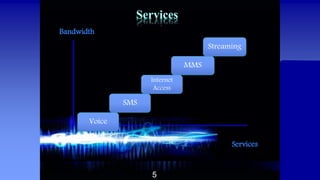
Voice
SMS
Internet
Access
MMS
Streaming
Bandwidth
Services
5
Implementation Of EDGE
• No hardware or software changes to be made in GSM
core networks, only base stations must be modified.
• EDGE compatible transceiver units must be installed in
Base Station Subsystem hardware.
• Software upgrades to the Base Station Controller
(BSCs) and Base Stations (BS). EDGE is just an “add-
on” to the BSS.
• A new modulation scheme “8-PSK” is introduced to
provide high data rate and high spectral efficiency.
6
Reasons For Using 8-PSK
• To achieve higher bit rates than that of GPRS, the
existing GMSK modulation technique must be modified.
• EDGE is specified to reuse the channel structure, width,
coding and existing mechanism of GPRS.
• The modulation technique used for EDGE i.e. “8-PSK”
fulfills all those requirements.
• This makes it possible to integrate new EDGE channels
into an existing frequency plan of GSM network.
7
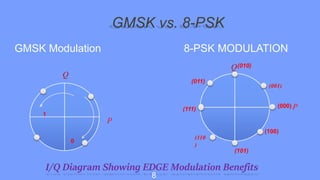
GMSK vs. 8-PSK
GMSK Modulation 8-PSK MODULATION
0
1
Q
Q
(001)
(000)
(100)
P
(101)
(110
)
(111)
(011)
(010)
I/Q Diagram Showing EDGE Modulation Benefits
8
• The 8-PSK modulation is a method in which 1 symbol
carries 3 bits of information.
• The total data rate is therefore increased by a factor of
three.
• The distance between the symbols are shorter than that of
GMSK.Hence increase the risk of misinterpretation of symbols.
• Each set of bits is just one bit different from its neighbor.
So if the radio receiver makes an error in reading the
symbol, most likely this will result in only one bit being
misinterpreted. 9
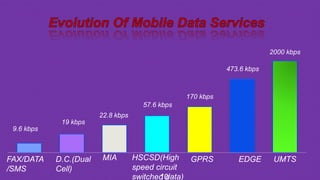
FAX/DATA
/SMS
D.C.(Dual
Cell)
MIA HSCSD(High
speed circuit
switched data)
GPRS EDGE UMTS
9.6 kbps
19 kbps
22.8 kbps
57.6 kbps
170 kbps
473.6 kbps
2000 kbps
10
• EDGE is a subsystem within the GSM standard. But
GPRS has introduced Packet-Switched Data into GSM
networks.
• EDGE is an “add-on” to GPRS and can not work alone.
• EDGE can transmit three times as many bits as GPRS
during the same period of time.
• GPRS allows average data rates of 115 Kbps and
theoretically up to 160 Kbps whereas EDGE offers
average data rate of 384 Kbps and theoretically up to
473.6 Kbps. 11
User Benefits
1) Speed
2) An “Always-on” connection
3) Coverage
4) Phone selection
12
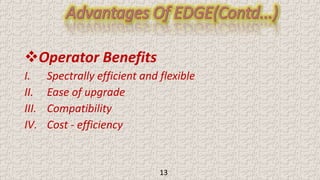
Operator Benefits
I. Spectrally efficient and flexible
II. Ease of upgrade
III. Compatibility
IV. Cost - efficiency
13
14
References
 http://searchmobilecomputing.techtarget.com/definition/E
DGE
 https://www.slideshare.net/jirshu/edge-technology
 https://en.wikipedia.org/wiki/Enhanced_Data_Rates_for_
GSM_Evolution
15
The End
Thanking You
All...
16

Enhanced data gsm environment

  • 1.
  • 2.
  • 3.
  • 4.
  • 5.
  • 6.
    Implementation Of EDGE •No hardware or software changes to be made in GSM core networks, only base stations must be modified. • EDGE compatible transceiver units must be installed in Base Station Subsystem hardware. • Software upgrades to the Base Station Controller (BSCs) and Base Stations (BS). EDGE is just an “add- on” to the BSS. • A new modulation scheme “8-PSK” is introduced to provide high data rate and high spectral efficiency. 6
  • 7.
    Reasons For Using8-PSK • To achieve higher bit rates than that of GPRS, the existing GMSK modulation technique must be modified. • EDGE is specified to reuse the channel structure, width, coding and existing mechanism of GPRS. • The modulation technique used for EDGE i.e. “8-PSK” fulfills all those requirements. • This makes it possible to integrate new EDGE channels into an existing frequency plan of GSM network. 7
  • 8.
    GMSK vs. 8-PSK GMSKModulation 8-PSK MODULATION 0 1 Q Q (001) (000) (100) P (101) (110 ) (111) (011) (010) I/Q Diagram Showing EDGE Modulation Benefits 8
  • 9.
    • The 8-PSKmodulation is a method in which 1 symbol carries 3 bits of information. • The total data rate is therefore increased by a factor of three. • The distance between the symbols are shorter than that of GMSK.Hence increase the risk of misinterpretation of symbols. • Each set of bits is just one bit different from its neighbor. So if the radio receiver makes an error in reading the symbol, most likely this will result in only one bit being misinterpreted. 9
  • 10.
    FAX/DATA /SMS D.C.(Dual Cell) MIA HSCSD(High speed circuit switcheddata) GPRS EDGE UMTS 9.6 kbps 19 kbps 22.8 kbps 57.6 kbps 170 kbps 473.6 kbps 2000 kbps 10
  • 11.
    • EDGE isa subsystem within the GSM standard. But GPRS has introduced Packet-Switched Data into GSM networks. • EDGE is an “add-on” to GPRS and can not work alone. • EDGE can transmit three times as many bits as GPRS during the same period of time. • GPRS allows average data rates of 115 Kbps and theoretically up to 160 Kbps whereas EDGE offers average data rate of 384 Kbps and theoretically up to 473.6 Kbps. 11
  • 12.
    User Benefits 1) Speed 2)An “Always-on” connection 3) Coverage 4) Phone selection 12
  • 13.
    Operator Benefits I. Spectrallyefficient and flexible II. Ease of upgrade III. Compatibility IV. Cost - efficiency 13
  • 14.
  • 15.
  • 16.