1
2
Introduction
►exponential increase in the subscribers’ growth and demand for
conversational voice services.
►The growth is unparalleled in the history of technology adoption.
►First generation wireless devices (1G) communicated only voice signals.
►2G devices communicate voice as well as data signals.
►2.5G and 2.5G+ are enhancements of the second generation.
►3G devices communicate at a higher data rates.
►4G facilitates higher data rates than 3G and enables multimedia newspaper
, high resolution mobile TV,IP telephony and data rates of 100 Mbps.
3
GSM VOICE EVOLUTION
►Speech in GSM started with the support of the Full rate speech codec(FR) in
GSM phase 1.
►The voice spectral efficiency (SE) determines the number of voice users
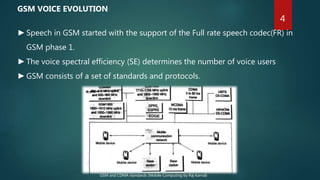
►GSM consists of a set of standards and protocols.
GSM and CDMA standards (Mobile Computing by Raj Kamal)
4
►Challenge of GSM 900 MHz: scattered and small allocations(5 MHz-10
MHZ)
►Introduction of HR codec in GSM phase 2 in 1995 doubled voice capacity.
►Most of the voice traffic was carried over GSM networks
►Adaptive Multi-Rate speech codec (AMR) is a voice enhancement feature
deployed to improve a networks SE in GSM phase 2+
►Better voice quality by introducing a new speech codec.
5
SPEECH CODING
►The goal of speech coding is to represent speech in digital form with as
few bits as possible.
►Interest in speech coding is motivated by the evolution to digital
communications and the requirement to minimize bit rate, and hence,
conserve bandwidth.
►the classic trade off in source compression is rate versus distortion--the
higher the rate, the smaller the average distortion in the reproduced
signal.
6
►since a higher bit rate implies a greater bandwidth requirement, the goal is
always to minimize the rate required to satisfy the distortion constraint.
►The most common approaches to speech coding are waveform-following
coders and analysis-by-synthesis methods.
►Waveform-following coders attempt to reproduce the time domain speech
waveform as accurately as possible.
►analysis-by-synthesis methods reproduce only those characteristics of the
input speech that are determined to be most important.
7
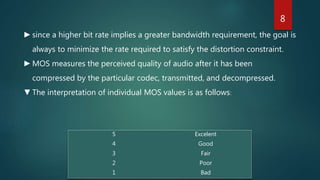
5 Excelent
4 Good
3 Fair
2 Poor
1 Bad
►since a higher bit rate implies a greater bandwidth requirement, the goal is
always to minimize the rate required to satisfy the distortion constraint.
►MOS measures the perceived quality of audio after it has been
compressed by the particular codec, transmitted, and decompressed.
▼The interpretation of individual MOS values is as follows:
8
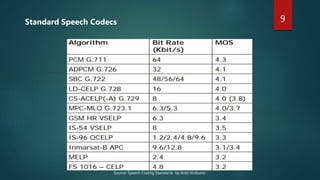
Standard Speech Codecs
Source: Speech Coding Standards by Antti Kiviluoto
9
VOICE OVER LTE
►VoIP (voice over IP) is the transmission of voice and multimedia content
over Internet Protocol (IP) networks.
►also referred to as IP telephony.
►VoIP encapsulates audio via a codec into data packets, transmits them
across an IP network and unwrap them back into audio at the other end
of the connection.
► VoIP endpoints include dedicated desktop VoIP
phones, softphone applications running on PCs and mobile devices.
10
OUTGOING VOICE CALLS OVER LTE
►The mobile device sends a message to the Voice Access Network
Controller(VANC).
►A standard GSM service request message is sent to the MSC.
►The MSC sends an Assignment Request message to the VANC to
request the establishment of a channel.
►The VANC then translates this message to prepare the mobile device
for the exchange of IP packets containing voice data.
►The voice path is established and voice conversation can begin.
11
INCOMING VOICE CALLS OVER LTE
►Incoming voice calls works in a similar way.
►As from the MSC’s point of view no connection is established to the
mobile device.
►MSC sends a standard paging message to the VANC that acts like a BSC.
►As the VANC has an established IPSec tunnel ,it can forward the paging
message directly to the mobile.
12
Conclusion
Finally, we note that voice is the preferred method of human
communication. Although there have been times when it seemed that the
voice communications problem was solved, such as when the PSTN was
our primary network or later when digital cellular networks reached
maturity, such is not the case today. It is evident that there is a diverse set
of challenges and opportunities for research and innovation in speech
coding and voice communications.
13
References
□ Raj Kamal, Mobile Computing, Oxford University Press, 2007
□ http://www.radio-electronics.com/info/cellulartelecomms/lte-long-term-
evolution/voice-over-lte-volte.php
□ Raju Ramaswamy ,”The Design and Implementation of a Packet Voice”
□ Martin Sauter, From GSM to LTE, Wiley publications
□ Man Young Rhee, Mobile communication Systems and Security
□ Mikko Saily, GSM/EDGE Evolution and Performance , Wiley publications
14
Thank You

Voice oriented data communication

  • 1.
  • 2.
  • 3.
    Introduction ►exponential increase inthe subscribers’ growth and demand for conversational voice services. ►The growth is unparalleled in the history of technology adoption. ►First generation wireless devices (1G) communicated only voice signals. ►2G devices communicate voice as well as data signals. ►2.5G and 2.5G+ are enhancements of the second generation. ►3G devices communicate at a higher data rates. ►4G facilitates higher data rates than 3G and enables multimedia newspaper , high resolution mobile TV,IP telephony and data rates of 100 Mbps. 3
  • 4.
    GSM VOICE EVOLUTION ►Speechin GSM started with the support of the Full rate speech codec(FR) in GSM phase 1. ►The voice spectral efficiency (SE) determines the number of voice users ►GSM consists of a set of standards and protocols. GSM and CDMA standards (Mobile Computing by Raj Kamal) 4
  • 5.
    ►Challenge of GSM900 MHz: scattered and small allocations(5 MHz-10 MHZ) ►Introduction of HR codec in GSM phase 2 in 1995 doubled voice capacity. ►Most of the voice traffic was carried over GSM networks ►Adaptive Multi-Rate speech codec (AMR) is a voice enhancement feature deployed to improve a networks SE in GSM phase 2+ ►Better voice quality by introducing a new speech codec. 5
  • 6.
    SPEECH CODING ►The goalof speech coding is to represent speech in digital form with as few bits as possible. ►Interest in speech coding is motivated by the evolution to digital communications and the requirement to minimize bit rate, and hence, conserve bandwidth. ►the classic trade off in source compression is rate versus distortion--the higher the rate, the smaller the average distortion in the reproduced signal. 6
  • 7.
    ►since a higherbit rate implies a greater bandwidth requirement, the goal is always to minimize the rate required to satisfy the distortion constraint. ►The most common approaches to speech coding are waveform-following coders and analysis-by-synthesis methods. ►Waveform-following coders attempt to reproduce the time domain speech waveform as accurately as possible. ►analysis-by-synthesis methods reproduce only those characteristics of the input speech that are determined to be most important. 7
  • 8.
    5 Excelent 4 Good 3Fair 2 Poor 1 Bad ►since a higher bit rate implies a greater bandwidth requirement, the goal is always to minimize the rate required to satisfy the distortion constraint. ►MOS measures the perceived quality of audio after it has been compressed by the particular codec, transmitted, and decompressed. ▼The interpretation of individual MOS values is as follows: 8
  • 9.
    Standard Speech Codecs Source:Speech Coding Standards by Antti Kiviluoto 9
  • 10.
    VOICE OVER LTE ►VoIP(voice over IP) is the transmission of voice and multimedia content over Internet Protocol (IP) networks. ►also referred to as IP telephony. ►VoIP encapsulates audio via a codec into data packets, transmits them across an IP network and unwrap them back into audio at the other end of the connection. ► VoIP endpoints include dedicated desktop VoIP phones, softphone applications running on PCs and mobile devices. 10
  • 11.
    OUTGOING VOICE CALLSOVER LTE ►The mobile device sends a message to the Voice Access Network Controller(VANC). ►A standard GSM service request message is sent to the MSC. ►The MSC sends an Assignment Request message to the VANC to request the establishment of a channel. ►The VANC then translates this message to prepare the mobile device for the exchange of IP packets containing voice data. ►The voice path is established and voice conversation can begin. 11
  • 12.
    INCOMING VOICE CALLSOVER LTE ►Incoming voice calls works in a similar way. ►As from the MSC’s point of view no connection is established to the mobile device. ►MSC sends a standard paging message to the VANC that acts like a BSC. ►As the VANC has an established IPSec tunnel ,it can forward the paging message directly to the mobile. 12
  • 13.
    Conclusion Finally, we notethat voice is the preferred method of human communication. Although there have been times when it seemed that the voice communications problem was solved, such as when the PSTN was our primary network or later when digital cellular networks reached maturity, such is not the case today. It is evident that there is a diverse set of challenges and opportunities for research and innovation in speech coding and voice communications. 13
  • 14.
    References □ Raj Kamal,Mobile Computing, Oxford University Press, 2007 □ http://www.radio-electronics.com/info/cellulartelecomms/lte-long-term- evolution/voice-over-lte-volte.php □ Raju Ramaswamy ,”The Design and Implementation of a Packet Voice” □ Martin Sauter, From GSM to LTE, Wiley publications □ Man Young Rhee, Mobile communication Systems and Security □ Mikko Saily, GSM/EDGE Evolution and Performance , Wiley publications 14
  • 15.