TRANSDUCERS
Transducers are the devices that convert the electrical energy from the audiometer
into acoustical or vibratory energy.
Transducers used for audiometric purposes are earphones, loudspeakers, or bone-
conduction vibrators.
Earphones are of three varieties, insert, supra-aural, and circumaural
A supra-aural, insert, or circumaural earphone and a loudspeaker convert the
electrical output from the audiometer to acoustic energy
A bone vibrator converts the electrical output to mechanical energy
1. SUPRA AURAL EARPHONES
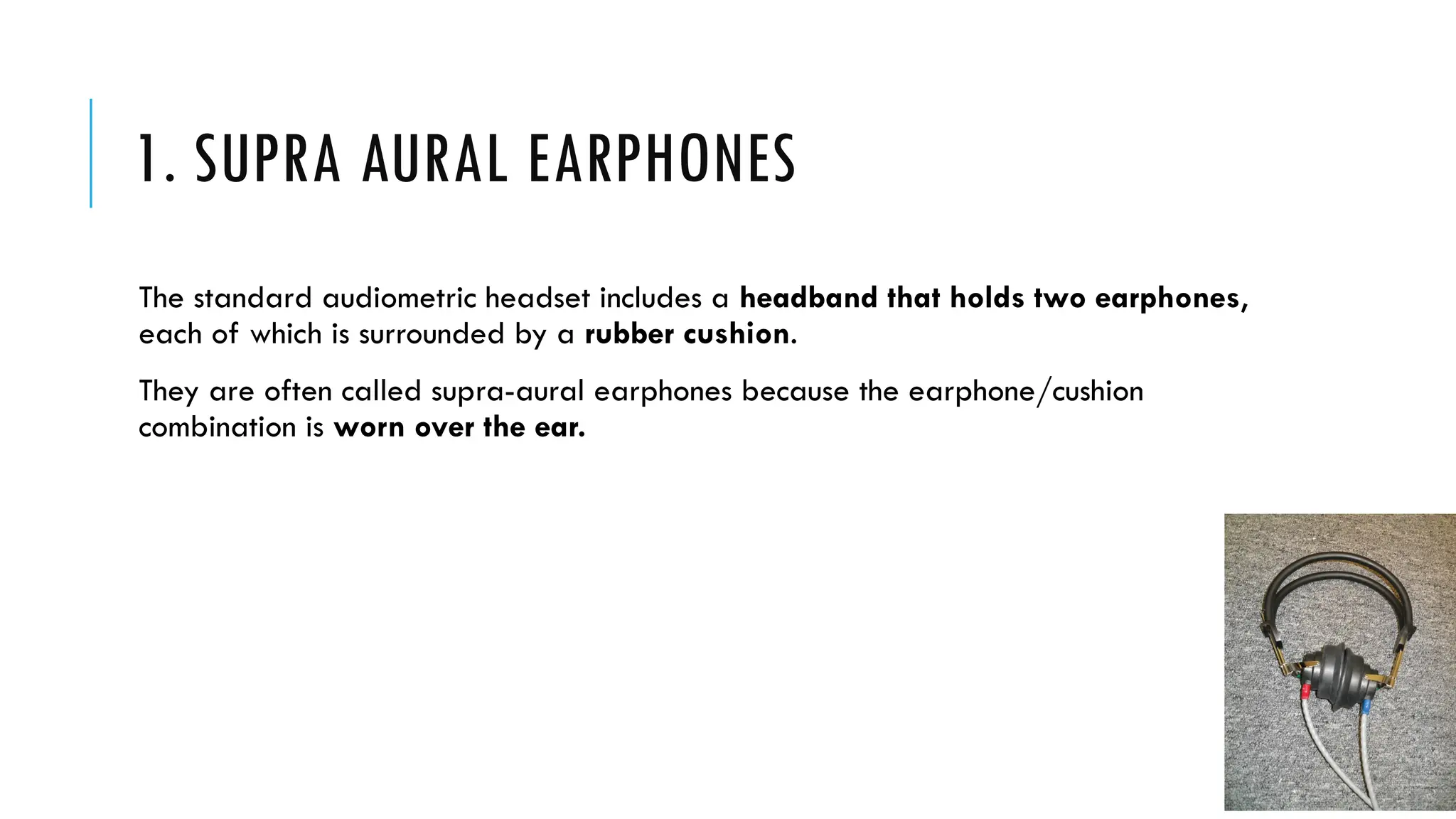
The standard audiometric headset includes a headband that holds two earphones,
each of which is surrounded by a rubber cushion.
They are often called supra-aural earphones because the earphone/cushion
combination is worn over the ear.
ADVANTAGES WHEN COMPARED WITH CIRCUMAURAL EARPHONES
i. They are relatively lightweight and sit on top of rather than around the ear;
therefore, they tend to be more comfortable
ii. Achieving proper placement on the client is quick and easy-hearing screenings
with a portable audiometer.
COMMON PRODUCTS
The most common supra-aural earphones are Telephonics Corporation (Huntington,
NY) Telephonics Dynamic Headphone (TDH) 39, 49, and 50.
These earphones have high sensitivity, low distortion.
Relatively flat frequency response with limited output above 8000 Hz. Thus, TDH-
type earphones are only used for testing from 125 to 8000 Hz.
ANSI S3.6–2004 specifies the characteristics of earphone cushions (ANSI S3.6–2004),
which are met by a Telephonics Model 51 and MX-41/AR.
Headbands are produced by several manufacturers.
ANSI S3.6–2004 specifies that the static headband force should be 4.5 ± 0.5 N.
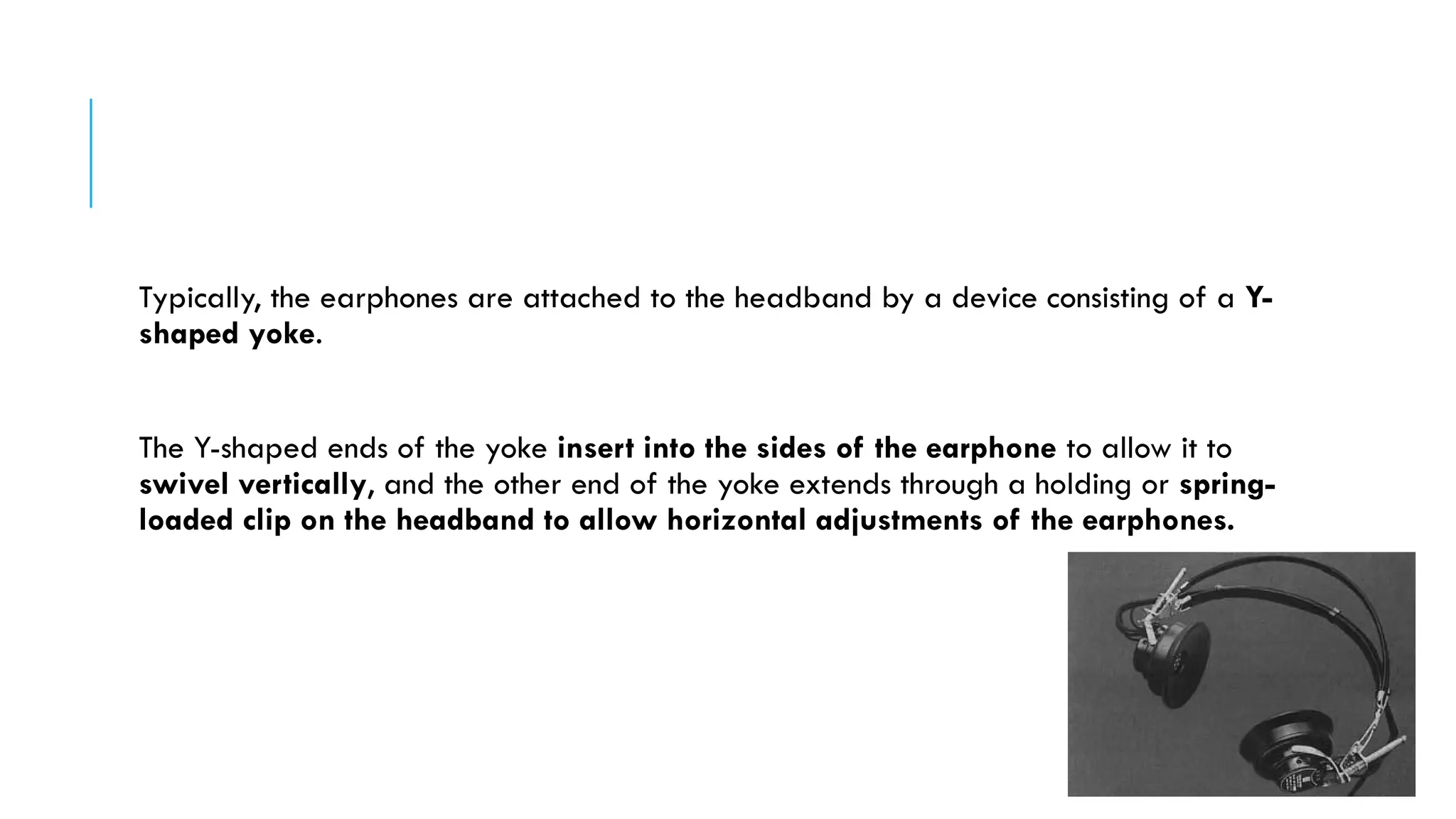
Typically, the earphones are attached to the headband by a device consisting of a Y-
shaped yoke.
The Y-shaped ends of the yoke insert into the sides of the earphone to allow it to
swivel vertically, and the other end of the yoke extends through a holding or spring-
loaded clip on the headband to allow horizontal adjustments of the earphones.
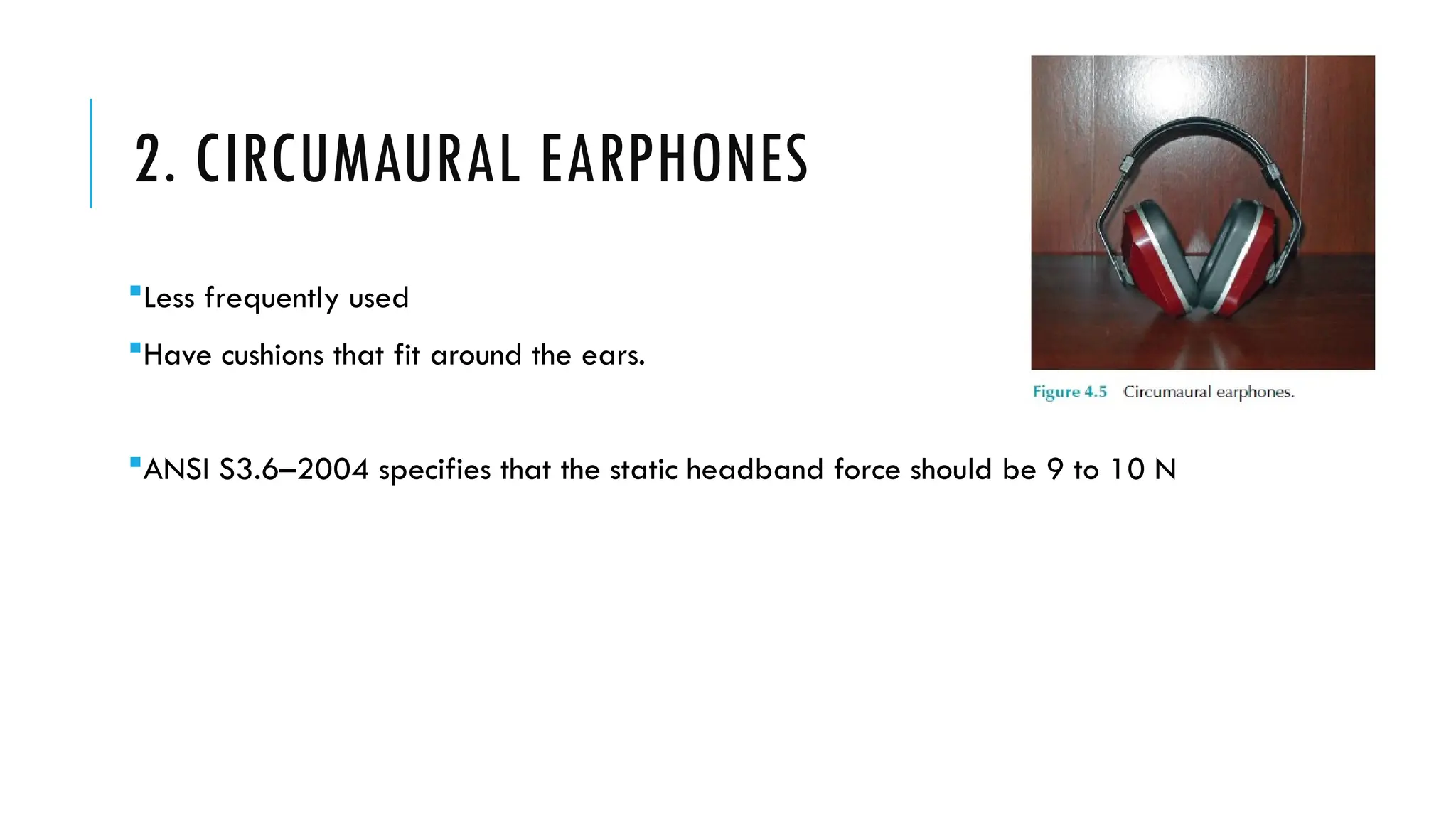
2. CIRCUMAURAL EARPHONES
Less frequently used
Have cushions that fit around the ears.
ANSI S3.6–2004 specifies that the static headband force should be 9 to 10 N
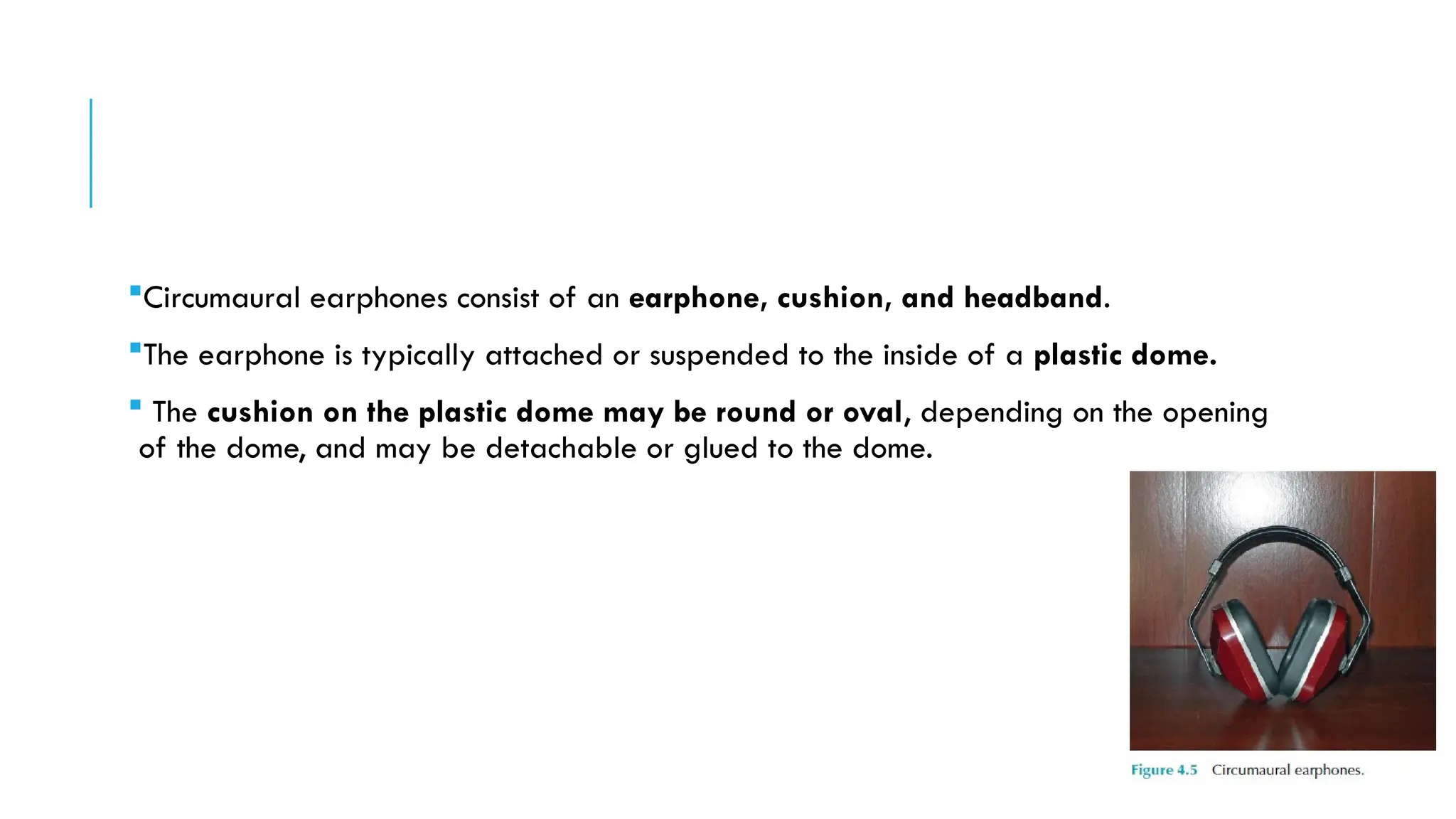
Circumaural earphones consist of an earphone, cushion, and headband.
The earphone is typically attached or suspended to the inside of a plastic dome.
 The cushion on the plastic dome may be round or oval, depending on the opening
of the dome, and may be detachable or glued to the dome.
COMMON PRODUCTS
Examples of a circumaural earphone include the
Sennheiser Electronic Corporation (Old Lyme, CT) HDA200
Koss Corporation (Milwaukee, WI) HV/1A.
Sennheiser HDA 200 circumaural earphones.
ADVANTAGE:
Circumaural earphones are more efficient at reducing unwanted ambient sound -
good
Choice in screening environments where background noise is a problem
LIMITATIONS
Larger, heavier, and as a result may be less comfortable than the supra-aural type.
Proper placement is not as quick and easy.
3. INSERT EARPHONES
Have a pliable earpiece that is inserted into the external auditory canal, and are
also used for various clinical purposes
I. NO MORE COLLAPSING CANALS
Placement of supra-aural earphones can cause the ear canals to collapse or close.
Exerts pressure sufficient to cause the external auditory ear canal to close off - the
tragus collapsing over, and closing off, the opening to the external ear canal.
This is especially true in older patients whose ear canal cartilage is more pliable.
Collapsed canals generally cause high-frequency conductive hearing loss on the
audiogram, a condition that is not experienced in real life without earphones.
II.REDUCED NEED FOR MASKING
Earphones deliver sound to the ear canal, but they also deliver vibration to the skull
through the earphone cushion. The more contact the cushion has with the head, the
more readily the vibration is transferred.
This causes crossover to the other ear, a condition that creates the need to mask or
keep the nontest ear busy during audiometric testing.
Sound that is delivered to one ear is attenuated or reduced by the head as it
crosses over to the other ear. This is referred to as interaural attenuation (IA), or
attenuation between the ears.
The amount of IA is greater for insert earphones than for supra-aural earphones.
This means that crossover is less likely, thereby reducing the need to mask.
III.ENHANCED PLACEMENT STABILITY
Earphone placement affects the sound delivered to the ear; improper placement
can cause testing inaccuracies.
This effect is smaller with properly placed insert earphones than with supra-aural
earphones.
COMMON PRODUCTS
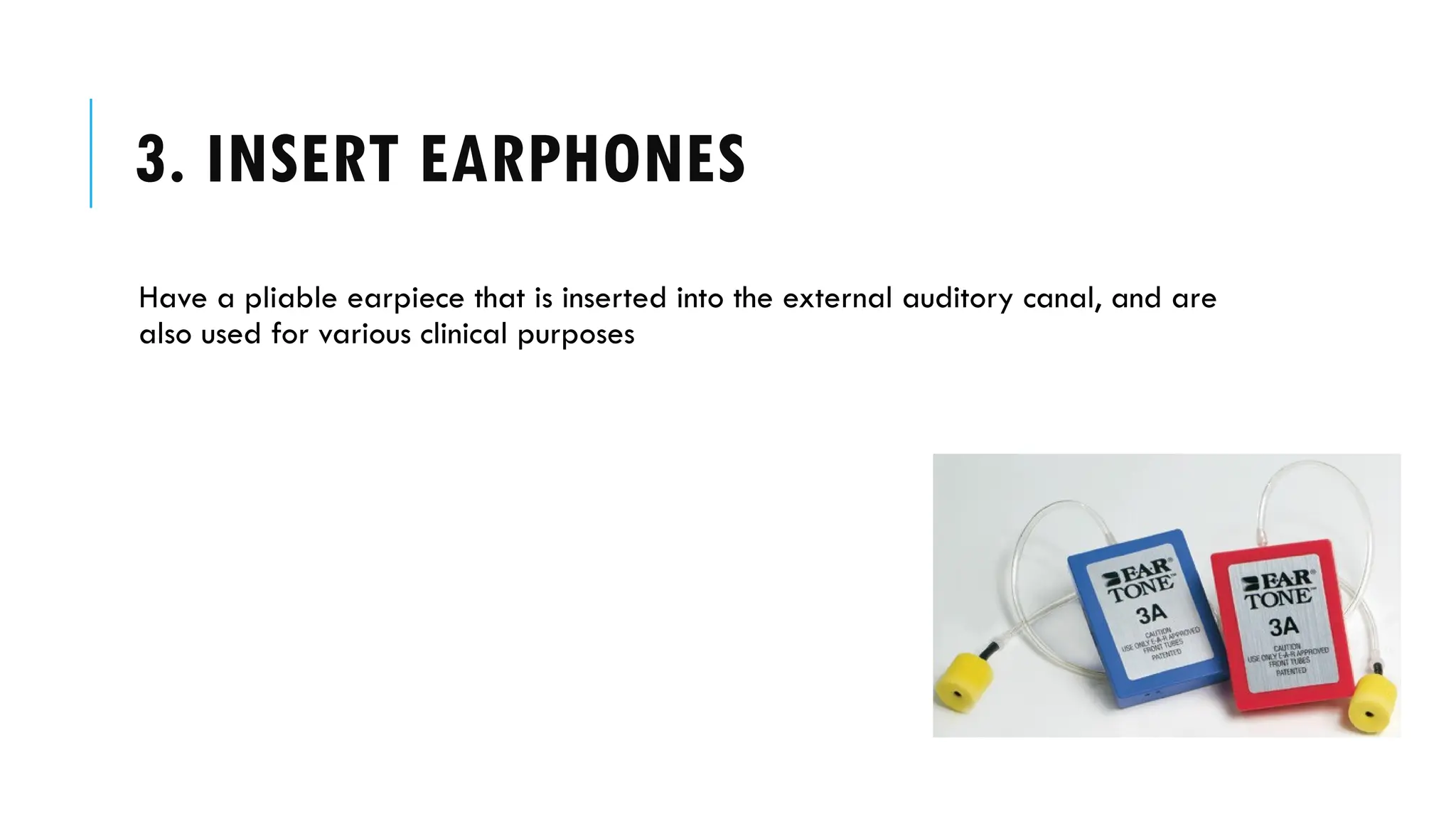
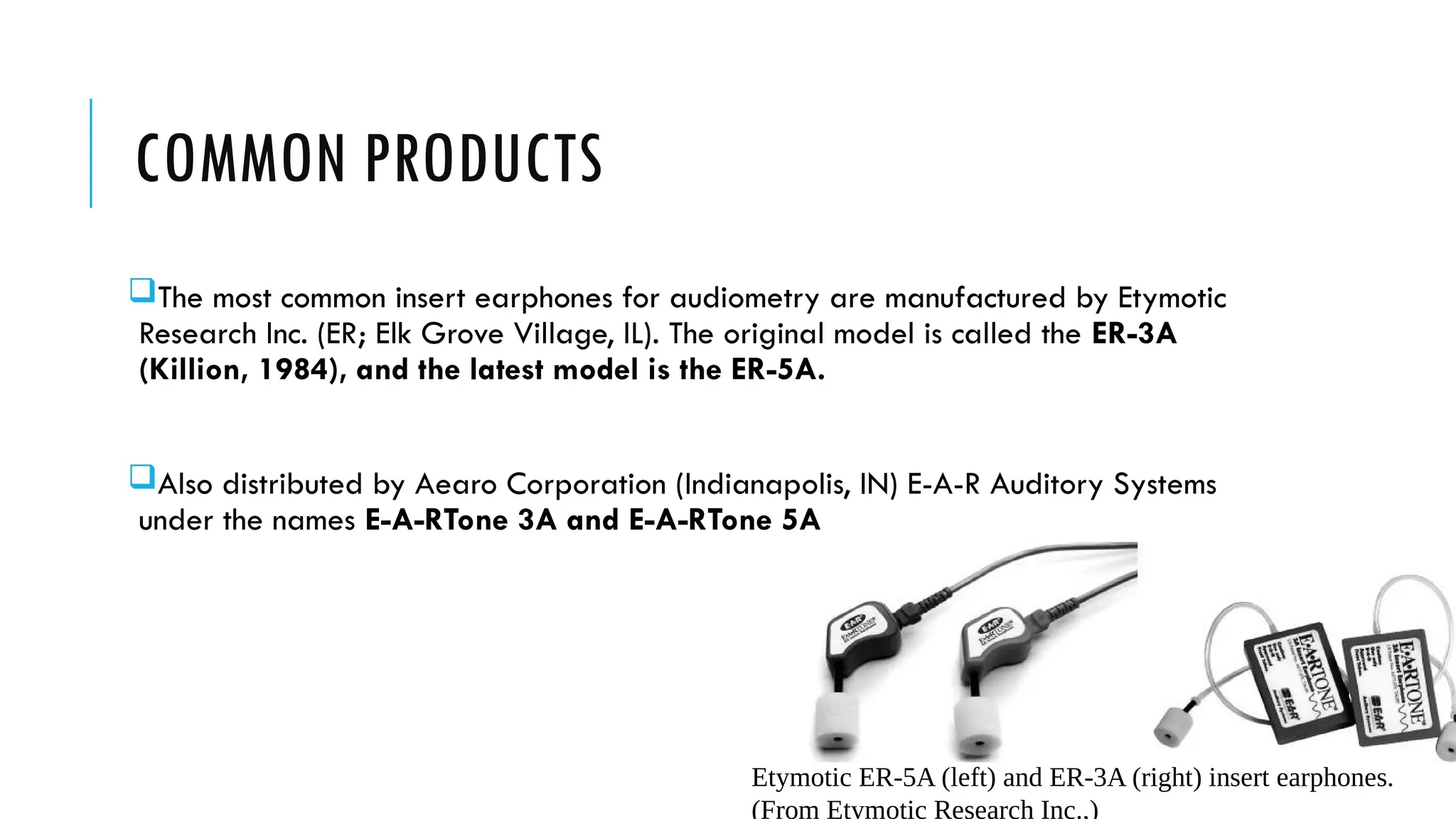
The most common insert earphones for audiometry are manufactured by Etymotic
Research Inc. (ER; Elk Grove Village, IL). The original model is called the ER-3A
(Killion, 1984), and the latest model is the ER-5A.
Also distributed by Aearo Corporation (Indianapolis, IN) E-A-R Auditory Systems
under the names E-A-RTone 3A and E-A-RTone 5A
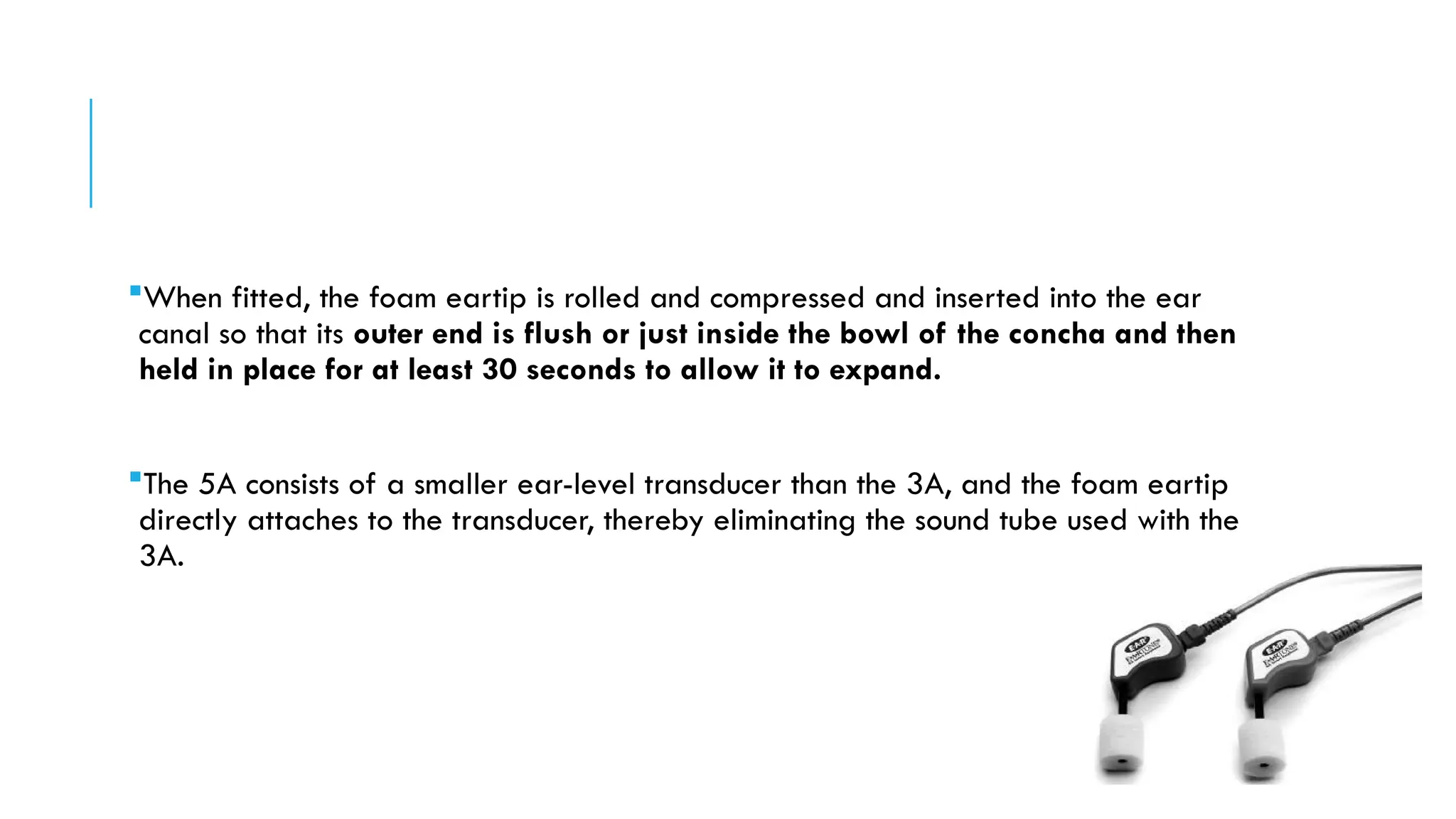
Etymotic ER-5A (left) and ER-3A (right) insert earphones.
(From Etymotic Research Inc.,)
The 3A consists of a shouldermounted transducer coupled to the ear canal by means
of a sound tube (240 mm long, 1.37 mm [inside diameter] ID) attached to a
connecting nipple (11 mm long, 1.37 mm ID) and then to an eartip tube (26 mm long,
1.93 mm ID), which runs through a foam eartip.
The eartips are disposable and available in three sizes.
Each size has the same length (12 mm) but different outside diameters to
accommodate individuals with very large ear canals (17.8 mm), normal ear canals
(13.7 mm), or small ear canals (9.7 mm).
When fitted, the foam eartip is rolled and compressed and inserted into the ear
canal so that its outer end is flush or just inside the bowl of the concha and then
held in place for at least 30 seconds to allow it to expand.
The 5A consists of a smaller ear-level transducer than the 3A, and the foam eartip
directly attaches to the transducer, thereby eliminating the sound tube used with the
3A.
The frequency response of the 3A (Frank and Richards, 1991) and the 5A is relatively
flat from 100 to 4000 Hz and then decreases.
Even though the 3A or 5A can be used for testing from 125 to 8000 Hz, the
available maximum output at 6000 and especially at 8000 Hz is reduced
compared with the output at 1000 Hz.
4. BONE-CONDUCTION VIBRATOR
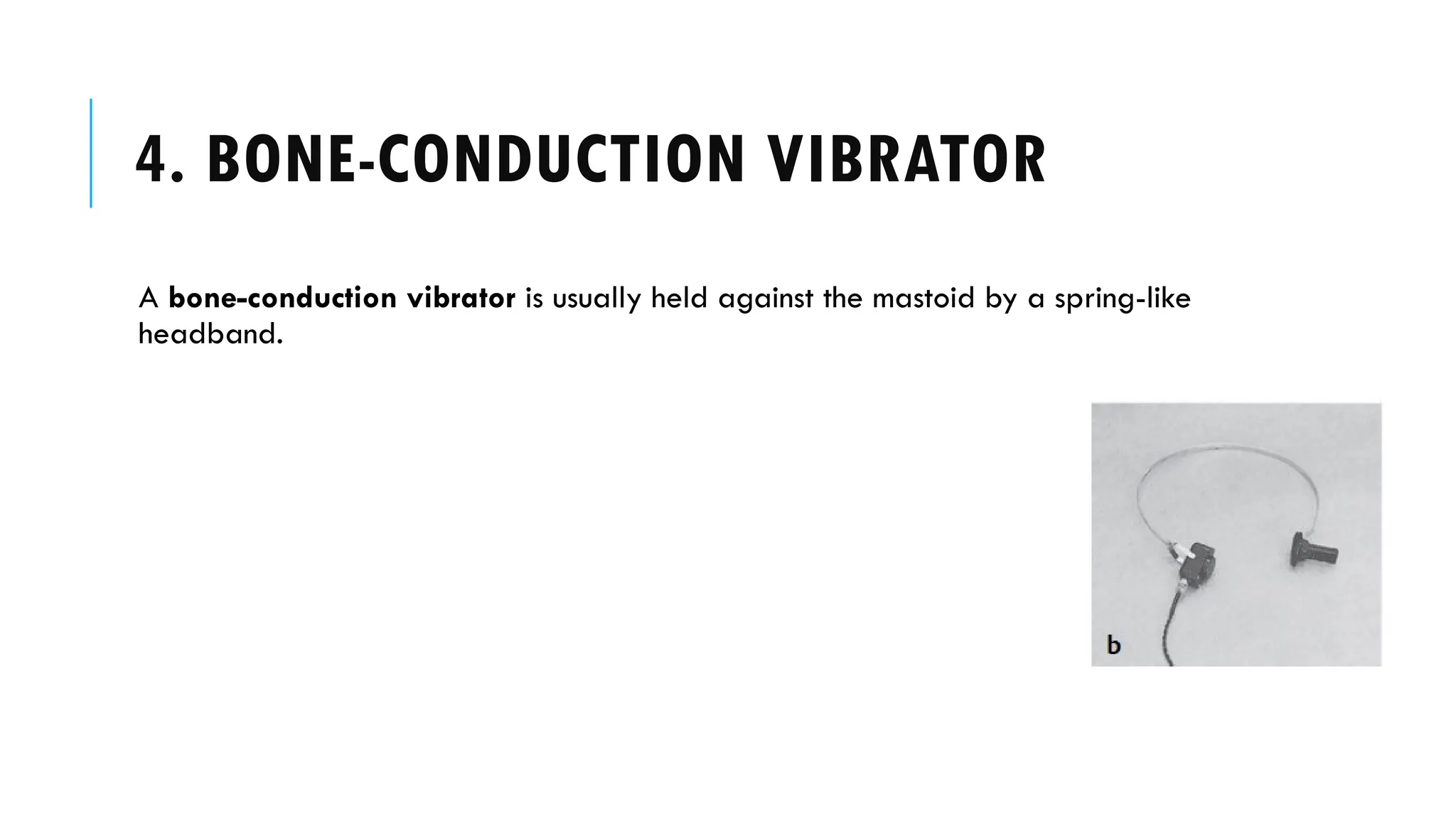
A bone-conduction vibrator is usually held against the mastoid by a spring-like
headband.
A bone vibrator consists of an electromagnetic transducer having a plane circular
tip area of 175 ± 25 mm2.
However, bone vibrators differ in size, shape, weight, encapsulation, and
frequency response.
COMMON PRODUCTS
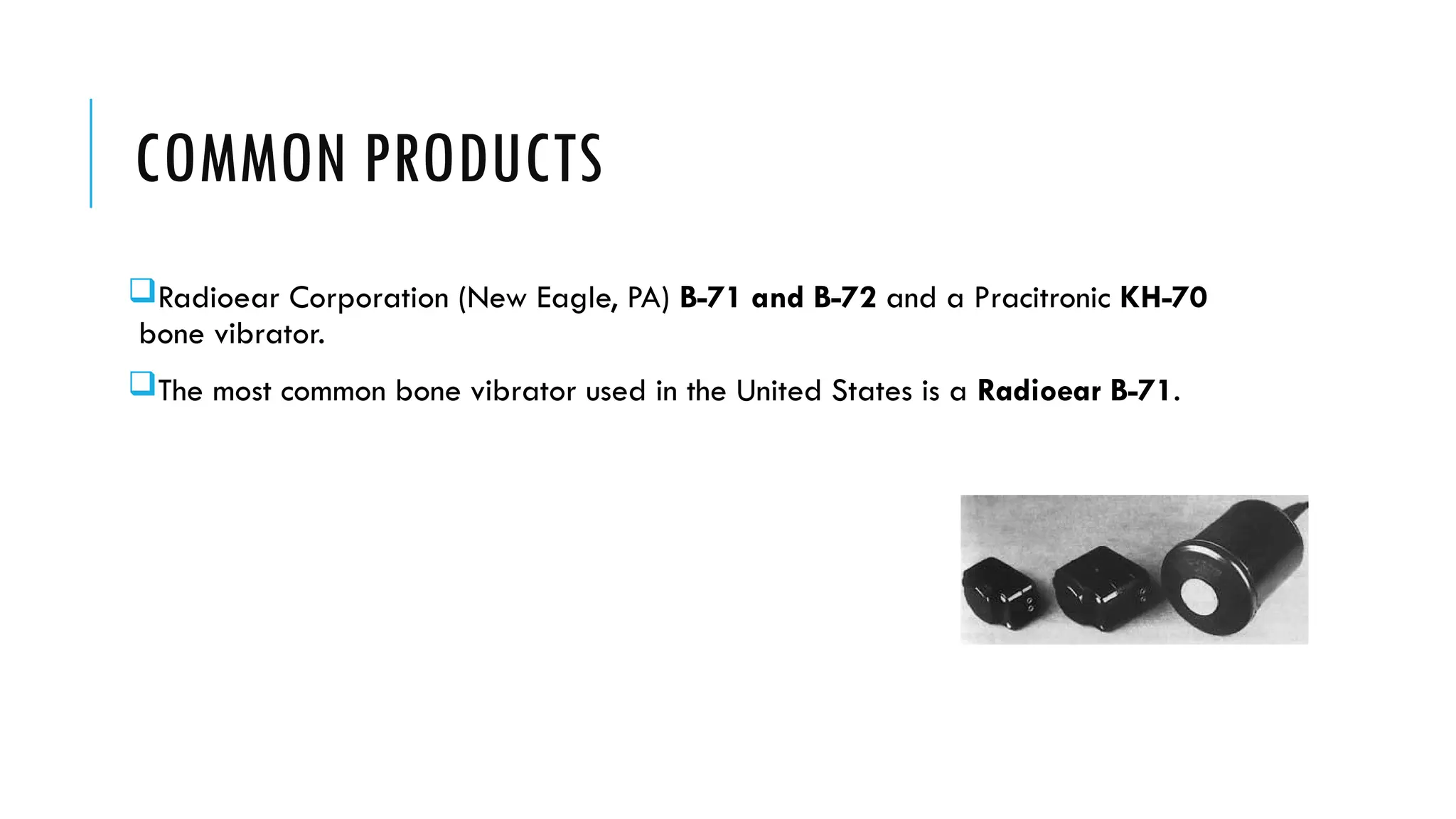
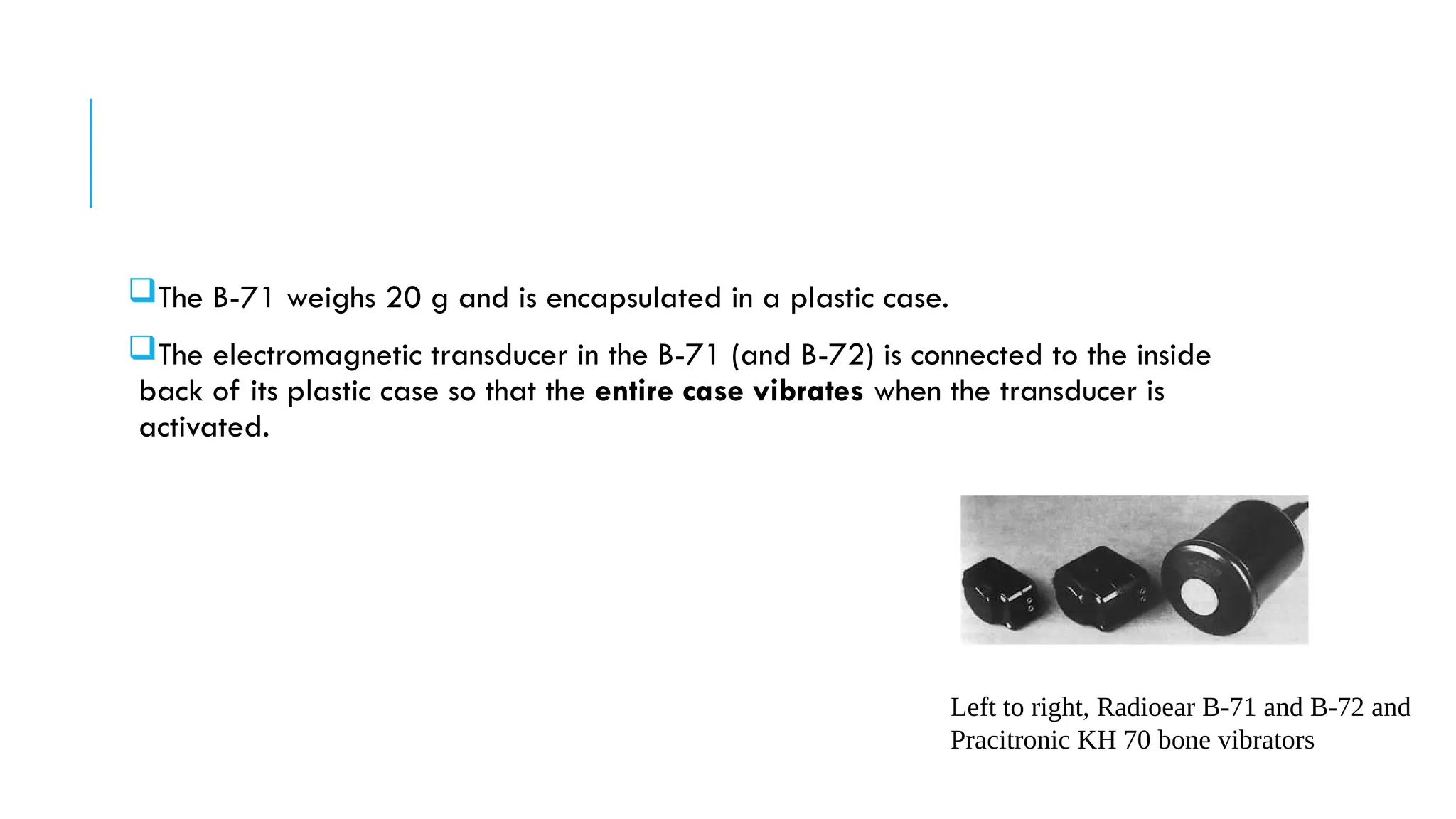
Radioear Corporation (New Eagle, PA) B-71 and B-72 and a Pracitronic KH-70
bone vibrator.
The most common bone vibrator used in the United States is a Radioear B-71.
The B-71 weighs 20 g and is encapsulated in a plastic case.
The electromagnetic transducer in the B-71 (and B-72) is connected to the inside
back of its plastic case so that the entire case vibrates when the transducer is
activated.
Left to right, Radioear B-71 and B-72 and
Pracitronic KH 70 bone vibrators
The frequency response of a B-71 is characterized by three resonant peaks at 450,
1500, and 3800 Hz that decrease in amplitude as frequency increases followed by a
sharp drop in output above 4000 Hz (Richards and Frank, 1982).
Thus, bone-conduction testing with the B-71 is typically conducted from 250 to 4000
Hz
When fitted, a bone vibrator can be placed on the mastoid or forehead using a
headband.
 ANSI S3.6–2004 specifies the static headband force as 5.4 6 ± 0.5 N for either
mastoid or forehead placement
5. LOUDSPEAKERS
Loudspeakers should have a bandwidth between 100 and 10,000 Hz, a smooth
frequency response, and be housed in an enclosure.
To meet these requirements, typically two or more limited-range, frequency-
response speakers are contained in the same enclosure.
A loudspeaker should be capable of
Producing a sound pressure level (SPL) from 0 to 120 dB at a reference point in the
sound field
Be electrically isolated so that circuit or line noise is not amplified
 Have very low distortion, especially at very high output levels

3.Transducers working and mechanisms part 1

  • 1.
  • 2.
    Transducers are thedevices that convert the electrical energy from the audiometer into acoustical or vibratory energy. Transducers used for audiometric purposes are earphones, loudspeakers, or bone- conduction vibrators. Earphones are of three varieties, insert, supra-aural, and circumaural
  • 3.
    A supra-aural, insert,or circumaural earphone and a loudspeaker convert the electrical output from the audiometer to acoustic energy A bone vibrator converts the electrical output to mechanical energy
  • 4.
    1. SUPRA AURALEARPHONES The standard audiometric headset includes a headband that holds two earphones, each of which is surrounded by a rubber cushion. They are often called supra-aural earphones because the earphone/cushion combination is worn over the ear.
  • 5.
    ADVANTAGES WHEN COMPAREDWITH CIRCUMAURAL EARPHONES i. They are relatively lightweight and sit on top of rather than around the ear; therefore, they tend to be more comfortable ii. Achieving proper placement on the client is quick and easy-hearing screenings with a portable audiometer.
  • 6.
    COMMON PRODUCTS The mostcommon supra-aural earphones are Telephonics Corporation (Huntington, NY) Telephonics Dynamic Headphone (TDH) 39, 49, and 50. These earphones have high sensitivity, low distortion. Relatively flat frequency response with limited output above 8000 Hz. Thus, TDH- type earphones are only used for testing from 125 to 8000 Hz.
  • 7.
    ANSI S3.6–2004 specifiesthe characteristics of earphone cushions (ANSI S3.6–2004), which are met by a Telephonics Model 51 and MX-41/AR. Headbands are produced by several manufacturers. ANSI S3.6–2004 specifies that the static headband force should be 4.5 ± 0.5 N.
  • 8.
    Typically, the earphonesare attached to the headband by a device consisting of a Y- shaped yoke. The Y-shaped ends of the yoke insert into the sides of the earphone to allow it to swivel vertically, and the other end of the yoke extends through a holding or spring- loaded clip on the headband to allow horizontal adjustments of the earphones.
  • 9.
    2. CIRCUMAURAL EARPHONES Lessfrequently used Have cushions that fit around the ears. ANSI S3.6–2004 specifies that the static headband force should be 9 to 10 N
  • 10.
    Circumaural earphones consistof an earphone, cushion, and headband. The earphone is typically attached or suspended to the inside of a plastic dome.  The cushion on the plastic dome may be round or oval, depending on the opening of the dome, and may be detachable or glued to the dome.
  • 11.
    COMMON PRODUCTS Examples ofa circumaural earphone include the Sennheiser Electronic Corporation (Old Lyme, CT) HDA200 Koss Corporation (Milwaukee, WI) HV/1A. Sennheiser HDA 200 circumaural earphones.
  • 12.
    ADVANTAGE: Circumaural earphones aremore efficient at reducing unwanted ambient sound - good Choice in screening environments where background noise is a problem
  • 13.
    LIMITATIONS Larger, heavier, andas a result may be less comfortable than the supra-aural type. Proper placement is not as quick and easy.
  • 14.
    3. INSERT EARPHONES Havea pliable earpiece that is inserted into the external auditory canal, and are also used for various clinical purposes
  • 15.
    I. NO MORECOLLAPSING CANALS Placement of supra-aural earphones can cause the ear canals to collapse or close. Exerts pressure sufficient to cause the external auditory ear canal to close off - the tragus collapsing over, and closing off, the opening to the external ear canal. This is especially true in older patients whose ear canal cartilage is more pliable. Collapsed canals generally cause high-frequency conductive hearing loss on the audiogram, a condition that is not experienced in real life without earphones.
  • 16.
    II.REDUCED NEED FORMASKING Earphones deliver sound to the ear canal, but they also deliver vibration to the skull through the earphone cushion. The more contact the cushion has with the head, the more readily the vibration is transferred. This causes crossover to the other ear, a condition that creates the need to mask or keep the nontest ear busy during audiometric testing. Sound that is delivered to one ear is attenuated or reduced by the head as it crosses over to the other ear. This is referred to as interaural attenuation (IA), or attenuation between the ears. The amount of IA is greater for insert earphones than for supra-aural earphones. This means that crossover is less likely, thereby reducing the need to mask.
  • 17.
    III.ENHANCED PLACEMENT STABILITY Earphoneplacement affects the sound delivered to the ear; improper placement can cause testing inaccuracies. This effect is smaller with properly placed insert earphones than with supra-aural earphones.
  • 18.
    COMMON PRODUCTS The mostcommon insert earphones for audiometry are manufactured by Etymotic Research Inc. (ER; Elk Grove Village, IL). The original model is called the ER-3A (Killion, 1984), and the latest model is the ER-5A. Also distributed by Aearo Corporation (Indianapolis, IN) E-A-R Auditory Systems under the names E-A-RTone 3A and E-A-RTone 5A Etymotic ER-5A (left) and ER-3A (right) insert earphones. (From Etymotic Research Inc.,)
  • 19.
    The 3A consistsof a shouldermounted transducer coupled to the ear canal by means of a sound tube (240 mm long, 1.37 mm [inside diameter] ID) attached to a connecting nipple (11 mm long, 1.37 mm ID) and then to an eartip tube (26 mm long, 1.93 mm ID), which runs through a foam eartip. The eartips are disposable and available in three sizes. Each size has the same length (12 mm) but different outside diameters to accommodate individuals with very large ear canals (17.8 mm), normal ear canals (13.7 mm), or small ear canals (9.7 mm).
  • 20.
    When fitted, thefoam eartip is rolled and compressed and inserted into the ear canal so that its outer end is flush or just inside the bowl of the concha and then held in place for at least 30 seconds to allow it to expand. The 5A consists of a smaller ear-level transducer than the 3A, and the foam eartip directly attaches to the transducer, thereby eliminating the sound tube used with the 3A.
  • 21.
    The frequency responseof the 3A (Frank and Richards, 1991) and the 5A is relatively flat from 100 to 4000 Hz and then decreases. Even though the 3A or 5A can be used for testing from 125 to 8000 Hz, the available maximum output at 6000 and especially at 8000 Hz is reduced compared with the output at 1000 Hz.
  • 22.
    4. BONE-CONDUCTION VIBRATOR Abone-conduction vibrator is usually held against the mastoid by a spring-like headband.
  • 23.
    A bone vibratorconsists of an electromagnetic transducer having a plane circular tip area of 175 ± 25 mm2. However, bone vibrators differ in size, shape, weight, encapsulation, and frequency response.
  • 24.
    COMMON PRODUCTS Radioear Corporation(New Eagle, PA) B-71 and B-72 and a Pracitronic KH-70 bone vibrator. The most common bone vibrator used in the United States is a Radioear B-71.
  • 25.
    The B-71 weighs20 g and is encapsulated in a plastic case. The electromagnetic transducer in the B-71 (and B-72) is connected to the inside back of its plastic case so that the entire case vibrates when the transducer is activated. Left to right, Radioear B-71 and B-72 and Pracitronic KH 70 bone vibrators
  • 26.
    The frequency responseof a B-71 is characterized by three resonant peaks at 450, 1500, and 3800 Hz that decrease in amplitude as frequency increases followed by a sharp drop in output above 4000 Hz (Richards and Frank, 1982). Thus, bone-conduction testing with the B-71 is typically conducted from 250 to 4000 Hz
  • 27.
    When fitted, abone vibrator can be placed on the mastoid or forehead using a headband.  ANSI S3.6–2004 specifies the static headband force as 5.4 6 ± 0.5 N for either mastoid or forehead placement
  • 28.
    5. LOUDSPEAKERS Loudspeakers shouldhave a bandwidth between 100 and 10,000 Hz, a smooth frequency response, and be housed in an enclosure. To meet these requirements, typically two or more limited-range, frequency- response speakers are contained in the same enclosure.
  • 29.
    A loudspeaker shouldbe capable of Producing a sound pressure level (SPL) from 0 to 120 dB at a reference point in the sound field Be electrically isolated so that circuit or line noise is not amplified  Have very low distortion, especially at very high output levels

Editor's Notes

  • #14 CLINICAL AUDIOLOGY-BRAD STACH -3RD EDITION
  • #29 The output is controlled by an electrical crossover network that minimizes overlap between the frequency response of each speaker to obtain an overall smooth frequency response.