Hearing Aids
&
Implanted Hearing
Devices
Mr. Binu Babu
M.Sc. Nursing
Mrs. Jincy Ealias
M.Sc. Nursing
HEARING AIDS
Definition
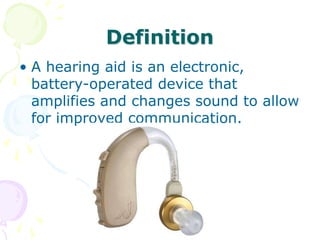
• A hearing aid is an electronic,
battery-operated device that
amplifies and changes sound to allow
for improved communication.
Components of Hearing
Aids
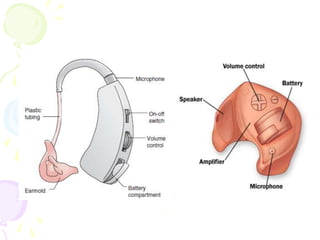
• Microphone: Receives sound and converts it into
electrical impulses. (picks up sound)
• Amplifier: Intensifies electrical impulses. (makes
sound louder)
• Receiver: Translates those electrical impulses
into louder sounds. (delivers amplified sound into
ear-miniature loudspeaker)
• Battery: Serves as power source for device.
• Earmolds (earpieces) : Directs the flow of
sound into the ear and enhance sound quality.
Indication
• Hearing loss
Types of Hearing Aid
• Pocket Model
• Behind-the-Ear (BTE)
• In-the-Ear (ITE)
• In-the-Canal (ITC), Mini Canal (MIC)
and Completely-in-Canal (CIC) aids
• Spectacle type
• Remote microphone (RM)
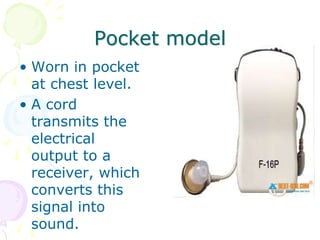
Pocket model
• Worn in pocket
at chest level.
• A cord
transmits the
electrical
output to a
receiver, which
converts this
signal into
sound.
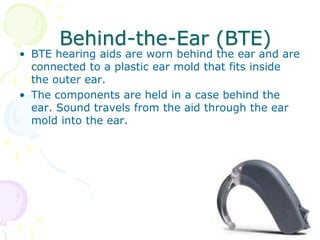
Behind-the-Ear (BTE)
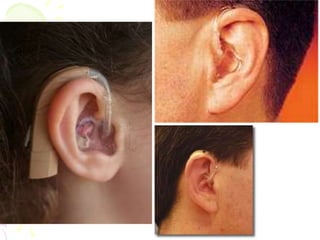
• BTE hearing aids are worn behind the ear and are
connected to a plastic ear mold that fits inside
the outer ear.
• The components are held in a case behind the
ear. Sound travels from the aid through the ear
mold into the ear.
In-the-Ear (ITE)
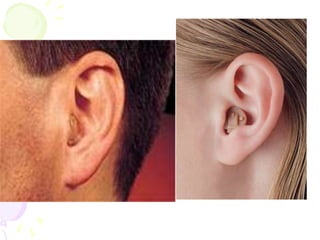
• ITE hearing aids fit completely in the outer
ear and are used for mild to severe
hearing loss.
• ITE aids can be damaged by earwax and
ear drainage, and their small size can
cause adjustment problems and feedback.
In-the-Canal (ITC)
• ITC hearing aids are customized to fit the size
and shape of the ear canal and are used for mild
or moderately severe hearing loss.
• Small one-piece hearing aid
• All components contained in a custom-fit, hard-
molded plastic shell
• Fits outside the ear canal
• Slightly visible in the ear
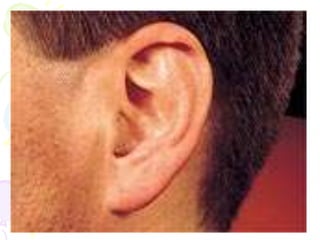
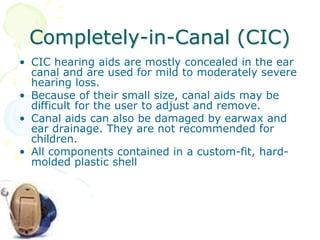
Completely-in-Canal (CIC)
• CIC hearing aids are mostly concealed in the ear
canal and are used for mild to moderately severe
hearing loss.
• Because of their small size, canal aids may be
difficult for the user to adjust and remove.
• Canal aids can also be damaged by earwax and
ear drainage. They are not recommended for
children.
• All components contained in a custom-fit, hard-
molded plastic shell
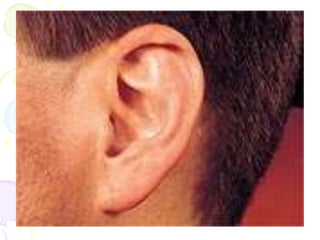
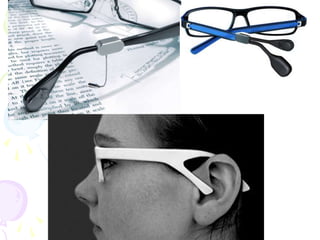
Spectacle type
• The hearing aid components are
incorporated within a spectacle
frame.
• It is useful for those who use glasses
along with hearing aids.
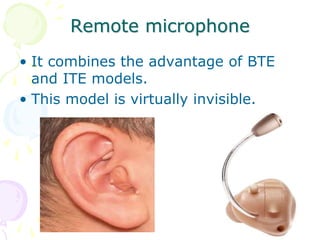
Remote microphone
• It combines the advantage of BTE
and ITE models.
• This model is virtually invisible.
Hearing aid problems
• Whistling Noise
– Loose ear mold
– Improperly made
– Improperly worn
– Worn out
• Improper Aid Selection
– Too much power required in aid
– Separation between microphone and receiver
– Open mold used inappropriately
• Inadequate Amplification
– Dead batteries
– Cerumen in ear
– Cerumen or other material in mold
– Wires or tubing disconnected from aid
– Aid turned off or volume too low
– Improper mold
– Improper aid for degree of loss
• Pain from Mold
– Improperly fitted mold
– Ear skin or cartilage infection
– Middle ear infection
– Ear tumor
– Unrelated conditions of the
temporomandibular joint, throat, or
larynx
Care and maintenance of Hearing Aid
• Prevent it from falling down
• Don’t spill liquids on the hearing aid.
• It must fit well.
• Cords should not be twisted or knotted.
• Protect it from dust, dirt and heat.
• Remove the battery from hearing aid when it is not
in use.
• Remember to detach the ear mould from the
receiver before washing the mould.
• Receiver should not come in contact with the
water.
• Do not expose the hearing aid to medicinal or hair
sprays
IMPLANTED HEARING
DEVICES
Three types
• Cochlear implant
• Bone conduction device
• Semi-implantable hearing device
1) Cochlear implants
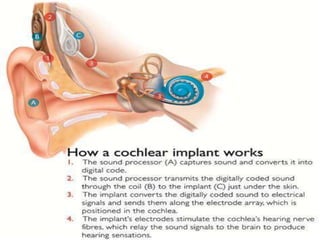
• A cochlear implant is an auditory
prosthesis used for people with profound
sensorineural hearing loss bilaterally who
do not benefit from conventional hearing
aids.
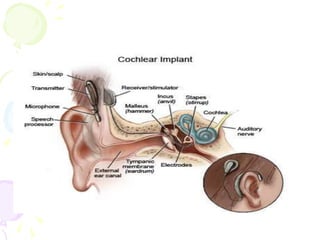
• Components- external
internal
 External component: consists of an external
speech processor and a transmitter.
 Internal component: it is surgically implanted
and comprises the receiver/stimulator package
with an electrode array.
• The implant provides stimulation directly
to the auditory nerve, bypassing the
nonfunctioning hair cells of the inner ear.
• The microphone and signal processor,
worn outside the body, transmit electrical
stimuli to the implanted electrodes.
• The electrical signals stimulate the
auditory nerve fibers and then the brain,
where they are interpreted.
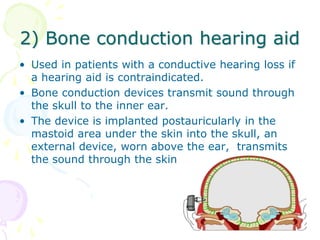
2) Bone conduction hearing aid
• Used in patients with a conductive hearing loss if
a hearing aid is contraindicated.
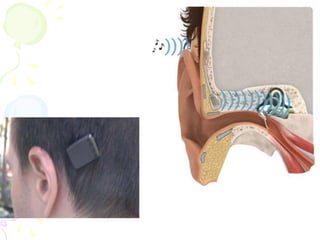
• Bone conduction devices transmit sound through
the skull to the inner ear.
• The device is implanted postauricularly in the
mastoid area under the skin into the skull, an
external device, worn above the ear, transmits
the sound through the skin
3) Semi-implantable hearing
device
• The middle ear implantation (MEI) is
implanted in the middle ear cavity which
mechanically vibrates the middle ear
structures.
• MEI is used for sensorineural hearing loss.

hearingaids-200811091717.pdf

  • 1.
    Hearing Aids & Implanted Hearing Devices Mr.Binu Babu M.Sc. Nursing Mrs. Jincy Ealias M.Sc. Nursing
  • 2.
  • 3.
    Definition • A hearingaid is an electronic, battery-operated device that amplifies and changes sound to allow for improved communication.
  • 4.
    Components of Hearing Aids •Microphone: Receives sound and converts it into electrical impulses. (picks up sound) • Amplifier: Intensifies electrical impulses. (makes sound louder) • Receiver: Translates those electrical impulses into louder sounds. (delivers amplified sound into ear-miniature loudspeaker) • Battery: Serves as power source for device. • Earmolds (earpieces) : Directs the flow of sound into the ear and enhance sound quality.
  • 6.
  • 7.
    Types of HearingAid • Pocket Model • Behind-the-Ear (BTE) • In-the-Ear (ITE) • In-the-Canal (ITC), Mini Canal (MIC) and Completely-in-Canal (CIC) aids • Spectacle type • Remote microphone (RM)
  • 8.
    Pocket model • Wornin pocket at chest level. • A cord transmits the electrical output to a receiver, which converts this signal into sound.
  • 9.
    Behind-the-Ear (BTE) • BTEhearing aids are worn behind the ear and are connected to a plastic ear mold that fits inside the outer ear. • The components are held in a case behind the ear. Sound travels from the aid through the ear mold into the ear.
  • 11.
    In-the-Ear (ITE) • ITEhearing aids fit completely in the outer ear and are used for mild to severe hearing loss. • ITE aids can be damaged by earwax and ear drainage, and their small size can cause adjustment problems and feedback.
  • 13.
    In-the-Canal (ITC) • ITChearing aids are customized to fit the size and shape of the ear canal and are used for mild or moderately severe hearing loss. • Small one-piece hearing aid • All components contained in a custom-fit, hard- molded plastic shell • Fits outside the ear canal • Slightly visible in the ear
  • 15.
    Completely-in-Canal (CIC) • CIChearing aids are mostly concealed in the ear canal and are used for mild to moderately severe hearing loss. • Because of their small size, canal aids may be difficult for the user to adjust and remove. • Canal aids can also be damaged by earwax and ear drainage. They are not recommended for children. • All components contained in a custom-fit, hard- molded plastic shell
  • 17.
    Spectacle type • Thehearing aid components are incorporated within a spectacle frame. • It is useful for those who use glasses along with hearing aids.
  • 19.
    Remote microphone • Itcombines the advantage of BTE and ITE models. • This model is virtually invisible.
  • 20.
    Hearing aid problems •Whistling Noise – Loose ear mold – Improperly made – Improperly worn – Worn out • Improper Aid Selection – Too much power required in aid – Separation between microphone and receiver – Open mold used inappropriately
  • 21.
    • Inadequate Amplification –Dead batteries – Cerumen in ear – Cerumen or other material in mold – Wires or tubing disconnected from aid – Aid turned off or volume too low – Improper mold – Improper aid for degree of loss
  • 22.
    • Pain fromMold – Improperly fitted mold – Ear skin or cartilage infection – Middle ear infection – Ear tumor – Unrelated conditions of the temporomandibular joint, throat, or larynx
  • 23.
    Care and maintenanceof Hearing Aid • Prevent it from falling down • Don’t spill liquids on the hearing aid. • It must fit well. • Cords should not be twisted or knotted. • Protect it from dust, dirt and heat. • Remove the battery from hearing aid when it is not in use. • Remember to detach the ear mould from the receiver before washing the mould. • Receiver should not come in contact with the water. • Do not expose the hearing aid to medicinal or hair sprays
  • 24.
  • 25.
    Three types • Cochlearimplant • Bone conduction device • Semi-implantable hearing device
  • 26.
    1) Cochlear implants •A cochlear implant is an auditory prosthesis used for people with profound sensorineural hearing loss bilaterally who do not benefit from conventional hearing aids.
  • 27.
    • Components- external internal External component: consists of an external speech processor and a transmitter.  Internal component: it is surgically implanted and comprises the receiver/stimulator package with an electrode array.
  • 28.
    • The implantprovides stimulation directly to the auditory nerve, bypassing the nonfunctioning hair cells of the inner ear. • The microphone and signal processor, worn outside the body, transmit electrical stimuli to the implanted electrodes. • The electrical signals stimulate the auditory nerve fibers and then the brain, where they are interpreted.
  • 31.
    2) Bone conductionhearing aid • Used in patients with a conductive hearing loss if a hearing aid is contraindicated. • Bone conduction devices transmit sound through the skull to the inner ear. • The device is implanted postauricularly in the mastoid area under the skin into the skull, an external device, worn above the ear, transmits the sound through the skin
  • 33.
    3) Semi-implantable hearing device •The middle ear implantation (MEI) is implanted in the middle ear cavity which mechanically vibrates the middle ear structures. • MEI is used for sensorineural hearing loss.