The Security Vulnerability
Assessment Process, Best
 Practices & Challenges
                  1


  Kellep A. Charles, CISA, CISSP


          www.SecurityOrb.com
Agenda
                             2

About Me
Topic Introduction
The Process
The Best Practices/Challenges
Conclusion


                      www.SecurityOrb.com
About Me
                                      3

Kellep Charles but you can call me K.C.
Government contractor in the DC area
Served as an adjunct professor
Doctoral Student
    Research area:
        Human Computer Interaction-Security HCI-Sec
        Honeypot & Artificial Neural Networks
Operate SecurityOrb.com


                               www.SecurityOrb.com
Introduction
                                      4

Security vulnerability assessments have become an
  imperative part of any organization’s computer and
  network security posture.

Many organizations consist of:
  Heterogeneous computing environments
         Windows, Mac OS X, Linux/Unix
     Multiple Applications
   Distributed computing
   Internet-enabled information access systems.


 The need to understand the state of an organization’s
  overall information system is ever more important now.
                               www.SecurityOrb.com
Introduction
                                     5

Best practices in information security acknowledge
    a defensive only approach to securing an enterprise does
     not suffice
    at times is considered inadequate.


Frequently these defensive security devices such as
 firewalls and intrusion detection systems (IDS)
    often not configured properly
    not capable of locating all the vulnerabilities and threats on
     the network, especially at the node level.

                              www.SecurityOrb.com
Introduction
                                6

Performing regular security vulnerability assessment
 helps bridge that gap

Allows an organization to take a proactive stance
 towards protecting their information computing
 environment.

The bottom line objective is to safeguard the core
 intellectual and electronic assets of the organization,
 and to ensure compliance with appropriate
 regulations
                         www.SecurityOrb.com
Why Is It So Vital?
                                   7

Most Systems are unpatched
    Lazy, overworked or misinformed system administrators
Most compromises are from unpatched systems with
 patches or work around available
Some systems cannot be patched (allow for alternate
 defense)
Proactive and offensive posture towards security
Compliance


                            www.SecurityOrb.com
Assessment Levels
                                    8

 Basic Security Assessment - The objective for this assessment
  is to give the responsible party a basic understanding of the
  security of the business as a whole in three key areas:
  Administrative, Physical and Technical Safeguards. It is
  meant to point out possible areas of weakness with a walk
  through of the facility and a Q&A session. It is not an in-depth
  study, rather, a basic first step in protecting information.

 In-depth Security Assessment - This is a comprehensive study
  of the security of your business. We will analyze all policies
  and procedures, router access lists, Firewall configurations
  and policies, PC and server configurations, complete Website
  review, complete mail server review. We will then present the
  client with a written report of our findings. This type of
  assessment will give you a thorough understanding of how
  your company measures up to "Industry Best Practices".
                             www.SecurityOrb.com
Assessment Levels
                                   9


External Vulnerability Testing - We will test your network
from the outside from a "hacker's point-of-view". We will use
the same tools criminals use to try and compromise your
network and servers.

Internal Vulnerability Testing - These are the same tools
used in the External test. This type of assessment is essential
in understanding how and why hackers, viruses and worms
spread so quickly through an organization.


                            www.SecurityOrb.com
Assessment Process
                                        10
   To effectively conduct a security assessment so it is beneficial to an
    organization
     a proven methodology must be followed so the assessors and
      assesses are on the same page.

 Using a proven security assessment methodology supplies a
    blueprint of events from start-to-finish that can be examined,
    tracked and replicated.

 Reports that are constructed from the security assessments are used
    to provide a snap shot view of information system deficiencies for
    short-term analysis as well as trending data for long-term evaluation

 Allowing the organization to understand their vulnerabilities so they
    can better protect themselves from current and future threats.

                                  www.SecurityOrb.com
Security Assessment Process
                                    11

The process includes the following 6 phases
    Pre Security Assessment Process
    Security Assessment In-Brief
    Security Assessment Field Work
    Security Assessment Report Analysis & Preparation
    Security Assessment Out-Brief
    Post Security Assessment Process


                             www.SecurityOrb.com
Security Assessment Process
                                   12

Pre-Security Assessment Process


    The pre-security assessment process entails one of the most
     important aspects of conducting a security assessment.
     Obtaining an engagement letter grants the assessment
     team the authority to commence with the formal processes
     of creating documentation to support the security
     assessment, permission for the onsite visit and the overall
     authority to conduct the security assessment.


                            www.SecurityOrb.com
Security Assessment Process
                                     13

Security Assessment In-Brief


    Once the team has arrived at the assessment location, a
     security assessment in-brief is required. In the in-brief, both
     the security assessment team and the organizational staff
     members will introduce themselves and the roles they will have
     during the security assessment process.


                              www.SecurityOrb.com
Security Assessment Process
                                    14

Security Assessment Field Work (Scanning,
 Interview, Walk-Thru and Doc Review)

    Once the in brief has been review, discussed, completed and
     agreed upon, the security assessment fieldwork can
     commence. The security assessment field-work process consist
     of conducting vulnerability scans, facility walkthrough, manual
     system checks, staff interview and various document reviews.


                              www.SecurityOrb.com
Security Assessment Process
                                    15

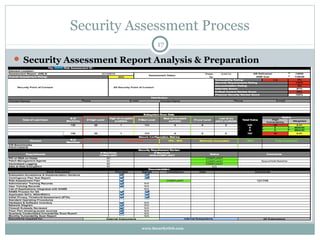
Security Assessment Report Analysis &
 Preparation

    Towards the end of the security assessment, once all of the
     security assessment fieldwork has been completed, the
     security assessment team will review and process the
     information in preparation of the final report. During this
     phase, the security assessment team will address any false
     positive, document any variances and findings that will be
     included in the final report.


                             www.SecurityOrb.com
Security Assessment Process
                        16

Security Assessment Report Analysis &
 Preparation


                  www.SecurityOrb.com
Security Assessment Process
                                 17

 Security Assessment Report Analysis & Preparation


                          www.SecurityOrb.com
Security Assessment Process
                                   18

Security Assessment Out-Brief

    The security assessment team will provide
     recommendations as well.

    Contact information will be on the out-brief.

    This process should be interactive were questions are
     taken through out the security assessment out-brief.

    At the end of the security assessment out-brief, both
     parties will have to sign the pages of the out-brief and
     discuss what will be occurring in the post security
     assessment process.
                             www.SecurityOrb.com
Security Assessment Process
                                       19

Security Assessment Out-Brief

    The security assessment team will provide recommendations as well.

    Contact information will be on the out-brief.

    This process should be interactive were questions are taken through
     out the security assessment out-brief.

    At the end of the security assessment out-brief, both parties will have
     to sign the pages of the out-brief and discuss what will be occurring
     in the post security assessment process.


                                 www.SecurityOrb.com
Security Assessment Process
                                  20

Post Security Assessment Process


    The post security assessment process is where the security
     assessment team securely files all documentation and
     electronic data pertaining to the organization in which the
     security assessment was conducted on.
    In addition, a team meeting with all members of the
     assessment team should be conducted to review and lessons
     learned to add any improvements or deficiencies to the
     process.


                            www.SecurityOrb.com
Vulnerability Assessment, Penetration Test &
                Security Audit
                                          21

 A vulnerability assessment is a practice used to identify all potential
   vulnerabilities that could be exploited in an environment.
    The assessment can be used to evaluate physical security, personnel (testing
     through social engineering and such), or system and network security.

 While a vulnerability assessment's goal is to identify all vulnerabilities in an
   environment, a penetration test has the goal of "breaking into the network."
    only needs to exploit one or two vulnerabilities to actually penetrate the
     environment.
    Penetration testing is also referred to as ethical hacking


 A security audit is basically someone going around with a criteria checklist of
   things that should be done or in place to ensure that the company is in
   compliance with its security policy, regulations and legal responsibilities.


www.SecurityOrb.com
Credential Scans vs Un-credential Scans
                                   22

Credentialed scanning allows for a much more
   accurate and thorough picture of the system.
      Mechanic and doctor example


Part of vulnerability scanning is to identify missing
   patches that leave a machine open to compromise.

 Test of a Windows 7 system
      The results speak for themselves: first scan without
       credentials, then with credentials – What do you think you will
       see?
www.SecurityOrb.com
Credential Scans vs Un-credential Scans
                                          23

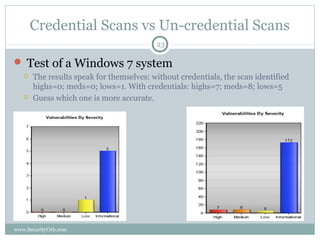
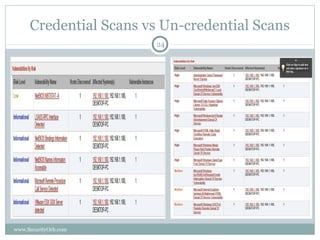
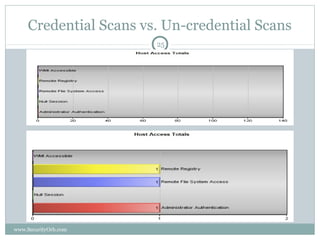
 Test of a Windows 7 system
      The results speak for themselves: without credentials, the scan identified
       highs=0; meds=0; lows=1. With credentials: highs=7; meds=8; lows=5
      Guess which one is more accurate.


www.SecurityOrb.com
Credential Scans vs Un-credential Scans
                        24


www.SecurityOrb.com
Credential Scans vs. Un-credential Scans
                        25


www.SecurityOrb.com
System Hardening
                                             26

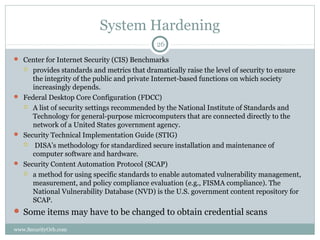
 Center for Internet Security (CIS) Benchmarks
    provides standards and metrics that dramatically raise the level of security to ensure
     the integrity of the public and private Internet-based functions on which society
     increasingly depends.
 Federal Desktop Core Configuration (FDCC)
   A list of security settings recommended by the National Institute of Standards and
     Technology for general-purpose microcomputers that are connected directly to the
     network of a United States government agency.
 Security Technical Implementation Guide (STIG)
   DISA’s methodology for standardized secure installation and maintenance of
     computer software and hardware.
 Security Content Automation Protocol (SCAP)
   a method for using specific standards to enable automated vulnerability management,
     measurement, and policy compliance evaluation (e.g., FISMA compliance). The
     National Vulnerability Database (NVD) is the U.S. government content repository for
     SCAP.
 Some items may have to be changed to obtain credential scans

www.SecurityOrb.com
Vulnerability Management
                                 27

 The repeated practice of identifying, classifying, remediating, and
  mitigating
 Prioritize
 Mitigate Vulnerabilities - Ultimately, the root causes of
  vulnerabilities must be addressed. This is often done via patching
  vulnerable services, changing vulnerable configurations or
  making application updates to remove vulnerable code.
 Maintain and Monitor - Organizations' computing
  environments are dynamic and evolve over time, vulnerability
  management is an ongoing process rather than a point-in-time
  event.


www.SecurityOrb.com
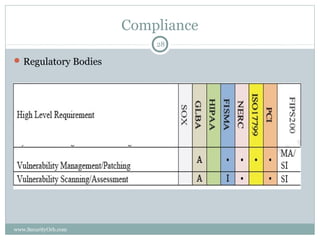
Compliance
                          28

 Regulatory Bodies


www.SecurityOrb.com
Other Things to Consider
                                 29

Virtualization
Cloud Computing
Politics
Reoccurring Scans
Distributed Scanning
Patch Management
Penetration Testing


www.SecurityOrb.com
What Vulnerability Scanning Can’t Do
                         30

Find Zero-Days and malware
Eliminates the most obvious and known security
 threats.
Can’t Patch
Determine the difference between False
 Positive/Negative


www.SecurityOrb.com
Conclusion

The art of defending an organizational network takes
 many approaches to be done successfully.
No one control can assure that the network is safe.
 Firewalls are great for prevention, IDS offer the
 ability for detection, Security Awareness briefing
 provides for user knowledge and Security
 Assessments assist with a proactive posture towards
 security.
It also helps prove you've done "due diligence" in
 performing basic system patches and fixing the well-
 known problems in case a security breach causes
 financial, legal or regulatory problems.
32


   Thank You…
@kellepc           @securityorb


           www.SecurityOrb.com

The Security Vulnerability Assessment Process & Best Practices

  • 1.
    The Security Vulnerability AssessmentProcess, Best Practices & Challenges 1 Kellep A. Charles, CISA, CISSP www.SecurityOrb.com
  • 2.
    Agenda 2 About Me Topic Introduction The Process The Best Practices/Challenges Conclusion www.SecurityOrb.com
  • 3.
    About Me 3 Kellep Charles but you can call me K.C. Government contractor in the DC area Served as an adjunct professor Doctoral Student  Research area:  Human Computer Interaction-Security HCI-Sec  Honeypot & Artificial Neural Networks Operate SecurityOrb.com www.SecurityOrb.com
  • 4.
    Introduction 4 Security vulnerability assessments have become an imperative part of any organization’s computer and network security posture. Many organizations consist of:  Heterogeneous computing environments  Windows, Mac OS X, Linux/Unix  Multiple Applications  Distributed computing  Internet-enabled information access systems.  The need to understand the state of an organization’s overall information system is ever more important now. www.SecurityOrb.com
  • 5.
    Introduction 5 Best practices in information security acknowledge  a defensive only approach to securing an enterprise does not suffice  at times is considered inadequate. Frequently these defensive security devices such as firewalls and intrusion detection systems (IDS)  often not configured properly  not capable of locating all the vulnerabilities and threats on the network, especially at the node level. www.SecurityOrb.com
  • 6.
    Introduction 6 Performing regular security vulnerability assessment helps bridge that gap Allows an organization to take a proactive stance towards protecting their information computing environment. The bottom line objective is to safeguard the core intellectual and electronic assets of the organization, and to ensure compliance with appropriate regulations www.SecurityOrb.com
  • 7.
    Why Is ItSo Vital? 7 Most Systems are unpatched  Lazy, overworked or misinformed system administrators Most compromises are from unpatched systems with patches or work around available Some systems cannot be patched (allow for alternate defense) Proactive and offensive posture towards security Compliance www.SecurityOrb.com
  • 8.
    Assessment Levels 8  Basic Security Assessment - The objective for this assessment is to give the responsible party a basic understanding of the security of the business as a whole in three key areas: Administrative, Physical and Technical Safeguards. It is meant to point out possible areas of weakness with a walk through of the facility and a Q&A session. It is not an in-depth study, rather, a basic first step in protecting information.  In-depth Security Assessment - This is a comprehensive study of the security of your business. We will analyze all policies and procedures, router access lists, Firewall configurations and policies, PC and server configurations, complete Website review, complete mail server review. We will then present the client with a written report of our findings. This type of assessment will give you a thorough understanding of how your company measures up to "Industry Best Practices". www.SecurityOrb.com
  • 9.
    Assessment Levels 9 External Vulnerability Testing - We will test your network from the outside from a "hacker's point-of-view". We will use the same tools criminals use to try and compromise your network and servers. Internal Vulnerability Testing - These are the same tools used in the External test. This type of assessment is essential in understanding how and why hackers, viruses and worms spread so quickly through an organization. www.SecurityOrb.com
  • 10.
    Assessment Process 10  To effectively conduct a security assessment so it is beneficial to an organization  a proven methodology must be followed so the assessors and assesses are on the same page.  Using a proven security assessment methodology supplies a blueprint of events from start-to-finish that can be examined, tracked and replicated.  Reports that are constructed from the security assessments are used to provide a snap shot view of information system deficiencies for short-term analysis as well as trending data for long-term evaluation  Allowing the organization to understand their vulnerabilities so they can better protect themselves from current and future threats. www.SecurityOrb.com
  • 11.
    Security Assessment Process 11 The process includes the following 6 phases  Pre Security Assessment Process  Security Assessment In-Brief  Security Assessment Field Work  Security Assessment Report Analysis & Preparation  Security Assessment Out-Brief  Post Security Assessment Process www.SecurityOrb.com
  • 12.
    Security Assessment Process 12 Pre-Security Assessment Process  The pre-security assessment process entails one of the most important aspects of conducting a security assessment. Obtaining an engagement letter grants the assessment team the authority to commence with the formal processes of creating documentation to support the security assessment, permission for the onsite visit and the overall authority to conduct the security assessment. www.SecurityOrb.com
  • 13.
    Security Assessment Process 13 Security Assessment In-Brief  Once the team has arrived at the assessment location, a security assessment in-brief is required. In the in-brief, both the security assessment team and the organizational staff members will introduce themselves and the roles they will have during the security assessment process. www.SecurityOrb.com
  • 14.
    Security Assessment Process 14 Security Assessment Field Work (Scanning, Interview, Walk-Thru and Doc Review)  Once the in brief has been review, discussed, completed and agreed upon, the security assessment fieldwork can commence. The security assessment field-work process consist of conducting vulnerability scans, facility walkthrough, manual system checks, staff interview and various document reviews. www.SecurityOrb.com
  • 15.
    Security Assessment Process 15 Security Assessment Report Analysis & Preparation  Towards the end of the security assessment, once all of the security assessment fieldwork has been completed, the security assessment team will review and process the information in preparation of the final report. During this phase, the security assessment team will address any false positive, document any variances and findings that will be included in the final report. www.SecurityOrb.com
  • 16.
    Security Assessment Process 16 Security Assessment Report Analysis & Preparation www.SecurityOrb.com
  • 17.
    Security Assessment Process 17  Security Assessment Report Analysis & Preparation www.SecurityOrb.com
  • 18.
    Security Assessment Process 18 Security Assessment Out-Brief  The security assessment team will provide recommendations as well.  Contact information will be on the out-brief.  This process should be interactive were questions are taken through out the security assessment out-brief.  At the end of the security assessment out-brief, both parties will have to sign the pages of the out-brief and discuss what will be occurring in the post security assessment process. www.SecurityOrb.com
  • 19.
    Security Assessment Process 19 Security Assessment Out-Brief  The security assessment team will provide recommendations as well.  Contact information will be on the out-brief.  This process should be interactive were questions are taken through out the security assessment out-brief.  At the end of the security assessment out-brief, both parties will have to sign the pages of the out-brief and discuss what will be occurring in the post security assessment process. www.SecurityOrb.com
  • 20.
    Security Assessment Process 20 Post Security Assessment Process  The post security assessment process is where the security assessment team securely files all documentation and electronic data pertaining to the organization in which the security assessment was conducted on.  In addition, a team meeting with all members of the assessment team should be conducted to review and lessons learned to add any improvements or deficiencies to the process. www.SecurityOrb.com
  • 21.
    Vulnerability Assessment, PenetrationTest & Security Audit 21  A vulnerability assessment is a practice used to identify all potential vulnerabilities that could be exploited in an environment.  The assessment can be used to evaluate physical security, personnel (testing through social engineering and such), or system and network security.  While a vulnerability assessment's goal is to identify all vulnerabilities in an environment, a penetration test has the goal of "breaking into the network."  only needs to exploit one or two vulnerabilities to actually penetrate the environment.  Penetration testing is also referred to as ethical hacking  A security audit is basically someone going around with a criteria checklist of things that should be done or in place to ensure that the company is in compliance with its security policy, regulations and legal responsibilities. www.SecurityOrb.com
  • 22.
    Credential Scans vsUn-credential Scans 22 Credentialed scanning allows for a much more accurate and thorough picture of the system.  Mechanic and doctor example Part of vulnerability scanning is to identify missing patches that leave a machine open to compromise.  Test of a Windows 7 system  The results speak for themselves: first scan without credentials, then with credentials – What do you think you will see? www.SecurityOrb.com
  • 23.
    Credential Scans vsUn-credential Scans 23  Test of a Windows 7 system  The results speak for themselves: without credentials, the scan identified highs=0; meds=0; lows=1. With credentials: highs=7; meds=8; lows=5  Guess which one is more accurate. www.SecurityOrb.com
  • 24.
    Credential Scans vsUn-credential Scans 24 www.SecurityOrb.com
  • 25.
    Credential Scans vs.Un-credential Scans 25 www.SecurityOrb.com
  • 26.
    System Hardening 26  Center for Internet Security (CIS) Benchmarks  provides standards and metrics that dramatically raise the level of security to ensure the integrity of the public and private Internet-based functions on which society increasingly depends.  Federal Desktop Core Configuration (FDCC)  A list of security settings recommended by the National Institute of Standards and Technology for general-purpose microcomputers that are connected directly to the network of a United States government agency.  Security Technical Implementation Guide (STIG)  DISA’s methodology for standardized secure installation and maintenance of computer software and hardware.  Security Content Automation Protocol (SCAP)  a method for using specific standards to enable automated vulnerability management, measurement, and policy compliance evaluation (e.g., FISMA compliance). The National Vulnerability Database (NVD) is the U.S. government content repository for SCAP.  Some items may have to be changed to obtain credential scans www.SecurityOrb.com
  • 27.
    Vulnerability Management 27  The repeated practice of identifying, classifying, remediating, and mitigating  Prioritize  Mitigate Vulnerabilities - Ultimately, the root causes of vulnerabilities must be addressed. This is often done via patching vulnerable services, changing vulnerable configurations or making application updates to remove vulnerable code.  Maintain and Monitor - Organizations' computing environments are dynamic and evolve over time, vulnerability management is an ongoing process rather than a point-in-time event. www.SecurityOrb.com
  • 28.
    Compliance 28  Regulatory Bodies www.SecurityOrb.com
  • 29.
    Other Things toConsider 29 Virtualization Cloud Computing Politics Reoccurring Scans Distributed Scanning Patch Management Penetration Testing www.SecurityOrb.com
  • 30.
    What Vulnerability ScanningCan’t Do 30 Find Zero-Days and malware Eliminates the most obvious and known security threats. Can’t Patch Determine the difference between False Positive/Negative www.SecurityOrb.com
  • 31.
    Conclusion The art ofdefending an organizational network takes many approaches to be done successfully. No one control can assure that the network is safe. Firewalls are great for prevention, IDS offer the ability for detection, Security Awareness briefing provides for user knowledge and Security Assessments assist with a proactive posture towards security. It also helps prove you've done "due diligence" in performing basic system patches and fixing the well- known problems in case a security breach causes financial, legal or regulatory problems.
  • 32.
    32 Thank You… @kellepc @securityorb www.SecurityOrb.com