MICROSOFT CASE STUDY
 Introduction
 How it all Started
 History And Development
 Vision And Mission
 SWOT Analysis
 Porters Five Force Analysis.
 Capabilities And Core Competencies
 Corporate And Business Level Strategy
 Percentage of people Using Windows
 Conclusion
CONTENTS
 It is an American Multi-National Technology Company and it
has a Brand value of nearly $61.2 Billion.
 Headquartered at Redmond , Washington.
 Best Software Products are Windows Line of Operating
Systems.
 Its flagship hardware products are the Xbox Video Game
Consoles and the Microsoft Surface tablet line up.
INTRODUCTION
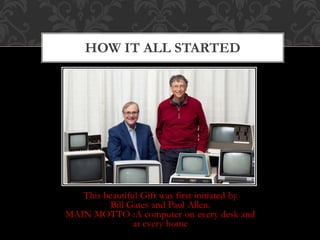
This beautiful Gift was first initiated by
Bill Gates and Paul Allen.
MAIN MOTTO :A computer on every desk and
at every home
HOW IT ALL STARTED
HISTORY AND DEVELOPMENT
1975 :Initiation.
1980 :Developed DOS for IBM Computers.
1986 :Went into public and had tremendous growth later on.
1990 :Launched Windows 3.0.(with file and program manager).
1998 :Launched Windows 98 with a slogan
“Where do you want to go Today?”
2000 :Windows 2000 followed by Windows XP and Xbox in 2001.
2007 :Vista Operating System.
2009 :Windows 7 and in 2011 it entered into Mobile Industry.
2012 :Windows 8.
2015 : Came up with Windows 10.
All Major Products Launched by Microsoft
ALL PRODUCTS OF MICROSOFT
Microsoft’s Vision Statement
Microsoft Corporation’s vision statement is
“to help individuals and businesses realize their full potential.”
Microsoft’s Mission Statement
Microsoft Corporation’s mission statement is
“to empower every person and every organization on the planet to
achieve more.”
VISION AND MISSION
SWOT ANALYSIS
Strengths :1) Market leader in Client operating system.
2)Large Clientele.
3)Stable Profits.
Weaknesses :1)Windows 8 Negative User Response.
2)Lack of mobile market share.
3)Customer dissatisfaction for mobiles.
Opportunities : 1)Nokia Accusation
2)Expanding Mobile Device Market
3)Promotion of Sky drive for storage.
Threats : 1)Google Drive and other MS office competitors
2)Threat of Linux and Mac OS.
PORTERS FIVE FORCE ANALYSIS
 Tangible Resources
 Intangible Resources
 Human Resources
CAPABILITIES AND CORE COMPETENCIES
 Cash Reserves : Approximately $90.2 Billion in cash reserves.
 Operating Revenue : Approximately $93.58 Billion.
 Ranks #25 in the Fortune 500 list.
 Cash , Cash Equivalents , short term investments is about $
113.240 Billions .
 Total Assets of $193.694 Billions.
TANGIBLE RESOURCES
MICROSOFT REVENUE
 Technology Based : $5.97 Billions
 Marketing related : $ 1.869 Billions
 Gross Carrying Amount : $9.1 Billions
 Net Carrying Amount : $3.73 Billions
 Intangible Assets and Goodwill : $21.605 Billions
INTANGIBLE RESOURCES
 Microsoft's success is based on the effectiveness of their
employees.
 Attract and Retain the best talent in the Information
Technology Business
 Educated , Dedicated and committed employees.
HUMAN RESOURCES
 Financial Control.
 Capacity for Decision Making.
 Continuous Improvements .
 Brand Management .
 Engineering and technical know-how.
 Research Capability.
 Ability to identify and respond to market trends and adapts.
CAPABILITIES
 Longstanding commitment and leadership in developing
innovative accessibility solutions.
 Making the computer easier to see, hear, and use by
building accessibility into Microsoft products and services.
 Promoting innovation of accessibility in the development
community and working with industry organizations to
encourage innovation.
 accessibility in meeting the technology needs of people with
disabilities.
STRATEGIES
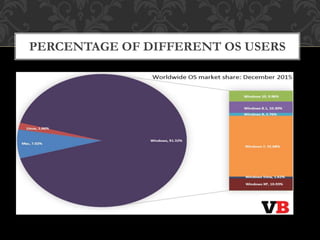
PERCENTAGE OF DIFFERENT OS USERS
WORLD WIDE PRESENCE OF MICROSOFT
Microsoft Tops 2015 Enterprises ListWindows is still used over 70 % population
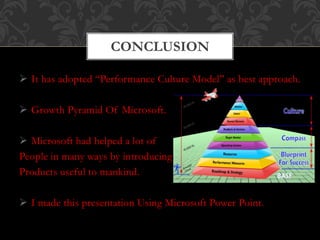
 It has adopted “Performance Culture Model” as best approach.
 Growth Pyramid Of Microsoft.
 Microsoft had helped a lot of
People in many ways by introducing
Products useful to mankind.
 I made this presentation Using Microsoft Power Point.
CONCLUSION
1. Evaluate Microsoft’s product and marketing evolution over the
years. What has the company done well, and where did it falter?
Ans ) Good Times : 1) Microsoft launched the DOS operating system for IBM
computers in early 1980’s.
2) went public in 1986 and launched Window 3.0
3) In the 1998, the new slogan Microsoft made helped promote its brand
4) During the mid-1990s, Microsoft launched Internet Explorer to compete
Netscape, which Microsoft become the winner of “browser wars”.
Falter Times: 1)In mid 1990’s, Microsoft faced antitrust charges and lawsuits
because of its marketing method.
2) During the next few years, Microsoft didn’t release new operating system
when the customers need it. On the contrary, Mac seized the opportunity to
make a successful marketing campaign that gained lot of customers.
QUESTIONS ON CASE STUDY
2) Evaluate Microsoft’s recent expansions into areas such as
search engines and smart phones. Do you think these are good
areas of growth for Microsoft? Why or why not?
Ans) 1) Nowadays, with the technology development and the popular with
smartphone, the decision to expand into search engines and smartphones
should be very sensible.
2) The new improvement of Windows 8, Windows 8 phone, and Surface
Tablet impressed consumers with a detachable keyboard.
3) This not only connects with the development of smartphone, but also
keeps communication with its consumers, which is the right way to keep
activity in the market.
DISCLAIMER
Created by Bikumalla . Prudhvi Raj ,NIT GOA during a Marketing Internship ,by
Prof . Sameer Mathur ,IIM Lucknow.

Microsoft case study

  • 1.
  • 2.
     Introduction  Howit all Started  History And Development  Vision And Mission  SWOT Analysis  Porters Five Force Analysis.  Capabilities And Core Competencies  Corporate And Business Level Strategy  Percentage of people Using Windows  Conclusion CONTENTS
  • 3.
     It isan American Multi-National Technology Company and it has a Brand value of nearly $61.2 Billion.  Headquartered at Redmond , Washington.  Best Software Products are Windows Line of Operating Systems.  Its flagship hardware products are the Xbox Video Game Consoles and the Microsoft Surface tablet line up. INTRODUCTION
  • 4.
    This beautiful Giftwas first initiated by Bill Gates and Paul Allen. MAIN MOTTO :A computer on every desk and at every home HOW IT ALL STARTED
  • 5.
    HISTORY AND DEVELOPMENT 1975:Initiation. 1980 :Developed DOS for IBM Computers. 1986 :Went into public and had tremendous growth later on. 1990 :Launched Windows 3.0.(with file and program manager). 1998 :Launched Windows 98 with a slogan “Where do you want to go Today?” 2000 :Windows 2000 followed by Windows XP and Xbox in 2001. 2007 :Vista Operating System. 2009 :Windows 7 and in 2011 it entered into Mobile Industry. 2012 :Windows 8. 2015 : Came up with Windows 10.
  • 6.
    All Major ProductsLaunched by Microsoft ALL PRODUCTS OF MICROSOFT
  • 7.
    Microsoft’s Vision Statement MicrosoftCorporation’s vision statement is “to help individuals and businesses realize their full potential.” Microsoft’s Mission Statement Microsoft Corporation’s mission statement is “to empower every person and every organization on the planet to achieve more.” VISION AND MISSION
  • 8.
    SWOT ANALYSIS Strengths :1)Market leader in Client operating system. 2)Large Clientele. 3)Stable Profits. Weaknesses :1)Windows 8 Negative User Response. 2)Lack of mobile market share. 3)Customer dissatisfaction for mobiles. Opportunities : 1)Nokia Accusation 2)Expanding Mobile Device Market 3)Promotion of Sky drive for storage. Threats : 1)Google Drive and other MS office competitors 2)Threat of Linux and Mac OS.
  • 9.
  • 10.
     Tangible Resources Intangible Resources  Human Resources CAPABILITIES AND CORE COMPETENCIES
  • 11.
     Cash Reserves: Approximately $90.2 Billion in cash reserves.  Operating Revenue : Approximately $93.58 Billion.  Ranks #25 in the Fortune 500 list.  Cash , Cash Equivalents , short term investments is about $ 113.240 Billions .  Total Assets of $193.694 Billions. TANGIBLE RESOURCES
  • 12.
  • 13.
     Technology Based: $5.97 Billions  Marketing related : $ 1.869 Billions  Gross Carrying Amount : $9.1 Billions  Net Carrying Amount : $3.73 Billions  Intangible Assets and Goodwill : $21.605 Billions INTANGIBLE RESOURCES
  • 14.
     Microsoft's successis based on the effectiveness of their employees.  Attract and Retain the best talent in the Information Technology Business  Educated , Dedicated and committed employees. HUMAN RESOURCES
  • 15.
     Financial Control. Capacity for Decision Making.  Continuous Improvements .  Brand Management .  Engineering and technical know-how.  Research Capability.  Ability to identify and respond to market trends and adapts. CAPABILITIES
  • 16.
     Longstanding commitmentand leadership in developing innovative accessibility solutions.  Making the computer easier to see, hear, and use by building accessibility into Microsoft products and services.  Promoting innovation of accessibility in the development community and working with industry organizations to encourage innovation.  accessibility in meeting the technology needs of people with disabilities. STRATEGIES
  • 17.
  • 18.
    WORLD WIDE PRESENCEOF MICROSOFT Microsoft Tops 2015 Enterprises ListWindows is still used over 70 % population
  • 19.
     It hasadopted “Performance Culture Model” as best approach.  Growth Pyramid Of Microsoft.  Microsoft had helped a lot of People in many ways by introducing Products useful to mankind.  I made this presentation Using Microsoft Power Point. CONCLUSION
  • 20.
    1. Evaluate Microsoft’sproduct and marketing evolution over the years. What has the company done well, and where did it falter? Ans ) Good Times : 1) Microsoft launched the DOS operating system for IBM computers in early 1980’s. 2) went public in 1986 and launched Window 3.0 3) In the 1998, the new slogan Microsoft made helped promote its brand 4) During the mid-1990s, Microsoft launched Internet Explorer to compete Netscape, which Microsoft become the winner of “browser wars”. Falter Times: 1)In mid 1990’s, Microsoft faced antitrust charges and lawsuits because of its marketing method. 2) During the next few years, Microsoft didn’t release new operating system when the customers need it. On the contrary, Mac seized the opportunity to make a successful marketing campaign that gained lot of customers. QUESTIONS ON CASE STUDY
  • 21.
    2) Evaluate Microsoft’srecent expansions into areas such as search engines and smart phones. Do you think these are good areas of growth for Microsoft? Why or why not? Ans) 1) Nowadays, with the technology development and the popular with smartphone, the decision to expand into search engines and smartphones should be very sensible. 2) The new improvement of Windows 8, Windows 8 phone, and Surface Tablet impressed consumers with a detachable keyboard. 3) This not only connects with the development of smartphone, but also keeps communication with its consumers, which is the right way to keep activity in the market.
  • 22.
    DISCLAIMER Created by Bikumalla. Prudhvi Raj ,NIT GOA during a Marketing Internship ,by Prof . Sameer Mathur ,IIM Lucknow.