Group 7
Jyoti - B 22
Simila - B47
Sonal – B48
Thomas - B 53
Sreeparna - B 49
Sumit - B50
Established on April 4, 1975
American Public Multinational Corporation
Headquarters in Edmond, Washington, USA
Continue….
"Our vision is to create innovative technology that is accessible to everyone
and that adapts to each person's needs. Accessible technology eliminates
barriers for people with disabilities and it enables individuals to take full
advantage of their capabilities."
Vision Statement
At Microsoft, our mission and values are to help people and businesses
through out the world realize their full potential
Mission Statement
1. The market is forecast to reach an estimated US $1,147 billion in 2017 with a
CAGR of more than 5% during 2012–2017.
2. Industry comprises services related to the application of business and technical
expertise to enable organizations to create, manage, optimize, and access
information and business processes.
3. The industry's scope includes product support services such as hardware and
software maintenance and professional services such as IT consulting,
development, and integration services
4. North America has 42% of the global market share.
5. Outsourcing locations such as India, China, Vietnam, and the Philippines are
anticipated to be key drivers because of their low-cost labor and skilled talent
pools
6. Industry moving from PC /Laptop to Mobile and Tablets
1. Microsoft has sold more than 67 million Xbox 360 consoles across 38 countries.
2. Globally, Gaming console (XBOX) has sold as many as 19 million sensors worldwide since its
launch
3. Global analysts, Gartner have forecast that by 2015, Windows Phone will be among the top 3
Smartphone OS platforms worldwide.
4. Microsoft currently sells seven Windows 7 licenses per second.
5. Windows 7 has sold over 600 Million licenses till date
6. Microsoft's new site for the Xbox One confirms that Achievements will stretch across your
games
7. Leader in PC operating systems and Business Productivity Software
8. MCI work with 1.2 million developers, over 1000 Independent Software Vendors and more
than 2000 System Integrators in India.
9. 95% of the enterprise workforce in India uses the Microsoft platform to create, contribute
and innovate.
INCOME STAT
(In millions, except per share amounts)      
Year Ended June 30, 2013 2012 2011
Revenue
$ 77,849
$  73,723
 
$  69,943
 
Cost of revenue 20,249 17,530 15,577
Gross profit 57,600 56,193 54,366
Operating expenses:
Research and development 10,411 9,811 9,043
Sales and marketing 15,276 13,857 13,940
General and administrative 5,149 4,569 4,222
Goodwill impairment 0 6,193 0
Total operating expenses 30,836 34,430 27,205
Operating income 26,764 21,763 27,161
Other income 288 504 910
Income before income taxes 27,052 22,267 28,071
Provision for income taxes 5,189 5,289 4,921
Net income $21,863 $16,978 $23,150 
(In millions)
June 30, 2013 2012
Assets
Current assets:
Cash and cash equivalents $ 3,804 $ 6,938
Short-term investments (including securities loaned of $579 and $785) 73,218 56,102
Total cash, cash equivalents, and short-term investments 77,022 63,040
Accounts receivable, net of allowance for doubtful accounts of $336 and $389 17,486 15,780
Inventories 1,938 1,137
Deferred income taxes 1,632 2,035
Other 3,388 3,092
Total current assets 101,466 85,084
Property and equipment, net of accumulated depreciation of $12,513 and $10,962 9,991 8,269
Equity and other investments 10,844 9,776
Goodwill 14,655 13,452
Intangible assets, net 3,083 3,170
Other long-term assets 2,392 1,520
Total assets $ 142,431 $ 121,271
Liabilities and stockholders’ equity
Current liabilities:
Accounts payable $ 4,828 $ 4,175
Current portion of long-term debt 2,999 1,231
Accrued compensation 4,117 3,875
Income taxes 592 789
Short-term unearned revenue 20,639 18,653
Securities lending payable 645 814
Other 3,597 3,151
Total current liabilities 37,417 32,688
Long-term debt 12,601 10,713
Long-term unearned revenue 1,760 1,406
Deferred income taxes 1,709 1,893
Other long-term liabilities 10,000 8,208
Total liabilities 63,487 54,908
Commitments and contingencies
Debt to Equity   0.27
Return on Invested Capital    25.93
Current Ratio  2.71
 Windows Division -  
  Windows operating system; 
  Windows Services suite of applications and web services, including Outlook.com and Sky 
Drive; 
 Surface RT and Pro devices
 PC accessories
 Server and Tools
 Windows Server operating systems; 
 Windows Azure; 
 Microsoft SQL Server;  Windows Embedded; 
 Visual Studio; System Center products;
  Microsoft Consulting Services; and Premier product support services
 Online Services Division 
 Bing; Bing Ads; and MSN
 Microsoft Business Division
     Microsoft Office
 Microsoft Exchange; Microsoft SharePoint; Microsoft Lync; Yammer; 
 Microsoft Office Project and Office Visio; Microsoft Dynamics ERP and Dynamics CRM; 
Microsoft Office 365
 Entertainment and Devices Division
    Xbox 360 gaming
   Windows Phone
   Skype
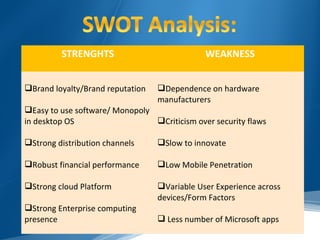
STRENGHTS WEAKNESS
Brand loyalty/Brand reputation
Easy to use software/ Monopoly
in desktop OS
Strong distribution channels
Robust financial performance
Strong cloud Platform
Strong Enterprise computing
presence
Dependence on hardware
manufacturers
Criticism over security flaws
Slow to innovate
Low Mobile Penetration
Variable User Experience across
devices/Form Factors
 Less number of Microsoft apps
OPPORTUNITIES
Cloud based services
Mobile /online advertising
Mobile device industry
Growth through acquisitions
Multiple Form Factors
THREAT
 Intense competition in
software products
 Changing consumer needs
and habits
 Open source projects
 Potential lawsuits
 Mature PC markets
• Low capital requirement
• Low setup cost
• Innovation driven industry
• Huge market potential
• Cloud platform
• No true substitutes for the IT industry
• Nothing can really replace all that computers
do for us as a society.
• Few key suppliers
• Increasing manufacturing base in China
• New manufacturers are looking for new
customers
• Strong existing relationships between current
suppliers and IT firms
• Huge number of buyers
• Customers control the IT industry
• huge choices to the buyer with low switching cost
• IT firms provide incentives to price sensitive buyers
• There are typically many interactions between buyers
and IT companies because of the need for training to
use products, constantly upgraded technology and an
abundance of advertising.
• This industry is known for rapid growth, effectiveness
and competition
• Large companies have economies of scale
• Well branded products
• Strong customer base
• legal and advertising battles are common among the
players
Continue…
THANK YOU

Microsoft

  • 1.
    Group 7 Jyoti -B 22 Simila - B47 Sonal – B48 Thomas - B 53 Sreeparna - B 49 Sumit - B50
  • 2.
    Established on April4, 1975 American Public Multinational Corporation Headquarters in Edmond, Washington, USA
  • 4.
  • 7.
    "Our vision isto create innovative technology that is accessible to everyone and that adapts to each person's needs. Accessible technology eliminates barriers for people with disabilities and it enables individuals to take full advantage of their capabilities." Vision Statement At Microsoft, our mission and values are to help people and businesses through out the world realize their full potential Mission Statement
  • 8.
    1. The marketis forecast to reach an estimated US $1,147 billion in 2017 with a CAGR of more than 5% during 2012–2017. 2. Industry comprises services related to the application of business and technical expertise to enable organizations to create, manage, optimize, and access information and business processes. 3. The industry's scope includes product support services such as hardware and software maintenance and professional services such as IT consulting, development, and integration services 4. North America has 42% of the global market share. 5. Outsourcing locations such as India, China, Vietnam, and the Philippines are anticipated to be key drivers because of their low-cost labor and skilled talent pools 6. Industry moving from PC /Laptop to Mobile and Tablets
  • 9.
    1. Microsoft hassold more than 67 million Xbox 360 consoles across 38 countries. 2. Globally, Gaming console (XBOX) has sold as many as 19 million sensors worldwide since its launch 3. Global analysts, Gartner have forecast that by 2015, Windows Phone will be among the top 3 Smartphone OS platforms worldwide. 4. Microsoft currently sells seven Windows 7 licenses per second. 5. Windows 7 has sold over 600 Million licenses till date 6. Microsoft's new site for the Xbox One confirms that Achievements will stretch across your games 7. Leader in PC operating systems and Business Productivity Software 8. MCI work with 1.2 million developers, over 1000 Independent Software Vendors and more than 2000 System Integrators in India. 9. 95% of the enterprise workforce in India uses the Microsoft platform to create, contribute and innovate.
  • 10.
    INCOME STAT (In millions,except per share amounts)       Year Ended June 30, 2013 2012 2011 Revenue $ 77,849 $  73,723   $  69,943   Cost of revenue 20,249 17,530 15,577 Gross profit 57,600 56,193 54,366 Operating expenses: Research and development 10,411 9,811 9,043 Sales and marketing 15,276 13,857 13,940 General and administrative 5,149 4,569 4,222 Goodwill impairment 0 6,193 0 Total operating expenses 30,836 34,430 27,205 Operating income 26,764 21,763 27,161 Other income 288 504 910 Income before income taxes 27,052 22,267 28,071 Provision for income taxes 5,189 5,289 4,921 Net income $21,863 $16,978 $23,150 
  • 11.
    (In millions) June 30,2013 2012 Assets Current assets: Cash and cash equivalents $ 3,804 $ 6,938 Short-term investments (including securities loaned of $579 and $785) 73,218 56,102 Total cash, cash equivalents, and short-term investments 77,022 63,040 Accounts receivable, net of allowance for doubtful accounts of $336 and $389 17,486 15,780 Inventories 1,938 1,137 Deferred income taxes 1,632 2,035 Other 3,388 3,092 Total current assets 101,466 85,084 Property and equipment, net of accumulated depreciation of $12,513 and $10,962 9,991 8,269 Equity and other investments 10,844 9,776 Goodwill 14,655 13,452 Intangible assets, net 3,083 3,170 Other long-term assets 2,392 1,520 Total assets $ 142,431 $ 121,271 Liabilities and stockholders’ equity Current liabilities: Accounts payable $ 4,828 $ 4,175 Current portion of long-term debt 2,999 1,231 Accrued compensation 4,117 3,875 Income taxes 592 789 Short-term unearned revenue 20,639 18,653 Securities lending payable 645 814 Other 3,597 3,151 Total current liabilities 37,417 32,688 Long-term debt 12,601 10,713 Long-term unearned revenue 1,760 1,406 Deferred income taxes 1,709 1,893 Other long-term liabilities 10,000 8,208 Total liabilities 63,487 54,908 Commitments and contingencies
  • 12.
  • 13.
     Windows Division -     Windows operating system;    Windows Services suite of applications and web services, including Outlook.com and Sky  Drive;  Surface RT and Pro devices  PC accessories  Server and Tools  Windows Server operating systems;   Windows Azure;   Microsoft SQL Server;  Windows Embedded;   Visual Studio; System Center products;   Microsoft Consulting Services; and Premier product support services  Online Services Division   Bing; Bing Ads; and MSN  Microsoft Business Division      Microsoft Office  Microsoft Exchange; Microsoft SharePoint; Microsoft Lync; Yammer;   Microsoft Office Project and Office Visio; Microsoft Dynamics ERP and Dynamics CRM;  Microsoft Office 365  Entertainment and Devices Division     Xbox 360 gaming    Windows Phone    Skype
  • 20.
    STRENGHTS WEAKNESS Brand loyalty/Brandreputation Easy to use software/ Monopoly in desktop OS Strong distribution channels Robust financial performance Strong cloud Platform Strong Enterprise computing presence Dependence on hardware manufacturers Criticism over security flaws Slow to innovate Low Mobile Penetration Variable User Experience across devices/Form Factors  Less number of Microsoft apps
  • 21.
    OPPORTUNITIES Cloud based services Mobile/online advertising Mobile device industry Growth through acquisitions Multiple Form Factors THREAT  Intense competition in software products  Changing consumer needs and habits  Open source projects  Potential lawsuits  Mature PC markets
  • 23.
    • Low capitalrequirement • Low setup cost • Innovation driven industry • Huge market potential • Cloud platform
  • 24.
    • No truesubstitutes for the IT industry • Nothing can really replace all that computers do for us as a society.
  • 25.
    • Few keysuppliers • Increasing manufacturing base in China • New manufacturers are looking for new customers • Strong existing relationships between current suppliers and IT firms
  • 26.
    • Huge numberof buyers • Customers control the IT industry • huge choices to the buyer with low switching cost • IT firms provide incentives to price sensitive buyers • There are typically many interactions between buyers and IT companies because of the need for training to use products, constantly upgraded technology and an abundance of advertising.
  • 27.
    • This industryis known for rapid growth, effectiveness and competition • Large companies have economies of scale • Well branded products • Strong customer base • legal and advertising battles are common among the players
  • 31.
  • 32.

Editor's Notes

  • #21 Brand loyalty. Over the years, Microsoft has been the leading OS and software provider, which resulted in more than 90% market share for PC OS. Most of us grew up using its easy to use OS, are familiar with it and will keep using it. Few other brands are capable to compete with Microsoft for this reason. Even open source OS, which are completely free and well suited to use for common user, find it hard to attract users Brand reputation. According to Interbrand, Microsoft’s brand is the 5th most valuable brand in the world, valued at $ 59 billion in 2013. Forbes listed the corporate as the 7th most reputable business in the world. Brand reputation leads to higher sales and greater market share Easy to use software. Windows OS and Office software products are so popular not just because Microsoft has great monopolistic power, strong distribution channels and good brand reputation but also because its products are of great quality and really easy to use Strong distribution channels. The company works with all the major computer hardware producers such as Lenovo, Dell, Toshiba and Samsung and major computer retailers to make sure computers would be sold with already pre-installed Windows software. The company also invested in Dell and Nokia to tighten its relationships with these companies Robust financial performance. Microsoft grew its revenues by 20% from 2008 to 2013 and holds more than $77 billion of cash and cash equivalents that can be used for acquisitions and substantial investments into R&D ###################################################################### Weakness: Poor acquisitions and investments. Few of Microsoft’s acquisitions were successful and brought not just revenues and products but new skills and competencies to the company. Massive, LinkExchange, WebTV, Danger are just few examples of multimillion acquisitions made by Microsoft but soon shut down or divested Dependence on hardware manufacturers. Microsoft is a giant software corporation but it does not produce its own hardware and depends on computer hardware manufacturers to develop products that run Windows OS. If cheap and popular alternative OS would appear, hardware manufacturers may simple choose the alternative and Microsoft could do little to change the situation Criticism over security flaws. Windows OS, the main Microsoft product has been heavily criticized for being so weak against various viruses’ attacks. Compared to other OS, Windows is the least protected against such attacks. Mature PC markets. Only recently has Microsoft entered the mobile technology sector and still heavily depends on its OS and software sales for standalone and laptop computers. The market for these products has matured and Microsoft will find it harder to grow revenues in these sectors. Slow to innovate. Microsoft has huge R&D resources and great position to enter new markets with innovative products but constantly failed to do so. It had an opportunity to be the first player in online advertising but missed the opportunity. It’s entrance to mobile OS was also too late, while Google and Apple captured the market share. ########################################################################
  • #22 Opportunities: Cloud based services. Microsoft could expand its range of cloud services and software as the demand for cloud-based services is expanding Mobile advertising. Mobile advertising markets are expected to grow in double digits over the next few years and Microsoft has a great opportunity to tap into these markets with its mobile OS Mobile device industry. Smartphones and tablets markets will grow steadily over the next few years and Microsoft could exploit this opportunity by introducing more of its own tablets and a new company phone Growth through acquisitions. With a huge reserve of cash Microsoft could start acquiring new startups that would bring new technology, skills and competences to the business ######################################################################## Threat: Intense competition in software products. Microsoft is more than ever on the pressure to introduce successful OS both in PC and mobile markets as such competitors like Google and Apple have already established positions Changing consumer needs and habits. Customers shift from buying laptops and standalone PCs to buying smartphones and tablets, the markets, where Microsoft has only a modest market share and may never establish itself Open source projects. Many new open source projects are coming to the market and some of them became quite successful, such as new Linux OS and Open Source Office. Open source projects are free and so they can become an alternative to expensive Microsoft’s products. Potential lawsuits. Microsoft has already been sued for many times and lost quite a few large scale lawsuits. Lawsuits are expensive as they require time and money. And as Microsoft continues to operate more or less the same way, there is high probability for more expensive lawsuits to come
  • #24 Threat of New Entrants: The IT industry is relatively attractive to newcomers because of its rapid growth and appealing customer base. At the same time, the industry is unattractive to newcomers because of the cost advantage large-scale incumbents possess, the significant amount of capital a new firm would need, and the major established brands already in the industry.  Any newcomer in this industry can expect a strong retaliation from existing players, which is a major reason this industry is not too attractive. The best way for a new entrant in this field to be successful would be if they had a brand new idea for a product or service; the lack of differentiation in the industry is one thing a newcomer could exploit. Overall, the IT industry isn't overly attractive, but it is routine and profitable enough that a lot of people try and enter it. Many new firms try to enter this industry, but they rarely give established names a real run for their money #########################################################################
  • #25 Threat from Substitutes: There is not much of a threat from substitutes to the IT industry, mostly because there aren't true substitutes. We live in a digital age, so we rely on IT to run our lives and businesses. An example of a substitute would be a scientific calculator, but to compare the two is a stretch. Nothing can really replace all that computers do for us as a society.
  • #26 Bargaining Power of Suppliers: Companies like Intel and AMD are a part of the IT industry, these companies are the key suppliers to the IT industry's firms. The inputs in this industry are pretty standard, with differences being speed, memory etc. Though the inputs are standard, new companies find it difficult (not impossible) to enter this industry as a supplier because of the existing relationships between current suppliers and IT firms, the ever changing and improving technologies of the world and the intense rivalry between existing players. IT firms are very important to suppliers because they are their primary customers, but I believe suppliers are even more important to buyers(IT firms). Suppliers are not "locked" into deals with specific firms (contracts exempt), but most of the relationships between the firms and suppliers in this industry are well established, and these suppliers would most likely not want to end their relationships with firms in the first place.
  • #27 Bargaining Power of Buyers: In an industry as massive as Information Technology, the term "buyers" refers to almost everyone in the world. While there are countries that are behind technologically, a majority of locations in the world have access to computers and the internet etc. Given the large number of buyers, it is safe to say that the customers control the IT industry. There are so many choices for a buyer (many firms in this industry) and there are minimal switching costs, so customers aren't typically "locked in" to one firm. Also, because a lot of IT sales come from companies that make large purchases, those companies are powerful and important to the IT firms (who often provide incentives to these businesses, in order to convince them to utilize their products over competitors). Customers are sensitive to price, but IT products and services are necessary to the success of businesses, so they are willing to spend a lot of money to get a good product. There are typically many interactions between buyers and IT companies because of the need for training to use products, constantly upgraded technology and an abundance of advertising.
  • #28 Rivalry Among Existing Players: The IT industry is known for its rapid growth, effectiveness and competition. A main reason why many new entrants are not successful is the intense rivalry between existing players. Large companies in this industry benefit from economies of scale, which is valuable and something they try very hard not to lose. Products in this industry are well branded and tend to have a strong customer base. Market share is unevenly distributed among existing players, who are often in various kinds of legal and advertising battles with one another.