Microsoft
case study
INDEX
1. FOUNDATION
2. TIMELINE
3. VISION AND MISSION
4. MICROSOFT BUSINESS SEGMENTS
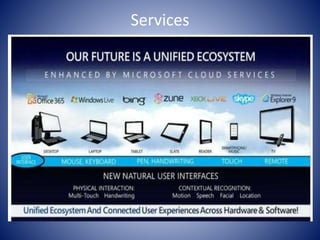
4. SERVICES
5.MARKETING STRATEGIES
6. CAPABILITIES AND CORE
COMPETENCIES
7.STRENGTHS,OPPERTUNITIES,WEAKNESS
ES AND THREATS
8. QUESTIONS
9. CONCLUSIONS
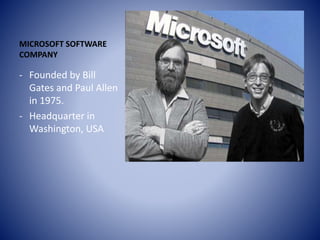
MICROSOFT SOFTWARE
COMPANY
- Founded by Bill
Gates and Paul Allen
in 1975.
- Headquarter in
Washington, USA
• 4 APRIL 1975- The very
beginning.
• 1984-1994 - Windows and
Office
• 1995-2005 – Internet and
the 32-bit era
• 2006-now – vista and cloud
computing
TIMELINE
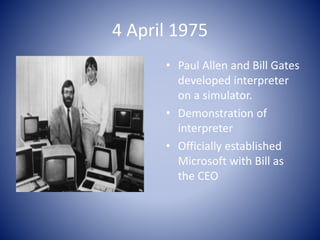
4 April 1975
• Paul Allen and Bill Gates
developed interpreter
on a simulator.
• Demonstration of
interpreter
• Officially established
Microsoft with Bill as
the CEO
1984-1994
• Introduction of new os with IBM
• Graphical extension for MS DOS
• Introduction of office suit in 1990
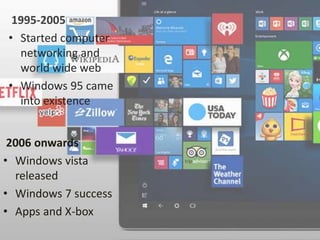
1995-2005
• Started computer
networking and
world wide web
• Windows 95 came
into existence
2006 onwards
• Windows vista
released
• Windows 7 success
• Apps and X-box
Vision and mission
• ”A computer on every desk, and in every home.”
• "Create experiences that combine the magic of software with the
power of Internet services Across a world of devices.“
• At Microsoft, our mission is to enable people and businesses
throughout the world to realize their full potential
• Our vision is to create innovative technology that is accessible to
everyone and that adapts to each person's needs. Accessible
technology eliminates barriers for people with disabilities and it
enables individuals to take full advantage of their capabilities."
—Bill Gates, Chairman, Microsoft Corporation
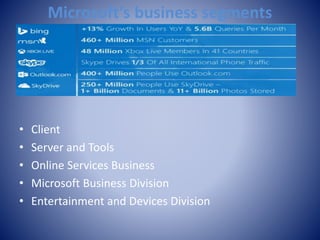
Microsoft’s business segments
• Client
• Server and Tools
• Online Services Business
• Microsoft Business Division
• Entertainment and Devices Division
Services
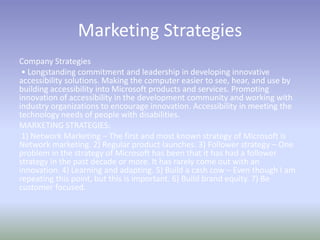
Marketing Strategies
Company Strategies
• Longstanding commitment and leadership in developing innovative
accessibility solutions. Making the computer easier to see, hear, and use by
building accessibility into Microsoft products and services. Promoting
innovation of accessibility in the development community and working with
industry organizations to encourage innovation. Accessibility in meeting the
technology needs of people with disabilities.
MARKETING STRATEGIES:
1) Network Marketing – The first and most known strategy of Microsoft is
Network marketing. 2) Regular product launches. 3) Follower strategy – One
problem in the strategy of Microsoft has been that it has had a follower
strategy in the past decade or more. It has rarely come out with an
innovation. 4) Learning and adapting. 5) Build a cash cow – Even though I am
repeating this point, but this is important. 6) Build brand equity. 7) Be
customer focused.
Capabilities and core competencies
 Tangible Resources
 Intangible Resources
 Human Resources
Tangible resources
Cash Reserves : Approximately $90.2 Billion in
cash reserves.
Operating Revenue : Approximately $93.58
Billion.
Ranks #25 in the Fortune 500 list.
 Cash , Cash Equivalents , short term
investments is about $ 113.240 Billions .
Total Assets of $193.694 Billions.
Intangible resources
Technology Based : $5.97 Billions
Marketing related : $ 1.869 Billions
Gross Carrying Amount : $9.1 Billions
Net Carrying Amount : $3.73 Billions
Intangible Assets and Goodwill : $21.605
Billions
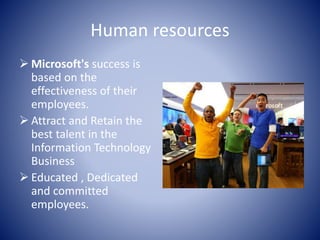
Human resources
 Microsoft's success is
based on the
effectiveness of their
employees.
 Attract and Retain the
best talent in the
Information Technology
Business
 Educated , Dedicated
and committed
employees.
Strengths, Opportunities, Weakness
and Threats !
• Strengths :
• 1) Leader of the market in Client operating system.
• 2)Large Clientele.
• 3)Stable Profits.
• Weaknesses :
• 1)Windows 8 Negative User Response.
• 2)Lack of mobile market share.
• 3)Customer dissatisfaction for mobiles.
Opportunities :
1)Nokia Accusation with the Lumia series
2)Expanding Mobile Device Market
3)Promotion of Sky drive for storage.
Threats :
1)Google Drive , icloud and other MS office
competitors
2)Threat of Linux and Mac OS
QUESTIONS ON CASE STUDY
Evaluate Microsoft’s product and marketing
evolution over the years. What has the
company done well, and where did it falter?
Ans
Good Times : 1) Microsoft launched the DOS
operating system for IBM computers in early
1980’s.
2) went public in 1986 and launched Window
3.0
3) In the 1998, the new slogan Microsoft made
helped promote its brand
4) During the mid-1990s, Microsoft launched
Internet Explorer to compete Netscape, which
Microsoft become the winner of “browser
wars”.
Falter Times: 1)In mid 1990’s, Microsoft faced
antitrust charges and lawsuits because of its
marketing method.
2) During the next few years, Microsoft didn’t
release new operating system when the
customers need it. On the contrary, Mac
seized the opportunity to make a successful
marketing campaign that gained lot of
customers.
Evaluate Microsoft’s recent expansions into
areas such as search engines and smart
phones. Do you think these are good areas of
growth for Microsoft? Why or why not?
Ans
1) Nowadays, with the technology
development and the popular with
smartphone, the decision to expand into
search engines and smartphones should
be very sensible.
2) The new improvement of Windows 8,
Windows 8 phone, and Surface Tablet
impressed consumers with a detachable
keyboard.
3) This not only connects with the
development of smartphone, but also
keeps communication with its
consumers, which is the right way to
keep activity in the market.
Conclusion
 It has adopted “Performance
Culture Model” as best
approach.
 Growth Pyramid Of Microsoft.
 Microsoft had helped a lot of
• People in many ways by
introducing
• Products useful to mankind.
 I made this presentation Using
Microsoft Power Point.
DISCLAIMER
Created by: Raushan Raj
SLIET,LONGOWAL
During a Marketing Internship by,
Prof . Sameer Mathur ,IIM Lucknow.

Microsoft case study

  • 1.
  • 2.
    INDEX 1. FOUNDATION 2. TIMELINE 3.VISION AND MISSION 4. MICROSOFT BUSINESS SEGMENTS 4. SERVICES 5.MARKETING STRATEGIES 6. CAPABILITIES AND CORE COMPETENCIES 7.STRENGTHS,OPPERTUNITIES,WEAKNESS ES AND THREATS 8. QUESTIONS 9. CONCLUSIONS
  • 3.
    MICROSOFT SOFTWARE COMPANY - Foundedby Bill Gates and Paul Allen in 1975. - Headquarter in Washington, USA
  • 4.
    • 4 APRIL1975- The very beginning. • 1984-1994 - Windows and Office • 1995-2005 – Internet and the 32-bit era • 2006-now – vista and cloud computing TIMELINE
  • 5.
    4 April 1975 •Paul Allen and Bill Gates developed interpreter on a simulator. • Demonstration of interpreter • Officially established Microsoft with Bill as the CEO
  • 6.
    1984-1994 • Introduction ofnew os with IBM • Graphical extension for MS DOS • Introduction of office suit in 1990
  • 7.
    1995-2005 • Started computer networkingand world wide web • Windows 95 came into existence 2006 onwards • Windows vista released • Windows 7 success • Apps and X-box
  • 8.
    Vision and mission •”A computer on every desk, and in every home.” • "Create experiences that combine the magic of software with the power of Internet services Across a world of devices.“ • At Microsoft, our mission is to enable people and businesses throughout the world to realize their full potential • Our vision is to create innovative technology that is accessible to everyone and that adapts to each person's needs. Accessible technology eliminates barriers for people with disabilities and it enables individuals to take full advantage of their capabilities." —Bill Gates, Chairman, Microsoft Corporation
  • 9.
    Microsoft’s business segments •Client • Server and Tools • Online Services Business • Microsoft Business Division • Entertainment and Devices Division
  • 11.
  • 12.
    Marketing Strategies Company Strategies •Longstanding commitment and leadership in developing innovative accessibility solutions. Making the computer easier to see, hear, and use by building accessibility into Microsoft products and services. Promoting innovation of accessibility in the development community and working with industry organizations to encourage innovation. Accessibility in meeting the technology needs of people with disabilities. MARKETING STRATEGIES: 1) Network Marketing – The first and most known strategy of Microsoft is Network marketing. 2) Regular product launches. 3) Follower strategy – One problem in the strategy of Microsoft has been that it has had a follower strategy in the past decade or more. It has rarely come out with an innovation. 4) Learning and adapting. 5) Build a cash cow – Even though I am repeating this point, but this is important. 6) Build brand equity. 7) Be customer focused.
  • 13.
    Capabilities and corecompetencies  Tangible Resources  Intangible Resources  Human Resources
  • 14.
    Tangible resources Cash Reserves: Approximately $90.2 Billion in cash reserves. Operating Revenue : Approximately $93.58 Billion. Ranks #25 in the Fortune 500 list.  Cash , Cash Equivalents , short term investments is about $ 113.240 Billions . Total Assets of $193.694 Billions.
  • 15.
    Intangible resources Technology Based: $5.97 Billions Marketing related : $ 1.869 Billions Gross Carrying Amount : $9.1 Billions Net Carrying Amount : $3.73 Billions Intangible Assets and Goodwill : $21.605 Billions
  • 16.
    Human resources  Microsoft'ssuccess is based on the effectiveness of their employees.  Attract and Retain the best talent in the Information Technology Business  Educated , Dedicated and committed employees.
  • 17.
    Strengths, Opportunities, Weakness andThreats ! • Strengths : • 1) Leader of the market in Client operating system. • 2)Large Clientele. • 3)Stable Profits. • Weaknesses : • 1)Windows 8 Negative User Response. • 2)Lack of mobile market share. • 3)Customer dissatisfaction for mobiles.
  • 18.
    Opportunities : 1)Nokia Accusationwith the Lumia series 2)Expanding Mobile Device Market 3)Promotion of Sky drive for storage. Threats : 1)Google Drive , icloud and other MS office competitors 2)Threat of Linux and Mac OS
  • 19.
    QUESTIONS ON CASESTUDY Evaluate Microsoft’s product and marketing evolution over the years. What has the company done well, and where did it falter? Ans Good Times : 1) Microsoft launched the DOS operating system for IBM computers in early 1980’s. 2) went public in 1986 and launched Window 3.0 3) In the 1998, the new slogan Microsoft made helped promote its brand 4) During the mid-1990s, Microsoft launched Internet Explorer to compete Netscape, which Microsoft become the winner of “browser wars”. Falter Times: 1)In mid 1990’s, Microsoft faced antitrust charges and lawsuits because of its marketing method. 2) During the next few years, Microsoft didn’t release new operating system when the customers need it. On the contrary, Mac seized the opportunity to make a successful marketing campaign that gained lot of customers. Evaluate Microsoft’s recent expansions into areas such as search engines and smart phones. Do you think these are good areas of growth for Microsoft? Why or why not? Ans 1) Nowadays, with the technology development and the popular with smartphone, the decision to expand into search engines and smartphones should be very sensible. 2) The new improvement of Windows 8, Windows 8 phone, and Surface Tablet impressed consumers with a detachable keyboard. 3) This not only connects with the development of smartphone, but also keeps communication with its consumers, which is the right way to keep activity in the market.
  • 20.
    Conclusion  It hasadopted “Performance Culture Model” as best approach.  Growth Pyramid Of Microsoft.  Microsoft had helped a lot of • People in many ways by introducing • Products useful to mankind.  I made this presentation Using Microsoft Power Point.
  • 21.
    DISCLAIMER Created by: RaushanRaj SLIET,LONGOWAL During a Marketing Internship by, Prof . Sameer Mathur ,IIM Lucknow.