Presented By:
Nikhil Aggarwal (11201004)
Vivek Diwedi (11201968)
Karan Khanna (11201920)
Abhimanyu Durga
Saketh Sachin
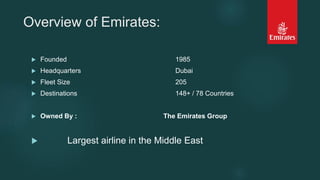
Overview of Emirates:
 Founded 1985
 Headquarters Dubai
 Fleet Size 205
 Destinations 148+ / 78 Countries
 Owned By : The Emirates Group
 Largest airline in the Middle East
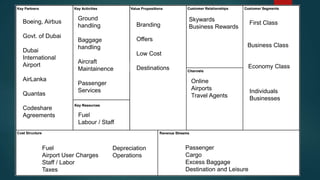
Boeing, Airbus
Govt. of Dubai
Dubai
International
Airport
AirLanka
Quantas
Codeshare
Agreements
Ground
handling
Baggage
handling
Aircraft
Maintainence
Passenger
Services
Fuel
Labour / Staff
Online
Airports
Travel Agents
Fuel
Airport User Charges
Staff / Labor
Taxes
First Class
Business Class
Economy Class
Skywards
Business RewardsBranding
Offers
Low Cost
Destinations
Passenger
Cargo
Excess Baggage
Destination and Leisure
Individuals
Businesses
Depreciation
Operations
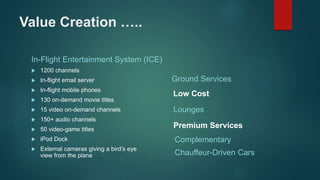
Value Creation …..
In-Flight Entertainment System (ICE)
 1200 channels
 In-flight email server
 In-flight mobile phones
 130 on-demand movie titles
 15 video on-demand channels
 150+ audio channels
 50 video-game titles
 iPod Dock
 External cameras giving a bird’s eye
view from the plane
Ground Services
Lounges
Complementary
Chauffeur-Driven Cars
Low Cost
Premium Services
Emirates: Case study analysis
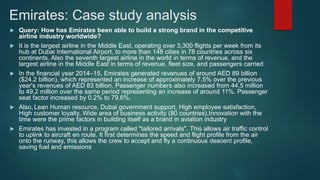
 Query: How has Emirates been able to build a strong brand in the competitive
airline industry worldwide?
 It is the largest airline in the Middle East, operating over 3,300 flights per week from its
hub at Dubai International Airport, to more than 148 cities in 78 countries across six
continents. Also the seventh largest airline in the world in terms of revenue, and the
largest airline in the Middle East in terms of revenue, fleet size, and passengers carried
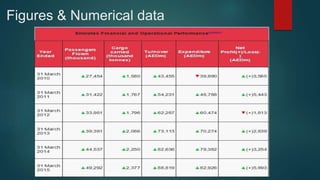
 In the financial year 2014–15, Emirates generated revenues of around AED 89 billion
($24.2 billion), which represented an increase of approximately 7.5% over the previous
year's revenues of AED 83 billion. Passenger numbers also increased from 44.5 million
to 49.2 million over the same period representing an increase of around 11%. Passenger
seat factor increased by 0.2% to 79.6%.
 Also, Lean Human resource, Dubai government support, High employee satisfaction,
High customer loyalty, Wide area of business activity (80 countries),Innovation with the
time were the prime factors in building itself as a brand in aviation industry
 Emirates has invested in a program called "tailored arrivals". This allows air traffic control
to uplink to aircraft en route. It first determines the speed and flight profile from the air
onto the runway, this allows the crew to accept and fly a continuous descent profile,
saving fuel and emissions
Figures & Numerical data
Emirates: Case Study Analysis
 Query: What are some of the apparent weaknesses with the company’s
strategic direction? How can the airline address them?
 The Apparent weaknesses of companies strategic direction are :
1. They Overlook the faults in their marketing strategies.
2. They are overconfident about their position in the aviation industry
3. They are not a part of any alliance.
4. They do not look into the pros and cons of their competitors. for eg. Etihad airways
and many other airways have also signed the open skies policy and are ready to
compete with emirates at a very competitive price with the same quality of service.
5. Ignore the competition :they totally ignore their competitors like Gulf Air Company
GSC, Air France, Lufthansa AG, British Airways, and Qatar Airways Group.
6. Target only the Elite class of customer.
Contd.
 Solutions to above addressed issues:
1. Improving in flight service to an even better level.
2. Extending new routes.
3. Product development-private suites.
4. Low cost carrier(budget airlines)
5. By involving in the competition and making their strategies as per the market
demand.
6. Work for middle and low class population also.
Emirates: Case study Analysis
 Query: With the decline of fuel prices globally, airline companies continue to
reap the benefits. What impact will this have on Emirates’ business strategy in
the future?
1. Company will now attract cost conscious customers through declining of fuel price.
2. To reduce price-fluctuation risk on projected operating costs, many airlines hedge a
proportion of their future fuel needs six to 24 months in advance by buying jet fuel or
crude oil contracts from banks or on an oil futures market.
3. When the oil price is falling, options are an advantage. It is cheaper to hedge
forwards and get protection if prices go up, but if you pay a premium for options you
also retain the potential to benefit from lower oil prices more immediately.
4. Risked slower growth in the coming years as heavy investments in new planes and
premium-class services begin to erode profit margins.
Recent Facts: Emirates is not subsidized
 Sheikh Ahmed (Chairman of The Emirates Group) said the airline is not subsidised
and it's been profitable from day one.
 He also said following points while addressing “World Government Summit”
1. “Government should play the role to ensure we are competitive and prices are
right… We all fly the same aircraft, it's what extras we give.“
2. “We were the first airline to install videos in every seat. We have more than 2,200
channels on board; we have showers. What will come next on board? As an airline
we always see what customer wants, but you have to pay for it. We can't give it for
free. “
3. People believe 2016 will be bad year. “I say it will be a good year in relation to
capacity. People said that when Qatar Airways came, when Etihad Airways came.
Same would happen.
4. “UAE is not the same as 30 years ago. We have more people now. Today, Dubai
has 80 million passengers and we aim for 120 million - it is the hub for the world.”
5. Emirates chief said Internet access on 17-hour flight is for just a dollar but the airline
needs a wider bandwidth to meet the demands of passengers.
For More updates visit:
www.emirates247.com

Emirates

  • 1.
    Presented By: Nikhil Aggarwal(11201004) Vivek Diwedi (11201968) Karan Khanna (11201920) Abhimanyu Durga Saketh Sachin
  • 2.
    Overview of Emirates: Founded 1985  Headquarters Dubai  Fleet Size 205  Destinations 148+ / 78 Countries  Owned By : The Emirates Group  Largest airline in the Middle East
  • 3.
    Boeing, Airbus Govt. ofDubai Dubai International Airport AirLanka Quantas Codeshare Agreements Ground handling Baggage handling Aircraft Maintainence Passenger Services Fuel Labour / Staff Online Airports Travel Agents Fuel Airport User Charges Staff / Labor Taxes First Class Business Class Economy Class Skywards Business RewardsBranding Offers Low Cost Destinations Passenger Cargo Excess Baggage Destination and Leisure Individuals Businesses Depreciation Operations
  • 4.
    Value Creation ….. In-FlightEntertainment System (ICE)  1200 channels  In-flight email server  In-flight mobile phones  130 on-demand movie titles  15 video on-demand channels  150+ audio channels  50 video-game titles  iPod Dock  External cameras giving a bird’s eye view from the plane Ground Services Lounges Complementary Chauffeur-Driven Cars Low Cost Premium Services
  • 5.
    Emirates: Case studyanalysis  Query: How has Emirates been able to build a strong brand in the competitive airline industry worldwide?  It is the largest airline in the Middle East, operating over 3,300 flights per week from its hub at Dubai International Airport, to more than 148 cities in 78 countries across six continents. Also the seventh largest airline in the world in terms of revenue, and the largest airline in the Middle East in terms of revenue, fleet size, and passengers carried  In the financial year 2014–15, Emirates generated revenues of around AED 89 billion ($24.2 billion), which represented an increase of approximately 7.5% over the previous year's revenues of AED 83 billion. Passenger numbers also increased from 44.5 million to 49.2 million over the same period representing an increase of around 11%. Passenger seat factor increased by 0.2% to 79.6%.  Also, Lean Human resource, Dubai government support, High employee satisfaction, High customer loyalty, Wide area of business activity (80 countries),Innovation with the time were the prime factors in building itself as a brand in aviation industry  Emirates has invested in a program called "tailored arrivals". This allows air traffic control to uplink to aircraft en route. It first determines the speed and flight profile from the air onto the runway, this allows the crew to accept and fly a continuous descent profile, saving fuel and emissions
  • 6.
  • 7.
    Emirates: Case StudyAnalysis  Query: What are some of the apparent weaknesses with the company’s strategic direction? How can the airline address them?  The Apparent weaknesses of companies strategic direction are : 1. They Overlook the faults in their marketing strategies. 2. They are overconfident about their position in the aviation industry 3. They are not a part of any alliance. 4. They do not look into the pros and cons of their competitors. for eg. Etihad airways and many other airways have also signed the open skies policy and are ready to compete with emirates at a very competitive price with the same quality of service. 5. Ignore the competition :they totally ignore their competitors like Gulf Air Company GSC, Air France, Lufthansa AG, British Airways, and Qatar Airways Group. 6. Target only the Elite class of customer. Contd.
  • 8.
     Solutions toabove addressed issues: 1. Improving in flight service to an even better level. 2. Extending new routes. 3. Product development-private suites. 4. Low cost carrier(budget airlines) 5. By involving in the competition and making their strategies as per the market demand. 6. Work for middle and low class population also.
  • 9.
    Emirates: Case studyAnalysis  Query: With the decline of fuel prices globally, airline companies continue to reap the benefits. What impact will this have on Emirates’ business strategy in the future? 1. Company will now attract cost conscious customers through declining of fuel price. 2. To reduce price-fluctuation risk on projected operating costs, many airlines hedge a proportion of their future fuel needs six to 24 months in advance by buying jet fuel or crude oil contracts from banks or on an oil futures market. 3. When the oil price is falling, options are an advantage. It is cheaper to hedge forwards and get protection if prices go up, but if you pay a premium for options you also retain the potential to benefit from lower oil prices more immediately. 4. Risked slower growth in the coming years as heavy investments in new planes and premium-class services begin to erode profit margins.
  • 10.
    Recent Facts: Emiratesis not subsidized  Sheikh Ahmed (Chairman of The Emirates Group) said the airline is not subsidised and it's been profitable from day one.  He also said following points while addressing “World Government Summit” 1. “Government should play the role to ensure we are competitive and prices are right… We all fly the same aircraft, it's what extras we give.“ 2. “We were the first airline to install videos in every seat. We have more than 2,200 channels on board; we have showers. What will come next on board? As an airline we always see what customer wants, but you have to pay for it. We can't give it for free. “ 3. People believe 2016 will be bad year. “I say it will be a good year in relation to capacity. People said that when Qatar Airways came, when Etihad Airways came. Same would happen. 4. “UAE is not the same as 30 years ago. We have more people now. Today, Dubai has 80 million passengers and we aim for 120 million - it is the hub for the world.” 5. Emirates chief said Internet access on 17-hour flight is for just a dollar but the airline needs a wider bandwidth to meet the demands of passengers.
  • 11.
    For More updatesvisit: www.emirates247.com