Dr. Y. P. Singh
S. R. Govt. Polytechnic College, Sagar (MP), India
Email: ypsingh@srgpcsagar.org
9425436423
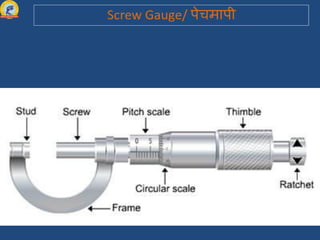
Parts of a Screw Gauge
1. Pitch Scale
Parts of a Screw Gauge
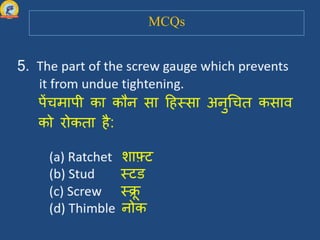
• The head of the screw has a ratchet which avoids undue tightening
of the screw.
2. Ratchet
Parts of a Screw Gauge
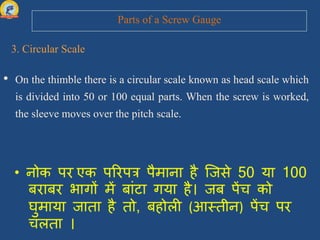
• On the thimble there is a circular scale known as head scale which
is divided into 50 or 100 equal parts. When the screw is worked,
the sleeve moves over the pitch scale.
3. Circular Scale
Parts of a Screw Gauge
• A stud with a plane end surface is anvil which is fixed on the
‘U’ frame. When the tip of the screw is in contact with the anvil,
usually, the zero of the head scale coincides with the zero of the
pitch scale.
4. Anvil
 it is the smallest reading which you can get with the
instrument.
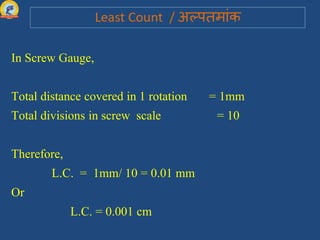
In Screw Gauge,
Total distance covered in 1 rotation = 1mm
Total divisions in screw scale = 10
Therefore,
L.C. = 1mm/ 10 = 0.01 mm
Or
L.C. = 0.001 cm
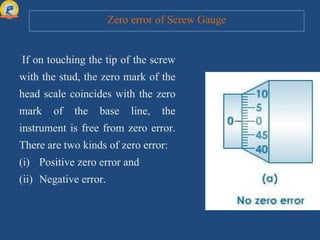
Zero error of Screw Gauge
If on touching the tip of the screw
with the stud, the zero mark of the
head scale coincides with the zero
mark of the base line, the
instrument is free from zero error.
There are two kinds of zero error:
(i) Positive zero error and
(ii) Negative error.
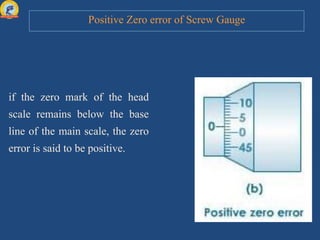
Positive Zero error of Screw Gauge
if the zero mark of the head
scale remains below the base
line of the main scale, the zero
error is said to be positive.
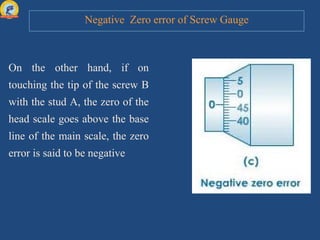
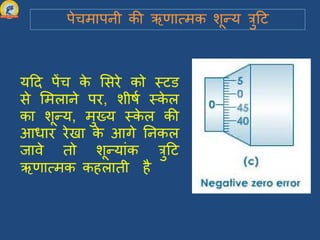
Negative Zero error of Screw Gauge
On the other hand, if on
touching the tip of the screw B
with the stud A, the zero of the
head scale goes above the base
line of the main scale, the zero
error is said to be negative
Use of A Micrometer Screw Gauge
Where can you use a micrometer screw gauge?
Reading an screw gauge.

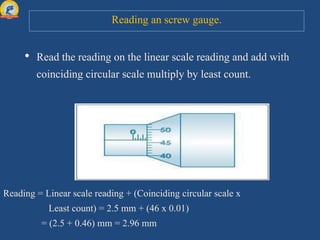
• Read the reading on the linear scale reading and add with
coinciding circular scale multiply by least count.
Reading = Linear scale reading + (Coinciding circular scale x
Least count) = 2.5 mm + (46 x 0.01)
= (2.5 + 0.46) mm = 2.96 mm
MCQs
MCQs
MCQs
MCQs
MCQs
MCQs
Further Study
Further study through animation and simulator can be done at:
amrita.olabs.co.in,. (2015). Screw Gauge. Retrieved 28 December 2015,
from amrita.olabs.co.in/?sub=1&brch=5&sim=156&cnt=470
Screw Gauge.pdf

Screw Gauge.pdf

  • 1.
    Dr. Y. P.Singh S. R. Govt. Polytechnic College, Sagar (MP), India Email: ypsingh@srgpcsagar.org 9425436423
  • 4.
    Parts of aScrew Gauge 1. Pitch Scale
  • 5.
    Parts of aScrew Gauge • The head of the screw has a ratchet which avoids undue tightening of the screw. 2. Ratchet
  • 6.
    Parts of aScrew Gauge • On the thimble there is a circular scale known as head scale which is divided into 50 or 100 equal parts. When the screw is worked, the sleeve moves over the pitch scale. 3. Circular Scale
  • 7.
    Parts of aScrew Gauge • A stud with a plane end surface is anvil which is fixed on the ‘U’ frame. When the tip of the screw is in contact with the anvil, usually, the zero of the head scale coincides with the zero of the pitch scale. 4. Anvil
  • 9.
     it isthe smallest reading which you can get with the instrument.
  • 11.
    In Screw Gauge, Totaldistance covered in 1 rotation = 1mm Total divisions in screw scale = 10 Therefore, L.C. = 1mm/ 10 = 0.01 mm Or L.C. = 0.001 cm
  • 12.
    Zero error ofScrew Gauge If on touching the tip of the screw with the stud, the zero mark of the head scale coincides with the zero mark of the base line, the instrument is free from zero error. There are two kinds of zero error: (i) Positive zero error and (ii) Negative error.
  • 14.
    Positive Zero errorof Screw Gauge if the zero mark of the head scale remains below the base line of the main scale, the zero error is said to be positive.
  • 16.
    Negative Zero errorof Screw Gauge On the other hand, if on touching the tip of the screw B with the stud A, the zero of the head scale goes above the base line of the main scale, the zero error is said to be negative
  • 18.
    Use of AMicrometer Screw Gauge
  • 19.
    Where can youuse a micrometer screw gauge?
  • 20.
    Reading an screwgauge. • Read the reading on the linear scale reading and add with coinciding circular scale multiply by least count. Reading = Linear scale reading + (Coinciding circular scale x Least count) = 2.5 mm + (46 x 0.01) = (2.5 + 0.46) mm = 2.96 mm
  • 21.
  • 22.
  • 23.
  • 24.
  • 25.
  • 26.
  • 27.
    Further Study Further studythrough animation and simulator can be done at: amrita.olabs.co.in,. (2015). Screw Gauge. Retrieved 28 December 2015, from amrita.olabs.co.in/?sub=1&brch=5&sim=156&cnt=470