Microgrid Communication
Systems
The communication system of the
microgrid can be based on three
types of networks
• Home Area Net-work (HAN)
• Neighborhood Area Network (NAN)
• Wide Area Network (WAN)
Home Area Net-work (HAN)
• Deployed and operated within a small area (tens of
meters), usually a house or a small office.
• has relatively low transmission data rate compared
to other two networks.
• Range of hundreds of bits per second (bps).
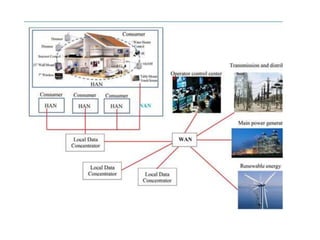
• all smart home devices that consume energy and
smart meters can be connected to HAN.
• HAN allows more efficient home energy
management.
Neighborhood Area Network (NAN)
• Deployed and operated within area of hundreds meters which
is actually few urban buildings.
• Several HANs can be connected to one NAN and they transmit
data of energy. consumed by each house to the NAN network.
• The NAN network delivers this data to Local Data Centers for
storage.
• This data storage is important for charging the consumers
and data analysis for energy generation.
• The NAN has up to 2 Kbps transmission data rate .
• The NAN can be implemented by PLC and Wi-Fi .
Wide Area Network (WAN)
• Deployed and operated within vast area of tens of
kilometers.
• It consists of several NANs .
• The communication of all microgrid’s components
including operator control center, main and
renewable energy generation, transmission and
distribution, is based on WAN.
• Has very high trans-mission data rate up to few Gbps.
• The WAN can be implemented by Ethernet networks
or WiMAX .
Communication Technologies That
Can Be Used in Microgrid
ZigBee
• ZigBee is used in applications that require a low data rate,
long battery life, low cost and secure networking.
• ZigBee is an ultra-low power wireless networking technology
so it used in HANS .
• Applications include wireless light switches, security alarms ,
electrical meters with in-home-displays, traffic management
systems.
• Industrial equipment that requires short-range wireless
transfer of data at relatively low rates.
• ZigBee allows connection of up to 60,000 devices to its
network.
• It also allows better energy consumption .
• The advantages of ZigBee application in microgrid are low
price, small size and it uses relatively small bandwidth.
• The disadvantages of the ZigBee are small battery , small
memory, limited data rate and low processing capability .
Wlan
• links two or more devices
• usually providing a connection through an access
point to the Internet.
• gives users the ability to move around within a local
coverage area and still be connected to the network.
• WLANs have become popular in the home due to
ease of installation.
• The advantage of WLAN is low cost.
• The major disadvantage of WLAN is high potential for
interference with other devices that communicate on
the same frequencies.
Bluetooth
• Operates within range < 10 meters.
• Data rate 1 Mbits/sec.
• Operating frequency 2.4 GHZ.
• Power consumption is meduim.
• Device connection requires up to 10 sec to be
connected .
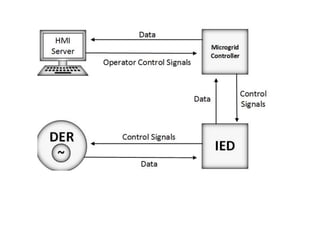
Intelligent Electronic Devices (IEDs )
• IEDs have the capability to receive power system data from the DERs and
send it to the microgrid controller as feedback for the control system.
Based on the data, control signals and reference values of voltage,
frequency, active and reactive power are issued by the microgrid
controller to the IEDs. The IEDs in turn issue control signals to DERs and
loads.
• To improve communication system availability, microgrid communication
system components can have redundancies. For example, wire connected
physical links could be used with wireless links to improve communication
system availability. Data traffic could be routed to the wireless system to
increase data transfer speeds by mitigating traffic congestion on wired
links .
Microgrid Communication Systems

Microgrid Communication Systems

  • 1.
  • 2.
    The communication systemof the microgrid can be based on three types of networks • Home Area Net-work (HAN) • Neighborhood Area Network (NAN) • Wide Area Network (WAN)
  • 3.
    Home Area Net-work(HAN) • Deployed and operated within a small area (tens of meters), usually a house or a small office. • has relatively low transmission data rate compared to other two networks. • Range of hundreds of bits per second (bps). • all smart home devices that consume energy and smart meters can be connected to HAN. • HAN allows more efficient home energy management.
  • 4.
    Neighborhood Area Network(NAN) • Deployed and operated within area of hundreds meters which is actually few urban buildings. • Several HANs can be connected to one NAN and they transmit data of energy. consumed by each house to the NAN network. • The NAN network delivers this data to Local Data Centers for storage. • This data storage is important for charging the consumers and data analysis for energy generation. • The NAN has up to 2 Kbps transmission data rate . • The NAN can be implemented by PLC and Wi-Fi .
  • 5.
    Wide Area Network(WAN) • Deployed and operated within vast area of tens of kilometers. • It consists of several NANs . • The communication of all microgrid’s components including operator control center, main and renewable energy generation, transmission and distribution, is based on WAN. • Has very high trans-mission data rate up to few Gbps. • The WAN can be implemented by Ethernet networks or WiMAX .
  • 7.
  • 8.
    ZigBee • ZigBee isused in applications that require a low data rate, long battery life, low cost and secure networking. • ZigBee is an ultra-low power wireless networking technology so it used in HANS . • Applications include wireless light switches, security alarms , electrical meters with in-home-displays, traffic management systems. • Industrial equipment that requires short-range wireless transfer of data at relatively low rates. • ZigBee allows connection of up to 60,000 devices to its network.
  • 9.
    • It alsoallows better energy consumption . • The advantages of ZigBee application in microgrid are low price, small size and it uses relatively small bandwidth. • The disadvantages of the ZigBee are small battery , small memory, limited data rate and low processing capability .
  • 10.
    Wlan • links twoor more devices • usually providing a connection through an access point to the Internet. • gives users the ability to move around within a local coverage area and still be connected to the network. • WLANs have become popular in the home due to ease of installation. • The advantage of WLAN is low cost. • The major disadvantage of WLAN is high potential for interference with other devices that communicate on the same frequencies.
  • 11.
    Bluetooth • Operates withinrange < 10 meters. • Data rate 1 Mbits/sec. • Operating frequency 2.4 GHZ. • Power consumption is meduim. • Device connection requires up to 10 sec to be connected .
  • 12.
    Intelligent Electronic Devices(IEDs ) • IEDs have the capability to receive power system data from the DERs and send it to the microgrid controller as feedback for the control system. Based on the data, control signals and reference values of voltage, frequency, active and reactive power are issued by the microgrid controller to the IEDs. The IEDs in turn issue control signals to DERs and loads. • To improve communication system availability, microgrid communication system components can have redundancies. For example, wire connected physical links could be used with wireless links to improve communication system availability. Data traffic could be routed to the wireless system to increase data transfer speeds by mitigating traffic congestion on wired links .