Principles of Microfinance Refresher

MODULE 3

Risk,
Risk Management &
Microfinance
Introduction: What is Risk and Risk Management?

Six Steps to Managing Risk

Credit Risk Management

Loan Portfolio Tracking, Product Design, & Loan Policies

Next Steps
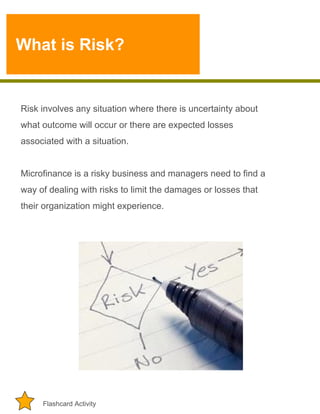
What is Risk?

Risk involves any situation where there is uncertainty about
what outcome will occur or there are expected losses
associated with a situation.
Microfinance is a risky business and managers need to find a
way of dealing with risks to limit the damages or losses that
their organization might experience.

Flashcard Activity
Categories of Risk*

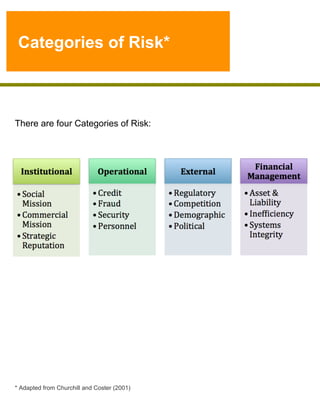
There are four Categories of Risk:

* Adapted from Churchill and Coster (2001)
What is Risk Management?

Risk Management is the process of taking calculated risks,
reduces the likelihood that a loss will occur, and minimizes the
scale of the loss should it occur. It includes the prevention of
potential problems, the early detection of actual problems when
they occur, and the correction of policies and procedures that
permitted the occurrence.
Combining the planning and controlling functions of managers,
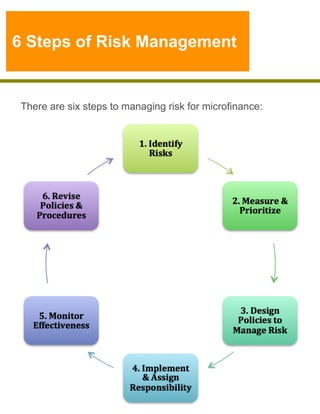
risk management is an ongoing six-step process.

Flashcard Activity
6 Steps of Risk Management

There are six steps to managing risk for microfinance:
Credit Risk Management

Definition
Credit Risk Management refers to the techniques that are applied to
optimally manage the exposure of a financial institution who has lent
money to borrowers. Possible losses include:
●  Loss of principal or interest
●  Cost of retrieval
●  Time
●  Inability to help other clients
●  Loss of job
●  Difficulty securing funding
●  And more...

Methods to Manage Credit Risk
●  Less financing
●  Less control
●  Insurance
●  Reduce the level of risk activity
●  Diversification
●  Increase precaution
●  Contractual risk transfer
Flashcard Activity
Loan Portfolio Tracking
& Portfolio Quality

Loan Portfolio Tracking
An outstanding portfolio refers to the principal amount of loans
outstanding for a particular period. The loan portfolio is the main
product of a microfinance institution. It is important to track the loans
in your portfolio. Loan portfolio management reports should be
compiled to coincide with the installment cycle of loans. You can use
a manual or automated system but it must have this information:
●  Loan appraisal and disbursement terms: size, duration,
lending methodology, repayment installments, etc...
●  Repayment performance
●  Delinquency: amount in arrears, portfolio at risk, ratio,
provisioning, write off, etc...
Portfolio Quality
The main source of earnings for the MFI is its loan portfolio.
Reaching a large number of clients cannot be achieved unless there
is good portfolio quality. It is the MFIs responsibility to instill credit
discipline among its clients.
Risk Management &
Product Development

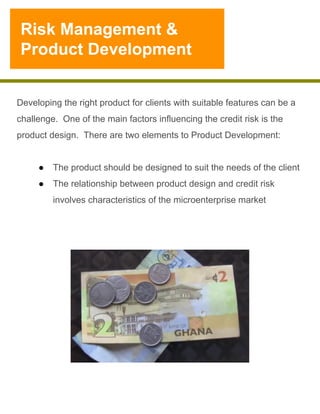
Developing the right product for clients with suitable features can be a
challenge. One of the main factors influencing the credit risk is the
product design. There are two elements to Product Development:
●  The product should be designed to suit the needs of the client
●  The relationship between product design and credit risk
involves characteristics of the microenterprise market
Risk Management &
Post Loan Policies

For several reasons after the loan is disbursed, the MFI must
ensure prompt repayment to maintain the profitability and
sustainability of the institution. There are four areas to review
after a loan is disbursed to ensure prompt and adequate
repayment and avoid risks and delinquency:
1.  Documentation
2.  Controls
3.  Monitoring
4.  Prompt Decision Taking
Risk Management &
Post Loan Policies

Documentation
Data generation and compilation are paramount but not enough.
Analysis of the data by a sound Management Information System
(MIS) must be put in place. Reports can be generated through
tracking indicators. The MIS must be designed to give early
warning signs as needed.
Controls
Management must put in place adequate internal control
measures in line with the Mission and Vision of the organization.
Such internal controls must be explicit and well documented as a
guide for all employees.
Monitoring
The entire operations of the MFI must be carried out regularly and
specified by internal guidelines.
Prompt Action
Status reports should drive management to take prompt and
necessary steps and actions to forestall any undesirable results.
Performance Monitoring

Managers again face the challenge in monitoring performance in the
form of:
●  Outreach
●  Social Performance
●  Financial Ratios
●  Portfolio Quality Ratios (to establish profitability/sustainability)
Next Steps...

Once you have finished reviewing these slides you may proceed to the
following sections of this Module (if you opened these slides in a
separate window, close out this window or tab and return to MODULE
3 in CourseSites):

• 
• 
• 

Review the Resources
Complete the Journal Reflection and FlashCard Review
Check your understanding with the Self-Review

Note: A PDF version of this slide deck is also available for download

Founded in 1999 as the Microenterprise Development Institute, the Carsey Institute’s
Sustainable Microenterprise and Development Program (SMDP) provides training and
networking opportunities for practitioners in the fields of microfinance, enterprise
development, social enterprise, and community-based and rural development. Over
the past fourteen years, we have trained more than 1,800 practitioners from more than
one hundred countries around the globe. The SMDP offers an intensive professional
training experience with a concentration on program planning and implementation of
client and community inclusive economic development strategies.

http://carseyinstitute.unh.edu/smdp

SMDP Microfinance Refresher MODULE 3

  • 1.
    Principles of MicrofinanceRefresher MODULE 3 Risk, Risk Management & Microfinance Introduction: What is Risk and Risk Management? Six Steps to Managing Risk Credit Risk Management Loan Portfolio Tracking, Product Design, & Loan Policies Next Steps
  • 2.
    What is Risk? Riskinvolves any situation where there is uncertainty about what outcome will occur or there are expected losses associated with a situation. Microfinance is a risky business and managers need to find a way of dealing with risks to limit the damages or losses that their organization might experience. Flashcard Activity
  • 3.
    Categories of Risk* Thereare four Categories of Risk: * Adapted from Churchill and Coster (2001)
  • 4.
    What is RiskManagement? Risk Management is the process of taking calculated risks, reduces the likelihood that a loss will occur, and minimizes the scale of the loss should it occur. It includes the prevention of potential problems, the early detection of actual problems when they occur, and the correction of policies and procedures that permitted the occurrence. Combining the planning and controlling functions of managers, risk management is an ongoing six-step process. Flashcard Activity
  • 5.
    6 Steps ofRisk Management There are six steps to managing risk for microfinance:
  • 6.
    Credit Risk Management Definition CreditRisk Management refers to the techniques that are applied to optimally manage the exposure of a financial institution who has lent money to borrowers. Possible losses include: ●  Loss of principal or interest ●  Cost of retrieval ●  Time ●  Inability to help other clients ●  Loss of job ●  Difficulty securing funding ●  And more... Methods to Manage Credit Risk ●  Less financing ●  Less control ●  Insurance ●  Reduce the level of risk activity ●  Diversification ●  Increase precaution ●  Contractual risk transfer Flashcard Activity
  • 7.
    Loan Portfolio Tracking &Portfolio Quality Loan Portfolio Tracking An outstanding portfolio refers to the principal amount of loans outstanding for a particular period. The loan portfolio is the main product of a microfinance institution. It is important to track the loans in your portfolio. Loan portfolio management reports should be compiled to coincide with the installment cycle of loans. You can use a manual or automated system but it must have this information: ●  Loan appraisal and disbursement terms: size, duration, lending methodology, repayment installments, etc... ●  Repayment performance ●  Delinquency: amount in arrears, portfolio at risk, ratio, provisioning, write off, etc... Portfolio Quality The main source of earnings for the MFI is its loan portfolio. Reaching a large number of clients cannot be achieved unless there is good portfolio quality. It is the MFIs responsibility to instill credit discipline among its clients.
  • 8.
    Risk Management & ProductDevelopment Developing the right product for clients with suitable features can be a challenge. One of the main factors influencing the credit risk is the product design. There are two elements to Product Development: ●  The product should be designed to suit the needs of the client ●  The relationship between product design and credit risk involves characteristics of the microenterprise market
  • 9.
    Risk Management & PostLoan Policies For several reasons after the loan is disbursed, the MFI must ensure prompt repayment to maintain the profitability and sustainability of the institution. There are four areas to review after a loan is disbursed to ensure prompt and adequate repayment and avoid risks and delinquency: 1.  Documentation 2.  Controls 3.  Monitoring 4.  Prompt Decision Taking
  • 10.
    Risk Management & PostLoan Policies Documentation Data generation and compilation are paramount but not enough. Analysis of the data by a sound Management Information System (MIS) must be put in place. Reports can be generated through tracking indicators. The MIS must be designed to give early warning signs as needed. Controls Management must put in place adequate internal control measures in line with the Mission and Vision of the organization. Such internal controls must be explicit and well documented as a guide for all employees. Monitoring The entire operations of the MFI must be carried out regularly and specified by internal guidelines. Prompt Action Status reports should drive management to take prompt and necessary steps and actions to forestall any undesirable results.
  • 11.
    Performance Monitoring Managers againface the challenge in monitoring performance in the form of: ●  Outreach ●  Social Performance ●  Financial Ratios ●  Portfolio Quality Ratios (to establish profitability/sustainability)
  • 12.
    Next Steps... Once youhave finished reviewing these slides you may proceed to the following sections of this Module (if you opened these slides in a separate window, close out this window or tab and return to MODULE 3 in CourseSites): •  •  •  Review the Resources Complete the Journal Reflection and FlashCard Review Check your understanding with the Self-Review Note: A PDF version of this slide deck is also available for download Founded in 1999 as the Microenterprise Development Institute, the Carsey Institute’s Sustainable Microenterprise and Development Program (SMDP) provides training and networking opportunities for practitioners in the fields of microfinance, enterprise development, social enterprise, and community-based and rural development. Over the past fourteen years, we have trained more than 1,800 practitioners from more than one hundred countries around the globe. The SMDP offers an intensive professional training experience with a concentration on program planning and implementation of client and community inclusive economic development strategies. http://carseyinstitute.unh.edu/smdp