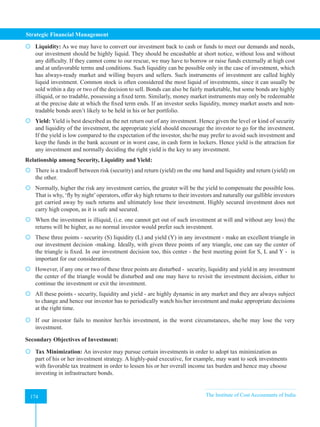
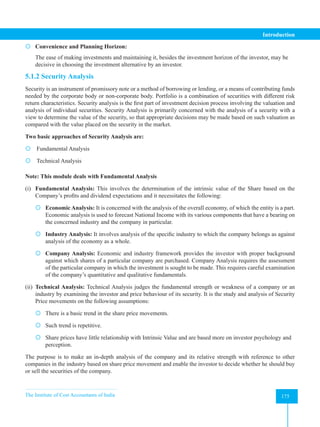
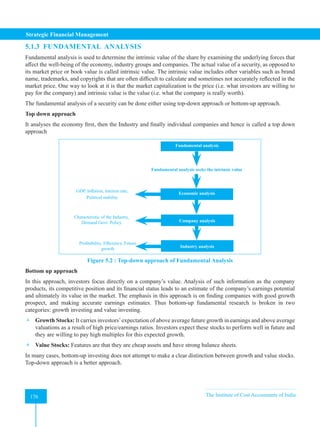
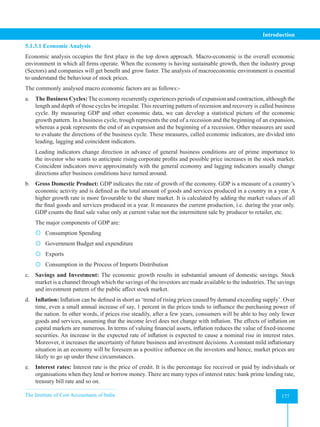
Strategic Financial
Management
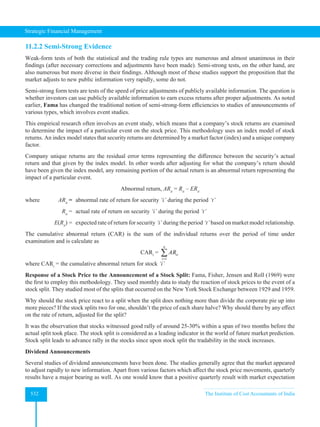
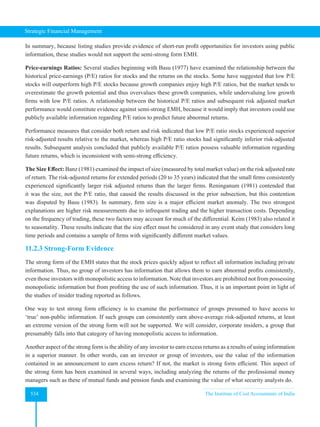
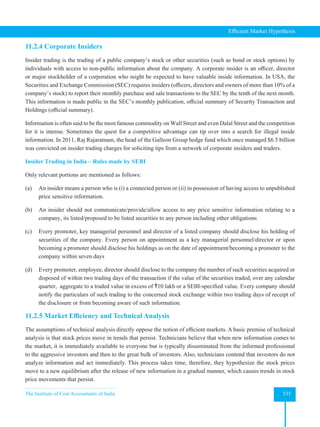
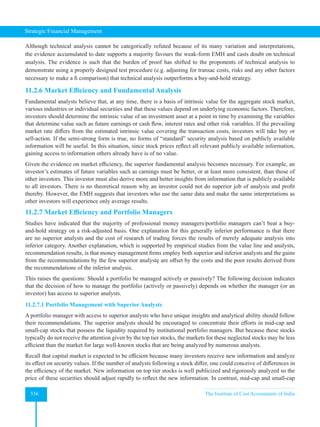
14
The Institute of Cost Accountants of India
Statutory Body under an Act of Parliament
www.icmai.in
Paper
Final
About the Institute
T
he Institute of Cost Accountants of India is a Statutory Body set up under an Act of Parliament in the
year 1959. The Institute as a part of its obligation, regulates the profession of Cost and Management
Accountancy, enrols students for its courses, provides coaching facilities to the students, organizes
professional development programmes for the members and undertakes research programmes in
the ield of Cost and Management Accountancy. The Institute pursues the vision of cost competitiveness, cost
management, ef icient use of resources and structured approach to cost accounting as the key drivers of the
profession.
With the current emphasis on management of resources, the specialized knowledge of evaluating operating
ef iciency and strategic management the professionals are known as ''Cost and Management Accountants
(CMAs)''. The Institute is the 2ⁿ largest Cost & Management Accounting body in the world and the largest in
Asia, having more than 5,00,000 students and 90,000 members all over the globe. The Institute operates
throughfourregionalcouncilsatKolkata,Delhi,MumbaiandChennaiand113Chapterssituatedatimportant
cities in the country as well as 11 Overseas Centres, headquartered at Kolkata. It is under the administrative
controloftheMinistryofCorporateAffairs,GovernmentofIndia.
Vision Statement
The Institute of Cost Accountants of India would be the preferred source of resources and
professionalsforthe inancialleadershipofenterprisesglobally.”
Mission Statement
The Cost and Management Accountant professionals would ethically drive enterprises globally by
creating value to stakeholders in the socio-economic context through competencies drawn from
theintegrationofstrategy,managementandaccounting.”
Motto
From ignorance, lead me to truth
From darkness, lead me to light
From death, lead me to immortality
Peace, Peace, Peace
Behind Every Successful Business Decision, there is always a CMA
Cover Image Source: https://www.freepik.com/photos/ inancial-management
FINAL
Paper 14
StrategicFinancialManagement
Study Notes
SYLLABUS 2022
The Institute of Cost Accountants of India
CMA Bhawan, 12, Sudder Street, Kolkata - 700 016
www.icmai.in
First Edition : August 2022
Price: ` 700.00
Published by :
Directorate of Studies
The Institute of Cost Accountants of India
CMA Bhawan, 12, Sudder Street, Kolkata - 700 016
studies@icmai.in
Printed at :
M/s. Print Plus Pvt. Ltd.
212, Swastik Chambers
S. T. Road, Chembur
Mumbai - 400 071
Copyright of these Study Notes is reserved by the Institute of Cost Accountants of India and prior permission
from the Institute is necessary for reproduction of the whole or any part thereof.
Copyright © 2022 by The Institute of Cost Accountants of India
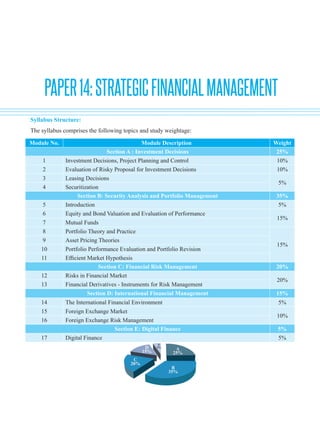
PAPER14:STRATEGICFINANCIALMANAGEMENT
Syllabus Structure:
The syllabus comprises the following topics and study weightage:
Module No. Module Description Weight
Section A : Investment Decisions 25%
1 Investment Decisions, Project Planning and Control 10%
2 Evaluation of Risky Proposal for Investment Decisions 10%
3 Leasing Decisions
5%
4 Securitization
Section B: Security Analysis and Portfolio Management 35%
5 Introduction 5%
6 Equity and Bond Valuation and Evaluation of Performance
15%
7 Mutual Funds
8 Portfolio Theory and Practice
15%
9 Asset Pricing Theories
10 Portfolio Performance Evaluation and Portfolio Revision
11 Efficient Market Hypothesis
Section C: Financial Risk Management 20%
12 Risks in Financial Market
20%
13 Financial Derivatives - Instruments for Risk Management
Section D: International Financial Management 15%
14 The International Financial Environment 5%
15 Foreign Exchange Market
10%
16 Foreign Exchange Risk Management
Section E: Digital Finance 5%
17 Digital Finance 5%
Learning Environment
Subject Title STRATEGIC FINANCIAL MANAGEMENT
Subject Code SFM
Paper No. 14
Course
Description
The subject Strategic Financial Management deals with three key areas of strategic decision making with
respect to financial resources, namely, long term investment decisions, management of investment portfolio
and management of risk in national and internal operations. It provides a detailed understanding of various
alternatives approaches of capital budgeting and project appraisal under a deterministic environment and
complements the discussion with detail coverage of different techniques for incorporating the uncertainty
element in project evaluation. The subject provides a detail account of the alternative approaches towards
security analysis and portfolio performance evaluation and portfolio revision. It also provides a detail
coverage on various risk management techniques including use of derivatives with an added emphasis on
risk management in international operations. In addition to the above, the subject gives an overview of the
components of a digital finance ecosystem and highlights the interaction among them.
CMA Course
Learning
Objectives
(CMLOs)
1. Interpret and appreciate emerging national and global concerns affecting organizations and be in a state
of readiness for business management.
a. Identify emerging national and global forces responsible for enhanced/varied business challenges.
b. Assess how far these forces pose threats to the status-quo and creating new opportunities.
c. Find out ways and means to convert challenges into opportunities
2. Acquire skill sets for critical thinking, analyses and evaluations, comprehension, syntheses, and
applications for optimization of sustainable goals.
a. Be equipped with the appropriate tools for analyses of business risks and hurdles.
b. Learn to apply tools and systems for evaluation of decision alternatives with a 360-degree
approach.
c. Develop solutions through critical thinking to optimize sustainable goals.
3. Develop an understanding of strategic, financial, cost and risk-enabled performance management in a
dynamic business environment.
a. Study the impacts of dynamic business environment on existing business strategies.
b. Learn to adopt, adapt and innovate financial, cost and operating strategies to cope up with the
dynamic business environment.
c. Come up with strategies and tactics that create sustainable competitive advantages.
4. Learn to design the optimal approach for management of legal, institutional, regulatory and ESG
frameworks, stakeholders’ dynamics; monitoring, control, and reporting with application-oriented
knowledge.
a. Develop an understanding of the legal, institutional and regulatory and ESG frameworks within
which a firm operates.
b. Learn to articulate optimal responses to the changes in the above frameworks.
c. Appreciate stakeholders’ dynamics and expectations, and develop appropriate reporting
mechanisms to address their concerns.
5. Prepare to adopt an integrated cross functional approach for decision management and execution with
cost leadership, optimized value creations and deliveries.
a. Acquire knowledge of cross functional tools for decision management.
b. Take an industry specific approach towards cost optimization, and control to achieve sustainable
cost leadership.
c. Attain exclusive knowledge of data science and engineering to analyze and create value.
Subject
Learning
Objectives
[SLOB(s)]
1. To obtain in-depth knowledge on application of various techniques of project evaluation under a
deterministic environment as well as techniques of incorporating the element of uncertainty in project
appraisal. (CMLO 2a, 2b)
2. To develop detailed understanding of how to make strategic choices in long term investment decisions
such as own or lease and making optimal allocation of limited funds. (CMLO 3c)
3. To equip oneself with the knowledge of application of various techniques in security evaluation,
building a portfolio, measuring its performance and making revisions to optimise the returns. (CMLO
3a)
4. To develop detail understanding of the sources and impact of risks to which an organisation is exposed
to in a dynamic business environment at national and international level and the techniques for
managing the same to sustain competitive advantages. (CMLO 3b, 3c)
5. To obtain an overview of various components of digital finance to better understand the interrelationship
among them. (CMLO 1a, b, c)
Subject
Learning
Outcomes
(SLOC) and
Application
Skills (APS)
SLOCs:
1. Students will be able to perform project appraisals, allocation of limited funds among competing
projects and making strategic choices in long term investment decisions.
2. They will be able to identify the risks associated with various functional areas of the organisation and
evaluate the alternative risk management techniques.
3. They will be able to build profitable portfolios and evaluate their performance continuously to identify
if any revision is warranted.
APSs:
1. They will develop necessary skill to prepare project appraisal reports and guide the management in
selecting the appropriate one.
2. They will be able to prepare risk reports to be submitted to the management to facilitate strategic
decision making relating to the functional areas of the organisation.
3. They will be able to prepare periodic portfolio performance reports to facilitate portfolio revision
decisions.
Module wise Mapping of SLOB(s)
Module
No.
Topics
Additional Resources (Research articles, books, case
studies, blogs)
SLOB Mapped
Section A: Investment Decisions
1 Investment
Decisions, Project
Planning and
Control
Capital Budgeting Techniques Among The Fortune 500: A
Rationale Approach - Burns and Walker
https://www.emerald.com/insight/content/doi/10.1108/
eb018643/full/html
1. To obtain in-depth
knowledge on
application of
various techniques
of project
evaluation under
a deterministic
environment as
well as techniques
of incorporating
the element of
uncertainty in
project appraisal.
2 Evaluation of
Risky proposal
for Investment
decisions
Capital-Budgeting Decisions Involving Combinations of
Risky Investments – J C Van Horne
https://pubsonline.informs.org/doi/abs/10.1287/
mnsc.13.2.b84
3 Leasing Decisions The Leasing Decision:AComparison of Theory and Practice
– Drury and Braund
https://www.tandfonline.com/doi/abs/10.1080/00014788
.1990.9728876
Section B: Security Analysis and Portfolio Management
4 Securitization Introduction to Securitization – Fabozzi, Kothari
https://books.google.co.in/books?hl=en&lr=&id=
D R e WA A A A Q B A J & o i = f n d & p g = P T 6 & d q =
securitization&ots=SwP5p0u-NO&sig=jBrJi0h0
HwyTa3zCfGO18pJ5Zxo&redir_esc= y#v=onepage&q
=securitization&f=false
2. Todevelopadetailed
u n d e r s t a n d i n g
on how to
make strategic
choices in long
term investment
decisions such as
own or lease and
making optimal
allocation of
limited funds.
5 Introduction to
Security Analysis
Fundamental and technical analysis: substitutes or
complements? – Bettman, Sault and Schultz
https://onlinelibrary.wiley.com/doi/abs/10.1111/j.
1467-629X.2008.00277.x
To equip oneself with
the knowledge of
application of various
techniques in security
evaluation, building a
portfolio, measuring
its performance and
making revisions to
optimise the returns.
6 Equity and Bond
Valuation and
Evaluation of
Performance
Convertible Bond Valuation: An Empirical Test – R. King
https://onlinelibrary.wiley.com/doi/abs/10.1111/j.1475-
6803.1986.tb00435.x
7 Mutual Funds The Origins of Mutual Funds – Rouwenhorst
https://papers.ssrn.com/sol3/papers.cfm?abstract_
id=636146
8 Portfolio Theory
and Practice
The Markowitz Contribution to Portfolio Theory – Witt
& Dobbins
https://www.emerald.com/insight/content/doi/10.1108/
eb013433/full/html
9 Asset Pricing
Theories
The Capital Asset Pricing Model: Some Empirical Tests –
Jensen, Black & Scholes
https://papers.ssrn.com/sol3/papers.cfm?abstract_id=
908569
10 Portfolio
Performance
Evaluation and
Portfolio Revision
A Note on Ambiguity in Portfolio Performance Measures
– Peterson & Rice
https://www.jstor.org/stable/2327098
11 Efficient Market
Hypothesis
Information efficiency in the stock markets in India – Sarkar
https://shodhganga.inflibnet.ac.in/handle/10603/156663
Section C: Financial Risk Management
12 Risks in Financial
Market
Financial Market Risks during the COVID-19 Pandemic
– Haroon et al.
https://www.tandfonline.com/doi/abs/10.1080/15404
96X.2021.1873765
To develop a detail
understanding
of the sources
and impact of
risks to which an
organisation is
exposed to in a
dynamic business
environment
at national and
international level
and the techniques
for managing the
same to sustain
competitive
advantages.
13 Financial
Derivatives -
Instruments for
Risk Management
Derivatives and Risk Management – Fabozzi
https://jpm.pm-research.com/content/25/5/16.abstract
Section D : International Financial Management
14 The International
Financial
Environment
Innovation in the International Financial Markets – Dufey
& Giddy
https://link.springer.com/article/10.1057/palgrave.
jibs.8490577
15 Foreign Exchange
Market
Foreign Exchange Market Structure, Players and Evolution
– King et al.
https://papers.ssrn.com/sol3/papers.cfm?abstract_
id=1935858
16 Foreign Exchange
Risk Management
Management of foreign exchange risk: a review article
– Jacque
https://www.sciencedirect.com/science/article/pii/
B9780408108416500294
Section E : Digital Finance
17 Digital Finance Impact of digital finance on financial inclusion and stability
– Ozili
https://www.sciencedirect.com/science/article/pii/
S2214845017301503
To obtain an over-
view of various
components of
digital finance to
better understand
the interrelationship
among them.
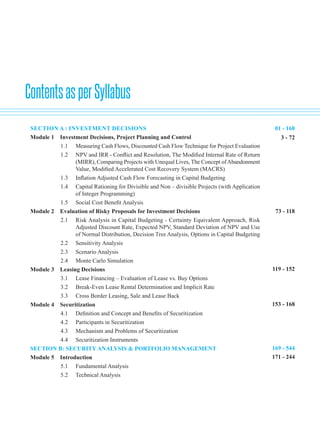
ContentsasperSyllabus
SECTION A : INVESTMENT DECISIONS						
Module 1 Investment Decisions, Project Planning and Control
1.1 Measuring Cash Flows, Discounted Cash Flow Technique for Project Evaluation
1.2 NPV and IRR - Conflict and Resolution, The Modified Internal Rate of Return
(MIRR), Comparing Projects with Unequal Lives, The Concept ofAbandonment
Value, Modified Accelerated Cost Recovery System (MACRS)
1.3 Inflation Adjusted Cash Flow Forecasting in Capital Budgeting
1.4 Capital Rationing for Divisible and Non – divisible Projects (with Application
of Integer Programming)

1.5 Social Cost Benefit Analysis
Module 2 Evaluation of Risky Proposals for Investment Decisions			
2.1 Risk Analysis in Capital Budgeting - Certainty Equivalent Approach, Risk
Adjusted Discount Rate, Expected NPV, Standard Deviation of NPV and Use
of Normal Distribution, Decision Tree Analysis, Options in Capital Budgeting
2.2 Sensitivity Analysis
2.3 Scenario Analysis
2.4 Monte Carlo Simulation
Module 3 Leasing Decisions		
3.1 Lease Financing – Evaluation of Lease vs. Buy Options
3.2 Break-Even Lease Rental Determination and Implicit Rate
3.3 Cross Border Leasing, Sale and Lease Back
Module 4 Securitization			
4.1 Definition and Concept and Benefits of Securitization
4.2 Participants in Securitization
4.3 Mechanism and Problems of Securitization
4.4 Securitization Instruments
SECTION B: SECURITY ANALYSIS & PORTFOLIO MANAGEMENT		
Module 5 Introduction		
5.1 Fundamental Analysis
5.2 Technical Analysis
01 - 168
3 - 72
73 - 118
119 - 152
153 - 168
169 - 544
171 - 244
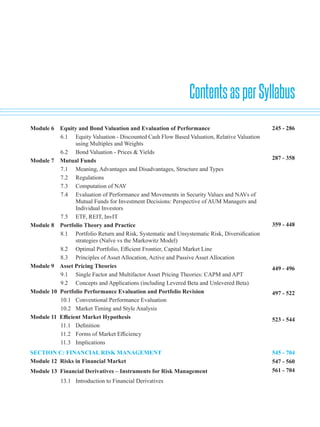
ContentsasperSyllabus
Module 6 Equity and Bond Valuation and Evaluation of Performance		
6.1 Equity Valuation - Discounted Cash Flow Based Valuation, Relative Valuation
using Multiples and Weights
6.2 Bond Valuation - Prices & Yields
Module 7 Mutual Funds						
7.1 Meaning, Advantages and Disadvantages, Structure and Types
7.2 Regulations
7.3 Computation of NAV
7.4 Evaluation of Performance and Movements in Security Values and NAVs of
Mutual Funds for Investment Decisions: Perspective of AUM Managers and
Individual Investors
7.5 ETF, REIT, InvIT
Module 8 Portfolio Theory and Practice			
8.1 Portfolio Return and Risk, Systematic and Unsystematic Risk, Diversification
strategies (Naïve vs the Markowitz Model)
8.2 Optimal Portfolio, Efficient Frontier, Capital Market Line
8.3 Principles of Asset Allocation, Active and Passive Asset Allocation
Module 9 Asset Pricing Theories		
9.1 Single Factor and Multifactor Asset Pricing Theories: CAPM and APT
9.2 Concepts and Applications (including Levered Beta and Unlevered Beta)
Module 10 Portfolio Performance Evaluation and Portfolio Revision		
10.1 Conventional Performance Evaluation
10.2 Market Timing and Style Analysis
Module 11 Efficient Market Hypothesis		
11.1 Definition
11.2 Forms of Market Efficiency
11.3 Implications
SECTION C: FINANCIAL RISK MANAGEMENT		
Module 12 Risks in Financial Market		
Module 13 Financial Derivatives – Instruments for Risk Management		
13.1 Introduction to Financial Derivatives
245 - 286
287 - 358
359 - 448
449 - 496
497 - 522
523 - 544
545 - 704
547 - 560
561 - 704
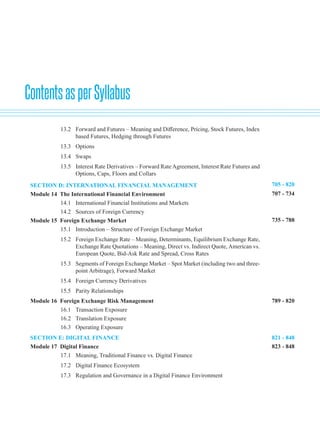
ContentsasperSyllabus
705 - 820
707 - 734
735 - 788
789 - 820
821 - 848
823 - 848
13.2 Forward and Futures – Meaning and Difference, Pricing, Stock Futures, Index
based Futures, Hedging through Futures
13.3 Options
13.4 Swaps
13.5 Interest Rate Derivatives – Forward Rate Agreement, Interest Rate Futures and
Options, Caps, Floors and Collars
SECTION D: INTERNATIONAL FINANCIAL MANAGEMENT
Module 14 The International Financial Environment
14.1 International Financial Institutions and Markets
14.2 Sources of Foreign Currency
Module 15 Foreign Exchange Market
15.1 Introduction – Structure of Foreign Exchange Market
15.2 Foreign Exchange Rate – Meaning, Determinants, Equilibrium Exchange Rate,
Exchange Rate Quotations – Meaning, Direct vs. Indirect Quote, American vs.
European Quote, Bid-Ask Rate and Spread, Cross Rates
15.3 Segments of Foreign Exchange Market – Spot Market (including two and three-
point Arbitrage), Forward Market
15.4 Foreign Currency Derivatives
15.5 Parity Relationships
Module 16 Foreign Exchange Risk Management
16.1 Transaction Exposure
16.2 Translation Exposure
16.3 Operating Exposure
SECTION E: DIGITAL FINANCE
Module 17 Digital Finance
17.1 Meaning, Traditional Finance vs. Digital Finance
17.2 Digital Finance Ecosystem
17.3 Regulation and Governance in a Digital Finance Environment
The Institute of Cost Accountants of India 1
Investment Decisions, Project Planning and Control
SECTION-A
INVESTMENTDECISIONS
Strategic Financial Management
2 The Institute of Cost Accountants of India
The Institute of Cost Accountants of India 3
Investment Decisions, Project Planning and Control
InvestmentDecisions,Project
PlanningandControl
1
This Module Includes:
1.1 Measuring Cash Flows, Discounted Cash Flow Technique for Project Evaluation
1.2 NPV and IRR - Conflict and Resolution, The Modified Internal R`ate of Return (MIRR),
Comparing Projects with Unequal Lives, The Concept of Abandonment Value, Modified
Accelerated Cost Recovery System (MACRS)
1.3 Inflation Adjusted Cash Flow Forecasting in Capital Budgeting
1.4 Capital Rationing for Divisible and Non – divisible Projects (with Application of Integer
Programming)
1.5 Social Cost Benefit Analysis
Strategic Financial Management
4 The Institute of Cost Accountants of India
InvestmentDecisions,Project
PlanningandControl
SLOB Mapped against the Module
1. To obtain in-depth knowledge on application of various techniques of project
evaluation under a deterministic environment as well as techniques of incorporating
the element of uncertainty in project appraisal. (CMLO 2a, 2b)
2. To develop detailed understanding of how to make strategic choices in long term
investment decisions such as own or lease and making optimal allocation of limited
funds. (CMLO 3c)
Module Learning Objectives:
After studying this module, the students will be able to –
 Develop a theoretical understanding of various techniques of project evaluation.
 Understand the reasons behind the conflict between NPV and IRR and various methods to resolve
the same.
 Know the technique for inflation adjusted cash flow forecasting and capital budgeting.
 Learn the technique for capital rationing for divisible and non-divisible projects.
 Understand the relevance of social cost and benefit analysis in capital budgeting.
The Institute of Cost Accountants of India 5
Investment Decisions, Project Planning and Control
1
F
inancial management aims at procuring the funds in the most economic and prudent manner and optimum
utilization of the same in order to maximize value of the firm. Accordingly, the broad areas of decisions
concerning financial management are: investment decisions, financing decisions and dividend decisions.
The investment decisions may relate to long-term investment or short-term investment. The long-term investment
decisions are related to investment in long-term assets or projects for generating future benefits. Such decisions are
popularly known as capital budgeting decisions. In accounting, any expenditure for earning future income over
a long period of time is known as capital expenditure. Therefore, long term investment decisions are also known
as capital expenditure decisions.
Such decisions may relate to the new investments in case of a newly established firm or an existing firm, e.g.,
purchase of a new machinery, setting up of a new plant, taking up a new project, etc. Apart from new investments,
there may be investments for replacement or modernization or expansion programme. Investment may also be
required for diversification into new product lines, new market etc.
Long term investment decisions are considered as the most important decisions in financial management. These
decisions involve substantial amount of investment to be blocked for a sufficiently larger timespan, the returns are
uncertain and there is possibility of incurring huge amount of losses if such decisions are required to be reversed.
In other worlds, such decisions involve a largely irreversible commitment of resources with long term implications
having its huge impact on the future growth and profitability of the firm. This is why, long term investment decisions
require, at the planning stage, a detail evaluation of the financial viability of the project by appropriate evaluation
techniques. In addition, a detailed analysis of marketing, technical, economic (social cost benefit) and ecological
aspects of different alternative investment opportunities is required to be conducted. Market analysis focuses on
the demand for the proposed products or services desired to be provided through the investment proposal, expected
market share, etc. Technical analysis considers the preliminary tests, layout of the factory, availability of inputs,
etc. Social Cost Benefit analysis focuses on the possible impact of the investment proposal from the societal point
of view. Ecological analysis or Environmental analysis considers the impact of the proposed investment on the
environment. Many projects like power project, projects relating to chemical, leather processing etc., may have
significant environmental implications, hence, the assessment of the likely damage caused by such projects on the
environment and cost of controlling or restoring such damages should also form part of the analyses.
Once the investment is made towards commissioning a project or setting up of manufacturing facilities, process of
periodical performance review should be started with a view to compare the actual performance with the planned
or projected performance and initiate control procedure.
Introduction
Strategic Financial Management
6 The Institute of Cost Accountants of India
1.1
1.1.1 Estimation of Project Cash Flow
F
inancial analysis of long-term investment decisions basically involves estimating cost of the asset / project
and benefits receivable therefrom over the economic life of the asset or project. Estimating cost is relatively
easier as it is conventionally incurred in the current period only, but estimating benefits is very difficult as
it relates to future period involving risk and uncertainty.
For estimating benefits, two alternatives are available – (i) Cash Inflow and (ii) Accounting Profit. The cash flow
approach is considered as superior to accounting profit approach as cash flows are theoretically better measure of
net economic benefits associated with the long-term investments. Moreover, as cost of investment is represented
by cash outflows, benefit out of such investment is better represented through cash inflows. The difference between
the two measures – cash flow and accounting profit – arises because of inclusion of some non-cash items, e.g.,
depreciation, in determining accounting profit. Moreover, accounting profit differs depending on the accounting
policies, procedures, methods (e.g., method of depreciation, method of inventory valuation) adopted by the
organisation.
The cash flow approach takes cognizance of the time value of money. Usually, accrual concept is followed in
determining accounting profit, e.g., revenue is recognized when the product is sold, not at the time when the cash
is collected from such sale; similarly, revenue expenditure is recognized when it is incurred, not at the time of
actual payment. Thus, the cash flow as a measure of cost and benefit of an investment proposal is better to use for
evaluating the financial viability of a proposal and for this purpose, the incremental cash flows are considered.
For new investment decisions, all the cash flows are incremental but in case of investment decisions relating to
replacement of old assets by the new ones, the incremental costs (cash outflows) and incremental benefits (cash
inflows) are to be estimated.
The cash flows associated with a proposal may be classified into: (i) Initial Cash Flow, (ii) Subsequent Cash Flow
and (iii) Terminal Cash Flow.
(i) Initial Cash Flow: Any long-term investment decision will involve large amount of initial cash outlay. It
reflects the cash spent for acquiring the asset, known as initial cash outflow. For estimating the initial cash
outflow, the following aspects are taken into consideration.
(a) The cost of the asset, installation cost, transportation cost and any other incidental cost, i.e., all the costs to
be incurred for the asset in order to bring it to workable condition, are to be taken into consideration.
(b) Sunk cost which has already been incurred or committed to be incurred, and hence, which has no effect on
the present or future decision, will be ignored as it is irrelevant cost for the decision. For example, a plot
of land which is owned by the firm and lying idle is the sunk cost, hence, the cost of such plot of land will
not be considered for estimating the initial cost, but if it has any alternative use, the opportunity cost of
such alternative use is the relevant cost and such opportunity cost will have to be considered. On the other
MeasuringCashFlows,DiscountedCash
FlowTechniqueforProjectEvaluation
The Institute of Cost Accountants of India 7
Investment Decisions, Project Planning and Control
hand, if a new plot of land is required to be purchased for the proposal, the cost of such plot of land is the
relevant cost and will form part of initial investment.
(c) Investment decisions relating to replacement of an existing asset usually involve salvage value of the old
item which is considered as cash inflow and is subtracted from the cash outflow relating to the installation
of the new asset. If the existing asset is the only asset in the concerned block of asset, the incidence of
income tax on gain or loss on sale of the existing asset is also to be considered, as the block of asset will
cease to exist due to sale of the asset. The tax impact on gain on sale of asset represent burden of tax, hence
cash outflow and tax impact on loss on sale represent savings of tax, hence, cash inflow. Therefore, tax
on gain on sale of asset has to be added and tax on loss on sale has to be subtracted in order to determine
initial cash outflow. However, if there are other assets in the same block, the question of gain or loss on
sale of asset may not arise; hence, only the sale proceed from sale of old asset will be deducted from the
total initial cash outflow.
(d) Change in working capital requirement due to the new investment decision is also required to be considered
to determine the initial cash flow. If additional working capital is required, it will increase the initial cash
outflow. On the other hand, in a replacement situation, if requirement of working capital is decreased, such
decrease in working capital requirement will reduce the total initial cash outflow.
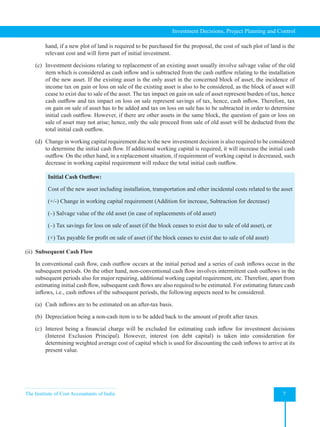
Initial Cash Outflow:
Cost of the new asset including installation, transportation and other incidental costs related to the asset
(+/-) Change in working capital requirement (Addition for increase, Subtraction for decrease)
(–) Salvage value of the old asset (in case of replacements of old asset)
(–) Tax savings for loss on sale of asset (if the block ceases to exist due to sale of old asset), or
(+) Tax payable for profit on sale of asset (if the block ceases to exist due to sale of old asset)
(ii) Subsequent Cash Flow
In conventional cash flow, cash outflow occurs at the initial period and a series of cash inflows occur in the
subsequent periods. On the other hand, non-conventional cash flow involves intermittent cash outflows in the
subsequent periods also for major repairing, additional working capital requirement, etc. Therefore, apart from
estimating initial cash flow, subsequent cash flows are also required to be estimated. For estimating future cash
inflows, i.e., cash inflows of the subsequent periods, the following aspects need to be considered.
(a) Cash inflows are to be estimated on an after-tax basis.
(b) Depreciation being a non-cash item is to be added back to the amount of profit after taxes.
(c) Interest being a financial charge will be excluded for estimating cash inflow for investment decisions
(Interest Exclusion Principal). However, interest (on debt capital) is taken into consideration for
determining weighted average cost of capital which is used for discounting the cash inflows to arrive at its
present value.
Strategic Financial Management
8 The Institute of Cost Accountants of India
Net Cash Inflow after Taxes (CFAT):
Net Sales Revenue
Less: Cost of Goods Sold
Less: General Expenses (other than Interest)
Less: Depreciation
Profit before Interest and Taxes (PBIT or EBIT)
Less: Taxes
Profit after Taxes (excluding Interest) [PAT]
Add: Depreciation
Net Cash Inflow after Taxes
In short, CFAT = EBIT (1 – t) + Depreciation [where, t is income tax rate]
Note: If PAT is taken from accounting records, which is arrived at after charging Interest, ‘Interest Net
of Taxes’ is to be added back along with the amount of Depreciation, i.e.,
PAT after charging Interest
Add: Depreciation
Add: Interest Net of Taxes (i.e., Total Interest – Tax on Interest)
Net Cash Inflow after Taxes
Consider the following illustration.
Illustration 1
` `
Net Sales Revenue 10,00,000
Less: Cost of Goods Sold 5,00,000
Less: Operating Expenses 2,00,000
Less: Depreciation 1,00,000 8,00,000
PBIT or EBIT 2,00,000
Less: Interest 50,000
PBT or EBT 1,50,000
Less: Tax (30%) 45,000
PAT 1,05,000
Net Cash Inflow after Taxes: `
EBIT 2,00,000
Less: Tax (30%) 60,000
1,40,000
Add: Depreciation 1,00,000
Net Cash Inflow after Taxes 2,40,000
The Institute of Cost Accountants of India 9
Investment Decisions, Project Planning and Control
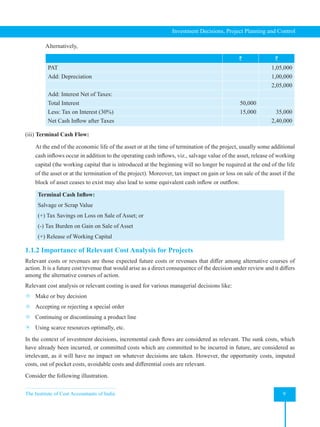
Alternatively,
` `
PAT 1,05,000
Add: Depreciation 1,00,000
2,05,000
Add: Interest Net of Taxes:
Total Interest 50,000
Less: Tax on Interest (30%) 15,000 35,000
Net Cash Inflow after Taxes 2,40,000
(iii) Terminal Cash Flow:
At the end of the economic life of the asset or at the time of termination of the project, usually some additional
cash inflows occur in addition to the operating cash inflows, viz., salvage value of the asset, release of working
capital (the working capital that is introduced at the beginning will no longer be required at the end of the life
of the asset or at the termination of the project). Moreover, tax impact on gain or loss on sale of the asset if the
block of asset ceases to exist may also lead to some equivalent cash inflow or outflow.
Terminal Cash Inflow:
Salvage or Scrap Value
(+) Tax Savings on Loss on Sale of Asset; or
(-) Tax Burden on Gain on Sale of Asset
(+) Release of Working Capital
1.1.2 Importance of Relevant Cost Analysis for Projects
Relevant costs or revenues are those expected future costs or revenues that differ among alternative courses of
action. It is a future cost/revenue that would arise as a direct consequence of the decision under review and it differs
among the alternative courses of action.
Relevant cost analysis or relevant costing is used for various managerial decisions like:
 Make or buy decision
 Accepting or rejecting a special order
 Continuing or discontinuing a product line
 Using scarce resources optimally, etc.
In the context of investment decisions, incremental cash flows are considered as relevant. The sunk costs, which
have already been incurred, or committed costs which are committed to be incurred in future, are considered as
irrelevant, as it will have no impact on whatever decisions are taken. However, the opportunity costs, imputed
costs, out of pocket costs, avoidable costs and differential costs are relevant.
Consider the following illustration.
Strategic Financial Management
10 The Institute of Cost Accountants of India
Illustration 2
A company is considering replacement of one of its old machines, purchased three years ago at a cost of `5,00,000
with a life of 5 years. It follows straight line method of depreciation. Annual revenue from the sale of the product
manufactured using the machine is `5,50,000 and the annual operating cost is `4,00,000. The current salvage value
of the machine is `1,00,000. The cost of the new machine is `3,00,000 and its salvage value at the end of its life 2
years is nil. The annual operating cost of the new machine is estimated at `2,30,000 and the revenue is expected to
be same as to that of the old machine.
Relevant Costs and Revenues are shown below:
Particulars Old New Difference Relevant or not
Revenue (For next two years) *
Book Value of Old Machine at the end of three years
Current Salvage Value
Cost of the new machine
Operating Cost (2 years)
11,00,000
2,00,000
1,00,000
--
8,00,000
11,00,000
--
--
3,00,000
4,60,000
Nil
--
1,00,000
(3,00,000)
3,40,000
Not Relevant
Not relevant
(Sunk Cost)
Relevant
Relevant
Relevant
*(as the old machine with a life of 5 years is being considered for replacement after 3 years)
1.1.3 Discounted Cash Flow Technique for Project Evaluation
For financial appraisal of the project / investment proposals different techniques are used. These methods or
techniques can broadly be categorized into two groups – Non-Discounted Cash Flow Methods and Discounted
Cash Flow.
Non-Discounted Cash Flow methods consider the cash flows over the life of the projects similarly. In other
words, here it is assumed that cash flows in different time periods do not have any time value and hence are directly
additive. These methods are again divided into two groups –
1. Accounting or Average Rate of Return (ARR)
2. Payback Period:
a. Traditional Payback Period
b. Payback Profitability
c. Payback Reciprocal
As against the Non-Discounted Cash Flow methods, Discounted Cash Flow methods assume that cash flow
over different time periods are not directly additive as they involve time value of money. Hence, before making
any analysis, one has to convert them into cash flows at the same parlance i.e. either compounded cash flows or
discounted cash flows. Since conceptually the latter is more realistic, these methods first convert the cash flows into
their present values and then conduct the analysis.
Depending upon a few other project specific considerations these methods can be as follows:
1. Discounted Pay Back Period
2. Net Present Value (NPV)
3. Profitability Index or Benefit Cost Ratio
4. Adjusted Net Present Value (ANPV)
5. Internal Rate of Return (IRR)
The Institute of Cost Accountants of India 11
Investment Decisions, Project Planning and Control
6. Modified NPV
7. Modified IRR
Non-Discounted Cash Flow Methods
1. Accounting or Average Rate of Return Method:
Accounting or average rate of return method Accounting or Average Rate of Return (ARR) method measures
the average annual net income out of the project (incremental income) as a percentage of the investment. After
calculation of ARR, the same is compared with a predetermined or minimum required rate of return or cut-off
rate set up by the management. The project is accepted if the ARR is higher than the minimum desired ARR.
ARR can be calculated as follows:
Accounting or Average Rate of Return (ARR) =
Average Annual Profit after Tax
Average Investment
× 100
Where, Average annual profit after tax =
Total profit after depreciation and tax of the whole life of the project /Project Life (in years)
Where equal amount of depreciation is charged every year,
Average Investment = Half of the Depreciable Part (Cost – Salvage Value) + Non-Depreciable Part (Salvage
Value).
In other cases, average investment is to be determined taking the book value of the investment of different
years separately and average is to calculated accordingly.
 Decision Rules:
1. Acceptance/Rejection Decision: A project is accepted if it generates returns higher than the target/cut
off ARR.
2. Mutually Exclusive Decision: The project which gives the highest ARR over the minimum required
rate of return, is acceptable.
Consider the following illustration.
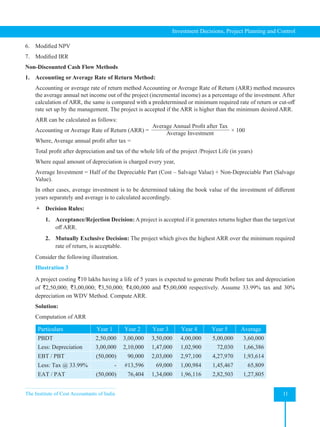
Illustration 3
A project costing `10 lakhs having a life of 5 years is expected to generate Profit before tax and depreciation
of `2,50,000; `3,00,000; `3,50,000; `4,00,000 and `5,00,000 respectively. Assume 33.99% tax and 30%
depreciation on WDV Method. Compute ARR.
Solution:
Computation of ARR
Particulars Year 1 Year 2 Year 3 Year 4 Year 5 Average
PBDT 2,50,000 3,00,000 3,50,000 4,00,000 5,00,000 3,60,000
Less: Depreciation 3,00,000 2,10,000 1,47,000 1,02,900 72,030 1,66,386
EBT / PBT (50,000) 90,000 2,03,000 2,97,100 4,27,970 1,93,614
Less: Tax @ 33.99% - #13,596 69,000 1,00,984 1,45,467 65,809
EAT / PAT (50,000) 76,404 1,34,000 1,96,116 2,82,503 1,27,805
Strategic Financial Management
12 The Institute of Cost Accountants of India
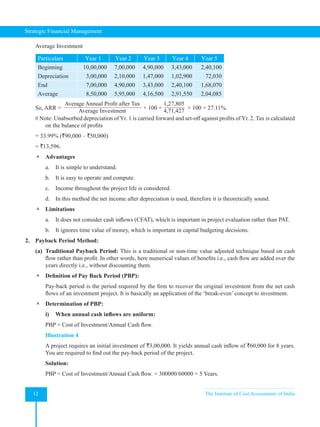
Average Investment
Particulars Year 1 Year 2 Year 3 Year 4 Year 5
Beginning 10,00,000 7,00,000 4,90,000 3,43,000 2,40,100
Depreciation 3,00,000 2,10,000 1,47,000 1,02,900 72,030
End 7,00,000 4,90,000 3,43,000 2,40,100 1,68,070
Average 8,50,000 5,95,000 4,16,500 2,91,550 2,04,085
So, ARR =
Average Annual Profit after Tax
Average Investment
× 100 =
1,27,805
4,71,427
  × 100 = 27.11%.
# Note: Unabsorbed depreciation of Yr. 1 is carried forward and set-off against profits of Yr. 2. Tax is calculated
on the balance of profits
= 33.99% (`90,000 – `50,000)
= `13,596.
 Advantages
a. It is simple to understand.
b. It is easy to operate and compute.
c. Income throughout the project life is considered.
d. In this method the net income after depreciation is used, therefore it is theoretically sound.
 Limitations
a. It does not consider cash inflows (CFAT), which is important in project evaluation rather than PAT.
b. It ignores time value of money, which is important in capital budgeting decisions.
2. Payback Period Method:
(a) Traditional Payback Period: This is a traditional or non-time value adjusted technique based on cash
flow rather than profit. In other words, here numerical values of benefits i.e., cash flow are added over the
years directly i.e., without discounting them.
 Definition of Pay Back Period (PBP):
Pay-back period is the period required by the firm to recover the original investment from the net cash
flows of an investment project. It is basically an application of the ‘break-even’ concept to investment.
 Determination of PBP:
i) When annual cash inflows are uniform:
PBP = Cost of Investment/Annual Cash flow.
Illustration 4
A project requires an initial investment of `3,00,000. It yields annual cash inflow of `60,000 for 8 years.
You are required to find out the pay-back period of the project.
Solution:
PBP = Cost of Investment/Annual Cash flow. = 300000/60000 = 5 Years.
The Institute of Cost Accountants of India 13
Investment Decisions, Project Planning and Control
ii) When the annual cash inflows are not uniform:
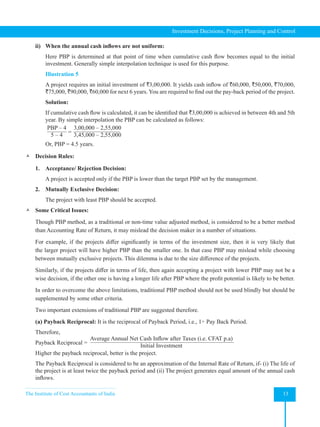
Here PBP is determined at that point of time when cumulative cash flow becomes equal to the initial
investment. Generally simple interpolation technique is used for this purpose.
Illustration 5
A project requires an initial investment of `3,00,000. It yields cash inflow of `60,000, `50,000, `70,000,
`75,000, `90,000, `60,000 for next 6 years. You are required to find out the pay-back period of the project.
Solution:
If cumulative cash flow is calculated, it can be identified that `3,00,000 is achieved in between 4th and 5th
year. By simple interpolation the PBP can be calculated as follows:
PBP – 4
5 – 4
=
3,00,000 – 2,55,000
3,45,000 – 2,55,000
Or, PBP = 4.5 years.
 Decision Rules:
1. Acceptance/ Rejection Decision:
A project is accepted only if the PBP is lower than the target PBP set by the management.
2. Mutually Exclusive Decision:
The project with least PBP should be accepted.
 Some Critical Issues:
Though PBP method, as a traditional or non-time value adjusted method, is considered to be a better method
than Accounting Rate of Return, it may mislead the decision maker in a number of situations.
For example, if the projects differ significantly in terms of the investment size, then it is very likely that
the larger project will have higher PBP than the smaller one. In that case PBP may mislead while choosing
between mutually exclusive projects. This dilemma is due to the size difference of the projects.
Similarly, if the projects differ in terms of life, then again accepting a project with lower PBP may not be a
wise decision, if the other one is having a longer life after PBP where the profit potential is likely to be better.
In order to overcome the above limitations, traditional PBP method should not be used blindly but should be
supplemented by some other criteria.
Two important extensions of traditional PBP are suggested therefore.
(a) Payback Reciprocal: It is the reciprocal of Payback Period, i.e., 1÷ Pay Back Period.
Therefore,
Payback Reciprocal =
Average Annual Net Cash Inflow after Taxes (i.e. CFAT p.a)
Initial Investment
Higher the payback reciprocal, better is the project.
The Payback Reciprocal is considered to be an approximation of the Internal Rate of Return, if- (i) The life of
the project is at least twice the payback period and (ii) The project generates equal amount of the annual cash
inflows.
Strategic Financial Management
14 The Institute of Cost Accountants of India
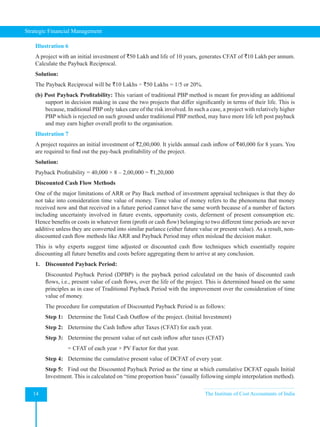
Illustration 6
A project with an initial investment of `50 Lakh and life of 10 years, generates CFAT of `10 Lakh per annum.
Calculate the Payback Reciprocal.
Solution:
The Payback Reciprocal will be `10 Lakhs ÷ `50 Lakhs = 1/5 or 20%.
(b) Post Payback Profitability: This variant of traditional PBP method is meant for providing an additional
support in decision making in case the two projects that differ significantly in terms of their life. This is
because, traditional PBP only takes care of the risk involved. In such a case, a project with relatively higher
PBP which is rejected on such ground under traditional PBP method, may have more life left post payback
and may earn higher overall profit to the organisation.
Illustration 7
A project requires an initial investment of `2,00,000. It yields annual cash inflow of `40,000 for 8 years. You
are required to find out the pay-back profitability of the project.
Solution:
Payback Profitability = 40,000 × 8 – 2,00,000 = `1,20,000
Discounted Cash Flow Methods
One of the major limitations of ARR or Pay Back method of investment appraisal techniques is that they do
not take into consideration time value of money. Time value of money refers to the phenomena that money
received now and that received in a future period cannot have the same worth because of a number of factors
including uncertainty involved in future events, opportunity costs, deferment of present consumption etc.
Hence benefits or costs in whatever form (profit or cash flow) belonging to two different time periods are never
additive unless they are converted into similar parlance (either future value or present value). As a result, non-
discounted cash flow methods like ARR and Payback Period may often mislead the decision maker.
This is why experts suggest time adjusted or discounted cash flow techniques which essentially require
discounting all future benefits and costs before aggregating them to arrive at any conclusion.
1. Discounted Payback Period:
Discounted Payback Period (DPBP) is the payback period calculated on the basis of discounted cash
flows, i.e., present value of cash flows, over the life of the project. This is determined based on the same
principles as in case of Traditional Payback Period with the improvement over the consideration of time
value of money.
The procedure for computation of Discounted Payback Period is as follows:
Step 1: Determine the Total Cash Outflow of the project. (Initial Investment)
Step 2: Determine the Cash Inflow after Taxes (CFAT) for each year.
Step 3: Determine the present value of net cash inflow after taxes (CFAT)
= CFAT of each year × PV Factor for that year.
Step 4: Determine the cumulative present value of DCFAT of every year.
Step 5: Find out the Discounted Payback Period as the time at which cumulative DCFAT equals Initial
Investment. This is calculated on “time proportion basis” (usually following simple interpolation method).
The Institute of Cost Accountants of India 15
Investment Decisions, Project Planning and Control
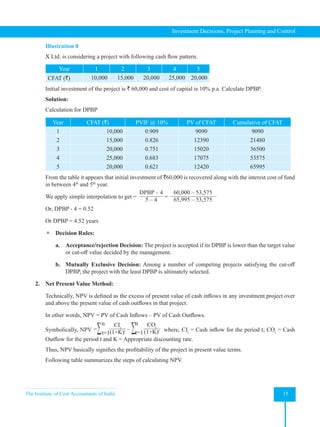
Illustration 8
X Ltd. is considering a project with following cash flow pattern.
Year 1 2 3 4 5
CFAT (`) 10,000 15,000 20,000 25,000 20,000
Initial investment of the project is ` 60,000 and cost of capital is 10% p.a. Calculate DPBP.
Solution:
Calculation for DPBP
Year CFAT (`) PVIF @ 10% PV of CFAT Cumulative of CFAT
1 10,000 0.909 9090 9090
2 15,000 0.826 12390 21480
3 20,000 0.751 15020 36500
4 25,000 0.683 17075 53575
5 20,000 0.621 12420 65995
From the table it appears that initial investment of `60,000 is recovered along with the interest cost of fund
in between 4th
and 5th
year.
We apply simple interpolation to get =  
DPBP – 4
5 – 4
=
60,000 – 53,575
65,995 – 53,575
Or, DPBP - 4 = 0.52
Or DPBP = 4.52 years
 Decision Rules:
a. Acceptance/rejection Decision: The project is accepted if its DPBP is lower than the target value
or cut-off value decided by the management.
b. Mutually Exclusive Decision: Among a number of competing projects satisfying the cut-off
DPBP, the project with the least DPBP is ultimately selected.
2. Net Present Value Method:
Technically, NPV is defined as the excess of present value of cash inflows in any investment project over
and above the present value of cash outflows in that project.
In other words, NPV = PV of Cash Inflows – PV of Cash Outflows.
Symbolically, NPV =∑ CIt
(1+K)t
n
t=1
– ∑ COt
(1+K)t
n
t=1 where, CIt
= Cash inflow for the period t; COt
= Cash
Outflow for the period t and K = Appropriate discounting rate.
Thus, NPV basically signifies the profitability of the project in present value terms.
Following table summarizes the steps of calculating NPV.
Strategic Financial Management
16 The Institute of Cost Accountants of India
Steps
Projects with Non-conventional Cash Flow
Structure
Projects with Conventional Cash Flow
Structure
1. Determine the cash inflows and outflows associated with the project (CIand CO)
2. Identify the appropriate discounting rate (preferably the cost of capital)
3. Calculate the present value of all cash inflows i.e., ∑ CIt
(1+K)t
n
t=1
4. Calculate the present value of all cash outflows
i.e. ∑ COt
(1+K)t
n
t=1
Calculate the total cash outflow at the
beginning of the project (CO0
i.e. I0
)
5. Determine NPV = Step 3 – Step 4
i.e., NPV =∑ CIt
(1+K)t
n
t=1
– ∑ COt
(1+K)t
n
t=1
NPV = ∑ CIt
(1+K)t
n
t=1
– I0
 Decision Rules:
1. Acceptance/Rejection Decision: Since, NPV basically denotes the time value adjusted
profitability of a project, a project is accepted if its NPV is positive and rejected if the NPV is
negative.
2. Mutually Exclusive Decision: In case of mutually exclusive projects (where one out of two or
more projects is to be selected), the projects are first ranked based on their respective NPV and
then the project with highest NPV is selected.
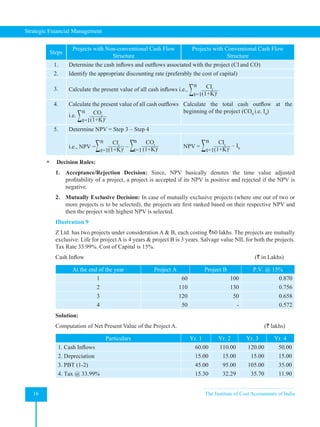
Illustration 9
Z Ltd. has two projects under consideration A & B, each costing `60 lakhs. The projects are mutually
exclusive. Life for project A is 4 years & project B is 3 years. Salvage value NIL for both the projects.
Tax Rate 33.99%. Cost of Capital is 15%.
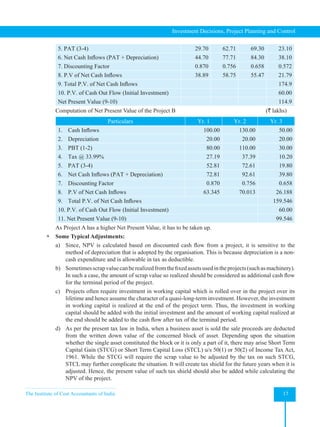
Cash Inflow            (` in Lakhs)
At the end of the year Project A Project B P.V. @ 15%
1 60 100 0.870
2 110 130 0.756
3 120 50 0.658
4 50 - 0.572
Solution:
Computation of Net Present Value of the Project A.    (` lakhs)
Particulars Yr. 1 Yr. 2 Yr. 3 Yr. 4
1. Cash Inflows 60.00 110.00 120.00 50.00
2. Depreciation 15.00 15.00 15.00 15.00
3. PBT (1-2) 45.00 95.00 105.00 35.00
4. Tax @ 33.99% 15.30 32.29 35.70 11.90
The Institute of Cost Accountants of India 17
Investment Decisions, Project Planning and Control
5. PAT (3-4) 29.70 62.71 69.30 23.10
6. Net Cash Inflows (PAT + Depreciation) 44.70 77.71 84.30 38.10
7. Discounting Factor 0.870 0.756 0.658 0.572
8. P.V of Net Cash Inflows 38.89 58.75 55.47 21.79
9. Total P.V. of Net Cash Inflows 174.9
10. P.V. of Cash Out Flow (Initial Investment) 60.00
Net Present Value (9-10) 114.9
Computation of Net Present Value of the Project B     (` lakhs)
Particulars Yr. 1 Yr. 2 Yr. 3
1. Cash Inflows 100.00 130.00 50.00
2. Depreciation 20.00 20.00 20.00
3. PBT (1-2) 80.00 110.00 30.00
4. Tax @ 33.99% 27.19 37.39 10.20
5. PAT (3-4) 52.81 72.61 19.80
6. Net Cash Inflows (PAT + Depreciation) 72.81 92.61 39.80
7. Discounting Factor 0.870 0.756 0.658
8. P.V of Net Cash Inflows 63.345 70.013 26.188
9. Total P.V. of Net Cash Inflows 159.546
10. P.V. of Cash Out Flow (Initial Investment) 60.00
11. Net Present Value (9-10) 99.546
As Project A has a higher Net Present Value, it has to be taken up.
 Some Typical Adjustments:
a) Since, NPV is calculated based on discounted cash flow from a project, it is sensitive to the
method of depreciation that is adopted by the organisation. This is because depreciation is a non-
cash expenditure and is allowable in tax as deductible.
b) Sometimesscrapvaluecanberealizedfromthefixedassetsusedintheprojects(suchasmachinery).
In such a case, the amount of scrap value so realized should be considered as additional cash flow
for the terminal period of the project.
c) Projects often require investment in working capital which is rolled over in the project over its
lifetime and hence assume the character of a quasi-long-term investment. However, the investment
in working capital is realized at the end of the project term. Thus, the investment in working
capital should be added with the initial investment and the amount of working capital realized at
the end should be added to the cash flow after tax of the terminal period.
d) As per the present tax law in India, when a business asset is sold the sale proceeds are deducted
from the written down value of the concerned block of asset. Depending upon the situation
whether the single asset constituted the block or it is only a part of it, there may arise Short Term
Capital Gain (STCG) or Short Term Capital Loss (STCL) u/s 50(1) or 50(2) of Income Tax Act,
1961. While the STCG will require the scrap value to be adjusted by the tax on such STCG,
STCL may further complicate the situation. It will create tax shield for the future years when it is
adjusted. Hence, the present value of such tax shield should also be added while calculating the
NPV of the project.
Strategic Financial Management
18 The Institute of Cost Accountants of India
 Advantages
a. It considers the time value of money. Hence it satisfies the basic criterion for project evaluation.
b. Unlike payback period, all cash flows (including post-payback returns) are considered.
c. NPV constitutes addition to the wealth of Shareholders and thus focuses on the basic objective of
financial management.
d. Since all cash flows are converted into present value (current rupees), different projects can be
compared on NPV basis. Thus, each project can be evaluated independent of others on its own
merit.
 Disadvantages
a. It involves complex calculations in discounting and present value computations.
b. It involves forecasting cash flows and application of discount rate. Thus, accuracy of NPV depends
on accurate estimation of these two factors which may be quite difficult to forecast in practice.
c. NPV and project ranking may differ at different discount rates, causing inconsistency in decision-
making.
d. It ignores the difference in initial outflows i.e., size of different proposals while evaluating
mutually exclusive projects.
e. Similarly, comparing projects with different lifespan may not be appropriate under NPV criterion.
3. Profitability Index: Net Present Value, as a criterion for project appraisal, often becomes inappropriate
when the competing projects have similar lifespan but significantly different initial outlay. This is because
NPV is an absolute measure and hence does not recognize the size difference (difference in the size of
investment or cash outflow) between two competing projects.
Thus, a refinement of NPV is suggested in form of a new method, called Profitability Index (PI) method.
PI is defined as the ratio between the present value of cash inflow to the present value of cash outflow or
investment.
That is to say, PI =
Present Value of Cash Inflow
Present Value of Cash Outflow
(for non-conventional cash flow) or,
=
Present Value of Cash Inflow
Initial Outlay
  (for conventional cash flow)
Thus, basically PI calculates the present value of cash inflow or benefit per rupee of present value of cash
outflow (or initial outlay) or cost. This is why it is also called Benefit-Cost Ratio.
Illustration 10
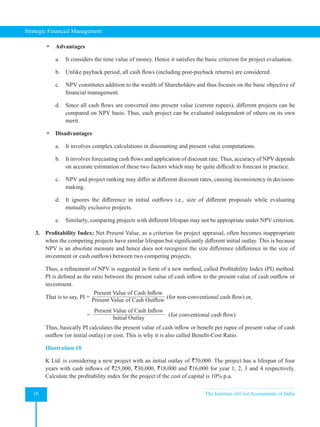
K Ltd. is considering a new project with an initial outlay of `70,000. The project has a lifespan of four
years with cash inflows of `25,000, `30,000, `18,000 and `16,000 for year 1, 2, 3 and 4 respectively.
Calculate the profitability index for the project if the cost of capital is 10% p.a.
The Institute of Cost Accountants of India 19
Investment Decisions, Project Planning and Control
Solution:
Calculation for PV of Cash Inflow
Year CFAT (`) PVIF@ 10% PV of CFAT (`)
1 25,000 0.909 22,725
2 30,000 0.826 24,780
3 18,000 0.751 13,518
4 16,000 0.683 10,928
Total PV of CFAT 71,951
So, PI =
Present Value of Cash Inflow
Initial Outlay
=
71951
70000
= 1.028
 Decision Rules
a) Acceptance/Rejection Decision: A project is accepted if its PI is more than one and rejected if
the PI is less than one. For a project with PI equals to one, the decision maker remains indifferent.
For example, in illustration 10, the investment project is having a PI of 1.028. Hence the project
may be accepted.
b) Mutually Exclusive Decision: In case of mutually exclusive projects, the projects are first ranked
based on their respective PI and then the project with highest PI is selected.
Consider the following illustration.
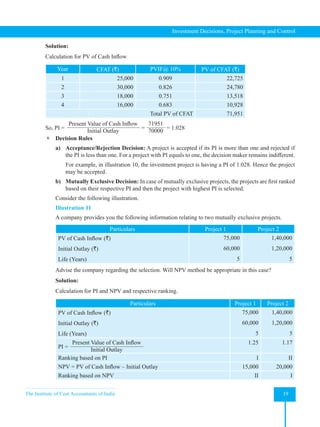
Illustration 11
A company provides you the following information relating to two mutually exclusive projects.
Particulars Project 1 Project 2
PV of Cash Inflow (`)
Initial Outlay (`)
Life (Years)
75,000
60,000
5
1,40,000
1,20,000
5
Advise the company regarding the selection. Will NPV method be appropriate in this case?
Solution:
Calculation for PI and NPV and respective ranking.
Particulars Project 1 Project 2
PV of Cash Inflow (`)
Initial Outlay (`)
Life (Years)
75,000
60,000
5
1,40,000
1,20,000
5
PI =
Present Value of Cash Inflow
Initial Outlay
1.25 1.17
Ranking based on PI I II
NPV = PV of Cash Inflow – Initial Outlay 15,000 20,000
Ranking based on NPV II I
Strategic Financial Management
20 The Institute of Cost Accountants of India
SincePIishigherforProject1,itoffershigherbenefitperrupeeofinvestment.Henceitisrecommended.
It may be worth mentioning that, NPV will not be appropriate as project 2, though offers higher NPV
also have higher initial outlay. Hence the absolute value of NPV is not comparable at all.
 Advantages:
a. This method considers the time value of money.
b. It is a better project evaluation technique than Net Present Value and helps in ranking projects
where Net Present Value is positive.
c. It focuses on maximum return per rupee of investment and hence is useful in case of investment
in divisible projects, when availability of funds is restricted.
 Disadvantages:
a. In case a single large project with high Profitability Index is selected, possibility of accepting
several small projects which together may have higher NPV than the single project, is excluded.
b. Situations may arise where a project with a lower profitability index selected may generate cash
flows in such a way that another project can be taken up one or two years later, the total NPV in
such case being more than the one with a project with highest Profitability Index.
c. In case of more than one proposal, which are mutually exclusive, with different investment
patterns or values, profitability index alone cannot be used as a measure for choosing.
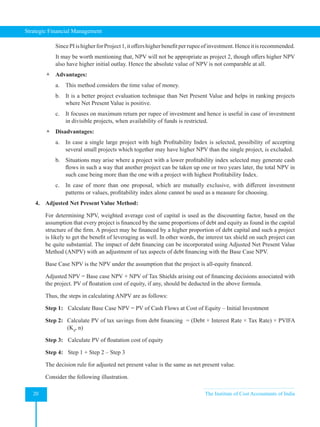
4. Adjusted Net Present Value Method:
For determining NPV, weighted average cost of capital is used as the discounting factor, based on the
assumption that every project is financed by the same proportions of debt and equity as found in the capital
structure of the firm. A project may be financed by a higher proportion of debt capital and such a project
is likely to get the benefit of leveraging as well. In other words, the interest tax shield on such project can
be quite substantial. The impact of debt financing can be incorporated using Adjusted Net Present Value
Method (ANPV) with an adjustment of tax aspects of debt financing with the Base Case NPV.
Base Case NPV is the NPV under the assumption that the project is all-equity financed.
Adjusted NPV = Base case NPV + NPV of Tax Shields arising out of financing decisions associated with
the project. PV of floatation cost of equity, if any, should be deducted in the above formula.
Thus, the steps in calculating ANPV are as follows:
Step 1: Calculate Base Case NPV = PV of Cash Flows at Cost of Equity – Initial Investment
Step 2: Calculate PV of tax savings from debt financing  = (Debt × Interest Rate × Tax Rate) × PVIFA
(Kd
, n)
Step 3: Calculate PV of floatation cost of equity
Step 4: Step 1 + Step 2 – Step 3
The decision rule for adjusted net present value is the same as net present value.
Consider the following illustration.
The Institute of Cost Accountants of India 21
Investment Decisions, Project Planning and Control
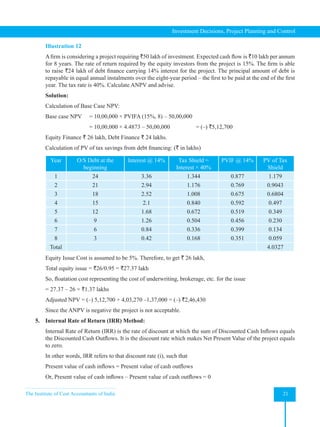
Illustration 12
Afirm is considering a project requiring `50 lakh of investment. Expected cash flow is `10 lakh per annum
for 8 years. The rate of return required by the equity investors from the project is 15%. The firm is able
to raise `24 lakh of debt finance carrying 14% interest for the project. The principal amount of debt is
repayable in equal annual instalments over the eight-year period – the first to be paid at the end of the first
year. The tax rate is 40%. Calculate ANPV and advise.
Solution:
Calculation of Base Case NPV:
Base case NPV = 10,00,000 × PVIFA (15%, 8) – 50,00,000
			 = 10,00,000 × 4.4873 – 50,00,000 		 = (–) `5,12,700
Equity Finance ` 26 lakh, Debt Finance ` 24 lakhs.
Calculation of PV of tax savings from debt financing: (` in lakhs)
Year O/S Debt at the
beginning
Interest @ 14% Tax Shield =
Interest × 40%
PVIF @ 14% PV of Tax
Shield
1 24 3.36 1.344 0.877 1.179
2 21 2.94 1.176 0.769 0.9043
3 18 2.52 1.008 0.675 0.6804
4 15 2.1 0.840 0.592 0.497
5 12 1.68 0.672 0.519 0.349
6 9 1.26 0.504 0.456 0.230
7 6 0.84 0.336 0.399 0.134
8 3 0.42 0.168 0.351 0.059
Total 4.0327
Equity Issue Cost is assumed to be 5%. Therefore, to get ` 26 lakh,
Total equity issue = `26/0.95 = `27.37 lakh
So, floatation cost representing the cost of underwriting, brokerage, etc. for the issue
= 27.37 – 26 = `1.37 lakhs
Adjusted NPV = (–) 5,12,700 + 4,03,270 –1,37,000 = (–) `2,46,430
Since the ANPV is negative the project is not acceptable.
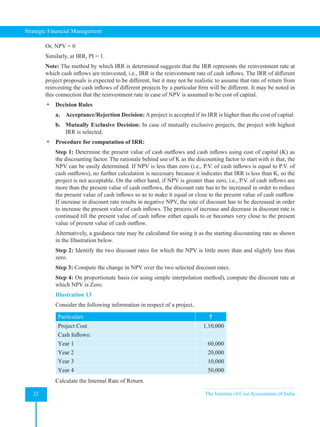
5. Internal Rate of Return (IRR) Method:
Internal Rate of Return (IRR) is the rate of discount at which the sum of Discounted Cash Inflows equals
the Discounted Cash Outflows. It is the discount rate which makes Net Present Value of the project equals
to zero.
In other words, IRR refers to that discount rate (i), such that
Present value of cash inflows = Present value of cash outflows
Or, Present value of cash inflows – Present value of cash outflows = 0
Strategic Financial Management
22 The Institute of Cost Accountants of India
Or, NPV = 0
Similarly, at IRR, PI = 1.
Note: The method by which IRR is determined suggests that the IRR represents the reinvestment rate at
which cash inflows are reinvested, i.e., IRR is the reinvestment rate of cash inflows. The IRR of different
project proposals is expected to be different, but it may not be realistic to assume that rate of return from
reinvesting the cash inflows of different projects by a particular firm will be different. It may be noted in
this connection that the reinvestment rate in case of NPV is assumed to be cost of capital.
 Decision Rules
a. Acceptance/Rejection Decision: A project is accepted if its IRR is higher than the cost of capital.
b. Mutually Exclusive Decision: In case of mutually exclusive projects, the project with highest
IRR is selected.
 Procedure for computation of IRR:
Step 1: Determine the present value of cash outflows and cash inflows using cost of capital (K) as
the discounting factor. The rationale behind use of K as the discounting factor to start with is that, the
NPV can be easily determined. If NPV is less than zero (i.e., P.V. of cash inflows is equal to P.V. of
cash outflows), no further calculation is necessary because it indicates that IRR is less than K, so the
project is not acceptable. On the other hand, if NPV is greater than zero, i.e., P.V. of cash inflows are
more than the present value of cash outflows, the discount rate has to be increased in order to reduce
the present value of cash inflows so as to make it equal or close to the present value of cash outflow.
If increase in discount rate results in negative NPV, the rate of discount has to be decreased in order
to increase the present value of cash inflows. The process of increase and decrease in discount rate is
continued till the present value of cash inflow either equals to or becomes very close to the present
value of present value of cash outflow.
Alternatively, a guidance rate may be calculated for using it as the starting discounting rate as shown
in the Illustration below.
Step 2: Identify the two discount rates for which the NPV is little more than and slightly less than
zero.
Step 3: Compute the change in NPV over the two selected discount rates.
Step 4: On proportionate basis (or using simple interpolation method), compute the discount rate at
which NPV is Zero.
Illustration 13
Consider the following information in respect of a project.
Particulars `
Project Cost 1,10,000
Cash Inflows:
Year 1 60,000
Year 2 20,000
Year 3 10,000
Year 4 50,000
Calculate the Internal Rate of Return.
The Institute of Cost Accountants of India 23
Investment Decisions, Project Planning and Control
Solution:
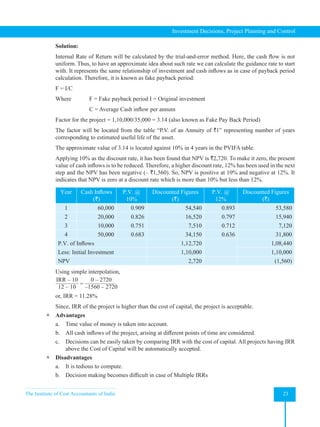
Internal Rate of Return will be calculated by the trial-and-error method. Here, the cash flow is not
uniform. Thus, to have an approximate idea about such rate we can calculate the guidance rate to start
with. It represents the same relationship of investment and cash inflows as in case of payback period
calculation. Therefore, it is known as fake payback period:
F = I/C
Where    F = Fake payback period I = Original investment
C = Average Cash inflow per annum
Factor for the project = 1,10,000/35,000 = 3.14 (also known as Fake Pay Back Period)
The factor will be located from the table “P.V. of an Annuity of `1” representing number of years
corresponding to estimated useful life of the asset.
The approximate value of 3.14 is located against 10% in 4 years in the PVIFA table.
Applying 10% as the discount rate, it has been found that NPV is `2,720. To make it zero, the present
value of cash inflows is to be reduced. Therefore, a higher discount rate, 12% has been used in the next
step and the NPV has been negative (– `1,560). So, NPV is positive at 10% and negative at 12%. It
indicates that NPV is zero at a discount rate which is more than 10% but less than 12%.
Year Cash Inflows
(`)
P.V. @
10%
Discounted Figures
(`)
P.V. @
12%
Discounted Figures
(`)
1 60,000 0.909 54,540 0.893 53,580
2 20,000 0.826 16,520 0.797 15,940
3 10,000 0.751 7,510 0.712 7,120
4 50,000 0.683 34,150 0.636 31,800
P.V. of Inflows 1,12,720 1,08,440
Less: Initial Investment 1,10,000 1,10,000
NPV 2,720 (1,560)
Using simple interpolation,
IRR – 10
12 – 10
=
0 – 2720
–1560 – 2720
or, IRR = 11.28%
Since, IRR of the project is higher than the cost of capital, the project is acceptable.
 Advantages
a. Time value of money is taken into account.
b. All cash inflows of the project, arising at different points of time are considered.
c. Decisions can be easily taken by comparing IRR with the cost of capital. All projects having IRR
above the Cost of Capital will be automatically accepted.
 Disadvantages
a. It is tedious to compute.
b. Decision making becomes difficult in case of Multiple IRRs
Strategic Financial Management
24 The Institute of Cost Accountants of India
c. It may conflict with NPV in case of difference in inflow/ outflow patterns, or size of investment,
or life of the alternative proposals.
d. The presumption that all the future cash inflows of a proposal are reinvested at a rate equal to the
IRR may not be practically valid.
 Multiple IRR
In case of projects with non-conventional cashflow, there may be multiple IRRs.
Consider the following illsutration.
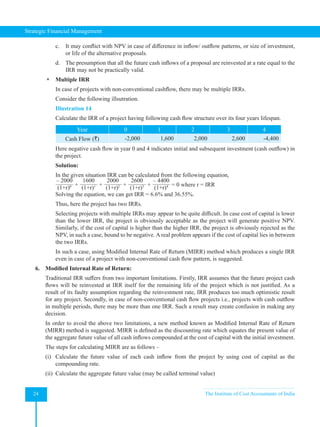
Illustration 14
Calculate the IRR of a project having following cash flow structure over its four years lifespan.
Year 0 1 2 3 4
Cash Flow (`) -2,000 1,600 2,000 2,600 -4,400
Here negative cash flow in year 0 and 4 indicates initial and subsequent investment (cash outflow) in
the project.
Solution:
In the given situation IRR can be calculated from the following equation,
– 2000
(1+r)0 +
1600
(1+r)1 +
2000
(1+r)2 +
2600
(1+r)3 +
– 4400
(1+r)4 = 0 where r = IRR
Solving the equation, we can get IRR = 6.6% and 36.55%.
Thus, here the project has two IRRs.
Selecting projects with multiple IRRs may appear to be quite difficult. In case cost of capital is lower
than the lower IRR, the project is obviously acceptable as the project will generate positive NPV.
Similarly, if the cost of capital is higher than the higher IRR, the project is obviously rejected as the
NPV, in such a case, bound to be negative. A real problem appears if the cost of capital lies in between
the two IRRs.
In such a case, using Modified Internal Rate of Return (MIRR) method which produces a single IRR
even in case of a project with non-conventional cash flow pattern, is suggested.
6. Modified Internal Rate of Return:
Traditional IRR suffers from two important limitations. Firstly, IRR assumes that the future project cash
flows will be reinvested at IRR itself for the remaining life of the project which is not justified. As a
result of its faulty assumption regarding the reinvestment rate, IRR produces too much optimistic result
for any project. Secondly, in case of non-conventional cash flow projects i.e., projects with cash outflow
in multiple periods, there may be more than one IRR. Such a result may create confusion in making any
decision.
In order to avoid the above two limitations, a new method known as Modified Internal Rate of Return
(MIRR) method is suggested. MIRR is defined as the discounting rate which equates the present value of
the aggregate future value of all cash inflows compounded at the cost of capital with the initial investment.
The steps for calculating MIRR are as follows –
(i) Calculate the future value of each cash inflow from the project by using cost of capital as the
compounding rate.
(ii) Calculate the aggregate future value (may be called terminal value)
The Institute of Cost Accountants of India 25
Investment Decisions, Project Planning and Control
(iii) Calculate initial investment (in case of conventional cash flow project) or present value of all cash
outflow (in case of non-conventional cash flow project).
(iv) Determine the discounting rate that equates the present value of the aggregate future value with the
initial investment or present value of all cash outflow. Such rate will be the MIRR.
A direct formula for MIRR can be obtained as follows –
Aggregate PV of cash outflow or Initial Investment =
Aggregate FV of Cash Inflow
(1 + MIRR)n (Here, n = project life).
Therefore, MIRR =
Aggregate Future Value of Cash Inflow
Aggregate Present Value of Cash Outflow
√
n
  – 1 (For Non-conventional cash flow) or,
  MIRR =
Aggregate Future Value of Cash Inflow
Initial Investment
√
n
  – 1 (For conventional cash flow).
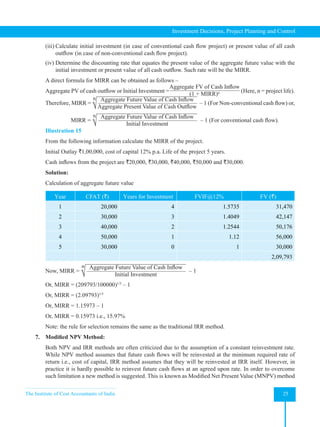
Illustration 15
From the following information calculate the MIRR of the project.
Initial Outlay `1,00,000, cost of capital 12% p.a. Life of the project 5 years.
Cash inflows from the project are `20,000, `30,000, `40,000, `50,000 and `30,000.
Solution:
Calculation of aggregate future value
Year CFAT (`) Years for Investment FVIF@12% FV (`)
1 20,000 4 1.5735 31,470
2 30,000 3 1.4049 42,147
3 40,000 2 1.2544 50,176
4 50,000 1 1.12 56,000
5 30,000 0 1 30,000
2,09,793
Now, MIRR =
Aggregate Future Value of Cash Inflow
Initial Investment
√
n
– 1
Or, MIRR = (209793/100000)1/5
– 1
Or, MIRR = (2.09793)1/5
Or, MIRR = 1.15973 – 1
Or, MIRR = 0.15973 i.e., 15.97%
Note: the rule for selection remains the same as the traditional IRR method.
7. Modified NPV Method:
Both NPV and IRR methods are often criticized due to the assumption of a constant reinvestment rate.
While NPV method assumes that future cash flows will be reinvested at the minimum required rate of
return i.e., cost of capital, IRR method assumes that they will be reinvested at IRR itself. However, in
practice it is hardly possible to reinvest future cash flows at an agreed upon rate. In order to overcome
such limitation a new method is suggested. This is known as Modified Net Present Value (MNPV) method
Strategic Financial Management
26 The Institute of Cost Accountants of India
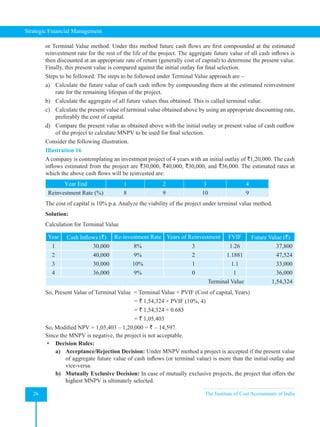
or Terminal Value method. Under this method future cash flows are first compounded at the estimated
reinvestment rate for the rest of the life of the project. The aggregate future value of all cash inflows is
then discounted at an appropriate rate of return (generally cost of capital) to determine the present value.
Finally, this present value is compared against the initial outlay for final selection.
Steps to be followed: The steps to be followed under Terminal Value approach are –
a) Calculate the future value of each cash inflow by compounding them at the estimated reinvestment
rate for the remaining lifespan of the project.
b) Calculate the aggregate of all future values thus obtained. This is called terminal value.
c) Calculate the present value of terminal value obtained above by using an appropriate discounting rate,
preferably the cost of capital.
d) Compare the present value as obtained above with the initial outlay or present value of cash outflow
of the project to calculate MNPV to be used for final selection.
Consider the following illustration.
Illustration 16
A company is contemplating an investment project of 4 years with an initial outlay of `1,20,000. The cash
inflows estimated from the project are `30,000, `40,000, `30,000, and `36,000. The estimated rates at
which the above cash flows will be reinvested are:
Year End 1 2 3 4
Reinvestment Rate (%) 8 9 10 9
The cost of capital is 10% p.a. Analyze the viability of the project under terminal value method.
Solution:
Calculation for Terminal Value
Year Cash Inflows (`) Re-investment Rate Years of Reinvestment FVIF Future Value (`)
1 30,000 8% 3 1.26 37,800
2 40,000 9% 2 1.1881 47,524
3 30,000 10% 1 1.1 33,000
4 36,000 9% 0 1 36,000
Terminal Value 1,54,324
So, Present Value of Terminal Value  = Terminal Value × PVIF (Cost of capital, Years)
= ` 1,54,324 × PVIF (10%, 4)
= ` 1,54,324 × 0.683
= ` 1,05,403
So, Modified NPV = 1,05,403 – 1,20,000 = ` – 14,597.
Since the MNPV is negative, the project is not acceptable.
 Decision Rules:
a) Acceptance/Rejection Decision: Under MNPV method a project is accepted if the present value
of aggregate future value of cash inflows (or terminal value) is more than the initial outlay and
vice-versa.
b) Mutually Exclusive Decision: In case of mutually exclusive projects, the project that offers the
highest MNPV is ultimately selected.
The Institute of Cost Accountants of India 27
Investment Decisions, Project Planning and Control
1.2
1.2.1 Conflict between NPV and IRR
T
hough in case of a single independent project application of both NPV and IRR methods always choose the
same project, while evaluating mutually exclusive projects, the results sometimes lead to conflict. In other
words, the project which is acceptable under NPV may not be so under IRR and vice-versa.
Such conflict may arise because of three reasons:
a) Difference in the timing of cash flow or cash flow pattern of alternative projects, known as time disparity in
cash flow.
b) Difference in the life expectancy of the alternative projects known as life disparity.
c) Difference in the investment size (size of cash outflow) of the alternative projects known as scale or size
disparity.
These are disussed below with the help of numerical illustrations:
a) Time Disparity in Cash Flows:
Time disparity in cash flows essentially implies that the cash flow patterns of the competing projects are
significantly different. In other words, though the total cash flow is more or less similar, they accrue differently.
In case of one project early cashflows are higher while for the other cash flow during the later period of the
project are higher. In such a situation there may be difference in the ranking based on NPV and that based on
IRR.
Illustration 17
PQR Ltd is considering two projects X and Y. The cash flows associated with the project are as follows:
Project I Project II
` `
Investment 2,20,000 2,20,000
Year 1 62,000 1,42,000
Year 2 80,000 80,000
Year 3 1,00,000 82,000
Year 4 1,40,000 40,000
Cost of capital 10% p.a.
Evaluate the projects under NPV and under IRR method.
NPV and IRR - Conflict and Resolution, MIRR,
Comparing Projects with Unequal Lives, The
ConceptofAbandonmentValue,MACRS
Strategic Financial Management
28 The Institute of Cost Accountants of India
Solution:
The results of NPV and IRR can be summarized as follows –
Project I Project II
NPV (`) 73,158 64,135
Ranking based on NPV 1 2
IRR (appx.) 22.61% 25.99%
Ranking based on IRR 2 1
From the above table it is clear that the results of NPV and IRR are contradictory. Here, both the projects have
similar lifespan and also similar investment size. So, the source of conflict is the timing of cash flow or the
pattern of cash flow.
 Resolution of the Conflict (Modified IRR and Modified NPV)
The conflict between NPV and IRR due to time disparity may be resolved using Modified version of NPV or
IRR (MNPV or MIRR) as follows.
Using reinvestment rate of 14% (as assumed),
TVI
= 62000 (1 + .14)3
+ 80000 (1 + .14)2
+ 100000 (1 + .14)1
+ 140000 (1 + .14)0
= 4,49,824
TVII
= 142000 (1 + .14)3
+ 80000 (1 + .14)2
+ 82000 (1 + .14)1
+ 40000 (1 + .14)0
= 4,47,827
MNPV(I) = {449824 ÷ (1 +.10)4
} – 220000 = 87,235
MNPV(II) = {447827 ÷ (1 +.10)4
} – 220000 = 85,871
MIRR(I) = (449824 ÷220000)1/4
– 1 = 19.58%
MIRR(II)   = (447827 ÷220000)1/4
– 1 = 19.44%
Thus, under both the MIRR and MNPV, project I is acceptable.
Note: For theoretical discussion on MIRR, follow the previous explanations.
b) Life Disparity:
Another source of conflict may be the life disparity i.e., different project lifespan. That is to say, while one is a
long duration project, the other is a relatively short duration project.
Illustration 18
XYZ Ltd is considering two investment projects A and B. Project A has a life of only one year whereas project
B has a lifespan of 3 years. The cash flows associated with the project are as follows:
Year Project A (`) Project B (`)
1
2
3
7,50,000
–
–
2,00,000
2,00,000
7,00,000
Both the projects require initial investment of ` 5,00,000 and cost of capital is 12% p.a. Evaluate the projects
under NPV and IRR.
Solution:
The results of NPV and IRR can be summarized as follows –
The Institute of Cost Accountants of India 29
Investment Decisions, Project Planning and Control
Particulars Project A Project B
NPV (`) 1,69,643 3,36,256
Ranking based on NPV II I
IRR 50% 40%
Ranking based on IRR I II
From the above table it is clear that the results of NPV and IRR are contradictory. Since investment size of the
projects is same, the source of conflict is the life of the projects.
Resolution of Conflict (Equivalent Annual Benefit i.e., EAB Approach for Projects with Unequal Lives)
The conflict between NPV and IRR due to life disparity can resolved by using Equivalent Annual Benefit
(EAB) or Equivalent Annual Cost (EAC) method.
Equivalent Annual Benefit (EAB) or Equivalent annual cost (EAC) is the annual cost of owning, operating,
and maintaining an asset over its entire life. Apart from resolving the conflict between NPV and IRR for
mutually exclusive projects, this method can be used whenever two projects with unequal live are compared
under NPV method.
EAB = NPV × Capital Recovery Factor or NPV ÷ PVIFA
Here, Capital Recovery Factor is the inverse of PVIFA.
In the context of our example, EAB approach may be followed as follows.
PVIFA for project A =
1
1.121 = 0.893
PVIFA for project B = (0.893 + 0.797 + 0.712) = 2.402
So, Capital recovery Factor (Project A) = 1 ÷ 0.893 = 1.12
And Capital recovery Factor (Project B) = 1 ÷ 2.402 = 0.416
So, EAB (Project A) = 169750 × 1.12 = ` 1,90,000
EAB (Project B) = 336400 × 0.416 = `1,39,882
Based on EAB, Project A is better.
c) Scale or Size Disparity:
Since IRR is a relative measure and NPV is an absolute measure, conflict in ranking may also arise in case the
projects differ significantly in their investment size.
Illustration 19
ABC Ltd is considering two investment projects X and Y. The cash flows associated with the project is as
follows.
Year Project X (`) Project Y (`)
1
2
3
4
5
4,000
4,000
4,000
4,000
4,000
14,000
14,000
14,000
14,000
14,000
Strategic Financial Management
30 The Institute of Cost Accountants of India
Initial investment for project X is `10,000 whereas that for project B is `40,000. If cost of capital is 10%,
evaluate the two projects based on NPV and IRR.
Solution:
Calculation for NPV of the projects
Particulars Project X Project Y
1. Annual CFAT (`)
2. PVIFA (10%, 5 Years)
3. Total PV (1 × 2)
4. Initial Investment
5. NPV (3 – 4)
4,000
3.79
15,160
10,000
5,163
14,000
3.79
53,060
40,000
13,071
Using the normal trial and error approach, we get,
IRR (A) = 50%
IRR (B) = 40%
So, the results can be summarized as follows –
Particulars Project X Project Y
NPV (`) 5,163 13,071
Ranking based on NPV II I
IRR 29% 22%
Ranking based on IRR I II
From the above table it is clear that the results of NPV and IRR are contradictory. Since lifespan of the projects
is same but the projects differ in terms of size or scale, the source of conflict is the scale or size of the project.
Resolution of Conflict (Differential Cash Flow Approach)
The conflict between NPV and IRR due to size disparity can resolved using incremental approach as follows:
Differential Cash Outflows = 40,000 – 10,000 = `30,000,
Differential Net Cash Inflows = 14,000 – 4,000 = `10,000 p.a.
We know that IRR is the discount rate at which Present Value of Cash Inflows are equal to the Present Value
of Cash Outflows.
So, 30,000 = 10,000 × PVIFA (x%, 5 years)
PVIFA (x%, 5 years) = 3
Or, x = 19.86
So, IRR of incremental cashflow = 19.86%. Since, it is higher than the cost of capital (10%), the project with
higher cash flow p.a. should be selected.
1.2.2 Comparing Projects with Unequal Lives
If the mutually exclusive projects have differing lives and the projects can be replaced (or replicated) repeatedly
when they wear out, the appraisal becomes more complicated. This is because, the analysis of a one-time investment
differs significantly from that of an investment chain (in which the asset is replaced regularly in the future).
The Institute of Cost Accountants of India 31
Investment Decisions, Project Planning and Control
There are two logically equivalent ways of comparing mutually exclusive projects in a replacement chain. They are
the least common multiple of lives approach and the equivalent annual annuity approach.
(a) Equivalent Annual Annuity (EAA) Approach: Equivalent Annual Annuity is defined as the annuity
payment (series of equal annual payments over the project’ s life) that is equivalent in value to the NPV. This
is also known as Equivalent Annual Cost or Equivalent Annual Benefit (Refer to Illustration 16). Among the
competing projects, the project with highest EAA is accepted.
(b) Least Common Multiple (LCM) of Lives Approach: For the least common multiple of lives approach,
the analyst extends the time horizon of analysis so that the lives of both projects will divide exactly into the
horizon. For example, if there are two projects – S and L with lifespan of 2 years and 3 years respectively, the
least common multiple of 2 and 3 will be 6. Thus, the two-year project would be replicated three times over the
six - year horizon and the three - year project would be replicated two times over the six - year horizon. The
NPV thus calculated will be compared for decision making.
Refer to Illustration 18.
NPV of Project A = `1,69,750 (1 Year Project)
NPV of Project B = ` 3,36,400 (3 Year Project)
Thus, the LCM = 3. Hence, within a 3-year time horizon, project A can be repeated 3 times while project B can be
repeated only once. This means receiving `1,69,750 NPV from Project A at the end of year 1, 2, and 3. The PV of
these NPVs at 12% cost of capital = 1,69,750 × 0.893 + 1,69,750 × 0.797 + 1,69,750 × 0.712 = `4,07,740. This is
higher than the NPV of the three-year project. Hence, if reputation is allowed, project A is better than project B.
1.2.3 Abandonment Value
Abandonment value is the value of a project or asset if it were immediately liquidated or sold. This is why
abandonment value is also known as liquidation value of an asset. The general rule for deciding to discontinue the
product is that if the product’s salvage value is greater than the net present value (NPV) of its expected cash flows,
the project is abandoned. There is no denying the fact that if any project is not profitable, it is better to discontinue
the same. Since, there is every possibility that the expected cash flows of the project may change over the life of
the asset. Hence, the company should also estimate the future abandonment values in the initial investment phase.
The consideration of abandonment value in project evaluation comes under Real Option Analysis in Capital
Budgeting (This has been discussed in greater details in Module 2). Thus, a project under NPV method is accepted
if NPV with abandonment is positive and higher than the NPV without abandonment option. Alternatively,
abandonment can be considered as a put option and its value can be calculated using option valuation methodology.
The value thus determined should be added to the NPV without abandonment option to get the total NPV and if the
same is positive, the project may be accepted.
Consider the following illustration.
Illustration 20
X Ltd. is considering a capital project with the following characteristics:
The initial outlay is `5,00,000.
Project life is 6 years.
Annual after-tax operating cash flows have a 50 percent probability of being `80,000 for the four years and a 50
percent probability of being `1,40,000.
Salvage value at project termination is 0.
The required rate of return is 12 percent.
Strategic Financial Management
32 The Institute of Cost Accountants of India
In one year, after realizing the first-year cash flow, the company has the option to abandon the project and receive
the salvage value of `4,00,000.
a. Compute the project NPV assuming no abandonment.
b. What is the optimal abandonment strategy? Compute the project NPV using that strategy.
Solution:
a. NPV assuming no abandonment
NPV (Low Cash Flow) = –500000 + 80000 × PVIFA (12%, 6)
					 = –5,00,000 + 80,000 × 4.111 = (–) `1,71,120
NPV (High Cash Flow) = –500000 + 140000 × PVIFA (12%, 6)
					 = –5,00,000 + 1,40,000 × 4.111 = `75,540
NPV of the project without abandonment option = 0.50 × (–) 171120 + 0.50 × 75540 = (–) `47,790
Since, NPV is negative, the project should be rejected.
b. NPV assuming abandonment option
Low cash flow and abandonment after 1 year:
NPV = –500000 + 80000 × PVIF (12%, 1) + 400000 × PVIF (12%, 1)
			 = –500000 + 80000 × 0.893 + 400000 × 0.893
			 = (–) `71,360
Whereas, NPV for Low cash flow and continue = (–) `1,71,120
This is the preferred option as NPV without abandonment leads to an NPV of (–) `1,71,120.
High cash flow and abandonment after 1 year:
NPV = –500000 + 140000 × PVIF (12%, 1) + 400000 × PVIF (12%, 1)
			 = –500000 + 140000 × 0.893 + 400000 × 0.893 = (–) `17,780
Whereas, NPV for High cash flow and Continue = `75,540
So, the latter is the preferred option.
Hence, NPV with abandonment option = (–) 17780 × 0.50 + 75540 × 0.50 = `28,880
Since NPV is higher with abandonment option, the project should be accepted.
1.2.4 Modified Accelerated Cost Recovery System (MACRS)
Many countries specify the depreciation methods that are acceptable for tax purposes in their jurisdictions. These
methods may provide an opportunity of charging higher depreciation in the initial years to ensure speedy recovery
of the cost incurred for the purchase of the asset. For example, in the United States, corporations use the MACRS
(modified accelerated cost recovery system) for tax purposes. In the United States, assets other than real properties
are usually grouped into MACRS asset classes and subject to a special depreciation schedule in each class which
allows higher depreciation charge in initial years. Since, depreciation is a non-cash expenditure which is tax
deductible, allowing higher depreciation in initial years improves the cash flow after tax in those years and hence
generate higher PV of cash flows as compared to straight line method.As the PV factors are higher during the initial
years, MACRS results into higher NPV which increases the possibility of acceptance.
Consider the following illustration.
The Institute of Cost Accountants of India 33
Investment Decisions, Project Planning and Control
Illustration 21
M Ltd. is the manufacturer of a low-end consumer durable N. In order to modernize the manufacturing facility,
M Ltd. wants to buy a new machinery costing `10,00,000 at cash price. The annual cash flow before tax over the
entire lifespan of the company is `3,00,000 p.a. The marginal rate of tax is 40% and cost of capital is 10% p.a.
The scrap value at the end of the useful life of the machinery is negligible. The company is currently following a
straight-line method of charging depreciation on machineries. Do you think the project is financially viable?
The company has an alternative to charge accelerated depreciation @ 30% of the depreciable amount each for the
first three years and @ 10% for the fourth year. Does it change your suggestion?
Solution:
Computation of NPV (Under Straight Line Method of Depreciation).
Year CFBT Depreciation Taxable Profit Tax CFAT PVIF
@10%
PV
(1) (2) (3) (4) = (2) – (3) (5) = (4)×40% (6) = (4)–(5)+(3) (7) (8) = (6)×(7)
1 3,00,000 2,00,000
(10,00,000/5)
1,00,000 40,000 2,60,000 0.909 2,36,340
2 3,00,000 2,00,000 1,00,000 40,000 2,60,000 0.826 2,14,760
3 3,00,000 2,00,000 1,00,000 40,000 2,60,000 0.751 1,95,260
4 3,00,000 2,00,000 1,00,000 40,000 2,60,000 0.683 1,77,580
5 3,00,000 2,00,000 1,00,000 40,000 2,60,000 0.621 1,61,460
Total PV*
Less: Initial investment
9,85,400
10,00,000
NPV (14,600)
Note: * Alternatively, Total PV = CFAT p.a.× PVIFA (10%, 5 Years) = `2,60,000×3.79 = `9,85,400.
Since the NPV is negative, the decision of buying the machine is not viable.
Computation of NPV (Under MACRS).
Year CFBT Depreciation
Taxable
Profit Tax CFAT
PVIF
@10% PV
(1) (2) (3) (4)=(2) – (3) (5)= (4)×40% (6)=(4)–(5)+(3) (7) (8)=(6)×(7)
1 3,00,000
3,00,000
(10,00,000×30%) 0 0 3,00,000 0.909 2,72,700
2 3,00,000 3,00,000 0 0 3,00,000 0.826 2,47,800
3 3,00,000 3,00,000 0 0 3,00,000 0.751 2,25,300
4 3,00,000
1,00,000
(10,00,000×10%) 2,00,000 80,000 2,20,000 0.683 1,50,260
5 3,00,000 0 3,00,000 1,20,000 1,80,000 0.621 1,11,780
Total PV
Less: Initial Investment
10,07,840
10,00,000
NPV 7,840
Since the NPV is positive, the decision of buying the machine is viable. Thus, using MACRS the company finds
the same project acceptable which was not acceptable under SLM.
Strategic Financial Management
34 The Institute of Cost Accountants of India
1.3
1.3.1 Concept of Inflation
T
he term ‘Inflation’ refers to the increase in general price level of goods and services. Due to such increase
in price level, purchasing power of money decreases. As a result, more money is required to acquire same
quantity of goods and services or less quantity can be procured with the same amount of money. For
example, a person can purchase 5 kg of apple with `700 at present, i.e., at `140 per kg. If rate of inflation
is 5%, the price per kg will be `147 and the person would require `735 to buy the same quantity (5 kg) of apples, or
would get less than 5 kg (`700/`147 = 4.76 kg), of apple for `700. The causes of inflation are generally attributed to
increase in aggregate demand due to increase in private and government spending (Demand Pull Inflation) or drop
in aggregate supply of goods and services due to natural disasters, increase in the price of inputs, etc., for which
cost increases (Supply Shock Inflation or Cost Push Inflation).
Rate of inflation is measured by observing the change in the price of a specified number of goods and services in an
economy over a period of time, usually based on data collected by government agencies and an index is determined
to indicate the inflation rate. Some of the widely used measures of inflation include: Consumer Price Index (CPI),
Producer Price Index (PPI), Wholesale Price Index (WPI), Commodity Price Index, etc.
1.3.2 Impact of Inflation on Investment Analysis
Investment Analysis will be unrealistic if the impact of inflation is not properly incorporated. Since, the cash flows
of future periods over the life of the project are considered for the analysis and price level does not remain same
over such period (usually price level increases over time, i.e., inflationary situation), the nominal value of cash flow
estimates will not reflect the real purchasing power resulting in the distortion in the capital budgeting decisions.
In order to reflect the true picture, cash flows should be adjusted to accommodate the effect of the inflation. The
process of adjustment for inflation is as follows.
Nominal or Money Cash Flows are discounted with the Inflation Rate (IR) to arrive at the Real Cash Flows. Real
Cash Flows are discounted with the Real Discount Rate (RDR) to get the Present Value.
Alternatively, Nominal Cash Flows may be discounted with the Nominal Discount Rate (NDR) directly to get the
Present Value.
So, either a two-stage process – (i) finding out the real cash flow by discounting the nominal cash flow with the
inflation rate and (ii) discounting real cash flows with the real discount rate to get the present value of the real cash
flows – or a single stage process may be followed to get the present value of real cash flows by directly discounting
the money / nominal cash flows with the nominal discount rate which incorporates both the inflation rate and real
discount rate as shown below.
Real Cash Flows = Nominal Cash Flows of the Period ‘t’ ÷ (1 + Inflation Rate)t
Present Value of Real Cash Flows = Real Cash Flows of the period ‘t’ as calculated above ÷ (1+ RDR)t
Inflation Adjusted Cash Flow
ForecastinginCapitalBudgeting
The Institute of Cost Accountants of India 35
Investment Decisions, Project Planning and Control
Alternatively,
Present Value of Real Cash Flows = Nominal Cash Flows of the period ‘t’ ÷ (1+ NDR)t
It may be noted that Nominal or Money Cash Flows are the actual amount expected to arise in future while Real
Cash Flows are the nominal cash flows expressed in terms of real values representing purchasing power. Therefore,
it is prudent to use the real cash flows for analysis instead of money or nominal cash flows.
1.3.3 Relationship between NDR and RDR
The relationship between NDR and RDR can be expressed in form of the following equation:  
1 + Nominal Discount Rate = (1 + Real Discount Rate) (1 + Inflation Rate)
or, NDR = (1 + RDR) (1 + IR) – 1
It may be observed from the above equation that Nominal Discount Rate contains two elements – Real Discount
Rate and Inflation Rate. Real Discount Rate helps maintaining the shareholders wealth and Inflation Rate is the
compensation for giving up the purchasing power today for a purchasing power in future.
Illustration 22
The following information is available:
Initial Outlay `24 lakh. Life 4 years. Annual PBDT `10 lakh. Income Tax Rate 40%. Inflation Rate 5%. Real
Discount Rate (Cost of Capital 10%).
In absence of Inflation:
Year PBDT Depreciation PBT Tax PAT Cash Flow
0 – 24,00,000
1 – 4 10,00,000 6,00,000 4,00,000 1,60,000 2,40,000 8,40,000
Calculate NPV before and after adjustment of inflation and comment on the viability of the project.
Solution:
In absence of Inflation, NPV will be as follows:
PV of Cash Inflows = 8,40,000 × (0.9091 + 0.8264 + 0. 7513 + 0.6830) = `26,62,632
Less: PV of Cash Outflows (Initial Outlay) = `24,00,000
NPV =
` 2,62,632
As the NPV is positive, the project is acceptable.
With 5% Inflation, Nominal Cash Inflow will be discounted with Inflation Rate for finding out the Real Cash Flow
and thereafter Real Cash Inflow will be discounted with Real Discount Rate to get the present value.
Year 1 2 3 4
Nominal Cash Inflow after Tax (`): 8,40,000 8,40,000 8,40,000 8,40,000
Real Cash Inflow 8,00,000 7,61,905 7,25,624 6,91,070
[(Nominal Cash Inflow / (1+ Inflation Rate)]
PV of Real Cash Inflow 7,27,273 6,29,674 5,45,172 4,72,010
[(Real Cash Flow / (1+ Real Discount Rate, K)]
Strategic Financial Management
36 The Institute of Cost Accountants of India
Total PV of Real Cash Inflows: ` 23,74,129
PV of Cash Outflow (Initial Outlay): ` 24,00,000
NPV ` (–) 25,871
The project is not acceptable as NPV is negative.
Alternatively, the Nominal Cash Inflows may be discounted with the Nominal Discount Rate.
Nominal Discount Rate = 1 – (1+IR) (1+RDR)
NDR = 1 – (1+0.05) (1+0.10) = 1 – 1.155 = 0.155 or 15.5%
PV of Real Cash Inflows = 8,40,000 × [(
1
1.155
)1
+ (
1
1.155
)2
+ (
1
1.155
)3
+ (
1
1.155
)4
] = ` 23,74,176
NPV (after considering inflation) = ` (23,74,176 – 24,00,000) = ` (–) 25,824
[Note: Two results are same, difference between two figures (`25,871 & `25,824) is due to approximation of
discounting factors.]
The project is not acceptable as NPV is negative.
The Institute of Cost Accountants of India 37
Investment Decisions, Project Planning and Control
1.4
C
apital budgeting decisions are often characterized by limited availability of financial resources or fund
constraint. As a result, even if all the available projects have positive NPV, a firm may have to forego
a few of them just because of non-availability of fund. The firm, in such a case, will select projects to
maximize the overall NPV subject to the fund constraint. This type of capital budgeting decision is
known as capital rationing.
Divisible and Non–divisible Projects:
Capital rationing decisions can be studied under the following two situations.
Situation 1: When projects are divisible:
A project is considered to be divisible if it can be accepted in part also. In such a situation the principle of
capital rationing can be applied through the following steps.
a) Calculate the Profitability Index (PI) for each project.
b) Rank the projects in descending order of PI.
c) Go on accepting the projects based on the above ranking until the funds are fully exhausted.
d) In case the available fund is inadequate to accept the next project fully, accept it to the extent of fund
available i.e., proportionately.
e) Aggregate of NPV of projects thus selected will be the maximum NPV subject to the fund constraint.
Illustration 23
X Ltd. has ` 20,00,000 allocated for capital budgeting purposes. The following proposals are available:
Projects Initial Outlay (`) Total PV (`)
A 6,00,000 7,32,000
B 3,00,000 2,85,000
C 6,00,000 8,40,000
D 9,00,000 10,62,000
E 4,00,000 4,80,000
F 8,00,000 8,40,000
Which of the above investments should be undertaken? Assume that the projects are divisible.
CapitalRationingforDivisibleandNon–divisible
Projects(withApplicationofIntegerProgramming)
Strategic Financial Management
38 The Institute of Cost Accountants of India
Solution:
Calculation for NPV, Profitability Index and Ranking
Projects Initial Outlay Total PV PI Ranking NPV
(1) (2) (3) (4)=(3)/(2) (5) (6)=(3) – (2)
A 6,00,000 7,32,000 1.22 2 1,32,000
B 3,00,000 2,85,000 0.95 6 -15,000
C 6,00,000 8,40,000 1.4 1 2,40,000
D 9,00,000 10,62,000 1.18 4 1,62,000
E 4,00,000 4,80,000 1.2 3 80,000
F 8,00,000 8,40,000 1.05 5 40,000
Selection of the projects based on PI ranking.
Ranking Projects Initial Outlay (`) Cumulative Initial Outlay (`) NPV (`)
1 C 6,00,000 6,00,000 2,40,000
2 A 6,00,000 12,00,000 1,32,000
3 E 4,00,000 16,00,000 80,000
4 D 4,00,000
(Balancing Figure)
20,00,000 72,000*
(1,62,000 ×
4,00,000
9,00,000
)
Total 20,00,000 5,24,000
Note: * Project D has been accepted in part as the funds available after accepting project E is not sufficient to
accept D in full. NPV has been calculated proportionately.
Situation 2: When projects are not divisible:
A project is considered to be indivisible if it cannot be accepted in part i.e. either to accept it in full or to reject
it. In such a situation the principle of capital rationing can be applied through the following steps.
a) Make a list of the possible combinations of available projects that can be taken up with the available funds.
b) Calculate the total outlay and aggregate NPV of each combination.
c) The combination that yields the highest aggregate NPV is considered the best.
d) In some cases, projects under consideration may have some additional features such as-
(i) Exclusivity i.e., mutual exclusiveness, as a result of which the projects can be accepted simultaneously.
e.g., If project A and C are mutually exclusive, they cannot be included in the same combination.
(ii) Savings in cost due to synergy i.e., acceptance of two projects simultaneously, leads to reduction in the
initial outlay of any one or both. E.g., If project A and D are accepted simultaneously, there will be a
saving in total investment to the extent of `20,000.
(iii) Cost of unused funds i.e., if any fund remains unutilized, it will amount to some opportunity cost
to be considered while calculating the overall NPV. E.g., If the best possible combination requires
`9,80,000 whereas the total allotted fund is `10,00,000 and opportunity cost if 10%, then total NPV
of the selected combination must be reduced by ` (10,00,000 – 9,80,000) × 10% = `2,000.
The above factors should be considered very carefully while evaluating the possible combinations.
The Institute of Cost Accountants of India 39
Investment Decisions, Project Planning and Control
Illustration 24 (without features like exclusivity, synergy, cost of unutilized funds)
In a capital rationing situation (investment limit ` 25 lakh), suggest the most desirable feasible combination on
the basis of the following data. (All figures in ` in lakhs)
Project Initial Outlay (`) NPV (`)
A
B
C
D
15
10
7.5
6
6
4.5
3.6
3
Assume that the projects are indivisible.
Solution:
In the given situation, theoretically 15 possible combinations, though all may not qualify the fund constraint.
These are evaluated as follows.
Combinations Initial Outlay (` in lakhs) NPV (` in lakhs)
A
B
C
D
15
10
7.5
6
6.0
4.5
3.6
3.0
A & B
A & C
A & D
B & C
B & D
C & D
25
22.5
21
17.5
16
13.5
10.5
9.6
9.0
8.1
7.5
6.6
A & B & C
A & B & D
A & C & D
B & C & D
32.5 (exceed the limit)
31 (exceed the limit)
28.5 (exceed the limit)
23.5
N.A
N.A
N.A
11.1
A & B & C & D 38.5 (exceed the limit) N. A
Since total NPV is the highest for the combination (B & C & D), the projects to be selected are B, C and D.
The resulting aggregate NPV will be `11.1 lakh with total initial outlay of `23.5 lakhs.
Illustration 25 (with features like exclusivity, synergy, cost of unutilized funds)
PQR Limited is considering a number of plant improvement projects with an allocable fund of `10,00,000. The
following projects are under consideration.
Projects Outlay (`) Present Value (`)
A
B
C
D
E
F
6,00,000
5,00,000
4,00,000
3,00,000
2,00,000
50,000
7,25,000
6,00,000
5,00,000
4,00,000
2,75,000
75,000
Projects A and B are mutually exclusive. If project A is undertaken, the initial cost of project C is reduced by
Strategic Financial Management
40 The Institute of Cost Accountants of India
`50,000 (without affecting its benefits). If project B is undertaken the initial cost of D is reduced by `50,000
(without affecting the benefits). The benefit cost ratio of unutilized fund is 0.90. Which projects should be
chosen?            
Solution:
Calculation of NPV of the projects
Projects Outlay (`) Present Value (`) NPV (`)
A
B
C
D
E
F
6,00,000
5,00,000
4,00,000
3,00,000
2,00,000
50,000
7,25,000
6,00,000
5,00,000
4,00,000
2,75,000
75,000
1,25,000
1,00,000
1,00,000
1,00,000
75,000
25,000
Let us assume that the term ‘benefit’ means the Present Value of cash flow and not NPV.
Then, the revised initial outlay of project C if combined with project A = ` (4,00,000 – 50,000) = `3,50,000
and that of project D if combined with project B = `(3,00,000 – 50,000) = `2,50,000.
Similarly, the revised NPV of project C if combined with A = `(5,00,000 – 3,50,000) = `1,50,000 and that of
project D if combined with B = `(4,00,000 – 2,50,000) = `1,50,000.
Evaluation of feasible combination
Combinations Initial Outlay (`) NPV (`)
A, C, F 10,00,000
(6,00,000+3,50,000+50,000)
3,00,000
(1,25,000+1,50,000+25,000)
B, D, E, F 10,00,000
(5,00,000+2,50,000+2,00,000+50,000)
3,50,000
(1,00,000+1,50,000+75,000+25,000)
A, D, F 9,50,000
(6,00,000+3,00,000+50,000)
2,45,000*
(1,25,000+1,00,000+25,000 – 50,000×0.10)
B, C, F 9,50,000
(5,00,000+4,00,000+50,000)
2,20,000*
(1,00,000+1,00,000+25,000 – 50,000×0.10)
C, D, E, F 9,50,000
(4,00,000+3,00,000+2,00,000+50,000)
2,95,000*
(1,00,000+1,00,000+75,000+25,000–50,000 ×0.10)
*Here, `(50,000×0.10) = `5,000 is the loss due to unutilized investment.
Since NPV is the highest for the combination (B, D, E, F), the projects to be selected are B, D, E and F.
Linear Programming Approach in Capital Rationing
In the previous illustration, the project under consideration had conventional cash flow pattern (i.e. single
outflow at the beginning with multiple inflow over the life). However, in practice, question of capital rationing
may also arise in multiple periods when the underlying projects have non-conventional cash flow pattern
(i.e., multiple outflow). In such a situation, capital rationing problems can be solved with the help of Linear
Programming Problem (LPP).
An LPP has three parts to it:
The Institute of Cost Accountants of India 41
Investment Decisions, Project Planning and Control
(a) The objective function – that is the objective that is to be achieved. For profit and sales function the
objective is to maximize and for coat or loss function the objective is minimization.
(b) The functional constraints – that is the constraints that are to be abided by while achieving the objective
function. The constraints can be less than type such as availability of resources including the financial
resources and can also be greater than type such as minimum production to be ensured, minimum quantities
to be sold.
(c) The non-negativity constraint – that is the decision variables can take only positive or zero values and
not the negative values.
Consider the following illustration.
Illustration 26
The following projects are under consideration of Y Ltd.
Projects Period of Investment NPV
(`)
1st
year 2nd
year
A
B
C
D
5,00,000
6,00,000
3,00,000
8,00,000
3,00,000
3,00,000
6,00,000
4,00,000
50,000
60,000
60,000
70,000
Fund Available 12,00,000 8,00,000
Determine the optimal project mix in order to maximize NPV, if:
(a) Projects are divisible; and
(b) Projects are indivisible.
Solution:
(a) When projects are divisible:
Let X1
, X2
, X3
, X4
are the part of the projects A, B, C and D respectively that will be undertaken to
maximize the NPV.
So, the objective function is: Max Z = 50000X1
+ 60000X2
+60000X3
+70000X4
Fund constraint in first year: 500000X1
+ 600000X2
+300000X3
+800000X4
≤ 1200000.
Fund constraint in second year: 300000X1
+ 300000X2
+600000X3
+400000X4
≤ 800000.
And since only a part is accepted, 0 ≤ X1
, X2
, X3
, X4
≤ 1.
So, the LPP is summarized as follows:
Max Z = 50000X1
+ 60000X2
+60000X3
+70000X4
Subject to: 500000X1
+ 600000X2
+300000X3
+800000X4
≤ 1200000
300000X1
+ 300000X2
+600000X3
+400000X4
≤ 800000
And 0 ≤ X1
, X2
, X3
, X4
≤ 1
(b) When projects are indivisible:
Let X1
, X2
, X3
, X4
are the part of the projects A, B, C and D respectively that will be undertaken to
maximize the NPV.
Strategic Financial Management
42 The Institute of Cost Accountants of India
So, the objective function is: Max Z = 50000X1
+ 60000X2
+60000X3
+70000X4
Fund constraint in first year: 500000X1
+ 600000X2
+300000X3
+800000X4
≤ 1200000.
Fund constraint in second year: 300000X1
+ 300000X2
+600000X3
+400000X4
≤ 800000.
And since projects are indivisible, X1
, X2
, X3
, X4
can be either 0 or 1.
So, the LPP is summarized as follows:
Max Z = 50000X1
+ 60000X2
+60000X3
+70000X4
Subject to: 500000X1
+ 600000X2
+300000X3
+800000X4
≤ 1200000
300000X1
+ 300000X2
+600000X3
+400000X4
≤ 800000
And X1
, X2
, X3
, X4
= 0 or 1.
Note: the problem can now be solved using the standard solution technique applicable for LPP.
Note: When the decision variables takes only 0 or 1 values, it is called Linear Integer Programming
problem.
Linear Integer Programming Problem with Project Interdependence
General linear programming problems, however, cannot deal with ‘Project Interdependence’when projects are
mutually exclusive projects and/or complementary and contingent. In such cases Linear Integer Programming
Problem must be applied.
The above three interdependence between projects are incorporated by including additional constraints that
signifies those relationships. These are discussed below:
1. Mutual Exclusiveness: Mutually exclusive projects are defined as a set of projects wherein the acceptance
of any one of them precludes the rejection of the other projects in the set. This is reflected in the model by
the following constraint –
∑aEA
Xa
≤ 1 where A= the set of mutually exclusive projects ‘a’ refers to the project selected. Since every
decision variable can be either 0 or 1, the above constraint means that only one of the set of projects may
be selected. If actually one of the projects is selected the condition becomes ∑aEA
Xa
= 1
2. Contingency: This refers to the condition that the selection of one project is dependent on the acceptance
of the other project or projects. For instance, if project B cannot be accepted unless project D is accepted,
we can say that project B is contingent on project D. In other terms, the prerequisite for accepting project
B is the acceptance of project D which is represented as follows:
XB
≤ XD
When a project, say, Xo
is acceptable if both projects XM
and XN
are accepted, the above condition becomes:
2XO
= XM
+ XN
3. Mutual Exclusiveness and Contingency: Sometimes project dependency may have both features i.e.,
mutual exclusiveness as well as contingency. For example –
Consider two projects P and Q both of which are mutually exclusive. There is another project R which is
contingent on the acceptance of either P or Q. This can be written as follows:
XP
+ XQ
≤ 1
XR
≤XP
+ XQ
The Institute of Cost Accountants of India 43
Investment Decisions, Project Planning and Control
4. Complementariness: Two projects are known to be complementary if acceptance of two projects has
favourable influence on the cash flows of another project. For example, consider two projects A and B.
Either of them can be accepted independently. However, if both are accepted together, the following
benefits can be obtained:
(a) Cost reduction by 6% and
(b) Net cash flow increased by 11%.
To reflect the relationship, a composite project AB representing the combination of A and B is set-up, the
cash inflows of AB would be 11% higher than the sum of the cash inflows of either A or B. Moreover, since
A, B as well as AB cannot be accepted simultaneously, because the latter is a composite one consisting of
A and B, the following constraint is incorporated:
XA
+ XB
+ XAB
≤ 1.
Consider the following illustration:
Illustration 27
The following information is available in respect for seven projects under consideration.
(` In Lakh)
Project NPV Cash outflow in year 1 Cash outflow in year 2 Cash outflow in year 3
1
2
3
4
5
6
7
46
33
22
26
39
26
52
52
41
11
38
27
50
47
50
23
45
7
51
13
0
48
35
31
15
-
20
29
The fund constraint for the years 1, 2 and 3 are `145 lakh, `182 lakh and `195 lakh respectively. The following
are the project interdependencies:
(a) Projects 1 and 2 are mutually exclusive.
(b) Out of projects 3, 4, 5 and 6 at least two must be accepted.
(c) Project 7 cannot be accepted unless 2 and 4 are accepted.
(d) Project 5 can be delayed by a year. Such a delay would not change the cash outflows, but reduces the NPV
to `27 lakh.
(e) Project 3 and 4 are complementary. If the two are accepted the total cash outflows will be less by 7% and
increase in the NPV is by 12%.
Solution:
Here, the decision variables are X1
to X7
representing the seven projects. Additionally, let X8
is the decision
variable to represent the delay of project 5 by a year and X9
is the decision variable for the variable for
representation of the composite project 3 and 4.
So, the integer linear programming problem can be formulated as follows:
Max Z = 46X1
+ 33X2
+22X3
+26X4
+39X5
+ 26X6
+52X7
+27X8
+53.76X9
Strategic Financial Management
44 The Institute of Cost Accountants of India
Subject to: 52X1
+ 41X2
+11X3
+38X4
+27X5
+50X6
+47X7
+0X8
+45.57X9
≤ 145
50X1
+ 23X2
+45X3
+7X4
+51X5
+13X6
+0X7
+27X8
+48.36X9
≤ 182
48X1
+ 35X2
+31X3
+15X4
+20X5
+20X6
+29X7
+51X8
+42.78X9
≤ 195
X1
+ X2
≤ 1
X3
+ X4
+ X5
+ X6
≥ 2
2X7
≤ X2
+ X4
X5
+ X8
≤ 1
X3
+ X4
+ X9
≤ 1
And X1
, X2
, X3
….. X9
= 0 or 1.
Note: (1) Combined NPV of project 3 and 4 after increase = (22+26) × 112% = 53.76
(2) Revised total cash outflow if project 3 and 4 both are accepted:
Year 1: (11+38) × 93% = 45.57
Year 2: (45+7) × 93% = 48.36
Year 3: (31+15) × 93% = 42.78
The Institute of Cost Accountants of India 45
Investment Decisions, Project Planning and Control
1.5
W
hile evaluating investment proposals, more emphasis is given on the return on investment as the
firms usually face the limitations or scarcity of funds. However, the impact of investment proposals
from the larger social point of view is considered in Social Cost Benefit Analysis (SCBA). The
social costs and benefits of a project differ from the costs incurred and benefits earned in monetary
terms primarily due to market imperfections, externalities, taxes, concern for savings and redistribution, merit
and demerit goods. As the focus of SCBA is on the social costs and benefits of the projects, the perspectives
and parameters provided by the macro level plans often serve as the basis of SCBA. The purpose of SCBA to
supplement and strengthen the existing techniques of financial analysis.
Need for Social Cost Benefit Analysis (SCBA)
(i) Monetary Cost Benefit Analysis fails to consider the external effects of a project, which may be positive like
development of infrastructure or negative like pollution and imbalance in environment.
(ii) Taxes and subsidies are monetary costs and gains, but these are only transfer payments from social point of
view and therefore irrelevant.
(iii) Market prices used to measure costs and benefits in project analysis, do not represent social values due to
imperfections in market.
(iv) SCBA is essential for measuring the redistribution effect of benefits of a project as benefits going to poorer
section are more important from social point of view than one going to sections which are economically better
off.
(v) Projects, manufacturing life necessities like medicines, or creating infrastructure like construction of road or
electricity generation are more important than projects for manufacture of liquor and cigarettes. Thus, merit
wants are important appraisal criterion for SCBA.
Relevance of Social Cost Benefit Analysis for Private Enterprises
(i) SCBA is one of the most important criteria for taking up any project by the Government enterprises. For
example, if government wants to take up a project relating to expansion of road for which Hawkers are to be
removed, it has to consider the rehabilitation of the hawkers and cost involved therein. SCBA is important for
private corporations also which have a moral responsibility to undertake socially desirable projects.
(ii) If the private sector includes social cost benefit analysis in its project evaluation techniques, it will ensure
that it is not ignoring its own long-term interest, since projects that are socially beneficial and acceptable are
expected to survive in the long run. Therefore, SCBA is important for private enterprises also.
SocialCostBenefitAnalysis
Strategic Financial Management
46 The Institute of Cost Accountants of India
Methodology of SCBA
Two principal approaches for SCBA are: (i) UNIDO (United Nations Industrial Development Organisation)
approach and (ii) Little-Mirrlees (L-M) approach. The L-M approach has considerable similarity with the UNIDO
approach. However, there are certain important differences as well. The Financial Institutions like ICICI, IDBI,
and IFCI evaluate the project proposals primarily from the financial point of view and also incorporate the larger
social aspect in their analyses. These institutions follow the simplified version of L-M approach with some minor
variation.
Additional Illustrations
1. Following are the data on a capital project being evaluated by the management of X Ltd.
Project M
`
Annual cost saving 4,00,000
Useful life 4 years
I.R.R. 15%
Profitability Index (PI) 1.064
NPV ?
Cost of capital ?
Cost of project ?
Payback ?
Salvage value 0
Find the missing values considering the following table of discount factor only:
Discount factor 15% 14% 13% 12%
1 year 0.869 0.877 0.885 0.893
2 years 0.756 0.769 0.783 0.797
3 years 0.658 0.675 0.693 0.712
4 years 0.572 0.592 0.613 0.636
2.855 2.913 2.974 3.038
Solution:
Cost of Project M
At 15% I.R.R., the sum total of cash inflows = Cost of the project i.e., Initial cash outlay Given:
Annual cost saving			 ` 4,00,000
Useful life				4 years
I.R.R. 15%
Now, considering the discount factor table @ 15% cumulative present value of cash inflows for 4 years is
2.855. Therefore, Total of cash inflows for 4 years for Project M is (`4,00,000 × 2.855) = `11,42,000
Hence cost of project is = `11,42,000
The Institute of Cost Accountants of India 47
Investment Decisions, Project Planning and Control
Payback period of the Project M
Payback period =
Cost of the project
Annual cost saving
=
11,42,000
4,00,000
= 2.855 or 2 years 11 months approximately.
Cost of Capital
If the profitability index (PI) is 1, cash inflows and outflows would be equal. In this case, (PI) is 1.064.
Therefore, cash inflows would be more by 0.064 than outflow.
Profitability index (PI) =
Discounted Cash inflows
Cost of the project
or, 1.064 =
Discounted Cash inflows
11,42,000
or, Discounted Cash inflows = 1.064 × `11,42,000 = `12,15,088
Hence, Discounted cash inflows = `12,15,088
Since, Annual cost saving is `4,00,000, hence, cumulative discount factor for 4 years
= `12,15,088 / 4,00,000 = 3.037725 or 3.038
Considering the discount factor table at discount rate of 12%, the cumulative discount factor for 4 years is
3.038. Hence, the cost of capital is 12%.
Net present value of the project.
NPV = Total present value of cash inflows – Cost of the project
		 = `12,15,088 – `11,42,000 = `73,088.
2. Nine Gems Ltd. has just installed Machine – R at a cost of `2,00,000. The machine has a five-year life with
no residual value. The annual volume of production is estimated at 1,50,000 units, which can be sold at `6
per unit. Annual operating costs are estimated at `2,00,000 (excluding depreciation) at this output level. Fixed
costs are estimated at `3 per unit for the same level of production.
Nine Gems Ltd. has just come across another model called Machine – S capable of giving the same output at an  
annual operating cost of `1,80,000 (exclusive of depreciation). There will be no change in fixed costs. Capital
cost of this machine is `2,50,000 and the estimated life is for five years with nil residual value.
The company has an offer for sale of Machine – R at `1,00,000, but the cost of dismantling and removal will
amount to `30,000. As the company has not yet commenced operations, it wants to sell Machine – R and
purchase Machine –S.
Nine Gems Ltd. will be a zero-tax company for seven years in view of several incentives and allowances
available. The cost of capital may be assumed at 15%. P.V. factors for five years are as follows:
Year P.V. Factors
1 0.8696
2 0.7561
3 0.6575
4 0.5717
5 0.4972
(i) Advise whether the company should opt for the replacement.
(ii) Will there be any change in your view, if Machine-R has not been installed but the company is in the
process of selecting one or the other machine?
Support your view with necessary workings.
Strategic Financial Management
48 The Institute of Cost Accountants of India
Solution:
(i) Replacement of Machine – R:
Incremental cash out flow
Particulars ` `
(i) Cash outflow on Machine – S 2,50,000
Less: Sale value of Machine – R
Less: Cost of dismantling and removal
1,00,000
30,000 70,000
Net outflow 1,80,000
Incremental cash flow from Machine –S
Annual cash flow from Machine – S [(1,50,000×`6)–(1,50,000× `3) –
1,80,000]
2,70,000
Annual cash flow from Machine – R [(1,50,000×`6)– (1,50,000×`3) –
2,00,000]
2,50,000
Net incremental cash in flow 20,000
Present value of incremental cash inflows = `20,000 × (0.8696 + 0.7561 + 0.6575 + 0.5717 + 0.4972)
							= `20,000 × 3.3523 = `67,046
NPV of Machine – S = `67,046 – `1,80,000 = (–) `1,12,954.
`2,00,000 spent on Machine – R is a sunk cost and hence it is not relevant for deciding the replacement.
Decision: Since Net present value of Machine –S is in the negative, replacement is not advised.
If the company is in the process of selecting one of the two machines, the decision is to be made on the
basis of independent evaluation of two machines by comparing their Net present values.
(ii) Independent evaluation of Machine– R and Machine –S
Particulars Machine– R Machine– S
Units produced 1,50,000 1,50,000
Selling price per unit (`) 6 6
Sale value 9,00,000 9,00,000
Less: Operating Cost (exclusive of depreciation) 2,00,000 1,80,000
Contribution 7,00,000 7,20,000
Less: Fixed cost 4,50,000 4,50,000
Annual Cash flow 2,50,000 2,70,000
Present value of cash flows for 5 years 8,38,075 9,05,121
Cash outflow 2,00,000 2,50,000
Net Present Value 6,38,075 6,55,121
As the NPV of Cash in flow of Machine-S is higher than that of Machine-R, the choice should fall on
Machine-S.
Note: As the company is a zero tax company for seven years (Machine life in both cases is only for five
years), depreciation and the tax effect on the same are not relevant for consideration.
The Institute of Cost Accountants of India 49
Investment Decisions, Project Planning and Control
3. S Engineering Company is considering to replace or repair a particular machine, which has just broken down.
Last year this machine costed `2,00,000 to run and maintain. These costs have been increasing in real terms
in recent years with the age of the machine. A further useful life of 5 years is expected, if immediate repairs of
`1,90,000 are carried out. If the machine is not repaired it can be sold immediately to realize about `50,000
(Ignore loss/gain on such disposal).
Alternatively, the company can buy a new machine for `4,90,000 with an expected life of 10 years with no
salvage value after providing depreciation on straight line basis. In this case, running and maintenance costs
will reduce to `1,40,000 each year and are not expected to increase much in real term for a few years at least.
S Engineering Company regard a normal return of 10% p.a. after tax as a minimum requirement on any new
investment. Considering capital budgeting techniques, which alternative will you choose? Take corporate tax
rate of 50% and assume that depreciation on straight line basis will be accepted for tax purposes also. Given
cumulative present value of `1 p.a. at 10% for 5 years `3.791, 10 years `6.145.
Solution:
Evaluation of proposal to repair existing machine or buy a new machine for M/s S. Engineering Company
(i) To repair existing machine:
Particulars Amount (`)
Present value of after-tax cash outflows
Cost of repairs immediately net of tax 95,000 (50% of 1,90,000)
Equivalent annual cost for 5 years =
95,000
3.791
25,059
Running and maintenance cost per annum net of tax (50% of 2,00,000) 1,00,000
Total net equivalent cash outflows p.a. 1,25,059
(ii) To buy a new machine:
Particulars Amount (`)
Present value of after-tax cash outflows
Purchase cost of new machine 4,90,000
Less: Sale Proceeds of old machine 50,000
4,40,000
Equivalent annual cost for 10 years =
4,40,000
6.145 71,603
Tax saving of depreciation (4,90,000/10) × 50% (24,500)
Running and maintenance cost p.a. net of tax (50% of 1,40,000) 70,000
Total net equivalent cash outflows p.a. 1,17,103
Since, net equivalent cash outflows p.a. for buying a new machine `1,17,103 is less than net equivalent
cash outflows of `1,25,059 for repairing of an existing machine. Therefore, it is advisable that the company
should go for buying a new machine.
Strategic Financial Management
50 The Institute of Cost Accountants of India
Alternative Solution:
(i) To repair an existing machine:
Particulars Amount (`)
Present value of after-tax cash outflow
Cost of repairs immediately net of tax (1,90,000 × 50%) 95,000
Running and maintenance cost for 5 years (2,00,000 × 50% × 3.791) 3,79,100
Total net present value of after-tax cash outflows for 5 years 4,74,100
Hence, net equivalent cash outflows p.a. = 474100/3.791 1,25,059
(ii) To Buy new machine
Particulars Amount (`) Amount (`)
Present value of after-tax cash outflow
Purchase cost of new machine 4,90,000
Less: Sale proceeds of old machine 50,000 4,40,000
Tax benefit on depreciation p.a. (4,90,000/10) × 50% (24,500)
Running and maintenance cost p.a. (50% of 1,40,000) 70,000
45,500
Net cash outflows for 10 years (45,500 × 6.145) 2,79,598
Total net present value of after-tax cash outflows for 10 years 7,19,598
Hence, net equivalent cash outflow p.a. = 719598/6.145 1,17,103
Since, net equivalent cash outflows p.a. for buying a new machine `1,17,103 is less than net equivalent
outflows of `1,25,509 for repairing of an existing machine. Therefore, it is advisable that the company should
go for buying a new machine.
4. ABC Company Ltd. has been producing a chemical product by using machine Z for the last two years. Now the
management of the company is thinking to replace this machine either by X or by Y machine. The following
details are furnished to you:
Particulars Z (`) X (`) Y (`)
Books value 1,00,000 - -
Resale value now 1,10,000 - -
Purchase price - 1,80,000 2,00,000
Annual fixed costs (including depreciation) 92,000 1,08,000 1,32,000
Variable running costs (including labour) per unit 3 1.50 2.50
Production per hour (unit) 8 8 12
You are also provided with the following details:
Selling price per unit ` 20
Cost of materials per unit ` 10
Annual operating hours 2,000
Working life of each of the three machines (as from now) 5 years
Salvage value of machines Z ` 10,000, X ` 15,000, Y ` 18,000
The Institute of Cost Accountants of India 51
Investment Decisions, Project Planning and Control
The company charges depreciation using straight line method. It is anticipated that an additional cost of `8,000
per annum would be incurred on special advertising to sell the extra output of machine.Assume tax rate of 40%
and cost of capital 10%. The present value of `1 to be received at the end of the year at 10% is as under:
Year 1 2 3 4 5
Present value 0.909 0.826 0.751 0.683 0.621
Required: Using NPV method, you are required to analyse the feasibility of the proposal and make
recommendations.
Solution:
ABC Company Ltd.
Computation of yearly cash inflow
Machine Z (`) X (`) Y (`)
Sales (units) 16,000 16,000 24,000
Selling price per unit 20 20 20
Sales: (A) 3,20,000 3,20,000 4,80,000
Less: Costs
Variable running costs 48,000 24,000 60,000
Material cost 1,60,000 1,60,000 2,40,000
Annual fixed cost 92,000 1,08,000 1,32,000
Additional cost (Special advertising) - - 8,000
Total costs: (B) 3,00,000 2,92,000 4,40,000
Profit before tax: (A) – (B) 20,000 28,000 40,000
Less: Tax @ 40% 8,000 11,200 16,000
Profit after tax 12,000 16,800 24,000
Add: Depreciation 20,000 33,000 36,400
Cash inflow 32,000 49,800 60,400
Computation of cash inflow in 5th year
Machine Z (`) X (`) Y (`)
Cash in flow 32,000 49,800 60,400
Add: Salvage value of machines 10,000 15,000 18,000
Cash inflow 42,000 64,800 78,400
Strategic Financial Management
52 The Institute of Cost Accountants of India
Computation of Net Present Value
Year Machine Z X Y
Discounting
factor
Cash
inflow
P.V. of cash
inflow
Cash
inflow
P.V. of cash
inflow
Cash
inflow
P.V. of cash
inflow
` ` ` ` ` `
1 0.909 32,000 29,088 49,800 45,268 60,400 54,904
2 0.826 32,000 26,432 49,800 41,135 60,400 49,890
3 0.751 32,000 24,032 49,800 37,400 60,400 45,360
4 0.683 32,000 21,856 49,800 34,013 60,400 41,253
5 0.621 42,000 26,082 64,800 40,241 78,400 48,686
1,27,490 1,98,057 2,40,094
Less: Purchase price 1,10,000 1,80,000 2,00,000
Net present value 17,490 18,057 40,094
Recommendation:
The net present value is higher in the case of Machine Y. Therefore, it is advisable that the company should
replace machine Z with machine Y.
However, as the cost of investment is not the same for all machines, it would be better to base the decision on
profitability index which is as under:
P.I =
PV of cash inflow
PV of cash outflow
Machine Z =
127490
110000
= 1.159
Machine X =
198057
180000
= 1.10
Machine Y =
240094
200000
= 1.20
Since the profitability index of machine Y is the highest therefore machine Z should be replaced by machine Y.
5. Complex Ltd., an infrastructure company is evaluating a proposal to build, operate and transfer a section of 20
kms. of road at a project cost of `400 crores to be financed as follows:
Equity Shares Capital `100 crores, loans at the rate of interest of 15% p.a. from financial institutions `300
crores. The Project after completion will be opened to traffic and a toll will be collected for a period of 15 years
from the vehicles using the road. The company is also required to maintain the road during the above 15 years
and after the completion of that period, it will be handed over to the Highway authorities at zero value. It is
estimated that the toll revenue will be `100 crores per annum and the annual toll collection expenses including
maintenance of the roads will amount to 5% of the project cost. The company considers to write off the total
cost of the project in 15 years on a straight-line basis. For Corporate Income-tax purposes the company is
allowed to take depreciation @ 10% on WDV basis. The financial institutions are agreeable for the repayment
of the loan in 15 equal annual instalments – consisting of principal and interest.
Calculate Project IRR and Equity IRR. Ignore Corporate taxation. Explain the difference in Project IRR and
Equity IRR.
The Institute of Cost Accountants of India 53
Investment Decisions, Project Planning and Control
Solution:
Computation of Project IRR (` in crore)
Project IRR is computed by using the following equation: CO0
= ∑ CFt
(1+r)t
n
t=1
Where,
CO0
= Cash outflow at time zero
CFt
= Net cash inflow at different points of time
n = Life of the project and
r = Rate of discount (IRR)
Now,
CO0
= ` 400
CFt
= `80 p.a. for 15 years (Refer to working note (i))
Therefore,
` 400 crores = `80 × PVIFA (r%, 15)
The value of IRR of the project:
1. An approximation of IRR is made on the basis of cash flow data. A rough approximation may be made
with reference to the payback period. The payback period in the given case is 5 years (i.e., 400/80). From
the PVIFA table the closest figures are given in rate 18% (5.092) and the rate 19% (4.876). This means the
IRR of the project is expected to be between 18% and 19%.
2. The estimate of IRR cash inflow of the project for both these rates is as follows:
At 18% = `80 × PVIFA (18%, 15 years)
			 = `80 × 5.092 = ` 407.36
at 19% = `80 × PVIFA (19%, 15 years)
			 = `80 crores × 4.876 = ` 390.08 crore
3. The exact IRR by interpolating between 18% and 19% is worked out as follows:
    IRR = 18% +
(407.36 – 400)
(407.36 – 390.08)
× 1% = 18.43%
Therefore, the IRR of the project is 18.43%.
Working Notes:
(i) Net cash inflow of the project
Cash inflow ` in crore
Toll revenue 100 crores p.a. for 15 years
Cash outflow ` in crore
Toll collection expenses including maintenance of the roads (5% of ` 400
crores)
20 crores p.a. for 15 years
Net cash inflow 80 crores p.a. for 15 years
Note: Since corporate taxes is not payable. The impact of depreciation need not be considered.
Strategic Financial Management
54 The Institute of Cost Accountants of India
Computation of Equity IRR
Equity IRR is computed by using the following equation:
Cash inflow at zero date from equity shareholders = ∑Cash inflow available for equity shareholders
(1+r)n
Where,
r = Equity IRR
n = Life of the project
Here, Cash inflow at zero date from equity shareholders = `100 crores
Cash inflow for equity shareholders = `28.69 crores p.a. (Refer to working note).
Therefore: `100 crores = ∑`28.69
(1+r)n
The value of equity IRR of the project is calculated as follows:
An approximation of IRR is made on the basis of cash flow data. A rough approximation may be made with
reference to the payable period. The payback period in the given case is 3.484 (100/28.69)
From the PVIFA table at 28% the cumulative discount factor for 1 –15 years is 3.484. Therefore, the equity
IRR of project is 28%.
(ii) Equated annual instalment (i.e., principal + interest) of loan from financial institution:
Amount of loan from financial institution (` in crore) ` 300
Rate of interest 15% p.a.
No. of years 15
Cumulative discount factor for 1-15 years 5.847
Hence, equated yearly instalment will be `300 crores/5.847 i.e., `51.31crore.
(iii) Cash inflow available for equity shareholders
Net cash inflow of the project [Refer to working note (i)] ` 80.00
Equated yearly instalment of the project [Refer to working note (ii)] ` 51.31
Cash inflow available for equity shareholders ` 28.69
Difference in Project IRR and Equity IRR:
The project IRR is 18.4% whereas Equity IRR is 28%. This is attributed to the fact that XYZ Ltd. is earning
18.4% on the loan from financial institution but paying only 15%. The difference between the return and cost
of funds from financial institution has enhanced equity IRR. The 3.4% (18.4% - 15%) earnings on `300 crores
goes to equity shareholders who have invested `100 crore i.e.,
3.4% × `300/`100 = 10.2% is added to the project IRR is equity IRR of 28%.
6. X Ltd. an existing profit-making company, is planning to introduce a new product with a projected life of 8
years. Initial equipment cost will be `120 lakhs and additional equipment costing `10 lakhs will be needed at
the beginning of third year. At the end of the 8 years, the original equipment will have resale value equivalent
to the cost of removal, but the additional equipment would be sold for `1 lakhs. Working Capital of `15 lakhs
will be needed. The 100% capacity of the plant is of 4,00,000 units per annum, but the production and sales-
volume expected are as under:
The Institute of Cost Accountants of India 55
Investment Decisions, Project Planning and Control
Year Capacity in percentage
1 20
2 30
3-5 75
6-8 50
A sale price of `100 per unit with a profit-volume ratio of 60% is likely to be obtained. Fixed Operating Cash
Cost are likely to be `16 lakhs per annum. In addition to this the advertisement expenditure will have to be
incurred as under:
Year 1 2 3-5 6-8
Expenditure in ` lakhs each year 30 15 10 4
The company is subject to 40% tax, straight-line method of depreciation, (permissible for tax purposes also)
and taking 15% as appropriate after-tax Cost of Capital, should the project be accepted?
Solution:
(a) Computation of initial cash outlay (` in lakhs)
Equipment Cost (at year 0) 120
Working Capital (at year 0) 15
135
Calculation of cash inflows
Year 1 2 3-5 6-8
Sales (in units) 80,000 1,20,000 3,00,000 2,00,000
` ` ` `
Contribution @ ` 60 p.u. 48,00,000 72,00,000 1,80,00,000 1,20,00,000
Fixed cost 16,00,000 16,00,000 16,00,000 16,00,000
Advertisement 30,00,000 15,00,000 10,00,000 4,00,000
Depreciation 15,00,000 15,00,000 16,50,000 16,50,000
Profit/(loss) (13,00,000) 26,00,000 1,37,50,000 83,50,000
Tax @ 40% Nil 10,40,000 55,00,000 33,40,000
Profit/(loss) after tax (13,00,000) 15,60,000 82,50,000 50,10,000
Add: Depreciation 15,00,000 15,00,000 16,50,000 16,50,000
Cash Inflow 2,00,000 30,60,000 99,00,000 66,60,000
Computation of PV of Cash Inflow (`)
Year CIF (`) PV Factor @ 15% (`)
1 2,00,000 0.8696 1,73,920
2 30,60,000 0.7561 23,13,666
3 99,00,000 0.6575 65,09,250
4 99,00,000 0.5718 56,60,820
Strategic Financial Management
56 The Institute of Cost Accountants of India
5 99,00,000 0.4972 49,22,280
6 66,60,000 0.4323 28,79,118
7 66,60,000 0.3759 25,03,494
8 66,60,000 0.3269 21,77,154
WC 15,00,000 0.3269 4,90,350
SV (1,00,000) 0.3269 (32,690)
2,75,97,362
PV of COF0
1,35,00,000
Additional Investment = ` 10,00,000 × 0.7561 7,56,100
NPV 1,33,41,262
Recommendation: Accept the project in view of positive NPV.
7. A & Co. is contemplating whether to replace an existing machine or to spend money on overhauling it.A & Co.
currently pays no taxes. The replacement machine costs `1,00,000 now and requires maintenance of `10,000
at the end of every year for eight years. At the end of eight years, it would have a salvage value of `20,000 and
would be sold. The existing machine requires increasing amounts of maintenance each year and its salvage
value fall each year as follows:
Year Maintenance (`) Salvage (`)
Present 0 40,000
1 10,000 25,000
2 20,000 15,000
3 30,000 10,000
4 40,000 0
The opportunity cost of capital for A & Co. is 15%. When should the company replace the machine?
(Notes: Present value of an annuity of `1 per period for 8 years at interest rate of 15%: 4.4873; present value
of `1 to be received after 8 years at interest rate of 15%: 0.3269).
Solution:
A & Co.
Equivalent cost of (EAC) of new machine
`
(i) Cost of new machine now 1,00,000
Add: P.V. of annual repairs @ `10,000 per annum for 8 years (`10,000 × 4.4873) 44,873
1,44,873
Less: P.V. of salvage value at the end of 8 years (`20,000 × 0.3269) 6,538
1,38,335
Equivalent annual cost (EAC) (`1,38,335/4.4873) 30,828
Equivalent Cost (EAC) of keeping the machine
The Institute of Cost Accountants of India 57
Investment Decisions, Project Planning and Control
Present value I Year II Year III Year IV Year
(P.V) (`) (`) (`) (`)
Value Present 40,000 25,000 15,000 10,000
Add: P.V of annual maintenance (Annual Maintenance/1.15) 8,696 17,391 26,087 34,783
Total 48,696 42,391 41,087 44,783
Less: P.V. of salvage value at the end of the year (P.V./1.15) 21,739 13,043 8,696 Nil
26,957 29,348 32,391 44,783
1.15 1.15 1.15 1.15
Equivalent Annual Cost (EAC) 31,000 33,750 37,250 51,500
Advice: The company should replace the old machine immediately because the EquivalentAnnual Cost (EAC)
of the new machine at `30,828 is lower than the cost of using the existing machine in first year, second year,
third year and fourth year.
8. S Ltd. has `10,00,000 allocated for capital budgeting purposes. The following proposals and associated
profitability indexes have been determined as follows:
Project Amount (`) Profitability Index
1 3,00,000 1.22
2 1,50,000 0.95
3 3,50,000 1.20
4 4,50,000 1.18
5 2,00,000 1.20
6 4,00,000 1.05
Which of the above investments should be undertaken? Assume that projects are indivisible and there is no
alternative use of the money allocated for capital budgeting.
Solution:
Statement showing ranking of projects on the basis of Profitability Index
Project Amount P.I. Rank
1 3,00,000 1.22 1
2 1,50,000 0.95 5
3 3,50,000 1.20 2
4 4,50,000 1.18 3
5 2,00,000 1.20 2
6 4,00,000 1.05 4
Assuming that projects are indivisible and there is no alternative use of the money allocated for capital budgeting
on the basis of P.I., the S Ltd., is advised to undertake investment in projects 1, 3 and 5. However, among the
alternative projects the allocation should be made to the projects which adds most to the shareholders wealth.
The NPV method, by its definition, will always select such projects.
Strategic Financial Management
58 The Institute of Cost Accountants of India
Statement showing NPV of the projects
Project Amount (`) P.I. Cash inflows of project (`) N.P.V. of Project (`)
(i) (ii) (iii) (iv) = [(ii) × (iii)] (v) = [(iv) – (ii)]
1 3,00,000 1.22 3,66,000 66,000
2 1,50,000 0.95 1,42,500 (-)7,500
3 3,50,000 1.20 4,20,000 70,000
4 4,50,000 1.18 5,31,000 81,000
5 2,00,000 1.20 2,40,000 40,000
6 4,00,000 1.05 4,20,000 20,000
The allocation of funds to the projects 1, 3 and 5 (as selected above on the basis of P.I.) will give N.P.V. of
`1,76,000 and `1,50,000 will remain unspent.
However, the N.P.V. of the projects 3, 4 and 5 is `1,91,000 which is more than the N.P.V. of projects 1, 3 and
5. Further, by undertaking projects 3, 4 and 5 no money will remain unspent. Therefore, S Ltd. is advised to
undertake investments in projects 3, 4 and 5.
9. A product is currently manufactured on a machine that is not fully depreciated for tax purposes and has a book
value of `70,000. It was purchased for `2,10,000 twenty years ago. The cost of the product are as follows:
Particulars Unit Cost (`)
Direct Labour 28.00
Indirect labour 14.00
Other variable overhead 10.50
Fixed overhead 17.50
70.00
In the past year 10,000 units were produced. It is expected that with suitable repairs the old machine can be
used indefinitely in future. The repairs are expected to average `75,000 per year.
An equipment manufacturer has offered to accept the old machine as a trade in for a new equipment. The
new machine would cost `4,20,000 before allowing for `1,05,000 for the old equipment. The Project costs
associated with the new machine are as follows:
Particulars Unit Cost (`)
Direct Labour 14.00
Indirect labour 21.00
Other variable overhead 7.00
Fixed overhead 22.75
64.75
The fixed overhead costs are allocations for other departments plus the depreciation of the equipment. The old
machine can be sold now for `50,000 in the open market. The new machine has an expected life of 10 years
and salvage value of `20,000 at that time. The current corporate income tax rate is assumed to be 50%. For tax
purposes cost of the new machine and the book value of the old machine may be depreciated in 10 years. The
minimum required rate is 10%. It is expected that the future demand of the product will stay at 10,000 units per
year. The present value of an annuity of `1 for 9 years @ 10% discount factor = 5.759. The present value of `1
The Institute of Cost Accountants of India 59
Investment Decisions, Project Planning and Control
received at the end of 10th year @ 10% discount factor is = 0.386. Should the new equipment be purchased?
Solution:
Evaluation of replacement decision under NPV Method
Step 1: Calculation of PV of net cash outflow
Cost of new machine						4,20,000
Less: Exchange price for old machine 1,05,000
								3,15,000
Add: Tax on profit on exchange [1,05,000 – 70,000 = 35,000×50%]=    17,500
Net Investment =               3,32,500
Step 2: Calculation of PV of incremental operating cash inflows for 10 years
Existing New Incremental
Number of units 10,000 10,000 –
` ` `
Variable cost per unit 52.5 42 10.5
Variable Cost 5,25,000 4,20,000 1,05,000
Repairs 75,000 -- 75,000
Depreciation 7,000 40,000 [33,000]
[2,10,000 – 70,000]/20
[4,20,000 – 20,000]/10
Total Savings before tax 1,47,000
Less: Tax at 50% 73,500
Savings after tax 73,500
Add: Depreciation 33,000
CFAT 1,06,500
Note: The allocations from other department are irrelevant for decision making.
Step 3: Calculation of terminal cash inflows
Salvage value of machine = `20,000
Step 4: Calculation of NPV:
Operating cash inflow from 1 to 9 years  [1,06,500 × 5.759] = 6,13,334
PV of cash inflow for 10th year (1,06,500 + 20,000) × 0.386 =    48,829
PV of total cash inflow = 6,62,163
Less: Outflow = 3,32,500
NPV = 3,29,663
Comment: Since NPV is positive, it is advised to replace the machine.
Note: Since the exchange value is greater than open market value, the open market value is irrelevant.
Working Notes:
1. Calculation of Operating Cash Inflows
Strategic Financial Management
60 The Institute of Cost Accountants of India
Year Production Contribution Fixed
expenses
Depreciation
(WDV)
PBT PAT CIAT PV at 15% PV
1
2
3
4
5
6
400
800
1080
1200
1200
1200
320
640
864
960
960
960
240
360
480
480
480
480
200
133
89
59
40
26
(120)
147
295
421
440
454
(60)
74
148
210
220
227
140
207
237
269
260
253
0.870
0.756
0.658
0.572
0.497
0.432
121.80
156.49
155.95
153.87
129.22
109.29
PV of operating cash inflows for 6 years 826.62
10. Techtronics Ltd., an existing company, is considering a new project for manufacture of pocket video games
involving a capital expenditure of `600 lakhs and working capital of `150 lakhs. The capacity of the plant is
for an annual production of 12 lakh units and capacity utilisation during the 6-year working life of the project
is expected to be as indicated below.
Year Capacity utilization (%)
1 331
/3
%
2 662
/3
%
3 90 %
4-6 100 %
The average price per unit of the product is expected to be `200 netting a contribution of 40%. Annual fixed
costs, excluding depreciation, are estimated to be `480 lakhs per annum from the third year onwards; for the
first and second year it would be `240 lakhs and `360 lakhs respectively. The average rate of depreciation for
tax purposes is 331
/3
% on the capital assets. No other tax reliefs are anticipated. The rate of income-tax may
be taken at 50%.
At the end of the third year, an additional investment of `100 lakhs would be required for working capital.
The company, without taking into account the effects of financial leverage, has targeted for a rate of return
of 15%. You are required to indicate whether the proposal is viable, giving your working notes and analysis.
Terminal value for the fixed assets may be taken at 10% and for the current assets at 100%. Calculation may be
rounded off to lakhs of rupees. For the purpose of your calculations, the recent amendments to tax laws with
regard to balancing charge may be ignored.
Solution:
Evaluation of Expansion decision under NPV method
Step 1:									` In lakhs
Calculation of PV of cash outflow
Cost of fixed asset at [t = 0] = 600 × 1 = `600
Cost of working capital at [t = 0] = 150 × 1 = `150
Additional WC required at [t = 3] = 100 × PVF (3yrs 15%)  = (100 × 0.66) = `66
PV of cash outflow = ` 816
The Institute of Cost Accountants of India 61
Investment Decisions, Project Planning and Control
Step 2:
Calculation of PV of operating cash inflow for six years (working notes) = `826 lakhs
Step 3:
Calculation of PV of terminal cash inflow ` In lakhs
Salvage value of fixed assets [600 × 10/100] =  60
Less: Tax on profit at 50% [60-53] × 50/100 = 3.5(rounded off) =    4
Add: WC recovered [100%] [100 + 150] = 250
										= 306
Its present value = 306 × PVF (6 years 15%) = 306 × 0.432 = `132 lakhs
Step 4:
Calculation of NPV ` In lakhs
PV of total cash inflows [Recurring + Terminal i.e., 826 + 132] = `958
Less: Outflow = `816
NPV =
`142
Comment: As NPV is positive, it is advised to implement the new project.
Working Notes:
1.  Calculation of Operating Cash Inflows
Year Production Contribution
Fixed
expenses
Depreciation
(WDV)
PBT PAT CIAT PV at 15% PV
1
2
3
4
5
6
400
800
1080
1200
1200
1200
320
640
864
960
960
960
240
360
480
480
480
480
200
133
89
59
40
26
(120)
147
295
421
440
454
(60)
74
148
210
220
227
140
207
237
269
260
253
0.870
0.756
0.658
0.572
0.497
0.432
121.80
156.49
155.95
153.87
129.22
109.29
PV of operating cash inflows for 6 years 826.62
Solved Case Study
A large profit-making company is considering the installation of a machine to process the waste produced by one of
its existing manufacturing processes to be converted into a marketable product. At present, the waste is removed by
a contractor for disposal on payment by the company of `50 lakhs per annum for the next four year. The contract
can be terminated upon installation of the aforesaid machine on payment of a compensation of `30 lakhs before the
processing operation starts. This compensation is not allowed as deduction for tax purposes.
The machine required for carrying out the processing will cost `200 lakhs to be financed by a loan repayable in 4
equal instalments commencing from the end of year 1. The interest rate is 16% per annum. At the end of the 4th
year, the machine can be sold for `20 lakhs and the cost of dismantling and removal will be `15 lakhs.
Strategic Financial Management
62 The Institute of Cost Accountants of India
Sales and direct costs of the product emerging from waste processing for 4 years are estimated as under:
` in lakhs
Year 1 2 3 4
Sales 322 322 418 418
Material consumption 30 40 85 85
Wages 75 75 85 100
Other expenses 40 45 54 70
Factory overheads 55 60 110 145
Depreciation (as per income-tax rules) 50 38 28 21
Initial stock of materials required before commencement of the processing operations is `20 lakhs at the start of
year 1. The stock levels of materials to be maintained at the end of year 1, 2 and 3 will be `55 lakhs and the stocks
at the end of year 4 will be nil. The storage of materials will utilize space which would otherwise have been rented
out for `10 lakhs per annum. Labour costs include wages of 40 workers, whose transfer to this process will reduce
idle time payments of `15 lakhs in year 1 and `10 lakhs in year 2. Factory overheads include apportionment of
general factory overheads except to the extent of insurance charges of `30 lakhs per annum payable on this venture.
The company’s tax rate is 35%.
Present value factors for four years are as under:
Year 1 2 3 4
Present value factors 0.870 0.756 0.658 0.572
Advise the management on the desirability of installing the machine for processing the waste. All calculations
should form part of the answer.
Solution:
Statement of Incremental Profit (` in lakhs)
Particulars
Years
1 2 3 4
Sales: (A) 322 322 418 418
Material consumption 30 40 85 85
Wages 60 65 85 100
Other expenses 40 45 54 70
Factory overheads (Insurance) 30 30 30 30
Loss of rent 10 10 10 10
Interest 32 24 16 8
Depreciation (as per income tax rules) 50 38 28 21
Total cost: (B) 252 252 308 324
Incremental profit: (C) = (A) – (B) 70 70 110 94
Tax (35% of (C)) 24.5 24.5 38.5 32.9
Statement of Incremental Cash Flows (` in lakhs)
The Institute of Cost Accountants of India 63
Investment Decisions, Project Planning and Control
Particulars
Years
0 1 2 3 4
Material stocks (20) (35) - - -
Compensation for contract (30) - - - -
Contract payment saved - 50 50 50 50
Tax on contract payment - (17.5) (17.5) (17.5) (17.5)
Incremental profit - 70 70 110 94
Depreciation added back - 50 38 28 21
Tax on profits - (24.5) (24.5) (38.5) (32.9)
Loan repayment - (50) (50) (50) (50)
Profit on sale of machinery (net) - - - - 5
Total incremental cash flows (50) 43 66 82.0 69.60
Present value factor 1.00 0.870 0.756 0.658 0.572
Net present value of cash flows (50) 37.410 49.896 53.956 39.811
Net present Value = `181.073 – `50 = `131.073 lakhs.
Advice: Since the net present value of cash flows is `131.073 lakhs which is positive the management should
install the machine for processing the waste.
Notes:
1. Materials stock increase are taken in cash flows.
2. Idle-time wages have also been considered.
3. Apportioned factory overheads are not relevant only insurance charges of this project are relevant.
4. Interest calculated at 16% based on 4 equal instalments of loan repayment.
5. Sale of machinery – Net income after deducting removal expenses taken. Tax on capital gains ignored.
6. Saving in contract payment and income tax there on considered in the cash flows.
Strategic Financial Management
64 The Institute of Cost Accountants of India
Exercise
Theoretical Questions
Multiple Choice Questions
1. Which of the following statements is/are true?
A. NPV is not useful for evaluating mutually exclusive projects.
B. The result of the NPV technique is not effected by the discount rate used.
C. Benefit-cost ratio helps in evaluating the projects which differ in initial outlays.
D. The advantage of NPV criteria is that it remains the same for all possible reinvestment rates of intermediate
cash flows.
2. Terminal value of the projects’ cash inflows means
A. The sum of the future cash flows after a particular period of time
B. The present value of the projects’ future cash inflows
C. The sum of the reinvested values of the cash inflows up to the end of the project life
D. The sum of the reinvested values of the cash inflows up to the end of the project life minus initial outlay
3. Which of the following statements is/are true?
A. If BCR takes a value of one, it means that the NPV is positive.
B. While BCR is a ratio of present value of benefits to initial investment, the profitability index is the ratio
of net present value to initial investment.
C. While BCR can take negative values, NBCR cannot take negative values.
D. BCR criteria is used to rank the projects in the order of decreasingly efficient use of capital when the
capital budget is limited.
4. IRR can be viewed as
A. Desired rate of return for the investment proposed
B. Rate of return earned on the initial investment
C. The discount rate at which the capital is procured
D. Rate of return earned on the intermediate cash flows of the project
5. Which of the following techniques is the most suitable, when NPV and IRR lead to inconsistent ranking due
to life disparity between two or more projects?
A. Modified Net Present Value.
B. Modified Internal Rate of Return.
C. Uniform Annual Equivalent Cost/Benefit.
D. Discounted Payback Period.
The Institute of Cost Accountants of India 65
Investment Decisions, Project Planning and Control
Answer:
1 2 3 4 5
C C D B C
State True or False
1. Cash inflows are to be estimated on an after-tax basis.
2. The conflict between NPV and IRR due to life disparity may be resolved using Modified version of NPV or
IRR.
3. Monetary Cost Benefit Analysis fails to consider the external effects of a project, which may be positive like
development of infrastructure or negative like pollution and imbalance in environment.
4. Nominal Cash Flows may be discounted with the Real Discount Rate (RDR) directly to get the inflation
adjusted Present Value.
5. IRR assumes that the future project cash flows will be reinvested at IRR itself for the remaining life of the
project.
Answer:
1 2 3 4 5
True False True False True
Fill in the Blanks
1. NPV is defined as the excess of present value of ___________in any investment project over and above the
present value of _________in that project.
2. At IRR, NPV is ________.
3. When NPV is zero, PI is _____.
4. Multiple IRR situation is observed in case of ____________ cash flow.
5. To handle project interdependence issues in capital rationing, ___________ should be used.
Answer:
1 cash inflows, cash outflows 2 zero
3 one 4 non-conventional
5 integer linear programming
Short Essay Type Questions
1. How can the problems of traditional PBP method be overcome?
2. How will you treat salvage value and working capital investment in NPV method?
Strategic Financial Management
66 The Institute of Cost Accountants of India
3. How is IRR related to NPV and PI method?
4. What are the possible reasons of conflict between IRR and NPV?
5. What is the need for Social Cost Benefit Analysis?
Essay Type Questions
1. Write a Short Note on: Multiple IRR.
2. How will you resolve the conflict between IRR and NPV in case of mutually exclusive projects?
3. What is MIRR? How does it overcome the limitations of IRR?
4. What is Modified NPV method? How is it better than the NPV method?
5. What is the relevance of SCBA for private enterprises? What are the two approaches of SCBA?
Practical Problems
Multiple Choice Questions
1. The following information is available in case of an investment proposal:
NPV at discounting rate of 10% = ` 1250 and NPV at discounting rate of 11% = ` (-) 200. The IRR of the
proposal is_________________
A. 11.86%
B. 10.86%
C. 9.87%
D. 11.96%
2. The Profitability Index of a project is 1.28 and its cost of investment is ` 2,50,000. The NPV of the project is
___________
A. ` 75,000
B. ` 80,000
C. ` 70,000
D. ` 65,000
3. From the following information calculate the MIRR of the project.
Initial Outlay `50,000, cost of capital 12% p.a., Life of the project 4 years, Aggregate future value of cash
flows `1,04,896.50.
A. 20.35%
B. 21.53%
C. 31.25%
D. 12.25%
The Institute of Cost Accountants of India 67
Investment Decisions, Project Planning and Control
4. The IRR of a project is 10%. If the annual cash flow after tax is `1,30,000 and project duration is 4 years, what
is the initial investment in the project?
A. ` 4,10,000
B. ` 4,12,100
C. ` 3,90,000
D. ` 4,05,000
5. The NPV of a 4-year project is ` 220 lakh and PVIFA at 12% for 4 years is 3.037. The Equivalent Annual
Benefit of the project is ___________
A. ` 66.52 lakh
B. ` 94.74lakh
C. ` 66.96 lakh
D. ` 76.65 lakh
Answer:
1 2 3 4 5
B C A B A
Comprehensive Numerical Problems
1. An oil company proposes to install a pipeline for transport of crude from wells to refinery. Investments and
operating costs of the pipeline vary for different sizes of pipelines (diameter). The following details have been
conducted:
(a) Pipeline diameter (in inches) 3 4 5 6 7
(b) Investment required (` lakhs) 16 24 36 64 150
(c) Gross annual savings in operating costs before depreciation (` lakhs) 5 8 15 30 50
The estimated life of the installation is 10 years. The oil company’s tax rate is 50%. There is no salvage value
and straight-line rate of depreciation is followed.
Calculate the net savings after tax and cash flow generation and recommend therefrom, the largest pipeline to
be installed, if the company desires a 15% post-tax return. Also indicate which pipeline will have the shortest
payback. The annuity PV factor at 15% for 10 years is 5.019.
[Answer: Pipeline diameter of 6 inches has shortest payback period; Pipeline of 6 inches
diameter has highest NPV and it is recommended for installation]
Strategic Financial Management
68 The Institute of Cost Accountants of India
2. A particular project has a four-year life with yearly projected net profit of `10,000 after charging yearly
depreciation of ` 8,000 in order to write-off the capital cost of `32,000. Out of the capital cost `20,000 is
payable immediately (Year 0) arid balance in the next year (which will be the year 1 for evaluation). Stock
amounting to `6,000 (to be invested in year 0) will be required throughout the project and for debtors a further
sum of `8,000 will have to be invested in year 1. The working capital will be recouped in year 5. It is expected
that the machinery will fetch a residual value of `2,000 at the end of 4th year. Income tax is payable @ 40%
and the Depreciation equals the taxation writing down allowances of 25% per annum. Income tax is paid after
9 months after the end of the year when profit is made. The residual value of `2,000 will also bear tax @ 40%.
Although the project is for 4 years, for computation of tax and realisation of working capital, the computation
will be required up to 5 years.
Taking discount factor of 10%, calculate NPV of the project and give your comments regarding its acceptability.
[Answer: NPV = `10,910; Proposal should be accepted]
3. A company is considering a cost saving project. This involves purchasing a machine costing `7,000, which
will result in annual savings on wage costs of `1,000 and on material costs of `400.
The following forecasts are made of the rates of inflation each year for the next 5 years:
Wages costs 10%,                   Material costs        5%,                 General prices       6%
The cost of capital of the company, in monetary terms, is 15%.
Evaluate the project, assuming that the machine has a life of 5 years and no scrap value.
[Answer: NPV = (-) `1,067]
4. A Ltd. is considering the question of taking up a new project which requires an investment of `200 lakhs on
machinery and other assets. The project is expected to yield the following gross profits (before depreciation
and tax) over the next five years:    (` lakhs)
Year 1 2 3 4 5
Gross profit 80 80 90 90 75
The cost of raising the additional capital is 12% and the assets have to be depreciated at 20% on ‘written
down value’ basis. The scrap value at the end of the five-year period may be taken as zero. Income-tax
applicable to the company is 50%.
Calculate the net present value of the project and advise the management whether the project has to be
implemented. Also calculate the Internal Rate of Return of the project.
[Answer: NPV = `19.31 lakhs; IRR = 15.6%]
5. United Industries Ltd. has an investment budget of `100 lakhs for 2021-22. It has short listed two projects A
and B after completing the market and technical appraisals. The management wants to complete the financial
appraisal before making the investment. Further particulars regarding the two projects are given below:
The Institute of Cost Accountants of India 69
Investment Decisions, Project Planning and Control
(` lakhs)
Particulars A B
Investment required
Average annual cash inflow before depreciation and tax (estimate)
100
28
90
24
Salvage value - Nil for both projects.
Estimate life - 10 years for both projects.
The company follows straight line method of charging depreciation. Its tax rate is 50%. You are required to
calculate: (a) Payback period and (b) I.R.R. of the two projects.
[Answer: Payback period = 5.26 years and 5.45 years; IRR = 13.78% and 12.87%]
6. Swastik Ltd. manufacturers of special purpose machine tools, have two divisions which are periodically
assisted by visiting teams of consultants. The management is worried about the steady increase of expense in
this regard over the years. An analysis of last year’s expenses reveals the following:                (`)
Consultants’ remuneration
Travel and conveyance
Accommodation expenses
Boarding charges
Special allowances
2,50,000
1,50,000
6,00,000
2,00,000
50,000
12,50,000
The management estimates accommodation expenses to increase by `2,00,000 annually.
As part of a cost reduction drive, Swastik Ltd. are proposing to construct a consultancy centre to take care of
the accommodation requirements of the consultants. This centre will additionally save the company `50,000
in boarding charges and `2,00,000 in the cost of Executive Training Programmes hitherto conducted outside
the company’s premises every year.
The following details are available regarding the construction and maintenance of the new centre:
(a) Land at a cost of `8,00,000 already owned by the company, will be used.
(b) Construction cost `15,00,000 including special furnishings.
(c) Cost of annual maintenance `1,50,000.
(d)  Construction cost will be written off over 5 years being the useful life.
Assuming that the write-off of construction cost as aforesaid will be accepted for tax purposes, that the rate
of tax will be 50% and that the desired rate of return is 15%, you are required to analyse the feasibility of the
proposal and make recommendations. The relevant Present Value Factors are:
Year 1 2 3 4 5
PV Factor 0.87 0.76 0.66 0.57 0.50
[Answer: NPV = `10.95 lakhs]
Strategic Financial Management
70 The Institute of Cost Accountants of India
7. GFM produces two products - a main product Cp and a co-product Dg. For their main product Cp there is a
100% buy back arrangement with their foreign collaborators. Recently GFM doubled their capacity and with
this their production capacity for the co-product Dg increased to 10,000 MT per annum. Fortunately, there was
an unprecedented increase in demand for Dg and price too has increased significantly to `1,000 per tonne.
However, with delicensing and liberalisation, more and more units for manufacturing Cp and Dg are being set
up in the country. GFM, therefore, anticipates stiff competition for Dg from next financial year. For maintaining
sales at current level (i.e., 10,000 MT per year) GFM will have to drop the price by `50 per MT every year for
the next 5 years when prices are likely to stabilise at pre-boom level of `750 per MT.
The Vice-President (Marketing) who, sensing this situation, has just completed a market study, suggests that
the Company revive and earlier project for converting Dg into Dp grade and starting with 1,000 MT from
next year increase production of Dp in stages of 1,000 MT every year by correspondingly reducing Dg. The
Production Manger estimates that the additional variable cost for Dp will be `200 per MT. V.P. (Marketing)
feels that Dp can be sold at `1,500 per MT but in the first two years a discounted price of `1,400 in year 1
and `1,450 in year 2 will have to be fixed. With partial conversion into Dp, the drop in price of Dg can also
be contained at `25 MT instead of `50 envisaged. Production facilities for Dp involves a capital outlay of `50
lakhs.
Present the projected sales volume and price of products Dg and Dp for the next 5 years under two alternatives.
If GFM normally appraises investments @ 12% p.a. and if cash beyond 5 years from investment are ignored
advise whether Dp should be produced.
[Answer: NPV of incremental cashflow = `12.03 lakhs; conversion of Dg into Dp is advisable.]
8. Electromatic Excellers Ltd. specialise in the manufacture of novel transistors. They have recently developed
technology to design a new radio transistor capable of being used as an emergency lamp also. They are quite
confident of selling all the 8,000 units that they would be making in a year. The capital equipment that would
be required will cost `25 lakhs. It will have an economic life of 4 years and no significant terminal salvage
value.
During each of the first four years promotional expenses are planned as under:
1st Year 1 2 3 4
Advertisement (`) 1,00,000 75,000 60,000 30,000
Others (`) 50,000 75,000 90,000 1,20,000
Variable cost of production and selling expenses: `250 per unit
Additional fixed operating costs incurred because of this new product are budgeted at `75,000 per year.
The company’s profit goals call for a discounted rate of return of 15% after taxes on investments on new
products. The income tax rate on an average works out to 40%. You can assume that the straight-line method
of depreciation will be used for tax and reporting.
The Institute of Cost Accountants of India 71
Investment Decisions, Project Planning and Control
Work out an initial selling price per unit of the product that may be fixed for obtaining the desired rate of return
on investment.
Present value of annuity of `1 received or paid in a steady stream throughout 4 years in the future at 15% is
2.8549.
Unsolved Case Study
B Ltd. is considering whether to set up a division in order to manufacture a new ProductA. The following statement
has been prepared, showing the projected profitability per unit of the new product: (`)
Selling price 22.00
Less: Direct labour (2 hours @ ` 2.50 per hour) 5.00
Material (3kg. @ ` 1.50 per kg.) 4.50
Overheads 11.50 21.00
Net profit per unit 1.00
A feasibility study, recently undertaken at a cost of `50,000, suggests that a selling price of `22 per unit should be
set. At this price, it is expected that 10,000 units of A would be sold each year. Demand for A is expected to cease
after 5 years. Direct labour and material costs would be incurred only for the duration of the product life.
Overheads per unit have been calculated as follows:
Variable overheads 2.50
Rent (Note 1): (` 8,000/ 10,000 units) 0.80
Manager’s salary (Note 2): (` 7,000/10,000 units) 0.70
Depreciation (Note 3): (` 50,000/10,000 units) 5.00
Head office costs (Note 4): (2 hours @ `1.25 per hour) 2.50
11.50
Notes:
(1)  Product A would be manufactured in a factory rented specially for the purpose. Annual rental would be `8,000
payable only for as long as the factory was occupied.
(2)  A manager would be employed to supervise production of Product A, at a salary of `7,000 p.a. The Manager
is at present employed by B Ltd. but is due to retire in the near future on an annual pension of `2,000, payable
by the company. If he continued to be employed, his pension would not be paid during the period of his
employment. His subsequent pension rights would not be affected.
(3)   Manufacture of the Product A would require a specialised machine costing `2,50,000. The machine would be
capable of producing Product A for an indefinite period, although due to its specialised nature, it would not
have any resale or scrap value when the production of Product A ceased. It is the policy of B Ltd. to provide
depreciation on all fixed asset using straight line method. The annual charge of `50,000 for the new machine is
based on a life of five years, equal to the period which Product A are expected to be produced.
Strategic Financial Management
72 The Institute of Cost Accountants of India
(4) B Ltd. allocates its head office fixed costs to all products at the rate of `1.25 per direct labour hour. Total
head office fixed costs would not be affected by the introduction of the Product A to the company’s range of
products.
The cost of capital of B Ltd. is estimated at 5% p.a. in real terms and you may assume that all costs and prices
given above will remain constant in real terms. All cash flows would arise at the end of each year, with the
exception of the cost of the machine which would be payable immediately.
The management of B Ltd. is very confident about the accuracy of all the estimates given above, with the
exception of those relating to product life, the annual sales volume and material cost per unit of Product A.
You are required to:
(i) Decide whether B Ltd. should proceed with manufacture of the Product A.
(it) Prepare a statement showing how sensitive the NPV of manufacturing Product A is to errors of estimation
in each of the three factors: Product life. Annual Sales Volume and Material cost per unit of Product A.
Ignore taxation.
The present value of annuity for 3 years, 4 years and 5 years at 5% respectively are 2.72, 3.55 and 4.33.
[Answer: NPV = `1,26,710; So, product A is recommended; Sensitivity forecast error: Product
life = 3.2 years i.e., 36% lower limit of error; Annual sales volume =7074 units i.e., 29% lower
limit and Material cost A = `7,426 i.e., 65% upper limit].
References:
1. Pandey, I M; Essentials of Financial Management; Pearson Publication
2. Chandra, P.; Financial Management – Theory and Practice; McGraw Hill
3. Khan and Jain; Financial Management – Text, Problems and Cases; McGraw Hill
4. Brigham and Houston; Fundamentals of Financial management; Cengage
The Institute of Cost Accountants of India 73
Evaluation of Risky Proposals for Investment Decisions
EvaluationofRiskyProposalsfor
InvestmentDecisions
2
This Module includes:
2.1 RiskAnalysis in Capital Budgeting - Certainty EquivalentApproach, RiskAdjusted Discount
Rate, Expected NPV, Standard Deviation of NPV and Use of Normal Distribution, Decision
Tree Analysis, Options in Capital Budgeting
2.2 Sensitivity Analysis
2.3 Scenario Analysis
2.4 Monte Carlo Simulation
Strategic Financial Management
74 The Institute of Cost Accountants of India
74
EvaluationofRiskyProposalsfor
InvestmentDecisions
SLOB Mapped against the Module
1. To obtain in-depth knowledge on application of various techniques of project
evaluation under a deterministic environment as well as techniques of incorporating
the element of uncertainty in project appraisal. (CMLO 2a, 2b)
2. To develop detailed understanding of how to make strategic choices in long term
investment decisions such as own or lease and making optimal allocation of limited
funds. (CMLO 3c)
Module Learning Objectives:
After studying this module, the students will be able to -
 Understand certainty equivalent approach, risk adjusted discount rate, expected NPV and standard
deviation, decision tree analysis in capital budgeting.
 Learn sensitivity analysis, scenario analysis and Monte Carlo Simulation techniques to deal with
uncertainty in capital budgeting.
A
The Institute of Cost Accountants of India 75
Evaluation of Risky Proposals for Investment Decisions
Risk Analysis in Capital Budgeting - Certainty Equivalent
Approach, Risk Adjusted Discount Rate, Expected NPV,
StandardDeviationofNPVandUseofNormalDistribution,
DecisionTreeAnalysis,OptionsinCapitalBudgeting
2.1
A
Introduction
While making an investment decision, a financial manger may face three alternative situations relating to the
possible states of nature. Accordingly, there can be:
1. Decision making under Complete Certainty
2. Decision making under Complete Uncertainty; and
3. Decision making under Risk.
Decision making under complete certainty implies that the manager is fully aware of all the states of nature
(i.e., possible events not under the control of the firm) available and expected payoffs from the strategies under
considerations for each state of nature. Since all the outcomes are fully known here, the manager can construct a
pay-off matrix for all states of nature and can select the best possible strategy with the maximum pay-off.
For example, suppose the manager of Medicare Pharma expects any of the three states of nature viz. N1, N2 and
N3 and he has three possible strategies namely, S1, S2 and S3. He has constructed a pay-off matrix as follows:
(` in lakhs)
Strategy States of Nature
N1 N2 N3
S1 2 1.5 0.5
S2 3 1.6 0.8
S3 2.5 1.4 0.7
Where,
N1: strong market demand
N2: average market demand; and
N3: weak market demand
S1, S2 and S3 represents the three possible drug development strategies.
If the manager knows with certainty that a particular state of nature is going to exist, he can choose an appropriate
strategy accordingly.
For example, if he knows that N2 is the states of nature expected, he will select S2 with the highest pay-off.
Unfortunately, in a dynamic business world, such a situation hardly prevails and what anyone can actually face is
either a situation of complete uncertainty or risk.
Strategic Financial Management
76 The Institute of Cost Accountants of India
76
Under condition of complete uncertainty, the manger does not have any information regarding the expected
occurrence of any states of nature. In technical terms, he does not have the information regarding the probability
distribution of the states of nature. Here, as per the decision theory, a manager may use maximax/Hurwicz criteria,
maximin criteria, minmax criteria or criteria of realism to make an appropriate selection of strategy.
Risk is a scenario that falls in between ‘complete certainty’ and ‘complete uncertainty’. In other words, it is a
situation where the manager has information regarding the probability distribution of the states of nature. The
probabilities are calculated based on past experience and hence for a totally new situation, this strategy is not at all
applicable. Under this situation, the manager calculates the expected value of each individual strategy based on the
probabilities assigned to the states of nature and the payoff associated with each strategy. The strategy with highest
expected pay-off is ultimately selected.
Let us assume that, in our previous example the probabilities associated with N1, N2 and N3 are 0.25, 0.25 and
0.50. Then, the expected payoff of S1 = (0.25×2 + 0.25×1.5 + 0.5×0.5) = 1.125. Similarly, the expected payoff of
S2 and S3 will be 1.55 and 1.325. Accordingly, S2 with highest expected payoff will be selected.
The elements of risk and uncertainty are integral to a long-term investment or capital budgeting decisions. Hence,
appropriate tools must be used to evaluate the investment alternatives to arrive at the best strategy.
While dealing with risk and uncertainties in capital investment decisions, a financial manager, resorts to various
alternative techniques based on the principle stated above. Some of the important techniques are:
1. Certainty Equivalent Approach
2. Risk Adjusted Discount Rate
3. Expected NPV and Standard Deviation
4. Decision Tree Analysis
In addition to the above, some advance risk analysis techniques are also used such as –
1. Sensitivity Analysis
2. Scenario Analysis
3. Simulation Approach
These techniques are discussed in detail as follows.
2.1.1 Certainty Equivalent Approach
Under this approach, the estimated cash flows over the life of the proposed project, i.e., risky cash flows, are
converted to their certainty equivalent. Certainty equivalent of estimated cash flow will indicate the cash flows that
are likely to be received with almost certainty (certain cash flows or riskless cash flows). The certainty equivalent
cashflows are then discounted with the risk-free rate of discount (as the risk adjustment has already been made) to
arrive at their present value and make a decision on the acceptance of the project under consideration.
The certain cash flows are derived through multiplying the estimated risky cash flows of the future periods by
Certainty Equivalent Co-efficient of the respective periods. Certainty Equivalent Co-efficient is calculated based
on the risk perceived by the decision maker. If, for example, the finance manager feels that he would rather have
a certain inflow of `10,000 in the second year of a project than an inflow of `20,000 with 0.75 probability and
`30,000 with a probability of 0.25. The certainty equivalent of the uncertain cash flow which has an expected value
of (20,000×0.75 + 30,000×0.25) = `22,500 is `10,000. Hence, the certainty equivalent coefficient of the cash flows
based on risk return preferences of the manager is 10,000/22,500 = 0.44. The Certainty Equivalent Coefficient
(CEC) ranges between 0 and 1. The higher the coefficient, the higher is the confidence of the management on the
The Institute of Cost Accountants of India 77
Evaluation of Risky Proposals for Investment Decisions
forecasted cashflows.ACEC of unity indicates that the management is completely certain about the cashflows to be
realized. On the extreme a CEC of zero will indicate that the management is highly doubtful about the realization
of the cashflows. Generally, the CECs are high for the initial years and decreases in the later years of the project
as the risk will be higher in the later years. The changes in CEC depends on the degree of correlation among cash
flows in different years. If the correlation is high, the CECs of different years remains the same. However, if the
correlation is low, then CECs of different years are to be calculated separately.
Thus, the basic steps involved are:
a. Estimate the projects cashflows (CFt
)
b. By multiplying estimated project cashflows (CFt
) with Certainty Equivalent Coefficient (say, αt
), determine the
certainty equivalent cashflows (αt
× CFt
)
c. Calculate the total PV of certainty equivalent cashflows by applying the risk-free rate of return (r).
Total PV = ∑
at
CFt
(1+r)t
n
t=1
d. Deduct the initial investment to calculate NPV.
e. If NPV is positive, the project is acceptable.
Consider the following illustration.
Illustration 1
A financial manager is looking at a project proposal whose cost of capital is 10%. The project requires an initial
investment of `15 crore and provides cash inflows of `20 crores and `25 crores at the end of first and second
years. The life of the project is only 2 years and its salvage value is Nil. The management feels that the certainty
equivalent coefficients are 0.85 and 0.75 for year 1 and 2 respectively. The risk-free rate of discount according to
the analyst is 8%. Compute the certainty equivalent cashflows and advice on the project.
Solution:
Calculation of Certainty Equivalent Cashflows (` in crore)
Year Cash Inflows CEC CECF PVIF @8% PV of CF
1 20 0.85 17 0.926 15.742
2 25 0.75 18.75 0.857 16.069
Total PV of CF
Less: Initial Investment
NPV
31.811
10.000
21.811
As per the basic NPV criterion, the project is acceptable as its NPV is positive.
2.1.2 Risk Adjusted Discount Rate
The rationale, underlying this method is that all the projects undertaken by a firm should not be discounted at the
same rate. The rate should be so chosen for each project that it reflects the risk characteristics of the project. If the
risk of the project is similar to the existing projects, the weighted average cost of capital is used as the discounting
rate. But, if the project involves higher or lower risk, a higher or lower discounting rate should be used for adjusting
the risk involved. Such a revised discounting rate is called Risk Adjusted Discount (RAD) Rate.
The Risk Adjusted Discount rate (RAD), therefore, consists of three exponents. The risk-free rate of discount, the
premium for the normal risk of the firm and the premium (whether positive and negative) for the extra or below
normal risk of the project.
Strategic Financial Management
78 The Institute of Cost Accountants of India
78
Symbolically, RAD (say, i) = r + u + a
Where, r = risk free rate
u = the premium for normal risk of the firm
a = the premium for the abnormal or subnormal risk of the project compared to the normal risk of the firm.
The first two components, taken together, constitute the weighted average cost of capital. In an uncertain
environment, due to increase in the discount rate, present value of cash flows will be less and will reduce the value
of NPV or IRR, etc. This conservative estimate of benefits will take care of risk and uncertainties.
The additional risk premium may be decided upon by the firm on a case-to-case basis, or a blanket rate may be
decided for each class of investments. For example, a firm may decide the discount rates for various categories of
investments as follows:
Category of Investment 				 Discount rate
Replacement investments				 Cost of capital + 2%
New projects 					 Cost of capital + 4%
Research and development investments 		 Cost of capital + 5%
Consider the following Illustration.
Illustration 2
A firm is considering a replacement investment. The firm feels that the suitable discount rate for investment is cost
of capital + 2%. Firm’s cost of capital is 13%. The cash flows as projected by the company’s analyst are as follows:
Initial outflow is `14 lakhs and expected cash inflow for 1-5 years is `2.54 lakhs and from 6-10 years is `3.14
lakhs. Calculate the NPV of the project.
Solution:
NPV = -14 + 2.54 × PVIFA (15%, 5) + 3.14 × PVIFA (15%, 6-10)
= -14 + 2.54 × PVIFA (15%, 5) + 3.14 × PVIFA (15%, 5) × PVIF (15%, 5)
= -14 + 2.54 × 3.352 + 3.14 × 3.352 × 0.497
= (-) `0.255 lakhs
Since, NPV is negative, the project should not be accepted.
Note: Risk Adjusted Discounting rate = cost of capital + 2% = 13% + 2% = 15%
2.1.3 Expected NPV and Standard Deviation
Hillier Model
H. S. Hillier argues that the uncertainty or the risk associated with a capital expenditure proposal is shown by the
standard deviation of the expected cash flows. In other words, the more certain a project is, lesser would be the
deviation of various cash flows from the mean cash flows.
Hillier argues that working out the standard deviation of the various ranges of possible cash flows would be helpful
in the process of taking cognizance of uncertainty involved with future projects.
Accordingly, Hillier developed a model to evaluate long term investment proposals based on the expected Net
Present Value and the standard deviation of the Net present value of the project which can be calculated using the
expected cashflows and standard deviations of cash flows.
The Institute of Cost Accountants of India 79
Evaluation of Risky Proposals for Investment Decisions
The steps involved are as follows:
Step 1: Calculate the expected cashflows and S.D of cashflows for each year of the project based on the
probability distribution of cashflows for the respective year.
Expected cashflows (At
) = ∑Pi
CFi
where ‘i’ refers to the states of nature and i = 0, 1…, n.
S.D of cash flows = √∑Pi
(CFi
- CF)2
Illustration 3
Pioneer Projects Ltd. is considering accepting one of two mutually exclusive projects M & N. For the first year
the cash flow and probabilities are estimated as under:
Project M Project N
Probability Cash flow (`) Probability Cash flow (`)
0.10 12,000 0.10 8,000
0.20 14,000 0.25 12,000
0.40 16,000 0.30 16,000
0.20 18,000 0.25 20,000
0.10 20,000 0.10 24,000
Calculate the expected cashflows and standard deviation of cashflows.
Solution:
Calculation of expected cashflows and standard deviation of cashflows for Project M (’000)
Probablity Cash flows (X) EV = P × X X - ∑EV (X - ∑EV)2
(X - ∑EV)2
× Probablity
0.10 12 1.2 -4 16 1.6
0.20 14 2.8 -2 4 0.8
0.40 16 6.4 0 0 0
0.20 18 3.6 2 4 0.8
0.10 20 2.0 4 16 1.6
∑EV = 16.0 Variance = 4.8
Standard Deviation (σ) = √4.8 = 2.19
Calculation of expected cashflows and standard deviation of cashflows for Project N (’000)
Probablity Cash flows (X) EV = P × X X - ∑EV (X - ∑EV)2
(X - ∑EV)2
× Probablity
0.10 8.0 0.8 -8 64 6.4
0.25 12.0 3.0 -4 16 4.0
0.30 16.0 4.8 0 0 0
0.25 20.0 5.0 4 16 4.0
0.10 24.0 2.4 8 64 6.4
∑EV = 16.0 Variance = 20.8
Standard Deviation (σ) = 20.8 = 4.56
Note: The above illustration shows the calculation of expected cashflows and standard deviation of cashflows for
the projects only for the first year. In the similar way, the calculation of expected cashflows and standard deviation
of cashflows for all the other years in the life of the projects must also be calculated.
Strategic Financial Management
80 The Institute of Cost Accountants of India
80
Step 2: Calculate the Expected NPV and Standard Deviation of NPV
The calculation of expected NPV is very simple. It is the excess of the present value of expected cashflows over the
initial investment in the project. Symbolically,
Expected NPV (NPV) =
n
t
t=1
t
-I
(1+
A
i)
∑
Where, At
= the expected cash flows
i = the risk-free discount rate
n = life of the project
The calculation of standard deviation of NPV depends on the association between the expected cashflows. There
can be three possible associations between the expected cashflows over time:
(a) Perfectly Correlated Cashflows:
If the cashflows are perfectly correlated, the S.D of NPV is calculated as follows:
σ (NPV) = t
t
n
t
=1
(1+i)
σ
∑
Where, σt
= standard deviation of the cashflows
Illustration 4
The cashflows of a project are perfectly correlated. The project involves an initial cash outlay of `20,000. The mean
or expected value and standard deviation of the cashflows are as follows:
Year 1 2 3 4
Exp. Cashflow (`) 10,000 6,000 8,000 6,000
S.D of Cashflow (`) 3,000 2,000 4,000 1,200
Risk free rate of interest is 6%. Calculate the expected NPV and S.D of NPV.
Solution:
Calculation of expected NPV and S.D of NPV 						 (Figure in `)
Year Exp. C/F SD of C/F PVIF @ 6% PV of C/F PV of S. D
1 10,000 3,000 0.943 9,430 2,829
2 6,000 2,000 0.890 5,340 1,780
3 8,000 4,000 0.840 6,720 3,360
4 6,000 1,200 0.792 4,752 951
Total PV of C/F
Less: Initial investment
26,242
20,000
8,920
NPV 6,242
So, expected NPV = `6,242
Standard deviation of NPV = `8,920
(b) Uncorrelated Cashflows:
If the cashflows are uncorrelated, the S.D of NPV is calculated as follows:
σ (NPV) =
1
2 2
2
1
(1 )
n t
t
t
i
σ
=
 
 
+
 
∑
The Institute of Cost Accountants of India 81
Evaluation of Risky Proposals for Investment Decisions
Illustration 5
Refer to the previous illustration, calculate the expected NPV and S.D of NPV assuming that the cashflows are
uncorrelated.
Solution:
Expected NPV = `6,242 (refer to the previous illustration).
Calculation of SD of NPV (Figure in `)
Year SD of C/F PVIF @ 6% PV of S. D (PV of S. D)2
1 3,000 0.943 2,829 80,03,241
2 2,000 0.890 1,780 31,68,400
3 4,000 0.840 3,360 1,12,89,600
4 1,200 0.792 951 9,04,401
Total 2,33,65,642
So, SD of NPV = 23365642 = `4,833
(c) Moderately Correlated Cashflows (positive or negative)
In reality cashflows are neither perfectly correlated nor uncorrelated, rather they are moderately correlated (with
positive or negative correlation). In such cases expected NPV and the standard deviation of NPV cannot be
determined in the above two approaches. They are to be based on conditional probabilities and joint probabilities.
Conditional probability is the probability of the event occurring given that the event preceding it has occurred.
P(B/A) indicates the probability of the occurrence of B given the occurrence of A.
Joint probability of, say, three events, that is, the probability of all the three events occurring simultaneously. So,
P (A, B, C) is the product of the conditional probabilities of the three events, that is P (A) × P (B/A) × P (C/ B, A).
Illustration 6
The information relating to cash flows and probabilities are given below.
Year 1 Year 2 Year 3
NCF (`)
Initial
Probability NCF (`)
Conditional
Probability NCF (`)
Conditional
Probability
20,000
30,000
0.35
0.65
20,000
30,000
55,000
65,000
0.40
0.60
0.20
0.80
25,000
30,000
35,000
40,000
45,000
55,000
60,000
70,000
0.20
0.80
0.30
0.70
0.50
0.50
0.60
0.40
Assuming an initial investment of `1,00,000, calculate the expected NPV and the standard deviation of NPV.
Strategic Financial Management
82 The Institute of Cost Accountants of India
82
Solution:
Here, we need to calculate the joint probabilities associated with each possible stream of cashflows as follows:
(Figure in `)
Year 1 Year 2 Year 3 Joint
Probabil-
ity
NCF (`) Initial
Probability
NCF (`) Conditional
Probability
NCF (`) Conditional
Probability
20,000
30,000
0.35
0.65
20,000
30,000
55,000
65,000
0.40
0.60
0.20
0.80
25,000
30,000
35,000
40,000
45,000
55,000
60,000
70,000
0.20
0.80
0.30
0.70
0.50
0.50
0.60
0.40
0.028*
0.112
0.063
0.147
0.065
0.065
0.312
0.208
*0.028 = 0.35 × 0.40 × 0.20 [cash flow `20,000(1st
year) – `20,000 (2nd
year) – `25,000 (3rd
year)]
Cash
Flow
Stream
NPV
Joint
Probability
NPV × Joint
Prob.
(NPV – Exp.
NPV)2
× Joint
Prob.
1.
1 2 3
20000 20000 25000
(1.06) (1.06) (1.06)
+ + – 100000 = - 42340
0.028 -1185.52 96005724
2.
1 2 3
20000 20000 30000
(1.06) (1.06) (1.06)
+ + – 100000 = - 38340
0.112 -4271.68 333348944
3.
1 2 3
20000 30000 35000
(1.06) (1.06) (1.06)
+ + – 100000 = - 25040
0.063 -1577.52 107228325
4.
1 2 3
20000 30000 40000
(1.06) (1.06) (1.06)
+ + – 100000 = - 20840
0.147 -3063.48 201849905
5.
1 2 3
30000 55000 45000
(1.06) (1.06) (1.06)
+ + – 100000 = 19755
0.065 1284.075 814208.887
6.
1 2 3
30000 55000 55000
(1.06) (1.06) (1.06)
+ + – 100000 = 28155
0.065 1830.075 9265469.89
7.
1 2 3
30000 65000 60000
(1.06) (1.06) (1.06)
+ + – 100000 = 41255
0.312 12871.56 195612781
8.
1 2 3
30000 65000 70000
(1.06) (1.06) (1.06)
+ + – 100000 = 49655
0.208 10328.24 232582156
Total Exp. NVP 16215.75 1174267896
Expected NPV = `16,215.75
S.D of NPV = 1174267896 = `34,268
The Institute of Cost Accountants of India 83
Evaluation of Risky Proposals for Investment Decisions
Step 3: Finally, alternative investment proposals should be compared using Coefficient of Variation which is
equal to
S.D. of NPV
Mean of Expected NPV
Illustration 7
Consider the following information regarding two projects X and Y.
(Figure in `)
Particulars X Y
Expected NPV 12,000 14,000
S.D of NPV 4,800 5,600
Advise on the selection of the project in terms of riskiness.
Solution:
Calculation of Coefficient of Variation
(Figure in `)
Particulars X Y
Expected NPV 12,000 14,000
S.D of NPV 4,800 5,800
Coefficient of Variation =
S.D. of NPV
Mean of Expected NPV
0.4 0.414
Since, the coefficient of variation is higher for Project Y, it is riskier than Project X. Hence, Project X with lower
risk may be preferred.
Use of Normal Probability Distribution (NPD)
Once the expected NPV and S.D of NPV is calculated, the probability of occurrence of any value of NPV is
calculated assuming that the NPV follows the normal distribution. Accordingly, it is possible to calculate the
probability of the project NPV taking a value higher than, lower than or in between specified value(s).
Basically, NPD is a smooth, symmetric, continuous bell-shaped curve. It can be used to analyse the risk element
in capital budgeting.
Properties of NPD:
8 The area under the Normal Curve is 1.
8 The curve reaches its maximum at the expected value (Mean) of the distribution and one-half of the area lies on
either side of the mean.
8 About 50% (49.72%) of the area lies within ± 0.67 standard deviation of the expected value
About 68% (68.26%) of the area lies within ± 1.00 standard deviation of the expected value
About 95% (95.46%) of the area lies within ± 2.00 standard deviation of the expected value
About 100% (99.74%) of the area lies within ± 3.00 standard deviation of the expected value, i.e., only 0.26%
of the area lies outside ± 3.00 standard deviation.
Normal Probability Table may be used to determine the area under Normal Curve for various standard deviation
(S.D.) and Probability of occurrence can be read from the Normal Probability Table. The Table is the ‘right-tail’ of
the distribution.
The negative signs for the value of Z simply reflect that the value lies to the left of the mean value.
Consider the following illustrations.
Strategic Financial Management
84 The Institute of Cost Accountants of India
84
Illustration 8
Refer to our previous illustration no. 6. Suppose, we are interested to calculate the probability that NPV of the
project will be at least `20,000. The same can be calculated as follows
Solution:
P (NPV ≥ 50000) = P
NPV - Expected NPV 20000 16215.75
S.D of NPV 34268
−
 
≥
 
 
= P (Z ≥ 0.11) = 1 -
Profit
P/V Ratio (0.11)
		 = 1 – (0.5 +0.4602) = 0.0398 = 3.98%
Note: For
Profit
P/V Ratio
(0.11), please refer to standard normal distribution table.
Illustration 9
A project has expected NPV value of `800 and S.D. of NPV of `400. The management wants to determine the
probability of the NPV under the following ranges.
(i) Zero or less
(ii) Greater than zero
(iii) Between the range of `500 and `900
(iv) Between the range of `300 and `600
Solution:
(i) P (NPV ≤ 0)
=
NPV- expected NPV 0 800
P
S.D. of NPV 400
−
 
≤
 
 
= P (Z ≤ - 2) = (-2) = 1 – (2) = 1- (0.50 + 0.4772) = 0.0228 or 2.28%
(ii) P (NPV ≥ 0)
=
NPV- expected NPV 0 800
P
S.D. of NPV 400
−
 
≥
 
 
= P (Z ≥ - 2) =1 - P (Z ≤ - 2) = 1-
Profit
P/V Ratio
(-2) =
Profit
P/V Ratio
(2) = (0.50 + 0.4772) = 0.9772 or 97.72%
(iii) When NPV = 500; Z = (500 – 800) / 400 = - 300/400 = - 3/ 4 = - 0.75
When NPV = 900; Z = (900 – 800) / 400 = 100/400 = 1/ 4 = 0.25
Table Value of 0.75 = .2734 and 0.25 = .0987; so,
Profit
P/V Ratio
(0.25) = 0.5987 and
Profit
P/V Ratio
(0.75) = 0.7734
P (NPV between 500 & 900)
= P (500 ≤ NPV ≤ 800)
= P (-0.75 ≤ Z ≤ 0.25)
=
Profit
P/V Ratio
(0.25) - (-0.75)
=
Profit
P/V Ratio
(0.25) – [1- (0.75)]
= 0.5987 – [1 – 0.7734]
= 0.5987 – 0.2266 = 0.3721 = 37.21%
The Institute of Cost Accountants of India 85
Evaluation of Risky Proposals for Investment Decisions
(iv) Table Value of 1.25 = 0.3944 and 0.50 = 0.1915; so,
Profit
P/V Ratio
(1.25) = 0.8944 and
Profit
P/V Ratio
(0.50) = 0.6915
P (NPV between 300 & 600)
= P (300 ≤ NPV ≤ 600)
= P (-1.25 ≤ Z ≤ -0.50)
=
Profit
P/V Ratio
(-0.5) -
Profit
P/V Ratio
(-1.25)
= [1-
Profit
P/V Ratio
(0.5)] – [1-
Profit
P/V Ratio
(1.25)]
= 0.3085 – 0.1056
= 0.2029 = 20.29%
2.1.4 Decision Tree Analysis
Decision Tree Analysis is a useful tool for analysis of investment proposals incorporating project flexibility. The
decision-tree method analyses investment opportunities involving a sequence of decisions over time. Various
decision points are defined in relation to subsequent chance events. The Expected NPV for each decision point
is computed based on the series of NPVs and their probabilities that branch out or follow the decision point in
question. In other words, once the range of possible decisions and chance events are laid out in tree-diagram form,
the NPVs associated with each decision are computed by working backwards on the diagram from the expected
cash flows defined for each path on the diagram. The optimal decision path is chosen by selecting the highest
expected NPV.
The following is an illustration on a decision tree relating to an investment proposal.
Illustration 10
A firm has an investment proposal, requiring an outlay of `40,000. The investment proposal is expected to have
2 years’ economic life with no salvage value. In year 1, there is a 0.4 probability that cash inflow after tax will be
`25,000 and 0.6 probability that cash inflow after tax will be `30,000. The probabilities assigned to cash inflows
after tax for the year 2 are as follows:
The Cash inflow year 1 ` 25,000 `30,000
The Cash inflow year 2 Probability Probability
` 12,000 0.2 ` 20,000 0.4
` 16,000 0.3 ` 25,000 0.5
` 22,000 0.5 ` 30,000 0.1
The firm uses a 12% discount rate for this type of investment.
Required:
(i) Construct a decision tree for the proposed investment project.
(ii) What net present value will the project yield if worst outcome is realized? What is the probability of occurrence
of this NPV?
(iii)What will be the best and the probability of that occurrence?
(iv)Will the project be accepted?
Strategic Financial Management
86 The Institute of Cost Accountants of India
86
Solution:
Decision Tree
(i) The decision tree given above shows that there are six possible outcomes each represented by a path. The net
present value of each path at 12% discount rate is given below: (Fig in `)
Path
(Cash inflow year 1 ×
discount factor year 1)
(Cash inflow year 2 ×
discount factor year 2)
Total Cash
inflow
Cash
outflow
Net present
value
(a) (b) (c) = (a) + (b) (d) (e) = (c) – (d)
` ` `
1 (` 25,000 × 0.8929) =
22,323
(` 12,000 × 0.7972) = 9,566 31,889 40,000 -8,111
2 (` 25,000 × 0.8929) =
22,323
(` 16,000 × 0.7972) =
12,755
35,078 40,000 -4,922
3 (`25,000 × 0.8929) =
22,323
(`22,000 × 0.7972) = 17,538 39,861 40,000 -139
4 (` 30,000 × 0.8929) =
26,787
(` 20,000 × 0.7972) =
15,944
42,731 40,000 2,731
5 (` 30,000 × 0.8929) =
26,787
(` 25,000 × 0.7972) =
19,930
46,717 40,000 6,717
6 (` 30,000 × 0.8929) =
26,787
(` 30,000 × 0.7972) =
23,916
50,703 40,000 10,703
Statement showing the expected Net Present Value
Path Net present value @ 12%
(Refer above) (`)
Joint probability
(Refer above)
Expected Net present
Value (`)
(a) (b) (a) × (b)
1 - 8,111 0.08 - 648.88
The Institute of Cost Accountants of India 87
Evaluation of Risky Proposals for Investment Decisions
2 - 4,922 0.12 - 590.64
3 -139 0.20 -27.80
4 2,731 0.24 655.44
5 6,717 0.30 2,015.10
6 10,703 0.06 642.18
2,045.40
(ii) If the worst outcome is realized the Net present value which the project will yield is `8,111 (negative). The
probability of occurrence of this Net present value is 8%.
(iii) The best outcome will be path 6 when Net present value is higher i.e., `10,703 (positive). The probability of
occurrence of this Net present value is 6%.
(iv) Yes, the project will be accepted since the Expected Net Present Value is positive.
Illustration 11
A firm has an investment proposal, requiring an outlay of `80,000. The investment proposal is expected to have
two years economic life with no salvage value. In year 1, there is a 0.4 probability that cash inflow after tax will
be `50,000 and 0.6 probability that cash inflow after tax will be `60,000. The probability assigned to cash inflow
after tax for the year 2 are as follows:
The cash inflow year 1 ` 50,000 ` 60,000
The cash inflow year 2 Probability Probability
` 24,000 0.2 ` 40,000 0.4
`32,000 0.3 ` 50,000 0.5
`44,000 0.5 ` 60,000 0.1
The firm uses 8% discount rate for this type of investment.
Required:
(i) Construct a decision tree for the proposed investment project and calculate the expected net present value
(NPV).
(ii) What net present value will the project yield, if worst outcome is realized? What is the probability of occurrence
of this NPV?
(iii) What will be the best outcome and the probability of that occurrence?
(iv) Will the project be accepted?
(Note: 8% discount factor 1 year 0.9259; 2 year 0.8573)
Solution:
The decision tree diagram is presented in the chart, identifying various paths and outcomes, and the computation
of various paths/outcomes and NPV of each path are presented in the following tables:
(i) The Net Present Value (NPV) of each path at 8% discount rate is given below:
Strategic Financial Management
88 The Institute of Cost Accountants of India
88
The Net Present Value (NPV) of each path at 8% discount rate is given below:
Path Year 1 Cash Flows (`) Year 2 Cash Flows (`)
Total Cash
Inflows (PV) (`)
Cash
Outflows (`)
NPV
(`)
1 50,000×.9259 = 46,295 24,000×.8573 = 20,575 66,870 80,000 (-) 13,130
2 50,000×.9259 = 46,295 32,000×.8573 = 27,434 73,729 80,000 (-) 6,271
3 50,000×.9259 = 46,295 44,000×.8573 = 37,721 84,016 80,000 4,016
4 60,000×.9259 = 55,554 40,000×.8573 = 34,292 89,846 80,000 9,846
5 60,000×.9259 = 55,554 50,000×.8573 = 42,865 98,419 80,000 18,419
6 60,000×.9259 = 55,554 60,000×.8573 = 51,438 1,06,992 80,000 26,992
Statement showing Expected Net Present Value
Path NPV (`) Joint Probability Expected NPV (`)
1 (-) 13,130 0.08 (-)1,050.40
2 (-) 6,271 0.12 (-)752.52
3 4,016 0.20 803.20
4 9,846 0.24 2,363.04
5 18,419 0.30 5,525.70
6 26,992 0.06 1,619.52
8,508.54
Conclusions:
(ii) If the worst outcome is realized the project will yield NPV of (-) `13,130. The probability of occurrence of this
NPV is 8% and a loss of (-) ` 1,050.40 (path 1).
The Institute of Cost Accountants of India 89
Evaluation of Risky Proposals for Investment Decisions
(iii) The best outcome will be path 5 when the NPV is at `18,419. The probability of occurrence of this NPV is 30%
and an expected profit of `5,525.70.
(iv) The project should be accepted because the expected NPV is positive at `8,508.54 based on joint probability.
2.1.5 Options in Capital Budgeting – Real Options
Traditional capital budgeting theory argues that investments should be made when the net present value (NPV)
of an investment equals or exceeds zero. It also assumes that the investment must be made either now or never.
However, such an investment approach fails to consider that management can revise its strategies in response to
unexpected market and technological developments which may cause cash flows to deviate from their original
expectations. In other words, it fails to capture management’s flexibility in adapting its decisions to evolving
market and technological uncertainty. The notion of real options was developed from the idea that one can view
firms’ discretionary investment opportunities as a call option on real assets, similar to financial call option which
provides decision rights on financial assets. Again, the firm may have the option to abandon a project during its life.
This amounts to a put option on the remaining cash flows associated with the project.
By analogy, a real option provides the firm the right, but not the obligation, to take some action in the future. The
option is “real” because the underlying assets are usually physical and human assets rather than financial securities.
The commonality in applying option-pricing models for real assets and for financial securities is that the future is
uncertain. In an uncertain environment, having the flexibility to decide what to do after some of that uncertainty is
resolved has value. A key feature is that the real option creates economic value by generating future decision rights
– specifically, by offering management the flexibility to act upon new information such that the upside economic
potential is retained while the downside losses are contained.
Generally, real options in capital budgeting are of the following types:
a. Option to expand is the option to make an investment or undertake a project in the future to expand the
business operations (a fast-food chain considers opening new restaurants).
b. Option to abandon is the option to cease a project or an asset to realize its salvage value (a manufacturer can
opt to sell old equipment).
c. Option to wait is the option of deferring the business decision to the future (a fast-food chain considers
opening new restaurants this year or in the next year).
d. Option to contract is the option to shut down a project at some point in the future if conditions are unfavorable
(a multinational corporation can stop the operations of its branches in a country with an unstable political
situation).
e. Option to switch is the option to shut down a project at some point in the future if the conditions are unfavorable
and resume it when the conditions are favorable (an oil company can shut down the operation of one of its
plants when oil prices are low and resume operation when prices are high).
A strategic implication of real options theory is that investment will be discouraged by exogenous uncertainty. For
this reason, the timing of an investment can be crucial in determining its profitability. In other words, the option to
defer an investment creates value because exogenous uncertainty can be reduced with the passage of time.
Another value-creating aspect of real options can be found in abandonment. The abandonment option comes into
play when a firm purchases an asset that it may later resell or put to an alternative use, should future conditions be
sufficiently adverse. Availability and recognition of this option will increase a firm’s propensity to invest relative
to what would be suggested by a simple NPV rule, which assumes that the investment project continues for its
physical lifetime and omits the possibility of future divestment.
Consider the following illustration on using real options in capital budgeting.
Strategic Financial Management
90 The Institute of Cost Accountants of India
90
Illustration 12
A company is considering bidding for the exclusive rights to undertake a project, which will initially cost `35 lakh.
The company has forecast the following end of year cash flows for the four-year project.
Year 1 2 3 4
Cash flow (` in lakhs) 20 15 10 5
The relevant cost of capital for this project is 11% and the risk-free rate is 4.5%. The likely volatility (standard
deviation) of the cash flows is estimated to be 50%.
Solution:
NPV without any option to delay the decision
Year 0 1 2 3 4
Cash flow (` in lakhs) -35 20 15 10 5
PVIF @ 11% 1 0.9 0.81 0.73 0.66
PV of cash flows (` in lakhs) -35 18 12.2 7.3 3.3
So, NPV = ` 5.8 lakh.
Supposing the company does not have to make the decision right now but can wait for two years before it needs
to make the decision.
NPV with the option to delay the decision for two years.
Year 3 4 5 6
Cash flow (` in lakhs) 20 15 10 5
PVIF @ 11% 0.73 0.66 0.59 0.54
PV of cash flows (` in lakhs) 14.6 9.9 5.9 2.7
Total PV = 14.6 + 9.9 + 5.9 + 2.7 = ` 33.1 lakh
Variables to be used in the BSOP model
Asset value (Pa
) = $14.6m + $9.9m + $5.9m + $2.7m = $33.1m
Exercise price (Pe
) = $35m
Exercise date (t) = Two years
Risk free rate (r) = 4.5%
Volatility (s) = 50%
Using formula (See Module 13 for details on Black Scholes Option Pricing formula), we can calculate –
d1
= 0.40; d2
= -0.31; N(d1
) = 0.6554 and N(d2
) = 0.3783
Therefore, ​
C = St
​N(d1
​
) −Ke−rt
N(d2
​)
= 33.1 × 0.6554 – 35 × e-0.045×2
× 0.3783
= `9.6 lakh
Based on the facts that the company can delay its decision by two years and a high volatility, it can bid as much as
`9.6 lakh instead of `5.8 lakh for the exclusive rights to undertake the project. The increase in value reflects the
time before the decision has to be made and the volatility of the cash flows.
The Institute of Cost Accountants of India 91
Evaluation of Risky Proposals for Investment Decisions
SensitivityAnalysis 2.2
A
S
ensitivity analysis in the context of capital budgeting decisions refers to the analysis of impact of changes in
the underlying variables or parameters on the decisions regarding acceptance or rejection of the investment
proposal. If NPV method is followed for financial appraisal, the changes in the factors or variables or
parameters on the basis of which NPV is determined (i.e., Cash Outlay, Cash Inflow, Discounting Factor,
Life of the Project) are taken into consideration for sensitivity analysis. While analyzing the sensitivity, change in
each of the variables is considered one by one and other variables are taken as constant, that means, when impact
of changes in cash inflow is considered, the other elements, viz., cash outflow, discount rate, life of the project, are
taken as remaining unchanged (changing one variable at a time, keeping other variables unchanged). Similarly,
when changes in discount rate is considered, other elements, i.e., cash outlay, cash inflow and life of the project,
are taken as remaining unchanged and so on. The objective of the sensitivity analysis is to measure the impact of
changes in the parameters on the decision criteria and identify the key factors or parameters having more adverse
impact on the decision criteria, hence, require more attention.
In other words, sensitivity is the term used to describe the process where each estimated element of a project’s cash
flow is taken in turn (holding all other estimates constant) to see the extent to which it can vary before the project’s
positive expected net present value (ENPV) is reduced to zero, as zero NPV is the tolerance limit. Therefore, if
the estimated element varies by more than this amount, then the decision advice given by the original estimate of
the project’s NPV will be reversed. So, it may be said that sensitivity analysis measures to what extent the changes
in the underlying variables of the measurement criteria, e.g., NPV, can be tolerated for acceptance of the project.
For example, if NPV is `2,00,000, the project will remain acceptable even if the initial investment increases up to
`2,00,000, beyond which NPV will be negative and the project will be unacceptable. If the original estimated cost
of the project is `10,00,000, it can be said that tolerance limit of increase in cost will be 20%, i.e., if cost increases
by more than 20% of the original estimate, the project will not be acceptable. It may be noted that while measuring
the impact of changes in cost (cash outlay), it has been assumed that other elements like cash inflow, discounting
factor, life of the project are remaining unchanged.
Consider the following illustration.
Illustration 13
Given, Investment `1,00,000, Life 3 years, Annual Cash Inflows `2,00,000, Annual Cash Outflows `1,50,000,
Appropriate Discount Rate 10%. Calculate NPV and conduct a sensitivity analysis on the relevant factors.
Solution:
Expected NPV = -1,00,000 + (2,00,000 – 1,50,000) (0.909 + 0.826 + 0.751) = `24,300
Taking each of the estimated factors in turn (and holding all others as constant at their initial estimated values), we
shall examine the degree of variation necessary to reduce the ENPV of `24,300 to Zero.
Strategic Financial Management
92 The Institute of Cost Accountants of India
92
Investment: Let the investment be ` X
- X + 50000 (0.909 + 0.826 + 0.751) = 0
X = 50000 (0.909 + 0.826 + 0.751) = 1,24,300
So, the investment can be as high as `1,24,300 before the appraisal advice to invest becomes incorrect. In other
words, if the original estimate increases by more than `24,300 or 24.30%, the NPV will be negative.
Life: Let the life be X years.
- 100000 + 50000 × PVIFA (10%, X) = 0
PVIFA (10%, x) = 100000 / 50000 = 2
Now, PVIFA (10%, 2) = 1.74 and PVIFA (10%, 3) = 2.49 [ i.e., (0.909 + 0.826 + 0.751)]
Using simple interpolation, we get X = 2.35 years.
So, if the life of the asset decreases by more than 0.65 years or 21.67%, the NPV will be negative.
Net Cash Flow (NCF): Let the annual NCF be ` X
- 100000 + X (0.909 + 0.826 + 0.751) = 0
or, 2.486 X = 100000
or, X = 100000/2.486 = 40225
Decrease in NCF that can be tolerated = 50,000 – 40225 = ` 9,775
Percentage change = (9775/50,000) × 100 = 19.55%
So, if the NCF decreases by more than 9775 or 19.55%, the NPV will be negative
Discount Rate: Let the discount rate be X%
-100000 + 50000 × PVIFA (X%, 3) = 0
PVIFA (X%, 3) = 100000 / 50000 = 2
From Table,
PVIFA (20%, 3) = 2.11 and PVIFA (25%, 3) = 1.95
Using simple interpolation, we get, X = 0.234 or 23.4%
Discount rate can be increased from 10% to 23.4% or it can tolerate an increase of 134% in discount rate before
NPV becomes zero.
The summarized result of the sensitivity analysis is shown below:
Element or Variable Sensitivity
Initial Investment 24.30%
Net Cash Inflow 19.55%
Life 21.67%
Discount Rate 23.40%
The Institute of Cost Accountants of India 93
Evaluation of Risky Proposals for Investment Decisions
ScenarioAnalysis 2.3
A
S
cenario analysis is a what-if analysis in which a model’s output is calculated for a number of scenarios.
Scenario analysis is most commonly used in finance to estimate the expected value of an investment in a
number of situations (such as best-case scenario, base case scenario and worst-case scenario).
Scenario analysis of an investment would involve the following steps:
a) Finding the base case output at the most likely value for each input. For example, when calculating net present
value, use the most likely value for discount rate, cash flows growth, tax rate, etc.
b) Finding the value of the output at the best possible value for each input. In case of calculating net present value,
use the lowest possible discount rate, highest possible growth rate, lowest possible tax rate, etc. This is the
best-case scenario.
c) Finding the value of the output at the worst possible value for each input. For a net present value calculation,
it would mean the highest possible discount rate, lowest possible cash flow growth rate, highest possible tax
rate, etc. This is the worst-case scenario.
This gives us a range for output values.
Consider the following illustration.
Illustration 14
Spark Ltd. is a company that specializes in building tracks for high-speed trains. The company is the process of
bidding for a new interstate train project. The chief bidding engineer has come up with a net present value estimate
of `814.5 Crore. His inputs include the company’s weighted average cost of capital of 8%, cash inflows of `2,000
crore which are expected at the end of 3rd year, annual expenditures for year 1, 2 and 3 of `300 crore per year. As
the chief investment officer, you have made the following predictions:
For the best-case scenario, you predicted a WACC of 6.5%, cash inflows of `2,100 crore at the end of 2nd year
and cash outflows of `400 crore at the end of 1st year and `500 crore at the end of second year. For the worst-case
scenario, you predicted a WACC of 9%, cash inflows of `1,200 crore at the end of 4th year and cash outflows of
`200 crore at the end of each year for 4 years. The initial investment is 0 in all scenarios.
Find the best-case scenario and worst-case scenario.
Strategic Financial Management
94 The Institute of Cost Accountants of India
94
Solution:
The summary of different scenarios are as follows:
Particulars Base-Case Best Case Worst Case
WACC 8% 6.5% 9%
Cash Inflow `2000 crore at the end of
3rd
year
`2100 crore at the end of 2nd
year `1,200 crore at the end of
4th
year
Cash Outflow `300 crore per year for
first 3 years
`400 crore at the end of 1st year and
`500 crore at the end of 2nd year
`200 crore at the end of
each year for 4 years
NPV with the most likely figure (base-case) = `814.5 Crore (given)
NPV under best-case scenario = 1 2
400 2100 500
0
(1 6.5%) (1 6.5%)
− −
+ −
+ +
= `1,035 crore
NPV under worst-case scenario = - 200 × PVIFA (9%, 4) + 4
1200
0
(1 9%)
−
+
= `202 Crore
From this scenario analysis, we find that the net present value of the project is expected to be between `202 crore
and `1,035 crore with the most likely figure to be `814.5 crore.
Thus, NPV is likely to vary within the range `202 crores to `1,035 crore.
 Scenario Analysis vs. Sensitivity Analysis
The difference between the two methods is that sensitivity analysis examines the effect of changing just one variable
at a time while scenario analysis assesses the effect of changing all the input variables at the same time.
In other words, sensitivity analysis determines how sensitive the dependent variable is, if there’s a variation in
the independent variable. On the other hand, scenario analysis entails making several premises about different
independent variables and then examining how the outcome changes.
The Institute of Cost Accountants of India 95
Evaluation of Risky Proposals for Investment Decisions
MonteCarloSimulation 2.4
A
I
n sensitivity analysis, the impact on NPV of change in one of the variables is examined. Here, for studying the
impact of each variable all other factors have either been assumed to be constant, or their expected values are
used, but if the decision maker wants to know the expected value of the NPV taking into account each possible
value of all the factors that affect it, sensitivity is not the method to be used as the number of alternatives for
which NPV may have to be calculated will be very high.
To overcome these difficulties in sensitivity analysis, the simulation approach has been developed. Simulation
or Monte Carlo simulation, as it is generally referred to, has been found to be a useful technique in evaluation of
capital investments under conditions of risk. It is a flexible operations research tool that can handle any problem if
the structure and the logic of the problem can be specified.
In simple words, simulation is an imitation of a real-world system using a mathematical model that captures the
characteristic features of the system as it encounters random events in time. It can also be defined as the method of
solving decision-making problems by designing, constructing and operating a model of the real system.
The basic principle in simulation is that since risk arises out of events which cannot be fixed into a pattern, that
is random events, a model can be developed in which all factors excepting the random factors are fixed, and the
impact of the random factors on the output can be studied by generating the random events artificially. It should be
noted that though the occurrence of the events is not known, it should be possible to fix the occurrence of the event
in some probability distribution.
Using simulation, the manager or decision maker should:
1. Determine “probabilistic” variables.
2. Define probability distributions for these variables.
3. Check for correlation across variables.
4. Run the simulation.
5. Decide on the best possible course of action.
Consider the following illustration.
Illustration 15
X Ltd. is evaluating an investment proposal which has uncertainty associated with all three major factors: the
initial investment or original cost, the useful life and the annual cash flows. The probability distribution of the three
variables are as follows:
Strategic Financial Management
96 The Institute of Cost Accountants of India
96
Original cost Useful life Annual cash flows
Value
(` lakh)
Probability Value (years) Probability Value
(` Lakh)
Probability
9.00
7.00
6.00
0.10
0.60
0.30
7.00
6.00
5.00
0.20
0.40
0.40
2.00
2.50
1.50
1.00
0.20
0.40
0.10
0.30
The firm’s cost of capital is 15% and the risk-free rate of return is 12%. Suppose the finance manager feels that
these two values are likely to remain unchanged during the life of the project.
Conduct simulation trials and determine the NPV. Advice on the acceptability of the project.
The random numbers are:
Original Cost 52 37 82 69 98 96 33 50 88 90
Useful Life 6 63 57 2 94 52 69 33 32 30
Annual Cashflow 50 28 68 36 90 62 27 50 18 36
Solution:
Calculation of cumulative Probability
Original cost Useful life Annual cash flows
Value
(`
lakh)
Probability
Cumulative
Probability
Value
(years)
Probability
Cumulative
Probability
Value
(`
Lakh)
Probability
Cumulative
Probability
9.00
7.00
6.00
0.10
0.60
0.30
0.10
0.70
1.00
7.00
6.00
5.00
0.20
0.40
0.40
0.20
0.60
1.00
2.00
2.50
1.50
1.00
0.20
0.40
0.10
0.30
0.20
0.60
0.70
1.00
Calculation of random number intervals
Original cost Useful life Annual cash flows
Cumulative
Probability
Random
No.
Value
(years)
Cumulative
Probability
Random
No.
Value
(`
lakh)
Cumulative
Probability
Random
No.
9.00
7.00
6.00
0.10
0.70
1.00
0-9
10-69
70-99
7.00
6.00
5.00
0.20
0.60
1.00
0-19
20-59
60-99
2.00
2.50
1.50
1.00
0.20
0.60
0.70
1.00
0-19
20-59
60-69
70-99
The Institute of Cost Accountants of India 97
Evaluation of Risky Proposals for Investment Decisions
Simulation Trials
Run
Original cost (`) Useful life (Years) Annual Cashflow (`) NPV
(`)
Random No. Value Random No. Value Random No. Value
1
2
3
4
5
6
7
8
9
10
52
37
82
69
98
96
33
50
88
90
7
7
6
7
6
6
7
7
6
6
6
63
57
2
94
52
69
33
32
30
7
5
6
7
5
6
5
6
6
6
50
28
68
36
90
62
27
50
18
36
2.5
2.5
1.5
2.5
1.0
1.5
2.5
2.5
2.0
2.5
4.41
2.01
0.17
4.41
-2.4
0.17
2.01
3.28
2.22
4.28
Expected NPV 20.56
Here, NPV is calculated by the formula,
NPV = 1
(1 )
n t
t
t
CF
k
=
+
∑ - I
Where, CFt
= Expected Cash flow in year t
n = useful life of the project
I = Original Cost (i.e., Initial investment)
k = Cost of capital
As the NPV is positive, the firm may accept the investment proposal.
Advantages of Simulation
Simulation is one of the widely accepted techniques of risk analysis. It offers the following advantages.
a) Simulation models con handle any problem which fits into the following description:
(i) The behaviour of the variables affecting the problem can be described using a probability distribution.
(ii) The interrelationship between the variables can be mathematically expressed.
(iii) The operation of the system can be described using a mathematical model.
b) The model formulated for simulation. can be used to perform ‘sensitivity analysis’ or ‘What IF analysis’ to
study the impact of one of the variables. This can be done by fixing all other variables excepting the one
intended to be studied.
c) Simulation models are highly flexible and once developed, can be modified for use in different conditions.
d) Simulation can be used to study problems which are too risky or difficult to study in the real-life situation, such
as the possibility that the proposed project will fail or whether the proposed computerized system of service is
good enough to satisfy the customer.
Strategic Financial Management
98 The Institute of Cost Accountants of India
98
Additional Illustrations
1. A company is considering two mutually exclusive projects X and Y. Project X costs `3,00,000 and Project Y
`3,60,000. You have been given below the net present value, probability distribution for each project:
Project X Project Y
NPV Estimate (`) Probability NPV Estimate (`) Probability
30,000 0.1 30,000 0.2
60,000 0.4 60,000 0.3
1,20,000 0.4 1,20,000 0.3
1,50,000 0.1 1,50,000 0.2
Compute the expected net present value of Projects X and Y.
(i) Compute the risk attached to each project i.e., Standard Deviation of each probability distribution.
(ii) Which project do you consider riskier and why?
(iii) Compute the profitability index of each project.
Solution:
Project X
NPV
Estimate
(Ni)
(`)
Probability
(Pi)
NPV Estimate ×
Probability
(Ni × Pi)
(`)
Deviation from
Expected NPV
i.e., `90,000
(`)
Square of the
deviation
(`)
Square of the
deviation ×
Probability
(`)
30,000 0.1 3,000 – 60,000 3,60,00,00,000 36,00,00,000
60,000 0.4 24,000 – 30,000 90,00,00,000 36,00,00,000
1,20,000 0.4 48,000 30,000 90,00,00,000 36,00,00,000
1,50,000 0.1 15,000 60,000 3,60,00,00,000 36,00,00,000
Expected NPV =
90,000
1,44,00,00,000
Project Y
NPV
Estimate
(Ni)
(`)
Probability
(Pi)
NPV Estimate ×
Probability
(Ni × Pi)
(`)
Deviation from
Expected NPV i.e.,
`90,000
(`)
Square of the
deviation
(`)
Square of the
deviation ×
Probability
(`)
30,000 0.2 6,000 – 60,000 3,60,00,00,000 72,00,00,000
60,000 0.3 18,000 – 30,000 90,00,00,000 27,00,00,000
1,20,000 0.3 36,000 30,000 90,00,00,000 27,00,00,000
1,50,000 0.2 30,000 60,000 3,60,00,00,000 72,00,00,000
Expected NPV =
90,000
1,98,00,00,000
The Institute of Cost Accountants of India 99
Evaluation of Risky Proposals for Investment Decisions
(i) The expected NPV of projects X and Y is `90,000.
(ii) Standard deviation of NPV for project X = 1440000000 = `37,947
Standard deviation of NPV for project X = 1980000000 = `44,497
(iii) Coefficient of variation =
Standard Deviation
Expected NPV
For project X: Coefficient of variation = 37947/90000 = 0.42
For project Y: Coefficient of variation = 44497/90000 = 0.4944 i.e., 0.50
Therefore, Project Y is riskier since it has a higher coefficient of variation.
(iv) Profitability Index =
Discounted cash inflow
Discounted cash outflow
For project X: Profitability Index = (90000 + 300000)/ 300000 = 1.30
For project Y: Profitability Index = (90000 + 360000)/ 360000 = 1.25
2. Determine the risk adjusted net present value of the following projects:
Particulars A B C
Net cash outlays (`) 1,00,000 1,20,000 2,10,000
Project life 5 years 5 years 5 years
Annual cash inflow (`) 30,000 42,000 70,000
Coefficient of variation 0.4 0.8 1.2
The company selects the risk-adjusted rate of discount on the basis of the co-efficient of variation:
Coefficient of
variation
Risk adjusted rate of
discount
Present value factor 1 to 5 years at
risk adjusted rate of discount
0.0 10% 3.791
0.4 12% 3.605
0.8 14% 3.433
1.2 16% 3.274
1.6 18% 3.127
2.0 22% 2.864
More than 2.0 25% 2.689
Strategic Financial Management
100 The Institute of Cost Accountants of India
100
Solution:
Statement showing the determination of the risk adjusted net present value
Projects Net
cash
outlays
Coefficient
of
variation
Risk
adjusted
discount
rate
Annual
cash
inflow
PV factor
1-5 years
at risk
adjusted
rate
of discount
Discounted
cash inflow
Net present
value
` ` ` ` `
(i) (ii) (iii) (iv) (v) (vi) (vii)=(v)×(vi) (viii)=(vii)-(ii)
A 1,00,000 0.4 12% 30,000 3.605 1,08,150 8,150
B 1,20,000 0.8 14% 42,000 3.433 1,44,186 24,186
C 2,10,000 1.20 16% 70,000 3.274 2,29,180 19,180
3. Skylark Airways is planning to acquire a light commercial aircraft for flying class clients at an investment of
`50,00,000. The expected cash flow after tax for the next three years is as follows:
Year I Year II Year III
CFAT Probability CFAT Probability CFAT Probability
14,00,000 0.1 15,00,000 0.1 18,00,000 0.2
18,00,000 0.2 20,00,000 0.3 25,00,000 0.5
25,00,000 0.4 32,00,000 0.4 35,00,000 0.2
40,00,000 0.3 45,00,000 0.2 48,00,000 0.1
The Company wishes to take into consideration all possible risk factors relating to an airline operation. The
company wants to know:
(i) The expected NPV of this venture assuming independent probability distribution with 8 per cent risk free
rate of interest.
(ii) The possible deviation in the expected value.
(iii) State the importance of standard deviation of the present value distribution in Capital Budgeting decisions?
Solution:
(i) Expected NPV									(` in lakhs)
Year I Year II Year III
CFAT P CF×P CFAT P CF×P CFAT P CF×P
14 0.1 1.4 15 0.1 1.5 18 0.2 3.6
18 0.2 3.6 20 0.3 6.0 25 0.5 12.5
25 0.4 10.0 32 0.4 12.8 35 0.2 7.0
40 0.3 12.0 45 0.2 9 48 0.1 4.8
x or CF
27.0
x or CF
29.3 x or CF
27.9
The Institute of Cost Accountants of India 101
Evaluation of Risky Proposals for Investment Decisions
Expected
CF (`)
PV factor @
8%
Discounted CF
(`)
27 0.9259 25.00
29.3 0.8573 25.12
27.9 0.7938 22.15
PV of cash inflow 72.27
Less: Cash outflow 50.00
NPV 22.27
(ii) Possible deviation in the expected value		 Year I
( )
x x
− 2
( )
x x
− P P × 2
( )
x x
−
14 – 27 = -13 169 0.1 16.9
18 – 27 = -9 81 0.2 16.2
25 – 27 = -2 4 0.4 1.6
40 – 27 = 13 169 0.3 50.7
85.4
1 85.4
σ = = 9.241
Year II
( )
x x
− 2
( )
x x
− P P × 2
( )
x x
−
15-29.3 = -14.3 204.49 0.1 20.449
20-29.3 = -9.3 86.49 0.3 25.947
32-29.3 = 2.7 7.29 0.4 2.916
45-29.3 = 15.7 246.49 0.2 49.298
98.61
2 98.61
σ = = 9.930
Year III
( )
x x
− 2
( )
x x
− P
P x
2
( )
x x
−
18-27.9 = -9.9 98.01 0.2 19.602
25-27.9 = -2.9 8.41 0.5 4.205
35-27.9 = 7.1 50.41 0.2 10.082
48-27.9 = 20.1 404.01 0.1 40.401
74.29
3 74.29
σ = = 8.619
Strategic Financial Management
102 The Institute of Cost Accountants of India
102
Standard deviation about the expected value (assuming uncorrelated cash flows):
2 4 6
85.4 98.61 74.29
(1.08) (1.08) (1.08)
σ = + + = 13.8749
(iii) Standard deviation is a statistical measure of dispersion; it measures the deviation from a central number
i.e., the mean.
In the context of capital budgeting decisions, especially where we take up two or more projects giving
somewhat similar mean cash flows, by calculating standard deviation in such cases, we can measure in each
case the extent of variation. It can then be used to identify which of the projects is least risky in terms of
variability of cash flows.
A project, which has a lower coefficient of variation will be preferred if sizes are heterogeneous.
Besides this, if we assume that probability distribution is approximately normal, we are able to calculate the
probability of a capital budgeting project generating a net present value less than or more than a specified
amount.
4. Cyber Company is considering two mutually exclusive projects. Investment outlay of both the projects is
`5,00,000 and each is expected to have a life of 5 years. Under three possible situations their annual cash flows
and probabilities are as under:
Cash Flow
Situation Probabilities Project A Project B
Good 0.3 6,00,000 5,00,000
Normal 0.4 4,00,000 4,00,000
Worse 0.3 2,00,000 3,00,000
The cost of capital is 9 per cent, which project should be accepted? Explain with workings.
Solution:
Project A
Expected Net Cash flow (ENCF) = 0.3(6,00,000) + 0.4(4,00,000) + 0.3(2,00,000) = 4,00,000
σ2
= 0.3(6,00,000 – 4,00,000)2
+ 0.4(4,00,000 – 4,00,000)2
+ 0.3(2,00,000 – 4,00,000)2
σ2
= 24,00,00,00,000
σ = 1,54,919.33
ENPV = 4,00,000 × 3.890 = 15,56,000
NPV = 15,56,000 – 5,00,000 = 10,56,000
Project B
ENCF = 0.3 (5,00,000) + 0.4 (4,00,000) + 0.3 (3,00,000) = 4,00,000
σ2
= 0.3(5,00,000 – 4,00,000)2
+ 0.4(4,00,000 – 4,00,000)2
+ 0.3(3,00,000 – 4,00,000)2
σ2
= 6,00,00,00,000
σ = 77,459.66
ENPV = 4,00,000 × 3.890 = 15,56,000
NPV = 15,56,000 – 5,00,000 = 10,56,000
The Institute of Cost Accountants of India 103
Evaluation of Risky Proposals for Investment Decisions
Recommendation:
NPV in both projects being the same, the project should be decided on the basis of standard deviation and
hence project ‘B’ should be accepted having lower standard deviation, means less risky.
5. A company is considering Projects X and Y with following information:
Project Expected NPV (`) Standard deviation
X 1,06,000 75,000
Y 2,40,000 1,35,000
Which project will you recommend based on the above data?
(i) Explain whether your opinion will change, if you use coefficient of variation as a measure of risk.
(ii) Which measure is more appropriate in this situation and why?
Solution:
(i) On the basis of standard deviation project X be chosen because it is less risky than Project Y having higher
standard deviation.
(ii) CVx
= SD/ ENPV = 75,000/106000 = 0.71
CVy
= 135000/240000 = 0.5626
On the basis of Co-efficient of Variation (C.V.) Project X appears to be riskier and Y should be accepted.
(iii) However, the NPV method in such conflicting situation is best because the NPV method is in
compatibility with the objective of wealth maximisation in terms of time value.
6. The Globe Manufacturing Company Ltd. is considering an investment in one of the two mutually exclusive
proposals – Projects X and Y, which require cash outlays of `3,40,000 and `3,30,000 respectively. The
certainty-equivalent (C.E.) approach is used in incorporating risk in capital budgeting decisions. The current
yield on government bond is 10% and this be used as the riskless rate. The expected net cash flows and their
certainty-equivalents are as follows:
Project X Project Y
Year-end Cash flow (`) C.E. Cash flow (`) C.E.
1 1,80,000 0.8 1,80,000 0.9
2 2,00,000 0.7 1,80,000 0.8
3 2,00,000 0.5 2,00,000 0.7
Present value factors of ` 1 discounted at 10% at the end of year 1, 2 and 3 are 0.9091, 0.8264 and 0.7513
respectively.
Required:
(i) Which project should be accepted?
(ii) If risk adjusted discount rate method is used, which project would be analysed with a higher rate?
Strategic Financial Management
104 The Institute of Cost Accountants of India
104
Solution:
(i) Statement showing Net Present Value of Project X
Year-
end
Cash flow
(`)
C.E.
Adjusted Cash flow
(`)
Present value factor at
10%
Total present value
(`)
(a) (b) (c) = (a) × (b) (d) (e) = (c) × (d)
1 1,80,000 0.8 1,44,000 0.9091 1,30,910
2 2,00,000 0.7 1,40,000 0.8264 1,15,696
3 2,00,000 0.5 1,00,000 0.7513 75,130
3,21,736
Less: Initial investment 3,40,000
Net Present Value (18,264)
Statement showing the Net Present Value of Project Y
Year-end Cash flow (`) C.E. Adjusted Cash flow
(`)
Present value
factor 10%
Total present
value (`)
(a) (b) (c) = (a) × (b) (d) (e) = (c) × (d)
1 1,80,000 0.9 1,62,000 0.9091 1,47,274
2 1,80,000 0.8 1,44,000 0.8264 1,19,002
3 2,00,000 0.7 1,40,000 0.7513 1,05,182
3,71,458
Less: Initial investment 3,30,000
Net present value 41,458
Decision: Since the net present value of project Y is positive, the project Y should be accepted.
(ii) Since the certainty-equivalent (C.E.) Co-efficient of project X is lower than project Y, project X is riskier
than project Y. Therefore, if risk adjusted discount rate method is used then project X would be analysed with
a higher rate.
7.
Particulars Profit if there is strong demand Profit/(loss) if here is weak demand
Option A (`) 4,000 (1.000)
Option B (`) 1,500 500
Probability of demand 0.3 0.7
a. What would be the decision based on expected values? If no information about demands were available?
b. What is the value of perfect information about demand?
The Institute of Cost Accountants of India 105
Evaluation of Risky Proposals for Investment Decisions
Solution:
a. If there were no information to help with the decision, the project with the higher EV of profit would be
selected.
Probability Project A Project B
Profit EV Profit EV
0.3
0.7
4,000
(1,000)
1,200
(700)
1,500
500
450
350
1.0 500 800
Analysis: Project B would be selected. This is clearly the better option if demand turns out to be weak.
However, if demand were to turn out to be strong, Project A would be more profitable. There is a 30% chance
that this could happen.
b. Perfect information will indicate for certain whether demand will be weak or strong. If demand is forecasted
‘weak’ Project B would be selected. If demand is forecasted as ‘strong’, Project A would be selected, and
perfect information would improve the profit from `1,500, which would have been earned by selecting B to
`4,000.
Forecast demand Probability Project chosen Profit EV of profit
Weak 0.7 B 500 350
Strong 0.3 A 4,000 1,200
EV of profit with
perfect information
1,550
The Value of Perfect Information derives from the 0.3 probability that if demand is going to be strong, the
information would reveal this fact, and the decision is changed from ‘choose B’ to ‘choose A’ thereby earning
`2,500 more profit. The EV of the Value of Perfect Information is therefore 0.3 × `2,500 = `750. Another way
of making this same calculation is as follows: 								
(`)
EV of profit without Perfect Information (i.e., choose B all the time)
EV of profit with Perfect Information
800
1,550
Value of Perfect Information 750
Analysis: Provide that the information does not cost more than ` 750 to collect, it would be worth having.
8. A manager is trying to decide which of the three mutually exclusive projects to undertake. Each of the projects
could lead to varying net profits which are classified as outcomes I, II and III. The manager has constructed the
following pay-off table or matrix (a conditional profit table).
Net profit if outcome turns out to be:
Project I II III
A (`) 50,000 65,000 80,000
B (`) 70,000 60 ,000 75,000
C (`) 90,000 80,000 55,000
Probability 0.2 0.6 0.2
Strategic Financial Management
106 The Institute of Cost Accountants of India
106
Which project should be undertaken?
Solution:
If the project with the highest EV of profit were chosen, this would be project C. 		 (`)
Outcome Probability Project A EV Project B EV Project C EV
I 0.2 10,000 14,000 18,000
II 0.6 39,000 36,000 48,000
III 0.2 16,000 15,000 11,000
1.0 65,000 65,000 77,000
However, if the maximum criterion were applied, the assessment would be as follows:
Project Selected The worst outcome that could happen Profit (`)
A I 50,000
B II 60,000
C III 55,000
Analysis: By choosing B, we are ‘guaranteed’ a profit of at least ` 60,000, which is more than we would get
from project A or C if the worst outcome were to occur for them. The decision would therefore be to choose
project B.
9. A manager is trying to decide which of the three mutually exclusive projects to undertake. Each of the projects
could lead to varying net profits which are classified as outcomes I, II and III. The manager has constructed the
following pay-off table or matrix (a conditional profit table).
Net profit if outcome turns out to be:
Outcomes Project
(Net profit) Probability A B C
I (Worst) 0.2 50,000 70,000 90,000
II (Most likely) 0.5 85,000 75,000 1,00,000
III (Best) 0.3 1,30,000 1,40,000 1,10,000
Which project should be undertaken? Which project is profitable, if minimax regret rule is applicable?
Solution:
If the project with the highest EV of profit were chosen, this would be project C. 		 (`)
Outcome Probability Project A
EV
Project B
EV
Project C
EV
I (Worst) 0.2 10,000 14,000 18,000
II (Most likely) 0.5 42,500 37,500 50,000
III (Best) 0.3 39,000 42,000 33,000
1.0 91,500 93,500 1,01,000
A table of regrets can be compiled, as follows, showing the amount of profit that might be foregone for each
project, depending on whether the outcome is I, II or III.
The Institute of Cost Accountants of India 107
Evaluation of Risky Proposals for Investment Decisions
Outcome
Project
A B C
I (Worst) [90,000 – 50,000] = 40,000 [90,000 – 70,000] = 20,000 [90,000 – 90,000] = 0
II (Most likely) [1,00,000 - 85,000] = 15,000 [1,00,000 - 75,000] = 25,000 [1,00,000 – 1,00,000] = 0
III (Best) [1,40,000 - 1,30,000]=10,000 [1,40,000 – 1,40,000] = 0 [1,40,000 –
1,10,000]=30,000
Analysis: The maximum regret is 40,000 with project A, 25,000 with B and 30,000 with C. The lowest of these
three maximum regrets is 25,000 with B, and so project B would be selected if the minimax regret rule is used.
Note: The minimax regret rule aims to minimize the regret from making the wrong decision. Regret is the
opportunity lost through making the wrong decision.
10. Infoway Ltd. is considering the purchase of an automatic packing machine to replace the 2 machines which are
currently used to pack Product X. The new machine would result in reduced labour costs because of the more
automated nature of the process and in addition, would permit production levels to be increased by creating
greater capacity at the packing stage with an anticipated rise in the demand for Product X, it has been estimated
that the new machine will lead to increased profits in each of the next 3 years. Due to uncertainty in demand
however, the annual cash flows (including savings) resulting from purchase of the new machine cannot be
fixed with certainty and have therefore, been estimated probabilistically as follows:
Annual cashflows:									 (` ‘000)
Year 1 Probability Year 2 Probability Year 3 Probability
10 0.3 10 0.1 10 0.3
15 0.4 20 0.2 20 0.5
20 0.3 30 0.4 30 0.2
40 0.3
Due to the overall uncertainty in the sales of Product X, it has been decided that only 3 years cash flows will be
considered in deciding whether to purchase the new machine. After allowing for the scrap value of the existing
machines, the net cost of the new machine will be `42,000. The effects of taxation should be ignored.
Required:
(a) Ignoring the time value of money, identify which combinations of annual cash flows will lead to an overall
negative net cash flow, and determine the total probability of this occurring.
(b) On the basis of the average cash flow for each year, calculate the net present value of the new machine
given that the company’s cost of capital is 15%. Relevant discount factors are as follows:
Year Discount factor
1 0.8696
2 0.7561
3. 0.6575
(c) Analyse the risk inherent in this situation by simulating the net present value calculation. You should
use the random number given at the end of the illustration in 5 sets of cash flows. On the basis of your
simulation results what is the expected net present value and what is the probability of the new machine
yielding a negative net present value?
Strategic Financial Management
108 The Institute of Cost Accountants of India
108
Set 1 Set 2 Set 3 Set 4 Set 5
Year 1 4 7 6 5 0
Year 2 2 4 8 0 1
Year 3 7 9 4 0 3
Solution:
(a) If the total cash flow in years 1, 2 and 3 is less than `42,000, the net cash flow will be negative. The
combinations of cash flow with total less than `42,000 are given in table below:
Cash flow								 (`’000)
Year 1 Probability Year 2 Probability Year 3 Probability Total Joint Probability
10 0.3 10 0.1 10 0.3 30 0.3 × 0.1 × 0.3 = 0.009
10 0.3 10 0.1 20 0.5 40 0.3 × 0.1 × 0.5 = 0.015
10 0.3 20 0.2 10 0.3 40 0.3 × 0.2 × 0.3 = 0.018
15 0.4 10 0.1 10 0.3 35 0.4 × 0.1 × 0.3 = 0.012
20 0.3 10 0.1 10 0.3 40 0.3 × 0.1 × 0.3 = 0.009
Total = 0.063
The probability of a negative cash flow is 0.063
(b) Expected cash flow = Σ [Cash flow × Probability]
(`’000)
Year 1 EV = (10×0.3) + (15×0.4) + (20×0.3) 15
Year 2 EV = (10×0.1) + (20×0.2) + (30×0.4) + (40×0.3) 29
Year 3 EV = (10×0.3) + (20×0.5) + (30×0.2) 19
P.V. of the cash = (15×0.8696) + (29×0.7561) + (19×0.6575) = `47,463
The net present value of the new machine = 47,463 – 42,000 = `5,463
(c) Allocated random number ranges to the cash flows for each year.
Cashflow (` 000) Probability Random number
Year 1 10 0.3 0 - 2
15 0.4 3 - 6
20 0.3 7 - 9
Year 2 10 0.1 0
20 0.2 1 - 2
30 0.4 3 - 6
40 0.3 7 - 9
Year 3 10 0.3 0 - 2
20 0.5 3 - 7
30 0.2 8 - 9
The Institute of Cost Accountants of India 109
Evaluation of Risky Proposals for Investment Decisions
We can now carry out the simulation.							 (` ‘000)
Year 1 Year 2 Year 3
Number Random Cash DCF Random Cash DCF Random Cash DCF Net PV
1 4 15 13.044 2 20 15.122 7 20 13.150 -0.684
2 7 20 17.392 4 30 22.683 9 30 19.725 17.800
3 6 15 13.044 8 40 30.244 4 20 13.150 14.438
4 5 15 13.044 0 10 7.561 0 10 6.575 -14.820
5 0 10 8.696 1 20 15.122 3 20 13.150 -5.032
Total 11.702
The average net present value of the cash flow = 11,702/5 = `2,340.40
Three out of the five simulations produced negative NPV, therefore, we estimate the probability of a negative
NPV as 3/5=0.6. Since the simulation is small, the estimates are unlikely to be reliable.
Solved Case Study
Supreme Logistics Co. is evaluating an investment proposal which has uncertainty associated with the three
important aspects: original cost, useful life and annual net cash flows. The three probability distributions for these
variables are shown below:
Original Cost Useful life Annual Net Cash Inflows
Value Probability Period Probability Value Probability
` 60,000 0.30 5 years 0.40 ` 10,000 0.10
` 70,000 0.60 6 years 0.40 ` 15,000 0.30
` 90,000 0.10 7 years 0.20 ` 20,000 0.40
` 25,000 0.20
The company wants to perform five simulation runs of this project’s life. The firm’s cost of capital is 15% and the
risk- free rate is 6%; for simplicity it is assumed that these two values are known with certainty and will remain
constant over the life of the project.
To simulate the probability distribution of original cost, useful life and annual net cash inflows, the following are
the sets of random numbers:
09, 84, 41, 92, 65; 24, 38, 73, 07, 04; and 07, 48, 57, 64, 72 respectively each of the five simulation runs.
Conduct the simulation to calculate the NPV of the project.
Solution:
To simulate the probability distribution corresponding to original cost, useful life and annual net cash inflows, we
assign an appropriate set of random numbers as shown in the following table:
Original cost
Value (`) Probability Cumulative Probability Random Numbers
60,000 0.30 0.30 00-29
70,000 0.60 0.90 30-89
90,000 0.10 1.00 90-99
Strategic Financial Management
110 The Institute of Cost Accountants of India
110
Useful Life
Period Probability Cumulative Probability Random Number
5 0.40 0.40 00-39
6 0.40 0.80 40-79
7 0.20 1.00 80-99
Net Cash Inflows
Value (`) Probability Cumulative Probability Random Numbers
10,000 0.10 0.10 00-09
15,000 0.30 0.40 10-39
20,000 0.40 0.80 40-79
25,000 0.20 1.00 80-99
The five simulation runs are now performed and the results are tabulated below:
Simulation Worksheet
Simulation
Run
Original Cost Useful life Annual net cash inflows
Random
Number
Value (`)
Random
Number
Period
(years)
Random Number Value (`)
1 09 60,000 24 5 07 10,000
2 84 70,000 38 5 48 20,000
3 41 70,000 73 6 57 20,000
4 92 90,000 07 5 64 20,000
5 65 70,000 04 5 72 20,000
Now let us calculate NPV for run 1 to run 5.
Run 1
(1) Period (2) Cash flows (3) PV factor @ 6% Present Value (4) = (2) × (3)
0 -60,000 1.000 -60,000
1 10,000 0.943 9,430
2 10,000 0.890 8,900
3 10,000 0.840 8,400
4 10,000 0.792 7,920
5 10,000 0.747 7,470
Net Present Value = ` -17,880
Run 2
(1) Period (2) Cash flows (3) PV factor @ 6% Present Value (4) = (2) × (3)
0 -70,000 1.000 -70,000
1 20,000 0.943 18,860
2 20,000 0.890 17,800
3 20,000 0.840 16,800
4 20,000 0.792 15,840
5 20,000 0.747 14,940
NPV = `14,240
The Institute of Cost Accountants of India 111
Evaluation of Risky Proposals for Investment Decisions
Run 3
Period Cash flows
0 -70,000
1 20,000
2 20,000
3 20,000
4 20,000
5 20,000
6 20,000
Therefore, NPV = (20,000 × PV of annuity factor for 6 years @ 6%) – 70,000
		 =
(` 20,000 × 4.917) – `70,000
		 =
` (98,340 – 70,000) = ` 28,340
Run 4
Period Cash flows
0 -90,000
1 20,000
2 20,000
3 20,000
4 20,000
5 20,000
Therefore, NPV = (` 20,000 × PV of annuity factor for 5 years @ 6%) – `90,000
		 =
` (20,000 × 4.212) – ` 90,000
		 =
` (84,240 – 90,000) = ` -5760
Run 5
Period Cash flows
0 -70,000
1 20,000
2 20,000
3 20,000
4 20,000
5 20,000
Therefore, NPV = (` 20,000 × PV of annuity factor for 5 years @ 6%) – `70,000
		 =
` (20,000 × 4.212) – ` 70,000
		 =
` (84,240 – 70,000) = `14,240.
Strategic Financial Management
112 The Institute of Cost Accountants of India
112
Exercise
Theoretical Problems
Multiple Choice Questions
1. If the cash flows over the life of the project are perfectly correlated, the Standard Deviation is determined using
the formula ________
A. SD =
2
2
(1 )
i
σ
+
∑
B. SD = 2
(1 )
i
σ
+
∑
C. SD =
2
(1 )
i
σ
+
∑
D. SD = (1 )
t
t
i
σ
+
∑
2. Which of the following is/are not true regarding the risk adjusted investment appraisal techniques?
i. In the certainty equivalent method, if there is high degree of correlation between the cash flows ver the
entire project life the certainty equivalent coefficient is taken as one for all the years.
ii. In sensitivity analysis, the impact of the changes in one or more variables on the criterion of merit is
studied.
iii. Simulation does not produce an optimal solution but the user of the technique has to generate all possible
combinations of conditions and constraints to choose the optimal solution.
A. Only (ii) above.
B. Only (iii) above.
C. Both (i) and (ii) above
D. Both (i) and (iii) above
3. Coefficient of variation
A. Is an absolute measure of risk
B. Is a relative measure of risk
C. Is given by mean expected return by standard deviation
D. Is given by the product of mean expected return and standard deviation
Answer:
1 2 3
D C D
The Institute of Cost Accountants of India 113
Evaluation of Risky Proposals for Investment Decisions
State True or False
1. Risk is a scenario that falls in between ‘complete certainty’ and ‘complete uncertainty’.
2. The Certainty Equivalent Coefficient (CEC) ranges between 0 and 0.5.
3. H. S. Hillier argues that the uncertainty or the risk associated with a capital expenditure proposal is shown by
the Range of the expected cash flows.
4. A real option provides the firm the right, but not the obligation, to take some action in the future.
5. Sensitivity analysis in the context of capital budgeting decisions refers to the analysis of impact of changes in
the underlying variables or parameters on the decisions regarding acceptance or rejection of the investment
proposal.
6. Scenario analysis assesses the effect of changing one of the input variables at a time.
Answer:
1 2 3 4 5 6
True False False True True False
Fill in the Blanks
1. __________is the option to cease a project or an asset to realize its salvage value.
2. The three possible scenarios are best-case scenario, ________and worst-case scenario.
3. ____________is a smooth, symmetric, continuous bell-shaped curve.
4. __________is an imitation of a real-world system using a mathematical model that captures the characteristic
features of the system as it encounters random events in time.
5. A real option provides the firm the_______, but not the obligation, to take some action in the future.
Answer:
1 Option to abandon 2 base case scenario
3 Normal Probability Distribution 4 Simulation
5 right
Short Essay Type Questions
1. How will you distinguish certainty, uncertainty and risk?
2. What do you mean by certainty equivalent coefficient? How is it used?
3. What is risk adjusted discount rate? What are its components?
4. State the formulas for calculating the standard deviation of project cashflows in three different correlation
assumptions.
5. How is scenario analysis different from sensitivity analysis?
Strategic Financial Management
114 The Institute of Cost Accountants of India
114
Essay Type Questions
1. How is sensitivity analysis used in capital budgeting?
2. How is scenario analysis used in capital budgeting?
3. How is Monte Carlo Simulation used in capital budgeting?
4. How will you use Normal probability Distribution in capital budgeting?
Practical Problems
Multiple Choice Questions
1. If nominal discounting rate is 15%, inflation rate is 5%, then real discounting rate will be ___________
A. 9.52%
B. 9.25%
C. 10.25%
D. 10.52%
2. If project cost = ` 12,000, Annual cash flow = ` 4,500 Cost of capital = 14%, life = 4 years, PVIFA (14%, 4) =
2.9137, then the sensitivity with respect to the project cost is
A. 9.27%
B. 10.27%
C. 9.72%
D. 10.72%
3. The following information is available with respect to Project X
NPV Estimate (`) 30,000 60,000 1,20,000 1,50,000
Probability 0.1 0.4 0.4 0.1
The expected NPV will be _____________
A. ` 1,00,000
B. `75,000
C. `90,000
D. `1,20,000
4. If expected NPV = ` 1,20,000 and S.D = `30,000, then coefficient of variation will be _____________
A. 25%
B. 20%
C. 30%
D. 50%
The Institute of Cost Accountants of India 115
Evaluation of Risky Proposals for Investment Decisions
5. Given, expected value of profit without perfect information = `1,600 and expected value of perfect information
= `300, then expected value of profit with perfect information will be ________
A. `1,300
B. `1,900
C. `950
D. None of the above
Answer:
1 2 3 4 5
A A C A B
Comprehensive Numerical Problems
1. Diamond industries is considering investment in specialized moulds which cost `1.00 lakh, with a life of 2
years, after which there is no expected value. The possible incremental cash flows (post-tax) are:
Year I Year II
Cash flow (`) Probability Cash flow (`) Probability
60,000 0.20 50,000 0.20
70,000 0.50 60,000 0.50
80,000 0.30 70,000 0.30
The risk-free rate of return required by the company is 10%.
Required:
a. Assume that the cash flows are perfectly correlated. Calculate the expected net present value and the
standard deviation of the net present value of the probability distribution of possible net present values.
b. If the NPV were normally distributed what is the probability of the investment providing a negative net
present value?
c. If the cash flows were independent what would be the probability of the NPV being negative?
[Answer: Expected NPV = `14,958 and S.D = `12,149; 10.93%; 4.09%]
2. Calculate the Expected NPV and S.D (NPV) for the moderately correlated cash flows which are expected to be
generated by a certain project which are shown in the table below
Year 1 Year 2 Year 3
Net cash flow
(`)
Initial
probability
Net cash flow (`) Probability
Net cash flow
(`)
Probability
50,000 0.6 50,000 0.8 40,000 0.70
35,000 0.30
75,000 0.2 80,000 0.50
Strategic Financial Management
116 The Institute of Cost Accountants of India
116
70,000 0.50
80,000 0.4 85,000 0.6 85,000 0.60
95,000 0.40
1,10,000 0.4 1,05,000 0.35
1,15,000 0.65
The initial outlay for the project is `1,50,000 and the risk-free interest rate is 6%.
[Answer: `27,667; `56,807]
3. Rama Chemicals is considering an investment project. The estimated life of the project is 3 years. The cost of
the project is `15,000. The projected cash flows are given below.
Year 1 Year 2 Year 3
Net cash flow (`)
Initial
probability
Net cash flow (`) Probability Net cash flow (`) Probability
6,000 0.3 4,00 0.2 6,000 0,3
5,000 0.4 6,000 0.6 10.000 0.4
14,000 0.3 12,000 0.2 14,000 0.3
The cash flows are independent and the post-tax risk-free discount rate is 6%. You are required to analyze the
project for Rama Chemicals.
Required:
a. Calculate the expected net present value.
b. Calculate the probability of NPV being zero or less.
[Answer: `6,995; 8.85%]
4. A company is trying to choose between two investment proposals A and B. Project A has a standard deviation
of `6,500 while Project B has a standard deviation of `7,200. The finance manager wishes to know which
investment to choose, given each of the following combinations of the expected values;
(i) Project A and Project B both have expected net present value of `15,000. (ii) Project A has expected NPV of
`18,000 while for Project B it is `22,000.
[Answer: (i) Since expected NPV are similar, the project with lower S.D is recommended (i.e., Project
A); COV for Project A 0.361 and for B 0.327 and hence Project B is recommended]
5. From the following project details calculate the sensitivity of the (a) Project cost, (b) Annual cash flow, and (c)
Cost of capital. Which variable is the most sensitive?
Project cost ` 12,000 Annual cash flow ` 4,500
Life of the project 4 years Cost of capital 14%
The annuity factor at 14% for 4 years is 2.9137 and at 18% for 4 years is 2.6667.
[Answer: (a) 9.27%; (b) 8.48%; (c) 29%]
Unsolved Case Study
Trabco Cables is considering the risk characteristics of a project. The firm has identified that the following factors
have a bearing on the NPV of the project which are not subject to much variation and may be deemed to be constant
at the following levels:
The Institute of Cost Accountants of India 117
Evaluation of Risky Proposals for Investment Decisions
Initial investment (I) `600 crore
Cost of capital (k) 10%
Fixed costs (F) `300 crore
Depreciation (Straight line method) (D) `60 crore
Tax rate (T) 34%
Life of the project (n) 5 years
Net salvage value (S) 0
The factors which are expected to vary and have a bearing on the NPV are:
Quantity manufactured and sold (Q);
price per unit (P) and variable cost per unit (V). The probability
distributions of these have been defined as follows:
Q P V
Value (`) Probability Value (`) Probability Value (`) Probability
240 0.10 1.0 0.30 1.0 0.50
280 0.10 1.5 0.20 1.5 0.30
320 0.20 2.0 0.10 2.0 0.20
360 0.30 2.5 0.40
400 0.20
440 0.10
Required:
a. Define the NPV model for the given project.
b. Set up a correspondence between values of exogenous variables and 2-digit random numbers.
c. Using the random number table given below obtain one simulated value of NPV.
Random Numbers
53479 81115 98036 12217 59526
97344 70328 58116 91964 26240
66023 38277 74523 71118 84892
99776 75723 03172 43112 83086
30176 48979 92153 38416 42436
81874 83339 14988 99937 13213
19839 90630 71863 95053 55532
09337 33435 53869 52769 18801
31151 58295 40823 41330 21093
67619 52515 03037 81699 17106
Strategic Financial Management
118 The Institute of Cost Accountants of India
118
References:
1. Pandey, I M; Essentials of Financial Management; Pearson Publication
2. Chandra, P.; Financial Management – Theory and Practice; McGraw Hill
3. Khan and Jain; Financial Management – Text, Problems and Cases; McGraw hill
4. Brigham and Houston; Fundamentals of Financial management; Cengage
The Institute of Cost Accountants of India 119
Leasing Decisions
LeasingDecisions 3
This Module includes:
3.1 Lease Financing – Evaluation of Lease vs. Buy Options
3.2 Break-Even Lease Rental Determination and Implicit Rate
3.3 Cross Border Leasing, Sale and Lease Back
Strategic Financial Management
120 The Institute of Cost Accountants of India
120
LeasingDecisions
SLOB Mapped against the Module
1. To obtain in-depth knowledge on application of various techniques of project
evaluation under a deterministic environment as well as techniques of incorporating
the element of uncertainty in project appraisal. (CMLO 2a, 2b)
2. To develop detailed understanding of how to make strategic choices in long term
investment decisions such as own or lease and making optimal allocation of limited
funds. (CMLO 3c)
Module Learning Objectives:
After studying the chapter, the students will be able to -
 Understand the meaning of lease financing.
 Evaluate lease vs. buy options.
 Determine the break-even lease rental and implicit rate.
 Understand the meaning of cross border lease and sale and leaseback arrangements.
A
The Institute of Cost Accountants of India 121
Leasing Decisions
LeaseFinancing–EvaluationofLeasevs
BuyOptions 3.1
Introduction
O
rganisations often requires assets worth millions in order to produce goods or to render services. Buying
those assets outright may not always be a feasible option as it will essentially involve a large outflow of
cash which can otherwise be invested in expansion projects. Again, debt financing may also not be cost
effective. In such cases, financing the assets through leases may be an appropriate alternative. However,
lease financing also comes with its own limitations and a final choice must be made only after a careful evaluation
of a lease or buy options. Apart from the lessees, lessors also need to weigh a few important aspects while entering
into a lease agreement. Calculating a break-even lease rental will guide him in evaluating a lease proposal. In addi-
tion, a few typical lease agreements, such as cross border leases demand special considerations which are otherwise
absent in domestic leasing agreements.
3.1.1 Concept of Lease
A lease is basically an agreement between two parties, commonly known as lessor and lessee, whereby the lessor
conveys to the lessee the right to use an asset for an agreed period of time in return for a payment or series of
payments.
3.1.2 Parties Associated with Lease
As mentioned above, a lease agreement has two parties associated with it – the lessor and the lessee. A lessor is
the owner of the asset who conveys the right to use the asset to lessee. A lessee, on the other hand, is the person
who makes either lump-sum or periodic payments to continue to use the asset. The period for which such a right is
conveyed by the lessor to the lessee is called the lease period.
In some cases, a lessee may again lease out entire or a part of the asset to another person. Such another person is
termed as a sub-lessee. A sub-lease agreement is basically another lease agreement where original lesser assumes
the role of a lesser.
3.1.3 Types of Leases
Leases can broadly be classified into Finance Lease and Operating Lease. A finance lease is a lease that transfers
substantially all the risks and rewards incidental to ownership of an asset. Thus, in such a lease, the lease period
covers substantial life of the asset and hence the lease is found to be of long term in nature. Moreover, the payment
towards lease rental covers substantial, if not all, the cost of obtaining the asset by the lessor i.e., owner. On the
other hand, an operating lease does not transfer substantially all the risks and rewards incidental to ownership.
In short, while operating lease is merely a rental, financial lease is a disguised purchase.
3.1.4 Advantages of Leasing Transaction
(i) Advantages to the Lessor
(a) Full Security: Lessor’s interest is fully secured as he is always the owner of the asset and can take
repossession of the asset, if the Lessee defaults.
Strategic Financial Management
122 The Institute of Cost Accountants of India
122
(b) Tax Benefits: Tax Relief is available by way of depreciation. If the lessor is in high tax bracket, he can
lease out assets with high depreciation rates and thus reduce his tax liability substantially. Besides, the
rentals can be suitably structured to pass on some tax benefit to the assessee. Generally, assets that are
leased out carry a higher depreciation rate.
(c) High Profits: Because of a higher depreciation charge, there is a quicker capital recovery and also higher
profitability since rate of return is more than what is available in case of lending business.
(d) Trading on Equity: Lessors may have very low equity and use substantial amount of borrowed funds and
deposits for their business. Thus, they carry out their operation with great financial leverage. Hence, the
return on equity is very high.
(ii) Advantages to the Lessee
(a) Source of Financing: Leasing is a source of financing provided by the lessor to the lessee. The lessee may
use the asset against payment of lease rental without purchasing the asset. Therefore, the amount which
would have been required for purchasing the asset may be used for other purposes.
(b) No Dilution of Ownership: Leasing provides finance without diluting the ownership or control of the
promoters, unlike equity or debt financing.
(c) No Loss of Control: In case of Institutional Financing (Bank and Other Term Lending Institutions), the
lender may have restrictive conditions in the sanction letter such as representation in the Board, conversion
of debt into equity, payment of dividend, etc. Such restrictions are not present in case of lease financing.
This enhances the independence of the firm in its operations.
(d) Tax Benefits: Since the entire lease rental is treated as an expenditure, cost of the asset is amortized
rapidly under this option, and hence there is huge tax savings, when compared to similar outflow under
borrow and procure option.
(e) Less Risk: Risk of obsolescence rests with the lessor, and the Lessee always has the option of replacing
the asset with latest technology, by opting for a different asset or lessor.
(f) Sale and Leaseback: By employing sale and lease back arrangement, the lessee may overcome a financial
crisis by immediately arranging financial resources (to be discussed in detail later in this Module).
3.1.5 Limitations of Leasing
(a) Restrictions on Use: The lessor generally imposes certain restrictions on the leased assets. The Lessee may
not be permitted to make additions on alterations to suit his needs.
(b) High Pay-out: A Financial Lease may entail a higher pay out obligation, if the equipment is not found useful
subsequently, and the lessee opts for premature termination of the Lease arrangement.
(c) No Ownership for Lessee: In most circumstances, the Lessee does not become the owner of the asset, and is
thus deprived of the residual value of the asset.
3.1.6 Lease vs. Buy Option
Evaluation of a Lease vs. Buy Option
There is no denying the fact that lease will never entail ownership of asset to the lessee. However, in case of a
finance lease that transfers substantially all the risks and rewards incidental to ownership of an asset, such issue
may not be that significant as the lessee continues to enjoy all the benefits associated with the asset for almost
the entire lifetime of the asset. Hence, the issue that concerns most is the cost. In order to make a comparative
analysis all the relevant cash flows are required to be identified. In addition, any tax savings shall also be taken
into consideration. Following is a summary of all the cash flows and tax shields associate with the two options.
The Institute of Cost Accountants of India 123
Leasing Decisions
Buy (Though Loan) Lease
 PV of instalments against the loan taken to buy the asset.
 Interest tax shield
 Depreciation tax shield
 Present value of residual value of asset to be deducted.
 Present value of after-tax lease rentals
 Present value of any maintenance cost
Consider the following illustration.
Illustration 1
Excel Transport needs a truck for which it is considering the following two options:
(i) Buy the asset for `3,00,000 by borrowing the amount @12% interest and repaying the same together with
interest in 4 equal annual instalments.
(ii) Acquiring the asset on lease with a payment of annual lease rentals of `90,000 per annum for 4 years.
The firm follows straight line method of depreciation and is under the income tax bracket of 30%. Life of the asset
is 4 years.
Which option – lease or buy, should the firm opt for?
Solution:
Applicable discount rate = 12(1-0.3) = 8.4% p.a.
Lease Option:
Present value of after-tax lease rentals = 90,000 × (1-0.3) × PVIFA (8.4%, 4 years) = 63,000 × 3.28 = `2,06,640
Buy Option
Annual instalment = 3,00,000 ÷ PVIFA (12%, 4) = 3,00,000 ÷ 3.037 = `98,782
Calculation of interest tax shield (in `)
Opening
outstanding
Interest
@ 12%
Instalment Principal
Closing
Outstanding
Tax savings
on Interest
PVIF @
8.4%
PV of tax
savings
3,00,000 36,000 98,782 62,782 2,37,218 10,800 0.9225 9,963
2,37,218 28,466 98,782 70,316 1,66,902 8,540 0.8510 7,268
1,66,902 20,028 98,782 78,754 88,148 6,008 0.7851 4,717
88,148 10,634 98,782 88,148 0 3,190 0.7242 2,310
Total 24,258
Calculation of depreciation tax shield (in `)
Depreciation Tax savings PVIF @ 8.4% PV of tax savings
75,000 22,500 0.9225 20,756
75,000 22,500 0.8510 19,148
75,000 22,500 0.7851 17,665
75,000 22,500 0.7242 16,295
73,864
Present value of cash flow under buy option
Strategic Financial Management
124 The Institute of Cost Accountants of India
124
Particulars `
Present value of instalments (98,782 × 3.2828)
Less: Interest tax shield
Less: Depreciation tax shield
Total
3,24,282
24,258
73,864
2,26,160
Since the present value of net cash outflow under leasing option is lower than that of buy option, leasing is preferable
to buy option.
Alternative Approach of Calculation (Buy Option) (in `)
Year Instalment Interest
@ 12%
Tax Savings
on Interest
Depreciation Tax Savings
on Dep.
NCF PVIF @
8.4%
PV of
NCF
1 98,782 36,000 10,800 75,000 22,500 65,482 0.9225 60,407
2 98,782 28,466 8,540 75,000 22,500 67,742 0.8510 57,648
3 98,782 20,028 6,008 75,000 22,500 70,274 0.7851 55,172.11
4 98,782 10,634 3,190 75,000 22,500 73,092 0.7242 52,933
2,26,160
Since the present value of net cash outflow under leasing option is lower than that of buy option, leasing is preferable
to buy option.
Impact of Lease on Financial Statements
Any acquisition of assets under lease vis-à-vis an outright purchase by loan will have significant difference in
impact on both Profit and Loss Account and Balance Sheet of the Lessee especially in case of operating lease.
The following illustration shows the differential impact of a lease transaction vis-à-vis outright buy transaction
financed by loan.
Illustration 2
Sigma Ltd. is proposing to acquire special purpose machinery. The initial cost of machine is `8,00,000.
Depreciation allowance is given @ 20% p.a. on reducing balance method. To finance the entire cost, the
company intend to get a loan of `8,00,000 on interest @ 18% p.a.
Another proposal has come for review to take the same machinery on lease basis on annual lease rentals of
`2,40,000 for a period of 5 years. How would the acquisition of assets under the above two alternatives effect
the Profit and Loss Account and Balance Sheet? The Profit and Loss Account and the Balance Sheet of Sigma
Ltd. before the acquisition are given below:
Profit and Loss Account of Sigma Ltd.
Particulars ` Particulars `
To Administrative & Other exp.
To Net Profit
18,00,000
10,00,000
By Gross Profit 28,00,000
28,00,000 28,00,000
Balance Sheet of Sigma Ltd.
Liabilities ` Assets `
Equity
Current Liabilities
14,00,000
6,00,000
Fixed Assets
Current Assets
12,00,000
8,00,000
20,00,000 20,00,000
The Institute of Cost Accountants of India 125
Leasing Decisions
Solution:
(a) Effects on Profit and Loss Account
(i) When asset is purchased outright by taking a loan
Profit and Loss Account of Sigma Ltd.
Particulars ` Particulars `
To Administrative & Other exp.
To Interest on loan (@18% on `8,00,000)
To Depreciation on machinery (@20% on `8,00,000)
To Net Profit
18,00,000
1,44,000
1,60,000
6,96,000
By Gross Profit 28,00,000
28,00,000 28,00,000
(ii) When asset is taken on lease
Profit and Loss Account of Sigma Ltd.
Particulars ` Particulars `
To Administrative & Other exp.
To Lease Rent
To Net Profit
18,00,000
2,40,000
7,60,000
By Gross Profit 28,00,000
28,00,000 28,00,000
(a) Effects on Balance Sheet
(i) When asset is purchased outright by taking a loan
Balance Sheet of Sigma Ltd.
Liabilities ` Assets `
Equity
Debt
Current Liabilities
14,00,000
8,00,000
6,00,000
Fixed Assets (12,00,000+8,00,000)
Current Assets
20,00,000
8,00,000
28,00,000 28,00,000
(ii) When asset is taken on lease
Balance Sheet of Sigma Ltd.
Liabilities ` Assets `
Equity
Current Liabilities
14,00,000
6,00,000
Fixed Assets
Current Assets
12,00,000
8,00,000
20,00,000 20,00,000
Strategic Financial Management
126 The Institute of Cost Accountants of India
126
Break-EvenLeaseRentalDetermination
andImplicitRate 3.2
3.2.1 Concept of Break-even Lease Rental
While evaluating a lease-or-buy option, a lessee often looks for a lease rental for which both the lease and the
buy option will yield equal amount of cash outflow. Such a lease rental is known as break even lease rental. In
other words, the break-even lease rental is the rental at which the lessee remains indifferent to a choice between
leasing and buying. Thus, it is the maximum amount of lease rental that the lessee is willing to pay. Therefore, if
the actual amount of lease rental is less than or equal to the break-even lease rental, the lessee will accept the lease.
Otherwise, the same will be rejected.
To put it symbolically, it is the lease rental (L) for which,
PV of after-tax lease rental (L)
= PV of cash outflow under buy (through loan) option
= PV of Instalments – PV of Interest tax shield – PV of depreciation tax shield – PV of salvage value.
From the view point of a lessor, however, the concept of break-even lease rental is different. Here, break-even lease
rental is the minimum lease rental that lessor can accept. In other words, it is the lease rental for which the NPV
is zero.
To put it symbolically, it is the lease rental (L) for which,
PV of after-tax lease rental (L) = Cost of the asset - PV of depreciation tax shield - PV of salvage value.
Consider the following illustrations.
Illustration 3: BELR from the point of view of a lessee
Excel Transport needs a truck for which it is considering the following two options:
(i) Buy the asset for `3,00,000 by borrowing the amount @12% interest and repaying the same together with
interest in 4 equal annual instalments.
(ii) Acquiring the asset on lease with a payment of annual lease rentals for 4 years.
The firm follows straight line method of depreciation and is under the income tax bracket of 30%. Life of the asset
is 4 years.
What is the maximum amount the lessee will be willing to pay for accepting the lease?
The Institute of Cost Accountants of India 127
Leasing Decisions
Solution:
Refer to Illustration 1 for detail calculation.
Present value of cash flow under buy option
Particulars `
Present value of instalments (98,782 × 3.2828)
Less. Interest tax shield
Less. Depreciation tax shield
3,24,282
24,258
73,864
Total 2,26,160
Let the break-even lease rental is ` X.
Applicable discount rate = 12(1-0.3) = 8.4% p.a.
So, Present value of after-tax lease rental
= `X × (1- tax rate) × PVIFA (8.4%, 4 years)
= `X × (1- 0.30) × 3.2828
= `2.29796X
Conditionally, 2.29796X = 2,26,160
So, X = 98,417
So, the maximum amount the lessee will be willing to pay for accepting the lease (i.e., BELR) is `98,417.
Illustration 4: BELR from the point of view of a lessor
ABC finance, a leasing company, has been approached by a prospective customer intending to acquire a machine
whose Cash Down price is `6 crores. The customer, in order to leverage his tax position, has requested a quote for
a four-year lease with rentals payable at the end of each year but in a diminishing manner such that they are in the
ratio of 4: 3: 2: 1. Depreciation can be assumed to be on straight line basis and ABC Finance’s marginal tax rate
is 30%. The target rate of return for ABC Finance on the transaction is 10% p.a. The asset has no salvage value.
Solution:
Applicable discount rate = 10 (1-0.3) = 7.0% p.a.
Cost of the asset = `6 crores.
Depreciation under SLM = `6 crores ÷ 4 years = `1.5 crores.
PV of depreciation tax shield
= `1.5 crores × 0.30 × PVIFA (7%, 4 years)
= `1.5 crores × 0.30 × 3.387
= `1.52415 crores
Let the amount to be quoted by ABC Finance (i.e., break-even lease rental) is `X for fourth year.
Strategic Financial Management
128 The Institute of Cost Accountants of India
128
So, Present value of after lease rental revenue will be:
Year Post-tax Rental PVIF @7% PV of post-tax rental
1 4X × (1-0.3) 0.935 2.618X
2 3X × (1-0.3) 0.873 1.8333X
3 2X × (1-0.3) 0.816 1.1424X
4 X × (1-0.3) 0.763 0.5341X
Total 3.387 6.1278X
Conditionally, 6.1278X = 6,00,00,000 – 1,52,41,500
or, X = 73,04,171
So, the lease rentals to be quoted are `2,92,16,684, `2,19,12,513, `1,46,08,342 and `73,04,171
3.2.2 Leveraged Lease and Break-Even Lease Rental
Leveraged lease refers to a lease agreement wherein the lessor acquires an asset partially financed by the financial
institutions and lease out the same to the lessee for the agreed lease payments. The lessee transfers the lease
rentals directly to an escrow account maintained with the financial institution by the lessor. The financial institution
charges the loan instalments (principal as well as interest) from the proceeds available in the escrow account and
balance amount if any gets transferred to the account of the lessor.
Financial Institution
Lease Asset
through Lease
Agreement
Leveraged lease
Lessor Lessee
Pay Lease rentals
Borrow funds
to acquire an asset
Transfer
Balance amount, if
any after deducting
loan installment
Figure 3.1: Leveraged Lease Process
In case of Leveraged Lease, the lessor must determine the minimum lease rental (or BELR) to recover the equity
portion (financed by own fund) of the cost of asset by the net cash flow (i.e., lease rental less loan instalment).
Consider the following illustration.
The Institute of Cost Accountants of India 129
Leasing Decisions
Illustration 5: BELR in case of Leveraged Lease
P Ltd has taken a plant on lease, valued at `20 crore. The lease arrangement is in the form of a leveraged lease. K
Ltd. is the equity participant and the H Ltd. is the loan participant. They invested fund in the ratio of 1:4. The loan
from H Ltd. carries a fixed rate of interest of 15 percent, payable in 6 equated annual instalments. The lease term
is 6 years, with lease rental payable annually in arrear.
(a) Compute the equated annual instalment from the point or view of H Ltd.
(b) If the lease rate is unknown, and H Ltd.’s pre-tax yield is 20 percent, what is the minimum lease rent that must
be quoted?
Solution:
Cost of asset = `40 crores
Debt-equity ratio = 1:4
Loan raised = `40 × 4/5 = `32 crores
Rate of interest = 15% p.a.
(a) Let the equated annual instalment = ` X
Conditionally, X ×PVIFA (15%, 6 years) = 32
or, 3.7845X = 32
or, X = 32/3.7845
or, X = 8.4555423 Crore = `8,45,55,423
So, the equated annual instalment is `8,45,55,423.
(b) Let the lease rental be ` Y
Equity component of the cost of asset = ` 40 × 1/5 = `8 crores
So, Net cash flow = Lease rental - Loan instalment = `(Y - 8,45,55,423)
Conditionally, (Y - 8,45,55,423) × PVIFA (20%, 6 years) = 8,00,00,000
or, (Y - 8,45,55,423) × 3.3255 = 8,00,00,000
or, Y - 8,45,55,423 = 2,40,56,533
or, Y = 10,86,11,956
So, the minimum lease rent that must be quoted by H Ltd. is `10,86,11,956.
3.2.3 Implicit Rate in Lease
The rate implicit in the lease is the interest rate charged by the lessor in the lease agreement. This is essentially the
return or margin the lessor is receiving from the lease agreement, and as such, the lessor can be unwilling to name
the rate outright. Since the rate of return for the lease is not stated, it is implied.
As per Ind AS 116, it is the rate of interest that causes the present value of (a) the lease payments and (b) the
unguaranteed residual value to equal the sum of (i) the fair value of the underlying asset and (ii) any initial direct
costs of the lessor.
Strategic Financial Management
130 The Institute of Cost Accountants of India
130
Under Ind AS 116, the lessor will use the implicit rate to perform the lease classification test at lease inception or
at the date of a modification, by calculating whether the present value of the lease payments (discounted at the
implicit rate) represents substantially all of the fair value of the underlying asset. Moreover, at the commencement
date, a lessee shall measure the lease
liability at the present value of the lease payments that are not paid at that date. The lease payments shall be
discounted using the interest rate implicit in the lease, if that rate can be readily determined. If that rate cannot be
readily determined, the lessee shall use the lessee’s incremental borrowing rate.
Consider the following Illustration.
Illustration 6
Lessor charges `5,000 annually, paid directly to the lessor at the start of each year
Lease commencement: 1/1/2020
Lease end date: 12/31/2024
Lease term: 5 years
The fair value of the tractor at lease commencement: `20,000
The lessor expects the fair value of the tractor at the end of the 5-year lease term (the unguaranteed residual value)
will be `1,000
Lessor incurs initial direct costs of 1,500
Calculate the interest rate implicit in the lease.
Solution:
Implicit rate is the rate (say r) for which,
PV of Lease payments + PV of unguaranteed residual value = Fair value of underlying asset + Initial direct costs
of the lessor
or, 5000 × PVIFA (r%, 5 years) + 1000 × PVIF (r%, 5 years) = 20000 + 1500
Solving the above equation for r, we get r = 9.92%.
So, the interest rate implicit in the lease is 9.92% p.a.
3.2.4 Alternative Lease Rental Structures
Against any lease, the lease rents are payable on periodical basis over the specified lease period. The lease
rentals should be structured in such a way that it will create a win-win opportunity for both lessor and lessee. In a
competitive environment, the lessee will look for a lease finance where the lease rentals are lowest while the lessor
must recover his principal amount invested as well as the desired return on investment to ensure sustainability.
Following are some popular lease rent structures used by businesses:
a) Equal Periodic Plan - In this plan, the periodic lease rent payable is divided into equal amounts by applying
the annuity factor for the specified period of lease at a predetermined interest rate taken as the discount rate.
b) Stepped-up Plan - Under this plan, the periodic lease rent will go on increasing with a specified rate of
increase.
c) Stepped-down Plan - Under this plan, the periodic lease rent will go on decreasing with a specified rate of
decrease.
The Institute of Cost Accountants of India 131
Leasing Decisions
d) Balloon Payment Plan - In this plan, the periodic lease rent payable in the initial period would be less, fixed
up in such a way to meet the nominal amount comparative to the cost of investment, the rest of the amount is
payable in lump sum during the ending periods of the lease.
e) Deferred Payment Plan - Under this plan, the lease rent need not be paid for the initial specified period.
However, the same is payable in the subsequent periods, in equal annual amounts which will recover the cost
of financing for the deferred payment period also.
Consider the following illustration.
Illustration 7
(a) Equal Periodic Plan
Majestic Transport needs a machine for which it is considering the following two options:
(i) Buy the asset for `6,00,000 by borrowing the amount @12% interest and repaying the same together with
interest in 4 equal annual instalments.
(ii) Acquiring the asset on lease with a payment of annual lease rentals for 4 years.
The firm follows straight line method of depreciation and is under the income tax bracket of 30%. Life of
the asset is 4 years.
If Majestic Transport is willing to opt for equal annual plan for lease rental, what will be the lease rental
payable?
Solution:
Applicable discount rate = 12(1-0.3) = 8.4% p.a.
Buy Option
Annual instalment = 6,00,000 ÷ PVIFA (12%, 4) = 6,00,000 ÷ 3.037 = `1,97,564
Calculation of interest tax shield 							 (Figures in `)
Opening
outstanding
Interest
@12%
Instalment Principal Closing
Outstanding
Tax
savings
PVIF @
8.4%
PV of tax
savings
6,00,000 72,000 1,97,564 1,25,564 4,74,436 21,600 0.9225 19,926
4,74,436 56,932 1,97,564 1,40,632 3,33,804 17,077 0.8510 14,533
3,33,804 40,056 1,97,564 1,57,508 1,76,296 12,017 0.7851 9,435
1,76,296 21,268 1,97,564 1,76,296 0 6,380 0.7242 4,620
Total 48,514
Calculation of depreciation tax shield 							 (Figures in `)
Depreciation Tax savings PVIF @ 8.4% PV of tax savings
1,50,000 45,000 0.9225 41,513
1,50,000 45,000 0.8510 38,295
1,50,000 45,000 0.7851 35,330
1,50,000 45,000 0.7242 32,589
1,47,727
Strategic Financial Management
132 The Institute of Cost Accountants of India
132
Present value of cash flow under buy option
Particulars `
Present value of instalments (1,97,564 × 3.2828)
Less. Interest tax shield
Less. Depreciation tax shield
6,48,563
48,514
1,47,727
Total 4,52,322
Determination of lease rental payable under Equated Annual Plan
Let the (break-even) lease rental is ` X.
Applicable discount rate = 12(1-0.3) = 8.4% p.a.
So, Present value of after-tax lease rental
= ` X × (1- tax rate) × PVIFA (8.4%, 4 years)
= ` X × (1- 0.30) × 3.2828
= ` 2.29796X
Conditionally, 2.29796X = 4,52,322
So, X = 1,96,836
So, the maximum amount the lessee will be willing to pay for accepting the lease under an equal periodic plan
(i.e., BELR) is ` 1,96,836.
(b) Stepped-up Plan
Refer to the previous information.Assume that the lessor wants the rental to be in the ratio of 4:3:2:1. Calculate
the lease rental.
Solution:
Present value of cash flow under buy option = `4,52,322
Present value of the after-tax lease rental 		 				 (Figures in `)
Year Lease rental After tax lease rental PVIF @ 8.4% PV of after-tax lease rental
1 4X 4X (1-0.30) = 2.8X 0.9225 2.583X
2 3X 3X (1-0.30) =2.1X 0.8510 1.7871X
3 2X 2X (1-0.30) =1.4X 0.7851 1.09914X
4 X X (1-0.30) =0.7X 0.7242 0.50694X
Total 5.97618X
Conditionally, 5.97618X = 4,52,322
or, X = 75,687
So, the lease rental for 4th
year = `75,687; for 3rd
year = `1,51,374; for 2nd
year = `2,27,061 and for 1st
year =
`3,02,748.
(c) Stepped-down Plan
Refer to the previous information.Assume that the lessor wants the rental to be in the ratio of 1:2:3:4. Calculate
the lease rental.
The Institute of Cost Accountants of India 133
Leasing Decisions
Solution:
Present value of cash flow under buy option = `4,52,322
Present value of the after-tax lease rental 						 (Figures in `)
Year Lease rental After tax lease rental PVIF @ 8.4% PV of after-tax lease rental
1 X X (1-0.30) = 0.7X 0.9225 0.64575X
2 2X 2X (1-0.30) =1.4X 0.8510 1.1914X
3 3X 3X (1-0.30) =2.1X 0.7851 1.64871X
4 4X 4X (1-0.30) =2.8X 0.7242 2.02776X
Total 5.51362X
Conditionally, 5.51362X = 4,52,322
or, X = 82,037
So, the lease rental for 1st
year = `82,037; for 2nd
year = `1,64,074; for 3rd
year = `2,46,111; for 4th
year =
`3,28,148.
(d) Balloon Payment Plan – it may be similar to a stepped-up plan.
(e) Deferred Payment Plan
Refer to the previous information. Assume that the lessee requires a plan to pay nothing in the first year and
pay the rest equally in the remaining three years.
Solution:
Present value of cash flow under buy option = `4,52,322
Present value of the after-tax lease rental 						 (Figures in `)
Year Lease rental After tax lease rental PVIF @ 8.4% PV of after-tax lease rental
1 0 0 0.9225 0
2 X X (1-0.30) =0.7X 0.8510 0.5957X
3 X X (1-0.30) =0.7X 0.7851 0.54957X
4 X X (1-0.30) =0.7X 0.7242 0.50694X
Total 1.65221X
Conditionally, 1.65221X = 4,52,322
or, X = 2,73,768
So, from the second year onwards, the lessee is required to pay `2,73,768 per year for three consecutive years.
Strategic Financial Management
134 The Institute of Cost Accountants of India
134
CrossBorderLeasing,Saleand
LeaseBack 3.3
A
3.3.1 Cross Border Leasing
Concept of Cross Border Leasing
Cross-border leasing is a leasing arrangement where lessor and lessee are situated in different countries. Cross-
border leasing can be considered as an alternative to equipment loans to foreign buyers, the only difference being
the documentation, down payments, payment streams, and lease-end options as offered under Equipment Loans.
Operating leases may be feasible for exports of large equipment with a long economic life relative to the lease term.
This type of arrangement is extremely useful when the tax rates are relatively high in the lessor’s country along
with liberal depreciation rules and either very flexible or very formalistic rules governing tax ownership. The tax
savings of the lessor are passed through to the lessee as a lower cost of finance.
Objectives of Cross Border Leasing:
(a) Overall Cost of Financing: A major objective of cross-border leases is to reduce the overall cost of financing
through utilization of tax depreciation allowances by the lessor in order to reduce its taxable income. The tax
savings are passed through to the lessee as a lower cost of finance. The basic prerequisites are relatively high
tax rates in the lessor’s country, liberal depreciation rules and either very flexible or very formalistic rules
governing tax ownership.
(b) Security: The lessor is often able to utilize non-recourse debt to finance a substantial portion of the equipment
cost. The debt is secured, among other things, by a mortgage on the equipment and by an assignment of the
right to receive payments under the lease.
(c) Accounting Treatment: Depending on the structure, in some countries, the lessor can utilize very favourable
“Leveraged Lease” Financial Accounting treatment for the overall transaction.
(d) Repossession: In some countries, it is easier for a lessor to repossess the leased equipment following a default
by Lessee because the lessor is an owner and not a mere secured lender.
Advantages of Cross Border Leasing
(a) Double Dip Lease: Cross-border leasing has been widely used to arbitrage the difference in the tax laws of
different countries. This is possible since each country applies differing rules for determining whether the party
acting as lessor under a cross-border lease is the “owner” of the leased asset for tax purposes which enables
him to claim tax allowances.
Example: In the United States the criteria is that the lessor possesses substantially all attributes of economic
ownership of the leased asset. In the European Union, Formalistic Property law concepts focus primarily on
the location of legal title, although these countries usually also require that the lessor have some attributes of
economic ownership or, at least, that the lessee have only a minimal economic interest in the equipment. In
these cases, with sufficiently long leases (often 99 years), an asset can end up with two effective owners, one
each in different countries, this is often referred to as a double-dip lease.
The Institute of Cost Accountants of India 135
Leasing Decisions
(b) Financing Infrastructure: Cross-border leasing has been in practice as a means of financing infrastructure
development in emerging nations. Cross-border Leasing may have significant applications in Financing
Infrastructure development in emerging nations in the areas of rail and air transport equipment, telephone and
telecommunications, equipment, and assets incorporated into power generation and distribution systems and
other projects that have predictable revenue streams
3.3.2 Sale and Lease Back Agreement
Under this type of lease agreement, the lessee first purchases the equipment of his choice and then sells it to the
lessor firm. The lessor in turn leases out the asset to the same lessee. The main advantage of this method is that the
lessee can be rest assured about the quality of the asset and can convert the sale into a lease arrangement after he
has the possession of the asset. He can exercise this option even in the case of an existing asset used by him for
some time to get a lumpsum cash released from the asset which he can put into some alternative use. The lessor
gets the tax benefit for depreciation. This method of financing an asset is also popular when the lessee is in liquidity
problems, he can sell the asset to a leasing company and take it back on lease. The fund released therefrom will
improve the liquidity position of the lessee and he will continue to use the asset without parting with it.
In a cross-border lease, sometimes, the original owner of an asset is not subject to taxation in any country and
therefore not able to claim depreciation. Hence, the transaction often involves an entity selling an asset (such as
sewerage system or power plant) to an investor (who can claim depreciation), and long-term leasing it right back.
Additional Illustrations
1. A factory needs an equipment for use. It has the option of outright purchase or leasing the equipment. Data are
given below. Recommend the best option that the factory should choose.
Option I
Purchase outright for a cost of `80 lakhs. It is to be entirely financed by a term loan @ 18% p.a. interest on
outstanding payable on a yearly basis. The term loan to be repaid in eight equal instalments of `10 lakhs
each, beginning from second year-end. The economic life of the equipment is assessed to be ten years. The
equipment will be depreciated @ 10% p.a. on straight line basis, with insignificant salvage value at the end of
the economic life? The estimated maintenance expenses would be as detailed below:
Year 1 2 3 4 5 6 7 8 9 10
MC* 4.00 4.40 4.88 5.47 6.18 7.05 8.11 9.41 11.01 13.00
*MC = maintenance cost in ` Lakhs
Option II
The equipment may be leased for a ten-year period. The maintenance of the equipment will be done by the
lessor. The lessee has to pay `18 lakhs annual rental at the beginning of each year over the lease period.
Note - Assume that the lessee is in a tax bracket of 50% and average cost of capital of the lessee firm as 14%
p.a.
Strategic Financial Management
136 The Institute of Cost Accountants of India
136
Solution:
Option I: Purchase 		 (` in lakhs)
Year Loan
repaid
Amount
balance
Interest MC Int. + MC+
Dep.
Tax
Savings
Outflow
Int. +MC
Total
Outflow
1 - 80 14.40 4.00 26.40 13.20 5.20 5.20
2 10 70 14.40 4.40 26.80 13.40 5.40 15.40
3 10 60 12.60 4.88 25.48 12.74 4.74 14.74
4 10 50 10.80 5.47 24.27 12.13 4.14 14.14
5 10 40 9.00 6.18 23.18 11.59 3.59 13.59
6 10 30 7.20 7.05 22.25 11.13 3.13 13.12
7 10 20 5.40 8.11 21.51 10.76 2.76 12.75
8 10 10 3.60 9.41 21.01 10.50 2.50 12.50
9 10 0 1.80 11.01 20.81 10.41 2.40 12.41
10 - - - 13.00 21.00 10.50 2.50 2.50
Calculation for Present Values
Year Total Cash Outflow PVIF @ 14% PV of Cash Outflow
1 5.20 0.877 4.56
2 15.40 0.769 11.84
3 14.74 0.675 9.95
4 14.14 0.592 8.37
5 13.59 0.519 7.05
6 13.12 0.465 6.10
7 12.75 0.400 5.10
8 12.50 0.351 4.39
9 12.40 0.308 3.82
10 2.50 0.270 0.68
Total 61.86
Option II: Lease 			 (` in lakhs)
Year Lease rent Lease rent after tax PVIF @14% Present Value
1 18 9 1.000 9.00
2 18 9 0.877 7.89
3 18 9 0.769 6.92
4 18 9 0.675 6,07
5 18 9 0.592 5.33
6 18 9 0.519 4.67
7 18 9 0.465 4.19
8 18 9 0.400 3.60
9 18 9 0.351 3.16
10 18 9 0.308 2.77
Total present value of cash outflows 53.60
The Institute of Cost Accountants of India 137
Leasing Decisions
Comment: The present value of net cash flows is lowest for lease option; hence it is suggested to take
equipment on lease basis.
2. Fair finance, a leasing company, has been approached by a prospective customer intending to acquire a machine
whose Cash Down price is `3 crores. The customer, in order to leverage his tax position, has requested a quote
for a three-year lease with rentals payable at the end of each year but in a diminishing manner such that they
are in the ratio of 3: 2: 1. Depreciation can be assumed to be on straight line basis and Fair Finance’s marginal
tax rate is 35%. The target rate of return for Fair Finance on the transaction is 12%.
Calculate the lease rents to be quoted for the lease for three years.
Solution:
Capital sum to be placed under Lease
Particulars ` in lakhs
Cash Down price of machine
Less: PV of depreciation tax shield [100 × 0.35 × PVIFA (12%, 3 years) = 35 × 2.4018]
300.00
84.06
215.94
If the normal annual lease rent per annum is x, then cash flow will be:
Year Post-tax cash flow P.V. of post-tax cash flow
1 3x × (1 – .35) = 1.95x 1.95×(1/1.12) =1.7411x
2 2x × (1 – .35) = 1.3x 1.30 × [(1/(1.12)
2
] = 1.0364x
3 x × (1 – .35) = 0.65x 0.65 × [1/(1.12)
3
] = 0.4626x
= 3.2401x
Therefore 3.2401 x = 215.94
or, x = `66.6409 lakhs
Year-wise rentals are as follows: (` in lakhs)
Year 1 3 × 66.6409 lakhs 199.9227
Year 2 2 × 66.6409 lakhs 133.2818
Year 3 1 × 66.6409 lakhs 66.6409
3. ABC Company Ltd. is faced with two options as under in respect of acquisition of an asset valued `1,00,000/-
Either
(a) to acquire the asset directly by taking a Bank Loan of `1,00,000/- repayable in 5 year-end instalments at
an interest of 15%.
OR
(b) to lease in the asset at yearly rentals of `320 per `1,000 of the asset value for 5 years payable at year end.
The following additional information are available.
(a) The rate of depreciation of the asset is 15% W.D.V.
(b) The company has an effective tax rate of 50%.
(c) The company employs a discounting rate of 16%.
Strategic Financial Management
138 The Institute of Cost Accountants of India
138
You are to indicate in your report which option is more preferable to the Company. Restrict calculation over a
period of ten years
The present value of one Rupee due at the end of each year is
End of
year
1 2 3 4 5 6 7 8 9 10
Present
Value
0.86207 0.74316 0.64066 0.55229 0.47611 0.41044 0.35313 0.30503 0.26295 0.22668
Solution:
ABC Company Ltd
Appraisal of Buying Decision: PV of Cash Out Flows					 (Fig in `)
Year
Principal
repayment
Interest Outflow
Tax savings
on dep.
Tax savings
on int.
Net cash
out flow
PV factor
@ 16%
Present
value
1 20,000 15,000 35,000 7,500 7,500 20,000 0.86207 17,241.4
2 20,000 12,000 32,000 6,375 6,000 19,625 0.74316 14,584.5
3 20,000 9,000 29,000 5,420 4,500 19,080 0.64066 12,223.8
4 20,000 6,000 26,000 4,606 3,000 18,394 0.55229 10,158.8
5 20,000 3,000 23,000 3,915 1,500 17,585 0.47611 8,372.4
6 - - - 3,328 – (3,328) 0.41044 (1,366)
7 - - - 2,829 – (2,829) 0.35313 (999.0)
8 - - - 2,405 – (2,405) 0.30503 (733.6)
9 - - - 2,044 – (2,044) 0.26295 (537.5)
10 - - - 1,737 – (1,737) 0.22668 (393.7)
58,551.1
Net present value of outflows `58,551.1.
(b) Appraisal of Leasing Decision: Present Value of Cash outflows under Lease Alternative
Lease rent per year is 320/1,000 × 1,00,000 = `32,000
Year Lease rent (`) Tax savings (`) Net out flow (`) PVCF @ 16% Present value (`)
1-5 32,000 16,000 16,000 3.27429 52,390
PVCF = Present Value of Cashflow
From “a” and “b”, it is advised to lease, Since the net cash outflow is lower under Lease alternative.
However, it is not wise to compare the two projects with different life periods. So, consider equivalent annual
cash outflows, which is calculated as follows,
Leasing : `52,390/3.27429 = `16,000
Buying : `58,552/4.83252 = `12,115.
So, it is advised to buy the asset.
The Institute of Cost Accountants of India 139
Leasing Decisions
4. Elite Builders has been approached by a foreign embassy to build for it a block of six flats to be used as guest
houses. As per the terms of the contract, the foreign embassy would provide Elite Builders the plans and the
land costing `25 lakhs. Elite Builders would build the flats at their own cost and lease them to the foreign
embassy for 15 years. At the end of which the flats will be transferred to the foreign embassy for a nominal
value of `8 lakh. Elite Builders estimates the cost of constructions as follows:
Area per flat, 1,000 sq. feet; Construction cost, `400 per sq. feet; Registration and other costs, 2.5 per cent of
cost of construction; Elite Builders will also incur `4 lakhs each in years 14 and 15 towards repairs.
Elite Builders proposes to charge the lease rentals as follows:
Years Rentals
1 - 5 Normal
6 – 10 120 per cent of normal
11 - 15 150 per cent of normal
Elite builders present tax rate averages at 35 per cent which is likely to be the same in future. The full cost
of construction and registration will be written off over 15 years at a uniform rate and will be allowed for tax
purposes.
You are required to calculate the normal lease rental per annum per flat. For your exercise you may assume:
(a) Minimum desired return of 10 per cent,
(b) Rentals and repairs will arise on the last day of the year, and,
(c) Construction, registration and other costs will be incurred at time = 0.
Solution:
Calculation of present value of Cash outflow: (Figure in `)
Cost of construction 400 × 1,000 × 6 24,00,000
Registration and other costs @ 2.5% 60,000
Cost of Repairs 4,00,000
(-) Tax savings @ 35% 1,40,000
2,60,000
At t14
= Present value = 2,60,000 × 0.26333 68,466
At t15
= present value = 2,60,000 × 0.23939 62,241 1,30,707
25,90,707
(Rounded of to
25,90,700)
Let ‘X’ be Normal lease rent per 6 flats per annum. P/V of Recurring Cash Inflow for 15 years.
Particulars 1-5 years 6-10 years 11-15 years
Lease Rent p.a. X 1.2 X 1.5 X
Depreciation (24,60,000/15) 164,000 164,000 164,000
PBT X-164,000 1.2X-164000 1.5X-164,000
PAT 65 % 0.65X-106600 0.78X-106600 0.975X-106600
CIAT = PAT + Dep. 0.65X + 57400 0.78X + 57400 0.975X + 57400
Strategic Financial Management
140 The Institute of Cost Accountants of India
140
PVCF 3.7908 2.3538 1.4615
PV 2.464X + 217592 1.836X + 135108 1.425X + 83890
Leasing Decision: Total PV = 5.725 X + 436590
P/V of Terminal Cash Inflows: `
Nominal value of flats after 15 years 8,00,000
Less: Tax on Profit [8,00,000 × 35%] 2,80,000
Total 5,20,000
PV = 5,20,000 × 0.239 1,24,280
At 10% Rate of Return: P/V of Cash Inflows = P/V of Cash outflows
5.725X + 4,36,590 + 1,24,280 = 25,90,700
Or, X = 3,54,555.
Lease Rent per Flat = 3,54,555/6 = `59,092.50
5. The Sharda Beverages Ltd has taken a plant on lease, valued at `20 crore. The lease arrangement is in the form
of a leveraged lease. The Kuber Leasing Limited is the equity participant and the Hindusthan Bank Ltd. (HBL)
is the loan participant. They fund the investment in the ratio of 2:8. The loan from HBL carries a fixed rate of
interest of 19 percent, payable in 6 equated annual instalments. ‘The lease term is 6 years, with lease rental
payable annually in arrear.
a) Compute the equated annual instalment from the point or view - of HBL.
b) If the lease rate is unknown, and HBL’s per-tax yield is 25 percent, what is the minimum lease rent that
must be quoted’?
Solution:
Cost of the asset		 `20 cr
Debt Equity ratio		 2: 8
Loan raised			 (20 × 8/10) = `16cr
Rate of interest		 19%
(a) Computation of annual instalment
X × PVCF6yr, 19%
= `16 cr.
X = `16 cr/3.4098
X = 4,69,23,573
So, equated annual instalment is `4,69,23,573
(b) Let the lease rent be X
Net outflow = Lease rent – Loan instalment = X – 46923573
Then,
(X – 46923573) PVCF6yr, 25%
= 40000000
X = 6,04,76,463
Minimum lease rental to be quoted is `6,04,76,463.
The Institute of Cost Accountants of India 141
Leasing Decisions
6. Basic Information:
(i) Asset related: Cost `120 lacs; Depreciation 40%; Useful life 4 years; Residual value after three years
`25.92 lacs.
(ii) Leasing: Full pay out; Three-year lease; Lease Quote `434 per `1,000; Payment annually in arrears.
(iii) Borrow and buy Three-year loan; Interest rate 15%; Quantum to be determined, such that annual repayment
of principal will be equal to annual lease rental payment.
(iv) Other: Tax Rate is 40%, and opportunity cost of capital is 11%.
Based on information given above, determine the preferred option as between leasing and buying.
Solution:
Appraisal of Leasing decision
Benefits of leasing 			 (` in lakhs)
1. Saving in Investment 120.00
2. PV of tax shield on lease rentals 50.91
170.91
Cost of leasing 									(` in lakhs)
Present Value of lease rentals 118.91
PV of tax shield on depreciation 31.70
PV of tax shield on Interest 12.54
PV of terminal cash inflows (25.92 × 0.7312) 18.95
182.10
Net advantage of leasing = `(170.91 -182.1) lakhs = `(11.19) lakhs. Hence, it is better to purchase the asset
than to lease.
Working Notes:
1. Calculation of PV of lease rentals
Lease rent per year = 434/1000 × 120 		 = ` 52.08 lakhs
Present value lease rent = 52.08 × PVCF3yr, 15%
= `118.91 lakhs
2. Present value of tax shield on lease rentals 						 (` in lakhs)
Year Lease rental Tax saving PV @ 11% Present value
1 52.08 20.83 0.9009 18.7657
2 52.08 20.83 0.8116 16.9056
3 52.08 20.83 0.7312 15.2308
Total = `50.9100 lakhs
Strategic Financial Management
142 The Institute of Cost Accountants of India
142
3. Present value of depreciation tax shield 						 (` in lakhs)
Year Book value Depreciation Tax savings PV @11% Present value
1 120 48 19.20 0.9009 17.2972
2 72 28.8 11.52 0.8116 9.3496
3 43.2 17.28 6.91 0.7312 5.0526
4 25.92 10.368 4.147 0.6587 2.7316
4. Calculation of interest tax shield 							 (` in lakhs)
Year O/ S loan Interest Installment Principal PV @ 11% Present value
1 118.91 17.835 52.08 34.245 0.9009 6.427
2 84.655 12.698 52.08 39.382 0.8116 4.122
3 45.263 6.817 52.08 45.263 0.7312 1.995
Total 12.54
Present value of terminal cash inflows = 25.92 × 0.7312 = `18.95 lakhs Present value of lease rental = `118.91
lakhs
Interest rate @ 15%; No of instalments = 3
Instalment amount = 118.91/PVCF 3yr, 15%
= `52.08 lakhs
7. HB Finance Ltd is considering to enter the computer leasing business. Mainframe computers can be purchased
for `2,00,000 each and, in turn, be leased out at `50,000 per year for 8 years with the initial payment occurring
at the end of first year. You may ignore taxes and depreciation.
a) Estimate the annual before tax expenses and internal rate of return (IRR) for the company.
b) What should be the yearly lease payment charged by the company in order to earn a 20 percent annual
compounded rate of return before expenses and taxes?
c) Assume that the firm uses the straight-line method of depreciation, there is no salvage value, the annual
expenses are `20,000, and the tax rate is 35%. Calculate the yearly lease payment in order to enable the
firm to earn 20 percent after tax annual compound rate of return.
d) Further, assume that computer has a resale value of `40,000. Determine the revised lease rental to enable
the firm to earn 20 per cent.
Solution:
(a) Cost of the Asset			 ` 2,00,000
Life 				8 years
Lease rent			 ` 50,000 p.a.
(50,000) PVCF8yr, IRR
= `2,00,000
PVCF8yr, IRR
		 = 4
IRR 			 = 18.63%
The Institute of Cost Accountants of India 143
Leasing Decisions
(b) Calculation of yearly lease rent to be charged to earn 20% return
Let the yearly lease rent be X
So, X × PVCF8yr, 20% 		
= 200000
or, X 				 = 200000 / 3.8372
or, X 				= `52120
(c) Let X be the yearly lease rent
Computation of cash inflows per annum
Lease rent			X
(-) annual expenses		 20,000
(-) Depreciation			25,000
PBT				X - 45,000
PAT @ (1-35%)			 0.65X – 29,250
CIAT				 0.65X – 4,250
Cash inflows after tax
Present value for 8years @ 20% = (0.65X – 4250) × 3.8372 = 2,00,000
Yearly lease rent X 		 = `86,725
(d) Present value of cash outflows
Cost of computer 2,00,000
Present value of recurring cash inflows
Lease rent			X
(-) annual expenses		 20,000
(-) Depreciation			20,000
PBT				X – 40,000
PAT @ (1-35%)			 0.65X - 26,000
CIAT				 0.65X- 6000
Present value for 8years @ 20% = (0.65X-6,000) × 3.872
Present value of terminal cash inflows:
Resale value 			 = `40,000
Its present value (40,000 × 0.23257)= `9,303
At 20%,
Inflows = Outflows
(0.65x – 6,000) × 3.8372 + 9303 = 2,00,000;
Revised lease rent, X 		 = `85,687.
Strategic Financial Management
144 The Institute of Cost Accountants of India
144
8. Beta Ltd is considering the acquisition of a personal computer costing `50,000. The effective life of the
computer is expected to be five years. The company plans to acquire the same either by borrowing `50,000
from its bankers at 15% interest p.a. or on lease. The company wishes to know the lease rentals to be paid
annually, which match the loan option. The following further information is provided to you:
a) The principal amount of loan will be paid in five annual equal instalments.
b) Interest, lease rentals, principal repayment are to be paid on the last day of each year.
c) The full cost of the computer will be written off over the effective life of computer on a straight-line basis
and the same will be allowed for tax purposes
d) The company’s effective tax rate is 40% and the after-tax cost of capital is 9%
e) The computer will be sold for `1,700 at the end of the 5th Year. The commission on such sales is 9% on
the sale value.
You are required to compute the annual lease rentals payable by Beta Ltd, which will result in indifference to
the loan option.
Solution:
Computation of Net Cash outflow if the Asset is Purchased by Borrowing
Year
Principal
repayment
(`)
Interest
(`)
Installment
(`)
Tax
savings on
interest (`)
Tax
savings on
dep (`)
Net cash
outflow
(`)
PV @
9%
Present
value (`)
1 10,000 7,500 17,500 3,000 4,000 10,500 0.91743 9,633
2 10,000 6,000 16,000 2,400 4,000 9,600 0.84168 8,080
3 10,000 4,500 14,500 1,800 4,000 8,700 0.77218 6,718
4 10,000 3,000 13,000 1,200 4,000 7,800 0.70843 5,526
5 10,000 1,500 11,500 600 4,000 6,900 0.64993 4,485
Present Value of Total outflow of cash 		 `34,442
Less: Present value of terminal cash inflows:
Sale value of asset				 ` 1,700
(-) Commission				` 153 ` 1,547
(-) Tax on profit @ 40%				 ` 619
							` 928
Its Present value ` (928 × 0.64993) ` 603
Net cash outflow = 34,442 – 603 		 = `33,839
Since we are required to find the annual lease rental payable, which will result in indifference to loan option.
The present value of net cash outflow will be the same in each case.
Computation of break-even lease rent:
Let X be the break-even lease rent
The Institute of Cost Accountants of India 145
Leasing Decisions
Present value of cash inflows:
Lease rent							` X
(-) Tax saving (X @ 40%)				 ` 0.4X
Lease rent after tax per year ` 0.6X
Present value of lease rental for five years = (0.6X) × (3.8896) = 33,839
or, X = 							`14,500.
So, the required annual lease rental is 				 `14,500.
9. ABC leasing Ltd. is in the process of making out a proposal to lease certain equipment. The cost of the
equipment is `10,00,000 and the period of lease is 10 years. The following additional information is available.
You are required to determine the equated annual rent to be charged for the proposal.
a) The ma chine can be depreciated fully over the 10 years on straight-line basis
b) The current effective tax rate is 40% and expects to go down to 30% from the beginning of the 6 th year
of the lease.
c) It is the normal objective to make a 10% post-tax return in its lease pricing
d) Lease management fee of 1% of the value of the assets is usually collected from the lessees upon signing
of the contract of lease, to cover the overhead costs related to processing of the proposal.
e) Annual lease rents are collected at the beginning of every year.
Solution:
Present value of cash outflow:
Cost of equipment `10,00,000
Let X be the equated annual lease rent
Present value of lease rentals after tax (Figures in `)
Year Lease rent Tax Net cash inflows PV @ 10% Present value
0 X - X 1.0000 X
1-5 X 0.4X 0.6X 3.7908 2.2745X
6-9 X 0.3X 0.7X 1.9680 1.3776X
10 0 0.3X (0.3X) 0.3855 (0.1158X)
Present value of total recurring cash inflows = 4.5364X
Calculation of tax shield on depreciation (Figures in `)
Year Depreciation Tax benefit PV @ 10 % Present value
1-5 1,00,000 40,000 3.7908 1,51,600
6-10 1,00,000 30,000 2.3540 70,620
2,22,220
Strategic Financial Management
146 The Institute of Cost Accountants of India
146
At 10%, Inflows = Outflows
Or, 1000000 = 4.5364X + 222220
X = 1,71,453.
Therefore, equated annual rent is `1,71,453.
Solved Case Study
PQR Ltd. is considering to acquire an additional computer to supplement its time-share computer services to
its clients. It has two options:
(i) To purchase the computer for `22 lakhs.
(ii) To lease the computer for three years from a leasing company for `5 lakhs as annual lease rent plus 10%
of gross time-share service revenue. The agreement also requires an additional payment of `6 lakhs at the
end of the third year. Lease rents are payable at the year-end, and the computer reverts to the lessor after
the contract period.
The company estimates that the computer under review will be worth `10 lakhs at the end of third year.
Forecast Revenues are:
Year 1 2 3
Amount (` in lakhs) 22.5 25 27.5
Annual operating costs excluding depreciation/lease rent of computer are estimated at `9 lakhs with an
additional `1 lakh for start-up and training costs at the beginning of the first year. These costs are to be borne by
the lessee. Your company will borrow at 16% interest to finance the acquisition of the computer. Repayments
are to be made according to the following schedule:
Year end 1 2 3
Principal (` in ’000) 500 850 850
Interest (` in ’000) 352 272 136
The company uses straight line method (SLM) to depreciate its assets and pays 50% tax on its income. The
management approaches you to advice. Which alternative would be recommended and why?
Note: The PV factor at 8% and 16% rates of discount are:
Year 1 2 3
8% 0.926 0.857 0.794
16% 0.862 0.743 0.641
Solution:
Working Notes:0
a) Depreciation: ` (22,00,000 – 10,00,000)/3 = ` 4,00,000 p.a.
b) Effective rate of interest after tax shield: 0.16 × (1 - 0.50) = 0.08 or 8%.
c) Operating and training costs are common in both alternatives hence not considered while calculating NPV
of cash flows.
The Institute of Cost Accountants of India 147
Leasing Decisions
Calculation of NPV
1. Alternative I: Purchase of Computer
Particulars Year 1 Year 2 Year 3
` ` `
Instalment Payment
Principal 5,00,000 8,50,000 8,50,000
Interest 3,52,000 2,72,000 1,36,000
Total (A) 8,52,000 11,22,000 9,86,000
Tax shield @ 50%;
Interest payment 1,76,000 1,36,000 68,000
Depreciation 2,00,000 2,00,000 2,00,000
Total (B) 3,76,000 3,36,000 2,68,000
Net Cash outflows (A – B) 4,76,000 7,86,000 7,18,000
PV fa ctor at 8% 0.926 0.857 0.794
PV of Cash outflows 4,40,776 6,73,602 5,70,092
Total PV of Cash outflows: 16,84,470
Less: PV of salvage value (`10 lakhs × 0.794) 7,94,000
Net PV of cash outflows 8,90,470
2. Alternative II: Lease of the Computer
Particulars Year 1 Year 2 Year 3
` ` `
Lease rent 5,00,000 5,00,000 5,00,000
10% of gross revenue 2,25,000 2,50,000 2,75,000
Lump sum payment - - 6,00,000
Total Payment 7,25,000 7,50,000 13,75,000
Less: Tax shield @ 50% 3,62,500 3,75,000 6,87,500
Net Cash outflows 3,62,500 3,75,000 6,87,500
PV of Cash outflows @ 8% 3,35,675 3,21,375 5,45,875
Total PV of cash outflows 12,02,925
Recommendation:
Since the Present Value (PV) of net cash outflow of Alternative I is lower, the company should purchase the
computer.
Strategic Financial Management
148 The Institute of Cost Accountants of India
148
Exercise
Theoretical Questions
Multiple Choice Questions
1. The major advantage of leasing is that it _________.
A. provides flexible financing
B. provides lower payments
C. avoids risks of obsolescence.
D. All of the above
2. A finance lease is an agreement between an owner of an asset and a user of that asset wherein the:
A. usual risks and benefits of ownership are transferred to the user;
B. legal title to property is transferred to the lessee when the first lease payment is made;
C. ownership passes to the lessor on inception date of the lease;
D. substantially all of the risks and benefits of ownership remain with the lessor.
3. A way to analyse whether debt or lease financing would be preferable is to:
A. compare the net present values under each alternative, using the cost of capital as the discount rate.
B. compare the net present values under each alternative, using the after-tax cost of borrowing as the discount
rate.
C. compare the payback periods for each alternative.
D. compare the effective interest costs involved for each alternative.
4. Which of following clearly define the Leasing services?
A. One party agrees to rent property owned by another party
B. It guarantees the lessee, also known as the tenant, use of the asset
C. It guarantees the lessor, regular payments from the lease
D. All of the above.
5. The type of lease that includes a third party, a lender, is called as which of the following?
A. Sale and leaseback
B. Leveraged Lease
C. Direct leasing arrangement
D. Operating lease
Answer:
1 2 3 4 5
D A B D B
The Institute of Cost Accountants of India 149
Leasing Decisions
State True or False
1. A lease agreement has two parties associated with it – the lessor and the lessee.
2. A lessee may again lease out entire or a part of the asset to another person. Such another person is termed as a
super lessee.
3. Leases can broadly be classified into Finance Lease and Operating Lease.
4. Operating lease is merely a rental, financial lease is a disguised purchase.
5. A finance lease is a lease that does not transfers substantially all the risks and rewards incidental to ownership
of an asset.
Answer:
1 2 3 4 5
True False True True False
Fill in the Blanks
1. Under ___________ plan the periodic lease rent will go on increasing with a specified rate of increase.
2. Under _______ plan, the lease rent need not be paid for the initial specified period.
3. Cross-border leasing is a leasing arrangement where lessor and lessee are situated in _________ countries.
4. A leveraged lease involves a lessor, a lessee and a __________.
5. At ______________ buying and leasing options are equally preferable.
Answer:
1 Step-up 2 Deferred payment
3 different 4 lender
5 break-even lease rental
Short Essay Type Questions
1. What are the two major types of leases? Discuss.
2. What is cross border leasing? What are its advantages?
3. Write a short note on: Sale and Leaseback
4. Write a short note on: Leveraged Lease
Strategic Financial Management
150 The Institute of Cost Accountants of India
150
Practical Problems
Comprehensive Practical Problems
1. A firm has the choice of buying a piece of equipment at a cost of `1,00,000 with borrowed funds at a cost of
18% p.a. repayable in five annual instalments of `32,000, or to take on lease the same on an annual rental of
`32,000. The firm is in the tax-bracket of 40%.
Assume:
(i) The salvage value of the equipment at the end of the period is zero.
(ii) The firm uses straight line depreciation.
Discounting factors are:
@ 9% 0.917 0.842 0.772 0.708 0.650
@ 11% 0.901 0.812 0.731 0.659 0.593
@ 18% 0.847 0.718 0.609 0.516 0.437
Which alternative do you recommend?
		 [Answer: PV of advantage of owning = `1050; Owning is recommended]
2. PQR. Ltd. is considering the possibility of purchasing a multipurpose machine which cost `10 lakhs. The
machine has an expected life of 5 years. The machine generates `6 lakhs per year before depreciation and
tax, and the management wishes to dispose the machine at the end of 5 years which will fetch `1 lakh. The
depreciation allowable for the machine is 25% on written down value and the company’s tax rate is 50%.
The company approached a NBFC for a five-year lease for financing the asset which quoted a rate of `28 per
thousand per month. The company wants you to evaluate the proposal with purchase option. The cost of capital
of the company is 12% and for lease option it wants you to consider a discount rate of 16%.
						 [Answer: Net Present Value: Purchase option = `4,31,000;
Lease = `4,33,000; Lease is recommended]
3. XYZ Ltd. is considering a proposal to acquire an equipment costing `5,00,000. The expected effective life of
the equipment is 5 years. The company has two options - either to acquire it by obtaining a loan of `5 lakhs at
12% interest p.a. or by lease. The following additional information is available:
(i) the principal amount of loan will be repaid in 5 equal yearly instalments.
(ii) the full cost of the equipment will be written off over a period of 5 years on straight line basis and it is to
be assumed that such depreciation charge will be allowed for tax purpose.
(iii) the effective tax rate for the company is 40% and the after-tax cost of capital is 10%.
(iv) the interest charge, repayment of principal and the lease rentals are to be paid on the last day of each year.
You are required to work out the amount of lease rental to be paid annually, which will match the loan option.
[Answer: Required lease rental is `1,38,277]
The Institute of Cost Accountants of India 151
Leasing Decisions
4. Welsh Limited is faced with a decision to purchase or acquire on lease a mini car. The cost of the mini car is
`1,26,965. It has a life of 5 years. The mini car can be obtained on lease by paying equal lease rentals annually.
The leasing company desires a return of 10% on the gross value of the asset. Welsh Limited can also obtain
100% finance from its regular banking channel. The rate of interest will be 15% p.a. and the loan will be paid
in five annual equal instalments, inclusive of interest. The effective tax rate of the company is 40%. For the
purpose of taxation, it is to be assumed that the asset will be written off over a period of 5 years on a straight-
line basis.
(a) Advise Welsh Limited about the method of acquiring the car.
(b) What should be the annual lease rental to be charged by the leasing company to match the loan option?
For your exercise use the following discount factors:
Discount Rate Year 1 Year 2 Year 3 Year 4 Year 5
10% 0.91 0.83 0.75 0.68 0.62
15% 0.87 0.76 0.66 0.57 0.49
9% 0.92 0.84 0.77 0.71 0.65
[Answer: (a) PV of cash outflow under lease = `81,719; under debt financing = `87,335; Lease is
recommended; (b) Required lease rental = `34,906]
5. The FFM Ltd. is in the tax bracket of 35% and discounts its cash flows at 16%. In the acquisition of an asset
worth `10,00,000, it is given two offers - either to acquire the asset by taking a bank loan @ 15% p.a. repayable
in five yearly instalments of `2,00,000 each plus interest or to lease-in the asset at yearly rentals of `3,24,000
for five years. In both cases, the instalment is payable at the end of the year. Applicable rate of depreciation is
15% using ‘written down value’ (WDV) method.
You are required to suggest the better alternative.
							 [Answer: PV of cash outflow: Under Lease = `6,89,505;
Under Buy = `7,31,540; Leasing is recommended]
Unsolved Case Study
Modern Outlook Ltd. (MOL), a small manufacturing firm, is considering the acquisition of the use of a machine.
After evaluating equipment offered by seven different manufacturers, it has come to the conclusion that ‘Z’ was
the most suitable machine for its needs. Consequently, it has asked the manufacturer’s sales personnel to provide
information on alternative financing plans available through their financing subsidiary. The subsidiary presented
the two alternatives.
Alternative I was to lease the ‘Z’ equipment for 7 years, which was the machine’s expected useful life. The annual
lease payments would be `14,700 and would include service and maintenance. Lease payments would be due at
the beginning of the year. Lease payments would be fully tax-deductible.
Strategic Financial Management
152 The Institute of Cost Accountants of India
152
Alternative II would be to purchase the ‘Z’ equipment through 100% loan from the financing subsidiary. The cost
of the machine is `50,000. It would make seven annual payments of `9,935 each to repay the loan of `50,000.
Payments would be, at the end of each year.
The MOL’s marginal tax rate in 44%, It has estimated that the equipment has an expected salvage value of `1,000.
The company plans to depreciate the equipment by using straight-line method. The service and maintenance would
cost `3,700 annually.
You are required to advice MOL on the desirability of the alternative plans, assuming that the rate of interest is
9% p.a.
						 [Answer: PV of cash outflow: Under Lease = `50,014;
Under Buy = `43,537; Buying is recommended]
References:
1. Pandey, I M; Essentials of Financial Management; Pearson Publication
2. Chandra, P.; Financial Management – Theory and Practice; McGraw Hill
3. Khan and Jain; Financial Management – Text, Problems and Cases; McGraw hill
4. Brigham and Houston; Fundamentals of Financial management; Cengage
The Institute of Cost Accountants of India 153
Securitization
Securitization 4
This Module Includes:
4.1 Definition and Concept and Benefits of Securitization
4.2 Participants in Securitization
4.3 Mechanism and Problems of Securitization
4.4 Securitization Instruments
Strategic Financial Management
154 The Institute of Cost Accountants of India
Securitization
SLOB Mapped against the Module
1. To obtain in-depth knowledge on application of various techniques of project
evaluation under a deterministic environment as well as techniques of incorporating
the element of uncertainty in project appraisal. (CMLO 2a, 2b)
2. To develop detailed understanding of how to make strategic choices in long term
investment decisions such as own or lease and making optimal allocation of limited
funds. (CMLO 3c)
Module Learning Objectives:
After studying the chapter, the students will be able to -
 Understand the meaning and benefits of securitization and know about the participants involved in
securitization.
 Appreciate the mechanism of securitization and the limitations associated with it.
 Know about various securitized instruments.
The Institute of Cost Accountants of India 155
Securitization
4.1
Introduction
T
he development of securitization as a financial instrument along withderivatives mark thetransformation
of global financial markets. From the traditional form of financial intermediation, markets are rapidly
growing into financial commoditization.Lending relationships are being converted into investment
products at greatpace and efficiency in many countries, with resultant benefits for the systemas a whole.
Mortgage-backed securities are already the second-largest fixed incomeinvestment in the United States and other
parts of the developed economies. Leaving aside the developed financial markets, mortgage securitization is
attracting attention everywhere in the worldincluding emerging markets. This proves that securitizationis not only
profitable for the investment bankers and the world of high finance,but it also offers good for society as it connects
housing finance markets withcapital markets.
4.1.1 Definition and Concept of Securitization
“Securitization” in its widest sense implies every process that converts a business relation into a transaction. To be
specific, it refers to the sale of assets, which generate cash flows, from the institution that owns them, to another
company (termed as Special Purpose Vehicle) that has been specifically set up for the purpose, and the issuing of
notes (preferably interest-bearing bonds) by this second company. These notes are backed by the cash flows from
the original assets.
Financial engineering techniques employed by investment banks today enable bonds to be created from any type of
cash flow. The most typical such flows are those generated by high-volume loans such as residential mortgages and
car and credit card loans, which are recorded as assets on bank or financial house balance sheets. In a securitization,
the loan assets are packaged together, and their interest payments are used to service the new bond issue. In addition
to the more traditional cash flows from mortgages and loan assets, investment banks underwrite bonds secured with
flows received by leisure and recreational facilities, such as health clubs, and other entities, such as nursing homes.
Bonds securitizing mortgages are usually treated as a separate class, termed mortgage-backed securities, or MBSs.
Those with other underlying assets are known as asset-backed securities, or ABSs. The type of asset class backing
a securitized bond issue determines the method used to analyze and value it.
In the words of Sundaresan (1997, page 359), securitization is “a framework in which some illiquid assets of a
corporation or a financial institution are transformed into a package of securities backed by these assets, through
careful packaging, credit enhancements, liquidity enhancements, and structuring.”
DefinitionandConceptandBenefitsof
Securitization
Strategic Financial Management
156 The Institute of Cost Accountants of India
Thus, securitization may be defined as the process in which certain types of assets are pooled so that they can be
repackaged into interest-bearing securities. The interest and principal payments from the assets are passed through
to the purchasers of the securities.
4.1.2 Growth of Securitization
Securitization, in its primitive form, can be traced back to farm railroad mortgage bonds of the 1860s. A number
of other examples were found in form of the mortgage-backed bonds of the 1880s and securitisation of mortgages
before the 1929 crash. However, the modern era of securitisation began in 1970. That was when the Department
of Housing and Urban Development created the first modern residential mortgage-backed security when the
Government National Mortgage Association (Ginnie Mae or GNMA) issued the first residential mortgage-backed
security, which pooled mortgage loans and allowed them to be used as collateral for securities sold into the
secondary market. The stated purpose was to channel investment capital from global investors to provide access
to capital for affordable housing. In 1971 Freddie Mac issued the first conventional loan securitisation. In 1977
Bank of America issued the first private label residential mortgage pass-through bond. Throughout the 1970s
bankers and lawyers developed increasingly sophisticated securitisation structures. This was aided significantly
when, in 1986, Congress passed the Tax Reform Act that included the Real Estate Mortgage Investment Conduit
provisions (REMIC) that enabled greater flexibility in structuring bond classes with varying maturities and risk
profiles. In the mid-1980s the first securitisations of automobile loans and bank credit card receivables were done.
Commercial banks developed the first asset-backed commercial paper conduits (ABCPs) in the 1980s. During the
1980s UK banks began structuring residential mortgage securitisations. During the late 1980s and the 1990s the
securitisation market exploded. This was aided in the United States by the REMIC legislation and changes in SEC
rules, and fuelled by the growth of money market funds, investment funds and other institutional investors, such
as pension funds and insurance companies looking for product. In the 1990s commercial mortgages began to be
securitised. Outside the US, countries including the UK and Japan adopted laws that allowed for securitisation. The
first securitisations of sub-prime residential mortgages were done in the early 1990s. During the next decade the
growth in the volume of sub-prime mortgages that were securitised was huge.
4.1.3 Benefits of Securitization
The driving force behind securitization has been the need for banks to realize value from the assets they hold on
their balance sheet. Typically, these assets are residential mortgages, corporate loans, and retail loans such as credit
card loans. A financial institution securitizes part of its balance sheet for three main reasons:
a. Funding the assets that it owns
b. Balance sheet capital management
c. Risk management and credit risk transfer.
These are discussed below.
a. Funding the assets that is owns
Banks can use securitization to (1) support rapid asset growth, (2) diversify their funding mix and reduce cost
of funding, and (3) reduce maturity mismatches. Banks aim to optimize their funding between a mix of retail,
interbank, and wholesale sources. Securitization is a prime component in this mix. Securitization also helps
The Institute of Cost Accountants of India 157
Securitization
a bank to reduce its funding costs. This is because the securitization process separates the credit rating of the
originating institution from the credit rating of the issued notes. Typically, most of the notes issued by special
purpose vehicles (SPVs) will be more highly rated than the bonds issued by the originating bank directly.
Finally, bank often funds long-term assets, such as residential mortgages, with short-asset liabilities, such as
bank account deposits or interbank funding. This funding “gap” can be mitigated via securitization, as the
originating bank receives funding from the sale of the assets, and the economic maturity of the issued notes
frequently matches that of the assets.
b. Balance sheet capital management
Banks use securitization to improve balance sheet capital management. Securitization provides (1) regulatory
capital relief, in some cases (depending on the form of the transaction), (2) “economic” capital relief, and (3)
diversified sources of funding.
c. Risk Management and Credit risk transfer
Once assets have been securitized, the credit risk exposure on these assets for the originating bank is reduced
considerably. This is because assets have been sold to the SPV. Securitization can also be used to remove
nonperforming assets from banks’ balance sheets. This will remove credit risk as well as a potentially negative
sentiment from the balance sheet apart from freeing up regulatory capital as before. Further, if any of the
securitized NPA starts performing again, or there is a recovery value obtained from defaulted assets, the
originator will receive any surplus profit made by the SPV.
Securitization is beneficial from the view point of investors also. The potential attractions include:
a. Ability to diversify into sectors of exposure that might not be available in the regular bond markets (for
example, residential mortgages or project finance loans).
b. Access to different (and sometimes superior) risk-reward profiles.
c. Access to sectors that are otherwise not open to them.
Strategic Financial Management
158 The Institute of Cost Accountants of India
4.2
A typical Securitization involves the following parties:
a. Originator: An originator actually creates a securitized asset. This entity generates (originates) or owns the
defined or identifiable cash flow (that is, an income stream from receivables). An example of an originator with
assets that can be securitized is a retail bank which may securitize mortgages, automobile loans, credit card
receivables, trade receivables etc.
b. Arranger: An originator usually appoints a financial institution to design and set up the securitization structure.
It is known as arranger. It determines the risk profile of the receivables to create different tranches of security,
sets up an SPV and also designs credit enhancement and liquidity support.
c. Special Purpose Vehicle: This is an entity established by the Originator to specifically purchase the assets
and realize their off-balance-sheet treatment for legal and accounting purposes. This is generally established
in form of a trust or a company and is, as far as legally possible, bankruptcy remote from the originator. The
newly incorporated SPV (also called the issuer) issues securities to investors to fund the purchase of the
isolated receivables from the originator.
d. Investors: In a securitization process, typically, financial institutions, insurance companies, pension funds,
hedge funds, companies, high net worth individuals are the investors. Investors purchase the securities issued
by the SPV according to their risk/return preferences.
e. Servicers: SPV appoints the servicer to administer and collect the underlying receivables in the capacity of
SPV’s agent for a servicing fee stipulated under the servicing agreement.
f. Rating Agencies: Rating agencies rate the securities to indicate whether the SPV has a strong or weak capacity
to pay interest and principal. They act as the ultimate appraiser of the underlying pool of collateral.
g. Enhancement Providers: They provides credit enhancements to the asset-backed securities. Credit
enhancement is used to improve the liquidity, marketability, appeal, and safety of the underlying cash flows
(interest and principal) of a new instrument in the capital market. This enhancement is provided internally by
(i) underwriters or dealers that agree to buy the entire subordinated tranche or (ii) banks or insurers that provide
unconditional guarantees which the SPV can draw if debtors default.
h. Regulators: They issues various regulations that guides and regulates the securitization process. Regulations
may include accountancy practices and capital adequacy requirements, structuring of SPV, licencing
requirements, supervision, laws for trading of securities, data protection etc.
ParticipantsinSecuritization
The Institute of Cost Accountants of India 159
Securitization
4.3
4.3.1 Mechanism of Securitization
I
n its simplest form, the securitization process involves two steps. First, a financial institution with loans or
other income-producing assets, known the originator, identifies the assets it wants to remove from its balance
sheet and pools them into a reference portfolio. It then sells this asset pool to an issuer, known as a special
purpose vehicle (SPV)—an entity set up, usually by a financial institution, specifically to buy the assets
and realize their off-balance-sheet treatment for legal and accounting purposes. Next, the issuer SPV finances
the acquisition of the pooled assets by issuing tradable, interest-bearing securities that are sold to the investors in
the capital market. The investors receive fixed or floating rate payments (depending upon the tranches they have
bought) from a trustee account funded by the cash flows generated by the reference portfolio. In most cases, the
originator services the loans in the portfolio, collects payments from the original borrowers, and after deducting a
servicing fee, passes them on directly to the SPV or the trustee. Alternatively, SPV may appoint a servicer for this
purpose.
In a more recent arrangement, the reference portfolio is divided into several slices, called tranches, each of which
has a different level of risk associated with it and is sold separately. The investment return (i.e., principal and
interest repayment) as well as losses are allocated among the various tranches according to their seniority. The
least risky tranche, for example, has first call on the income generated by the underlying assets, while the riskiest
has last claim on that income.
The conventional securitization structure assumes a three-tier security design—junior, mezzanine, and senior
tranches. This structure concentrates expected portfolio losses in the junior, or first loss position, which is usually
the smallest of the tranches but which bears most of the credit exposure and accordingly is rewarded with the
highest return. There is little expectation of portfolio losses in senior tranches, which, because investors often
finance their purchase by borrowing, are very sensitive to changes in underlying asset quality.
MechanismandProblemsof
Securitization
Strategic Financial Management
160 The Institute of Cost Accountants of India
How Securitization works
Underlying assets
Reference
portfolio
(“collateral”)
Transfer of asssets from the
originator to the issuing vehicle
Assets immune from bankruptcy
of seller
Originator retains no legal interest
in assets
A
Asset originator 1
SPV issues debt securities (asset-
backed) to investors
Typically structured into various
classes/tranches, rated by one or more
rating agencies
A
Issuing agent (e.g., special
purpose vehicle [SPV])
2
Issues asset-backed
securities
Senior tranche(s)
Mezzanine
tranche(s)
Junior tranche(s)
A
Capital market
investors
Figure 4.1: The Securitization Process
(Source: Finance & Development September 2008, IMF)
The steps can be summarized as follows:
1. The originator selects the receivables to be assigned.
2. A special purpose entity is formed.
3. The special purpose company acquires the receivables.
4. The special purpose vehicle issues securities which are publicly offered or privately placed.
5. The securities offered by the SPV are structured – usually Class A, B, C (senior, mezzanine, junior). The
ratings are driven by the size of credit support, which is, in turn, driven by the expected losses from the pool,
which are driven by the inherent risk of default in the pool.
6. The servicer for the transaction is appointed, and is normally the originator.
7. The debtors of the originator or obligors are notified depending on the legal requirements of the country
concerned. Most likely, the originator will try to avoid notification.
8. The servicer collects the receivables, usually in an escrow mechanism, and pays off the collection to the SPV.
9. The SPV passes the collections to the investors or reinvests the same to pay off the investors at stated intervals.
The pay-down to investors will follow the formula fixed in the transaction, which may either sequentially pay
Class A, B and C, or pay them proportionally, or in any other pattern.
10. In case of default, the servicer takes action against the debtors as the SPV’s agent. If losses are realized, they
are distributed in the reverse order of seniority.
The Institute of Cost Accountants of India 161
Securitization
11. When only a small amount of outstanding receivables are left to be collected, the originator usually cleans up
the transaction by buying back the outstanding receivables.
12. At the end of the transaction, the originator’s profit, if retained and subject to any losses to the extent agreed
by the originator, in the transaction is paid off.
4.3.2 Problems of Securitization
In spite of its widely recognised benefits, securitization has a few limitations as well.
a. Though theoretically the cost of securitizing assets is expected to be lower than the cost of mainstream funding,
actually, securitization has proved to be a costly source, primarily in emerging markets due to the higher
premium demanded by the investors and additional cost of rating and legal fees.
b. Setting up of an SPV requires high initial payment. Hence, there is a certain minimum economic size below
which securitization is not cost effective.
c. Securitization transfers the problem of asset liability mismatch to investors. The profile of the repayment of
principal to investors in a pass-through transaction replicates the payback pattern of the assets.
d. Securitization requires high level of disclosure of information. In addition to the disclosures required by
regulators, there are disclosures to services, trustees, rating agencies, and in some circumstances, even to
investors.
e. Investors are interested only in asset backed securities which have a high quality. So, banks can securitize only
better-quality receivables.
f. Banks often allow debt restructuring to their business clients to tide over business emergencies. Since,
securitization transactions are looked after by professional trustees who do not have any discretion to allow
time or skip payments, debt restructuring cannot be possible here. Restructuring provisions of bankruptcy laws
also do not come to the rescue as most SPVs are structured as bankruptcy remote entities.
g. As per the current accounting standards, securitization accounting leads to upfront booking of profits. These
profits represent not only the profits encashed while making the sale, but even estimated profits based on future
profitability of the transaction.
Strategic Financial Management
162 The Institute of Cost Accountants of India
4.4
S
ecuritization was initially used to finance simple, self-liquidating assets such as mortgages. But any type
of asset with a stable cash flow can in principle be structured into a reference portfolio that supports
securitized debt. Securities can be backed not only by mortgages but by corporate and sovereign loans,
consumer credit, project finance, lease/trade receivables, and individualized lending agreements. The
generic name for such instruments is asset-backed securities (ABS), although securitization transactions backed by
mortgage loans (residential or commercial) are called mortgage- backed securities. A variant is the collateralized
debt obligation, which uses the same structuring technology as an ABS but includes a wider and more diverse range
of assets.
Asset-backed securities (ABSs) are financial securities backed by income-generating assets such as credit card
receivables, home equity loans, student loans, and auto loans etc. These are created when a company sells its loans
or other debts to an issuer, a financial institution that then packages them into a portfolio to sell to investors. These
may act as an alternative of bond investments.
Mortgage-backed securities (MBS) are variations of asset-backed securities that are formed by pooling together
mortgages exclusively. The bank handles the loans and then sells them at a discount to be packaged as MBSs to
investors as a type of collateralized bond. For an investor, MBS is attractive as there exists mortgages as the back-
up.
Collateralized debt obligations (CDOs) consolidate a group of fixed income assets such as high-yield debt or asset-
backed securities into a pool, which is then divided into various tranches. They can be further divided into:
a. Collateralized bond obligations (CBOs) are CDOs backed primarily by corporate bonds.
b. Collateralized loan obligations (CLOs) are CDOs backed primarily by leveraged bank loans.
c. Commercial real estate collateralized debt obligations (CRE CDOs) are CDOs backed primarily by commercial
real estate loans and bonds.
Different type of securities issued by the special purpose vehicle (SPV) in securitization transactions are as follows:
a. Pass Through Certificates: In case of a pass-through certificate, payments to investors depend upon the
cash flow from the assets backing such certificates. That is to say, as and when cash (principal and interest) is
received from the original borrower by the SPV, it is passed on to the holders of certificates at regular intervals
and the entire principal is returned with the retirement of the assets packed in the pool. Thus, pass through have
a single maturity structure and the tenure of these certificates is matched with the life of the securitized assets.
b. Pay Through Certificates: Pay through certificates has a multiple maturity structure depending upon the
maturity pattern of underlying assets. Thus, the SPV can issue two or three different types of securities with
different maturity patterns like short term, medium term and long term. Thus, these have a greater flexibility
with varying maturity pattern needed by the investors. In case of Pay Through Certificates, the SPV instead of
transferring undivided interest on the receivables issues debt securities such as bonds, repayable on fixed dates,
SecuritizationInstruments
The Institute of Cost Accountants of India 163
Securitization
but such debt securities in turn would be backed by the mortgages transferred by the originator to the SPV.
The SPV will temporarily reinvest the cash flows to the extent required to bridge the gap between the date of
payments.
c. Preferred Stock Certificates: These are issued by a subsidiary company against the trade debts and consumer
receivables of its parent company. In other words, subsidiary companies buy the trade debts and receivables
of parent companies to enjoy liquidity. Generally, these stocks are backed by guarantees given by highly rated
merchant banks and hence they are also attractive from the investor’s point of view. These instruments are
generally short term in nature.
d. Asset Backed Commercial Papers: This type of structure is mostly prevalent in mortgage-backed securities.
Under this the SPV purchases portfolio of mortgages from different sources (various lending institution) and
they are combined into a single group on the basis of interest rate, maturity dates and underlying collaterals.
They are then transferred to a Trust which in turn issued mortgage-backed certificate to the investors. These
are also of short term in nature.
e. Interest Only Certificates: In case of these certificates, payments are made to investors only from the interest
incomes earned from the assets securitized.
f. Principal Only Certificates: As the very name suggest payment are made to the investors only from the
repayment of principal by the original borrower. These certificates enable speculative dealings since the
speculators know well that the interest rate movements would affect the bond value immediately. When
interest rate increases, the bond value will decline and vice-versa.
The Alleged Role of Securitization in Financial Crisis of 2007-2009
During 2007-2009, the United States witnessed its biggest economic crash since the Great Depression. It left
8.8 million people jobless, shooting unemployment up to 10% and also leaving around 10 million Americans
homeless. The US stock market crashed with the DOW index dropping around 7,000 points or 54% in a span
of 18 months. On an overall basis, U.S. stocks lost one-third of their value. Among many of the causes behind
this financial crisis, there is also an alleged role of securitization of subprime mortgages into mortgage-backed
securities (MBS) and collateralized debt obligations (CDO).
Before the 2000s, it was not easy to obtain a mortgage if one had bad credit or did not have a steady job.Amortgage
is a loan that people take out to buy a home. Post 2000s MBS became very popular in USA. Investors bought
into mortgage-backed securities as they provided a high rate of return and also offer safety because housing was
so stable. As home prices were rising, investors figured the worst outcome would be that the borrower defaults
on their loan, in which case the bank would sell the collateral and recover the dues. Additionally, credit agencies
labelled mortgage-backed securities as safe investments, giving them AAA ratings.
As investors became desperate to buy more mortgage-backed securities, so lenders had to create more of them.
They created Residential Mortgage-Backed Securities (RMBS) apart from Commercial Mortgage-Backed
Securities (CMBS). To create more mortgage-backed securities, banks needed more mortgages. So, banks started
to loosen their standards and began to make mortgage loans to people with bad credit ratings and low income.
These mortgages are known as subprime mortgages. Subprime lenders even gave NINJA (No Income, No Job,
and no Assets) loans without verification of income, employment, or asset ownership.Then they would bundle
up the subprime mortgages, securitize them into mortgage-backed securities, and sell them to investors. Because
these mortgages were subprime, they offered even higher returns to compensate for the higher risk of default,
making MBS with subprime mortgages seem even more attractive.
Strategic Financial Management
164 The Institute of Cost Accountants of India
At the same time, banks created and sold an even riskier product called collateralized debt obligations (CDO).
They are a type of derivative, meaning that they derive or get their value from an underlying asset.CDOs contain
different tranches such as senior, mezzanine, and equity with equity having the highest risk and highest return.
Credit agencies gave CDOs high credit ratings despite having risky loans. Leading up to the crisis, investors put
huge amounts of money into CDOs because they assumed the growth of the housing market, even in the lower
tranches, was safe.
Soon things went wrong. The default rate on subprime mortgages increased manifold. With housing prices
nosediving, the banks failed to service the RMBS. Institutional investors lost huge amount overnight which further
increased the misery of the investors.
Thus, the greed for profit of the originators of RMBS and CDOs and a few institutions led to the collapse of capital
market at large. The crisis soon transmitted to other parts of the world due to integrated nature of financial markets.
Solved Case Study
Case Study of Domino’s
Founded in 1960, Domino’s currently has over 17,000 restaurant locations globally with over $16 billion annual
system-wide sales. Since 2010, average same-store sales have increased 7.4 percent annually. Domino’s primarily
operates as a franchisor of its brand, where 97 percent of its stores are owned and operated by franchisees.
In the franchise model, Domino’s (as the franchisor) grants a store owner/operator the right to operate using all
of Domino’s intellectual property in consideration for an upfront license fee and an ongoing sales royalty. By
paying the fees and royalties, the store operator get benefits from Domino’s brand, store look and design, menu,
ingredient sourcing network, information technology, and advertising campaigns. From Domino’s perspective, the
franchisees shoulder the cost of expanding the chain’s footprint while providing Domino’s with a stable stream of
royalty payments.
The stability of the royalty payments comes from the fact that franchisees pay Domino’s a fixed percentage of
stores sales, not profits, therefore removing the risk of decreasing franchisee operating margins. The stability and
predictability of the royalty payment streams, combined with the value of Domino’s intellectual property, allowed
Domino’s to access the structured credit markets and issue investment-grade debt. Below are the steps:
a. Domino’s created an SPV, called Domino’s Pizza Master Issuer LLC, into which it sold its revenue-generating
assets. These assets include: existing and future franchise agreements, existing and future intellectual property,
franchisor-owned store royalties, supply-chain business segment real estate and operational profits, and SPV
transaction accounts.
b. The SPV issued ABS notes to finance the purchase of the acquired assets. The SPV pledges its assets as
collateral for the benefits of noteholders to secure its repayment obligations.
c. Domino’s entered into a management agreement with the SPV, which essentially requires it to continue
operating the business on a daily basis as franchisor.
d. Domino’s retains a substantial equity interest in the SPV and is permitted to collect cash flows in excess of
required ABS noteholder payments. Domino’s retained equity aligns its interest with that of ABS noteholders;
both benefit from a well-performing business.
The Institute of Cost Accountants of India 165
Securitization
Read the Case and Answer the following:
a. Identify the Originator.
b. Identify the SPV.
c. What were the assets included in the ABS?
d. What helped Domino’s to access the structured credit markets?
Solution:
a. The originator is Domino’s.
b. The SPV is Domino’s Pizza Master Issuer LLC.
c. The assets included were existing and future franchise agreements, existing and future intellectual property,
franchisor-owned store royalties, supply-chain business segment real estate and operational profits, and SPV
transaction accounts.
d. The stability and predictability of the royalty payment streams, combined with the value of Domino’s
intellectual property, allowed Domino’s to access the structured credit markets and issue investment-grade
debt.
Strategic Financial Management
166 The Institute of Cost Accountants of India
Exercise
Theoretical Questions
Multiple Choice Questions
1. In securitization who is the issue of securities?
A. SPV
B. Underwriter
C. Depositer
D. Insurer
2. Under “securitisation process”, the bank or financial institution which gives loan is known as;
A. SPV
B. Obligor
C. Originator
D. Credit enhancer
3. The concept of securitisation is associated with ___________.
A. Capital market
B. Money market.
C. Debt market.
D. Foreign exchange market.
4. Under “securitisation process”, _____________ are instruments which issued subsidiary company in respect
of receivables of holding or parent company
A. Pass through certificate
B. Pay through certificate
C. Preferred stock certificate
D. None of these
5. Under “securitisation process”, original borrower is known as;
A. SPV
B. Obligor
C. Originator
D. Credit enhancer
6. _____________ certificate under securitisation have multiple maturity structure.
A. Pass through certificate
B. Pay through certificate
C. Preferred stock certificate
D. Interest only certificate
The Institute of Cost Accountants of India 167
Securitization
Answer:
1 2 3 4 5 6
A C C C B B
State True or False
1. Credit rating is integral part of securitization.
2. Debt securitization is loan which is given to financial institutions by borrowers.
3. In case of a pay-through certificate, payments to investors depend upon the cash flow from the assets backing
such certificates.
4. Credit enhancement is used to improve the liquidity, marketability, appeal, and safety of the underlying cash
flows (interest and principal) of a new instrument in the capital market.
5. Interest only certificates enable speculative dealings.
Answer:
1 2 3 4 5
True False False True False
Fill in the Blanks
1. ______are issued by a subsidiary company against the trade debts and consumer receivables of its parent
company.
2. In __________payments are made to investors only from the interest incomes earned from the assets
securitized.
3. An _________ is an entity established by the Originator to specifically purchase the assets and realize their
off-balance-sheet treatment for legal and accounting purposes.
4. ________ are CDOs backed primarily by corporate bonds
5. ___________ are CDOs backed primarily by leveraged bank loans.
Answer:
1 Preferred Stock Certificates 2 interest only certificates
3 SPV 4 CBOs
5 CLOs
Short Essay Type Questions
1. Name the parties associated with securitization.
2. Name the different type of securities issued by an SPV under securitization.
3. Describe the basic mechanism of Securitization.
Strategic Financial Management
168 The Institute of Cost Accountants of India
4. Write a short note on: Pass Through Certificates
5. Write a short note on: Pay Through Certificates
6. Write a short note on: Preferred Stock Certificates
Essay type Questions
1. What are the advantages of Securitization from the viewpoint of a bank?
2. What are the advantages of Securitization from the viewpoint of investors?
3. What are the steps in Securitization?
4. Describe various certificates issued by the SPV in securitization.
5. Differentiate between Assets Backed Securities and Mortgage-Backed Securities.
References:
1. Securitization: The Road Ahead – IMF Staff Discussion Note
2. Alles (2001); Asset Securitization and Structured Financing: Future Prospects and Challenges for Countries in
Emerging Markets; IMF Working Paper
3. Fabozzi and Kothari; Introduction to Securitization; Wiley
4. Baig and Choudhury; The Mechanics of Securitization; Wiley
5. Kothari; Securitization – The Financial Instrument of the Future; Wiley
The Institute of Cost Accountants of India 169
Introduction
SectionB
SecurityAnalysisand
PortfolioManagement
Strategic Financial Management
170 The Institute of Cost Accountants of India
170
A
The Institute of Cost Accountants of India 171
Introduction
Introduction 5
This Module includes:
5.1 Fundamental Analysis
5.2 Technical Analysis
Strategic Financial Management
172 The Institute of Cost Accountants of India
172
Introduction
SLOB Mapped against the Module
To equip oneself with the knowledge of application of various techniques in security
evaluation, building a portfolio, measuring its performance and making revisions to
optimise the returns. (CMLO 3a)
Module Learning Objectives:
After studying this module, the students will be able to -
 Understand the meaning of technical analysis and fundamental analysis and the difference between
the two approaches in security analysis.
 Appreciate various tools used under these two approaches.
A
The Institute of Cost Accountants of India 173
Introduction
FundamentalAnalysis 5.1
A
5.1.1 Introduction
Investment - Basics and Analysis of Securities
I
nvestment is putting money into something with the expectation that it will generate income or profit or its
value will appreciate in future. The word originates in the Latin “vestis”, meaning garment, and refers to the act
of putting things (money or other claims to resources) into others’ pockets.
The term “investment” is used differently in economics and in finance. Economists refer to a real investment (such
as purchase of a machine or a house), while financial economists refer to a financial asset, such as money that is put
into a bank or the financial market, which may then be used to buy a real asset.
Basic Investment Objectives
Any investment decision will be influenced by three objectives - security, liquidity and yield. A best investment
decision will be one, which has the best possible compromise between these three objectives.
Security
Liquidity
Yield
Figure 5.1 : Investment triangle - three compromising objectives
Individually these objectives are very powerful in influencing the investors. Collectively they work against each
other forcefully, as can be seen below. Hence the acclaim - ‘A best investment decision will be one, which has the
best possible compromise between these three objectives’.
When selecting where to invest our funds, we have to analyze and manage following three objectives.
 Security: Any Investment objective is the certainty in recovery of the principal. One can afford to lose the
returns at any given point of time, but he/she will not afford to lose the very principal itself. By identifying the
importance of security, we will be able to identify and select the instrument that meets this criterion.
Strategic Financial Management
174 The Institute of Cost Accountants of India
174
 Liquidity: As we may have to convert our investment back to cash or funds to meet our demands and needs,
our investment should be highly liquid. They should be encashable at short notice, without loss and without
any difficulty. If they cannot come to our rescue, we may have to borrow or raise funds externally at high cost
and at unfavorable terms and conditions. Such liquidity can be possible only in the case of investment, which
has always-ready market and willing buyers and sellers. Such instruments of investment are called highly
liquid investment. Common stock is often considered the most liquid of investments, since it can usually be
sold within a day or two of the decision to sell. Bonds can also be fairly marketable, but some bonds are highly
illiquid, or no tradable, possessing a fixed term. Similarly, money market instruments may only be redeemable
at the precise date at which the fixed term ends. If an investor seeks liquidity, money market assets and non-
tradable bonds aren’t likely to be held in his or her portfolio.
 Yield: Yield is best described as the net return out of any investment. Hence given the level or kind of security
and liquidity of the investment, the appropriate yield should encourage the investor to go for the investment.
If the yield is low compared to the expectation of the investor, she/he may prefer to avoid such investment and
keep the funds in the bank account or in worst case, in cash form in lockers. Hence yield is the attraction for
any investment and normally deciding the right yield is the key to any investment.
Relationship among Security, Liquidity and Yield:
 There is a tradeoff between risk (security) and return (yield) on the one hand and liquidity and return (yield) on
the other.
 Normally, higher the risk any investment carries, the greater will be the yield to compensate the possible loss.
That is why, ‘fly by night’operators, offer sky high returns to their investors and naturally our gullible investors
get carried away by such returns and ultimately lose their investment. Highly secured investment does not
carry high coupon, as it is safe and secured.
 When the investment is illiquid, (i.e. one cannot get out of such investment at will and without any loss) the
returns will be higher, as no normal investor would prefer such investment.
 These three points - security (S) liquidity (L) and yield (Y) in any investment - make an excellent triangle in
our investment decision -making. Ideally, with given three points of any triangle, one can say the center of
the triangle is fixed. In our investment decision too, this center - the best meeting point for S, L and Y - is
important for our consideration.
 However, if any one or two of these three points are disturbed - security, liquidity and yield in any investment
the center of the triangle would be disturbed and one may have to revisit the investment decision, either to
continue the investment or exit the investment.
 All these points - security, liquidity and yield - are highly dynamic in any market and they are always subject
to change and hence our investor has to periodically watch his/her investment and make appropriate decisions
at the right time.
 If our investor fails to monitor her/his investment, in the worst circumstances, she/he may lose the very
investment.
Secondary Objectives of Investment:
 Tax Minimization: An investor may pursue certain investments in order to adopt tax minimization as
part of his or her investment strategy. A highly-paid executive, for example, may want to seek investments
with favorable tax treatment in order to lessen his or her overall income tax burden and hence may choose
investing in infrastructure bonds.
The Institute of Cost Accountants of India 175
Introduction
 Convenience and Planning Horizon:
The ease of making investments and maintaining it, besides the investment horizon of the investor, may be
decisive in choosing the investment alternative by an investor.
5.1.2 Security Analysis
Security is an instrument of promissory note or a method of borrowing or lending, or a means of contributing funds
needed by the corporate body or non-corporate body. Portfolio is a combination of securities with different risk­
return characteristics. Security analysis is the first part of investment decision process involving the valuation and
analysis of individual securities. Security Analysis is primarily concerned with the analysis of a security with a
view to determine the value of the security, so that appropriate decisions may be made based on such valuation as
compared with the value placed on the security in the market.
Two basic approaches of Security Analysis are:
 Fundamental Analysis
 Technical Analysis
Note: This module deals with Fundamental Analysis
(i) Fundamental Analysis: This involves the determination of the intrinsic value of the Share based on the
Company’s profits and dividend expectations and it necessitates the following:
 Economic Analysis: It is concerned with the analysis of the overall economy, of which the entity is a part.
Economic analysis is used to forecast National Income with its various components that have a bearing on
the concerned industry and the company in particular.
 Industry Analysis: It involves analysis of the specific industry to which the company belongs as against
analysis of the economy as a whole.
 Company Analysis: Economic and industry framework provides the investor with proper background
against which shares of a particular company are purchased. Company Analysis requires the assessment
of the particular company in which the investment is sought to be made. This requires careful examination
of the company’s quantitative and qualitative fundamentals.
(ii) Technical Analysis: Technical Analysis judges the fundamental strength or weakness of a company or an
industry by examining the investor and price behaviour of its security. It is the study and analysis of Security
Price movements on the following assumptions:
 There is a basic trend in the share price movements.
 Such trend is repetitive.
 Share prices have little relationship with Intrinsic Value and are based more on investor psychology and
perception.
The purpose is to make an in-depth analysis of the company and its relative strength with reference to other
companies in the industry based on share price movement and enable the investor to decide whether he should buy
or sell the securities of the company.
Strategic Financial Management
176 The Institute of Cost Accountants of India
176
5.1.3 FUNDAMENTAL ANALYSIS
Fundamental analysis is used to determine the intrinsic value of the share by examining the underlying forces that
affect the well-being of the economy, industry groups and companies. The actual value of a security, as opposed to
its market price or book value is called intrinsic value. The intrinsic value includes other variables such as brand
name, trademarks, and copyrights that are often difficult to calculate and sometimes not accurately reflected in the
market price. One way to look at it is that the market capitalization is the price (i.e. what investors are willing to
pay for the company) and intrinsic value is the value (i.e. what the company is really worth).
The fundamental analysis of a security can be done either using top-down approach or bottom-up approach.
Top down approach
It analyses the economy first, then the Industry and finally individual companies and hence is called a top down
approach
Fundamental analysis
Industry analysis
Company analysis
Economic analysis
Fundamental analysis seeks the intrinsic value
GDP, Inflation, Interest rate,
Political stability
Characteristic of the Industry,
Demand Govt. Policy
Profitability, Efficiency, Future
growth
Figure 5.2 : Top-down approach of Fundamental Analysis
Bottom up approach
In this approach, investors focus directly on a company’s value. Analysis of such information as the company
products, its competitive position and its financial status leads to an estimate of the company’s earnings potential
and ultimately its value in the market. The emphasis in this approach is on finding companies with good growth
prospect, and making accurate earnings estimates. Thus bottom-up fundamental research is broken in two
categories: growth investing and value investing.
 Growth Stocks: It carries investors’expectation of above average future growth in earnings and above average
valuations as a result of high price/earnings ratios. Investors expect these stocks to perform well in future and
they are willing to pay high multiples for this expected growth.
 Value Stocks: Features are that they are cheap assets and have strong balance sheets.
In many cases, bottom-up investing does not attempt to make a clear distinction between growth and value stocks.
Top-down approach is a better approach.
The Institute of Cost Accountants of India 177
Introduction
5.1.3.1 Economic Analysis
Economic analysis occupies the first place in the top down approach. Macro-economic is the overall economic
environment in which all firms operate. When the economy is having sustainable growth, then the industry group
(Sectors) and companies will get benefit and grow faster. The analysis of macroeconomic environment is essential
to understand the behaviour of stock prices.
The commonly analysed macro economic factors are as follows:-
a. The Business Cycles: The economy recurrently experiences periods of expansion and contraction, although the
length and depth of those cycles be irregular. This recurring pattern of recession and recovery is called business
cycle. By measuring GDP and other economic data, we can develop a statistical picture of the economic
growth pattern. In a business cycle, trough represents the end of a recession and the beginning of an expansion,
whereas a peak represents the end of an expansion and the beginning of a recession. Other measures are used
to evaluate the directions of the business cycle. These measures, called economic indicators, are divided into
leading, lagging and coincident indicators.
Leading indicators change direction in advance of general business conditions are of prime importance to
the investor who wants to anticipate rising corporate profits and possible price increases in the stock market.
Coincident indicators move approximately with the general economy and lagging indicators usually change
directions after business conditions have turned around.
b. Gross Domestic Product: GDP indicates the rate of growth of the economy. GDP is a measure of a country’s
economic activity and is defined as the total amount of goods and services produced in a country in a year. A
higher growth rate is more favourable to the share market. It is calculated by adding the market values of all
the final goods and services produced in a year. It measures the current production, i.e. during the year only.
GDP counts the final sale value only at current value not the intermittent sale by producer to retailer, etc.
The major components of GDP are:
 Consumption Spending
 Government Budget and expenditure
 Exports
 Consumption in the Process of Imports Distribution
c. Savings and Investment: The economic growth results in substantial amount of domestic savings. Stock
market is a channel through which the savings of the investors are made available to the industries. The savings
and investment pattern of the public affect stock market.
d. Inflation: Inflation can be defined in short as ‘trend of rising prices caused by demand exceeding supply’. Over
time, even a small annual increase of say, 1 percent in the prices tends to influence the purchasing power of
the nation. In other words, if prices rise steadily, after a few years, consumers will be able to buy only fewer
goods and services, assuming that the income level does not change with inflation. The effects of inflation on
capital markets are numerous. In terms of valuing financial assets, inflation reduces the value of fixed-income
securities. An increase in the expected rate of inflation is expected to cause a nominal rise in interest rates.
Moreover, it increases the uncertainty of future business and investment decisions. A constant mild inflationary
situation in an economy will be foreseen as a positive influence on the investors and hence, market prices are
likely to go up under these circumstances.
e. Interest rates: Interest rate is the price of credit. It is the percentage fee received or paid by individuals or
organisations when they lend or borrow money. There are many types of interest rates: bank prime lending rate,
treasury bill rate and so on.
Strategic Financial Management
178 The Institute of Cost Accountants of India
178
In general, increase in interest rates – whether caused by inflation, government policy, rising risk premiums or
other factors reduces borrowings and leads to economic slowdown. Rising interest rates decline bond yields,
depress corporate profitability and lead to an increase in the discount rate applied by equity investors, both of
which have an adverse impact on stock prices.
f. Government Budget and Expenditure: Government expenditure consists of budgetary spending by central,
state and local governments on goods and services such as infrastructure, research, road, defence, schools,
hospitals, police and fire departments. This spending does not include the amount spent in the form of relief or
compensation because these do not represent production of goods and services.
Government revenue comes from direct taxes such as Income Tax, Corporate Tax and Indirect Taxes such as
Goods and Services Tax which was introduced on April 1, 2017.
Budget is the annual financial statement of the government, which deals with expected revenues and
expenditures. The excess of government expenditures over revenue is known as deficit. A deficit budget may
lead to high rate of inflation and adversely affect the cost of production. Surplus budget may result in deflation.
Hence, balanced budget is highly favourable to the stock market.
g. Tax Structure: The tax structure which provides incentives for savings and investments.
h. Balance of payment: According to Kindle Berger, “the balance of payments of a country is a systematic
record of all economic transactions between the residents of the reporting country and residents of foreign
countries during a given period of time.” Balance of payment can be grouped into three broad accounts:
(1) current account, (2) capital account, (3) official international reserve account.
 Trade account balance: It is the difference between exports and imports of goods, usually referred as
visible or tangible items. An industrial country with its industrial products comprising consumer and
capital goods has always had advantageous position.
 Current account balances: It is the difference between receipts and payments on account of current
account which includes trade balance. The current account also includes invisible like interest, export and
import of services, remittances, profits, dividends, etc.
 Capital account balance: It is the difference between the receipts and payments on account of capital
account. The capital account involves inflows and outflows relating to investments, short term borrowing/
lending, and medium-term to long-term borrowing/lending. There can be excess or deficit in capital
account.
Figure 5.3 : Balance of Payment = Balance of Current Account + Balance of Capital Account
The Institute of Cost Accountants of India 179
Introduction
i. Foreign exchange reserves: Foreign exchange reserves, are the reserves which are held in foreign currencies
usually in hand currencies like dollar, euro, pound, etc gold and special drawing rights (SDRs). When a
country enjoys a net surplus both in current account and capital account, it increases foreign exchange reserves.
Whenever current account deficit exceeds the inflow in capital account, foreign exchange from the reserve
accounts is used to meet the deficit. Ultimately, foreign exchange reserve depends on balance of payments
position.
j. Monsoon and Agriculture: India is primarily an agricultural country. The importance of agriculture in Indian
economy is evident.Agriculture is directly and indirectly linked with the industries. For example, Sugar, Textile
and Food processing industries depend upon agriculture for raw material. Fertilizer and Tractor industries
are supplying inputs to the agriculture. A good monsoon leads better harvesting; this in turn improves the
performance of Indian economy.
k. Infrastructure facilities: Infrastructure facilities are essential for growth of Industrial and agricultural
sectors. Infrastructure facilities include transport, energy, banking and communication. In India, even though
Infrastructure facilities have been developed, still they are not adequate.
l. Demographic factors: The demographic data provide details about the population by age, occupation, literacy
and geographic location. This is needed to forecast the demand for the consumer goods.
m. Political stability: A stable political system would also be necessary for a good performance of the economy.
Political uncertainties and adverse change in government policy affect the industrial growth.
Techniques Used in Economic Analysis:
(A) Anticipatory Surveys:
 Facilitate investors to form an opinion about the future state of the economy.
 Incorporate industry surveys on construction activities, expenditure on plant and machinery, levels of
inventory- all having a definite bearing on economic activities.
 Future spending habits of consumers are taken into account.
However, an important limitation is that the survey results do not guarantee that intentions surveyed would
materialize. They are not regarded as forecasts per se, as there can be a consensus approach by the investor for
exercising his opinion.
(B) Barometer/IndicatorApproach: Various indicators are used to find out how the economy shall perform in the
future. The indicators have been classified as under:
 Leading Indicators: They lead the economic activity in terms of their outcome. They relate to the time
series data of the variables that reach high/low points in advance of economic activity.
 Roughly Coincidental Indicators: They reach their peaks and troughs at approximately the same time as
the economy.
 Lagging Indicators: They are time series data of variables that lag behind in their consequences vis-a-vis
the economy. They reach their turning points after the economy has reached its own already.
 Diffusion/composite index: This index combines several indicators into one index to measure the
magnitude of the movement of a particular set of indicators. Computation of diffusion indices are however
difficult. Moreover, it does not eliminate irregular movements, but this is most useful when the other
indicators give conflicting signals and also since they do not measure the magnitude of change.
Strategic Financial Management
180 The Institute of Cost Accountants of India
180
(C) Economic Model Building Approach: In this approach, a precise and clear relationship between dependent
and independent variables is determined. GNP model building or sectoral analysis is used in practice through
the use of National Accounting Framework. The steps used are as follows:
 Hypothesize total economic demand by measuring total income (GNP) based on political stability, rate
of inflation, changes in economic levels.
 Forecast the GNP by estimating levels of various components viz. consumption expenditure, gross
private domestic investment, government purchases of goods/services, net exports.
 After forecasting individual components of GNP, add them up to obtain the forecasted GNP.
 Comparison is made of total GNP thus arrived at with that from an independent agency for the forecast
of GNP and then the overall forecast is tested for consistency.
(D) Gross National Product Analysis: Gross National Product (GNP) as a measure national income reflects the
growth rate in economic activities and is regarded as a forecasting tool for analyzing the overall economy
along with its various components during a particular period.
5.1.3.2 Industry Analysis or Sector Analysis
The second step in the top-down approach of fundamental analysis of securities is Industry analysis. An industry
or sector is a group of firms that have similar technological structure of production and produce similar products.
These industries are classified according to their reactions to the different phases of the business cycle. They are
classified into growth, cyclical, defensive and cyclical growth industry. A market assessment tool designed to
provide a business with an idea of the complexity of a particular industry. Industry analysis involves reviewing the
economic, political and market factors that influence the way the industry develops. Major factors can include the
power wielded by suppliers and buyers, the condition of competitors and the likelihood of new market entrants.
Industry Analysis should take into account the following factors:
 Characteristics of the industry: When the demand for industrial products is seasonal, their problems may
spoil the growth prospects. If it is consumer product, the scale of production and width of the market will
determine the selling and advertisement cost. The nature of industry is also an important factor for determining
the scale of operation and profitability.
 Demand and market: If the industry is to have good prospects of profitability, the demand for the product
should not be controlled by the government.
 Government policy: The government policy is announced in the Industrial policy resolution and subsequent
announcements by the government from time to time. The government policy with regard to granting of
clearances, installed capacity, price, distribution of the product and reservation of the products for small
industry etc. are also factors to be considered for industrial analysis.
 Labour and other industrial problems: The industry has to use labour of different categories and expertise.
The productivity of labour as much as the capital efficiency would determine the progress of the industry. If
there is a labour problem that industry should be neglected by the investor. Similarly, when the industries have
the problems of marketing, investors have to be careful when investing in such companies.
 Management: In case of new industries, investors have to carefully assess the project reports and the
assessment of financial institutions in this regard. The capabilities of management will depend upon tax
planning, innovation of technology, modernization etc. A good management will also insure that their shares
are well distributed and liquidity of shares is assured.
The Institute of Cost Accountants of India 181
Introduction
 Future prospects: It is essential to have an overall picture of the industry and to study their problems and
prospects. After a study of the past, the future prospects of the industry are to be assessed.
 When the economy expands, the performance of the industries will be better. Similarly, when the economy
contracts reverse will happen in the Industry. Each Industry is different from the other. Cement Industry is
entirely different from Software Industry or Textile Industry in its products and process.
Techniques Used in Industry Analysis
 RegressionAnalysis: Investor diagnoses the factors determining the demand for output of the industry through
product demand analysis. The following factors affecting demand are to be considered - GNP, disposable
income, per capita consumption / income, price elasticity of demand. These factors are then used to forecast
demand using statistical techniques such as regression analysis and correlation.
 Input - Output Analysis: It reflects the flow of goods and services through the economy, intermediate steps
in production process as goods proceed from raw material stage through final consumption. This is carried out
to detect changing patterns/trends indicating growth/decline of industries.
Sensitivity to the Business Cycle
Once the financial analysts forecast the state of the company, it is necessary to determine the implication of that
forecast for specific industries. Not all industries are equally sensitive to the business cycle.
The following three factors are most sensitive to a firm’s earnings to the business cycle:
(a) Sensitivity of sales: Necessities show little sensitivity to business conditions.
Example of industries in this group are food, drugs and medical services. Despite the income, the demand
for tobacco is not dependent on business cycle, through in India, demand is falling. In contrast, the firm in
industries such as machine tools, steel, auto and transportation are highly sensitive to the state of the economy.
(b) Degree of operating leverage: Operating leverage is referred to as the segregation of fixed and variable costs.
Fixed costs are fixed irrespective of production levels which include managerial remuneration, insurance,
depreciation, lease rentals, interest on long term dept., rent on business premises, etc. Variable costs include
material cost, power cost, interest on working capital advance, selling commission etc. which varies with
output.
It is to be noted that firms with high fixed costs as opposed to variable costs are said to have high operating
leverage and small things in business conditions can have large impacts on profitability. The profits of such
firms are more sensitive to business condition. Firms with high variable costs are opposed to fixed costs are
said to have low operating leverages. The profit of such firms are less sensitive to business conditions.
(c) Financial Leverage: The third factor that influence the business cycle sensitivity is financial leverage which
is of use of debt fund. Other things being constant, the higher the degree of financial leverage the greater the
sensitivity of a firm to a business cycle.
Economic trends can take two basic forms:
 Cyclical changes that arise from the ups and down of the business cycle;
 Structural changes that occur when the economy is undergoing a major change in how it functions.
For example, excess labour or capital may exist in some sectors, whereas shortages of labour and capital may
exist elsewhere. Industry analysts must examine structural economic changes for the implication they have for
an industry under review.
Strategic Financial Management
182 The Institute of Cost Accountants of India
182
While industry performance is related to the stage of the business cycle, the real challenge is that every business
cycle is different and those who look only at history miss the evolving trends that will determine future market and
industry performance.
Switching industry groups over the course of a business cycle is known as a rotation strategy. When trying to
determine which industry groups will benefit from the next stage of the business cycle, the investor needs to
monitor economic trends and change in industry characteristics.
Figure 5.4 : Different stages in Business Cycle
The above figure:5.4 presents a stylized graphic of which industry group typically performs well in different stages
of the business cycle. For example, towards the end of a recession, financial stocks rise in value because investors
anticipate that banks’earnings will rise as both the economy and loan demand recover. These industry expectations
assume that when the recession ends there will be an increase in loan demand, housing construction and security
offerings.
Once the economy begins its recovery, consumer durables, valuable electronic items, refrigerators, etc. become
attractive investments because a reviving economy will increase consumer confidence and there will be more
disposable income. Thus, capital goods industries such as heavy equipment manufacturers, machine tool makers
become attractive.
Cyclical industry whose sales rise and fall along with general economic activity are attractive investments during
the early stages of an economic recovery because of their high degree of operating leverage, which means that they
benefit greatly from the increase in sales during an economic expansion. Industries with financial leverage likewise
benefits from rising sales volume.
Traditionally, towards the business cycle peak, inflation increases as demand starts to outstrips supply. Basic
material industry such as oil, metals and timber, which transform raw material into finished products, becomes
investors favourites, because inflation has little influence on the cost of extracting these products and the firm in
these can increases prices, these industries earn higher margins.
During recession, some industries do better than others. Consumer staples, such as pharmaceuticals, food and
beverages, outperform the other sector because, although overall spending may decline people still spend money
on necessities so these “defensive” industries generally maintain their value, that is, they will experience minimal
decline. Similarly, if a weak domestic economy causes a weak currency, industries that export to growing economies
benefit because their goods becomes more cost competitive.
In the above discussion, some of the industries that are typically attractive investments over the others during
a business cycle periods have been analysed. An investor should not invest only upon the current economic
environment because the efficient market has already incorporated current economic news into security prices.
Rather, an investor must forecast important economic variables and invest accordingly.
The Institute of Cost Accountants of India 183
Introduction
Evaluating the Industry Life Cycle
An insightful analysis when predicting industry sales and trends in profitability comes from viewing the industry
over some length of time and divide its development into stages similar to those of the growth of a human being,
like birth, adolescence, adulthood, middle age and old age.
A five stage model would include:
1. Pioneering development
2. Rapid accelerating growth
3. Mature growth
4. Stabilization stage and market maturity
5. Declaration of growth and decline
Figure 5.5 shows the growth path of sales during each stage. The vertical scale in logs reflects rate of growth,
whereas the horizontal arithmetic scale has different width representing different, unequal time periods. To estimate
industry sales, an investor must predict the length of time for each stage. This requires answers to such questions
as: For how long will an industry grow at an accelerating rate (stage 2)? For how long will it be in a mature growth
phase (stage 3) before its sales growth stabilizes (stage 4) and then decline (stage 5)?
Figure 5.5 : Industry Life Cycle
Besides being useful when estimating sales, this industry life cycle analysis also provides insights into profit
margins and earnings growth, although these profits may not parallel the sale growth. The profit margin series
typically peaks very early in the total cycle and then levels off and declines as competition is attracted by the early
success of the industry.
The following is a brief description of how these stages affect sales growth and profits:
1. Pioneering Development: During this start-up stage, the industry experiences modest sales growth and very
small or negative profits. The market for the industry’s product or service during this stage is small, and the
firms incur major development costs.
2. Rapid Accelerating Growth: During this rapid growth stage, markets develop for the product or service and
demand become substantial. The limited number of firms in the industry face little competition, and firms can
experience substantial backlogs and very high profit margins. The industry builds its productive capacity as
sales grow on an increasing rate and the industry attempts to meet excess demand. High sales growth and high
profit margins that increase as firms become more efficient cause industry and firm profits to explode.
3. Mature Growth: the success in stage 2 has satisfied most of the demand for the industry goods or service.
Thus, future scales growth may be above normal, but it no longer accelerates. For example, if the overall
Strategic Financial Management
184 The Institute of Cost Accountants of India
184
economy is growing at 8 percent, sales for this industry might grow at an above normal rate of 15 percent or
20 percent a year. Also the rapid growth of sales and high profit margins attract competitors to the industry,
causing an increase in supply and lower prices, which means that the profit margins begin to decline to normal
levels.
4. Stabilization stage: industries eventually evolve into the stabilization stage, also known as maturity stage, at
which point the growth begins to moderate. This is probably the longest part of the industry life cycle. Products
become more standardized and les innovative, the marketplace is full of competitors, and cost are stable rather
than decreasing though efficiency improves. For example, management’s ability to control costs and produce
operating efficiencies become very important in terms of individual company’s profit margins, Industries at
this stage, competition produces tight profit margins, rates of return on assets and equity, eventually become
equal to or slightly below the competitive level.
5. Declaration of Growth and Decline: At this stage of maturity, the growth in sales declines because of shifts
in demand or growth of substitutes. Profit margins continue to be squeezed, and some firms experience low
profits or even losses. Firms that remain profitable may show very low rates of return on capital. Finally,
investors begin to think about alternative uses for the capital tied up in this industry. One of the major reasons
is the obsolescence of the product; for example, the steady replacement of desktop first by laptops and now by
tablets.
An investor needs to analyse these competitive forces to determine the intensity of competition in an industry and
assess the effect of this competition on the industry’s long run profit potential. The industry’s competitive structure
changes. Over time investors should always update themselves with the industrial environment.
Competition and Expected Industry Returns
Porter’s concept of competitive strategy is described as the search by a firm for favourable competitive position
in an industry. Porter believes that the competitive environment of an industry determines the ability of the firms to
sustain above average rates of return on the invested capital. The below figure - 5.6 suggests that five competitive
forces determine the intensity of competition and that the relative effect of each of these five factors can vary
dramatically among industries.
Figure 5.6 : Competitive factors determining the intensity of competition between firms/organisations
The Institute of Cost Accountants of India 185
Introduction
a. Threat of New Entrants: New entrants to an industry put pressure on prices and profits. Even if a firm has not
yet entered in an industry, the potential for it to do so places pressure on prices, because high prices and profit
margins encourage entry by new competitors. Therefore, barriers to entry can be key determinant of industry
profitability. The various barriers to entry are:
(i) Economies of scale.
(ii) Brand loyalty – makes it difficult for new entrants to penetrate.
(iii) Government regulation.
(iv) Customer switching costs.
(v) Absolute cost advantage.
(vi) Ease in distribution.
(vii) Strong capital base.
(viii)Patent protection – it may also give advantages in serving a market.
b. Rivalry Between Existing Competitors: When there are several competitors in an industry, there will
generally be more price competition and lower profit margins as competitors seek to expand their share of the
market. Slow industry growth contributes to this competition, because expansion must come at the expense of
the rival’s market share. High fixed costs also create pressure to reduce price, because fixed costs put grater
pressure on firms to operate near full capacity. Industries producing relatively homogeneous goods are also
subject to considerable price pressure because firms cannot compete on the basis of product differentiation.
c. Pressure from Substitute Products: Substitute products means that the industry faces competition from firms
in related industries. For example, wool producers compete with synthetic fibre producers. The availability of
substitutes limits the prices that can be charged to customers.
d. Bargaining Power of Buyers: If a buyer purchases a large fraction of an industry’s output, it will have
considerable bargaining power and can demand price concessions. For example, auto products can put the
pressure on suppliers of auto parts, which reduces the profitability of the auto parts industry.
e. Bargaining Power of Suppliers: If a supplier of a key input has a monopolistic control over the product, it
can demand higher prices for the goods and squeeze profits out of the industry. One special case of this issue
pertains to organized labour as a supplier of a key input to the production process. Labour unions resort to
collective bargaining to increase the wages paid to workers. When the labour market is highly unionized,
a significant share of the potential profits in the industry can be captured by the workforce. The key factor
determining power of suppliers is the availability of substitute products. If substitutes are available, the supplier
has little advantage and cannot extract higher prices.
The power of Porter’s five varies from industry to industry. Whatever be the industry, these five forces influence the
profitability as they affect the prices, the costs, and the capital investment essential for survival and competition in
industry. This five-forces model also helps in making strategic decisions as it is used by the managers to determine
industry’s competitive structure.
Porter ignored, however, a sixth significant factor: complementary. This term refers to the reliance that develops
between the companies whose products work is in combination with each other. Strong complementers might
have a strong positive effect on industry. Also, the five forces model overlooks the role of innovation as well as the
significance of individual firm difference. It presents a stagnant view of competition.
Strategic Financial Management
186 The Institute of Cost Accountants of India
186
5.1.3.3 Company Analysis
Company analysis is a method of assessing the competitive position of a firm, its earnings and profitability, the
efficiency with which it operates its financial position and its future with respect to earnings of its shareholders.
Company analysis is a study of variables that influence the future of firm both qualitatively and quantitatively.
Qualitative factors are non-quantifiable factors that represents certain aspects of a company’s business. Integrating
such information into evaluation of stock prices can be quite difficult but cannot be ignored.
The management factor is a qualitative factor, it is difficult to measure, yet exerts tremendous influence on the
profitability, or even the existence of the company; quantifiable factors directly affect the stock prices like revenues,
earnings, growth rate, profit after tax, etc. This is explained in figure - 5.7.
Once economy / market analysis has indicated a favourable time to invest in common stocks and industry analysis
has been performed to find those industries that are expected to perform well in future, it remains for the investors
to choose promising companies within those industries. The last step in top-down fundamental analysis, therefore,
is to analyze individual companies. The final questions are:
(a) Which are the best companies within these desirable industries?
(b) What is the intrinsic value of the firm’s stock? Specifically, is the intrinsic value of the stock above its market
value, or is the expected rate of return on the stock equal to or greater than its required than its required rate of
return?
Figure 5.7 : Qualitative and Quantitative Factors
The important point to note is that after analyzing a company and deriving an understanding of its strength
and risks, an investor needs to compute the intrinsic value of the firm’s stock and compare it with the market
value to take a decision whether it should be acquired or not. The stock of an excellent firm with superior
performance both in respect of current and future sales and earnings, can be priced so high that the intrinsic
value of the stock is below the market price (over-valued), should not be a choice.
On the other hand, the stock of not so well-known company might have lower sales and earnings growth but
market price is below the intrinsic value, it should be a natural choice for better investment.
The Institute of Cost Accountants of India 187
Introduction
SWOT Analysis
SWOT analysis involves an examination of a firm’s strengths, weaknesses, opportunities and threats.
The strengths of a company give the firm a comparative advantage in the market place. It includes strong brand
image, high quality products, maintaining a good customer relationship, customer loyalty, innovative R&D, market
leadership or strong financial resources. To maintain that strengths, they must continue to be developed, maintained
and defended through prudent capital investment policies.
Strengths (S)
• Technological Skill
• Leading brands
• Distribution Channels
• Customer Loyalty Relationships
• Production Quality
• Scale
• Management
Weaknesses (W)
• Absence of important skills
• Weak brands
• Poor access to distribution
• Low customer retention
• Unreliable product /service
• Sub-scale
• Management
Opportunities (O)
• Change in Customer tastes
• Technological advances
• Changes in Government Policies
• Lower Personal Taxes
• Change in Population age
• New distribution Channels
Threats (T)
• Change in Customer base
• Closing of geographic markets
• Technological advances
• Changes in Government policies
• Tax increases
• Change in Population age
• New distribution Channels
Positive Negative
Internal Factors
External Factors
Figure 5.8 : SWOT Analysis
Factors considered in Company Analysis
Now that the analysis of the economy, structural forces, industry, company and its competitors is completed, it is
time to estimate the intrinsic value of company’s common stock. If the intrinsic value is higher than the current
market price of the stock, an investor should purchase it. If the current market price is higher than the intrinsic
value, we should avoid or sell it if an investor already owns it.
There are two popular and principal methods to find out the intrinsic value of the common stock (a) dividend
discount model and (b) earnings multiplier method. In practice, earnings multiplier method is the most popular
method. While applying earnings multiplier method, an analyst should start with historical financial data for
estimating the intrinsic value.
Strategic Financial Management
188 The Institute of Cost Accountants of India
188
Factors Considered in Company Analysis are:-
(A) Net Worth and Book Value:
(i) The Company’s Wealth in terms of Net Worth available to Equity Shareholders and Book Value per Share
is a starting point for evaluating a share’s worth.
Computation:
Particulars Amount (`)
Equity Share Capital XXX
Add: Free Reserves XXX
Less: Accumulated Losses (XXX)
Total Net Worth of Business XXX
Book Value of Share = Total Net Worth / Number of Shares Outstanding XX
(ii) However, Book Value may not be an indicator of the Intrinsic Worth of the Share, due to the following
reasons-
• First, the market price of the share reflects the future earnings potential of the firm which may have no
relationship with the value of its assets. Example: Service Sector, where intrinsic value is based more
on future earning potential than on Asset Backing as per Balance Sheet.
• Second, the book value is based upon the historical costs of the assets of the firm and these may be
gross underestimates of the cost of the replacement or resale values of these assets.
(B) Sources and Utilization of funds:
• The identification of sources and uses of funds is known as Fund Flow and Cash Flow Analysis.
• One of the major uses of Funds Flow Analysis is to find out whether the firm has used short term sources
of funds to finance long term investments.
• Such methods of financing increases the risk of liquidity crunch for the firm, as long term investment,
because of the gestation period involved may not generate enough surplus in time to meet the short term
liabilities incurred by the firm. This increases the credit and default risk of the entity.
(C) Time Series Analysis, Common Size Analysis and Financial Ratio Analysis:
• Financial Statements are utilized to make Inter and Intra Firm Comparison.
• The techniques that are used to do such comparative analysis are: Common-Sized Statements, Financial
Ratio Analysis, and Time Series analysis.
(D) Size and Ranking:
• A rough idea regarding the size and ranking of the company within the economy, in general, and the
industry, in particular would help the investment manager in assessing the risk associated with the
Company.
• It may also be useful to assess the position of the Company, in terms of Technical Know-how, Research
and Development activity and Price Leadership.
The Institute of Cost Accountants of India 189
Introduction
(E) Growth Record:
(i) The growth in sales, net income, net capital employed and earning per share of the company in the past
few years should be examined.
(ii) The following three growth indicators may be looked into in particulars:
• Price Earnings Ratio
• Percentage Growth Rate of Earning per annum, and
• Percentage Growth Rate of Net Block
(iii) An evolution of future growth prospects of the Company should be carefully made. This requires an
analysis of:
• Existing capacities and their utilization, indicated by the quantitative information present in the
Financials,
• Proposed expansion and diversification plans and the nature of the Company’s technology, generally
indicated in the Directors’ Reports.
(iv) Growth is the most important factor in Company Analysis for the purpose of investment management. A
Company may have a good record of profits and performance in the past, but if it does not have growth
potential, its Shares cannot be rated high from the investment point of view.
(F) Financial Analysis – Intra Firm Analysis: This involves analysis of the following Ratios-
Group Ratios Considered Significance
Liquidity
Ratios
Current Ratio, Quick Ratio, Absolute Cash Ratio,
Basic Defence Interval Measure
Measure of short Term Solvency of
the Entity
Capital
Structure
Ratios
Debt to Total Funds, Equity to Total Funds, Debt –
Equity Ratio, Capital Gearing Ratio, Proprietary
Ratio, Fixed Asset to Long Term Fund Ratio
Indicative of Financing Techniques
and Long Term Solvency
Profitability
Ratios based
on Sales
Gross Profit Ratio, Operating Profit Ratio, Net Profit
Ratio, Contribution Sales Ratio [or] Profit Volume
Ratio
Indicators of the Operating and
Financial Profitability of the Entity.
Coverage
Ratios
Debt Service Coverage Ratio, Interest Coverage
Ratio, Preference Dividend Coverage Ratio
Ability to Serve Fixed Liabilities
Turnover
Ratios
Raw Material Turnover Ratio, WIP Turnover Ratio,
Finished Goods or Stock Turnover Ratio, Debtors
Turnover Ratio, Creditors Turnover ratio, Working
Capital Turnover Ratio, Fixed Assets Turnover Ratio,
Capital Turnover Ratio
They are indicative of the level of
activity and capacity utilization of
the Entity.
Overall
Return
Ratios
Return on Investment or Capital Employed, Return
on Equity (ROE) or Return on Net Worth (RONW),
Return on Assets (ROA), Earnings Per Share (EPS),
Dividend Per Share (DPS), Price Earnings Ratio (PE
Ratio), Dividend Yield (%), Book Value per Share,
Market Value to Book Value
Indicators of the Overall Profitability
and wealth Creating potential of the
Firm.
Strategic Financial Management
190 The Institute of Cost Accountants of India
190
(G) Quality of Management: This is an intangible factor and has a very important bearing on the value of the
shares. The quality of management at the helm of the Company is reflected in the confidence of the Investor in
the Company, which in turn in reflected in the price of its Shares.
(H) Location and Labour-Management Relations: The location of the Company’s manufacturing facilities
determines its economic viability, proximity to market, availability of inputs like power, skilled labour and
raw-materials, etc. The relationship of the Company with its labourers is an essential criterion, since it has an
impact on the efficiency of operations.
(I) Pattern of Existing Stock Holding: An analysis of the pattern of existing stock holdings of the Company is
relevant, to know the stake of the various parties in the Company.
(J) Marketability of Shares:
(i) Mere listing of a share on the Stock Exchange does not automatically mean that a Share can be sold or
purchased at will. There are many Shares which remain inactive for long periods with no transactions
being affected.
(ii) In this regard, dispersal of shareholding with special reference to the extent of public holding should be
seen. This is also known as the Market Depth of particular scrip.
(iii) The other relevant factors are speculative interest in the scrip, the exchange where it is traded and the
volume of trading, etc.
Techniques Used in Company Analysis:
(i) Correlation & Regression Analysis: Simple regression is used when inter relationship covers two variables.
For more than two variables, multiple regression analysis is followed. Here the inter relationship between
variables belonging to economy, industry and company are found out. The same is quantified using the
correlation co-efficient between the variables and standard deviation of the variables.
(ii) Time Series and TrendAnalysis:ATrend line or characteristic line is drawn using the method of least squares
to identify and extrapolate the trend obtained based on a given Time Series.
(iii) Decision Tree Analysis: This involves the use of probability to find out the expected value arising out a given
course of action. In this method various probabilities arc assigned to states of nature and the expected value of
a given course of action is determined.
Fundamental Analysis Tools:
Although the raw data of the Financial Statement has some useful information, much more can be understood about
the value of a stock by applying a variety of tools to the financial data.
1. Earnings per Share - EPS
2. Price to Earnings Ratio - P/E
3. Projected Earnings Growth - PEG
4. Price to Sales Ratio - P/S
5. Price to Book Ratio - P/B
6. Dividend Yield
7. Dividend Payout Ratio
8. Book value per share
9. Return on Equity
The Institute of Cost Accountants of India 191
Introduction
1. Earnings per Share
The overall earnings of a company is not in itself a useful indicator of a stock’s worth. Low earnings coupled
with low outstanding shares can be more valuable than high earnings with a high number of outstanding
shares. Earnings per share are much more useful information than earnings by itself. Earnings per share (EPS)
is calculated by dividing the net earnings by the number of outstanding shares.
Earning Per Share (EPS) =
Total Earnings Available to Equity Shareholder
Total No. of Equity Shares Outstanding
For example: ABC company had net earnings of `10 lakhs and 1,00,000 outstanding shares for an EPS of 10
(10,00,000/1,00,000 = 10). This information is useful for comparing two companies in a certain industry but
should not be the deciding factor when choosing stocks.
2. Price to Earnings Ratio (P/E Ratio)
The Price to Earnings Ratio (P/E) shows the relationship between stock price and company earnings. It is
calculated by dividing the share price by the Earnings per Share.
P/E = Stock Price / EPS
In our example above of ABC company the EPS is 10 so if it has a price per share of `50 the P/E is 5(50/10=5).
The P/E tells you how many investors are willing to pay for that particular company’s earnings.
P/ E’s can be read in a variety of ways. A high P/E could mean that the company is overpriced or it could
mean that investors expect the company to continue to grow and generate profits. A low P/E could mean that
investors are wary of the company or it could indicate a company that most investors have overlooked.
Either way, further analysis is needed to determine the true value of a particular stock.
3. Projected Earnings Growth Rate - PEG Ratio
A ratio used to determine a stock’s value while taking into account earnings growth. The calculation is as
follows:
PEG Ratio =
Price / Earning Ratio
Annual EPS Growth
PEG is a widely used indicator of a stock’s potential value. It is favoured by many over the price/earnings ratio
because it also accounts for growth. Similar to the P/E ratio, a lower PEG ratio means that the stock is more
undervalued.
4. Price to Sales Ratio
When a company has no earnings, there are other tools available to help investors judge its worth. New
companies in particular often have no earnings, but that does not mean they are bad investments. The Price to
Sales ratio (P/S) is a useful tool for judging new companies. It is calculated by dividing the market cap (stock
price times number of outstanding shares) by total revenues. An alternate method is to divide current share
price by sales per share. P/S indicates the value the market places on sales. The lower the P/S the better the
value.
P/S or PSR =
Share Price
Revenue Per share
5. Price to Book Ratio
Book value is determined by subtracting liabilities from assets. The value of a growing company will always
be more than book value because of the potential for future revenue. The price to book ratio (P/B) is the value
the market places on the book value of the company. It is calculated by dividing the current price per share
Strategic Financial Management
192 The Institute of Cost Accountants of India
192
by the book value per share (book value/ number of outstanding shares). Companies with a low P/B are good
value and are often sought after by long term investors who see the potential of such companies. A lower P/B
ratio could mean that the stock is undervalued. However, it could also mean that something is fundamentally
wrong with the company. As with most ratios, be aware that this varies by industry. This ratio also gives some
idea of whether you’re paying too much for what would be left if the company went bankrupt immediately. It
is also known as the “price-equity ratio”.
P/B = Share Price/ Book Value per Share
6. Dividend Yield (Return)
Some investors are looking for stocks that can maximize dividend income. Dividend yield is useful for
determining the percentage return a company pays in the form of dividends. It is calculated by dividing the
annual dividend per share by the stock’s price per share. Usually it is the older, well- established companies
that pay a higher percentage, and these companies also usually have a more consistent dividend history than
younger companies. Dividend yield is calculated as follows:
Dividend Yield (Return) =
Annual Dividend Per Share
Market Price Per Share
Dividend yield is a way to measure how much cash flows you are getting for each rupee invested in an equity
position. Investors who require a minimum stream of cash flows from their investment portfolio can secure this
cash flow by investing in stocks paying relatively high, stable dividend yields.
To better explain the concept, refer to this dividend yield example: If two companies both pay annual dividends
of ` l per share, but ABC Company’s stock is trading at `20 while XYZ company’s stock is trading at `40,
then ABC has a dividend yield of 5% while XYZ is only yielding 2.5%. Thus, assuming all other factors are
equivalent, an investor looking to supplement his or her income would likely prefer ABC’s stock over that of
XYZ.
7. Dividend payout ratio
Dividend payout ratio is the fraction of net income a firm pay to its stockholders in dividends:
Dividend payout ratio =
Dividends
Net Income for the same period
The part of the earnings not paid to investors is left for investment to provide for future earnings growth.
Investors seeking high current income and limited capital growth prefer companies with high Dividend payout
ratio. However, investors seeking capital growth may prefer lower payout ratio because capital gains are
taxed at a lower rate. High growth firms in early life generally have low or zero payout ratios. As they mature,
they tend to return more of the earnings back to investors. Note that dividend payout ratio is calculated as
DPS/EPS.
Calculated as: Dividend payout ratio =
Yearly Dividend per share
Earning per Share
or equivalently =
Dividend
Net Income
The payout ratio provides an idea of how well earnings support the dividend payments. More mature companies
tend to have a higher payout ratio.
8. Book Value per Share
A measure used by owners of common shares in a firm to determine the level of safety associated with each
individual share after all debts are paid accordingly.
The Institute of Cost Accountants of India 193
Introduction
Book Value Per Share =
Total shareholder’s Equity ̶ Preferred Equity
Total Outstanding Shares
Fundamental analysis can be used to identify companies that represent good value. Hence it is good for long
term investments. Valuation techniques vary depending on the industry group. For this reason, a set of different
techniques or model is required for different industry. This can get quite time consuming and limit the amount
of research that can be performed. In fundamental analysis, companies should be compared against other
companies in the same sector. For example, a software company (Infosys Technologies) should be compared
with a software company (Wipro), and not to a bank (ICICI Bank).
9. Return on Equity
Return on equity (ROE) is a measure of how much in earnings a company generates in a time period compared
to its shareholders’ equity. It is typically calculated on a full-year basis (either the last financial year or the last
four quarters).
Expanded Definition
When capital is tied up in a business, the owners of the capital want to see a good return on that capital.
Looking at profit by itself is meaningless. I mean, if a company earns `1 lakh in net income, that’s okay, but
its great if the capital invested to earn that is only `2.5 Lakh (40% return) and terrible if the capital invested is
`25 Lakh (4% return).
Return on investment measures how profitable the company is for the owner of the investment. In this case,
return on equity measures how profitable the company is for the equity owners, i.e. the shareholders.
ROE =
Net Income
Average Shareholders’ Equity
The “average” is taken over the time period being calculated and is equal to “the sum of the beginning equity
balance and the ending equity balance, divided by two.”
Return on equity is expressed as a percent and measures the return a company receives on its shareholder’s
equity. It is a much simpler version of return on invested capital. In general, the market is willing to pay a
higher multiple for stocks with higher ROEs.
As with every ratio, ROE should be compared to the company’s industry and competitors. If a company is
earning 35% ROE, that may sound great, but if the industry is earning 40% on an average, then the investor
should find out why the company is flying lower. Contra wise, if its competitors are earning 25%, then the
company may be a high flyer. However, don’t invest based on just one ratio. Compare several ratios before
making a decision.
DuPont model
This breaks ROE down into several components so that one can see how changes in one area of the business
changes return on equity.
ROE = (Net Margin) × (Asset Turnover) × (Equity Multiplier)
ROE =
Net Income
Revenue
×
Revenue
Total Assets
×
Total Assets
Equity
Return on equity grows, all else equal:
 the more net margin increases
 the more revenue is generated from a firm’s assets
 The more leveraged a firm becomes
Strategic Financial Management
194 The Institute of Cost Accountants of India
194
While the first two seems fairly straight forward, the third one doesn’t seem to be, but it really is. If revenue
generating assets are purchased through the use of debt (not equity), then the increased amount of net income
generated by that greater amount of assets will increase the return on the fixed amount of equity.
Sustainable growth
Return on equity also ties into how much growth one can expect from a company. When a firm reinvests its
net income, then it can be expected to grow. The fastest this can be expected to occur is the return on equity.
This is calculated:
Sustainable growth = Retention ratio × ROE Sustainable growth = (1 - Payout ratio) × ROE
Sustainable growth =
(1 - Total Dividend Paid) × ROE
Net Income
Alternative Definition
Common shareholders are interested in what return the company is making on their stake to account for this,
dividends paid out to preferred shareholders should be subtracted from net income before calculating ROE. So,
ROE =
Net Income - Preferred Dividends
Average Shareholders’ Equity
Other Relevent Ratios:
Ratio Formulas
Liquidity
(i) Current Ratio Current Assets
Current Liabilities
(ii) Quick Ratio or Acid Test Ratio Quick Assets
Current Liabilities
(iii) Cash Ratio Cash+Bank+Current Investments
Current Liabilities
Leverage ratio
(iv) Debt-Equity Ratio Total Outside Liabilities
Shareholders’ Funds
(v) Debt Asset Ratio Total Outside Liabilities
Total Assets
(vi) Interest Coverage Ratio PBIT
Total Assets
Turnover/Management Efficiency Ratio
(vii) Inventory Turnover Ratio Returns from Operations
Average inventory
(viii) Debtors’ Turnover Ratio Net Credit Sales
Average Debtors
(ix) Fixed Assets Turnover Ratio Revenue from Operations
Average Net Fixed Assets
The Institute of Cost Accountants of India 195
Introduction
(x) Total Assets Turnover Ratio Total Revenues
Average Total Assets
Profitability
(xi) Operating Profit Margin Ratio PBIT
Total Revenues
(xii) Net Profit Margin Ratio Net Profit
Total Revenues
(xiii) Return on Assets Profit after Tax
Average Total Assets
(xiv) EBITDA Margin EBITDA
Total Revenues
(xv) Earning Power EBIT
Average Total Assets
(xvi) Return on Capital Employed PBIT (1 ̶ T)
Average Total Assets
(xvii) Return on Equity or Return on Net Worth Equity Earnings/PAT
Average Equity
Valuation
(xviii) Price-Earnings Ratio Market Price /Share
Earnings Per Share
(xix) Market Value to Book Value Ratio MVPS
BVPS
(xx) Yield Dividend + Price Change
Initial Price
(xxi) Dividend Per Share (`) Percentage of Dividend Declared ×
Face Value Per Share
(xxii) EPS (`) Total Earnings after Tax
No. of Outstanding Shares
Valuation of Goodwill
Valuation of goodwill is an important step of valuation of shares. Hence before discussing the valuation of shares,
let’s understand the concept of valuation of goodwill. Goodwill is defined as super profit earning capacity of the
business. Goodwill Super Profit × No. of years of purchase. Hence, before we calculate the value of goodwill, let’s
understand these two terms (i) super profit, and (ii) No. of years of purchase.
 Super profit = Future Maintainable Profit ̶ Normal Profit.
Future Maintainable Profit
Buyer of goodwill is interested in future profits of the concern. Hence, for determining value of goodwill we
estimate future maintainable profit on the basis of following points:
i. Take profits for past few years. Take profit for such number of years as reveal the future trend of the profit
e.g., if the profit has clear trend we may take profit only for three years but if there is no clear trend, we
may take profit for 4 to 7 years.
Strategic Financial Management
196 The Institute of Cost Accountants of India
196
ii. Eliminate the effect of non-trade items. For example: Income from investment of surplus funds.
iii. Eliminate the effect of abnormal items, for example, loss on account of strike, flood, etc. abnormal profit
on account of war, etc.
iv. Eliminate the effect of such items which occurred in the past but which are not likely to take in the future.
v. Take average of profits. If the profits have clear trend, take weighted average, otherwise lake simple
average.
vi. Take effect of such transactions into consideration which did not take place in past but which would take
place in future.
vii. Consider income tax.
Normal profit = Average capital employed × Normal Rate
Capital employed, here, means owners investment in trade assets (excluding goodwill) of the business.
Average Capital Employed =
Opening Capital Employed + Closing Capital Employed
2
If opening capital employed is not given in the question, we assume opening capital employed is equal to
closing capital employed minus current year’s post-tax profit. Hence average capital employed:
=
(Closing Capital Employed - Current Year Post Tax Profit) + Closing Capital Employed
2
= Closing Capital Employed - Half of Current Year Post Tax profit.
Goodwill = Super profit × No. of years of purchase.
Illustration 1
Negotiation is going on for transfer of A Ltd. on the basis of the balance sheet and the additional information as
given below:
Balance Sheet of A Ltd. as on 31st March, 2021
(`) (`)
Share capital (`10 fully paid up) 10,00,000 Goodwill 1,00,000
Reserve and surplus 4,00,000 Land and building 3,00,000
Creditors 3,00,000 Plant and machinery 8,00,000
Trade Investments 1,00,000
Stock 2,00,000
Debtors 1,50,000
Cash and bank 50,000
Total 17,00,000 Total 17,00,000
Profit before tax for 2020-21 amounted to `6,00,000 including `10,000 as interest on investment. However, an
additional amount of `50,000 p.a. shall be required to be spent for smooth running of the business.
Market values of land & buildings and plant & machinery are estimated at `9,00,000 and `10,00,000 respectively.
In order to match the above figures further depreciation to the extent of `40,000 should be taken into consideration.
Income tax rate may be taken at 50 per cent. Return on capital at the rate of 10 per cent post tax may be considered
normal for this business at the present stage.
The Institute of Cost Accountants of India 197
Introduction
It has been agreed that 4 years’ purchase of super profit shall be taken as value of goodwill for the purpose of the
deal. Value the Goodwill.
Solution:
Working Note:
i. Closing capital employed
Land and building 9,00,000
Plant and machinery 10,00,000
Trade Investments 1,00,000
Stock 2,00,000
Debtors 1,50,000
Cash 50,000
Creditors -3,00,000
Total 21,00,000
ii. Average capital employed: 21,00,000 – [(1/2) (3,00,000)] = `19,50,000
iii. Normal profit: 19,50,000 × 0.10 = `1,95,000
iv. Future maintainable profit:
						Amount (`)
PBT 6,00,000
Depreciation -40,000
Additional Expenses -50,000
Tax -2,55,000
PAT 2,55,000
Super profit 2,55,000 - 1,95,000 = 60,000
Goodwill = Super Profit × No. of years of purchase = ` 60,000 × 4 = ` 2,40,000.
Illustration 2
Given below is the Balance Sheet of S Ltd. as on 31st March 2022
Liabilities ` Lakhs Assets ` Lakhs
Shares Capital (10 × `10) 100 Land & Building 90
Reserve and surplus 90 Plant & Machinery 80
Creditors 30 Investments 10
Stock 20
Debtors 15
Cash & Bank 5
Total 220 Total 220
You are required to work out the value of the Company’s goodwill considering the following information:
i. Profit for the current year `64 lakhs include `4 lakhs extraordinary income and `1 lakh income from investments
of surplus funds; such surplus funds are unlikely to recur.
ii. In subsequent years, additional advertisement expenses of `5 lakhs are expected to be incurred each year.
Strategic Financial Management
198 The Institute of Cost Accountants of India
198
iii. Market value of Land and Building and Plant and Machinery have been ascertained at `96 lakhs and `100
lakhs respectively. This will entail additional depreciation of `6 lakhs each year.
iv. Effective Income-tax rate is 30%,
v. The Capitalization rate applicable to similar business is 15%.
Solution:
Valuation of Goodwill:
Assumptions:
i. Profit of `64 lakhs are pre-tax.
ii. Additional depreciation of `6 lakhs will be allowed for tax purposes.
Particulars (`)
Future maintainable profit:
Current profit 64,00,000
Extraordinary Income (non-recurring) -4,00,000
Investment Income (non-recurring) -1,00,000
Advertising -5,00,000
Depreciation -6,00,000
48,00,000
Less: Tax -14,40,000
Future maintainable profit: 33,60,000
Plant, land and building 1,96,00,000
Investment (assumed as non-trade investment) 10,00,000
Closing capital employed 2,06,00,000
Average capital employed:
: Closing capital employed - 0.50 of current year post tax profit
: `206 lakhs - 0.50 (`44.80 lakhs) `183.60 lakhs
Normal profit = `183.60 lakhs × 0.15 = `27.54 lakhs
Super profit = `33.60 lakhs - `27.54 lakhs = `6.06 lakhs
Assuming the number of years of purchase to be 5, goodwill = `6.06 × 5 = `30.30 lakhs
Valuation of Shares
Valuation of shares is another important step of valuation of business. Hence before discussing the valuation of
business, let’s understand the concept of valuation of shares. There are three important methods of valuation of
shares:
(a) Book value method
(b) Market value method
(c) Fair value method. Fair value = Average of Book value and Fair value.
(a) Book value/Balance sheet value/Net asset value of share: (Accountants refer this value as intrinsic value)
Book value method assumes liquidation (without liquidation expenses) i.e., we find the amount that the holder of
The Institute of Cost Accountants of India 199
Introduction
one equity share will get if the company goes into liquidation. It is obtained by dividing current value of all assets’
(including goodwill and non-trade-assets minus preference shareholder’s claim) by number of equity shares.
Illustration 3
From the balance sheet of India Trading Company Limited as at 31st March, 2022, the following figures have been
extracted:
Share Capital `
9% Preference Share capital (`100) 3,00,000
10,000 Equity Shares of `10 Each fully paid 1,00,000
10,000 Equity Shares of `10 Each `5 paid 50,000
10,000 Equity Shares of `10 Each `2.50 paid 25,000
4,75,000
Reserve and Surplus:
General Reserve 2,00,000
Profit and Loss account 50,000
7,25,000
On a revaluation of assets on 31st March, 2022, it was found that they had appreciated by `75,000 over their book
value in the aggregate.
The articles of association of the company provide that in case of liquidation, preference shareholders would have
a further claim to 10 per cent of the surplus assets, if any.
You are required to determine the value of the business through the values of preference shares and equity shares
assuming that a liquidation of the company has to take place on 31st March, 2022, and that the expenses of winding
up are nil.
Solution:
(a) Valuation of shares
`
Book value of assets 7,25,000
Appreciation 75,000
Total 8,00,000
Less: Paid up capital - 4,75,000
Surplus assets 3,25,000
Share of preference shareholders in Surplus assets 32,500
Share of equity shareholders in surplus assets 2,95,500
Share per equity share in surplus assets: 2,92,500/30,000 9.75
Share per preference share in surplus assets: 32,500/3,000 10.83
Value preference share: 100 + 10.83 = 110.83
Value per equity share (`10 paid): 10 + 9.75 = 19.75
Value per equity share (`5 paid): 5 + 9.75 = 14.75
Value per equity share (`2.50 paid ): 2.50 + 9.75 = 12.25
Strategic Financial Management
200 The Institute of Cost Accountants of India
200
(b) Market Value/Yield Value Method
This method assumes business as a going concern. Under this two approaches are there:
(i) based on dividend and
(ii) based on EPS. Based on dividend, two approaches are there, one is based on actual constant dividend this
method is also called as divided yield method) and the other is based.
MP (based on constant div.) =
D
Ke
Ke
is also referred as normal rate of return on equity shares.
MP (based on dividend growing at constant rate):
=
D1
Ke
- g
Ke
is also referred as normal rate of return on equity shares.
MP (based on EPS) =
E. P. S.
Ke
Ke
is also referred as normal rate of return on equity shares. (This method is also called as PE method as PE is
reciprocal of Ke
i.e. Normal rate)
The value of the share depends upon future EPS/dividend. (The basic principle of the share valuation is that the
market always discounts the future). Hence, we should take ‘dividend per share/EPS’ of coming year and not that
of past year.
Note: In case there is no specific requirement of the question: We should apply the above mentioned methods in
the following orders of preference: (i) Growth based method (ii) EPS based method (iii) Constant dividend based
method.
Illustration 4
From the following Trial Balance for the year ending 31 March 2021 and other relevant information, determine
the value of the business on the basis of values of equity shares of Bhakti Ltd. as on 1st April, 2021 assuming the
PE ratio to be 10.
Particulars Dr. (`) Cr. (`)
Fixed Assets (Cost Price) 1,00,000
Equity Share Capital (`10) 3,00,000
Reserve and Surplus 1,80,000
Provision for Depreciation 30,000
Purchase/sales 8,00,000 10,00,000
Opening stock 1,00,000
Salaries 80,000
Rent and rates 11,000
Fixed selling expenses 10,000
Variable selling expenses 9,000
Debtors /Creditors 2,60,000 80,000
Bank 2,10,000
Bad debts 10,000
Total 15,90,000 15,90,000
The Institute of Cost Accountants of India 201
Introduction
Stock is `1,50,000 as on 31 March, 2021.
Depreciation is provided at 10 per cent p.a. on cost price, `10,000 worth of fixed assets is to be added during the
middle of 2021. During the year ended 31st March, 2022:
(i) Sales are likely to go up by 10 per cent at the same price
(ii) The purchase price may go up by 2 per cent
(iii) Stock holding is likely to increase by `65,000
(iv) Bad debts are expected to go up by 50 per cent
(v) Salaries and fixed selling expenses are likely to grow up by 10 per cent and 5 per cent respectively and
(vi) The Variable selling expenses are estimated to be higher by 10 per cent per unit, Ignore tax.
Solution:
(i) Year ended 31st March, 2021: `
Cost of goods sold (COGS) : 7,50,000
Sales : 10,00,000
COGS : 75% of the sales
(ii) Year ended 31st March, 2022: `
Sales : 11,00,000
COGS (had there been no change in cost) : 8,25,000
As the cost has increased by 2%, the COGS for the year 31.3.2022:
1,50,000 + 6,75,000 (1.02) = 8,38,500
Profit and Loss account for the year ended 31.3.2022							 (`)
Particular Amount Particular Amount
COGS 8,38,500 Sales 11,00,000
Depreciation 10,750
Salaries 88,000
Fixed Selling expenses 10,500
Rent and rates 11,000
Bad debts 15,000
Variable selling expenses 10,890
Net Profit 1,15,360
Total 11,00,000 Total 11,00,000
EPS= 1,15,360/30,000 = 3.8453
Market price of the share: EPS × PE ratio = 3.8453 × 10 = ` 38.453
Strategic Financial Management
202 The Institute of Cost Accountants of India
202
Discussion on the different angles of earnings and its effect on Company and the probable intrinsic value of
shares
When we talk about relative valuation models, we always compare price multiples of companies based on
different fundamental parameters like EPS, P/E, price-to-book value ratio, price-to-sales ratio and enterprise
value (EV/EBIT) among many. Price multiples are ratios of a stock price to some measure of value per share.
Price multiples are most frequently applied to valuation using the method of comparable. This method involves
using a price multiple to evaluate whether an asset is relatively undervalued, fairly valued or overvalued in
relation to benchmark value of the multiple. The benchmark value of the multiple may be the multiple of a
similar company or the average value of the multiple for a peer group of companies, industry, index, etc. The
economic rationale for the method of comparable is the law of one price.
No doubt, the P/E ratio is the most popular one and the key idea behind the use of P/E is that the earning power
is the chief driver of investment value and EPS is probably the primary focus which describes company’s
earnings. The P/E ratio is affected by: (a) the expected dividend payout ratio, (b) the required rate of return and
(c) the expected growth rate of dividends.
Discussion on the different angles of earnings and its effect on company and the probable intrinsic value of
the share:
Table 5.1 Financials of Summer Limited (` in lakhs)
2015 2016 2017 2018 2019 2020 2021
(1) Net sales 1188 1355 1513 1558 1753 1928 2100
(2) Cost of goods sold 880 950 1110 1188 1380 1450 1595
(3) Gross profit 308 405 403 370 373 478 505
(4) Operating expenses 88 103 110 123 150 150 185
(5) Operating profit 220 302 293 247 223 328 320
(6) Non-operating surplus/deficit 10 18 23 15 - (18) 5
(7) Profit before interest and tax (PBIT) 230 320 316 262 223 310 325
(8) Interest (I) 50 53 63 55 53 60 63
(9) Profit before tax (PBT) 180 267 253 207 107 250 262
(10) Tax (T) 75 110 105 103 85 100 88
(11) Profit after tax (PAT) 105 157 148 104 85 150 174
(12) Dividend 50 57 58 68 70 75 74
(13) Retained earnings 55 100 90 36 15 75 100
(14) Equity share capital (`10 each)(Bonus 1:5)** 250 **300 300 300 300 300 300
(15) Reserve and surplus 163 210 182 212 224 284 364
(16) Shareholders funds [14 + 15] 413 510 482 512 524 584 664
(17) Loan funds 375 324 314 312 424 456 442
(18) Capital employed [16 + 17] 788 834 796 824 948 1040 1106
(19) Net fixed assets 630 666 608 644 760 880 916
(20) Investments 45 34 32 30 30 40 50
(21) Net current assets 113 134 156 150 158 120 140
(22) Total assets 788 834 796 824 948 1040 1106
(23) Earnings per share (note 2) 4.20 5.23 4.93 3.47 2.83 5.00 5.80
The Institute of Cost Accountants of India 203
Introduction
(24) Year-end market price 60.10 64.80 71.28 67.72 77.88 84.89 90.00
(25) Return on equity (note 1) 25.42% 30.76% 30.71% 20.31% 16.22% 25.68% 26.20%
(26) Book value per share (note 5) 16.52 17.00 16.06 17.06 17.46 19.47 22.13
(27) Dividend per share (note 4) 2.00 1.90 1.93 2.27 2.33 2.50 2.47
(28) Dividend payout ratio (note 3) 0.4762 0.3630 0.3919 0.6539 0.8235 0.5000 0.4253
In order to assess the earnings and dividend level, investment analysts should take into consideration the
followings: (a) return on equity; (b) earnings per share; (c) dividend payout ratio; (d) dividend per share; (e)
book value per share.
Return on Equity: (Note 1) It is defined as: Profit after tax or equity earnings divided by shareholders’ fund.
The return for 2015 = PAT/Shareholder’s funds = 105/413 = 25.42%.
We can decompose ROE as
		 ROE =
Profit after tax
Sales
×
Sales
Total Assets
×
Total Assets
Total equity
			 ↓		 ↓		 ↓
		 Net profit margin × Asset turnover × Equity multiplier
The break up for Summer Ltd. will be as follows:
For the year 2015 = 105/1188 × 1188/788 × 788/( 413) = 0.0884 × 1.5087 × 1.9080 = 0.2542 = 25.42%
For the year 2016 = 157/1355 × 1355/834 × 834/( 510) = 0.1158 × 1.6247 × 1.63529 = 0.3076 = 30.76%
For the year 2017 = 148/1513 × 1513/796 × 796/( 482) = 0.0978 × 1.9008 × 1.65147 = 0.3071 = 30.71%
For the year 2018 = 104/1558 × 1558/824 × 824/( 512) = 0.0668 × 1.8908 × 1.6094 = 0.2031 = 20.31%
For the year 2019 = 85/1753 × 1753/948 × 948/( 524) = 0.0485 × 1.8492 × 1.8092 = 0.1622 = 16.22%
For the year 2020 = 150/1928 × 1928/1040 × 1040/584 = 0.0778 × 1.8538 × 1.7808 = 0.2568 = 25.68%
For the year 2021 = 174/2100 × 2100/1106 × 1106/664 = 0.0829 × 1.8987 × 1.6657 = 0.2620 = 26.20%
One more way to find out return on equity particularly preferred by Mr. Peter Lynch which is as follows:
		 ROE =
PBIT
Sales
×
Sales
Assets
×
PBT
PBIT
×
PAT
PBT
×
Asset
Equity
↓ ↓ ↓ ↓ ↓		
PBIT
efficiency
×
Asset
turnover
×
Interest
burden
×
Tax
burden
× Leverage
Earnings per share (Note 2): Equity earnings/number of outstanding shares
 EPS for 2015 = 105/25 = `4.2 EPS for 2017 = `4.93; EPS for 2018 = `3.47.
EPS for 2016 = 157/30 = `5.23 and so on. EPS for 2019 = `2.83; EPS for 2020 = `5.00
EPS = ROE × Book value per share EPS for 2021 = `5.80				
Dividend payout ratio (Note 3): It represents the proportion of equity earnings which is paid out as dividends
or how much dividend is paid out of total earnings.
It is stated as: Dividend payout ratio = (Equity dividends)/(Equity earnings)
Strategic Financial Management
204 The Institute of Cost Accountants of India
204
  Dividend payout ratio for 2015 = 50/105 = 0.4762
for 2016 = 57/157 = 0.3630
for 2017 = 58/148 = 0.3919
for 2018 = 68/104 = 0.6539
for 2019 = 70/85 = 0.8235
for 2020 = 75/150 = 0.5000
for 2021 = 74/174 = 0.4253
Dividend per share (Note 4): Dividend per share is simply dividend declared divided by total number of
outstanding shares. In India, dividend is calculated normally as a percentage of paid up capital per share. If
dividend is declared as 40% of the paid up capital and the face value per share is ` 10, the dividend per share
will be ` 4.00(0.40 × 10).
Book value per share (Note 5):
Book value per share = (Paid up equity share capital+Retained earnings)/(Number of outstanding shares)
For the year 2015 = (250+163)/25 = ` 16.52
For the year 2016 = 510/30 = ` 17.00
For the year 2017 = (482/30) = `16.06
For the year 2018 = (512/30) = `17.07
For the year 2019 = (524/30) = `17.47
For the year 2020 = (584/30) = `19.47
For the year 2021 = (664/30) = `22.13
Price-to-Book Value Per Share
Another popular valuation method is the price-to-book value ratio which reflects how much price the investors
are willing to pay for each rupee of book value per share.
Price-to-book value per share for different years is given in Table 5.2
Table 5.2 Market Price ÷ Book Value per share
Year 2015 2016 2017 2018 2019 2020 2021
Price-to-book Value Ratio 3.64 3.81 4.44 3.96 4.46 4.36 4.06
Price-earnings ratio: PE ratios are the most commonly used valuation metric. Almost all the analysts reports
circulating take note of it either on trailing earnings performance or historic performance. One noticeable
misconception is that a low PE stock is a cheap stock and a high PE stock is an expensive stock. However, along
with that one has to look at other important factors such as return on equity and future growth expectations.
The perception gap also plays an important role in the valuation of companies.
Price earnings ratio is measured market price per share divided by earnings per share which reflects the price
investors are willing to pay for every rupee of earnings per share. In a sense, it represents the market’s summary
evaluation of a company’s prospects.
The Institute of Cost Accountants of India 205
Introduction
Table 5.3 Price Earnings Ratio
Year 2015 2016 2017 2018 2019 2020 2021
Market price per share 60.10 64.80 71.28 67.72 77.88 84.89 90.00
Earnings per share 4.20 5.23 4.93 3.47 2.83 5.00 5.80 (note 2)
P/E ratio 14.31 12.39 14.45 19.52 27.52 16.98 15.52
Determinants of the Expected P/E ratio: The expected P/E ratio is conceptually a function of three factors:
P/E = (D1/E1)/(r-g)									
where D1/E1 = the expected dividend payout ratio,
r = the required rate of return and
g = expected growth rate in dividends.
Investors attempting to determine the P/E ratio that will prevail for a particular stock should think in terms of
the following three factors and their likely changes.
(a) The higher the expected dividend payout ratio, other things being equal, the higher the P/E ratio. However,
“other things” are seldom equal. If the payout rises, the expected growth rate in earnings and dividends,
‘g’, will probably decline thereby adversely affecting the P/E ratio. This decline occurs because less funds
will be available for reinvestment in the business thereby leading to decline in the expected growth rate
‘g’.
(b) As we know, the relationship between r and the P/E ratio is inverse: other things being equal, as ‘r’ rises,
the P/E ratio declines; as ‘r’ declines, the P/E ratio rises. Because the required rate of return is a discount
rate, P/E ratios and discount rates move inversely to each other.
(c) P/E and ‘g’ are directly related; the higher the ‘g’, other things being equal, the higher the P/E ratio.
Now we are in the final stage to determine the intrinsic value of the stock and based on that we will take a final
decision whether we will sell the stock or retain or further invest in stocks of SPRING Ltd. (in our example).
It requires the following steps:
(i) To find an appropriate or projected P/E ratio.
(ii) To find an expected earnings per share.
(iii) To find the value based on (i) and (ii).
(iv) To find the required rate of return.
(v) To find the growth rate in dividends.
Projected P/E ratio: When we are discussing the P/E ratio, it is important to remember that different P/E
ratios can be calculated for the same stock at one point in time, including
(a) P/E based on last year’s reported earnings
(b) P/E based on trailing 12 month’s earnings
(c) P/E based on this year’s expected earnings
(d) P/E based on next year’s expected earnings.
Strategic Financial Management
206 The Institute of Cost Accountants of India
206
An example may be given to illustrate the different P/E ratios. The equity stock of SPRING Ltd. is trading
on December 1, 2018 at ` 95 (for example) and the following EPS data is available:
EPS for the last year (20-21) ` 5.80
EPS for the trailing 12 months = ` 5.90
EPS expected for the current year (21-22) = ` 6.20
EPS expected for the following year (22-23) = ` 6.50
The different P/E ratios based on market price will be as follows:
(a) P/E for the last year = 95/5.80 = 16.38
(b) P/E for the trailing 12 months = 95/5.90 = 16.10
(c) P/E for the current year based on expected earnings = 95/6.20 = 15.32
(d) P/E for the following year based on expected earnings = 95/6.50 = 14.62
In our discussion, we will use the P/E ratio based on the current year’s expected earnings.
As explained earlier, P/E ratio depends on the three factors: (i) dividend payout ratio; (ii) required rate of
return; (iii) growth rate.
(i) The dividend payout ratio considering an average of the past 7 years will be:
(0.4762 + 0.3630 + 0.3919 + 0.6539 + 0.8235 + 0.5000 + 0.4253)/7 = 3.63387/7 = 0.5191
Average return on equity for the last seven years are follows:
(25.42 + 30.76 + 30.71 + 20.31 + 16.22 + 25.68 + 26.20)/7=175.30/7 = 25.04%
Sustainable growth rate = Retention ratio × Return on equity
The expected growth rate in dividends will be the product of average retention ratio x average return
on equity. This work out as:
(1 – 0.5191) × 25.04% = 12.04%
g = ROE × (1 – payout ratio)
= ROE × retention rate
(ii) Projected EPS for the year (2021 - 22) considering an average of the past historical financial data is
(4.20 + 5.23 + 4.93 + 3.47 + 2.83 + 5.00 + 5.80)/7 = 31.46/7 = ` 4.49.
(iii) Required rate of return: Required return is considered as per CAPM and the following assumption
are made: average risk free rate of return is 6% and the excess of market return over risk-free return is
7% (i.e. market risk premium) and has a beta factor of 1.2.
 Return as per CAPM= Rf +ẞ × (Market risk premium) = 6% + (13 – 6) × 1.20 = 14.40% Using the
above inputs, the P/E ratio for the stock of SPRING Ltd will be
P/E = (Dividend payout ratio)/(r-g) = 0.5191/(0.1440 - 0.1204) = 21.90
We want to find the weighted average of P/E:
Historical P/E = (14.31 + 12.39 + 14.45 + 19.52 + 27.52 + 16.98 + 15.52)/7 = 120.69/7 = 17.24
The Institute of Cost Accountants of India 207
Introduction
Projected P/E = (17.24 +21.90)/2 =19.57 (x)
Projected EPS = Historical EPS + 25% Increase in EPS (assumed)
Value of EPS = ` 4.49 × 1.25 = ` 5.62 (y)
 The projected value per share of SPRING for coming year would be
(x) × (y) = 19.57 × ` 5.62= `109.98
P/E ratio = MPS/EPS or MPS = P/E ratio × EPS
In our example of Summer Ltd., we have considered EPS (estimated) and a PE (estimated). It would not
be a prudent decision completely based on that estimate as future is very uncertain and any one of the
variables may change with macroeconomics conditions. Still, it is of no doubt a good estimate about future
price changes which may vary ± 20% (approximate).
 Market price and decisions are shown at different price.
Market Decisions
Less than upto ` 110 Buy (undervalued)
Above ` 110 and ` 130 Hold
Exceeding ` 130 Sold
Value of a Stock Based on Return on Equity
Some analysts considered the stock as overvalued or undervalued based on a method which is return on
equity divided by P/E ratio. Consider the example of Summer Ltd.
Average return on equity = 25.04%
Average P/E ratio = 17.24
 Value as per return on equity = 25.04/17.24 = 1.45.
According to value investors, who follow this method:
(a) If the value is less than 1, it represents overvalued, i.e. need not to be purchased.
(b) If the value is greater than 1 but less than 2, it represents worthy investment.
(c) If the value is greater than 2 but less than 3, it represents attractive.
(d) If the value is greater than 3, it represents extremely attractive.
In our calculation, share of Summer Ltd. Is worthy and hence to be a good investment as its value is greater
than 1.
Price – Earnings to growth Rate is also another tool of evaluating investment by analysts and it states
that: Price Earnings Ratio is divided by expected growth rate in earnings per share.
PEG ratio more than 1 suggests that the stock is overvalued. PEG ratio less than 1 but more than 0.50 is
attractive investment. PEG ratio less than 0.50 is very attractive investment.
Consider the example of Summer Ltd, project P/E ratio is 19.57 and growth in EPS is 25%.
Therefore, PEG ratio is (19.57/25) = 0.7828.
Hence, investment in shares in ‘Summer’ Ltd. is a good proportion which has been tested in different
angles.
Strategic Financial Management
208 The Institute of Cost Accountants of India
208
TechnicalAnalysis 5.2
A
5.2.1 Introduction
T
echnical Analysis is the forecasting of future financial price movements based on an examination of past
price movements. Like weather forecasting, technical analysis does not result in absolute predictions
about the future. Instead, technical analysis can help investors anticipate what is “likely” to happen to
prices over time. Technical analysis uses a wide variety of charts that show price over time.
Technical analysis is applicable to stocks, indices, commodities, futures or any tradable instrument where the price
is influenced by the forces of supply and demand. Price refers to any combination of the open, high, low, or close
for a given security over a specific time frame. The time frame can be based on intraday (1-minute, 5-minutes,
10-minutes, 15-minutes, 30-minutes or hourly), daily, weekly or monthly price data and last a few hours or many
years. In addition, some technical analysts include volume or open interest figures with their study of price action.
5.2.2 The Basis of Technical Analysis
At the end of the century, the Dow Theory laid the foundations for what was later to become modern technical
analysis. Dow Theory was not presented as one complete amalgamation, but rather pieced together from the
writings of Charles Dow over several years. Of the many theorems put forth by Dow, three stand out:
 Price discounts everything.
 Price Movements Are Not Totally Random.
 ‘What’ is more important than ‘Why’.
Price Discounts Everything
Technical analysts believe that the current price fully reflects all information. Because all information is already
reflected in the price, it represents the fair value, and should form the basis for analysis. After all, the market price
reflects the sum knowledge of all participants, including traders, investors, portfolio managers, buy-side analysts,
sell-side analysts, market strategist, technical analysts, fundamental analysts and many others. It would be folly to
disagree with the price set by such an impressive array of people with impeccable credentials. Technical analysis
utilizes the information captured by the price to interpret what the market is saying with the purpose of forming a
view on the future.
Price Movements are not Totally Random
Most technicians agree that prices trend. However, most technicians also acknowledge that there are periods when
prices do not trend. If prices were always random, it would be extremely difficult to make money using technical
analysis.
A technician believes that it is possible to identify a trend, invest or trade based on the trend and make money as
the trend unfolds. Because technical analysis can be applied to many different time frames, it is possible to spot
both short-term and long-term trends.
The Institute of Cost Accountants of India 209
Introduction
“What” is more important than “Why”
In his book, The Psychology of TechnicalAnalysis, Tony Plummer paraphrases Oscar Wilde by stating, “Atechnical
analyst knows the price of everything, but the value of nothing”. Technicians, as technical analysts are called, are
only concerned with two things:
1. What is the current price?
2. What is the history of the price movement?
The price is the end result of the battle between the forces of supply and demand for the company’s stock. The
objective of analysis is to forecast the direction of the future price. By focusing on price and only price, technical
analysis represents a direct approach. Fundamentalists are concerned with why the price is what it is. For technicians,
the why portion of the equation is too broad and many times the fundamental reasons given are highly suspect.
Technicians believe it is best to concentrate on ‘what’and never mind ‘why’. Why did the price go up? It is simple,
more buyers (demand) than sellers (supply). After all, the value of any asset is only what someone is willing to pay
for it. Who needs to know why?
5.2.3 Tools and Techniques of Techincal Analysis
There are numerous tools and techniques for doing technical analysis. Basically this analysis is done from the
following four important points of view:
(i) Prices: Whenever there is change in prices of securities, it is reflected in the changes in investor attitude and
demand and supply of securities.
(ii) Time: The degree of movement in price is a function of time. The longer it takes for a reversal in trend, greater
will be the price change that follows.
(iii) Volume: The intensity of price changes is reflected in the volume of transactions that accompany the change.
If an increase in price is accompanied by a small change in transactions, it implies that the change is not strong
enough.
(iv) Width: The quality of price change measured by determining whether a change in trend spreads across most
sectors and industries or is concentrated in few securities only. Study of the width of the market indicates the
extent to which price changes have taken place in the market in accordance with a certain overall trends.
5.2.4 Technical Analysis Vs Fundamental Analysis
The major difference between the technical and fundamental analysis are as follows:
(i) Technical analysts try to predict short term price movements whereas fundamental analysis try to establish
long term values.
(ii) The focus of technical analysis in mainly on internal market data, particularly price and volume data whereas
the focus of fundamental analysis is on the factors relating to the economy, industry and the company.
(iii) Speculators who want to make quick money mostly use results of technical analysis whereas investors who
invest on long term basis use the results of fundamental analysis.
(iv) Fundamental analysis involves compilation and analysis of huge amount of data and is therefore, complex,
time consuming and tedious in nature. On the other hand, technical analysis is a simple and quick method on
forecasting behavior of stock prices.
(v) According to the technical analysts, their method is far superior the fundamental analysis, because fundamental
analysis is based on financial statements which themselves are plagued by certain deficiencies like subjectivity,
inadequate disclosure etc.
Strategic Financial Management
210 The Institute of Cost Accountants of India
210
(vi) Fundamental analysis is a longer term approach. Even if an analyst identifies an underpriced security, market
may take time to bid its price up. Technical analysts feel that their own techniques and charts are quicker and
superior to fundamental analysis.
Thus, technical and fundamental analysis provide exactly opposite approaches to valuation, but in practice,
generally, a judicious combination of both these approaches is used to arrive at better results.
These two approaches are not used as substitutes but as complementary to each other.
5.2.5 Technical Trading Rules and Indicators
To illustrate the specific technical trading rules, Figure 5.9 shows a typical stock price cycle that could be an
example for the overall stock market or for an individual stock. The graph shows a peak and trough, along with
a rising trend channel, a flat trend channel, a declining trend channel, and indications of when a technical analyst
would ideally want to trade.
The graph begins with the end of a declining (bear) market that finishes in a trough, followed by an upward trend
that breaks through the declining trend channel. Confirmation that the declining trend has reversed would be a buy
signal.
The analyst would then expect the development of a rising trend channel. As long as the stock price stayed in this
rising channel, the technician would hold the stock(s). Ideally, the technician wants to sell at the peak of the cycle,
but can’t identify a peak until after the rend changes.
If the stock (or the market) begins trading in a flat pattern, it will necessarily break out of its rising trend channel.
At this point, some technical analysts would sell, but most would hold to see if the stock experiences a period of
consolidation and then breaks out of the flat trend channel on the upside and begins rising again. Alternatively, if
the stock were to break out of the channel on the downside, the technician would take this as a sell signal and would
expect a declining trend channel. The next buy signal would come after the trough when the price breaks out of the
declining channel and establishes a rising trend.
Figure 5.9 : Typical Stock Market Cycle
There are numerous technical trading rules and a range of interpretations for each of them. Almost all technical
analysts consider various alternative rules and decide on a buy or sell decision based on a consensus of the signals,
because complete agreement of all the rules is rare. We have divided the rules into four groups based on the
attitudes of technical analysts. The groups are as follows:
(A) Contrary Opinion Rules
(B) Follow the Smart money
(C) Other market indicators
(D) Price and volume techniques including Dow theory.
The Institute of Cost Accountants of India 211
Introduction
(A) Contrary – Opinion Rules
This is based on the premise that the technical analysts tend to act in the opposite direction of the majority of
investors. When the investors are bullish, technical analysts are bearish and vice-versa.
(i) Mutual fund Cash Position: This serves as a good proxy for the technical analysts following contrary –
opinion rules. These technical analysts are of the opinion that mutual funds do not adopt the right strategy
during speaks and troughs. Mutual funds hold cash for the following reasons:
 To meet the payments towards the purchase of securities from the investors when they sell back to
them.
 Idle cash which is yet to be invested.
 Bearish outlook of the fund managers may trigger them towards the maintenance of extra cash as a
defensive strategy.
Whatever be the reason, mutual funds are known to maintain a high percentage of cash near the trough of a
market cycle. This implies that they are bearish and they should be fully invested to take advantage of the
expected market rise. But at the peak, technical analysts expect mutual funds to hold a low percentage of
cash. This indicates a bearish outlook by the mutual funds and they would be selling stocks and realizing
gains on some parts of their portfolios. Similarly, if mutual funds maintain a high cash position. It will
signify a bullish attitude by the mutual funds and they are expected to engage in buying stock with excess
cash. Contrary – opinion technicians would keep a close watch on the cash position of the mutual funds
and would act in the opposite direction.
(ii) Credit Balances in Brokerage Accounts: Brokerage accounts are left with credit balances when the
investors sell stocks and leave the proceeds with brokers for a brief period of time till some other stocks
are purchased or such funds are withdrawn to be invested elsewhere. Technical analysts view these credit
balances as pools of potential purchasing power. In addition, if there is any drop in these balances, it
is interpreted as a bearish signal indicating lower purchasing power as the market approaches a peak.
Similarly, an increase in credit balances can be viewed as an increase in buying power and thus indicating
a bullish signal.
(iii) Investment Advisory Opinions: If a majority of investment advisors share a bearish attitude about the
market, then the technicians expect a market trough and the onset of the bull market. As most investment
advisory services are expected to follow the trend, the number of bears will be more when market bottoms
are approaching. This trading rule is developed based on the ratio of the number of advisory services to the
number of services expressing an opinion. For instance, a “bearish sentiment index” of 60% would indicate
that a bearish attitude is prevalent among advisory services and the contrarians would therefore consider
this a bullish indicator. Similarly, when the bearish sentiment index falls below 20%, it indicates the
prevalence of a bullish attitude among advisory services and the contrarian would therefore act according
to their bearish sentiment.
(iv) Put/Call Ratio: Contrary – opinion technicians use put option, which gives the holder the right to sell
stock at a specified price for a given time period, as signals of a bearish attitude. A higher put call ratio
indicates a pervasive bearish attitude for investors, which technicians consider a bullish indicator.
(v) Futures Traders Bullish on Stock Index Futures: Another relatively popular contrary – opinion measure
is the percentage of speculators in stock index futures who are bullish regarding stocks based on a survey
of individual futures traders. These technicians would consider it a bearish sign when more than 70 percent
of the speculators are bullish, and a bullish sign when this ratio declines to 30 percent or lower.
Strategic Financial Management
212 The Institute of Cost Accountants of India
212
(B) Follow the Smart Money
Aset of indicators that indicate the behaviours of smart, sophisticated investors.These indicators are constructed
by some technical analysts to create a few rules to follow and are explained in the following subsections.
(i) Confidence Index: It is ratio of Barron’s average yield on 10 top grade corporate bonds to the yield on
the Dow Jones average of 40 bonds. This ratio is always less than one as the yields on high grade bonds
should always be lower than those on a large cross-section of bonds.
When this ratio is high, it is interpreted to indicate a bullish signal. This is because when investors are
confident, they are expected to invest more in lower quality bonds for the added yield. Because of this
attitude of the investors, there is a decline in the average yield for the large cross-section of bonds, relative
to the yield on high grade bonds and hence the ratio is high. The opposite holds good when investors are
pessimistic and hence the index is low.
But the flaw in this approach is due to the assumption that bond investor behaviour is solely determined
based on demand, i.e. changes in the yield spread are caused by changes in investor demand for different
quality bonds. This ignores the supply factor which also plays a vital role in determining the yield
differences. A change in the supply of bonds can cause the series to generate a false signal about the
confidence in the investors.
(ii) T-bill-Euro-Dollar Yield Spread: This another measures of investor confidence based on the spread
between T-bill and Euro dollar rates. It is observed that during times of international crisis, this spread
widens as money flows to the US T-bills increase causing a decline in the ratio. This would serve a leading
indicator of stock market trough which is expected to occur subsequently.
(iii) Short Sales by Specialists: Specialists trading on the exchange often engage themselves in short sales
for market making purposes. They often exercise their direction in this area when they feel strongly about
future expected market changes. For technicians, a value below 30% of specialists would be minimizing
their participation in short sales. When the ratio crosses 50%, then a bearish market is expected to prevail.
(iv) Debit Balances in Brokerage accounts (Margin Debt): When money is borrowed by the investor from
their brokers, brokerage accounts show debit balances. These balances represent the attitude of investors
who involve themselves in margin transactions. Therefore, any increase in debit balances would indicate
a bearish sign.
(C) Other Market Indicators
(i) Breadth of Market: It measures the ratio of number of issues that have increased in price each day to
the number of issues that have decreased in price. This is useful in explaining the cause of a change of
direction in Dow Jones Industrial Average or the S & P 500 index.
(ii) Short Interest: It is the cumulative number of shares that have been sold short by investors and not
covered. The short interest ratio is calculated by the technical analysts as a ratio of outstanding short
interest to the average daily volume of trading on the exchange.
(iii) Block Uptick-Downtick Ratio: As nearly 50% of trade volume in NYSE is done by block trading
by institutions, the exchange can determine the direction of price change accompanied by a particular
block trade relative to the price of the prior transactions. If the block trade price is higher than the prior
transactions, then it is known as uptick. On the other hand, if the block trade price is lower than that on the
prior transactions, then it is known as downtick.
(iv) Trin Statistic: Market volume is sometimes used to measure this strength of a market rise or fall.
Increased investor participation in a market advance or retreat is viewed as a measure of the significance
of the movement. Technicians consider market advances to be a more favbourable omen of continued
price increased when they are associated with increased trading volume. Similarly, market reversals are
considered more bearish when associated with higher volume. The trin statistic is defined as
The Institute of Cost Accountants of India 213
Introduction
Trin =
Volume declining / Number declining
Volume advancing / Number advancing
Therefore, trin is the ratio of average volume in declining issues to average volume in advancing issues. Ratios
above 1.0 are considered bearish because the falling stocks would then have high average volume than the
advancing stocks, indicating net selling pressure. Rising volume in a rising market should not necessarily
indicate a larger imbalance of buyers versus sellers. For example, a trin statistic above 1.0, which is considered
bearish, could equally be interpreted as an indication that there is more buying activity in declining issues.
(D) Dow Theory
The oldest and best known theory of technical analysis is the Dow Theory, originally developed in 1900, by the
editor of the Wall Street Journal, Charles H Dow, who may regard as the father of technical analysis. The basic
principles of technical analysis originated from this theory. Although Dow developed the theory to describe
the past price movements. William Hamilton followed up by using it to predict movements in the market. In a
nutshell, this theory seeks to study the major movements in the market with a view to establish trends. Until a
reversal occurs, a trend is assumed to exist. It should be noted that the Dow theory only describes the direction
of market trends and does not attempt to forecast future movements or estimates either the duration or the size
of such market trends [However, subsequent analysts like Robert Rhea, who provided a formalized account of
the theory (‘The Dow Theory’), attempted to measure size and duration trends proposed by Dow].
Any discussion on technical analysis using price and volume data should begin with a consideration of the
Dow Theory because it was among the earliest work on this topic and remains the basis for many technical
indicators. (1) Major trends or primary trends are like tides in the ocean. (2) Intermediate trends that resemble
waves and (3) Short-run movements that are like ripples. Followers of the Dow Theory attempt to detect the
direction of the major price trend (tide), recognizing that intermediate movements (waves) may occasionally
move in the opposite direction. They recognize that a major market advance does not go straight up, but rather
includes small price declines as some investors decide to take profits.
Figure 5.10 : Sample Bullish Price Pattern
Figure 5.10 shows the typical bullish pattern. The technician would look for every recovery to reach a new
peak above the prior peak, and this price rise should be accompanies by heavy trading volume. Alternatively,
each profit-taking reversal that follows an increase to new peak should have a trough above the prior trough
with relatively light-trading volume during the profit-taking reversals. When this pattern of price and volume
movements changes, the major trend may be entering a period of consolidation (a flat trend) or a major reversal.
Strategic Financial Management
214 The Institute of Cost Accountants of India
214
Support and Resistance Levels
Both support and resistance levels are in integral part of technical analysis. A support level exists at a price where
considerable demand for that stock is expected to prevent a future fall in the price level. The fall in the price may
be halted for the time being, or it may even result in a price reversal. In the support level, the demand for the scrip
is expected to remain.
Figure 5.11 : Support & Resistance Levels for ITC
In the resistance level, the supply of scrip is greater than the demand and a further rise in price is prevented. The
selling pressure is greater, and the increase in price is halted for the time being. When the stock touches a certain
level and then drops, this is called resistance, and if the stock goes down to a certain level and then rises, there
exists a support.
If the scrip prices reverse the support level and moves downward, it means that the selling pressure has overcome
the potential buying pressure, signaling the possibility of a further fall in the value of the scrip. It indicates the
violation of the support level and a bearish market.
If the scrip penetrates the previous top and move above, it is a violation of the resistance level. At this point, the
buying pressure would be more than the selling pressure. It the scrip moves above the doubles top or triple top
information, it indicates a bullish market. The support and resistance levels need not be formed only on top or
bottom. They can be on the trend lines or gaps of the chart.
Gaps
A gap is an empty space between one price bar and the next. Gaps occur when the price significantly changes from
the close of one price bar to next, with no trading taking place in the empty space between the bars.
There are four types of gaps: common breakaway, runaway and exhaustion, as well as gap pattern known as an
island reversal.
Figure 5.12 : A Bull & A Bear Gap - SBI
The Institute of Cost Accountants of India 215
Introduction
Charts
Charts are a valuable and easiest of the tools used in technical analysis. The graphic presentation of data helps the
investor to find out the trend of price without any difficulty. Charts also have the following uses:
 Help to spot current trends for buying and selling.
 Indicate the probable future action of the market by projection.
 Show historical movements.
 Indicate the key areas of support and resistance.
The charts do not lie but interpretation differs from analyst to analyst according to one’s skills and experience.
Leading analyst James Dines has said ‘charts are like fire or electricity. They are brilliant tools if intelligently
controlled and handled, but dangerous to a novice.
Analyzing the Chart-Patterns
The size of a chart pattern, and where it occurs within a trend, provides clues as to how big the next price move
will be once the chart pattern completes. When the price finally breaks out of the chart pattern (completion), this
indicates the direction the price is likely to continue moving. Therefore, chart patterns are useful tools for any
trader, whether they trade the patterns or use them for analytical purposes.
Reversal Patterns vs. Continuation Patterns
There are two main types of charts patterns: reversal patterns and continuation patterns. Reversal patterns signal
an end to the trend that was in places prior to the chart pattern forming. For example, if the price had been trending
higher and then a reversal pattern forms and completes, the uptrend is likely to over. Continuation patterns signal
the continuation of a trend. If the price is moving lower, then a continuation pattern forms and the price breaks out
(completes) in the trending direction, then that downtrend is likely to continue.
Traders highlight chart patterns by using trend lines. Trend lines are drawn along high and low points on the chart.
The trend lines are then used to signal when the price is breakout of, or completing, the pattern.
Line Chart
Line charts are single graphs drawn by plotting the closing price of the stock on a given day and connecting
the points thus plotted over a period of time. The charts are easily drawn and widely used in technical analysis.
The price is marked on the Y-axis and the period of time on the X-axis. Line charts help in easy identification of
patterns. (See figure 5.13 for a typical chart)
Figure 5.13 : Line Chart of RIL
Strategic Financial Management
216 The Institute of Cost Accountants of India
216
Bar Charts
The bar chart is the simplest and most commonly used tool of a technical analyst. To build a bar, a dot is entered
to represent the highest price at which the stock is traded on that day, week or month. The another dot is entered
to indicate the lowest price on that date. A line is drawn to connect these points. A horizontal number is drawn to
mark the closing price. Line charts are used to show price movements. The line chart is a simplification of the bar
chart. Here, a line is drawn to connect the successive closing prices.
Figure 5.14 : Bar Chart of ITC)
Chart Patterns
Chart reveals certain patterns that are predictive values. They are used as supplement to other information and
as confirmation of signals provided by trend lines. Some of the most widely used and easily recognizable chart
patterns are discussed here.
Figure 5.15 : A chart with ‘V’ formation
‘V’ formation
As the name indicates, in the ‘V’ formation, there is a long sharp decline and a fat reversal. The ‘V’ pattern occurs
mostly in popular stocks where the interest changes quickly from hope to feat and vice versa. In the case of an
inverted ‘V’, first rise occurs and then decline. There can also be extended ‘V’s. In this, the bottom or top moves
more slowly over a broader area.
Figure 5.16 : ICICI - ‘V’ shapped reversal
The Institute of Cost Accountants of India 217
Introduction
Tops and Bottoms
Top and bottom formation is fascinating to watch but what is more important is the middle portion of it. The investor
should buy after the upward trend has started and exit before the top is reached. Tops and bottoms are formed at the
beginning or end of the new tends. The reversal from the tops and bottoms indicate sell and buy signals.
Figure 5.17 : A double top formation Figure 5.18 : A double bottom formation
Double Top and Double Bottom
This formation signals the end of one trend and the beginning of another. The double top is formed when a stock
price rises to a certain level, falls rapidly, rises again to the same height or more, and turns down. Its pattern
resembles the letter ‘M’. The double top may indicate the onset of the bear market. The results should be confirmed
with share volumes and trends.
Figure 5.19 : Double top Coal India
In a double bottom, the price of the stock falls to a certain level and increases with diminishing activity. Then it falls
again to the same or to a lower price and then goes up to a higher level. The double bottom resembles the letter ‘W’.
Technical analysts view double bottom as a sign of a bull market. The double top formations are shown in Figure
5.17 and the double bottom formation in 5.18.
Figure 5.20 : Double bottom of Bharti Telecom
Strategic Financial Management
218 The Institute of Cost Accountants of India
218
Head and Shoulders
This pattern is easy to identify and the signal generated by it is considered to be reliable. In the head-and –
shoulder pattern, there are three rallies resembling the left shoulder, a head and a right shoulder. A neckline is
drawn connecting the lows of the tops. When the stock price cuts the neckline from above, it signals a bear market.
The upward movement of the price for some duration creates the left shoulder. At the top of the left shoulder,
people who bought during the upward trend begin to sell, resulting in a dip. Near the bottom, there will be reaction
and people who have not bought in the first upward trend start buying at relatively low prices thus pushing the
price upwards. The alternating forces of demand and supply create new ups and lows. This is shown in figure 5.21.
Figure 5.21 : A Head and Shoulders formation
Inverted Head and Shoulders
Here, the reverse of the previous pattern holds true. The price of stock falls and rises, which makes an inverted right
shoulder. As the fall and rise in price continues, the head and left shoulders are created. Connecting the tips of the
inverted head and shoulders gives the neckline. When the price pierces the neckline from below, it indicates the
end of a bear market and the beginning of a bull market. These patterns have to be confirmed with the volume and
trend of the market. This is illustrated in figure 5.22.
Figure 5.22 : An inverted Head and Shoulders formation
Rounding Bottom
Rounding bottom formations give a bullish signal and indicate a possible reversal of the downwards trend. They
are normally elongated and U-shaped. Sometimes they are called rounding turns, bowls or saucers. In order to
show the trend reversal:
• The bottom low has to be a new low.
• The low should not be too sharp and take a few weeks to form.
• The decline and the rise should take more or less equal period.
• The break out has to be higher than the beginning of the decline.
• Volumes are high at the beginning of the decline, low at the end of the decline and increase during advance.
Figure 5.23 shows the formation of a rounding bottom.
The Institute of Cost Accountants of India 219
Introduction
Figure 5.23 : A rounding bottom formation - IOCL
Cup and Handle
A cup and handle pattern marks the beginning of a bullish trend. In this pattern, the upward trend pause for a while
and continues after confirmation of the pattern. Figure 5.24 shows this pattern.
This price pattern resembles a cup and is followed by an upward trend. The downwards or sideways movement of
stock price forms a pattern like a handle. When the price movement pierces the resistance lines in the handle, the
upward trend continues. The formation of the cup and handle pattern takes several months or even a year or more.
Figure 5.24 : Cup and handle formation
Triangle
The triangle formation is easy to identify and popular in technical analysis. Triangles can be symmetrical, ascending,
descending and inverted.
Symmetrical Triangle: This pattern is made up of a series of fluctuations, each of which is smaller then the
previous one. Tops do not attain the height of previous tops. Likewise, bottom are higher than the previous bottom.
Connecting the lower tops that are slanting downwards gives a symmetrical triangle. Connecting the rising bottoms,
which is slanting upwards, becomes the lower trend line. It is not easy to predict the breakaway either way. The
symmetrical triangle does not have any bias towards either bull or bear operators. It indicates the slowdown or
temporary halt in the direction of the original trend. There is always a chance that the original trend will continue
after the completion of the triangle. This is shown in Figure 5.25
Strategic Financial Management
220 The Institute of Cost Accountants of India
220
Figure 5.25 : Symmetrical Triangle - GAIL
Ascending triangle:
Here the upper trend line is almost a horizontal trend line connecting the tops and the lower trend line is a rising
trend line connecting the rising bottoms. When the demand for the scrip exceeds the supply of it, there is a breakout.
The break will be in favour of a bullish trend. This pattern is spotted during an upward move, and the probability
of an upward move, and the probability of an upward move is high here. This is shown in figure 5.26.
Figure 5.26 : Ascending Triangle - Ambuja Cement
Descending Triangle
Here, the lower tops forms the upper trend line, which is a falling one. The lower trend line would be almost
horizontal connecting the bottoms. It indicated the support level. The possibility of a downward breakout is high in
this pattern. The pattern indicates that the bear operators are more powerful than the bull operators. This pattern is
seen during a downtrend figure 5.27.
The Institute of Cost Accountants of India 221
Introduction
Figure 5.27 : Descending Triangle - HCL Technologies
Point and Figure Charts
To predict the extent and direction of price movements of a stock or the stock market indices, technical analysts
use point and figure (PF) charts. These charts are one - dimentional without any indication of time or volume. They
show price changes in relation to previous prices. The change in the direction of prices can be interpreted. The
charts are drawn on ruled paper. Figure 5.28 shows the PE chart.
Figure 5.28 : A point and figure chart
Flags: a flag pattern is commonly seen on price charts. These patterns emerge either before a fall or a rise in the
value of the scrips. These patterns show the market corrections of an over-bought or over-sold situation. These
patterns form quickly. Each rally and setback may last only three to four days. If the pattern is wider, it may take
three weeks to become complete.
A flag resembles a parallelogram. A bullish flag is formed by two trend lines that stoop downwards. A breakout
would occur on the upper side of the trend line. In a bearish flag, both the trend lines would be stooping upwards.
The breakout occurs in the downward trend line (figures 5.29 and 5.30).
Figure 5.29 : An up flag formation Figure 5.30 : A down flag formation
Strategic Financial Management
222 The Institute of Cost Accountants of India
222
Pennant: A pennant looks like a symmetrical triangle. There can be bullish as well as bearish pennants. In a bullish
pennant, the lower tops form the upper trend line. The lower trend line connects the rising bottoms. The bullish
trend occurs when the value of scrip moves above the upward trend line. Likewise, in the bearish pennant, the
upward trend line is a falling one and the lower trend line, a rising one (Figures 5.31 and 5.32)
Figure 5.31 : An upward Pennant formation Figure 5.32 : A downward Pennant formation
Candlestick Chart
According to records, the candlestick chart is the oldest of price prediction charts. In the 1700s, people used
candlesticks to forecast rice prices. During this era in Japan, use of candlestick charts helped Munehisa Homma,
a rice merchant from Sakata, make a fortune and become a prominent rice trader. The application of candlesticks
helped him execute more than 100 consecutive winning trades. To create a candlestick chart one needs four
elements, namely, open, high, low and closing price for a given period. This is explained as follows:
Figure 5.33 : Candlestick
When the candle body is white, it indicates the closing price is higher than the opening price, and shows a bullish
trend. A black body indicates that the closing price is lower than the opening price and shows bearish trend Figure
5.34 shows the candlestick chart of NSE.
Figure 5.34 : Candlestick chart for NSE - Niffty
The Institute of Cost Accountants of India 223
Introduction
Elliott Wave Theory
It was Ralpha Nelson Elliott who gave the Elliott Wave theory in the late 1920s. He discovered that even though
stock behaves in a somewhat chaotic manner, trade happen in repetitive cycles. His theory resembles the Dow
Theory, which says that stock price move in waves.
Elliott discovered that the upward and downward swings in the market always showed up in the same repetitive
patterns. These patterns are divided and termed as waves. The unique characteristics of the Elliott patterns are that
they consist of five waves indicating the main trend and three corrective waves. In financial market, every action
creates an equal and opposite reaction. A 5-3 waves complete a cycle. Five waves are within an impulsive wave.
An impulsive wave moves along with a main trend. According to the Elliott wave theory, a 5-3 pattern remains
constant, but the time span of each wave may differ. Figure 5.35 shows the wave.
Figure 5.35 : Elliott Wave Figure 5.36 : Elliott Wave Pattern
Figure 5.36 shows five up (1-5) and three down waves (A-C). The waves 1, 3 and 5 are impulsive waves. They
are in the direction of the trend. Waves 2,4 and B are corrective waves. As A and C move along the trend, they are
impulsive waves.
Figure 5.36 gives a detailed breakup of the Elliott wave. Wave 2 consists of five short waves, i.e. three in the main
direction and two in the correction mode. Correction wave 4 consists of three sub-waves. Thus, Figure 5.36 shows
trends and counter-trends. The example given above is for a bullish market. For a bear market, a downward trend
of the same pattern van be shown. The theory divides the wave into different categories such as:
• Grand super cycle
• Cycle
• Intermediate
• Super cycle
• Primary
• Minor
Moving Average
The market indices do not rise or fall in a straight line. The upward and downward movements are interrupted
by counter moves. The underlying trend can be studied by smoothening the data. This is done by using the data
moving average technique.
The word ‘moving’ here means that the body of data moves ahead to include recent observations. If it is a five-day
moving average, on the sixth day the body of data moves to include the sixth day observation eliminating the first
day’s observation, and so on. In the moving average calculation, the closing price of the stock is used. The below
table provide an illustration of a five-day moving average.
Strategic Financial Management
224 The Institute of Cost Accountants of India
224
Calculation of Five-day Moving Average of ABC Company Stock
Day Price Average
Feb 4 255 -
Feb 6 261 -
Feb 7 269 266.2
Feb 8 273 270.8
Feb 11 273 272.8
Feb 12 278 273.2
Feb 13 271
Feb 14 271
Moving averages are used to study the movement of the market as well as the individual scrip price. They show the
underlying trend in the scrip. The period of the average determines the period of the trend that is being identified.
To identify a short-term trend, 10-30 day moving averages are used. For the medium-term, 50-125 day averages
are used, and for the long-term, 200 day moving averages are used.
Index and Stock Price Moving Averages
Individual stock prices are compared with the stock market indices. The moving average of the stock and the index
are plotted on the same sheet and trends are compared. If the NSE or BSE index lies above the stock’s moving
average line, that particular stock is seen as having a bullish trend. The price may go beyond the market average. If
the Sensex or Nifty is below the stock’s moving average, a bearish market can be expected for that particular stock.
If the moving average of the stock penetrates the stock market index from above, it is a sell signal, and unfavourable
market conditions prevail for the particular scrip. If the stock line pushes up through the market average, it is a buy
signal.
Stock Price and Moving Averages
Buy and sell signals are provided by the moving averages. Moving averages are used along with the price of the
scrip. The stock price may intersect the moving average at a particular point. Downward penetration of the rising
average indicates the possibility of a further fall. Hence a sell signal is generated as shown in Figure 5.37B. Upward
penetration of a falling average would indicate the possibility of the further rise and indicates a buy signal. As the
average indicates the underlying trends, its violation may signal trend reversals as shown in Figure 5.37A.
Figure 5.37A : Moving average and stock prices -
buy signal
Figure 5.37B : Moving average and stock prices -
Sell signal
Comparing Two Moving Averages
When long-term and short-term moving averages are drawn, the intersection of the two moving averages generate
buy or sell signals. When the scrip price is falling and the short-term average intersects the long-term moving
average from above, it is a signal to sell. If the stock price is rising, and the short-term average intersects the long-
The Institute of Cost Accountants of India 225
Introduction
term average from below, it indicates a further rise in price. It gives a buy signal. Sell and buy signals are shown
in Figure 5.37A and 5.37B.
If the short-term average moves above the long-term average and the long-term average falls, the investor should
treat an intersection with suspicion. The short-term movement may not hold for long. Hence, the investor should
wait for the long-term average to turn upwards before buying the scrip. Similarly, if the short-term average moves
below the long-term average before the long-term average has flattened out before it reverses its direction, the
investor should wait for a fall in the long-term average for a reversal of direction before moving out of the scrip.
Figure 5.38A : Moving average and a buy signal Figure 5.38B : Moving average and a sell signal
Exponential Moving Average
An exponential moving average (EMA) is a weighted moving average. Recent prices are given more weight than
older prices. The concept behind this is that more recent prices are considered more important than older prices. A
200-day long-term simple average gives equal weightage to price data that are more than six months old.
Calculation of the EMA is more complex than calculation of a simple moving average. An EMA calculation first
needs an exponent. The calculation of the exponent is simple.
Exp =
2
n
Where n is the number of days of the moving average. If it is 10 days, then the exponent is as follows:
Exp =
2
10 = 0.20
If 200-day EMA is calculated, then
Exp =
2
200 = 0.01
Figure 5.39 : Exponential moving average for ONGC
Strategic Financial Management
226 The Institute of Cost Accountants of India
226
The weight given for the shorter period is more than the weight given for the longer period. The weighting declines
by half when the moving average period doubles.
EMA = (Current day’s close - Previous day’s EMA) × Exponent + Previous day EMA
A rising exponential moving average indicates rising prices. A falling moving average indicated declining trend.
A rising long-term moving average shows a long-term uptrend. A falling long-term moving average shows a long-
term downtrend. Just like the simple moving average, they generate buy and sell signal. Exponential moving
average is given in Figure 5.39.
Oscillators
Oscillators indicate the market momentum or the scrips’ momentum. Oscillators show the share price movement
across a reference point form one extreme to another. The momentum indicates:
• Overbought and oversold conditions of the scrip or the market
• A possible trend reversal
• A rise or decline in the momentum.
Generally, oscillators are analysed along with the price chart. They indicate trend reversal that have to be confirmed
with the price movement of the scrip. Change in the price should be correlated to changes in the momentum, only
then buy and sell signals can be generated. Actions have to be taken only when the price and momentum agree
with each other. Oscillators are built with the daily, weekly or monthly closing prices. For short-term trading, daily
price oscillators are useful.
Moving Average Convergence and Divergence (MACD)
Moving average convergence and divergence (MACD) is the difference between two exponential moving averages.
It measures the convergence and divergence between two exponential moving averages of varying periods. Short-
term and long-term exponential moving averages are calculated using the closing prices. MACD considers the
difference between the short-term and long-term exponential moving averages. Daily or weekly moving averages
are also calculated. The 12-day and 26-day exponential averages and 12-day and 48-day exponential moving
averages are common amongst traders.
MACD is the short-term exponential moving average (SEMA) minus the longer-term exponential moving average
(LEMA). If the value of SEMA is more than that of LEMA, MACD is positive and vice versa. If both values are
equal, MACD will be zero.
MACD line = 12-day EMA ̶ 26-day EMA
Convergence takes place when moving averages move towards each other. Divergence occurs when the shorter and
longer moving averages move away from each other. Usually, changes the occur in MACD are due to changes in
the short-term moving. Further, SEMA changes faster than LEMA. The longer moving average (26-day) is slow
and less reactive to price changes in the underlying stock or index.
• The zero contour is the centre line and MACD line oscillates above and below this line.
• When MACD crosses over the zero line, it shows that SEMA has crossed LEMA.
• The direction of the moving average crossover of the zero line shows the direction of n price movement.
• The positive value of MACD indicates that SEMA is above LEMA and the rising price trend.
• The negative MACD values show that the SEMA is below the LEMA and a declining trend.
The Institute of Cost Accountants of India 227
Introduction
MACD signal line: The signal line is a trigger line that signals buy or sell strategy. When MACD penetrates the
signal line from below and moves above, it gives a buy signal. Likewise, when it falls below MACD signal line, it
indicates a bearish market.
Signal line = 9-day EMA of MACD line
• When MACD crosses the signal line from below, it is a bullish crossover.
• When MACD crosses the signal line from above, it is bearish crossover.
• Depending on the strength of the movement, the crossover may be for a few days or a week’s.
MACD histogram: The MACD histogram is the difference between MACD value and the signal line (EMA)
value. The changes in MACD histogram occur before changes occur in MACD. Its trend emerges earlier than
MACD signal line. Sometimes, it may cause more false signals. Technical charts usually give MACD histogram
along with the MACD indicator. The MACD histogram helps to identify the centre line crossovers and divergences
without difficulty.
MACD histogram = MACD line ̶ Signal line
Following points about the MACD histogram should be noted:
• The MACD histogram crosses the zero line when MACD crosses the signal line (EMA).
• The value on MACD histogram is positive when the value of MACD is greater than the value of signal line.
• The value on the MACD histogram is negative if the value of MACD is less than the signal line value.
• When MACD histogram is above the zero line, it is a buy signal.
• When MACD histogram intersects the zero line downwards with negative values, it is a sell signal.
Figure 5.40 shows MACD, MACD signal line, MACD histogram and signals.
Figure 5.40 : MACD-Nifty
Relative Strength Index (RSI)
RSI was developed by Wells Wilder. It is an oscillator used to identify the inherent technical strength and weakness
of a particular scrip or market. RSI can be calculated for a scrip by adopting the following formula.
Strategic Financial Management
228 The Institute of Cost Accountants of India
228
RSI = 100 ̶
100
1 + `
( (
` =
Average Gain Per Day
Average Loss Per Day
RSI can be calculated for any number of days depending on the wish of the technical analyst and the time frame
of trading adopted in a particular stock market. RSI is calculated for 5, 7, 9 and 14 days. If the period considered
is longer, the possibility of getting the wrong signal is reduced. Reactionary or sustained rise or fall in the price of
the scrip is foretold by RSI.
Table 5.4: Calculation of 9-day RSI for XYZ Company
Date Price Gain Loss
Feb 4 300 - -
Feb 6 304 4 -
Feb 7 319 15 -
Feb 8 317 - 2
Feb 11 319 2 -
Feb 12 333 14 -
Feb 13 331 - 2
Feb 14 332 1 -
Feb 18 348 16 -
Feb 19 346 - 2
52/9 = 5.78 6/9 = 0.67
The broad rule is if RSI crosses 70, there may be downturn and it is time to sell. If RSI is below 30, it is time to
pick up the scrip. Figure 5.41 shows buy and sell signals of an RSI chart. If the share price is falling and RSI is
rising, divergence is said to have occurred. Divergence indicates the turning point of the market. If RSI is rising
in the overbought zone, it indicates a fall in prices. If RSI falls in the overbought zone, it gives a clear sell signal.
The term ‘overbought’ describes the price level at which momentum can no longer be maintained, and the price
has to go down. This condition occurs after a sharp rise in price during 50 period of heavy buying. When RSI is
in the oversold region, it generates a buy signal. The term ‘oversold’ is used to describe a security or market that
has declined to an unreasonably low level. This condition is characterized by an increase in sales and excess of net
declines.
Figure 5.41 : RSI Chart
Stochastic
It was George C Lane who developed the stochastic oscillator in the late 1950s. Stochastic oscillator is a momentum
indicator, and it shows the location of the closing price relative to the high-low range in a predefined period.
The Institute of Cost Accountants of India 229
Introduction
Usually, when the stock price increases, the closing prices tend to be near the high price of the day. When prices
fall, the closing prices tend to be near the low price of the day. Lane developed this stochastic indicator on the basis
of his observations.
The stochastic indicator has two lines %K and %D. The %K line is faster than the %D line. The %D line lags
behind the %K line. The values of the %K and %D lines lie between 0 and 100. Thus, the lines oscillate between
0 and 100.
To calculate this stochastic indicator, typically five days, weeks or months are used. Yet, stock traders use different
periods to suit their methods of trading. The formula used for the construction of the %K line is
%K = 100 {(C ̶ L5
)/(H5
̶ L5
)}
where C = latest closing price; L5
= lowest price touched by the scrip during the last five days; H5
, highest price
touched by the scrip during the last five days.
Given below is the formula for the calculation of %D line.
%D = 100 × (H3
/L3
)
where H3
= three-day sum of (C ̶ L5
); L3
= three-day sum of (H5
̶ L5
)
Table 5.5 gives the calculation of the stochastic oscillator.
Table 5.5 Calculation of The Stochastic Oscillator.
Date High Low Close H3 = C-L3 L3 = H5-L5 %K %D
2/5/22 97.40 95.50 96.25
3/5/22 97.55 94.80 95.40
4/5/22 96.45 92.65 93.80
7/5/22 93.60 90.10 93.10
8/5/22 94.50 92.70 93.25 3.15 7.45 42.28
9/5/22 92.95 90.20 90.90 0.8 7.45 10.74
10/5/22 92.80 89.05 89.65 0.6 7.40 8.11 20.40
%K =
100 × (C ̶ L5
)
H5
̶ L5
For 8/5/22,
%K =
93.25 ̶ 90.1
97.55 ̶ 90.1
× 100 = 42.28
%D =
100 × H3
L3
H3
= sum of 3 days of C ̶ L5
= 3.15 + 0.8 + 0.6 = 4.55
L3
= sum of 3 days of H5
̶ L4.5
= 7.45 + 7.45 + 7.40 = 22.3
%D =
H3
L3
× 100
%D =
4.55
22.3 × 100 = 20.40
Strategic Financial Management
230 The Institute of Cost Accountants of India
230
Slow and Fast Stochastic
The formula given above is used to calculate the fast stochastic. The stochastic is considered too fast to follow in-
day trading. Hence, the slow stochastic is calculated. The % D line in the fast stochastic is the %X line in the slow
stochastic. The %D line is the three-day simple moving average of the slow % K line. Thus at first, fast stochastic
is calculated to arrive at slow stochastic.
Overbought and Oversold Region
In the stochastic oscillator, the overbought region is above the 70% mark and the oversold region is below the 30
mark. It is observed that the stochastic generates best buy signal below the 15 mark and the best sell signal above
the 85 mark. The %D line is taken to identify the overbought and oversold zones. The presence of the %K line
in the overbought and oversold regions gives early indication of the possibility of the %D line following it. The
intersection of the %K and %D lines gives buy and sell signals. When the %D line is in the overbought zone, and
the %K line intersects it from above, it generates a sell signal. In the oversold region, if the %K line moves above
the %D line, it gives a buy signal. If the signals occur along the major trend of the scrip, they are powerful. Figure
5.42 explains this.
Illusration 5
Application of Moving Average Analysis
A moving average is calculated by taking into account the most recent observations. To illustrate its calculation,
consider the closing price of a stock on 10 successive trading days:
Trading Day Closing Price
1 25.0
2 26.0
3 25.5
4 24.5
5 26.0
6 26.0
7 26.5
8 26.5
9 26.0
10 27.0
A 5-day moving average of daily closing prices is calculated as follows:
Trading day Closing price Sum of five most recent closing prices Moving average
1 25.0
2 26.0
3 25.5
4 24.5
5 26.0 127.0 25.4
6 26.0 128.0 25.6
7 26.5 128.5 25.7
8 26.5 129.5 25.9
9 26.0 131.0 26.2
10 27.0 132.0 26.4
The Institute of Cost Accountants of India 231
Introduction
To identify trends, technical analysts use moving averages analysis: a 200 - day moving average of daily prices
(or alternatively, 30-week moving average of weekly prices) may be used to identify a long-term trend; a 60 - day
moving average of daily prices may be used to discern an intermediate term trend; a 10 - day moving average of
daily prices amy be used to detect a short-term trend.
The buy and sell signals provided by the moving average analysis are as follows:
Buy signal Sell signal
 Stock price line rises through the moving average
line when the graph of the moving average line is
flattening out.
 Stock price line falls below the moving average line
which is rising.
 Stock price line, which is above the moving average
line, falls but begins to rise again before reaching the
moving average line.
 Stock price line falls through the moving average
line when the graph of the moving average line is
flattening out.
 Stock price line rises above the moving average
line which is falling.
 Stock price line, which is below the moving
average line, rises but begins to fall again before
reaching the moving average line.
Illustration 6
Assume the following daily closings for the Dow Jones Industrial Average:
Day DJIA Day DJIA
1 12,010 7 12,220
2 12,100 8 12,130
3 12,165 9 12,250
4 12,080 10 12,315
5 12,070 11 12,240
6 12,150 12 12,310
Calculate a four day moving average for days 4 through 12.
Solution:
Day 4 = (12,010 + 12,100 +12,165 + 12,080)/4 = 48,355/4 = 12,088.75
Day 5 = (12,100 + 12,165 + 12,080 + 12,070)/4 = 48,415/4 = 12,103.75
Day 6 = (12,165 + 12,080 + 12,070 + 12,150)/4 = 48,465/4 = 12,116.25
Day 7 = (12,080 + 12,070 + 12,150 + 12,220)/4 = 48,520/4 = 12,130.00
Day 8 = (12,070 + 12,150 + 12,220 + 12,130)/4 = 48,570/4 = 12,142.50
Day 9 = (12,150 + 12,220 + 12,130 + 12,250)/4 = 48,470/4 = 12,187.50
Day 10 = (12,220 + 12,130 + 12,250 + 12,315)/4 = 48,915/4 = 12,228.75
Day 11 = (12,130 + 12,250 + 12,315 + 12,240)/4 = 48,935/4 = 12,233.75
Day 12 = (12,250 + 12,315 + 12,240 + 12,310)/4 = 49,115/4 = 12,278.75
Strategic Financial Management
232 The Institute of Cost Accountants of India
232
Solved Case Study
A financial analyst has collected the following information of MN Ltd. the details are given as follows:
(` in Million)
Particular 2018 2019 2020 2021
(a) Net sales 2,550 2,730 3,030 3,380
(b) Cost of goods sold 1,660 1,770 1,970 2,250
(c) Gross profit 890 960 1,060 1,130
(d) Operating expenses 180 200 210 250
(e) Operating profit 710 760 850 880
(f) Non-operating profit/deficit 30 40 50 -30
(g) PBIT 740 800 900 850
(h) Interest 110 130 180 200
(i) PBT 630 670 720 650
(j) Tax 190 200 220 190
(k) Profit after tax 440 470 500 460
(l) Dividend 180 190 200 160
(m) Retained earnings 260 280 300 300
(n) Equity share capital (` 10 each) 400 400 500* (Bonus 1:4) 500
(o) Reserve and surplus 400 480 500 480
(p) Shareholders’ funds [n+o] 800 880 1,000 980
(q) Loan funds 500 550 600 550
(p) + (q) = Capital employed 1,300 1,430 1,600 1,530
(r) Net fixed assets 800 880 900 860
(s) Investments 40 50 80 40
(t) Net current assets 460 500 620 630
(u) Total assets 1,300 1,430 1,600 1,530
Year end market price per share 102 107 101 107
On the basis of his information, calculate the following for the last four years:
(i) Return on equity; earnings per share; book value per share; adjusted EPS; adjusted BVPS; bonus adjustment
factor, P/E ratio (prospective); PB ratio and retention ratio.
(ii) The compounded annual growth rate of sales, CAGR EPS and volatility of ROE.
(iii) The sustainable growth rate.
(iv) Decompose the ROE in terms of five factors.
(v) Estimate the EPS for 2022 assuming an increase of 10% over the average period of last four years.
(vi) Derive the P/E ratio using the constant growth dividend model. For this purpose, assume:
The Institute of Cost Accountants of India 233
Introduction
(a) dividend pay-out ratio for the average of the period of last four years.
(b) The required rate of return to be calculated based on CAPM model assuming Rf
return is 8% and market
risk premium is 26% and beta factor is 1.5.
(c) The expected growth rate in dividends is expected to be the product of the average retention ratio and the
average return on equity for the previous four years.
(vii)Find out the expected value of the stock for the year 2022 and Mr. Kapoor, a NRI would like to invest `5
million. Advise him.
Solution:
(a) Return on equity = PAT/Shareholders’ funds
(b) EPS= PAT/Number of outstanding shares
(c) Book value per share = Shareholders’ funds/Number of outstanding shares
(d) Bonus adjustment factor = Capital after bonus issue / Capital before bonus issue
Retention ratio = Retained earnings/Total equity earnings or PAT
(e) P/E ratio (prospective) = Price per share at the beginning of the year/Earnings per share for the year
(f) CAGR in sales = [sales for 2021 / sales for 2018]1/3
– 1
CAGR in EPS = [EPS for 2021 / EPS for 2018]1/3
– 1
(g) Sustainable growth rate= Retention ratio × ROE
(i)
Particular 2018 2019 2020 2021
(a) Return on Equity 0.55 0.53 0.50 0.47
(b) Book value per share (`) 20.00 22.00 20.00 19.60
(c) EPS (`) 11.00 11.75 10.00 9.20
(d) Bonus adjustment factor 1 1 1.25 1.25
(e) Adjusted EPS (`) 11.00 11.75 12.50 11.50
(f) Adjusted BVPS (`) 20.00 22.00 25.00 24.50
(g) P/E ratio (Prospective) 8.68* 10.70** 10.98***
(h) P/B ratio 5.10 4.86 5.05 5.45
(i) Retention ratio 0.59 0.60 0.60 0.65
*102/11.75; **107/10.00; ***101/9.20.
(ii) CAGR in Sales = (3380/2550)1/3
– 1 = (1.3255)1/3
– 1 = 9.85%
CAGR in EPS = (11.50/11.00)1/3
– 1 = (1.0455)1/3
– 1 = 1.49%
Volatility of return on equity = 55-47/51.25 = 15.61%
(iii) Sustainable growth rate = [(0.59+0.60+0.60+0.65)/4] [(55+53+50+47)/4]
			 = 0.61 × 51.25		 = 31.26%
Strategic Financial Management
234 The Institute of Cost Accountants of India
234
(iv) ROE = (PBIT/Sales) × (Sales/Assets) × (PBT/PBIT) × (PAT/PBT) × (Asset/Equity)
For 2018 = (740/2550) × (2550/1300) × (630/740) × (440/630) × (1300/800)
= 0.2902 × 1.9615 × 0.8514 × 0.6984 × 1.625= 0.55.
For 2019 = 0.53
For 2020 = 0.50 [Average = (0.55+0.53+0.50+0.47)/4 = 0.5125]
For 2021 = 0.47
(v) Average adjusted EPS = [(11.00 + 11.75 + 12.50 +11.50)/4] = 46.75/4 = 11.69
 Expected EPS for 2022 = 11.69 × 1.10 = ` 12.86
(vi) Average retention ratio for the period 2018 to 2021 = 0.61[(0.59+0.60+0.60+0.65)/4]
So, the average dividend pay-out ratio was (1 -0.61) or 0.39
Required rate of return as per CAPM = Rƒ
+β (Rm
- Rƒ
) = 8 + (26 - 8) × 1.5 = 35%.
g = average ROE × average retention ratio
Expected growth rate in dividends = 51.25 × 0.61 = 31.26%
 P/E ratio as per the constant growth model = D1
/r – g = 0.39/(0.35-0.3126) = 10.43
 The value per share = Expected P/E ratio × EPS = 10.43 × 12.86 or ` 134
As the intrinsic value is much higher it is better to invest in stocks of MN Ltd.
The Institute of Cost Accountants of India 235
Introduction
Exercise
Theoretical Problems
Multiple Choice Questions
1. The price-earnings ratio of a stock reflects the
a. Growth of the company
b. Market mood for the company stock
c. Earnings retained and invested in the company
d. Dividend paid out for the company’s stock
2. The growth in book value per share shows the
a. Rise in the share price
b. Increase in the physical assets of the firm
c. Increase in the net worth
d. Growth in reserves
3. Which of the following is not a component of ROE analysis?
a. Pre-tax margin
b. Asset turnover ratio
c. Effective tax rate
d. Dividend payout ratios
4. Which of the following does not form a part of company analysis?
a. A trend analysis of the company’s market share
b. Life cycle analysis of the industry
c. Leverage and coverage ratio analysis
d. Cost structure and break even analysis
5. An industry in the growth stage of its life cycle is indicated by
a. High P/E ratios
b. High dividend payout ratios
c. High dividend yield
d. High investment in R&D
Strategic Financial Management
236 The Institute of Cost Accountants of India
236
6. Degree of financial leverage (DFL) expresses the relationship between
a. EPS and EAIT
b. EPS and P/E
c. EPS and EBIT
d. EPS and Sales
7. Liquidity of a company generally measures
a. The ability of a company to pay its employees in a timely manner
b. The ability to pay interest and principal on all debt
c. The ability to pay dividends
d. The ability to pay current liabilities
8. A common stock ratio
a. Is directly related to the company’s growth rate
b. Can be zero for a growth firm
c. Measures the earnings of a share as a percentage of its market price
d. Indicates the future cash dividends to be expected
9. An industry may have short life due to
a. Legal restrictions
b. Evolution of replacement industry which diminishes the demand for the original industry
c. Coming into force of a newer technology which makes the existing one unviable from operating costs
point of view
d. All of the above.
10. Competition in an industry is generally affected by the
a. Ease with which the new entrants can enter
b. Relationship among the existing players
c. Bargaining power of buyers and suppliers
d. All of the above
11. High growth rates in earnings and market share are characteristics of companies which are in
a. Maturity stage
b. Expansion stage
The Institute of Cost Accountants of India 237
Introduction
c. Pioneering stage
d. Declining stage
12. Companies in maturity stage are characterized by
a. High dividend payout ratios
b. Fluctuation in earnings
c. Presence of new investment opportunities
d. All of the above
13. Which of the following can be classified as a lag indicator of economic growth?
a. Ratio of trade inventories to sales
b. Manufacture and trade sales
c. Orders for plant and equipment
d. Business confidence index
14. In Porter’s structural analysis, which of the following is not considered as an entry barrier?
a. Product differentiation
b. Switching costs
c. Capital requirements
d. Low value addition
15. According to Porter’s model, the rivalry among existing competitors will be high if
a. There are diverse competitors
b. There are equally balanced competitors
c. The industry growth is high
d. None of the above
16. A business division with high growth but low relative market share is referred to as a
a. Cash cow
b. Profit center
c. Question mark
d. Star
Strategic Financial Management
238 The Institute of Cost Accountants of India
238
17. An industry in the expansion stage of its life cycle in indicated by
a. High P/E ratios
b. High dividend pay-out ratios
c. High dividend yield
d. All of the above
18. In the bull market
a. The stock prices are increasing
b. Each peak is higher than the previous peak
c. Each bottom is higher than the previous bottom
d. Both (b) and (c)
19. The declining market is called ‘bear market’ because of the
a. Long hibernation period of bears
b. Traditional usage
c. Fur coat of the bears
d. Attacking manner of bears
20. Dow theory was developed to explain the
a. New York stock market movements
b. Dow Jones industrial averages
c. Security market price movements
d. Buy and sell strategy
21. According to stock market psychology
a. Investors forget the past
b. History repeats itself
c. More faith is placed in predictions of the future
d. Both (a) and (b)
22. Violation of a trend line means
a. Moving away from the trend line
b. Changing its direction
c. Penetration of the trend line
d. Cutting the rising trend line from above
The Institute of Cost Accountants of India 239
Introduction
23. The chartist believes that charts
a. Spot the current trend for buying and selling
b. Indicate the future action to be taken
c. Shows historical movements
d. All of the above
24. The stock price in the stock market
a. Hovers around the support level or resistance level
b. Moves between the same support and resistance levels
c. Moves between the changing support and resistance level
d. Both (a) and (b)
Answer:
1 2 3 4 5 6 7 8 9 10 11 12 13 14 15 16 17 18 19 20
b d d b a c d b d d c a a d b c a d d b
21 22 23 24
b c d c
State True or False
1. Analysis of the global economy is the first step of a top-down analysis of a company’s prospects.
2. Price elasticity of demand is not a key statistic used to describe the state of the macro economy?
3. The expected rate of inflation is the fundamental factors that determine the level of interest rates.
4. Cyclical industries are most volatile?
5. A company can benefit from economies of scale in relation to Investment in R&D.
6. Market indicators are employed in Evaluating the performance of the portfolios, Studying the behavior of the
stock market, Calculating beats of the securities.
Answer:
1 2 3 4 5 6
True False True True True True
Strategic Financial Management
240 The Institute of Cost Accountants of India
240
Fill in the blanks
1. ___________ is a characteristic of the consolidation stage of the industry life cycle?
2. When the RBI ______ the discount rate, the money supply of the economy increases.
3. Fiscal policy refers to the government’s use of ____________ to stabilize the economy.
4. Monetary policy refers to the government’s ____________ to influence investment and consumption demand
5. As the business cycle enters the initial phase of economic recovery the stock prices generally ___________
6. Industries can be classified according to ___________
Answer:
1 Emergence of industry leaders 2 Lowers
3 Its spending and tax actions 4 Manipulation of the money supply
5 Decline 6 Producers
Short Essay Type Questions
1. Technical Analysts believe that one can use past price changes to predict future price changes. How do they
justify this belief?
2. Technicians contend that stock prices move in trends that persist for long periods of time. What do technicians
believe happens in the real world to cause these trends?
3. Briefly discuss the problems related to fundaments analysis that are considered advantages for techniques
analysis.
4. Discuss some disadvantages of Technical Analysis.
5. Describe the Dow Theory and its three components. Which component is most important? What is the reason
for an intermediate reversal?
6. Discuss why most technicians follow several technical rules and attempt to derive a consensus?
7. Discuss some disadvantages of technical analysis.
8. If the mutual fund cash position were to increase close to 10 percent, would a technician consider this cash
position bullish or bearish? Give two reasons for this opinion.
9. Assume a significant decline in credit balances at brokerage firms. Discuss why a technician would consider
this bullish or bearish.
10. If the bearish sentiment index of advisory service opinions were to increase to 61 percent, discuss why a
technician would consider this bullish or bearish.
11. What is the purpose of computing a moving-average line for a stock? Describe a bullish pattern using a 50-
day moving-average line and the stock volume of trading. Discuss why this pattern is considered bullish.
The Institute of Cost Accountants of India 241
Introduction
12. Assuming a stock price and volume chart that also contains a 50-day and a 200-day MA line, describe a
bearish pattern with the two MA lines and discuss why it is bearish.
13. Explain how you would construct a relative-strength ratio for an individual stock or an industry group. What
would it mean to say a stock experienced good relative strength during a bear market?
14. Discuss why most technicians follow several technical rules and attempt to derive a consensus.
15. What are the basic investment objectives?
16. What are the qualitative and quantitative factors in company analysis?
Essay Type Questions
1. ‘Technical analysis is based on certain assumptions’. Explain.
2. Explain in detail the Dow Theory and how is it used to determine the direction of the stock market.
3. Do stock prices have support level and resistance level? If so, explain.
4. What is a bar chart? What is line chart?
5. What are the features of a point and figure chart?
6. Explain the significance of gaps and head and shoulder patterns in the chart.
7. How would you use a candlestick chart to predict the stock price movement? How it indicates bull and bear
market?
8. Discuss the cup and handle and rounded bottom patterns.
9. Explain the concept of Elliott wave theory.
10. What are the basic premises of technical analysis?
11. What are the differences between technical analysis and fundamental analysis?
12. Discuss the basic concepts underlying chart analysis.
13. Explain the Dow Theory.
14. What is a bar chart? What is a line chart?
15. Describe briefly the important technical formations on bar and line charts and the indications provided by
them.
16. Explain the techniques of moving average analysis. What buy and sell signals are provided by it?
17. What are the tools used in fundamental analysis? Explain.
18. What are the Macro-economic factors in economic analysis?
19. Explain the different stages of industry life cycle and describe how it affects the sales, growth and profit of an
organisation.
20. Explain Porter’s concept of competitive strategy.
21. What are the factors considered in company analysis?
Strategic Financial Management
242 The Institute of Cost Accountants of India
242
Practical Problems
Multiple Choice Questions
1. A company has an ROE of 0.24 and book value of `25.38. the EPS for this company is
a. 6.09
b. 7.25
c. 6.94
d. 6.13
2. If ROA is 0.195 and the leverage factor of 1.38, the ROE of the company is
a. 0.279
b. 0.283
c. 0.254
d. 0.269
3. It was observed that in a certain month, 6 out of 10 leading indicators and moved up as compared to 4 indicators
in the previous month. The diffusion index for the months was
a. 20%
b. 40%
c. 60%
d. 80%
Answer:
1 2 3
a d c
Comprehensive Numerical Problems
1. Mind Tree Ltd. belongs to an industry in which equity shares sell at par on the basis of 10 per cent dividend
yield provided the net tangible assets of the company are 240 per cent of the paid up equity capital and provided
that the total distribution of profit does not exceed 55 per cent of the profits. The dividend rate fluctuates from
year to year in the industry. The balance sheet of Mind Tree Ltd. stood as follows on 31.3.2022:
The Institute of Cost Accountants of India 243
Introduction
Liabilities ` Assets `
9% Preference share Capital (` 100) 4,00,000 Goodwill 3,00,000
Equity Share capital (` 100) 10,00,000 FA less Depreciation 14,00,000
P & L account 4,00,000 Investment 3,50,000
8% Debentures 1,00,000 CA 4,30,000
Current liabilities 6,00,000 Preliminary Expenses 20,000
Total 25,00,000 Total 25,00,000
The company has been earning on the average `3,00,000 as profit after debenture interest but before tax which
may be taken at 30 per cent. The rate of dividend on equity shares has been maintained at 15 percent in the past
year and is expected to be maintained. Determine the value of equity shares assuming that the market value of
fixed assets (excluding goodwill) `18,00,000.
2. Following Financial data are available for POR for the year 2022:
Particulars ` Lakhs
8% Debentures 125
10% Bonds (2021) 50
Equity shares (`10 Each) 100
Reserve and Surplus 300
Total assets 600
Assets turnover ratio 1.1
Effective interest rate 8%
Balance Sheet
Liabilities Amount Assets Amount
ESC (` 10 each) 5,00,000 Land and Building 2,00,000
9% Preference Share Capital 1,00,000 Plant & machinery 4,00,000
Reserves 3,00,000 Stock 2,50,000
Creditors 2,00,000 Debtors 2,10,000
Bank 40,000
Total 11,00,000 Total 11,00,000
Profit and dividend in last several years were as under:
Year PBT Equity Dividend
2022 3,20,000 18%
2021 2,50,000 15%
2020 2,20,000 12%
Managerial remuneration is likely to go up by ` 20,000 p.a. Income tax may be provided at 30 percent. Normal
rate of return is 10%. Find the value of equity shares on the basis of EPS.
Strategic Financial Management
244 The Institute of Cost Accountants of India
244
3. The following information is taken from the accounts of Charu Ltd. for last year:
Issued share capital:
10,00,000 ordinary shares of ` 1 each, fully paid
Secured Loan:
` 2,50,000, 8 per cent debenture
Reserves:
Capital Redemption reserve `1,50,000
General Revenue		 `7,50,000
Profit and dividend:
Profit for the year		 ` 6
Ordinary dividend		 10%
You are also told that the current market price of Charu’s ordinary shares is ` 3.20 each.
Calculate: (i) EPS, (ii) P.E. Ratio, (ii) Earning yield, (iv) Dividend yield, (v) Dividend cover.
4. A performance analyst determines that an asset-weighted composite return for one year is 2.59 percent and
the mean return of the portfolios in the composite is 2.57 percent. She calculates the following dispersion
measures for the portfolios that were in the composite for the full year:
High 3.65%
Low 1.92%
High/low range 1.73%
Interquartile range 0.82%
Equal – weighted standard deviation 0.55%
References:
1. Chandra. P., Investment Analysis and Portfolio Management, McGarw Hill.
2. Ranganathan., Security Analysis and Portfolio Management, Pearson.
3. Fisher. & Jordon., Security Analysis and Portfolio Management, Pearson.
4. Graham. & Dodd., Security Analysis, McGarw Hill.
5. Subrata Mukherjee., Security Analysis and Portfolio Management, Vikas Publishing House Private Limited.
The Institute of Cost Accountants of India 245
Equity and Bond Valuation and Evaluation of Performance
EquityandBondValuationand
EvaluationofPerformance 6
This Module includes:
6.1 Equity Valuation – Discounted Cash Flow Based Valuation, Relative Valuation using Multiples
and Weights
6.2 Bond Valuation – Prices & Yields
Strategic Financial Management
246 The Institute of Cost Accountants of India
246
EquityandBondValuationand
EvaluationofPerformance
SLOB Mapped against the Module
To equip oneself with the knowledge of application of various techniques in security
evaluation, building a portfolio, measuring its performance and making revisions to
optimise the returns. (CMLO 3a)
Module Learning Objectives:
After studying this module, the students will be able to -
 Understand various alternative approaches of valuation of equity shares.
 Learn various techniques of valuation of bonds and relation between bond prices and bond yields.
A
The Institute of Cost Accountants of India 247
Equity and Bond Valuation and Evaluation of Performance
EquityValuation–DiscountedCash
FlowBasedValuation,Relative
ValuationusingMultiplesandWeights
6.1
A
C
ompared to bond valuation, the valuation of ordinary or equity shares is relatively more difficult. The
difficulty arises out of two factors: (a) the rate of dividend on equity shares is not known and (b) the
payment of equity dividend is discretionary, i.e. dependant on the company’s discretion mostly based
on financial data. Thus, the estimates of the amount and timing of the cash flows expected by equity
shareholders are more uncertain. In case of debentures/bonds and preference shares, the rate of interest and
dividends, both, are known with certainty. It is, therefore, easy to make the forecasts of cash flows associated with
them. Earnings and dividends on equity shares are generally expected to grow, unlike the interest on bonds and
preference dividend. This variable nature of dividend makes it more complex calculation in the market place.
Next, important question arises: What determines the value of common stock? What approaches are commonly
used by investors interested in valuing and selecting stocks?
Two basic approaches to valuing common stocks using fundamental security analysis are as follows:
(i) Discounted cash flow techniques
(ii) Relative valuation techniques
Discounted cash flow techniques attempt to estimate the value of a stock today using a present value analysis
similar to the discounting process used for bonds. For example, the future stream of dividends to be received from
a common stock is discounted back to the present at an appropriate discount rate, i.e. the investor’s rate of return.
The alternative of discount model is the free cash flow model.
Relative valuation technique such as the P/E ratio, the price/book value ratio, the price to sales ratio and price
to cash flow ratio are typically more widely used by practising security analysts. According to them, a stock is
valued relative to other stocks on the basis of above ratios. By applying these ratios, analysts do try to find out the
undervalued and overvalued stocks.
Discounted Cash Flow Techniques
The classic method of calculating the estimated value of any security involves the use of discounted cash flow
techniques, a present value analysis sometimes referred to as capitalization of income method. The value of a
security can be estimated by a present value process involving the capitalization (discounting) of expected future
cash flows. Therefore, the estimated value of a security is equal to the discounted (present) value of future stream
of cash flows that an investor expects to receive from the security. Symbolically,
3
1 2
2 3
0 ...
(1 ) (1 ) (1 ) (1 )
n
n
C C
C C
V
k k k k
= + + + +
+ + + +
		 ... ... ... (i)
or 0
1 (1 )
N
t
t
t
C
V
k
=
=
+
∑
Strategic Financial Management
248 The Institute of Cost Accountants of India
248
where, V0
= Present value of an asset at time (0) or t = 0.
Ct
= Payment at time (t)
k = Discount or capitalization rate or required rate of return.
To use such a model, an investor must:
(1) Estimate an appropriate rate of return.
(2) Estimate the amount and timing of the future stream of cash flows.
(3) Use these two components in a present value model to estimate the value of the security, which is then
compared to current market price of the security.
Expected stream
of cash flows
Timing
Risk-free rate
plus risk premium
Investor’s required
rate of return (risk)
Appropriate
discount rate
Present value framework
used by investors in the
market place
Intrinsic value
of an asset
Compared to
Current market
price
Amounts
Figure 6.1
Required Rate of Return: An investor who is considering the purchase of a common stock must assess its risk
and given its risk, the minimum expected rate of return that will be required to induce the investor to make the
purchase. As we have seen in capital asset pricing model (CAPM), the required rate of return is the minimum
expected rate of return necessary to induce an investor to buy a particular stock, given its risk. The required rate of
return, capitalization rate and discount rate are interchangeable terms in valuation analysis. Determining this rate
precisely is a very complex job.
Expected Future Cash Flows: The other important component of the present value framework is the expected
stream of future cash flows. The value of the common stock is the present value of all the cash flows received from
the issuer (corporation).
The important question arises:
(1) What are the cash flows to use in valuating a stock?
(2) What are the expected amounts of the cash flows?
(3) When will the expected cash flows be received?
The Institute of Cost Accountants of India 249
Equity and Bond Valuation and Evaluation of Performance
The only answer to all of the above questions is simply the flow of dividends, because this is the only last distribution
that a corporation actually makes to its stockholders, because dividends are the only cash flow stream to be received
directly by investors under normal condition, it is appropriate to base a valuation model on dividends. We now
consider such a model, the dividend discount model (DDM), which is the basis for understanding the fundamental
valuation of common stocks using discounted cash flow techniques. In many respects, the DDM is the foundation
to understanding the valuation of common stocks.
Estimated value of a stock:
3
1 2
2 3
0 ...
(1 ) (1 ) (1 ) (1 )
D
D D D
V
k k k k
∞
∞
= + + + +
+ + + +
		 ... ... ... (ii)
1 (1 )
n
t
t
t
D
k
=
=
+
∑ = Dividend discount model
where D1,
D2
= Dividend expected to be received in each future period.
k = the required rate of return, discount rate or the opportunity cost of a comparable risk alternative.
This model considers that the amount of dividend is expected to grow other time, is to make some assumptions
about the expected growth rate of dividends. The dividend discount model is operationalised by estimating the
expected growth rate(s) in the dividend stream.
The Zero Growth Rate Model: A zero growth rate equal to a fixed money (Rupee) dividend. For example, a firm
pays a dividend `10 per share annually and has no plans to change this amount. The zero growth rate dividend case
reduces to a perpetuity.
Estimated value of a stock, 0
0
D
V
k
= = zero growth rate version of the dividend discount model.
Here, D0
is the constant dividend received in rupees for all future time periods and k is the opportunity cost or the
required rate of return.
Illustration 1
India Incorporated currently pays a dividend of `10 per share and it will be constant during the life time of the
corporation or in perpetual time. If the required rate of return of the investor is 14% a year, what will be the value
of the stock using zero growth rate model?
Solution:
0
0
D
V
k
= or
10
0.14
`
= ` 71.43
Constant growth model: Under this model, dividends are expected to grow at a constant growth rate over time.
This constant or normal growth rate model is shown as:
Estimated value of stock,
2 3
0 0 0 0
2 3
0
(1 ) (1 ) (1 ) (1 )
...
(1 ) (1 ) (1 ) (1 )
D g D g D g D g
V
k k k k
∞
∞
+ + + +
= + + +
+ + + +
		 ... ... ... (iii)
D0
is the current dividend being paid and growing at the constant growth rate g, and k is the appropriate discount
rate.
Equation (iii) can be simplified to the following equation:
Estimated value of stock 1
D
k g
=
−
= Constant growth rate version			 ... ... ... (iv)
Strategic Financial Management
250 The Institute of Cost Accountants of India
250
Illustration 2
MN Limited is expected to grow at the rate of 8% per annum, which currently pays `10 as dividend. For investments
at this risk level, investor requires a return of 15% a year, what is the estimated value of the stock?
Solution:
Estimated Value of the stock = 1
0
10(1.08) 10.80
0.15 0.08 0.07
D
V
k g
= = =
− −
` `
= `154.29.
Please note that the current dividend (D0
) must be compounded one period because the constant growth version of
the dividend discount model specifies the numerator as the dividend expected to be received one period from now,
which is D1
.Therefore, D1
= D0
(1+g).
Equation (iv) has no summation of infinity sign, the results produced by this equation are equivalent to those that
would be obtained if the dividend for each future period is determined and then discounted back to the present. In
other words, the mathematics of the process involving a constant growth rate to infinity reduces to a very small
expression, making the fact that all dividends from now to infinity are being accounted for.
To understand fully the constant growth rate version of the dividend discount model, it implies that stock price for
any one period is estimated to grow at the same rate as dividends, which is ‘g’. In fact, holding the payout ratio (the
ratio of dividends to earnings) constant, the constant growth model implies that dividends, earnings and stock price
are all expected to grow at the expected constant growth rate, ‘g’.
Illustration 3
Estimated present value of stock (V1
) of India Incorporated is `154.29 at the end of first year, if in next year or year
two, all the conditions are constant, what will be the value of the stock at the end of the year 2, if all other data are
same as in Illustration 2 above?
Solution:
		 2
10.80(1.08) 11.66
0.15 0.08 0.07
V
= =
−
`
= ` 166.63 or ` 154.29 × (1.08)
The estimated value at the end of year 2 is 8% higher than the preceeding year. Change in value will be exactly by
the growth rate.
Change in value =
Ending value – Beginning value
Beginning value
=
166.63 154.29
0.08
154.29
−
= or 8%
Equation gives us certain information:
(1) If the market lowers the required rate of return for a stock, value will rise (other things being equal).
(2) If investors decide that the expected growth rate in dividends will be higher as the result of some favourable
development for the firm, value will also rise (other things being equal). Of course, the converse of these two
situations also holds – a rise in the discount rate or a reduction in the expected growth rate of dividends will
lower the value of the stock.
One of the limitation of the DDM is that it is very sensitive. A relatively small change in the inputs can change the
value by large percentage amounts.
Illustration 4
Other things being constant, only k is considered 16% instead of 15% above in previous illustration. Find out the
estimated value of the stock.
The Institute of Cost Accountants of India 251
Equity and Bond Valuation and Evaluation of Performance
Solution:
Estimated value at the end of year 0(1 ) 10(1.08)
1
0.16 0.08
D g
k g
+
= =
− −
`
= ` 135
Conclusion: One percentage change in required return causes [(154.29 – 135)/154.29] or 12.5% change in value
(decrease).
Illustration 5
Other things being constant as in Illustration 4, growth rate is considered 9% instead of 8%, find out the new
valuation of stock.
Solution:
The new valuation of stock =
10(1.09) 10.90
0.15 0.09 0.06
=
−
= ` 181.67
An increase of previous value by 17.74%. Only one percent change in growth rate amounts to 17.74% change
in price of the stock. Last assumption, required rate of return increased from 15% to 18% and the growth rate has
dropped from 8% to 4%.
The new price of the stock will be: 10(1.04) 10.04
0.18 0.04 0.14
=
−
` `
` 10.4
= ` 74.29
Therefore, the estimated value declines by 51.85% compared with the original value `154.29 (Illustration 2).
These differences suggest why stock prices constantly fluctuate as investors make their buy and sell decisions.
Even if it is assumed that all investors will follow DDM, still there will be differences in estimation of value of
the stock because:
(a) Each investor has his or her own required rate of return, resulting wide variety of ‘k’.
(b) Each investors have their own growth rate expectations in dividends. Small differences in growth rate (g)
produces significant differences in price, everything else held.
Thus, at any point in time for a particular stock, some investors are willing to buy, whereas others wish to sell,
depending on their estimate of the intrinsic value of the stock. This helps to make market active and liquid.
Equation (iv) can be modified to include the earnings per share. Assuming a constant pay-out ratio, it can be
rewritten as:
		 1 1
(1 )
b E D
V
k g k g
−
= =
− −
[where b is the retention rate] ... ... ... (v)
Estimating the Capitalization Rate
The capitalization rate can be determined from the constant growth of dividend capitalization model. Under this
approach, the required rate of return on the equity capitalization rate (k) will be as follows:
		 1
0
D
k g
P
= +
						
... ... ... (vi)
where P0
= present value of the stock, k = capitalization rate, D1
= dividend one year hence and g = growth rate.
Strategic Financial Management
252 The Institute of Cost Accountants of India
252
Multiple-Growth Rate Model
Many firms grow at a rapid rate (or rates) for a number of years and then slow down an “average” growth rate.
Many companies do not pay dividends at their early growth stage. The constant growth model will be unable to
tackle the situation and hence another model is required.
Under this growth model in which the expected future growth in dividends must be described using two or more
growth rates (one of which could be zero). It is important to remember that at least two different growth rates are
involved; this is the distinguishing characteristics of multiple growth situations.
We will segregate the portion into three-stages:
Step I. P0
or V0
= Expected dividend stream during the super normal period of the super normal growth is to be
specified and the present value of this dividend stream is to be computed for which the equation will be:
		 1 (1 )
n
t
t
t
D
k
= +
∑
Step II. the value of the share at the end of the initial growth period is to be calculated:
1
n
n
D
P
k g
+
=
−
(as per the constant growth model), which is then discounted to the present value. The discounted value,
therefore, is
		 1 1
(1 )
n
n
n
D
k g k
+
×
− +
Step III. Now add steps, I and II to find the present value (P0
orV0
)
		 1
1
0
1
1
(1 ) (1 )
n
n
t n
n
t
D
D
P
k g
k k
+
=
= + ×
−
− −
∑
where, P0
= Price of equity at time ‘0’
Dn
= D1
(1+ga
)n– 1
D1
= Expected dividend one year hence
ga
= Super normal growth rate of dividends
gn
= Normal growth rate of dividends
Illustration 6
Consider the equity share of India Incorporated
D0
= Current dividend per share `3.00
n = Duration of the period of super normal growth = 5 years
ga
= Growth rate during the period of super normal growth = 25%
gn
= Normal growth rate after super normal growth period is over = 7%
k = Investor’s required rate of return = 14%
Find the price of the Equity Share under Multiple Growth Rate Model.
The Institute of Cost Accountants of India 253
Equity and Bond Valuation and Evaluation of Performance
Solution:
The following are the steps involved:
Step I. Dividend stream during super normal growth period.
D1
= `3.00 (1.25); D2
= `3.00 (1.25)2
, D3
= `3.00 (1.25)3
D4
= `3.00(1.25)4
and D5
=`3.00(1.25)5
The present value of the above stream of dividends is
		
2 3 4 5
2 3 4 5
3.00(1.25) 3.00(1.25) 3.00(1.25) 3.00(1.25) 3.00(1.25)
(1.14) (1.14) (1.14) (1.14) (1.14)
+ + + +
		= ` (3.29 + 3.61 + 3.96 + 4.34 + 4.76) = ` 19.96
Step II. The price of the shares at the end of 5 years, applying the constant growth model at that point of time will
be
		
5
6 5
5
(1 ) 3.00(1.25) (1.07)
0.14 0.07
n
n
D D g
P
k g k g
+
= = =
− − −
= ` 140
Discounted value of this price = 5
140
(1.14)
`
= ` 72.71
Step III. The sum of Steps I and II is
		`19.96 + `72.71 = `92.67
Intrinsic Value and Market Price
After making careful estimates of the expected stream of dividends and the required rate of return for a common
stock, the value of the stock today is estimated using the DDM. The value is often called the intrinsic value of the
stock, which we denote as V0
. Note that intrinsic value is simply an estimated value or a formula value. This is the
end objective of a discounted cash flow technique such as the dividend discount model.
The importance of intrinsic value is:
(a) If V0
> P0
, the asset is undervalued and should be purchased or held if already acquired.
(b) If V0
< P0
, the asset is overvalued and should be avoided, should be sold out if held or possibly sold short.
(c) If V0
= P0
, this implied an equilibrium in that the asset which is correctly priced. P0
represents the current
market price, where V0
represents the value that we have calculated by applying DDM.
Dividend Discount Model in Practice
In practice, investors use the dividend discount model in other ways to select stocks. The rearrangement can be
done by using equation as:
		 1
0
D
k g
P
= +
			
... ... ... (vii)
Strategic Financial Management
254 The Institute of Cost Accountants of India
254
This equation states that the expected rate of return on a constant growth stock, ‘k’ is the dividend yield plus the
expected growth in dividends and price ‘g’. The latter term may be considered as the price change component or
capital gains component. Therefore, an investor’s expected rate of return from a stock is the sum of the income
component and the price change component which together constitute the total return from a stock.
Illustration 7
A company’s share is currently traded for `80 per share. It is expected that a dividend of `4 per share after one year
will grow at 8% indefinitely. What is the expected return?
Solution:
k = [(Div1
)/P0
] + g = [4/80] + 0.08 = 0.13 or 13%
Three-Phase Model
Here, three phases of dividend growth pattern is assumed. Dividends are assumed to grow at a constant rate ‘g’ for
a period of ‘A’ years. After the phase ‘A’, the growth rate of dividend declines for A + 1 years throughout phase
B and the decline in the dividend rate would be linear. Afterwards, there would be perpetual growth rate ‘gn
’.
Sometimes the ‘ga
’would be less than ‘gn
’ and in the second phase there would be linear growth rate. The perpetual
growth rate is known as the firm’s long-run normal growth rate. Figure illustrates the three-stage growth rates.
ga
Phase I
Phase II
Phase III
Time
gb
Figure 6.2: Three-phase model of stock return and valuation
		 0 1
0
1 1
(1 ) (1 ) (1 )
(1 ) (1 ) (1 )
A B
t
a t b B n
t t B
n
t t A
D g D g D g
P
k k k g k
−
= = +
+ + +
= + +
+ + − +
∑ ∑
where D0
= Next year dividend
ga
= Period ‘A’ growth rate (Phase I)
gb
= Period ‘B’ growth rate (Phase II)
gn
= Growth rate in the third phase
DB
= Dividend at the beginning of the third phase
Illustration 8
For the first four years, India Incorporated is assumed to grow at a rate of 10%. After four years, the growth rate of
dividend is assumed to decline linearly to 6 percent. After 7 years, it is assumed to grow at a rate of 6% infinitely.
The next year dividend is `2.00 per share and the required rate of return is 14%. Find the value of the stock.
The Institute of Cost Accountants of India 255
Equity and Bond Valuation and Evaluation of Performance
Solution:
0 1
0
1 1
(1 ) (1 ) (1 )
(1 ) (1 ) (1 )
A B
t
a t b B n
t t B
n
t t A
D g D g D g
P
k k k g k
−
= = +
+ + +
= + +
+ + − +
∑ ∑
where D0
= 2.00; ga
= 0.10; gn
= 0.06;
k = 0.14; DB
= declining rate of return from 10% to 6 %, i.e. 0.09, 0.08, 0.07, 0.06.
B = 7 years (the beginning of phase III)
Step I 2 3
0
3 4
1
(1 ) 2(1.1) 2(1.1) 2(1.1)
2
(1.14) (1.14)
(1 ) (1.14) (1.14)
A t
a
t
t
D g
k
=
+
= + + +
+
∑ 2
= 1.754 + 1.693 + 1.633 + 1.576 = `6.656
Step II 1
1
(1 )
(1 )
B
t b
t
t A
D g
k
−
= +
+
+
∑
3 3 3
5 6 7
2(1.1) (1.09) 2(1.1) (1.09)(1.08) 2(1.1) (1.09)(1.08)(1.07)
(1.14) (1.14) (1.14)
= + + = ` 4.27
Step III
3
(1 ) 2(1.1) (1.09)(1.08)(1.07)(1.06)
(0.14 0.06) 2.5023
(1 )
B n
B
n
D g
k g k
+
=
− ×
− +
= ` 17.761
Step IV Add all the above components (I+II+III)
= `(6.66 + 4.27 + 17.76) = `28.69
The present value of the stock is `28.69
Conclusion: We have moved from constant growth model to two-phase growth model and three-plus growth
model, with each model, the number of variables and complexity of computation have increased. If growth models
are over simplified, inadequate information would be provided by the forecasts. If they are too complex, the results
or forecasts made by the computation are likely to be inaccurate. Hence, the analyst has to trade off between
manageability and accuracy. Estimating year-by-year growth rate into an infinite future is quite impossible. At the
same time, giving a simple average growth rate for the future is not fully dependable. The analyst has to strike a
balance between the complexity and manageability of the known information for predicting the value of the stock.
Relative Valuation Techniques
All practising security analysts recognize the foundation and intuitive nature of discounted cash flow techniques
but they also recognize it in implementing these models in practice, because small differences in inputs will create
large differences in value which may lead errors for determining mispricing securities.
The relative value concept is based on making comparisons in order to determine value. By using price-earnings
ratio, an analyst or investor can avoid to estimate ‘g’ and ‘k’ parameters of dividend discount model.
P/E ratio
The P/E ratio or earnings multiplier approach is the best known and most widely used valuation technique. Without
question, the P/E ratio is one of the most widely mentioned and discussed variables both in Wall Street and
Dalal Street.
As a definition, the P/E ratio is simply the number of times investors’ value earning are expressed in the stock price.
For example, a stock priced at `200, with most recent 12-month earnings per share of `10, is said to be selling for a
Strategic Financial Management
256 The Institute of Cost Accountants of India
256
multiple of 20. In another stock, if the earnings per share is `5.00 and is selling at the same price of `200, it is said
that the share is selling at a multiple of 40. It denotes that the market price of the share is 40 times the earnings per
share. P/E ratio is published by the financial press on a regular basis.
It is by definition that
		P0
= Current stock price = E0
× P0
/E0
where, P0
= current stock price and E0
= the most recent 12 month earnings per share.
It is worth nothing that stock price is the product of two variables when using this type of approach.
(1) EPS and (2) P/E multiple. (EPS states earnings per share).
Determinants of P/E ratio: The P/E ratio can be derived from the dividend discount model which is the foundation
of valuation for common stocks. Please note that this process directly applies only for the case of constant growth. If
a multiple growth model is applicable to the stock being considered, a different formulation from the one presented
here will be needed. In fact, using the P/E ratio for multiple growth rate companies can be misleading and should
be done with care.
Consider equation (iv) using the constant growth version of the model. The value of a stock or
		
1
D
P
k g
=
−
[recall Equation (v)]
Dividing both sides of the equation by expected earnings E1
		
		
1 1
1
/
/
D E
P E
k g
=
− 					
... ... ... (viii)
Equation (viii) indicates those factors that affect the estimated P/E ratio.
If the growth rate is assumed to depend on the return on equity (ROE), then g = ROE (1 – d1
/e1
)
Then, 1
0
d
P
k g
=
−
can be written as 1 1
1 1
1 1
/
/
(1 / )
d e
P E
k ROE d e
=
− −
Thus, P/E ratio depends on the dividend payout, discount rate and return on equity and all these factors affect
the P/E multiple.
Variables that impact on growth of price, return and P/E ratio.
1. The expected dividend payout ratio, D1
/E1.
2. The required rate of return which has to be estimated.
3. The expected growth rate of dividends.
The following relationship should hold, other things being equal:
1. The higher the expected payout ratio, the higher the P/E ratio.
2. The higher the expected growth rate (g), the higher the P/E ratio.
3. The higher the required rate of return (k), the lower the P/E ratio.
The Institute of Cost Accountants of India 257
Equity and Bond Valuation and Evaluation of Performance
It is important to remember the phrase other things being equal, because usually other things are not equal and the
preceding relationship do not hold by themselves. A firm can in-crease its estimated P/E ratio and market price
per share simply raising its payout ratio. However, such an action would, in all likelihood, reduce future growth
prospects, lowering g, and thereby defeating the increase in the payout. Similarly, trying to increase g by taking
on particularly risky investment projects would cause investors to demand a higher required rate of return,
thereby raising ‘k’. Again, this would work to offset the positive effects of the increase in ‘g’.
Variables 2 and 3 are typically the most important factors in the preceding determination of the P/E ratio, because
a small change in either can have a large effect on the P/E ratio.
Different companies have varied expected growth rates. While some companies remain stagnant, others show
normal growth and still some grow at a super normal growth rate. Assuming a constant required rate of return,
varying growth rates mean difference in stock prices, dividend yields, capital gain yield and price-earning ratio.
To illustrate the above, three cases can be considered.
Firm with no growth
Firm with normal growth rate
Firm with super normal growth rate
Growth rate (%)
0
8
12
The expected earnings per share and dividend per share of each of the above firms are ₹10.00 and ₹5.00 per share,
respectively. The required rate of return from equity investments is 15%. We can calculate the stock price, dividend
yield, capital gains yield and price-earnings ratio for all the above cases with the given information considering
different growth assumptions.
Stock Price Dividend Yield Capital Gain P/E Ratio
D1
P0
)
( P1
- P0
P0
)
( (P/E)
No growth firm
1
0
5.00
0.15
D
P
k
= =
= ` 33.33
5
33.33
`
` = 15.00%
0
= ` 33.33/ `10
= 3.33
Normal growth firm
1
0
5.00
0.15 0.08
D
P
k g
= =
− −
= ` 71.43
5
71.43
`
` = 7%
Growth (next year) = 71.43×1.08 = 77.14
Capital gain = 5.71
71.43
= 8% = (77.14 – 71.43)
= ` 5.71
= 7.14
(71.43/10)
Super normal growth firm
1
0
5.00
0.15 0.12
D
P
k g
= =
− −
= ` 166.66
5
166.66
`
` = 3%
Growth (next year) = 166.66 (1.12) = ` 186.66
Capital gain =
186.66 166.66
166.66
−
= 12%
= ` 20.00
= 16.66
(166.66/10)
Strategic Financial Management
258 The Institute of Cost Accountants of India
258
Looking at the table, we can come into the conclusion that:
1. Other things being equal, as the expected growth in dividends increases the expected return, i.e. total return
(= dividend yield + capital gain) depends more on the capital gain less on the dividend yield.
2. Other things being equal, the price-earnings ratio increases as the expected growth rate in dividend increases.
3. High dividend yield and low price-earnings ratio imply limited growth prospects.
4. Low dividend yield and high price-earnings ratio imply considerable growth prospects.
Understanding the P/E Ratio
Most investors intuitively realize that the P/E ratio should be higher for companies whose earnings are expected
to grow rapidly. However, how much higher is not an easy question to answer. The market will assess the degree
of risk involved in the expected future growth of earnings – if the higher growth rate carries a high level of risk,
the P/E ratio will be affected accordingly. Future more, high growth rate may be attributable to several different
factors, some of which are more desirable than others.
P/E ratio reflects investors expectations about the growth potential of a stock and the risk involved. These two
factors can offset each other. Other things being equal, the greater the risk of a stock, the lower the P/E ratio;
however, growth prospect may offset the risk and lead to a higher P/E ratio. The internet companies that were so
popular in the late 1990s were clearly very risky but investors valued their potential very highly and were willing
to pay very high prices for these companies.
The required rate of return, in turn, is also closely related to interest rates, which are the required returns on bonds.
As interest rates increase, required rate of return on all securities, including stock, also generally increase. As
interest rates increase, bonds become more attractive compared to stocks on a current return basis. There is an
inverse relationship between P/E ratios and interest rates. As interest rates rise (decline), other things being
equal, P/E ratios should decline (rise).
Price-earnings is derived: g = b × ROE, P0
= D1
/(k – g) or P0
/E1
= (1 – b)/[k – (ROE × b)].
The growth rate of a growing firm that is sustainable equals to P0
/E1
.
The Institute of Cost Accountants of India 259
Equity and Bond Valuation and Evaluation of Performance
BondValuation–Prices&Yields 6.2
A
Introduction
I
n comparison to equities, bond at first sight appears less glamorous and exciting. There is less uncertainly
about the cash flows accruing to the bond holders as compared to the shareholders. The emphasis is, therefore,
more on fine tuned calculations and analysis. Such careful computations may not be worthwhile in equities
became there is greater uncertainly about the numbers that one is working with. Typically bond price fluctuate
less than equity prices, and the investor who desires superior performance has to be on the lookout for even small
differentials in prices and returns.
Role of Bonds From the View Point of an Investor
The portfolio of an investor who is willing to take high risks to earn high returns should opt for equities. On
the other hand, the portfolio of an investor whose only objective is to minimize the risk might consist wholly of
securities issued by government (risk is nil) and other corporate bonds whose default risk is very low if that bonds
are AAA rated.
Most of the investor adopt a middle path. These investors find that their investment needs are modest and usually
prefer less volatility in returns. These investors will be at advantage if corporate bonds are incorporated into their
portfolios. Unlike the stockholders who faces uncertainly regarding the rate as well as returns on his investments,
a bond holder received interest payments regularly in respective of the profits of the firm since payment of interest
is an obligation on the part of the issuer unlike dividend which is discretionary and dependent on the profits of the
firm. Thus, a bond holder can lock in income as compared to a stockholder. Also, in case of the firm liquidated the
debt-holder will have a preferential rights over a stockholder to recover his investment.
Bond
Bonds are fixed income securities because the interest payments (for coupon bonds) and the principal repayment
for a typical bond are specified at the time the bond is issued and fixed for the life of the bond. At the time of
purchase, the bond buyer knows the future stream of cash flows to be received from buying and holding the bond
to maturity. Barring default by the issuer, these payments will be received at specified intervals until maturity, at
which time the principal will be repaid. However, if the buyer decides to sell the bond before maturity, the price
received will depend on the level of interest rates at the time.
Bond Characteristics
Face Value: This value is stated on the face of the bond and is also known as par value. A bond is issued normally
at a par value of 1000
Coupon Rate: A bond carries a specific rate of interest which is called the coupon rate and it is the periodic rate
Strategic Financial Management
260 The Institute of Cost Accountants of India
260
of interest which is paid by the issuer to the holder of the bonds. Interest on bonds is typically paid semi-annual.
Maturity: A bond is issued for a specific period of time and is repaid on maturity. Typically corporate bonds have
a maturity period of 7-10 years whereas government bonds have a maturity period upto 30 years. The last coupon
payment is also paid on the maturity date.
Redemption Value: The value which a bondholder gets on maturity is called redemption value. A bond may be
redeemed at par, at premium (more than par) and at discount (less than par value).
Market Value: A bond may be traded in a stock exchange. Market value is the price at which the bond is usually
bought or sold. Market value may be different from the redemption value.
Call Date: For bonds which are callable, i.e. bonds which can be redeemed by the issuer prior to maturity. The call
date represents the date at which the bond can be called.
Call Price: The amount of money the issuer has to pay to call a callable bond is known as call price.
Required Return: It is the rate of return demanded currently by an investor on a bond is known as required rate
of return.
Yield to Call (YTC): The rate of return that an investor would earn if he bought a callable bond at its current
market price and held until the bond was called on the call date.
Yield to Maturity (YTM): The rate of return that an investor would earn if It is bought at the current market price
and held until maturity is called as its YTM. In other words, it represents the discount rate which equates the
discounted value of a bond’s future cash flows to its current market price.
Bond Yields: Bond yields and the interest rate is the same concept. Threfore, we begin our discussion of bond
yields with a brief consideration of interest rates. The basic foundation of market interest rate is the opportunity
cost of foregoing consumption, representing the rate that must be offered to individuals to persuade them to save
rather than consume.
Interest rates measure the price paid by borrower to a lender for the use of resources over some time period, that
is, interest rates are the price for loanable funds. The price differs case to case, based on the demand and supply for
these funds, resulting in a wide variety of interest rates.
Types of Bond:
 Zero Coupon Bond:
 Zero Coupon Bond is issued at a discount and repaid at face value. No periodic interest is paid.
 The difference between the issue price and redemption price represents the return to the holder.
 Convertible Bond: Bond which carries an option to convert the bond into Equity at a fixed conversion price.
 Bearer Bonds: It is an official certificate issued without recording the name of the holder. These are very risky
because they can be either lost or stolen.
 Registered Bonds: It is a bond whose ownership is recorded by the issuer or by a transfer agent.
 Term Bonds: Most corporate bonds are term bonds, that is, they run for a specific term of years and then
become due and payable.
 Serial Bonds: While issuing bonds some corporate arrange them in such a way that specific principal amounts
The Institute of Cost Accountants of India 261
Equity and Bond Valuation and Evaluation of Performance
become due on specified dates prior to maturity. They are termed as serial bonds.
 Puttable Bonds: A puttable bond grants the bondholder the right to sell the issue back to the issuer at par value
on designated dates.
 Callable Bonds: These bonds refer to the ability of the issuer to pay off a debt obligation prior to its maturity
at the option of the issuer of debt.
 Exchangeable Bonds: It grants the bondholder the right to exchange the bonds for the common stock of a firm
other than that of the issuer of the bond.
 Fixed Rate Bonds: These are bonds with a coupon or a stated rate of interest which remains constant throughout
the life of the bond.
 High Yield Bonds: They are bonds that are rated below investment grade by the credit rating agencies. They
are also called junk bonds.
 Mortgage Bonds: A bond that is secured through a lien against the property of the firm is known as mortgage
bond.
 Subordinated Bonds: These bonds have a lower priority than secured debts, debentures and other bonds and
the general creditors of the issuer in case of liquidation.
 Guaranteed Bonds: It is an obligation guaranteed by another entity.
 Perpetual Bonds: These bonds are also called perpetuities. It has no maturity date.
 Global bonds: Bonds that are designed so as to qualify for immediate trading in any domestic capital market
and in the Euro market are called global bonds.
 Easy Exit Bonds: These are bonds which provide easy liquidity and exit route to investors by way of
redemption or buy back facility where investors can get the benefit of ready encashment in case of need to
withdraw before maturity.
 Option Bonds: These are cumulative and non-cumulative bonds where interest is payable on maturity or
periodically. Redemption premium is also offered to attract investors. These were issued by institutions like
IDBI, ICICI, etc.
 Double Option Bonds: The face value of each bond is `5,000. The bond carries interest at 15% p.a.
compounded half-yearly from the date of allotment. The bond has a maturity period of 10 years. Each bond has
two parts in the form of two separate certificates, one for principal of `5,000 and other for interest (including
redemption premium) of `16,500. Both these certificates are listed on all major stock exchanges. The Investor
has the facility of selling either one or both parts at anytime he wishes so.
 Floating Rate Bonds: Here, Interest rate is not fixed and is allowed to float depending upon the market
conditions. This is an instrument used by the issuing Companies to hedge themselves against the volatility in
the interest rates. Financial institutions like IDBI, ICICI, etc. have raised funds from these bonds.
 Inflation Bonds: Inflation Bonds are bonds in which interest rate is adjusted for inflation. Thus, the investor
gets an interest free from the effects of inflation. For example, if the interest rate is 10% and the inflation is 2%,
the investor will earn 12.20% [i.e. (1 + Interest Rate) × (1 + Inflation Rate) -1]. This is similar to Floating Rate
Bonds, i.e. rate of return varies over a period of time.
Strategic Financial Management
262 The Institute of Cost Accountants of India
262
Bond Price
The Valuation Principle: What determines the price of a security? The answer is obviously estimated value. A
security’s estimated value determines the price that investor place in the open market.
Security’s intrinsic value or estimated value is the present value of the estimated cash flows from that asset. Any
security purchased is expected to provide one or more cash flows some time in the future. These cash flows could
be periodic, such as interest or dividends, or simply a terminal price or redemption value, or a combination of these.
Since these cash flows occur in the future, they must be discounted at an appropriate rate to determine the present
value. The sum of these discounted cash flows is the estimated intrinsic value of the asset. Calculating intrinsic
value, therefore, requires the use of present value techniques. It can be shown as:
Present Value (P0
) = ∑
Cash Flows
(1+R)t
n
t=1
or ∑
Ct
(1+R)t
n
t=1
Where P0
= Estimated value of the asset now (time period 0).
Cash flows (Ct
) = Future cash flows resulting from ownership of the asset.
R = Appropriate discount rate or rate of return required by an investor by an investor for an
		 investment of this type.
n = Number of periods over which the cash flows are expected.
Illustration 9
Calculate the value of an asset if the annual cash flow is ₹3,000 per year for the next 7 years and the discount rate
is 18%.
Solution:
The value of an asset can be calculated as
P0
= ∑
Ct
(1+R)t
n
t=1
= ∑ 3000
(1 + 0.18)7
n=t
t=1
= 3000 (PVIFA 18%, 7 years)
= 3000 × 3.812 = `11,436
Valuation of Bonds
The price of a bond should equal the present value of its expected cash flows. The coupons and the principal
repayment of ₹1,000 face value are known, and the present value, or price, can be determined by discounting these
future payments from the issuer at an appropriate required yield r, for the issue. The equation will be an follows:
P0
= ∑
Ct
(1+r)t
n
t=1
+
FV
(1 + r)n
Where, P0
= Present value or price of the bond today (time period 0).
C = Semi-annual coupon or interest payments.
FV = Face value (or par value) of the bond.
n = Number of semi-annual periods until the bond matures.
r = Appropriate semi-annual discount rate or market yield.
If the coupon payment is an ordinary annuity, the formula for present value of annuity will be:
P = C × (PVIFAr,n
) + FV × (PVIFr,n
)
The Institute of Cost Accountants of India 263
Equity and Bond Valuation and Evaluation of Performance
Illustration 10
Consider a 10 year, 12% coupon bond with a par value of `10,000. Assume that the required yield on this bond is
13%. Find out the value of the bond.
Solution:
The cash flows for this bond are as follows:
10 annual coupon payments of `120
`10,000 principal repayment 10 years from now
The value of the bond is:
P = 120 × (PVIFA13%,10 years
) + 10,000 × (PVIF13%,10 years
)
P =120 × 5.426 + 10,000 × 0.295
P = 651.1 + 2950
P = ` 3,601.1
Illustration 11
Consider the case where an investor purchases a bond whose face value is ₹1,000, maturity period is 5 years and
the coupon rate of interest is 7%. The required return is 8%. What should he be willing to pay now to purchase the
bond if it matures at par?
Solution:
Annual interest = ₹70; Principal repayment after 5 years = ₹1000
 The intrinsic value or the present value of the bond
= ₹70 (PVIFA 8%, 5 years) + ₹1,000 (PVIF 8%, 5 years)
= ₹70 × 3.993 + ₹1,000 × 0.681 = 279.51 + 681 = ₹960.51
Bond values with Semi-annual Interest: Most of the bonds pay interest semi-annually. For valuation of those
bonds the equation is given below:
P = ∑
C/2
(1+r/2)t
2n
t=1
+
FV
(1 + r/2)2n
Where P is the value of the bond, C/2 is the semi-annual coupon payment, r/2 is the periodic applicable to a half
year period, M is the maturity value and 2n is the maturity period expressed in terms of half yearly periods.
Strategic Financial Management
264 The Institute of Cost Accountants of India
264
Illustration 12
Consider an 8 year, 12% coupon bond with a par value of ` 1000 on which interest is payable semiannually. The
required rate of return on this bond is 14. Find out the value of the bond.
Solution:
The value of the bond is
P = 6 × (PVIFA7%,16
) + 1000× (PVIF7%,16
)
P = 6 × (9.447) + 1000 × (0.339)
P = 56.682 + 339
P = 395.682
P = ` 396
Illustration 13
Semi-annual payment of interest on bond ‘A’ of ₹1,000 value carries a coupon rate of 10% and a maturity period
of 6 years. Interest is payable semi-annually. If the required rate of return is 12%, calculate the value of the bond.
Solution:
P0
= ∑ 100/2
(1 + 0.12/2)t
n=12
t=1
+
1000
(1 + 0.12/2)12
= ` 50 (PVIFA 6%, 12 years) + 1000 (PVIF 6%, 12 years)
= ` 50 × 8.384 + 1000 × 0.497
= 419.20 + 497
= `916.20
Now, consider bond ‘B’, issued five years ago with face value ₹1,000, when the interest rate demanded for such a
bond was 7%. Assume that the current discount rate or required yields on bonds of this type is 10% on an annual
basis or 5% semi-annual basis and the bond has three years left to maturity, the current price of the bond would be
P = ` 35 (PVIFA 5% for 6 years) + `1000 (PVIF 5% for 6 years)
= (` 35 × 5.076) + (` 1000 × 0.746) = 177.66 + 746 = `923.66
Thus, bond B is valued like any other asset on the basis of its future stream of cash flows, using an appropriate
market yield. Since the numerator is always specified for coupon-bearing bonds at the time of issuance, the only
issue in valuing a typical bond is to determine the denominator or the discount rate. The appropriate rate is the
bond’s required yield.
The required yield, r, in equation is specific for each particular bond. It is the current market rate being earned by
the investor on comparable bonds with the same maturity and the same credit quality. In other words, we can say,
it is an opportunity cost. Thus market interest rate are incorporated directly into the discount rate used to solve for
the fundamental value of a bond.
The appropriate rate is the bond’s required yield
The Institute of Cost Accountants of India 265
Equity and Bond Valuation and Evaluation of Performance
Since market interest rates fluctuate constantly, required yields do also. When solving for a bond price, it is
customary to use the yield to maturity. If the YTM is used, we can, for convenience, restate Equation (i)*
in terms
of price and YTM as in Equation (ii)
P0
= ∑
Ct
(1+YTM)t
n
t=1
+
FV
(1 + YTM)n .......................... (*)
Measuring Bond Yields
Current yield measures the rate of return earned on a bond if it is purchased at its current market price and the
coupon interest is received.
 Current yield =
Coupon Interest
Current Market Price
If the current market price of a 10%, ₹1,000 bond is ₹920, the current yield will be ₹100/920 or 10.87%. Current
yield is a not a true measure of the return to a bond purchaser because it does not account for the difference between
the bond’s purchase price and its eventual redemption at par value.
Yield to Maturity
The rate of return on bonds often quoted for investors is the yield to maturity (YTM), a promised rate of return that
will occur only under certain assumptions. It is the compound rate of return an investor will receive from a bond
at the current market price if:
(a) The bond is held till maturity, and
(b) The coupons received while the bond is held are reinvested at the calculated yield to maturity.
An investor will earn actually this promised rate if, and only if, these two conditions are satisfied. The likelihood
of second condition is extremely difficult to achieve in reality. YTM is the periodic interest rate that equates the
present value of the expected future cash flows (both coupouns and maturity value) to be received on the bond to
the initial investment in the bond, which is its current price. Yield to maturity is the internal rate of return (IRR)
on the bond investment, similar to the IRR used in capital budgeting analysis (and subject to the same limitations).
YTM is the discount factor that makes the present value of future
cash flows from a bond equal to current price of the bond.
Illustration 14
Consider a ₹1,000 par value bond whose current market price is ₹850. The bond carries a coupon rate of 8% and
has a maturity period of 9 years. What should be the rate of return that an investor earns if he purchases the bond
and holds till maturity?
*
The price of a bond should equal the present value of its expected cash flows. The coupons and the principal repayment of ₹1,000 face value
are known, and the present value, or price, can be determined by discounting these future payments from the issuer at an appropriate required
yield r, for the issue. The equation will be as follows:
P0
= ∑
Ct
(1+r)t
n
t=1
+
FV
(1 + r)n .......................... (i)
Where P0
= Present value or price of the bond today (time period 0)
C = Semi-annual coupon or interest payments.
FV = Face value (or par value) of the bond.
n = Number of semi-annual periods until the matures.
r = Appropriate semi-annual discount rate or market yield.
Strategic Financial Management
266 The Institute of Cost Accountants of India
266
Solution:
P = ∑
Ct
(1+YTM)t
n
t=1
+
FV
(1 + YTM)n
We know Ct
= ₹80 annual, FV = ₹1,000, n = 9 years, YTM = ?
Through financial calculator or computer excel spreadsheet, we can easily find out YTM = 10.67% for annual and
10.63% semi-annual.
A B C
Settlement date 01-01-2013 01-01-2013
Maturity date 01-01-2022 01-01-2022
Annual coupon rate 0.08 0.08
Bond price (Flat) 85 85
Redemption value 100 100
Coupon payment per year 2 1
Yield to maturity 0.1063 0.1067
Semi-annual coupons Annual coupons
Formula used
B9 =YIELD (B2,B3,B4,B5,B6,B7)
C9 =YIELD (C2,C3,C4,C5,C6,C7)
The yield to maturity calculation for zero coupon bond is here on the same process expressed in the above equation,
equating the current price to the future cash flow to find YTM, and then doubling the result to obtain the annual
YTM, because there are no coupons, the only cash flow is the face value of the bond to be received at maturity. The
YTM calculation for a zero coupon bond will be as follows:
YTM = [FV/P]1/n
- 1
An approximation: Instead of trial and error, we have an another method to find the approximate YTM on a bond:
YTM =
C + (M - P)/n
0.4 M + 0.6 P
where YTM is the yield to maturity, C is the annual coupon payment, M is the maturity value of the bond, P is the
present value of the bond, n is the years to maturity. Consider Illustration 22:
YTM =
80 + (1000 - 850)/9
0.4 × 1000 + 0.6 × 850
					 =
80 + 16.66
400 + 510 		 = 10.62%
Yield to Call: Most corporate bonds, as well as government bonds, are callable by the issuers, typically after some
deferred call periods. For bonds likely to be called, the yield to maturity calculation is unrealistic and a better
calculation is the yield to call.
The Institute of Cost Accountants of India 267
Equity and Bond Valuation and Evaluation of Performance
Illustration 15
Suppose the 8% coupon, 20-year maturity bond sells for ₹1,120 and is callable in 10 years at a call price of ₹1,090.
Calculate its yield to maturity and yield to call using the following inputs:
Yield to call (₹) Yield to Maturity (₹)
Coupon Payment 40 40
Number of Semi-annual periods 20 40
Final payment 1,090 1,000
Present Price 1,120 1,120
Solution:
With the help of spreadsheet, we can easily calculate: Yield to call = 6.95% or yield (issue date as 01- 01- 2003,
01-01-2013, interest .08% present price 112, redemption price 109, no. of installments in a year 2). Yield to maturity
= 7.00%
A B
Semi-annual coupons
Settlement date 1-1-2012
Maturity date 1-1-2022
Annual coupon rate 0.08
Bond Price (flat) 112
Redemption value 109
No. of installments in a year 2
Yield to call 0.0695
Formula uses
B9 yield to call = Yield (B2, B3, B4, B5, B6, B7)
Realized Compound Yield
After the investment period for a bond is over, an investor can calculate the Realized Compound Yield (RCY).
This rate measures the compound yield on the bond investment actually earned over the investment period, taking
into account all immediate cash flows and reinvestment rates. The semi-annual realized compound yield can be
calculated using the following formula:
RCY =
Total ending wealth
Purchase Price of bond
[ ]
1/n
-10
Assume an investor had ₹1,000 to invest 2 years ago. This investor purchased a 10% coupon bond with a two-year
maturity at face value. The promised YTM for this bond was 10%. Assume that investor invested exactly at 10%
at the end of each year and after 2 years the amount would come exactly at ₹ 1,210.
Strategic Financial Management
268 The Institute of Cost Accountants of India
268
At time (0) - the amount of investment				 = ₹1,000
Add: Interest at the end of 1st year re-invested @10%			 = ₹ 100
Opening balance at the beginning of year 2 				 = ₹1,100
Add: Interest at the end of 2nd year re-invested @10%		 = ₹ 110
				Ending value			 ₹1,210
P2
= P0
[(1 + r)2
]
Or, ₹1,000 (1 + r)2
= ₹1,000 [(1 + 0.10)2
] = ₹1,210 or r = 0.10 = 10%
With a reinvestment rate equal to the 10% yield to maturity, the realized compound return equals to yield to
maturity.
Price Yield Relationship
The earlier section discussed price of bond. However, it is required to understand different types of bond yield. The
commonly employed bond yield measures are:
(i) Current yield: The current yield relates the annual coupon interest to the market price. It is calculated by using
the formula:
Current Yield = Annual Interest/Price
(ii) Yield to Maturity: The yield to maturity (YTM) is defined as the interest rate that makes the present value of
a bond’s payments equal to its price. This interest rate is often interpreted as a measure of the average rate of
return that will be earned on a bond if it is bought now and held until maturity.
(iii) Yield to Call: Some bonds carry a call feature that entitles the issuer to call (buy back) the bond prior to the
stated maturity date in accordance with a call schedule.
The basic property of a bond is that its price varies inversely with yield. If the required yield decreases, the present
value of the cash flow increases; hence the price of the bond increases. Conversely, when the required yield
increases, the present value of cash flow decreases. The higher the coupon rate, the smaller the percentage price
change due to any given change in interest rate are positively related. The graph of the price-yield relationship for
the bond has a convex shape.
The relationship between the coupon rate, the required yield and the price of bond is as follows:
Coupon Rate > Required Yield Price > Par (Premium Bond)
Coupon Rate = Required Yield Price = Par
Coupon Rate < Required Yield Price < Par (Discount Bond)
Consider, a bond carrying a coupon rate of 14% issued 3 years ago for `1,000 (its par value) by XYZ Co. The
original maturity of bond was 10 years, so its residual maturity now is 7 years. The interest rate is fallen in the last
3 years and investors now expect a return of 10% from this bond. So the price of the bond now would be `1,194.70
(based on the formula mentioned above).
The Institute of Cost Accountants of India 269
Equity and Bond Valuation and Evaluation of Performance
Additional Illustrations
1. A company has an EPS of `5 for the current year and a DPS of `2. The earnings growth rate during the past
four years was 4% and expected to grow at 2% a year in the long run. Currently, it is trading at 7 times its
earnings. If the required rate of return is 14%, compute the following:
(a) An estimate of the P/E ratio.
(b) The long-term growth rate implied by the current P/E ratio.
Solution:
(a) EPS current year = `2.00; expected growth rate = 2%; required rate of return = 14%
We know that : 0
0
(1 ) 2(1.02)
17.00
(0.14 0.02)
D g
P
k g
+
= = =
− −
`
			 P/E ratio =
17 17
5
EPS
=
EPS = 3.4
(b) Again 0
0
(1 )
D g
P
k g
+
=
−
Dividing throughout by EPS, we have
			
0 0 (1 )
P D g
E E k g
+
 
=
−
 
Given that 0
7
P
E
= or ( ) (1 )
2
7
5 (0.14 g)
g
+
=
+̶
Solving, g = 0.078378 or 7.84%
2. Chandra Chemicals earned `7.00 per share during the last year and paid a dividend of `2.50 per share. The
earnings were expected to grow @10% for the next 3 years and thereafter stabilize at 3%. The payout ratio is
expected to remain at the same level during the three years and then increase to 60%. If the required rate of
return is 16%, compute:
(a) The expected price of the share at the end of third year.
(b) The current price of the stock
Employ the two-stage dividend growth model.
Solution:
(a) We compute the expected EPS, expected DPS at the end of the third year.
		 Expected EPS at the end of fourth year = 7(1.10)3
(1.03) = `9.60
Expected DPS at the end of fourth year = (9.60) (0.60) = `5.76
Given that the required rate of return is 16%. Therefore, the expected share price at the end of third year
will be given by:
		
3
DPSin the fourth year
P
k g
=
−
Strategic Financial Management
270 The Institute of Cost Accountants of India
270
		
5.76
44.31
0.16 0.03
= =
−
`
`
(b) The current price of the stock is given by
		
3
3
1
3
0
1 (1 ) (1 )
t
t
P
D
P
k k
=
= +
− +
∑ t
The dividends are obtained as follows on the assumption that DPS also grows at the same rate at which the
EPS grows.
Year DPS (`)
1 2.50 (1.10) = 2.75
2 2.75 (1.10) = 3.03
3 3.03 (1.10) = 3.33
2 3 3
0
2.75 3.03 3.33 44.31
(1.16) (1.16) (1.16) (1.16)
P = + + +
= 2.37 + 2.25 + 2.13 + 28.39 = ` 35.14
3. You have been reading about Software Ltd. which currently retains 90 per cent of its earnings (`5 a share this
year). It earns a ROE of almost 30 percent.
(a) Assuming a required rate of return of 14 percent, how much would you pay for the share on the basis of
earnings multiplier model?
(b) What would you pay for the stock if its retention rate was 60 percent and its ROE was 19 percent?
Solution:
(a) Required rate of return (k) = 14%
Return on Equity (ROE) = 30%
Retention Rate (RR) = 90%
Earnings per share = `5.00
Then growth rate = RR × ROE = 0.90 × 0.30 = 0.27
/ 0.10
/
0.14 0.27
D E
P E
k g
= =
− −
Since, the required rate of return (k) is less than the growth rate (g), the earnings multiplier cannot be used
(the answer is meaningless).
(b) However, if ROE = 0.19 and RR = 0.60
then, Growth rate = 0.60 × 0.19 = 0.114
P/E
0.40 0.40
/ 15.38
0.14 0.114 0.026
P F
= = =
−
If next years earnings are expected to be:
The Institute of Cost Accountants of India 271
Equity and Bond Valuation and Evaluation of Performance
`5.57 = `5.00 × (1 + 0.114)
Applying the P/E ratio: Price = 15.38 × 5.57
= `85.69
Thus, you would be willing to pay up to `85.69
4. Zed Ltd. is currently selling for `60 per share and is expected to pay a dividend of `3.00. The expected growth
rate in dividends is 8 percent for the foreseeable future. Calculate the required rate of return for this stock.
Solution:
To solve this problem for k, we can simply rearrange the equation of basic DDM.
1
0
D
k g
P
= + ; or
3.00
0.08
60
k
= + = 0.13 or 13%
5. X Ltd. pays a dividend of `1.22, which is expected to grow indefinitely at 5%. If the current value of X Ltd’s
share based on the constant DDM is `40.00, what is the required rate of return?
Solution:
0
0
(1 ) 1.22(1.05)
0.05
40
D g
k g
P
+
= +
= + = 8.20%
6.
(a) 	Software stocks currently provide an expected rate of return of 16%. Zed Ltd. a large computer company,
will pay a year end dividend of `2.00 per share. If the stock is currently selling at `50 per share, what must
be the market’s expectations of the growth rate of Zed Ltd. dividends?
(b) 	If dividend growth forecasts for Zed Ltd. are revised downward to 5% per year, what will happen to the
price of Zed Ltd. stock? What (qualitatively) will happen to the company’s price-earnings ratio?
Solution:
(a) 1
0
D
k g
P
= + or
2.00
0.16
50
g
= +
`
`
or g = 12%
(b) 1
0
2
18.18
0.16 0.05
D
P
k g
= = =
− −
`
`
The price falls in response to the more pessimistic dividend forecast. The forecast for current year earnings,
however, is unchanged. Therefore, the P/E ratio falls. The lower P/E ratio is evidence of the diminished
optimism concerning the firm’s growth prospects.
7.
(a) 	
Exe Ltd. has an ROE of 16% and a plough back ratio of 50%. If the coming year’s earnings are expected
to be `2.00 per share, at what price should the stock sell? The market capitalization rate is 12%.
(b) What price do you expect Exe’s share to sell for in 3 years?
Strategic Financial Management
272 The Institute of Cost Accountants of India
272
Solution:
(a) g = ROE × b = 16% × 0.50 = 8%
D1
= ` 2 × (1 – b) = ` 2 × (1 – 0.50) = ` 1.00
1
0
1.00
25.00
0.12 0.08
D
P
k g
= = =
− −
`
`
(b) P3
= P0
(1 + g)3
= ` 25(1.08)3
= ` 31.49
8. AB Ltd. is expected to pay a dividend of `4.00 at the end of first year, a dividend of `7.00 at the end of second
year, a dividend of `11.00 at the end of 3rd
year. From 4th
year onwards, the dividends are expected to grow at
a constant growth rate of 4%. If the required rate of return is 14%, compute the present value of the stock.
Solution:
3 3
1 2
2 3 3
0
(1 )
(1 ) (1 ) (1 ) (1 ) ( )
D D g
D D
P
k k k k k g
+
= + + +
+ + + + −
Subtituting these values:
2 3 3
0
4 7 11 11.44
(1.14) (1.14) (1.14) (1.14) (0.14 0.04)
P = + + +
−
= 3.509 + 5.39 + 7.415 + 77.22
= ` 93.54		
Therefore, the price of the share is ` 93.54 through DDM (dividend discount model)
9.
(a) 	A Ltd’s earnings per share is `10 and growth rate of earning is 4%. The earnings growth rate is expected
to stay at this level in the near future. If its payout ratio is 55% and the cost of capital is 15%, what is the
current market price of the share?
(b) What will be the price of the above-mentioned stock after three years?
Solution:
(a) Given, current EPS = `10; earnings growth rate = 4%; pay-out ratio = 55%, required rate of return = 15%.
If we substitute the values in the equation, we have
1
0
(1 ) 10(1.04)(0.55)
52
(0.15 0.04)
E b
P
k g
−
= = =
− −
`
(b) The price after 3 year is computed as follows:
4
0
4
3
(1 g) ( )
(b) E b
E
P
k g k g
+
= =
− −
or
4
3
10(1 0.04) (0.55)
(0.15 0.04)
P
+
=
−
= ` 58.49
The price after 3 years will be ` 58.49
10. Akai Ltd’s latest annual dividend of `1.25 a share was paid yesterday and maintained its historic 7% annual
rate of growth. You plan to purchase the stock today because you believe that the dividend growth rate will
increase to 8% for the next three years and the selling price of the stock will be `40.00 per share at the end of
that time.
The Institute of Cost Accountants of India 273
Equity and Bond Valuation and Evaluation of Performance
(a) How much should you be willing to pay for the share if you require a 12% return?
(b) What is the maximum price you should be willing to pay for the stock if you believe that the 8% growth
rate can be maintained indefinitely and you require a 12% return?
(c) If the 8% rate of growth is achieved, what will be the price at the end of year 3, assuming the conditions
in part (b)?
Solution:
(a) Projected dividends for next 3 years:
Year 1 (`1.25 × 1.08) = `1.35
Year 2 (`1.35 × 1.08) = `1.46
Year 3 (`1.46 × 1.08) = `1.58
Required rate of return = 12%
Growth rate of dividends = 8%
The present value of stock is:
2 3 3
1.35 1.46 1.58 40
1.12 (1.12) (1.12) (1.12)
V = + + +
= 1.21 + 1.16 + 1.12 + 28.47 = ` 31.96
(b) Growth rate = 8%
Required rate of return = 12%
1.35 1.35
0.12 0.08 0.04
V
= =
−
= `33.75
(c) Assuming all the above assumption remain the same, the price at the end of year 3 will be:
4
4
3
1.25 (1.08) 1.25 1.3605
0.12 0.08 0.04
D
P
k g
× ×
= = =
− −
= `42.52
11. A bond with a face value of `1,000 provides 12% annual return and pays `1,050 at the time of maturity, which
is 10 years from now. If the investor required rate of return 13%, at which price should the company issue the
bond?
Solution:
` 120 × PVIFA(13%, 10 years)
+ ` 1050 × PVIF = ` 120 × 5.426 + `1,050 × 0.295
= 651.12 + 309.75 = ` 960.87. The company should issue the bond at `960.87.
12. Mr. Khanna purchased ` 1,000 par value bond for ` 950. The coupon payment on this bond is ` 90. One year
later he sells the bond for `900. Find out his rate of return.
Solution:
Holding period return = 90 + (900-950) / 950 = 4.21%
13. ABC Ltd. has provided the following information: (a) annual interest payment ` 60; (b) par value of the bond
` 995; (c) current market price ` 700; (d) years to maturity 5 years. Find out the yield to maturity.
Strategic Financial Management
274 The Institute of Cost Accountants of India
274
Solution
Through excel presentation yield to maturity = 14.68% or
YTM = [1+(F-P)/n ]/[0.4F+ 0.6 P] = 60 +[(995-700)/5]/[0.4 (995)+0.6(700)] = (60 +59)/(398+420) = 119/818
= 14.54%
14. A financial institution issues two types of bonds with one year and another three years’ maturity respectively.
The first, which pays `10,000 a year hence, is now selling for `8,929. The second which pays `100 next years,
`100 after two years and `1,100 at the end of third year is now offered at `997.18. Find out the implied rates
of these two bonds.
Solution:
Assume k1
and k2
are the implied interest rates on bonds I and II, respectively.
Bond I:
` 10,000 PVIF(k₁, I) = ` 8929
or `10,000 / (1+k₁) = ` 8929 or ` 8929 (1+k₁) = ` 10,000
or Solving, we get k1
, = 12%
Bond II:
977.18 = 100 PVIF (k₂, I₁) + 100 PVIF (k2
, I2
) + ` 1100 PVIF (k₂, I3
)
or 977.18 = 100/(1+k2
) + 100/(1+k2
)2
+ 1100/(1+k2
)3
Solving, we get k₂ = 10.1%
 Implied interest rate on bond, I and II are, respectively, 12% and 10.1%.
15. An AAA rated bond of face value `1,000 is currently quoting in the market at `1,062. The coupon rate of
the bond is 14% payable semi-annually. The remaining maturity of the bond is five years and the principal is
repayable at two equal instalments at the end of the 4th and 5th year form now. Find out the YTM of the bond.
Solution:
The required YTM is given by r in the following equation:
1062 = 70 PVIFAr,8
+ 500 × PVIFr,8
+35 PVIFr,9
+ 535 × PVIFr,10
for r = 6%,
RHS = 70 × (6.210) + 500 × (0.627) + 35 × (0.592) + 535 × 0.558 = `1067.45
for r = 7%,
RHS = 70x (5.971) + 500 × (0.582) + 35 × (0.544) + 535 × (0.508) = ` 999.79
r = 6%+(7-6) % × (1067.45-1062)/(1067.45-999.79) = [(6+1)×5.45]/67.66 = 6.08%
Required rate = 6.08 × 2 = 12.16%
16. A company is offering a bond with the issue price of ` 100, annual coupon rate is 12% with maturity period 5
years. If the bond is to be redeemed at par and the investor faces a 30% tax on income and a 10% capital gains
tax, find out the effective yield to maturity for the investor.
The Institute of Cost Accountants of India 275
Equity and Bond Valuation and Evaluation of Performance
Solution:
Let the yield to maturity be ‘i’, then,
100 = 12 × 0.7 × PVIFA(i,5)
+ 100 PVIF(i, 5)
Solving, we get i = 8.41%
17. A Ltd. issued bonds face value ` 1,000 having a maturity premium of 10% and a coupon rate of 9%. The
bonds are presently trading at par. The yield to maturity of the bond to an investor as of now, by approximation
method, is 12%. What will be the approximate maturity period for the bonds?
Solution:
Let the approximate maturity period be n years and the face value of the bond be ` 1,000.
 YTM through approximation method would be
YTM = 1+ [(F-P)/n] /[(F+P)/2]
We have I = ` 90; P = ` 1000; F = ` 1100 and YTM = 12%
 0.12 = 90+[(1100-1000)/n]/[(1100 +1000)/2]
or 0.12 = [(90+100)/n]/1050
or n=2.78 years
18. Two bonds have identical times to maturity and coupon rates. One is callable at `105, the other at `110. Which
should have the higher yield to maturity? Why?
Solution:
The bond callable at `105 should sell at a lower price because the call provision is more valuable to the firm.
Therefore, its yield to maturity should be higher.
19. Which security has a higher effective annual interest rate?
(a) A 3-month T-bill selling at ` 97,645 with par value ` 1,00,000.
(b) A coupon bond selling at par and paying a 10% coupon semi-annually
Solution:
(a) Effective annual rate for 3-month T-bill;
(1,00,000/97,645)4
– 1 = 10%
(b) Effective annual interest rate for coupon bond paying 5% semi-annually:
(1.052
-1) = 0.1025 or 10.25%.
Therefore, the coupon bond has the higher effective annual interest rate.
20. Consider a bond with 10% coupon and with YTM = 8%. If the bond’s YTM remains constant, then in 1 year,
will the bond price be higher, lower or unchanged? Why?
Solution:
The bond price will be lower. As time passes, the bond price, which is now above par value, will approach par.
Strategic Financial Management
276 The Institute of Cost Accountants of India
276
21. Consider an 8% coupon bond selling ` 953.10 with 3 years until maturity making annual coupon payments.
The interest rates in coming 3 years would be, with certainty, r1
= 8%, r2
= 10% and r3
= 12%. Calculate the
YTM and realized compound yield of the bond.
Solution
Using a spreadsheet, YTM = 9.88%.
Realized compound yield: First find the future value, which is (re-invested coupons and principal):
FV = (`80 × 1.10 × 1.12) + (`80 × 1.12) + `1,080 = `1,268.16
Find the rate, that makes the FV of purchase price equal to `1,268.16.
		 `953.10 × (1 + Realized yield)³ = `1,268.16
or 		 Realized rate = 9.99% or 10% (approx.)
22. Face value of a bond ₹1,000, coupon rate 6%, Current market price ₹900. Current Yield?
Solution:
Current Yield (60/900) ×100 = 6.67%
23. Acompany issues Zero coupon bond of 10 years’maturity. Issue price ₹260. Maturity value ₹1,000. Ignore tax.
What is the YTM?
Solution:
Present value of ₹1,000 to be received after 10 years = ₹260
PV of ₹1 to be received after 10 years = 0.26. Consulting the PVF table, we find that the rate of interest in this
case is in the range of 14% to 15%.
NPV at 14 % = -260+ (1000 × 0.270) = + 10
As NPV (at 14%) is positive, this shows that the return is greater than 14%.
Let calculate NPV at 15%.
NPV at 15% = - 260 + (1000 × 0.247) = -13
As NFV (at 15%) is negative, this shows that the return is less than 15%. We can find the exact return (called
YTM. also called current interest rate) through interpolation.
YTM or current interest rate:
= Lower rate +
Lower rate NPV
(Lower rate NPV - Higher rate NPV)
× (difference in rates)
= 14 +
10
10 - (-13)
× 1 = 14.43%
24. What is the YTM of ₹1,000 10 years zero coupon bond if the issue price ₹190?
Solution:
 Present value of ₹1,000 to be received after 10 years ₹190.
 PV of ₹1 to be received after 10 years = 0.19.
 Consulting the PVF table, we find that the rate of interest in this case is in the range of 18% to 19%.
The Institute of Cost Accountants of India 277
Equity and Bond Valuation and Evaluation of Performance
 NPV at 18% = -190 + (1000 × 0.191) = + 1
 As NPV (at 18%) is positive, this shows that the return is greater than 18%.
Let’s calculate NPV at 19%.
 NPV at 19% = -190+ (1000 × 0.176) = - 14
 As NPV (at 19%) is negative, this shows that the return is less than 19%.
We can find the exact return (called YTM, also called current interest rate) through interpolation.
YTM or current interest rate:
= Lower rate +
Lower rate NPV
(Lower rate NPV - Higher rate NPV)
× (difference in rates)
= 18 +
1
1 - (-14)
× 1 = 18.066%.
Solved Case Study
Naveen has joined Excel Corporation as a finance trainee. He has given the following details and have been
asked to find out the following which are as follows:
The current yield curve for default free zero coupon bonds is as follows:
Maturity (years) YTM %
1 10
2 11
3 12
(a) What are the implied 1-year forward rates?
(b) Assume that the pure expectations hypothesis of the term structure is correct. If the market expectations
are accurate, what will be the pure yield curve (that is, the yields to maturity on 1-year and 2-year zero
coupon bonds) next year?
(c) If an investor purchase a 2-year zero coupon bond now, what is the expected total rate of return over the
next year? What if you purchase a 3-year zero coupon bond? Ignore taxes.
(d) What should be the current price of a 3-year maturity bond with a 12% coupon rate paid annually? If you
purchased it at the price, what would be your total expected rate of return over the next year (coupon plus
price change)? (Ignore taxes).
Solution:
(a) We obtain forward ate from the following table:
Maturity YTM Forward Rate Price [for parts (c) and (d)]
1 year 10% --- ₹1000/1.10 = ₹909.09
2 years 11% (1.112
/ 1.10) – 1 =12.01% ₹1000/1.112
= ₹811.62
3 years 12% (1.123
/ 1.112
) – 1 = 14.03% ₹1000/1.123
= ₹711.78
Strategic Financial Management
278 The Institute of Cost Accountants of India
278
(b) We obtain next year’s prices and yields by discounting each zero’s face value at the forward rates for next
year that we derived in part (a).
Maturity Price YTM
1 year ₹1000/1.1201 = ₹892.78 12.01%
2 years ₹1000 / (1.1201 × 1.1403) = ₹782.93 13.02%
Please note that this year’s upward sloping yield curve implies, according to the expectation hypothesis, a
shift upward in the next year’s curve.
(c) Next year, the 2-year zero will be a 1-year zero, and will therefore sell at a price of: ₹1000/1.1201
= ₹892.78. Similarly, the current 3-year zero will be a 2-year zero and will sell for ₹782.93.
Expected total rate of return:
2-year bond = (₹892.78 ÷ ₹811.62) - 1 = 1.1000 – 1 = 10%
3-year bond = (₹782.93 ÷ ₹711.78) - 1 = 1.1000 – 1 = 10%
(d) The current price of the bond should equal to the value of each payment times the present value of ₹1 to
be received at the “maturity” of that payment. The present value schedule can be taken directly from the
prices of zero-coupon bonds calculated above.
Current price = (₹120 × 0.9090) + (₹120 × 0.8116) + (₹1,120 × 0.71178) = ₹1,003.68
Similarly, the expected prices of zeros one year from now can be used to calculate the expected bond value
at that time.
Expected price 1 year from now = (₹120 × 0.89278) + (₹1,120 × 0.78293) = ₹984.02
 Total expected rate of return = [₹120 + ₹(984.02 - 1003.68) ÷ 1003.68] = 10%
The Institute of Cost Accountants of India 279
Equity and Bond Valuation and Evaluation of Performance
Exercise
Theoretical Questions
Multiple Choice Question
1. Default risk is nil in:
a. Treasury bills
b. IDBI bonds
c. ICICI bonds
d. Reliance bonds
2. Value of the bond depends on
a. Coupon rate
b. Expected yield to maturity
c. Years to maturity
d. All of the above
3. Coupon yield of the bond is
a. The discounted value of the bond
b. Coupon payment stated as a percentage of a bond’s features
c. Coupon payment stated as a percentage of a bond’s present price
d. Both (a) and (b)
4. Yield to maturity is same as
a. NPV
b. IRR
c. Geometric mean
d. Both (b) and (c)
5. By investing in bonds, a trader is subjecting himself to the following risks:
a. Interest rate risk
b. Default risk
c. Reinvestment risk
d. All of the above
6. If a bondholder is to receive the stated yield to maturity, he has to invest the interim cash flow at
a. Existing interest rates
b. Coupon rate
c. Stated YTM
d. Current yield
7. The definition “the promised compounded rate of return an investor will receive from a bond purchased at the
current market price and held to maturity” pertains to
a. Yield to maturity
b. Realized yield
c. Current yield
d. Yield to call
Strategic Financial Management
280 The Institute of Cost Accountants of India
280
8. Bond volatility is inversely related to
a. Term to maturity
b. Yield to maturity
c. Coupon rate
d. Both (b) and (c)
9. The constant growth dividend discount model will not produce a finite value for a stock if the dividend growth
rate is
a. Above its historical average
b. Below its historical average
c. Equal to the historical average
d. Above the required rate of return of the stock
10. Which among the following is/are the determination of price - earnings ratio?
a. Dividend payout ratio
b. Growth rate in dividends
c. Required rate of return
d. All of (a), (b) and (c) above
Answer:
1 2 3 4 5 6 7 8 9 10
a d c d d c a d c d
State True or False
1. There is no default in payment of interest and principal while calculating YTM
2. The YTM of a bond will be equal to the realized yield if, The coupon payments are reinvested at YTM
3. Realized yield of a debt instrument is Always less than the current yield
4. The yield maturity is equal to the realized compound return if all coupon interest payments, Are reinvested at
the bonds yield to maturity
5. A bond that gives the bondholder the option to exchange it for common stock prior to maturity is a Callable
bond
6. As the interest rate rises in the economy, the P/E Ratio decreases considering that other parameters will remain
constant
7. A grwoth stock is usually indicated by high market discounting
8. A bond that gives the bondholder the option to exchange it for common stock prior to maturity period is a
convertible bond
9. Realised yield of a debt instrument is closer to teh re-investment rate, as the maturity lengthens
10. The capitalization rate used in valuing a particular security return is determined by risk of security, growht rate
of dividends and dividend payout ratio
The Institute of Cost Accountants of India 281
Equity and Bond Valuation and Evaluation of Performance
Answer:
1 2 3 4 5 6 7 8 9 10
False True False True False True True True True True
Fill in the Blanks
1. The government made a cut in the interest rate by 30 basis points. This means there is a change of __________
2. The term structure of the bond is the relationship between the ___________ and _________
3. Yield to maturity is same as _____ and _______
4. By investing in bonds, a trader is subjecting himself to the __________risks
5. If a bondholder is to receive the stated yield to maturity, he has to invest the interim cash flow at _________
6. The definition “the promised compounded rate of return an investor will receive from a bond purchased at the
current market price and held to maturity” pertains to ___________
7. Bond volatility is inversely related to ________ and ___________
Answer:
1 0.30% 2 Yield and time taken to mature
3 IRR and Geometric mean 4 Interest rate risk, Default risk and Reinvestment risk
5 Stated YTM 6 Yield to maturity
7 Yield to maturity and Coupon rate
Short Essay Type Question
1. Under what conditions will it be ideal to use one or several of the relative valuation ratios to evaluate a stock?
2. Discuss a scenario where it would be appropriate to use one of the present value of cash flow techniques for
the valuation.
3. Why is the required rate of return for a stock, the discount rate to be used in valuation analysis?
4. In what circumstances would you choose to use a dividend discount model rather than a free cash flow model
to value a firm?
5. In what circumstances is it important to use multistage DDMs rather than constant growth models?
6. If a security underpriced (i.e., intrinsic vlaue  market price), then what is the relationship between its market
capitalization rate and its expected rate of return.
7. What problems are encountered in using the dividend discount model?
Essay Type Question
1. In what circumstances would you choose to use a dividend discount model rather than a free cash flow model
to value a firm?
2. In what circumstances is it important to use multistage DDMs rather than constant growth models?
3. If a security is underpriced (i.e. intrinsic value  market price), then what is the relationship between its market
capitalization rate and its expected rate of return?
Strategic Financial Management
282 The Institute of Cost Accountants of India
282
4. Discuss why the two valuation approaches (present value of cash flows and the relative valuation ratios) are
competitive or complementary.
5. Discuss the impact of growth on price, returns and P/E ratio.
6. What are the types of bond?
7. Under what conditions will it be ideal to use one or several of the relative valuation ratios to evaluate a stock.
8. Discuss a scenario where it would be appropriate to use one of the present value of cash flow techniques for
the valuation.
9. Discuss why the two valuation approaches (present value of cash flows and the relative valuation ratios) are
competitive or complementary.
10. Why do bond prices go down when interest rates go up?
11. Does lenders like high interest rates?
12. What is the dividend discount model? Write this model in equation form.
13. Discuss the constant growth model.
14. Explain the two-stage growth model.
15. What are the key determinants of price-earnings multiple?
Practical Problems
Multiple Choice Question
1. All other things being equal, which one of the following bonds will have the maximum volatility?
a. 15 year, 15% coupon bond
b. 5 year, 10% coupon bond
c. 15 year, 10% coupon bond
d. 5 year, 15% coupon bond
2. A Ltd. has 1 million AAA rated 12% bonds outstanding, maturity in 7 years from now. If the market interest
rate is 14%, the price of the bond is (assume FV `100) and coupons are payable annually
a. 90.00
b. 91.46
c. 93.00
d. 94.00
3. If the YTM on a one-year GOI bond and a two-year GOI bonds are 7.97% and 8.86%, respectively then the
implicit one-year forward rate at the end of year 1 is
a. 8.09%
b. 9.23%
c. 9.66%
d. 9.76%
4. You just purchased a 10-year maturity, semi-annual coupon bond for `1,148.77 (face value `1,000), a coupon
rate of 8% and a yield to maturity 6%. The bond is callable in four years at `1,080. what is the yield to call?
a. 5.6%
The Institute of Cost Accountants of India 283
Equity and Bond Valuation and Evaluation of Performance
b. 6.0%
c. 7.2%
d. 8.0%
[Hints: n = 8; call price = `1080; semi-annual interest payment will be `40. spreadsheet or calculator entries
will be N = 8; PV = -1148.77; PMT = 40, FV = 1080, CPT 1/Y 2.80. the annual yield to call = 2.80 × 2 = 5.60%]
5. A 20-year maturity bond with a par value `1,000 makes semi-annual payments at a coupon rate of 8%. The
YTM is 9%. How much should you pay for the bond?
a. `1080
b. `1000
c. `908
d. `966
6. A bond with a par value of `1,000 has a 6% annual coupon rate. Interest is paid semi-annually and the price of
the bond is `1,025. what is the current yield?
a. 3.0%
b. 2.9%
c. 6.2%
d. 5.9%
7. A semi-annual coupon bond is currently selling for `1,142.12. The bond has a maturity of 10 years, a par value
of `1,000 and a 9% coupon rate. What is the yield to maturity?
a. 3.5%
b. 7.0%
c. 7.5%
d. 9.0%
8. One year ago, you purchased an annual coupon bond for `817.84. At that time the bond had a maturity of 15
years, a face value of `1,000, a coupon rate of 5% and a yield to maturity of 7%. One year later, the yield to
maturity increased to 7.5%. what is the total rate of return for the year?
a. 9.79%
b. 2.44%
c. 7.50%
d. 3.75%
9. Mr. X expects 20% return from his investment. The dividend from the stock is `2.0 and the present price is
`50. What should be the future price of the stock?
(a) ` 56.39
(b) ` 58.00
(c) ` 60.00
(d) ` 62.30
10. A stock of `10 face value has declared 35% dividend for the current year. The stock is currently selling for `40.
What I the dividedly yield?
(a) 35%
(b) 8.75%
Strategic Financial Management
284 The Institute of Cost Accountants of India
284
(c) 7.0%
(d) 8.25%
11. According to the constant growth model, the next year’s dividend is `2.00, required rate of return is 15% and
the growth rate is 10%, the market price would be
(a) ` 50
(b) ` 45
(c) ` 40
(d) ` 48
12. The current price is `100, the required rate of return is 20% and the dividend paid `3.00 on a share of `10 face
value. What is the expected growth rate?
(a) 15%
(b) 16%
(c) 18%
(d) 17%
13. A stock with a dividend pay-out ratio of 45%, required rate of return is 15% and a constant growth rate of 10%
will have a P/E ratio of
(a) 3 times
(b) 9 times
(c) 8 times
(d) 7.5 times
14. A company with PAT of ` 40 Lakh, tax rate of 50%, RONW of 100%, reserves of ` 30 lakh and a par value
`5 will have pre-tax EPS of
(a) ` 4.00
(b) ` 40.00
(c) ` 36.00
(d) ` 42.00
15. The current dividend, market price and the annual dividend growth rate of a company are `2.50 per share, `50
per share and 5%, respectively. The capitalization rate of the equity will be
(a) 0.0526
(b) 0.10
(c) 0.1050
(d) 0.1025
Answer:
1 2 3 4 5 6 7 8 9 10 11 12 13 14 15
d b d a c d b b b b c d b b d
The Institute of Cost Accountants of India 285
Equity and Bond Valuation and Evaluation of Performance
Comprehensive Numerical Problems
1. XYZ is expected to pay `0.06 dividend next year. The dividend is expected to grow at 50% per annum in the
2nd and the 3rd year, at 20% per annum in the 4th and 5th year, and at 5% p.a. thereafter. If the required rate
of return is 12%, what is the value per share?
2. ABC is currently priced at `11.40 and is expected to pay `0.40 dividend next year. The dividend is expected
to grow at 15% next four years and then 7% p.a. beyond 5 years. If purchased at its current price what is the
expected rate of return on ABC? Assume price equals value.
3. Wye Ltd. is a company operating in a mature industry. Presently, it’s EPS is `6.75. Wye Ltd’s dividend payout
ratio is 60% and ROE is 10% and of these are expected to be the same in the near future. The beta of the
company is 0.86. The treasury bill rate is 9.86% and the average return form the market is 15.26%. You are
required to calculate the intrinsic value of Wye Ltd. shares using the dividend discount model.
4. XYZ reported earnings per share of `2.40 in 2016 and paid dividends per share of `1.06. The earnings had
grown 7.5% a year over the prior five years and were expected to grow 60% a year in the long run (starting in
2017). The stock had a beta of 1.05 and traded for ten times earnings. The rf
was 7%.
(a) Estimate the P/E ratio of XYZ.
(b) What long-term growth rate is implied in the firm’s current P/E ratio?
(c) What is the value of an equity share if P/E is 8 (assuming current EPS)?
5. A 13% bond interest payable semi-annually is issued at `100. Its market price is `112. Compute the current
yield. If it matures in five years, what is the YTM of the bond? If the interest rates increase, what would be the
effect on the bondholder?
6. A bond which has a coupon of 13% and a par value of `100 is callable at the end of 3 years at a premium of
10%. It matures in sex years and pays coupon semi-annually. The market price is `107. With this data, compute
yield to call.
7. Consider a bond with `1,000 face value, 10 years to maturity and 8% coupon. Bond is selling at an YTM of
10% now. If the yield is expected to decline to 9% at the end of 4 years and if we sell the bond, then what is the
total absolute and percentage return earned, if coupons were reinvested at 9.5%. Segregate the absolute return
into four components:
(a) Gain because of passage of time
(b) Gain because decrease in yield
(c) Coupons and
(d) Reinvestment income
8. Consider two bonds A and B. They have the following characteristics:
Bond A Bond B
Face value (`) 100 100
Coupon rate 14% 14%
Current market price (`) 100 100
Term to maturity 4 years 7 years
Coupon payments Annually Annually
Strategic Financial Management
286 The Institute of Cost Accountants of India
286
(a) Compute the YTM of bonds A and B.
(b) If the interest rate falls by 1 percentage point, what would be the new market price of the bonds?
(c) What is the percentage change in the price of two bonds? What did you notice regarding the percentage
price change in case of bonds A and B, identical in all respects expect term to maturity?
(d) If the interest rates increase by 1 percentage point, what will be the current price of bond A? What do you
observe when the interest rate rises by 1 percentage point and falls by the same amount in the case of bond
A?
Unsolved Case Study
The professor in the classroom provided the case study of IDBI which originally issued tripe bond in the year late
eighties and asked the students to find out the queries stated in (a), (b) and (c)
IDBI made the first of its kind triple bond issue. The terms of issue of the first type, the deep discount bond are
as follows: The bond has a face value of `1,00,000 which is issued at a deep discounted price of `2,700 with a
maturity of 25 years. The investor has been given an option (put option) to seek redemption at the end of every 5
years. The redemption prices are as follows:
End of Year 5 10 15 20 25
Price (`) 5,700 12,000 25,000 50,000 1,00,000
IDBI has an option (call option) to redeem at the end of every five years provided IDBI notifies the bondholder of
its intention at least 6 months in advance.
(a) Comment on the yield curve of the deep discount bond.
(b) When is an investor better off exercising the option of redemption?
(c) Under what circumstances will IDBI exercise its call option? If it does, what is the effect on the returns to an
investor?
References:
1. Chandra. P., Investment Analysis and Portfolio Management, McGarw Hill.
2. Ranganathan., Security Analysis and Portfolio Management, Pearson.
3. Fisher.  Jordon., Security Analysis and Portfolio Management, Pearson.
4. Graham.  Dodd., Security Analysis, McGarw Hill.
5. Subrata Mukherjee., Security Analysis and Portfolio Management, Vikas Publishing House Private Limited.
The Institute of Cost Accountants of India 287
Mutual Funds
MutualFunds 7
This Module includes:
7.1 Meaning, Advantages and Disadvantages, Structure and Types
7.2 Regulations
7.3 Computation of NAV
7.4 Evaluation of Performance and Movements in Security Values and NAVs of Mutual Funds for
Investment Decisions: Perspective of AUM Managers and Individual Investors
7.5 ETF, REIT, InvIT
Strategic Financial Management
288 The Institute of Cost Accountants of India
288
MutualFunds
SLOB Mapped against the Module
To equip oneself with the knowledge of application of various techniques in security
evaluation, building a portfolio, measuring its performance and making revisions to
optimise the returns. (CMLO 3a)
Module Learning Objectives:
After studying this module, the students will be able to -
 Understand the basic concepts associated with mutual funds.
 Appreciate relevant regulations relating to mutual funds in India.
 Learn the process of calculation of NAV of mutual funds units.
 Understand various ways of measuring eth performance of mutual funds
 Learn basic concepts associated with ETFs, REITs and InvITs.
A
The Institute of Cost Accountants of India 289
Mutual Funds
Meaning,AdvantagesandDisvantages,
StructureandTypes 7.1
A
7.1.1 Meaning of Mutual Fund
A
Mutual Fund is a pool of funds from diverse cross section of society, that impart the benefits of scale and
professional management to the investors, which other wise would not have been available to them. The
rational for any pooling of service is two-fold; affordability and convenience. Office commuters can go
to office by own vehicle or taxicab, which is the synonym for do-it-yourself in the context of intestments.
The other way of doing the office commute is by public transport like bus or train, which essentially is the pooling
concept, bringing transport within the reach of those people who cannot afford an own vehicle. The sysnonym here
is the Mutual Fund. To be noted, it is not just afforedability due to which people may take to public transport; there
could be reasons like saving the hasseles of maintaining and driving own vehicle. The other benefit in the mutual
fund context is professional management and tracking of investments.
Mutual
Fund
Investors
Investors
Investors
Investors
Investors
Investors
Investors Investors
Figure 7.1: Mutual Fund - Common Pool of Investments
The diagram above illustrates that a mutual fund is a common pool of investments of a cross section of investors.
To understand the concept better, please look at the following diagram.
Strategic Financial Management
290 The Institute of Cost Accountants of India
290
that earns
Returns
redistributed to
Investors
invest in
Mutual Fund
which turn invests in
Securities
like shares
debentures
Figure 7.2: Mutual Fund a common pool for investment
A Mutual Fund is a trust that pools he savings of a number of investors who share a common financial goal. The
money thus collected is then invested in capital market instruments such as shares, debentures and other securities.
The incomeearned through these investments and the capital appreciations realized are shared by its unit holders
in proportion to the number of units owned by them. Thus a Mutual Fund is the most suitable investment for the
common man as well as HNIs since it offers an opportunity to invest in a diversified, professionally managed
basket of securities at a relatively low cost.
7.1.2 Entities Involved
There are various entities involved in the overall structure.
Unit Holder
SEBI
Sponsors
Trustees
The Mutual Fund Transfer Agent
AMC
Custodian
Figure 7.3: Various Entities involved in Mutual Fund
A MF enterprises five separate entities, namely sponsor, mutual fund trust, AMC, registars and transfer agents and
custodian. The sponsor establishes the MF and gets it registered with SEBI. The MF needs to be constituted in the
form of a trust and the instruments of the trust should be in the form of a deed registered under the provisions of the
Indian Registration Act, 1908. The sponsor is required to contribute at least 40% of the minimum net worth (`10
crore) of the asset management company. The board of trustees manages the MF and the sponsor executes the trust
deeds in favour of the trustees. It is the job of the MF trustees to see that schemes floated and managed by the
AMC appointed by the trustees are in accordance with the trust deed and SEBI guidelines.
The Institute of Cost Accountants of India 291
Mutual Funds
1. Sponsor
The sponsor is a body corporate who establishes a mutual fund after completing the formalities as prescribed by
SEBI. A mutual fund has to be established through the medium of a sponsor.
Conditions:
(a) Sponsor should have a sound track record and general reputation of fairness and integrity in all its business
transactions.
(b) Sponsor should be carrying on business in financial services for a period of not less than five years.
(c) Sponsor should contributed at least 40% to the worth of the AMC.
(d) A deed shall be executed by the sponsor in favour of the trustees in the instrument of trust.
2. Trustees
‘Trustees” means Board of Trustees or the Trustee Company who holds the property of the mutual fund in trust for
the benefit of the unit holders.
Conditions:
(a) A mutual fund shall appoint trustees in accordance with the mutual fund regulations.
(b) An asset management company or any of its officers or employees shall not be eligible to act as a trustee of
any mutual fund.
(c) Two-thirds of the trustees shall be independent persons and shall not be associated with the sponsors.
(d) No person is appointed as a trustee of a mutual fund can be appointed as a trustee of any other mutual fund
unless such a person is an independent trustee.
(e) The person so appointed as a trustee should have a thorough knowledge about financial markets and have not
been found guilty by any laws.
3. Asset Management Company (AMC)
The AMC manages the fund of the various schemes and employs a large number of professionals for investment,
research and agent servicing. The AMC also comes out with new schemes periodically. It plays a key role in the
running of the mutual fund and operates under the supervision and guidance of the trustees. An AMC’s
income comes from the management fees, it charges for the schemes it manages and the management fees, is
calculated as a percentage of net assets managed.
SEBI has issued the following guidelines for the formation and functioning of the AMCs:
(a) An AMC should be headed by an independent non-interested and non-executive chairman
(b) The managing director and other executive staff should be full time employees of AMC
(c) Fifty percent of the board of trustees of AMC should be outside directors who are not in any way connected
with the AMC
(d) The AMC’s will not be permitted to conduct other activities such as merchant banking or issue management.
4. Distributors
Distributors earn a commission for bringing the investors into the schemes of a mutual fund. This commission is
an expense for the scheme. Depending upon the financial and physical resources at their disposal, the distributors
could be:
(a) Tier 1 distributors who have their own or franchised network reaching out to investors all across the country;
or
(b) Tier 2 distributors who are generally regional players with some reach within other region; or
(c) Tier 3 distributors who are small and marginal players with limited reach.
Strategic Financial Management
292 The Institute of Cost Accountants of India
292
5. Custodian/Depository in a MF
The MF shall appoint a custodian to carry out the custodial services for the schemes of the fund and sent intimation
of the same to the Board within fifteen days of the appointment of custodian. In case of dematerialized securities,
holdings will be held by depository through depository participant. The custodian handles the investment back
office operations of a mutual fund. This ensures an ongoing independent record of the investments of the scheme.
It looks after the receipt an delivery of securities, collection of income, distribution of dividends and segregation of
assets between schemes. The sponsor of a mutual fund can’t act as a custodian. This condition is meant to ensure
that the assets of the mutual fund are not in the hands of its sponsor.
6. Registrars and Transfer Agents
An investor’s holding in mutual fund scheme is typically tracked by the Registrar and Transfer Agent (RT).
Their functions include: (a) issuing units, (b) redeeming units, (c) sending fact sheets, (d) annual reports, etc. Some
funds handle such functions in-house, while others outsource it to SEBI-approved registrars and transfer agents
like CAMs etc.
7.1.3 History of Mutual Find in India
The mutual fund industry in India started in the year 1963 with the formation of Unit Trust of India, at the initiative
of Government of India and Reserve Bank of India with the primary objective was to mobilize the small savings.
The history of mutual fund industry can be divided into five phases.
Phase I Establishment and Growth of Unit Trust of India 1964-1987
Unit Trust of India was established in the year 1963 by an Act of Parliament. It was set up by RBI and it continued
to operate under the regulating control of the RBI until the two were delinked in the year 1978 and the entire control
was transferred in the hands of Industrial Development Bank of India.
UTI’s first innovative and most successful launch was Unit Scheme 1964 or popularly known as US-64. Other
innovative products of UTI include: (a) Unit Linked Investment Plan or ULIP in 1971; (b) Children’s Gift Growth
Fund and India Fund in 1986; (c) Master share (India’s first equity dividend scheme), 1987; (d) Monthly income
scheme. From 1964 to 1987, 23 long years, UTI enjoyed the complete monopoly.
Phase II Entry of Public Sector Funds (1987-1993)
In 1986, the Government of India amended banking regulation act and allowed public sector commercial banks to
set up mutual funds. This led to SBI, PNB, Canara Bank, Bank of India, Bank of Baroda, etc. commercial banks
to set up their own mutual funds.
In 1987, GoI further granted permission to insurance corporations in the public sector to float mutual funds and
accordingly LIC and GIC set up their own mutual funds. The period of 1987-1993 can be termed as the period of
public sector mutual funds, from a single player in 1985 to 8 players in 1993. However, UTI remained the leader
with about 60% market share and asset under management of the industry has increased seven times to `47,100
crores.
Phase III Emergence of Private Sector Banks (1993-1996)
The permission was given to the private sector funds including foreign funds management companies (most of
them entering through joint venture with Indian promoter) to enter the mutual fund industry in 1993. In 1993, the
first mutual fund regulation came into being under which all mutual funds, except UTI was to be registered. The
Kothari Pioneer (now merged with Franklin Templeton) was the first private sector mutual fund registered in July
1993).
Phase IV Growth and SEBI Regulation (1996-2004)
The mutual fund industry witnessed robust growth and strict regulations from SEBI after 1996. The mobilization of
funds and the number of players operating in the industry reached new heights as investors started showing more
interest in mutual funds.
The Institute of Cost Accountants of India 293
Mutual Funds
Investor’s interests were safeguarded when SEBI (Mutual Funds) Regulation 1996 was introduced and the
Government of India offered tax benefits to investors through their budget proposal in the year 1999 which
exempted all divided incomes in the hands of the investors. Various investor awareness programmes were also
initiated by SEBI and Association of Mutual Funds in India (AMFI).
Phase V Growth and Consolidation (2004 Onwards)
During this phase, the industry witnessed several mergers and acquisitions, e.g. Alliance Mutual Fund have been
taken over by Birla Sun Life. Simultaneously, more international mutual fund players entered India like Fidelity,
Franklin Templeton Mutual Fund, etc. During this period excellent performance of the stock market, low interest
rate, tax holidays on some schemes have helped for robust growth. Still, the penetration of mutual fund in the retail
investors segment is still low at 6% of GDP against 72% in U.S. Active participation of the retail investors will
boost the mutual fund industry in India. Today, the mutual fund industry is dominated by urban investors and to
some extent semi-urban investor. Mutual fund industry must tap the huge untapped potential particularly in rural
areas.
7.1.4 Types of Schemes
The schemes floated by mutual funds can be grouped into three broad categories based on their operations,
investment objectives and others.
Classification of
Mutual Funds
Classification by
Investment objectives
Classification by
operations
Others
Growth Fund
Balanced Fund
Income Fund
Money Market Fund
Gilt Fund
Floating rate fund
Treasury
Management Fund
High Yield Debt
Fund
Fixed Maturity Plan
Monthly Income Plan
Sector Fund
Index Fund
Tax Saving Fund
Exchange Traded
Fund
Gold ETF
Fund of Fund (FoF)
Quantitative fund
Assured return
Scheme
Capital protection
oriented Fund
Arbitrage Fund
Load/Unload Fund
Life Style Fund
Open - Ended Fund
Close - Ended Fund
Interval Fund
Figure 7.4: Classification of Mutual Funds
Strategic Financial Management
294 The Institute of Cost Accountants of India
294
7.1.4.1 Classification by Operations
Open-Ended Fund
When the units are sold and redeemed, everyday or continuously on an all-going basis at the price determined
by the fund’s NAV, they are call OEFs. These funds have to announce their sale and repurchase prices from
time to time and these prices and NAVs normally remain close to each other. There is not ceiling of the amount
of investment by the investors and similarly as and when the investors chose to sell, the MF is legally bound to
repurchase those units. As a result, the corpus changes daily heavily. The units of such funds are perpetuities,
that is without any redemption date, no lock in period and they need not to be listed on the stock markets since in
their case, the investor carryout transactions directly with MFs. OEFs have to invest a good part of their capital/
fund in liquid assets in order to be ever ready to repurchase their units. Usually, the investors of OEFs are assured
of dividends, capital appreciation, safety and liquidity, etc, make the OEFs quite popular amongst wide range of
investors.
Closed-End Funds
A closed-end fund has a stipulated maturity period which generally range from 3 to 15 years. The fund is open for
subscription only during a specified period. Investors can invest in the scheme at the time of new fund offer (NFO)
and thereafter they can buy or sell the units of the scheme on the stock exchanges where they are listed. Their
corpus remains fixed till their redemption, the date of which is fixed and declared at the time of issue itself. They
have a lock in period of 3-5 years and they may offer guaranteed dividend. Once there units are listed, they may
trade at a discount (market price  NAV) or at a premium or at NAV, but it has been found that they mostly trade
at a discount. This may provide investors the chance to arbitrage the spreads especially when the redemption date
is close by. In practice, many CEFs in India offer a return profile which is similar to that of debentures or bonds or
deposits. In order to provide an exit route to the investors, some closed-ended funds give an option of selling back
the units to the mutual fund through periodic repurchase at NAV related prices. SEBI regulations stipulate that at
least one of the two exit routes must be provided to the investors.
Difference between Open End and Closed End Funds:
Aspect Open End Funds Closed End Funds
Initial
Subscription
Open-End Fund is one which is available
for subscription all through the year.
Fund is open for subscription only during a specified
period.
Maturity Do not have a fixed maturity. Stipulated maturity period (3 to 15 Years)
Subsequent
Transactions
Investors can buy and sell units at Net
Asset Value related prices.
Investors can invest at the time of the initial public
issue and thereafter they can buy or sell the units of
the scheme on the stock exchanges where they are
listed.
Repurchase Any time. Based on terms of the fund. Periodic repurchase at
NAV related price.
Interval Fund
This category of funds possesses the characteristics of both open-ended and closed ended funds. These kinds of
funds either can be traded on stock exchange or may be open for sale during predetermined intervals at NAV-
related prices. Though usually interval funds are classified as closed-end funds, but they are very different from
closed-end funds in various ways. Unlike closed-end funds, the shares of interval funds typically do not trade on
the secondary market. Rather, these funds are offered to repurchase at a price based on the net asset value. These
offers are made periodically generally every 3, 6 or 12 months, as disclosed in the fund’s prospectus and annual
report.
The Institute of Cost Accountants of India 295
Mutual Funds
7.1.4.2 Classification by Investment Objectives
Growth Fund: It is primarily aimed at achieving capital appreciation over medium to long-term. In these schemes,
a higher amount of fund is invested inequity and equity-linked instruments and the remaining are in debt and
money market securities. Investors willing to consume a medium to higher level of risk in anticipation of a sound
capital appreciation in the future usually prefer to invest in these funds. They are also known as ‘nest egg’ or ‘long
haul’ investments. Some of the prevailing growth funds in India are BNP Paribas Equity Funds, Fidelity Equity
Fund, HSBC Dynamic Fund, etc.
Income Fund: It provides regular and constant income to the investors. Such schemes generally invest in fixed
income securities such as bonds, corporate debentures and of government securities. Such funds are less risky as
compared to equity schemes as they are not affected by the fluctuations in equity markets. Due to less investment
in equity–linked schemes, the capital appreciation is limited. IDFC Capital Protection-Oriented Fund, SBI Capital
Protection-Oriented Fund, Reliance Fixed Horizon Fund are a few examples in Indian context.
Balanced Fund: It provides both capital appreciation and periodic returns over a long period of time. The portfolio
of these kinds of funds constitutes of both equity and debt as indicated in their offer documents. Usually, a balanced
fund invests 60 per cent of net assets in equity and 40 per cent in debt instruments, money market instruments
and cash. The riskiness of these funds is less in comparison to growth fund. They are also called ‘income-cum-
growth’ funds and are ideal for investors seeking a combination of regular income and moderate growth. Some of
the examples of balanced funds are HDFC Balanced Fund, UTI Balanced Fund, Tata Balanced Fund and so on.
Money Market Mutual Funds: The aim of money market funds is to provide easy liquidity, preservation of
capital and moderate income. These schemes generally invest in safer short-term instruments such as treasury
bills, certificates of deposit, commercial paper and inter-bank call money. Returns on these schemes may fluctuate
depending upon the interest rate prevailing in the market. These are ideal for corporate and individual investors
as a means to park their surplus funds for short periods. AIG India Liquid Fund, DSP Black Rock Liquidity Fund,
ICICI Prudential Liquid Plan are some of the examples of these funds.
Gilt Funds: These funds exclusively put their funds in Government securities, both Central and State Governments
and Treasury Bills. Highest safety is achievable with a comparative low return and these funds can be both short-
term and long-term and depending on their investment horizon, investors can choose between them. Baroda Pioneer
Gilt Fund, IDFC GSF-Provident Fund, Taurus Gilt Find are few examples of gilt funds.
Floating Rate Funds: These funds focus on the securities that pay a floating rate interest such as bank loans,
bonds and other debt securities. Floating rate funds are of two types such as long-term and short-term. Short-term
fund plan contains securities of shorter maturity period, with higher liquidity, whereas the portfolio of long-term
plan is skewed towards longer term maturation. Depending on the particular floating rate security, the interest rate
may change daily, monthly, quarterly, annually or at another specified interval. LIC Nomura Floating Rate Fund,
Reliance Floating Rate Short-Term plan are few examples of floating rate funds.
Treasury Management Funds: These funds are similar to a liquid fund and invest primarily in money market
securities. Both the yields provided and the risk associated with these funds is slightly higher than the liquid funds.
DSP Chola Treasury Management Fund, Templeton Treasury Management Fund and Tata Treasury Management
Fund are the examples of treasury management funds.
High Yield Debt Funds: These funds generate a higher interest income as they park their funds in instruments
having lower credit ratings. These funds are also known junk bond funds and are popular abroad but not prevalent
in India. Credit Suisse High Yield, Fidelity Capital and Income Fund are examples of high yield debt funds.
Fixed Maturity Plans: Generally these funds invest in certificate of deposits and commercial paper depending on
the maturity time. The impact of interest rate volatility is less in these funds are they have a fixed maturity time.
Strategic Financial Management
296 The Institute of Cost Accountants of India
296
They are similar to fixed deposits but carry lower liquidity and give superior tax advantage over them/some of
FMPs in India are ICICI Prudential Fixed Maturity Plan, Reliance Fixed Maturity Plan, etc.
Monthly Income Plan (MIP): MIP is a marginal equity product, which works for conservative investors who
are comfortable in investing a small component of their money in equity. The risk profile of these funds is low to
medium. DSP Black Rock Monthly Income Plan, HDFC Monthly Income Plan, Reliance Monthly Income Plan
are few examples of MIP.
Sector Funds
These funds allocate capital in a specified sector of the economy or may be in a specified particular industry. As
these funds do not allow diversification, the risk is more in comparison to other well-diversified portfolios. Baroda
Pioneer Banking and Financial Services Fund, Reliance Media and Entertainment Fund, SBI Magnum Sector
Funds (Umbrella-Pharma), UTI Auto Sector Fund are some of the examples of sector funds in India.
7.1.4.3 Other Funds
Index Fund: These funds are designed to replicate the performance of a well-established stock market index or a
particular segment of the stock market. In India, an Index fund mirrors the major market index, like nifty or sensex
as closely as possible by investing in all the stocks that comprise in proportions equal to the weightage of those
stocks in the index. Unlike a typical mutual fund, index funds do not actively trade stocks throughout the year.
This helps in reducing the transaction fees. While reducing the risks associated with the market, index funds offers
many benefits to the investors. Firstly, the investor is indirectly able to invest in a portfolio of a blue chip stock that
constitute the index. Next, they offer diversification across a multiplicity of sectors, at least 20-25 sectors find their
way into the index. Index funds are considered to be appropriate for conservative long-term investors looking at
moderate risk, moderate return arising out of a well-diversified portfolio. Some of the Index Funds based on SP
CNX NIFTY are UTI Nifty Fund, Franklin India Index Fund and IDBI Principal Index Fund.
Tax-Saving Funds (Equity Linked Savings Schemes): In India, these funds offer rebates under Section 80C of
Income Tax Act. They are also known as equity linked savings schemes. These funds usually have a lock-in period
of 3 years. These funds benefit the investors in mostly two ways: (a) it is market linked and (b) at some time tax
free. Some of the major tax saving funds in India are HDFC Tax Saver, (b) UTI Equity Tax Savings, (c) Franklin
India Tax Shield, etc.
Exchange Traded Funds (ETFs): A new investing trend of increasing importance is the exchange-traded funds
(ETFs). These few financial assets have some characteristics of index mutual funds, closed-end funds and even
individual stocks.
An ETF is a basket of stocks that tracks a particular sector, investment style, geographical area, or the market as a
whole. Although this is tiny compared to the assets in mutual funds, the growth rate in assets for ETF s has been
impressive as more and more investors discover them. Like an index mutual funds, ETFs is till date are passive
portfolios that simply hold a basket of stocks. The first ETF in India, namely Nifty BeES was introduced by an
Asset Management company (BENCHMARK) on 8th
January, 2002. Each Nifty BeES unit is 1/10th
of the SP
NIFTY INDEX value. Nifty BeES units are traded and settled in dematerialized form like any other in the rolling
settlement. SPICE is another ETF in India and is based on SENSEX and it was launched by ICICI Prudential MF
on 13th
January, 2003. The price of one SPICE unit is equal to about 1/100th
of SENSEX value. A unique feature of
SPICE is said to be that it can be bought and sold like any other equity share on the BSE trading terminal (BOLT)
through a stock broker.
Like an index mutual fund, ETFs till date are passive portfolios that simply hold a basket of stocks. Unlike a mutual
fund, however and like a stock or a closed-end fund, an ETF trades on an exchange throughout the day and can
be bought on margin and sold short. And like a closed-end fund, ETFs can trade at discounts and premiums but to
The Institute of Cost Accountants of India 297
Mutual Funds
date, the differences between NAV and price have been tine and this will almost certainly continue to be the case
because of the unique mechanisms that were developed to create and liquidate ETF shares.
Recall, that many closed-end funds sell at discounts, meaning the price of the shares is less than the NAV of the
fund. If the ETF share prices are less than the actual value of the underlying assets, an institutional investor can
buy the ETF shares and turn them into the sponsoring company for an equivalent amount of the underlying stocks,
which the institution then sells for an immediate profit. If the ETF share prices is greater than the underlying
assets, the process is reversed. The unique process essentially ensures that the price of the ETF shares will be
approximately very close to the value of the underlying assets.
Board of Trustees
Sponsor Company
Mutual Funds
Asset Management
Company
Custodian/depository
participant
Bankers
Transfer agents
Distributors / agents
Establishes MF as a trust
and registers MF with
SEBI
Holds unit-holders’ fund in
MF, ensure compliance to SEBI,
enter into agreement with SEBI
Floats MF who manages fund
as per SEBI guidelines and
AMC agreement
Provides necessary
custodial services
Provides banking services
Acts as transfer agents
Sales units
Appointed by trustees
Figure 7.5
Gold ETFs (GETFs): These are exchange traded finds that are meant to close track the price of physical gold.
Each unit of the ETF allows the investor to own 1 g. of gold without physically owning it. Thus investing in a
gold ETF provided the benefit of liquidity and marketability which area a limitation of possessing physical gold.
As there is no physical gold transaction, owners of these funds do not bear any carrying cost. The first GETF was
launched by benchmark mutual fund as Gold BeES on 1st
February, 2007. Some of gold exchange traded funds
in India are Axis Mutual Fund-Axis gold, HDFC Gold Exchange Traded Fund, ICICI Prudential Gold Exchange
Traded Fund, etc.
Strategic Financial Management
298 The Institute of Cost Accountants of India
298
Fund of Funds (FOFs): Fund of Funds is a mutual fund which invests in other mutual funds. Just a mutual fund
invests in a number of different securities, a fund of funds holds shares of many different mutual funds. These funds
were designed to achieve even greater diversification than traditional mutual funds. On the downside, expense fees
on fund of funds are typically higher than those on regular funds because they include part of the expense fees
charged by the underlying funds. In addition, since a fund of funds buys many different funds which themselves
invest in many different stocks, it is possible for the fund of funds to own the same stock through several different
funds and it can be difficult to keep track of the overall holdings. In India, SEBI cleared the proposal to set up FOF
only in 2003. Earlier, it had restricted MFs to invest in other MFs up to 5 per cent of their NAV only.
Quantitative Fund: It is an investment fund that selects securities based on quantitative analysis. The fund
managers use some sophisticated quantitative tools and techniques to select securities while constructing portfolio
such as P/E ratio, price to book ratio and other financial parameters. At present, eight quant based mutual funds are
available in India out of which Reliance Quant Plus and Religare AGILA are most common.
Assured Return Schemes: These schemes assure a specific return to the investors irrespective of performance of
the scheme. The return and other benefits are clearly stated in the offer document.
Capital Protection-Oriented Funds: These funds open a new corridor of investment avenues for risk-averse
investors. It carries the features of both equity and debt investment. Usually there are closed-ended funds where a
bigger chunk of money is invested in fixed income instruments and the balance is being invested in equities. These
funds are suitable for investors who want to protect the downside risk and capture the upside in equities with a
3-year perspective. In developed countries, such funds offer capital guarantees with some upside participation but
in India only capital protection is guaranteed with no guarantee for upside participation. Axis Capital-Oriented
Fund, Birla Sun-Life Capital Protection-Oriented Fund, etc., are common in India.
Arbitrage Funds: These funds focus to derive benefits from the price differences between cash and future
derivative markets. For example, a fund may purchase equity shares in the cash market and simultaneously sell
the same in the futures market. Return is the difference between the price of the two markets. The higher return
of the fund depends on the volatility of the equity market. Arbitrage funds have a low risk return trade-off and
generate moderate returns. Some of the funds such as HDFC Arbitrage Fund, Kotak Equity Arbitrage Fund and
SBI Arbitrage Opportunity Fund are common in India.
Load Fund: As the term implies, this fund charges a percentage of NAV for entry into or exit from these funds.
That is, investors pay a charge each time they buy or sell units in the fund. This charge is used by the mutual funds
for marketing and distribution expenses.
Life Style Fund: This is a special type of fund where the asset mix is determined by the level of risk and return that
is appropriate for an individual investor. Several factors such as investor’s age, risk appetite, investment purpose
and the time duration of investment, determine the asset mix. Aditya Birla Sun Life India, Gennext Fund, Kotal
Lifestyle Fund and UTI Life Style Fund are some examples of life style funds in India.
7.1.5 Options of Mutual Funds
Indian mutual funds offer three broad options to Indian investors. They are:
(a) Growth option: The growth option reinvests the profits back into scheme and it is the ideal option for
investors who are looking to create a corpus for long-term goal.
The Institute of Cost Accountants of India 299
Mutual Funds
(b) Dividend option: Under the dividend pay-out option, the scheme distributes realized profits to investors as
dividends. This option is useful to investors looking for periodic income from their mutual fund investments.
(c) Dividend reinvestment option: Dividend reinvestment option does not distribute the dividends to investors,
the dividend is declared but not physically paid out. Instead, it is reinvested back into the scheme and the
additional units are issued. These additional units are treated like a fresh purchase.
7.1.6 Systematic Withdrawal Plan and Systematic Investment Plan
A Systematic Withdrawal Plan (SWP) allows investors to receive a regular income while still managing their
investments growth potential. Investors can use a SWP to supplement the income they are receiving from any other
source. A SWP includes convenient pay-out options and has several tax advantages. An investor can choose to
withdraw from the capital appreciation in the NAV without affecting the principal amount or can withdraw a fixed
amount every month or quarter and any amount thereafter.
Systematic Investment Plan (SIP): SIP is a feature specially designed for those who are interested in building
wealth over a long-term and plan out a better future for themselves and their family. The SIP allows investors to
save a fixed amount of money every month or quarter for the purchase of additional units. Anyone can enroll for
this facility by starting an account with minimum investment amount and giving post-dated cheques or ECS of
periodic investment every month for a specified period based on one’s convenience. This disciplined approach to
investing gives advantage like benefit of compounding, rupee cost averaging, convenience and help to build wealth
over the long-term and avoiding the risk of timing the market.
7.1.7 Advantages of Mutual Funds
(i) Professional Management: Mutual funds are managed by a body of professional managers who are highly
experienced and posit requisite skills to manage funds efficiently along with a good research team. The
performance of mutual fund schemes depends on the quality of fund manager employed.
(ii) Diversification: Mutual funds allocate their funds across industries and sectors. In this way, investors hold a
diversified portfolio even with a small amount of investment that would otherwise required a big amount of
capital.
(iii) Convenient Administration: It reduces administrative jargons, saves time and makes investing easy. It also
helps to avoid many problems such as bad deliveries, delayed payments and unnecessary follow up with
brokers and companies.
(iv) Return Potential: It has been observed that over a medium term to long-term, mutual funds have the
potential to provide high return as they invest in a diversified basket of selected securities.
(v) Low Costs: Investors bear a low cost by investing in m utual funds as brokerage, custodial and other fees are
relatively less as compared to directly investing in the capital markets.
(vi) Liquidity: In open-ended schemes, investors can get their money back promptly at net asset value related
prices from the mutual fund. With close-end schemes, investors can sell their units on a stock exchange at the
prevailing market price or avail of the facility of direct repurchase at NAV related prices which some closed-
ended and interval schemes offer periodically.
(vii) Transparency: The mutual fund companies regularly disclose to investors their related value of investment/s,
in which companies the investments have been made by the scheme, the proportion invested in each class of
assets and the fund manager’s investment strategy and outlook.
Strategic Financial Management
300 The Institute of Cost Accountants of India
300
(viii) Flexibility: Through features such as systematic investment plans (SIPs), systematic withdrawal plans
(SWPs) and dividend reinvestment plans, one can systematically invest or withdraw funds according to his
requirements and expediency.
(ix) Choice of Schemes: Many mutual funds cater the need of investors and allow them to switch from one
fund to another according to investor’s choice. For example, if investor’s objective changes from capital
appreciation (gain) to income, they can switch from growth to income funds and vice-versa.
(x) Investment Strategy: Investors individually may lack sufficient funds to invest in blue chip stocks. Whereas,
a mutual fund because of its large corpus allows even a small investor to take the benefit of its affordability
for investment strategy.
(xi) Well Regulated: All mutual funds are registered with SEBI and they function within the provisions of
strict regulations designed to protect the interests of investors. The operations of mutual funds are regularly
monitored by SEBI.
7.1.8 Limitations of Mutual Funds
(i) Through diversification a mutual fund reduces risk, but it does not ensure against any losses of funds that may
occur during turmoil.
(ii) Performance of many funds are below the benchmark due to poor performance of fund managers and policies
of the fund houses.
(iii) Investors have no option while choosing the securities they want to invest in.
(iv) Many mutual funds provide positive returns but well below the benchmark level.
(v) Investors rely on the past performance of mutual funds to select a good fund and it may not be a guarantee
for a good return in future.
(vi) Despite the liquidity of mutual funds, most mutual funds (particularly open-ended funds) cannot be bought or
sold in the middle of the trading day. One can only buy and sell them at the end of the day once current value
of holding is calculated.
(vii) Diversification reduces the risk no doubt, however, on the other hand, the diversification has a disadvantage
of dilution. This implies that investment in a single security may double or triple its value over a certain
period whereas in an MF investment the security counts only a small part.
(viii) If fund manager’s pay is linked to performance of the fund, he may be tempted to perform only on short-term
neglecting the long run performance of the fund.
(ix) Sometimes excessive management fees is charged by the fund, which reduces the return available to an
investor. The annual fund operative fees in India is 1 to 3%. This fees is charged to investors regardless the
performance of the fund. If the investment is not sufficiently diversified, it will be a huge loss to the investors.
(x) Mutual funds usually maintain large cash reserves against a large number of simultaneous withdrawals.
Although this provides investor with liquidity, it means that some of the fund money is invested in cash
instead of assets which tend to lower the investor’s potential return.
The Institute of Cost Accountants of India 301
Mutual Funds
Solved Questions
1. What are the comparative advantages of investing in the following:
(a) Open-end mutual funds
(b) Individual stocks and bonds that you choose for yourself
Answer:
(a) Open-end mutual funds: Diversification from large-scale investing, lower transactions costs associated
with large-scale trading, professional management that may be able to take advantage of buy or sell
opportunities as they arise, record keeping.
(b) Individual stocks and bonds: No management fee, ability to coordinate realization of capital gains or
losses with investors’ personal tax situations, capability of designing portfolio to investor’s specific risk
and return profile.
2. Open-end equity mutual funds find it necessary to keep a significant percentage of total investments, typically
around 5% of the portfolio, in very liquid money market assets. Closed-end funds do not have to maintain
such a position in ‘cash equivalent’ securities. What difference between open-end and closed-end funds might
account for their differing policies?
Answer:
Open-end funds are obligated to redeem investor’s shares at net asset value and thus must keep cash or cash-
equivalent securities on hand in order to meet potential redemptions. Close-end funds do not need the cash
reserves because there are no redemptions for closed-end funds. Investors in closed-end funds sell their shares
when they wish to cash out.
3. Balanced funds, life-cycle funds and asset allocation funds all invest in both the stock and bond markets. What
are the differences among these types of funds?
Answer:
Balanced funds keep relatively stable proportions of funds invested in each asset class. They are meant as
convenient instruments to provide participation in a range of asset classes. Life cycle funds are balanced
funds whose asset mix generally depends on the age of the investor. Aggressive life cycle funds, with larger
investment in equities are marketed to younger investors, while conservative life-cycle funds, with larger
investment in fixed income securities, are designed for older investors. Asset allocation funds, in contrast, may
vary the proportions invested in each asset class by large amounts as predictions of relative performance across
classes vary. Asset allocation funds therefore, engage in more aggressive market timing.
4. Why can closed-end funds sell at prices that differ from net asset value while open-end funds do not?
Answer:
Unlike an open-end fund, in which underlying shares are redeemed when the fund is redeemed, a closed-end
fund trades as a security in the market. Thus, their prices may differ from the NAV.
Strategic Financial Management
302 The Institute of Cost Accountants of India
302
Regulations 7.2
A
7.2.1 Establishment of a Mutual Fund
1) SEBI Regulations: Mutual Funds should be registered with SEBI, for collecting funds from the public. Mutual
Funds are governed by SEBI Regulations, are subject to monitoring and inspection by SEBI.
2) Sponsor:
(a) Meaning: Sponsor is a Body Corporate who establishes a Mutual Fund after completing the formalities
prescribed in the SEBI’s Mutual Fund Regulations. A Mutual Fund has to be established through the
medium of a sponsor.
(b) Conditions:
 Sponsor should have a sound track record and general reputation of fairness and integrity in all its
business transactions.
 Sponsor should contribute at least 40% to the Net Worth of the Asset Management Company.
 A Deed shall be executed by the Sponsor, in favour of the trustees named in the instrument of trust.
3) Trust:
(a) Constitution: Mutual Fund should be established as either a Trustee Company or a Trust, under the Indian
Trust Act and the instrument of trust shall be in the form of a deed.
(b) Registration: The Trust Deed shall be duly registered under the provisions of the Indian Registration Act,
1908.
(c) Contents: Deed should contain the clauses specified in the Third Schedule of SEBI Regulations.
Eligibility criteria for grant of a certificate of registration as per Regulation 7 of SEBI (Mutual Funds)
Regulations, 1996. For the purpose of grant of a certificate of registration, the applicant has to fulfil the
following, namely:-
a) The sponsor should have a sound track record and general reputation of fairness and integrity in all his business
transactions.
Explanation: For the purposes of this clause “sound track record” shall mean the sponsor should -
1. Be carrying on business in financial services for a period of not less than five years; and
2. The net worth is positive in all the immediately preceding five years; and
3. The net worth in the immediately preceding year is more than the capital contribution of the sponsor in the
asset management company; and
The Institute of Cost Accountants of India 303
Mutual Funds
4. The sponsor has profits after providing for depreciation, interest and tax in three out of the immediately
preceding five years, including the fifth year.
b) The applicant is a fit and proper person.
c) In the case of an existing mutual fund, such fund is in the form of a trust and the trust deed has been approved
by the Board;
d) The sponsor has contributed or contributes atleast 40% to the net worth of the asset management company;
Provided that any person who holds 40% or more of the net worth of an asset management company shall be
deemed to be a sponsor and will be required to fulfil the eligibility criteria specified in these regulations.
e) The sponsor or any of its directors or the principle officer to be employed by the mutual fund should not have
been guilty of fraud or has not been convicted of an offence involving moral turpitude or has not been found
guilty of any economic offence.
f) Appointment of trustees to act as trustees for the mutual fund in accordance with the provisions of the
regulations;
g) Appointment of asset Management Company to manage the mutual fund and operate the scheme of such funds
in accordance with the provisions of these regulations;
h) Appointment of custodian in order to keep custody of the securities or gold and gold related instrument or other
assets of the mutual fund held in terms of these regulations, and provide such other custodial services as may
be authorised by the trustees.
Investors looking to invest in mutual funds must be aware of rules and regulations that govern the Indian mutual
fund sector – SEBI guidelines for mutual funds.
In India, the SEBI MF Regulations of 1996 govern the working of mutual funds. These guidelines treat mutual
funds like Public Trusts that fall under the Indian Trust Act of 1982. For handling mutual funds and ensuring
accountability on the trustees, the guidelines specify a three-tier set up comprising of the fund managers, the
investors, and the representatives.
SEBI may conduct an on-site due-diligence of the existing businesses of the sponsor to study the following:
1. Existing infrastructure for client servicing, complaints handling;
2. Track record of complaint / grievance handling; and
3. Compliance philosophy and practice.
7.2.2 Restrictions and Conditions for investments by Mutual Funds
(I) Inter-Scheme Transfer: Transfers of Investments from one scheme to another scheme in the same Mutual
Fund will be allowed only if —
(a) Market Price: Transfers are done at prevailing market price for quoted instruments on spot basis.
(b) Investment Objective: Securities transferred should be in conformity with the investment objective of the
scheme to which such transfer has been made.
(II) Fees for Investment: A Scheme can invest in another scheme — (a) under the same AMC, (b) other Mutual
Fund, without charging any fees.
(III) Issue Expenses: Initial Issue Expenses of any scheme should not exceed 6% of funds raised there under.
Strategic Financial Management
304 The Institute of Cost Accountants of India
304
(IV) Delivery Based Transactions:
(a) Delivery: Mutual Fund should buy and sell securities only on the basis of deliveries. It should take,
delivery of the securities for purchases, and deliver the securities in case of sale.
(b) Prohibition: Purchase and sale should not result in a position where the Mutual Fund has to make short
sale or carry forward transaction.
(c) Derivative Transaction: Mutual Funds can enter into Derivatives Transactions in a Recognized Stock
Exchange for the purpose of hedging and portfolio balancing, in accordance with the guidelines issued by
SEBI.
(V) Title: Every MF should get the securities purchased or transferred in the name of Mutual Fund on account of
the concerned scheme, wherever investments are intended to be of long-term nature.
(VI) Bank Deposits: Pending deployment of funds of a scheme as per the investment objective, Mutual Funds can
invest the same in Short-term Deposits of Scheduled Commercial Banks.
(VII) Restriction on Investments: Investments made by Mutual Funds should confirm to the following limits:
Instrument / Investment in Quantum of Investment and
(a) Debt instruments of a single issuer and
Mortgaged backed Securitised Debt
 15% of NAV of the Scheme
 20% with approval of Board of Trustees and AMC
 Govt. Securities and Money Market
 Instruments.
(b) Unrated Debt Instruments (Approval
of Board of Trustees and AMC
required)
 Individually (for each issuer) - 10% of NAV of Scheme
 Aggregate Investment - 25% of the NAV of Scheme
(c) Share Capital of a Company  10% of the Company’s Paid Up Capital.
(d) Scheme under the same AMC or
other Mutual Fund under the same
management or schemes of other AMC
 5% of the NAV of the Mutual Fund.
(e) Equity Shar es o r Equit y Related
instruments of a Company
 10% of the NAV of the Scheme
 Not applicable to investments in index fund or sector or
industry specific scheme
(f) Unlisted Equity Shares/Equity Related
instrument
— Open Ended Scheme
— Close Ended Scheme
 5% of the NAV of the scheme
 10% of the NAV of the scheme
(VIII) Prohibited Investments: A Mutual Fund should not invest in -
(a) any unlisted security of an Associate or Group Company of the Sponsor,
(b) any security issued by way of private placement by an Associate or Group Company of the Sponsor,
(c) listed securities of Group Companies of the Sponsor which is in excess of 25% of the Net Assets,
(d) any Fund of a Fund Scheme.
The Institute of Cost Accountants of India 305
Mutual Funds
7.2.3 Investors’ Rights  Obligations under the Mutual Fund Regulations
(A) Rights:
(i) Unit holder has proportionate right in the beneficial ownership of the scheme assets, as well as any dividend
or income declared under the scheme.
(ii) Unit holder is entitled to receive dividend warrant within 42 days.
(iii) AMC can be terminated by 75% of the unit holders.
(iv) Unit Holder has the right to inspect major documents i.e., material contracts, Memorandum of Association
and Articles of Association of the AMC, Offer Document, etc.
(v) 75% of the unit holders have the right to approve any changes in the close-ended scheme.
(vi) Every unit holder have right to receive copy of the annual statement.
(B) Limitations to Investors’ Rights:
(i) No right against Trust: Unit holders cannot sue the Trust, but they can initiate proceedings against the
Trustees, if they feel that they are being cheated.
(ii) No right to sue for lower returns: Except in certain circumstances, AMC cannot assure a specified level
of return to the investors. AMC cannot be sued to make good any shortfall in such schemes.
(C) Investors’ Obligations:
(i) Study of risk factors: An investor should carefully study the risk factors and other information provided
in the Offer Document. Failure to study will not entitle him for any rights thereafter.
(ii) Monitoring schemes: It is the responsibility of the investor to monitor his schemes, by studying the
Reports and other Financial Statements of the Funds.
7.2.4 Factors Affecting selection of Mutual Funds
1) Past Performance: The Net Asset Value is the yardstick for evaluating a Mutual Fund. An increase in NAV
means a capital appreciation of the investor. While evaluating the performance of the fund, the dividends
distributed is to be considered as the same signifies income to the investor. Dividends distributed during a
period go on to reduce the Net Asset Value of the fund to the extent of such distribution.
2) Timing: The timing when the mutual fund is raising money from the market is vital. In a bullish market,
investment in mutual fund falls significantly in value whereas in a bearish market, it is the other way round
where it registers growth.
3) Size of Fund: Managing a small sized fund and managing a large sized fund is not the same as it is not
dependent on the product of numbers. Purchase through large sized fund may by itself push prices up while
sale may push prices down. Medium sized funds are generally preferred.
4) Age of Fund: Longevity of the fund in business needs to be determined and its performance in rising, falling
and steady markets have to be checked for consistency.
5) Largest Holding: It is important to note where the largest holdings in mutual fund have been invested in order
to identify diversion of funds to Group Concerns.
6) Fund Manager: One should have an idea of the person handling the fund management. A person of repute
gives confidence to the investors. His performance across varying market scenarios should also be evaluated.
Strategic Financial Management
306 The Institute of Cost Accountants of India
306
7) Expense Ratio: SEBI has laid down the upper ceiling for Expense Ratio. A lower Expense Ratio will give a
higher return which is better for an investor.
8) PE Ratio: The ratio indicates the weighted average PE Ratio of the stocks that constitute the fund portfolio
with weights being given to the market value of holdings. It helps to identify the risk levels in which the mutual
fund operates.
9) Portfolio Turnover: The fund manager decides as to when he should enter or quit the market. A very low
portfolio turnover indicates that he is neither entering nor quitting the market very frequently. A high ratio, on
the other hand, may suggest that too frequent moves have lead the fund manager to miss out on the next big
wave of investments. A simple average of the portfolio turnover ratio of a peer group updated by mutual fund
tracking agencies may serve as a benchmark. The ratio is annual purchase plus annual sale to average value of
the portfolio.
Poorly Performing Fund used as Exit Criteria:
1) When the mutual fund consistently under performs the broad based index, it is high time, that it should get out
of the scheme. It would be better to invest in the index itself either by investing in the constituents of the index
or by buying into an index fund.
2) When the mutual fund consistently under performs its peer group instead of it being at the top. In such a case,
it would have to pay to get out of the scheme and then invest in the winning schemes.
3) When the mutual fund changes its objectives e.g. instead of providing a regular income to the investor, the
composition of the portfolio has changed to a growth fund mode which is not in tune with the investor’s risk
preferences.
4) When the investor changes his objective of investing in a mutual fund which no longer is beneficial to him.
5) When the fund manager, handling the mutual fund schemes, has been replaced by a new entrant whose image
is not known.
7.2.5 Steps taken for improvement and compliance of standards of Mutual Fund
(A) Disclosure of Schemes:
(i) Disclosure: Mutual Funds should disclose the full portfolio of their schemes in the annual report within 1
month of the close of each financial year.
(ii) Mode of Disclosure: Mutual Fund should either send it to each unit holder or publish it by way of an
advertisement in one english daily and one in regional language.
(B) Committee:
(i) AMC should prepare a compliance manual and design internal audit systems, before the launch of any
schemes.
(ii) The Trustees should constitute an Audit Committee, which will review the internal audit systems and the
recommendation of the internal and statutory audit reports and ensure their rectification.
(C) Valuation Committee: The AMC shall constitute an in-house valuation committee consisting of senior
executives including personnel from accounts, fund management and compliance departments. The Committee
would review the system practice of valuation of securities on a regular basis.
(D) Transactions with Associates: The Trustees shall review all transactions of the Mutual Fund with the
associates, on a regular basis.
The Institute of Cost Accountants of India 307
Mutual Funds
7.2.6 Trustees with regard to setting up of a Mutual Fund and their eligibility for appointment
(A) Meaning: Trustees means Board of Trustees or the Trustee Company who hold the property of the Mutual
Fund in trust, for the benefit of the unit holders.
(B) Regulations: Mutual Fund shall appoint trustees in accordance with Mutual Fund regulations.
(C) Eligibility Conditions: A person can be appointed as a Trustee, only if he—
(a) is a person of ability, integrity and standing,
(b) Has not been found guilty of moral turpitude, and
(c) Has not been convicted of any economic offence or violation of any securities laws, and
(d) Has furnished the required particulars and information.
(D) Not Eligible for appointment as Trustee:
(a) Asset Management Company
(b) Officers or Employees of AMC
(E) Restriction on Further Appointment: A person who is appointed as a Trustee of a Mutual fund, cannot be
appointed as a Trustee of any other Mutual Fund unless —
(a) He is an independent trustee.
(b) Prior approval of the Mutual Fund of which he is a trustee has been obtained for such an appointment.
(F) Independent Trustees: At least 2/3rd of the trustees should be independent persons and shall not be associated
with the sponsors or be associated with them in any manner whatsoever.
(G) Company as Trustee: In case a Company is appointed as a Trustee, then its Directors can act as trustees of any
other trust, provided that the object of the trust is not in conflict with the object of the Mutual Fund.
Rights and Obligations of the Trustees of a Mutual Fund, with reference to the operations of the Trust and
the decisions they can take with reference to a fund:
1) Agreement: Trustees and the AMC should enter into an Investment Management Agreement. The Trustees
have a right to obtain all information considered necessary from the AMC.
2) Obligations before Launch of Scheme: Before the launch of any new scheme, the Trustees should ensure that
the AMC has —
(i) Proper infrastructure for handling the data, records, and to take care of accounting and dealing room
requirements.
(ii) Appointed all key personnel including Fund Manager, and submitted their bio-data with the Trustees,
within 45 days of their appointment.
(iii) Appointed Auditors to audit its accounts.
(iv) Appointed a Compliance Officer, for compliance with regulatory requirement and to redress investor
grievances.
(v) Appointed registrars and laid down parameters for their supervision.
Strategic Financial Management
308 The Institute of Cost Accountants of India
308
(vi) Prepared a Compliance Manual  designed internal control mechanisms including internal audit systems.
(vii) Specified norms for empanelment of Brokers and Marketing Agents.
3) Diligence and Integrity of AMC: Trustees should ensure that the AMC —
(i) Has been diligent in empanelling the brokers, in monitoring securities transactions with brokers and
avoiding undue concentration of business with any brokers.
(ii) Has not given any undue or unfair advantage to any associates or dealt with any of the associates of the
AMC in any manner detrimental to interest of the unit holders.
(iii) Has entered into transactions in accordance with SEBI regulations and the scheme and the Trust Deed.
(iv) Has been managing the Mutual Fund Schemes independently of other activities, and have taken adequate
steps to ensure that the interest of investors of one scheme are not being compromised with those of any
other scheme or of other activities of the AMC.
4) Intimation to SEBI: If the Trustees believe that Mutual Fund Scheme is not being conducted in accordance
with regulations, they should immediately inform SEBI of the violation and the action taken by them.
5) Submission of Details: Each Trustee should file details of his transactions of dealing in securities with the
Mutual Fund on a quarterly basis.
6) Custodian of Assets: Trustees are accountable for and are the custodian of, the funds and property of the
respective schemes.
7) Calling for Information: Trustees should call for the details of transactions in securities by the key personnel
of the AMC in his own name/on behalf of the AMC  should report to SEBI, as  when required.
8) Review Activities: Trustees should review
(i) Related Party Transactions: All transactions carried out between the Mutual Funds, AMC  its
associates.
(ii) Net Worth: Net Worth of the AMC and in case of any shortfall, ensure that the AMC make up for the
shortfall as per SEBI Regulations.
(iii) Service Contracts: All service contracts such as custody arrangements, transfer agency of the securities
and satisfy itself that such contracts are executed in the interest of the unit holders.
(iv) Investor Complaints: Investor complaints received and the redressal of the same.
9) No Conflict of Interest: Trustees should ensure that there are no conflict of interest between the manner of
deployment of its Net worth by the AMC and the interest of the unit holders.
10) Furnishing of Information to SEBI: Trustees should furnish to the SEBI on a half yearly basis-
(i) Activity Report: Report on the activities of the Mutual Fund.
(ii) Certificate on Transaction by Related Parties: Certificate stating that the Trustees have satisfied
themselves that there have been no instances of self dealing or front running by any of the Trustees,
directors and key personnel of the AMC.
(iii) Certificate on Management of Fund: Certificate that the AMC has been managing the schemes
independently of any other activities, by ensuring that the interest of the unit holders are protected.
The Institute of Cost Accountants of India 309
Mutual Funds
11) Consent of Unit holders: The trustees shall obtain the consent of the unit holders when —
(i) Required to do so by the Board in the interest of the unit holders; or
(ii) Required to do so on the requisition made by 3/4ths of the unit holders of any scheme; or
(iii) When the majority of the trustees decide to wind up or prematurely redeem the units; or
(iv) When any change in the fundamental attributes of any scheme or the trust or fees and expenses payable or
any other change which would modify the scheme or affect the interest of the unit holders is proposed to
be carried out unless the consent of not less than 3/4ths of the unit holders is obtained.
7.2.7 Criteria for appointment of AMC and other conditions to be satisfied by an AMC
(A) Eligibility Criterion:
(i) Financial Performance:
 Sound Track Record (Net Worth and Profitability), good reputation and fairness in transaction.
 Minimum Net Worth = `10 Crores.
(ii) Directors / Key Personnel
 Qualification and Experience: Directors ofAMC to have adequate professional experience in finance
and financial services related field.
 Clean Records: Should not have been found guilty of moral turpitude or convicted of any economic
offence or violation of any securities laws / economic laws.
 Previous Employment: They should not have worked for any AMC / Mutual Fund / Intermediary
during the period when such AMC / MF / Intermediary were suspended by SEBI.
(iii) Independent Directors: Board of Directors of AMC to have atleast 50% Independent Directors, i.e. not
associated with, the sponsor or any of its subsidiaries or the Trustees.
(iv) Chairman: Chairman of the AMC should not be Trustee of any Mutual Fund.
(B) Other Terms and Conditions: Approval granted shall be subject to the following conditions —
(i) Restriction on Directorship: Director of the AMC shall not be Director in another AMC. Independent
Directors are excluded from this restriction.
(ii) Furnishing of Particulars: In case of any material change in the information/ particulars previously
furnished, AMC should immediately inform the SEBI.
(iii) Appointment of Directors: Appointment of Director of an AMC will require the prior approval of the
Trustees.
(iv) Compliance with Regulations: AMC should comply with SEBI Regulations.
(v) Change in Controlling Interest: Change in controlling interest of theAMC will require the prior approval
of Trustees, SEBI and the Unit Holders.
(vi) Furnishing of Documents / Information to Trustees: AMC should furnish information and documents
to the Trustees as and when required by the Trustees.
Strategic Financial Management
310 The Institute of Cost Accountants of India
310
(C) Restriction on Activities of AMC:
(i) Not to be Trustee: AMC should not act as a Trustee of any Mutual Fund.
(ii) BusinessActivities: Without the approval of SEBI, anAMC cannot undertake any other business activities
except :-
 Portfolio Management Services,
 Management and advisory services to Offshore Funds, Pension Funds, Provident Funds, Venture
Capital Funds, etc.
(iii) Not to Invest in Schemes: AMC should not invest in any of its schemes, unless full disclosure of such
intention has been made in the offer document.
Duties and obligations of an AMC with reference to management of Mutual Fund Scheme:
1) Regulations: AMC should ensure that the Scheme Funds are invested only in accordance with SEBI
Regulations and the Trust Deed.
2) Investment Decisions: It should take all its investment decisions with care and diligence, in the same manner
as any other person in the same business would have taken.
(a) Liability for Acts of Persons: AMC is responsible for the acts of commission or omissions by its
Employees, or
(b) Persons whose services have been procured by the AMC.
3) Non-Exclusion from Liability: AMC or its Directors or other Officers shall not be absolved of liability to the
Mutual Fund for their acts of commission or omission, while holding such position or office.
4) Activity Report to Trustees: AMC should submit a report on its activities and the compliance with the SEBI
regulations. Such a report should be furnished every quarter.
5) Related Party Transaction:
(a) AMC should not utilize the services of the — (i) Sponsor, or (ii) any of its Associates, or (iii) Employees
or their relatives, for any securities transaction and distribution and sale of securities without proper
disclosure.
(b) Report to SEBI/Trustees: Transactions entered into with any of the associates should be reported to SEBI
and the Board of Trustees.
(c) Transactions by Key-Management Personnel: AMC should furnish the details of transactions in
securities by the key personnel of the AMC in their own name or on behalf of the AMC and shall also
report to SEBI, as and when required by SEBI.
6) Large Investor Particulars:
(a) Situation: Company has invested more than 5% of the NAV of a Scheme.
(b) Reportable Information: Investment made by the Mutual Fund in that Company/ Subsidiaries.
The Institute of Cost Accountants of India 311
Mutual Funds
(c) Reporting and Disclosure: The above information should be brought to the notice of the Trustees by the
AMC, and disclosed in the half yearly and annual accounts of the respective schemes.
7) Personnel Related Information: Detailed bio-data of all its Directors along with their interest in other
Companies, within 15 days of their appointment, should be submitted to the Trustees.
8) Restriction on Appointment of Personnel: AMC should not appoint any person as key personnel who has
been found guilty of any economic offence or involved in violation of securities laws.
9) Appointment of Registrar/Agents: AMC shall appoint Registrars and Share Transfer Agents who are
registered with SEBI.
7.2.8 Regulatory requirements with regard to Money Market Funds and the issues that
act as hurdles for the success of Money Market Mutual Funds
1) Regulatory Framework: Instructions based on recommendations of the Task force constituted under the
chairmanship of Shri D. Basu on MMMFs were as follows -
(a) No minimum amount of investments prescribed.
(b) Minimum lock-in-period is 46 days.
(c) Minimum of 25 percent of funds (20 percent earlier) shall be invested in treasury bills and dated
Government securities having an unexpired maturity upto one year.
(d) Maximum of 30 percent of funds (20 percent earlier) shall be diverted to call money market.
(e) Investment in Commercial Papers restricted to 15 percent.
(f) Maximum of 20 percent of funds may be invested in commercial transactions and accepted/ coaccepted by
banks.
(g) Investments in Capital Market Instruments have been barred so as to avoid undue risks.
(h) Borrowing and Lending between schemes of the Money Market Mutual Funds and between sponsoring
bank and the Money Market Mutual Funds are also prohibited. Switching of assets between Schemes will
have to be at market rates and based on conscious investment decisions.
2) Regulatory impediments for the success of Money Market Funds:
(a) The Lock-in period hampers the liquidity of the fund. Money Market Fund should ideally operate like a
savings account.
(b) Investorsexpecttogetmorethanwhattheywouldgetonbankfixeddeposits.Consideringtheadministrative
expenses involved, the yield on Money Market Funds should be relatively higher.
(c) Retail investors have to be educated about Money Market Funds. A huge network is needed to target such
investors.
(d) A large corpus is needed to deal in the money market on a consistent basis.
(e) No regulatory body has been determined.
Strategic Financial Management
312 The Institute of Cost Accountants of India
312
7.2.9 Rating of Mutual Funds Scheme in India
In India, Mutual funds schemes are evaluated by independent institutions amongst which CRISIL, Value Research
India and Economic Times are most popular.
CRISIL: This rating shows how likely a particular MF is going to deliver the returns on time and within the policy
framework. Their calculations include: (a) superior return scope; (b) portfolio concentration analysis; (c) mean
return and volatility; (d) quality of assets; (e) exposure to sensitive sector; (f) liquidity analysis; (g) tracking error
for index funds. It indicates how much a fund’s performance can fluctuate regarding the index that it tracks.Alower
tracking error is a positive indicator. It covers the schemes and ranks in the following five categories equity, debt,
balanced, gilt and liquid.
CRISIL rating starts from 1 star to 5 star. Top 10% funds get 5-star ratings (very good), the next 20% good, the next
40% average, the next 20% below average and the last 10% poor.
Value Research India: Value research fund rating (risk-adjusted rating) is a metric that can be defined as a
composite measure of both the returns and risk associated with a particular fund. The rating is almost in line
with CRISIL. Each scheme is assigned a risk grade and a return grade and composite measure of performance is
calculated by subtracting the risk grade form the return grade. Within each category, the top 10%, are considered 5
star, the next 22.5% four star the next 35% three star, the next 22.5% two star, and the last 10% one star.
Economic Times: It evaluates MF schemes on a quarterly basis and uses a risk-adjusted tracker for the measurement
of performance known as Sortino ratio. It assesses the fund performance under five categories: equity diversified,
ELSS, balanced, MIP and debt. The top 10% of funds in each category are classified as platinum, the next 20% as
gold and balance 70% as silver.
Morningstar Ratings
One of the best-known and widely used by the investors regarding mutual fund performance today is the rating
system developed by Morningstar. Investors quickly search the ratings made by Morningstar when they wish to
invest in mutual fund. They feel that such a rating is a likely predictor of future success. However, it is important
to note that this rating system is measuring historical risk-adjusted performance of funds that have at least a three-
year history.
When both the risk and return measures are put together, a raging can be determined for all fund in a set. Top 10%
receive 5 stars, next 22.5% receive for stars, next 35% receive three stars, next 22.5 two stars and balance 10%
one star.
The Morningstar raking system, using one to five stars, remains a popular measure of mutual fund performance.
Although not perfect even now, it is a sound, well-regarded tool for investors if used properly. Morningstar itself
has always urged investors to use its star system of rakings as a starting point in selecting funds, not as the bottom
line. This is a good advice to remember.
The Institute of Cost Accountants of India 313
Mutual Funds
ComputationofNAV 7.3
A
7.3.1 Computation of NAV
M
utual Funds are a vehicle that collects money from investors to buy securities. These investors have a
common objective, and this pool of money is advised by the fund manager who decides how to invest
the money. AMutual Fund is an organisation (in India this organisation must be in the form of a trust)
that pools the savings of a number of investors called as unit holders who share a common goal.
The money thus collected is invested by the professional fund managers in different types of securities depending
upon the objectives of the scheme. The return/ loss on investment is shared by the unit holders in proportion to the
number of units owned by them.
Net Asset Value
The performance of a particular scheme of a mutual fund is denoted by Net Asset Value (NAV). In simple words,
NAV is the market value of the securities held by the scheme. Mutual funds invest the money collected from
investors in securities markets. Since market value of securities changes every day, NAV of a scheme also varies on
day to day basis. The NAV per unit is the market value of securities of a scheme divided by the total number of units
of the scheme on any particular date. The net assets value of any MF scheme is the current value of its all assets net
of its liabilities. Division of this amount by number of outstanding units of the scheme, we get NAV per unit. NAV
per unit represents the amount which the holder of one unit will get if the scheme is dissolved or liquidated (for this
calculation, forced or distress sale is not assumed, moreover the liquidation or dissolution costs are not considered).
NAV per unit is generally called as NAV (ignoring the phrase “per unit”).
Net Asset Value in Relation to a Mutual Fund
Net asset value (NAV) of a mutual fund (MF) scheme is the market value per unit of all the assets of the scheme. It
is the value of each of the scheme. It includes dividends, interest accruals and reduction of liabilities and expenses.
(A) Ascertainment:
(i) The investor’s subscription is treated as the capital in the balance sheet of the fund and the investments
on their behalf are treated as assets.
(ii) NAV per unit = Net asset value of the fund ÷ Number of units outstanding.
(iii) It reflects the realizable value that the investor will get for unit that he is holding if the scheme is
liquidated on that date.
(iv) Net assets = (Market value of investments + Receivables + Accrued income + Other assets) – (Accrued
expenses + Payables + Other liabilities).
(B) Utility
(i) The performance of a particular scheme of a mutual fund is denoted by NAV.
(ii) NAV plays an important part in investor’s decisions to enter or to exit the schemes.
(iii) Analysts use the NAV to determine the yield on the schemes.
Strategic Financial Management
314 The Institute of Cost Accountants of India
314
Illustration 1
Calculate the NAV of Excellent Fund from the following data:
Size of the fund, `300 crore; face value, `10 per unit, market value of investment, `360 crore; receivables, `6 crore;
accrued income, `4 crore, Liabilities, `2 crore; and accrued expenses, `1 crore
Solution:
Market value of investment + Receivables + Accrued income – Liabilities – Accrued expenses
NAV
Number of units outstanding
=
360 6 4 2 1 367
12.23 per unit
300 30
10
+ + − −
= = = `
Rate of Returns: It is the difference between the net asset value at the end and net asset value at the beginning
plus the amount of dividend, if any, declared by the fund. It can be monthly, quarterly, annually or long-term basis.
Illustration 2
A mutual fund has a net asset value of `50 at the beginning of the year. During the year, a sum of `4 was distributed
as income (dividend) besides `3 as capital gains distribution. At the end of the year, NAV was `55. Calculate
total return for the year. Suppose the aforesaid mutual fund in the next year declared a dividend of `5 as income
distribution and no capital gains distribution and NAV at the end of second year was `50, what is the return for the
second year?
Solution:
Total return in year I
Change in NAV + Distribution (Dividend + Capital)
NAV at the begining of the period
=
(55 50) 4 3 12
50 50
− + +
= = or 24%
Total return in year II
(50 55) 0 5
0%
50
− + +
= =
For example, if the market value of securities of a mutual fund scheme is INR 200 lakh and the mutual fund has
issued 10 lakh units of INR 10 each to the investors, then the NAV per unit of the fund is INR 20 (i.e. 200 lakh/10
lakh). NAV is required to be disclosed by the mutual funds on a daily basis. Unlike stocks (where the price is driven
by the market and changes from minute-to-minute), mutual funds don’t declare NAVs through the day. Instead,
NAVs of all mutual fund schemes are declared at the end of the trading day after markets are closed, in accordance
with SEBI Mutual Fund Regulations. Further, as per SEBI Mutual Fund Regulations, for all mutual fund schemes,
other than liquid fund schemes, the mutual fund Units are allotted only at prospective NAV, i.e., the NAV that
would be declared at the end of the day, based on the closing market value of the securities held in the respective
schemes.
NAV of a fund scheme = (1) Market value of traded listed securities + (2) Estimated value of (i) Non-traded listed
securities (ii) Unlisted securities + (3) Liquid assets/ cash + (4) Accrued dividend/interest - (5) Accrued expenses
- (6) Other liabilities
Net Asset Value = Net Asset of the Scheme ÷ Number of units outstanding
The Institute of Cost Accountants of India 315
Mutual Funds
Illustration 3
Mr. Ajay on 1.7.2019, during the initial offer of some Mutual Fund invested in 10,000 units having face value of
`10 for each unit. On 31.3.2020 the dividend operated by the M.F. was 10% and Mr. Ajay found that his annualized
yield was 153.33%. On 31.12.2021, 20% dividend was given. On 31.3.2022 Mr. X redeemed all his balance of
11,296.11 units when his annualized yield was 73.52%. What are the NAVs as on 31.3.2020, 31.12.2021 and
31.3.2022?
Solution:
Annualized Return = % Return from date of investment to the date on which annualized return is given or
calculated ÷ Period of the above return in terms of years.
31.3.2020:
Annualized Return = Return from 1.7.2019 to 31.3.2020 / 0.75 year
or, 153.33 = Return from 1.7.2019 to 31.3.2020 / 0.75 year
Return from 1.7.2019 to 31.3.2020 = 115%
It means the investment made on 1.7.2019 has grown to ` 2,15,000 on 31.3.2020
Let the NAV = X
X = [10,000 units + (Amount of dividend/X)] X = 2,15,000
[10,000 units + (`10,000/X)] X = 2,15,000
NAV = 20.50
Total no. of units = 10487.80
31.12.2021
No of units issued (reinvestment of dividend as on 31.12.2021) :
11296.11- 10487.80 = 808.20
NAV = [10487.80 × Dividend per share ] /808.20
= [10487.80 × 2] /808.20 = 25.95
31.3.2022
Annualized Return = Return from 1.7.2019 to 31.3.2022 / 2.75 year
73.52 = Return from 1.7.2019 to 31.3.2021 / 2.75 year
Return from 1.7.2000 to 31.3.2003 = 202.18
It means the investment of `1,00,000 made on 1.7.2000 has grown to `3,02,180 on 31.3.2022.
NAV = 302180 / 11296.11 = 26.75
Strategic Financial Management
316 The Institute of Cost Accountants of India
316
Illustration 4
Name of the Scheme ABC
Size of the Scheme `100 lakhs
Face Value of the Share `10
Number of the outstanding shares 10 lakhs
Market value of the fund’s investments Receivables `180 lakhs
Accrued Income `1 lakh
Receivables `1 lakh
Liabilities `50,000
Accrued expenses `50,000
Find NAV per unit?
Solution:
NAV per unit = (Investment + Recoverable + Accrued Income – Liabilities – Accrued expenses)/No of units
(mutual fund) = (180 lakhs + 1 lakh + 1 lakh – 0.50 lakh – 0.50 lakh)/10 lakhs = 18.1 lakhs.
The Institute of Cost Accountants of India 317
Mutual Funds
Evaluation of Performance and Movements
in Security Values and NAVs of Mutual Funds
for Investment Decisions: Perspective of AUM
ManagersandIndividualInvestors
7.4
A
7.4.1 Perspective of AUM Managers and Individual Investors
M
utual fund is a mechanism for pooling money by issuing units to the investors and investing funds
in securities in accordance with objectives as disclosed in offer document. Investments in securities
are spread across a wide cross-section of industries and sectors and thus the risk is diversified
because all stocks may not move in the same direction in the same proportion at the same time.
Mutual funds issue units to the investors in accordance with quantum of money invested by them. Investors of
mutual funds are known as unit holders. A mutual fund is set up in the form of a trust, which has sponsor, trustees,
Asset Management Company (AMC) and custodian. The trust is established by a sponsor or more than one sponsor
who is like promoter of a company. The trustees of the mutual fund hold its property for the benefit of the unit
holders. AMC approved by SEBI manages the funds by making investments in various types of securities.
The performance of a particular scheme of a mutual fund is denoted by Net Asset Value (NAV). Net Asset Value
(NAV) is the market value of all securities held by the mutual fund scheme. You would find the performance of a
mutual fund scheme denoted by NAV or the Net Asset Value. NAV, in simple terms, is the price you pay for the
units of the mutual fund scheme. Generally, mutual fund units begin with a unit-cost of ₹10 and it rises as the fund’s
assets under the management grow.
Considering the market trends, any prudent fund manager can change the asset allocation, i.e., he can invest higher
or lower percentage of the fund in equity or debt instruments compared to what is disclosed in the offer document.
It can be done on a short term basis on defensive considerations i.e. to protect the NAV. Hence, the fund managers
are allowed certain flexibility in altering the asset allocation considering the interest of the investors. In case the
mutual fund wants to change the asset allocation on a permanent basis, they are required to inform the unit holders
and give them option to exit the scheme at prevailing NAV without any load. A lot of investors think net asset value
is similar to a stock price. This causes them to believe that a fund with a lower net asset value is cheaper and hence,
a better investment. In truth, it is not an indicator of mutual fund performance. A lower value alone does not make a
fund a better investment or vice versa. Hence, it should not be the only determining factor to choose a mutual fund.
Assets Under Management, in simple terms, is the total market value of all the assets that are managed by a mutual
fund at a given point. This includes the returns on investment generated by a mutual fund and also the capital
available to make fresh investments. A mutual fund that has a high AUM indicates a higher client base and reflects
the high level of trust that a fund house enjoys from its clients. Many investors use AUM to understand the level of
liquidity. A higher AUM acts as a cushion whenever there is a huge redemption. This mostly applies for overnight
and liquid funds that often witness large redemptions made by institutional investors. With a higher AUM, such
funds can easily absorb large-scale or shock offloading.
Strategic Financial Management
318 The Institute of Cost Accountants of India
318
Thus, AUM is a two-fold indicator, since it talks about performance and the size of a mutual fund. A higher or
increasing AUM indicates positive mutual fund performance, or it could mean that new customers have bought
additional funds or both. A decreasing AUM, on the other hand, is an indication of poor performance or a high
level of unit redemption by customers. The latter may or may not be associated with the fund’s performance. The
total value of assets under management of a mutual fund house never remains fixed. It fluctuates depending on the
amount of money being invested by existing investors and the number of new investors who invest money. It also
depends on the returns that a mutual fund generates.
There are different methods used by fund houses to calculate the assets under management. In case of positive
returns, the total investments in the fund rise and this leads to an increase in the number of investors and therefore,
an increase in assets under management.
When a fund gives negative returns, it results in a decrease in assets under management of the company. Similarly,
if investors redeem their share, the fund’s value will decrease and result in a lower AUM. Investors can either use
AUM to compare a mutual fund performance over different time periods, or it can be compared against different
mutual fund houses to understand comparative performance.
While assessing investment options, investors must look at how well a mutual fund can manage its assets. Assets
under management can reflect how popular a mutual fund is, however, it should not be the only determinant in an
investment decision. Other factors such as the fund manager’s experience, strategies adopted by the mutual fund,
etc are equally important to be considered.
7.4.2 Methods for evaluating the performance of Mutual Fund
1) Sharpe Ratio:
(a) Nature: Sharpe Ratio is a composite measure to evaluate the performance of Mutual Funds by comparing
the reward to risk ratio of different funds. This formula uses the volatility of portfolio return.
(b) Basis: The reward, i.e. portfolio return in excess of the average risk free rate of return, is divided by
standard deviation. Since it considers standard deviation as a measure of risk, it takes into account both
Systematic and Unsystematic Risk.
(c) Risk Premium: This measure indicates the risk premium return per unit of total risk. Excess return earned
over the risk free return on portfolio to the portfolio’s total risk measured by the standard deviation.
(d) Computation:
Sharpe Ratio = (RP
– RF
) ÷ σP
Where,
RP
= Return on Portfolio
RF
= Risk Free Return
σP
= Standard Deviation of Portfolio
(e) Use: Sharpe Ratio is an appropriate measure of performance for an overall portfolio when it is compared
with another portfolio. The result on its own cannot lead to any comparison. It has to be compared with
returns from other portfolio for making any meaningful conclusion.
The Institute of Cost Accountants of India 319
Mutual Funds
2) Treynor’s Ratio:
(a) Nature: Treynor Ratio is a measure to evaluate the performance of mutual funds by comparing the reward
to volatility ratio of different funds. Risk considered here is only Systematic Risk, and not Total Risk.
(b) Assumption: It assumes a completely diversified portfolio, i.e. that the investor would have eliminated all
the unsystematic risk by holding a diversified portfolio.
(c) Basis: Excess return earned over the risk free return on portfolio to the portfolio’s total risk measured by
the Beta of Portfolio. The ratio expresses the portfolio’s risk premium per unit of beta.
(d) Computation:
Treynor’s Ratio = (RP
– RF
) ÷ βP
Where, RP
= Return on Portfolio
RF
= Risk Free Return
βP
= Beta of Portfolio
(e) Use: It is appropriate only in case of comparison with completely diversified portfolio. As in the case of
Sharpe Ratio, Treynor’s measure cannot be used in an isolated manner. It should be compared with such
results of other portfolio to draw conclusions.
3) Jensen’s Alpha:
(a) Nature: It is an absolute measure of evaluating a fund’s performance. It compares desired performance
(based on benchmark portfolio) with actual performance.
(b) Benchmark Performance: Benchmark Performance is computed using Capital Asset Pricing Model
(CAPM), i.e. by factoring the sensitivity of the portfolio return to that the Market Portfolio.
(c) Computation:
Jensen’s Alpha [a] = Actual Return Less Return under CAPM
(d) Evaluation and Appropriateness:
• If Jensen’s Alpha is positive, it reflects that the Mutual Fund has exceeded the expectations and
outperformed the Market Portfolio and vice-versa.
• Alpha would give meaningful results only if its used to compare two portfolios of similar beta factors.
• It is used for measuring performance of a portfolio and to identify the part of the performance that can
be attributed solely to the portfolio.
• This model considers only systematic risk and not the total risk.
Different kinds of expenditure incurred by a Mutual Fund and the way to treat them in computing the net asset
value:
(A) Initial Issue Expenses: AMC incur some expenses when a scheme is launched. The benefits of these
expenses accrue over many years. Therefore, they cannot be charged to any single year. SEBI permits
amortization of initial expenses as follows —
Strategic Financial Management
320 The Institute of Cost Accountants of India
320
i. Close End Scheme: Such schemes floated on a load basis, the initial issue expense shall be amortized
on a weekly basis over the period of the scheme.
ii. Open Ended Scheme: Initial issue expenses may be amortized over a period not exceeding 5 years.
Issue expenses incurred during the life of an open end scheme cannot be amortized.
(B) Recurring Expenses: It includes the followings :-
(i) Marketing and selling expenses including
Agent’s Commission.
(i) Cost of fund transfers from location to
location.
(ii) Brokerage and Transaction Costs. (ii) Cost of providing accounts statements and
dividend/redemption cheques and warrants.
(iii) Registrar Services for transfer of units sold or
redeemed.
(iii) Insurance Premium paid by the Fund.
(iv) Audit Fees. (iv) Winding up costs for terminating a fund or a
scheme.
(v) Custodian Charges. (v) Costs of Statutory Advertisements.
(vi) Costs related to investor communication. (vi) Other costs as approved by SEBI.
(C) Total Expenses: Total Expenses of the scheme as charged by the AMC excluding issue or redemption
expenses but including investment management and advisory fees, are subject to the following limits-
(i) On the first `100 Crores of the average weekly Net Assets - 1.5%
(ii) On the next `300 Crores of the average weekly Net Assets - 2.25%
(iii) On the next `300 Crores of the average weekly Net Assets - 2.0%
(iv) On the balance of the assets 1.75%
7.4.3 Value of Traded Securities and Non-Traded Securities of Mutual Fund
1) Traded Securities:
(a) Last Quoted Closing Price: Traded Securities should be valued at the last quoted closing price on the
Stock Exchange.
(b) More than One Stock Exchange: If the securities are traded on more than one Stock Exchange then
the valuation should be as per the last quoted closing price on the Stock Exchange where the security
is principally traded.
(c) No Trading on Principal Stock Exchange: When on a particular valuation day, a security has not
been traded on the selected Stock Exchange, the value at which it is traded on another Stock Exchange
may be used.
2) Non-Traded Securities:
(a) Meaning: If a security is not traded on any Stock Exchange for a period of 60 days prior to the
valuation date, the scrip must be valued as a non-trade scrip.
The Institute of Cost Accountants of India 321
Mutual Funds
(b) Valuation: Non-Traded Scrips should be valued in good faith by the AMC on the basis of valuation
methods approved by the AMC.
(c) General Principles in Valuation:
 Equity Instruments: Valued on the basis of capitalization of earnings solely or in combination
with the NetAsset Value. Price Earning Ratios of comparable traded securities, with an appropriate
discount for lower liquidity, should be used for the purpose of capitalization.
 Debt Instruments: Valued on YTM (Yield to Maturity) basis. Capitalization factor being
determined for comparable traded securities with an appropriate discount for lower liquidity.
 Government Securities: Valued at YTM based on the prevailing market rate.
 Money Market Instruments: Valued at Cost Plus Accruals.
 Convertible Debentures/Bonds: Non-convertible component should be valued as a debt
Instrument, and Convertibles as any Equity Instrument.
7.4.3 Computation of the Time Weighted and Rupee Weighted Rate of Return
1) Total Return (Investors’ Perspective):
Total Return = Distributions + Capital Appreciation NAV at the beginning of the period
Where, Distributions = Dividend Distribution or Capital Distribution Capital Appreciation
			 = Closing NAV Less Opening NAV
2) Time Weighted Rate of Return (TWROR):
(a) It is the rate of return earned per rupee invested over a period of time. It eliminates the effect of
additional cash flows and the return on such cash flows.
(b) It seeks to measure the rate of return earned per rupee invested in the fund over a period of time, had
there been no withdrawals from or further investments to that rupee.
3) Rupee Weighted Rate of Return (RWROR):
(a) This method seeks to measure the internal rate of return based on absolute movements in cash with
reference to the Mutual Fund. The Fund Value at the beginning of the year is equated to investment
and the dividend distribution and the year end fund value are equated to cash flows received.
(b) Factors: Factors affecting the RWROR are —
• Beginning and ending market values.
• Timing of the net contributions to the fund.
Please see Module 10.1 for further discussion
Strategic Financial Management
322 The Institute of Cost Accountants of India
322
Illustration 5
Chintamani Fund, a fund which invests exclusively in Public Sector Undertakings, yielded `3.75 per Unit for the
year. The opening NAV was `21.20. Chintamani Fund has a risk factor of 3.50%.
Ascertain the Sharpe Ratio and evaluate the funds performance in juxtaposition with performance of the Sensex
if —
(a) Risk Free Return is 5%, Return on Sensex is 15% with a standard deviation of 2.75%.
(b) Risk Free Return is 4%, Return on Sensex is 17% with a standard deviation of 3%.
(c) Risk Free Return is 7%, Return on Sensex is 18% with a standard deviation of 4%.
Solution:
1. Formula for Computing Sharpe Ratio.
Sharpe Ratio = (RP
- RF
) ÷ σp
Where, RP
= Return on portfolio
RF
= Risk Free Return
σP
= Standard Deviation of Portfolio
Particulars Case A Case B Case C
Risk Free Return [RF
] 5% 4% 7%
Market Return [RM
] 15% 17% 18%
Standard Deviation of Market
Return [σM
]
2.75% 3.00% 4.00%
Sharpe Ratio for Chintamani
Fund [(RP
-RF
) ÷ σp
] [A]
3.63
[(17.69% - 5%)÷ 3.50%]
3.91
[(17.69% -4%) ÷ 3.50%]
3.05
[(17.69% -7%) ÷ 3.50%]
Sharpe Ratio for Market
Return [(RM
- RF
)- σM
] [B]
3.64
[(15% - 5%) ÷ 2.75%]
4.33
[(17%-4%) ÷ 3% ]
2.75
[(18% -7%) ÷ 4%]
Sharpe Ratio is Higher for Market Return Market Return Chintamani Fund
Inference / Evaluation Market has outperformed
Chintamani Fund’s
performance.
Market has outperformed
Chintamani Fund’s
performance.
Chintamani Fund has
outperformed Market’s
performance.
Note: Return on Chintamani Fund = Yield ` 3.75 ÷ Opening NAV ` 21.20 = 17.69%.
Illustration 6
Four friends S, T, U, and V have invested equivalent amount of money in four different funds in tune with their
attitude to risk, S prefers to play aggressive and is keen on equity-funds, T is moderately aggressive with a desire
to invest upto 50% of his funds in Equity, whereas U does not invest anything beyond 20% in Equity. V, however,
relies more on movement of market, and prefers any fund which replicates the market portfolio.
Their investment particulars, returns therefrom and Beta of the fund are given below —
The Institute of Cost Accountants of India 323
Mutual Funds
Fund Invested Return for the year Beta Factor
Money Multiplier Fund (100% Equity) 23.50% 1.80
Balanced Growth Fund (50% Equity - 50% Debt) 16.50% 1.25
Safe Money Fund (20% Equity and 80% Debt Funds) 12.50% 0.60
If the Market Return was 16% and the Risk Free Return is measured at 7%, which of the four friends were rewarded
better per unit of risk taken?
Solution:
Particulars S T U V
Risk Free Return [RF
] 7% 7% 7% 7%
Fund Invested Money Multiplier
Fund
Balanced Growth
Fund
Safe Money
Fund
Market
Portfolio
Beta of the Portfolio [βP
] 1.80 1.25 0.60 1.00
Return on Portfolio [RP
] 23.50% 16.50% 12.50% 16.00%
Treynor Measure [(RP
-RF
) ÷ βP
] 9.17
[23.50–7] ÷1.80
7.60
[16.50–7] ÷ 1.25
9.17
[12.50–7] ÷ 0.60
9.00
[16–7] ÷ 1
Ranking 1 3 1 2
Evaluation: Both S and U have earned the same Reward per unit of risk taken, which is more than the Market
Reward to Risk of 9.00.
Illustration 7
Following information is available regarding four mutual funds:
Mutual Fund Return Risk (σ) β (Beta) Risk free rate
P 13 16 0.90 10
Q 17 23 0.86 10
R 23 39 1.20 10
S 15 25 1.38 10
Evaluate performance of these mutual funds using Sharp Ratio and Treynor’s Ratio. Comment on the evaluation
after ranking the funds.
Solution:
Mutual
Fund
Under Sharpe’s Method
[(RP
-RF
) ÷ σP
]
Ranking
Under Treynor
Method
[(RP
-RF
) ÷ βP
]
Ranking
P [(13-10) ÷ 16] = 0.19 4 [(13-10) ÷ 0.90] = 3.33 4
Q [(17-10) ÷ 23] = 0.31 2 [(17-10) ÷ 0.86] = 8.14 2
R [(23-10) ÷ 39] = 0.33 1 [(23-10) ÷ 1.20] = 10.83 1
S [(15-10) ÷ 25] = 0.2 3 [(15-10) ÷ 1.38] = 3.63 3
Strategic Financial Management
324 The Institute of Cost Accountants of India
324
Illustration 8
The following particulars are furnished about three Mutual Fund Schemes, P, Q and R
Particulars Scheme P Scheme Q Scheme R
Dividend Distributed `1.75 — `1.30
Capital Appreciation `2.97 `3.53 `1.99
Opening NAV `32.00 `27.15 `23.50
Beta 1.46 1.10 1.40
Ascertain the Alpha of the three schemes and evaluate their performance, if Government of India Bonds carry an
interest rate of 6.84% and the NIFTY has increased by 12.13%.
Solution:
Particulars Scheme P Scheme Q Scheme R
Dividend Distributed `1.75 - `1.30
Add: Capital Appreciation `2.97 `3.53 `1.99
Total Return [A] `4.72 `3.53 `3.29
Opening NAV [B] `32.00 `27.15 `23.50
Actual Return [A] ÷ [B] = [C] 14.75%
[4.72 ÷32.00]
13.00%
[3.53 ÷ 27.15]
14.00%
[3.29 ÷ 23.50]
Beta [D] 1.46 1.10 1.40
Expected Return under CAPM [E(RP
)] [E]
RF
+ βP
X (RM
– RF
) = 6.84 + [D] × (12.13 - 6.84)
14.56%
[6.84 + 1.46 ×
(12.13 – 6.84]
12.66%
[6.84 + 1.10 ×
12.13 – 6.84]
14.25%
[6.84 + 1.40 ×
(12.13 – 6.84]
Jensen’s Alpha (σp
) [C] – [E] 0.19% 0.19%
(14.75-14.56)
0.34%
(13.00-12.66)
(0.25%)
(14.00-14.25)
Ranking 2 1 3
The Institute of Cost Accountants of India 325
Mutual Funds
ETF,REIT,InvIT 7.5
A
Exchange Traded Funds (ETF)
E
TFs are mutual fund units that investors can buy or sell at the stock exchange. This is in contrast to a
normal mutual fund unit that an investor buys or sells from the AMC (directly or through a distributor).
In the ETF structure, the AMC does not deal directly with investors or distributors. Units are issued to
a few designated large participants called Authorised Participants (APs). The APs provide buy and sell
quotes for the ETFs on the stock exchange, which enable investors to buy and sell the ETFs at any given point of
time when the stock markets are open for trading. ETFs therefore trade like stocks and experience price changes
throughout the day as they are bought and sold. Buying and selling ETFs requires the investor to have dematted
and trading accounts. Many investors implicitly assume that the price of exchange-traded funds (ETFs), vehicles
that provide passive exposure to a basket of securities and real-time liquidity, stays extremely close to their net
asset value (NAV).
Real Estate Investment Trusts (REIT)
Real Estate Investment Trusts (REITs) are investment vehicles that invest in the mortgage market. Although
extensive research has been performed on traditional REITs, with a focus on the commercial real estate market,
little research has been performed on the valuation of mortgage REITs, particularly agency mortgage REITs.
Investment in REITS easier than investment in Real Estate properties. REITs stocks are listed in stock market;
hence details will be available on public domain. REITs allow anyone to invest in portfolios of real estate assets the
same way they invest in other industries – through the purchase of individual company stock or through a mutual
fund or exchange traded fund (ETF). Direct investment in real estate property is very capital intensive. Capital
appreciation can be phenomenal.REITs generate income in form of dividend. REITs dividend payment is relatively
assured as most of their income is in the form of rental (lease) income. Dividend earned by the investors of REIT
will be tax free.
Infrastructure Investment Trusts (InvIT)
An InvIT is established as a trust and is registered with the SEBI. They are required to be registered with SEBI as
debenture trustees. Also, they are required to invest at least 80% into infra assets that generate steady revenue. An
infrastructure investment trust, simply put, is a pooled investment vehicle like a mutual fund. While mutual funds
invest the sum received in financial securities, an InvIT invests the same in real infrastructure assets like roads,
power plants, transmission lines, pipelines etc. InvIT is a business trust (like REIT), registered with the market
regulator, that owns, operates, and manages operational infrastructure assets. These long-term revenue-generating
infrastructure assets, in turn generate cash flows, which are then distributed to the unit holders periodically. InvITs
Strategic Financial Management
326 The Institute of Cost Accountants of India
326
are a hybrid between equity and debt investment, i.e., it has features of both equity and debt. While the operating
business model helps provide stable, predictable, and relatively low-risk cash flows like debt, there is growth
potential like equity as the returns are not fixed with a scope of change in the unit price. As a body corporate of
LLP, an investment manager supervises all the operational activities surrounding InvITs.
7.5.1 Exchange Traded Funds (ETF)
Concept of Exchange Traded Funds:
ETFs are derivatively priced financial instruments which track a given underlying including stock, bonds,
commodities or a basket of assets like an index fund. These are actively traded on intra-day basis in a stock
exchange. ETFs enjoy a unique trading mechanism with dual market structure. In the primary market it is open
only to the authorized participants who can create and redeem ETF shares in kind directly from the fund in lots. On
the other hand, in the secondary market these are open to all investors who can trade on them on a real time basis.
Accordingly, ETFs have two prices; the Net Asset Value (NAV) at which ETF shares are created and redeemed in
the primary market and the market price which is determined through the interaction of demand and supply of ETF
shares in the secondary market. When the buying and selling pressure are on a higher side these two prices may
significantly deviate from one another. However, the in kind creation and redemption procedure itself ensures that
such deviations are wiped out very quickly through an arbitrage process.
Origin and Development of ETFs:
The origin of exchange traded funds can be traced back in 1989 when the trading of Index Participation Shares, an
SP 500 Proxy, started on the American Stock Exchange and the Philadelphia Stock Exchange. In 1990, a similar
product, Toronto Index Participation Shares, which tracked the TSE 35 and later the TSE 100 indeces, started
trading on the Toronto Stock Exchange (TSE) in 1990. Since then ETFs, have continued their triumph over similar
other products till date.
In India, the first ETF was launched in December 2001 by Benchmark Mutual Fund. The name of the product was
NIFTYBEES and it was based on the Nifty 50 index. In 2003 came LIQUIDBEES, the first ever liquid ETF in the
world. GOLDBEES, the first Gold ETF in India was also introduced by BenchmarkAMC in March 2007. By 2011-
12 there were 14 Gold ETFs and 21 Index ETFs in India. Unfortunately, since 2012-13, Gold ETFs lost their shine
due to steady decline of gold prices around the world. However Index ETFs maintained their momentum further.
In 2014-15, 8 new Index ETFs were introduced. For 2015-16 and 2016-17 the number went on to 11 and 18 and so
on. Not only in numbers, the growth of Index ETFs is phenomenon in terms of the total number of folios as well
as the Average Asset Under Management (AAUM).
Features of ETFs: ETFs offer a number of unique characteristics including the following.
a) Dynamic Pricing: Though in terms of generic nature, ETFs resemble mutual funds, they are traded intra-day
in stock exchanges just like shares and hence are continuously priced.
b) Similar to Derivatives: Similar to derivatives, ETFs track a given underlying (share, bond, metal or any
index). As a result their value fluctuates with the fluctuations in the price of the underlying. For example, Gold
ETFs have physical gold as their underlying. Hence the price and NAV of Gold ETFs fluctuate with the price
of physical gold.
c) High Transparency: Since ETFs are designed to replicate the performance of their underlying, investors
are least assured about the composition of their portfolios. Additionally, due to efficient disclosure practices
adopted by them, it is possible to access information such as expense ratio, portfolio holding etc. frequently.
The Institute of Cost Accountants of India 327
Mutual Funds
d) Tax Efficiency: ETFs are mostly passively managed and hence are characterized by lower turnover and less
realized capital gains. Since these capital gains are actually shared by the investors, ETFs offer greater tax
efficiency.
e) Low Cost: Due to its passive management style, ETFs pay lower management and administrative fees as
compared to traditional actively managed mutual funds. Lower cost positively affects the returns of ETFs.
f) High Liquidity: ETFs are highly liquid as the shares are traded on a real time basis. Hence investors can
easily sell their holding and realize their investment at an efficient price. In case of traditional mutual funds
redemption requests are processed only at the closing NAV.
g) Diversification and Precision: Through index ETFs investors can invest in multiple securities and can enjoy
better diversification. In case of other ETFs which invest in a particular asset class the precision is really
appreciable.
Broad Classification of ETFs: ETFs can be classified in many ways.
a) Nature of Underlying: According to the nature of the underlying there can be Commodity ETFs such as Gold
ETFs (e.g. R Share Goldbees), Currency ETFs (e.g. US Doller Money Market ETF) or Index ETF. Index ETFs
are further classified into Equity ETFs tracking indices of equity shares (e.g. R Share Niftybees tracking Nifty
50) and Fixed Income ETFs (e.g. LIC NF G-SEC LT tracking GSE 10 Index of NSE).
b) Management Style: According to the fund management style ETFs can be either Passively Managed ETFs
(like Index ETFs) or Actively Managed ETFs (e.g. Current Yield ETF by Bear Strearns). However, majority of
the ETFs around the world are passively managed.
c) Physical vs. Synthetic ETFs: ETFs can also be Physical where the underlying is a particular asset class or
securities under a given index (e.g. Gold ETFs or Index ETFs) and Synthetic where the underlying are some
swaps or collaterals. Synthetic ETFs use financial engineering to achieve the benchmark returns instead of
holding the securities itself.
d) Others: Apart from the above there are some recent innovations in ETFs such as Leveraged ETFs and Inverse
ETFs. Leveraged ETFs promise returns that are more sensitive to market movements (such as double or triple
returns as offered by their non leveraged counterparts). These are often called bull or bear funds. Inverse
ETFs on the other hand are designed to perform inversely with the benchmark it follows. Both these ETFs use
financial engineering to achieve their objectives.
Performance Evaluation of ETFs; the Tracking Risk:
Since ETFs are actively traded in the stock exchanges, their performance can be measured in terms of the return
they offer due to daily price fluctuations. However, some ETFs such as Index ETFs regularly pays dividend
and hence their returns do constitute the dividend yields. In other words, ETF returns can either be price return
(excluding dividends) or total returns (including dividends). However, since most ETFs are designed to replicate
the performance of their underlying, returns cannot be the sole criteria for evaluating the performance of an ETF.
Researchers argue that a better alternative is to see how effectively the ETFs are tracking their benchmarks. Though
under a full replication strategy, ETF returns are likely to underperform their benchmark only due to the total
expense ratio, in practice the deviations are found to be larger. This is due to the fact that ETFs often fail to track
their benchmark because of various factors both endogenous as well as exogenous. This tracking risk can sometime
be quite fatal for an investor desiring of choosing a particular ETF. Thus a careful analysis of the tracking risk can
only assist an investor in choosing the best ETF out of an available lot.
Strategic Financial Management
328 The Institute of Cost Accountants of India
328
Advantages and Disadvantages of Exchange Traded Funds versus Mutual Funds
Advantages of an ETF over a Mutual Fund:
(a) ETF are continuously traded and can be sold or purchased on margin.
(b) There are no capital gains tax triggers when an ETF is sold (shares are just sold from one investor to another).
(c) Investors buy from brokers; thus eliminating the cost of direct marketing to individual small investors. This
implies lower management fees.
Disadvantages of an ETF over a Mutual Fund:
(a) Prices can depart from NAV (unlike an open-end fund).
(b) There is a broker fee when buying and selling (unlike a no-load fund).
7.5.2 Real Estate Investment Trust (REIT)
A Real Estate Investment Trust is a corporation or a business trust that combines the capital of many investors to
acquire (or provide financing for) various real estate assets. Investors are able to invest in a professionally managed
portfolio of real estate assets. The structure also qualifies as a pass-through entity and distributes maximum portion
of its earnings as dividends to shareholders. One of the major advantages of this investment is its liquidity as
compared to traditional direct investment and through private equity route, which offer low liquidity on investment.
The primary reason for the liquid nature of REITs is that they are traded in major exchanges as any ordinary share
of a company. It provides the advantage of portfolio diversification and long-term capital appreciation.
REIT’s were first introduced by SEBI in 2007 and are monitored and regulated by the SEBI to ensure adherence to
industry practices and safeguard the interest of the investors.
(a) It must be structured either as a corporation, a business trust or similar association.
(b) A board of Directors or trustees must manage it.
(c) Shares are fully transferable.
(d) Minimum number of shareholders should be 100 and five or less members should not hold more than 50 per
cent of the shares.
(e) 90% of the income must be distributed as a dividend.
(f) 80% of the investment must be in properties that generate revenue.
(g) Only 10% of the total investment must be in real-estate under construction.
(h) Derive at least 75 per cent of gross income from rents or mortgage interest.
(i) Have no more than 20% of its assets in stock in taxable REIT subsidiaries.
(j) The company must have an asset base of `500 crore.
(k) NAVs need to be update twice in each financial year.
Working of REIT
(a) REIT industry boasts of a diverse profile that offers investors a chance to make investments in real-estate
related funds. REIT could be classified as Equity REIT and Mortgage REIT.
The Institute of Cost Accountants of India 329
Mutual Funds
(b) Equity REIT hold in their vicinity properties such as offers, hotels, shopping centers, condominiums and draw
most of their revenues from the rent of these properties.
(c) Mortgage REIT looks over the financing of the properties that may be residential or commercial in nature,
thereby drawing income from interest earned on the investment in mortgages or mortgage-backed securities.
Types of REITs
(a) Equity REITs: They are the owners of the real estate properties and lease it to companies or individuals to
make money. The income is then distributed among the REIT investors as a dividend.
(b) Mortgage REITs: They are not the owners but get EMIs against the property from the owners and builders.
The earnings are via net interest margin (difference of interest earned on mortgage and cost of funding the
loan) which they distribute among the REIT investors as a dividend.
(c) Hybrid REITs: Invest in both equity and mortgage REITs.
Difference Between REIT and Real Estate Mutual Fund
REITs and real estate mutual funds are different but they are similar as they both offer liquidity and a cheap way
to get exposure to diversified and large capital real estate assets. Long-term investors have the potential to reap the
rewards of dividend income and capital appreciation over a long period of time.
For retail or short-term investors with a low investible surplus, these real estate funds create an opportunity to
invest in properties that otherwise may not be feasible to invest in. A real estate fund can invest in a real estate
investment trust to offer benefits to investors, making REIT a part of the investment.
(a) Real estate mutual funds offer wider diversification than the REITs based on the investment strategy and have
the benefits of experts and professionals managing their portfolio, unlike the REITs.
(b) REITs distribute a higher amount of dividend each year to its shareholders or investors than REMFs.
(c) In case of continuous inflationary trend, the return to the REIT, investor will be better than REMF investors.
(d) REIT or REMF investment should be spread across several real estate categories or funds so as to minimize
the risk and it should not be more than 10% of the portfolio.
The RBI’s proposal to allow banks to invest in REITs will propel a lot of companies to bring in their REITs and get
it listed on the exchange. REITs are governed by SEBI and thus are looked as a sure measure by the GoI to pool
in greater investments in India’s realty sector. Once the REITs are up and ready for the investment we can hope to
see an increase in the retail sector participation.
Distinguishing Among ETFs, Close-End-Funds and Open-End Funds
The differences among ETFs, Close-End-Funds and Open-End Funds are as follows:
1. Both closed-end funds and ETFs trade throughout the day on exchanges, can be bought on margin and can be
shorted. Open-end funds, on the other hand, are bought and sold at the end of the trading day when the NAV
is calculated. Thus, an investor urgently wanting to buy or sell such assets during the day would be out of luck
with the typical open-end fund.
Strategic Financial Management
330 The Institute of Cost Accountants of India
330
2. Closed-end funds and most open-end funds exceptions are index funds) are actively managed for better or
worse. ETFs, in contrast, are currently passive in nature, following an index, a sector, and investment style, or
geographical region.
3. Open-end funds trade at NAV (although buyers of load funds pay a sales charge). Closed-end funds typically
trade at discounts and premiums, with discounts predominating in many years. ETFs can trade at discounts or
premiums, but their mechanics are such that they are very likely to trade close to their NAV.
4. A closed-ended funds has a fixed maturity period (usually to 10 years) whereas an open-ended scheme and
ETF has no maturity period.
5. The subscription to a closed-ended fund scheme is open for a limited period only. Whereas an open-ended and
ETF both accept funds from investors on a continuous basis.
7.5.3 Infrastructure Investment Trusts (InvIT)
InvITs (Infrastructure Investment Trust)
Infrastructure investment trusts are investment instruments that work like mutual funds and are regulated by the
Securities and Exchange Board of India. Abbreviated as InvITs, their units are listed on different trading platforms
like stock exchanges and are a wholesome combination of both equity and debt instruments.
The primary objective of InvITs is to promote the infrastructure sector of India by encouraging more individuals
to invest in it and can be modified according to a given situation. Typically, such a tool is designed to pool money
from several investors to be invested in income-generating assets. The cash flow thus generated is distributed
among investors as dividend income. When compared to Real Estate Investment Trust or REITs, the structure and
operation of both are quite similar.
Types of InvITs
Through InvITs, individuals can park their funds into infrastructure projects in two ways, i.e. either directly or
through particular purpose vehicles, thus classifying them in two different types.
• Investment in revenue-generating finished projects –
One of the types allows investment in revenue-generating finished projects and tends to invite investors through
a public offering.
• Investment in projects under construction –
Additionally, investors are also allowed to invest in projects that are under construction or have been finished.
Notably, this type opts for a private placement of its units.
Structure of InvITs in India
An InvIT is established as a trust and is registered with the SEBI. Typically, infrastructure investment trust SEBI
comprises 4 elements, namely –
• Trustee: They are required to be registered with SEBI as debenture trustees. Also, they are required to invest
at least 80% into infra assets that generate steady revenue.
The Institute of Cost Accountants of India 331
Mutual Funds
• Sponsor: Typically, a body corporate, LLP, promoter or a company with a net worth of at least ` 100 crore
classifies as a sponsor. Further, they must hold at least 15% of the total InvITs with a minimum lock-in period
of 3 years or as notified by any regulatory requirement. When it comes to a public-private partnership or PPP
projects, sponsors serve as a Special Purpose Vehicle (SPV).
• Investment manager: As a body corporate of LLP, an investment manager supervises all the operational
activities surrounding InvITs.
• Project manager: The authority is mostly responsible for executing projects. However, in the case of PPP
projects, it serves as an entity that also supervises ancillary responsibilities.
The table below highlights the structure of infrastructure investment trust.
Elements Role
Trustee Invest a minimum of 80% in infra assets.
Sponsor/s Holds 15% of the total InvITs.
Investment manager Manages investment and supervises operational activities concerning InvIT.
Project manager Executes projects.
Purpose of InvITs
The purpose of InvITs is to enable Infrastructure Companies to repay their debt obligation quickly and effectively.
Since infrastructure-oriented projects tend to take time to generate substantial cash flow, InvITs come in handy for
paying off loan interests and other expenses conveniently.
Advantages of InvITs
Though InvITs were regarded as one of the most expensive investment avenues previously, they tend to offer
several benefits to investors.
The following highlights the most prominent benefits of infrastructure trusts in general.
• Diversification
InvITs with multiple assets offer individuals an opportunity to diversify their investment portfolio. Such a
feature directly helps lower associated risks and further allows investors to generate steady returns in the long
run.
• Accrues fixed income
The option to redistribute risks and accrue a fixed income serves as a potent alternative for generating fixed
income, especially for retirees. Also, including such an investment tool would help those who intend to plan
retirement effectively.
• Liquidity
Generally, it is easy to enter or exit from infrastructure investment trust, which directly enhances their liquidity
aspect. However, small investors may find it challenging to sell a high-valued property quickly.
Strategic Financial Management
332 The Institute of Cost Accountants of India
332
• Quality asset management
InvITs offers investors the opportunity to get their assets managed professionally. It not only ensures effective
management and allocation of resources but also helps to prevent fragmentation of holdings.
Nevertheless, the pointers below help to understand how different elements tend to benefit by investing in an
infrastructure investment trust.
• Investors
Parking funds into this investment option allows investors to generate fixed returns on the same. For instance,
an infrastructure investment trust has to distribute 90% of its total net cash flow to its investors. It means that
investors can generate steady earnings throughout the course of investment.
Additionally, investors also receive dividend income on their investment in case the InvITs have surplus cash
flow.
• Promoters
By investing in InvITs, promoters would be able to lower their debt burden significantly via an asset sale.
Further, promoters can use the proceeds to reinvest in other portfolio projects.
Disadvantages of InvITs
Although investors can benefit in several ways by parking their funds in InvITs, they are exposed to certain
drawbacks as well. Consequently, to make the most of such an investing option, individuals should weigh the pros
and cons beforehand to streamline the process effectively.
For instance, the following highlights the significant drawbacks of this investment tool.
• Regulatory risk
Even the slightest change in the regulatory framework like taxation or policies concerning the infrastructure
sector would have a ripple effect on InvITs.
• Inflation risk
A high rate of inflation has a significant impact on the performance of infrastructure investment trusts. For
instance, inflation may increase the sector’s operating cost. Further, an increase in the toll rates would lower
the prospect of generating substantial returns.
• Asset risk
Typically, investment in infrastructure has a long gestation period, and hence the process of generating returns
is often delayed. Such a delay not only takes a toll on the cash flow but further hampers profit projections.
Who Should Invest in InvITs
Like stocks, InvITs are also listed on exchanges through IPO. However, a minimum amount required to invest in
such an IPO is ` 10 lakh. Notably, small investors may struggle a little if they intend to invest directly in InvITs
through IPO. Regardless, high net worth institutions, individuals, etc. tend to find infrastructure investment trust a
profitable investment option due to their capacity to invest and its return prospects.
Prospects of InvITs in India
It is anticipated that investment in InvITs in India has a promising future and may prove beneficial in these following
ways.
The Institute of Cost Accountants of India 333
Mutual Funds
1. Existing projects would be provided with substantial refinancing options in the long run.
2. It would help disengage developer’s capital to facilitate reinvestment towards new infrastructure projects.
3. It is expected to facilitate the refinancing of current debt with cost-effective capital for the long term.
4. It would encourage international investors to invest in the Indian infrastructure sector.
5. Prospects of increasing opportunity to diversify an investment portfolio with the help of quality infrastructure
assets remain.
InvIT VS REIT
Most investors consider InvITs and REITS to be similar investment options. Though they share some common
features, several factors separate the two.
To begin with, infrastructure investment trust is planned to pool money from investors to invest it in assets generating
cash flow. Moreover, they invest in projects like roadways, highways and other high-value infrastructural units.
Conversely, REIT serves as an investment tool that helps own and operate income-generating real estate properties.
Such properties serve as a stream of annual revenue and mostly include warehouses, healthcare centres, commercial
buildings, malls, etc.
The pointers below elaborate the differences between the two in detail.
• Liquidity
Compared to REITS, InvITs are more liquid. Such a point of difference arises from the fact that InvITs come
with a large trading lot size, which is often not feasible for small investors. On the other hand, the lower unit
price and trading size of REITs make it a viable option for small investors.
• Income stability
The stability of income for InvITs depends mainly on those factors that tend to affect the capacity of usage and
also the scalability of tariffs. Hence, in most cases, income is quite uncertain. When compared to InvITs, REITs
tend to provide a steady flow of income mostly because their income yielding properties come with extensive
rental contracts.
• Growth prospect
When it comes to InvITs, their growth prospect depends mainly on the success of acquisition and concession
of assets. Whereas, the growth prospects of REITs rely on the redevelopment or acquisition of assets, new
construction, etc.
Read more here: Difference Between REITs and INVITs
• Associated risks
The infrastructure sector is prone to react to regulatory policies and political interference. Thus, parking funds
in infrastructure investment trusts often prove risky. On the other hand, REITs tend to hold properties that are
either leased or owned on a freehold basis.
Lastly, it can be said that before planning to invest in an infrastructure investment trust, one should assess the
pros and cons of the same carefully. Additionally, they should factor in things like their investment capability,
investment horizon, risk appetite, etc. to create a suitable investment portfolio.
Strategic Financial Management
334 The Institute of Cost Accountants of India
334
Additional Illustrations
1. Mr. Shyam invested in a mutual fund when the NAV was `12.65 per unit. 60 days later the asset value per
unit of the fund was `12.25. In the meantime, Shyam had received a cash dividend of `0.50 and a capital gain
distribution of `0.30. Compute the monthly return.
Solution:
[Divided + Capital gain distribution + Capital appreciation] / Opening NAV
			 = (0.50 + 0.30 – 0.40)/12.65 = 3.16%
Annualized return = (Return × 365)/60 days = 19.22% p.a.
Monthly return		 = 19.22/12 or 1.60% p.m.
2. Mr. Sharma can earn a return of 16% by investing in equity shares of his own. Now he is considering a
recently announced equity-based mutual fund scheme in which initial expenses are 5.7 percent and annual
recurring expenses are 1.7 percent. How much should the mutual fund earn to provide Mr. Sharma a return of
16 percent?
Solution:
Let the return on mutual fund be `X.
Investor’s expectation denotes the return from the amount invested.
Returns from mutual funds =
Investor's expectations
100 – Issue expectations + Annual recuring expenses
		 X =
16
1.7
1 0.057
+
−
		 = 16.96 + 1.7 = 18.67%
The Mutual Fund should earn so as to provide a return of 16% = 18.67%.
3. You have purchased 2000 shares of India Hope Fund which had a net asset value of `10.00 per unit at the
beginning of the year. The fund deducted a front-end load of 5%. The securities in the fund increased in value
by 10% during the year. The fund’s expense ratio is 1.1%. What is your rate of return on the fund if you sell
your shares at the end of the year?
Solution:
Initial investment = (`10×2000)/0.95 = `21052.63.
The ending value of the shares includes the increase of 10% minus the expense ratio of 1.1%
Ending value = `20,000 × (1.10-0.011) = `21,780.
The returns are equals to:
(Ending value – Beginning value) – 1 = (`21780.00/21052.63) –1 = 3.46%
4. You are considering an investment of `5,000 in a mutual fund with a 6% load and an annual expense ratio of
0.8%. You plan to invest for five years. Assume the portfolio rate of return net of operating expenses is 10%
annually. What is the value of portfolio after five years?
The Institute of Cost Accountants of India 335
Mutual Funds
Solution:
Investment of `5,000 with a 6% front-end load comes to `5,000×(1–0.06) = `4,700
The net annual return is (10.00%-0.80%) = 9.20%
The future value equals to `4,700×(1.092)5
= `7,298.12 (4700×1.5528)
5. (a) 
An open-end fund has a net asset value of `10.80 per unit. It is sold with a front load of 6%. What is the
offering price?
(b) 
If the offering price of an open-end fund is `12.50 per unit and the fund is sold with a front load of 5%,
what is the net asset value?
Solution:
(a) Offering price =
10.80
NAV
11.49
1– Load / Expenses 1 0.06
= =
−
`
`
(b) NAV = Offering × (1–Load) = `12.50 × (1–0.05) = `11.88
6. (a) The composition of Good hope fund portfolio is as follows:
Stock Shares Price/Unit (`)
P 2,00,000 35
Q 3,00,000 40
R 4,00,000 20
S 6,00,000 25
The fund has not borrowed any funds, but its accrued management fee with the portfolio manager
currently totals `30,000. There are 4 million units outstanding. What is the net asset value of the fund?
(b) If during the year the portfolio manager sells all of the holdings of stock S and replaces it with 2,00,000
shares of stock T at `50 per share and 2,00,000 shares of stock U at `25 per share, what is the portfolio
turnover rate?
Solution:
(a)
Stock Value of Stock held by Fund (`)
P 70,00,000
Q 1,20,00,000
R 80,00,000
S 1,50,00,000
Total 4,20,00,000
Net asset value =
4,20,00,000 30,000
10.49
40,00,000
−
= `
Strategic Financial Management
336 The Institute of Cost Accountants of India
336
(b) Value of stock replaced
(i) S – 2,00,000 shares @ `50 per share = `1,00,00,000
(ii) U - 2,00,000 shares @ `25 per share = ` 50,00,000
1,50,00,000
Turnover rate =
1,50,00,000
0.3571
4,20,00,000
= or 35.71%
7. Closed-end fund of ‘X’ has a portfolio currently worth `200 million. It has liabilities of `3 million and 5
million shares outstanding.
(a) What is the NAV of the fund?
(b) If the fund sales for `36 per unit, what is the premium or discount as a percent of net asset value?
Solution:
(a) NAV =
2,00,000,000 – 30,00,000
50,00,000
`
= `39.40
(b) Premium (or discount) =
Price – NAV 36 39.40
NAV 39.40
−
= = - 8.63%
The fund sells at a 8.63% discount from NAV
8. (a) A mutual fund started the year with a net asset value of `12.50 per unit. By year end, its NAV equals
		 `12.10 per unit. The fund paid year-end distributions of income and capital gains of `1.50 per unit. What
		 was the pre-tax rate of return to an investor in the fund?
(b) A closed-end fund starts the year with a net asset value of `12.50. By year-end, NAV equals `12.10. At
the beginning of the year, the fund was selling at a 2% premium to NAV. By the end of the year, the fund
is selling at a 7% discount to NAV. The fund paid year-end distributions of income and a capital gain of
`1.50.
(i) What is the rate of return to an investor in the fund during the year?
(ii) What would have been the rate of return to an investor who held the same securities as the fund manager
during the year?
Solution:
(a)
1 0
0
(NAV – NAV ) + Distributions ( 12.10 12.50) 1.50
NAV 12.50
− +
=
` ` `
` = 0.088 or 8.8%
(b) Start of the year price: P0
= `12.00 × 1.02 = `12.24
(i) End of year price P1
= `12.10 × 0.93 = `11.25
Although NAV increased by `0.10, the price of the fund decreased by `0.99
Rate of return =
1 0
0
(P – P ) + Distributions 11.25 12.24 1.50
NAV 12.00
− +
=
` ` `
`
P0
`12.24 = 0.042 or 4.20%
The Institute of Cost Accountants of India 337
Mutual Funds
(ii) An investor holding the same security as the fund manager would have earned a rate of return based on the
increase in the NAV of the portfolio:
1 0
0
(NAV – NAV ) + Distributions 12.10 12.00 1.50
NAV 12.00
− +
=
` ` `
` = 13.33%
9. Mr. Rakash Yadav has invested in three mutual fund schemes as given below:
Particulars Scheme A Scheme B Scheme C
Date of investment 1-4-2018 1-5-2018 1-7-2018
Amount of investment 12,00,000 4,00,000 2,50,000
Net asset value (NAV) at entry date 10.25 10.15 10.00
Dividend declared up to 31-7-2018 23,000 6,000 NIL
NAV as at 31-7-2018 (`) 10.20 10.25 9.90
You are required to calculate the effective yield on per annum basis in respect of each of the three schemes to
Mr. Rakash Yadav up to 31-7-2018.
Solution:
Schemes Investment
(`)
Unit Numbers
(Investment/NAV at
Entry Date)
Unit NAV
31/7/2018
(`)
Total NAV 31/7/2018 (Unit
Numbers × Unit NAV as on
31/7/2018 (`)
MF A 12,00,000 1,17,073.17 10.20 11,94,146.33
MF B 4,00,000 39,408.87 10.25 4,03,940.92
MF C 2,50,000 25,000.00 9.90 2,47,500.00
Schemes NAV (+)/(-) (NAV
as on 31/7/2018 –
Investment
Dividend
Received
Total Yield
Change in NAV
+ Dividend
Number
of Days
Effective Yield (% p.a.) (Total
Yield/Investment) × (365/No. of
Days) × 100
MF A (-) 5,853.67 23,000 17,146.33 122 4.275%
MF B (+) 3,940.92 6,000 9,940.92 92 9.86%
MF C (-) 2,500.00 NIL (-) 2500.00 31 -11.77%
10. On 01-07-2016, Mr. X invested `50,000 at an initial offer in mutual funds at a face value of `10 each per unit.
On 31-3-2017, a dividend was paid @10% and the annualized yield was 120%. On 31-3-2018, 20% dividend
and capital gain of `0.60 per unit was given. Mr. X redeemed all his 6271.98 units when his annualized yield
was 71.50% over the period of holding. Calculate NAV as on 31-3-2017, 31-3-2018 and 31-3-2019.
Solution:
Yield for 9 months (120% × 9/12) = 90%
Market value of investments as on 31-3-2017 = `50,000 + (50000×90%) = `95,000
Therefore, NAV as on 31/3/2017 = (`95,000 –`5,000)/5,000 =`18.00
Since dividend was reinvested by Mr. X, additional units acquired =
5,000
277.78
18
=
`
`
units.
Strategic Financial Management
338 The Institute of Cost Accountants of India
338
Therefore, number of units as on 31-3-2017 = 5000 + 277.78 = 5277.78
Alternatively, (`95,000/`18) = 5277.78 units
Dividend as on 31-3-2018 = 5277.78 × `10 × 0.2 = `10,555.56
Let X be the NAV as on 31-3-2018, then number of new units reinvested will be `10,555.56/X.
Accordingly, 6271.98 units shall consist of reinvested units of 5277.78 (as on 31-3-2017).
Thus, by way of equation it can be shown as follows:
10,555.56
6271.98 5277.78
X
= +
`
or X = `10,555.56/(6271.98-5277.78) = `10.62
NAV as on 31-3-2019 = `50,000 (0.715×33/12)/6271.98 = `15.68
11. There are two mutual funds viz. X mutual fund and Y mutual fund. Each having closed-ended equity schemes.
NAV as on 31-12-2018 of equity schemes of X mutual fund is `70.71 (consisting 99% equity and remaining
cash balance) and that of Y mutual fund is `62.50 (consisting 96% equity and balance in cash).
Following is the other information:
Particulars
Equity Schemes
X Mutual Fund Y Mutual Fund
Sharpe ratio 2 3.3
Treynor ratio 5 15
Standard deviation 11.25 5
There is no change in portfolios during the next months and annual average cost is `3 per unit for the schemes
of both the mutual funds. For calculation, consider 12 months in a year and ignore number of days for particular
month. Calculate NAV after one month if the market goes down by 5%.
Solution:
Working Notes:
(i) Decomposition of funds in equity and cash components
Mutual Fund X Mutual Fund Y
NAV on 21/12/18 (`) 70.71 62.50
(%) of Equity 99% 96%
Equity element in NAV `70.00 `60.00
Cash element in NAV `0.71 `2.50
(ii) Calculation of Beta
(a) ‘X’ mutual fund
The Institute of Cost Accountants of India 339
Mutual Funds
Sharpe ratio =
( )
2
11.25
f f
x
E R R ER R
− −
= =
σ
or E(R) – Rf
= 22.50
Treynor ratio
( )
15 f
x
E R R
−
= =
β
or 15βx
= 22.50 = βx
= 22.50/15 or 1.50
(b) ‘Y’ mutual fund
Sharpe ratio
( ) ( )
3.3
5
f f
y
E R R E R R
− −
= = =
σ
or E(R) – Rf
= 16.50
Treynor ratio
( ) 16.50
15 f
y y
E R R
−
= = =
β β
or 16.50
1.1
15
y
β
= =
(iii)		Decrease in the value of equity
Mutual Fund X Mutual Fund Y
Market goes down by 5.00% 5.00%
Beta 1.50 1.10
Equity component goes down 7.50% 5.50%
(iv) Balance of cash after 1 month
Mutual Fund X Mutual Fund Y
Cash in hand on 31-12-18 `0.71 `2.50
Less: expenses per month `0.25 `0.25
Balance after 1 month 0.46 `2.25
NAV after 1 month
Mutual Fund X Mutual Fund Y
Value of equity after 1 month
70×(1-0.075) `64.75 --
60×(1-0.055) -- `56.70
Cash balance 0.46 2.25
Balance after 1 month 65.21 58.95
12. Mr. Z has invested in the three mutual funds as per the following details:
MF ‘X’ MF ‘Y’ MF ‘Z’
Amount of investment (`) 2,00,000 4,00,000 2,00,000
Net assets value (NAV) at the time of purchase (`) 10.30 10.10 10.00
Dividend received upto 31/03/2018 (`) 6,000 NIL 5,000
NAV as on 31/03/2018 (`) 10.25 10.00 10.20
Effective yield p.a. as on 31/03/2018 9.66 -11.66 24.15
Assume 1 year = 365 days
Mr. Z has misplaced the documents of his investment. Help him in finding the date of his original investment
after ascertaining the following:
Strategic Financial Management
340 The Institute of Cost Accountants of India
340
(i) Number of units in each scheme
(ii) Total net present value
(iii) Total yield
(iv) Number of days of investment held
Solution:
(i) Number of units in each scheme
MF ‘X’ 2,00,000
19,417.48
10.30
=
`
`
MF ‘Y’ 4,00,000
39,603.96
10.10
=
`
`
MF ‘Z’ 2,00,000
20,000.00
10.00
=
`
`
(ii) Total NAV as on 31/3/2018
MF ‘X’ 19,417.48 × `10.25 = `1,99,029.17
MF ‘Y’ 39,603.96 × `10.00 		 = `3,96,039.60
MF ‘Z’ 20,000 × `10.20 		 = `2,04,000.00
								`7,99,068.77
(iii) Total yield
Name of Mutual Funds Capital Yield Dividend Yield Total
MF ‘X’ `1,99,029.17 - `2,00,000 = - `970.83 `6,000 `5,029.17
MF ‘Y’ `3,96,039.60 - `4,00,000 = - `3,960.40 NIL -3,960.40
MF ‘Z’ `2,04,000 - `2,00,000 = `4,000 `5,000 `9,000.00
Total 10,068.77
Total yield =
10068.77
100 1.2586%
8,00,000
× =
`
`
(iv) No. of days investment was held
MF ’X’ MF ‘Y’ MF ‘Z’
Let number of days be X Y Z
Initial Investment 2,00,000 4,00,000 2,00,000
Yield (`) 5029.17 -3960.40 9,000
Yield (%) 2.5146 -0.9901 4.5
Period of holding (Days) (2.5146 ÷ 9.66) ×
365 = 95 days
[(-0.9901) ÷ (-11.66)] ×
365 = 31 days
(4.5 ÷ 24.15) ×
365 = 68 days
Date of Original Investment 26.12.17 28.02.18 22.01.18
The Institute of Cost Accountants of India 341
Mutual Funds
13. Consider the recent performance of the closed fund, a closed-end fund devoted to finding underdeveloped,
thinly traded stocks:
Period NAV (`) Premium/Discount (%)
0 10.00 0.0
1 11.25 -5.0
2 9.85 +2.3
3 10.50 -3.2
4 12.30 -7.0
a. Calculate the average return per period for an investor who bought 100 shares of the closed fund at the
invitation and then sold her position at the end of period 4.
b. What was the average periodic growth rate in NAV over that same period?
c. Calculate the periodic return for another investor who bought 100 shares of closed fund at the end of
period 1 and sold his position at the end of period 2.
d. What was the periodic growth rate in NAV between periods 1 and 2?
Solution:
Period NAV (`) Premium/Discount (%) Price Annual Rating
0 10.00 0.0 10.00 ---
1 11.25 -5.0 10.69 6.97
2 9.85 +2.3 10.08 -5.7
3 10.50 -3.2 10.16 0.8
4 12.30 -7.0 11.44 12.6
a. Using the above data, the arithmetic average return per year is 3.65%. On an annual compound (geometric
average) basis, the average annual return is 3.42%. This later answer is the same as if the annual return is
computed using only the end points, shares were worth `11.44 at the end of year 4 and were purchased for
`10.00, giving a compounded return of (`11.44/`10.00)0.25
–1 = 3.42%
b. (`12.30/10)0.25
– 1=5.31%
c. Ignoring commission, shares were purchased `10.69 and sold at `10.08, a return of –5.7%
d. Change in NAV is `1.40 (`9.85–11.25); the percentage change is `1.40/`11.25 = –12.44%
MF ‘X’ MF ‘Y’ MF ‘Z’
Let number of days be X Y Z
Initial investment 2,00,000 4,00,000 2,00,000
Yield (`) 5029.17 -3960.40 9,000
Yield (%) 2.5146 -0.9901 4.5
Period of holding (Days) 2.5146
365
9.66
× = 95 days 0.9901
365
11.66
−
×
−
=31 days 4.5
365
24.15
× = 68 days
Date of Original investment 26.12.17 28.02.18 22.01.18
Strategic Financial Management
342 The Institute of Cost Accountants of India
342
14. A mutual fund having 300 units has shown its NAV of `8.75 and `9.45 at the beginning and the end of the year
respectively. The Mutual fund has given two options to the investors:
(i) Get dividend of `0.75 per unit and capital gain of `0.60 per unit, or
(ii) These distributions are to be reinvested at an average NAV of `8.65 per unit.
What difference would it make in terms of returns available and which option is preferable by the investors?
Solution:
Option 1: When Dividend and Capital Gain are paid:
Calculation of monthly return on the mutual funds:
r =
(NAVt
- NAVt - 1
) It
+ Gt
NAVt - 1
=
(`9.45 - `8.75) + (`0.75 + `0.60)
8.75
=
0.70 + 1.35
8.75
= 23.43%
Option 2: When Dividend and Capital gain are reinvested:
If all dividends and capital gain reinvested into additional units are rs.8.65 per unit the position would be.
Total amount reinvested = `1.35 × 300 		 = `405
Additional units added =
`405
8.65
			 = 46.82 units or 47 units
Value of units at the end = 346.82 units × `9.45 = `3,277.45
Or 					 = 347 units × `9.45 = `3,279.15
Price paid for 300 units as the beginning = (300 × 8.75) = `2,625
Return = (`3,277.45 – `2,625) / `2,625 = 24.86%
Or Return = (`3,279.15 - `2,625)/(`2,625) = (`654.15)/(`2,625) = 24.92%
From the above, it can be said the reinvestment option is better.
15. Orange purchased 200 units of Oxygen Mutual fund at `45 per unit of 31st December 2009. In 2010, he
received `1.00 as dividend per unit and a capital gains distribution of `2 per unit. Required:
(i) Calculate the return for the period of one year assuming that the NAV as on 31st December 2010 was `48
per unit
(ii) Calculate the return for the period of one year assuming that the NAV as on 31st December 2010 was `48
per unit and all dividends and capital gains distributions have been reinvested at an average price of `46.00
per unit.
Ignore Taxation.
The Institute of Cost Accountants of India 343
Mutual Funds
Solution:
(i) Returns for the year (All changes on a Per-Unit Basis)
Change in price: `48 – `45 = `3.00
Dividends received: `1.00
Capital gains distribution `2.00
Total reward `6.00
Holding period reward: (`6.00 / `45)×100 = 13.33%
(ii) When all dividends and capital gains distributions are re-invested into additional units of the fund @(`46/
unit)
Dividend + Capital gains per unit = `1.00 + `2.00 = `3.00
Total received from 200 units = `3.00 × 200 = `600/-
Additional units acquired `600/`46 = 13.04 Units
Total No. of Units 200 units + 13.04 units = 213.04 units
Value of 213.04 units held at the end of the year = 213.04 units × `48 = `10225.92
Price paid for 200 units at the beginning of the year = 200 units × `45 = `9,000.00
Holding Period Reward `(10,225.92 – 9,000.00) = `1,225.92
Holding Period Reward `1,225 / `9,000 × 100 = 13.62%
16. During the year 2021 an investor invested in a mutual fund. The capital gain and dividend for the year was
`3.00 per unit, which were re-invested at the yearend NAV of `23.75. The investor had total units of 26,750
as at the end of the year. The NAV had appreciated by 18.75% during the year and there was an entry load of
`0.05 at the time when the investment was made. The investor lost his records and wants to find out the amount
of investment made and the entry load in the mutual fund.
Solution:
NAV in the Beginning of year =
`23.75
118.75
× 100 = `20
No. of Units after Bonus issue = 26,750
Let x be the No. of Units acquired then
26,750 = x +
x × 3
23.75
or, x = 23,750 units
Investment Amount = 23,750 units (`20 + `0.05) = `4,76,187.50
Entry load = `1,187.50 i.e. (23750 × 0.05)
17. Mr. A has invested in three Mutual Fund (MF) schemes as per the details given below:
Particulars MF ‘A’ MF ‘B’ MF ‘C’
Date of Investment 01/11/2020 01/02/2021 01/03/2021
Amount of investment (`) 1,00,000 2,00,000 2,00,000
Net Asset Value (NAV) at entry date (`) 10.30 10.00 10.10
Dividend Received upto 31-3-2021 (`) 2,850 4,500 NIL
NAV as on 31-3-2021 (`) 10.25 10.15 10.00
Strategic Financial Management
344 The Institute of Cost Accountants of India
344
Assume 1 year = 365 days
Show the amount of rupees upto two decimal points
You are required to find out the effective yield (upto three decimal points) on per annum basis in respect of each
of the above three Mutual Fund (MF) schemes upto 31-3-2021.
Solution:
Particulars MF ‘A’ MF ‘B’ MF ‘C’
(a) Investments `1,00,000 `2,00,000 `2,00,000
(b) Opening NAV `10.30 `10.00 `10.10
(c) No. of units (a/b) 9,708.74 20,000 19,801.98
(d) Unit NAV ON 31-3-2021 `10.25 `10.15 `10.00
(e) Total NAV on 31-3-2021 (c×d) `99,514.59 `2,03,000 `1,98,019.86
(f) Increase / Decrease of NAV (a-e) (`485.41) `3,000 (`1,980.20)
(g) Dividend Received `2,850 `4,500 Nil
(h) Total Yield (f+g) `2,364.59 `7,500 (`1980.20)
(i) Number of Days 152 60 31
(j) Effective yield p.a. (h/a × 365 /i × 100) 5.678% 22.813% (-) 11.657%
18. Consider the recent performance of the closed fund, a closed-end fund devoted to finding undervalued, thinly
traded stocks:
Period NAV (`) Premium/Discount%
0 10.00 0.0
1 11.25 -5.0
2 9.85 +2.3
3 10.50 -3.2
4 12.30 -7.0
(a) Calculate the average return per period for an investor who bought 100 shares of the closed fund at the
limitation and then sold her position at the end of period 4.
(b) What was the average periodic growth rate in NAV over that same period.
(c) Calculate the periodic return for another investor who bought 100 shares of closed fund at the end of
period 1 and sold his position at the end of period 2.
(d) What was the periodic growth rate in NAV between periods 1 and 2
Solution:
Period NAV(`) Premium/Discount Market Price Annual Return (%)
0 10.00 0.0 10.00 -
1 11.25 -5.0 10.69 6.9
2 9.85 +2.3 10.08 -5.7
3 10.50 3.2 10.16 0.8
4 12.30 -7.0 11.44 12.6
The Institute of Cost Accountants of India 345
Mutual Funds
a. Using the above data, the arithmetic average return per year is 3.65%. On an annual compound (geometric
average) basis, the average annual return is 3.42%.
This latter answer is the same as if the annual return is computed using only the end points, shares
were worth `11.44 at the end of year 4 and were purchased for `10.00, giving a compounded return of
(`11.44/`10)0.25 – 1 = 3.42%
b. (`12.30/10)0.25 – 1 = 5.31%
c. Ignoring commission, shares were purchased `10.69 and sold at `10.08, return of – 5.7%
d. Change in NAV is ` -1.40 (` 9.85-11.25); the percentage change is ` -1.40/`11.25 = 12.44%
Solved Case Studies
1. Summer Mutual Fund sponsored open-ended equity-oriented fund.
There were three plans size ‘S’, dividend reinvestment plan; ‘T’, bonus plan and ‘U’, growth plan.
At the time of initial public offer on 1-4-2011, Mr. Sachin, Mr. Sourav and Mr. Rahul, three investors invested
`1,00,000 each and chosen ‘T’, ‘U’ and ‘S’ plans, respectively.
The history of the fund is as follows:
Dividend (%) Bonus Ratio Net Asset Value Per Unit (`10)
Plan S Plan T Plan U
28-07-2015 20 -- 30.70 31.40 33.42
31-03-2016 70 5:4 58.42 31.05 70.05
31-10-2019 40 -- 42.18 25.02 56.15
15-03-2020 25 -- 46.45 29.10 64.28
31-03-2020 -- 1:3 42.18 20.05 60.12
31-03-2021 40 1:4 48.10 19.95 72.40
31-07-2021 -- -- 53.75 22.98 82.07
[Ignore Education Cess]
On 31st
July, 2021, all three investors redeemed all the balance units. Calculate the annual rate of return to each
of the investors consider:
(i) Long-term capital gain is exempt from income tax.
(ii) Short-term capital gain is subject to income tax @ 10%.
(ii) Security transaction tax is 0.2 percent only on sale/redemption of units.
Strategic Financial Management
346 The Institute of Cost Accountants of India
346
Solution:
Return from plan ‘S’ – dividend reinvestment for Rahul. Under dividend reinvestment plan, the amount of
dividend is reinvested in the business at the prevailing rate.
(a) Statement of units, value and return on investment
Date
Dividend
(%)
Investment
(`)
Rate
(`)
Units
Commutative
Units
Value
(`)
(1) (2) (3) = Div × Cum. Units (4) (5) = (3)/(4) (6) (7) = 6×`10
01-04-2011 Initial offer 1,00,000 10.00 10,000.00 10,000.00 1,00,000
28-07-2015 0.20 20,000
(2×10,000)
30.70 651.47 10,651.47 1,06,515
31-03-2016 0.70 74,560
(7×10,651.47)
58.42 1,276.28 11,927.75 1,19,278
31-03-2019 0.40 47,711
(4×11,927.75)
42.18 1,131.13 13,058.88 1,30,589
15-03-2020 0.25 32,647
(2.5×13,058.88)
46.45 702.85 13,761.73 1,37,617
24-03-2021 0.40 55047
(4×13,761.33)
48.10 1,144.43 14,906.16 1,49,062
31-07-2021 — — 53.75 — 14,906.16 1,49,062
(b) Return on Investment
Particulars `
Redemption value = 14,906.16 × 53.75 8,01,206.10
Less: Short-term capital gain tax @ 10% = 1,144.43 units (53.75 - 48.10) × 10% 646
8,00,560.10
Less: Securities transaction tax @ 0.2% on `8,01,206.10 1,602.41
Redemption value net of taxes 7,98,957.69
Less: Investment 1,00,000.00
Net return from investment 6,98,957.69
Period of investment (1/4/2011 to 31/07/2021) in months 124
Annual average return =
[Net Return × 12 months × 100]
Purchase price × Period of investment (in months)
=
6,98,957.69 × 12 × 100
1,00,000 × 124 67.64%
Short-term capital gains is only in respect of investment made on 24-3-2021 where the period of holding is less
than 1 year. Securities transaction tax is not to be considered for short-term capital gains and hence deducted
from the net amount to ascertain cash flows.
The Institute of Cost Accountants of India 347
Mutual Funds
Returns from Plan ‘T’ – Bonus plan for Mr. Sachin and under the bonus plan, bonus units are issued in the
specified ratio.
(a) Statement of units, bonus and value per unit
Date Bonus Ratio Units Cum. Units NAV/Unit (`)
(1) (2) (3) (4) (5)
01-04-2011 Initial issue 10,000 10,000 10.00
31-03-2016 5:4 12,500 (10,000×5/4) 22,500 31.05
31-03-2020 1:3 7,500 (22,500×1)/3 30,000 20.05
24-03-2021 1:4 7,500 (30,000×1)/4 37,500 19.95
(b) Return on Investment
Particulars `
Redemption value = 37,500 × 22.98 8,61,750.00
Less: Short-term capital gain tax @ 10% = 7500 ×(22.98 - 0)× 10% 17,235.00
8,44,515.00
Less: Securities transaction tax @ 0.2% 1,723.50
Net of tax 8,42,791.50
Less: Investment 1,00,000.00
Net gain 7,42,791.50
Annual average return =
[Net Return × 12 months × 100]
Purchase price × Period of investment (in months)
=
7,42,719.50 × 12 × 100
1,00,000 × 124 71.88%
(i) For income tax purposes, cost of acquisition of bonus shares is considered as NIL.
(ii) Short-term capital gains is only in respect of bonus issued on 24-3-2016 as the period of holding is less
than 1 year.
Return from plan U - Growth plan to Mr. Sourav
Particulars `
Redemption value (10,000 × 82.07) 8,20,700.00
Less: Security transaction tax (S.T.T) is 0.2% 1,641.40
Net amount received 8,19,058.60
Less: Investment 1,00,000.00
7,19,058.60
There is no short-term capital gains as the period of holding is more than 1 year
 Average annual return = [(7,19,058.60 × 12 × 100)] ÷ [(1,00,000 × 124)] = 69.59%
Strategic Financial Management
348 The Institute of Cost Accountants of India
348
2. The following particulars relates to Gift Fund Schemes:
Particulars Value (` in Crore)
1. Investment in Shares (at cost)
(a) IT and ITES companies 28
(b) Infrastructure companies 15
(c) Aviation, Transport and Logistics 7
(d) Automotive 32
(e) Banking/Financial services 8
2. Cash and Other Assets in Hand (even throughout the fund period) 2
3. Investment in Fixed Income Bearing Bonds
(a) Listed bonds (10,000; 10.50% Bonds of `10,000 each) 10
(b) Unlisted bonds 8
4. Expenses payable as on closure date 3
5. Market expectation on Listed Bonds 8.40%
6. Number of units Outstanding 5.50
The particulars relating to sectoral Index are as follows -
Sector Index on the Date of Purchase Index on the Valuation Date
IT and ITES 1750 2950
Infrastructure 1375 2475
Aviation, Transport and Logistics 1540 2570
Automotive 1760 2860
Banking/Financial 1600 2300
Required:
(i) Net asset value of the fund
(ii) Net asset value per unit.
(iii) If the period under consideration is 2 years and the fund has distributed `2.00 per unit per year as cash
dividend
(iv) Ascertain the Net Return (Annualized). Ascertain the Expense Ratio, if the fund has incurred the following
expenses:
Management and Advisory Fees `275 lakhs
Administration expenses (including Fund Managers Remuneration) `350 lakhs
Publicity and Documentation `80 lakhs
`705 lakhs
The Institute of Cost Accountants of India 349
Mutual Funds
Solution:
(1) Net asset value of the fund
Particulars ` in Crore
1. Market value of shares in
(a) IT and ITES [Cost `28×Closing Sector Index 2950÷Opening Sector Index 1750] 47.20
(b) Infrastructure [Cost `15×Closing Sector Index 2475÷Opening Sector Index 1375] 27.00
(c) Aviation [Cost `7×Closing Sector Index 2570÷Opening Sector Index 1540] 11.68
(d) Automotive [Cost `32×Closing Sector Index 2860 ÷ Opening Sector Index 1760] 52.00
(e) Banking [Cost `8×Closing Sector Index 2300÷Opening Sector Index 1600] 11.50
2. Market Value of Investment in Listed Bonds [(Face value `10 crores × Interest on
Face Value @10.50%) ÷ Market Expectation 8.40%]
12.50
3. Cost of investment in Unlisted Bonds 8.00
4. Cash and Other Assets 2.00
Total Assets of the fund
Less: Outstanding Expenses
171.88
(3.00)
Net Asset Value of the Fund 168.88
Note: It is assumed that Cash and Other Assets existed from the beginning of the period at the same
values.
(2) Net asset value per unit
NAV Per Unit = Net Asset Value of the Fund ÷ No. of units outstanding
				= `168.88 crore ÷ 5.50 crore units = `30.71
(3) Annualized return on Fund
(a) Computation of Opening NAV
Particulars ` in crore
1. Investment in Shares (at Cost)
(a) IT and ITES Companies 28.00
(b) Infrastructure Companies 15.00
(c) Aviation, Transport and Logistics 7.00
(d) Automotive 32.00
(e) Banking/Financial Services 8.00
2. Investment in Fixed Income Bearing Bonds
(a) Listed Bonds [10,000; 10.50% bonds of `10,000 each] 10.00
(b) Unlisted Bonds 8.00
Net Asset Value 108.00
Note: Cash and Other Assets are not included because they arise out of investments made in the beginning.
Strategic Financial Management
350 The Institute of Cost Accountants of India
350
(b) Computation of Opening NAV per unit
Net asset value of the fund ÷ No. of units outstanding = `108.00 crore ÷ 5.50 crore units
							= `19.64/unit
(c) Computation of Returns per units
(i) Capital appreciation = Closing NAV per unit – Opening NAV per unit
		 		 = `30.71-`19.64
				= `11.07
(ii) Cash dividend = `2.00×2 years
				= `4.00
(iii) Returns 		 = (Cash dividend+Capital appreciation)/Opening NAV
		 = (`4.00+`11.07)/`19.64
				= 77%
(iv) Returns per year = Total return/Period = 77%/2
				= 38.50%
4. Expense ratio
(i) Total expenses = Management advisory fees `2.75 cr + Administration expenses `3.50 crore +
Publicity and documentation `0.80 crore = `7.05 crores
(ii) Average value of portfolio = (Opening Net Asset Value + Closing Net Asset Value) ÷ 2
					
(108 168.88)
2
+
=
`
					= `276.88 ÷ 2 			
= `138.44 crores
(iii) Expense Ratio		 = Total Expenses ÷ Average Value of Portfolio
					= (`7.05 Crores ÷ `138.44 Crores) × 100		
					= 5.09%
(iv) Expense per unit 		 = Total expenses ÷ No. of units
					
7.05 crore
5.50 crore
=
`
					= `1.282.
The Institute of Cost Accountants of India 351
Mutual Funds
Exercise
Theoretical Problems
Multiple Choice Questions
1. The important role while establishing the mutual fund scheme is played by the
(a) AMC
(b) Trustees
(c) Sponsors
(d) Custodians
2. Settlement are done at the instance of the
(a) Custodian
(b) AMC
(c) Trustees
(d) Sponsors
3. The functions of the trustees is/are
(a) Marketing the mutual fund schemes
(b) To seek the RBI approval in case the scheme is open for NRIs
(c) Submitting compliance reports to SEBI
(d) All of the above
4. Balanced funds have the following characteristics
(a) They consist of equity and bonds in equal proportion
(b) They have moderate risk component
(c) They have above average growth potential
(d) None of the above
5. The function(s) of AMC is/are
(a) Taking investment decisions and committing the funds in the primary/secondary market
(b) Maintaining the records and necessary information systems
(c) Inform the trustees of the latest happenings and decisions
(d) All of the above
6. Which among the following increases the NAV of a mutual fund scheme?
(a) Value of investments
(b) Receivables
(c) Accrued income
(d) All of (a), (b) and (c)
Strategic Financial Management
352 The Institute of Cost Accountants of India
352
7. Following is/are the advantages of investing in mutual funds
(a) Diversified investment
(b) Professional management
(c) Tax benefits
(d) All of (a), (b) and (c)
8. Which of the following benefits is not usually conferred by mutual funds?
(a) Diversified investment portfolio
(b) Professional stock selection and asset management
(c) Tax benefits
(d) Assured returns
9. Which of the following is not an advantage of mutual funds?
(a) Expertise in selection and timing of investment
(b) Economies of scale and lower transaction costs
(c) Reinvestment of dividend income possible
(d) Limited investment opportunities and hence no need for the investor to have knowledge on investment
management
10. The mutual funds are likely to perform better in the market than a small investor because they
(a) Depend on the technical analysis tools and have the expertise to use them
(b) Depend on the fundamental analysis which ensures the long-term performance of the fund
(c) Have access to better information, ability and infrastructure to utilize it
(d) None of the above
11. Identify the statement that applies to open-end mutual funds
(a) They do not redeem or issue shares
(b) Shares of such funds are traded on organized exchanges
(c) Their price can’t fall below the NAV
(d) Exit from such funds involves selling shares to other investors.
12. Which of the following is an advantage to investors of exchange traded funds (ETFs) that is not available to
investors in open-end mutual funds?
(a) ETFs allow investors to invest in broad market indexes as well as international indexes
(b) Investors can avoid incurring an expense in the form of a bid ask spread by purchasing an ETF rather than
investing in an open-end mutual fund
(c) ETFs offer a potential tax advantage to investors who incur capital gains taxes only when they sell ETF
shares
(d) ETF prices cannot deviate from net asset value
The Institute of Cost Accountants of India 353
Mutual Funds
Answer:
1 2 3 4 5 6 7 8 9 10 11 12
c b d b d d d d d c d b
State True or False
1. The funds that combine features of both open-ended and close-ended schemes are called Middle Funds
2. Day to day operations of a mutual fund is handled by AMC
3. Diversified equity fund is a category of funds that invest in a diverse mix of securities that cut across sectors
and market capitalization.
4. The asset allocation that is worked out for an investor based on risk profiling is called StrategicAssetAllocation
5. The funds that combine features of both open-ended and close-ended schemes are called Dual Funds
6. When the trustees / AMC make any change in the fundamental attributes of a scheme, Unit-holders are given
the option to exit at the prevailing Net Asset Value. This exit window must be kept open for 15 days.
7. Diversified equity fund is a category of funds that invest in a diverse mix of securities that cut across sectors
and market capitalization
8. AMCs are required to invest seed capital of 1% percent of the amount raised subject to a maximum of Rs.
50 Lakhs in all the growth option of the mutual fund schemes (excluding close-ended schemes) through the
lifetime of the scheme.
9. While the AMC manages the investments of the scheme, the assets of the scheme are held by the Custodian.
10. Mutual Fund Units involve investment risks including the possible loss of principal.
Answer:
1. 2. 3. 4. 5. 6. 7. 8. 9. 10.
False True True True False False True True True True
Fill in the blanks
1. The First player of the Mutual fund industry was ___________
2. In India, AMC must be registered with ___________
3. ___________ schemes not exposed to sudden and large movements of funds.
4. Investors can enter and exit under ___________ at any time.
5. ___________ approve the contents of the Offer document.
6. ___________ is a supplementary document that contains additional information of the fund.
7. ___________ is a myth about Mutual Fund Investment in India.
8. The performance of a scheme is reflected in its ____________
9. CAGR stands for ___________
10. ___________ of a mutual fund is the price at which units are bought or sold by investor.
Strategic Financial Management
354 The Institute of Cost Accountants of India
354
Answer:
1. UTI MF 2. Securities Exchange Board of India
3. Close-Ended Funds 4. Open-Ended Funds
5. Trustee 6. SAI
7. Demat account 8. Net asset value
9. Compounded Annual Growth Rate 10. NAV
Short Essay Type Questions
1. What are the key differences between close-ended and open-ended schemes?
2. What is a fund-of-fund scheme?
3. Describe in brief about systematic withdrawal plan and systematic investment plan.
4. What do you mean by net asset value of a mutual fund?
5. Discuss the tax aspects of a mutual fund investment.
6. What are the factors to be considered for selecting a mutual fund for investment?
7. Explain the following terms: alpha, beta, asset mix, rate of return, ex-mark (R2
), gross yield, portfolio turnover
ratio, expense ratio.
8. What is ETF?
9. What do you mean by Real Estate Investment Trust (REIT)?
Essay Type Questions
1. Define A mutual fund and state its advantages and disadvantages in brief.
2. Discuss the role of various entities in a mutual fund operation
3. Discuss in brief the different types of schemes in a mutual fund
4. What is an exchange traded fund? How is it structured?
5. What are the restrictions and conditions for investments by mutual funds?
6. What are the methods commonly applied for valuation of traded and non-traded securities of a mutual fund?
7. What are the rights and obligations of mutual fund investors?
8. How does ETF, REIT  InVIT work?
9. Enumerate the differences between REIT  Real Estate Mutual Fund.
The Institute of Cost Accountants of India 355
Mutual Funds
Practical Problem
Multiple Choice Question
1. How much money would you need to purchase 400 shares of a mutual fund with a NAV of ` 55 per share and
a 3% load?
(a) `22,000
(b) `21,450
(c) `23,200
(d) `22,660
2. If a mutual fund NAV is 50 and its expense ratio is 2% what are the total expenses per share?
(a) 2
(b) 10
(c) 1
(d) 5
3. You invested 1,000 in a mutual fund with a 4% load when NAV was 20 per share. If you sell your shares at a
NAV of 20 per share, what is the return of your investment?
(a) 14.8%
(b) 15.2%
(c) 12.5%
(d) 10.8%
4. A mutual fund has a beginning balance of 100 million earns interest of 10 million, receives dividends of 15
million, and has expenses of 5 million. If 10 million shares are outstanding, what is the NAV?
(a) 10.50
(b) 11.00
(c) 12.00
(d) 12.50
5. A scheme has average weekly net assets of ` 324 Cr and has annual expenses of ` 3.24Cr, it’s expenses ratio
is
(a) 1%
(b) 10%
(c) Can’t say
(d) Insufficient information
6. If a scheme has 45 Cr units issued and has an FV of `10 and NAV is at 11.33, unit capital (` in Cr) would be
equal to
(a) 500.85
(b) 50.85
Strategic Financial Management
356 The Institute of Cost Accountants of India
356
(c) 950.85
(d) 450
7. For a scheme to be defined as an equal fund, it must have a minimum
(a) 65% in Indian equities
(b) 65% in equities
(c) 51% Indian equities
(d) 35% in Indian equities
8. On average, actively managed mutual funds have an expenses ratio of about
(a) 1.5%
(b) 2.5%
(c) 3%
(d) 5%.
9. If opening units 10,000 Units subscribe 3000, Units redeem 1000 then Closing units?
a) 10,000 units
b) 13,000 units
c) 12,000 units
d) 14,000 units
10. If opening units 1,25,000 Units subscribe 2,00,000, Units redeem 50,000 then Closing units?
a) 3,25,000 units
b) 2,75,000 units
c) 3,75,000 units
d) 2,50,000 units
11. A mutual fund had average daily assets of `500 million in the past year. During the year, the fund sold `60
million of stock X and purchased `90 million of stock Y. What was the fund’s turnover ratio?
(a) 12%
(b) 15%
(c) 18%
(d) 30%.
12. A closed-end fund has a portfolio currently worth `350 million. The fund has liabilities of `5 million and 17
million units outstanding. What is the net asset value of the fund?
(a) `20.28
(b) `20.29
(c) `20.59
(d) `29.17
The Institute of Cost Accountants of India 357
Mutual Funds
Answer:
1 2 3 4 5 6 7 8 9 10 11 12
d c b b a b b a c b a b
Comprehensive Numerical Questions
1. NAV - Valuation of Securities
Based on the following information, determine the NAV of a Regular Income Scheme on per unit basis -
(` Crores)
Listed Shares at Cost (ex-dividend) (`) 20.00 Expenditure Accrued (`) 0.75
Cash in Hand (`) 1.23 Number of Units (`10 Face Value) 20 Lakhs
Bonds and Debentures at Cost (`) 4.30 Current Realizable Value of Fixed Income
Securities of Face Value of 100 (`)
106.50
Of these, Bonds not listed and quoted (`) 1.00
Other Fixed Interest Securities at Cost (`) 4.50 The Listed Shares were purchased when
Index was
1,000.00
Dividend Accrued (`) 0.80 Present Index is 2,300.00
Amount Payable on Shares (`) 6.32 Value of Listed Bonds and Debentures at
NAV date (`)
8.00
There has been a diminution of 20% in Unlisted Bonds and Debentures. Other Fixed Interest Securities are at
cost.
2. NAV - Computation of Closing Cash Balance
On 1st April, ABC Mutual Fund issued 20 Lakh Units at `10 per unit. Relevant Initial Expenses involved were
`12 lakhs. It invested the fund so raised in Capital Market Instruments to build a Portfolio of `185 Lakhs.
During the month of April, it disposed off some of the instruments costing `60 Lakhs for 63 Lakhs and used
the proceeds in purchasing Securities for `56 Lakhs. Fund Management Expenses for the month of April were
`8 Lakhs of which 10% was in arrears. In April, the Fund earned Dividends amounting to `2 Lakhs and it
distributed 80% of the realized earnings. On 30th April, the Market Value of the Portfolio was `198 Lakhs.
Mr. Akash, an Investor, subscribed to 100 units on 1st April and disposed off the same at Closing NAV on 30th
April. What was his Annual Rate of Earning?
3. A mutual fund that had a net asset value of `10 at the beginning of the month. It made income and capital gain
distribution of `0.05 and `0.04 per unit respectively during the month and then ended the month with a net
asset value of `10.03. Compute the monthly return.
Strategic Financial Management
358 The Institute of Cost Accountants of India
358
Unsolved Case Studies
1. Mr. Akash has invested in three Mutual fund scheme as per details below:
Particulars Scheme X Scheme Y Scheme Z
Date of Investment 01.12.2021 01.01.2022 01.03.2022
Amount of investment `5,00,000 `1,00,000 `50,000
Net Asset Value (NAV) at entry date `10.50 `10.00 `10.00
Dividend Received upto 31.03.2022 `9,500 `1,500 Nil
NAV as at 3103.2022 `10.40 `10.10 `9.80
You are required to calculate the effective yield on per annum braising in respect of each of the three scheme
to Mr. Akash upto 31.03.2022.
2. A mutual fund’s opening NAV is `20 and it’s closing NAV `24. The expense per unit is `0.50. the funds annual
purchase is `250 crores and its annual sale is `420 crores. It has only 4 stocks in its portfolio with market value
of `100 crores, `300 `500 crore and `100 crores respectively. The PE multiple of these stocks is 7, 4, 11 and
12 respectively.
Compute:
a. expense ratio
b. Portfolio turnover ratio
c. PE ratio
References:
1. Chandra. P., Investment Analysis and Portfolio Management, McGarw Hill.
2. Ranganathan., Security Analysis and Portfolio Management, Pearson.
3. Fisher.  Jordon., Security Analysis and Portfolio Management, Pearson.
4. Graham.  Dodd., Security Analysis, McGarw Hill.
5. Subrata Mukherjee., Security Analysis and Portfolio Management, Vikas Publishing House Private Limited.
The Institute of Cost Accountants of India 359
Portfolio Theory and Practice
PortfolioTheoryandPractice 8
This Module includes:
8.1 Portfolio Return and Risk, Systematic and Unsystematic Risk, Diversification strategies (Naïve
vs the Markowitz Model)
8.2 Optimal Portfolio, Efficient Frontier, Capital Market Line
8.3 Principles of Asset Allocation, Active and Passive Asset Allocation
Strategic Financial Management
360 The Institute of Cost Accountants of India
360
PortfolioTheoryandPractice
SLOB Mapped against the Module
To equip oneself with the knowledge of application of various techniques in security
evaluation, building a portfolio, measuring its performance and making revisions to
optimise the returns. (CMLO 3a)
Module Learning Objectives:
After studying this module, the students will be able to -
 Understand the basic concepts relating to risk and returns of portfolios.
 Appreciate the process of diversification of portfolio risks.
 Learn about optimal portfolio, efficient frontier and capital market line.
 Understand alternative principles of asset allocation in a portfolio.
A
The Institute of Cost Accountants of India 361
Portfolio Theory and Practice
PortfolioReturnandRisk,Systematicand
UnsystematicRisk,Diversificationstrategies
(NaïvevstheMarkowitzModel)
8.1
A
8.1.1 Portfolio Management
A portfolio refers to a collection of investments such as stocks, shares, mutual funds, bonds, cash and so on
depending on the investor’s income, budget and convenient time frame.
Portfolio Management refers to the selection of securities and their continuous shifting in the Portfolio for
optimizing the return for a given level of risk and maximizing the wealth of an investor.
So we can say that Portfolio Management is the art of selecting the right investment basket for the investors
in terms of minimum risk and maximum return.
8.1.2 Types of Portfolio Management
Portfolio Management is of the following types:
 Active Portfolio Management: As the name suggests, in an active portfolio management service, the portfolio
managers are actively involved in buying and selling of securities to ensure maximum return to individual
investors.
 Passive Portfolio Management: In a passive portfolio management, the portfolio manager deals with a fixed
portfolio designed to match the current market scenario.
 Discretionary Portfolio Management Services: In Discretionary portfolio management services, an
individual authorizes a portfolio manager to take care of his financial needs on his behalf. The individual issues
money to the portfolio manager who in turn takes care of all his investment needs, paper work, documentation,
filing and so on. In discretionary portfolio management, the portfolio manager has full rights to take decisions
on his client’s behalf.
 Non-Discretionary Portfolio Management Services: In non discretionary portfolio management services,
the portfolio manager can merely advise the client what is good and bad for him but the client reserves full
right to take his own decisions.
8.1.3 Major tasks involved with Portfolio Management are as follows
 Taking decisions about investment mix and policy
 Matching investments to objectives
 Asset allocation for individuals and institutions
 Balancing risk against performance
Strategic Financial Management
362 The Institute of Cost Accountants of India
362
8.1.4 Objectives of Portfolio Management
(i) Reduce Risk: To reduce the risk of loss of capital / income, by investing in various types of securities and over
a wide range of industries, i.e. diversification.
(ii) Safety of Principal: To keep the capital / principal amount intact, in terms of value and in terms of purchasing
power. The capital or the principal amount invested should not erode, either in value or in terms of purchasing
power. By earning return, principal amount will not erode in nominal terms, and by earning returns at a rate
not lesser than the inflation rate, principal amount will be intact in present value terms too.
(iii) Stability of Income: To facilitate a more accurate and systematic re-investment of income, to ensure growth
and stability in returns.
(iv) Capital Growth: To enable attainment of capital growth by reinvesting in growth securities or through
purchase of growth securities.
(v) Marketability / Liquidity: To have an easily marketable investment portfolio, so that the investor is able to
liquidate investments and take advantage of attractive opportunities in the market.
(vi) Tax Savings: To effectively plan for and reduce the tax burden on income, so that the investor gains maximum
from his investment.
8.1.5 Basic Principles of Portfolio Management
There are two basic principles of Portfolio Management, viz.
A. Effective Investment Planning: Effective investment planning is made by taking into account —
(i) Fiscal, financial and monetary policies of the Government, and the Reserve Bank of India.
(ii) Industrial and economic environment and its impact on industry prospects in terms of prospective
technological changes, competition in the market, capacity utilization by the industry and demand
prospects, etc.
B. Constant Review of investment: The Portfolio Manager should review the investment in securities on a
continuous basis, to identify more profitable avenues for selling and purchasing the investment. This review
requires analysis of the following —
(i) Assessment of quality of management of the companies in which investment has already been made or is
proposed to be made.
(ii) Financial and trend analysis of companies’ Financial Statements, to identify sound companies with
optimum capital structure and better performance and to disinvest the holding of those companies whose
performance is not satisfactory.
(iii) Analysis of Securities Market and its trend.
The above analysis will help the portfolio manager to arrive at a conclusion as to whether the securities already
in possession should be disinvested and new securities be purchased. If so, the timing for investment or dis-
investment is also revealed.
8.1.6 Factors Affecting Investment Decisions in Portfolio Management
Selection of Investment is based on the following criteria—
(i) Types of Securities: What type of securities should be chosen? Debentures. Convertible Bonds, Preference
Shares, Equity Shares, Government Securities and Bonds etc.
The Institute of Cost Accountants of India 363
Portfolio Theory and Practice
(ii) Proportion of Investment: What should be the proportion of investment in Fixed Interest/ Dividend Securities
and variable interest/dividends bearing securities?
(iii) Identification of Industry: In case investments are to be made in the Shares or Debentures of Companies,
which particular industry shows potential of growth?
(iv) Identification of Company:After identifying industries with high growth potential, selection of the Company,
in whose shares or securities investments are to be made.
(v) Objectives of Portfolio: If the portfolio is to have a safe and steady returns (such as Provident Funds and
welfare funds), then securities with low-risk would be selected. In case of portfolios which are floated for high
returns, then risk investments which carry a very high rate of return will be selected.
(vi) Timing of purchase:
 At what price the share is acquired for the Portfolio, depends entirely on the timing decision.
 If a person wishes to make any gains, he should buy when the shares are selling at a low price and sell
when they are at a high price.
(vii) Risk Tolerance: Risk refers to the volatility of portfolio’s value. The amount of risk the investor is willing
to take on is an extremely important factor. While some people do become more risk averse as they get
older; a conservative investor remains risk averse over his life-cycle. An aggressive investor generally dares
to take risk throughout his life. If an investor is risk averse and he takes too much risk, he usually panic when
confronted with unexpected losses and abandon their investment plans mid-stream and suffers huge losses.
8.1.7 Phases in Portfolio Management
Portfolio Management Process involves the following five phases -
1. Security Analysis:
(a) This involves both Fundamental Analysis and Technical Analysis.
(b) To construct well-diversified portfolios and reduce / eliminate / mitigate Unsystematic Risk, an Investor
should select securities across diverse industry sectors which do not have strong positive correlation
among themselves.
2. Portfolio Analysis:
(a) The securities identified for investment should be combined to form a suitable portfolio.
(b) Each such portfolio has its own specific risk and return characteristics. The Return and Risk of each
portfolio can be computed mathematically based on the risk-return profiles for the constituent securities
and the pair-wise correlations among them.
(c) By varying the proportions of the Total Investable Resources allocated to each one of them, an indefinitely
large number of Feasible Portfolios can be constructed.
3. Portfolio Selection:
(a) A Rational Investor seeks to identify the Efficient Portfolios out of the whole set of Feasible Portfolios
mentioned above, and decide on the Optimal Portfolio suiting his risk appetite.
(b) An Efficient Portfolio has: (i) the highest return among all Feasible Portfolios having identical Risk, and
(ii) the lowest Risk among all Feasible Portfolios having identical Return.
(c) Harry Markowitz’s Portfolio Theory outlines the methodology for locating the Optimal Portfolio for an
investor.
Strategic Financial Management
364 The Institute of Cost Accountants of India
364
4. Portfolio Revision:
(a) Portfolio Monitoring and Revision is intended to ensure that the Portfolio does not lose it optimality.
(b) The need for revision arises due to: (i) market-related changes, e.g. change in risk-return patterns, economy
changes, emergence of new securities, or (ii) investor-related changes, e.g. availability of additional funds
for investment, change in risk appetite, need of cash for other alternative use, etc.
(c) Portfolio Revision should be carried out with care, scientifically and objectively, and is as important as
Portfolio Analysis and Selection.
5. Portfolio Evaluation:
(a) This involves assessing the risk-return performance of the portfolio over a period, by quantitative
measurement of actual return realized and the risk borne by the portfolio over the period of investment.
(b) This provides a mechanism for identifying weaknesses in the investment process and for overcoming
them.
Note: Portfolio Management is an ongoing process, achieved through continual refinement of skills and market
watch.
8.1.8 Portfolio Return and Risk
8.1.8.1 Portfolio Return
Harrry Markowitz, the father of modern portfolio theory, published an article in the Journal of Finance in March
1952. It was the first scientific approach to determine the risk return, covariance of the securities and developed a
methodology for determining the optimum portfolio. Before Markowitz, it was the knowledge of smart investors,
i.e., the traditional theory that ‘don’t put all the eggs into a single basket.’ That represents the risk diversification
without adequate scientific knowledge about risk. Individual securities have risk return characteristics of their own.
But portfolios which are combination of securities do not take the aggregate characteristics of risk and return in
the same direction as compared to their individual parts. In recognition for his contribution in the field of finance,
Harry Markowitz was awarded Nobel Prize in Economics in the year 1990.
Concept of Return We can calculate the portfolio’s expected return using historical data or using the probability
of future returns of the securities. Portfolio theory is primarily concerned with the ex-ante (future) events which
indicate expected future results. All portfolio decisions are for future, and hence we should consider ex-ante values.
On the other hand, if we want to evaluate the portfolio performance, we should calculate the actual return and risk
for past periods, i.e, ex-post values. It is very important to understand that ex-ante values which will always be the
projected values and ex-post values will always be actual values of past results.
Measurement of historical returns: Any historical return may be calculated as Holding Period yield.
[(Share price at the end of year - Share price at the beginning of the
year) +Dividend received]/(Share price at the beginning of the year)
Illustration 1
Mr. Amit bought 10 shares of TCS on 1.4.2018 for ` 30,050. The company paid a dividend of `30 per share and the
value of the stock as on 31.3.2019 was `34,280. Calculate the holding period yield of the investor.
The Institute of Cost Accountants of India 365
Portfolio Theory and Practice
Solution:
Holding period return: = [(` 34,280 - `30,050) + `300]/(`30,050) = 15.07%.
It is better to split it into two parts (a) Current yield; and (b) Capital appreciation.
Current yield 		 = (Dividend received)/(Initial investment)
			= (`300)/(`30,050)
			= 0.00998
Capital appreciation = (Closing value-Opening value )/(Initial investment)
			= (`34,280 - `30,050)/(`30,050)
			= 0.14076
Total yield = 0.00998 + 0.14076 = 15.07%.
We can find out the historical return of a portfolio by considering the respective weights attached to it and the
combined portfolio weights will be equal to one or hundred percent.
                 E(RP
) = Ʃ
n
i=1
Wi
(Ri
)
Illustration 2
A portfolio manager invests in five portfolios namely P, Q, R, S and T in the ration of 30%, 20%, 25%, 15% and
10% and the respective returns of the portfolios are 12%, 14% - 20%, 10% and 9%.
The combined portfolio return will be:
Solution:
RP = 0.30 × 0.12 + 0.20 × 0.14 + 0.25 × -0.20 + 0.15 × 0.10 + 0.10 × 0.09
			 = 0.036 + 0.028 – 0.05 + 0.015 + 0.009
			= 3.8%.
Ex-ante Return of a Portfolio
Ex-ante return will always be the projected or future returns. We are putting probability factor to determine the
future expected value. The future expected returns of the portfolio may be calculated as the probability multiplied
by the returns of individual securities.
 Ex-ante return of a portfolio = ƩPi
Ri
					
Illustration 3
Calculate the return of a portfolio which has 60% invested in TCS and the rest in RIL. The probable return in
different conditions of the economy are as follows:
Condition of the economy Probability of occurrence (%) Return on TCS(%) Return of RIL(%)
Growth 50 16 12
Stable 40 12 14
Recession 10 -6 -2
Find out only the return of the portfolio.
Strategic Financial Management
366 The Institute of Cost Accountants of India
366
Solution:
Returns on TCS shares = 16 × 0.5 + 12 × 0.4 – 6 × 0.10
			 = 8 + 4.8 – 0.60
			= 12.2%
Returns on RIL shares = 0.50 × 12 + 0.40 × 14 + 0.10 × -2
			 = 6 + 5.60 – 0.20
			= 11.40%.
WA
= TCS = 60%; and WB
= RIL = 40%
 ERP
= WA
× RTCS
+ WB
× RRIL
= 0.60 × 12.2 + 0.40 × 11.40
		 = 7.32 + 4.56
		= 11.88%
Regardless of the number of securities in a portfolio, the expected return on the portfolio is always a weighted
average or proportion of the individual securities attached to the portfolio.
8.1.8.2 Portfolio Risk
Portfolio risk or variance measures the amount of uncertainty in portfolio returns. Portfolio variance can
be calculated by taking the variance of both sides of the return equation as follows, where Cov (R1
, R2
) is the
covariance of returns R1
and R2
, W1
is the weight in asset 1, W2
(= 1 - W1
) is the weight in asset 2, and σ1
2
, σ2
2
are
the variances of the two assets:
σ2
P
= Var (RP
) = Var (W1
R1
+ W2
R2
)
= W2
1
Var (R1
) + W2
2
Var (R2
) + 2W1
W2
Cov (R1
,R2
)
= W2
1
σ2
1
+ W2
2
σ2
2
+ 2W1
W2
Cov (R1
, R2
)
The standard deviation, or risk, of a portfolio of two assets is given by the square root of the portfolio’s variance:
σP
= W2
1
σ2
1
+ W2
2
σ2
2
+ 2W1
W2
Cov (R1
,R2
)
√
Type of Risks
A. Systematic Risk: It arises out of external and uncontrollable factors, which are not specific to a security or
industry to which such security belongs. It is that part of risk caused by factors that affect the price of all the
securities. Systematic Risk cannot be eliminated by diversification.
(i) Market Risk
• These are risks that are triggered due to social, political and economic events. Example: When CBDT
issued a draft circular on how to treat income from trading in shares, whether as Capital Receipts or
Business Receipts, the stock prices fell down sharply, across all sectors.
• These risks arise due to changes in demand and supply, expectations of the investors, information
flow, investor’s risk perception, etc. consequent to the social, political or economic events.
The Institute of Cost Accountants of India 367
Portfolio Theory and Practice
(ii) Interest Rate Risk
• Uncertainty of future market values and extent of income in the future, due to fluctuations in the
general level of interest, is known as Interest Rate Risk.
• These are risks arising due to fluctuating rates of interest and cost of corporate debt. The cost of
corporate debt depends on the interest rates prevailing, maturity periods, credit worthiness of the
borrowers, monetary and credit policy of RBI, etc.
(iii) Purchasing Power Risk: Purchasing Power Risk is the erosion in the value of money due to the effects
of inflation.
B. Unsystematic Risk: These are risks that emanate from known and controllable factors, which are unique and/
or related to a particular security or industry. These risks can be eliminated by diversification of portfolio.
(i) Business Risk
• It is the volatility in revenues and profits of particular Company due to its market conditions, product
mix, competition, etc.
• It may arise due to external reasons or (Government policies specific to that kind of industry) internal
reasons (labour efficiency, management, etc.)
(ii) Financial Risk
• These are risks that are associated with the Capital Structure of a Company. A Company with no Debt
Financing, has no financial risk. Higher the Financial Leverage, higher the Financial Risk.
• These may also arise due to short term liquidity problems, shortage in working capital due to funds
tied in working capital and receivables, etc.
(iii) Default Risk: These arise due to default in meeting the financial obligations on time. Non- payment of
financial dues on time increases the insolvency and bankruptcy costs.
C. Risk Involved In Investment in Government Securities [G. Sec.]
Interest Rate Risk
(i) Interest Rate Risk are on account of inverse relation of price and interest. These are typical of any fixed
coupon security with a fixed period to maturity.
(ii) However, this risk can be completely eliminated in case an investor’s investment horizon (intended period
of holding) identically matches the term of security.
Re-investment Risk
(i) Re-investment risk is the risk that the rate at which the interim cash flows are re-invested may fall thereby
affecting the returns.
(ii) The most prevalent tool deployed to measure returns over a period of time is the yield-to- maturity (YTM)
method which assumes that the cash flows generated during the life of a security is reinvested at the rate
of YTM.
Default Risk
(i) Default risk in the context of a Government Security is always zero.
(ii) However, these securities suffer from a small variant of default risk, i.e. maturity risk.
Strategic Financial Management
368 The Institute of Cost Accountants of India
368
(iii) Maturity Risk is the risk associated with the likelihood of Government issuing a new security in place of
redeeming the existing security. In case of Corporate Securities, it is referred to as Credit Risk.
Extent of Risk in Government Securities:
• Government Securities are usually referred to as risk free securities. However, these securities are subject to
only one type of risk, i.e. interest rate risk.
• Subject to changes in the overall interest rate scenario, the price of these securities may appreciate or depreciate.
Components of Risk
Total Risk = Systematic Risk + Unsystematic Risk
• Systematic Risk: It represents that portion of Total Risk which is attributable to factors that affect the market
as a whole. Beta is a measure of Systematic Risk.
• Unsystematic Risk: It is the residual risk or balancing figure, i.e. Total Risk Less Systematic Risk.
Measure of Risk
Circumstances: An investor will look at the Standard deviation of an individual security as a proper measure of
risk in the following circumstances —
(i) His portfolio consists of only one security.
(ii) Investor who is evaluating the diversifiable risk, i.e. a rational risk-averse investor who wants to bring down
the risk associated with his portfolio.
No Return for Diversifiable Risk: While risk is analysed into diversifiable and non-diversifiable segments, the
market generally does not reward for diversifiable risk, since the investor himself is expected to diversify the risk
himself.
Statistical Tools, Standard Deviation  Variance
A. Statistical Tools: Statistical tools such as measures of dispersion can be used to evaluate the risk associated
with returns from an investment. Measures of dispersion include Variance and Standard Deviation.
B. Standard Deviation as a Measure of Risk:
 The Standard Deviation is a measure of how each possible outcome deviates from the Expected Value. The
higher the value of dispersion (i.e. Standard Deviation), the higher is the risk associated with the Portfolio
and vice-versa.
 Generally, Standard Deviation of a specified security or portfolio is considered to be the Total Risk
associated with that security or portfolio.
 Standard Deviation is the average or mean of deviations. Deviations are the movement in returns from the
mean return. it measures the risk in absolute terms.
Mathematical Notation:
a. When Standard Deviation is taken as Total Risk
σs
= σs
× ρSM
+ σs
× (1− ρSM
)
(or) βSM
× σM
+ σs
× (1− ρSM
)
Systematic Risk + Unsystematic Risk Where
The Institute of Cost Accountants of India 369
Portfolio Theory and Practice
Where σs
= Standard Deviation of the Returns from Security S
ρSM
= Correlation Co-efficient between Returns from Security S and Market Portfolio
βSM
= Beta of Security S with reference to Market Returns
C. Variance as a Measure of Risk: Variance measures is the sum of square of deviations from the mean.
Mathematical Notation:
When Variance is taken as Total Risk
σs
2
= βs
2
× σM
2
+ σs
2
× (1− ρ2
SM
)
Systematic Risk + Unsystematic Risk
Where σs
2
= Variance of the Returns from Security S
ρ2
SM
= Square of Correlation Co-efficient between Returns from Security S and Market (Co-efficient
		 of Determination)
Note: Unsystematic Risk is computed only as the balancing figure, and not as a separate item.
Beta Measures Non-Diversifiable Risk
Type of Investor: For an investor who invests his money in a portfolio of securities, Beta is the proper measure of
risk.
Non-Diversifiable Risk: Only a portfolio investor would look into eliminating the diversifiable risk and evaluate
the exact extent of systematic or non-diversifiable risk.
Concept of Beta
(i) Measure of Sensitivity: Beta of a security measures the sensitivity of the security with reference to a broad
based market index like BSE Sensex, NIFTY.
(ii) Measure of Systematic Risk: Beta measures systematic risk i.e., that which affects the market as a whole and
hence cannot be eliminated through diversification.
(iii) Factors: Beta is a factor of the following —
 Standard Deviation (Risk) of the Security or Portfolio,
 Standard deviation (Risk) of the Market, and
 Correlation between the Security and Market
The relationship is explained as follows —
Beta of Security S(β) =
σs
σm
× ρSM
   ↓       ↓
Movement in Security S per unit of movement in market portfolio × Extent of Correlation between Security
S and Market Portfolio
(iv) Beta = Expected Movement: It gives the expected movement in the return of a security (or market price of
the security) per unit of movement in the market portfolio return.
Strategic Financial Management
370 The Institute of Cost Accountants of India
370
(v) Inferences:
Beta Value is Security is
less than 1 less risky than the market portfolio
Equal to 1 As risky as the market portfolio. Normal Beta security. When security beta = 1 then if mkt.
move up by 10% security will move up by 10%. If mkt. fell by 10% security also tend to
fall by 10%.
more than 1 More risk than the market portfolio. Termed as Agguessive Security/High beta Security.
A Security beta will tend to move twice as much as the market. If market went up by 10%
security tends to rise by 20%. If market fall by 10% Security tends to fall by 20%.
less than 0 Negative Beta. It indicates negative (inverse) relationship between security return and
market return. If market goes up security will fall  viceversa. Normally gold is supposed
to have negative beta.
Equal to 0 Means there is no systematic risk and share price has no relationship with market. Risk free
security is assumed to be zero.
(vi) Mathematical Formulae:
• Using Standard Deviation and Correlation:
Beta of a Security (βs
) =
σs
σm
× ρSM
• Using Covariance and Market Variance:
Beta of a Security (βs
) =
COVSM
σm
• From Basic Data:
Beta of a Security (βs
) =
∑RM
RS
- nRM RS
∑R2
M
-nR2
m
n = No. of pairs considered (generally the number of years / months / days)
∑RM
RS
= Aggregate of Product
∑RM
2
= Aggregate of Return Square
RM
= Mean of Market Return = Aggregate of Market Returns ÷ No. of Years
RS
= Mean of Security Return = Aggregate of Security Returns ÷ No. of Years
Standard Deviation of A Portfolio Standard Deviation as a Measure of Risk
Risk of a portfolio is not equal to the sum of its parts. This is because all securities are neither correlated with
each other to the same extent or in the same manner, nor are relationship expressible in linear or arithmetic terms.
choice of securities in a portfolio can either go about to increase the risk factor which is greater than the sum of
the individual risk of securities. It can also be lower than the risk factor of the least risky security in the portfolio.
Therefore, Standard Deviation of a Portfolio is not the weighted average of the standard deviation of its individual
securities, since it does not consider the correlation between different such securities and a common base, i.e.
market return.
The Institute of Cost Accountants of India 371
Portfolio Theory and Practice
Formulae:
(a) Formulae (Two Securities): Risk of Portfolio, i.e. Standard Deviation of Portfolio of A and B
σAB = √ (σA
2
×WA
2
) + (σB
2
×WB
2
) + 2(σA
×WA
× σB
×WB
× ρAB
)
(b) Formulae (Three Securities): (i) Standard Deviation of 3 securities σ STP is given by —
= √ (σP
2
×WP
2
)+(σQ
2
×WQ
2
)+(σR
2
×WR
2
)+2(σP
×WP
×σQ
×WQ
×ρPQ
)+2(σP
×WP
×σR
×WR
×ρPR
)+2(σQ
×WQ
×σR
×WR
×ρQR
)
(ii) Matrix Approach:
Securities P Q R
Weights WP
WQ
WR
P WP
(σP
2
) (CovPQ
) (CovPR
)
Q WQ
(CovPQ
) (σ Q
2
) (CovQR
)
R WR
(CovPR
) (CovQR
) (σR
2
)
After plotting the values in the above matrix (which can be extended to n securities), variance can be measured
as follows —
Description
1 WP
× WP
× σP2
2 WP
× WQ
× CovPQ
3 WP
× WR
× CovPR
4 WQ
× WP
× CovPQ
5 WQ
× WQ
× σQ
2
6 WQ
× WR
× CovQR
7 WR
× WP
× CovPR
8 WR
× WQ
× CovQR
9 WR
× WR
× σR
2
Total Variance of Portfolio
Note: The Covariance between the Securities P and Q is given by the Formula -
CovPQ
= βP
× βQ
× σ2
M
Where, σ2
M
= Variance of Market
(c) The Total Risk of the Portfolio can be split as follows (Variance Approach)-
Systematic Risk of the Portfolio = βportfolio
× σ2
M
Unsystematic Risk of the Portfolio = σ2
portfolio
̶  Systematic Risk of the Portfolio
Co-efficient of Variation As A Tool to Measure Risk
Co-efficient of Variation translates the standard deviation of different probability distributions so as to compare on
the basis of one particular base. It is the deviation per unit of the mean return.
The coefficient of variation for a probability distribution is the ratio of its standard deviation to its expected value.
Strategic Financial Management
372 The Institute of Cost Accountants of India
372
Illustration 4
Two securities A and B have a standard deviation of 10% and 20% each. On first glance, Security B is more riskier
than Security A. If mean (average) returns of Securities A and B is 10% and 30% respectively, then we can observe
that A has more risk per unit of return, while B has a lower risk per unit of return.
Solution:
Particulars Security A Security B
Standard Deviation 10% 20%
Mean Return (Average Expected Return) 10% 30%
Co-Efficient of Variation [Standard Deviation ÷ Average Return] 10% ÷ 10% = 1 20% ÷ 30% = 0.67
Purpose:
Standard Deviation measures the dispersion in absolute terms. It does not provide a base for comparison. Coefficient
of variance provides a common base. i.e. extent of variance, which can be used to compare different investments.
Formula:
Co-efficient of Variation = Standard Deviation ÷ Expected NPV
Meaning of covariance it is the relationship or responsiveness of returns between two securities – how they move
or change each other. It is the product of deviations of returns from their arithmetic mean. It is calculated as
follows:
(a) When historical data is given:
1
( ) ( )
A A B B
R R R R
N
∑ − −
where RA
denotes return from security A, RB
denotes return from security B, A
R , is the arithmetic mean of
returns from security A, B
R , is the arithmetic mean of returns from security B, N = No. of terms.
(b) When probability or ex-ante data is used the formula will be
1
( ) ( ).
n
i iA A iB B
i
P R R R R
=
− −
∑
Illustration 5
The return in two securities and their associated probabilities are given below. Find out the value of (r), i.e.,
correlation coefficient.
State of economy Probability Return of security X (%) Return of security Y (%)
1 0.20 12 15
2 0.30 15 12
3 0.10 -7 15
4 0.25 11 -4
5 0.15 7 6
The Institute of Cost Accountants of India 373
Portfolio Theory and Practice
Solution:
Calculation of covariance
State of
economy
Probability Return on
Security X
(%)
Return of
Security
Y (%)
Deviation of
return of security
X from it mean
Deviation of
return of security
Y from its mean
Product of the
deviation X
probability
(1) (2) (3) (4) (5) (6) (7)
1 0.20 12 15 12-10 = 2 15–8 = 7 2.80
2 0.30 15 12 15-10 = 5 12–8 = 4 6.00
3 0.10 –7 15 –7–10 = –17 15–8 = 7 –11.9
4 0.25 11 –4 11–10 = 1 –4 –8 = –12 –3.0
5 0.15 7 6 7–10 = –3 6–8 = –2 0.9
Sum = –5.2
The expected return on security X:
= E(Rx
) = (0.20 × 12) + (0.30 ×15) + (0.10 × –7) + (0.25 × 11) + (0.15 × 7)
= 2.4 + 4.5 – 0.70 + 2.75 + 1.05 = 10%
The expected return on security Y:
= E(Ry
) = (0.20 × 15) + (0.30 ×12) + (0.10 × 15) + (0.25 × –4) + (0.15 × 6)
= 3.00 + 3.6 + 1.5 – 1.00 + 0. = 8%
Covariance between the returns of securities is – 5.2.
We have to calculate the S.D. of X and S.D. of Y respectively to find out the value of (r)
σ2
x
= 0.20 (12-10)2
+ 0.30 (15-10)2
+ 0.10 (-7-10)2
+ 0.25 (11-10)2
+ 0.15 (7-10)2
			 = 0.20 (4) + 0.30 (25) + 0.10 (289) + .25 (1) + 0.15 (9)
			 = 0.8 + 7.5 + 28.9 + 0.25 + 1.35 = 38.8.
Or                   σx
= 6.23%
2
Y
σ = .20 (15 – 8)2
+ 0.30 (12 – 8)2
+ 0.10 (15 – 8)2
+ 0.25 (– 4 – 8)2
+ 0.15 (6 – 8)2
		 = 0.20 (49) + 0.30 (16) + 0.10 (49) + 0.25 (144) + 0.15 (4)
		 = 9.8 + 4.8 + 4.9 + 36 + 0.60 = 56.10
or Y
σ = 7.49%.
Covariance may be calculated in this process also:
Cov (X, Y) = [0.20 (12 – 10) (15 – 8) + 0.30 (15 – 10) (12 – 8) + 0.10 (– 7 – 10) (15 – 8)
			 + 0.25 (11 – 10) (– 4 – 8) + 0.15 ( 7 – 19) ( 6 – 8)]
		 = 0.20 (14) + 0.30 (20) + 0.15 (–119) + 0.25 ( –12) + 0.15 (6)
		 = 2.80 + 6 – 11.90 – 3 + 0.90
		 = – 5.2.
Correlation coefficient r = [Cov(X, Y)] ÷ [σx
× σY
] = - 5.2 ÷ [6.23 × 7.49]
or		 r = (- 5.2) ÷ 46.6627 = -0.11.
Strategic Financial Management
374 The Institute of Cost Accountants of India
374
Correlation and Diversification
A. Correlation Co-efficient
Correlation Co-efficient is a measure of closeness of the relationship between two random variables and is
bounded by the values +1 and -1.
Different Meaning of Co-relation Coefficient (r)
The value of r varies from -1 to +1. When the value of r is -1, it represents a complete perfect negative correlation
by which we can reduce our portfolio risk to zero, provided the other conditions are satisfied. When the value of r is
zero, it means there is no correlation or co-movement. The returns are independent and still we can reduce our risk.
When the value of r represents +1, it denotes a perfect positive correlation and hence no risk reduction is possible.
Formulae:
The formulae for determining the correlation coefficient are—
(i) Based on Covariance and Standard Deviation:
ρXY
= CovXY
÷ (σX
× σY
)
(ii) Based on Probability Distribution of Future Returns:
ρXY
=
∑[Xi
- E(Xi
)] × [i
- E(Yi
)]
∑R2
M
-nR2
m
(iii) Based on historical realized returns
ρXY
=
n∑Xi
Yi
- ∑Xi
∑Yi
√[n∑Xi
2
-(∑Xi
)2
] - [n∑Yi
2
-(∑Yi
)2
]
Valuation and Inference
Portfolio Risk will be —
(a) Maximum when two components of a portfolio stand perfectly positively correlated.
(b) Minimum when two components of a portfolio stand perfectly negatively correlated.
B. Diversification:
Diversification refers to investing in more than one security, i.e. dividing the Portfolio into different stocks and not
investing the money in one particular stock. Some of the risks associated with individual assets can be eliminated
by forming Portfolio by way of spreading an investment across assets. This is called diversification.
Features:
(i) Diversification reduces risks because prices of different stocks do not move exactly together. It helps to reduce
Portfolio risk by eliminating unsystematic risk for which investors are not rewarded.
(ii) Investors are rewarded for taking market risk.
(iii) Diversification averages the returns of the assets within the Portfolio, thereby it attenuates the potential highs
(and lows).
(iv) Diversification among companies, industries and asset classes, protects against business risk, and financial
risk.
The Institute of Cost Accountants of India 375
Portfolio Theory and Practice
C. Relationship Between Correlation And Diversification:
Relationship Between Securities: The level of diversification of a Portfolio depends on how the investments
(in the Portfolio) react with one another. If they offset each other properly, then the value of Portfolio is well
protected.
Examination of Correlation: The interaction among the investments can be determined by examining the
correlation coefficient between pairs of investments.
Inference from Correlation: The relationship between Correlation and Diversification can be described as
follows —
Correlation coefficient Nature Diversification
ρ = +1 Perfectly positively
correlated
(a)  Investments do not offset each other and they move in
tandem.
(b)  No diversification.
ρ = -1 Perfectly negatively
correlated
(a)  Investments offset each other totally and they move in
opposite direction.
(b)  Full diversification achieved.
ρ = Q No correlation (a) No predictability of movement of investments.
(b)  Not a good diversification.
A Portfolio With The Minimum Level of Risk
The following formula is used to determine the appropriate proportions that will create the minimum Variance
Portfolio (containing two securities A and B —
Proportion of Investment in Security A, WA
=
σB
3
- CovAB
σA
3
+ σB
2
- 2CovAB
Proportion of Investment in Security B, WB
= 1 - WA
Where — WA
is the Proportion of Investment in Portfolio A.
WB
is the Proportion of Investment in Portfolio B.
σA
is the Standard Deviation of Portfolio A,
σB
is the Standard Deviation of Portfolio B.
CovAB
is the Co-variance between Portfolio A and B.
Illustration 6
Portfolio Risk and Return
An Investor has decided to invest `1,00,000 in the Shares of two Companies, namelyABC and XYZ.The projections
of Returns from the Shares of the two Companies along with their probabilities are as follows:
Probability 0.20 0.25 0.25 0.30
ABC (%) 12 14 -7 28
XYZ (%) 16 10 28 -2
Strategic Financial Management
376 The Institute of Cost Accountants of India
376
You are required to-
1. Comment on Return and Risk of Investment in Individual Shares.
2. Compare the Risk and Return of these two Shares with a Portfolio of these Shares in equal proportions.
3. Find out the proportion of each of the above Shares to formulate a minimum Risk Portfolio.
Solution:
1. Computation of Expected Returns and Risk of the Individual Shares
P RA
RB
P × RA
P × RB
DA
=RA
–RA
DB
=RB
–RB
P × (DA
)2
P × (DB
)2
P(DA
×DB
)
0.20 12 16 2.40 3.20 0.55 3.90 0.06 3.04 0.43
0.25 14 10 3.50 2.50 1.45 -2.10 0.53 1.10 -0.76
0.25 -7 28 -1.75 7.00 -19.55 15.90 95.55 63.20 -77.71
0.30 28 -2 8.40 -0.60 15.45 -14.10 71.61 59.64 65.35
RA
=12.55% R B
=12.10% σ2
A
=167.75 σ2
B
= 126.98 -143.39
Standard Deviation = σA
= √167.75 = 12.95%, Standard Deviation = σB
= √126.98 = 11.27%
Computation of Co-efficient of Variation (Risk per unit of Return):
For ABC: 12.95 ÷ 12.55 = 1.03 For XYZ: 11.27 ÷ 12.10 = 0.93
Conclusion: Hence, based on Risk, XYZ is more preferable.
2. Risk and Return of the Portfolio (50% : 50% mix)
(a) Return of the Portfolio: Returns in %: (12.55 × 0.50) + (12.10 × 0.50) = 12.325%
			 Returns in Amount: 1000.000 × 12.325 = `12,325
(b) Risk of the Portfolio-Standard Deviation of the Portfolio (Matrix Approach):
WABC
(0.05) WXYZ
(0.05)
WABC
(0.05)
= 0.5 × 0.5 × σABC
2
= 0.25 × (12.95)2
= 41.9256
0.5 × 0.5 × Cov(XYZ, ABC
)
= 0.25 × (-144.255) = -36.0638
σABC XYZ
2
= 41.9256+31.7532+2 × (-36.0638)
= 1.5512%
WXYZ
(0.05)
= 0.5 × 0.5 × Cov. (XYZ, ABC
)
= 0.25 × (-144.255) = 36.0638
0.5 × 0.5 × σ XYZ
2
= 0.25 × (11.27)2
= 31.7532
σ ABC XYZ
2
= 1.245%
So, Minimum Risk Portfolio WABC
= [σXYZ
2
- COV(ABC XYZ
)]/[(σABC
2
+ σXYZ
2
-2COV(ABC XYZ
)]
				= [(11.27)2
- (-143.39)]/[(12.95)2
+ (11.27)2
- 2(-143.39)]
WABC
= 46.50% (Proportion of Investment in ABC share)
WXYZ
= 100% - WABC
= 53.50% (Proportion of investment in XYZ share)
The Institute of Cost Accountants of India 377
Portfolio Theory and Practice
Expected Return of A Security Under Sharpe Single Index Market Model
Market Model: Market Model does not pre-suppose the existence of risk free return for the purpose of estimating
return from a security. Under this model (assumption), the market risk affects the whole of return from a security,
and not just the return in excess of the risk-free rate.
Formulae:
1. Expected Return [E(RP
)]: Without considering Risk Free Return
→E(RP
) = αP
+(βP
×RM
)+ e
Components:
Notation Description
αP
(Alpha Intercept) It is the return from a Security / Portfolio when Market Return is Zero.
= Average Return Less Expected Return (Beta Adjusted Return) = Rp
- βP
× RM
Over a longer period, α should be Zero.
βP
× RM
Beta Adjusted Market Return.
e Error Factor (with Zero Mean and constant standard deviation)
2. Expected Return: Considering Risk Free Return (Risk Adjusted Excess Return Approach)
→ E(RP
) = αP
- [R ×(1-βP
)] + RF
+ [βP
(RM
- RF
)] + e
Components:
Notation Description
αP
- [R×(1 - βP
)] Risk Adjusted Excess Return (Alpha Value adjusted for Risk Rate of Return)
RF
Risk Free Rate of Return
[βP
×(RM
- RF
)] Market Risk Premium adjusted for Beta Factor
e Error Factor (with Zero Mean and constant standard deviation)
Computation of Beta:
 Under Market Model, computation of Beta is done using annualized returns from security and the market on a
daily basis.
 Return for this purpose = (Dividend + Price Increase) ÷ Price at the beginning of the day.
Alpha
The difference between the investment’s actual expected return and its fair return (as per CAPM) is known as the
investment’s alpha (i.e. α). It is an absolute measure, which is the return on the Portfolio in excess of the CAPM
predicted return. Alpha measures the relative value addition provided by an Asset Manager compared to a market
index, given a Portfolio’s market risk. Alpha can also be interpreted as the deviation from the SML in the CAPM.
Features:
(i) Alpha is appropriate, when the investment represents one of the many investments held by a client.
(ii) Alpha enables to evaluate how well a Manager has performed, when accounting for the level of risk undertaken
to achieve their returns.
Strategic Financial Management
378 The Institute of Cost Accountants of India
378
Value:
(i) Positive Alpha: A positive alpha indicates that the expected return from this stock is higher than the return
under CAPM, to the extent of the alpha value. Hence stocks with positive alpha should be considered as under-
valued stocks and hence should be bought.
(ii) Negative Alpha: A negative Alpha value indicates that expected return from the stock is less than the return
under CAPM, to the extent of the alpha value. Hence stocks with negative alpha should be considered as over-
valued stocks and should be sold.
Concept of Risk in the context of Portfolio Theory
1. Risk refers to the possibility of the rate of return from a security or a portfolio of securities deviating from the
corresponding expected / average rate.
2. The essence of risk in an investment is the variation in its returns, which is caused by a number of factors.
3. Risk arises where there is a possibility of variation between expectations and realizations with regard to an
investment, The possible variation of the Actual Return from the Expected Return is termed as Risk.
• Expected Future Return is what an Investor expects to get from his investment and is uncertain. Investment
decisions are made based on the Expected Return.
• Realized or Actual Return is what an Investor actually obtains from his investment at the end of the
investment period. If actual realizations correspond to expectations exactly, there would be no risk.
4. An Investment whose returns are fairly stable is considered to be a low-risk investment, whereas an investment
whose returns fluctuate significantly is considered to be a highly risky investment.
Risk Appetite, Risk Aversion and Risk Premium are sometimes used interchangeably this can be explained
as follows:
1. Meaning of Terms:
(a) Risk Aversion is an intrinsic attribute of Investors, that leads to the tendency to avoid risk unless adequately
compensated. Thus, Risk Aversion is the degree to which Investors abhor uncertainty surrounding their
investment.
(b) Risk Appetite is the willingness to bear risk. It consists of two components: (i) degree to which Investors
dislike the associated uncertainty, and (ii) the level that uncertainty.
(c) Risk Premium is the reward for holding a risky investment rather than a risk-free investment. Thus, Risk
Premium measures the additional returns that Investors require to hold assets whose returns are more variable
than those of low risk ones.
2. Effect of variation in level of Risk Appetite:
(a) Investors with a high risk appetite will invest in aggressive Equity Instruments in high risk/high reward sectors.
The probability of losing money is as high as is the probability of reaping rewards.
(b) Investors with a low risk appetite will prefer to invest more in Debt Instruments, which have guarantee of
returns, cash flows and principal.
(c) Between the two extremes, is the category of Investors who take moderate risk, and invest in balanced funds
or a mix of Equity and Debt in their portfolio.
(d) As Investors risk appetite increases and shifts towards riskier assets, their prices shoot up, as compared to the
less risky ones. However, an uncontrollable surge in Investor’s risk appetite can plunge the Financial Markets
into crisis.
The Institute of Cost Accountants of India 379
Portfolio Theory and Practice
(e) When there is diminishing risk appetite, there will be a price rise in low risk assets, when compared to riskier
investments. However, complete collapse of investor appetite for risk will dampen the markets.
Note: Sharpe Ratio / Treynor Ratio characterise how well the returns of an asset compensates the Investor for the
risk he takes. A higher Ratio implies greater rewards for taking additional risks. The ratio measures a portfolio’s
risk-return trade-off, and helps the investor decide if the investment is worth the risk.
Distinguish between “Systematic Risk” and “Unsystematic Risk”.
Aspect Systematic Risk (Non-Diversifiable Risk) Unsystematic Risk (Diversifiable Risk)
Meaning These arise out of external and uncontrollable
factors, which are not specific to a security or
industry to which such security belongs. They
arise out of general and system-wide factors,
like economic, political and social changes
These are risks that emanate from known and
controllable factors, which are unique and /
or related to a particular security or industry.
These are in addition to Systematic Risk that
affects that particular security / industry.
Macro/Micro
Effect
These risks affect a large number of securities
simultaneously, and are considered macro in
nature.
These are internal /specific to particular
security / industry, and are considered micro
in nature.
Elimination These risks are absolute, i.e. they cannot be
eliminated by diversification.
Theseriskscanbeeliminatedbydiversification
of portfolio. As the number of securities in
the portfolio increases, Unsystematic Risk is
eliminated and only Systematic Risk of those
securities remains.
Sub-Types These are further sub-classified into -
(a) Market Risk
(b) Interest Rate Risk
(c) Purchasing Power Risk
These are further sub-classified into -
(a) Business Risk
(b) Financial Risk
(c) Default Risk
Distinguish between “Standard Deviation” and “Beta”
Point
Standard Deviation (SD or σ) or Variance      
(V or σ2
) as a measure of Risk
Beta (β) as a measure of Risk
Meaning /
Concept
(a) SD is a measure of how each possible
outcome deviates from the Expected Value.
The higher the SD, the higher is the risk
associated with the Security / Portfolio and
vice-versa.
(b) SD is the average or mean of deviations.
Deviations are the movement in returns
from the mean return.
(c) SD measures the risk in absolute terms.
(d) SD is generally considered as the Total
Risk of a particular security or portfolio.
(e) Variance is the sum of square of deviations
from the Mean.
(a) Beta of a Security measures the sensitivity of
the security with reference to a broad based
Market Index like BSE Senses, NIFTY.
(b) Beta measures Systematic Risk, i.e. that
which affects the market as a whole,
and hence cannot be eliminated through
diversification.
(c) Beta is a factor of the following –
• Standard Deviation (Risk) of the
Security or Portfolio,
• Standard Deviation (Risk) of the
Market, and
• Correlation between the Security and
Market
Strategic Financial Management
380 The Institute of Cost Accountants of India
380
Applicable
for
Investor who invests in a single security, i.e.
portfolio consists of only one security.
Investor who invests his money in a portfolio of
securities, i.e. Portfolio Investor.
Risks
evaluated
SD as a measure of risk is used by an Investor
who is evaluating only the Total Risk,
without analysing into Diversifiable and Non-
Diversifiable components.
A Portfolio Investor would look into eliminating
the Diversifiable Risk, and evaluate the exact
extent of Systematic or Non-Diversifiable Risk
(one which cannot be eliminated at all).
Nature of
Investor
Such an Investor does not consider or evaluate
the non-diversifiable risk (i.e. Systematic Risk)
at all for his decision-making. Such an investor
can also be termed as an Inefficient Investor.
A Rational Investor views the Beta of a security
as the security’s proper measure of risk. He
understands that the market does not reward for
Diversifiable Risk, since the Investor himself is
expected to diversify the risk himself.
Risk Diversification strategies (Naïve vs the Markowitz Model)
Although there is a difference in the specific definitions of risk and uncertainty, in most financial literature the two
terms are used interchangeably. For most investors, risk means the uncertainty of future outcomes. An alternative
definition might be the probability of an adverse outcome. Investment decision and capital allocation in the stock
market is subjected to the variability of risk and return. Thus, the investors, as well as the portfolio manager, must
find the best solutions to allocate the various assets efficiently. Constructing a portfolio of a stock based on the
investor’s risk tolerance is a difficult task. In this situation, the portfolio manager needs to have some background
knowledge in the economy of the market and mathematical modelling to create a portfolio based on the market
participant’s appetite. At first glance, one may think this intuitive approach to investing will be less effective than
using mathematical models to calculate an optimum range of investments. However, in practice, various studies
have found that the naive diversification approach can do equally well as a strategy developed using sophisticated
models.
Some investors would say that including assets across all asset classes could diversify a portfolio. For example, an
investor might argue that a portfolio should be diversified by investing in stocks, bonds, and real estate.
While that might be reasonable, two questions must be addressed in order to construct a diversified portfolio. First,
how much should be invested in each asset class? Should 40% of the portfolio be in stocks, 50% in bonds, and 10%
in real estate, or is some other allocation more appropriate? Second, given the allocation, which specific stocks,
bonds, and real estate should the investor select?
Some investors who focus only on one asset class such as common stock argue that these portfolios should also
be diversified. By this they mean that an investor should not place all funds in the stock of one corporation, but
rather should include stocks of many corporations. Here, too, several questions must be answered to construct a
diversified portfolio. First, which corporations should be represented in the portfolio? Second, how much of the
portfolio should be allocated to the stocks of each corporation? Often one hears investors talking about diversifying
their portfolio. An investor who diversifies constructs a portfolio in such a way as to reduce portfolio risk without
sacrificing return. This is certainly a goal that investors should seek.
Amajor contribution of the theory of portfolio selection is that, by using the concepts, we can provide a quantitative
measure of the diversification of a portfolio, and it is this measure that we can use to achieve the maximum
diversification benefits.
Naive diversification is a strategy whereby an investor simply invests in a number of different assets in the hope
that the variance of the expected return on the portfolio is lowered. In contrast, mathematical programming can
The Institute of Cost Accountants of India 381
Portfolio Theory and Practice
be used to select the best possible investment weights. The naive 1/N diversification rule is the strategy in which
a fraction 1/N of wealth is allocated to each of the N assets available for investment at each rebalancing date.
The naïve strategy does not align with the mean–variance framework of optimal asset allocation strategy, which
suggests giving more weight to those assets that contribute to higher mean–variance efficiency. Compared with the
optimal portfolio, the most appealing feature of the 1/N portfolio is that it is easy to implement because it does not
require any estimation of the moments of asset returns, optimization, and short sales.
Naive diversification assumes that investing in many different assets reduces overall portfolio risk without needing
to calculate exact weightings using a mathematical model. For example, an investor may divide their money
equally between all their investment options regardless of what these are.
Markowitz’s (1952) mean–variance framework provides the basic concept of modern portfolio theory and is still
widely used in practice today in asset allocation and active portfolio management; individual investors tend to use
naive diversification rather than sophisticated diversification.
In the early 1960s, the investment community talked about risk, but there was no specific measure for the term.
To build a portfolio model, however, investors had to quantify their risk variable. The basic portfolio model was
developed by Harry Markowitz (1952, 1959), who derived the expected rate of return for a portfolio of assets and
an expected risk measure.
Markowitz Model of Risk-Return Optimization
A. Propounded By: Harry Markowitz is regarded as the father of modern portfolio theory. He propounded the
Markowitz Model of Risk Return optimization.
B. Basis:
(i) Investors are mainly concerned with two properties of an asset — Risk and Return.
(ii) Investor can trade off between return and risk, by diversification of portfolio. To the investor, risk of an
individual asset does not matter. What really matters is the contribution it makes to the investor’s total
risk. The tradeoff between risks and returns must be reflected in the required rates of returns on investment
opportunities.
(iii) The theory focuses on balancing safety, liquidity and return depending on the preference of different
investors.
C. Application: The model is used to address the following portfolio selection problems / questions —
(i) Finding the mean variance efficient portfolios and
(ii) Selecting one such portfolio.
D. Assumptions of the Model: The model has taken into account risks associated with investments using variance
or standard deviation of the return. The model is based on the following assumptions —
(i) Return on an investment adequately summarises the outcome of the investment.
(ii) Investors can visualise a probability distribution of rates of return.
(iii) Investors’ risk estimates are proportional to the variance of return they perceive for a security or portfolio.
(iv) Investors base their investment decisions on two criteria i.e. expected return and variance of return (Risk).
Strategic Financial Management
382 The Institute of Cost Accountants of India
382
(v) Investors are risk averse. For a given expected return he prefers to take minimum risk, for a given level of
risk the investor prefers to get maximum expected return.
(vi) Investors are assumed to be rational in so far as they would prefer greater returns to lesser ones given
equal or smaller risk and are risk averse. Risk aversion in this context means merely that as between two
investments with equal expected returns, the investment with the smaller risk would be preferred.
(vii) ‘Return’ could be any suitable measure of monetary inflows, but yield has been the most commonly used
measure of return, in this context, so that where the standard deviation of returns is referred to we shall
mean the standard deviation of yield about its expected value.
E. Diversification and Efficient Portfolio:
(i) Efficient Frontier: Markowitz developed the concept of efficient frontier. For selection of a portfolio,
comparison between combinations of portfolios is essential. A portfolio is not efficient if there is another
portfolio with —
 Higher expected value of return and a lower standard deviation (risk).
 Higher expected value of return and the same standard deviation (risk)
 Same expected value but a lower standard deviation (risk)
(ii) Optimum Portfolio: Investor has to select a portfolio from amongst all those represented by the efficient
frontier. This will depend upon his risk-return preference. As different investors have different preferences
with respect to expected return and risk, the optimal portfolio of securities will vary considerably among
investors.
(iii) Diversification: Diversification is the process which combines assets that are less than perfectly positively
correlated in order to reduce portfolio risk without sacrificing any portfolio returns. If an investors’
portfolio is not efficient he may —
 Increase the expected value of return without increasing the risk.
 Decrease the risk without decreasing the expected value of return, or
 Obtain some combination of increase of expected return and decrease risk.
Illustration on Systematic and Unsystematic Risk
Illustration 7
Calculate the Systematic and Unsystematic Risk for the Companies Stock. If equal amount of money is allocated
for the stocks what would
Company A Company B Sensex
Average Return 0.15 0.25 0.66
Variance of Return 6.30 5.86 2.25
Beta 0.71 0.685
Co efficient of determination 0.18
The Institute of Cost Accountants of India 383
Portfolio Theory and Practice
Solution:
SR = Systematic Risk, USR = Unsystematic Risk, Total Risk
Co Beta Beta2
SR = Beta2
× σM
2
TR = σ2
USR = TR - SR Weight × β USR × W2
A 0.71 0.5041 0.5041 × 2.25 = 1.134 6.30 6.30 – 1.134 = 5.166 0.3550 1.292
B 0.685 0.4962 0.4692 × 2.25 = 1.056 5.86 5.86 – 1.056 = 4.804 0.3425 1.201
0.6975 2.493
Risk of Portfolio = SR (0.69572
× 2.25) + USR 2.493 = 3.5876.
Illustration 8
From the following, you are required to find the Risk of the Portfolio, if the Standard Deviation of the Market Index
(σm
) is 18%.
Security B Random Error σei
Weight
A 1.60 7 0.25
B 1.15 11 0.30
C 1.40 3 0.25
D 1.00 9 0.20
Solution:
1. Computation of Risk of Portfolio
Security β Weight Product Unsystematic
Risk (SD) = σei
Unsystematic Risk
(Variance Approach)
Product = Unsys. Risk x
(Weight)2
(1) (2) (3) (4)=(2) x (3) (5) (6) = (5)2
(7) = (6) x (3)2
A 1.60 0.25 0.40 7 49 49 x 0.25 x 0.25 = 3.06
B 1.15 0.30 0.345 11 121 121 x 0.30 x 0.30 = 10.89
C 1.40 0.25 0.35 3 9 9 x 0.25 x 0.25 = 0.56
D 1.00 0.20 0.20 9 81 81 x 0.20 x 0.20 = 3.24
Total 1.00 1.295 ƩUnsystematic Risk = 17.75
1. Beta of the portfolio β = 1.295
2. Systmetic risk (Variance Approach) of the portfolio  = β2
× ΣM
2
= (1.295)2
× (18)2
= 543.35
3. Total risk (Variance Approach) = Systematic Risk 543.35 + Unsystematic Risk 17.75 = 561.11.
Strategic Financial Management
384 The Institute of Cost Accountants of India
384
OptimalPortfolio,EfficientFrontier,
CapitalMarketLine
8.2
A
8.2.1 Optimal Portfolio
M
odern Portfolio Theory (MPT) seeks to construct an optimal portfolio by considering the relationship
between risk and return. The theory recommends that the risk of a particular security should not
looked on a standalone basis, rather it should be looked in relation to portfolio. A security may be
very risky but when combined with some other security, the combination may not be that much
risky (because some of its negative fluctuations may be set off by positive fluctuations of the other security). The
theory explores how an investor can use diversification to optimize his portfolio.8 Markowitz showed that, using
portfolio, the risk can be minimized without reducing the expected return, by diversifying out the unsystematic
risk. Consider two securities, A and B. A’s expected return is 10% and SD is 15%, B’s expected return is 20%, SD
is 30%. Coefficient of correlation between the returns of the two assets is 0. An investor is planning to invest all his
money in A because he finds that he cannot bear the risk of B (because B’s risk is quite high). A portfolio manager
suggests him that he may invest 80% of his funds in A and 20% of funds in B. This will enhance his return to 12%
and risk will be reduced to 13.40%.
The theory suggests three steps for portfolio decisions:
(I) To select the securities of one’s choice and to construct all possible portfolios.
(II) To classify these portfolios into two parts:
(a) Efficient
(b) Inefficient
A portfolio is classified as efficient one if it is not inefficient.
A portfolio is inefficient if:
(a) it is rejected by application of Set A, or
(b) there exists some other portfolio which is better than this portfolio in both the respects. i.e. it has higher return
and lower risk.
When the efficient portfolios are plotted in risk-return space, we get efficient frontier. A set of all efficient portfolios
is known as efficient frontier. As per MPT, an investor should seek a portfolio that lies on the efficient set.
Efficient Frontier
If we examined different two-asset combinations and derived the curves assuming all the possible weights,
we would have a graph like that in Figure 8.1. The envelope curve that contains the best of all these possible
combinations is referred to as the efficient frontier. Specifically, the efficient frontier represents that set of portfolios
that has the maximum rate of return for every given level of risk, or the minimum risk for every level of return.
The Institute of Cost Accountants of India 385
Portfolio Theory and Practice
An example of such a frontier is shown in Figure 8.2. Every portfolio that lies on the efficient frontier has either a
higher rate of return for equal risk or lower risk for an equal rate of return than some portfolio beneath the frontier.
Thus, we would say that Portfolio A in Figure 8.2 dominates Portfolio C because it has an equal rate of return but
substantially less risk. Similarly, Portfolio B dominates Portfolio C because it has equal risk but a higher expected
rate of return, because of the benefits of diversification among imperfectly correlated assets, we would expect
the efficient frontier to be made up of portfolios of investments rather than individual securities. Two possible
exceptions arise at the end points, which represent the asset with the highest return and that asset with the lowest
risk.
Numerous Portfolio Combinations of Available Assets
Figure 8.1
Efficient Frontier for Alternative Portfolios
Figure 8.2
Strategic Financial Management
386 The Institute of Cost Accountants of India
386
As an investor, one will target a point along the efficient frontier based on one’s utility function and attitude toward
risk. No portfolio on the efficient frontier can dominate any other portfolio on the efficient frontier. All of these
portfolios have different return and risk measures, with expected rates of return that increase with higher risk.
Investment Opportunity Set: Multi-Asset Case
What will be the opportunity set it an investor holds more than two sets particularly in case of mutual fund, or if a
portfolio manager deals with several portfolios at a time. For this purpose we are analyzing the following figure 6.7
Figure 8.3
The attainable set of portfolios are shown below. Any portfolio along the line or within the line P to Z is possible.
It is not possible for the investor to have a portfolio outside of this parameter because no combination of expected
return and risk exists there.
In the figure here, we can see that the portfolios P and V have the same level of risk but portfolio V has a higher
return and hence is considered more efficient than portfolio P. Similarly amongst portfolios W, U and Q, W is
more efficient than U and Q. Similarly, out of portfolios X, S, and R, portfolio X dominates the other portfolios in
efficiency. We can prepare the efficient frontier line in this way to find out two ways:
(a) Through graphical presentation
(b) Through risk penalty
When an efficient frontier is determined, the next question is: out of the total available opportunities set to him
which portfolio will he choose? Simply, he will choose portfolio that maximizes his utility which is guided by the
“Theory of Maximization”.
Our main objective is to determine the maximum satisfaction of an investor from investment opportunities. We will
look closely into how risk affects preferences of an ordinary investor. Utility functions or indifference curves are
normally used to represent some of the preferences.
Utility Analysis: Utility is the satisfaction that an investor enjoys from his portfolios return. An ordinary investor
is assumed to receive greater utility from higher return and vice versa. It is a common theory that the investor
gets more satisfaction or more utility in X + 1 rupees than from a single rupee. If he is allowed to choose between
two certain events obviously he will choose the one which gives him larger outcome. Thus, utility increases with
increase in return.
For the purpose of risk preferences, we can categorize the investors as : (a) Risk averse (b) Risk neutral and (c)
Aggressive. The character of each type of investors can be explained with the help of a ‘fair gamble ‘. If a coin is
tossed the outcome is either head or tail, i.e., chance is always 0.5 each. Head represents a winning toss and will
yield `10 whereas the tail denotes nil outcome or a dead loss i.e., 0. The cost of the game is ` 5 in each case. The
expected value of the game each time will be
The Institute of Cost Accountants of India 387
Portfolio Theory and Practice
(1
/2
× `10) + (1
/2
× 0) = `5, which is exactly the entry cost.
Risk averse type investors will always reject a fair gamble because the disutility of the loss is greater for him than
the utility of an equivalent gain.
Risk neutral investor will be indifferent whether fair gamble is undertaken or not, The aggressive or risk taking
investors will accept it because the expected utility of investing is higher than the expected utility of not investing.
[for details, refer chapter 5. These three different types of investors utility are shown individuality:
The upward sloping curved X indicates increasing utility. The increasing utility suggests that the utility increases
more than proportional increase in return and shows the risk lover’s attitude towards risk.
Marginal
utility
10
5
35
30
25
20
15
35
30
25
20
15
10
5
Utility curve for
aggressive/risk
lover investor
X
Convex
Increasing
utility U = W2
Return
Figure 8.4
Marginal
utility
10
5
35
30
25
20
15
35
30
25
20
15
10
5
Utility curve
for risk neutral
investor
Y
Linear
constant
utility U= W
Return
Figure 8.5
The straight line Y shows the constant utility, a linear function where doubling of returns would doubt the utility
and it indicates risk neutral situation.
Marginal
utility
10
5
35
30
25
20
15
35
30
25
20
15
10
5
Utility curve for risk
averse investors
Z
Return
Concave Decreasing
utility U = W1/2
Figure 8.6
Curve Z shows diminishing utility for risk averse type of investor.
Utility function or indifference curves are normally used to represent investors.
Utility functions or indifference curves are normally used to represent investor’s preferences. Let us prepare an
indifference curves that are parallel to one each other and linear. The higher a curve, the more desirable are the
situations lying along it. Each curve carries equal satisfaction along its length Figure 8.6 and labelled it from 1 to
5 in order of increasing desirability.
Strategic Financial Management
388 The Institute of Cost Accountants of India
388
Figure 8.7 Figure 8.8
Investors generally like to get more return for additional risk assumed and the lines will be positively sloped. See
figure 8.7 for a set of indifference curves (lines) for a risk lover. His indifference curves are negatively sloped and
convex towards the origin.
The risk lover is happy with the high level of portfolio risk (σp
). If an efficient frontier is drawn on the figure, the
only point of tangency with the risk lover’s indifference curves would be at the upper right point of the frontier. This
point contains one security and follows the aggressive investors maxim of putting all the eggs into a single basket.
For the risk fearing, lower the risk of portfolio, happier he would be. The degree of the slope of indifference curve
indicates the degree of risk aversion. The conservative investor needs larger return to undertake small increase in
risk and just reverse in case of aggressive investors.
Figure 8.9 Figure 8.10
After pointing out the various indifferent/utility curves of the investors the final question comes: what would be the
optimum portfolio, or in other words, how will the investor find the feasible portfolio tangent to the best attainable
(highest) indifference line/curve. The Figure 8.9 can solve the query of the investor.
Point ‘M’ is his best portfolio because (i) it is efficient and (ii) at this point, the frontier will be tangent to the
indifference curve (line).
Risk Penalty: Utility is the expected return minus risk penalty. This risk penalty depends on portfolio risk and the
investor’s risk tolerance. More risk means more undesirable unit of additional risk. It can be assumed that twice the
risk is four times of the undesirable risk. The risk penalty is as follows:
Risk penalty = (Risk)2
÷ Risk tolerance
The Institute of Cost Accountants of India 389
Portfolio Theory and Practice
Risk squared is the variance of return of the portfolio. Risk tolerance is a number from 0 to 100. High risk tolerance
means investor’s appetite to bear more risk for more return. Low tolerance is just reversed. Risk penalty decreases
as tolerance increases.
Example expected return from a portfolio is 16%, variance of return (risk squared) is 289% and the investor’s
tolerance is 60, the risk penalty will be =  289% ÷ 60 = 4.82%
Utility is = ERP
  - Risk penalty  = 16% - 4.82% = 11.18%
If the investor’s utility is minimum 10%, and since it exceeds 105, so the return from the portfolio will be accepted
by him.
Determination of Optimum Portfolio with inclusion of Risk Free Assets
So far, we have discussed the risk-return trade off only on risky asst i.e., determination of optimum portfolio of
risky assets. But when a risk free asset (rf
) is included with risky assets, what will be the optimum portfolio? And,
how funds will be allocated amongst different asset classes.
It’s a critical question as to how an investor will allocate his funds on two risky securities (say security A and
security B or stocks and bonds) and one risk free security with the help of capital allocation line. When optimizing
capital allocation, we want to work with the capital allocation line (CAL) offering the highest slope or Sharpe ratio.
The steeper the CAL, the greater is the expected return corresponding to any level of volatility. Now, we proceed
to asset allocation: constructing the risky portfolio of major asset classes, here a bond and a stock fund, with the
possible Sharpe ratio.
The asset allocation decision requires that we consider T-bills or another safe asset along with the risky asset
classes. The reason is that the Sharpe ratio we seek t maximize is defined as the risk premium in excess of the risk
free rate, divided by the standard deviation of the portfolio. We use T-bills as the risk free rate in evaluating the
Sharpe ratios of all possible portfolios. The portfolio that maximises the Sharpe ratio is the solution to the asset
allocation problem. Using only stocks, bonds, and bills is actually not so restrictive, as it includes all three major
asset classes.
To find out the optimum allocation of funds we require to find the Sharpe ratio and respective weights of risky
assets. The objective is to maximize the slope of the capital allocation line for any portfolio . thus, our objective
function is the slope or the Sharpe ratio or SP
.
SP
= [E(rp
) - rf
] ÷ σP
When we maximize the objective function, SP
, we have to satisfy the constraint that the weight of the portfolio’s
sum will be equal to 1 or (100%), i.e., W(Stock A + Stock B) = 1 or WA
+ WB
= 1
 To optimize Max SP
= [E(rp
) - rf
] ÷ σP
, subject to  ∑Wi
= 1. This is non-linear problem that can be solved using
standard tools of calculus.
In the case of the two risky assets, the solution for the weights of the optimal risky portfolio, P, is given by the
following equation:
WA
=
[E(RX
) - Rf
] × σy
2
- [E(RX
) - Rf
] × Covxy
[E(RX
) - Rf
]× σy
2
+ [E(Ry
) - Rf
] × σx
2
-[E(RX
) - Rf
+ E(Ry
) - Rf
]×Cov(xy)
In earlier chapters, we found the optimal complete portfolio given as optimal risky portfolio and the CAL generated
by a combination of this portfolio and T-bills. Now that we have constructed the optimal risky portfolio P, we
can use the individual investor’s degree of risk aversion, A, to calculate the optimal proportion of the complete
portfolio to invest in the risky component.
Strategic Financial Management
390 The Institute of Cost Accountants of India
390
Illustration 9
Following is the data regarding six securities:
Securities A B C D E F
Return (%) 8 8 12 4 9 8
Risk (%) (Standard Deviation) 4 5 12 4 5 6
1. Which of the securities will be selected?
2. Assuming perfect correlation, is it preferable to Invest 75% in Security A and 25% in Security C?
Solution:
1. Selection of Securities
(a) Securities A, B and F have identical return at 8%. However, Security A has a risk of 4% only (least among
A, B and F). Therefore, A should be selected (as it is the security with the least risk and highest return in
its risk category).
(b) Securities B and E have identical risk factor at 5%. However, return on Security E is more than B.
Therefore, E should be preferred over B.
Selection: A and E may be selected.
Note: Security C and B may also be selected on grounds of higher return.
2. Portfolio = 75% in A and 25% in C
Since there is a perfect correlation betweenA C, Risk and Return can be averaged with proportion, computed
as under
(a) Portfolio Return = Weighted Return = (WA
× RA
) + (WC
× RC
) = (8 × 75%) + (12 × 25%) = 6 + 3 = 9%
(b) Portfolio Risk = Weighted Risk = (WA
× σA
) + (WC
× σC
) = (4 × 75%) + (12 × 25%) = 3 + 3 = 6%
Recommendation: Compared to investment in Securities A and C, investment in E is better. This is because,
for the same Return (i.e. 9%), Security E has a lower risk factor (at 5% against 6% for the Portfolio ofAand C.)
Illustration 10
Europium Ltd has been specially formed to undertake two Investment Opportunities. The Risk and Return
characteristics of the two projects are shown below:
Particulars A B
Expected Return 12% 20%
Risk 3% 7%
Europium plans to Invest 80% of its available funds in Project A and 20% in Project B. The directors believe that
the correlation co-efficient between the returns of the Projects is +1.0.
Required -
1. Calculate the Returns from the proposed Portfolio of Projects A and B.
2. Calculate the Risk of the Portfolio,
3. Suppose the correlation co-efficient between A and B was -1, how should the Company Invest its Funds in
order to obtain zero Risk Portfolio.
The Institute of Cost Accountants of India 391
Portfolio Theory and Practice
Solution:
1. Basic Values of Factors for Portfolio Return  Risk
Standard Deviation = σ Correlation Co-efficient = ρ Weights (W) Return = R
σA
= 3% ρAB = + 1 WA
+ 0.80 RA
= 12%
σB
= 7% WB
+ 0.20 RB
= 20%
Portfolio Return = Weighted Return = (WA
× RA
) + (WB
× RB
) = (12 × 80%) + (20 × 20%) = 9.6 + 4 = 13.6%
2. Risk of Portfolio [80% : 20% Ratio]
Risk (σAB
) = √ (σA
2
× WA
2
) + (σB
2
×WB
2
) + 2(σA
× WA
× σB
× WB
× ρAB
)
		= √ (32
× 0.802
) + (72
× 0.202
) + (2 × 3 × 0.80 × 7 × 0.20 × 1)
		= √ (5.76+1.96+6.72)
		= √ 14.44
		 = 3.8%
3. Computation of Proportion of Investment in Security A and B if ρAB = -1
ρAB
		 = COVAB
/(σA
× σB
)
-1 		 = COVAB
/(3 × 7)     Hence, COVAB
= -21
Proportion of Investment in Security A is computed as under –
 WA
= (σB
2
- COVAB
)/(σA
2
+ σB
2
- 2COVAB
)
 WA
= [72
- (-21)]/[32
+72
- 2 (-21)] = [(49+21)]/[9+49+42 ] = 70/100 = 0.70
So, Proportion of Investment in Security B, WB
= 1 – WA
= 1 - 0.70 = 0.30
Illustration 11
L Ltd and M Ltd has the following Risk and Return estimates:
RL
RM
σL
σM
Correlation co-efficient = rLM
20% 22% 18% 15% -1
Calculate the proportion of Investment in L Ltd and M Ltd to minimize the Risk of Portfolio.
Solution:
1. Basic Values of Factors for Determination of Portfolio Risk
Standard Deviation of L Ltd σL
18%
Standard Deviation of M Ltd σM
15%
Correlation co-efficient ρLM
-1
Weight of Security A WL
X
Weight of Security B WM
1 - X
Strategic Financial Management
392 The Institute of Cost Accountants of India
392
2. Computation of Investment in Security A (WA
)
(a)  Computation of Covariance
ρLM 		
= COVLM
/(σL
× σM
)
 -1 = COVLM
/(18 × 15)  
 COVLM
= - 270
(b) Proportion of investment in L Ltd and M Ltd
WL
=  (σM
2
- COVLM
)/(σL
2
+ σM
2
- 2COVLM
)
		 = (152
- (270))/(182
+ 152
- 2 × (-270))
		 = (225 - 270)/(324 + 225 + 540)
		 = 495/1089
		 = 0.45
(c) Proportion of investment in M Ltd
WM
		 = 1 – 0.45 = 0.55
8.2.2 Capital Market Line (CML)
The Markowitz mean-variance model is modified by introducing into the analysis the concept of risk-free asset.
If it is assumed that the investor has access to risk-free securities (for example, Treasury bills) in addition to the
universe of risky securities, then he can construct a new set of portfolios as depicted by the line Rt
. At point Rt
the
investor is investing all his investible fund in risk-free securities, whilst at point M he is holding an all –equity
portfolio. The combination of risk-free investment and risky investments in portfolio which may be achieved by
points between these two limits are termed as lending portfolios. Let us now assume that the investor can lend and
borrow funds at the same risk-free interest rate. In such circumstances the efficiency boundary simply becomes the
straight line drawn from Rt
which is a tangent to the original risky portfolio efficiency boundary. The efficiency
boundary that arises out of this assumption of the identical risk free lending and borrowing rates leads to some very
important conclusions and is termed as ‘Capital Market Line’ (CML).
Figure 8.11: Capital Market Line
The Institute of Cost Accountants of India 393
Portfolio Theory and Practice
Purpose:
The Capital Market Line (CML) provides the best risk and return tradeoff for an investor. CML enables an investor
to estimate the Expected Return from a Portfolio.
Feature:
(i) Portfolio is assumed to be efficient i.e., exact replication of the market portfolio in terms of risks and rewards.
(ii) CML assumes no unsystematic risk i.e., all the unsystematic risk is completely taken care off by proper diver-
sification similar to that of market portfolio.
(iii) Capital Market Line estimates the return for a portfolio based on the Total Risk Route i.e., it assumes existence
of perfect correlation between the portfolio return and market return.
(iv) Individual securities does not lie on Capital Market Line. This is because they have some extent of unsystematic
risk associated with their returns.
Market Price of Risk: Market Price of Risk of a Portfolio X = (RM
- RF
) ÷ σM
Where — RM
= Market Return
RF
= Risk Free Rate of Return
σM
= Standard Deviation of the Market Portfolio.
Expected Return on Portfolio under CMLApproach:
E(RP
) RF
+ λ × σP
Where E(RP
) = Expected Return on Portfolio
RF
= Risk Free Rate of Interest/ Return
λ = Market Price of Risk, i.e. Risk Premium per Unit of Market Risk
σP
= Risk of the Portfolio (Standard Deviation)
Figure 8.12: Expected Return under CML approach
Strategic Financial Management
394 The Institute of Cost Accountants of India
394
Figure 8.12 is a capital market line showing an expected relationship between risk and return for representative
asset classes arrayed over a range of risk. Note that the line is upward-sloping, indicating that higher risk should
be accompanied by higher return. Conversely, the capital market relationship can be considered as showing that
higher return can be generated only at the “expense” of higher risk. When measured over longer periods of time,
the realized return and risk of the asset classes conform to this sort of relationship.
Treasury bills are positioned at the low end of the risk range, consistent with these securities’ generally being
considered as representative of risk-free investing, at least for short holding periods. Correspondingly, the return
offered by T-bills is usually considered as a basic risk-free return. On the other hand, equities as a class show
the highest risk and return, with venture capital at the very highest position on the line, as would be expected.
International equities, in turn, are shown as higher risk than domestic equities.
Bonds and real estate are at an intermediate position on the capital market line, with real estate showing higher risk
relative to both corporate and government bonds.
Security Market Line (SML)
Security Market Line (SML) reflects the linear relationship between Systematic Risk and Expected Return in
financial markets that result when Expected Returns and Beta Coefficients are plotted across a graph. SML is the
relationship between Expected Return and Beta, on which both portfolios and individual securities lie.
Purpose:
SML helps to determine if the investment is offering a return that is appropriate for its level of risk. Given its risk
class, a security’s return should be on the SML.
Evaluation based on SML:
Value of a security can be judged based on where the return from such security is plotted with reference to the SML
as follows —
Actual Return is Inference Security is
Above SML Stock is yielding a higher return than what can be expected. Underpriced
On SML Stock is yielding a return equivalent to can be expected. Correctly Priced
Below SML Stock is yielding a lower return than what can be expected. Overpriced
Graphical Representation (Security Market Line): Security Market Line expresses the basic theme of the
CAPM, i.e. expected return increases linearly with risk, measured by Beta.
Figure 8.13: Security market line
The Institute of Cost Accountants of India 395
Portfolio Theory and Practice
Individual Security vs. Portfolio of Securities:
(a) A major implication of CAPM is that both, an Individual Security and all the Portfolios as well be placed on
the Security Market Line.
(b) This is because of an efficient market hypothesis, i.e. all securities are expected to yield returns commensurate
with their riskiness, measured by Beta.
Differences Between Security Market Line And Capital Market Line:
Aspect Capital Market Line Security Market Line
1. Risk
Considered
Capital Market Line uses Standard
Deviation, i.e. Total Risks across the
x-axis.
Security Market Line uses Beta or Systematic
Risk across the x-axis. (i.e. that part of Total Risk
which is commonto the whole of the market).
2. Nature of
Portfolios
It uses only efficient portfolios, i.e. one
which is a perfect replication of the
Market Portfolio in terms of risks and
rewards.
Security Market Line uses both efficient and non-
efficient portfolios.
3. Combination Every point on the Capital Market Line is
a proportional combination between Risk
free Rate of Return and Market Return.
It graphs all portfolios and securities which lie on
and off the Capital Market Line.
Characteristic Line
Characteristic Line is a graph depicting the relationship between Security’s Returns and Market Index Returns.
Security Characteristic Line is a time series graph. Return considered for this is the excess return, i.e. expected
return over and above the Risk Free Rate of Return.
Purpose:
Security Characteristic Line is used to estimate beta and also to determine how a security return correlates to a
market index return.
Beta:
Beta estimate comes from the slope estimate of the security characteristic line.
Figure 8.14: Characteristic Line
Strategic Financial Management
396 The Institute of Cost Accountants of India
396
● represents set of return of the Security and Return of the Market at a particular point.
......... represents Characteristic Line (a line which covers most of the dots on the graph)
Distinguish between a “Security Market Line (SML)” and “Characteristic Line (CL)”
Aspect Security Market Line Characteristic Line
Scheme It represents the relationship between return
and risk (measured in terms of systematic
risk) of a security or portfolio.
It represents the relationship between the returns
of two securities or a security and the market
return, over a period of time.
Nature of
Graph
Security Market Line is a cross-sectional
graph.
Security Characteristic Line is a Time Series
Graph.
Comparison Security Market Line graphs beta versus
expected return.
Characteristic Line graphs time series of Security
Returns versus the Index Returns.
Utility It is used for estimating the expected return
for a security relative to its beta risk.
To estimate beta and also to determine how a
security return correlates to a market index return.
The Institute of Cost Accountants of India 397
Portfolio Theory and Practice
PrinciplesofAssetAllocation,Active
andPassiveAssetAllocation 8.3
A
8.3.1 Asset Allocation
Asset allocation involves dividing an investment portfolio among different asset categories, such as stocks, bonds,
and cash.
Asset allocation is an investment strategy that aims to balance risk and reward by apportioning a portfolio’s assets
according to an individual’s goals, risk tolerance, and investment horizon. The three main asset classes - equities,
fixed-income, and cash and equivalents - have different levels of risk and return, so each will behave differently
over time.
Ideal asset allocation is the mix of investments, from most aggressive to safest, that will earn the total return over
time that you need. The percentage of one’s portfolio depends on the time frame and the tolerance for risk.
Determining a strategic asset allocation is arguably the most important aspect of the investment process. The
process of creating a diversified, multi-asset class portfolio typically involves two separate steps. The first step is
the asset allocation decision, which can refer to both the process and the result of determining long- term (strategic)
exposures to the available asset classes (or risk factors) that make up the investor’s opportunity set.
Asset allocation is the first and primary step in translating the client’s circumstances, objectives, and constraints
into an appropriate portfolio (or, for some approaches, multiple portfolios) for achieving the client’s goals within
the client’s tolerance for risk.
The second step in creating a diversified; multi-asset-class portfolio involves implementation decisions that
determine the specific investments (individual securities, pooled investment vehicles, and separate accounts) that
will be used to implement the targeted allocations.
Although it is possible to carry out the asset allocation process and the implementation process simultaneously, in
practice, these two steps are often separated for two reasons. First, the frameworks for simultaneously determining
an asset allocation and its implementation are often complex. Second, in practice, many investors prefer to revisit
their strategic asset allocation policy somewhat infrequently (e.g., annually or less frequently) in a dedicated asset
allocation study, while most of these same investors prefer to revisit/monitor implementation vehicles (actual
investments) far more frequently (e.g., monthly or quarterly). Mean–variance optimization (MVO), as introduced
by Markowitz (1952, 1959), is perhaps the most common approach used in practice to develop and set asset
allocation policy.
Strategic Financial Management
398 The Institute of Cost Accountants of India
398
8.3.2 Principles of Asset Allocation
1. The more volatile the asset is in the short term, the better it will deliver in the long term. Stocks deliver the
best average returns ever the long term, but also fluctuate the most over the short term. In contrast, bonds
and money markers tend to have smaller fluctuations, but deliver lower returns over the long-term Thus, the
time horizon - the length of time one is willing to invest his money- is an important factor in deciding the
asset allocation. The longer one is willing to invest a portion of his money, the greater the allocation towards
diversified equity for that portion.
2. While one may be comfortable staying invested for reasonable periods of time, one may not be comfortable
with big fluctuations in the value of your portfolio. Or, while one’s commitment at the moment is for the
long term, unforeseen contingencies may force one to terminate a part of his investment much sooner. Under
such circumstances, his allocation to diversified equity may be lower than that warranted by the time horizon
consideration alone. This consideration is usually labelled ‘risk appetite’ which is a fairly ridiculous label, as
nobody wants to go out and aggressively lose money.
3. One’s asset allocation has to be governed by his investment expectation - how much he wants his money
to grow. If one’s need to double his money in 5 years, one would need a growth of around 15% per annum.
This cannot be attained without significant equity exposure in his investment portfolio. If one’s absorption
capacity is lower, one would need to think in terms of either setting lower growth goals or planning for a longer
time horizon to mitigate fluctuations. Different asset classes one can invest in include mutual funds, stocks,
government bonds, Fixed Deposits, Alternative Investment Funds, etc. One’s investment strategy has to begin
with an objective analysis of what he wants his money to do for him and take into account one’s personal
preferences, his expectations and the time horizon one has decided on for his investments.
8.3.3 Asset Allocation Strategies in Portfolio Management
The four Asset Allocation Strategies in Portfolio Management are -
1. Integrated Asset Allocation: Here, Capital Market conditions and Investor Objectives and Constraints are
analysed, and the allocation that best serves the Investor’s needs while incorporating the Capital Market
forecast is determined.
2. Strategic Asset Allocation: Here, Optimal Portfolio mixes based on Returns, Risk, and Co-variances is
generated using historical information and adjusted periodically to restore target allocation within the context
of the Investor’s objectives and constraints.
3. Tactical Asset Allocation: Here, the Investor’s risk tolerance is assumed constant and the Asset Allocation is
changed based on expectations about capital market conditions.
4. Insured Asset Allocation: Here, the risk exposure for changing portfolio values (wealth) is adjusted. More
value means more ability to take risk.
8.3.4 Active and Passive Asset Allocation
Active Portfolio Strategy (APS) and the principles thereof.
Note: Portfolio Strategy is classified into Active Portfolio Strategy (APS) and Passive Portfolio Strategy.
The Institute of Cost Accountants of India 399
Portfolio Theory and Practice
The Active Portfolio Strategy (APS) is described as follows
1. Concept of APS:
(a) APS is followed by Investment Professionals and aggressive Investors, who strive to earn superior return
after adjustment for risk.
(b) “Active” Fund Management involves researching individual Companies, gathering extensive data about
their financial performance, business strategies and management characteristics, etc. to identify and invest
in stocks of those Companies that the Fund Managers think will produce better returns, and beat the overall
market (or Index).
(c) Active Strategy is based on the assumption that the Capital Market is characterized by efficiency, which
can be exploited by resorting to specific techniques.
2. Techniques / Principles of APS:
Technique Description
(a) Market
Timing
Market Timing is based on an explicit or implicit forecast of general market movement, based on
tools like business cycle analysis, moving average analysis, advance-decline analysis, econometric
models, etc.
The forecast for the general market movement as derived with the help of these tools is tempted
by the subjective judgment of the Investors.
(b) Sector
Rotation
Sector or Group Rotation (or shifting) applies to both Equity and Debt components of the portfolio.
It is used more compulsorily with respect to strategy.
In case of Equity, the weightage for various industry sectors is based on their asset outlook, and
the industry’s future prospects.
In case of Bonds, Sector Rotation implies a shift in the composition of the Bond Portfolio in terms
of quality as reflected in credit rating, coupon rate, term of maturity, etc.
(c) Security
Selection.
Security Selection involves a search for under-priced security.
In case of Equity, the APS Manager employs fundamental / technical analysis to identify Stocks
which seems to promise superior return, and concentrate the stock components of portfolio more
on them, rather than on Stocks which are perceived to be unattractive.
In case of Bonds, Security Selection calls for choosing Bonds which offer the highest YTM
(Yields to-Maturity) at a given level of risk.
(d)
Specialised
Investment
Concept
Specialised Investment Concept / Philosophy is used particularly for investment in Stocks. Using
this concept, investments are made in Growth Stocks, Neglected or Out-of-Favour Stocks, Asset
Stocks, Technology Stocks and Cyclical Stocks.
Specialized Investment Concept helps to -
i.    Focus one’s effort on a certain kind of investment that reflects one’s ability and talent.
ii. Avoid the distraction of perusing other alternatives.
iii. Master an approach or style through sustained practice and continual self-criticism.
However, focussing exclusively on a Specialized Concept may it obsolete. Changes in market risk
may affect the validity of the basic premise underlying the investor philosophy.
Strategic Financial Management
400 The Institute of Cost Accountants of India
400
Passive Portfolio Strategy.
1. Meaning: Passive Strategy is based on the assumption that the Capital Market is fairly efficient, with respect
to the available information. Hence, the Fund Managers search for superior return.
2. Guidelines: Passive Strategy involves adhering to the following two guidelines -
(a) Create a well-diversified portfolio at a pre-determined level of risk.
(b) Hold the portfolio relatively unchanged over time, unless it became adequately diversified or inconsistent
with the investor risk-return preference.
3. Example of Passive Strategy = Index Fund:
(a) An Index Fund is a Mutual Fund Scheme that invests in the securities of the Target Index in the same
proportion or weightage. Thus, they are passively managed Funds.
(b) An Index Fund’s daily returns are the same as the daily returns obtained from an Index.
(c) An Index Fund carries all the risks normally associated with the type of asset the fund holds. So, when the
overall stock market rises / falls, the price of Shares in the Index Fund also rises / falls.
(d) An Index Fund does not mitigate market risks. Indexing merely ensures that the Investors’ returns will not
stray far from the returns on the Index that the fund seeks to imitate.
Additional Illustrations
1. Stocks P and Q have the following historical returns —
Year 2017 2018 2019 2020 2021
Stock P’s Return (KP
) -12.24 23.68 34.44 5.82 28.30
Stock Q’s Return (KQ
) -7.00 25.55 44.09 2.20 20.16
You are required to calculate the average rate of return for each stock during the period 2017 to 2021. Assume
that someone held a Portfolio consisting 50% of Stock P and 50% of Stock Q.
What would have been the realized rate of return on the Portfolio in each year from 2017 to 2021? What would
be the average return on the Portfolio during the period? (You may assume that year ended on 31st March).
Solution:
1. Calculation of average rate of return on Portfolio during 2017-2021
Year Stock P’s Return % Stock Q’s Return %
2017 -12.24 -7.00
2018 23.68 25.55
2019 34.44 44.09
2020 5.82 2.20
2021 28.30 20.16
Total 80.00 85.00
Average rate of return 80/5 years = 16% 85/5 years =17%
The Institute of Cost Accountants of India 401
Portfolio Theory and Practice
2. Calculation of realized rate of return on Portfolio during 2017-2021
Stock P Stock Q Total
Year Proportion Return Net Return Proportion Return Net Return Net Return
1 2 3 4 = 3 × 2 5 6 7 = 5 × 6 8 = 4 + 7
2017 0.50 -12.24 -6.12 0.50 -7.00 -3.50 -9.62
2018 0.50 23.68 11.84 0.50 25.55 12.78 24.62
2019 0.50 34.44 17.22 0.50 44.09 22.05 39.27
2020 0.50 5.82 2.91 0.50 2.20 1.10 4.01
2021 0.50 28.30 14.15 0.50 20.16 10.08 24.23
40.00 42.51 82.51
Average rate of return = `82.51 ÷ 5 = 16.50%
2. Securities X and Y have standard deviations of 3% and 9%. Nitin is having a surplus of `20 Lakhs for
investment in these two securities. How much should he invest in each of these securities to minimize risk, if
the correlation coefficient for X and Y is: (a) -1; (b) -0.30; (c) 0; (d) 0.60
Solution:
1. Basic Values of Factors for Determination of Portfolio Risk
Standard Deviation of Security X σX
3%
Standard Deviation of Security Y σY
9%
Correlation co-efficient of Securities X and Y ρXY
-1,- 0.30, 0,0.60
Weight of Security X WX
a
Weight of Security Y WY
1-a
2. Computation of Investment in Securities
Proportion of Investment in Security X, WX
=
σY
2
- CovXY
σX
2
+ σY
2
- 2CovXY
Proportion of Investment in Security Y, WY
= 1 – WX
CovXY
= ρXY
× σX
× σY
If rXY
is CovXY
is Computation Investment
-1
-27
(-1×3×9)
→ WX
= [ σY
2
- CovXY
] ÷ [ σX
2
+ σY
2
- 2CovXY
] 0.750 in X
→ WX
= [92
- (-27)] ÷ [32
+ 92
- 2 × (-27)] 0.250 in Y
→ WX
= [81 + 27] ÷ [9 + 81 + 54] `15,00,000 in X
→ WX
= 108/144 = 0.75 `5,00,000 in Y
-0.3
-8.1
(-0.3×3×9)
→ WX
= [ σY
2
- CovXY
] ÷ [ σX
2
+ σY
2
- 2CovXY
] 0.839 in X
→ WX
= [92
- (-8.1)] ÷ [32
+ 92
- 2 × (-8.1)] 0.161 in Y
→ WX
= [81 + 8.1] ÷ [9 + 81 + 16.2] `16,78,000 in X
→ WX
= 89.1 / 106.2 = 0.839 `3,22,000 in Y
Strategic Financial Management
402 The Institute of Cost Accountants of India
402
0
0
(0×3×9)
→ WX
= [ σY
2
- CovXY
] ÷ [ σX
2
+ σY
2
- 2CovXY
] 0.900 in X
→ WX
= [92
- 0] ÷ [32
+ 92
- 2 × 0] 0.100 in Y
→ WX
= [81 - 0] ÷ [9 + 81- 0] ` 18,00,000 in X
→ WX
= 81/90 = 0.90 ` 2,00,000 in Y
0.60
16.2
(0.6×3×9)
→ WX
= [ σY
2
- CovXY
] ÷ [ σX
2
+ σY
2
- 2CovXY
]
Reducing Risk below
3% is not possible.
→ WX
= [92
- 16.2] ÷ [32
+ 92
- 2 × 16.2]
→ WX
= [81 - 16.2] ÷ [9 + 81 – 32.4]
→ WX
= 64.8 / 57.60 = 1.125  1
At this correlation level, risk reduction is not possible.
3. An investor is considering two investment opportunities with the following risk and return characteristics.
Project P Q
Expected return 15% 22%
Risk 3% 7%
The investor plans to invest 80% of its available funds in share P and 20% in Q. the directors believe that the
correlation co-efficient between the returns of the shares is +1.0.
Required—
(a) Calculate the returns from the proposed portfolio of shares P and Q.
(b) Calculate the risk of the portfolio;
(c) Suppose the correlation coefficient between P and Q was -1. How should the company invest its funds in
order to obtain zero risk portfolio.
Solution:
1. Return of the Portfolio
Securities Expected return Proportion Return from portfolio
(1) (2) (3) (4) = (2)×(3)
P 15 0.8 12
Q 22 0.2 4.4
Return of the Portfolio 16.4
2. Basic Values of Factors for Determination of Portfolio Risk
Particulars Notation Value
Standard deviation of Security P σP
3%
Standard deviation of Security Q σQ
7%
Correlation co-efficient of Securities P and Q ρPQ
+ 1
Weight of Security P WP
0.80
Weight of Security Q WQ
0.20
The Institute of Cost Accountants of India 403
Portfolio Theory and Practice
Risk of Portfolio i.e. Standard deviation of Portfolio of P and Q [80% : 20% Ratio]
σPQ = √ (σP
2
×WP
2
) + (σQ
2
×WQ
2
) + 2(σP
2
×WP
× σQ
×WQ
× σPQ
)
		 = √ (32
×0.802
) + (72
×0.202
) + (2× 3 × 0.80 × 7 × 0.20 × 1)
		 = √(9 × 0.64)+(49 × 0.04) + (6.72)
Risk = √5.76 + 1.96 + 6.72
		 = √14.44
		 = 3.8%
3. Computation of Investment in Security P and Q
Proportion of Investment in Security P, WP
=
σQ
2
- CovPQ
σP
2
+ σQ
2
- 2CovPQ
Proportion of Investment in Security Q, WQ
= 1 - WP
CovPQ
= ρPQ
× σP
× σQ
           = -1 × 3 × 7 = -21
→WP
= [σQ
2
– CovPQ
] ÷ [σP
2
+ σQ
2
- 2CovPQ
]
→WP
= [72
– (-21)] ÷ [32
+72
-2 ×(-21)]
→WP
= [49 + 21] ÷ [9 + 49 + 42]
→WP
= 70 / 100
= 0.70
Proportion of Investment in Security Q, WQ
= 1 - WP
= 1 – 0.70 = 0.30
4. An investor has two portfolios known to be on minimum variance set for a population of three securities R, S
and T having the weights mentioned below:
WR
WS
WT
Portfolio X 0.30 0.40 0.30
Portfolio Y 0.20 0.50 0.30
It is supposed that there are no restrictions on short sales.
(a) What would be the weight for each stock for a portfolio constructed by investing `6,000 in Portfolio X and
`4,000 in Portfolio Y?
(b) Suppose the investor invests `5,000 out of `10,000 in Security R. How he will allocate the balance between
security S and T to ensure that his portfolio is on minimum variance set?
Solution:
1. Investment in Individual Securities
Security Portfolio X Portfolio Y Total Weight
R 6,000 × 0.30 = 1,800 4,000 × 0.20 = 800 2,600 2,600 ÷ 10,000 = 0.26
S 6,000 × 0.40 = 2,400 4,000 × 0.50 = 2,000 4,400 4,400 ÷ 10,000 = 0.44
T 6,000 × 0.30 = 1,800 4,000 × 0.30 = 1,200 3,000 3,000 ÷ 10,000 = 0.30
6,000 4,000 10,000 1.0000
Strategic Financial Management
404 The Institute of Cost Accountants of India
404
2. Investment Strategy to Ensure Minimum Variance
Given the following equations → WR
= 0.50 (`5,000 ÷ `10,000)
→ WR
+ WS
+ WT
= 1
Therefore it naturally follows that
→ WT
+ WS
= 0.50 ...(1)
A simple linear equation establishing an equation between two variables WR
and WS
or the Variables WS
and WT
in the given manner—
				WT
= a + bWS
Substituting the values of WR
 WS
from the data given (Portfolio X and Y), we get -
0.30 = a + b × 0.40,
0.30 = a + b × 0.50,
b = 0,
a = 0.30,
WT
= 0.30 - 0WS.
or
WT
+ 0WS
= 0.30 ...(2)
Therefore solving (1) and (2) we get WT
= 0.30 and WS
= 0.20
Conclusion: Allocation of Funds -
R = ` 5,000 (Given)
S = 0.20 × ` 10,000 = ` 2,000.
T= 0.30 × ` 10,000 = ` 3,000.
Alternatively,
Since the Proportion of Investment in T is 0.30 and is constant across both the Portfolio, any linear equation
drawn from the Data given would result in the Weight of T being a constant 0.30.
Therefore, WR
= 0.50 (Given), WT
= 0.30 (Constant),
Therefore, WS
= 0.20 (WS
= 1- 0.50 - 0.30 = 0.20).
5. Calculate expected return and standard deviation of the following two investments “A” and “B” exclusively
and also if total investment is divided one half in each.
The economic predictions are —
The Institute of Cost Accountants of India 405
Portfolio Theory and Practice
Economic climate Probability of Economic climate Returns from A% Returns from B%
Recession (R) 0.2 12 10
Stable (S) 0.5 15 16
Expansion (E) 0.3 20 12
1.00
Solution:
1. Investment A and B exclusively
Economic
climate
Probability
%
RA
%
RB
P×RA
P×RB
RA
−RA
RB
− RB
P(RA
− RA
)2
P(RB
− RB
)2
R 0.2 12 10 2.40 2.0 -3.9 -3.6 3.04 2.59
S 0.5 15 16 7.50 8.0 -0.9 2.4 0.41 2.88
E 0.3 20 12 6.0 3.6 4.1 -1.6 5.04 0.77
15.9% 13.6% 8.49 6.24
RA
= 15.90%  RB
= 13.60%
Standard Deviation = SDA
= √8.49 = 2.91% ; Standard Deviation = SDB
= √6.24 = 2.50%
2. One half in Portfolio A and One half in B
Economic Climate Probability P Return R % PR R − R P(R − R )2
R 0.2 (12+10)/2 = 11 2.20 -3.75 2.8125
S 0.5 (15+16)/2 = 15.5 7.75 0.75 0.2813
E 0.3 (20+12)/2 = 16 4.80 1.25 0.4688
14.75 3.5626
R AB
= 14.75%
SD or σ(A+B)
= √ 3.5636 = 1.89%
Hence, Expected return from the Portfolio is 14.75% and standard deviation of the Portfolio is 1.89%.
6. From the following information, ascertain the risk of the portfolio —
Securities Standard Deviation Proportion in Portfolio
A 8% 0.30
B 12% 0.50
C 6% 0.20
Correlation Co-efficient
AB = 0.50
AC = - 0.40
BC = + 0.75
Strategic Financial Management
406 The Institute of Cost Accountants of India
406
Solution:
1. Formula Approach (Alternative 1)
(a) Basic Values of Factors for Determination of Portfolio Risk
Standard Deviation of Security A σA
8%
Standard Deviation of Security B σB
12%
Standard Deviation of Security C σC
6%
Correlation co-efficient of Securities A and B 0.50
Correlation co-efficient of Securities A and C -0.40
Correlation co-efficient of Securities B and C 0.75
Weight of Security A WA
0.30
Weight of Security B WB
0.50
Weight of Security C WC
0.20
(b) Computation of Portfolio Risk (σABC
)
= √ (σA
2
×WA
2
)+(σB
2
×WB
2
)+(σC
2
×WC
2
)+2(σA
×WA
×σB
×WB
×ρAB
)+2(σA
×WA
×σC
×WC
×ρAC
)+2(σB
×WB
×σC
×WC
×ρBC
)
=√ (82
×0.32
)+(122
×0.52
)+(62
×0.22
)+(2×8×0.3×12×0.5×0.5)+(2×8×0.3×6×0.2×(-0.4))+(2×12×0.5×6×0.2×0.75)
= √ (64×0.09)+(144×0.25)+(36×0.04)+(14.4)+(-2.304)+(10.8)
= √ 5.76 + 36 + 1.44 + 14.4 - 2.304 + 10.8
= √ 66.096
= 8.13%
2. Matrix Approach (Alternative 2)
(a) Basic Values of Factors for Determination of Portfolio Risk
Variance of Security A σA
2
82
= 64
Variance of Security B σB
2
122
= 144
Variance of Security C σC
2
62
= 36
Covariance of Securities A and B [PAB
× σA
× σB
] COVAB
0.50 × 8 × 12 =48
Covariance of Securities A and C [PAC
× σA
× σC
] COVAC
- 0.40 × 8 × 6 = - 19.2
Covariance of Securities B and C [PBC
× σB
× σC
] COVBC
0.75 × 12 × 6 = 54
Weight of Security A WA
0.30
Weight of Security B WB
0.50
Weight of Security C WC
0.20
The Institute of Cost Accountants of India 407
Portfolio Theory and Practice
(b) Matrix
Securities A B C
Weights
0.30
WA
0.50
WB
0.20
WC
A
0.30
WA
64
(σA
2
)
48
(CovAB
)
-19.2
(CovAC
)
B
0.50
WB
48
(COVAB
)
144
(σB
2
)
54
(CovBC
)
C
0.20
WC
-19.2
(CovAC
)
54
(CovBC
)
36
(σC
2
)
(a) Computation of Portfolio Variance (σABC
2
)
Description
Computation
(W × W × Cov) or (W × W × σ2
)
Product
1 WA
× WA
× (σA
2
) 0.30 × 0.30 × 64 5.76
2 WA
× WB
× COVAB
0.30 × 0.50 × 48 7.20
3 WA
× WC
× COVAC
0.30 × 0.20 × (19.2) (1.15)
4 WB
× WA
× COVAB
0.50 × 0.30 × 48 7.20
5 WB
× WB
× σB
2
0.50 × 0.50 × 144 36
6 WB
× WC
× COVBC
0.50 × 0.20 × 54 5.40
7 WC
× WA
× COVAC
0.20 × 0.30 × (19.2) (1.15)
8 WC
× WB
× COVBC
0.20 × 0.50 × 54 5.40
9 WC
× WC
× σC
2
0.20 × 0.20 × 36 1.44
Variance of the Portfolio (σABC
) 66.10
Standard Deviation (Risk) of the Portfolio (σABC
) 8.13%
7. Aditi is interested to construct a portfolio of Securities M and N. She has collected the following information
about the proposed investment.
M N
Expected return 20% 25%
σ 12% 16%
Co-efficient of Correlation, (r), between M and N is 16.
Aditi wants to constitute only five portfolios of M and N as follows.
I. All funds invested in M.
II. 50% of funds in each M and N.
III. 75% of funds in M and 25% in N.
IV. 25% of funds in M and 75% in N.
V. All funds invested in N.
Strategic Financial Management
408 The Institute of Cost Accountants of India
408
You are required to calculate —
(1) Expected return under different portfolios,
(2) Risk factor associated with these portfolios,
(3) Which portfolio is best from the point of view of Risk.
(4) Which portfolio is best from the point of view of Return.
Solution:
1. Expected Return under different Portfolios
Portfolio
M N
Expected Return of Portfolio
Probability Return Probability Return
I 1 0.20 0 0.25 1 × 0.20 + 0 × 0.25 = 20%
II 0.5 0.20 0.5 0.25 0.5 × 0.20 + 0.5 × 0.25 = 22.50%
III 0.75 0.20 0.25 0.25 0.75 × 0.20 + 0.25 × 0.25 = 21.25%
IV 0.25 0.20 0.75 0.25 0.25 × 0.20 + 0.75 × 0.25 = 23.75%
V 0 0.20 1 0.25 0 × 0.20 +1 × 0.25 = 25%
2. Risk factor associated with different Portfolios:
Portfolio Computation σAB
I
= √ (σM
2
×WM
2
)+(σN
2
×WN
2
)+2(σM
×WM
)×(σN
×WN
×ρMN
)
= √ (122
×12
)+(162
×02
)+(2×12×1×16×0×0.14)
= √ 144
= 12%
12%
II
= √ (σM
2
×WM
2
)+(σN
2
×WN
2
)+2(σM
×WM
×σN
×WN
×ρMN
)
= √ (122
×0.502
)+(162
×0.502
)+(2×12×0.50×16×0.50×0.16)
= √ 36+64+15.36
= √115.36
= 10.74%
10.74%
III
= √ (σM
2
×WM
2
)+(σN
2
×WN
2
)+2(σM
×WM
×σN
×WN
×ρMN
)
= √ (122
×0.752
)+(162
×0.252
)+(2×12×0.75×16×0.25×0.16)
= √ 81+16+11.52
= √108.52
= 10.42%
10.42%
The Institute of Cost Accountants of India 409
Portfolio Theory and Practice
IV
= √ (σM
2
×WM
2
)+(σN
2
×WN
2
)+2(σM
×WM
×σN
×WN
×ρMN
)
= √ (122
×0.252
)+(162
×0.752
)+(2×12×0.25×16×0.75×0.16)
= √ 9+144+11.52
= √164.52
= 12.38%
12.83%
V
= √ (σM
2
×WM
2
)+(σN
2
×WN
2
)+2(σM
×WM
×σN
×WN
×ρMN
)
= √ (122
×02
)+(162
×12
)+(2×12×0×16×1×0.16)
= √ 256
= 16%
16%
3. Best Portfolio from the point of view of risk:
The Best Portfolio from the point of view of risk is the one which has the least risk factor i.e., 10.42%.
Portfolio III [i.e., 75% of funds invested in M and 25% in N].
4. Best Portfolio from the point of return:
Portfolio V [i.e., 100% funds invested in the security, N] is the best from the point of return. This Portfolio
will earn a return of 25%.
8. AninvestorholdstwoequitysharesAandBinequalproportionwiththefollowingriskandreturncharacteristics:
e(RA
) 28%
σA
30%
e(RB
) 24%
σB
26%
The returns of these securities have a positive correlation of 0.7. You are required to calculate the portfolio
return and risk. Further, suppose that the investor wants to reduce the portfolio risk (σp
) to 17 per cent. How
much should the correlation coefficient be to bring the portfolio risk to the desired level?
Solution:
Basic Data
Notation Particulars Value
ρAB
Correlation co-efficient of Portfolio with market 0.7
σA
Standard Deviation of Share A 30%
σB
Standard Deviation of Share B 26%
σP
Risk of the Portfolio 17%
E(RA
) Return of the equity share A 28%
E(RB
) Return of the equity share B 24%
Strategic Financial Management
410 The Institute of Cost Accountants of India
410
1. Computation of Expected Return
Expected Return [E(RP
)] = Proportion of A × E(RA
) + Proportion of B × E(RB
)
					 = 28(0.5) + 24(0.5)
					 = 14 + 12
					= 26%
2. Computation of Portfolio Risk
σP = √ (σA
2
×WA
2
)+(σB
2
×WB
2
)+2(σA
×WA
×σB
×WB
×ρAB
)
= √ (302
×0.502
)+(262
×0.502
)+(2×30×0.50×26×0.50×0.70)
= √ 225+169+273
= √ 667
= 25.83%
3. Correlation Co - efficient
If the investor desires the portfolio standard deviation to be 17 per cent, the correlation coefficient will be
as computed below:
σP
= √ (σA
2
×WA
2
)+(σB
2
×WB
2
)+2(σA
×WA
×σB
×WB
×ρAB
)
= √ (302
×0.502
)+(262
×0.502
)+(2×30×0.50×26×0.50×CorAB
)
(17)2
= (30)2
(0.5)2
+ (26)2
(0.5)2
+2(0.5)(0.5)(30)(26) CorAB
289 = 225+169+390 CorAB
CorAB
= –105.25/390
= – 0.269
9. From the following information, ascertain the Market Price (X) of Risk of the portfolio -
Market Return
(Rm
)
Standard Deviation on
Market Return (σm
)
Return on Government
Bonds (Rf
)
Standard Deviation of the
Portfolio (σp
)
18% 6% 6% 8%
20% 8% 7% 4%
22% 9% 8% 12%
Also, determine the expected return for each of the above cases.
Solution:
1. Formulae for Expected Return and Market Price of Risk
Expected Return on Portfolio Rp
= Rf
+ λ × σP
Market Price of Risk of Portfolio λ = (Rm
− Rf
)/ σM
The Institute of Cost Accountants of India 411
Portfolio Theory and Practice
2. Expected Return and Market Price of Risk
Market
Return
(Rm
)
Standard Deviation
on Market Return
(σm
)
Return on
Government
Bonds (Rf
)
Standard
Deviation of
Portfolio (σp
)
Market Price of
Risk (λ)
Expected Return
(RP
) = [Rf
+ λ × σP
]
(1) (2) (3) (4) (5)=[(1)-(3)]/(2) (6)=(3)+(5)×(4)
18% 6% 6% 8% 2
[(18-6)/6]
22%
[6% + 2 × 8%]
20% 8% 7% 4% 1.625
[(20-7)/8]
13.50%
[7% + 1.625 × 4%]
22% 9% 8% 12% 1.556
[(22-8)/9]
26.67%
[8% + 1.556 × 12%]
10. X Co. Ltd., invested on 1.4.2020 in certain equity shares as below:
Name of Co. No. of shares Cost (`)
D Ltd. 1,000 (` 10 each) 20,000
G Ltd. 500 (`1 each) 15,000
In September, 2020,10% dividend was paid out by D Ltd. and in October, 2020, 30% dividend paid out
by G Ltd. On 31.3.2021 market quotations showed a value of `22 and `29 per share for D Ltd. and G Ltd.
respectively.
On 1.4.2021, investment advisors indicate (a) that the dividends from D Ltd. and G Ltd. for the year ending
31.3.2022 are likely to be 20% and 35%, respectively and (b) that the probabilities of market quotations on
31.3.2022 are as given below:
Probability factor Price/ share of D Ltd. Price/ share of G Ltd.
0.2 22 29
0.5 25 31
0.3 28 33
You are required to—
(a) Calculate the average return from the portfolio for the year ended 31.3.2021
(b) Calculate the expected average return from the portfolio for the year 2021-22; and
(c) Advise X Co. Ltd., of the comparative risk in the two investments by calculating the standard deviation in
each case.
Solution:
1. Calculation of return on Portfolio for 2020-2021 (Calculation in `/ share)
Particulars D G
1. Market value by 31.03.21 22 29
2. Cost of investment 20 30
3. Gain / loss 2 (1)
4. Dividend received during the year Capital gain / loss by 31.03.21 1 0.3
Strategic Financial Management
412 The Institute of Cost Accountants of India
412
5. Yield [(3) + (4)] 3 (0.7)
6. % return [(5) ÷ (2) ] × 100 15 (2.33)
7. Weight in the Portfolio [20 : 15] 57 43
Weighted average return = (57 × 15%) - (43 ×- 2.33%) = 7.55%
2. Calculation of Expected Return for 2021-22
Particulars D G
1. Expected dividend 2 0.35
2. Capital gain by 31.03.22
• (22 × 0.2) + (25 × 0.5) + (28 × 0.3)-22 = (25.3-22) 3.3
• (29 × 0.2) + (31 × 0.5) + (33 × 0.3)-29 = (31.2-29) 2.2
3. Yield[(1) + (2)] 5.3 2.55
4. Market value 01. 04.21 22 29
5. % return [(3) ÷ (4)] 24.09% 8.79%
6. Weight in Portfolio (1,000 × 22) : (500 × 29) 45 29
Weighted Average (Expected) Return = 13.38%
3. Standard deviation of D Ltd.
Expected Market
Value
Expected
Gain
Expected
Dividend
Expected
Yield
D
[(4) -5.3]
D2
Probability PD2
(1) (2) (3) (4) (5) (6) (7) (8)
22 0 2 2 -3.3 10.89 0.2 2.17
25 3 2 5 -0.3 0.09 0.5 0.05
28 6 2 8 2.7 7.29 0.3 2.19
4.41
Standard deviation = √PD2
= √ 4.41 = 2.1
4. Standard deviation of G Ltd.
Expected
Market Value
Expected
Gain
Expected
Dividend
Expected
Yield
D
[(4) -2.55]
D2
Probability PD2
(1) (2) (3) (4) (5) (6) (7) (8)
29 0 0.35 0.35 -2.2 4.84 0.2 0.97
31 2 0.35 2.35 -0.2 0.04 0.5 0.02
33 4 0.35 4.35 1.8 3.24 0.3 0.97
1.96
Standard deviation = √PD2
= √ 1.96 = 1.4
Share of company D Ltd. is more risky as the S.D. is more that of company G Ltd.
The Institute of Cost Accountants of India 413
Portfolio Theory and Practice
11. The historical rates of return of two securities over the past ten years are given.
Calculate the Covariance and the Correlation coefficient of the two securities;
Years 1 2 3 4 5 6 7 8 9 10
Security A : (Return %) 12 8 7 14 16 15 18 20 16 22
Security B : (Return %) 20 22 24 18 15 20 24 25 24 18
Solution:
1. Computation of Factors
Year
Return of Deviation from Mean Variance of Covariance of
Security A
(R1
)
Security B
(R2
)
SA
(R1
- R 1
) (D1
)
SB
(R2
- R 2
) (D2
)
(D1
2
) (D2
2
)
R1
 R2
[D1
× D2
]
(1) (2) (3) (4) (5) (6) (7) (8)
1 12 20 -2.8 -1 7.84 1 2.8
2 8 22 -6.8 1 46.24 1 -6.8
3 7 24 -7.8 3 60.84 9 -23.4
4 14 18 -0.8 -3 0.64 9 2.4
5 16 15 1.2 -6 1.44 36 -7.2
6 15 20 0.2 -1 0.04 1 -0.2
7 18 24 3.2 3 10.24 9 9.6
8 20 25 5.2 4 27.04 16 20.8
9 16 24 1.2 3 1.44 9 3.6
10 22 18 7.2 -3 51.84 9 -21.6
∑R1
= 148 ∑R2
= 210 207.6 100 -20
Security A Security B
Mean R 1
= ∑R1
÷ n
= 148 ÷ 10 = 14.8
R 2
= ∑R2
÷ n
= 210 ÷ 10 = 21
Variance σA
2
= ∑D1
2
÷ n = 207.6 / 10 = 20.76 σB
2
= ∑D2
2
÷ n = 100 / 10 = 10
Standard Deviation
σA
= √20.76 = 4.55 σB
= √10 = 3.162
2. Covariance and Correlation:
Combination Security A and B
Covariance CovAB
= Σ[D1
×D2
]÷ n = −20 ÷10 = −2
Correlation ρAB
= CovAB
/σA
× σB
      = -2 / (4.55 × 3.162) = - 0.1390
Strategic Financial Management
414 The Institute of Cost Accountants of India
414
12. The distribution of return of security “P” and the market portfolio “Q” is given below:
Probability
Return %
P Q
0.30 30 -10
0.40 20 20
0.30 0 35
You are required to calculate the expected return of security “P” and the market portfolio “Q”, the covariance
between the market portfolio and security and beta for the security,
Solution:
1. Expected Return and Risks of Security P
Scenario
Probability
(P)
Return
(R)%
Expected
Return %
Deviation (D)% D2 Variance
(P × D2
)
(1) (2) (3) (4) = (2) × (3) (5) = (3)-(2×4) (6) (7) = (2)×(6)
1 0.30 30 9 13 169 50.7
2 0.40 20 8 3 9 3.6
3 0.30 0 0 (17) 289 86.7
17.00% 141
Expected Return on Security P = 17.00%
Risk on Security (P) = σP
= √Variance = √141 = 11.87%
2. Expected Return and Risks of Market Portfolio Q
Scenario
Probability
(P)
Return (R)%
Expected
Return %
Deviation (D) % D2 Variance
(P × D2
)
(1) (2) (3) (4) = (2) × (3) (5) = (3)-∑(4) (6) (7) = (2)×(6)
1 0.30 (10) (3) (25.5) 650.25 195.075
2 0.40 20 8 4.5 20.25 8.1
3 0.30 35 10.5 (19.5) 380.25 114.07
15.50% 317.245
Expected Return on Market Portfolio Q = 15.50%
Risk on Security (Q) = σQ
= √Variance = √317.24 = 17.81%
3. Computation of Covariance of Securities P and Market Portfolio Q
Scenario
Probability
(P)
Deviation (DP
)
from Mean for P%
Deviation (DQ
) from
Mean for Q%
Deviation Product
(DPQ
) = DP
× DQ
Covariance
(P × DPQ
)
(1) (2) (3) (4) (5) = (3)×(4) (6) = (2)×(5)
1 0.30 13 (25.5) (331.5) (99.45)
2 0.40 3 4.5 13.5 5.4
3 0.30 (17) 19.5 (331.5) (99.45)
(193.5)
Covariance of Securities P and Market Portfolio Q [CovPQ
] = (193.5)
Beta = CovPQ
÷ σP
2
= -193.5 ÷ 317.245 = - 0.6099
The Institute of Cost Accountants of India 415
Portfolio Theory and Practice
13. A Study by a Mutual Fund has revealed the following data in respect of the three securities:
Security σ (%) Correlation with Index, ρsm
P 20 0.66
Q 18 0.95
R 12 0.75
The Standard Deviation of the Market Portfolio (BSE Sensex) is observed to be 18%.
1. What is the sensitivity of returns of each stock with respect to the market?
2. What are the Co-variances among the various stocks?
3. What would be the risk of portfolio consisting of all the three stocks equally?
4. What is the beta of the portfolio consisting of equal investment in each stock?
5. What is the total systematic and unsystematic risk of the portfolio in (4)?
Solution:
1. Sensitivity
Security P Q R
Standard Deviation [A] 20.00 18.00 12.00
Correlation to Market Portfolio [B] 0.66 0.95 0.75
Beta (Sensitivity) = [A] × [B] / σM
[C] 0.73 0.95 0.50
2. Covariance between the securities
Covariance of Returns between the securities P and Q = CovPQ
= βP
× βQ
× σM
2
Securities P Q R
Beta 0.73 0.95 0.50
P 0.73 - 0.73 × 0.95× 324 0.73 × 0.50 × 324
Q 0.95 0.73 × 0.95× 324 - 0.50 × 0.95 × 324
R 0.50 0.73 × 0.50 × 324 0.50 × 0.95 × 324 -
Covariance Between Computation
P and Q βP
× βQ
× σ2
M
= 0.73 × 0.95 × 324 = 224.69
P and R βP
× βR
× σ2
M
= 0.73 × 0.50 × 324 = 118.26
Q and R βQ
× βR
× σ2
M
= 0.95 × 0.50 × 324 = 153.90
3. Risk of the Portfolio consisting of Equal Investment in each stock
Matrix
Securities P Q R
Weights 1/3
WP
1/3
WQ
1/3
WR
P
1/3
WP
400
(σP
2
)
224.69
(CovPQ
)
118.26
(CovPR
)
Q
1/3
WQ
224.69
(CovPQ
)
324
(σQ
2
)
153.90
(CovQR
)
R
1/3
WR
118.26
(CovPR
)
153.90
(CovQR
)
144
(σR
2
)
Strategic Financial Management
416 The Institute of Cost Accountants of India
416
Computation of Portfolio Variance ( σPQR
2
)
Description
Computation
(W × W × Cov) or (W × W × σ2
)
Product
1 WP
× WP
× (σP
2
) 1/3 × 1/3 × 400 44.44
2 Wp
× WQ
× COVPQ
1/3 × 1/3 × 224.69 24.97
3 WP
× WR
× COVPR
1/3 × 1/3 × 118.26 13.14
4 WQ
× WP
× COVPQ
1/3 × 1/3 × 224.69 24.97
5 WQ
× WQ
× σQ
2
1/3 × 1/3 × 324 36.00
6 WQ
× WR
× COVQR
1/3 × 1/3 × 153.90 17.10
7 WR
× WP
× COVPR
1/3 × 1/3 × 118.26 13.14
8 WR
× WQ
× COVQR
1/3 × 1/3 × 153.90 17.10
9 WR
× WR
× σR
2
1/3 × 1/3 × 144 16
Variance of the Portfolio (σPQR
2
) 206.86
Standard Deviation (Risk) of the Portfolio (σPQR
) 14.38%
4. Beta of the Portfolio consisting of equal investment in each stock
Security P Q R
(a) Beta 0.73 0.95 0.50
(b) Weight 1/3 1/3 1/3
(c) Product 0.243 0.317 0.167
Portfolio Beta = 0.243+0.317+0.167 = 0.727
5. Systematic and Unsystematic Risk of the Portfolio
Total Risk = Systematic Risk + Unsystematic Risk
Variance Approach - Total Risk of the Portfolio = Variance of the Portfolio = 206.86
Systematic Risk = β2
P
× σ2
M
= 0.727 × 0.727 × 324 = 171.24
Unsystematic Risk = 206.86 – 171.24 = 35.62
14. The rates of return on the Security of Company A and Market portfolio for 10 periods are given below:
Period Return of Security A (%) Return on Market portfolio (%)
1 18 22
2 20 20
3 24 18
4 26 16
5 18 20
6 -5 8
7 17 -6
8 19 5
9 -7 6
10 20 11
The Institute of Cost Accountants of India 417
Portfolio Theory and Practice
(a) What is the beta of Security A?
(b) What is the characteristic line for security A?
Solution:
1. Computation of Beta of Security
Return of Deviation from Mean Variance of Covariance of
Period
Mkt.
(RM
)
A
(RA
)
Mkt.
(RM
− R M
)
(DM
)
A
(RA
− R A
)
(DA
)
Mkt.
(DM
2
)
A
(DA
2
)
RM
 RA
[DM
× DA
]
(1) (2) (3)
(4)
[(2)-12]
(5)
[(3)-15]
(6)
(4)2
(7)
(5)2
(8)
(4)×(5)
1 22 18 10 3 100 9 30
2 20 20 8 5 64 25 40
3 18 24 6 9 36 81 54
4 16 26 4 11 16 121 44
5 20 18 8 3 64 9 24
6 8 -5 -4 -20 16 400 80
7 -6 17 -18 2 324 4 -36
8 5 19 -7 4 49 16 -28
9 6 -7 -6 -22 36 484 132
10 11 20 -1 5 1 25 -5
120 150 706 1174 335
Market Portfolio Shares of Company A
Mean R M
= ∑RM
÷ n
        = 120 ÷ 10
=12
R A
= ∑RA
÷ n
                        = 150 ÷ 10
=15
Variance σM
2
= ∑DM
2
÷ n
        = 706 ÷ 10
= 70.6
σA
2
= ∑DA
2
÷ n
        = 1174 ÷ 10
= 117.4
Standard Deviation σM
= √70.6 = 8.40 σA
= √117.4 = 8.40
Covariance and Correlation:
Combination Market and A
Covariance CovMA
= [∑DM
× DA
] ÷ n
= 335 ÷ 10
= 33.5
Beta β β = CovMA
÷ σM
2
                                  = 33.5 ÷ 70.6
= 0.4745
Strategic Financial Management
418 The Institute of Cost Accountants of India
418
2.  Computation of Characteristic Line for Security A
Particulars Value
y = R A
15
β 0.4745
x = R M
  (Expected Return on Market Index) 12
Characteristic Line for Security A = y = α + βx,
15 = α + 0.4745 × 12
α = 15 - (0.4745 × 12) = 9.306%
Characteristic line for Security A = 9.306 + 0.4745 RM
Note: It is assumed that rates of return for market portfolio and the security given in the question are returns
in excess of risk free rate of return.
15. Security A has an expected return of 20 percent and a standard deviation of 30 percent. Security B has an
expected return of 26 percent and a standard deviation of 60 percent. If the correlation between A and B is 0.5,
what is the expected return and standard deviation of a portfolio comprising of 40 percent of Security A and 60
percent of Security B?
Solution:
The expected portfolio return is given by
rP
= WA
rP
+ (1 - WA
) rB
=0.4(0.2)+0.6(0.26) = 0.235 		 = 23.6%
The portfolio standard deviation is given by
σP
= √ WA
2
σA
2
+ (1 - WA
)2
σB
2
+ 2WA
(1 - WA
)ρAB
σA
σB
= √ 0.42
(0.32
) + 0.62
(0.62
) + 2(0.4) (0.6) (0.5) (0.3) (0.6)
= 0.4326
16. The standard deviations of the returns of two securities are 5% and 10%, with expected returns of 8% and 12%
respectively. A portfolio is invested with 40% in the first security and 60% in the second security. Calculate the
expected return and standard deviation of the portfolio assuming that the correlation coefficients between the
returns of the securities are (1) 1.0, (2) 0 and (3) −1.0.
Solution:
(1) When correlation coefficient between the returns of the securities is 1.0
The expected portfolio return is given by
rP
= W1
r1
+ W2
r2
		
=0.4(0.8%)+0.6(0.12%) 				= 10.4%
The portfolio standard deviation is given by
σp
= √ W1
2
σ1
2
+ W2
2
σ2
2
+ 2W1
W2
ρ12
σ1
σ2
		 = √ 0.42
(5%2
) + 0.62
(10%2
) + 2(0.4) (0.6) (1) (5%) (10%)
		 = 8%
When the correlation is 1, the expected return is 10.4% and the standard deviation of returns is 8.0%.
The Institute of Cost Accountants of India 419
Portfolio Theory and Practice
(2) When correlation coefficient between the returns of the securities is 0
The expected portfolio return is given by
rP
= W1
r1
+ W2
r2
		
=0.4(0.8%)+0.6(0.12%)
		 = 10.4%
The portfolio standard deviation is given by
σp
= √ W1
2
σ1
2
+ W2
2
σ2
2
+ 2W1
W2
ρ12
σ1
σ2
		 = √ 0.42
(5%2
) + 0.62
(10%2
) + 2(0.4) (0.6) (0) (5%) (10%)
		 = 6.3%
When the correlation is zero, the expected return is 10.4% and the standard deviation of returns is 6.3%.
(3) When correlation coefficient between the returns of the securities is - 1.0
The expected portfolio return is given by
rP
= W1
r1
+ W2
r2		
=0.4(0.8%)+0.6(0.12%) 		 = 10.4%
The portfolio standard deviation is given by
σp
= √ W1
2
σ1
2
+ W2
2
σ2
2
+ 2W1
W2
ρ12
σ1
σ2
		 = √ 0.42
(5%2
) + 0.62
(10%2
) + 2(0.4) (0.6) (-1) (5%)(10%)
		 = 4%
When the correlation is -1, the expected return is 10.4% and the standard deviation of returns is 4.0%.
17. Calculate mean returns and standard deviation of returns for the following individual stocks.
Year Stock - X(%) Stock -Y(%)
2017 12.40 -19.00
2018 7.20 -23.40
2019 8.00 27.60
2020 4.80 -10.60
2021 0.40 19.00
Solution:
Table showing the necessary calculations
Year Return (Xi
) Return (Yi
) (Xi
- X )2
(Yi
- Y )2
2017 12.40 -19.00 34.11 314
2018 7.20 -23.40 0.41 489.29
2019 8.00 27.60 2.07 834.05
2020 4.80 -10.60 3.10 86.86
2021 0.40 19.00 37.95 411.28
32.80 -6.40 77.64 2135.48
Strategic Financial Management
420 The Institute of Cost Accountants of India
420
Mean return from stock X = ΣXi
/n = 32.80/5 = 6.56%
Mean return from stock Y = ΣYi
/n = -6.40/5 = -1.28%
σx2
= Σ(Xi
- X )2
/n-1 = 77.64/4 = 19.41
σy2
= Σ(Yi
- Y )2
/n-1 = 2135.48/4 = 533.87
Standard deviation of returns from stock X (σx
) = √19.41 = 4.41%
Standard deviation of returns from stock Y (σy
) = √533.87 = 23.11%
18. On the basis of the results from illustration 17, find out the portfolio return and portfolio risk assuming that
(i) weights are equal in both the stocks
(ii) weights are not given
Solution:
(i) Table showing the necessary calculations for covariance
Year (Xi
- X ) (Yi
- Y ) (Xi
- X )(Yi
- Y )
2017 5.84 -17.72 -103.48
2018 0.64 -22.12 -14.16
2019 1.44 28.88 41.59
2020 -1.76 -9.32 16.40
2021 -6.16 20.28 -124.92
-184.57
Wx
= 0.5 Wy
= 0.5
Covariance (x,y) = Σ(Xi
- X )(Yi
- Y ) / (n-1)
				= -184.57/4
				= - 46.14
Portfolio return (Rp
) = Wx
X + Wy
- Y
= 1/2×6.56 +1/2×(-1.28)
				= 3.28-0.64
				= 2.64%
Variance of return (σp
2
) = WX
2
σX
2
+ Wy
2
σy
2
+ 2WX
Wy
σXy
				= (0.5)2
(19.41) + (0.5)2
(533.87) + [2×0.5×0.5×(-46.14)]
				 = 4.85 + 133.47 – 23.07
				= 115.25
Portfolio risk (σp
) is given by the Standard Deviation of return = √115.25 = 10.74%
(ii) Correlation coefficient (ρxy
) = σxy
/ σx
σy
= - 46.14/ (4.41×23.11)
					= -0.45
The Institute of Cost Accountants of India 421
Portfolio Theory and Practice
Wx
= σy
2
– σx
σy
ρxy
/ (σx
2
+ σy
2
- 2σx
σy
ρxy
)
= (533.87-[4.41×23.11×(-0.45)])/(19.41+533.87-[2×4.41×23.11×(-0.45)])
		 = 0.90
Wy
= 1 – Wx
		 = 1 – 0.90
		 = 0.10
Rp
= Wx
X + Wy
Y
= 0.90×6.56 + 0.10×(-1.28)
		 = 5.904 – 0.128
		 = 5.78%
σp
2
= WX
2
σX
2
+ Wy
2
σy
2
+ 2WX
Wy
σXy
		 = (0.90)2
×19.41 + (0.10)2
×533.87 + 2×0.90×0.10×(-46.14)
		 = 15.72 + 5.3387 – 8.3052
		 = 12.7535
σp
= √12.7535
		 = 3.57%.
19. Illustration on Beta, Portfolio Variance, etc.
Following are the details of a portfolio consisting of three Shares:
Share Portfolio Weight Beta Expected Return % Total Variance
A 0.20 0.40 14 0.015
B 0.50 0.50 15 0.025
C 0.30 1.10 21 0.100
Standard Deviation of Market Portfolio Returns= 10%
You are given the following additional data: Covariance (A, B) = 0.030, Covariance (A, C) = 0.020,
Covariance (B, C) = 0.040
Calculate the following: (i) The Portfolio Beta, (ii) Residual Variance of each of the three Share, (iii) Portfolio
Variance using Sharpe Index Model, (iv) Portfolio Variance (on the basis of Modern Portfolio Theory given
by Markowitz).
Solution:
1. Determination of Portfolio Beta
Share Name Portfolio Weight Beta Weighted Beta
A 0.20 0.40 0.08
B 0.50 0.50 0.25
C 0.30 1.10 0.33
Portfolio Beta 0.66
Strategic Financial Management
422 The Institute of Cost Accountants of India
422
2. Residual Variance (Using Variance Approach)
Particulars Share A Share B Share C
Total Variance (Given) 0.015 0.025 0.100
Less: Systematic = Market Variance × β2
= (SD)2
× β2
(0.1)2
× (0.4)2
= 0.0016
(0.1)2
× (0.5)2
= 0.0025
(0.1)2
× (1.10)2
= 0.0121
Unsystematic = Residual Variance 0.0134 0.0225 0.0879
3. Computation of Portfolio Variance using Sharpe Index Model
(a) Systematic Variance of Portfolio = Market Variance × (Beta of Portfolio)2
= (0.10)2
× (0.66)2
= 0.0044
(b) Unsystematic Variance of Portfolio=Weighted Average Unsystematic Risk of Individual Securities Portfolio
Security Unsystematic Risk (UR) Weight (W) W2
Product (UR × W2
)
A 0.0134 0.2 0.04 0.0005
B 0.0225 0.5 0.25 0.0056
C 0.0879 0.3 0.09 0.0079
Total 0.0140
(C) Portfolio Variance = Systematic Variance of Portfolio + Unsystematic Variance of Portfolio
				 = 0.0044 + 0.0140
				= 0.0184
(4) Markowitz Approach (Matrix Computation)
Securities A B C
Weights WA
= 0.20 WB
= 0.50 WC
= 0.30
A WA
= 0.20 σA
2
= 0.015 Cov(A,B) = 0.030 Cov(A,C) = 0.020
B WB
= 0.50 Cov(A,B) = 0.030 σB
2
= 0.025 Cov(B,C) = 0.040
C WC
= 0.30 Cov(A,C) = 0.020 Cov(B,C) = 0.040 σC
2
= 0.100
A B C
A WA
× WA
× σA
2
0.20 × 0.20 × 0.015 = 0.0006
WA
× WB
× CovAB
0.20 × 0.50 × 0.030 = 0.0030
WA
× WC
× CovAC
0.30 × 0.20 × 0.020 = 0.0012
B WA
× WB
× CovAB
0.20 × 0.50 × 0.030 = 0.0030
WB
× WB
× σB
2
0.50 × 0.50 × 0.025 = 0.0063
WB
× WC
× CovBC
0.50 × 0.30 × 0.040 = 0.0060
C WA
× WC
× CovAC
0.30 × 0.20 × 0.020 = 0.0012
WB
× WC
× CovBC
0.50 × 0.30 × 0.040 = 0.0060
WC
× WC
× σC
2
0.30 × 0.30 × 0.100 = 0.0090
Variance of the Portfolio (σABC
2
) 0.0363
20. Illustration on Covariance among Securities and Systematic and Unsystematic Risk Portfolio
A study by a Mutual Fund has revealed the following data in respect of the three Securities:
Security σ (%) Correlation with Index, (psm
)
A 20 0.66
B 18 0.95
C 12 0.75
The Institute of Cost Accountants of India 423
Portfolio Theory and Practice
The Standard Deviation of the Market Portfolio (BSE Sensex) is observed to be 15%
1. What is the Sensitivity of Returns of each Stock with respect to the Market?
2. What are the Co-Variances among the various Stocks?
3. What would be the Risk of Portfolio consisting of all the three Stocks equally?
4. What is the Beta of Portfolio consisting of equal Investment in each Stock?
5. What is the total Systematic and Unsystematic Risk of the Portfolio in (4)?
Solution:
1. Sensitivity
Security A B C
Standard Deviation                                (σ) 20.00 18.00 12.00
Correlation to Market Portfolio        (ρsm
) 0.66 0.95 0.75
Beta (Sensitivity) = ρSM
× (σ security)/(σ market) 0.88 1.14 0.60
2. Covariance between the securities
Covariance of Returns between the two securities = Covs1,s2
        = βs1
× βs2
× σM
2
CovAB
= βA
× βB
× σM
2
CovAC
= βA
x βB
x σM
2
CovBC
= βB
× βC
× σM
2
0.88 × 1.14 × 225 = 225.72 0.88 × 0.60 × 225 = 118.80 1.14 × 0.60 × 225 = 153.90
3. Risk of the Portfolio consisting of Equal Investment in each stock
Securities A B C
Weights WA
= 1/3 WB
= 1/3 WC
= 1/3
A WA
= 1/3 σA
2
= 400 Cov(A,B) = 225.72 Cov(A,C) = 118.80
B WB
= 1/3 Cov(A,B) = 225.72 σB
2
= 324 Cov(B,C) = 153.90
C WC
= 1/3 Cov(A,C) = 118.80 Cov(B,C) = 153.90 σC
2
= 144
A B C
A
WA
× WA
× σA
2
1/3 × 1/3 × 400 = 44.44
WA
× WB
× CovAB
1/3 × 1/3 × 225.72 = 25.08
WA
× WC
× CovAC
1/3 × 1/3 × 118.80 = 13.20
B
WA
× WB
× CovAB
1/3 × 1/3 × 225.72 = 25.08
WB
× WB
× σB
2
1/3 × 1/3 × 324 = 36.00
WB
× WC
× CovBC
1/3 × 1/3 × 153.90 = 17.10
C
WA
× WC
× CovAC
1/3 × 1/3 × 118.80 = 13.20
WB
× WC
× CovBC
1/3 × 1/3 × 153.90 = 17.10
WC
× WC
× σC
2
1/3 × 1/3 × 144 = 16.00
Variance of the Portfolio (σABC
2
) 207.20
Standard Deviation (Risk) of the Portfolio (σABC
) 14.3944
4. Beta of the Portfolio consisting of equal Investment in each Stock = (0.88+1.14+0.60)/3 = 0.873
5. Systematic and Unsystematic Risk of the Portfolio [Variance Approach]
Strategic Financial Management
424 The Institute of Cost Accountants of India
424
Total Risk = 207.20
Systematic Risk
Βp
2
× σM
2
= (0.0873)2
× 225 = 171.48
Unsystematic Risk (Balancing figure)
207.20 – 171.48 = 35.72
21. Illustration on Capital Market Line – Measuring Expected Return
Portfolio A, a fully diversified Portfolio, has a Standard Deviation of 6%. The NIFTY has yields a Return of
16.5%, with a Standard Deviation of 4%, Ascertain the expected Return of Portfolio A under the following
three cases –
1. 5.80% ` 100 Central Government guaranteed RBI Bonds is traded at ` 116,
2. Market’s Attitude towards risk is 3,
3. Risk Free Return is 7%.
Solution:
Expected Return on Portfolio                  Rp
     = Rf
+ (λ x σp
)             Where, λ = (Rm
- Rf
)/σm
Particulars Case 1 Case 2 Case 3
Risk Free Return [RF
] Return/(Market Price )
= (100 × 5.8%)/116   
= 5%
4.5%
[Note]
7%
[Given]
Market’s Attitude towards
Risk (λ) = (Rm
-Rf
)/σm
(16.50% - 5%)/(4%)
= 2.875
3
[Given]
(16.50% - 7%)/(4%)
= 2.375
Expected Return [Rp
]
= Rf
+ (λ × σp
)
5% + (2.875 × 6%)
= 22.25%
4.5% + (3 × 6%)
= 22.50%
7% + (3 × 6%)
= 25%
Note: Risk Free Return [Case 2]: (Rm
- Rf
)/σm
= 3  → (16.5 - Rf
)/(4%) = 3 → Rf
= 16.5 – 12% = 4.50%
22. Illustration on Capital Market Line (CML) – Market Price of Risk
From the following information, as certain the Market Price of Risk of the portfolio –
Market Return (Rm
) Standard Deviation on
Market Return (σm
)
Return on Government
Bonds (Rf
)
Standard Deviation of the
Portfolio (σρ
)
18% 6% 6% 8%
20% 8% 7% 4%
22% 9% 8% 12%
Also, determine the expected return for each of the above cases
Solution:
1. Formulae for Expected Return and Market Price of Risk
Expected Return on Portfolio Rp
= Rf
+ ( λ × σp
)
Market Price of Risk of Portfolio λ = (Rm
- Rf
)/σm
The Institute of Cost Accountants of India 425
Portfolio Theory and Practice
2. Expected Return and Market Price of Risk
Market
Return
Rm
SD on
Market
Return (σm
)
Return on
Govt Bonds
(Rf
)
SD of
Portfolio
(σρ
)
Market Price of Risk                       
(λ) = [(Rm
- Rf
)/σm
]
Expected Return          
(Rp
) = [Rf
+ λ × σρ
]
(1) (2) (3) (4) (5) = [(1) – (3) / (2)] (6) = (3) + (5) × (4)
18% 6% 6% 8% (18-6)/6 = 2 [6% + 2 × 8%] = 22%
20% 8% 7% 4% (20-7)/8 = 1.625 [7%+1.625×4%]=13.50%
22% 9% 8% 12% (22-8)/9 = 1.556 [8%+1.556×12%]= 26.67%
23. A Stock costing `120 pays no dividends. The possible prices that the Stock might sell for at the end of the year
with the respective probabilities are given below. Compute the Expected Return and its Standard Deviation.
Price 115 120 125 130 135 140
Probability 0.1 0.1 0.2 0.3 0.2 0.1
Solution:
Price Return (R) = P – `120 Probability (P) Expected Return (P × R) D = R - R D2
P × D2
115 (5) 0.1 (0.5) (13.5) 182.25 18.225
120 0 0.1 0.0 (8.5) 72.25 7.225
125 5 0.2 1.0 (3.5) 12.25 2.450
130 10 0.3 3.0 1.5 2.25 0.675
135 15 0.2 3.0 6.5 42.25 8.450
140 20 0.1 2.0 11.5 132.25 13.225
Total R = 8.5 50.250
Expected Return on Security = `8.5, Risk of Security = σ = √Variance = √50.25 = `7.09
      OR   (`7.09 ÷ `120) = 5.91%
24. From the following data pertaining to returns of Shares of Companies A, B  Market for the past 5 years, find
Beta (β) of A  B –
Year 1 2 3 4 5
Market 12% 14% 13% 12% 14%
Company A 16% 8% 13% 14% 19%
Company B 14% 17% 15% 20% 19%
Solution:
1. Computation of Factors
Year RM
RA
RB DM
= RM
- R M
DA
= RA
- R A
DB
= RB
- R B
DM
2
DM
× DA
DM
× DB
(1) (2) (3) (4) (5) = (2) – 13 (6) = (3)-14 (7) = (4)-17 (8) = (5)2
(9)= (5)×(6) (10)=(5)×(7)
1 12 16 14 -1 2 -3 1 -2 3
2 14 8 17 1 -6 0 1 -6 0
Strategic Financial Management
426 The Institute of Cost Accountants of India
426
3 13 13 15 0 -1 -2 0 0 0
4 12 14 20 -1 0 3 1 0 -3
5 14 19 19 1 5 2 1 5 2
65 70 85 4 -3 2
2. Computation of Beta
Market Portfolio Shares of Company A Shares of Company B
Mean R M
=∑RM
÷n=65÷5=13 R A
=∑RA
÷n=70÷5=14 R M
= ∑RB
÷ n = 85÷5        
=17
Variance 
Covariance
σM
2
=∑DM
2
÷ n=4÷5=0.80 CovMA
=∑[DM
× DA
]=3÷5= -0.60 CovMB
= ∑[DM
× DB
] = 2 ÷ 5
= 0.40
Beta CovMA
÷ σM
2
= -0.60 ÷ 0.80 =
-0.75
CovMB
÷ σM
2
= 0.40 ÷ 0.80      
= 0.50
25. Shiva Ltd invested at the beginning of Year 1 in certain Equity Shares as below
Name of the Company No. of shares Cost (`)
M Ltd 1,000 (`100 each) 2,00,000
N Ltd 500 (`10 each) 1,50,000
In Year 1, 10% Dividend was paid out by M Ltd, and 30% Dividend paid out by N Ltd. At the end of year 1,
market quotations showed a value of `220 and `290 per Share for M Ltd and N Ltd respectively.
At the beginning of year 2, Investment Advisors indicate – (a) that the Dividends from M Ltd and N Ltd for
the Year 2 are likely to be 20% and 35% respectively, and (b) that the probabilities of market quotations at the
end of Year 2 are as below:
Probability Price per Share of M Ltd Price per Share of N Ltd
0.2 220 290
0.5 250 310
0.3 280 330
1. Calculate the Average Return from the Portfolio for the Year 1.
2. Calculate the Expected Average Return from the Portfolio for the Year 2, and
3. Advise Shiva Ltd of the comparative risk in the two Investments by calculating the Standard Deviation in
each case.
Solution:
1. Calculation of closing MPS and total Return for 2018-2019
EMPS = Expected Market Price per Share, Gain = Closing MPS Less Opening MPS, Div. = Dividend,
Yield = Div. + Gain
M Ltd. N Ltd.
Prob. Clg. Opg. Gain Div. Yield MPS ×
Prob.
Clg. Opg. Gain Div. Yield MPS ×
Prob.
0.2 220 220 0 20 20 44 290 290 0 3.5 3.5 58
The Institute of Cost Accountants of India 427
Portfolio Theory and Practice
0.5 250 220 30 20 50 125 310 290 20 3.5 23.5 155
0.3 280 220 60 20 80 84 330 290 40 3.5 43.5 99
EMPS
= 253
EMPS
= 312
2. Calculation of return on Portfolio
Particulars
For Year 1 For Year 2
M Ltd N Ltd M Ltd N Ltd
Opening Market
Price (P0
)
200 300 220 290
Clg. / Exp.
Market Price (P1
)
220 290 253 312
Return = (Div+
(P1
-P0
))/P0
(10+(220-
200))/220 = 15%
(3+(290-300))/300
= (2.33%)
(20+(253-220))/220
= 24.09%
(3.50+(312-
290))/290 = 8.79%
Weight based on
Opg. Value
2,00,000 1,50,000 2,20,000 1,45,000
Weight average
Return
(15% × 200/350)   –  (2.33% × 150/350)
=7.57%
(24.09% × 220/365)+ (8.79% × 145/365)
=18.01%
3. Computation of Standard Deviation
RM
= Return of M Ltd., RN
= Return from N Ltd., DM
= Deviation M Ltd, DN
= Deviation of N Ltd.
Prob.
(P)
M Ltd. N Ltd.
RM
RF
× P
DM
= RM
-53 DM
2
P × DM
2
RN
RN
× P DN
= RN
-14 DN
2
P × DN
2
0.2 20 4 -33 1089 217.80 3.5 0.70 -22 484 96.80
0.5 50 25 -3 9 4.50 23.5 11.75 -2 4 2.00
0.3 80 24 27 729 218.70 43.5 13.05 18 324 97.20
53 Variance of M Ltd 441.00 25.50 Variance of N Ltd 196.00
Standard Deviation = √PD2
= √441
21
Standard Deviation = √PD2
= √196
14
Inference: Shares of M Ltd is more risky as its Standard Deviation is more than the Standard Deviation of N
Ltd
26. The rates of return on the Security of company S and Market Portfolio for 10 periods are given below:
Year 1 2 3 4 5 6 7 8 9 10
Return on Security S (%) 20 22 25 21 18 -5 17 19 -7 20
Return on Market Portfolio 22 20 18 16 20 8 -6 5 6 11
1. What is the beta of Security S?
2. What is the Characteristic Line for Security S?
3. What is the Systematic and Unsystematic Risk of Security S?
Strategic Financial Management
428 The Institute of Cost Accountants of India
428
Solution:
1. Computation of Beta of Security
Period RM
RS DM
= (RM
- R M
) DS
= (RS
- R S
) DM
2
DS
2
DM
× DS
(1) (2) (3) (4)=[(2)-12] (5)=[(3)-15] (6) = (4)2
(7)=(5)2
(8)=(4)×(5)
1 22 20 10 5 100 25 50
2 20 22 8 7 64 49 56
3 18 25 6 10 36 100 60
4 16 21 4 6 16 36 24
5 20 18 8 3 64 9 24
6 8 -5 -4 -20 16 400 80
7 -6 17 -18 2 324 4 -36
8 5 19 -7 4 49 16 -28
9 6 -7 -6 -22 36 484 132
10 11 20 -1 5 1 25 -5
120 150 706 1148 357
Market Portfolio Security of Company S
Mean R M
= ∑RM
÷ n = 120÷10=12 R S
=∑RS
÷ n = 150÷10=15
Variance σM
2
=∑DM
2
÷ n = 706 ÷ 10 = 70.6 σS
2
=∑DS
2
÷ n = 1148 ÷ 10 = 114.8
Standard Deviation σM
= √70.60  = 8.40 σS
= √114.80  =10.71
Covariance and Correlation:
Combination Market and S
Covariance CovMS
= ∑[DM
× DS
] ÷ n = 357 ÷ 10 = 35.7
Beta βS
BS
= CovMS
/σM
2
= 35.7/70.6 = 0.51
2. Computation of Characteristic Line for Security S
Particulars Value
y = R A
15
β 0.51
x = R M
(Expected Return on Market Index) 12
Characteristic Line for Security S = y = α + βx, α = 15 – (0.51 × 12) = 8.88%
15 = α + (0.51 × 12)
Characteristic line for Security S = 8.88 + 0.51 RM
Note: It is assumed that Rates of Return for Market Portfolio and the Security given in the question is returns
in excess of Risk Free Rate of Return.
The Institute of Cost Accountants of India 429
Portfolio Theory and Practice
3. Analysis of Risk into Systematic Risk and Unsystematic Risk
Particulars Standard Deviation Approach Variance Approach
Total Risk 10.71% 114.80%
Systematic Risk β × σm
= 0.51 × 8.40 = 4.284% β2
× σm
2
= 0.512
× 70.60 =
18.363%
Unsystematic Risk [Total Risk -
Systematic Risk]
10.71 - 4.284 = 6.426% = 114.80 - 18.363 = 96.437%
27. Illustration on Systematic  Unsystematic Risk
The following are the Returns of Share S and the Market (M) for the Last 6 years –
Year 1 2 3 4 5 6
Return on S (%) 18 9 20 -10 5 12
Return on Market Portfolio 15 7 16 -13 4 7
1. Calculation the Covariance  Correlation Co-efficient of returns
2. Determine the Beta co-efficient for S
3. What is S’s Total Risk?
4. How much is the Systematic Risk?
Solution:
1. Computation of Covariance and Correlation Co-efficient
Years RM
RS DM
= (RM
- R M
) DS
= (RS
- R S
) DM
2
DS
2
DM
x DS
(1) (2) (3) (4)=[(2)-6] (5)=[(3)-9] (6)=(4)2
(7)=(5)2
(8)=(4)×(5)
1 15 18 9 9 81 81 81
2 7 9 1 0 1 0 0
3 16 20 10 11 100 121 110
4 -13 -10 -19 -19 361 361 361
5 4 5 -2 -4 4 16 8
6 7 12 1 3 1 9 3
36 54 0 0 548 588 563
Market Portfolio Shares of S
Mean R M
= ∑RM
÷ n = 36 ÷ 6 = 6 R S
=∑RS
÷ n = 54 ÷ 6 = 9
Variance σM
2
=∑DM
2
÷ n = 548 ÷ 6 = 91.33 σS
2
=∑DS
2
÷ n = 588 ÷ 6 = 98
Standard Deviation
σM
= √ 91.33 = 9.56 σS
= √98 = 9.90
Strategic Financial Management
430 The Institute of Cost Accountants of India
430
2. Computation of Covariance  Corelation
Combination Market and S Combination Market and S
Covariance CovMS
= ∑[DM
× DS
] ÷ n
           = 563 ÷ 6
= 93.83
Corelation ρMS
= CovMS
/σM
× σS
       = 93.83/(9.56 × 9.90)  
= 0.99
3 Computation of Beta: Beta of Security = βS
= COVMS
/(σM
2
) = 93.83/91.33 = 1.03
4. Computation of Systematic and Unsystematic Risk
Particulars Standard Deviation Approach Variance Approach
Total Risk 9.90 98%
Systematic Risk β × σM
= 1.03 × 9.56 = 9.847% β2
× σM
2
= 1.032
× 9.562
= 9.847
             =1.061 × 91.39 = 96.96%
Unsystematic Risk = Total Risk Less
Systematic Risk
9.90% - 9.847% = 0.053% 98% - 96.96% = 1.04%
Solved Case Studies
1. Case Study on Modifying Portfolio Beta
A Portfolio Manager has the following four stocks in his portfolio:
Security No. of Shares Market Price Per Share (`) β
A 10,000 50 0.9
B 5,000 20 1.0
C 8,000 25 1.5
D 2,000 200 1.2
1. Compute the Portfolio Beta.
2. If the Portfolio Manager seeks to reduce the Beta to 0.8, how much Risk Free Investment should he bring
in?
3. If the Portfolio Manager seeks to increase the Beta to 1.2, how much Risk Free Investment should he bring
in?
Solution:
1. Computation of Portfolio Beta
Security No of Shares MP (`) Market Value of Investments Beta Beta = Market Value × Beta
A 10,000 50 5,00,000 0.9 4,50,000
B 5,000 20 1,00,000 1.0 1,00,000
C 8,000 25 2,00,000 1.5 3,00,000
D 2,000 200 4,00,000 1.2 4,80,000
12,00,000 13,30,000
Therefore, Portfolio Beta = Product/(Market Value) = 13,30,000/12,00,000 = 1.108
The Institute of Cost Accountants of India 431
Portfolio Theory and Practice
2. Revision of Portfolio Beta
Revised Portfolio will consist of the above Portfolio and Risk Free Investments. Let the weight of above
Portfolio be ‘X’
Security Beta Proportion (Amt. Investment) Product
Risky Securities (Above Portfolio) 1.108 X 1.108x
Risk Free Investments (Always Beta = 0) 0 1 – X 0
1 1.108x
Step Reduce Beta to 0.8 Increase Beta to 1.2
1. Revised
Beta
Beta Product/(Amount Invested) = 1.108x
= 0.8 (Reqd.)
Beta Product/(Amount Invested)
=1.108x       =1.2 (Reqd.)
2. Weights So, X = 0.8/1.108 = 72.2%
Weight of Risky Investments = X = 72.2%
Weight of Risk Free Investments = 27.8%
(balancing figure)
So, X = 1.2/1.108 = 108.3%
Weight of Risky Investments = X =
108.3%
Weight of Risk Free Investments = - 8.3%
(balancing figure)
Alternative
1 - If Total
Portfolio
Value is to be
the Same
(a) Risk Free = 27.8% × 12,00,000 = 3,33,600
(b) Risky Investments = `8,66,400
Action: Sell Risky Investments for `3,33,600
and Invest in Risk Free Investments for
`3,33,600.
Total Value = 3,33,600 +8,66,400 = `12,00,000
(a) Risk Free = 12,00,000 × -8.3% =
-99,600
(b) Risky Investments = 12,00,000 ×
108.3% = 12,99,600
Action: Borrow ` 99,600 at Risk Free
Rate and invest in the above Portfolio.
Total Value = Total Value = `12,99,600 -
99,600 = 12,00,000
Alternative
2 - If Total
Portfolio
Value is
changed
(a) Risky Investments are retained at 12,00,000
= 72.2% Portion.
(b) Hence, Risk Free Investments to be made =
(12,00,000/72.2%) × 27.8% = ` 4,62,050
Action: Invest in Risk Free Investments
for ` - 4,62,050, without selling the Risky
Investments.
Total Value = 4,62,050+12,00,000= 16,62,050
(a) Risky Investments are retained at
12,00,000 = 108.3% Portion.
(b) Hence, Risk Free Borrowing =
(12,00,000/ 108.3%) × 8.3% = `91,967
Action: Additional Invest Should be
(`91,967) i.e. to be borrowed at Risk Free
Rate.
Total Value = 12,00,000 - 91,967 =
11,08,033
2. Mr. M has invested in the following two shares ‘P’and ‘T’. The expected return on ‘P’is 12% and the standard
deviation on this return is 7%. Whereas share ‘T’ has a return of 20% and the standard deviation of this return
is 15%. The correlation between ‘P’ and ‘T’ is equal to 0.15.
(i) He wishes to invest either 50% in each fund or
(ii) 25% in ‘P’ and 75% in ‘T’ advise him.
Strategic Financial Management
432 The Institute of Cost Accountants of India
432
Solution:
Portfolio
P T Expected return on
portfolio
Prop. Return Prop. Return
1. 0.50 0.12 0.50 0.20 0.06 + 0.10 = 16%
2. 0.25 0.12 0.75 0.20 0.03 + 0.15 = 18%
Expected return on 50% proportion will bring a return of 16% but 25% in ‘P’ and 75% ‘T’ will bring a higher
return of 18%.
(i)
Portfolio P Q1
T Q2
r = 0.15
1 0.50 0.07 0.50 0.15 0.15
2 0.25 0.07 0.75 0.15 0.15
Portfolio 1:
= (0.50)2
× (0.07)2
+ (0.50)2
× (0.15)2
+ 2(0.50 × 0.50 × 0.07 × 0.15 × 0.15)
√
= 0.25×0.0049+0.25×0.0225+0.0007875
√
= 0.001225+0.005625 + 0.0007875
√
= 0.0076375
√
= 0.0874
ƟP
= 0.087 or 8.7%. Risk for 50% in ‘P’ and 50% funds in ‘T’
(ii)
Portfolio 2:
25% in ‘P’ portfolio and 75% in portfolio ‘T’
ƟP
2
= (0.25)2
× (0.07)2
+ (0.75)2
× (0.15)2
+ 2(0.25 × 0.75 × 0.15 × 0.07 × 0.15)
√
= 0.00030625 + 0.01265625 + 0.000590625
√
= 0.013553125
√
ƟP
= 0.1164 or 11.64%
The Institute of Cost Accountants of India 433
Portfolio Theory and Practice
Exercise
Theoretical Problems
Multiple Choice Questions
1. Risk of two securities with different expected return can be compared with
a. Coefficient of variation
b. Standard deviation of securities
c. Variance of securities
d. None of the above
2. A portfolio having two risky securities can be turned risk less if
a. The securities are completely positively correlated
b. If the correlation ranges between zero and one
c. The securities are completely negatively correlated
d. None of the above
3. Efficient portfolios can be defined as those portfolios which for a given level of risk provides
a. Maximum return
b. Average return
c. Minimum return
d. None of the above
4. Capital market line is:
a. Capital allocation line of a market portfolio
b. Capital allocation line of a risk free asset
c. Both a and b
d. None of the above
5. The object of portfolio is to reduce ___________ by diversification
a. Return
b. Risk
c. Uncertainty
d. Percentage
6. This type of risk is avoidable through proper diversification
a. Portfolio risk
b. Systematic risk
c. Unsystematic risk
d. Total risk
7. Beta is the slope of
a. The security market line
b. The capital market line
c. A characteristic line
d. The CAPM
Strategic Financial Management
434 The Institute of Cost Accountants of India
434
8. A measure of risk per unit of expected return
a. Standard deviation
b. Coefficient of variation
c. Correlation coefficient
d. Beta
9. The greater the beta, the security involved
a. Greater the unavoidable risk
b. Greater the avoidable risk
c. Less the unavoidable risk
d. Less the avoidable risk
10. A statistical measure of the Degree to which two variables move together
a. Coefficient of variation
b. Variance
c. Covariance
d. Certainty equivalent
11. Which theory believes that the investors prefer larger to smaller returns from securities?
a. Modern
b. Traditional
c. Markowitz
d. Sharpe
12. Modern portfolio theory ___________ the relationship between risk and return
a. Maximizes
b. Minimizes
c. Quantifies
d. Does not assume
13. Which measures the systematic or non-systematic risk of a security?
a. Beta
b. Standard deviation
c. Variance
d. Range
14. _______ is the variability in a security’s returns resulting from fluctuations in the aggregate market.
a. Market risk
b. Inflation risk
c. Credit risk
d. Intend rate risk
15. Which model related return to a single factor?
a. Markowitz
The Institute of Cost Accountants of India 435
Portfolio Theory and Practice
b. Single index
c. M.M Approach
d. Traditional
16. ______ Risk is the possibility that borrowers repay debt ahead of schedule.
a. Liquidity
b. Inflation
c. Prepayment
d. Investment
17. Which of the following is not a common risk factor?
a. Market Risk
b. Promotional Risk
c. Interest Rate Risk
d. Inflation Risk
18. ________ step involves determining periodically how the portfolio has performed over the review period.
a. Portfolio performance evaluation
b. Portfolio revision
c. Portfolio construction
d. Performing security analysis
19. A combination of various investment products like bonds, shares, securities, mutual funds and so on is called
as ____________
a. Portfolio
b. Investment
c. Speculation
d. Gambling
20. The Markowitz model identifies the efficient set of portfolios, which offers the _________.
a. Highest return for any given level of risk or the lowest risk for any given level of return.
b. Least-risk portfolio for a conservative, middle-aged investor
c. Long-run approach to wealth accumulation for a young investor
d. Risk-free alternative for risk-averse investors
21. A model for optimizing the selection of securities is the ____________ model.
a. Miller-Orr
b. Black-Sholes
c. Markowitz
d. Gordon
22. Market risk is best measured by the _____________.
a. Alpha
b. Beta
Strategic Financial Management
436 The Institute of Cost Accountants of India
436
c. Standard deviation
d. Coefficient of variation
23. The relevant risk for a well-diversified portfolio is ____________.
a. Interest rate risk
b. Inflation risk
c. Business risk
d. Market risk
24. Company-specific risk is also known as ____________.
a. Market risk
b. Systematic risk
c. Non-diversifiable risk
d. Idiosyncratic risk
25. Which of the following is true regarding the expected return of a portfolio?
a. It is a weighted average only for stock portfolios
b. It can only be positive
c. It can never be above the highest individual return
d. All of the above are true.
26. In order to determine the expected return of a portfolio, all of the following must be known expect __________.
a. Probabilities of expected returns of individual assets
b. Weight of each individual asset to total portfolio value
c. Expected return of each individual asset
d. All of the above must be known in order to determine the expected return of a portfolio.
27. ___________ is concerned with the interrelationships between security returns.
a. Random diversification
b. Correlating diversification
c. Friedman diversification
d. Markowitz diversification
28. Unsystematic risk may arise due to the following reason.
a. Change in interest rate
b. Increase in population
c. Employee strike in the company
d. Exchange rate fluctuations
29. Total risk includes __________
a. Systematic risk only
b. Unsystematic risk only
c. Both a and b above
d. Only diversifiable risks
The Institute of Cost Accountants of India 437
Portfolio Theory and Practice
Answer:
1 2 3 4 5 6 7 8 9 10 11 12 13 14 15 16 17 18 19 20
a c a c b c c b a c a c a a b c b a d d
21 22 23 24 25 26 27 28 29
c d d c c d d c c
State True or False
1. The most significant benefit of actively managing a portfolio is that it offers an opportunity for fund managers
to generate much higher returns than the benchmark and thereby keeping the alpha on a higher side.
2. As passive management of investments does not involve continuous selling and buying of securities; therefore,
the cost involved is lesser. Also, it is easy to track the performance as knowing how well the underlying index
has performed will give the required insights.
3. Portfolios of investments can be managed in three ways, depending on how actively they are managed.
4. Active assets are not used by a business in its daily or routine business operations for the purpose of revenue
production.
5. Systematic risk is a macro in nature as it affects a large number of organisations operating under a similar
stream or same domain.
6. Systematic risk can be planned by the organisation.
7. The CML is usually derived on the assumption that there exists a riskless asset available for investment.
8. The CML shows the appropriate measure of risk and the risk-return relationship for efficient portfolios, but it
does not show those for inefficient portfolios or individual securities.
9. The efficient frontier is a boncave curve in the risk-return space that extends from the minimum variance
portfolio to the maximum return portfolio.
10. Higher risk is associated with greater probability of higher standard deviation
Answer:
1. 2. 3. 4. 5. 6. 7. 8. 9. 10.
True True False False True False True True False False
Fill in the Blanks
1. ______ is defined as instruments issued by seekers of funds in the investment market to the providers of funds
in lieu of funds.
2. _____ is the employment of funds on assets with the aim of earning income or capital appreciation.
3. ______ is an act of conducting a risky financial transaction, in the hope of substantial profit.
4. Time horizon of speculation is __________
5. Time horizon of Investment is _____________
6. Risk is speculation is __________
Strategic Financial Management
438 The Institute of Cost Accountants of India
438
7. Time horizon is short term in case of investment as compared to __________
8. _____ is the game of chance in which return is dependent upon a particular event happening.
9. Safety of principal and stability of returns is the motive for ________
10. Risk in security analysis is generally associated with the possibility that the realized returns will be _________
than the returns that were expected.
11. Risk can be both _________ and _____________
12. Those forces that are uncontrollable, external and broad in their effect are called sources of ________.
13. Systematic risk is due to the influence of ________ factors on an organisation.
14. Economic, political and sociological changes are sources of _______________.
15. Unsystematic risk is due to the influence __________ factors prevailing within an organisation.
16. ___ originates from the sale and purchase of securities affected by business cycles, technological changes, etc.
17. ________ arises due to change in the capital structure of the organisation.
18. Total return for any security is defined as ________________
19. ______ is the periodic cash flow (income), such as dividend or interest, generated by the investment.
20. ______ is the price appreciation (or depreciation) divided by the beginning price of the asset.
21. The ________ suggests that every stock has an intrinsic value and the intrinsic value is more than the market
value, the fundamentalists recommend buying of the security and vice versa.
22. _________ (ECMH) is based on the assumption that in efficient capital markets prices of traded securities
always fully reflect all publicly available information concerning those securities.
23. The __________ endeavours to predict future price levels of stocks by examining one or many series of past
data from the market itself.
Answer:
1 Securities 2 Investment
3 Speculation 4 Short Term
5 Short Term 6 High
7 speculation 8 Gambling
9 gambling 10 Less
11 Systematic risk Unsystematic risk 12 Systematic risk
13 External 14 Systematic risk
15 Internal 16 Business or liquidity risk
17 Financial or credit risk 18 Total return = Current return + Capital return
19 Current Return 20 Capital Return
21 Fundamental Approach 22 Efficient Capital Market Theory
23 Technical Approach
The Institute of Cost Accountants of India 439
Portfolio Theory and Practice
Short Essay Type Questions
1. Define Portfolio Management. What are the objectives of Portfolio Management.
2. What are the basic principles of Portfolio Management?
3. What are the factors effecting Portfolio Management?
4. Discuss the various kinds of Systematic and Unsystematic risk.
5. What is risk? How do you distinguish between systematic and unsystematic risk?
6. What are the risk involved in Government Securities?
7. Write short note on: (i) Asset Allocation Strategy (ii) Active and Passive Asset Allocation Strategies.
8. What are the principles of Asset Allocation?
9. What is Markowitz ‘efficient frontier’? Explain with illustrations.
10. Write notes on: (a) Capital Market Line, (b) Security Market Line, (c) Beta.
Essay Type Questions
1. Discuss how the risk associated with securities is effected by Government policy.
2. Distinguish between capital market line and security market line.
3. ‘Systematic risk cannot be controlled but unsystematic risk can be reduced’. Elaborate.
4. What is financial risk? Is it possible to reduce it while planning an organisation?
5. In what way can the relationship of risk and return be established?
6. Discuss the usefulness of regression equation and correlation in measuring risk.
7. ‘Most investors are risk averse’. Elaborate.
8. Why is return an important consideration for investment? Can it be measured?
9. How does Markowitz Theory help in planning an investor’s portfolio?
10. Do you think that the effect of a combination of securities can bring about a balanced portfolio? Discuss.
11. Is Sharpe’s Model is improvement over Markowitz Portfolio Theory?
12. What statistical techniques would you choose to calculate risk? Why?
13. Discuss the significance of ‘Beta’ in an individual’s portfolio.
14. How can an individual make an analysis of different curves to get the most beneficial portfolio?
15. What is an efficient frontier? How does it establish an optimum portfolio?
Strategic Financial Management
440 The Institute of Cost Accountants of India
440
Practical Problems
Multiple Choice Questions
1. A portfolio comprises two securities and the expected return on them is 12% and 16% respectively. Determine
return of portfolio if first security constitutes 40% of total portfolio.
a. 12.4%
b. 13.4%
c. 14.4%
d. 15.4%
2. Mr. A invested `10,000 in a shares of XYZ Company 10 years ago, and that is shares (including reinvested
dividends) are currently worth `23,8000. Using this information, calculate total investment return of Mr. A
a. 100%
b. 38%
c. 138%
d. 238%
3. What is the annualized return of Mr. A based on the data of the above question?
a. 8%
b. 9.06%
c. 10%
d. 11%
4. Mr. X invested `10,000 in shares of XYZ Company 20 years ago, and that his shares (including reinvested
dividends) are currently worth `18,800. Using this information, calculate total investment return of Mr. A.
a. 100%
b. 38%
c. 58%
d. 88%.
Answer:
1 2 3 4
c c b d
The Institute of Cost Accountants of India 441
Portfolio Theory and Practice
Comprehensive Numerical Problems
1. The return from security Z can be provided in different time periods. What would be the average expected risk
and return of the security?
Time period – 2021 Return Probability
Jan 0.25 0.10
Feb 0.15 0.40
Mar 0.10 0.30
April 0.05 0.20
2. The return on two securities ‘X’ and ‘Z’ are given below select the security according to risk and return:
Return on Security ‘X’ (%) Return on Security ‘Z’ (%) Probability
5 1 0.5
4 3 0.4
0 3 0.1
3. An Investor has to choose from 2 securities. The following are their rates of return and probabilities.
Q P
Return (%) Probability Return (%) Probability
20 0.1 13 0.1
16 0.4 16 0.2
10 0.3 22 0.3
3 0.2 25 0.4
Which is the better security Q or P?
4. Mr. X has a portfolio of securities. These are as follows:
Amount (in Lakhs) 6 9 12 15 18
Return 7% 12% 19% 10% 2%
Find out expected return of portfolio.
5. Find risk and return of the following 5 securities. Give an analysis. Should the investor keep all these securities?
Securities Return % Probability
1 25 0.05
2 30 0.15
3 35 0.40
4 40 0.15
5 45 0.25
Strategic Financial Management
442 The Institute of Cost Accountants of India
442
6. The market price of a share A is `155. Following information is available about market condition, dividends
and market price after one year (year-end). Find the expected return of the share and the variability of the
return.
Market Condition Probability Market Price (`) Dividend (A)
Bullish 0.25 200 15
Stable 0.50 160 10
Bearish 0.25 150 5
7. Calculate Risk and Return for the following:
Monthly Return x - x (x - x)2
3.17 -4.71 22.18
-14.63 13.09 171.35
3.27 4.81 23.14
-3.27 1.73 2.99
-15.77 14.23 202.49
-4.15 2.61 6.81
2.36 3.09 15.21
-7.33 5.82 33.87
-10.9 9.44 89.11
26.47 -28.01 784.56
8.01 -9.05 90.25
-5.62 4.08 16.65
-18.39 0.07 1458.61
8. An investor has the choice of two securities X and Z, Their rates of return and probabilities are given. Which
according to you should he buy for investment?
X Z
Rate of Return Probability Rate of Return Probability
-30 20 -20 20
0 40 10 40
30 30 40 30
70 10 80 10
9. Mr. Mohan invests `10,00,000 in 5 securities. He is interested in finding out his return.
Amount Return
Security A 1,50,000 15%
Security B 2,00,000 12%
Security X 2,50,000 9%
Security Z 3,00,000 15%
Security Q 1,00,000 12%
The Institute of Cost Accountants of India 443
Portfolio Theory and Practice
10. Stocks Y and Z display the following parameters:
Stock Y Stock Z
Expected Return 15 20
Expected Variance 9 16
Covariance Y, Z = +8
What is the correlation of holding some of Y and some of Z? should the investor combine the stock?
11. Given below the information on market rates of Returns and data from two c ompanies P and Q.
Year 2019 Year 2020 Year 2021
Market (%) 11.0 13.0 6.0
Company P (%) 13.0 11.5 9.8
Company Q (%) 11.0 10.5 9.5
Determine the beta coefficients of the Shares of Company P and Company Q.
12. From the following information pertaining to returns of Security D and the market for the past 4 Years,ascertain
the value of Beta (β) of Security D —
Year 1 2 3 4
Security D 14% 15% 18% 22%
Market 9% 12% 15% 18%
13. An investor is seeking the price to pay for a security, whose standard deviation is 5.00%. the correlation
coefficient for the security with the market is 0.80 and the market standard deviation is 4.40%. The return
from Government securities is 5.20% and from the market portfolio is 9.80%. The investor knows that, by
calculating the required return, he can then determine the price to pay for the security. What is the required
return on security?
14. The rates of return on the security Z and market portfolio for 10 periods are given below:
Period 1 2 3 4 5 6 7 8 9 10
Return of stock Z (%) 20 22 25 21 18 -5 17 19 -7 20
Return on market portfolio (%) 22 20 18 16 20 8 -6 5 6 11
(a) What is the beta for stock Z
(b) What is the characteristic line of stock Z
15. The rates of return on the security of Z and the market portfolio for the nine periods are given below:
Period Return on stock Z (%) Return on market Portfilio (%)
1 20 22
2 22 20
3 25 18
4 21 16
5 18 20
6 -5 8
7 17 -6
8 19 5
9 -7 6
Strategic Financial Management
444 The Institute of Cost Accountants of India
444
(a) What is the beta for stock Z?
(b) What is the characteristic line of stock?
(c) Calculate beta using regression formula
(d) Decompose the total risk into systematic and unsystematic risk
(e) Calculate beta by plotting the returns-characteristic line.
16. Two Companies X Ltd. and Y Ltd. are being evaluated for investments. The risk free rate of return is 6.5%.
You are required to:
Probabilities X Ltd. Y Ltd. Market
0.32 0.46 0.33 0.25
0.26 0.38 0.27 0.18
0.24 0.25 0.14 0.11
0.18 0.15 0.09 0.07
(a) Calculate betas for both the companies
(b) Calculate express return expected from both the companies
(c) Calculate the proportions of systematic risk and unsystematic risk for both the companies
(d) State whether the stock of both the companies are underpriced or overpriced.
17. A study has revealed the following:
Security σ (%) Correlation with index (Pm
)
X 20 0.60
Y 18 0.95
Z 12 0.75
The standard deviation of the market portfolio is 15%
(a) what is the sensitivity of returns of each stock with respect to the market
(b) what are the covariance among the various stocks
(c) what would be the risk of the portfolio consisting of all three stocks equally
(d) what is the beta of the portfolio consisting of equal investments in each stock
(e) what is the total, systematic and unsystematic risk of the portfolio in (d) above?
Assume calculation to be made based on Sharpe’s single index model.
18. A study by a mutual fund has revealed the following:
Security σ (%) Correlation with index (rm
)
X 20 0.60
Y 18 0.95
Z 12 0.75
For the standard deviation of the market portfolio to be 15%
(a) what is the sensitivity of return of each stock with respect to the market?
(b) what are the covariance among the various stocks?
The Institute of Cost Accountants of India 445
Portfolio Theory and Practice
(c) what would be the risk of the portfolio consisting of all the three stocks equally?
(d) what is the beta of the portfolio consisting of equal investments in each stock?
19. The data below describe a three-stock financial market that satisfies the single index model.
Name of the stocks Capitalization (`) Beta Mean excess return (%) Standard deviation (%)
A 30,000 1.0 10 40
B 40,000 0.2 2 30
C 50,000 1.7 15 50
The standard deviation of the market index portfolio is 25%
(a)What will be the mean excess return of the index portfolio?
(b)What is the covariance between stocks A and B?
(c) What is the covariance between stock B and the index?
(d) Break down the variance of stock B into its systematic and firm specific components?
20. The following table gives data on four stocks:
Stock Alpha (α) Systematic variance Unsystematic variance
A -.06 5 4
B .10 2 6
C .00 3 1
D -.14 3 2
The market expected to have a 12% return over a forward period with a return variance of 6%. Calculate the
expected return for a portfolio consisting of equal proportion of stocks A, B, C and D.
21. The market information regarding the following stocks is given below in the table:
Stocks α β ei
2
A -.05 +1.6 .04
B +.08 -0.3 .00
C .00 +1.1 .10
(a) if the market index is expected to have a return of 0.20 and variance of .20 which single stock would the
investor prefer to own form the risk-and-return point of view?
(b) interpret the ei
2
value and α value of B
22. The following are estimates for the stocks.
Stocks Expected returns(%) Beta Unsystematic risk (%)
X 13 0.8 30
Y 18 1.2 40
The market index has a standard deviation of 22% and the risk free rate is 8%
(a) What are the standard deviation of stocks A and Db?
(b) Suppose that we were to construct a portfolio with proportion: Stock X: 0.30; stock Y: 0.45 and T-Bill 0.25,
compute the expected return, standard deviation, beta and nonsystematic risk of the portfolio.
Strategic Financial Management
446 The Institute of Cost Accountants of India
446
23. Stocks A and B have the following historical returns –
Period 1 2 3 4 5
Stocks A’s Return (KA
) -12.24 23.67 34.45 5.82 28.30
Stocks B’s Return (KB
) -5.00 19.55 44.09 1.20 21.16
You are required to calculate the average Rate of Return for each Stock during the period.Assume that someone
held a portfolio consisting 50% of Stock A and 50% of Stock B.
What would have been the realized rate of return on the Portfolio in each year period? What would have been
the average return on the portfolio during the period? (you may assume that year ended on 31st March)
24. (a) Calculate the market sensitivity index, and the expected return on the Portfolio from the following data:
Standard deviation of an asset 4.5%
Market standard deviation 4.0%
Risk - free rate of return 15.0%
Expected return on market Portfolio 17.0%
Correlation coefficient of Portfolio with market 0.89
(b) What will be the expected return on the Portfolio? If Portfolio beta is 0.5 and the risk free return is 10%.
25. You can choose to invest in two shares, A and B.
E(R) (σ)
A 10% 10%
B 15% 20%
The correlation between the returns on the two shares is 0.15. Your portfolio consists of 100 A shares and 50 B
shares.
The current price of A is 50 and the current price of B is 100. Calculate the expected return and standard
deviation of the portfolio.
26. Calculate:
(i) Expected return of a security from the following information.
Beta = 0.8
Rate of return on Market Portfolio = 15%
Risk free interest = 5%
(ii) Beta for a security, which has an expected return of 18%.
27. The riskless security have a return of 8% whereas market portfolios have a return of 12%. The standard
deviation of the market portfolio is 3%. An Investor portfolio has a standard deviation of 1.5% and has
correlation with the market return of 0.80. Find out the expected return of the investor.
The Institute of Cost Accountants of India 447
Portfolio Theory and Practice
Unsolved Case Studies
1. Case Study on Portfolio Management - Confidence Index and Cut off Point
Ramesh wants to invest in stock market. He has got the following information about individual securities:
Security Expected return Beta σei
2
M 15 1.5 40
N 12 2 20
O 10 2.5 30
P 09 1 10
Q 08 1.2 20
R 14 1.5 30
Market Index Variance is 10% and the Risk Free Rate of Return is 7%. What should be the optimum portfolio
assuming no Short Sales?
2. Case Study on Portfolio Management - Portfolio Risk and Evaluation
XYZLtdhassubstantialCashFlowanduntilthesurplusfundsareutilizedtomeetthefutureCapitalExpenditure,
likely to happen after several months, are invested in a portfolio of short-term Equity Investments, details for
which are given below:
Investment No of Shares Beta Market Price per Share (`) Expected Dividend Yield
I 60,000 1.16 4.29 19.50%
II 80,000 2.28 2.92 24.00%
III 1,00,000 0.90 2.17 17.50%
IV 1,25,000 1.50 3.14 26.00%
The Current Market Return is 19% and the Risk Free Rate is 11%.
Required:
a. Calculate the risk of XYZ’s short-term Investment Portfolio relative to that of the Market.
b. Whether XYZ should change the composition of its Portfolio?
3. Mr. Alex is a practicing Cost and Management Accountant. His current Annual Professional Income is `40
Lakhs. His Portfolio Value is `50 Lakhs and now he is spending 10% of his time to manage his portfolio. If
he spends this time on profession, his professional Income will go up in some proportion. He is thinking to
invest his entire Portfolio into a Multicap Fund, assuming the Fund’s NAV will grow at 13% p.a. (including
dividend). You are requested to advice Mr. Alex, whether he can invest the Portfolio into Multicap Funds? If
so, what is the Net Financial Benefit?
4. The risk and return of two projects is given below.
A Z
Expected Return 15% 20%
Risk 5% 7%
Strategic Financial Management
448 The Institute of Cost Accountants of India
448
An investor plans to invest 70% of his funds in Project A and 30% in Z. the correlation coefficient between the
returns of the project is +1.0.
Find risk and return of the portfolio A and Z
5. Construct a portfolio of two investments X and Z. Calculate risk and return. Which is the best, out of the three
portfolios? The following information is given of the investments. Coefficient of correlation r = 0.15
X Z
Expected Return 11% 20%
Ɵ of Returns 9% 18%
Calculate when
(i) 50% of funds are in X and 50% in Z
(ii) 75% in X and 25% in Z
(iii) All funds invested in Z.
The expected return of the portfolio is the weighted average of the returns of the securities. The weights are
proportion of the security in the portfolio.
6. Mr. P has a portfolio with an expected return of 20% and standard deviation of 25%. He purchases another
portfolio B which has an expected return of 15% and standard deviation of 18%. The market values of the two
portfolios are in the ratio of 2:3. Find expected return and standard deviation of the correlation coefficient of
0.7.
References:
1. Chandra. P., Investment Analysis and Portfolio Management, McGarw Hill.
2. Ranganathan., Security Analysis and Portfolio Management, Pearson.
3. Fisher.  Jordon., Security Analysis and Portfolio Management, Pearson.
4. Graham.  Dodd., Security Analysis, McGarw Hill.
5. Subrata Mukherjee., Security Analysis and Portfolio Management, Vikas Publishing House Private Limited.
6. G. Sekar  B Saravana Prasath., Strategic Financial Management, Commercial Law Publishers (India) Pvt. Ltd.
The Institute of Cost Accountants of India 449
Asset Pricing Theories
AssetPricingTheories 9
This Module Includes:
9.1		 Single Factor and Multifactor Asset Pricing Theories: CAPM and APT
9.2 		Concepts and Applications (including Levered Beta and Unlevered Beta)
Strategic Financial Management
450 The Institute of Cost Accountants of India
AssetPricingTheories
SLOB Mapped against the Module
To equip oneself with the knowledge of application of various techniques in security
evaluation, building a portfolio, measuring its performance and making revisions to
optimise the returns. (CMLO 3a)
Module Learning Objectives:
After studying this module, the students will be able to -
 Understand the meaning and difference between single factor and multi factor asset pricing theories.
 Learn applications of single factor and multi factor asset pricing theories.
The Institute of Cost Accountants of India 451
Asset Pricing Theories
9.1
9.1.1 Capital Asset Pricing Model
W
illiam F. Sharpe and John Linter developed the Capital Asset Pricing Model (CAPM). The model
is based on the portfolio theory developed by Harry Markowitz. The model emphasises the risk
factor in portfolio theory which is a combination of two risks, systematic risk and unsystematic risk.
The model suggests that a security’s return is directly related to its systematic risk which cannot
be neutralized through diversification. The combination of both types of risks stated above provides the total risk.
The total variance of returns is equal to market related variance plus company’s specific variance. CAPM explains
the behavior of security prices and provides a mechanism whereby investors could assess the impact of proposed
securities in such a way that the risk premium or excess return is proportional to systematic risk, which is indicated
by the beta coefficient. The model is used for analyzing the risk – return implication of holding securities.
The simplest form of an equilibrium model, called the standard capital asset pricing model (CAPM), or the Single
-Factor Capital Asset Pricing Model.
Features:
(a) CAPM explains the relationship between the Expected Return, Non-Diversifiable Risk (Systematic Risk) and
the valuation of securities.
(b) CAPM is based on the premise that the diversifiable risk of a security is eliminated when more and more
securities are added to the Portfolio.
(c) All securities do not have same level of systematic risk and therefore, the required rate of return goes with the
level of systematic risk. It considers the required rate of return of a security on the basis of its (Systematic Risk)
contribution to the total risk.
(d) Systematic Risk can be measured by Beta which is a function of the following —
 Total Risk Associated with the Market Return,
 Total Risk Associated with the Individual Securities Return,
 Correlation between the two.
Formula for Computing Expected Return:
E(RP
) 		 = RF
+ {βP
×(RM
−RF
)}
Where E(RP
) = Expected Return on Portfolio
RF
		 = Risk Free Rate of Interest/ Return
β 		 = Portfolio Beta
RM
		 = Expected Return on Market Portfolio
SingleFactorandMultifactorAssetPricing
Theories:CAPMandAPT
Strategic Financial Management
452 The Institute of Cost Accountants of India
Assumptions of CAPM
(i) With reference to Investors:
(a) All investors are considered to be efficient investors based on their position taken on the efficient frontier
line. Their exact location on the efficient frontier line helps them to take the judgment in the form of risk-
return utility function.
(b) Their choice is based on the risk and return of a security.
(c) Investors are free to borrow or lend (invest) any amount of money at risk free rate of return (e.g. the
treasury bill rate).
(d) All investors analyze securities in the same way and share the same economic view of the world. So all
investors are expected to have homogeneous expectations, i.e., their future rates of return have identical
probability distributions. Given a set of security prices and the risk free interest rate, all investors use the
same expected returns and covariance matrix of security returns to generate the efficient frontier and the
unique optimal risky portfolio.
(e) All investors have same investment time horizon.
(f) No individual investor can influence the market in respect of prices or returns. A case of pure perfect
competition exists where investors will come and go but nobody can influence the stock prices.
(g) There is no personal income tax and investors are indifferent in respect of returns such as dividends or
capital gains.
(h) Investors can short sell any amount of shares without limit.
(i) Investors have homogenous expectations of Risk and Return over an identical time horizon.
(ii) With reference to Market:
(a) Information is freely and simultaneously available to all investors.
(b) Capital Market is not dominated by any individual investors.
(c) Investors can borrow and lend unlimited amount at the risk-free rate.
(d) No taxes, transaction costs, restrictions on short-term rates or other market imperfections.
(e) Total asset quantity is fixed, and all assets are marketable and divisible.
(iii) Assumptions Common to Both Markowitz Model and CAPM
(a) Investors are risk averse and are expected to maximize their utilities.
(b) Investors choose the portfolio based on their expected return and standard deviation (risk).
Meaning of Risk Free and Risky Asset
Risk free asset is one whose return is certain and risk or standard deviation is nil, σrf
= 0. Examples of risk free
assets are treasury bills, deposits in banks either in savings or in fixed deposits account or deposits made in public
provident fund account. A risky asset is one whose future cash flow is uncertain and the risk is measured by
standard deviation.
The Institute of Cost Accountants of India 453
Asset Pricing Theories
Covariance of a Risky Asset with Risk Free Asset
Let us consider x as risk free security and y as risky security.
Covxy
= Ʃ
n
i=1
[Rx
- E(Rx
)][Ry
- E(Ry
)]/N
where Rx
– E(Rx
) will be zero because return is certain. Hence the value of covariance will also be zero.
Similarly, r =
Covxy
σx
σy
will also be zero.
Combining a Risk Free Asset with a Risky Asset
Now let us see what happens to Markowitz efficient frontier line which earlier had only risky assets, now risk free
asset is included. What will be the expected return and risk of the portfolio after inclusion of the risk free asset?
The expected return of the portfolio will be –
ERP
= W1
f1
+ (1-W1
)E(Rx
)
where W1
=Proportion of investment in risk free assets only, (1-W1
) = Balance of proportion invested in risky asset,
f1
=Rate of return in risk free asset only, E(Rx
)=Expected return on risky security x, ERP
=Expected return of the
portfolio.
We know portfolio risk = W1
2
σ2
f
+ W2
2
σ2
x
+ 2rW1
W2
σf
σx
[W2
= Proportion of investment in risky securities, W1
=
Proportion of investment in risk free securities, σf
= Standard deviation of risk free security, σx
= Standard deviation
of risky security.]
Where σf
= standard deviation of risk free security is zero (r) or correlation coefficient is also zero. What remains
is the risk of the risky asset only, i.e., W2
2
σ2
x
Illustration 1
Risk free return on a 91-day treasury bill is 6.00% p.a. Return on risky security is 12% and the standard deviation is
9.0%. Find out the risk and return of the portfolio. It is assumed that the investor invests equally in two securities.
Solution:
E(RP
) = 0.50 × 6.00 × + 0.50 × 12 = 3.00 + 6.00 = 9.00%
σp
= 0.50 × 0 + (0.50)2
× (9.0)2
= 4.50%
An investor is free to invest all his wealth in a risk free asset or he can invest all his wealth in risky asset. He can
also borrow at risk free rate and invest in risky asset so as to enhance his return. Under different combinations of
lending and borrowing of risky and risk free securities at the risk free rate of interest the expected return and risk
of the portfolio will be as under:
Strategic Financial Management
454 The Institute of Cost Accountants of India
Rates are considered as per Illustration 1.
Table 9.1
Weights (%) Expected return of the portfolio %
(ERp
)
Standard deviation of the
portfolio σp
(%)
Risk free security Risky security
100 0 6.00 0.00 (Rf
)
80 20 7.20 1.80 (R)
60 40 8.40 3.60 (S)
40 60 9.60 5.40 (T)
20 80 10.80 7.20 (U)
0 100 12.00 9.00 (V)
-20 120 13.20 10.80 (W)
-40 140 14.40 12.60 (Z)
If we plot the above information we can get the following figure:
A very conservative investor can invest all his wealth in risk free asset and his returns will be 6% with no risk.
Another investor with a combination of 40% in risk free security and 60% in risky security can achieve a return of
9.60% having a risk 5.40% (Point T). An aggressive investor will get a return of 12.00% and having a risk of 9.00%
(Point V) if he invests all his wealth in risky asset. A very aggressive investor can borrow and invest entirely in
risky asset, his return will be 14.40% and of corresponding risk is 12.60%. The straight line Rf
Z represents the
portfolio opportunity set having a combination of the risk free and risky securities.
Figure 9.1: Risk-return relationship for portfolio of risky and risk-free securities
An important implication of introducing risk less rate of lending and borrowing is the transformation of the efficient
frontier. Left hand portion of the intersection point M is known as lending portfolio and beyond that point is known
as borrowing portfolio. M is considered as Optimum Market Portfolio. With the introduction of rf
the efficient
frontier is transformed into a linear form. As long as E(Rm
)  Rf
investors can increase their expected returns and
risk by borrowing increasing amounts at rf
and investing the borrowed proceeds in portfolio M. The figure 9.2
shows efficient frontier with lending and borrowing portfolios.
The Institute of Cost Accountants of India 455
Asset Pricing Theories
Figure 9.2: The capital market line
Multiple Risky Assets and a Risk Free Asset
Investors hold multiple numbers of risky assets along with risk free asset(s). What will be the optimum portfolio
along with Figure 9.3, i.e., efficient frontier with Rf
and Rf
, with a figure of lending and borrowing.
We draw three lines from the risk free rate to the three portfolios. Each line shows the manner in which the capital
is allocated. This line is called the capital allocation line (CAL). The CAL Rf
, AC is drawn from the minimum
variance portfolio A. But the risk averse investor will maximize his utility at point B (same level of risk with point
A) hence dominates and will be his optimum portfolio. The investor can still maximize his utility until he reaches
the point of tangency (M) with the investment opportunity set. He will choose portfolios along line Rf
MZ since
portfolios along this line offer more return and appropriate risk than choosing portfolios in any other line. Thus, in
an equilibrium all investors will choose a combination of risk free asset and risky asset at point M. The Capital
allocation line Rf
MZ is known as Capital Market Line.
Figure 9.3: The Risk return relationship for portfolio of risky and risk-free securities
The Capital Market Line is an efficient set of risk free and risky assets and shows the risk return trade off in the
market equilibrium. Portfolio M is the optimum risky portfolio which is obtained by combining risk free asset (rf
).
The optimum risky portfolio M, is the market portfolio of all risky assets where each asset is held in proportion to
its market value. The market value of risky assets is nothing but the amount of funds invested in risky assets by
all the investors. Hence, M is the market portfolio where each risky asset ‘i’ has the weight (Wi
) which is equal to:
Wi
= Market value of asset i
Total market value of all assets in market portfolio M
An investor thus makes his investments with risk free assets along with risky assets. These are two separate
investments (a) risky investments and (b) risk free investments and the theory is popularly known as the theory of
separation as introduced by J. Tobin, a Nobel laureate.
Strategic Financial Management
456 The Institute of Cost Accountants of India
There are two parts of separation theorem (a) investment part and (b) financing part. Investment decision is the
same for all the investors. Everyone will choose to invest in market portfolio M. The financing decision or how
much to borrow or lend, will vary from investor to investor. It depends on individual preferences for risk and return
of the investors.
Figure 9.4: The Personal preferences for risk and expected return
Investor R’s optimal portfolio is known as lending; whereas investor S’s optimal portfolio is known as borrowing
portfolio. Desired risk levels are then achieved through combining portfolio M with lending or borrowing or in
other words separating investing decision with financing decision.
Illustration 2
There are two investors X and Y. The objective of investor X is to earn a return of 20% and assume the relevant risk.
Investor Y wants to limit his risk/variance of 36(%)2
. Assume rf
= 6%; E(Rm
) = 25% and σm
= 9%.
Solution:
Investor X: E(Rp
) =W1
rf
+ (1-W₁)rm
20%= (W₁ x 0.6) + (1 -W₁)0.25
or 0.20 = 0.06W₁ +0.25 -0.25 W₁
or 0.20 = 0.19 W₁ +0.25
or 0.19 W₁ = 0.05 or W₁ = 0.05/0.19 = 0.2631
or W₁ = 26.31%
X should invest 26.31% of his own portfolio at 6% in R, and the balance will be borrowed to invest in the market
portfolio M to get the expected return of 20%. Risk of the portfolio will be:
σp =
(1 - W₁) × 0.09
σp =
(1 - .2631) × 0.09 = 6.63%
To check for ERp
= 0.2631 × 0.06 + 0.7369 × 0.25
= 0.0157 + 0.1843 = 0.2, or 20%
Targeted risk for Investor Y
or σ2
y
= 36
 σy
= 6
6 = (1 – Wf
)9
or 6 = 9 – 9Wf
or Wf
= 1/3 rd
 Investor Y should invest 1/3rd
of this portfolio in risk free asset and 2/3rd
in risky portfolio to limit his risk at 6%.
Expected return of the portfolio (ERp
) = 1/3 × 0.06 + 2/3 × 0.25 = 18.67%.
The Institute of Cost Accountants of India 457
Asset Pricing Theories
Capital Market Line (CML)
With the ability to borrow and lend at the risk free rate of interest (rf
) with an investment in market portfolio M, the
old efficient portfolio has transformed into a new efficient portfolio emanating from Rf
through market portfolio M.
This new linear efficient frontier is known as Capital market Line or simply CML. All portfolios lying along the
capital market line will dominate all other portfolios in respect of risk and returns. Therefore, all efficient portfolios
are lying on the capital market line. All inefficient portfolios are lying below the capital market line.
The CML not only represents the new efficient frontier, but also expresses the equilibrium pricing relationship
between expected return E(R) and risk (σ) for all efficient portfolios lying along the CML. Since the equation for
any line is expressed as y = a + bx, where a represents the vertical intercept and b represents the slope of line, the
pricing relationship of CML can be easily determined as: a = rf
and b = [E(Rm
) – Rf
]/σm
Thus, the CML relationship for any efficient portfolio can be expressed with the help of an equation as:
E(Ri
) = rf
+ {[E(Rm
) – Rf
]/σm
} σi
The above equation for efficient portfolio have two parts (a) the risk free rate of return (Rf
) and (b) a risk premium
{[E(Rm
) – Rf
]/σm
} σi,
that is proportionalto portfolios risk (σi
).
The slope of the CML (E(Rm
) – Rf
)/σm
is called the market price of risk and this component will be same for all the
portfolios lying on the CML. The most interesting part to note, the factor that distinguishes the expected returns
amongst CML portfolios, is the magnitude of risk (σi
). The greater the risk (σi
), the greater is the risk premium and
the expected return on the portfolio.
Illustration 3
Assume that expected return om market portfolio = 18% with a standard deviation of 20% . If the = 6%, the slope
of the CML would be?
Solution:
(E(RM
) –Rf
)/σm
= (18 – 6)/20 = 12/20 = 0.60
The slope of the CML shows the equilibrium price of risk in the market. In our above example, a risk premium
of 0.60 indicates that the market demands this amount of return for each percentage increase in the portfolio risk.
Therefore, the CML equation is: ERi
= 0.06 + 0.60σi
Now, the CML’s intercept would be 6% (rf
).
Expected return will change for changes in the different magnitudes of risk of individual security. It is important to
recognize that the CML pricing holds only for efficient portfolio that lies along its line. All individual securities and
inefficient portfolios will lie below the line. It not only represents the efficient portfolio lying along its line but also
represents zero unsystematic risk of portfolios. The total risk (σi
) is the sum of systematic and unsystematic risk.
In a well diversified efficient portfolio, their risk, can be thought of either total risk or systematic risk only.
Thus, CML explains that price for appropriate measures of risk is only systematic risk included in the portfolio.
Illustration 4
Consider Illustration 3 and additionally assume that the ratio of investment is 1/3 and 2/3 respectively for risk free
and risky securities. Find out the expected return and risk of the portfolio.
Strategic Financial Management
458 The Institute of Cost Accountants of India
Solution:
Given: ERm
18% ; Rf
= 6%; σm
= 20%; proportion of market portfolio = 2/3rd
and proportion of risk free asset (rf
)
= 1/3rd
E(Rp
) = (1/3) × 6 + (2/3) ×18 = 14%
Risk of the portfolio σp
= [W1
2
σ1
2
+ W2
2
σ2
2
+2×r×σ1
×σ2
×W1
×W2
]1/2
Where W1
= rf
, W2
= Risky portfolio, σp
= risk of the risk free security, σp
= risk of the risky asset.
σp
= 2/3 × 20 = 13.33% (risk of market portfolio only). [r is nil].
E(Rp) based on CML = Rf + }
}E(Rm
) - Rf
σM
[
[ σp
		 				 = 6 +
18 - 6
20 [
[ × 13.33
= 6 + 8 = 14% (Same as above)
The Capital Asset Pricing Model: CML establishes the equilibrium relationship between expected return and risk
of efficient portfolios only having no unsystematic risk. Two important questions arise:
(a) What will be the risk-return characteristics of all securities and portfolios whether efficient or inefficient?
(b) What will be the equilibrium relationship that should exist between the expected return of a security and its
relevant risk?
Under CAPM, risk of an individual security is directly related to the volatility of the returns of market portfolio.
Risk of an individual security is only the systematic risk. Systematic risk is measured as the covariance of an
individual risky security with the market portfolio. The greater the covariance, the greater the required return.
AS already stated, all investors hold the same market portfolio M, the required return should be a function of the
covariance between the security return and the market portfolio. The equilibrium relationship between securities
expected returns and their covariance’s with the market portfolio is called the Security Market Line (SML)
which is commonly referred to as CAPM.
Figure 9.5: The capital asset pricing model
The covariance of any asset with itself is represented by its variance, i.e., Covi,i
= σ2
i
. The return on market portfolio
should depend on its own risk, which is given by the variance of the market-return σMM
(σ2
M
). Therefore, the risk-
return relationship is shown as:
The Institute of Cost Accountants of India 459
Asset Pricing Theories
E(Ri
) = Rf
+
E(Rm
)-Rf
σ2
m
[
[ (Covi,m
)
E(Ri
) = Rf
+ [E(Rm
) - Rf
] ×σi
× σm
× ρim
σm
× σm
Rf
+ [E(Rm
) - Rf
] ×
σi
σm
× ρim
The term Covim
/σ2
m
is known as security’s beta which reflects the security’s systematic risk with respect to market
return.
The above equation has two components (1) Risk free rate of return rf
and (2) Market risk premium
E(Rm
)-Rf
σ2
m
[
[
Covi,m
which is proportional to the covariance of the security’s rate of return with respect to the market return. The
slope of the CAPM is given by E(Rm
) - Rf
/ σ2
m
and is same for all securities. The magnitude of Covim
determines
how much additional return an investor should get above the risk free rate (Rf
) to compensate for additional
risk undertaken by him. This risk belongs to only systematic risk as unsystematic risk has totally been
diversified.
The CAPM relationship can be expressed in term of security’s beta (β)
We know that (β) =
Cov(i,m)
σ2
m
Substituting this value in equation E(Ri
) = Rf
+
E(Rm
)-Rf
σ2
m
[
[ (Covi,m
) we get
E(Ri
)=Rf
+ [E(Rm
) – Rf
]βi
Security Market Line (SML)
We can plot the required rate of returns Rj
and systematic risk (β) as expressed in CAPM to produce a graph of the
SML as shown below:
Since all securities are expected to plot along the SML, the direct and convenient way to determine the expected
return provided we know the beta of the security.
SMLclassifies the securities based on the value of beta. If the value of β is less than one, it reflects the security
as conservative or defensive while if β exceeds one, it reflects the security as aggressive one.
Figure 9.6: Security market line
One of the major assumptions of the CAPM is that the market is in equilibrium and the expected rate of return
Strategic Financial Management
460 The Institute of Cost Accountants of India
is equal to the required rate of return for a given level of market risk or beta. In other words, the SML provides a
framework for evaluating whether high risk stocks are offering returns more or less in proportion to their risk and
vice-versa. If the security’s expected rate of return differs from the required rate of return, the security may be under
or overpriced and should lie below or above the SML. Now, let us clarify with the help of a figure and illustration.
From the figure, we see that Rf
= 6%; Rm
= 12%. Two securities A and B have shown in the figure and they should
lie on SML but obviously are not. Why? Let us take the case of A first. The expected rate of return is (say) 24%.
But a beta is of 1.3. The required rate of return using the SML would be [Rf
+ (Rm
– Rf
) × β] or (6 + (12 – 6) × 1.3)
or 13.8%.
This tells us that security B is underpriced / undervalued because its average rate of return is inappropriately high
for the level of risk it bears. On the other hand security B with a beta of 1.8, the expected rate of return is only 8%.
The required rate of return as per SML should be (6 + 6 x 1.8) or 16.8%. This tells us that security B is overvalued/
overpriced, hence unattractive because the return is much lower than other stocks with similar betas. These two
assets should move towards their equilibrium where the expected rate of return should be equal to the required rate
of return corresponding to their respective beta values.
Figure 9.7: Relationship between required rates of returns and beta
We know that expected return
E R =
Dt
+ Pt
- Pt-1
Pt-1
=
Expected Income
Market Purchase Price
While estimating the expected return one year later in the absence of historical data and probabilities, we can use
the general formula –
Expected return =
D0
(1+g)
P0
+g
where Do
= Last dividend paid, g = Growth rate, Po
= Current market price of the security.
To reach the equilibrium and their required rate of return position on the SML, both the securities have to go through
a temporary price adjustment. In order to reach equilibrium, assuming beta same as before (1.3), the expected
return of A has to be brought down to be equal to the required rate return. In order to do so, the denominator of the
above formula namely the purchase price has to be sufficiently increased. Similarly, in case of B, the purchase price
has to be reduced so as the expected rate is equal to the required rate of return.
Security A: Rf
=6%, Rm
=12%; β= 1.3
Required rate of return = Rf
+ (Rm
-Rf
) β = 6 + (12 - 6) × 1.3= 13.8%
Expected return a year hence:
The Institute of Cost Accountants of India 461
Asset Pricing Theories
Last dividend paid = ` 2 (assumed).
Current market price/share =10 (assumed).
Growth rate = 4% (assumed).
Expected rate of return =
D0
(1+g)
P0
+ g or
2(1.04)
10
+ .04
Next important question arises by how much the purchase price of A is to be increased so that it will be at
equilibrium. We know, at equilibrium, ROR=ER (Required rate of return= Expected rate of return).
		 13.8 =
D0
(1+g)
P0
+ g 		 or 13.8 =
2.08
P0
+ 0.04
		or P0
= 0.138 - 0.04 =
2.08
P0
		 or 0.098 =
2.08
P0
		or P0
= ` 21.22
In reality, how much price of security A should be pushed up so as to reach its equilibrium? As security A offers
more than proportionate returns, investors will purchase it, the price will go up and returns will come down and the
process will continue till ROR and ER will be at equilibrium level.
The security B: Rf
= 6%; Rm
= 12%; Beta = 1.8
Required rate of return = Rf
+ (Rm
– Rf
) β = 6 + (12 – 6) × 1.8 = 16.8%.
Expected return a year hence:
Last dividend paid = 0.90 (assumed)
Current market price/share = `40 (assumed)
Growth rate = 4% (assumed)
Expected return as per dividend model =
0.90 (1+.04)
40
+ 0.04		 = 0.0234 + 0.04 = 6.34%
Equilibrium price = 0.168 =
0.936
P0
+ 0.04		 or 0.168 - 0.04 =
0.936
P0
		 or 0.128P0
= 0.936.
or P0
= `7.31
The security B is overpriced and the investors will sell it because it offers less than the required rate of return. The
increase in supply of security B as investors will sell it, will bring down the market price and will increase the
return. The process will continue until the ER and ROR area at equilibrium level.
Analysis of Beta (β)
Beta measures the extent to which returns respond to the market portfolio. Formally, beta is the regression (slope)
coefficient of the security return on the market return, representing sensitivity to fluctuations in the overall security
market.
If all investors hold an identical risky portfolio, this portfolio must be the market portfolio.
If we equate the ratio of risk premium to systematic risk for the market portfolio, which has a beta of 1, to the
corresponding ratio for a particular stock, for example, Reliance Industries, we find that
E(Rm
) - Rf
1
=
E(RReliance
) - Rf
βReliance
E(R)Rel
- Rf
= β(Reliance)
[E(Rm
) - Rf
]
Re-arranging, E(R)Rel
= β(R)
[E(Rm
) - Rf
]
Strategic Financial Management
462 The Institute of Cost Accountants of India
This expected return (or mean return)-beta relationship is the most familiar expression of the CAPM and a very
powerful economic statement.
The risk premium on individual asset will be proportional to the risk premium on the market portfolio. M and the
beta coefficient of the security relative to the market portfolio. Beta measures the extent to which the return of
individual stock and market move together. Beta is measured as.
βi
=
Cov(i,m)
σ2
m
and the risk premium (excess over risk free return) on individual security is measured as-
E(Ri
) - Rf
=
Cov(i,m)
σ2
m
[E(Rm
) - Rf
] = βi
[E(Rm
) - Rf
].
The market portfolio is the tangency (efficient mean variance) portfolio. The reward-to-risk ratio for investment in
the market portfolio is:
Market risk premium
Market variance =
E(Rm
) - Rf
σ2
m
It is also known as market price of risk. This risk quantifies the extra return that investor demands to bear portfolio
risk
βm
= 1, as we can verify that
βm
=
Cov(Rm, Rm,)
σ2
m
=
σ2
m
σ2
m
= 1.
This also establishes 1 as the weighted average value of beta across all assets. If the market beta is 1, and the market
is a portfolio of all assets in the economy, the weighted average beta of all assets must be 1. Hence betas greater
than I are considered aggressive for above average sensitivity to market swings. Beta below 1 is considered as
defensive.
Illustration 5
Suppose the risk premium on market portfolio is 10% with a standard deviation of 24%. What is the risk premium
on a portfolio invested 25% in IOC and 75% in ONGC, if they have betas of 1.10 and 1.25 respectively?
Solution:
Bets of the portfolio (βp
) = 0.25 × 1.10 + 0.75 × 1.25
= 0.275 + 0.9375
= 1.2125.
As the market risk premium E(Rm
) – Rf
, is 10%, the portfolio risk premium will be:
E(Rp
) – Rf
= βp
[E(Rm
) – Rf
)]
= 1.2125 × 10 		 = 12.125%.
Security market line simply represents return-beta relationship as a reward to risk equation. Beta of a security
is the appropriate measure of its risk because beta is proportional to the risk that security contributes to the optimal
risky portfolio.
SML provides the required rate of return necessary to compensate investors for both risk as well as the time value
of money.
The Institute of Cost Accountants of India 463
Asset Pricing Theories
Alpha (α) denotes the excess of expected return less return as per CAPM or required return under CAPM.
Portfolio manager increases the weight of positive alphas and will reduce the weight of negative alphas.
CML vs CAPM: The CML shows the relationship between the expected return and associated risk for efficient,
well diversified portfolios. CAPM shows the pricing relationship of all portfolios whether efficient or inefficient.
In both the cases, the similarity is that the appropriate measure of risk is the systematic risk out of the total risk.
Systematic risk is shown under CML as (σi
) and (βi
) in case of CAPM. CAPM uses Covim
or ρim
, as its measure of
systematic risk.
Interesting to note that CML is a special case or sub-set of CAPM. To see this, consider the basic equation for
CAPM:
E(Ri
) = Rf
+[E(Rm
) – Rf
] × βi
Recall that βi
=
Cov(i,m)
σ2
m
=
ρim
σi
σm
σ2
m
Inserting this result into the above equation, we get
E(Ri
) = Rf
+ [E(Rm
) – Rf
] × ρim
σi
σm
For portfolios whose returns are perfectly positively correlated with the market and thus lie along the CML, ρim
=
1. Therefore, for these portfolios, the CAPM relationship may be rewritten as E(Ri
) = Rf
+ {[E(Rm
) – Rf
]/σm
} × σi
,
this is the CML relationship. Thus, the CAPM is the general risk and expected return of pricing relationship for all
assets whereas CML is a special case or subset of CAPM and represents an equilibrium pricing relationship only
for widely diversified efficient portfolios.
Alternative proof:
We know, that SML is given by
		 Re
= Rf
+ (Rm
-Rf
) × βe
Where 		 βe
= r
σe
σM
[where Re
= Required rate of return of security e, Rm
= Market rate of return, Rf
= Risk free rate of return, βe
= Beta
of security e]
For efficient portfolio r = 1
 βe
= 1 ×
σe
σM
 Re
= Rf
× (
Rm
- Rm
σM
)× σe
(Which is of the form y = a + bx)
This is shown as the security’s CML. It is a straight line relationship between required rate of return and systematic
risk measured by SD(σe
) applicable only for efficient portfolios. Thus the market price of risk in this i.e. the slope
of the CML =
Rm
- Rm
σM
.
Tax adjusted CAPM One of the major assumptions under CAPM is that there is no effect of personal income
tax either in the form of long-term capital gain (appreciation in the value of stock) or short-term gain in the form
of dividend. But in reality both are taxed though at different rates (presently there is no tax on dividend in India).
Strategic Financial Management
464 The Institute of Cost Accountants of India
Individual investors in the upper tax brackets would prefer to hold low-yield-high-capital gains stocks in order to
maximize their post tax return while investors who are subject to lower tax rates or zero tax liability may prefer to
hold high-yield stocks. Consequently, the equilibrium price of the asset will depend on tax implications.
Michael Bremen was the first researcher to formalize the impact of taxes on the CAPM. Assuming a differential
tax treatment for (long-term) capital gains and dividends, he developed the following version of CAPM which is
referred to as the tax adjusted CAPM:
E(Ri
) = rF
(1 – T) + βi
[E(rm
) – rf
(1-T) – TDm
] + TDi
Where E(Ri
) = Expected return on stock ‘i’, Rf
= Risk free rate of interest, βi
= Beta coefficient or stock ‘i’, Dm
=
Dividend yield on the market Portfilio, Di
= Dividend yield on stock ‘i’,
T =
(Td
– Tg
)
(1 – Tg
)
= Tax factor
Where Td
= Tax rate on dividend, Tg
= Tax rate on (long-term) capital gains.
Examining the above equation, we find that if T = 0, the equation boils down to the original CAPM equation. If T
is positive, we find that the expected pre-tax return is an increasing function of the dividend yield.
Illustration 6
The risk free rate of interest is 9% and the expected return on the market is 15%. The dividend yield on the market
portfolio is 4%. The tax rate on dividend income is 40%, while the tax rate on long-term capital gains is 20%.
Determine the expected return for a stock with a beta of 1.2 and a dividend yield of 6%. Will the expected return
change if the dividend yield is taken as 8%?
Solution:
The tax factor T =
(0.40 – 0.20)
1 – 0.20
=
0.20
0.80
		 = 0.25
The equation for the tax-adjusted CAPM will be:
E(Ri
) = 9%(1 – 0.25) + βi
[15% - 9% (1 – 0.25) – (0.25 × 4%)] + 0.25Di
= 6.75 + 7.25βi
+ 0.25Di
			
With βi
= 1.20 and Di
= 6%
		 E(Ri
) = 6.75 + 7.25 × 1.20 + 0.25 × (6) = 6.75 + 8.7 + 1.50 = 16.95%
			 With βi
= 1.2 and Di
= 8%
		 E(Ri
) = 6.75 + 7.25 (1.2) + 0.25 (8) 		 = 6.75 + 8.7 + 2 		 = 17.45%
Application of CAPM
1. CAPM is used abruptly in investment management industry. An analyst considers the required return
under CAPM as benchmark for estimating under pricing or overpricing of securities. If a stock is shown as
underpriced, it will have a positive alpha, that is, an expected return is in excess of the fair return as per SML.
2. CAPM is also helpful in capital budgeting decision. When a firm is considering a new project, the firm considers
the required rate as IRR for considering the viability of the project. This required rate of return as per CAPM
is also known as ‘hurdle rate for the project’.
3. CAPM is used in case of utility rate making cases. The rate of return to a regulated utility should be allowed
to earn on its investment in plant and equipment.
4. CAPM is also helpful in making an useful guess as to the expected return on assets not yet traded, particularly
in case of initial public offerings.
5. CAPM provides discount rates that help security analysts asses the intrinsic value of a firm or of a security.
The Institute of Cost Accountants of India 465
Asset Pricing Theories
Empirical Test of CAPM
The CAPM predicts that all investors hold portfolios that are efficient expected returns, standard deviation space.
As a consequence, the market portfolio is predicted to be efficient as well. To test the CAPM, we must test the
predication that the market portfolio positioned on the efficient set.
Black, Jensen and Scholes (BJS) do not directly test the prediction that the market portfolio is on the efficient set.
They concentrate, instead, on the security market line. They have taken the data of New York Stock Exchange
during the period 1926 through 1965. Their result appears to offer strong support for the CAPM. There is little
or no evidence of non-linearity in their estimated security market line; the slope is highly significant and positive
Fama and Macbeth (FM) also direct their attention to the properties of the security market line. Their study, however,
differs fundamentally from that of BJS in that they attempt to predict the future rates of return to portfolios on the
basis of risk variables estimated in previous periods. The test results according to Fama and Macbeth are consistent
with the predictions of the theory. There is little or no evidence of non-linearity in the relationship between beta and
return. The betas as estimated in one period are used to predict the rates of return in a later period. The results of
both these tests are comforting. In fact, the CAPM gained much support among academics as well as professionals
after their publication.
Roll’s Critique of Tests of the Capital Asset Pricing Model
Roll’s critique of the test of CAPM can be divided into two parts. First, he claims that the results of tests like those
of Black, Jensens and Scholes and Fama and Macbeth are tautological. According to him CAPM has never been
really tested.
Second, he claims that real prediction of CAPM is that market portfolio is efficient; this prediction is to be tested.
However, market portfolio should contain every asset in the international economic system. It is simply impossible
to determine if such a portfolio is efficient in expected return, standard deviation space. If it is impossible, it follows
that the CAPM can never be tested.
Current Validity of CAPM
The CAPM is greatly appealing at an intellectual level as it is logical and rational. Although its basic assumptions
have some doubts in the minds of investors, professionals and academics as well. The following points about
CAPM are worth and to be noted.
1. By focusing on the market risk, it makes the investors think about the riskiness of assets in general. It provides
the basic concepts and these are of fundamental value.
2. It follows logically from its assumptions and it comes to a conclusion that is intuitively appealing.
3. Forty years ago we believed that risk of an individual security could be measured on the basis of the properties
of its simple or marginal probability distribution, without regard to its relationship with other securities. The
insight provided by the CAPM was a major step forward in our understanding of the way securities are priced
in the market place.
4. It is also true that CAPM is an accepted model in the securities industry. It is used by the firm to make capital
budgeting and other decisions. It is used by some regulatory authorities to regulate utility rates.
5. It is used by rating agencies to measure the performance of investment managers. It would not be so widely
used if it were not regarded as an extremely useful benchmark. It is extremely important to understand the
model in terms of both its strengths and weaknesses.
Strategic Financial Management
466 The Institute of Cost Accountants of India
Benefits and Limitations of CAPM
Benefits - CAPM model of portfolio management can be effectively used to:
(a) Investors can estimate the required rate of return on a particular investment in company’s securities.
(b) Investments in risky projects having real assets can be evaluated of its worth in view of expected return.
(c) CAPM analyses the riskiness of increasing the levels of gearing and its impact on equity shareholders returns.
(d) CAPM suggests the diversification of portfolio in minimization of risk.
Limitations - CAPM is criticized for the following reasons:
(a) In real world, assumptions of CAPM will not hold good.
(b) In practice, it is difficult to estimate the risk free return, market rate of return, and risk premium.
(c) CAPM is a single period model while most projects are often available only as large indivisible projects. It is
therefore more difficult to adjust.
Illustration 7
The following information is available in respect of security A:
Equilibrium return 12%
Market return 		 12%
6% Treasury bond trading at `120
Co-variance of market return and security return 196%
Coefficient of correlation 0.80
You are required to determine the standard deviation of:
(i) Market return
(ii) Security return
Solution
Rf
= (6/120) × 100 = 5% [Rf
= Risk free return]
Applying CAPM:
12% = 5% + β (Rm
- Rf
)
or 7% = β (12% - 5%)
or β = 1
(i) We know β = [Cov(A, m)] ÷ σ2
m
or 1 = 196 ÷ σ2
m
		 = 196
or σm
= 14%
 Standard deviation of market return = 14%
(ii) Correlation coefficient = [Cov(A, m)] ÷ σm
σA
or 0.80 = 196 ÷ (14 × σA
) 		 or 11.20σA
= 196
Thus, σA
= 17.5%
Standard deviation of security return = 17.5%
The Institute of Cost Accountants of India 467
Asset Pricing Theories
9.1.2 Arbitrage Pricing Theory
The arbitrage pricing model (APM) looks very similar to the CAPM, but its origins are significantly different.
Whereas the CAPM is a single - factor model, the APM is a multifactor model instead of just a single beta value;
there is a whole set of beta values - one for each factor. Arbitrage pricing theory, out of which the APM arises,
states that the expected return on an investment is dependent upon how that investment reacts to a set of individual
macroeconomic factors (the degree of reaction being measured by the betas) and the risk premium associated with
each of those macroeconomic factors. The APM, which was developed by Ross (1976), holds that there are four
factors which explain the risk/risk premium relationship of a particular security. Basically, CAPM says that:
E(Ri
) = Rf
+ λβi
Where λ is the average risk premium = Rm
- Rf
However, APM holds that:
E(Ri
) = Rf
+ λ1
βi1
+ λ2
βi2
+ λ3
βi3
+ λ4
βi4
Where λ1
, λ2
, λ3
and λ4
, are the average risk premium for each of the four factors in the model βi1
and βi2
, βi3
and
βi4
are measures of the sensitivity of the particular security ‘i’ to each of the four factors Several factors appear to
have been identified as being important (some of which, such as inflation and money supply, industrial production
and personal consumption, do have aspects of being interrelated)
Factors Affecting the Returns
Financial analysts have spelt out the factors affecting return. Chen, Roll and Ross (1986) took four macroeconomic
variables and tested them. According to them, the factors are (i) inflation, (ii) term structure of interest rates, (iii)
risk premium and (iv) industrial production. Inflation affects the discount rate or the required rate of return and
the size of future cash flows. Short term inflation is measured by monthly percentage changes in the consumer
price index. The interest rates on long term bonds and short term bonds differ. This difference affects the value
of payments in the future relative to short term payments. The difference between the returns on high grade
bonds and low grade (more risky) ones indicates the market reaction to risk. Industrial production represents
the business cycle. Charges in industrial production have an impact on the expectations and opportunities of the
investor. The real value of the cash flow is also affected by it.
Burmeister and McElroy (1988) have estimated the sensitivities with some other factors. These are stated as (i)
Default risk; (ii) Time Premium; (iii) Deflation; (iv) Change in expected sales; (v) The market return not due to
the first four variables.
The default risk is measured by the difference between the return on long term government bonds and the return
on long term bonds issued by corporations plus one half of one per cent. Time premium is measured by the
return on long term government bonds minus the one month treasury bill rate of one month ahead. Deflation is
measured by the expected inflation at the beginning of the month minus the actual inflation rate during the month.
According to them, the first four factors accounted for 25% of the variation in Standard and Poor Composite Index
and all the four coefficients were significant.
Salomon brothers (1985) identified five factors in their fundamental factor model. Inflation was the only factor
they had in common with the others. Their factors are
(i) Growth rate in gross national product
(ii) Rate of interest (iii) Rate of change in oil prices
(iv) Rate of change in defence spending.
All the three sets of factors have common characteristics. They all affect macroeconomic activities. Inflation and
interest rate are identified as common factors. Thus the stock price is related to aggregate economic activity and
the discount rate of future cash flows.
Strategic Financial Management
468 The Institute of Cost Accountants of India
APT and CAPM
The simplest form of the APT model is consistent with the simple form of the CAPM. When only one factor is
taken into consideration, the APT can be stated as:
		 Ri
= λ0
+ λi
bi
;		 it is similar to the security market line equation.
		 Ri
= Rf
+ βi
(Rm
-Rf
)
Where λ0
= Risk free rate, bi
= Beta coefficient, λi
= Risk premium (explained just earlier).
APT is less restrictive that CAPM. In APT, the investor has no need to hold the market portfolio because it does
not make use of the market portfolio concept. The portfolios are constructed on the basis of the selected factors to
eliminate profits from arbitrage. APT is based on the price holding for all possible portfolio combinations.
The APT model takes into account the impact of numerous factors on the security. The macroeconomic factors
are taken into consideration, and it is closer to reality than CAPM.
There is a lack of consistency in the measurement of APT model because the factors that have an impact on one
group of securities may not affect the other group of securities.
The influences of the factors are not independent to each other. It may be very difficult to identify the influence
that corresponds exactly to each other. A Part from this, not all variables that exert an influence on a factor are
measurable.
Lastly, the market portfolio is well defined conceptually.
In the APT model, factors are not well specified. Hence, the investor finds it difficult to establish an equilibrium
relationship. The well defined market portfolio is a significant advantage of the CAPM and is widely used in the
stock market across the globe.
Application of APT
APT has wide applications in corporate finance and investment management. Its relevance under active strategies
of portfolio management is discussed hereunder.
Active Strategies
One of the important uses of the multi-index model in active management of portfolios is making factor bets. If
the expectations of investors are against the market expectations with respect to some factor, the investor can take
a position so as to be beneficial for him. Suppose inflation expected by the market is 7 percent but the investor
believes it to be 9%. By increasing the exposure to stocks/portfolios whose returns are positively related with
inflation, he can increase his returns. By increasing the number of factors in the model, betting opportunities can
be increased.
Another application of APT is in identifying mispriced securities like CAPM. APT is used to estimate the
required return on a stock based on the various return-generating factors and sensitivity of the security to these
factors. Along with the required rate of return, expected return on stock can also be estimated. If the required
rate of return is greater than the expected rate of return, the security is overpriced and the investor can go short
on the stock. On the contrary, if the required rate of return is lower than the expected rate of return, the security
is underpriced and the investor can go long on the stock. The advantage of APT over CAPM is that the required
rate of return can be estimated more accurately, because, two securities having the same sensitivity to the market
index (beta) might have different sensitivities to other factors, which are important in determining the equilibrium
return.
Finally, the multi-index model can be used in long-short investment strategy or risk neutral investment strategy.
This is nothing but arbitrage mechanism. If an investor is able to correctly identify mispriced securities using the
APT, he can construct zero risk, zero investment portfolios with a positive net return.
The Institute of Cost Accountants of India 469
Asset Pricing Theories
9.2
ConceptsandApplications(includingLevered
BetaandUnleveredBeta)
T
he Capital Asset Pricing Model is part of a larger body of economic theory known as Capital Market Theory
(CMT). CMT also includes security analysis and portfolio management theory, a normative theory that
describes how investors should behave in selecting common stocks for their portfolios, under a given set of
assumptions.
In contrast, the CAPM is a positive theory, meaning it describes the market relationships that will result if investors
behave in the manner prescribed by portfolio theory.
The CAPM is a conceptual cornerstone of modern capital market theory. Its relevance to business valuations and
capital budgeting is that businesses, business interests, and business investments are a subset of the investment
opportunities available in the total capital market; thus, the determination of the prices of businesses theoretically
should be subject to the same economic forces and relationships that determine the prices of other investment
assets.
Systematic risk is measured in CAPM by a factor called beta. Beta is a function of the relationship between the
return on an individual security and the return on the market as measured by a broad market index such as the
Standard  Poor’s (SP) 500 Index.
The capital asset pricing model (CAPM) can be used for publicly listed companies. Finding beta of projects or
companies that are not publicly listed is not possible through CAPM due to the lack of data. The pure-play method
is used in such cases. Unlevered and levered beta is used in this method to estimate the beta.
Beta is a measure of the market risk, or the systematic risk, of a security. A security with a large beta will have large
swings in its price in relation to the changes in the market index. This will lead to a higher standard deviation in
the returns of the security, which will indicate a greater uncertainty about the future performance of the security.
Beta represents the relative volatility of a given investment/stock with respect to the market and statistically, we
can measure the risk added by an asset to the market portfolio by its covariance with that portfolio. Assets that are
riskier than average will have a beta greater than 1 and assets that are safer than average will have a beta less than 1.
The risk-less asset will have a beta of 0. The foundations for the development of asset pricing models were laid by
Markowitz (1952) and Tobin (1958). Early theories suggested that the risk of an individual security is the standard
deviation of its returns – a measure of return volatility. Thus, the larger the standard deviation of security returns
the greater the risk. An investor’s main concern, however, is the risk of his/her total wealth made up of a collection
of securities, the portfolio. Markowitz observed that:
(i) When two risky assets are combined their standard deviations are not additive, provided the returns from the
two assets are not perfectly positively correlated and
(ii) When a portfolio of risky assets is formed, the standard deviation risk of the portfolio is less than the sum of
standard deviations of its constituents. Markowitz was the first to develop a specific measure of portfolio risk
and to derive the expected return and risk of a portfolio.
The Markowitz model generates the efficient frontier of portfolios and the investors are expected to select a
portfolio, which is most appropriate for them, from the efficient set of portfolios available to them.
Strategic Financial Management
470 The Institute of Cost Accountants of India
Beta often is measured by comparing the excess return on an individual security relative to the excess return on
the market index. By excess return, we mean the total return (which includes both dividends and capital gains and
losses) over and above the return available on a risk-free investment
A common method of calculating beta is to compute the slope of the best-fit line between the (excess) return on the
individual security and the (excess) return on the market.
Levered and Unlevered Betas
Robert Hamada combined the capital asset pricing model and the Modigliani and Miller capital structure theories
to create the Hamada equation. There are two types of risk for a firm: financial and business. The business risk
relates to the unlevered beta for the firm; the financial risk refers to the levered beta. An unlevered beta assumes
zero debt. The Hamada equation illustrates that when a firm increases its debt, the financial leverage also increases
the firm’s risk and, in turn, its beta. Levered beta can be calculated based on the unlevered beta, tax rate, and debt-
to-equity ratio.
Published betas for publicly traded stocks typically reflect the capital structure of each respective company. These
betas are sometimes referred to as levered betas, betas reflecting the leverage in the company’s capital structure. If
the leverage of the company subject to appraisal differs significantly from the leverage of the guideline companies
selected for analysis, or if the debt levels of the guideline companies differ significantly from one another, it may
be desirable to remove the effect that leverage has on the betas before using them as a proxy to estimate the beta
of the subject.
When the firm’s beta is measured based on observed historical total returns (as most betas are), its measurement
necessarily includes volatility related to the company’s financial risk. In particular, the equity of companies with
higher levels of debt is riskier than the equity of companies with less leverage (all else being equal). In other
words, levered betas incorporate two risk factors that bear on systematic risk: business risk and financial (or capital
structure) risk.
This adjustment for leverage differences is performed by first computing unlevered betas for the guideline
companies. An unlevered beta is the beta a company would have if it had no debt. The second step is to decide
where the subject company’s risk would fall on an unlevered basis relative to the guideline companies. The third
and final step is to relever the beta for the subject company on the basis of one or more assumed capital structures.
The result will be a market-derived beta specifically adjusted for the degree of financial leverage of the subject
company.
To summarize, the three steps are:
1. Compute an unlevered beta for each of the guideline companies.
2. Decide where the risk would fall for the subject company relative to the guideline companies, assuming all had
100% equity capital structures.
3. Relever the beta for the subject company based on one or more assumed capital structures.
9.2.1 Levered Beta
Levered beta (or geared Beta) takes debt and equity in its capital structure and then compares the risk of a firm
to the volatility of the market. Also, it gives tax benefit to the company by adding debt to its capital structure,
however, the more debt a company has, the more earnings are used to pay back that debt and this, in turn, increases
the risk associated with the stock. So, due to different capital structures and levels of debt, it would desirable to take
unlevered beta for effective comparison with the market. Levered beta is a financial calculation that indicates the
systematic risk of a stock used in the capital asset pricing model (CAPM). Beta or levered beta is a measure of a
firm’s systematic risk in relation to the market. A key determinant of beta is leverage, i.e. the level of the firm’s debt
compared to equity. The systematic risk includes the different types of risk that may affect the stock performance,
including macroeconomic factors, political events, etc., and it cannot be leveraged through diversification.
Usually, a beta equal to 1 indicates a stock’s risk equal to the market risk; a beta of less than 1 indicates a stock’s
risk lower than the market risk, and a beta of greater than 1 indicates a stock’s risk greater than the market risk.
The Institute of Cost Accountants of India 471
Asset Pricing Theories
To calculate the leveraged beta, we need to know the unlevered beta and the debt-to-equity ratio. Systematic risk
is the risk that affects the overall market. Beta does not take into account the unsystematic risk. Unsystematic risk
specifically affects a stock, so it can be reduced by diversifying the portfolio.
The term “levered beta” refers to the systematic risk of a company stock that is primarily used in the computation
of the expected rate of return using the capital asset pricing model (CAPM). In other words, levered beta takes into
account the impact of the company’s debt level compared to its equity on its systematic risk exposure. Levered beta
is also known as equity beta.
The formula for the levered beta can be derived by multiplying the unlevered beta with a factor of 1 plus the
product of the company’s debt-to-equity ratio and (1 – tax rate). Mathematically, it is represented as,
Levered Beta = Unlevered Beta × [1 + (1 – Tax Rate) × (Debt / Equity)]
9.2.2 Unlevered Beta
It is a risk measurement metric that compares the risk of a company without any debt to the risk of the market. In
simple language, unlevered beta is a company’s beta without considering the debt. It is also referred to as asset
beta because the risk of a firm after removing leverage is because of its assets. Unlevered beta (or ungeared beta)
takes only equity in its capital structure and then compares the risk of a firm to the risk of the market. Unlevered
beta is useful when comparing companies with different capital structures as it focuses on the equity risk and is
also referred to as the “Asset Beta” since its value is determined by the assets (or businesses) owned by the firm,
however, unlevering the beta removes beneficial effects gained by adding debt to the firm’s capital structure.
Generally, the Unlevered beta is lower than the levered beta however, it could be higher in some cases especially
when the net debt is negative (meaning that the company has more cash than debt).
Some industries or companies have a high level of debt on their balance sheet. This leverage makes their earnings
volatile, and investment in this company becomes risky. Levered beta considers the risk of leverage and its impact
on the company’s performance. So, levered beta is not an ideal measure to compare two companies with different
debt proportions. In such a scenario, you will have to remove the effect of debt by “unlevering” the beta. Unlevered
beta will facilitate a better comparison for such companies than levered beta.
Unlevered Beta = Levered Beta ÷ 1 + [ ( 1 –Tax) × ( Debt/ Equity)]
Illustration 8
Assume for the subject company:
Unlevered beta: 0.90
Tax rate: 0.30
Capital structure: 60% debt, 40% equity
Solution:
BL
= 0.90(1 + (1 – 0.30)0.60/0.40)
= 0.90(1 + 0.70(1.5))
= 0.90(2.05)
= 1.85
It is better to use an unlevered beta over a levered beta when a company or investor wishes to measure a publicly-
traded security’s performance in relation to market movements without the effects of that company’s debt factor.
A publicly traded security’s levered beta measures the sensitivity of that security’s tendency to perform in relation
to the overall market. Levered beta includes a company’s debt in the calculation of its sensitivity. Security with
positive levered beta signals that the security has a positive correlation with market performance and security with
negative levered beta signals that the security has a negative correlation with market performance.
A levered beta greater than positive 1 or less than negative 1 means that it has greater volatility than the market. A
levered beta between negative 1 and positive 1 has less volatility than the market.
Strategic Financial Management
472 The Institute of Cost Accountants of India
Additional Illustrations
1. If the risk free rate of interest (Rf
) is 10%, and expected return on market portfolio (Rm
) is 15%, ascertain
expected return of the portfolio if portfolio betas are — (a) 0.10 and (b) 0.30.
Solution:
1. Rule for determining Expected Return on Portfolio under CAPM
Under Capital Asset Pricing Model (CAPM) Rp
= Rf
+ [β × (Rm
- Rf
)]
Notation Particulars Value
Rp
Expected Return on Portfolio To be computed
Rf
Risk Free Rate of Interest/ Return 10%
β Portfolio Beta 0.10/0.30
Rm
Expected Return on Market Portfolio 15%
2. Computation of Expected Return on Portfolio
Beta Expected Return = Rf
+ β × (Rm
- Rf
)
0.10 = 10% + 0.10(15% -10%) =10.5%
0.30 = 10% + 0.30(15% - 10%) =11.5%
2. Subho has invested in four securities M, N, O and P, the particulars of which are as follows —
Security M N O P
Amount Invested (`) 1,25,000 1,50,000 80,000 1,45,000
Beta (β) 0.60 1.50 0.90 1.30
If RBI Bonds carries an interest rate of 8% and NIFTY yields 14%, what is the expected return on portfolio?
If investment in Security O is replaced by investment in RBI Bonds, what is the corresponding change in
Portfolio Beta and expected return?
Solution:
(i) Computation of Expected Return on Portfolio (Under CAPM)
(a) Computation of Weighted Beta (Beta of the Portfolio)
Security Amount
Invested (`)
Proportion of Investment to
Total Investment
Beta of Investment Weighted Beta
(1) (2) (3) = (2) ÷ 5,00,000 (4) (5) = (3) × (4)
M 1,25,000 0.25 0.60 0.150
N 1,50,000 0.30 1.50 0.450
O 80,000 0.16 0.90 0.144
P 1,45,000 0.29 1.30 0.377
Total 5,00,000 1.00 1.121
The Institute of Cost Accountants of India 473
Asset Pricing Theories
(b) Computation of Expected Return on Portfolio
Expected Return [E(Rp
)] = Rf
+ [βp
× (Rm
– Rf
)]
= 8% + [1.121 × (14% - 8%)]
= 8% + [1.121 × 6%]
= 8% + 6.726%
= 14.726%
(ii) Computation of Expected Return [Investment in O, replaced by RBI Bonds] (CAPM)
(a) Computation of Weighted Beta (Beta of the Portfolio)
Security Amount
Invested (`)
Proportion of Investment to
Total Investment
Beta of Investment Weighted Beta
(1) (2) (3) = (2) ÷ 5,00,000 (4) (5) = (3) × (4)
M 1,25,000 0.25 0.60 0.150
N 1,50,000 0.30 1.50 0.450
RBI Bonds 80,000 0.16 0.00 0.000
P 1,45,000 0.29 1.30 0.377
Total 5,00,000 1.00 0.977
(b) Computation of Expected Return on Portfolio
Expected Return [E(RP)]
= Rf
+ [βp
× (Rm
– Rf
)]
= 8% + [0.977 × (14% - 8%)]
= 8% + [0.977 × 6%]
= 8% + 5.862%
= 13.862%
3. The beta coefficient of M Ltd. Is 1.40. The company has been maintaining 8% rate of growth in dividends
and earnings. The last dividend paid was `4.00 per share. Return on government securities is 12% and return
on market portfolio is 18%. The current market price of the share of M Ltd. Is `32.00. What will be the
equilibrium price per share of M Ltd.?
Solution
Required rate of return as per CAPM = Rf
+ (Rm
- Rf
) × βi
= 12 + (18-12) × 1.40 = 20.40%.
Equilibrium price D1
= 4 × (1+0.08) = 4 × 1.08 = ` 4.32 and G = 0.08 [E.P. = Equilibrium price].
Expected return = [D1
/E.P.] + g or 20.40 = 4.32/E.P. + 0.08
or (0.2040 - 0.08) E.P. = 4.32
or 0.124 E.P. = 4.32
or E.P. = 4.32 / 0.124 or `34.84. or equilibrium price = `34.84
Strategic Financial Management
474 The Institute of Cost Accountants of India
4. An investor holds two stocks X and Y. An analyst prepared ex-ante probability distribution for the possible
Economic scenarios and the conditional returns for the two stocks and the market index as shown below:
Economic Scenario Probability Conditional Returns %
X Y Market
Growth
Stagnation
Recession
0.40
0.30
0.30
25
10
-5
20
15
-8
18
13
-3
The risk free rate during the next year is expected to be around 9%. Determine whether the investor should
liquidate his holdings in stocks X and Y or on the contrary make fresh investments in them. CAPM assumptions
are holding true.
Solution:
1. Computation of Expected Returns
Scenario Prob.
P
Return X
RX
Mean
P × RX
Return Y
RY
Mean
P × RY
Market Return
RM
Mean
P × RM
Growth 0.4 25 10 20 8.0 18 7.2
Stagnation 0.3 10 3 15 4.5 13 3.9
Recession 0.3 -5 -1.5 -8 -2.4 -3 -0.9
Estimated Returns 11.5 10.1 10.2
2. Computation of Standard Deviation of RM
RM
DM
=RM
- 10.2 DM
2
P PDM
2
18 7.8 60.84 0.4 24.34
13 2.8 7.84 0.3 2.35
-3 -13.2 174.24 0.3 52.27
Market Variance 78.96
		 Standard Deviation of the Market = √78.96 		 = 8.89%
3. Computation of Standard Deviation and Covariance of RX
RX
DX
= RX
- 11.5 DX
2
P PDX
2
DX
X DM
P DX
X DM
25 13.5 182.25 0.4 72.900 105.3 42.12
10 -1.5 2.25 0.3 0.675 -4.2 -1.26
-5 -16.5 272.25 0.3 81.675 217.8 65.34
155.25 106.20
		 Standard Deviation of Security X = √15.25 = 12.46%
		 Covariance with the market = 106.20
The Institute of Cost Accountants of India 475
Asset Pricing Theories
4. Computation of Standard Deviation and Covariance of RY
RY
DY
= RY
- 10.1 Dy
2
P PDy
2
DY
X DM
P DY
X DM
20 9.9 98.01 0.4 39.204 77.22 30.89
15 4.9 24.01 0.3 7.203 13.72 4.12
-8 -18.1 327.61 0.3 98.283 238.92 71.68
144.69 106.69
		 Standard Deviation of Security Y = √144.69 = 12.03%
		 Covariance with the market = 106.69
5. Computation of CAPM Return
A. Beta = Covariance / Variance of the Market
		 1. Beta of Security X = 106.20/ 78.96 = 1.34
		 2. Beta of Security Y = 106.69/ 78.96 = 1.35
B. Under CAPM, Equilibrium Return = Rf
+ β (Rm
- Rf
)
		 Expected Return of Security X = 9% + 1.34 (10.2 - 9) = 10.61%
		 Expected Return of Security Y = 9% + 1.35 (10.2 - 9) = 10.62%
6. Conclusion and Recommendation
Particulars Security X Security Y
Estimated Returns 11.50 10.10
Expected Return under CAPM 10.61 10.62
Estimated Return vs. Expected
Returns
Expected Return is Lower.
Stock X is underpriced.
Expected Return is Higher. Stock Y
is over priced.
Recommendation Buy /Hold Sell
5. An investor is holding 1000 shares of X Ltd. Presently the rate of dividend being paid by the company is `2.00
per share and the share is being sold at ` 25 per share in the market. However, several factors are likely to
change during the course of the year as indicated below.
Existing Revised
Rf
Market risk premium
Beta value
Expected growth rate
12%
6%
1.4
5%
10%
4%
1.25
9%
In view of the above factors whether the investor should, buy, hold or sell the shares ? And why?
Strategic Financial Management
476 The Institute of Cost Accountants of India
Solution
The return as per existing data:
Rx
= Rf
+ β(Rm
- Rf
) = 0.12 + .06 × 1.4 = 0.204 or 20.4%.
Substituting this for ke
in the dividend discount model
			 P =
D0
(1+g)
ke
- g
or P = (2×1.05) / (0.204 – 0.05) 		 = `13.63.
Since the share is selling at ` 25, it is overpriced. He should sell his shares now.
As per the revised data, we should have
Rx
= 0.10 + 1.25 × 0.04 = 15%
Substituting this for ke
in the dividend discount model
		P =
D0
(1+g)
ke
- g
we get, P = (2 × 1.09) / (0.15 – 0.09) = ` 36.33.
Since the share is selling at ` 25.00 it is underpriced, he should hold the shares as per revised data.
6. Sanjiv is contemplating buying/selling the shares of Companies M, N and O. He already holds some shares in
each of these Companies. He has the following data in his hand to aid him in his decision —
•		 Return on NIFTY 16%
•		 ` 500 Treasury Bonds, whose returns are considered risk free, earns its owners a return of `35
•		 Company M has a Beta Factor of 0.95 and investment therein yields a return of 13.5%
•		 Company N, which is traded at `1,200 per shares, earns its investors a sum of `246. It has a beta factor of
1.5.
•		 Company O, price of which is `450 has a beta factor of 0.6. Historical data shows that annual share price
increase of the Company is around 8%. Last dividend declared was `12 per share. Dividend payout is
expected to double in the next year.
Sanjiv seeks your guidance on the course of action.
Solution:
1. Market Return (RM
) and Risk Free Return (RF
)
		 (a) Market Return 		 = Return on NIFTY 		 = 16%
		 (b) Risk Free Return = Return on Treasury Bonds = Return in `/Face Value = `35/`500 =7%
2. Evaluation of Company M
Particulars Value
Estimated Return (Given) (RM
)		 [A] 13.5%
Expected Return under CAPM [E(RM
)]
E(RM
) = RF
+ βM
X (RM
– RF
) = 7% + 0.95 X (16% - 7%) [B]
15.55%
Estimated Return [A] vs. Expected Return under CAPM [B] [B] is Higher
Inference Stock gives lesser than what is should
give
Conclusion [Expected Return is higher than Estimated
Return] Share is
Overpriced
Recommendation SELL
The Institute of Cost Accountants of India 477
Asset Pricing Theories
3. Evaluation of Company N
Particulars Value
Estimated Return (Given) `246
Market Price (Given) `1200
Estimated Return (in %) (RN
) [Estimated Return `246/Market Price `1200][A] 20.50%
Expected Return under CAPM [E(RN
)]
E(RN
) = RF
+ βN
× (RM
– RF
) = 7% + 1.50 × (16% - 7%) [B]
20.50%
Estimated Return [A] vs. Expected Return under CAPM [B] Equal
Inference Stock is giving
exactly what it
should give
Conclusion [Expected Return is EQUAL To Estimated Return] Share is Correctly priced
Recommendation HOLD
4. Evaluation of Company O
Particulars Value
Capital Appreciation Expected (Market Price of `450 × 8%) `36
Estimated Dividend Payout (Previous Year’s Dividend of `12 × 2 Times) `24
Total Estimated Return for the year `60
Estimated Return (in %) (RO
) [Estimated Return `60/Market Price `450][A] 13.33%
Expected Return under CAPM [E(RB
)]
E(RO
) = RF
+ βO
× (RM
– RF
) = 7% + 0.60 × (16% - 7%) [B]
12.40%
Estimated Return [A] vs. Expected Return under CAPM [B] [B] is lower
Inference Stock gives more than
what it should give
Conclusion [Expected Return is LOWER than Estimated Return] Share is Underpriced
Recommendation BUY
7. You have chosen a risky market portfolio P, with an expected return of 15% and a standard deviation of 25%.
The Rf
0.06.
(a) State the equation for CML for portfolio P
(b) Suppose you prefer to reduce your risk by investing 40% in Rf
,and balance 60% in portfolio P. What is
your expected return now?
(c) What is your risk as per (b) above.
Strategic Financial Management
478 The Institute of Cost Accountants of India
Solution
(a) We know that CML is a graph plotting returns on y axis versus (σ) standard deviation (x axis). It joins Rf
,
plotted on the y axis and is drawn as a tangent to the maximum variance portfolio (efficient set), joining Rf
and any other risky portfolio (in this case portfolio P).
This equation is given by:
E(Rp
) = 0.06 + [(0.15 - 0.06) ÷ 0.25]σP
or E(Rp
) = 0.06 + 0.36σP
[Slop = (0.15 - 0.06)/0.25; y intercept = 0.06]
(b) E(Rp
) = 0.40 × 0.06 × 0.60 × 0.15 = 0.024 + 0.09 = 11.4%
(c) σP
= 0.06 × 0.25 + 0.40 × 0 = 15%.
8. Assume the asset below is correctly priced according to security market line. Device the SML. What is the
expected return on an asset with a beta of 2?
R1
= 6%; R2
= 12%; β1
= 0.5; β2
= 1.5
Solution
Since the SML is linear, we need only two points:
Ri
= Rf
+ βi
(Rm
– Rf
)
6% = Rf
+0.5(Rm
– Rf
) = 0.5Rf
+0.5Rm
12% = Rf
+1.5(Rm
– Rf
) = -0.5Rf
+1.5Rm
Adding the equations:
18% = 2.0 Rm
or Rm
= 9%
Thus, Rf
= [6-0.5(9)]/0.5 = 3% [Putting the value in equation (i)]
Hence, the SML is: βi
= 3% + βi
(9 – 3) or 3% + 6βi
For beta = 2;
Ri
= 3 + 2(6) = 15%
9. Tea Ltd., has been enjoying a substantial net cash inflow, and until the surplus funds are needed to meet tax and
dividend payments, and to finance further capital expenditure in several months time, they have been invested
in a small portfolio of short-term equity investments.
Details of the portfolio, which consists of shares in four UK listed companies, are as follows.
Company
Number of
shares held
Beta equity
coefficient
Market price
per share (`)
Latest Dividend
yield (%)
Expected return on
equity in the next year %
A Ltd.
B Ltd.
C Ltd.
D Ltd.
60,000
80,000
1,00,000
1,25,000
1.20
2.30
0.85
1.28
4.29
2.92
2.17
3.14
6.10
3.40
5.70
3.30
19.50
24.00
17.50
23.00
The current market return is 19% a year and the Risk free rate is 11% a year.
Required:
1. On the basis of the data given, calculate the risk of Tea Ltd’s short term investment portfolio relative to
that of the market.
2. Recommend, with reasons, whether Tea Ltd., should change the composition of its portfolio.
The Institute of Cost Accountants of India 479
Asset Pricing Theories
Solution:
(1) Computation of Weighed Beta
Security
No. of
shares held
MPS
(`)
Market value
of investments
Proportion Beta
Portfolio
Beta
[1] [2] [3] [4] [5] [6] [7] = [5] ×
[6]
A
B
C
D
60,000
80,000
1,00,000
1,25,000
4.29
2.92
2.17
3.14
2,57,400
2,33,600
2,17,000
3,92,500
2,57,400 ÷ 11,00,500 = 0.2339
2,33,600 ÷ 11,00,500 = 0.2123
2,17,000 ÷ 11,00,500 = 0.1972
3,92,500 ÷ 11,00,500 = 0.3567
1.20
2.30
0.85
1.28
0.28068
0.48829
0.16762
0.45658
11,00,500 1 5.63 1.393166
(2) Comparison with Return under CAPM and Recommended changes in Composition
Security Valuation under CAPM = RF
+ [β×(RM
– RF
)]
Expected Ke
in
the next year %
Evaluation Strategy
A 11% + 1.20 (19% - 11%) = 20.60 19.50 Overpriced Sell
B 11% + 2.30 (19% - 11%) = 29.40 24.00 Overpriced Sell
C 11% + 0.85 (19% - 11%) = 17.80 17.50 Overpriced Sell
D 11% + 1.28 (19% - 11%) = 21.24 23.00 Under priced Buy
10. Share of Sharee Limited has a beta factor of 1.8. The NIFTY has yielded a return of 17.5%. 6.75% `100
Treasury Bills are traded at `108. Ascertain —
(a) Expected Return on Shares of Sharee Ltd under CAPM.
(b) Alpha Factor of Shares of Sharee Ltd if the past 5 Years actual returns on shares of Sharee Ltd are —
23.4%; 27.2%; 26.6%; 24.3% and 28.5%.
Solution:
1. Expected Return on Shares of Sharee Ltd [E(RS
)] (Under CAPM)
(a) Computation of Risk Free Return (RP
)
Particulars Value
Face Value of Treasury Bills
Return on Face Value (in %)
Return on Treasury Bills (in Value) [`100 × 6.75%]
Trading Price of Treasury Bills
Risk Free Return (RF
) as per Market Expectations [Actual Return `6.75/Market Price `108]
`100
6.75%
`6.75
`108
6.25%
(b) Expected Return [E(RS
)]
		 E(RS
)								 RF
+ [βV
× (RM
– RF
)]
		 Risk Free Return 						 RF
		 6.25% [As per Working Note 1(a)]
		 Return on Market Portfolio				 RM
		 17.5% [Return on NIFTY]
		 Beta Factor 							 βV
		1.80		[Given]
Strategic Financial Management
480 The Institute of Cost Accountants of India
E(RS
) = RF
+ [βV
× (RM
– RF
)]
		 = 6.25% + [1.80 × (17.5% – 6.25%)]
		 = 6.25% + [1.80 × 11.25%]
		 = 6.25% + 20.25
		 = 26.5%
2. Value of Alpha (αv
) for Return on Shares of Sharee Ltd [E(RS
)]
Year Actual Return Abnormal Return [ARS
]
(1) (2) (3) = (2) – E(RS
)
1
2
3
4
5
23.4
27.2
26.6
24.3
28.5
23.4% – 26.50% = (3.10%)
27.2% – 26.50% = 0.70%
26.6% – 26.50% = 0.10%
24.3% – 26.50% = (2.20%)
28.5% – 26.50% = 2.00%
Total (2.50%)
∝V =∑ARS
÷ n = (2.50%) ÷ 5 Years = (0.50%)
		 Inference:Alpha is negative. Therefore, expected return will be less than return under CAPM to the extent
of 0.50%.
11. Returns on two portfolios, B and L, for the past 4 years are —
Year 1 2 3 4
Portfolio B
Portfolio L
13.00%
14.35%
13.50%
11.75%
12.50%
13.60%
14.00%
12.90%
Beta factor of the two portfolios are 1.3 and 1.2 respectively. If the market portfolio fetches 12% return and
RBI Bonds, which are considered risk free, yield 5% return, which of the above two portfolios will an investor
prefer?
Solution:
1. Computation of Expected Rate of Return under CAPM
		 E(RX
)							 RF
+ [βX
× (RM
– RF
)] [Expected Return on Portfolio X]
		 Risk Free Return 					 RF
5% [Treasury Bills]
		 Return on Market Portfolio			 RM
12% [Given]
Expected Return on Portfolio B Portfolio L
Beta Factor 1.30 1.20
Expected Return E(RB
) = RF
+ [βB
× (RM
– RF
)]
= 5% + [1.30 × (12% - 5%)]
= 5% + [1.30 × 7%]
= 5% + 9.1% = 14.10%
E(RL
) = RF
+ [βL
× (RM
– RF
)]
= 5% + [1.20 × (12% - 5%)]
= 5% + [1.20 × 7%]
= 5% + 8.4% = 13.40%
The Institute of Cost Accountants of India 481
Asset Pricing Theories
2. Computation of Alpha Factors
Year
Portfolio B Portfolio L
Actual Return Abnormal Return [ARB
] Actual Return Abnormal Return [ARL
]
(1) (2) (3) = (2)-E(RB
) (4) (5) = (4)-E(RL
)
1
2
3
4
13.00%
13.50%
12.50%
14.00%
13.00% - 14.10% = (1.10%)
13.50% - 14.10% = (0.60%)
12.50% -14.10% = (1.60%)
14.00% -14.10% = (0.10%)
14.35%
11.75%
13.60%
12.90%
14.35% - 13.40% = 0.95%
11.75% - 13.40% = (1.65%)
13.60% - 13.40% = 0.20%
12.90% - 13.40% = (0.50%)
(3.40%) (1.00%)
		 Alpha Factor:
		 Portfolio B ∝B
= ∑ARB
÷ n = ((3.40%) ÷ 4 Years = (0.85%)
		 Portfolio L ∝L
= ∑ARL
÷ n = ((1.00%) ÷ 4 Years = (0.25%)
3. Expected Return adjusted for Alpha
		 Alpha Adjusted Return = Return under CAPM + ∝
		 Portfolio B = E(RB
) + aB
= 14.10% - 0.85% = 13.25%
		 Portfolio L = E(RL
) + aL
= 13.40% - 0.25% = 13.15%
		 Conclusion: The Alpha for Security B is higher than L, indicating its better performance relative to L.
Hence, an investor should prefer Portfolio B.
12. Estimate the stock return by using CAPM and the APT model by which the particulars are given below:
(a) The expected return of the market is 14 per cent and the equity beta is 1.2. The risk free rate of interest is
6 per cent.
(b)
Factor Market Price of Risk (%) Sensitivity Index
Inflation 5 1.2
Industrial Production 1 0.9
Risk Premium 3 1.1
Interest Rate 4 -0.8
What explanations can you offer for the difference in the two estimates?
Solution:
Return as per CAPM
(a) Ri
= Rf
+ (Rm
- Rf
) × βi
			 = 0.06 + (0.14 - 0.06) × 1.2
			 = 0.06 + 0.096
			 = 0.156
			 = 15.60%.
Return under APT Model
Strategic Financial Management
482 The Institute of Cost Accountants of India
(b) Ri
= λ0
+ [λ1
βi1
+ λ2
βi2
+ λ3
βi3
+ λ4
βi4
]
			 = 0.06 + [0.05 × 1.2 + 0.01 × 0.9 + 0.03 × 1.1 + (0.04 × -0.8)]
			 = 0.06 + [0.06 + 0.009 + 0.033 - 0.032]
			 = 0.06 + [0.07]
			 = 0.13 or 13%
The rates are different under two models due to the usage of different variables. The rate under APT is
much lower because of negative impact of interest rate factor.
13. Mr. Parekh is totally confused whether he should purchase stock of HUL or not. His financial analyst has
provided the following information:
Rƒ
= 5%
Factor λi
βi
Interest Rate Risk 0.90 0.90
Purchasing Power Risk 0.8 1.70
Inflation Risk 1.4 1.50
Market Risk 0.7 -1.60
The probability of getting a return on HUL stock is given below:
Return % Probability (%)
18 40
20 30
12 20
8 10
Advise Mr. Parekh.
Solution
The expected return on stock of HUL based on APT is
Ri
= λ0
+ [λ1
βi1
+ λ2
βi2
+ λ3
βi3
+ λ4
βi4
]
			 = 6 + [0.90 x 0.90 + 0.80 x 1.70 + 1.4 x 1.50 + (0.70 x -1.60)]
			 = 6 + [0.81 + 1.36 + 2.1 - 1.12]
			 = 6 + 3.15
			 = 9.15%
The probable return = 18 x 0.40 + 20 x 0.30 + 12 x 0.20 + 8 x 0.10
				 = 7.20 + 6.00 + 2.40 + 0.80 = 16.40%
As probable return is much higher, Mr. Parekh should buy HUL stock.
The Institute of Cost Accountants of India 483
Asset Pricing Theories
14. The estimated factor sensitivities of ITC to the five macroeconomic factors are given below along with market
risk premium to each of these factors.
Factor Sensitivity Risk Premium (%)
Default risk 0.25 2.60
Inflation risk 0.32 -0.70
Business cycle risk 1.60 1.80
Time horizon risk 0.40 -0.75
Market-timing risk 0.90 3.17
Use the APT model to calculate the required rate of return for ITC assuming that treasury bill rate is 4.5%.
Solution
Return under five factor APT model will be:
E(Ri
) = Rƒ
+ (Default risk sensitivity × Risk premium) + (Inflation risk sensitivity × Risk premium) +
(Business cycle risk sensitivity × Risk premium) + (Time horizon sensitivity × Risk premium) + (Market
timing sensitivity × Risk premium)
E(Rƒ
) = 4.5 + (0.25 × 2.60) + (0.32) × (-0.70) + (1.60 × 1.80) + (0.40 × -0.75) + (0.90 × 3.17)
			 = 4.5 + [0.65 - 0.224 + 2.88 - 0.30 + 2.853]
			 = 4.5 + 5.859
			 = 10.36%
Solved Case Studies
1. A portfolio management services manages a stock fund consisting of five stocks with the following market
values, betas and expected returns:
Stock Market value (`) Beta Expected Return
A 2,00,000 1.10 15%
B 1,00,000 0.75 14%
C 1,50,000 0.90 15%
D 2,50,000 1.20 16%
E 3,00,000 1.40 17%
If risk free rate of return is 9% and expected return on market is 15%:
(a) What is the portfolio expected return as per CAPM?
(b) Which stocks are undervalued or overvalued?
Solution
In order to calculate the fund’s expected return with CAPM, we need the fund’s beta. This can be determined
with the following equation.
βρ
= Wi
Bi
Strategic Financial Management
484 The Institute of Cost Accountants of India
Wi
is the weight for the ‘i’th security and Bi
, is the beta co-efficient of the ‘i’th security.
WA
= 2,00,000/10,00,000 = 0.20
WB
= 1,00,000/10,00,000 = 0.10
Wc= 1,50,000/10,00,000 = 0.15
WD
= 2,50,000/10,00,000 = 0.25
WE
=3,00,000/10,00,000 = 0.30
1.00
βρ
= (0.20) (1.1) + (0.10) (0.75) + (0.15) (0.90) + (0.25) (1.20) + (0.30) (1.40)
			 = 0.22 +0.075 +0.135 +0.3 +0.42 = 1.15
E(Rp
) = Rf
+ [(ERm
- Rf
)] × ßp
= 9 + (15 − 9) × 1.15 = 15.90%.
(b) To find whether the stock is undervalued or overvalued we should first determine the return for each stock
that is consistent with equilibrium using the CAPM.
E(Ri
) = Rf
+ (Rm
− Rf
) × ßi
E(RA
) = 9 + (15-9) × 1.10 = 15.60% (overvalued)
E(RB
) = 9 +(15-9) × 0.75 = 13.50% (undervalued)
E(RC
) = 9 +(15-9) × 0.90 = 14.40% (undervalued)
E(RD
) = 9 +(15-9) × 1.20 = 16.20% (overvalued)
E(RE
) = 9 +(15-9) × 1.40 = 17.40% (overvalued)
Securities A, D and E are overvalued because the expected return is less than the equilibrium return,
whereas securities B and C are undervalued because their equilibrium return is less than their expected
value.
2. XYZ Ltd pays no taxes and is entirely financed by equity shares. The equity share has a beta of 0.6, a price-
earnings ratio of 5 and is priced to offer an expected return of 20%. XYZ Ltd. now decides to buy back half of
the equity shares by borrowing an equal amount. If the debt yields a risk free return of 10%, calculate:
(a) The beta of the equity shares after buy back.
(b) The required return and risk premium on the equity shares before the buy back.
(c) The required return and risk premium on the equity shares after buy back.
(d) The required return on debt.
(e) The percentage increase in expected earnings per share.
(f) The new price-earnings multiple.
Assume that operating profit of the firm is expected to remain constant in perpetuity.
Solution:
Before buy back – Beta = 0.6; P/E = 5; ER
(i) = 20%; Rf
= 10%
(a) Beta of equity share after buy back
βA
= [βE
×
E
D+E ]×[βD
×
D
D+E ]
Or, 0.6 = 0.5 × βE
+ 0.5 × 0.
Or, βE
= 1.20.
The Institute of Cost Accountants of India 485
Asset Pricing Theories
(b) Calculation of required return and the risk premium on the equity shares before the buyback.
Since the entire financing is in equity, its expected return would be 20%
E(R(i)
) = Rf
+ ß(Rm
- Rf
). Let X be the risk premium
0.20 = 0.10+ 0.60 × X
X = 0.10/0.6 		 = 16.67%.
(c) Calculation of required return and the risk premium on the equity shares after buyback
RA
= [RA
×
E
D+E ]×[RD
×
D
D+E ]
Or 0.20 (0.5 × RE
) + (0.5 × 0.10) or RE
= 30%.
E(Ri
) = Rf
+ β(Rm
- Rf
).
Let X be the risk premium
0.30 = 0.10 + 1.2X or X= 16.67%.
(d) The required return on debt is 10%.
(e) Calculation of percentage increase in EPS
Particulars Before Buyback After Buyback
Equity 100 50
Debt @ 10% 0 50
Total 100 100
EBIT@20% 20 20
Interest 0 5
EBT 20 15
Tax 0 0
EAT 20 15
No. of shares 100 50
EPS 0.2 0.3
P/E ratio 5 3.3
Percentage increase in EPS = 50%
(f) The new P/E multiple is 3.33.
3. Mr. Shiva has estimated probable returns under different macroeconomic conditions for the following three
stocks.
Name of the stocks
Current market
price (`)
Rates of return under different macroeconomic scenarios (%)
Recession Moderate growth Boom
X 10 -12 15 35
Y 30 20 12 -5
Z 80 18 20 15
Mr. Shiva is exploring if it is possible to make any arbitrage profits from the above information.
Using the above information construct an arbitrage portfolio and show the payoffs under different economic
scenarios.
Strategic Financial Management
486 The Institute of Cost Accountants of India
Solution:
The rates of return under different scenarios have been changed to rupee payoffs per share as indicated below:
Name of the
stocks
Current market
price (`)
Rates of return under different macroeconomic scenarios
Recession Moderate growth Boom
X 10 10(1 - 0.12) = 8.800 10(1 + 0.15) = 11.50 10(1 + 0.35) = 13.50
Y 30 30(1 + 0.20) = 36.00 30(1 + 0.12) = 33.60 30(1 - 0.05) = 28.50
Z 80 80(1 + 0.18) = 94.40 80(1 + 0.20) = 96.00 80(1 + 0.15) = 92.00
Construction of an arbitrage portfolio requires formation of a net zero investment portfolio.
Second, essential condition is that portfolio return must be a positive one.
If we short sell 2 shares of X and Y and long one share of Z it will be = 10 × (-2) + 30 × (-2) + 80 × 1 = 0
The payoffs from this arbitrage portfolio under different market conditions are stated below:
Stocks
Price
(`)
No of shares Cash flow Rates of return under different macroeconomic scenarios
Recession Moderate growth Boom
X 10 -2 -20 -17.60 -23.00 -27.00
Y 30 -2 -60 -72.00 -67.20 -57.00
Z 80 +1 +80 +94.40 +96.00 +92.00
Net Payoff +4.80 +5.80 +8.00
Net payoff from the portfolio, it is clear that there is an arbitrage profit under all the market conditions.
The Institute of Cost Accountants of India 487
Asset Pricing Theories
Exercise
Theoretical Problems
Multiple Choice Questions
1. Arbitrage portfolio
(a) Offers profit potential with an amount of additional investment and risk.
(b) Offers profit potential without an amount of additional investment and risk.
(c) Is the most diversified portfolio.
(d) Is the most undiversified portfolio.
2. APT can be used in
(a) Active management strategy of the portfolios.
(b) Passive management strategy of the portfolios.
(c) Identifying the mispriced securities
(d) All of (a) and (c) above.
3. In contrast to the CAPM, arbitrage pricing theory:
(a) Requires that markets be in equilibrium
(b) Uses risk premiums based on micro variables
(c) Specifies the number and identifies specific factors that determine expected returns.
(d) Does not require the restrictive assumptions concerning the market portfolio.
4. The feature of the general version of the arbitrage pricing theory (APT) that offers the greatest potential
advantage over the simple CAPM is the:
(a) Identification of anticipated changes in production, inflation, and term structure of interest rates as key
factors explaining the risk return relationship.
(b) Superior measurement of the risk free rate of return over historical time periods.
(c) Variability of coefficients of sensitivity to the APT factors for a given asset over time.
(d) Use of several factors instead of a single market-index to explain the risk-return relationship.
5. Which of the following is a valid comparison between the APT and CAPM?
(a) The CAPM applies to only well-diversified portfolios.
(b) The CAPM dominates the APT and econometric concerns appear to favor it
(c) The APT gets us to the expected return-beta relationship without requiring many of the unrealistic
assumptions of the CAPM.
(d) Both theories differ on the expected return-beta relationship.
6. The sum of an asset’s systematic variance and its non-systematic variance of returns is equal to the asset’s:
(a) Beta.
(b) Total risk.
(c) Total variance.
(d) None
7. The slope of the security characteristic line is an asset’s:
(a) Beta.
(b) Excess return.
Strategic Financial Management
488 The Institute of Cost Accountants of India
(c) Risk premium.
(d) None
8. With respect to the capital asset pricing model, the primary determinant of expected return of an individual
asset is the:
(a) Asset’s beta.
(b) Market risk premium.
(c) Asset’s standard deviation.
(d) None
9. With respect to the capital asset pricing model, which of the following values of beta for an asset is most likely
to have an expected return for the asset that is less than the riskfree rate?
(a) 20.5.
(b) 0.0.
(c) 0.5.
(d) None
10. The intercept of the best fit line formed by plotting the excess returns of a manager’s portfolio on the excess
returns of the market is best described as Jensen’s:
(a) Beta.
(b) Ratio.
(c) Alpha.
(d) None
11. With respect to capital market theory, the average beta of all assets in the market is:
(a) Less than 1.0.
(b) Equal to 1.0.
(c) Greater than 1.0.
(d) None
12. Which of the following types of risk is most likely avoided by forming a diversified portfolio?
(a) Total risk.
(b) Systematic risk.
(c) Non-systematic risk.
(d) None
13. The capital market line, CML, is the graph of the risk and return of portfolio combinations consisting of the
risk-free asset and:
(a) Any risky portfolio.
(b) The market portfolio.
(c) The leveraged portfolio.
(d) None
14. With respect to the pricing of risk in capital market theory, which of the following statements is most accurate?
(a) All risk is priced.
(b) Systematic risk is priced.
The Institute of Cost Accountants of India 489
Asset Pricing Theories
(c) Non-systematic risk is priced.
(d) None
15. With respect to return-generating models, the slope term of the market model is an estimate of the asset’s:
(a) Total risk.
(b) Systematic risk.
(c) Non-systematic risk.
(d) None
Answers:
1 2 3 4 5 6 7 8 9 10 11 12 13 14 15
b d d d c c a a a c b c b b b
State True or False
1. One can estimate the beta of a company (or a division or a project) by using accounting earnings rather than
traded prices.
2. The greater the financial leverage, the higher the beta is likely to be.
3. Corporate growth and beta are not correlated.
4. The larger the size of a company, the smaller the beta is likely to be.
5. Betas vary significantly across industries. These differences are primarily attributable to variations in business
risks across industries.
6. A company’s beta may not change over time.
7. Theoretically, the return on a zero-beta portfolio is the best estimate of the risk-free rate.
8. Accounting earnings are generally smoothed out, relative to the value of the company. This results in betas
which have a downward bias (for risky firms) or upward bias (for safer firms).
9. The standard approach to estimating betas requires information on market prices.
10. The commonly followed procedure for testing the CAPM involves two steps. In the first step, security betas
are estimated. In the second step, the relationship between security beta and return is examined.
Answers:
1 2 3 4 5 6 7 8 9 10
True True False True True False True True True True
Fill-in the Blanks
1. Levered beta (commonly referred to as just beta or equity beta) is a measure of ______________
2. Generally, the unlevered beta is ______________ than the levered
3. Since a security’s ______________ is naturally lower than its levered beta due to its debt, its unlevered beta is
more accurate in measuring its volatility and performance in relation to the overall market.
4. Levered beta takes into consideration the company’s debt, which generally results in a beta value closer to
______________ as due to tax advantages.
5. If a company has more debt than equity, then it’s considered to be highly______________
Strategic Financial Management
490 The Institute of Cost Accountants of India
6. When calculating ______________, the formula consists of multiplying the unlevered beta by 1 plus the
product of (1 – tax rate) and the company’s debt/equity ratio.
7. To determine the risk of a company without debt, we need to ________ the beta (i.e., remove the debt impact).
8. Levered beta measures the ______________ of a security’s or portfolio’s tendency to perform in line with the
market or against the market. Levered beta includes the company’s debts in the calculation.
9. Levered beta takes into consideration the company’s debt, which generally results in a beta value closer to zero
(showing lower volatility) due to ______________
10. Calculation of the _________ offers investors additional information necessary to make investment decisions.
Answers:
1 Market risk 2 Lower
3 Unlevered beta 4 zero
5 Leveraged 6 Levered beta
7 Un-lever 8 Sensitivity
9 Tax advantages. 10 Beta value
Short Essay Type Questions
1. What are the basic assumptions of CAPM?
2. Features of CAPM.
3. What is the difference between CML and SML?
4. What are the uses of CAPM?
5. What are the basic assumptions behind the Arbitrage Pricing Theory?
6. What are the advantages and disadvantages of the APT over the CAPM?
7. Describe the basic two-factor model of APT.
8. What is Levered Beta?
9. What is Unlevered Beta?
10. What are the analysis of Beta?
Essay Type Questions
1. Is the relationship between risk and return for efficient portfolios?
2. What is the difference between CML and SML?
3. Explain the difference between a security characteristic line and the capital market line.
4. Under the CAPM, what is the efficient set called? If there is any buying and selling of a risk free asset, what
happens to the efficient set?
5. What factors influence market risk premium?
6. In the context of CAPM with unlimited borrowing and lending at the risk free rate of interest, explain the
meaning of capital market line.
7. What is the empirical evidence on the CAPM?
8. Discuss the relationship of Asset beta  equity beta with an example.
9. How can an investor earn risk-free arbitrage? Can the arbitrage exist in the market forever?
10. Describe how the APT may be utilized in practical investment management.
The Institute of Cost Accountants of India 491
Asset Pricing Theories
Practical Problems
Multiple Choice Questions
1. The security market line’s first point is riskless asset with a beta of zero and the second point on the line is beta
of
(a) 1
(b) 1.5
(c) 2.0
(d) 0.5
2. The beta of equity is 1.2. The debt equity ratio of the company is 0.8. Calculate the beta of the assets of the
firm. (Assume no taxes)
(a) 0.95
(b) 0.75
(c) 0.67
(d) 1.60
3. Mr. Pandey has formed a portfolio and the characteristics of his portfolio are given below:
Security Cipla Ranbaxy Treasury bill Index fund
Weight (Wi
)
Beta (βi
)
0.07
1.72
0.25
0.89
0.25
?
0.43
?
Beta of his Portfolio is
(a) 0.8512
(b) 0.9539
(c) 0.7729
(d) 1.5067
4. The risk of the whole market as measured by beta is
(a) 1
(b) 0
(c) -1
(d) Greater than
5. Consider the information given below:
Rate of inflation = 5.1%
Beta = 0.85
Real rate of return = 4.2%
And market return = 12.6%
The risk premium for the above security will be-
(a) 2.5%
(b) 2.65%
(c) 2.805%
(d) 2.95%
Strategic Financial Management
492 The Institute of Cost Accountants of India
6. Covariance between a stock and a market index and the variance of the market index were found to be 33.56
and 19.15 respectively. The beta of the stock is:
(a) 1.55
(b) 1.75
(c) 1.85
(d) 2.05
7.
Portfolio E(ri
) Rish (βi
)
X 10.0 0.95
Y 13.5 1.15
M 17.0 1.00
From the above data it is obvious that
(a) Portfolio Y offers disproportionate return to the underlying risk.
(b) Portfolio M offers disproportionate return to the underlying risk.
(c) Portfolio X is fully diversified,
(d) Portfolio X is a market portfolio.
8. Assume that both A and B are well diversified portfolios and the risk free rate is 8%
Portfolio Expected return (%) Beta
A 16 1.00
B 12 0.25
In this situation you would conclude that portfolios A and B.
(a) Are in equilibrium?
(b) Offer an arbitrage opportunity?
(c) Are both underpriced?
(d) Are both fairly priced?
Answers:
1 2 3 4 5 6 7 8
a c c a c b b b
Comprehensive Numerical Problems
1. To help you estimate the project beta for a new project in the health sector, you have collected the following
information for your firms in this industry. What is the estimated project beta?
Firm D/(D+E) βd
Βe
1 0.35 0.32 1.874
2 0.45 0.45 2.268
3 0.30 0.24 1.669
4 0.28 0.27 1.812
The Institute of Cost Accountants of India 493
Asset Pricing Theories
2. Complete the blanks in the following table assuming the relevant equilibrium model in the CAPM with
unlimited borrowing and lending at the riskless rate of return.
Stock Expected Standard deviation Beta Residual variance
A 0.18 - 1.5 0.12
B 0.15 0.50 0.75 0.05
C - - 0.60 0.14
3.
Strategy_Famous.pdf
Strategy_Famous.pdf
Strategy_Famous.pdf
Strategy_Famous.pdf
Strategy_Famous.pdf
Strategy_Famous.pdf
Strategy_Famous.pdf
Strategy_Famous.pdf
Strategy_Famous.pdf
Strategy_Famous.pdf
Strategy_Famous.pdf
Strategy_Famous.pdf
Strategy_Famous.pdf
Strategy_Famous.pdf
Strategy_Famous.pdf
Strategy_Famous.pdf
Strategy_Famous.pdf
Strategy_Famous.pdf
Strategy_Famous.pdf
Strategy_Famous.pdf
Strategy_Famous.pdf
Strategy_Famous.pdf
Strategy_Famous.pdf
Strategy_Famous.pdf
Strategy_Famous.pdf
Strategy_Famous.pdf
Strategy_Famous.pdf
Strategy_Famous.pdf
Strategy_Famous.pdf
Strategy_Famous.pdf
Strategy_Famous.pdf
Strategy_Famous.pdf
Strategy_Famous.pdf
Strategy_Famous.pdf
Strategy_Famous.pdf
Strategy_Famous.pdf
Strategy_Famous.pdf
Strategy_Famous.pdf
Strategy_Famous.pdf
Strategy_Famous.pdf
Strategy_Famous.pdf
Strategy_Famous.pdf
Strategy_Famous.pdf
Strategy_Famous.pdf
Strategy_Famous.pdf
Strategy_Famous.pdf
Strategy_Famous.pdf
Strategy_Famous.pdf
Strategy_Famous.pdf
Strategy_Famous.pdf
Strategy_Famous.pdf
Strategy_Famous.pdf
Strategy_Famous.pdf
Strategy_Famous.pdf
Strategy_Famous.pdf
Strategy_Famous.pdf
Strategy_Famous.pdf
Strategy_Famous.pdf
Strategy_Famous.pdf
Strategy_Famous.pdf
Strategy_Famous.pdf
Strategy_Famous.pdf
Strategy_Famous.pdf
Strategy_Famous.pdf
Strategy_Famous.pdf
Strategy_Famous.pdf
Strategy_Famous.pdf
Strategy_Famous.pdf
Strategy_Famous.pdf
Strategy_Famous.pdf
Strategy_Famous.pdf
Strategy_Famous.pdf
Strategy_Famous.pdf
Strategy_Famous.pdf
Strategy_Famous.pdf
Strategy_Famous.pdf
Strategy_Famous.pdf
Strategy_Famous.pdf
Strategy_Famous.pdf
Strategy_Famous.pdf
Strategy_Famous.pdf
Strategy_Famous.pdf
Strategy_Famous.pdf
Strategy_Famous.pdf
Strategy_Famous.pdf
Strategy_Famous.pdf
Strategy_Famous.pdf
Strategy_Famous.pdf
Strategy_Famous.pdf
Strategy_Famous.pdf
Strategy_Famous.pdf
Strategy_Famous.pdf
Strategy_Famous.pdf
Strategy_Famous.pdf
Strategy_Famous.pdf
Strategy_Famous.pdf
Strategy_Famous.pdf
Strategy_Famous.pdf
Strategy_Famous.pdf
Strategy_Famous.pdf
Strategy_Famous.pdf
Strategy_Famous.pdf
Strategy_Famous.pdf
Strategy_Famous.pdf
Strategy_Famous.pdf
Strategy_Famous.pdf
Strategy_Famous.pdf
Strategy_Famous.pdf
Strategy_Famous.pdf
Strategy_Famous.pdf
Strategy_Famous.pdf
Strategy_Famous.pdf
Strategy_Famous.pdf
Strategy_Famous.pdf
Strategy_Famous.pdf
Strategy_Famous.pdf
Strategy_Famous.pdf
Strategy_Famous.pdf
Strategy_Famous.pdf
Strategy_Famous.pdf
Strategy_Famous.pdf
Strategy_Famous.pdf
Strategy_Famous.pdf
Strategy_Famous.pdf
Strategy_Famous.pdf
Strategy_Famous.pdf
Strategy_Famous.pdf
Strategy_Famous.pdf
Strategy_Famous.pdf
Strategy_Famous.pdf
Strategy_Famous.pdf
Strategy_Famous.pdf
Strategy_Famous.pdf
Strategy_Famous.pdf
Strategy_Famous.pdf
Strategy_Famous.pdf
Strategy_Famous.pdf
Strategy_Famous.pdf
Strategy_Famous.pdf
Strategy_Famous.pdf
Strategy_Famous.pdf
Strategy_Famous.pdf
Strategy_Famous.pdf
Strategy_Famous.pdf
Strategy_Famous.pdf
Strategy_Famous.pdf
Strategy_Famous.pdf
Strategy_Famous.pdf
Strategy_Famous.pdf
Strategy_Famous.pdf
Strategy_Famous.pdf
Strategy_Famous.pdf
Strategy_Famous.pdf
Strategy_Famous.pdf
Strategy_Famous.pdf
Strategy_Famous.pdf
Strategy_Famous.pdf
Strategy_Famous.pdf
Strategy_Famous.pdf
Strategy_Famous.pdf
Strategy_Famous.pdf
Strategy_Famous.pdf
Strategy_Famous.pdf
Strategy_Famous.pdf
Strategy_Famous.pdf
Strategy_Famous.pdf
Strategy_Famous.pdf
Strategy_Famous.pdf
Strategy_Famous.pdf
Strategy_Famous.pdf
Strategy_Famous.pdf
Strategy_Famous.pdf
Strategy_Famous.pdf
Strategy_Famous.pdf
Strategy_Famous.pdf
Strategy_Famous.pdf
Strategy_Famous.pdf
Strategy_Famous.pdf
Strategy_Famous.pdf
Strategy_Famous.pdf
Strategy_Famous.pdf
Strategy_Famous.pdf
Strategy_Famous.pdf
Strategy_Famous.pdf
Strategy_Famous.pdf
Strategy_Famous.pdf
Strategy_Famous.pdf
Strategy_Famous.pdf
Strategy_Famous.pdf
Strategy_Famous.pdf
Strategy_Famous.pdf
Strategy_Famous.pdf
Strategy_Famous.pdf
Strategy_Famous.pdf
Strategy_Famous.pdf
Strategy_Famous.pdf
Strategy_Famous.pdf
Strategy_Famous.pdf
Strategy_Famous.pdf
Strategy_Famous.pdf
Strategy_Famous.pdf
Strategy_Famous.pdf
Strategy_Famous.pdf
Strategy_Famous.pdf
Strategy_Famous.pdf
Strategy_Famous.pdf
Strategy_Famous.pdf
Strategy_Famous.pdf
Strategy_Famous.pdf
Strategy_Famous.pdf
Strategy_Famous.pdf
Strategy_Famous.pdf
Strategy_Famous.pdf
Strategy_Famous.pdf
Strategy_Famous.pdf
Strategy_Famous.pdf
Strategy_Famous.pdf
Strategy_Famous.pdf
Strategy_Famous.pdf
Strategy_Famous.pdf
Strategy_Famous.pdf
Strategy_Famous.pdf
Strategy_Famous.pdf
Strategy_Famous.pdf
Strategy_Famous.pdf
Strategy_Famous.pdf
Strategy_Famous.pdf
Strategy_Famous.pdf
Strategy_Famous.pdf
Strategy_Famous.pdf
Strategy_Famous.pdf
Strategy_Famous.pdf
Strategy_Famous.pdf
Strategy_Famous.pdf
Strategy_Famous.pdf
Strategy_Famous.pdf
Strategy_Famous.pdf
Strategy_Famous.pdf
Strategy_Famous.pdf
Strategy_Famous.pdf
Strategy_Famous.pdf
Strategy_Famous.pdf
Strategy_Famous.pdf
Strategy_Famous.pdf
Strategy_Famous.pdf
Strategy_Famous.pdf
Strategy_Famous.pdf
Strategy_Famous.pdf
Strategy_Famous.pdf
Strategy_Famous.pdf
Strategy_Famous.pdf
Strategy_Famous.pdf
Strategy_Famous.pdf
Strategy_Famous.pdf
Strategy_Famous.pdf
Strategy_Famous.pdf
Strategy_Famous.pdf
Strategy_Famous.pdf
Strategy_Famous.pdf
Strategy_Famous.pdf
Strategy_Famous.pdf
Strategy_Famous.pdf
Strategy_Famous.pdf
Strategy_Famous.pdf
Strategy_Famous.pdf
Strategy_Famous.pdf
Strategy_Famous.pdf
Strategy_Famous.pdf
Strategy_Famous.pdf
Strategy_Famous.pdf
Strategy_Famous.pdf
Strategy_Famous.pdf
Strategy_Famous.pdf
Strategy_Famous.pdf
Strategy_Famous.pdf
Strategy_Famous.pdf
Strategy_Famous.pdf
Strategy_Famous.pdf
Strategy_Famous.pdf
Strategy_Famous.pdf
Strategy_Famous.pdf
Strategy_Famous.pdf
Strategy_Famous.pdf
Strategy_Famous.pdf
Strategy_Famous.pdf
Strategy_Famous.pdf
Strategy_Famous.pdf
Strategy_Famous.pdf
Strategy_Famous.pdf
Strategy_Famous.pdf
Strategy_Famous.pdf
Strategy_Famous.pdf
Strategy_Famous.pdf
Strategy_Famous.pdf
Strategy_Famous.pdf
Strategy_Famous.pdf
Strategy_Famous.pdf
Strategy_Famous.pdf
Strategy_Famous.pdf
Strategy_Famous.pdf
Strategy_Famous.pdf
Strategy_Famous.pdf
Strategy_Famous.pdf
Strategy_Famous.pdf
Strategy_Famous.pdf
Strategy_Famous.pdf
Strategy_Famous.pdf
Strategy_Famous.pdf
Strategy_Famous.pdf
Strategy_Famous.pdf
Strategy_Famous.pdf
Strategy_Famous.pdf
Strategy_Famous.pdf
Strategy_Famous.pdf
Strategy_Famous.pdf
Strategy_Famous.pdf
Strategy_Famous.pdf
Strategy_Famous.pdf
Strategy_Famous.pdf
Strategy_Famous.pdf
Strategy_Famous.pdf
Strategy_Famous.pdf
Strategy_Famous.pdf
Strategy_Famous.pdf
Strategy_Famous.pdf
Strategy_Famous.pdf
Strategy_Famous.pdf
Strategy_Famous.pdf
Strategy_Famous.pdf
Strategy_Famous.pdf
Strategy_Famous.pdf
Strategy_Famous.pdf
Strategy_Famous.pdf
Strategy_Famous.pdf
Strategy_Famous.pdf
Strategy_Famous.pdf
Strategy_Famous.pdf
Strategy_Famous.pdf
Strategy_Famous.pdf
Strategy_Famous.pdf
Strategy_Famous.pdf
Strategy_Famous.pdf
Strategy_Famous.pdf
Strategy_Famous.pdf
Strategy_Famous.pdf
Strategy_Famous.pdf
Strategy_Famous.pdf
Strategy_Famous.pdf
Strategy_Famous.pdf
Strategy_Famous.pdf
Strategy_Famous.pdf
Strategy_Famous.pdf
Strategy_Famous.pdf
Strategy_Famous.pdf
Strategy_Famous.pdf
Strategy_Famous.pdf
Strategy_Famous.pdf
Strategy_Famous.pdf
Strategy_Famous.pdf

Strategy_Famous.pdf

  • 1.
    Strategic Financial Management 14 The Instituteof Cost Accountants of India Statutory Body under an Act of Parliament www.icmai.in Paper Final
  • 2.
    About the Institute T heInstitute of Cost Accountants of India is a Statutory Body set up under an Act of Parliament in the year 1959. The Institute as a part of its obligation, regulates the profession of Cost and Management Accountancy, enrols students for its courses, provides coaching facilities to the students, organizes professional development programmes for the members and undertakes research programmes in the ield of Cost and Management Accountancy. The Institute pursues the vision of cost competitiveness, cost management, ef icient use of resources and structured approach to cost accounting as the key drivers of the profession. With the current emphasis on management of resources, the specialized knowledge of evaluating operating ef iciency and strategic management the professionals are known as ''Cost and Management Accountants (CMAs)''. The Institute is the 2ⁿ largest Cost & Management Accounting body in the world and the largest in Asia, having more than 5,00,000 students and 90,000 members all over the globe. The Institute operates throughfourregionalcouncilsatKolkata,Delhi,MumbaiandChennaiand113Chapterssituatedatimportant cities in the country as well as 11 Overseas Centres, headquartered at Kolkata. It is under the administrative controloftheMinistryofCorporateAffairs,GovernmentofIndia. Vision Statement The Institute of Cost Accountants of India would be the preferred source of resources and professionalsforthe inancialleadershipofenterprisesglobally.” Mission Statement The Cost and Management Accountant professionals would ethically drive enterprises globally by creating value to stakeholders in the socio-economic context through competencies drawn from theintegrationofstrategy,managementandaccounting.” Motto From ignorance, lead me to truth From darkness, lead me to light From death, lead me to immortality Peace, Peace, Peace Behind Every Successful Business Decision, there is always a CMA Cover Image Source: https://www.freepik.com/photos/ inancial-management
  • 3.
    FINAL Paper 14 StrategicFinancialManagement Study Notes SYLLABUS2022 The Institute of Cost Accountants of India CMA Bhawan, 12, Sudder Street, Kolkata - 700 016 www.icmai.in
  • 4.
    First Edition :August 2022 Price: ` 700.00 Published by : Directorate of Studies The Institute of Cost Accountants of India CMA Bhawan, 12, Sudder Street, Kolkata - 700 016 studies@icmai.in Printed at : M/s. Print Plus Pvt. Ltd. 212, Swastik Chambers S. T. Road, Chembur Mumbai - 400 071 Copyright of these Study Notes is reserved by the Institute of Cost Accountants of India and prior permission from the Institute is necessary for reproduction of the whole or any part thereof. Copyright © 2022 by The Institute of Cost Accountants of India
  • 5.
    PAPER14:STRATEGICFINANCIALMANAGEMENT Syllabus Structure: The syllabuscomprises the following topics and study weightage: Module No. Module Description Weight Section A : Investment Decisions 25% 1 Investment Decisions, Project Planning and Control 10% 2 Evaluation of Risky Proposal for Investment Decisions 10% 3 Leasing Decisions 5% 4 Securitization Section B: Security Analysis and Portfolio Management 35% 5 Introduction 5% 6 Equity and Bond Valuation and Evaluation of Performance 15% 7 Mutual Funds 8 Portfolio Theory and Practice 15% 9 Asset Pricing Theories 10 Portfolio Performance Evaluation and Portfolio Revision 11 Efficient Market Hypothesis Section C: Financial Risk Management 20% 12 Risks in Financial Market 20% 13 Financial Derivatives - Instruments for Risk Management Section D: International Financial Management 15% 14 The International Financial Environment 5% 15 Foreign Exchange Market 10% 16 Foreign Exchange Risk Management Section E: Digital Finance 5% 17 Digital Finance 5%
  • 6.
    Learning Environment Subject TitleSTRATEGIC FINANCIAL MANAGEMENT Subject Code SFM Paper No. 14 Course Description The subject Strategic Financial Management deals with three key areas of strategic decision making with respect to financial resources, namely, long term investment decisions, management of investment portfolio and management of risk in national and internal operations. It provides a detailed understanding of various alternatives approaches of capital budgeting and project appraisal under a deterministic environment and complements the discussion with detail coverage of different techniques for incorporating the uncertainty element in project evaluation. The subject provides a detail account of the alternative approaches towards security analysis and portfolio performance evaluation and portfolio revision. It also provides a detail coverage on various risk management techniques including use of derivatives with an added emphasis on risk management in international operations. In addition to the above, the subject gives an overview of the components of a digital finance ecosystem and highlights the interaction among them. CMA Course Learning Objectives (CMLOs) 1. Interpret and appreciate emerging national and global concerns affecting organizations and be in a state of readiness for business management. a. Identify emerging national and global forces responsible for enhanced/varied business challenges. b. Assess how far these forces pose threats to the status-quo and creating new opportunities. c. Find out ways and means to convert challenges into opportunities 2. Acquire skill sets for critical thinking, analyses and evaluations, comprehension, syntheses, and applications for optimization of sustainable goals. a. Be equipped with the appropriate tools for analyses of business risks and hurdles. b. Learn to apply tools and systems for evaluation of decision alternatives with a 360-degree approach. c. Develop solutions through critical thinking to optimize sustainable goals. 3. Develop an understanding of strategic, financial, cost and risk-enabled performance management in a dynamic business environment. a. Study the impacts of dynamic business environment on existing business strategies. b. Learn to adopt, adapt and innovate financial, cost and operating strategies to cope up with the dynamic business environment. c. Come up with strategies and tactics that create sustainable competitive advantages. 4. Learn to design the optimal approach for management of legal, institutional, regulatory and ESG frameworks, stakeholders’ dynamics; monitoring, control, and reporting with application-oriented knowledge. a. Develop an understanding of the legal, institutional and regulatory and ESG frameworks within which a firm operates. b. Learn to articulate optimal responses to the changes in the above frameworks. c. Appreciate stakeholders’ dynamics and expectations, and develop appropriate reporting mechanisms to address their concerns. 5. Prepare to adopt an integrated cross functional approach for decision management and execution with cost leadership, optimized value creations and deliveries. a. Acquire knowledge of cross functional tools for decision management. b. Take an industry specific approach towards cost optimization, and control to achieve sustainable cost leadership. c. Attain exclusive knowledge of data science and engineering to analyze and create value.
  • 7.
    Subject Learning Objectives [SLOB(s)] 1. To obtainin-depth knowledge on application of various techniques of project evaluation under a deterministic environment as well as techniques of incorporating the element of uncertainty in project appraisal. (CMLO 2a, 2b) 2. To develop detailed understanding of how to make strategic choices in long term investment decisions such as own or lease and making optimal allocation of limited funds. (CMLO 3c) 3. To equip oneself with the knowledge of application of various techniques in security evaluation, building a portfolio, measuring its performance and making revisions to optimise the returns. (CMLO 3a) 4. To develop detail understanding of the sources and impact of risks to which an organisation is exposed to in a dynamic business environment at national and international level and the techniques for managing the same to sustain competitive advantages. (CMLO 3b, 3c) 5. To obtain an overview of various components of digital finance to better understand the interrelationship among them. (CMLO 1a, b, c) Subject Learning Outcomes (SLOC) and Application Skills (APS) SLOCs: 1. Students will be able to perform project appraisals, allocation of limited funds among competing projects and making strategic choices in long term investment decisions. 2. They will be able to identify the risks associated with various functional areas of the organisation and evaluate the alternative risk management techniques. 3. They will be able to build profitable portfolios and evaluate their performance continuously to identify if any revision is warranted. APSs: 1. They will develop necessary skill to prepare project appraisal reports and guide the management in selecting the appropriate one. 2. They will be able to prepare risk reports to be submitted to the management to facilitate strategic decision making relating to the functional areas of the organisation. 3. They will be able to prepare periodic portfolio performance reports to facilitate portfolio revision decisions. Module wise Mapping of SLOB(s) Module No. Topics Additional Resources (Research articles, books, case studies, blogs) SLOB Mapped Section A: Investment Decisions 1 Investment Decisions, Project Planning and Control Capital Budgeting Techniques Among The Fortune 500: A Rationale Approach - Burns and Walker https://www.emerald.com/insight/content/doi/10.1108/ eb018643/full/html 1. To obtain in-depth knowledge on application of various techniques of project evaluation under a deterministic environment as well as techniques of incorporating the element of uncertainty in project appraisal. 2 Evaluation of Risky proposal for Investment decisions Capital-Budgeting Decisions Involving Combinations of Risky Investments – J C Van Horne https://pubsonline.informs.org/doi/abs/10.1287/ mnsc.13.2.b84 3 Leasing Decisions The Leasing Decision:AComparison of Theory and Practice – Drury and Braund https://www.tandfonline.com/doi/abs/10.1080/00014788 .1990.9728876
  • 8.
    Section B: SecurityAnalysis and Portfolio Management 4 Securitization Introduction to Securitization – Fabozzi, Kothari https://books.google.co.in/books?hl=en&lr=&id= D R e WA A A A Q B A J & o i = f n d & p g = P T 6 & d q = securitization&ots=SwP5p0u-NO&sig=jBrJi0h0 HwyTa3zCfGO18pJ5Zxo&redir_esc= y#v=onepage&q =securitization&f=false 2. Todevelopadetailed u n d e r s t a n d i n g on how to make strategic choices in long term investment decisions such as own or lease and making optimal allocation of limited funds. 5 Introduction to Security Analysis Fundamental and technical analysis: substitutes or complements? – Bettman, Sault and Schultz https://onlinelibrary.wiley.com/doi/abs/10.1111/j. 1467-629X.2008.00277.x To equip oneself with the knowledge of application of various techniques in security evaluation, building a portfolio, measuring its performance and making revisions to optimise the returns. 6 Equity and Bond Valuation and Evaluation of Performance Convertible Bond Valuation: An Empirical Test – R. King https://onlinelibrary.wiley.com/doi/abs/10.1111/j.1475- 6803.1986.tb00435.x 7 Mutual Funds The Origins of Mutual Funds – Rouwenhorst https://papers.ssrn.com/sol3/papers.cfm?abstract_ id=636146 8 Portfolio Theory and Practice The Markowitz Contribution to Portfolio Theory – Witt & Dobbins https://www.emerald.com/insight/content/doi/10.1108/ eb013433/full/html 9 Asset Pricing Theories The Capital Asset Pricing Model: Some Empirical Tests – Jensen, Black & Scholes https://papers.ssrn.com/sol3/papers.cfm?abstract_id= 908569 10 Portfolio Performance Evaluation and Portfolio Revision A Note on Ambiguity in Portfolio Performance Measures – Peterson & Rice https://www.jstor.org/stable/2327098 11 Efficient Market Hypothesis Information efficiency in the stock markets in India – Sarkar https://shodhganga.inflibnet.ac.in/handle/10603/156663
  • 9.
    Section C: FinancialRisk Management 12 Risks in Financial Market Financial Market Risks during the COVID-19 Pandemic – Haroon et al. https://www.tandfonline.com/doi/abs/10.1080/15404 96X.2021.1873765 To develop a detail understanding of the sources and impact of risks to which an organisation is exposed to in a dynamic business environment at national and international level and the techniques for managing the same to sustain competitive advantages. 13 Financial Derivatives - Instruments for Risk Management Derivatives and Risk Management – Fabozzi https://jpm.pm-research.com/content/25/5/16.abstract Section D : International Financial Management 14 The International Financial Environment Innovation in the International Financial Markets – Dufey & Giddy https://link.springer.com/article/10.1057/palgrave. jibs.8490577 15 Foreign Exchange Market Foreign Exchange Market Structure, Players and Evolution – King et al. https://papers.ssrn.com/sol3/papers.cfm?abstract_ id=1935858 16 Foreign Exchange Risk Management Management of foreign exchange risk: a review article – Jacque https://www.sciencedirect.com/science/article/pii/ B9780408108416500294 Section E : Digital Finance 17 Digital Finance Impact of digital finance on financial inclusion and stability – Ozili https://www.sciencedirect.com/science/article/pii/ S2214845017301503 To obtain an over- view of various components of digital finance to better understand the interrelationship among them.
  • 10.
    ContentsasperSyllabus SECTION A :INVESTMENT DECISIONS Module 1 Investment Decisions, Project Planning and Control 1.1 Measuring Cash Flows, Discounted Cash Flow Technique for Project Evaluation 1.2 NPV and IRR - Conflict and Resolution, The Modified Internal Rate of Return (MIRR), Comparing Projects with Unequal Lives, The Concept ofAbandonment Value, Modified Accelerated Cost Recovery System (MACRS) 1.3 Inflation Adjusted Cash Flow Forecasting in Capital Budgeting 1.4 Capital Rationing for Divisible and Non – divisible Projects (with Application of Integer Programming) 1.5 Social Cost Benefit Analysis Module 2 Evaluation of Risky Proposals for Investment Decisions 2.1 Risk Analysis in Capital Budgeting - Certainty Equivalent Approach, Risk Adjusted Discount Rate, Expected NPV, Standard Deviation of NPV and Use of Normal Distribution, Decision Tree Analysis, Options in Capital Budgeting 2.2 Sensitivity Analysis 2.3 Scenario Analysis 2.4 Monte Carlo Simulation Module 3 Leasing Decisions 3.1 Lease Financing – Evaluation of Lease vs. Buy Options 3.2 Break-Even Lease Rental Determination and Implicit Rate 3.3 Cross Border Leasing, Sale and Lease Back Module 4 Securitization 4.1 Definition and Concept and Benefits of Securitization 4.2 Participants in Securitization 4.3 Mechanism and Problems of Securitization 4.4 Securitization Instruments SECTION B: SECURITY ANALYSIS & PORTFOLIO MANAGEMENT Module 5 Introduction 5.1 Fundamental Analysis 5.2 Technical Analysis 01 - 168 3 - 72 73 - 118 119 - 152 153 - 168 169 - 544 171 - 244
  • 11.
    ContentsasperSyllabus Module 6 Equityand Bond Valuation and Evaluation of Performance 6.1 Equity Valuation - Discounted Cash Flow Based Valuation, Relative Valuation using Multiples and Weights 6.2 Bond Valuation - Prices & Yields Module 7 Mutual Funds 7.1 Meaning, Advantages and Disadvantages, Structure and Types 7.2 Regulations 7.3 Computation of NAV 7.4 Evaluation of Performance and Movements in Security Values and NAVs of Mutual Funds for Investment Decisions: Perspective of AUM Managers and Individual Investors 7.5 ETF, REIT, InvIT Module 8 Portfolio Theory and Practice 8.1 Portfolio Return and Risk, Systematic and Unsystematic Risk, Diversification strategies (Naïve vs the Markowitz Model) 8.2 Optimal Portfolio, Efficient Frontier, Capital Market Line 8.3 Principles of Asset Allocation, Active and Passive Asset Allocation Module 9 Asset Pricing Theories 9.1 Single Factor and Multifactor Asset Pricing Theories: CAPM and APT 9.2 Concepts and Applications (including Levered Beta and Unlevered Beta) Module 10 Portfolio Performance Evaluation and Portfolio Revision 10.1 Conventional Performance Evaluation 10.2 Market Timing and Style Analysis Module 11 Efficient Market Hypothesis 11.1 Definition 11.2 Forms of Market Efficiency 11.3 Implications SECTION C: FINANCIAL RISK MANAGEMENT Module 12 Risks in Financial Market Module 13 Financial Derivatives – Instruments for Risk Management 13.1 Introduction to Financial Derivatives 245 - 286 287 - 358 359 - 448 449 - 496 497 - 522 523 - 544 545 - 704 547 - 560 561 - 704
  • 12.
    ContentsasperSyllabus 705 - 820 707- 734 735 - 788 789 - 820 821 - 848 823 - 848 13.2 Forward and Futures – Meaning and Difference, Pricing, Stock Futures, Index based Futures, Hedging through Futures 13.3 Options 13.4 Swaps 13.5 Interest Rate Derivatives – Forward Rate Agreement, Interest Rate Futures and Options, Caps, Floors and Collars SECTION D: INTERNATIONAL FINANCIAL MANAGEMENT Module 14 The International Financial Environment 14.1 International Financial Institutions and Markets 14.2 Sources of Foreign Currency Module 15 Foreign Exchange Market 15.1 Introduction – Structure of Foreign Exchange Market 15.2 Foreign Exchange Rate – Meaning, Determinants, Equilibrium Exchange Rate, Exchange Rate Quotations – Meaning, Direct vs. Indirect Quote, American vs. European Quote, Bid-Ask Rate and Spread, Cross Rates 15.3 Segments of Foreign Exchange Market – Spot Market (including two and three- point Arbitrage), Forward Market 15.4 Foreign Currency Derivatives 15.5 Parity Relationships Module 16 Foreign Exchange Risk Management 16.1 Transaction Exposure 16.2 Translation Exposure 16.3 Operating Exposure SECTION E: DIGITAL FINANCE Module 17 Digital Finance 17.1 Meaning, Traditional Finance vs. Digital Finance 17.2 Digital Finance Ecosystem 17.3 Regulation and Governance in a Digital Finance Environment
  • 13.
    The Institute ofCost Accountants of India 1 Investment Decisions, Project Planning and Control SECTION-A INVESTMENTDECISIONS
  • 14.
    Strategic Financial Management 2The Institute of Cost Accountants of India
  • 15.
    The Institute ofCost Accountants of India 3 Investment Decisions, Project Planning and Control InvestmentDecisions,Project PlanningandControl 1 This Module Includes: 1.1 Measuring Cash Flows, Discounted Cash Flow Technique for Project Evaluation 1.2 NPV and IRR - Conflict and Resolution, The Modified Internal R`ate of Return (MIRR), Comparing Projects with Unequal Lives, The Concept of Abandonment Value, Modified Accelerated Cost Recovery System (MACRS) 1.3 Inflation Adjusted Cash Flow Forecasting in Capital Budgeting 1.4 Capital Rationing for Divisible and Non – divisible Projects (with Application of Integer Programming) 1.5 Social Cost Benefit Analysis
  • 16.
    Strategic Financial Management 4The Institute of Cost Accountants of India InvestmentDecisions,Project PlanningandControl SLOB Mapped against the Module 1. To obtain in-depth knowledge on application of various techniques of project evaluation under a deterministic environment as well as techniques of incorporating the element of uncertainty in project appraisal. (CMLO 2a, 2b) 2. To develop detailed understanding of how to make strategic choices in long term investment decisions such as own or lease and making optimal allocation of limited funds. (CMLO 3c) Module Learning Objectives: After studying this module, the students will be able to –  Develop a theoretical understanding of various techniques of project evaluation.  Understand the reasons behind the conflict between NPV and IRR and various methods to resolve the same.  Know the technique for inflation adjusted cash flow forecasting and capital budgeting.  Learn the technique for capital rationing for divisible and non-divisible projects.  Understand the relevance of social cost and benefit analysis in capital budgeting.
  • 17.
    The Institute ofCost Accountants of India 5 Investment Decisions, Project Planning and Control 1 F inancial management aims at procuring the funds in the most economic and prudent manner and optimum utilization of the same in order to maximize value of the firm. Accordingly, the broad areas of decisions concerning financial management are: investment decisions, financing decisions and dividend decisions. The investment decisions may relate to long-term investment or short-term investment. The long-term investment decisions are related to investment in long-term assets or projects for generating future benefits. Such decisions are popularly known as capital budgeting decisions. In accounting, any expenditure for earning future income over a long period of time is known as capital expenditure. Therefore, long term investment decisions are also known as capital expenditure decisions. Such decisions may relate to the new investments in case of a newly established firm or an existing firm, e.g., purchase of a new machinery, setting up of a new plant, taking up a new project, etc. Apart from new investments, there may be investments for replacement or modernization or expansion programme. Investment may also be required for diversification into new product lines, new market etc. Long term investment decisions are considered as the most important decisions in financial management. These decisions involve substantial amount of investment to be blocked for a sufficiently larger timespan, the returns are uncertain and there is possibility of incurring huge amount of losses if such decisions are required to be reversed. In other worlds, such decisions involve a largely irreversible commitment of resources with long term implications having its huge impact on the future growth and profitability of the firm. This is why, long term investment decisions require, at the planning stage, a detail evaluation of the financial viability of the project by appropriate evaluation techniques. In addition, a detailed analysis of marketing, technical, economic (social cost benefit) and ecological aspects of different alternative investment opportunities is required to be conducted. Market analysis focuses on the demand for the proposed products or services desired to be provided through the investment proposal, expected market share, etc. Technical analysis considers the preliminary tests, layout of the factory, availability of inputs, etc. Social Cost Benefit analysis focuses on the possible impact of the investment proposal from the societal point of view. Ecological analysis or Environmental analysis considers the impact of the proposed investment on the environment. Many projects like power project, projects relating to chemical, leather processing etc., may have significant environmental implications, hence, the assessment of the likely damage caused by such projects on the environment and cost of controlling or restoring such damages should also form part of the analyses. Once the investment is made towards commissioning a project or setting up of manufacturing facilities, process of periodical performance review should be started with a view to compare the actual performance with the planned or projected performance and initiate control procedure. Introduction
  • 18.
    Strategic Financial Management 6The Institute of Cost Accountants of India 1.1 1.1.1 Estimation of Project Cash Flow F inancial analysis of long-term investment decisions basically involves estimating cost of the asset / project and benefits receivable therefrom over the economic life of the asset or project. Estimating cost is relatively easier as it is conventionally incurred in the current period only, but estimating benefits is very difficult as it relates to future period involving risk and uncertainty. For estimating benefits, two alternatives are available – (i) Cash Inflow and (ii) Accounting Profit. The cash flow approach is considered as superior to accounting profit approach as cash flows are theoretically better measure of net economic benefits associated with the long-term investments. Moreover, as cost of investment is represented by cash outflows, benefit out of such investment is better represented through cash inflows. The difference between the two measures – cash flow and accounting profit – arises because of inclusion of some non-cash items, e.g., depreciation, in determining accounting profit. Moreover, accounting profit differs depending on the accounting policies, procedures, methods (e.g., method of depreciation, method of inventory valuation) adopted by the organisation. The cash flow approach takes cognizance of the time value of money. Usually, accrual concept is followed in determining accounting profit, e.g., revenue is recognized when the product is sold, not at the time when the cash is collected from such sale; similarly, revenue expenditure is recognized when it is incurred, not at the time of actual payment. Thus, the cash flow as a measure of cost and benefit of an investment proposal is better to use for evaluating the financial viability of a proposal and for this purpose, the incremental cash flows are considered. For new investment decisions, all the cash flows are incremental but in case of investment decisions relating to replacement of old assets by the new ones, the incremental costs (cash outflows) and incremental benefits (cash inflows) are to be estimated. The cash flows associated with a proposal may be classified into: (i) Initial Cash Flow, (ii) Subsequent Cash Flow and (iii) Terminal Cash Flow. (i) Initial Cash Flow: Any long-term investment decision will involve large amount of initial cash outlay. It reflects the cash spent for acquiring the asset, known as initial cash outflow. For estimating the initial cash outflow, the following aspects are taken into consideration. (a) The cost of the asset, installation cost, transportation cost and any other incidental cost, i.e., all the costs to be incurred for the asset in order to bring it to workable condition, are to be taken into consideration. (b) Sunk cost which has already been incurred or committed to be incurred, and hence, which has no effect on the present or future decision, will be ignored as it is irrelevant cost for the decision. For example, a plot of land which is owned by the firm and lying idle is the sunk cost, hence, the cost of such plot of land will not be considered for estimating the initial cost, but if it has any alternative use, the opportunity cost of such alternative use is the relevant cost and such opportunity cost will have to be considered. On the other MeasuringCashFlows,DiscountedCash FlowTechniqueforProjectEvaluation
  • 19.
    The Institute ofCost Accountants of India 7 Investment Decisions, Project Planning and Control hand, if a new plot of land is required to be purchased for the proposal, the cost of such plot of land is the relevant cost and will form part of initial investment. (c) Investment decisions relating to replacement of an existing asset usually involve salvage value of the old item which is considered as cash inflow and is subtracted from the cash outflow relating to the installation of the new asset. If the existing asset is the only asset in the concerned block of asset, the incidence of income tax on gain or loss on sale of the existing asset is also to be considered, as the block of asset will cease to exist due to sale of the asset. The tax impact on gain on sale of asset represent burden of tax, hence cash outflow and tax impact on loss on sale represent savings of tax, hence, cash inflow. Therefore, tax on gain on sale of asset has to be added and tax on loss on sale has to be subtracted in order to determine initial cash outflow. However, if there are other assets in the same block, the question of gain or loss on sale of asset may not arise; hence, only the sale proceed from sale of old asset will be deducted from the total initial cash outflow. (d) Change in working capital requirement due to the new investment decision is also required to be considered to determine the initial cash flow. If additional working capital is required, it will increase the initial cash outflow. On the other hand, in a replacement situation, if requirement of working capital is decreased, such decrease in working capital requirement will reduce the total initial cash outflow. Initial Cash Outflow: Cost of the new asset including installation, transportation and other incidental costs related to the asset (+/-) Change in working capital requirement (Addition for increase, Subtraction for decrease) (–) Salvage value of the old asset (in case of replacements of old asset) (–) Tax savings for loss on sale of asset (if the block ceases to exist due to sale of old asset), or (+) Tax payable for profit on sale of asset (if the block ceases to exist due to sale of old asset) (ii) Subsequent Cash Flow In conventional cash flow, cash outflow occurs at the initial period and a series of cash inflows occur in the subsequent periods. On the other hand, non-conventional cash flow involves intermittent cash outflows in the subsequent periods also for major repairing, additional working capital requirement, etc. Therefore, apart from estimating initial cash flow, subsequent cash flows are also required to be estimated. For estimating future cash inflows, i.e., cash inflows of the subsequent periods, the following aspects need to be considered. (a) Cash inflows are to be estimated on an after-tax basis. (b) Depreciation being a non-cash item is to be added back to the amount of profit after taxes. (c) Interest being a financial charge will be excluded for estimating cash inflow for investment decisions (Interest Exclusion Principal). However, interest (on debt capital) is taken into consideration for determining weighted average cost of capital which is used for discounting the cash inflows to arrive at its present value.
  • 20.
    Strategic Financial Management 8The Institute of Cost Accountants of India Net Cash Inflow after Taxes (CFAT): Net Sales Revenue Less: Cost of Goods Sold Less: General Expenses (other than Interest) Less: Depreciation Profit before Interest and Taxes (PBIT or EBIT) Less: Taxes Profit after Taxes (excluding Interest) [PAT] Add: Depreciation Net Cash Inflow after Taxes In short, CFAT = EBIT (1 – t) + Depreciation [where, t is income tax rate] Note: If PAT is taken from accounting records, which is arrived at after charging Interest, ‘Interest Net of Taxes’ is to be added back along with the amount of Depreciation, i.e., PAT after charging Interest Add: Depreciation Add: Interest Net of Taxes (i.e., Total Interest – Tax on Interest) Net Cash Inflow after Taxes Consider the following illustration. Illustration 1 ` ` Net Sales Revenue 10,00,000 Less: Cost of Goods Sold 5,00,000 Less: Operating Expenses 2,00,000 Less: Depreciation 1,00,000 8,00,000 PBIT or EBIT 2,00,000 Less: Interest 50,000 PBT or EBT 1,50,000 Less: Tax (30%) 45,000 PAT 1,05,000 Net Cash Inflow after Taxes: ` EBIT 2,00,000 Less: Tax (30%) 60,000 1,40,000 Add: Depreciation 1,00,000 Net Cash Inflow after Taxes 2,40,000
  • 21.
    The Institute ofCost Accountants of India 9 Investment Decisions, Project Planning and Control Alternatively, ` ` PAT 1,05,000 Add: Depreciation 1,00,000 2,05,000 Add: Interest Net of Taxes: Total Interest 50,000 Less: Tax on Interest (30%) 15,000 35,000 Net Cash Inflow after Taxes 2,40,000 (iii) Terminal Cash Flow: At the end of the economic life of the asset or at the time of termination of the project, usually some additional cash inflows occur in addition to the operating cash inflows, viz., salvage value of the asset, release of working capital (the working capital that is introduced at the beginning will no longer be required at the end of the life of the asset or at the termination of the project). Moreover, tax impact on gain or loss on sale of the asset if the block of asset ceases to exist may also lead to some equivalent cash inflow or outflow. Terminal Cash Inflow: Salvage or Scrap Value (+) Tax Savings on Loss on Sale of Asset; or (-) Tax Burden on Gain on Sale of Asset (+) Release of Working Capital 1.1.2 Importance of Relevant Cost Analysis for Projects Relevant costs or revenues are those expected future costs or revenues that differ among alternative courses of action. It is a future cost/revenue that would arise as a direct consequence of the decision under review and it differs among the alternative courses of action. Relevant cost analysis or relevant costing is used for various managerial decisions like:  Make or buy decision  Accepting or rejecting a special order  Continuing or discontinuing a product line  Using scarce resources optimally, etc. In the context of investment decisions, incremental cash flows are considered as relevant. The sunk costs, which have already been incurred, or committed costs which are committed to be incurred in future, are considered as irrelevant, as it will have no impact on whatever decisions are taken. However, the opportunity costs, imputed costs, out of pocket costs, avoidable costs and differential costs are relevant. Consider the following illustration.
  • 22.
    Strategic Financial Management 10The Institute of Cost Accountants of India Illustration 2 A company is considering replacement of one of its old machines, purchased three years ago at a cost of `5,00,000 with a life of 5 years. It follows straight line method of depreciation. Annual revenue from the sale of the product manufactured using the machine is `5,50,000 and the annual operating cost is `4,00,000. The current salvage value of the machine is `1,00,000. The cost of the new machine is `3,00,000 and its salvage value at the end of its life 2 years is nil. The annual operating cost of the new machine is estimated at `2,30,000 and the revenue is expected to be same as to that of the old machine. Relevant Costs and Revenues are shown below: Particulars Old New Difference Relevant or not Revenue (For next two years) * Book Value of Old Machine at the end of three years Current Salvage Value Cost of the new machine Operating Cost (2 years) 11,00,000 2,00,000 1,00,000 -- 8,00,000 11,00,000 -- -- 3,00,000 4,60,000 Nil -- 1,00,000 (3,00,000) 3,40,000 Not Relevant Not relevant (Sunk Cost) Relevant Relevant Relevant *(as the old machine with a life of 5 years is being considered for replacement after 3 years) 1.1.3 Discounted Cash Flow Technique for Project Evaluation For financial appraisal of the project / investment proposals different techniques are used. These methods or techniques can broadly be categorized into two groups – Non-Discounted Cash Flow Methods and Discounted Cash Flow. Non-Discounted Cash Flow methods consider the cash flows over the life of the projects similarly. In other words, here it is assumed that cash flows in different time periods do not have any time value and hence are directly additive. These methods are again divided into two groups – 1. Accounting or Average Rate of Return (ARR) 2. Payback Period: a. Traditional Payback Period b. Payback Profitability c. Payback Reciprocal As against the Non-Discounted Cash Flow methods, Discounted Cash Flow methods assume that cash flow over different time periods are not directly additive as they involve time value of money. Hence, before making any analysis, one has to convert them into cash flows at the same parlance i.e. either compounded cash flows or discounted cash flows. Since conceptually the latter is more realistic, these methods first convert the cash flows into their present values and then conduct the analysis. Depending upon a few other project specific considerations these methods can be as follows: 1. Discounted Pay Back Period 2. Net Present Value (NPV) 3. Profitability Index or Benefit Cost Ratio 4. Adjusted Net Present Value (ANPV) 5. Internal Rate of Return (IRR)
  • 23.
    The Institute ofCost Accountants of India 11 Investment Decisions, Project Planning and Control 6. Modified NPV 7. Modified IRR Non-Discounted Cash Flow Methods 1. Accounting or Average Rate of Return Method: Accounting or average rate of return method Accounting or Average Rate of Return (ARR) method measures the average annual net income out of the project (incremental income) as a percentage of the investment. After calculation of ARR, the same is compared with a predetermined or minimum required rate of return or cut-off rate set up by the management. The project is accepted if the ARR is higher than the minimum desired ARR. ARR can be calculated as follows: Accounting or Average Rate of Return (ARR) = Average Annual Profit after Tax Average Investment × 100 Where, Average annual profit after tax = Total profit after depreciation and tax of the whole life of the project /Project Life (in years) Where equal amount of depreciation is charged every year, Average Investment = Half of the Depreciable Part (Cost – Salvage Value) + Non-Depreciable Part (Salvage Value). In other cases, average investment is to be determined taking the book value of the investment of different years separately and average is to calculated accordingly.  Decision Rules: 1. Acceptance/Rejection Decision: A project is accepted if it generates returns higher than the target/cut off ARR. 2. Mutually Exclusive Decision: The project which gives the highest ARR over the minimum required rate of return, is acceptable. Consider the following illustration. Illustration 3 A project costing `10 lakhs having a life of 5 years is expected to generate Profit before tax and depreciation of `2,50,000; `3,00,000; `3,50,000; `4,00,000 and `5,00,000 respectively. Assume 33.99% tax and 30% depreciation on WDV Method. Compute ARR. Solution: Computation of ARR Particulars Year 1 Year 2 Year 3 Year 4 Year 5 Average PBDT 2,50,000 3,00,000 3,50,000 4,00,000 5,00,000 3,60,000 Less: Depreciation 3,00,000 2,10,000 1,47,000 1,02,900 72,030 1,66,386 EBT / PBT (50,000) 90,000 2,03,000 2,97,100 4,27,970 1,93,614 Less: Tax @ 33.99% - #13,596 69,000 1,00,984 1,45,467 65,809 EAT / PAT (50,000) 76,404 1,34,000 1,96,116 2,82,503 1,27,805
  • 24.
    Strategic Financial Management 12The Institute of Cost Accountants of India Average Investment Particulars Year 1 Year 2 Year 3 Year 4 Year 5 Beginning 10,00,000 7,00,000 4,90,000 3,43,000 2,40,100 Depreciation 3,00,000 2,10,000 1,47,000 1,02,900 72,030 End 7,00,000 4,90,000 3,43,000 2,40,100 1,68,070 Average 8,50,000 5,95,000 4,16,500 2,91,550 2,04,085 So, ARR = Average Annual Profit after Tax Average Investment × 100 = 1,27,805 4,71,427 × 100 = 27.11%. # Note: Unabsorbed depreciation of Yr. 1 is carried forward and set-off against profits of Yr. 2. Tax is calculated on the balance of profits = 33.99% (`90,000 – `50,000) = `13,596.  Advantages a. It is simple to understand. b. It is easy to operate and compute. c. Income throughout the project life is considered. d. In this method the net income after depreciation is used, therefore it is theoretically sound.  Limitations a. It does not consider cash inflows (CFAT), which is important in project evaluation rather than PAT. b. It ignores time value of money, which is important in capital budgeting decisions. 2. Payback Period Method: (a) Traditional Payback Period: This is a traditional or non-time value adjusted technique based on cash flow rather than profit. In other words, here numerical values of benefits i.e., cash flow are added over the years directly i.e., without discounting them.  Definition of Pay Back Period (PBP): Pay-back period is the period required by the firm to recover the original investment from the net cash flows of an investment project. It is basically an application of the ‘break-even’ concept to investment.  Determination of PBP: i) When annual cash inflows are uniform: PBP = Cost of Investment/Annual Cash flow. Illustration 4 A project requires an initial investment of `3,00,000. It yields annual cash inflow of `60,000 for 8 years. You are required to find out the pay-back period of the project. Solution: PBP = Cost of Investment/Annual Cash flow. = 300000/60000 = 5 Years.
  • 25.
    The Institute ofCost Accountants of India 13 Investment Decisions, Project Planning and Control ii) When the annual cash inflows are not uniform: Here PBP is determined at that point of time when cumulative cash flow becomes equal to the initial investment. Generally simple interpolation technique is used for this purpose. Illustration 5 A project requires an initial investment of `3,00,000. It yields cash inflow of `60,000, `50,000, `70,000, `75,000, `90,000, `60,000 for next 6 years. You are required to find out the pay-back period of the project. Solution: If cumulative cash flow is calculated, it can be identified that `3,00,000 is achieved in between 4th and 5th year. By simple interpolation the PBP can be calculated as follows: PBP – 4 5 – 4 = 3,00,000 – 2,55,000 3,45,000 – 2,55,000 Or, PBP = 4.5 years.  Decision Rules: 1. Acceptance/ Rejection Decision: A project is accepted only if the PBP is lower than the target PBP set by the management. 2. Mutually Exclusive Decision: The project with least PBP should be accepted.  Some Critical Issues: Though PBP method, as a traditional or non-time value adjusted method, is considered to be a better method than Accounting Rate of Return, it may mislead the decision maker in a number of situations. For example, if the projects differ significantly in terms of the investment size, then it is very likely that the larger project will have higher PBP than the smaller one. In that case PBP may mislead while choosing between mutually exclusive projects. This dilemma is due to the size difference of the projects. Similarly, if the projects differ in terms of life, then again accepting a project with lower PBP may not be a wise decision, if the other one is having a longer life after PBP where the profit potential is likely to be better. In order to overcome the above limitations, traditional PBP method should not be used blindly but should be supplemented by some other criteria. Two important extensions of traditional PBP are suggested therefore. (a) Payback Reciprocal: It is the reciprocal of Payback Period, i.e., 1÷ Pay Back Period. Therefore, Payback Reciprocal = Average Annual Net Cash Inflow after Taxes (i.e. CFAT p.a) Initial Investment Higher the payback reciprocal, better is the project. The Payback Reciprocal is considered to be an approximation of the Internal Rate of Return, if- (i) The life of the project is at least twice the payback period and (ii) The project generates equal amount of the annual cash inflows.
  • 26.
    Strategic Financial Management 14The Institute of Cost Accountants of India Illustration 6 A project with an initial investment of `50 Lakh and life of 10 years, generates CFAT of `10 Lakh per annum. Calculate the Payback Reciprocal. Solution: The Payback Reciprocal will be `10 Lakhs ÷ `50 Lakhs = 1/5 or 20%. (b) Post Payback Profitability: This variant of traditional PBP method is meant for providing an additional support in decision making in case the two projects that differ significantly in terms of their life. This is because, traditional PBP only takes care of the risk involved. In such a case, a project with relatively higher PBP which is rejected on such ground under traditional PBP method, may have more life left post payback and may earn higher overall profit to the organisation. Illustration 7 A project requires an initial investment of `2,00,000. It yields annual cash inflow of `40,000 for 8 years. You are required to find out the pay-back profitability of the project. Solution: Payback Profitability = 40,000 × 8 – 2,00,000 = `1,20,000 Discounted Cash Flow Methods One of the major limitations of ARR or Pay Back method of investment appraisal techniques is that they do not take into consideration time value of money. Time value of money refers to the phenomena that money received now and that received in a future period cannot have the same worth because of a number of factors including uncertainty involved in future events, opportunity costs, deferment of present consumption etc. Hence benefits or costs in whatever form (profit or cash flow) belonging to two different time periods are never additive unless they are converted into similar parlance (either future value or present value). As a result, non- discounted cash flow methods like ARR and Payback Period may often mislead the decision maker. This is why experts suggest time adjusted or discounted cash flow techniques which essentially require discounting all future benefits and costs before aggregating them to arrive at any conclusion. 1. Discounted Payback Period: Discounted Payback Period (DPBP) is the payback period calculated on the basis of discounted cash flows, i.e., present value of cash flows, over the life of the project. This is determined based on the same principles as in case of Traditional Payback Period with the improvement over the consideration of time value of money. The procedure for computation of Discounted Payback Period is as follows: Step 1: Determine the Total Cash Outflow of the project. (Initial Investment) Step 2: Determine the Cash Inflow after Taxes (CFAT) for each year. Step 3: Determine the present value of net cash inflow after taxes (CFAT) = CFAT of each year × PV Factor for that year. Step 4: Determine the cumulative present value of DCFAT of every year. Step 5: Find out the Discounted Payback Period as the time at which cumulative DCFAT equals Initial Investment. This is calculated on “time proportion basis” (usually following simple interpolation method).
  • 27.
    The Institute ofCost Accountants of India 15 Investment Decisions, Project Planning and Control Illustration 8 X Ltd. is considering a project with following cash flow pattern. Year 1 2 3 4 5 CFAT (`) 10,000 15,000 20,000 25,000 20,000 Initial investment of the project is ` 60,000 and cost of capital is 10% p.a. Calculate DPBP. Solution: Calculation for DPBP Year CFAT (`) PVIF @ 10% PV of CFAT Cumulative of CFAT 1 10,000 0.909 9090 9090 2 15,000 0.826 12390 21480 3 20,000 0.751 15020 36500 4 25,000 0.683 17075 53575 5 20,000 0.621 12420 65995 From the table it appears that initial investment of `60,000 is recovered along with the interest cost of fund in between 4th and 5th year. We apply simple interpolation to get = DPBP – 4 5 – 4 = 60,000 – 53,575 65,995 – 53,575 Or, DPBP - 4 = 0.52 Or DPBP = 4.52 years  Decision Rules: a. Acceptance/rejection Decision: The project is accepted if its DPBP is lower than the target value or cut-off value decided by the management. b. Mutually Exclusive Decision: Among a number of competing projects satisfying the cut-off DPBP, the project with the least DPBP is ultimately selected. 2. Net Present Value Method: Technically, NPV is defined as the excess of present value of cash inflows in any investment project over and above the present value of cash outflows in that project. In other words, NPV = PV of Cash Inflows – PV of Cash Outflows. Symbolically, NPV =∑ CIt (1+K)t n t=1 – ∑ COt (1+K)t n t=1 where, CIt = Cash inflow for the period t; COt = Cash Outflow for the period t and K = Appropriate discounting rate. Thus, NPV basically signifies the profitability of the project in present value terms. Following table summarizes the steps of calculating NPV.
  • 28.
    Strategic Financial Management 16The Institute of Cost Accountants of India Steps Projects with Non-conventional Cash Flow Structure Projects with Conventional Cash Flow Structure 1. Determine the cash inflows and outflows associated with the project (CIand CO) 2. Identify the appropriate discounting rate (preferably the cost of capital) 3. Calculate the present value of all cash inflows i.e., ∑ CIt (1+K)t n t=1 4. Calculate the present value of all cash outflows i.e. ∑ COt (1+K)t n t=1 Calculate the total cash outflow at the beginning of the project (CO0 i.e. I0 ) 5. Determine NPV = Step 3 – Step 4 i.e., NPV =∑ CIt (1+K)t n t=1 – ∑ COt (1+K)t n t=1 NPV = ∑ CIt (1+K)t n t=1 – I0  Decision Rules: 1. Acceptance/Rejection Decision: Since, NPV basically denotes the time value adjusted profitability of a project, a project is accepted if its NPV is positive and rejected if the NPV is negative. 2. Mutually Exclusive Decision: In case of mutually exclusive projects (where one out of two or more projects is to be selected), the projects are first ranked based on their respective NPV and then the project with highest NPV is selected. Illustration 9 Z Ltd. has two projects under consideration A & B, each costing `60 lakhs. The projects are mutually exclusive. Life for project A is 4 years & project B is 3 years. Salvage value NIL for both the projects. Tax Rate 33.99%. Cost of Capital is 15%. Cash Inflow (` in Lakhs) At the end of the year Project A Project B P.V. @ 15% 1 60 100 0.870 2 110 130 0.756 3 120 50 0.658 4 50 - 0.572 Solution: Computation of Net Present Value of the Project A. (` lakhs) Particulars Yr. 1 Yr. 2 Yr. 3 Yr. 4 1. Cash Inflows 60.00 110.00 120.00 50.00 2. Depreciation 15.00 15.00 15.00 15.00 3. PBT (1-2) 45.00 95.00 105.00 35.00 4. Tax @ 33.99% 15.30 32.29 35.70 11.90
  • 29.
    The Institute ofCost Accountants of India 17 Investment Decisions, Project Planning and Control 5. PAT (3-4) 29.70 62.71 69.30 23.10 6. Net Cash Inflows (PAT + Depreciation) 44.70 77.71 84.30 38.10 7. Discounting Factor 0.870 0.756 0.658 0.572 8. P.V of Net Cash Inflows 38.89 58.75 55.47 21.79 9. Total P.V. of Net Cash Inflows 174.9 10. P.V. of Cash Out Flow (Initial Investment) 60.00 Net Present Value (9-10) 114.9 Computation of Net Present Value of the Project B (` lakhs) Particulars Yr. 1 Yr. 2 Yr. 3 1. Cash Inflows 100.00 130.00 50.00 2. Depreciation 20.00 20.00 20.00 3. PBT (1-2) 80.00 110.00 30.00 4. Tax @ 33.99% 27.19 37.39 10.20 5. PAT (3-4) 52.81 72.61 19.80 6. Net Cash Inflows (PAT + Depreciation) 72.81 92.61 39.80 7. Discounting Factor 0.870 0.756 0.658 8. P.V of Net Cash Inflows 63.345 70.013 26.188 9. Total P.V. of Net Cash Inflows 159.546 10. P.V. of Cash Out Flow (Initial Investment) 60.00 11. Net Present Value (9-10) 99.546 As Project A has a higher Net Present Value, it has to be taken up.  Some Typical Adjustments: a) Since, NPV is calculated based on discounted cash flow from a project, it is sensitive to the method of depreciation that is adopted by the organisation. This is because depreciation is a non- cash expenditure and is allowable in tax as deductible. b) Sometimesscrapvaluecanberealizedfromthefixedassetsusedintheprojects(suchasmachinery). In such a case, the amount of scrap value so realized should be considered as additional cash flow for the terminal period of the project. c) Projects often require investment in working capital which is rolled over in the project over its lifetime and hence assume the character of a quasi-long-term investment. However, the investment in working capital is realized at the end of the project term. Thus, the investment in working capital should be added with the initial investment and the amount of working capital realized at the end should be added to the cash flow after tax of the terminal period. d) As per the present tax law in India, when a business asset is sold the sale proceeds are deducted from the written down value of the concerned block of asset. Depending upon the situation whether the single asset constituted the block or it is only a part of it, there may arise Short Term Capital Gain (STCG) or Short Term Capital Loss (STCL) u/s 50(1) or 50(2) of Income Tax Act, 1961. While the STCG will require the scrap value to be adjusted by the tax on such STCG, STCL may further complicate the situation. It will create tax shield for the future years when it is adjusted. Hence, the present value of such tax shield should also be added while calculating the NPV of the project.
  • 30.
    Strategic Financial Management 18The Institute of Cost Accountants of India  Advantages a. It considers the time value of money. Hence it satisfies the basic criterion for project evaluation. b. Unlike payback period, all cash flows (including post-payback returns) are considered. c. NPV constitutes addition to the wealth of Shareholders and thus focuses on the basic objective of financial management. d. Since all cash flows are converted into present value (current rupees), different projects can be compared on NPV basis. Thus, each project can be evaluated independent of others on its own merit.  Disadvantages a. It involves complex calculations in discounting and present value computations. b. It involves forecasting cash flows and application of discount rate. Thus, accuracy of NPV depends on accurate estimation of these two factors which may be quite difficult to forecast in practice. c. NPV and project ranking may differ at different discount rates, causing inconsistency in decision- making. d. It ignores the difference in initial outflows i.e., size of different proposals while evaluating mutually exclusive projects. e. Similarly, comparing projects with different lifespan may not be appropriate under NPV criterion. 3. Profitability Index: Net Present Value, as a criterion for project appraisal, often becomes inappropriate when the competing projects have similar lifespan but significantly different initial outlay. This is because NPV is an absolute measure and hence does not recognize the size difference (difference in the size of investment or cash outflow) between two competing projects. Thus, a refinement of NPV is suggested in form of a new method, called Profitability Index (PI) method. PI is defined as the ratio between the present value of cash inflow to the present value of cash outflow or investment. That is to say, PI = Present Value of Cash Inflow Present Value of Cash Outflow (for non-conventional cash flow) or, = Present Value of Cash Inflow Initial Outlay (for conventional cash flow) Thus, basically PI calculates the present value of cash inflow or benefit per rupee of present value of cash outflow (or initial outlay) or cost. This is why it is also called Benefit-Cost Ratio. Illustration 10 K Ltd. is considering a new project with an initial outlay of `70,000. The project has a lifespan of four years with cash inflows of `25,000, `30,000, `18,000 and `16,000 for year 1, 2, 3 and 4 respectively. Calculate the profitability index for the project if the cost of capital is 10% p.a.
  • 31.
    The Institute ofCost Accountants of India 19 Investment Decisions, Project Planning and Control Solution: Calculation for PV of Cash Inflow Year CFAT (`) PVIF@ 10% PV of CFAT (`) 1 25,000 0.909 22,725 2 30,000 0.826 24,780 3 18,000 0.751 13,518 4 16,000 0.683 10,928 Total PV of CFAT 71,951 So, PI = Present Value of Cash Inflow Initial Outlay = 71951 70000 = 1.028  Decision Rules a) Acceptance/Rejection Decision: A project is accepted if its PI is more than one and rejected if the PI is less than one. For a project with PI equals to one, the decision maker remains indifferent. For example, in illustration 10, the investment project is having a PI of 1.028. Hence the project may be accepted. b) Mutually Exclusive Decision: In case of mutually exclusive projects, the projects are first ranked based on their respective PI and then the project with highest PI is selected. Consider the following illustration. Illustration 11 A company provides you the following information relating to two mutually exclusive projects. Particulars Project 1 Project 2 PV of Cash Inflow (`) Initial Outlay (`) Life (Years) 75,000 60,000 5 1,40,000 1,20,000 5 Advise the company regarding the selection. Will NPV method be appropriate in this case? Solution: Calculation for PI and NPV and respective ranking. Particulars Project 1 Project 2 PV of Cash Inflow (`) Initial Outlay (`) Life (Years) 75,000 60,000 5 1,40,000 1,20,000 5 PI = Present Value of Cash Inflow Initial Outlay 1.25 1.17 Ranking based on PI I II NPV = PV of Cash Inflow – Initial Outlay 15,000 20,000 Ranking based on NPV II I
  • 32.
    Strategic Financial Management 20The Institute of Cost Accountants of India SincePIishigherforProject1,itoffershigherbenefitperrupeeofinvestment.Henceitisrecommended. It may be worth mentioning that, NPV will not be appropriate as project 2, though offers higher NPV also have higher initial outlay. Hence the absolute value of NPV is not comparable at all.  Advantages: a. This method considers the time value of money. b. It is a better project evaluation technique than Net Present Value and helps in ranking projects where Net Present Value is positive. c. It focuses on maximum return per rupee of investment and hence is useful in case of investment in divisible projects, when availability of funds is restricted.  Disadvantages: a. In case a single large project with high Profitability Index is selected, possibility of accepting several small projects which together may have higher NPV than the single project, is excluded. b. Situations may arise where a project with a lower profitability index selected may generate cash flows in such a way that another project can be taken up one or two years later, the total NPV in such case being more than the one with a project with highest Profitability Index. c. In case of more than one proposal, which are mutually exclusive, with different investment patterns or values, profitability index alone cannot be used as a measure for choosing. 4. Adjusted Net Present Value Method: For determining NPV, weighted average cost of capital is used as the discounting factor, based on the assumption that every project is financed by the same proportions of debt and equity as found in the capital structure of the firm. A project may be financed by a higher proportion of debt capital and such a project is likely to get the benefit of leveraging as well. In other words, the interest tax shield on such project can be quite substantial. The impact of debt financing can be incorporated using Adjusted Net Present Value Method (ANPV) with an adjustment of tax aspects of debt financing with the Base Case NPV. Base Case NPV is the NPV under the assumption that the project is all-equity financed. Adjusted NPV = Base case NPV + NPV of Tax Shields arising out of financing decisions associated with the project. PV of floatation cost of equity, if any, should be deducted in the above formula. Thus, the steps in calculating ANPV are as follows: Step 1: Calculate Base Case NPV = PV of Cash Flows at Cost of Equity – Initial Investment Step 2: Calculate PV of tax savings from debt financing = (Debt × Interest Rate × Tax Rate) × PVIFA (Kd , n) Step 3: Calculate PV of floatation cost of equity Step 4: Step 1 + Step 2 – Step 3 The decision rule for adjusted net present value is the same as net present value. Consider the following illustration.
  • 33.
    The Institute ofCost Accountants of India 21 Investment Decisions, Project Planning and Control Illustration 12 Afirm is considering a project requiring `50 lakh of investment. Expected cash flow is `10 lakh per annum for 8 years. The rate of return required by the equity investors from the project is 15%. The firm is able to raise `24 lakh of debt finance carrying 14% interest for the project. The principal amount of debt is repayable in equal annual instalments over the eight-year period – the first to be paid at the end of the first year. The tax rate is 40%. Calculate ANPV and advise. Solution: Calculation of Base Case NPV: Base case NPV = 10,00,000 × PVIFA (15%, 8) – 50,00,000 = 10,00,000 × 4.4873 – 50,00,000 = (–) `5,12,700 Equity Finance ` 26 lakh, Debt Finance ` 24 lakhs. Calculation of PV of tax savings from debt financing: (` in lakhs) Year O/S Debt at the beginning Interest @ 14% Tax Shield = Interest × 40% PVIF @ 14% PV of Tax Shield 1 24 3.36 1.344 0.877 1.179 2 21 2.94 1.176 0.769 0.9043 3 18 2.52 1.008 0.675 0.6804 4 15 2.1 0.840 0.592 0.497 5 12 1.68 0.672 0.519 0.349 6 9 1.26 0.504 0.456 0.230 7 6 0.84 0.336 0.399 0.134 8 3 0.42 0.168 0.351 0.059 Total 4.0327 Equity Issue Cost is assumed to be 5%. Therefore, to get ` 26 lakh, Total equity issue = `26/0.95 = `27.37 lakh So, floatation cost representing the cost of underwriting, brokerage, etc. for the issue = 27.37 – 26 = `1.37 lakhs Adjusted NPV = (–) 5,12,700 + 4,03,270 –1,37,000 = (–) `2,46,430 Since the ANPV is negative the project is not acceptable. 5. Internal Rate of Return (IRR) Method: Internal Rate of Return (IRR) is the rate of discount at which the sum of Discounted Cash Inflows equals the Discounted Cash Outflows. It is the discount rate which makes Net Present Value of the project equals to zero. In other words, IRR refers to that discount rate (i), such that Present value of cash inflows = Present value of cash outflows Or, Present value of cash inflows – Present value of cash outflows = 0
  • 34.
    Strategic Financial Management 22The Institute of Cost Accountants of India Or, NPV = 0 Similarly, at IRR, PI = 1. Note: The method by which IRR is determined suggests that the IRR represents the reinvestment rate at which cash inflows are reinvested, i.e., IRR is the reinvestment rate of cash inflows. The IRR of different project proposals is expected to be different, but it may not be realistic to assume that rate of return from reinvesting the cash inflows of different projects by a particular firm will be different. It may be noted in this connection that the reinvestment rate in case of NPV is assumed to be cost of capital.  Decision Rules a. Acceptance/Rejection Decision: A project is accepted if its IRR is higher than the cost of capital. b. Mutually Exclusive Decision: In case of mutually exclusive projects, the project with highest IRR is selected.  Procedure for computation of IRR: Step 1: Determine the present value of cash outflows and cash inflows using cost of capital (K) as the discounting factor. The rationale behind use of K as the discounting factor to start with is that, the NPV can be easily determined. If NPV is less than zero (i.e., P.V. of cash inflows is equal to P.V. of cash outflows), no further calculation is necessary because it indicates that IRR is less than K, so the project is not acceptable. On the other hand, if NPV is greater than zero, i.e., P.V. of cash inflows are more than the present value of cash outflows, the discount rate has to be increased in order to reduce the present value of cash inflows so as to make it equal or close to the present value of cash outflow. If increase in discount rate results in negative NPV, the rate of discount has to be decreased in order to increase the present value of cash inflows. The process of increase and decrease in discount rate is continued till the present value of cash inflow either equals to or becomes very close to the present value of present value of cash outflow. Alternatively, a guidance rate may be calculated for using it as the starting discounting rate as shown in the Illustration below. Step 2: Identify the two discount rates for which the NPV is little more than and slightly less than zero. Step 3: Compute the change in NPV over the two selected discount rates. Step 4: On proportionate basis (or using simple interpolation method), compute the discount rate at which NPV is Zero. Illustration 13 Consider the following information in respect of a project. Particulars ` Project Cost 1,10,000 Cash Inflows: Year 1 60,000 Year 2 20,000 Year 3 10,000 Year 4 50,000 Calculate the Internal Rate of Return.
  • 35.
    The Institute ofCost Accountants of India 23 Investment Decisions, Project Planning and Control Solution: Internal Rate of Return will be calculated by the trial-and-error method. Here, the cash flow is not uniform. Thus, to have an approximate idea about such rate we can calculate the guidance rate to start with. It represents the same relationship of investment and cash inflows as in case of payback period calculation. Therefore, it is known as fake payback period: F = I/C Where F = Fake payback period I = Original investment C = Average Cash inflow per annum Factor for the project = 1,10,000/35,000 = 3.14 (also known as Fake Pay Back Period) The factor will be located from the table “P.V. of an Annuity of `1” representing number of years corresponding to estimated useful life of the asset. The approximate value of 3.14 is located against 10% in 4 years in the PVIFA table. Applying 10% as the discount rate, it has been found that NPV is `2,720. To make it zero, the present value of cash inflows is to be reduced. Therefore, a higher discount rate, 12% has been used in the next step and the NPV has been negative (– `1,560). So, NPV is positive at 10% and negative at 12%. It indicates that NPV is zero at a discount rate which is more than 10% but less than 12%. Year Cash Inflows (`) P.V. @ 10% Discounted Figures (`) P.V. @ 12% Discounted Figures (`) 1 60,000 0.909 54,540 0.893 53,580 2 20,000 0.826 16,520 0.797 15,940 3 10,000 0.751 7,510 0.712 7,120 4 50,000 0.683 34,150 0.636 31,800 P.V. of Inflows 1,12,720 1,08,440 Less: Initial Investment 1,10,000 1,10,000 NPV 2,720 (1,560) Using simple interpolation, IRR – 10 12 – 10 = 0 – 2720 –1560 – 2720 or, IRR = 11.28% Since, IRR of the project is higher than the cost of capital, the project is acceptable.  Advantages a. Time value of money is taken into account. b. All cash inflows of the project, arising at different points of time are considered. c. Decisions can be easily taken by comparing IRR with the cost of capital. All projects having IRR above the Cost of Capital will be automatically accepted.  Disadvantages a. It is tedious to compute. b. Decision making becomes difficult in case of Multiple IRRs
  • 36.
    Strategic Financial Management 24The Institute of Cost Accountants of India c. It may conflict with NPV in case of difference in inflow/ outflow patterns, or size of investment, or life of the alternative proposals. d. The presumption that all the future cash inflows of a proposal are reinvested at a rate equal to the IRR may not be practically valid.  Multiple IRR In case of projects with non-conventional cashflow, there may be multiple IRRs. Consider the following illsutration. Illustration 14 Calculate the IRR of a project having following cash flow structure over its four years lifespan. Year 0 1 2 3 4 Cash Flow (`) -2,000 1,600 2,000 2,600 -4,400 Here negative cash flow in year 0 and 4 indicates initial and subsequent investment (cash outflow) in the project. Solution: In the given situation IRR can be calculated from the following equation, – 2000 (1+r)0 + 1600 (1+r)1 + 2000 (1+r)2 + 2600 (1+r)3 + – 4400 (1+r)4 = 0 where r = IRR Solving the equation, we can get IRR = 6.6% and 36.55%. Thus, here the project has two IRRs. Selecting projects with multiple IRRs may appear to be quite difficult. In case cost of capital is lower than the lower IRR, the project is obviously acceptable as the project will generate positive NPV. Similarly, if the cost of capital is higher than the higher IRR, the project is obviously rejected as the NPV, in such a case, bound to be negative. A real problem appears if the cost of capital lies in between the two IRRs. In such a case, using Modified Internal Rate of Return (MIRR) method which produces a single IRR even in case of a project with non-conventional cash flow pattern, is suggested. 6. Modified Internal Rate of Return: Traditional IRR suffers from two important limitations. Firstly, IRR assumes that the future project cash flows will be reinvested at IRR itself for the remaining life of the project which is not justified. As a result of its faulty assumption regarding the reinvestment rate, IRR produces too much optimistic result for any project. Secondly, in case of non-conventional cash flow projects i.e., projects with cash outflow in multiple periods, there may be more than one IRR. Such a result may create confusion in making any decision. In order to avoid the above two limitations, a new method known as Modified Internal Rate of Return (MIRR) method is suggested. MIRR is defined as the discounting rate which equates the present value of the aggregate future value of all cash inflows compounded at the cost of capital with the initial investment. The steps for calculating MIRR are as follows – (i) Calculate the future value of each cash inflow from the project by using cost of capital as the compounding rate. (ii) Calculate the aggregate future value (may be called terminal value)
  • 37.
    The Institute ofCost Accountants of India 25 Investment Decisions, Project Planning and Control (iii) Calculate initial investment (in case of conventional cash flow project) or present value of all cash outflow (in case of non-conventional cash flow project). (iv) Determine the discounting rate that equates the present value of the aggregate future value with the initial investment or present value of all cash outflow. Such rate will be the MIRR. A direct formula for MIRR can be obtained as follows – Aggregate PV of cash outflow or Initial Investment = Aggregate FV of Cash Inflow (1 + MIRR)n (Here, n = project life). Therefore, MIRR = Aggregate Future Value of Cash Inflow Aggregate Present Value of Cash Outflow √ n – 1 (For Non-conventional cash flow) or, MIRR = Aggregate Future Value of Cash Inflow Initial Investment √ n – 1 (For conventional cash flow). Illustration 15 From the following information calculate the MIRR of the project. Initial Outlay `1,00,000, cost of capital 12% p.a. Life of the project 5 years. Cash inflows from the project are `20,000, `30,000, `40,000, `50,000 and `30,000. Solution: Calculation of aggregate future value Year CFAT (`) Years for Investment FVIF@12% FV (`) 1 20,000 4 1.5735 31,470 2 30,000 3 1.4049 42,147 3 40,000 2 1.2544 50,176 4 50,000 1 1.12 56,000 5 30,000 0 1 30,000 2,09,793 Now, MIRR = Aggregate Future Value of Cash Inflow Initial Investment √ n – 1 Or, MIRR = (209793/100000)1/5 – 1 Or, MIRR = (2.09793)1/5 Or, MIRR = 1.15973 – 1 Or, MIRR = 0.15973 i.e., 15.97% Note: the rule for selection remains the same as the traditional IRR method. 7. Modified NPV Method: Both NPV and IRR methods are often criticized due to the assumption of a constant reinvestment rate. While NPV method assumes that future cash flows will be reinvested at the minimum required rate of return i.e., cost of capital, IRR method assumes that they will be reinvested at IRR itself. However, in practice it is hardly possible to reinvest future cash flows at an agreed upon rate. In order to overcome such limitation a new method is suggested. This is known as Modified Net Present Value (MNPV) method
  • 38.
    Strategic Financial Management 26The Institute of Cost Accountants of India or Terminal Value method. Under this method future cash flows are first compounded at the estimated reinvestment rate for the rest of the life of the project. The aggregate future value of all cash inflows is then discounted at an appropriate rate of return (generally cost of capital) to determine the present value. Finally, this present value is compared against the initial outlay for final selection. Steps to be followed: The steps to be followed under Terminal Value approach are – a) Calculate the future value of each cash inflow by compounding them at the estimated reinvestment rate for the remaining lifespan of the project. b) Calculate the aggregate of all future values thus obtained. This is called terminal value. c) Calculate the present value of terminal value obtained above by using an appropriate discounting rate, preferably the cost of capital. d) Compare the present value as obtained above with the initial outlay or present value of cash outflow of the project to calculate MNPV to be used for final selection. Consider the following illustration. Illustration 16 A company is contemplating an investment project of 4 years with an initial outlay of `1,20,000. The cash inflows estimated from the project are `30,000, `40,000, `30,000, and `36,000. The estimated rates at which the above cash flows will be reinvested are: Year End 1 2 3 4 Reinvestment Rate (%) 8 9 10 9 The cost of capital is 10% p.a. Analyze the viability of the project under terminal value method. Solution: Calculation for Terminal Value Year Cash Inflows (`) Re-investment Rate Years of Reinvestment FVIF Future Value (`) 1 30,000 8% 3 1.26 37,800 2 40,000 9% 2 1.1881 47,524 3 30,000 10% 1 1.1 33,000 4 36,000 9% 0 1 36,000 Terminal Value 1,54,324 So, Present Value of Terminal Value = Terminal Value × PVIF (Cost of capital, Years) = ` 1,54,324 × PVIF (10%, 4) = ` 1,54,324 × 0.683 = ` 1,05,403 So, Modified NPV = 1,05,403 – 1,20,000 = ` – 14,597. Since the MNPV is negative, the project is not acceptable.  Decision Rules: a) Acceptance/Rejection Decision: Under MNPV method a project is accepted if the present value of aggregate future value of cash inflows (or terminal value) is more than the initial outlay and vice-versa. b) Mutually Exclusive Decision: In case of mutually exclusive projects, the project that offers the highest MNPV is ultimately selected.
  • 39.
    The Institute ofCost Accountants of India 27 Investment Decisions, Project Planning and Control 1.2 1.2.1 Conflict between NPV and IRR T hough in case of a single independent project application of both NPV and IRR methods always choose the same project, while evaluating mutually exclusive projects, the results sometimes lead to conflict. In other words, the project which is acceptable under NPV may not be so under IRR and vice-versa. Such conflict may arise because of three reasons: a) Difference in the timing of cash flow or cash flow pattern of alternative projects, known as time disparity in cash flow. b) Difference in the life expectancy of the alternative projects known as life disparity. c) Difference in the investment size (size of cash outflow) of the alternative projects known as scale or size disparity. These are disussed below with the help of numerical illustrations: a) Time Disparity in Cash Flows: Time disparity in cash flows essentially implies that the cash flow patterns of the competing projects are significantly different. In other words, though the total cash flow is more or less similar, they accrue differently. In case of one project early cashflows are higher while for the other cash flow during the later period of the project are higher. In such a situation there may be difference in the ranking based on NPV and that based on IRR. Illustration 17 PQR Ltd is considering two projects X and Y. The cash flows associated with the project are as follows: Project I Project II ` ` Investment 2,20,000 2,20,000 Year 1 62,000 1,42,000 Year 2 80,000 80,000 Year 3 1,00,000 82,000 Year 4 1,40,000 40,000 Cost of capital 10% p.a. Evaluate the projects under NPV and under IRR method. NPV and IRR - Conflict and Resolution, MIRR, Comparing Projects with Unequal Lives, The ConceptofAbandonmentValue,MACRS
  • 40.
    Strategic Financial Management 28The Institute of Cost Accountants of India Solution: The results of NPV and IRR can be summarized as follows – Project I Project II NPV (`) 73,158 64,135 Ranking based on NPV 1 2 IRR (appx.) 22.61% 25.99% Ranking based on IRR 2 1 From the above table it is clear that the results of NPV and IRR are contradictory. Here, both the projects have similar lifespan and also similar investment size. So, the source of conflict is the timing of cash flow or the pattern of cash flow.  Resolution of the Conflict (Modified IRR and Modified NPV) The conflict between NPV and IRR due to time disparity may be resolved using Modified version of NPV or IRR (MNPV or MIRR) as follows. Using reinvestment rate of 14% (as assumed), TVI = 62000 (1 + .14)3 + 80000 (1 + .14)2 + 100000 (1 + .14)1 + 140000 (1 + .14)0 = 4,49,824 TVII = 142000 (1 + .14)3 + 80000 (1 + .14)2 + 82000 (1 + .14)1 + 40000 (1 + .14)0 = 4,47,827 MNPV(I) = {449824 ÷ (1 +.10)4 } – 220000 = 87,235 MNPV(II) = {447827 ÷ (1 +.10)4 } – 220000 = 85,871 MIRR(I) = (449824 ÷220000)1/4 – 1 = 19.58% MIRR(II) = (447827 ÷220000)1/4 – 1 = 19.44% Thus, under both the MIRR and MNPV, project I is acceptable. Note: For theoretical discussion on MIRR, follow the previous explanations. b) Life Disparity: Another source of conflict may be the life disparity i.e., different project lifespan. That is to say, while one is a long duration project, the other is a relatively short duration project. Illustration 18 XYZ Ltd is considering two investment projects A and B. Project A has a life of only one year whereas project B has a lifespan of 3 years. The cash flows associated with the project are as follows: Year Project A (`) Project B (`) 1 2 3 7,50,000 – – 2,00,000 2,00,000 7,00,000 Both the projects require initial investment of ` 5,00,000 and cost of capital is 12% p.a. Evaluate the projects under NPV and IRR. Solution: The results of NPV and IRR can be summarized as follows –
  • 41.
    The Institute ofCost Accountants of India 29 Investment Decisions, Project Planning and Control Particulars Project A Project B NPV (`) 1,69,643 3,36,256 Ranking based on NPV II I IRR 50% 40% Ranking based on IRR I II From the above table it is clear that the results of NPV and IRR are contradictory. Since investment size of the projects is same, the source of conflict is the life of the projects. Resolution of Conflict (Equivalent Annual Benefit i.e., EAB Approach for Projects with Unequal Lives) The conflict between NPV and IRR due to life disparity can resolved by using Equivalent Annual Benefit (EAB) or Equivalent Annual Cost (EAC) method. Equivalent Annual Benefit (EAB) or Equivalent annual cost (EAC) is the annual cost of owning, operating, and maintaining an asset over its entire life. Apart from resolving the conflict between NPV and IRR for mutually exclusive projects, this method can be used whenever two projects with unequal live are compared under NPV method. EAB = NPV × Capital Recovery Factor or NPV ÷ PVIFA Here, Capital Recovery Factor is the inverse of PVIFA. In the context of our example, EAB approach may be followed as follows. PVIFA for project A = 1 1.121 = 0.893 PVIFA for project B = (0.893 + 0.797 + 0.712) = 2.402 So, Capital recovery Factor (Project A) = 1 ÷ 0.893 = 1.12 And Capital recovery Factor (Project B) = 1 ÷ 2.402 = 0.416 So, EAB (Project A) = 169750 × 1.12 = ` 1,90,000 EAB (Project B) = 336400 × 0.416 = `1,39,882 Based on EAB, Project A is better. c) Scale or Size Disparity: Since IRR is a relative measure and NPV is an absolute measure, conflict in ranking may also arise in case the projects differ significantly in their investment size. Illustration 19 ABC Ltd is considering two investment projects X and Y. The cash flows associated with the project is as follows. Year Project X (`) Project Y (`) 1 2 3 4 5 4,000 4,000 4,000 4,000 4,000 14,000 14,000 14,000 14,000 14,000
  • 42.
    Strategic Financial Management 30The Institute of Cost Accountants of India Initial investment for project X is `10,000 whereas that for project B is `40,000. If cost of capital is 10%, evaluate the two projects based on NPV and IRR. Solution: Calculation for NPV of the projects Particulars Project X Project Y 1. Annual CFAT (`) 2. PVIFA (10%, 5 Years) 3. Total PV (1 × 2) 4. Initial Investment 5. NPV (3 – 4) 4,000 3.79 15,160 10,000 5,163 14,000 3.79 53,060 40,000 13,071 Using the normal trial and error approach, we get, IRR (A) = 50% IRR (B) = 40% So, the results can be summarized as follows – Particulars Project X Project Y NPV (`) 5,163 13,071 Ranking based on NPV II I IRR 29% 22% Ranking based on IRR I II From the above table it is clear that the results of NPV and IRR are contradictory. Since lifespan of the projects is same but the projects differ in terms of size or scale, the source of conflict is the scale or size of the project. Resolution of Conflict (Differential Cash Flow Approach) The conflict between NPV and IRR due to size disparity can resolved using incremental approach as follows: Differential Cash Outflows = 40,000 – 10,000 = `30,000, Differential Net Cash Inflows = 14,000 – 4,000 = `10,000 p.a. We know that IRR is the discount rate at which Present Value of Cash Inflows are equal to the Present Value of Cash Outflows. So, 30,000 = 10,000 × PVIFA (x%, 5 years) PVIFA (x%, 5 years) = 3 Or, x = 19.86 So, IRR of incremental cashflow = 19.86%. Since, it is higher than the cost of capital (10%), the project with higher cash flow p.a. should be selected. 1.2.2 Comparing Projects with Unequal Lives If the mutually exclusive projects have differing lives and the projects can be replaced (or replicated) repeatedly when they wear out, the appraisal becomes more complicated. This is because, the analysis of a one-time investment differs significantly from that of an investment chain (in which the asset is replaced regularly in the future).
  • 43.
    The Institute ofCost Accountants of India 31 Investment Decisions, Project Planning and Control There are two logically equivalent ways of comparing mutually exclusive projects in a replacement chain. They are the least common multiple of lives approach and the equivalent annual annuity approach. (a) Equivalent Annual Annuity (EAA) Approach: Equivalent Annual Annuity is defined as the annuity payment (series of equal annual payments over the project’ s life) that is equivalent in value to the NPV. This is also known as Equivalent Annual Cost or Equivalent Annual Benefit (Refer to Illustration 16). Among the competing projects, the project with highest EAA is accepted. (b) Least Common Multiple (LCM) of Lives Approach: For the least common multiple of lives approach, the analyst extends the time horizon of analysis so that the lives of both projects will divide exactly into the horizon. For example, if there are two projects – S and L with lifespan of 2 years and 3 years respectively, the least common multiple of 2 and 3 will be 6. Thus, the two-year project would be replicated three times over the six - year horizon and the three - year project would be replicated two times over the six - year horizon. The NPV thus calculated will be compared for decision making. Refer to Illustration 18. NPV of Project A = `1,69,750 (1 Year Project) NPV of Project B = ` 3,36,400 (3 Year Project) Thus, the LCM = 3. Hence, within a 3-year time horizon, project A can be repeated 3 times while project B can be repeated only once. This means receiving `1,69,750 NPV from Project A at the end of year 1, 2, and 3. The PV of these NPVs at 12% cost of capital = 1,69,750 × 0.893 + 1,69,750 × 0.797 + 1,69,750 × 0.712 = `4,07,740. This is higher than the NPV of the three-year project. Hence, if reputation is allowed, project A is better than project B. 1.2.3 Abandonment Value Abandonment value is the value of a project or asset if it were immediately liquidated or sold. This is why abandonment value is also known as liquidation value of an asset. The general rule for deciding to discontinue the product is that if the product’s salvage value is greater than the net present value (NPV) of its expected cash flows, the project is abandoned. There is no denying the fact that if any project is not profitable, it is better to discontinue the same. Since, there is every possibility that the expected cash flows of the project may change over the life of the asset. Hence, the company should also estimate the future abandonment values in the initial investment phase. The consideration of abandonment value in project evaluation comes under Real Option Analysis in Capital Budgeting (This has been discussed in greater details in Module 2). Thus, a project under NPV method is accepted if NPV with abandonment is positive and higher than the NPV without abandonment option. Alternatively, abandonment can be considered as a put option and its value can be calculated using option valuation methodology. The value thus determined should be added to the NPV without abandonment option to get the total NPV and if the same is positive, the project may be accepted. Consider the following illustration. Illustration 20 X Ltd. is considering a capital project with the following characteristics: The initial outlay is `5,00,000. Project life is 6 years. Annual after-tax operating cash flows have a 50 percent probability of being `80,000 for the four years and a 50 percent probability of being `1,40,000. Salvage value at project termination is 0. The required rate of return is 12 percent.
  • 44.
    Strategic Financial Management 32The Institute of Cost Accountants of India In one year, after realizing the first-year cash flow, the company has the option to abandon the project and receive the salvage value of `4,00,000. a. Compute the project NPV assuming no abandonment. b. What is the optimal abandonment strategy? Compute the project NPV using that strategy. Solution: a. NPV assuming no abandonment NPV (Low Cash Flow) = –500000 + 80000 × PVIFA (12%, 6) = –5,00,000 + 80,000 × 4.111 = (–) `1,71,120 NPV (High Cash Flow) = –500000 + 140000 × PVIFA (12%, 6) = –5,00,000 + 1,40,000 × 4.111 = `75,540 NPV of the project without abandonment option = 0.50 × (–) 171120 + 0.50 × 75540 = (–) `47,790 Since, NPV is negative, the project should be rejected. b. NPV assuming abandonment option Low cash flow and abandonment after 1 year: NPV = –500000 + 80000 × PVIF (12%, 1) + 400000 × PVIF (12%, 1) = –500000 + 80000 × 0.893 + 400000 × 0.893 = (–) `71,360 Whereas, NPV for Low cash flow and continue = (–) `1,71,120 This is the preferred option as NPV without abandonment leads to an NPV of (–) `1,71,120. High cash flow and abandonment after 1 year: NPV = –500000 + 140000 × PVIF (12%, 1) + 400000 × PVIF (12%, 1) = –500000 + 140000 × 0.893 + 400000 × 0.893 = (–) `17,780 Whereas, NPV for High cash flow and Continue = `75,540 So, the latter is the preferred option. Hence, NPV with abandonment option = (–) 17780 × 0.50 + 75540 × 0.50 = `28,880 Since NPV is higher with abandonment option, the project should be accepted. 1.2.4 Modified Accelerated Cost Recovery System (MACRS) Many countries specify the depreciation methods that are acceptable for tax purposes in their jurisdictions. These methods may provide an opportunity of charging higher depreciation in the initial years to ensure speedy recovery of the cost incurred for the purchase of the asset. For example, in the United States, corporations use the MACRS (modified accelerated cost recovery system) for tax purposes. In the United States, assets other than real properties are usually grouped into MACRS asset classes and subject to a special depreciation schedule in each class which allows higher depreciation charge in initial years. Since, depreciation is a non-cash expenditure which is tax deductible, allowing higher depreciation in initial years improves the cash flow after tax in those years and hence generate higher PV of cash flows as compared to straight line method.As the PV factors are higher during the initial years, MACRS results into higher NPV which increases the possibility of acceptance. Consider the following illustration.
  • 45.
    The Institute ofCost Accountants of India 33 Investment Decisions, Project Planning and Control Illustration 21 M Ltd. is the manufacturer of a low-end consumer durable N. In order to modernize the manufacturing facility, M Ltd. wants to buy a new machinery costing `10,00,000 at cash price. The annual cash flow before tax over the entire lifespan of the company is `3,00,000 p.a. The marginal rate of tax is 40% and cost of capital is 10% p.a. The scrap value at the end of the useful life of the machinery is negligible. The company is currently following a straight-line method of charging depreciation on machineries. Do you think the project is financially viable? The company has an alternative to charge accelerated depreciation @ 30% of the depreciable amount each for the first three years and @ 10% for the fourth year. Does it change your suggestion? Solution: Computation of NPV (Under Straight Line Method of Depreciation). Year CFBT Depreciation Taxable Profit Tax CFAT PVIF @10% PV (1) (2) (3) (4) = (2) – (3) (5) = (4)×40% (6) = (4)–(5)+(3) (7) (8) = (6)×(7) 1 3,00,000 2,00,000 (10,00,000/5) 1,00,000 40,000 2,60,000 0.909 2,36,340 2 3,00,000 2,00,000 1,00,000 40,000 2,60,000 0.826 2,14,760 3 3,00,000 2,00,000 1,00,000 40,000 2,60,000 0.751 1,95,260 4 3,00,000 2,00,000 1,00,000 40,000 2,60,000 0.683 1,77,580 5 3,00,000 2,00,000 1,00,000 40,000 2,60,000 0.621 1,61,460 Total PV* Less: Initial investment 9,85,400 10,00,000 NPV (14,600) Note: * Alternatively, Total PV = CFAT p.a.× PVIFA (10%, 5 Years) = `2,60,000×3.79 = `9,85,400. Since the NPV is negative, the decision of buying the machine is not viable. Computation of NPV (Under MACRS). Year CFBT Depreciation Taxable Profit Tax CFAT PVIF @10% PV (1) (2) (3) (4)=(2) – (3) (5)= (4)×40% (6)=(4)–(5)+(3) (7) (8)=(6)×(7) 1 3,00,000 3,00,000 (10,00,000×30%) 0 0 3,00,000 0.909 2,72,700 2 3,00,000 3,00,000 0 0 3,00,000 0.826 2,47,800 3 3,00,000 3,00,000 0 0 3,00,000 0.751 2,25,300 4 3,00,000 1,00,000 (10,00,000×10%) 2,00,000 80,000 2,20,000 0.683 1,50,260 5 3,00,000 0 3,00,000 1,20,000 1,80,000 0.621 1,11,780 Total PV Less: Initial Investment 10,07,840 10,00,000 NPV 7,840 Since the NPV is positive, the decision of buying the machine is viable. Thus, using MACRS the company finds the same project acceptable which was not acceptable under SLM.
  • 46.
    Strategic Financial Management 34The Institute of Cost Accountants of India 1.3 1.3.1 Concept of Inflation T he term ‘Inflation’ refers to the increase in general price level of goods and services. Due to such increase in price level, purchasing power of money decreases. As a result, more money is required to acquire same quantity of goods and services or less quantity can be procured with the same amount of money. For example, a person can purchase 5 kg of apple with `700 at present, i.e., at `140 per kg. If rate of inflation is 5%, the price per kg will be `147 and the person would require `735 to buy the same quantity (5 kg) of apples, or would get less than 5 kg (`700/`147 = 4.76 kg), of apple for `700. The causes of inflation are generally attributed to increase in aggregate demand due to increase in private and government spending (Demand Pull Inflation) or drop in aggregate supply of goods and services due to natural disasters, increase in the price of inputs, etc., for which cost increases (Supply Shock Inflation or Cost Push Inflation). Rate of inflation is measured by observing the change in the price of a specified number of goods and services in an economy over a period of time, usually based on data collected by government agencies and an index is determined to indicate the inflation rate. Some of the widely used measures of inflation include: Consumer Price Index (CPI), Producer Price Index (PPI), Wholesale Price Index (WPI), Commodity Price Index, etc. 1.3.2 Impact of Inflation on Investment Analysis Investment Analysis will be unrealistic if the impact of inflation is not properly incorporated. Since, the cash flows of future periods over the life of the project are considered for the analysis and price level does not remain same over such period (usually price level increases over time, i.e., inflationary situation), the nominal value of cash flow estimates will not reflect the real purchasing power resulting in the distortion in the capital budgeting decisions. In order to reflect the true picture, cash flows should be adjusted to accommodate the effect of the inflation. The process of adjustment for inflation is as follows. Nominal or Money Cash Flows are discounted with the Inflation Rate (IR) to arrive at the Real Cash Flows. Real Cash Flows are discounted with the Real Discount Rate (RDR) to get the Present Value. Alternatively, Nominal Cash Flows may be discounted with the Nominal Discount Rate (NDR) directly to get the Present Value. So, either a two-stage process – (i) finding out the real cash flow by discounting the nominal cash flow with the inflation rate and (ii) discounting real cash flows with the real discount rate to get the present value of the real cash flows – or a single stage process may be followed to get the present value of real cash flows by directly discounting the money / nominal cash flows with the nominal discount rate which incorporates both the inflation rate and real discount rate as shown below. Real Cash Flows = Nominal Cash Flows of the Period ‘t’ ÷ (1 + Inflation Rate)t Present Value of Real Cash Flows = Real Cash Flows of the period ‘t’ as calculated above ÷ (1+ RDR)t Inflation Adjusted Cash Flow ForecastinginCapitalBudgeting
  • 47.
    The Institute ofCost Accountants of India 35 Investment Decisions, Project Planning and Control Alternatively, Present Value of Real Cash Flows = Nominal Cash Flows of the period ‘t’ ÷ (1+ NDR)t It may be noted that Nominal or Money Cash Flows are the actual amount expected to arise in future while Real Cash Flows are the nominal cash flows expressed in terms of real values representing purchasing power. Therefore, it is prudent to use the real cash flows for analysis instead of money or nominal cash flows. 1.3.3 Relationship between NDR and RDR The relationship between NDR and RDR can be expressed in form of the following equation: 1 + Nominal Discount Rate = (1 + Real Discount Rate) (1 + Inflation Rate) or, NDR = (1 + RDR) (1 + IR) – 1 It may be observed from the above equation that Nominal Discount Rate contains two elements – Real Discount Rate and Inflation Rate. Real Discount Rate helps maintaining the shareholders wealth and Inflation Rate is the compensation for giving up the purchasing power today for a purchasing power in future. Illustration 22 The following information is available: Initial Outlay `24 lakh. Life 4 years. Annual PBDT `10 lakh. Income Tax Rate 40%. Inflation Rate 5%. Real Discount Rate (Cost of Capital 10%). In absence of Inflation: Year PBDT Depreciation PBT Tax PAT Cash Flow 0 – 24,00,000 1 – 4 10,00,000 6,00,000 4,00,000 1,60,000 2,40,000 8,40,000 Calculate NPV before and after adjustment of inflation and comment on the viability of the project. Solution: In absence of Inflation, NPV will be as follows: PV of Cash Inflows = 8,40,000 × (0.9091 + 0.8264 + 0. 7513 + 0.6830) = `26,62,632 Less: PV of Cash Outflows (Initial Outlay) = `24,00,000 NPV = ` 2,62,632 As the NPV is positive, the project is acceptable. With 5% Inflation, Nominal Cash Inflow will be discounted with Inflation Rate for finding out the Real Cash Flow and thereafter Real Cash Inflow will be discounted with Real Discount Rate to get the present value. Year 1 2 3 4 Nominal Cash Inflow after Tax (`): 8,40,000 8,40,000 8,40,000 8,40,000 Real Cash Inflow 8,00,000 7,61,905 7,25,624 6,91,070 [(Nominal Cash Inflow / (1+ Inflation Rate)] PV of Real Cash Inflow 7,27,273 6,29,674 5,45,172 4,72,010 [(Real Cash Flow / (1+ Real Discount Rate, K)]
  • 48.
    Strategic Financial Management 36The Institute of Cost Accountants of India Total PV of Real Cash Inflows: ` 23,74,129 PV of Cash Outflow (Initial Outlay): ` 24,00,000 NPV ` (–) 25,871 The project is not acceptable as NPV is negative. Alternatively, the Nominal Cash Inflows may be discounted with the Nominal Discount Rate. Nominal Discount Rate = 1 – (1+IR) (1+RDR) NDR = 1 – (1+0.05) (1+0.10) = 1 – 1.155 = 0.155 or 15.5% PV of Real Cash Inflows = 8,40,000 × [( 1 1.155 )1 + ( 1 1.155 )2 + ( 1 1.155 )3 + ( 1 1.155 )4 ] = ` 23,74,176 NPV (after considering inflation) = ` (23,74,176 – 24,00,000) = ` (–) 25,824 [Note: Two results are same, difference between two figures (`25,871 & `25,824) is due to approximation of discounting factors.] The project is not acceptable as NPV is negative.
  • 49.
    The Institute ofCost Accountants of India 37 Investment Decisions, Project Planning and Control 1.4 C apital budgeting decisions are often characterized by limited availability of financial resources or fund constraint. As a result, even if all the available projects have positive NPV, a firm may have to forego a few of them just because of non-availability of fund. The firm, in such a case, will select projects to maximize the overall NPV subject to the fund constraint. This type of capital budgeting decision is known as capital rationing. Divisible and Non–divisible Projects: Capital rationing decisions can be studied under the following two situations. Situation 1: When projects are divisible: A project is considered to be divisible if it can be accepted in part also. In such a situation the principle of capital rationing can be applied through the following steps. a) Calculate the Profitability Index (PI) for each project. b) Rank the projects in descending order of PI. c) Go on accepting the projects based on the above ranking until the funds are fully exhausted. d) In case the available fund is inadequate to accept the next project fully, accept it to the extent of fund available i.e., proportionately. e) Aggregate of NPV of projects thus selected will be the maximum NPV subject to the fund constraint. Illustration 23 X Ltd. has ` 20,00,000 allocated for capital budgeting purposes. The following proposals are available: Projects Initial Outlay (`) Total PV (`) A 6,00,000 7,32,000 B 3,00,000 2,85,000 C 6,00,000 8,40,000 D 9,00,000 10,62,000 E 4,00,000 4,80,000 F 8,00,000 8,40,000 Which of the above investments should be undertaken? Assume that the projects are divisible. CapitalRationingforDivisibleandNon–divisible Projects(withApplicationofIntegerProgramming)
  • 50.
    Strategic Financial Management 38The Institute of Cost Accountants of India Solution: Calculation for NPV, Profitability Index and Ranking Projects Initial Outlay Total PV PI Ranking NPV (1) (2) (3) (4)=(3)/(2) (5) (6)=(3) – (2) A 6,00,000 7,32,000 1.22 2 1,32,000 B 3,00,000 2,85,000 0.95 6 -15,000 C 6,00,000 8,40,000 1.4 1 2,40,000 D 9,00,000 10,62,000 1.18 4 1,62,000 E 4,00,000 4,80,000 1.2 3 80,000 F 8,00,000 8,40,000 1.05 5 40,000 Selection of the projects based on PI ranking. Ranking Projects Initial Outlay (`) Cumulative Initial Outlay (`) NPV (`) 1 C 6,00,000 6,00,000 2,40,000 2 A 6,00,000 12,00,000 1,32,000 3 E 4,00,000 16,00,000 80,000 4 D 4,00,000 (Balancing Figure) 20,00,000 72,000* (1,62,000 × 4,00,000 9,00,000 ) Total 20,00,000 5,24,000 Note: * Project D has been accepted in part as the funds available after accepting project E is not sufficient to accept D in full. NPV has been calculated proportionately. Situation 2: When projects are not divisible: A project is considered to be indivisible if it cannot be accepted in part i.e. either to accept it in full or to reject it. In such a situation the principle of capital rationing can be applied through the following steps. a) Make a list of the possible combinations of available projects that can be taken up with the available funds. b) Calculate the total outlay and aggregate NPV of each combination. c) The combination that yields the highest aggregate NPV is considered the best. d) In some cases, projects under consideration may have some additional features such as- (i) Exclusivity i.e., mutual exclusiveness, as a result of which the projects can be accepted simultaneously. e.g., If project A and C are mutually exclusive, they cannot be included in the same combination. (ii) Savings in cost due to synergy i.e., acceptance of two projects simultaneously, leads to reduction in the initial outlay of any one or both. E.g., If project A and D are accepted simultaneously, there will be a saving in total investment to the extent of `20,000. (iii) Cost of unused funds i.e., if any fund remains unutilized, it will amount to some opportunity cost to be considered while calculating the overall NPV. E.g., If the best possible combination requires `9,80,000 whereas the total allotted fund is `10,00,000 and opportunity cost if 10%, then total NPV of the selected combination must be reduced by ` (10,00,000 – 9,80,000) × 10% = `2,000. The above factors should be considered very carefully while evaluating the possible combinations.
  • 51.
    The Institute ofCost Accountants of India 39 Investment Decisions, Project Planning and Control Illustration 24 (without features like exclusivity, synergy, cost of unutilized funds) In a capital rationing situation (investment limit ` 25 lakh), suggest the most desirable feasible combination on the basis of the following data. (All figures in ` in lakhs) Project Initial Outlay (`) NPV (`) A B C D 15 10 7.5 6 6 4.5 3.6 3 Assume that the projects are indivisible. Solution: In the given situation, theoretically 15 possible combinations, though all may not qualify the fund constraint. These are evaluated as follows. Combinations Initial Outlay (` in lakhs) NPV (` in lakhs) A B C D 15 10 7.5 6 6.0 4.5 3.6 3.0 A & B A & C A & D B & C B & D C & D 25 22.5 21 17.5 16 13.5 10.5 9.6 9.0 8.1 7.5 6.6 A & B & C A & B & D A & C & D B & C & D 32.5 (exceed the limit) 31 (exceed the limit) 28.5 (exceed the limit) 23.5 N.A N.A N.A 11.1 A & B & C & D 38.5 (exceed the limit) N. A Since total NPV is the highest for the combination (B & C & D), the projects to be selected are B, C and D. The resulting aggregate NPV will be `11.1 lakh with total initial outlay of `23.5 lakhs. Illustration 25 (with features like exclusivity, synergy, cost of unutilized funds) PQR Limited is considering a number of plant improvement projects with an allocable fund of `10,00,000. The following projects are under consideration. Projects Outlay (`) Present Value (`) A B C D E F 6,00,000 5,00,000 4,00,000 3,00,000 2,00,000 50,000 7,25,000 6,00,000 5,00,000 4,00,000 2,75,000 75,000 Projects A and B are mutually exclusive. If project A is undertaken, the initial cost of project C is reduced by
  • 52.
    Strategic Financial Management 40The Institute of Cost Accountants of India `50,000 (without affecting its benefits). If project B is undertaken the initial cost of D is reduced by `50,000 (without affecting the benefits). The benefit cost ratio of unutilized fund is 0.90. Which projects should be chosen? Solution: Calculation of NPV of the projects Projects Outlay (`) Present Value (`) NPV (`) A B C D E F 6,00,000 5,00,000 4,00,000 3,00,000 2,00,000 50,000 7,25,000 6,00,000 5,00,000 4,00,000 2,75,000 75,000 1,25,000 1,00,000 1,00,000 1,00,000 75,000 25,000 Let us assume that the term ‘benefit’ means the Present Value of cash flow and not NPV. Then, the revised initial outlay of project C if combined with project A = ` (4,00,000 – 50,000) = `3,50,000 and that of project D if combined with project B = `(3,00,000 – 50,000) = `2,50,000. Similarly, the revised NPV of project C if combined with A = `(5,00,000 – 3,50,000) = `1,50,000 and that of project D if combined with B = `(4,00,000 – 2,50,000) = `1,50,000. Evaluation of feasible combination Combinations Initial Outlay (`) NPV (`) A, C, F 10,00,000 (6,00,000+3,50,000+50,000) 3,00,000 (1,25,000+1,50,000+25,000) B, D, E, F 10,00,000 (5,00,000+2,50,000+2,00,000+50,000) 3,50,000 (1,00,000+1,50,000+75,000+25,000) A, D, F 9,50,000 (6,00,000+3,00,000+50,000) 2,45,000* (1,25,000+1,00,000+25,000 – 50,000×0.10) B, C, F 9,50,000 (5,00,000+4,00,000+50,000) 2,20,000* (1,00,000+1,00,000+25,000 – 50,000×0.10) C, D, E, F 9,50,000 (4,00,000+3,00,000+2,00,000+50,000) 2,95,000* (1,00,000+1,00,000+75,000+25,000–50,000 ×0.10) *Here, `(50,000×0.10) = `5,000 is the loss due to unutilized investment. Since NPV is the highest for the combination (B, D, E, F), the projects to be selected are B, D, E and F. Linear Programming Approach in Capital Rationing In the previous illustration, the project under consideration had conventional cash flow pattern (i.e. single outflow at the beginning with multiple inflow over the life). However, in practice, question of capital rationing may also arise in multiple periods when the underlying projects have non-conventional cash flow pattern (i.e., multiple outflow). In such a situation, capital rationing problems can be solved with the help of Linear Programming Problem (LPP). An LPP has three parts to it:
  • 53.
    The Institute ofCost Accountants of India 41 Investment Decisions, Project Planning and Control (a) The objective function – that is the objective that is to be achieved. For profit and sales function the objective is to maximize and for coat or loss function the objective is minimization. (b) The functional constraints – that is the constraints that are to be abided by while achieving the objective function. The constraints can be less than type such as availability of resources including the financial resources and can also be greater than type such as minimum production to be ensured, minimum quantities to be sold. (c) The non-negativity constraint – that is the decision variables can take only positive or zero values and not the negative values. Consider the following illustration. Illustration 26 The following projects are under consideration of Y Ltd. Projects Period of Investment NPV (`) 1st year 2nd year A B C D 5,00,000 6,00,000 3,00,000 8,00,000 3,00,000 3,00,000 6,00,000 4,00,000 50,000 60,000 60,000 70,000 Fund Available 12,00,000 8,00,000 Determine the optimal project mix in order to maximize NPV, if: (a) Projects are divisible; and (b) Projects are indivisible. Solution: (a) When projects are divisible: Let X1 , X2 , X3 , X4 are the part of the projects A, B, C and D respectively that will be undertaken to maximize the NPV. So, the objective function is: Max Z = 50000X1 + 60000X2 +60000X3 +70000X4 Fund constraint in first year: 500000X1 + 600000X2 +300000X3 +800000X4 ≤ 1200000. Fund constraint in second year: 300000X1 + 300000X2 +600000X3 +400000X4 ≤ 800000. And since only a part is accepted, 0 ≤ X1 , X2 , X3 , X4 ≤ 1. So, the LPP is summarized as follows: Max Z = 50000X1 + 60000X2 +60000X3 +70000X4 Subject to: 500000X1 + 600000X2 +300000X3 +800000X4 ≤ 1200000 300000X1 + 300000X2 +600000X3 +400000X4 ≤ 800000 And 0 ≤ X1 , X2 , X3 , X4 ≤ 1 (b) When projects are indivisible: Let X1 , X2 , X3 , X4 are the part of the projects A, B, C and D respectively that will be undertaken to maximize the NPV.
  • 54.
    Strategic Financial Management 42The Institute of Cost Accountants of India So, the objective function is: Max Z = 50000X1 + 60000X2 +60000X3 +70000X4 Fund constraint in first year: 500000X1 + 600000X2 +300000X3 +800000X4 ≤ 1200000. Fund constraint in second year: 300000X1 + 300000X2 +600000X3 +400000X4 ≤ 800000. And since projects are indivisible, X1 , X2 , X3 , X4 can be either 0 or 1. So, the LPP is summarized as follows: Max Z = 50000X1 + 60000X2 +60000X3 +70000X4 Subject to: 500000X1 + 600000X2 +300000X3 +800000X4 ≤ 1200000 300000X1 + 300000X2 +600000X3 +400000X4 ≤ 800000 And X1 , X2 , X3 , X4 = 0 or 1. Note: the problem can now be solved using the standard solution technique applicable for LPP. Note: When the decision variables takes only 0 or 1 values, it is called Linear Integer Programming problem. Linear Integer Programming Problem with Project Interdependence General linear programming problems, however, cannot deal with ‘Project Interdependence’when projects are mutually exclusive projects and/or complementary and contingent. In such cases Linear Integer Programming Problem must be applied. The above three interdependence between projects are incorporated by including additional constraints that signifies those relationships. These are discussed below: 1. Mutual Exclusiveness: Mutually exclusive projects are defined as a set of projects wherein the acceptance of any one of them precludes the rejection of the other projects in the set. This is reflected in the model by the following constraint – ∑aEA Xa ≤ 1 where A= the set of mutually exclusive projects ‘a’ refers to the project selected. Since every decision variable can be either 0 or 1, the above constraint means that only one of the set of projects may be selected. If actually one of the projects is selected the condition becomes ∑aEA Xa = 1 2. Contingency: This refers to the condition that the selection of one project is dependent on the acceptance of the other project or projects. For instance, if project B cannot be accepted unless project D is accepted, we can say that project B is contingent on project D. In other terms, the prerequisite for accepting project B is the acceptance of project D which is represented as follows: XB ≤ XD When a project, say, Xo is acceptable if both projects XM and XN are accepted, the above condition becomes: 2XO = XM + XN 3. Mutual Exclusiveness and Contingency: Sometimes project dependency may have both features i.e., mutual exclusiveness as well as contingency. For example – Consider two projects P and Q both of which are mutually exclusive. There is another project R which is contingent on the acceptance of either P or Q. This can be written as follows: XP + XQ ≤ 1 XR ≤XP + XQ
  • 55.
    The Institute ofCost Accountants of India 43 Investment Decisions, Project Planning and Control 4. Complementariness: Two projects are known to be complementary if acceptance of two projects has favourable influence on the cash flows of another project. For example, consider two projects A and B. Either of them can be accepted independently. However, if both are accepted together, the following benefits can be obtained: (a) Cost reduction by 6% and (b) Net cash flow increased by 11%. To reflect the relationship, a composite project AB representing the combination of A and B is set-up, the cash inflows of AB would be 11% higher than the sum of the cash inflows of either A or B. Moreover, since A, B as well as AB cannot be accepted simultaneously, because the latter is a composite one consisting of A and B, the following constraint is incorporated: XA + XB + XAB ≤ 1. Consider the following illustration: Illustration 27 The following information is available in respect for seven projects under consideration. (` In Lakh) Project NPV Cash outflow in year 1 Cash outflow in year 2 Cash outflow in year 3 1 2 3 4 5 6 7 46 33 22 26 39 26 52 52 41 11 38 27 50 47 50 23 45 7 51 13 0 48 35 31 15 - 20 29 The fund constraint for the years 1, 2 and 3 are `145 lakh, `182 lakh and `195 lakh respectively. The following are the project interdependencies: (a) Projects 1 and 2 are mutually exclusive. (b) Out of projects 3, 4, 5 and 6 at least two must be accepted. (c) Project 7 cannot be accepted unless 2 and 4 are accepted. (d) Project 5 can be delayed by a year. Such a delay would not change the cash outflows, but reduces the NPV to `27 lakh. (e) Project 3 and 4 are complementary. If the two are accepted the total cash outflows will be less by 7% and increase in the NPV is by 12%. Solution: Here, the decision variables are X1 to X7 representing the seven projects. Additionally, let X8 is the decision variable to represent the delay of project 5 by a year and X9 is the decision variable for the variable for representation of the composite project 3 and 4. So, the integer linear programming problem can be formulated as follows: Max Z = 46X1 + 33X2 +22X3 +26X4 +39X5 + 26X6 +52X7 +27X8 +53.76X9
  • 56.
    Strategic Financial Management 44The Institute of Cost Accountants of India Subject to: 52X1 + 41X2 +11X3 +38X4 +27X5 +50X6 +47X7 +0X8 +45.57X9 ≤ 145 50X1 + 23X2 +45X3 +7X4 +51X5 +13X6 +0X7 +27X8 +48.36X9 ≤ 182 48X1 + 35X2 +31X3 +15X4 +20X5 +20X6 +29X7 +51X8 +42.78X9 ≤ 195 X1 + X2 ≤ 1 X3 + X4 + X5 + X6 ≥ 2 2X7 ≤ X2 + X4 X5 + X8 ≤ 1 X3 + X4 + X9 ≤ 1 And X1 , X2 , X3 ….. X9 = 0 or 1. Note: (1) Combined NPV of project 3 and 4 after increase = (22+26) × 112% = 53.76 (2) Revised total cash outflow if project 3 and 4 both are accepted: Year 1: (11+38) × 93% = 45.57 Year 2: (45+7) × 93% = 48.36 Year 3: (31+15) × 93% = 42.78
  • 57.
    The Institute ofCost Accountants of India 45 Investment Decisions, Project Planning and Control 1.5 W hile evaluating investment proposals, more emphasis is given on the return on investment as the firms usually face the limitations or scarcity of funds. However, the impact of investment proposals from the larger social point of view is considered in Social Cost Benefit Analysis (SCBA). The social costs and benefits of a project differ from the costs incurred and benefits earned in monetary terms primarily due to market imperfections, externalities, taxes, concern for savings and redistribution, merit and demerit goods. As the focus of SCBA is on the social costs and benefits of the projects, the perspectives and parameters provided by the macro level plans often serve as the basis of SCBA. The purpose of SCBA to supplement and strengthen the existing techniques of financial analysis. Need for Social Cost Benefit Analysis (SCBA) (i) Monetary Cost Benefit Analysis fails to consider the external effects of a project, which may be positive like development of infrastructure or negative like pollution and imbalance in environment. (ii) Taxes and subsidies are monetary costs and gains, but these are only transfer payments from social point of view and therefore irrelevant. (iii) Market prices used to measure costs and benefits in project analysis, do not represent social values due to imperfections in market. (iv) SCBA is essential for measuring the redistribution effect of benefits of a project as benefits going to poorer section are more important from social point of view than one going to sections which are economically better off. (v) Projects, manufacturing life necessities like medicines, or creating infrastructure like construction of road or electricity generation are more important than projects for manufacture of liquor and cigarettes. Thus, merit wants are important appraisal criterion for SCBA. Relevance of Social Cost Benefit Analysis for Private Enterprises (i) SCBA is one of the most important criteria for taking up any project by the Government enterprises. For example, if government wants to take up a project relating to expansion of road for which Hawkers are to be removed, it has to consider the rehabilitation of the hawkers and cost involved therein. SCBA is important for private corporations also which have a moral responsibility to undertake socially desirable projects. (ii) If the private sector includes social cost benefit analysis in its project evaluation techniques, it will ensure that it is not ignoring its own long-term interest, since projects that are socially beneficial and acceptable are expected to survive in the long run. Therefore, SCBA is important for private enterprises also. SocialCostBenefitAnalysis
  • 58.
    Strategic Financial Management 46The Institute of Cost Accountants of India Methodology of SCBA Two principal approaches for SCBA are: (i) UNIDO (United Nations Industrial Development Organisation) approach and (ii) Little-Mirrlees (L-M) approach. The L-M approach has considerable similarity with the UNIDO approach. However, there are certain important differences as well. The Financial Institutions like ICICI, IDBI, and IFCI evaluate the project proposals primarily from the financial point of view and also incorporate the larger social aspect in their analyses. These institutions follow the simplified version of L-M approach with some minor variation. Additional Illustrations 1. Following are the data on a capital project being evaluated by the management of X Ltd. Project M ` Annual cost saving 4,00,000 Useful life 4 years I.R.R. 15% Profitability Index (PI) 1.064 NPV ? Cost of capital ? Cost of project ? Payback ? Salvage value 0 Find the missing values considering the following table of discount factor only: Discount factor 15% 14% 13% 12% 1 year 0.869 0.877 0.885 0.893 2 years 0.756 0.769 0.783 0.797 3 years 0.658 0.675 0.693 0.712 4 years 0.572 0.592 0.613 0.636 2.855 2.913 2.974 3.038 Solution: Cost of Project M At 15% I.R.R., the sum total of cash inflows = Cost of the project i.e., Initial cash outlay Given: Annual cost saving ` 4,00,000 Useful life 4 years I.R.R. 15% Now, considering the discount factor table @ 15% cumulative present value of cash inflows for 4 years is 2.855. Therefore, Total of cash inflows for 4 years for Project M is (`4,00,000 × 2.855) = `11,42,000 Hence cost of project is = `11,42,000
  • 59.
    The Institute ofCost Accountants of India 47 Investment Decisions, Project Planning and Control Payback period of the Project M Payback period = Cost of the project Annual cost saving = 11,42,000 4,00,000 = 2.855 or 2 years 11 months approximately. Cost of Capital If the profitability index (PI) is 1, cash inflows and outflows would be equal. In this case, (PI) is 1.064. Therefore, cash inflows would be more by 0.064 than outflow. Profitability index (PI) = Discounted Cash inflows Cost of the project or, 1.064 = Discounted Cash inflows 11,42,000 or, Discounted Cash inflows = 1.064 × `11,42,000 = `12,15,088 Hence, Discounted cash inflows = `12,15,088 Since, Annual cost saving is `4,00,000, hence, cumulative discount factor for 4 years = `12,15,088 / 4,00,000 = 3.037725 or 3.038 Considering the discount factor table at discount rate of 12%, the cumulative discount factor for 4 years is 3.038. Hence, the cost of capital is 12%. Net present value of the project. NPV = Total present value of cash inflows – Cost of the project = `12,15,088 – `11,42,000 = `73,088. 2. Nine Gems Ltd. has just installed Machine – R at a cost of `2,00,000. The machine has a five-year life with no residual value. The annual volume of production is estimated at 1,50,000 units, which can be sold at `6 per unit. Annual operating costs are estimated at `2,00,000 (excluding depreciation) at this output level. Fixed costs are estimated at `3 per unit for the same level of production. Nine Gems Ltd. has just come across another model called Machine – S capable of giving the same output at an annual operating cost of `1,80,000 (exclusive of depreciation). There will be no change in fixed costs. Capital cost of this machine is `2,50,000 and the estimated life is for five years with nil residual value. The company has an offer for sale of Machine – R at `1,00,000, but the cost of dismantling and removal will amount to `30,000. As the company has not yet commenced operations, it wants to sell Machine – R and purchase Machine –S. Nine Gems Ltd. will be a zero-tax company for seven years in view of several incentives and allowances available. The cost of capital may be assumed at 15%. P.V. factors for five years are as follows: Year P.V. Factors 1 0.8696 2 0.7561 3 0.6575 4 0.5717 5 0.4972 (i) Advise whether the company should opt for the replacement. (ii) Will there be any change in your view, if Machine-R has not been installed but the company is in the process of selecting one or the other machine? Support your view with necessary workings.
  • 60.
    Strategic Financial Management 48The Institute of Cost Accountants of India Solution: (i) Replacement of Machine – R: Incremental cash out flow Particulars ` ` (i) Cash outflow on Machine – S 2,50,000 Less: Sale value of Machine – R Less: Cost of dismantling and removal 1,00,000 30,000 70,000 Net outflow 1,80,000 Incremental cash flow from Machine –S Annual cash flow from Machine – S [(1,50,000×`6)–(1,50,000× `3) – 1,80,000] 2,70,000 Annual cash flow from Machine – R [(1,50,000×`6)– (1,50,000×`3) – 2,00,000] 2,50,000 Net incremental cash in flow 20,000 Present value of incremental cash inflows = `20,000 × (0.8696 + 0.7561 + 0.6575 + 0.5717 + 0.4972) = `20,000 × 3.3523 = `67,046 NPV of Machine – S = `67,046 – `1,80,000 = (–) `1,12,954. `2,00,000 spent on Machine – R is a sunk cost and hence it is not relevant for deciding the replacement. Decision: Since Net present value of Machine –S is in the negative, replacement is not advised. If the company is in the process of selecting one of the two machines, the decision is to be made on the basis of independent evaluation of two machines by comparing their Net present values. (ii) Independent evaluation of Machine– R and Machine –S Particulars Machine– R Machine– S Units produced 1,50,000 1,50,000 Selling price per unit (`) 6 6 Sale value 9,00,000 9,00,000 Less: Operating Cost (exclusive of depreciation) 2,00,000 1,80,000 Contribution 7,00,000 7,20,000 Less: Fixed cost 4,50,000 4,50,000 Annual Cash flow 2,50,000 2,70,000 Present value of cash flows for 5 years 8,38,075 9,05,121 Cash outflow 2,00,000 2,50,000 Net Present Value 6,38,075 6,55,121 As the NPV of Cash in flow of Machine-S is higher than that of Machine-R, the choice should fall on Machine-S. Note: As the company is a zero tax company for seven years (Machine life in both cases is only for five years), depreciation and the tax effect on the same are not relevant for consideration.
  • 61.
    The Institute ofCost Accountants of India 49 Investment Decisions, Project Planning and Control 3. S Engineering Company is considering to replace or repair a particular machine, which has just broken down. Last year this machine costed `2,00,000 to run and maintain. These costs have been increasing in real terms in recent years with the age of the machine. A further useful life of 5 years is expected, if immediate repairs of `1,90,000 are carried out. If the machine is not repaired it can be sold immediately to realize about `50,000 (Ignore loss/gain on such disposal). Alternatively, the company can buy a new machine for `4,90,000 with an expected life of 10 years with no salvage value after providing depreciation on straight line basis. In this case, running and maintenance costs will reduce to `1,40,000 each year and are not expected to increase much in real term for a few years at least. S Engineering Company regard a normal return of 10% p.a. after tax as a minimum requirement on any new investment. Considering capital budgeting techniques, which alternative will you choose? Take corporate tax rate of 50% and assume that depreciation on straight line basis will be accepted for tax purposes also. Given cumulative present value of `1 p.a. at 10% for 5 years `3.791, 10 years `6.145. Solution: Evaluation of proposal to repair existing machine or buy a new machine for M/s S. Engineering Company (i) To repair existing machine: Particulars Amount (`) Present value of after-tax cash outflows Cost of repairs immediately net of tax 95,000 (50% of 1,90,000) Equivalent annual cost for 5 years = 95,000 3.791 25,059 Running and maintenance cost per annum net of tax (50% of 2,00,000) 1,00,000 Total net equivalent cash outflows p.a. 1,25,059 (ii) To buy a new machine: Particulars Amount (`) Present value of after-tax cash outflows Purchase cost of new machine 4,90,000 Less: Sale Proceeds of old machine 50,000 4,40,000 Equivalent annual cost for 10 years = 4,40,000 6.145 71,603 Tax saving of depreciation (4,90,000/10) × 50% (24,500) Running and maintenance cost p.a. net of tax (50% of 1,40,000) 70,000 Total net equivalent cash outflows p.a. 1,17,103 Since, net equivalent cash outflows p.a. for buying a new machine `1,17,103 is less than net equivalent cash outflows of `1,25,059 for repairing of an existing machine. Therefore, it is advisable that the company should go for buying a new machine.
  • 62.
    Strategic Financial Management 50The Institute of Cost Accountants of India Alternative Solution: (i) To repair an existing machine: Particulars Amount (`) Present value of after-tax cash outflow Cost of repairs immediately net of tax (1,90,000 × 50%) 95,000 Running and maintenance cost for 5 years (2,00,000 × 50% × 3.791) 3,79,100 Total net present value of after-tax cash outflows for 5 years 4,74,100 Hence, net equivalent cash outflows p.a. = 474100/3.791 1,25,059 (ii) To Buy new machine Particulars Amount (`) Amount (`) Present value of after-tax cash outflow Purchase cost of new machine 4,90,000 Less: Sale proceeds of old machine 50,000 4,40,000 Tax benefit on depreciation p.a. (4,90,000/10) × 50% (24,500) Running and maintenance cost p.a. (50% of 1,40,000) 70,000 45,500 Net cash outflows for 10 years (45,500 × 6.145) 2,79,598 Total net present value of after-tax cash outflows for 10 years 7,19,598 Hence, net equivalent cash outflow p.a. = 719598/6.145 1,17,103 Since, net equivalent cash outflows p.a. for buying a new machine `1,17,103 is less than net equivalent outflows of `1,25,509 for repairing of an existing machine. Therefore, it is advisable that the company should go for buying a new machine. 4. ABC Company Ltd. has been producing a chemical product by using machine Z for the last two years. Now the management of the company is thinking to replace this machine either by X or by Y machine. The following details are furnished to you: Particulars Z (`) X (`) Y (`) Books value 1,00,000 - - Resale value now 1,10,000 - - Purchase price - 1,80,000 2,00,000 Annual fixed costs (including depreciation) 92,000 1,08,000 1,32,000 Variable running costs (including labour) per unit 3 1.50 2.50 Production per hour (unit) 8 8 12 You are also provided with the following details: Selling price per unit ` 20 Cost of materials per unit ` 10 Annual operating hours 2,000 Working life of each of the three machines (as from now) 5 years Salvage value of machines Z ` 10,000, X ` 15,000, Y ` 18,000
  • 63.
    The Institute ofCost Accountants of India 51 Investment Decisions, Project Planning and Control The company charges depreciation using straight line method. It is anticipated that an additional cost of `8,000 per annum would be incurred on special advertising to sell the extra output of machine.Assume tax rate of 40% and cost of capital 10%. The present value of `1 to be received at the end of the year at 10% is as under: Year 1 2 3 4 5 Present value 0.909 0.826 0.751 0.683 0.621 Required: Using NPV method, you are required to analyse the feasibility of the proposal and make recommendations. Solution: ABC Company Ltd. Computation of yearly cash inflow Machine Z (`) X (`) Y (`) Sales (units) 16,000 16,000 24,000 Selling price per unit 20 20 20 Sales: (A) 3,20,000 3,20,000 4,80,000 Less: Costs Variable running costs 48,000 24,000 60,000 Material cost 1,60,000 1,60,000 2,40,000 Annual fixed cost 92,000 1,08,000 1,32,000 Additional cost (Special advertising) - - 8,000 Total costs: (B) 3,00,000 2,92,000 4,40,000 Profit before tax: (A) – (B) 20,000 28,000 40,000 Less: Tax @ 40% 8,000 11,200 16,000 Profit after tax 12,000 16,800 24,000 Add: Depreciation 20,000 33,000 36,400 Cash inflow 32,000 49,800 60,400 Computation of cash inflow in 5th year Machine Z (`) X (`) Y (`) Cash in flow 32,000 49,800 60,400 Add: Salvage value of machines 10,000 15,000 18,000 Cash inflow 42,000 64,800 78,400
  • 64.
    Strategic Financial Management 52The Institute of Cost Accountants of India Computation of Net Present Value Year Machine Z X Y Discounting factor Cash inflow P.V. of cash inflow Cash inflow P.V. of cash inflow Cash inflow P.V. of cash inflow ` ` ` ` ` ` 1 0.909 32,000 29,088 49,800 45,268 60,400 54,904 2 0.826 32,000 26,432 49,800 41,135 60,400 49,890 3 0.751 32,000 24,032 49,800 37,400 60,400 45,360 4 0.683 32,000 21,856 49,800 34,013 60,400 41,253 5 0.621 42,000 26,082 64,800 40,241 78,400 48,686 1,27,490 1,98,057 2,40,094 Less: Purchase price 1,10,000 1,80,000 2,00,000 Net present value 17,490 18,057 40,094 Recommendation: The net present value is higher in the case of Machine Y. Therefore, it is advisable that the company should replace machine Z with machine Y. However, as the cost of investment is not the same for all machines, it would be better to base the decision on profitability index which is as under: P.I = PV of cash inflow PV of cash outflow Machine Z = 127490 110000 = 1.159 Machine X = 198057 180000 = 1.10 Machine Y = 240094 200000 = 1.20 Since the profitability index of machine Y is the highest therefore machine Z should be replaced by machine Y. 5. Complex Ltd., an infrastructure company is evaluating a proposal to build, operate and transfer a section of 20 kms. of road at a project cost of `400 crores to be financed as follows: Equity Shares Capital `100 crores, loans at the rate of interest of 15% p.a. from financial institutions `300 crores. The Project after completion will be opened to traffic and a toll will be collected for a period of 15 years from the vehicles using the road. The company is also required to maintain the road during the above 15 years and after the completion of that period, it will be handed over to the Highway authorities at zero value. It is estimated that the toll revenue will be `100 crores per annum and the annual toll collection expenses including maintenance of the roads will amount to 5% of the project cost. The company considers to write off the total cost of the project in 15 years on a straight-line basis. For Corporate Income-tax purposes the company is allowed to take depreciation @ 10% on WDV basis. The financial institutions are agreeable for the repayment of the loan in 15 equal annual instalments – consisting of principal and interest. Calculate Project IRR and Equity IRR. Ignore Corporate taxation. Explain the difference in Project IRR and Equity IRR.
  • 65.
    The Institute ofCost Accountants of India 53 Investment Decisions, Project Planning and Control Solution: Computation of Project IRR (` in crore) Project IRR is computed by using the following equation: CO0 = ∑ CFt (1+r)t n t=1 Where, CO0 = Cash outflow at time zero CFt = Net cash inflow at different points of time n = Life of the project and r = Rate of discount (IRR) Now, CO0 = ` 400 CFt = `80 p.a. for 15 years (Refer to working note (i)) Therefore, ` 400 crores = `80 × PVIFA (r%, 15) The value of IRR of the project: 1. An approximation of IRR is made on the basis of cash flow data. A rough approximation may be made with reference to the payback period. The payback period in the given case is 5 years (i.e., 400/80). From the PVIFA table the closest figures are given in rate 18% (5.092) and the rate 19% (4.876). This means the IRR of the project is expected to be between 18% and 19%. 2. The estimate of IRR cash inflow of the project for both these rates is as follows: At 18% = `80 × PVIFA (18%, 15 years) = `80 × 5.092 = ` 407.36 at 19% = `80 × PVIFA (19%, 15 years) = `80 crores × 4.876 = ` 390.08 crore 3. The exact IRR by interpolating between 18% and 19% is worked out as follows: IRR = 18% + (407.36 – 400) (407.36 – 390.08) × 1% = 18.43% Therefore, the IRR of the project is 18.43%. Working Notes: (i) Net cash inflow of the project Cash inflow ` in crore Toll revenue 100 crores p.a. for 15 years Cash outflow ` in crore Toll collection expenses including maintenance of the roads (5% of ` 400 crores) 20 crores p.a. for 15 years Net cash inflow 80 crores p.a. for 15 years Note: Since corporate taxes is not payable. The impact of depreciation need not be considered.
  • 66.
    Strategic Financial Management 54The Institute of Cost Accountants of India Computation of Equity IRR Equity IRR is computed by using the following equation: Cash inflow at zero date from equity shareholders = ∑Cash inflow available for equity shareholders (1+r)n Where, r = Equity IRR n = Life of the project Here, Cash inflow at zero date from equity shareholders = `100 crores Cash inflow for equity shareholders = `28.69 crores p.a. (Refer to working note). Therefore: `100 crores = ∑`28.69 (1+r)n The value of equity IRR of the project is calculated as follows: An approximation of IRR is made on the basis of cash flow data. A rough approximation may be made with reference to the payable period. The payback period in the given case is 3.484 (100/28.69) From the PVIFA table at 28% the cumulative discount factor for 1 –15 years is 3.484. Therefore, the equity IRR of project is 28%. (ii) Equated annual instalment (i.e., principal + interest) of loan from financial institution: Amount of loan from financial institution (` in crore) ` 300 Rate of interest 15% p.a. No. of years 15 Cumulative discount factor for 1-15 years 5.847 Hence, equated yearly instalment will be `300 crores/5.847 i.e., `51.31crore. (iii) Cash inflow available for equity shareholders Net cash inflow of the project [Refer to working note (i)] ` 80.00 Equated yearly instalment of the project [Refer to working note (ii)] ` 51.31 Cash inflow available for equity shareholders ` 28.69 Difference in Project IRR and Equity IRR: The project IRR is 18.4% whereas Equity IRR is 28%. This is attributed to the fact that XYZ Ltd. is earning 18.4% on the loan from financial institution but paying only 15%. The difference between the return and cost of funds from financial institution has enhanced equity IRR. The 3.4% (18.4% - 15%) earnings on `300 crores goes to equity shareholders who have invested `100 crore i.e., 3.4% × `300/`100 = 10.2% is added to the project IRR is equity IRR of 28%. 6. X Ltd. an existing profit-making company, is planning to introduce a new product with a projected life of 8 years. Initial equipment cost will be `120 lakhs and additional equipment costing `10 lakhs will be needed at the beginning of third year. At the end of the 8 years, the original equipment will have resale value equivalent to the cost of removal, but the additional equipment would be sold for `1 lakhs. Working Capital of `15 lakhs will be needed. The 100% capacity of the plant is of 4,00,000 units per annum, but the production and sales- volume expected are as under:
  • 67.
    The Institute ofCost Accountants of India 55 Investment Decisions, Project Planning and Control Year Capacity in percentage 1 20 2 30 3-5 75 6-8 50 A sale price of `100 per unit with a profit-volume ratio of 60% is likely to be obtained. Fixed Operating Cash Cost are likely to be `16 lakhs per annum. In addition to this the advertisement expenditure will have to be incurred as under: Year 1 2 3-5 6-8 Expenditure in ` lakhs each year 30 15 10 4 The company is subject to 40% tax, straight-line method of depreciation, (permissible for tax purposes also) and taking 15% as appropriate after-tax Cost of Capital, should the project be accepted? Solution: (a) Computation of initial cash outlay (` in lakhs) Equipment Cost (at year 0) 120 Working Capital (at year 0) 15 135 Calculation of cash inflows Year 1 2 3-5 6-8 Sales (in units) 80,000 1,20,000 3,00,000 2,00,000 ` ` ` ` Contribution @ ` 60 p.u. 48,00,000 72,00,000 1,80,00,000 1,20,00,000 Fixed cost 16,00,000 16,00,000 16,00,000 16,00,000 Advertisement 30,00,000 15,00,000 10,00,000 4,00,000 Depreciation 15,00,000 15,00,000 16,50,000 16,50,000 Profit/(loss) (13,00,000) 26,00,000 1,37,50,000 83,50,000 Tax @ 40% Nil 10,40,000 55,00,000 33,40,000 Profit/(loss) after tax (13,00,000) 15,60,000 82,50,000 50,10,000 Add: Depreciation 15,00,000 15,00,000 16,50,000 16,50,000 Cash Inflow 2,00,000 30,60,000 99,00,000 66,60,000 Computation of PV of Cash Inflow (`) Year CIF (`) PV Factor @ 15% (`) 1 2,00,000 0.8696 1,73,920 2 30,60,000 0.7561 23,13,666 3 99,00,000 0.6575 65,09,250 4 99,00,000 0.5718 56,60,820
  • 68.
    Strategic Financial Management 56The Institute of Cost Accountants of India 5 99,00,000 0.4972 49,22,280 6 66,60,000 0.4323 28,79,118 7 66,60,000 0.3759 25,03,494 8 66,60,000 0.3269 21,77,154 WC 15,00,000 0.3269 4,90,350 SV (1,00,000) 0.3269 (32,690) 2,75,97,362 PV of COF0 1,35,00,000 Additional Investment = ` 10,00,000 × 0.7561 7,56,100 NPV 1,33,41,262 Recommendation: Accept the project in view of positive NPV. 7. A & Co. is contemplating whether to replace an existing machine or to spend money on overhauling it.A & Co. currently pays no taxes. The replacement machine costs `1,00,000 now and requires maintenance of `10,000 at the end of every year for eight years. At the end of eight years, it would have a salvage value of `20,000 and would be sold. The existing machine requires increasing amounts of maintenance each year and its salvage value fall each year as follows: Year Maintenance (`) Salvage (`) Present 0 40,000 1 10,000 25,000 2 20,000 15,000 3 30,000 10,000 4 40,000 0 The opportunity cost of capital for A & Co. is 15%. When should the company replace the machine? (Notes: Present value of an annuity of `1 per period for 8 years at interest rate of 15%: 4.4873; present value of `1 to be received after 8 years at interest rate of 15%: 0.3269). Solution: A & Co. Equivalent cost of (EAC) of new machine ` (i) Cost of new machine now 1,00,000 Add: P.V. of annual repairs @ `10,000 per annum for 8 years (`10,000 × 4.4873) 44,873 1,44,873 Less: P.V. of salvage value at the end of 8 years (`20,000 × 0.3269) 6,538 1,38,335 Equivalent annual cost (EAC) (`1,38,335/4.4873) 30,828 Equivalent Cost (EAC) of keeping the machine
  • 69.
    The Institute ofCost Accountants of India 57 Investment Decisions, Project Planning and Control Present value I Year II Year III Year IV Year (P.V) (`) (`) (`) (`) Value Present 40,000 25,000 15,000 10,000 Add: P.V of annual maintenance (Annual Maintenance/1.15) 8,696 17,391 26,087 34,783 Total 48,696 42,391 41,087 44,783 Less: P.V. of salvage value at the end of the year (P.V./1.15) 21,739 13,043 8,696 Nil 26,957 29,348 32,391 44,783 1.15 1.15 1.15 1.15 Equivalent Annual Cost (EAC) 31,000 33,750 37,250 51,500 Advice: The company should replace the old machine immediately because the EquivalentAnnual Cost (EAC) of the new machine at `30,828 is lower than the cost of using the existing machine in first year, second year, third year and fourth year. 8. S Ltd. has `10,00,000 allocated for capital budgeting purposes. The following proposals and associated profitability indexes have been determined as follows: Project Amount (`) Profitability Index 1 3,00,000 1.22 2 1,50,000 0.95 3 3,50,000 1.20 4 4,50,000 1.18 5 2,00,000 1.20 6 4,00,000 1.05 Which of the above investments should be undertaken? Assume that projects are indivisible and there is no alternative use of the money allocated for capital budgeting. Solution: Statement showing ranking of projects on the basis of Profitability Index Project Amount P.I. Rank 1 3,00,000 1.22 1 2 1,50,000 0.95 5 3 3,50,000 1.20 2 4 4,50,000 1.18 3 5 2,00,000 1.20 2 6 4,00,000 1.05 4 Assuming that projects are indivisible and there is no alternative use of the money allocated for capital budgeting on the basis of P.I., the S Ltd., is advised to undertake investment in projects 1, 3 and 5. However, among the alternative projects the allocation should be made to the projects which adds most to the shareholders wealth. The NPV method, by its definition, will always select such projects.
  • 70.
    Strategic Financial Management 58The Institute of Cost Accountants of India Statement showing NPV of the projects Project Amount (`) P.I. Cash inflows of project (`) N.P.V. of Project (`) (i) (ii) (iii) (iv) = [(ii) × (iii)] (v) = [(iv) – (ii)] 1 3,00,000 1.22 3,66,000 66,000 2 1,50,000 0.95 1,42,500 (-)7,500 3 3,50,000 1.20 4,20,000 70,000 4 4,50,000 1.18 5,31,000 81,000 5 2,00,000 1.20 2,40,000 40,000 6 4,00,000 1.05 4,20,000 20,000 The allocation of funds to the projects 1, 3 and 5 (as selected above on the basis of P.I.) will give N.P.V. of `1,76,000 and `1,50,000 will remain unspent. However, the N.P.V. of the projects 3, 4 and 5 is `1,91,000 which is more than the N.P.V. of projects 1, 3 and 5. Further, by undertaking projects 3, 4 and 5 no money will remain unspent. Therefore, S Ltd. is advised to undertake investments in projects 3, 4 and 5. 9. A product is currently manufactured on a machine that is not fully depreciated for tax purposes and has a book value of `70,000. It was purchased for `2,10,000 twenty years ago. The cost of the product are as follows: Particulars Unit Cost (`) Direct Labour 28.00 Indirect labour 14.00 Other variable overhead 10.50 Fixed overhead 17.50 70.00 In the past year 10,000 units were produced. It is expected that with suitable repairs the old machine can be used indefinitely in future. The repairs are expected to average `75,000 per year. An equipment manufacturer has offered to accept the old machine as a trade in for a new equipment. The new machine would cost `4,20,000 before allowing for `1,05,000 for the old equipment. The Project costs associated with the new machine are as follows: Particulars Unit Cost (`) Direct Labour 14.00 Indirect labour 21.00 Other variable overhead 7.00 Fixed overhead 22.75 64.75 The fixed overhead costs are allocations for other departments plus the depreciation of the equipment. The old machine can be sold now for `50,000 in the open market. The new machine has an expected life of 10 years and salvage value of `20,000 at that time. The current corporate income tax rate is assumed to be 50%. For tax purposes cost of the new machine and the book value of the old machine may be depreciated in 10 years. The minimum required rate is 10%. It is expected that the future demand of the product will stay at 10,000 units per year. The present value of an annuity of `1 for 9 years @ 10% discount factor = 5.759. The present value of `1
  • 71.
    The Institute ofCost Accountants of India 59 Investment Decisions, Project Planning and Control received at the end of 10th year @ 10% discount factor is = 0.386. Should the new equipment be purchased? Solution: Evaluation of replacement decision under NPV Method Step 1: Calculation of PV of net cash outflow Cost of new machine 4,20,000 Less: Exchange price for old machine 1,05,000 3,15,000 Add: Tax on profit on exchange [1,05,000 – 70,000 = 35,000×50%]= 17,500 Net Investment = 3,32,500 Step 2: Calculation of PV of incremental operating cash inflows for 10 years Existing New Incremental Number of units 10,000 10,000 – ` ` ` Variable cost per unit 52.5 42 10.5 Variable Cost 5,25,000 4,20,000 1,05,000 Repairs 75,000 -- 75,000 Depreciation 7,000 40,000 [33,000] [2,10,000 – 70,000]/20 [4,20,000 – 20,000]/10 Total Savings before tax 1,47,000 Less: Tax at 50% 73,500 Savings after tax 73,500 Add: Depreciation 33,000 CFAT 1,06,500 Note: The allocations from other department are irrelevant for decision making. Step 3: Calculation of terminal cash inflows Salvage value of machine = `20,000 Step 4: Calculation of NPV: Operating cash inflow from 1 to 9 years [1,06,500 × 5.759] = 6,13,334 PV of cash inflow for 10th year (1,06,500 + 20,000) × 0.386 = 48,829 PV of total cash inflow = 6,62,163 Less: Outflow = 3,32,500 NPV = 3,29,663 Comment: Since NPV is positive, it is advised to replace the machine. Note: Since the exchange value is greater than open market value, the open market value is irrelevant. Working Notes: 1. Calculation of Operating Cash Inflows
  • 72.
    Strategic Financial Management 60The Institute of Cost Accountants of India Year Production Contribution Fixed expenses Depreciation (WDV) PBT PAT CIAT PV at 15% PV 1 2 3 4 5 6 400 800 1080 1200 1200 1200 320 640 864 960 960 960 240 360 480 480 480 480 200 133 89 59 40 26 (120) 147 295 421 440 454 (60) 74 148 210 220 227 140 207 237 269 260 253 0.870 0.756 0.658 0.572 0.497 0.432 121.80 156.49 155.95 153.87 129.22 109.29 PV of operating cash inflows for 6 years 826.62 10. Techtronics Ltd., an existing company, is considering a new project for manufacture of pocket video games involving a capital expenditure of `600 lakhs and working capital of `150 lakhs. The capacity of the plant is for an annual production of 12 lakh units and capacity utilisation during the 6-year working life of the project is expected to be as indicated below. Year Capacity utilization (%) 1 331 /3 % 2 662 /3 % 3 90 % 4-6 100 % The average price per unit of the product is expected to be `200 netting a contribution of 40%. Annual fixed costs, excluding depreciation, are estimated to be `480 lakhs per annum from the third year onwards; for the first and second year it would be `240 lakhs and `360 lakhs respectively. The average rate of depreciation for tax purposes is 331 /3 % on the capital assets. No other tax reliefs are anticipated. The rate of income-tax may be taken at 50%. At the end of the third year, an additional investment of `100 lakhs would be required for working capital. The company, without taking into account the effects of financial leverage, has targeted for a rate of return of 15%. You are required to indicate whether the proposal is viable, giving your working notes and analysis. Terminal value for the fixed assets may be taken at 10% and for the current assets at 100%. Calculation may be rounded off to lakhs of rupees. For the purpose of your calculations, the recent amendments to tax laws with regard to balancing charge may be ignored. Solution: Evaluation of Expansion decision under NPV method Step 1: ` In lakhs Calculation of PV of cash outflow Cost of fixed asset at [t = 0] = 600 × 1 = `600 Cost of working capital at [t = 0] = 150 × 1 = `150 Additional WC required at [t = 3] = 100 × PVF (3yrs 15%) = (100 × 0.66) = `66 PV of cash outflow = ` 816
  • 73.
    The Institute ofCost Accountants of India 61 Investment Decisions, Project Planning and Control Step 2: Calculation of PV of operating cash inflow for six years (working notes) = `826 lakhs Step 3: Calculation of PV of terminal cash inflow ` In lakhs Salvage value of fixed assets [600 × 10/100] = 60 Less: Tax on profit at 50% [60-53] × 50/100 = 3.5(rounded off) = 4 Add: WC recovered [100%] [100 + 150] = 250 = 306 Its present value = 306 × PVF (6 years 15%) = 306 × 0.432 = `132 lakhs Step 4: Calculation of NPV ` In lakhs PV of total cash inflows [Recurring + Terminal i.e., 826 + 132] = `958 Less: Outflow = `816 NPV = `142 Comment: As NPV is positive, it is advised to implement the new project. Working Notes: 1. Calculation of Operating Cash Inflows Year Production Contribution Fixed expenses Depreciation (WDV) PBT PAT CIAT PV at 15% PV 1 2 3 4 5 6 400 800 1080 1200 1200 1200 320 640 864 960 960 960 240 360 480 480 480 480 200 133 89 59 40 26 (120) 147 295 421 440 454 (60) 74 148 210 220 227 140 207 237 269 260 253 0.870 0.756 0.658 0.572 0.497 0.432 121.80 156.49 155.95 153.87 129.22 109.29 PV of operating cash inflows for 6 years 826.62 Solved Case Study A large profit-making company is considering the installation of a machine to process the waste produced by one of its existing manufacturing processes to be converted into a marketable product. At present, the waste is removed by a contractor for disposal on payment by the company of `50 lakhs per annum for the next four year. The contract can be terminated upon installation of the aforesaid machine on payment of a compensation of `30 lakhs before the processing operation starts. This compensation is not allowed as deduction for tax purposes. The machine required for carrying out the processing will cost `200 lakhs to be financed by a loan repayable in 4 equal instalments commencing from the end of year 1. The interest rate is 16% per annum. At the end of the 4th year, the machine can be sold for `20 lakhs and the cost of dismantling and removal will be `15 lakhs.
  • 74.
    Strategic Financial Management 62The Institute of Cost Accountants of India Sales and direct costs of the product emerging from waste processing for 4 years are estimated as under: ` in lakhs Year 1 2 3 4 Sales 322 322 418 418 Material consumption 30 40 85 85 Wages 75 75 85 100 Other expenses 40 45 54 70 Factory overheads 55 60 110 145 Depreciation (as per income-tax rules) 50 38 28 21 Initial stock of materials required before commencement of the processing operations is `20 lakhs at the start of year 1. The stock levels of materials to be maintained at the end of year 1, 2 and 3 will be `55 lakhs and the stocks at the end of year 4 will be nil. The storage of materials will utilize space which would otherwise have been rented out for `10 lakhs per annum. Labour costs include wages of 40 workers, whose transfer to this process will reduce idle time payments of `15 lakhs in year 1 and `10 lakhs in year 2. Factory overheads include apportionment of general factory overheads except to the extent of insurance charges of `30 lakhs per annum payable on this venture. The company’s tax rate is 35%. Present value factors for four years are as under: Year 1 2 3 4 Present value factors 0.870 0.756 0.658 0.572 Advise the management on the desirability of installing the machine for processing the waste. All calculations should form part of the answer. Solution: Statement of Incremental Profit (` in lakhs) Particulars Years 1 2 3 4 Sales: (A) 322 322 418 418 Material consumption 30 40 85 85 Wages 60 65 85 100 Other expenses 40 45 54 70 Factory overheads (Insurance) 30 30 30 30 Loss of rent 10 10 10 10 Interest 32 24 16 8 Depreciation (as per income tax rules) 50 38 28 21 Total cost: (B) 252 252 308 324 Incremental profit: (C) = (A) – (B) 70 70 110 94 Tax (35% of (C)) 24.5 24.5 38.5 32.9 Statement of Incremental Cash Flows (` in lakhs)
  • 75.
    The Institute ofCost Accountants of India 63 Investment Decisions, Project Planning and Control Particulars Years 0 1 2 3 4 Material stocks (20) (35) - - - Compensation for contract (30) - - - - Contract payment saved - 50 50 50 50 Tax on contract payment - (17.5) (17.5) (17.5) (17.5) Incremental profit - 70 70 110 94 Depreciation added back - 50 38 28 21 Tax on profits - (24.5) (24.5) (38.5) (32.9) Loan repayment - (50) (50) (50) (50) Profit on sale of machinery (net) - - - - 5 Total incremental cash flows (50) 43 66 82.0 69.60 Present value factor 1.00 0.870 0.756 0.658 0.572 Net present value of cash flows (50) 37.410 49.896 53.956 39.811 Net present Value = `181.073 – `50 = `131.073 lakhs. Advice: Since the net present value of cash flows is `131.073 lakhs which is positive the management should install the machine for processing the waste. Notes: 1. Materials stock increase are taken in cash flows. 2. Idle-time wages have also been considered. 3. Apportioned factory overheads are not relevant only insurance charges of this project are relevant. 4. Interest calculated at 16% based on 4 equal instalments of loan repayment. 5. Sale of machinery – Net income after deducting removal expenses taken. Tax on capital gains ignored. 6. Saving in contract payment and income tax there on considered in the cash flows.
  • 76.
    Strategic Financial Management 64The Institute of Cost Accountants of India Exercise Theoretical Questions Multiple Choice Questions 1. Which of the following statements is/are true? A. NPV is not useful for evaluating mutually exclusive projects. B. The result of the NPV technique is not effected by the discount rate used. C. Benefit-cost ratio helps in evaluating the projects which differ in initial outlays. D. The advantage of NPV criteria is that it remains the same for all possible reinvestment rates of intermediate cash flows. 2. Terminal value of the projects’ cash inflows means A. The sum of the future cash flows after a particular period of time B. The present value of the projects’ future cash inflows C. The sum of the reinvested values of the cash inflows up to the end of the project life D. The sum of the reinvested values of the cash inflows up to the end of the project life minus initial outlay 3. Which of the following statements is/are true? A. If BCR takes a value of one, it means that the NPV is positive. B. While BCR is a ratio of present value of benefits to initial investment, the profitability index is the ratio of net present value to initial investment. C. While BCR can take negative values, NBCR cannot take negative values. D. BCR criteria is used to rank the projects in the order of decreasingly efficient use of capital when the capital budget is limited. 4. IRR can be viewed as A. Desired rate of return for the investment proposed B. Rate of return earned on the initial investment C. The discount rate at which the capital is procured D. Rate of return earned on the intermediate cash flows of the project 5. Which of the following techniques is the most suitable, when NPV and IRR lead to inconsistent ranking due to life disparity between two or more projects? A. Modified Net Present Value. B. Modified Internal Rate of Return. C. Uniform Annual Equivalent Cost/Benefit. D. Discounted Payback Period.
  • 77.
    The Institute ofCost Accountants of India 65 Investment Decisions, Project Planning and Control Answer: 1 2 3 4 5 C C D B C State True or False 1. Cash inflows are to be estimated on an after-tax basis. 2. The conflict between NPV and IRR due to life disparity may be resolved using Modified version of NPV or IRR. 3. Monetary Cost Benefit Analysis fails to consider the external effects of a project, which may be positive like development of infrastructure or negative like pollution and imbalance in environment. 4. Nominal Cash Flows may be discounted with the Real Discount Rate (RDR) directly to get the inflation adjusted Present Value. 5. IRR assumes that the future project cash flows will be reinvested at IRR itself for the remaining life of the project. Answer: 1 2 3 4 5 True False True False True Fill in the Blanks 1. NPV is defined as the excess of present value of ___________in any investment project over and above the present value of _________in that project. 2. At IRR, NPV is ________. 3. When NPV is zero, PI is _____. 4. Multiple IRR situation is observed in case of ____________ cash flow. 5. To handle project interdependence issues in capital rationing, ___________ should be used. Answer: 1 cash inflows, cash outflows 2 zero 3 one 4 non-conventional 5 integer linear programming Short Essay Type Questions 1. How can the problems of traditional PBP method be overcome? 2. How will you treat salvage value and working capital investment in NPV method?
  • 78.
    Strategic Financial Management 66The Institute of Cost Accountants of India 3. How is IRR related to NPV and PI method? 4. What are the possible reasons of conflict between IRR and NPV? 5. What is the need for Social Cost Benefit Analysis? Essay Type Questions 1. Write a Short Note on: Multiple IRR. 2. How will you resolve the conflict between IRR and NPV in case of mutually exclusive projects? 3. What is MIRR? How does it overcome the limitations of IRR? 4. What is Modified NPV method? How is it better than the NPV method? 5. What is the relevance of SCBA for private enterprises? What are the two approaches of SCBA? Practical Problems Multiple Choice Questions 1. The following information is available in case of an investment proposal: NPV at discounting rate of 10% = ` 1250 and NPV at discounting rate of 11% = ` (-) 200. The IRR of the proposal is_________________ A. 11.86% B. 10.86% C. 9.87% D. 11.96% 2. The Profitability Index of a project is 1.28 and its cost of investment is ` 2,50,000. The NPV of the project is ___________ A. ` 75,000 B. ` 80,000 C. ` 70,000 D. ` 65,000 3. From the following information calculate the MIRR of the project. Initial Outlay `50,000, cost of capital 12% p.a., Life of the project 4 years, Aggregate future value of cash flows `1,04,896.50. A. 20.35% B. 21.53% C. 31.25% D. 12.25%
  • 79.
    The Institute ofCost Accountants of India 67 Investment Decisions, Project Planning and Control 4. The IRR of a project is 10%. If the annual cash flow after tax is `1,30,000 and project duration is 4 years, what is the initial investment in the project? A. ` 4,10,000 B. ` 4,12,100 C. ` 3,90,000 D. ` 4,05,000 5. The NPV of a 4-year project is ` 220 lakh and PVIFA at 12% for 4 years is 3.037. The Equivalent Annual Benefit of the project is ___________ A. ` 66.52 lakh B. ` 94.74lakh C. ` 66.96 lakh D. ` 76.65 lakh Answer: 1 2 3 4 5 B C A B A Comprehensive Numerical Problems 1. An oil company proposes to install a pipeline for transport of crude from wells to refinery. Investments and operating costs of the pipeline vary for different sizes of pipelines (diameter). The following details have been conducted: (a) Pipeline diameter (in inches) 3 4 5 6 7 (b) Investment required (` lakhs) 16 24 36 64 150 (c) Gross annual savings in operating costs before depreciation (` lakhs) 5 8 15 30 50 The estimated life of the installation is 10 years. The oil company’s tax rate is 50%. There is no salvage value and straight-line rate of depreciation is followed. Calculate the net savings after tax and cash flow generation and recommend therefrom, the largest pipeline to be installed, if the company desires a 15% post-tax return. Also indicate which pipeline will have the shortest payback. The annuity PV factor at 15% for 10 years is 5.019. [Answer: Pipeline diameter of 6 inches has shortest payback period; Pipeline of 6 inches diameter has highest NPV and it is recommended for installation]
  • 80.
    Strategic Financial Management 68The Institute of Cost Accountants of India 2. A particular project has a four-year life with yearly projected net profit of `10,000 after charging yearly depreciation of ` 8,000 in order to write-off the capital cost of `32,000. Out of the capital cost `20,000 is payable immediately (Year 0) arid balance in the next year (which will be the year 1 for evaluation). Stock amounting to `6,000 (to be invested in year 0) will be required throughout the project and for debtors a further sum of `8,000 will have to be invested in year 1. The working capital will be recouped in year 5. It is expected that the machinery will fetch a residual value of `2,000 at the end of 4th year. Income tax is payable @ 40% and the Depreciation equals the taxation writing down allowances of 25% per annum. Income tax is paid after 9 months after the end of the year when profit is made. The residual value of `2,000 will also bear tax @ 40%. Although the project is for 4 years, for computation of tax and realisation of working capital, the computation will be required up to 5 years. Taking discount factor of 10%, calculate NPV of the project and give your comments regarding its acceptability. [Answer: NPV = `10,910; Proposal should be accepted] 3. A company is considering a cost saving project. This involves purchasing a machine costing `7,000, which will result in annual savings on wage costs of `1,000 and on material costs of `400. The following forecasts are made of the rates of inflation each year for the next 5 years: Wages costs 10%, Material costs 5%, General prices 6% The cost of capital of the company, in monetary terms, is 15%. Evaluate the project, assuming that the machine has a life of 5 years and no scrap value. [Answer: NPV = (-) `1,067] 4. A Ltd. is considering the question of taking up a new project which requires an investment of `200 lakhs on machinery and other assets. The project is expected to yield the following gross profits (before depreciation and tax) over the next five years: (` lakhs) Year 1 2 3 4 5 Gross profit 80 80 90 90 75 The cost of raising the additional capital is 12% and the assets have to be depreciated at 20% on ‘written down value’ basis. The scrap value at the end of the five-year period may be taken as zero. Income-tax applicable to the company is 50%. Calculate the net present value of the project and advise the management whether the project has to be implemented. Also calculate the Internal Rate of Return of the project. [Answer: NPV = `19.31 lakhs; IRR = 15.6%] 5. United Industries Ltd. has an investment budget of `100 lakhs for 2021-22. It has short listed two projects A and B after completing the market and technical appraisals. The management wants to complete the financial appraisal before making the investment. Further particulars regarding the two projects are given below:
  • 81.
    The Institute ofCost Accountants of India 69 Investment Decisions, Project Planning and Control (` lakhs) Particulars A B Investment required Average annual cash inflow before depreciation and tax (estimate) 100 28 90 24 Salvage value - Nil for both projects. Estimate life - 10 years for both projects. The company follows straight line method of charging depreciation. Its tax rate is 50%. You are required to calculate: (a) Payback period and (b) I.R.R. of the two projects. [Answer: Payback period = 5.26 years and 5.45 years; IRR = 13.78% and 12.87%] 6. Swastik Ltd. manufacturers of special purpose machine tools, have two divisions which are periodically assisted by visiting teams of consultants. The management is worried about the steady increase of expense in this regard over the years. An analysis of last year’s expenses reveals the following: (`) Consultants’ remuneration Travel and conveyance Accommodation expenses Boarding charges Special allowances 2,50,000 1,50,000 6,00,000 2,00,000 50,000 12,50,000 The management estimates accommodation expenses to increase by `2,00,000 annually. As part of a cost reduction drive, Swastik Ltd. are proposing to construct a consultancy centre to take care of the accommodation requirements of the consultants. This centre will additionally save the company `50,000 in boarding charges and `2,00,000 in the cost of Executive Training Programmes hitherto conducted outside the company’s premises every year. The following details are available regarding the construction and maintenance of the new centre: (a) Land at a cost of `8,00,000 already owned by the company, will be used. (b) Construction cost `15,00,000 including special furnishings. (c) Cost of annual maintenance `1,50,000. (d) Construction cost will be written off over 5 years being the useful life. Assuming that the write-off of construction cost as aforesaid will be accepted for tax purposes, that the rate of tax will be 50% and that the desired rate of return is 15%, you are required to analyse the feasibility of the proposal and make recommendations. The relevant Present Value Factors are: Year 1 2 3 4 5 PV Factor 0.87 0.76 0.66 0.57 0.50 [Answer: NPV = `10.95 lakhs]
  • 82.
    Strategic Financial Management 70The Institute of Cost Accountants of India 7. GFM produces two products - a main product Cp and a co-product Dg. For their main product Cp there is a 100% buy back arrangement with their foreign collaborators. Recently GFM doubled their capacity and with this their production capacity for the co-product Dg increased to 10,000 MT per annum. Fortunately, there was an unprecedented increase in demand for Dg and price too has increased significantly to `1,000 per tonne. However, with delicensing and liberalisation, more and more units for manufacturing Cp and Dg are being set up in the country. GFM, therefore, anticipates stiff competition for Dg from next financial year. For maintaining sales at current level (i.e., 10,000 MT per year) GFM will have to drop the price by `50 per MT every year for the next 5 years when prices are likely to stabilise at pre-boom level of `750 per MT. The Vice-President (Marketing) who, sensing this situation, has just completed a market study, suggests that the Company revive and earlier project for converting Dg into Dp grade and starting with 1,000 MT from next year increase production of Dp in stages of 1,000 MT every year by correspondingly reducing Dg. The Production Manger estimates that the additional variable cost for Dp will be `200 per MT. V.P. (Marketing) feels that Dp can be sold at `1,500 per MT but in the first two years a discounted price of `1,400 in year 1 and `1,450 in year 2 will have to be fixed. With partial conversion into Dp, the drop in price of Dg can also be contained at `25 MT instead of `50 envisaged. Production facilities for Dp involves a capital outlay of `50 lakhs. Present the projected sales volume and price of products Dg and Dp for the next 5 years under two alternatives. If GFM normally appraises investments @ 12% p.a. and if cash beyond 5 years from investment are ignored advise whether Dp should be produced. [Answer: NPV of incremental cashflow = `12.03 lakhs; conversion of Dg into Dp is advisable.] 8. Electromatic Excellers Ltd. specialise in the manufacture of novel transistors. They have recently developed technology to design a new radio transistor capable of being used as an emergency lamp also. They are quite confident of selling all the 8,000 units that they would be making in a year. The capital equipment that would be required will cost `25 lakhs. It will have an economic life of 4 years and no significant terminal salvage value. During each of the first four years promotional expenses are planned as under: 1st Year 1 2 3 4 Advertisement (`) 1,00,000 75,000 60,000 30,000 Others (`) 50,000 75,000 90,000 1,20,000 Variable cost of production and selling expenses: `250 per unit Additional fixed operating costs incurred because of this new product are budgeted at `75,000 per year. The company’s profit goals call for a discounted rate of return of 15% after taxes on investments on new products. The income tax rate on an average works out to 40%. You can assume that the straight-line method of depreciation will be used for tax and reporting.
  • 83.
    The Institute ofCost Accountants of India 71 Investment Decisions, Project Planning and Control Work out an initial selling price per unit of the product that may be fixed for obtaining the desired rate of return on investment. Present value of annuity of `1 received or paid in a steady stream throughout 4 years in the future at 15% is 2.8549. Unsolved Case Study B Ltd. is considering whether to set up a division in order to manufacture a new ProductA. The following statement has been prepared, showing the projected profitability per unit of the new product: (`) Selling price 22.00 Less: Direct labour (2 hours @ ` 2.50 per hour) 5.00 Material (3kg. @ ` 1.50 per kg.) 4.50 Overheads 11.50 21.00 Net profit per unit 1.00 A feasibility study, recently undertaken at a cost of `50,000, suggests that a selling price of `22 per unit should be set. At this price, it is expected that 10,000 units of A would be sold each year. Demand for A is expected to cease after 5 years. Direct labour and material costs would be incurred only for the duration of the product life. Overheads per unit have been calculated as follows: Variable overheads 2.50 Rent (Note 1): (` 8,000/ 10,000 units) 0.80 Manager’s salary (Note 2): (` 7,000/10,000 units) 0.70 Depreciation (Note 3): (` 50,000/10,000 units) 5.00 Head office costs (Note 4): (2 hours @ `1.25 per hour) 2.50 11.50 Notes: (1) Product A would be manufactured in a factory rented specially for the purpose. Annual rental would be `8,000 payable only for as long as the factory was occupied. (2) A manager would be employed to supervise production of Product A, at a salary of `7,000 p.a. The Manager is at present employed by B Ltd. but is due to retire in the near future on an annual pension of `2,000, payable by the company. If he continued to be employed, his pension would not be paid during the period of his employment. His subsequent pension rights would not be affected. (3) Manufacture of the Product A would require a specialised machine costing `2,50,000. The machine would be capable of producing Product A for an indefinite period, although due to its specialised nature, it would not have any resale or scrap value when the production of Product A ceased. It is the policy of B Ltd. to provide depreciation on all fixed asset using straight line method. The annual charge of `50,000 for the new machine is based on a life of five years, equal to the period which Product A are expected to be produced.
  • 84.
    Strategic Financial Management 72The Institute of Cost Accountants of India (4) B Ltd. allocates its head office fixed costs to all products at the rate of `1.25 per direct labour hour. Total head office fixed costs would not be affected by the introduction of the Product A to the company’s range of products. The cost of capital of B Ltd. is estimated at 5% p.a. in real terms and you may assume that all costs and prices given above will remain constant in real terms. All cash flows would arise at the end of each year, with the exception of the cost of the machine which would be payable immediately. The management of B Ltd. is very confident about the accuracy of all the estimates given above, with the exception of those relating to product life, the annual sales volume and material cost per unit of Product A. You are required to: (i) Decide whether B Ltd. should proceed with manufacture of the Product A. (it) Prepare a statement showing how sensitive the NPV of manufacturing Product A is to errors of estimation in each of the three factors: Product life. Annual Sales Volume and Material cost per unit of Product A. Ignore taxation. The present value of annuity for 3 years, 4 years and 5 years at 5% respectively are 2.72, 3.55 and 4.33. [Answer: NPV = `1,26,710; So, product A is recommended; Sensitivity forecast error: Product life = 3.2 years i.e., 36% lower limit of error; Annual sales volume =7074 units i.e., 29% lower limit and Material cost A = `7,426 i.e., 65% upper limit]. References: 1. Pandey, I M; Essentials of Financial Management; Pearson Publication 2. Chandra, P.; Financial Management – Theory and Practice; McGraw Hill 3. Khan and Jain; Financial Management – Text, Problems and Cases; McGraw Hill 4. Brigham and Houston; Fundamentals of Financial management; Cengage
  • 85.
    The Institute ofCost Accountants of India 73 Evaluation of Risky Proposals for Investment Decisions EvaluationofRiskyProposalsfor InvestmentDecisions 2 This Module includes: 2.1 RiskAnalysis in Capital Budgeting - Certainty EquivalentApproach, RiskAdjusted Discount Rate, Expected NPV, Standard Deviation of NPV and Use of Normal Distribution, Decision Tree Analysis, Options in Capital Budgeting 2.2 Sensitivity Analysis 2.3 Scenario Analysis 2.4 Monte Carlo Simulation
  • 86.
    Strategic Financial Management 74The Institute of Cost Accountants of India 74 EvaluationofRiskyProposalsfor InvestmentDecisions SLOB Mapped against the Module 1. To obtain in-depth knowledge on application of various techniques of project evaluation under a deterministic environment as well as techniques of incorporating the element of uncertainty in project appraisal. (CMLO 2a, 2b) 2. To develop detailed understanding of how to make strategic choices in long term investment decisions such as own or lease and making optimal allocation of limited funds. (CMLO 3c) Module Learning Objectives: After studying this module, the students will be able to -  Understand certainty equivalent approach, risk adjusted discount rate, expected NPV and standard deviation, decision tree analysis in capital budgeting.  Learn sensitivity analysis, scenario analysis and Monte Carlo Simulation techniques to deal with uncertainty in capital budgeting. A
  • 87.
    The Institute ofCost Accountants of India 75 Evaluation of Risky Proposals for Investment Decisions Risk Analysis in Capital Budgeting - Certainty Equivalent Approach, Risk Adjusted Discount Rate, Expected NPV, StandardDeviationofNPVandUseofNormalDistribution, DecisionTreeAnalysis,OptionsinCapitalBudgeting 2.1 A Introduction While making an investment decision, a financial manger may face three alternative situations relating to the possible states of nature. Accordingly, there can be: 1. Decision making under Complete Certainty 2. Decision making under Complete Uncertainty; and 3. Decision making under Risk. Decision making under complete certainty implies that the manager is fully aware of all the states of nature (i.e., possible events not under the control of the firm) available and expected payoffs from the strategies under considerations for each state of nature. Since all the outcomes are fully known here, the manager can construct a pay-off matrix for all states of nature and can select the best possible strategy with the maximum pay-off. For example, suppose the manager of Medicare Pharma expects any of the three states of nature viz. N1, N2 and N3 and he has three possible strategies namely, S1, S2 and S3. He has constructed a pay-off matrix as follows: (` in lakhs) Strategy States of Nature N1 N2 N3 S1 2 1.5 0.5 S2 3 1.6 0.8 S3 2.5 1.4 0.7 Where, N1: strong market demand N2: average market demand; and N3: weak market demand S1, S2 and S3 represents the three possible drug development strategies. If the manager knows with certainty that a particular state of nature is going to exist, he can choose an appropriate strategy accordingly. For example, if he knows that N2 is the states of nature expected, he will select S2 with the highest pay-off. Unfortunately, in a dynamic business world, such a situation hardly prevails and what anyone can actually face is either a situation of complete uncertainty or risk.
  • 88.
    Strategic Financial Management 76The Institute of Cost Accountants of India 76 Under condition of complete uncertainty, the manger does not have any information regarding the expected occurrence of any states of nature. In technical terms, he does not have the information regarding the probability distribution of the states of nature. Here, as per the decision theory, a manager may use maximax/Hurwicz criteria, maximin criteria, minmax criteria or criteria of realism to make an appropriate selection of strategy. Risk is a scenario that falls in between ‘complete certainty’ and ‘complete uncertainty’. In other words, it is a situation where the manager has information regarding the probability distribution of the states of nature. The probabilities are calculated based on past experience and hence for a totally new situation, this strategy is not at all applicable. Under this situation, the manager calculates the expected value of each individual strategy based on the probabilities assigned to the states of nature and the payoff associated with each strategy. The strategy with highest expected pay-off is ultimately selected. Let us assume that, in our previous example the probabilities associated with N1, N2 and N3 are 0.25, 0.25 and 0.50. Then, the expected payoff of S1 = (0.25×2 + 0.25×1.5 + 0.5×0.5) = 1.125. Similarly, the expected payoff of S2 and S3 will be 1.55 and 1.325. Accordingly, S2 with highest expected payoff will be selected. The elements of risk and uncertainty are integral to a long-term investment or capital budgeting decisions. Hence, appropriate tools must be used to evaluate the investment alternatives to arrive at the best strategy. While dealing with risk and uncertainties in capital investment decisions, a financial manager, resorts to various alternative techniques based on the principle stated above. Some of the important techniques are: 1. Certainty Equivalent Approach 2. Risk Adjusted Discount Rate 3. Expected NPV and Standard Deviation 4. Decision Tree Analysis In addition to the above, some advance risk analysis techniques are also used such as – 1. Sensitivity Analysis 2. Scenario Analysis 3. Simulation Approach These techniques are discussed in detail as follows. 2.1.1 Certainty Equivalent Approach Under this approach, the estimated cash flows over the life of the proposed project, i.e., risky cash flows, are converted to their certainty equivalent. Certainty equivalent of estimated cash flow will indicate the cash flows that are likely to be received with almost certainty (certain cash flows or riskless cash flows). The certainty equivalent cashflows are then discounted with the risk-free rate of discount (as the risk adjustment has already been made) to arrive at their present value and make a decision on the acceptance of the project under consideration. The certain cash flows are derived through multiplying the estimated risky cash flows of the future periods by Certainty Equivalent Co-efficient of the respective periods. Certainty Equivalent Co-efficient is calculated based on the risk perceived by the decision maker. If, for example, the finance manager feels that he would rather have a certain inflow of `10,000 in the second year of a project than an inflow of `20,000 with 0.75 probability and `30,000 with a probability of 0.25. The certainty equivalent of the uncertain cash flow which has an expected value of (20,000×0.75 + 30,000×0.25) = `22,500 is `10,000. Hence, the certainty equivalent coefficient of the cash flows based on risk return preferences of the manager is 10,000/22,500 = 0.44. The Certainty Equivalent Coefficient (CEC) ranges between 0 and 1. The higher the coefficient, the higher is the confidence of the management on the
  • 89.
    The Institute ofCost Accountants of India 77 Evaluation of Risky Proposals for Investment Decisions forecasted cashflows.ACEC of unity indicates that the management is completely certain about the cashflows to be realized. On the extreme a CEC of zero will indicate that the management is highly doubtful about the realization of the cashflows. Generally, the CECs are high for the initial years and decreases in the later years of the project as the risk will be higher in the later years. The changes in CEC depends on the degree of correlation among cash flows in different years. If the correlation is high, the CECs of different years remains the same. However, if the correlation is low, then CECs of different years are to be calculated separately. Thus, the basic steps involved are: a. Estimate the projects cashflows (CFt ) b. By multiplying estimated project cashflows (CFt ) with Certainty Equivalent Coefficient (say, αt ), determine the certainty equivalent cashflows (αt × CFt ) c. Calculate the total PV of certainty equivalent cashflows by applying the risk-free rate of return (r). Total PV = ∑ at CFt (1+r)t n t=1 d. Deduct the initial investment to calculate NPV. e. If NPV is positive, the project is acceptable. Consider the following illustration. Illustration 1 A financial manager is looking at a project proposal whose cost of capital is 10%. The project requires an initial investment of `15 crore and provides cash inflows of `20 crores and `25 crores at the end of first and second years. The life of the project is only 2 years and its salvage value is Nil. The management feels that the certainty equivalent coefficients are 0.85 and 0.75 for year 1 and 2 respectively. The risk-free rate of discount according to the analyst is 8%. Compute the certainty equivalent cashflows and advice on the project. Solution: Calculation of Certainty Equivalent Cashflows (` in crore) Year Cash Inflows CEC CECF PVIF @8% PV of CF 1 20 0.85 17 0.926 15.742 2 25 0.75 18.75 0.857 16.069 Total PV of CF Less: Initial Investment NPV 31.811 10.000 21.811 As per the basic NPV criterion, the project is acceptable as its NPV is positive. 2.1.2 Risk Adjusted Discount Rate The rationale, underlying this method is that all the projects undertaken by a firm should not be discounted at the same rate. The rate should be so chosen for each project that it reflects the risk characteristics of the project. If the risk of the project is similar to the existing projects, the weighted average cost of capital is used as the discounting rate. But, if the project involves higher or lower risk, a higher or lower discounting rate should be used for adjusting the risk involved. Such a revised discounting rate is called Risk Adjusted Discount (RAD) Rate. The Risk Adjusted Discount rate (RAD), therefore, consists of three exponents. The risk-free rate of discount, the premium for the normal risk of the firm and the premium (whether positive and negative) for the extra or below normal risk of the project.
  • 90.
    Strategic Financial Management 78The Institute of Cost Accountants of India 78 Symbolically, RAD (say, i) = r + u + a Where, r = risk free rate u = the premium for normal risk of the firm a = the premium for the abnormal or subnormal risk of the project compared to the normal risk of the firm. The first two components, taken together, constitute the weighted average cost of capital. In an uncertain environment, due to increase in the discount rate, present value of cash flows will be less and will reduce the value of NPV or IRR, etc. This conservative estimate of benefits will take care of risk and uncertainties. The additional risk premium may be decided upon by the firm on a case-to-case basis, or a blanket rate may be decided for each class of investments. For example, a firm may decide the discount rates for various categories of investments as follows: Category of Investment Discount rate Replacement investments Cost of capital + 2% New projects Cost of capital + 4% Research and development investments Cost of capital + 5% Consider the following Illustration. Illustration 2 A firm is considering a replacement investment. The firm feels that the suitable discount rate for investment is cost of capital + 2%. Firm’s cost of capital is 13%. The cash flows as projected by the company’s analyst are as follows: Initial outflow is `14 lakhs and expected cash inflow for 1-5 years is `2.54 lakhs and from 6-10 years is `3.14 lakhs. Calculate the NPV of the project. Solution: NPV = -14 + 2.54 × PVIFA (15%, 5) + 3.14 × PVIFA (15%, 6-10) = -14 + 2.54 × PVIFA (15%, 5) + 3.14 × PVIFA (15%, 5) × PVIF (15%, 5) = -14 + 2.54 × 3.352 + 3.14 × 3.352 × 0.497 = (-) `0.255 lakhs Since, NPV is negative, the project should not be accepted. Note: Risk Adjusted Discounting rate = cost of capital + 2% = 13% + 2% = 15% 2.1.3 Expected NPV and Standard Deviation Hillier Model H. S. Hillier argues that the uncertainty or the risk associated with a capital expenditure proposal is shown by the standard deviation of the expected cash flows. In other words, the more certain a project is, lesser would be the deviation of various cash flows from the mean cash flows. Hillier argues that working out the standard deviation of the various ranges of possible cash flows would be helpful in the process of taking cognizance of uncertainty involved with future projects. Accordingly, Hillier developed a model to evaluate long term investment proposals based on the expected Net Present Value and the standard deviation of the Net present value of the project which can be calculated using the expected cashflows and standard deviations of cash flows.
  • 91.
    The Institute ofCost Accountants of India 79 Evaluation of Risky Proposals for Investment Decisions The steps involved are as follows: Step 1: Calculate the expected cashflows and S.D of cashflows for each year of the project based on the probability distribution of cashflows for the respective year. Expected cashflows (At ) = ∑Pi CFi where ‘i’ refers to the states of nature and i = 0, 1…, n. S.D of cash flows = √∑Pi (CFi - CF)2 Illustration 3 Pioneer Projects Ltd. is considering accepting one of two mutually exclusive projects M & N. For the first year the cash flow and probabilities are estimated as under: Project M Project N Probability Cash flow (`) Probability Cash flow (`) 0.10 12,000 0.10 8,000 0.20 14,000 0.25 12,000 0.40 16,000 0.30 16,000 0.20 18,000 0.25 20,000 0.10 20,000 0.10 24,000 Calculate the expected cashflows and standard deviation of cashflows. Solution: Calculation of expected cashflows and standard deviation of cashflows for Project M (’000) Probablity Cash flows (X) EV = P × X X - ∑EV (X - ∑EV)2 (X - ∑EV)2 × Probablity 0.10 12 1.2 -4 16 1.6 0.20 14 2.8 -2 4 0.8 0.40 16 6.4 0 0 0 0.20 18 3.6 2 4 0.8 0.10 20 2.0 4 16 1.6 ∑EV = 16.0 Variance = 4.8 Standard Deviation (σ) = √4.8 = 2.19 Calculation of expected cashflows and standard deviation of cashflows for Project N (’000) Probablity Cash flows (X) EV = P × X X - ∑EV (X - ∑EV)2 (X - ∑EV)2 × Probablity 0.10 8.0 0.8 -8 64 6.4 0.25 12.0 3.0 -4 16 4.0 0.30 16.0 4.8 0 0 0 0.25 20.0 5.0 4 16 4.0 0.10 24.0 2.4 8 64 6.4 ∑EV = 16.0 Variance = 20.8 Standard Deviation (σ) = 20.8 = 4.56 Note: The above illustration shows the calculation of expected cashflows and standard deviation of cashflows for the projects only for the first year. In the similar way, the calculation of expected cashflows and standard deviation of cashflows for all the other years in the life of the projects must also be calculated.
  • 92.
    Strategic Financial Management 80The Institute of Cost Accountants of India 80 Step 2: Calculate the Expected NPV and Standard Deviation of NPV The calculation of expected NPV is very simple. It is the excess of the present value of expected cashflows over the initial investment in the project. Symbolically, Expected NPV (NPV) = n t t=1 t -I (1+ A i) ∑ Where, At = the expected cash flows i = the risk-free discount rate n = life of the project The calculation of standard deviation of NPV depends on the association between the expected cashflows. There can be three possible associations between the expected cashflows over time: (a) Perfectly Correlated Cashflows: If the cashflows are perfectly correlated, the S.D of NPV is calculated as follows: σ (NPV) = t t n t =1 (1+i) σ ∑ Where, σt = standard deviation of the cashflows Illustration 4 The cashflows of a project are perfectly correlated. The project involves an initial cash outlay of `20,000. The mean or expected value and standard deviation of the cashflows are as follows: Year 1 2 3 4 Exp. Cashflow (`) 10,000 6,000 8,000 6,000 S.D of Cashflow (`) 3,000 2,000 4,000 1,200 Risk free rate of interest is 6%. Calculate the expected NPV and S.D of NPV. Solution: Calculation of expected NPV and S.D of NPV (Figure in `) Year Exp. C/F SD of C/F PVIF @ 6% PV of C/F PV of S. D 1 10,000 3,000 0.943 9,430 2,829 2 6,000 2,000 0.890 5,340 1,780 3 8,000 4,000 0.840 6,720 3,360 4 6,000 1,200 0.792 4,752 951 Total PV of C/F Less: Initial investment 26,242 20,000 8,920 NPV 6,242 So, expected NPV = `6,242 Standard deviation of NPV = `8,920 (b) Uncorrelated Cashflows: If the cashflows are uncorrelated, the S.D of NPV is calculated as follows: σ (NPV) = 1 2 2 2 1 (1 ) n t t t i σ =     +   ∑
  • 93.
    The Institute ofCost Accountants of India 81 Evaluation of Risky Proposals for Investment Decisions Illustration 5 Refer to the previous illustration, calculate the expected NPV and S.D of NPV assuming that the cashflows are uncorrelated. Solution: Expected NPV = `6,242 (refer to the previous illustration). Calculation of SD of NPV (Figure in `) Year SD of C/F PVIF @ 6% PV of S. D (PV of S. D)2 1 3,000 0.943 2,829 80,03,241 2 2,000 0.890 1,780 31,68,400 3 4,000 0.840 3,360 1,12,89,600 4 1,200 0.792 951 9,04,401 Total 2,33,65,642 So, SD of NPV = 23365642 = `4,833 (c) Moderately Correlated Cashflows (positive or negative) In reality cashflows are neither perfectly correlated nor uncorrelated, rather they are moderately correlated (with positive or negative correlation). In such cases expected NPV and the standard deviation of NPV cannot be determined in the above two approaches. They are to be based on conditional probabilities and joint probabilities. Conditional probability is the probability of the event occurring given that the event preceding it has occurred. P(B/A) indicates the probability of the occurrence of B given the occurrence of A. Joint probability of, say, three events, that is, the probability of all the three events occurring simultaneously. So, P (A, B, C) is the product of the conditional probabilities of the three events, that is P (A) × P (B/A) × P (C/ B, A). Illustration 6 The information relating to cash flows and probabilities are given below. Year 1 Year 2 Year 3 NCF (`) Initial Probability NCF (`) Conditional Probability NCF (`) Conditional Probability 20,000 30,000 0.35 0.65 20,000 30,000 55,000 65,000 0.40 0.60 0.20 0.80 25,000 30,000 35,000 40,000 45,000 55,000 60,000 70,000 0.20 0.80 0.30 0.70 0.50 0.50 0.60 0.40 Assuming an initial investment of `1,00,000, calculate the expected NPV and the standard deviation of NPV.
  • 94.
    Strategic Financial Management 82The Institute of Cost Accountants of India 82 Solution: Here, we need to calculate the joint probabilities associated with each possible stream of cashflows as follows: (Figure in `) Year 1 Year 2 Year 3 Joint Probabil- ity NCF (`) Initial Probability NCF (`) Conditional Probability NCF (`) Conditional Probability 20,000 30,000 0.35 0.65 20,000 30,000 55,000 65,000 0.40 0.60 0.20 0.80 25,000 30,000 35,000 40,000 45,000 55,000 60,000 70,000 0.20 0.80 0.30 0.70 0.50 0.50 0.60 0.40 0.028* 0.112 0.063 0.147 0.065 0.065 0.312 0.208 *0.028 = 0.35 × 0.40 × 0.20 [cash flow `20,000(1st year) – `20,000 (2nd year) – `25,000 (3rd year)] Cash Flow Stream NPV Joint Probability NPV × Joint Prob. (NPV – Exp. NPV)2 × Joint Prob. 1. 1 2 3 20000 20000 25000 (1.06) (1.06) (1.06) + + – 100000 = - 42340 0.028 -1185.52 96005724 2. 1 2 3 20000 20000 30000 (1.06) (1.06) (1.06) + + – 100000 = - 38340 0.112 -4271.68 333348944 3. 1 2 3 20000 30000 35000 (1.06) (1.06) (1.06) + + – 100000 = - 25040 0.063 -1577.52 107228325 4. 1 2 3 20000 30000 40000 (1.06) (1.06) (1.06) + + – 100000 = - 20840 0.147 -3063.48 201849905 5. 1 2 3 30000 55000 45000 (1.06) (1.06) (1.06) + + – 100000 = 19755 0.065 1284.075 814208.887 6. 1 2 3 30000 55000 55000 (1.06) (1.06) (1.06) + + – 100000 = 28155 0.065 1830.075 9265469.89 7. 1 2 3 30000 65000 60000 (1.06) (1.06) (1.06) + + – 100000 = 41255 0.312 12871.56 195612781 8. 1 2 3 30000 65000 70000 (1.06) (1.06) (1.06) + + – 100000 = 49655 0.208 10328.24 232582156 Total Exp. NVP 16215.75 1174267896 Expected NPV = `16,215.75 S.D of NPV = 1174267896 = `34,268
  • 95.
    The Institute ofCost Accountants of India 83 Evaluation of Risky Proposals for Investment Decisions Step 3: Finally, alternative investment proposals should be compared using Coefficient of Variation which is equal to S.D. of NPV Mean of Expected NPV Illustration 7 Consider the following information regarding two projects X and Y. (Figure in `) Particulars X Y Expected NPV 12,000 14,000 S.D of NPV 4,800 5,600 Advise on the selection of the project in terms of riskiness. Solution: Calculation of Coefficient of Variation (Figure in `) Particulars X Y Expected NPV 12,000 14,000 S.D of NPV 4,800 5,800 Coefficient of Variation = S.D. of NPV Mean of Expected NPV 0.4 0.414 Since, the coefficient of variation is higher for Project Y, it is riskier than Project X. Hence, Project X with lower risk may be preferred. Use of Normal Probability Distribution (NPD) Once the expected NPV and S.D of NPV is calculated, the probability of occurrence of any value of NPV is calculated assuming that the NPV follows the normal distribution. Accordingly, it is possible to calculate the probability of the project NPV taking a value higher than, lower than or in between specified value(s). Basically, NPD is a smooth, symmetric, continuous bell-shaped curve. It can be used to analyse the risk element in capital budgeting. Properties of NPD: 8 The area under the Normal Curve is 1. 8 The curve reaches its maximum at the expected value (Mean) of the distribution and one-half of the area lies on either side of the mean. 8 About 50% (49.72%) of the area lies within ± 0.67 standard deviation of the expected value About 68% (68.26%) of the area lies within ± 1.00 standard deviation of the expected value About 95% (95.46%) of the area lies within ± 2.00 standard deviation of the expected value About 100% (99.74%) of the area lies within ± 3.00 standard deviation of the expected value, i.e., only 0.26% of the area lies outside ± 3.00 standard deviation. Normal Probability Table may be used to determine the area under Normal Curve for various standard deviation (S.D.) and Probability of occurrence can be read from the Normal Probability Table. The Table is the ‘right-tail’ of the distribution. The negative signs for the value of Z simply reflect that the value lies to the left of the mean value. Consider the following illustrations.
  • 96.
    Strategic Financial Management 84The Institute of Cost Accountants of India 84 Illustration 8 Refer to our previous illustration no. 6. Suppose, we are interested to calculate the probability that NPV of the project will be at least `20,000. The same can be calculated as follows Solution: P (NPV ≥ 50000) = P NPV - Expected NPV 20000 16215.75 S.D of NPV 34268 −   ≥     = P (Z ≥ 0.11) = 1 - Profit P/V Ratio (0.11) = 1 – (0.5 +0.4602) = 0.0398 = 3.98% Note: For Profit P/V Ratio (0.11), please refer to standard normal distribution table. Illustration 9 A project has expected NPV value of `800 and S.D. of NPV of `400. The management wants to determine the probability of the NPV under the following ranges. (i) Zero or less (ii) Greater than zero (iii) Between the range of `500 and `900 (iv) Between the range of `300 and `600 Solution: (i) P (NPV ≤ 0) = NPV- expected NPV 0 800 P S.D. of NPV 400 −   ≤     = P (Z ≤ - 2) = (-2) = 1 – (2) = 1- (0.50 + 0.4772) = 0.0228 or 2.28% (ii) P (NPV ≥ 0) = NPV- expected NPV 0 800 P S.D. of NPV 400 −   ≥     = P (Z ≥ - 2) =1 - P (Z ≤ - 2) = 1- Profit P/V Ratio (-2) = Profit P/V Ratio (2) = (0.50 + 0.4772) = 0.9772 or 97.72% (iii) When NPV = 500; Z = (500 – 800) / 400 = - 300/400 = - 3/ 4 = - 0.75 When NPV = 900; Z = (900 – 800) / 400 = 100/400 = 1/ 4 = 0.25 Table Value of 0.75 = .2734 and 0.25 = .0987; so, Profit P/V Ratio (0.25) = 0.5987 and Profit P/V Ratio (0.75) = 0.7734 P (NPV between 500 & 900) = P (500 ≤ NPV ≤ 800) = P (-0.75 ≤ Z ≤ 0.25) = Profit P/V Ratio (0.25) - (-0.75) = Profit P/V Ratio (0.25) – [1- (0.75)] = 0.5987 – [1 – 0.7734] = 0.5987 – 0.2266 = 0.3721 = 37.21%
  • 97.
    The Institute ofCost Accountants of India 85 Evaluation of Risky Proposals for Investment Decisions (iv) Table Value of 1.25 = 0.3944 and 0.50 = 0.1915; so, Profit P/V Ratio (1.25) = 0.8944 and Profit P/V Ratio (0.50) = 0.6915 P (NPV between 300 & 600) = P (300 ≤ NPV ≤ 600) = P (-1.25 ≤ Z ≤ -0.50) = Profit P/V Ratio (-0.5) - Profit P/V Ratio (-1.25) = [1- Profit P/V Ratio (0.5)] – [1- Profit P/V Ratio (1.25)] = 0.3085 – 0.1056 = 0.2029 = 20.29% 2.1.4 Decision Tree Analysis Decision Tree Analysis is a useful tool for analysis of investment proposals incorporating project flexibility. The decision-tree method analyses investment opportunities involving a sequence of decisions over time. Various decision points are defined in relation to subsequent chance events. The Expected NPV for each decision point is computed based on the series of NPVs and their probabilities that branch out or follow the decision point in question. In other words, once the range of possible decisions and chance events are laid out in tree-diagram form, the NPVs associated with each decision are computed by working backwards on the diagram from the expected cash flows defined for each path on the diagram. The optimal decision path is chosen by selecting the highest expected NPV. The following is an illustration on a decision tree relating to an investment proposal. Illustration 10 A firm has an investment proposal, requiring an outlay of `40,000. The investment proposal is expected to have 2 years’ economic life with no salvage value. In year 1, there is a 0.4 probability that cash inflow after tax will be `25,000 and 0.6 probability that cash inflow after tax will be `30,000. The probabilities assigned to cash inflows after tax for the year 2 are as follows: The Cash inflow year 1 ` 25,000 `30,000 The Cash inflow year 2 Probability Probability ` 12,000 0.2 ` 20,000 0.4 ` 16,000 0.3 ` 25,000 0.5 ` 22,000 0.5 ` 30,000 0.1 The firm uses a 12% discount rate for this type of investment. Required: (i) Construct a decision tree for the proposed investment project. (ii) What net present value will the project yield if worst outcome is realized? What is the probability of occurrence of this NPV? (iii)What will be the best and the probability of that occurrence? (iv)Will the project be accepted?
  • 98.
    Strategic Financial Management 86The Institute of Cost Accountants of India 86 Solution: Decision Tree (i) The decision tree given above shows that there are six possible outcomes each represented by a path. The net present value of each path at 12% discount rate is given below: (Fig in `) Path (Cash inflow year 1 × discount factor year 1) (Cash inflow year 2 × discount factor year 2) Total Cash inflow Cash outflow Net present value (a) (b) (c) = (a) + (b) (d) (e) = (c) – (d) ` ` ` 1 (` 25,000 × 0.8929) = 22,323 (` 12,000 × 0.7972) = 9,566 31,889 40,000 -8,111 2 (` 25,000 × 0.8929) = 22,323 (` 16,000 × 0.7972) = 12,755 35,078 40,000 -4,922 3 (`25,000 × 0.8929) = 22,323 (`22,000 × 0.7972) = 17,538 39,861 40,000 -139 4 (` 30,000 × 0.8929) = 26,787 (` 20,000 × 0.7972) = 15,944 42,731 40,000 2,731 5 (` 30,000 × 0.8929) = 26,787 (` 25,000 × 0.7972) = 19,930 46,717 40,000 6,717 6 (` 30,000 × 0.8929) = 26,787 (` 30,000 × 0.7972) = 23,916 50,703 40,000 10,703 Statement showing the expected Net Present Value Path Net present value @ 12% (Refer above) (`) Joint probability (Refer above) Expected Net present Value (`) (a) (b) (a) × (b) 1 - 8,111 0.08 - 648.88
  • 99.
    The Institute ofCost Accountants of India 87 Evaluation of Risky Proposals for Investment Decisions 2 - 4,922 0.12 - 590.64 3 -139 0.20 -27.80 4 2,731 0.24 655.44 5 6,717 0.30 2,015.10 6 10,703 0.06 642.18 2,045.40 (ii) If the worst outcome is realized the Net present value which the project will yield is `8,111 (negative). The probability of occurrence of this Net present value is 8%. (iii) The best outcome will be path 6 when Net present value is higher i.e., `10,703 (positive). The probability of occurrence of this Net present value is 6%. (iv) Yes, the project will be accepted since the Expected Net Present Value is positive. Illustration 11 A firm has an investment proposal, requiring an outlay of `80,000. The investment proposal is expected to have two years economic life with no salvage value. In year 1, there is a 0.4 probability that cash inflow after tax will be `50,000 and 0.6 probability that cash inflow after tax will be `60,000. The probability assigned to cash inflow after tax for the year 2 are as follows: The cash inflow year 1 ` 50,000 ` 60,000 The cash inflow year 2 Probability Probability ` 24,000 0.2 ` 40,000 0.4 `32,000 0.3 ` 50,000 0.5 `44,000 0.5 ` 60,000 0.1 The firm uses 8% discount rate for this type of investment. Required: (i) Construct a decision tree for the proposed investment project and calculate the expected net present value (NPV). (ii) What net present value will the project yield, if worst outcome is realized? What is the probability of occurrence of this NPV? (iii) What will be the best outcome and the probability of that occurrence? (iv) Will the project be accepted? (Note: 8% discount factor 1 year 0.9259; 2 year 0.8573) Solution: The decision tree diagram is presented in the chart, identifying various paths and outcomes, and the computation of various paths/outcomes and NPV of each path are presented in the following tables: (i) The Net Present Value (NPV) of each path at 8% discount rate is given below:
  • 100.
    Strategic Financial Management 88The Institute of Cost Accountants of India 88 The Net Present Value (NPV) of each path at 8% discount rate is given below: Path Year 1 Cash Flows (`) Year 2 Cash Flows (`) Total Cash Inflows (PV) (`) Cash Outflows (`) NPV (`) 1 50,000×.9259 = 46,295 24,000×.8573 = 20,575 66,870 80,000 (-) 13,130 2 50,000×.9259 = 46,295 32,000×.8573 = 27,434 73,729 80,000 (-) 6,271 3 50,000×.9259 = 46,295 44,000×.8573 = 37,721 84,016 80,000 4,016 4 60,000×.9259 = 55,554 40,000×.8573 = 34,292 89,846 80,000 9,846 5 60,000×.9259 = 55,554 50,000×.8573 = 42,865 98,419 80,000 18,419 6 60,000×.9259 = 55,554 60,000×.8573 = 51,438 1,06,992 80,000 26,992 Statement showing Expected Net Present Value Path NPV (`) Joint Probability Expected NPV (`) 1 (-) 13,130 0.08 (-)1,050.40 2 (-) 6,271 0.12 (-)752.52 3 4,016 0.20 803.20 4 9,846 0.24 2,363.04 5 18,419 0.30 5,525.70 6 26,992 0.06 1,619.52 8,508.54 Conclusions: (ii) If the worst outcome is realized the project will yield NPV of (-) `13,130. The probability of occurrence of this NPV is 8% and a loss of (-) ` 1,050.40 (path 1).
  • 101.
    The Institute ofCost Accountants of India 89 Evaluation of Risky Proposals for Investment Decisions (iii) The best outcome will be path 5 when the NPV is at `18,419. The probability of occurrence of this NPV is 30% and an expected profit of `5,525.70. (iv) The project should be accepted because the expected NPV is positive at `8,508.54 based on joint probability. 2.1.5 Options in Capital Budgeting – Real Options Traditional capital budgeting theory argues that investments should be made when the net present value (NPV) of an investment equals or exceeds zero. It also assumes that the investment must be made either now or never. However, such an investment approach fails to consider that management can revise its strategies in response to unexpected market and technological developments which may cause cash flows to deviate from their original expectations. In other words, it fails to capture management’s flexibility in adapting its decisions to evolving market and technological uncertainty. The notion of real options was developed from the idea that one can view firms’ discretionary investment opportunities as a call option on real assets, similar to financial call option which provides decision rights on financial assets. Again, the firm may have the option to abandon a project during its life. This amounts to a put option on the remaining cash flows associated with the project. By analogy, a real option provides the firm the right, but not the obligation, to take some action in the future. The option is “real” because the underlying assets are usually physical and human assets rather than financial securities. The commonality in applying option-pricing models for real assets and for financial securities is that the future is uncertain. In an uncertain environment, having the flexibility to decide what to do after some of that uncertainty is resolved has value. A key feature is that the real option creates economic value by generating future decision rights – specifically, by offering management the flexibility to act upon new information such that the upside economic potential is retained while the downside losses are contained. Generally, real options in capital budgeting are of the following types: a. Option to expand is the option to make an investment or undertake a project in the future to expand the business operations (a fast-food chain considers opening new restaurants). b. Option to abandon is the option to cease a project or an asset to realize its salvage value (a manufacturer can opt to sell old equipment). c. Option to wait is the option of deferring the business decision to the future (a fast-food chain considers opening new restaurants this year or in the next year). d. Option to contract is the option to shut down a project at some point in the future if conditions are unfavorable (a multinational corporation can stop the operations of its branches in a country with an unstable political situation). e. Option to switch is the option to shut down a project at some point in the future if the conditions are unfavorable and resume it when the conditions are favorable (an oil company can shut down the operation of one of its plants when oil prices are low and resume operation when prices are high). A strategic implication of real options theory is that investment will be discouraged by exogenous uncertainty. For this reason, the timing of an investment can be crucial in determining its profitability. In other words, the option to defer an investment creates value because exogenous uncertainty can be reduced with the passage of time. Another value-creating aspect of real options can be found in abandonment. The abandonment option comes into play when a firm purchases an asset that it may later resell or put to an alternative use, should future conditions be sufficiently adverse. Availability and recognition of this option will increase a firm’s propensity to invest relative to what would be suggested by a simple NPV rule, which assumes that the investment project continues for its physical lifetime and omits the possibility of future divestment. Consider the following illustration on using real options in capital budgeting.
  • 102.
    Strategic Financial Management 90The Institute of Cost Accountants of India 90 Illustration 12 A company is considering bidding for the exclusive rights to undertake a project, which will initially cost `35 lakh. The company has forecast the following end of year cash flows for the four-year project. Year 1 2 3 4 Cash flow (` in lakhs) 20 15 10 5 The relevant cost of capital for this project is 11% and the risk-free rate is 4.5%. The likely volatility (standard deviation) of the cash flows is estimated to be 50%. Solution: NPV without any option to delay the decision Year 0 1 2 3 4 Cash flow (` in lakhs) -35 20 15 10 5 PVIF @ 11% 1 0.9 0.81 0.73 0.66 PV of cash flows (` in lakhs) -35 18 12.2 7.3 3.3 So, NPV = ` 5.8 lakh. Supposing the company does not have to make the decision right now but can wait for two years before it needs to make the decision. NPV with the option to delay the decision for two years. Year 3 4 5 6 Cash flow (` in lakhs) 20 15 10 5 PVIF @ 11% 0.73 0.66 0.59 0.54 PV of cash flows (` in lakhs) 14.6 9.9 5.9 2.7 Total PV = 14.6 + 9.9 + 5.9 + 2.7 = ` 33.1 lakh Variables to be used in the BSOP model Asset value (Pa ) = $14.6m + $9.9m + $5.9m + $2.7m = $33.1m Exercise price (Pe ) = $35m Exercise date (t) = Two years Risk free rate (r) = 4.5% Volatility (s) = 50% Using formula (See Module 13 for details on Black Scholes Option Pricing formula), we can calculate – d1 = 0.40; d2 = -0.31; N(d1 ) = 0.6554 and N(d2 ) = 0.3783 Therefore, ​ C = St ​N(d1 ​ ) −Ke−rt N(d2 ​) = 33.1 × 0.6554 – 35 × e-0.045×2 × 0.3783 = `9.6 lakh Based on the facts that the company can delay its decision by two years and a high volatility, it can bid as much as `9.6 lakh instead of `5.8 lakh for the exclusive rights to undertake the project. The increase in value reflects the time before the decision has to be made and the volatility of the cash flows.
  • 103.
    The Institute ofCost Accountants of India 91 Evaluation of Risky Proposals for Investment Decisions SensitivityAnalysis 2.2 A S ensitivity analysis in the context of capital budgeting decisions refers to the analysis of impact of changes in the underlying variables or parameters on the decisions regarding acceptance or rejection of the investment proposal. If NPV method is followed for financial appraisal, the changes in the factors or variables or parameters on the basis of which NPV is determined (i.e., Cash Outlay, Cash Inflow, Discounting Factor, Life of the Project) are taken into consideration for sensitivity analysis. While analyzing the sensitivity, change in each of the variables is considered one by one and other variables are taken as constant, that means, when impact of changes in cash inflow is considered, the other elements, viz., cash outflow, discount rate, life of the project, are taken as remaining unchanged (changing one variable at a time, keeping other variables unchanged). Similarly, when changes in discount rate is considered, other elements, i.e., cash outlay, cash inflow and life of the project, are taken as remaining unchanged and so on. The objective of the sensitivity analysis is to measure the impact of changes in the parameters on the decision criteria and identify the key factors or parameters having more adverse impact on the decision criteria, hence, require more attention. In other words, sensitivity is the term used to describe the process where each estimated element of a project’s cash flow is taken in turn (holding all other estimates constant) to see the extent to which it can vary before the project’s positive expected net present value (ENPV) is reduced to zero, as zero NPV is the tolerance limit. Therefore, if the estimated element varies by more than this amount, then the decision advice given by the original estimate of the project’s NPV will be reversed. So, it may be said that sensitivity analysis measures to what extent the changes in the underlying variables of the measurement criteria, e.g., NPV, can be tolerated for acceptance of the project. For example, if NPV is `2,00,000, the project will remain acceptable even if the initial investment increases up to `2,00,000, beyond which NPV will be negative and the project will be unacceptable. If the original estimated cost of the project is `10,00,000, it can be said that tolerance limit of increase in cost will be 20%, i.e., if cost increases by more than 20% of the original estimate, the project will not be acceptable. It may be noted that while measuring the impact of changes in cost (cash outlay), it has been assumed that other elements like cash inflow, discounting factor, life of the project are remaining unchanged. Consider the following illustration. Illustration 13 Given, Investment `1,00,000, Life 3 years, Annual Cash Inflows `2,00,000, Annual Cash Outflows `1,50,000, Appropriate Discount Rate 10%. Calculate NPV and conduct a sensitivity analysis on the relevant factors. Solution: Expected NPV = -1,00,000 + (2,00,000 – 1,50,000) (0.909 + 0.826 + 0.751) = `24,300 Taking each of the estimated factors in turn (and holding all others as constant at their initial estimated values), we shall examine the degree of variation necessary to reduce the ENPV of `24,300 to Zero.
  • 104.
    Strategic Financial Management 92The Institute of Cost Accountants of India 92 Investment: Let the investment be ` X - X + 50000 (0.909 + 0.826 + 0.751) = 0 X = 50000 (0.909 + 0.826 + 0.751) = 1,24,300 So, the investment can be as high as `1,24,300 before the appraisal advice to invest becomes incorrect. In other words, if the original estimate increases by more than `24,300 or 24.30%, the NPV will be negative. Life: Let the life be X years. - 100000 + 50000 × PVIFA (10%, X) = 0 PVIFA (10%, x) = 100000 / 50000 = 2 Now, PVIFA (10%, 2) = 1.74 and PVIFA (10%, 3) = 2.49 [ i.e., (0.909 + 0.826 + 0.751)] Using simple interpolation, we get X = 2.35 years. So, if the life of the asset decreases by more than 0.65 years or 21.67%, the NPV will be negative. Net Cash Flow (NCF): Let the annual NCF be ` X - 100000 + X (0.909 + 0.826 + 0.751) = 0 or, 2.486 X = 100000 or, X = 100000/2.486 = 40225 Decrease in NCF that can be tolerated = 50,000 – 40225 = ` 9,775 Percentage change = (9775/50,000) × 100 = 19.55% So, if the NCF decreases by more than 9775 or 19.55%, the NPV will be negative Discount Rate: Let the discount rate be X% -100000 + 50000 × PVIFA (X%, 3) = 0 PVIFA (X%, 3) = 100000 / 50000 = 2 From Table, PVIFA (20%, 3) = 2.11 and PVIFA (25%, 3) = 1.95 Using simple interpolation, we get, X = 0.234 or 23.4% Discount rate can be increased from 10% to 23.4% or it can tolerate an increase of 134% in discount rate before NPV becomes zero. The summarized result of the sensitivity analysis is shown below: Element or Variable Sensitivity Initial Investment 24.30% Net Cash Inflow 19.55% Life 21.67% Discount Rate 23.40%
  • 105.
    The Institute ofCost Accountants of India 93 Evaluation of Risky Proposals for Investment Decisions ScenarioAnalysis 2.3 A S cenario analysis is a what-if analysis in which a model’s output is calculated for a number of scenarios. Scenario analysis is most commonly used in finance to estimate the expected value of an investment in a number of situations (such as best-case scenario, base case scenario and worst-case scenario). Scenario analysis of an investment would involve the following steps: a) Finding the base case output at the most likely value for each input. For example, when calculating net present value, use the most likely value for discount rate, cash flows growth, tax rate, etc. b) Finding the value of the output at the best possible value for each input. In case of calculating net present value, use the lowest possible discount rate, highest possible growth rate, lowest possible tax rate, etc. This is the best-case scenario. c) Finding the value of the output at the worst possible value for each input. For a net present value calculation, it would mean the highest possible discount rate, lowest possible cash flow growth rate, highest possible tax rate, etc. This is the worst-case scenario. This gives us a range for output values. Consider the following illustration. Illustration 14 Spark Ltd. is a company that specializes in building tracks for high-speed trains. The company is the process of bidding for a new interstate train project. The chief bidding engineer has come up with a net present value estimate of `814.5 Crore. His inputs include the company’s weighted average cost of capital of 8%, cash inflows of `2,000 crore which are expected at the end of 3rd year, annual expenditures for year 1, 2 and 3 of `300 crore per year. As the chief investment officer, you have made the following predictions: For the best-case scenario, you predicted a WACC of 6.5%, cash inflows of `2,100 crore at the end of 2nd year and cash outflows of `400 crore at the end of 1st year and `500 crore at the end of second year. For the worst-case scenario, you predicted a WACC of 9%, cash inflows of `1,200 crore at the end of 4th year and cash outflows of `200 crore at the end of each year for 4 years. The initial investment is 0 in all scenarios. Find the best-case scenario and worst-case scenario.
  • 106.
    Strategic Financial Management 94The Institute of Cost Accountants of India 94 Solution: The summary of different scenarios are as follows: Particulars Base-Case Best Case Worst Case WACC 8% 6.5% 9% Cash Inflow `2000 crore at the end of 3rd year `2100 crore at the end of 2nd year `1,200 crore at the end of 4th year Cash Outflow `300 crore per year for first 3 years `400 crore at the end of 1st year and `500 crore at the end of 2nd year `200 crore at the end of each year for 4 years NPV with the most likely figure (base-case) = `814.5 Crore (given) NPV under best-case scenario = 1 2 400 2100 500 0 (1 6.5%) (1 6.5%) − − + − + + = `1,035 crore NPV under worst-case scenario = - 200 × PVIFA (9%, 4) + 4 1200 0 (1 9%) − + = `202 Crore From this scenario analysis, we find that the net present value of the project is expected to be between `202 crore and `1,035 crore with the most likely figure to be `814.5 crore. Thus, NPV is likely to vary within the range `202 crores to `1,035 crore.  Scenario Analysis vs. Sensitivity Analysis The difference between the two methods is that sensitivity analysis examines the effect of changing just one variable at a time while scenario analysis assesses the effect of changing all the input variables at the same time. In other words, sensitivity analysis determines how sensitive the dependent variable is, if there’s a variation in the independent variable. On the other hand, scenario analysis entails making several premises about different independent variables and then examining how the outcome changes.
  • 107.
    The Institute ofCost Accountants of India 95 Evaluation of Risky Proposals for Investment Decisions MonteCarloSimulation 2.4 A I n sensitivity analysis, the impact on NPV of change in one of the variables is examined. Here, for studying the impact of each variable all other factors have either been assumed to be constant, or their expected values are used, but if the decision maker wants to know the expected value of the NPV taking into account each possible value of all the factors that affect it, sensitivity is not the method to be used as the number of alternatives for which NPV may have to be calculated will be very high. To overcome these difficulties in sensitivity analysis, the simulation approach has been developed. Simulation or Monte Carlo simulation, as it is generally referred to, has been found to be a useful technique in evaluation of capital investments under conditions of risk. It is a flexible operations research tool that can handle any problem if the structure and the logic of the problem can be specified. In simple words, simulation is an imitation of a real-world system using a mathematical model that captures the characteristic features of the system as it encounters random events in time. It can also be defined as the method of solving decision-making problems by designing, constructing and operating a model of the real system. The basic principle in simulation is that since risk arises out of events which cannot be fixed into a pattern, that is random events, a model can be developed in which all factors excepting the random factors are fixed, and the impact of the random factors on the output can be studied by generating the random events artificially. It should be noted that though the occurrence of the events is not known, it should be possible to fix the occurrence of the event in some probability distribution. Using simulation, the manager or decision maker should: 1. Determine “probabilistic” variables. 2. Define probability distributions for these variables. 3. Check for correlation across variables. 4. Run the simulation. 5. Decide on the best possible course of action. Consider the following illustration. Illustration 15 X Ltd. is evaluating an investment proposal which has uncertainty associated with all three major factors: the initial investment or original cost, the useful life and the annual cash flows. The probability distribution of the three variables are as follows:
  • 108.
    Strategic Financial Management 96The Institute of Cost Accountants of India 96 Original cost Useful life Annual cash flows Value (` lakh) Probability Value (years) Probability Value (` Lakh) Probability 9.00 7.00 6.00 0.10 0.60 0.30 7.00 6.00 5.00 0.20 0.40 0.40 2.00 2.50 1.50 1.00 0.20 0.40 0.10 0.30 The firm’s cost of capital is 15% and the risk-free rate of return is 12%. Suppose the finance manager feels that these two values are likely to remain unchanged during the life of the project. Conduct simulation trials and determine the NPV. Advice on the acceptability of the project. The random numbers are: Original Cost 52 37 82 69 98 96 33 50 88 90 Useful Life 6 63 57 2 94 52 69 33 32 30 Annual Cashflow 50 28 68 36 90 62 27 50 18 36 Solution: Calculation of cumulative Probability Original cost Useful life Annual cash flows Value (` lakh) Probability Cumulative Probability Value (years) Probability Cumulative Probability Value (` Lakh) Probability Cumulative Probability 9.00 7.00 6.00 0.10 0.60 0.30 0.10 0.70 1.00 7.00 6.00 5.00 0.20 0.40 0.40 0.20 0.60 1.00 2.00 2.50 1.50 1.00 0.20 0.40 0.10 0.30 0.20 0.60 0.70 1.00 Calculation of random number intervals Original cost Useful life Annual cash flows Cumulative Probability Random No. Value (years) Cumulative Probability Random No. Value (` lakh) Cumulative Probability Random No. 9.00 7.00 6.00 0.10 0.70 1.00 0-9 10-69 70-99 7.00 6.00 5.00 0.20 0.60 1.00 0-19 20-59 60-99 2.00 2.50 1.50 1.00 0.20 0.60 0.70 1.00 0-19 20-59 60-69 70-99
  • 109.
    The Institute ofCost Accountants of India 97 Evaluation of Risky Proposals for Investment Decisions Simulation Trials Run Original cost (`) Useful life (Years) Annual Cashflow (`) NPV (`) Random No. Value Random No. Value Random No. Value 1 2 3 4 5 6 7 8 9 10 52 37 82 69 98 96 33 50 88 90 7 7 6 7 6 6 7 7 6 6 6 63 57 2 94 52 69 33 32 30 7 5 6 7 5 6 5 6 6 6 50 28 68 36 90 62 27 50 18 36 2.5 2.5 1.5 2.5 1.0 1.5 2.5 2.5 2.0 2.5 4.41 2.01 0.17 4.41 -2.4 0.17 2.01 3.28 2.22 4.28 Expected NPV 20.56 Here, NPV is calculated by the formula, NPV = 1 (1 ) n t t t CF k = + ∑ - I Where, CFt = Expected Cash flow in year t n = useful life of the project I = Original Cost (i.e., Initial investment) k = Cost of capital As the NPV is positive, the firm may accept the investment proposal. Advantages of Simulation Simulation is one of the widely accepted techniques of risk analysis. It offers the following advantages. a) Simulation models con handle any problem which fits into the following description: (i) The behaviour of the variables affecting the problem can be described using a probability distribution. (ii) The interrelationship between the variables can be mathematically expressed. (iii) The operation of the system can be described using a mathematical model. b) The model formulated for simulation. can be used to perform ‘sensitivity analysis’ or ‘What IF analysis’ to study the impact of one of the variables. This can be done by fixing all other variables excepting the one intended to be studied. c) Simulation models are highly flexible and once developed, can be modified for use in different conditions. d) Simulation can be used to study problems which are too risky or difficult to study in the real-life situation, such as the possibility that the proposed project will fail or whether the proposed computerized system of service is good enough to satisfy the customer.
  • 110.
    Strategic Financial Management 98The Institute of Cost Accountants of India 98 Additional Illustrations 1. A company is considering two mutually exclusive projects X and Y. Project X costs `3,00,000 and Project Y `3,60,000. You have been given below the net present value, probability distribution for each project: Project X Project Y NPV Estimate (`) Probability NPV Estimate (`) Probability 30,000 0.1 30,000 0.2 60,000 0.4 60,000 0.3 1,20,000 0.4 1,20,000 0.3 1,50,000 0.1 1,50,000 0.2 Compute the expected net present value of Projects X and Y. (i) Compute the risk attached to each project i.e., Standard Deviation of each probability distribution. (ii) Which project do you consider riskier and why? (iii) Compute the profitability index of each project. Solution: Project X NPV Estimate (Ni) (`) Probability (Pi) NPV Estimate × Probability (Ni × Pi) (`) Deviation from Expected NPV i.e., `90,000 (`) Square of the deviation (`) Square of the deviation × Probability (`) 30,000 0.1 3,000 – 60,000 3,60,00,00,000 36,00,00,000 60,000 0.4 24,000 – 30,000 90,00,00,000 36,00,00,000 1,20,000 0.4 48,000 30,000 90,00,00,000 36,00,00,000 1,50,000 0.1 15,000 60,000 3,60,00,00,000 36,00,00,000 Expected NPV = 90,000 1,44,00,00,000 Project Y NPV Estimate (Ni) (`) Probability (Pi) NPV Estimate × Probability (Ni × Pi) (`) Deviation from Expected NPV i.e., `90,000 (`) Square of the deviation (`) Square of the deviation × Probability (`) 30,000 0.2 6,000 – 60,000 3,60,00,00,000 72,00,00,000 60,000 0.3 18,000 – 30,000 90,00,00,000 27,00,00,000 1,20,000 0.3 36,000 30,000 90,00,00,000 27,00,00,000 1,50,000 0.2 30,000 60,000 3,60,00,00,000 72,00,00,000 Expected NPV = 90,000 1,98,00,00,000
  • 111.
    The Institute ofCost Accountants of India 99 Evaluation of Risky Proposals for Investment Decisions (i) The expected NPV of projects X and Y is `90,000. (ii) Standard deviation of NPV for project X = 1440000000 = `37,947 Standard deviation of NPV for project X = 1980000000 = `44,497 (iii) Coefficient of variation = Standard Deviation Expected NPV For project X: Coefficient of variation = 37947/90000 = 0.42 For project Y: Coefficient of variation = 44497/90000 = 0.4944 i.e., 0.50 Therefore, Project Y is riskier since it has a higher coefficient of variation. (iv) Profitability Index = Discounted cash inflow Discounted cash outflow For project X: Profitability Index = (90000 + 300000)/ 300000 = 1.30 For project Y: Profitability Index = (90000 + 360000)/ 360000 = 1.25 2. Determine the risk adjusted net present value of the following projects: Particulars A B C Net cash outlays (`) 1,00,000 1,20,000 2,10,000 Project life 5 years 5 years 5 years Annual cash inflow (`) 30,000 42,000 70,000 Coefficient of variation 0.4 0.8 1.2 The company selects the risk-adjusted rate of discount on the basis of the co-efficient of variation: Coefficient of variation Risk adjusted rate of discount Present value factor 1 to 5 years at risk adjusted rate of discount 0.0 10% 3.791 0.4 12% 3.605 0.8 14% 3.433 1.2 16% 3.274 1.6 18% 3.127 2.0 22% 2.864 More than 2.0 25% 2.689
  • 112.
    Strategic Financial Management 100The Institute of Cost Accountants of India 100 Solution: Statement showing the determination of the risk adjusted net present value Projects Net cash outlays Coefficient of variation Risk adjusted discount rate Annual cash inflow PV factor 1-5 years at risk adjusted rate of discount Discounted cash inflow Net present value ` ` ` ` ` (i) (ii) (iii) (iv) (v) (vi) (vii)=(v)×(vi) (viii)=(vii)-(ii) A 1,00,000 0.4 12% 30,000 3.605 1,08,150 8,150 B 1,20,000 0.8 14% 42,000 3.433 1,44,186 24,186 C 2,10,000 1.20 16% 70,000 3.274 2,29,180 19,180 3. Skylark Airways is planning to acquire a light commercial aircraft for flying class clients at an investment of `50,00,000. The expected cash flow after tax for the next three years is as follows: Year I Year II Year III CFAT Probability CFAT Probability CFAT Probability 14,00,000 0.1 15,00,000 0.1 18,00,000 0.2 18,00,000 0.2 20,00,000 0.3 25,00,000 0.5 25,00,000 0.4 32,00,000 0.4 35,00,000 0.2 40,00,000 0.3 45,00,000 0.2 48,00,000 0.1 The Company wishes to take into consideration all possible risk factors relating to an airline operation. The company wants to know: (i) The expected NPV of this venture assuming independent probability distribution with 8 per cent risk free rate of interest. (ii) The possible deviation in the expected value. (iii) State the importance of standard deviation of the present value distribution in Capital Budgeting decisions? Solution: (i) Expected NPV (` in lakhs) Year I Year II Year III CFAT P CF×P CFAT P CF×P CFAT P CF×P 14 0.1 1.4 15 0.1 1.5 18 0.2 3.6 18 0.2 3.6 20 0.3 6.0 25 0.5 12.5 25 0.4 10.0 32 0.4 12.8 35 0.2 7.0 40 0.3 12.0 45 0.2 9 48 0.1 4.8 x or CF 27.0 x or CF 29.3 x or CF 27.9
  • 113.
    The Institute ofCost Accountants of India 101 Evaluation of Risky Proposals for Investment Decisions Expected CF (`) PV factor @ 8% Discounted CF (`) 27 0.9259 25.00 29.3 0.8573 25.12 27.9 0.7938 22.15 PV of cash inflow 72.27 Less: Cash outflow 50.00 NPV 22.27 (ii) Possible deviation in the expected value Year I ( ) x x − 2 ( ) x x − P P × 2 ( ) x x − 14 – 27 = -13 169 0.1 16.9 18 – 27 = -9 81 0.2 16.2 25 – 27 = -2 4 0.4 1.6 40 – 27 = 13 169 0.3 50.7 85.4 1 85.4 σ = = 9.241 Year II ( ) x x − 2 ( ) x x − P P × 2 ( ) x x − 15-29.3 = -14.3 204.49 0.1 20.449 20-29.3 = -9.3 86.49 0.3 25.947 32-29.3 = 2.7 7.29 0.4 2.916 45-29.3 = 15.7 246.49 0.2 49.298 98.61 2 98.61 σ = = 9.930 Year III ( ) x x − 2 ( ) x x − P P x 2 ( ) x x − 18-27.9 = -9.9 98.01 0.2 19.602 25-27.9 = -2.9 8.41 0.5 4.205 35-27.9 = 7.1 50.41 0.2 10.082 48-27.9 = 20.1 404.01 0.1 40.401 74.29 3 74.29 σ = = 8.619
  • 114.
    Strategic Financial Management 102The Institute of Cost Accountants of India 102 Standard deviation about the expected value (assuming uncorrelated cash flows): 2 4 6 85.4 98.61 74.29 (1.08) (1.08) (1.08) σ = + + = 13.8749 (iii) Standard deviation is a statistical measure of dispersion; it measures the deviation from a central number i.e., the mean. In the context of capital budgeting decisions, especially where we take up two or more projects giving somewhat similar mean cash flows, by calculating standard deviation in such cases, we can measure in each case the extent of variation. It can then be used to identify which of the projects is least risky in terms of variability of cash flows. A project, which has a lower coefficient of variation will be preferred if sizes are heterogeneous. Besides this, if we assume that probability distribution is approximately normal, we are able to calculate the probability of a capital budgeting project generating a net present value less than or more than a specified amount. 4. Cyber Company is considering two mutually exclusive projects. Investment outlay of both the projects is `5,00,000 and each is expected to have a life of 5 years. Under three possible situations their annual cash flows and probabilities are as under: Cash Flow Situation Probabilities Project A Project B Good 0.3 6,00,000 5,00,000 Normal 0.4 4,00,000 4,00,000 Worse 0.3 2,00,000 3,00,000 The cost of capital is 9 per cent, which project should be accepted? Explain with workings. Solution: Project A Expected Net Cash flow (ENCF) = 0.3(6,00,000) + 0.4(4,00,000) + 0.3(2,00,000) = 4,00,000 σ2 = 0.3(6,00,000 – 4,00,000)2 + 0.4(4,00,000 – 4,00,000)2 + 0.3(2,00,000 – 4,00,000)2 σ2 = 24,00,00,00,000 σ = 1,54,919.33 ENPV = 4,00,000 × 3.890 = 15,56,000 NPV = 15,56,000 – 5,00,000 = 10,56,000 Project B ENCF = 0.3 (5,00,000) + 0.4 (4,00,000) + 0.3 (3,00,000) = 4,00,000 σ2 = 0.3(5,00,000 – 4,00,000)2 + 0.4(4,00,000 – 4,00,000)2 + 0.3(3,00,000 – 4,00,000)2 σ2 = 6,00,00,00,000 σ = 77,459.66 ENPV = 4,00,000 × 3.890 = 15,56,000 NPV = 15,56,000 – 5,00,000 = 10,56,000
  • 115.
    The Institute ofCost Accountants of India 103 Evaluation of Risky Proposals for Investment Decisions Recommendation: NPV in both projects being the same, the project should be decided on the basis of standard deviation and hence project ‘B’ should be accepted having lower standard deviation, means less risky. 5. A company is considering Projects X and Y with following information: Project Expected NPV (`) Standard deviation X 1,06,000 75,000 Y 2,40,000 1,35,000 Which project will you recommend based on the above data? (i) Explain whether your opinion will change, if you use coefficient of variation as a measure of risk. (ii) Which measure is more appropriate in this situation and why? Solution: (i) On the basis of standard deviation project X be chosen because it is less risky than Project Y having higher standard deviation. (ii) CVx = SD/ ENPV = 75,000/106000 = 0.71 CVy = 135000/240000 = 0.5626 On the basis of Co-efficient of Variation (C.V.) Project X appears to be riskier and Y should be accepted. (iii) However, the NPV method in such conflicting situation is best because the NPV method is in compatibility with the objective of wealth maximisation in terms of time value. 6. The Globe Manufacturing Company Ltd. is considering an investment in one of the two mutually exclusive proposals – Projects X and Y, which require cash outlays of `3,40,000 and `3,30,000 respectively. The certainty-equivalent (C.E.) approach is used in incorporating risk in capital budgeting decisions. The current yield on government bond is 10% and this be used as the riskless rate. The expected net cash flows and their certainty-equivalents are as follows: Project X Project Y Year-end Cash flow (`) C.E. Cash flow (`) C.E. 1 1,80,000 0.8 1,80,000 0.9 2 2,00,000 0.7 1,80,000 0.8 3 2,00,000 0.5 2,00,000 0.7 Present value factors of ` 1 discounted at 10% at the end of year 1, 2 and 3 are 0.9091, 0.8264 and 0.7513 respectively. Required: (i) Which project should be accepted? (ii) If risk adjusted discount rate method is used, which project would be analysed with a higher rate?
  • 116.
    Strategic Financial Management 104The Institute of Cost Accountants of India 104 Solution: (i) Statement showing Net Present Value of Project X Year- end Cash flow (`) C.E. Adjusted Cash flow (`) Present value factor at 10% Total present value (`) (a) (b) (c) = (a) × (b) (d) (e) = (c) × (d) 1 1,80,000 0.8 1,44,000 0.9091 1,30,910 2 2,00,000 0.7 1,40,000 0.8264 1,15,696 3 2,00,000 0.5 1,00,000 0.7513 75,130 3,21,736 Less: Initial investment 3,40,000 Net Present Value (18,264) Statement showing the Net Present Value of Project Y Year-end Cash flow (`) C.E. Adjusted Cash flow (`) Present value factor 10% Total present value (`) (a) (b) (c) = (a) × (b) (d) (e) = (c) × (d) 1 1,80,000 0.9 1,62,000 0.9091 1,47,274 2 1,80,000 0.8 1,44,000 0.8264 1,19,002 3 2,00,000 0.7 1,40,000 0.7513 1,05,182 3,71,458 Less: Initial investment 3,30,000 Net present value 41,458 Decision: Since the net present value of project Y is positive, the project Y should be accepted. (ii) Since the certainty-equivalent (C.E.) Co-efficient of project X is lower than project Y, project X is riskier than project Y. Therefore, if risk adjusted discount rate method is used then project X would be analysed with a higher rate. 7. Particulars Profit if there is strong demand Profit/(loss) if here is weak demand Option A (`) 4,000 (1.000) Option B (`) 1,500 500 Probability of demand 0.3 0.7 a. What would be the decision based on expected values? If no information about demands were available? b. What is the value of perfect information about demand?
  • 117.
    The Institute ofCost Accountants of India 105 Evaluation of Risky Proposals for Investment Decisions Solution: a. If there were no information to help with the decision, the project with the higher EV of profit would be selected. Probability Project A Project B Profit EV Profit EV 0.3 0.7 4,000 (1,000) 1,200 (700) 1,500 500 450 350 1.0 500 800 Analysis: Project B would be selected. This is clearly the better option if demand turns out to be weak. However, if demand were to turn out to be strong, Project A would be more profitable. There is a 30% chance that this could happen. b. Perfect information will indicate for certain whether demand will be weak or strong. If demand is forecasted ‘weak’ Project B would be selected. If demand is forecasted as ‘strong’, Project A would be selected, and perfect information would improve the profit from `1,500, which would have been earned by selecting B to `4,000. Forecast demand Probability Project chosen Profit EV of profit Weak 0.7 B 500 350 Strong 0.3 A 4,000 1,200 EV of profit with perfect information 1,550 The Value of Perfect Information derives from the 0.3 probability that if demand is going to be strong, the information would reveal this fact, and the decision is changed from ‘choose B’ to ‘choose A’ thereby earning `2,500 more profit. The EV of the Value of Perfect Information is therefore 0.3 × `2,500 = `750. Another way of making this same calculation is as follows: (`) EV of profit without Perfect Information (i.e., choose B all the time) EV of profit with Perfect Information 800 1,550 Value of Perfect Information 750 Analysis: Provide that the information does not cost more than ` 750 to collect, it would be worth having. 8. A manager is trying to decide which of the three mutually exclusive projects to undertake. Each of the projects could lead to varying net profits which are classified as outcomes I, II and III. The manager has constructed the following pay-off table or matrix (a conditional profit table). Net profit if outcome turns out to be: Project I II III A (`) 50,000 65,000 80,000 B (`) 70,000 60 ,000 75,000 C (`) 90,000 80,000 55,000 Probability 0.2 0.6 0.2
  • 118.
    Strategic Financial Management 106The Institute of Cost Accountants of India 106 Which project should be undertaken? Solution: If the project with the highest EV of profit were chosen, this would be project C. (`) Outcome Probability Project A EV Project B EV Project C EV I 0.2 10,000 14,000 18,000 II 0.6 39,000 36,000 48,000 III 0.2 16,000 15,000 11,000 1.0 65,000 65,000 77,000 However, if the maximum criterion were applied, the assessment would be as follows: Project Selected The worst outcome that could happen Profit (`) A I 50,000 B II 60,000 C III 55,000 Analysis: By choosing B, we are ‘guaranteed’ a profit of at least ` 60,000, which is more than we would get from project A or C if the worst outcome were to occur for them. The decision would therefore be to choose project B. 9. A manager is trying to decide which of the three mutually exclusive projects to undertake. Each of the projects could lead to varying net profits which are classified as outcomes I, II and III. The manager has constructed the following pay-off table or matrix (a conditional profit table). Net profit if outcome turns out to be: Outcomes Project (Net profit) Probability A B C I (Worst) 0.2 50,000 70,000 90,000 II (Most likely) 0.5 85,000 75,000 1,00,000 III (Best) 0.3 1,30,000 1,40,000 1,10,000 Which project should be undertaken? Which project is profitable, if minimax regret rule is applicable? Solution: If the project with the highest EV of profit were chosen, this would be project C. (`) Outcome Probability Project A EV Project B EV Project C EV I (Worst) 0.2 10,000 14,000 18,000 II (Most likely) 0.5 42,500 37,500 50,000 III (Best) 0.3 39,000 42,000 33,000 1.0 91,500 93,500 1,01,000 A table of regrets can be compiled, as follows, showing the amount of profit that might be foregone for each project, depending on whether the outcome is I, II or III.
  • 119.
    The Institute ofCost Accountants of India 107 Evaluation of Risky Proposals for Investment Decisions Outcome Project A B C I (Worst) [90,000 – 50,000] = 40,000 [90,000 – 70,000] = 20,000 [90,000 – 90,000] = 0 II (Most likely) [1,00,000 - 85,000] = 15,000 [1,00,000 - 75,000] = 25,000 [1,00,000 – 1,00,000] = 0 III (Best) [1,40,000 - 1,30,000]=10,000 [1,40,000 – 1,40,000] = 0 [1,40,000 – 1,10,000]=30,000 Analysis: The maximum regret is 40,000 with project A, 25,000 with B and 30,000 with C. The lowest of these three maximum regrets is 25,000 with B, and so project B would be selected if the minimax regret rule is used. Note: The minimax regret rule aims to minimize the regret from making the wrong decision. Regret is the opportunity lost through making the wrong decision. 10. Infoway Ltd. is considering the purchase of an automatic packing machine to replace the 2 machines which are currently used to pack Product X. The new machine would result in reduced labour costs because of the more automated nature of the process and in addition, would permit production levels to be increased by creating greater capacity at the packing stage with an anticipated rise in the demand for Product X, it has been estimated that the new machine will lead to increased profits in each of the next 3 years. Due to uncertainty in demand however, the annual cash flows (including savings) resulting from purchase of the new machine cannot be fixed with certainty and have therefore, been estimated probabilistically as follows: Annual cashflows: (` ‘000) Year 1 Probability Year 2 Probability Year 3 Probability 10 0.3 10 0.1 10 0.3 15 0.4 20 0.2 20 0.5 20 0.3 30 0.4 30 0.2 40 0.3 Due to the overall uncertainty in the sales of Product X, it has been decided that only 3 years cash flows will be considered in deciding whether to purchase the new machine. After allowing for the scrap value of the existing machines, the net cost of the new machine will be `42,000. The effects of taxation should be ignored. Required: (a) Ignoring the time value of money, identify which combinations of annual cash flows will lead to an overall negative net cash flow, and determine the total probability of this occurring. (b) On the basis of the average cash flow for each year, calculate the net present value of the new machine given that the company’s cost of capital is 15%. Relevant discount factors are as follows: Year Discount factor 1 0.8696 2 0.7561 3. 0.6575 (c) Analyse the risk inherent in this situation by simulating the net present value calculation. You should use the random number given at the end of the illustration in 5 sets of cash flows. On the basis of your simulation results what is the expected net present value and what is the probability of the new machine yielding a negative net present value?
  • 120.
    Strategic Financial Management 108The Institute of Cost Accountants of India 108 Set 1 Set 2 Set 3 Set 4 Set 5 Year 1 4 7 6 5 0 Year 2 2 4 8 0 1 Year 3 7 9 4 0 3 Solution: (a) If the total cash flow in years 1, 2 and 3 is less than `42,000, the net cash flow will be negative. The combinations of cash flow with total less than `42,000 are given in table below: Cash flow (`’000) Year 1 Probability Year 2 Probability Year 3 Probability Total Joint Probability 10 0.3 10 0.1 10 0.3 30 0.3 × 0.1 × 0.3 = 0.009 10 0.3 10 0.1 20 0.5 40 0.3 × 0.1 × 0.5 = 0.015 10 0.3 20 0.2 10 0.3 40 0.3 × 0.2 × 0.3 = 0.018 15 0.4 10 0.1 10 0.3 35 0.4 × 0.1 × 0.3 = 0.012 20 0.3 10 0.1 10 0.3 40 0.3 × 0.1 × 0.3 = 0.009 Total = 0.063 The probability of a negative cash flow is 0.063 (b) Expected cash flow = Σ [Cash flow × Probability] (`’000) Year 1 EV = (10×0.3) + (15×0.4) + (20×0.3) 15 Year 2 EV = (10×0.1) + (20×0.2) + (30×0.4) + (40×0.3) 29 Year 3 EV = (10×0.3) + (20×0.5) + (30×0.2) 19 P.V. of the cash = (15×0.8696) + (29×0.7561) + (19×0.6575) = `47,463 The net present value of the new machine = 47,463 – 42,000 = `5,463 (c) Allocated random number ranges to the cash flows for each year. Cashflow (` 000) Probability Random number Year 1 10 0.3 0 - 2 15 0.4 3 - 6 20 0.3 7 - 9 Year 2 10 0.1 0 20 0.2 1 - 2 30 0.4 3 - 6 40 0.3 7 - 9 Year 3 10 0.3 0 - 2 20 0.5 3 - 7 30 0.2 8 - 9
  • 121.
    The Institute ofCost Accountants of India 109 Evaluation of Risky Proposals for Investment Decisions We can now carry out the simulation. (` ‘000) Year 1 Year 2 Year 3 Number Random Cash DCF Random Cash DCF Random Cash DCF Net PV 1 4 15 13.044 2 20 15.122 7 20 13.150 -0.684 2 7 20 17.392 4 30 22.683 9 30 19.725 17.800 3 6 15 13.044 8 40 30.244 4 20 13.150 14.438 4 5 15 13.044 0 10 7.561 0 10 6.575 -14.820 5 0 10 8.696 1 20 15.122 3 20 13.150 -5.032 Total 11.702 The average net present value of the cash flow = 11,702/5 = `2,340.40 Three out of the five simulations produced negative NPV, therefore, we estimate the probability of a negative NPV as 3/5=0.6. Since the simulation is small, the estimates are unlikely to be reliable. Solved Case Study Supreme Logistics Co. is evaluating an investment proposal which has uncertainty associated with the three important aspects: original cost, useful life and annual net cash flows. The three probability distributions for these variables are shown below: Original Cost Useful life Annual Net Cash Inflows Value Probability Period Probability Value Probability ` 60,000 0.30 5 years 0.40 ` 10,000 0.10 ` 70,000 0.60 6 years 0.40 ` 15,000 0.30 ` 90,000 0.10 7 years 0.20 ` 20,000 0.40 ` 25,000 0.20 The company wants to perform five simulation runs of this project’s life. The firm’s cost of capital is 15% and the risk- free rate is 6%; for simplicity it is assumed that these two values are known with certainty and will remain constant over the life of the project. To simulate the probability distribution of original cost, useful life and annual net cash inflows, the following are the sets of random numbers: 09, 84, 41, 92, 65; 24, 38, 73, 07, 04; and 07, 48, 57, 64, 72 respectively each of the five simulation runs. Conduct the simulation to calculate the NPV of the project. Solution: To simulate the probability distribution corresponding to original cost, useful life and annual net cash inflows, we assign an appropriate set of random numbers as shown in the following table: Original cost Value (`) Probability Cumulative Probability Random Numbers 60,000 0.30 0.30 00-29 70,000 0.60 0.90 30-89 90,000 0.10 1.00 90-99
  • 122.
    Strategic Financial Management 110The Institute of Cost Accountants of India 110 Useful Life Period Probability Cumulative Probability Random Number 5 0.40 0.40 00-39 6 0.40 0.80 40-79 7 0.20 1.00 80-99 Net Cash Inflows Value (`) Probability Cumulative Probability Random Numbers 10,000 0.10 0.10 00-09 15,000 0.30 0.40 10-39 20,000 0.40 0.80 40-79 25,000 0.20 1.00 80-99 The five simulation runs are now performed and the results are tabulated below: Simulation Worksheet Simulation Run Original Cost Useful life Annual net cash inflows Random Number Value (`) Random Number Period (years) Random Number Value (`) 1 09 60,000 24 5 07 10,000 2 84 70,000 38 5 48 20,000 3 41 70,000 73 6 57 20,000 4 92 90,000 07 5 64 20,000 5 65 70,000 04 5 72 20,000 Now let us calculate NPV for run 1 to run 5. Run 1 (1) Period (2) Cash flows (3) PV factor @ 6% Present Value (4) = (2) × (3) 0 -60,000 1.000 -60,000 1 10,000 0.943 9,430 2 10,000 0.890 8,900 3 10,000 0.840 8,400 4 10,000 0.792 7,920 5 10,000 0.747 7,470 Net Present Value = ` -17,880 Run 2 (1) Period (2) Cash flows (3) PV factor @ 6% Present Value (4) = (2) × (3) 0 -70,000 1.000 -70,000 1 20,000 0.943 18,860 2 20,000 0.890 17,800 3 20,000 0.840 16,800 4 20,000 0.792 15,840 5 20,000 0.747 14,940 NPV = `14,240
  • 123.
    The Institute ofCost Accountants of India 111 Evaluation of Risky Proposals for Investment Decisions Run 3 Period Cash flows 0 -70,000 1 20,000 2 20,000 3 20,000 4 20,000 5 20,000 6 20,000 Therefore, NPV = (20,000 × PV of annuity factor for 6 years @ 6%) – 70,000 = (` 20,000 × 4.917) – `70,000 = ` (98,340 – 70,000) = ` 28,340 Run 4 Period Cash flows 0 -90,000 1 20,000 2 20,000 3 20,000 4 20,000 5 20,000 Therefore, NPV = (` 20,000 × PV of annuity factor for 5 years @ 6%) – `90,000 = ` (20,000 × 4.212) – ` 90,000 = ` (84,240 – 90,000) = ` -5760 Run 5 Period Cash flows 0 -70,000 1 20,000 2 20,000 3 20,000 4 20,000 5 20,000 Therefore, NPV = (` 20,000 × PV of annuity factor for 5 years @ 6%) – `70,000 = ` (20,000 × 4.212) – ` 70,000 = ` (84,240 – 70,000) = `14,240.
  • 124.
    Strategic Financial Management 112The Institute of Cost Accountants of India 112 Exercise Theoretical Problems Multiple Choice Questions 1. If the cash flows over the life of the project are perfectly correlated, the Standard Deviation is determined using the formula ________ A. SD = 2 2 (1 ) i σ + ∑ B. SD = 2 (1 ) i σ + ∑ C. SD = 2 (1 ) i σ + ∑ D. SD = (1 ) t t i σ + ∑ 2. Which of the following is/are not true regarding the risk adjusted investment appraisal techniques? i. In the certainty equivalent method, if there is high degree of correlation between the cash flows ver the entire project life the certainty equivalent coefficient is taken as one for all the years. ii. In sensitivity analysis, the impact of the changes in one or more variables on the criterion of merit is studied. iii. Simulation does not produce an optimal solution but the user of the technique has to generate all possible combinations of conditions and constraints to choose the optimal solution. A. Only (ii) above. B. Only (iii) above. C. Both (i) and (ii) above D. Both (i) and (iii) above 3. Coefficient of variation A. Is an absolute measure of risk B. Is a relative measure of risk C. Is given by mean expected return by standard deviation D. Is given by the product of mean expected return and standard deviation Answer: 1 2 3 D C D
  • 125.
    The Institute ofCost Accountants of India 113 Evaluation of Risky Proposals for Investment Decisions State True or False 1. Risk is a scenario that falls in between ‘complete certainty’ and ‘complete uncertainty’. 2. The Certainty Equivalent Coefficient (CEC) ranges between 0 and 0.5. 3. H. S. Hillier argues that the uncertainty or the risk associated with a capital expenditure proposal is shown by the Range of the expected cash flows. 4. A real option provides the firm the right, but not the obligation, to take some action in the future. 5. Sensitivity analysis in the context of capital budgeting decisions refers to the analysis of impact of changes in the underlying variables or parameters on the decisions regarding acceptance or rejection of the investment proposal. 6. Scenario analysis assesses the effect of changing one of the input variables at a time. Answer: 1 2 3 4 5 6 True False False True True False Fill in the Blanks 1. __________is the option to cease a project or an asset to realize its salvage value. 2. The three possible scenarios are best-case scenario, ________and worst-case scenario. 3. ____________is a smooth, symmetric, continuous bell-shaped curve. 4. __________is an imitation of a real-world system using a mathematical model that captures the characteristic features of the system as it encounters random events in time. 5. A real option provides the firm the_______, but not the obligation, to take some action in the future. Answer: 1 Option to abandon 2 base case scenario 3 Normal Probability Distribution 4 Simulation 5 right Short Essay Type Questions 1. How will you distinguish certainty, uncertainty and risk? 2. What do you mean by certainty equivalent coefficient? How is it used? 3. What is risk adjusted discount rate? What are its components? 4. State the formulas for calculating the standard deviation of project cashflows in three different correlation assumptions. 5. How is scenario analysis different from sensitivity analysis?
  • 126.
    Strategic Financial Management 114The Institute of Cost Accountants of India 114 Essay Type Questions 1. How is sensitivity analysis used in capital budgeting? 2. How is scenario analysis used in capital budgeting? 3. How is Monte Carlo Simulation used in capital budgeting? 4. How will you use Normal probability Distribution in capital budgeting? Practical Problems Multiple Choice Questions 1. If nominal discounting rate is 15%, inflation rate is 5%, then real discounting rate will be ___________ A. 9.52% B. 9.25% C. 10.25% D. 10.52% 2. If project cost = ` 12,000, Annual cash flow = ` 4,500 Cost of capital = 14%, life = 4 years, PVIFA (14%, 4) = 2.9137, then the sensitivity with respect to the project cost is A. 9.27% B. 10.27% C. 9.72% D. 10.72% 3. The following information is available with respect to Project X NPV Estimate (`) 30,000 60,000 1,20,000 1,50,000 Probability 0.1 0.4 0.4 0.1 The expected NPV will be _____________ A. ` 1,00,000 B. `75,000 C. `90,000 D. `1,20,000 4. If expected NPV = ` 1,20,000 and S.D = `30,000, then coefficient of variation will be _____________ A. 25% B. 20% C. 30% D. 50%
  • 127.
    The Institute ofCost Accountants of India 115 Evaluation of Risky Proposals for Investment Decisions 5. Given, expected value of profit without perfect information = `1,600 and expected value of perfect information = `300, then expected value of profit with perfect information will be ________ A. `1,300 B. `1,900 C. `950 D. None of the above Answer: 1 2 3 4 5 A A C A B Comprehensive Numerical Problems 1. Diamond industries is considering investment in specialized moulds which cost `1.00 lakh, with a life of 2 years, after which there is no expected value. The possible incremental cash flows (post-tax) are: Year I Year II Cash flow (`) Probability Cash flow (`) Probability 60,000 0.20 50,000 0.20 70,000 0.50 60,000 0.50 80,000 0.30 70,000 0.30 The risk-free rate of return required by the company is 10%. Required: a. Assume that the cash flows are perfectly correlated. Calculate the expected net present value and the standard deviation of the net present value of the probability distribution of possible net present values. b. If the NPV were normally distributed what is the probability of the investment providing a negative net present value? c. If the cash flows were independent what would be the probability of the NPV being negative? [Answer: Expected NPV = `14,958 and S.D = `12,149; 10.93%; 4.09%] 2. Calculate the Expected NPV and S.D (NPV) for the moderately correlated cash flows which are expected to be generated by a certain project which are shown in the table below Year 1 Year 2 Year 3 Net cash flow (`) Initial probability Net cash flow (`) Probability Net cash flow (`) Probability 50,000 0.6 50,000 0.8 40,000 0.70 35,000 0.30 75,000 0.2 80,000 0.50
  • 128.
    Strategic Financial Management 116The Institute of Cost Accountants of India 116 70,000 0.50 80,000 0.4 85,000 0.6 85,000 0.60 95,000 0.40 1,10,000 0.4 1,05,000 0.35 1,15,000 0.65 The initial outlay for the project is `1,50,000 and the risk-free interest rate is 6%. [Answer: `27,667; `56,807] 3. Rama Chemicals is considering an investment project. The estimated life of the project is 3 years. The cost of the project is `15,000. The projected cash flows are given below. Year 1 Year 2 Year 3 Net cash flow (`) Initial probability Net cash flow (`) Probability Net cash flow (`) Probability 6,000 0.3 4,00 0.2 6,000 0,3 5,000 0.4 6,000 0.6 10.000 0.4 14,000 0.3 12,000 0.2 14,000 0.3 The cash flows are independent and the post-tax risk-free discount rate is 6%. You are required to analyze the project for Rama Chemicals. Required: a. Calculate the expected net present value. b. Calculate the probability of NPV being zero or less. [Answer: `6,995; 8.85%] 4. A company is trying to choose between two investment proposals A and B. Project A has a standard deviation of `6,500 while Project B has a standard deviation of `7,200. The finance manager wishes to know which investment to choose, given each of the following combinations of the expected values; (i) Project A and Project B both have expected net present value of `15,000. (ii) Project A has expected NPV of `18,000 while for Project B it is `22,000. [Answer: (i) Since expected NPV are similar, the project with lower S.D is recommended (i.e., Project A); COV for Project A 0.361 and for B 0.327 and hence Project B is recommended] 5. From the following project details calculate the sensitivity of the (a) Project cost, (b) Annual cash flow, and (c) Cost of capital. Which variable is the most sensitive? Project cost ` 12,000 Annual cash flow ` 4,500 Life of the project 4 years Cost of capital 14% The annuity factor at 14% for 4 years is 2.9137 and at 18% for 4 years is 2.6667. [Answer: (a) 9.27%; (b) 8.48%; (c) 29%] Unsolved Case Study Trabco Cables is considering the risk characteristics of a project. The firm has identified that the following factors have a bearing on the NPV of the project which are not subject to much variation and may be deemed to be constant at the following levels:
  • 129.
    The Institute ofCost Accountants of India 117 Evaluation of Risky Proposals for Investment Decisions Initial investment (I) `600 crore Cost of capital (k) 10% Fixed costs (F) `300 crore Depreciation (Straight line method) (D) `60 crore Tax rate (T) 34% Life of the project (n) 5 years Net salvage value (S) 0 The factors which are expected to vary and have a bearing on the NPV are: Quantity manufactured and sold (Q); price per unit (P) and variable cost per unit (V). The probability distributions of these have been defined as follows: Q P V Value (`) Probability Value (`) Probability Value (`) Probability 240 0.10 1.0 0.30 1.0 0.50 280 0.10 1.5 0.20 1.5 0.30 320 0.20 2.0 0.10 2.0 0.20 360 0.30 2.5 0.40 400 0.20 440 0.10 Required: a. Define the NPV model for the given project. b. Set up a correspondence between values of exogenous variables and 2-digit random numbers. c. Using the random number table given below obtain one simulated value of NPV. Random Numbers 53479 81115 98036 12217 59526 97344 70328 58116 91964 26240 66023 38277 74523 71118 84892 99776 75723 03172 43112 83086 30176 48979 92153 38416 42436 81874 83339 14988 99937 13213 19839 90630 71863 95053 55532 09337 33435 53869 52769 18801 31151 58295 40823 41330 21093 67619 52515 03037 81699 17106
  • 130.
    Strategic Financial Management 118The Institute of Cost Accountants of India 118 References: 1. Pandey, I M; Essentials of Financial Management; Pearson Publication 2. Chandra, P.; Financial Management – Theory and Practice; McGraw Hill 3. Khan and Jain; Financial Management – Text, Problems and Cases; McGraw hill 4. Brigham and Houston; Fundamentals of Financial management; Cengage
  • 131.
    The Institute ofCost Accountants of India 119 Leasing Decisions LeasingDecisions 3 This Module includes: 3.1 Lease Financing – Evaluation of Lease vs. Buy Options 3.2 Break-Even Lease Rental Determination and Implicit Rate 3.3 Cross Border Leasing, Sale and Lease Back
  • 132.
    Strategic Financial Management 120The Institute of Cost Accountants of India 120 LeasingDecisions SLOB Mapped against the Module 1. To obtain in-depth knowledge on application of various techniques of project evaluation under a deterministic environment as well as techniques of incorporating the element of uncertainty in project appraisal. (CMLO 2a, 2b) 2. To develop detailed understanding of how to make strategic choices in long term investment decisions such as own or lease and making optimal allocation of limited funds. (CMLO 3c) Module Learning Objectives: After studying the chapter, the students will be able to -  Understand the meaning of lease financing.  Evaluate lease vs. buy options.  Determine the break-even lease rental and implicit rate.  Understand the meaning of cross border lease and sale and leaseback arrangements. A
  • 133.
    The Institute ofCost Accountants of India 121 Leasing Decisions LeaseFinancing–EvaluationofLeasevs BuyOptions 3.1 Introduction O rganisations often requires assets worth millions in order to produce goods or to render services. Buying those assets outright may not always be a feasible option as it will essentially involve a large outflow of cash which can otherwise be invested in expansion projects. Again, debt financing may also not be cost effective. In such cases, financing the assets through leases may be an appropriate alternative. However, lease financing also comes with its own limitations and a final choice must be made only after a careful evaluation of a lease or buy options. Apart from the lessees, lessors also need to weigh a few important aspects while entering into a lease agreement. Calculating a break-even lease rental will guide him in evaluating a lease proposal. In addi- tion, a few typical lease agreements, such as cross border leases demand special considerations which are otherwise absent in domestic leasing agreements. 3.1.1 Concept of Lease A lease is basically an agreement between two parties, commonly known as lessor and lessee, whereby the lessor conveys to the lessee the right to use an asset for an agreed period of time in return for a payment or series of payments. 3.1.2 Parties Associated with Lease As mentioned above, a lease agreement has two parties associated with it – the lessor and the lessee. A lessor is the owner of the asset who conveys the right to use the asset to lessee. A lessee, on the other hand, is the person who makes either lump-sum or periodic payments to continue to use the asset. The period for which such a right is conveyed by the lessor to the lessee is called the lease period. In some cases, a lessee may again lease out entire or a part of the asset to another person. Such another person is termed as a sub-lessee. A sub-lease agreement is basically another lease agreement where original lesser assumes the role of a lesser. 3.1.3 Types of Leases Leases can broadly be classified into Finance Lease and Operating Lease. A finance lease is a lease that transfers substantially all the risks and rewards incidental to ownership of an asset. Thus, in such a lease, the lease period covers substantial life of the asset and hence the lease is found to be of long term in nature. Moreover, the payment towards lease rental covers substantial, if not all, the cost of obtaining the asset by the lessor i.e., owner. On the other hand, an operating lease does not transfer substantially all the risks and rewards incidental to ownership. In short, while operating lease is merely a rental, financial lease is a disguised purchase. 3.1.4 Advantages of Leasing Transaction (i) Advantages to the Lessor (a) Full Security: Lessor’s interest is fully secured as he is always the owner of the asset and can take repossession of the asset, if the Lessee defaults.
  • 134.
    Strategic Financial Management 122The Institute of Cost Accountants of India 122 (b) Tax Benefits: Tax Relief is available by way of depreciation. If the lessor is in high tax bracket, he can lease out assets with high depreciation rates and thus reduce his tax liability substantially. Besides, the rentals can be suitably structured to pass on some tax benefit to the assessee. Generally, assets that are leased out carry a higher depreciation rate. (c) High Profits: Because of a higher depreciation charge, there is a quicker capital recovery and also higher profitability since rate of return is more than what is available in case of lending business. (d) Trading on Equity: Lessors may have very low equity and use substantial amount of borrowed funds and deposits for their business. Thus, they carry out their operation with great financial leverage. Hence, the return on equity is very high. (ii) Advantages to the Lessee (a) Source of Financing: Leasing is a source of financing provided by the lessor to the lessee. The lessee may use the asset against payment of lease rental without purchasing the asset. Therefore, the amount which would have been required for purchasing the asset may be used for other purposes. (b) No Dilution of Ownership: Leasing provides finance without diluting the ownership or control of the promoters, unlike equity or debt financing. (c) No Loss of Control: In case of Institutional Financing (Bank and Other Term Lending Institutions), the lender may have restrictive conditions in the sanction letter such as representation in the Board, conversion of debt into equity, payment of dividend, etc. Such restrictions are not present in case of lease financing. This enhances the independence of the firm in its operations. (d) Tax Benefits: Since the entire lease rental is treated as an expenditure, cost of the asset is amortized rapidly under this option, and hence there is huge tax savings, when compared to similar outflow under borrow and procure option. (e) Less Risk: Risk of obsolescence rests with the lessor, and the Lessee always has the option of replacing the asset with latest technology, by opting for a different asset or lessor. (f) Sale and Leaseback: By employing sale and lease back arrangement, the lessee may overcome a financial crisis by immediately arranging financial resources (to be discussed in detail later in this Module). 3.1.5 Limitations of Leasing (a) Restrictions on Use: The lessor generally imposes certain restrictions on the leased assets. The Lessee may not be permitted to make additions on alterations to suit his needs. (b) High Pay-out: A Financial Lease may entail a higher pay out obligation, if the equipment is not found useful subsequently, and the lessee opts for premature termination of the Lease arrangement. (c) No Ownership for Lessee: In most circumstances, the Lessee does not become the owner of the asset, and is thus deprived of the residual value of the asset. 3.1.6 Lease vs. Buy Option Evaluation of a Lease vs. Buy Option There is no denying the fact that lease will never entail ownership of asset to the lessee. However, in case of a finance lease that transfers substantially all the risks and rewards incidental to ownership of an asset, such issue may not be that significant as the lessee continues to enjoy all the benefits associated with the asset for almost the entire lifetime of the asset. Hence, the issue that concerns most is the cost. In order to make a comparative analysis all the relevant cash flows are required to be identified. In addition, any tax savings shall also be taken into consideration. Following is a summary of all the cash flows and tax shields associate with the two options.
  • 135.
    The Institute ofCost Accountants of India 123 Leasing Decisions Buy (Though Loan) Lease  PV of instalments against the loan taken to buy the asset.  Interest tax shield  Depreciation tax shield  Present value of residual value of asset to be deducted.  Present value of after-tax lease rentals  Present value of any maintenance cost Consider the following illustration. Illustration 1 Excel Transport needs a truck for which it is considering the following two options: (i) Buy the asset for `3,00,000 by borrowing the amount @12% interest and repaying the same together with interest in 4 equal annual instalments. (ii) Acquiring the asset on lease with a payment of annual lease rentals of `90,000 per annum for 4 years. The firm follows straight line method of depreciation and is under the income tax bracket of 30%. Life of the asset is 4 years. Which option – lease or buy, should the firm opt for? Solution: Applicable discount rate = 12(1-0.3) = 8.4% p.a. Lease Option: Present value of after-tax lease rentals = 90,000 × (1-0.3) × PVIFA (8.4%, 4 years) = 63,000 × 3.28 = `2,06,640 Buy Option Annual instalment = 3,00,000 ÷ PVIFA (12%, 4) = 3,00,000 ÷ 3.037 = `98,782 Calculation of interest tax shield (in `) Opening outstanding Interest @ 12% Instalment Principal Closing Outstanding Tax savings on Interest PVIF @ 8.4% PV of tax savings 3,00,000 36,000 98,782 62,782 2,37,218 10,800 0.9225 9,963 2,37,218 28,466 98,782 70,316 1,66,902 8,540 0.8510 7,268 1,66,902 20,028 98,782 78,754 88,148 6,008 0.7851 4,717 88,148 10,634 98,782 88,148 0 3,190 0.7242 2,310 Total 24,258 Calculation of depreciation tax shield (in `) Depreciation Tax savings PVIF @ 8.4% PV of tax savings 75,000 22,500 0.9225 20,756 75,000 22,500 0.8510 19,148 75,000 22,500 0.7851 17,665 75,000 22,500 0.7242 16,295 73,864 Present value of cash flow under buy option
  • 136.
    Strategic Financial Management 124The Institute of Cost Accountants of India 124 Particulars ` Present value of instalments (98,782 × 3.2828) Less: Interest tax shield Less: Depreciation tax shield Total 3,24,282 24,258 73,864 2,26,160 Since the present value of net cash outflow under leasing option is lower than that of buy option, leasing is preferable to buy option. Alternative Approach of Calculation (Buy Option) (in `) Year Instalment Interest @ 12% Tax Savings on Interest Depreciation Tax Savings on Dep. NCF PVIF @ 8.4% PV of NCF 1 98,782 36,000 10,800 75,000 22,500 65,482 0.9225 60,407 2 98,782 28,466 8,540 75,000 22,500 67,742 0.8510 57,648 3 98,782 20,028 6,008 75,000 22,500 70,274 0.7851 55,172.11 4 98,782 10,634 3,190 75,000 22,500 73,092 0.7242 52,933 2,26,160 Since the present value of net cash outflow under leasing option is lower than that of buy option, leasing is preferable to buy option. Impact of Lease on Financial Statements Any acquisition of assets under lease vis-à-vis an outright purchase by loan will have significant difference in impact on both Profit and Loss Account and Balance Sheet of the Lessee especially in case of operating lease. The following illustration shows the differential impact of a lease transaction vis-à-vis outright buy transaction financed by loan. Illustration 2 Sigma Ltd. is proposing to acquire special purpose machinery. The initial cost of machine is `8,00,000. Depreciation allowance is given @ 20% p.a. on reducing balance method. To finance the entire cost, the company intend to get a loan of `8,00,000 on interest @ 18% p.a. Another proposal has come for review to take the same machinery on lease basis on annual lease rentals of `2,40,000 for a period of 5 years. How would the acquisition of assets under the above two alternatives effect the Profit and Loss Account and Balance Sheet? The Profit and Loss Account and the Balance Sheet of Sigma Ltd. before the acquisition are given below: Profit and Loss Account of Sigma Ltd. Particulars ` Particulars ` To Administrative & Other exp. To Net Profit 18,00,000 10,00,000 By Gross Profit 28,00,000 28,00,000 28,00,000 Balance Sheet of Sigma Ltd. Liabilities ` Assets ` Equity Current Liabilities 14,00,000 6,00,000 Fixed Assets Current Assets 12,00,000 8,00,000 20,00,000 20,00,000
  • 137.
    The Institute ofCost Accountants of India 125 Leasing Decisions Solution: (a) Effects on Profit and Loss Account (i) When asset is purchased outright by taking a loan Profit and Loss Account of Sigma Ltd. Particulars ` Particulars ` To Administrative & Other exp. To Interest on loan (@18% on `8,00,000) To Depreciation on machinery (@20% on `8,00,000) To Net Profit 18,00,000 1,44,000 1,60,000 6,96,000 By Gross Profit 28,00,000 28,00,000 28,00,000 (ii) When asset is taken on lease Profit and Loss Account of Sigma Ltd. Particulars ` Particulars ` To Administrative & Other exp. To Lease Rent To Net Profit 18,00,000 2,40,000 7,60,000 By Gross Profit 28,00,000 28,00,000 28,00,000 (a) Effects on Balance Sheet (i) When asset is purchased outright by taking a loan Balance Sheet of Sigma Ltd. Liabilities ` Assets ` Equity Debt Current Liabilities 14,00,000 8,00,000 6,00,000 Fixed Assets (12,00,000+8,00,000) Current Assets 20,00,000 8,00,000 28,00,000 28,00,000 (ii) When asset is taken on lease Balance Sheet of Sigma Ltd. Liabilities ` Assets ` Equity Current Liabilities 14,00,000 6,00,000 Fixed Assets Current Assets 12,00,000 8,00,000 20,00,000 20,00,000
  • 138.
    Strategic Financial Management 126The Institute of Cost Accountants of India 126 Break-EvenLeaseRentalDetermination andImplicitRate 3.2 3.2.1 Concept of Break-even Lease Rental While evaluating a lease-or-buy option, a lessee often looks for a lease rental for which both the lease and the buy option will yield equal amount of cash outflow. Such a lease rental is known as break even lease rental. In other words, the break-even lease rental is the rental at which the lessee remains indifferent to a choice between leasing and buying. Thus, it is the maximum amount of lease rental that the lessee is willing to pay. Therefore, if the actual amount of lease rental is less than or equal to the break-even lease rental, the lessee will accept the lease. Otherwise, the same will be rejected. To put it symbolically, it is the lease rental (L) for which, PV of after-tax lease rental (L) = PV of cash outflow under buy (through loan) option = PV of Instalments – PV of Interest tax shield – PV of depreciation tax shield – PV of salvage value. From the view point of a lessor, however, the concept of break-even lease rental is different. Here, break-even lease rental is the minimum lease rental that lessor can accept. In other words, it is the lease rental for which the NPV is zero. To put it symbolically, it is the lease rental (L) for which, PV of after-tax lease rental (L) = Cost of the asset - PV of depreciation tax shield - PV of salvage value. Consider the following illustrations. Illustration 3: BELR from the point of view of a lessee Excel Transport needs a truck for which it is considering the following two options: (i) Buy the asset for `3,00,000 by borrowing the amount @12% interest and repaying the same together with interest in 4 equal annual instalments. (ii) Acquiring the asset on lease with a payment of annual lease rentals for 4 years. The firm follows straight line method of depreciation and is under the income tax bracket of 30%. Life of the asset is 4 years. What is the maximum amount the lessee will be willing to pay for accepting the lease?
  • 139.
    The Institute ofCost Accountants of India 127 Leasing Decisions Solution: Refer to Illustration 1 for detail calculation. Present value of cash flow under buy option Particulars ` Present value of instalments (98,782 × 3.2828) Less. Interest tax shield Less. Depreciation tax shield 3,24,282 24,258 73,864 Total 2,26,160 Let the break-even lease rental is ` X. Applicable discount rate = 12(1-0.3) = 8.4% p.a. So, Present value of after-tax lease rental = `X × (1- tax rate) × PVIFA (8.4%, 4 years) = `X × (1- 0.30) × 3.2828 = `2.29796X Conditionally, 2.29796X = 2,26,160 So, X = 98,417 So, the maximum amount the lessee will be willing to pay for accepting the lease (i.e., BELR) is `98,417. Illustration 4: BELR from the point of view of a lessor ABC finance, a leasing company, has been approached by a prospective customer intending to acquire a machine whose Cash Down price is `6 crores. The customer, in order to leverage his tax position, has requested a quote for a four-year lease with rentals payable at the end of each year but in a diminishing manner such that they are in the ratio of 4: 3: 2: 1. Depreciation can be assumed to be on straight line basis and ABC Finance’s marginal tax rate is 30%. The target rate of return for ABC Finance on the transaction is 10% p.a. The asset has no salvage value. Solution: Applicable discount rate = 10 (1-0.3) = 7.0% p.a. Cost of the asset = `6 crores. Depreciation under SLM = `6 crores ÷ 4 years = `1.5 crores. PV of depreciation tax shield = `1.5 crores × 0.30 × PVIFA (7%, 4 years) = `1.5 crores × 0.30 × 3.387 = `1.52415 crores Let the amount to be quoted by ABC Finance (i.e., break-even lease rental) is `X for fourth year.
  • 140.
    Strategic Financial Management 128The Institute of Cost Accountants of India 128 So, Present value of after lease rental revenue will be: Year Post-tax Rental PVIF @7% PV of post-tax rental 1 4X × (1-0.3) 0.935 2.618X 2 3X × (1-0.3) 0.873 1.8333X 3 2X × (1-0.3) 0.816 1.1424X 4 X × (1-0.3) 0.763 0.5341X Total 3.387 6.1278X Conditionally, 6.1278X = 6,00,00,000 – 1,52,41,500 or, X = 73,04,171 So, the lease rentals to be quoted are `2,92,16,684, `2,19,12,513, `1,46,08,342 and `73,04,171 3.2.2 Leveraged Lease and Break-Even Lease Rental Leveraged lease refers to a lease agreement wherein the lessor acquires an asset partially financed by the financial institutions and lease out the same to the lessee for the agreed lease payments. The lessee transfers the lease rentals directly to an escrow account maintained with the financial institution by the lessor. The financial institution charges the loan instalments (principal as well as interest) from the proceeds available in the escrow account and balance amount if any gets transferred to the account of the lessor. Financial Institution Lease Asset through Lease Agreement Leveraged lease Lessor Lessee Pay Lease rentals Borrow funds to acquire an asset Transfer Balance amount, if any after deducting loan installment Figure 3.1: Leveraged Lease Process In case of Leveraged Lease, the lessor must determine the minimum lease rental (or BELR) to recover the equity portion (financed by own fund) of the cost of asset by the net cash flow (i.e., lease rental less loan instalment). Consider the following illustration.
  • 141.
    The Institute ofCost Accountants of India 129 Leasing Decisions Illustration 5: BELR in case of Leveraged Lease P Ltd has taken a plant on lease, valued at `20 crore. The lease arrangement is in the form of a leveraged lease. K Ltd. is the equity participant and the H Ltd. is the loan participant. They invested fund in the ratio of 1:4. The loan from H Ltd. carries a fixed rate of interest of 15 percent, payable in 6 equated annual instalments. The lease term is 6 years, with lease rental payable annually in arrear. (a) Compute the equated annual instalment from the point or view of H Ltd. (b) If the lease rate is unknown, and H Ltd.’s pre-tax yield is 20 percent, what is the minimum lease rent that must be quoted? Solution: Cost of asset = `40 crores Debt-equity ratio = 1:4 Loan raised = `40 × 4/5 = `32 crores Rate of interest = 15% p.a. (a) Let the equated annual instalment = ` X Conditionally, X ×PVIFA (15%, 6 years) = 32 or, 3.7845X = 32 or, X = 32/3.7845 or, X = 8.4555423 Crore = `8,45,55,423 So, the equated annual instalment is `8,45,55,423. (b) Let the lease rental be ` Y Equity component of the cost of asset = ` 40 × 1/5 = `8 crores So, Net cash flow = Lease rental - Loan instalment = `(Y - 8,45,55,423) Conditionally, (Y - 8,45,55,423) × PVIFA (20%, 6 years) = 8,00,00,000 or, (Y - 8,45,55,423) × 3.3255 = 8,00,00,000 or, Y - 8,45,55,423 = 2,40,56,533 or, Y = 10,86,11,956 So, the minimum lease rent that must be quoted by H Ltd. is `10,86,11,956. 3.2.3 Implicit Rate in Lease The rate implicit in the lease is the interest rate charged by the lessor in the lease agreement. This is essentially the return or margin the lessor is receiving from the lease agreement, and as such, the lessor can be unwilling to name the rate outright. Since the rate of return for the lease is not stated, it is implied. As per Ind AS 116, it is the rate of interest that causes the present value of (a) the lease payments and (b) the unguaranteed residual value to equal the sum of (i) the fair value of the underlying asset and (ii) any initial direct costs of the lessor.
  • 142.
    Strategic Financial Management 130The Institute of Cost Accountants of India 130 Under Ind AS 116, the lessor will use the implicit rate to perform the lease classification test at lease inception or at the date of a modification, by calculating whether the present value of the lease payments (discounted at the implicit rate) represents substantially all of the fair value of the underlying asset. Moreover, at the commencement date, a lessee shall measure the lease liability at the present value of the lease payments that are not paid at that date. The lease payments shall be discounted using the interest rate implicit in the lease, if that rate can be readily determined. If that rate cannot be readily determined, the lessee shall use the lessee’s incremental borrowing rate. Consider the following Illustration. Illustration 6 Lessor charges `5,000 annually, paid directly to the lessor at the start of each year Lease commencement: 1/1/2020 Lease end date: 12/31/2024 Lease term: 5 years The fair value of the tractor at lease commencement: `20,000 The lessor expects the fair value of the tractor at the end of the 5-year lease term (the unguaranteed residual value) will be `1,000 Lessor incurs initial direct costs of 1,500 Calculate the interest rate implicit in the lease. Solution: Implicit rate is the rate (say r) for which, PV of Lease payments + PV of unguaranteed residual value = Fair value of underlying asset + Initial direct costs of the lessor or, 5000 × PVIFA (r%, 5 years) + 1000 × PVIF (r%, 5 years) = 20000 + 1500 Solving the above equation for r, we get r = 9.92%. So, the interest rate implicit in the lease is 9.92% p.a. 3.2.4 Alternative Lease Rental Structures Against any lease, the lease rents are payable on periodical basis over the specified lease period. The lease rentals should be structured in such a way that it will create a win-win opportunity for both lessor and lessee. In a competitive environment, the lessee will look for a lease finance where the lease rentals are lowest while the lessor must recover his principal amount invested as well as the desired return on investment to ensure sustainability. Following are some popular lease rent structures used by businesses: a) Equal Periodic Plan - In this plan, the periodic lease rent payable is divided into equal amounts by applying the annuity factor for the specified period of lease at a predetermined interest rate taken as the discount rate. b) Stepped-up Plan - Under this plan, the periodic lease rent will go on increasing with a specified rate of increase. c) Stepped-down Plan - Under this plan, the periodic lease rent will go on decreasing with a specified rate of decrease.
  • 143.
    The Institute ofCost Accountants of India 131 Leasing Decisions d) Balloon Payment Plan - In this plan, the periodic lease rent payable in the initial period would be less, fixed up in such a way to meet the nominal amount comparative to the cost of investment, the rest of the amount is payable in lump sum during the ending periods of the lease. e) Deferred Payment Plan - Under this plan, the lease rent need not be paid for the initial specified period. However, the same is payable in the subsequent periods, in equal annual amounts which will recover the cost of financing for the deferred payment period also. Consider the following illustration. Illustration 7 (a) Equal Periodic Plan Majestic Transport needs a machine for which it is considering the following two options: (i) Buy the asset for `6,00,000 by borrowing the amount @12% interest and repaying the same together with interest in 4 equal annual instalments. (ii) Acquiring the asset on lease with a payment of annual lease rentals for 4 years. The firm follows straight line method of depreciation and is under the income tax bracket of 30%. Life of the asset is 4 years. If Majestic Transport is willing to opt for equal annual plan for lease rental, what will be the lease rental payable? Solution: Applicable discount rate = 12(1-0.3) = 8.4% p.a. Buy Option Annual instalment = 6,00,000 ÷ PVIFA (12%, 4) = 6,00,000 ÷ 3.037 = `1,97,564 Calculation of interest tax shield (Figures in `) Opening outstanding Interest @12% Instalment Principal Closing Outstanding Tax savings PVIF @ 8.4% PV of tax savings 6,00,000 72,000 1,97,564 1,25,564 4,74,436 21,600 0.9225 19,926 4,74,436 56,932 1,97,564 1,40,632 3,33,804 17,077 0.8510 14,533 3,33,804 40,056 1,97,564 1,57,508 1,76,296 12,017 0.7851 9,435 1,76,296 21,268 1,97,564 1,76,296 0 6,380 0.7242 4,620 Total 48,514 Calculation of depreciation tax shield (Figures in `) Depreciation Tax savings PVIF @ 8.4% PV of tax savings 1,50,000 45,000 0.9225 41,513 1,50,000 45,000 0.8510 38,295 1,50,000 45,000 0.7851 35,330 1,50,000 45,000 0.7242 32,589 1,47,727
  • 144.
    Strategic Financial Management 132The Institute of Cost Accountants of India 132 Present value of cash flow under buy option Particulars ` Present value of instalments (1,97,564 × 3.2828) Less. Interest tax shield Less. Depreciation tax shield 6,48,563 48,514 1,47,727 Total 4,52,322 Determination of lease rental payable under Equated Annual Plan Let the (break-even) lease rental is ` X. Applicable discount rate = 12(1-0.3) = 8.4% p.a. So, Present value of after-tax lease rental = ` X × (1- tax rate) × PVIFA (8.4%, 4 years) = ` X × (1- 0.30) × 3.2828 = ` 2.29796X Conditionally, 2.29796X = 4,52,322 So, X = 1,96,836 So, the maximum amount the lessee will be willing to pay for accepting the lease under an equal periodic plan (i.e., BELR) is ` 1,96,836. (b) Stepped-up Plan Refer to the previous information.Assume that the lessor wants the rental to be in the ratio of 4:3:2:1. Calculate the lease rental. Solution: Present value of cash flow under buy option = `4,52,322 Present value of the after-tax lease rental (Figures in `) Year Lease rental After tax lease rental PVIF @ 8.4% PV of after-tax lease rental 1 4X 4X (1-0.30) = 2.8X 0.9225 2.583X 2 3X 3X (1-0.30) =2.1X 0.8510 1.7871X 3 2X 2X (1-0.30) =1.4X 0.7851 1.09914X 4 X X (1-0.30) =0.7X 0.7242 0.50694X Total 5.97618X Conditionally, 5.97618X = 4,52,322 or, X = 75,687 So, the lease rental for 4th year = `75,687; for 3rd year = `1,51,374; for 2nd year = `2,27,061 and for 1st year = `3,02,748. (c) Stepped-down Plan Refer to the previous information.Assume that the lessor wants the rental to be in the ratio of 1:2:3:4. Calculate the lease rental.
  • 145.
    The Institute ofCost Accountants of India 133 Leasing Decisions Solution: Present value of cash flow under buy option = `4,52,322 Present value of the after-tax lease rental (Figures in `) Year Lease rental After tax lease rental PVIF @ 8.4% PV of after-tax lease rental 1 X X (1-0.30) = 0.7X 0.9225 0.64575X 2 2X 2X (1-0.30) =1.4X 0.8510 1.1914X 3 3X 3X (1-0.30) =2.1X 0.7851 1.64871X 4 4X 4X (1-0.30) =2.8X 0.7242 2.02776X Total 5.51362X Conditionally, 5.51362X = 4,52,322 or, X = 82,037 So, the lease rental for 1st year = `82,037; for 2nd year = `1,64,074; for 3rd year = `2,46,111; for 4th year = `3,28,148. (d) Balloon Payment Plan – it may be similar to a stepped-up plan. (e) Deferred Payment Plan Refer to the previous information. Assume that the lessee requires a plan to pay nothing in the first year and pay the rest equally in the remaining three years. Solution: Present value of cash flow under buy option = `4,52,322 Present value of the after-tax lease rental (Figures in `) Year Lease rental After tax lease rental PVIF @ 8.4% PV of after-tax lease rental 1 0 0 0.9225 0 2 X X (1-0.30) =0.7X 0.8510 0.5957X 3 X X (1-0.30) =0.7X 0.7851 0.54957X 4 X X (1-0.30) =0.7X 0.7242 0.50694X Total 1.65221X Conditionally, 1.65221X = 4,52,322 or, X = 2,73,768 So, from the second year onwards, the lessee is required to pay `2,73,768 per year for three consecutive years.
  • 146.
    Strategic Financial Management 134The Institute of Cost Accountants of India 134 CrossBorderLeasing,Saleand LeaseBack 3.3 A 3.3.1 Cross Border Leasing Concept of Cross Border Leasing Cross-border leasing is a leasing arrangement where lessor and lessee are situated in different countries. Cross- border leasing can be considered as an alternative to equipment loans to foreign buyers, the only difference being the documentation, down payments, payment streams, and lease-end options as offered under Equipment Loans. Operating leases may be feasible for exports of large equipment with a long economic life relative to the lease term. This type of arrangement is extremely useful when the tax rates are relatively high in the lessor’s country along with liberal depreciation rules and either very flexible or very formalistic rules governing tax ownership. The tax savings of the lessor are passed through to the lessee as a lower cost of finance. Objectives of Cross Border Leasing: (a) Overall Cost of Financing: A major objective of cross-border leases is to reduce the overall cost of financing through utilization of tax depreciation allowances by the lessor in order to reduce its taxable income. The tax savings are passed through to the lessee as a lower cost of finance. The basic prerequisites are relatively high tax rates in the lessor’s country, liberal depreciation rules and either very flexible or very formalistic rules governing tax ownership. (b) Security: The lessor is often able to utilize non-recourse debt to finance a substantial portion of the equipment cost. The debt is secured, among other things, by a mortgage on the equipment and by an assignment of the right to receive payments under the lease. (c) Accounting Treatment: Depending on the structure, in some countries, the lessor can utilize very favourable “Leveraged Lease” Financial Accounting treatment for the overall transaction. (d) Repossession: In some countries, it is easier for a lessor to repossess the leased equipment following a default by Lessee because the lessor is an owner and not a mere secured lender. Advantages of Cross Border Leasing (a) Double Dip Lease: Cross-border leasing has been widely used to arbitrage the difference in the tax laws of different countries. This is possible since each country applies differing rules for determining whether the party acting as lessor under a cross-border lease is the “owner” of the leased asset for tax purposes which enables him to claim tax allowances. Example: In the United States the criteria is that the lessor possesses substantially all attributes of economic ownership of the leased asset. In the European Union, Formalistic Property law concepts focus primarily on the location of legal title, although these countries usually also require that the lessor have some attributes of economic ownership or, at least, that the lessee have only a minimal economic interest in the equipment. In these cases, with sufficiently long leases (often 99 years), an asset can end up with two effective owners, one each in different countries, this is often referred to as a double-dip lease.
  • 147.
    The Institute ofCost Accountants of India 135 Leasing Decisions (b) Financing Infrastructure: Cross-border leasing has been in practice as a means of financing infrastructure development in emerging nations. Cross-border Leasing may have significant applications in Financing Infrastructure development in emerging nations in the areas of rail and air transport equipment, telephone and telecommunications, equipment, and assets incorporated into power generation and distribution systems and other projects that have predictable revenue streams 3.3.2 Sale and Lease Back Agreement Under this type of lease agreement, the lessee first purchases the equipment of his choice and then sells it to the lessor firm. The lessor in turn leases out the asset to the same lessee. The main advantage of this method is that the lessee can be rest assured about the quality of the asset and can convert the sale into a lease arrangement after he has the possession of the asset. He can exercise this option even in the case of an existing asset used by him for some time to get a lumpsum cash released from the asset which he can put into some alternative use. The lessor gets the tax benefit for depreciation. This method of financing an asset is also popular when the lessee is in liquidity problems, he can sell the asset to a leasing company and take it back on lease. The fund released therefrom will improve the liquidity position of the lessee and he will continue to use the asset without parting with it. In a cross-border lease, sometimes, the original owner of an asset is not subject to taxation in any country and therefore not able to claim depreciation. Hence, the transaction often involves an entity selling an asset (such as sewerage system or power plant) to an investor (who can claim depreciation), and long-term leasing it right back. Additional Illustrations 1. A factory needs an equipment for use. It has the option of outright purchase or leasing the equipment. Data are given below. Recommend the best option that the factory should choose. Option I Purchase outright for a cost of `80 lakhs. It is to be entirely financed by a term loan @ 18% p.a. interest on outstanding payable on a yearly basis. The term loan to be repaid in eight equal instalments of `10 lakhs each, beginning from second year-end. The economic life of the equipment is assessed to be ten years. The equipment will be depreciated @ 10% p.a. on straight line basis, with insignificant salvage value at the end of the economic life? The estimated maintenance expenses would be as detailed below: Year 1 2 3 4 5 6 7 8 9 10 MC* 4.00 4.40 4.88 5.47 6.18 7.05 8.11 9.41 11.01 13.00 *MC = maintenance cost in ` Lakhs Option II The equipment may be leased for a ten-year period. The maintenance of the equipment will be done by the lessor. The lessee has to pay `18 lakhs annual rental at the beginning of each year over the lease period. Note - Assume that the lessee is in a tax bracket of 50% and average cost of capital of the lessee firm as 14% p.a.
  • 148.
    Strategic Financial Management 136The Institute of Cost Accountants of India 136 Solution: Option I: Purchase (` in lakhs) Year Loan repaid Amount balance Interest MC Int. + MC+ Dep. Tax Savings Outflow Int. +MC Total Outflow 1 - 80 14.40 4.00 26.40 13.20 5.20 5.20 2 10 70 14.40 4.40 26.80 13.40 5.40 15.40 3 10 60 12.60 4.88 25.48 12.74 4.74 14.74 4 10 50 10.80 5.47 24.27 12.13 4.14 14.14 5 10 40 9.00 6.18 23.18 11.59 3.59 13.59 6 10 30 7.20 7.05 22.25 11.13 3.13 13.12 7 10 20 5.40 8.11 21.51 10.76 2.76 12.75 8 10 10 3.60 9.41 21.01 10.50 2.50 12.50 9 10 0 1.80 11.01 20.81 10.41 2.40 12.41 10 - - - 13.00 21.00 10.50 2.50 2.50 Calculation for Present Values Year Total Cash Outflow PVIF @ 14% PV of Cash Outflow 1 5.20 0.877 4.56 2 15.40 0.769 11.84 3 14.74 0.675 9.95 4 14.14 0.592 8.37 5 13.59 0.519 7.05 6 13.12 0.465 6.10 7 12.75 0.400 5.10 8 12.50 0.351 4.39 9 12.40 0.308 3.82 10 2.50 0.270 0.68 Total 61.86 Option II: Lease (` in lakhs) Year Lease rent Lease rent after tax PVIF @14% Present Value 1 18 9 1.000 9.00 2 18 9 0.877 7.89 3 18 9 0.769 6.92 4 18 9 0.675 6,07 5 18 9 0.592 5.33 6 18 9 0.519 4.67 7 18 9 0.465 4.19 8 18 9 0.400 3.60 9 18 9 0.351 3.16 10 18 9 0.308 2.77 Total present value of cash outflows 53.60
  • 149.
    The Institute ofCost Accountants of India 137 Leasing Decisions Comment: The present value of net cash flows is lowest for lease option; hence it is suggested to take equipment on lease basis. 2. Fair finance, a leasing company, has been approached by a prospective customer intending to acquire a machine whose Cash Down price is `3 crores. The customer, in order to leverage his tax position, has requested a quote for a three-year lease with rentals payable at the end of each year but in a diminishing manner such that they are in the ratio of 3: 2: 1. Depreciation can be assumed to be on straight line basis and Fair Finance’s marginal tax rate is 35%. The target rate of return for Fair Finance on the transaction is 12%. Calculate the lease rents to be quoted for the lease for three years. Solution: Capital sum to be placed under Lease Particulars ` in lakhs Cash Down price of machine Less: PV of depreciation tax shield [100 × 0.35 × PVIFA (12%, 3 years) = 35 × 2.4018] 300.00 84.06 215.94 If the normal annual lease rent per annum is x, then cash flow will be: Year Post-tax cash flow P.V. of post-tax cash flow 1 3x × (1 – .35) = 1.95x 1.95×(1/1.12) =1.7411x 2 2x × (1 – .35) = 1.3x 1.30 × [(1/(1.12) 2 ] = 1.0364x 3 x × (1 – .35) = 0.65x 0.65 × [1/(1.12) 3 ] = 0.4626x = 3.2401x Therefore 3.2401 x = 215.94 or, x = `66.6409 lakhs Year-wise rentals are as follows: (` in lakhs) Year 1 3 × 66.6409 lakhs 199.9227 Year 2 2 × 66.6409 lakhs 133.2818 Year 3 1 × 66.6409 lakhs 66.6409 3. ABC Company Ltd. is faced with two options as under in respect of acquisition of an asset valued `1,00,000/- Either (a) to acquire the asset directly by taking a Bank Loan of `1,00,000/- repayable in 5 year-end instalments at an interest of 15%. OR (b) to lease in the asset at yearly rentals of `320 per `1,000 of the asset value for 5 years payable at year end. The following additional information are available. (a) The rate of depreciation of the asset is 15% W.D.V. (b) The company has an effective tax rate of 50%. (c) The company employs a discounting rate of 16%.
  • 150.
    Strategic Financial Management 138The Institute of Cost Accountants of India 138 You are to indicate in your report which option is more preferable to the Company. Restrict calculation over a period of ten years The present value of one Rupee due at the end of each year is End of year 1 2 3 4 5 6 7 8 9 10 Present Value 0.86207 0.74316 0.64066 0.55229 0.47611 0.41044 0.35313 0.30503 0.26295 0.22668 Solution: ABC Company Ltd Appraisal of Buying Decision: PV of Cash Out Flows (Fig in `) Year Principal repayment Interest Outflow Tax savings on dep. Tax savings on int. Net cash out flow PV factor @ 16% Present value 1 20,000 15,000 35,000 7,500 7,500 20,000 0.86207 17,241.4 2 20,000 12,000 32,000 6,375 6,000 19,625 0.74316 14,584.5 3 20,000 9,000 29,000 5,420 4,500 19,080 0.64066 12,223.8 4 20,000 6,000 26,000 4,606 3,000 18,394 0.55229 10,158.8 5 20,000 3,000 23,000 3,915 1,500 17,585 0.47611 8,372.4 6 - - - 3,328 – (3,328) 0.41044 (1,366) 7 - - - 2,829 – (2,829) 0.35313 (999.0) 8 - - - 2,405 – (2,405) 0.30503 (733.6) 9 - - - 2,044 – (2,044) 0.26295 (537.5) 10 - - - 1,737 – (1,737) 0.22668 (393.7) 58,551.1 Net present value of outflows `58,551.1. (b) Appraisal of Leasing Decision: Present Value of Cash outflows under Lease Alternative Lease rent per year is 320/1,000 × 1,00,000 = `32,000 Year Lease rent (`) Tax savings (`) Net out flow (`) PVCF @ 16% Present value (`) 1-5 32,000 16,000 16,000 3.27429 52,390 PVCF = Present Value of Cashflow From “a” and “b”, it is advised to lease, Since the net cash outflow is lower under Lease alternative. However, it is not wise to compare the two projects with different life periods. So, consider equivalent annual cash outflows, which is calculated as follows, Leasing : `52,390/3.27429 = `16,000 Buying : `58,552/4.83252 = `12,115. So, it is advised to buy the asset.
  • 151.
    The Institute ofCost Accountants of India 139 Leasing Decisions 4. Elite Builders has been approached by a foreign embassy to build for it a block of six flats to be used as guest houses. As per the terms of the contract, the foreign embassy would provide Elite Builders the plans and the land costing `25 lakhs. Elite Builders would build the flats at their own cost and lease them to the foreign embassy for 15 years. At the end of which the flats will be transferred to the foreign embassy for a nominal value of `8 lakh. Elite Builders estimates the cost of constructions as follows: Area per flat, 1,000 sq. feet; Construction cost, `400 per sq. feet; Registration and other costs, 2.5 per cent of cost of construction; Elite Builders will also incur `4 lakhs each in years 14 and 15 towards repairs. Elite Builders proposes to charge the lease rentals as follows: Years Rentals 1 - 5 Normal 6 – 10 120 per cent of normal 11 - 15 150 per cent of normal Elite builders present tax rate averages at 35 per cent which is likely to be the same in future. The full cost of construction and registration will be written off over 15 years at a uniform rate and will be allowed for tax purposes. You are required to calculate the normal lease rental per annum per flat. For your exercise you may assume: (a) Minimum desired return of 10 per cent, (b) Rentals and repairs will arise on the last day of the year, and, (c) Construction, registration and other costs will be incurred at time = 0. Solution: Calculation of present value of Cash outflow: (Figure in `) Cost of construction 400 × 1,000 × 6 24,00,000 Registration and other costs @ 2.5% 60,000 Cost of Repairs 4,00,000 (-) Tax savings @ 35% 1,40,000 2,60,000 At t14 = Present value = 2,60,000 × 0.26333 68,466 At t15 = present value = 2,60,000 × 0.23939 62,241 1,30,707 25,90,707 (Rounded of to 25,90,700) Let ‘X’ be Normal lease rent per 6 flats per annum. P/V of Recurring Cash Inflow for 15 years. Particulars 1-5 years 6-10 years 11-15 years Lease Rent p.a. X 1.2 X 1.5 X Depreciation (24,60,000/15) 164,000 164,000 164,000 PBT X-164,000 1.2X-164000 1.5X-164,000 PAT 65 % 0.65X-106600 0.78X-106600 0.975X-106600 CIAT = PAT + Dep. 0.65X + 57400 0.78X + 57400 0.975X + 57400
  • 152.
    Strategic Financial Management 140The Institute of Cost Accountants of India 140 PVCF 3.7908 2.3538 1.4615 PV 2.464X + 217592 1.836X + 135108 1.425X + 83890 Leasing Decision: Total PV = 5.725 X + 436590 P/V of Terminal Cash Inflows: ` Nominal value of flats after 15 years 8,00,000 Less: Tax on Profit [8,00,000 × 35%] 2,80,000 Total 5,20,000 PV = 5,20,000 × 0.239 1,24,280 At 10% Rate of Return: P/V of Cash Inflows = P/V of Cash outflows 5.725X + 4,36,590 + 1,24,280 = 25,90,700 Or, X = 3,54,555. Lease Rent per Flat = 3,54,555/6 = `59,092.50 5. The Sharda Beverages Ltd has taken a plant on lease, valued at `20 crore. The lease arrangement is in the form of a leveraged lease. The Kuber Leasing Limited is the equity participant and the Hindusthan Bank Ltd. (HBL) is the loan participant. They fund the investment in the ratio of 2:8. The loan from HBL carries a fixed rate of interest of 19 percent, payable in 6 equated annual instalments. ‘The lease term is 6 years, with lease rental payable annually in arrear. a) Compute the equated annual instalment from the point or view - of HBL. b) If the lease rate is unknown, and HBL’s per-tax yield is 25 percent, what is the minimum lease rent that must be quoted’? Solution: Cost of the asset `20 cr Debt Equity ratio 2: 8 Loan raised (20 × 8/10) = `16cr Rate of interest 19% (a) Computation of annual instalment X × PVCF6yr, 19% = `16 cr. X = `16 cr/3.4098 X = 4,69,23,573 So, equated annual instalment is `4,69,23,573 (b) Let the lease rent be X Net outflow = Lease rent – Loan instalment = X – 46923573 Then, (X – 46923573) PVCF6yr, 25% = 40000000 X = 6,04,76,463 Minimum lease rental to be quoted is `6,04,76,463.
  • 153.
    The Institute ofCost Accountants of India 141 Leasing Decisions 6. Basic Information: (i) Asset related: Cost `120 lacs; Depreciation 40%; Useful life 4 years; Residual value after three years `25.92 lacs. (ii) Leasing: Full pay out; Three-year lease; Lease Quote `434 per `1,000; Payment annually in arrears. (iii) Borrow and buy Three-year loan; Interest rate 15%; Quantum to be determined, such that annual repayment of principal will be equal to annual lease rental payment. (iv) Other: Tax Rate is 40%, and opportunity cost of capital is 11%. Based on information given above, determine the preferred option as between leasing and buying. Solution: Appraisal of Leasing decision Benefits of leasing (` in lakhs) 1. Saving in Investment 120.00 2. PV of tax shield on lease rentals 50.91 170.91 Cost of leasing (` in lakhs) Present Value of lease rentals 118.91 PV of tax shield on depreciation 31.70 PV of tax shield on Interest 12.54 PV of terminal cash inflows (25.92 × 0.7312) 18.95 182.10 Net advantage of leasing = `(170.91 -182.1) lakhs = `(11.19) lakhs. Hence, it is better to purchase the asset than to lease. Working Notes: 1. Calculation of PV of lease rentals Lease rent per year = 434/1000 × 120 = ` 52.08 lakhs Present value lease rent = 52.08 × PVCF3yr, 15% = `118.91 lakhs 2. Present value of tax shield on lease rentals (` in lakhs) Year Lease rental Tax saving PV @ 11% Present value 1 52.08 20.83 0.9009 18.7657 2 52.08 20.83 0.8116 16.9056 3 52.08 20.83 0.7312 15.2308 Total = `50.9100 lakhs
  • 154.
    Strategic Financial Management 142The Institute of Cost Accountants of India 142 3. Present value of depreciation tax shield (` in lakhs) Year Book value Depreciation Tax savings PV @11% Present value 1 120 48 19.20 0.9009 17.2972 2 72 28.8 11.52 0.8116 9.3496 3 43.2 17.28 6.91 0.7312 5.0526 4 25.92 10.368 4.147 0.6587 2.7316 4. Calculation of interest tax shield (` in lakhs) Year O/ S loan Interest Installment Principal PV @ 11% Present value 1 118.91 17.835 52.08 34.245 0.9009 6.427 2 84.655 12.698 52.08 39.382 0.8116 4.122 3 45.263 6.817 52.08 45.263 0.7312 1.995 Total 12.54 Present value of terminal cash inflows = 25.92 × 0.7312 = `18.95 lakhs Present value of lease rental = `118.91 lakhs Interest rate @ 15%; No of instalments = 3 Instalment amount = 118.91/PVCF 3yr, 15% = `52.08 lakhs 7. HB Finance Ltd is considering to enter the computer leasing business. Mainframe computers can be purchased for `2,00,000 each and, in turn, be leased out at `50,000 per year for 8 years with the initial payment occurring at the end of first year. You may ignore taxes and depreciation. a) Estimate the annual before tax expenses and internal rate of return (IRR) for the company. b) What should be the yearly lease payment charged by the company in order to earn a 20 percent annual compounded rate of return before expenses and taxes? c) Assume that the firm uses the straight-line method of depreciation, there is no salvage value, the annual expenses are `20,000, and the tax rate is 35%. Calculate the yearly lease payment in order to enable the firm to earn 20 percent after tax annual compound rate of return. d) Further, assume that computer has a resale value of `40,000. Determine the revised lease rental to enable the firm to earn 20 per cent. Solution: (a) Cost of the Asset ` 2,00,000 Life 8 years Lease rent ` 50,000 p.a. (50,000) PVCF8yr, IRR = `2,00,000 PVCF8yr, IRR = 4 IRR = 18.63%
  • 155.
    The Institute ofCost Accountants of India 143 Leasing Decisions (b) Calculation of yearly lease rent to be charged to earn 20% return Let the yearly lease rent be X So, X × PVCF8yr, 20% = 200000 or, X = 200000 / 3.8372 or, X = `52120 (c) Let X be the yearly lease rent Computation of cash inflows per annum Lease rent X (-) annual expenses 20,000 (-) Depreciation 25,000 PBT X - 45,000 PAT @ (1-35%) 0.65X – 29,250 CIAT 0.65X – 4,250 Cash inflows after tax Present value for 8years @ 20% = (0.65X – 4250) × 3.8372 = 2,00,000 Yearly lease rent X = `86,725 (d) Present value of cash outflows Cost of computer 2,00,000 Present value of recurring cash inflows Lease rent X (-) annual expenses 20,000 (-) Depreciation 20,000 PBT X – 40,000 PAT @ (1-35%) 0.65X - 26,000 CIAT 0.65X- 6000 Present value for 8years @ 20% = (0.65X-6,000) × 3.872 Present value of terminal cash inflows: Resale value = `40,000 Its present value (40,000 × 0.23257)= `9,303 At 20%, Inflows = Outflows (0.65x – 6,000) × 3.8372 + 9303 = 2,00,000; Revised lease rent, X = `85,687.
  • 156.
    Strategic Financial Management 144The Institute of Cost Accountants of India 144 8. Beta Ltd is considering the acquisition of a personal computer costing `50,000. The effective life of the computer is expected to be five years. The company plans to acquire the same either by borrowing `50,000 from its bankers at 15% interest p.a. or on lease. The company wishes to know the lease rentals to be paid annually, which match the loan option. The following further information is provided to you: a) The principal amount of loan will be paid in five annual equal instalments. b) Interest, lease rentals, principal repayment are to be paid on the last day of each year. c) The full cost of the computer will be written off over the effective life of computer on a straight-line basis and the same will be allowed for tax purposes d) The company’s effective tax rate is 40% and the after-tax cost of capital is 9% e) The computer will be sold for `1,700 at the end of the 5th Year. The commission on such sales is 9% on the sale value. You are required to compute the annual lease rentals payable by Beta Ltd, which will result in indifference to the loan option. Solution: Computation of Net Cash outflow if the Asset is Purchased by Borrowing Year Principal repayment (`) Interest (`) Installment (`) Tax savings on interest (`) Tax savings on dep (`) Net cash outflow (`) PV @ 9% Present value (`) 1 10,000 7,500 17,500 3,000 4,000 10,500 0.91743 9,633 2 10,000 6,000 16,000 2,400 4,000 9,600 0.84168 8,080 3 10,000 4,500 14,500 1,800 4,000 8,700 0.77218 6,718 4 10,000 3,000 13,000 1,200 4,000 7,800 0.70843 5,526 5 10,000 1,500 11,500 600 4,000 6,900 0.64993 4,485 Present Value of Total outflow of cash `34,442 Less: Present value of terminal cash inflows: Sale value of asset ` 1,700 (-) Commission ` 153 ` 1,547 (-) Tax on profit @ 40% ` 619 ` 928 Its Present value ` (928 × 0.64993) ` 603 Net cash outflow = 34,442 – 603 = `33,839 Since we are required to find the annual lease rental payable, which will result in indifference to loan option. The present value of net cash outflow will be the same in each case. Computation of break-even lease rent: Let X be the break-even lease rent
  • 157.
    The Institute ofCost Accountants of India 145 Leasing Decisions Present value of cash inflows: Lease rent ` X (-) Tax saving (X @ 40%) ` 0.4X Lease rent after tax per year ` 0.6X Present value of lease rental for five years = (0.6X) × (3.8896) = 33,839 or, X = `14,500. So, the required annual lease rental is `14,500. 9. ABC leasing Ltd. is in the process of making out a proposal to lease certain equipment. The cost of the equipment is `10,00,000 and the period of lease is 10 years. The following additional information is available. You are required to determine the equated annual rent to be charged for the proposal. a) The ma chine can be depreciated fully over the 10 years on straight-line basis b) The current effective tax rate is 40% and expects to go down to 30% from the beginning of the 6 th year of the lease. c) It is the normal objective to make a 10% post-tax return in its lease pricing d) Lease management fee of 1% of the value of the assets is usually collected from the lessees upon signing of the contract of lease, to cover the overhead costs related to processing of the proposal. e) Annual lease rents are collected at the beginning of every year. Solution: Present value of cash outflow: Cost of equipment `10,00,000 Let X be the equated annual lease rent Present value of lease rentals after tax (Figures in `) Year Lease rent Tax Net cash inflows PV @ 10% Present value 0 X - X 1.0000 X 1-5 X 0.4X 0.6X 3.7908 2.2745X 6-9 X 0.3X 0.7X 1.9680 1.3776X 10 0 0.3X (0.3X) 0.3855 (0.1158X) Present value of total recurring cash inflows = 4.5364X Calculation of tax shield on depreciation (Figures in `) Year Depreciation Tax benefit PV @ 10 % Present value 1-5 1,00,000 40,000 3.7908 1,51,600 6-10 1,00,000 30,000 2.3540 70,620 2,22,220
  • 158.
    Strategic Financial Management 146The Institute of Cost Accountants of India 146 At 10%, Inflows = Outflows Or, 1000000 = 4.5364X + 222220 X = 1,71,453. Therefore, equated annual rent is `1,71,453. Solved Case Study PQR Ltd. is considering to acquire an additional computer to supplement its time-share computer services to its clients. It has two options: (i) To purchase the computer for `22 lakhs. (ii) To lease the computer for three years from a leasing company for `5 lakhs as annual lease rent plus 10% of gross time-share service revenue. The agreement also requires an additional payment of `6 lakhs at the end of the third year. Lease rents are payable at the year-end, and the computer reverts to the lessor after the contract period. The company estimates that the computer under review will be worth `10 lakhs at the end of third year. Forecast Revenues are: Year 1 2 3 Amount (` in lakhs) 22.5 25 27.5 Annual operating costs excluding depreciation/lease rent of computer are estimated at `9 lakhs with an additional `1 lakh for start-up and training costs at the beginning of the first year. These costs are to be borne by the lessee. Your company will borrow at 16% interest to finance the acquisition of the computer. Repayments are to be made according to the following schedule: Year end 1 2 3 Principal (` in ’000) 500 850 850 Interest (` in ’000) 352 272 136 The company uses straight line method (SLM) to depreciate its assets and pays 50% tax on its income. The management approaches you to advice. Which alternative would be recommended and why? Note: The PV factor at 8% and 16% rates of discount are: Year 1 2 3 8% 0.926 0.857 0.794 16% 0.862 0.743 0.641 Solution: Working Notes:0 a) Depreciation: ` (22,00,000 – 10,00,000)/3 = ` 4,00,000 p.a. b) Effective rate of interest after tax shield: 0.16 × (1 - 0.50) = 0.08 or 8%. c) Operating and training costs are common in both alternatives hence not considered while calculating NPV of cash flows.
  • 159.
    The Institute ofCost Accountants of India 147 Leasing Decisions Calculation of NPV 1. Alternative I: Purchase of Computer Particulars Year 1 Year 2 Year 3 ` ` ` Instalment Payment Principal 5,00,000 8,50,000 8,50,000 Interest 3,52,000 2,72,000 1,36,000 Total (A) 8,52,000 11,22,000 9,86,000 Tax shield @ 50%; Interest payment 1,76,000 1,36,000 68,000 Depreciation 2,00,000 2,00,000 2,00,000 Total (B) 3,76,000 3,36,000 2,68,000 Net Cash outflows (A – B) 4,76,000 7,86,000 7,18,000 PV fa ctor at 8% 0.926 0.857 0.794 PV of Cash outflows 4,40,776 6,73,602 5,70,092 Total PV of Cash outflows: 16,84,470 Less: PV of salvage value (`10 lakhs × 0.794) 7,94,000 Net PV of cash outflows 8,90,470 2. Alternative II: Lease of the Computer Particulars Year 1 Year 2 Year 3 ` ` ` Lease rent 5,00,000 5,00,000 5,00,000 10% of gross revenue 2,25,000 2,50,000 2,75,000 Lump sum payment - - 6,00,000 Total Payment 7,25,000 7,50,000 13,75,000 Less: Tax shield @ 50% 3,62,500 3,75,000 6,87,500 Net Cash outflows 3,62,500 3,75,000 6,87,500 PV of Cash outflows @ 8% 3,35,675 3,21,375 5,45,875 Total PV of cash outflows 12,02,925 Recommendation: Since the Present Value (PV) of net cash outflow of Alternative I is lower, the company should purchase the computer.
  • 160.
    Strategic Financial Management 148The Institute of Cost Accountants of India 148 Exercise Theoretical Questions Multiple Choice Questions 1. The major advantage of leasing is that it _________. A. provides flexible financing B. provides lower payments C. avoids risks of obsolescence. D. All of the above 2. A finance lease is an agreement between an owner of an asset and a user of that asset wherein the: A. usual risks and benefits of ownership are transferred to the user; B. legal title to property is transferred to the lessee when the first lease payment is made; C. ownership passes to the lessor on inception date of the lease; D. substantially all of the risks and benefits of ownership remain with the lessor. 3. A way to analyse whether debt or lease financing would be preferable is to: A. compare the net present values under each alternative, using the cost of capital as the discount rate. B. compare the net present values under each alternative, using the after-tax cost of borrowing as the discount rate. C. compare the payback periods for each alternative. D. compare the effective interest costs involved for each alternative. 4. Which of following clearly define the Leasing services? A. One party agrees to rent property owned by another party B. It guarantees the lessee, also known as the tenant, use of the asset C. It guarantees the lessor, regular payments from the lease D. All of the above. 5. The type of lease that includes a third party, a lender, is called as which of the following? A. Sale and leaseback B. Leveraged Lease C. Direct leasing arrangement D. Operating lease Answer: 1 2 3 4 5 D A B D B
  • 161.
    The Institute ofCost Accountants of India 149 Leasing Decisions State True or False 1. A lease agreement has two parties associated with it – the lessor and the lessee. 2. A lessee may again lease out entire or a part of the asset to another person. Such another person is termed as a super lessee. 3. Leases can broadly be classified into Finance Lease and Operating Lease. 4. Operating lease is merely a rental, financial lease is a disguised purchase. 5. A finance lease is a lease that does not transfers substantially all the risks and rewards incidental to ownership of an asset. Answer: 1 2 3 4 5 True False True True False Fill in the Blanks 1. Under ___________ plan the periodic lease rent will go on increasing with a specified rate of increase. 2. Under _______ plan, the lease rent need not be paid for the initial specified period. 3. Cross-border leasing is a leasing arrangement where lessor and lessee are situated in _________ countries. 4. A leveraged lease involves a lessor, a lessee and a __________. 5. At ______________ buying and leasing options are equally preferable. Answer: 1 Step-up 2 Deferred payment 3 different 4 lender 5 break-even lease rental Short Essay Type Questions 1. What are the two major types of leases? Discuss. 2. What is cross border leasing? What are its advantages? 3. Write a short note on: Sale and Leaseback 4. Write a short note on: Leveraged Lease
  • 162.
    Strategic Financial Management 150The Institute of Cost Accountants of India 150 Practical Problems Comprehensive Practical Problems 1. A firm has the choice of buying a piece of equipment at a cost of `1,00,000 with borrowed funds at a cost of 18% p.a. repayable in five annual instalments of `32,000, or to take on lease the same on an annual rental of `32,000. The firm is in the tax-bracket of 40%. Assume: (i) The salvage value of the equipment at the end of the period is zero. (ii) The firm uses straight line depreciation. Discounting factors are: @ 9% 0.917 0.842 0.772 0.708 0.650 @ 11% 0.901 0.812 0.731 0.659 0.593 @ 18% 0.847 0.718 0.609 0.516 0.437 Which alternative do you recommend? [Answer: PV of advantage of owning = `1050; Owning is recommended] 2. PQR. Ltd. is considering the possibility of purchasing a multipurpose machine which cost `10 lakhs. The machine has an expected life of 5 years. The machine generates `6 lakhs per year before depreciation and tax, and the management wishes to dispose the machine at the end of 5 years which will fetch `1 lakh. The depreciation allowable for the machine is 25% on written down value and the company’s tax rate is 50%. The company approached a NBFC for a five-year lease for financing the asset which quoted a rate of `28 per thousand per month. The company wants you to evaluate the proposal with purchase option. The cost of capital of the company is 12% and for lease option it wants you to consider a discount rate of 16%. [Answer: Net Present Value: Purchase option = `4,31,000; Lease = `4,33,000; Lease is recommended] 3. XYZ Ltd. is considering a proposal to acquire an equipment costing `5,00,000. The expected effective life of the equipment is 5 years. The company has two options - either to acquire it by obtaining a loan of `5 lakhs at 12% interest p.a. or by lease. The following additional information is available: (i) the principal amount of loan will be repaid in 5 equal yearly instalments. (ii) the full cost of the equipment will be written off over a period of 5 years on straight line basis and it is to be assumed that such depreciation charge will be allowed for tax purpose. (iii) the effective tax rate for the company is 40% and the after-tax cost of capital is 10%. (iv) the interest charge, repayment of principal and the lease rentals are to be paid on the last day of each year. You are required to work out the amount of lease rental to be paid annually, which will match the loan option. [Answer: Required lease rental is `1,38,277]
  • 163.
    The Institute ofCost Accountants of India 151 Leasing Decisions 4. Welsh Limited is faced with a decision to purchase or acquire on lease a mini car. The cost of the mini car is `1,26,965. It has a life of 5 years. The mini car can be obtained on lease by paying equal lease rentals annually. The leasing company desires a return of 10% on the gross value of the asset. Welsh Limited can also obtain 100% finance from its regular banking channel. The rate of interest will be 15% p.a. and the loan will be paid in five annual equal instalments, inclusive of interest. The effective tax rate of the company is 40%. For the purpose of taxation, it is to be assumed that the asset will be written off over a period of 5 years on a straight- line basis. (a) Advise Welsh Limited about the method of acquiring the car. (b) What should be the annual lease rental to be charged by the leasing company to match the loan option? For your exercise use the following discount factors: Discount Rate Year 1 Year 2 Year 3 Year 4 Year 5 10% 0.91 0.83 0.75 0.68 0.62 15% 0.87 0.76 0.66 0.57 0.49 9% 0.92 0.84 0.77 0.71 0.65 [Answer: (a) PV of cash outflow under lease = `81,719; under debt financing = `87,335; Lease is recommended; (b) Required lease rental = `34,906] 5. The FFM Ltd. is in the tax bracket of 35% and discounts its cash flows at 16%. In the acquisition of an asset worth `10,00,000, it is given two offers - either to acquire the asset by taking a bank loan @ 15% p.a. repayable in five yearly instalments of `2,00,000 each plus interest or to lease-in the asset at yearly rentals of `3,24,000 for five years. In both cases, the instalment is payable at the end of the year. Applicable rate of depreciation is 15% using ‘written down value’ (WDV) method. You are required to suggest the better alternative. [Answer: PV of cash outflow: Under Lease = `6,89,505; Under Buy = `7,31,540; Leasing is recommended] Unsolved Case Study Modern Outlook Ltd. (MOL), a small manufacturing firm, is considering the acquisition of the use of a machine. After evaluating equipment offered by seven different manufacturers, it has come to the conclusion that ‘Z’ was the most suitable machine for its needs. Consequently, it has asked the manufacturer’s sales personnel to provide information on alternative financing plans available through their financing subsidiary. The subsidiary presented the two alternatives. Alternative I was to lease the ‘Z’ equipment for 7 years, which was the machine’s expected useful life. The annual lease payments would be `14,700 and would include service and maintenance. Lease payments would be due at the beginning of the year. Lease payments would be fully tax-deductible.
  • 164.
    Strategic Financial Management 152The Institute of Cost Accountants of India 152 Alternative II would be to purchase the ‘Z’ equipment through 100% loan from the financing subsidiary. The cost of the machine is `50,000. It would make seven annual payments of `9,935 each to repay the loan of `50,000. Payments would be, at the end of each year. The MOL’s marginal tax rate in 44%, It has estimated that the equipment has an expected salvage value of `1,000. The company plans to depreciate the equipment by using straight-line method. The service and maintenance would cost `3,700 annually. You are required to advice MOL on the desirability of the alternative plans, assuming that the rate of interest is 9% p.a. [Answer: PV of cash outflow: Under Lease = `50,014; Under Buy = `43,537; Buying is recommended] References: 1. Pandey, I M; Essentials of Financial Management; Pearson Publication 2. Chandra, P.; Financial Management – Theory and Practice; McGraw Hill 3. Khan and Jain; Financial Management – Text, Problems and Cases; McGraw hill 4. Brigham and Houston; Fundamentals of Financial management; Cengage
  • 165.
    The Institute ofCost Accountants of India 153 Securitization Securitization 4 This Module Includes: 4.1 Definition and Concept and Benefits of Securitization 4.2 Participants in Securitization 4.3 Mechanism and Problems of Securitization 4.4 Securitization Instruments
  • 166.
    Strategic Financial Management 154The Institute of Cost Accountants of India Securitization SLOB Mapped against the Module 1. To obtain in-depth knowledge on application of various techniques of project evaluation under a deterministic environment as well as techniques of incorporating the element of uncertainty in project appraisal. (CMLO 2a, 2b) 2. To develop detailed understanding of how to make strategic choices in long term investment decisions such as own or lease and making optimal allocation of limited funds. (CMLO 3c) Module Learning Objectives: After studying the chapter, the students will be able to -  Understand the meaning and benefits of securitization and know about the participants involved in securitization.  Appreciate the mechanism of securitization and the limitations associated with it.  Know about various securitized instruments.
  • 167.
    The Institute ofCost Accountants of India 155 Securitization 4.1 Introduction T he development of securitization as a financial instrument along withderivatives mark thetransformation of global financial markets. From the traditional form of financial intermediation, markets are rapidly growing into financial commoditization.Lending relationships are being converted into investment products at greatpace and efficiency in many countries, with resultant benefits for the systemas a whole. Mortgage-backed securities are already the second-largest fixed incomeinvestment in the United States and other parts of the developed economies. Leaving aside the developed financial markets, mortgage securitization is attracting attention everywhere in the worldincluding emerging markets. This proves that securitizationis not only profitable for the investment bankers and the world of high finance,but it also offers good for society as it connects housing finance markets withcapital markets. 4.1.1 Definition and Concept of Securitization “Securitization” in its widest sense implies every process that converts a business relation into a transaction. To be specific, it refers to the sale of assets, which generate cash flows, from the institution that owns them, to another company (termed as Special Purpose Vehicle) that has been specifically set up for the purpose, and the issuing of notes (preferably interest-bearing bonds) by this second company. These notes are backed by the cash flows from the original assets. Financial engineering techniques employed by investment banks today enable bonds to be created from any type of cash flow. The most typical such flows are those generated by high-volume loans such as residential mortgages and car and credit card loans, which are recorded as assets on bank or financial house balance sheets. In a securitization, the loan assets are packaged together, and their interest payments are used to service the new bond issue. In addition to the more traditional cash flows from mortgages and loan assets, investment banks underwrite bonds secured with flows received by leisure and recreational facilities, such as health clubs, and other entities, such as nursing homes. Bonds securitizing mortgages are usually treated as a separate class, termed mortgage-backed securities, or MBSs. Those with other underlying assets are known as asset-backed securities, or ABSs. The type of asset class backing a securitized bond issue determines the method used to analyze and value it. In the words of Sundaresan (1997, page 359), securitization is “a framework in which some illiquid assets of a corporation or a financial institution are transformed into a package of securities backed by these assets, through careful packaging, credit enhancements, liquidity enhancements, and structuring.” DefinitionandConceptandBenefitsof Securitization
  • 168.
    Strategic Financial Management 156The Institute of Cost Accountants of India Thus, securitization may be defined as the process in which certain types of assets are pooled so that they can be repackaged into interest-bearing securities. The interest and principal payments from the assets are passed through to the purchasers of the securities. 4.1.2 Growth of Securitization Securitization, in its primitive form, can be traced back to farm railroad mortgage bonds of the 1860s. A number of other examples were found in form of the mortgage-backed bonds of the 1880s and securitisation of mortgages before the 1929 crash. However, the modern era of securitisation began in 1970. That was when the Department of Housing and Urban Development created the first modern residential mortgage-backed security when the Government National Mortgage Association (Ginnie Mae or GNMA) issued the first residential mortgage-backed security, which pooled mortgage loans and allowed them to be used as collateral for securities sold into the secondary market. The stated purpose was to channel investment capital from global investors to provide access to capital for affordable housing. In 1971 Freddie Mac issued the first conventional loan securitisation. In 1977 Bank of America issued the first private label residential mortgage pass-through bond. Throughout the 1970s bankers and lawyers developed increasingly sophisticated securitisation structures. This was aided significantly when, in 1986, Congress passed the Tax Reform Act that included the Real Estate Mortgage Investment Conduit provisions (REMIC) that enabled greater flexibility in structuring bond classes with varying maturities and risk profiles. In the mid-1980s the first securitisations of automobile loans and bank credit card receivables were done. Commercial banks developed the first asset-backed commercial paper conduits (ABCPs) in the 1980s. During the 1980s UK banks began structuring residential mortgage securitisations. During the late 1980s and the 1990s the securitisation market exploded. This was aided in the United States by the REMIC legislation and changes in SEC rules, and fuelled by the growth of money market funds, investment funds and other institutional investors, such as pension funds and insurance companies looking for product. In the 1990s commercial mortgages began to be securitised. Outside the US, countries including the UK and Japan adopted laws that allowed for securitisation. The first securitisations of sub-prime residential mortgages were done in the early 1990s. During the next decade the growth in the volume of sub-prime mortgages that were securitised was huge. 4.1.3 Benefits of Securitization The driving force behind securitization has been the need for banks to realize value from the assets they hold on their balance sheet. Typically, these assets are residential mortgages, corporate loans, and retail loans such as credit card loans. A financial institution securitizes part of its balance sheet for three main reasons: a. Funding the assets that it owns b. Balance sheet capital management c. Risk management and credit risk transfer. These are discussed below. a. Funding the assets that is owns Banks can use securitization to (1) support rapid asset growth, (2) diversify their funding mix and reduce cost of funding, and (3) reduce maturity mismatches. Banks aim to optimize their funding between a mix of retail, interbank, and wholesale sources. Securitization is a prime component in this mix. Securitization also helps
  • 169.
    The Institute ofCost Accountants of India 157 Securitization a bank to reduce its funding costs. This is because the securitization process separates the credit rating of the originating institution from the credit rating of the issued notes. Typically, most of the notes issued by special purpose vehicles (SPVs) will be more highly rated than the bonds issued by the originating bank directly. Finally, bank often funds long-term assets, such as residential mortgages, with short-asset liabilities, such as bank account deposits or interbank funding. This funding “gap” can be mitigated via securitization, as the originating bank receives funding from the sale of the assets, and the economic maturity of the issued notes frequently matches that of the assets. b. Balance sheet capital management Banks use securitization to improve balance sheet capital management. Securitization provides (1) regulatory capital relief, in some cases (depending on the form of the transaction), (2) “economic” capital relief, and (3) diversified sources of funding. c. Risk Management and Credit risk transfer Once assets have been securitized, the credit risk exposure on these assets for the originating bank is reduced considerably. This is because assets have been sold to the SPV. Securitization can also be used to remove nonperforming assets from banks’ balance sheets. This will remove credit risk as well as a potentially negative sentiment from the balance sheet apart from freeing up regulatory capital as before. Further, if any of the securitized NPA starts performing again, or there is a recovery value obtained from defaulted assets, the originator will receive any surplus profit made by the SPV. Securitization is beneficial from the view point of investors also. The potential attractions include: a. Ability to diversify into sectors of exposure that might not be available in the regular bond markets (for example, residential mortgages or project finance loans). b. Access to different (and sometimes superior) risk-reward profiles. c. Access to sectors that are otherwise not open to them.
  • 170.
    Strategic Financial Management 158The Institute of Cost Accountants of India 4.2 A typical Securitization involves the following parties: a. Originator: An originator actually creates a securitized asset. This entity generates (originates) or owns the defined or identifiable cash flow (that is, an income stream from receivables). An example of an originator with assets that can be securitized is a retail bank which may securitize mortgages, automobile loans, credit card receivables, trade receivables etc. b. Arranger: An originator usually appoints a financial institution to design and set up the securitization structure. It is known as arranger. It determines the risk profile of the receivables to create different tranches of security, sets up an SPV and also designs credit enhancement and liquidity support. c. Special Purpose Vehicle: This is an entity established by the Originator to specifically purchase the assets and realize their off-balance-sheet treatment for legal and accounting purposes. This is generally established in form of a trust or a company and is, as far as legally possible, bankruptcy remote from the originator. The newly incorporated SPV (also called the issuer) issues securities to investors to fund the purchase of the isolated receivables from the originator. d. Investors: In a securitization process, typically, financial institutions, insurance companies, pension funds, hedge funds, companies, high net worth individuals are the investors. Investors purchase the securities issued by the SPV according to their risk/return preferences. e. Servicers: SPV appoints the servicer to administer and collect the underlying receivables in the capacity of SPV’s agent for a servicing fee stipulated under the servicing agreement. f. Rating Agencies: Rating agencies rate the securities to indicate whether the SPV has a strong or weak capacity to pay interest and principal. They act as the ultimate appraiser of the underlying pool of collateral. g. Enhancement Providers: They provides credit enhancements to the asset-backed securities. Credit enhancement is used to improve the liquidity, marketability, appeal, and safety of the underlying cash flows (interest and principal) of a new instrument in the capital market. This enhancement is provided internally by (i) underwriters or dealers that agree to buy the entire subordinated tranche or (ii) banks or insurers that provide unconditional guarantees which the SPV can draw if debtors default. h. Regulators: They issues various regulations that guides and regulates the securitization process. Regulations may include accountancy practices and capital adequacy requirements, structuring of SPV, licencing requirements, supervision, laws for trading of securities, data protection etc. ParticipantsinSecuritization
  • 171.
    The Institute ofCost Accountants of India 159 Securitization 4.3 4.3.1 Mechanism of Securitization I n its simplest form, the securitization process involves two steps. First, a financial institution with loans or other income-producing assets, known the originator, identifies the assets it wants to remove from its balance sheet and pools them into a reference portfolio. It then sells this asset pool to an issuer, known as a special purpose vehicle (SPV)—an entity set up, usually by a financial institution, specifically to buy the assets and realize their off-balance-sheet treatment for legal and accounting purposes. Next, the issuer SPV finances the acquisition of the pooled assets by issuing tradable, interest-bearing securities that are sold to the investors in the capital market. The investors receive fixed or floating rate payments (depending upon the tranches they have bought) from a trustee account funded by the cash flows generated by the reference portfolio. In most cases, the originator services the loans in the portfolio, collects payments from the original borrowers, and after deducting a servicing fee, passes them on directly to the SPV or the trustee. Alternatively, SPV may appoint a servicer for this purpose. In a more recent arrangement, the reference portfolio is divided into several slices, called tranches, each of which has a different level of risk associated with it and is sold separately. The investment return (i.e., principal and interest repayment) as well as losses are allocated among the various tranches according to their seniority. The least risky tranche, for example, has first call on the income generated by the underlying assets, while the riskiest has last claim on that income. The conventional securitization structure assumes a three-tier security design—junior, mezzanine, and senior tranches. This structure concentrates expected portfolio losses in the junior, or first loss position, which is usually the smallest of the tranches but which bears most of the credit exposure and accordingly is rewarded with the highest return. There is little expectation of portfolio losses in senior tranches, which, because investors often finance their purchase by borrowing, are very sensitive to changes in underlying asset quality. MechanismandProblemsof Securitization
  • 172.
    Strategic Financial Management 160The Institute of Cost Accountants of India How Securitization works Underlying assets Reference portfolio (“collateral”) Transfer of asssets from the originator to the issuing vehicle Assets immune from bankruptcy of seller Originator retains no legal interest in assets A Asset originator 1 SPV issues debt securities (asset- backed) to investors Typically structured into various classes/tranches, rated by one or more rating agencies A Issuing agent (e.g., special purpose vehicle [SPV]) 2 Issues asset-backed securities Senior tranche(s) Mezzanine tranche(s) Junior tranche(s) A Capital market investors Figure 4.1: The Securitization Process (Source: Finance & Development September 2008, IMF) The steps can be summarized as follows: 1. The originator selects the receivables to be assigned. 2. A special purpose entity is formed. 3. The special purpose company acquires the receivables. 4. The special purpose vehicle issues securities which are publicly offered or privately placed. 5. The securities offered by the SPV are structured – usually Class A, B, C (senior, mezzanine, junior). The ratings are driven by the size of credit support, which is, in turn, driven by the expected losses from the pool, which are driven by the inherent risk of default in the pool. 6. The servicer for the transaction is appointed, and is normally the originator. 7. The debtors of the originator or obligors are notified depending on the legal requirements of the country concerned. Most likely, the originator will try to avoid notification. 8. The servicer collects the receivables, usually in an escrow mechanism, and pays off the collection to the SPV. 9. The SPV passes the collections to the investors or reinvests the same to pay off the investors at stated intervals. The pay-down to investors will follow the formula fixed in the transaction, which may either sequentially pay Class A, B and C, or pay them proportionally, or in any other pattern. 10. In case of default, the servicer takes action against the debtors as the SPV’s agent. If losses are realized, they are distributed in the reverse order of seniority.
  • 173.
    The Institute ofCost Accountants of India 161 Securitization 11. When only a small amount of outstanding receivables are left to be collected, the originator usually cleans up the transaction by buying back the outstanding receivables. 12. At the end of the transaction, the originator’s profit, if retained and subject to any losses to the extent agreed by the originator, in the transaction is paid off. 4.3.2 Problems of Securitization In spite of its widely recognised benefits, securitization has a few limitations as well. a. Though theoretically the cost of securitizing assets is expected to be lower than the cost of mainstream funding, actually, securitization has proved to be a costly source, primarily in emerging markets due to the higher premium demanded by the investors and additional cost of rating and legal fees. b. Setting up of an SPV requires high initial payment. Hence, there is a certain minimum economic size below which securitization is not cost effective. c. Securitization transfers the problem of asset liability mismatch to investors. The profile of the repayment of principal to investors in a pass-through transaction replicates the payback pattern of the assets. d. Securitization requires high level of disclosure of information. In addition to the disclosures required by regulators, there are disclosures to services, trustees, rating agencies, and in some circumstances, even to investors. e. Investors are interested only in asset backed securities which have a high quality. So, banks can securitize only better-quality receivables. f. Banks often allow debt restructuring to their business clients to tide over business emergencies. Since, securitization transactions are looked after by professional trustees who do not have any discretion to allow time or skip payments, debt restructuring cannot be possible here. Restructuring provisions of bankruptcy laws also do not come to the rescue as most SPVs are structured as bankruptcy remote entities. g. As per the current accounting standards, securitization accounting leads to upfront booking of profits. These profits represent not only the profits encashed while making the sale, but even estimated profits based on future profitability of the transaction.
  • 174.
    Strategic Financial Management 162The Institute of Cost Accountants of India 4.4 S ecuritization was initially used to finance simple, self-liquidating assets such as mortgages. But any type of asset with a stable cash flow can in principle be structured into a reference portfolio that supports securitized debt. Securities can be backed not only by mortgages but by corporate and sovereign loans, consumer credit, project finance, lease/trade receivables, and individualized lending agreements. The generic name for such instruments is asset-backed securities (ABS), although securitization transactions backed by mortgage loans (residential or commercial) are called mortgage- backed securities. A variant is the collateralized debt obligation, which uses the same structuring technology as an ABS but includes a wider and more diverse range of assets. Asset-backed securities (ABSs) are financial securities backed by income-generating assets such as credit card receivables, home equity loans, student loans, and auto loans etc. These are created when a company sells its loans or other debts to an issuer, a financial institution that then packages them into a portfolio to sell to investors. These may act as an alternative of bond investments. Mortgage-backed securities (MBS) are variations of asset-backed securities that are formed by pooling together mortgages exclusively. The bank handles the loans and then sells them at a discount to be packaged as MBSs to investors as a type of collateralized bond. For an investor, MBS is attractive as there exists mortgages as the back- up. Collateralized debt obligations (CDOs) consolidate a group of fixed income assets such as high-yield debt or asset- backed securities into a pool, which is then divided into various tranches. They can be further divided into: a. Collateralized bond obligations (CBOs) are CDOs backed primarily by corporate bonds. b. Collateralized loan obligations (CLOs) are CDOs backed primarily by leveraged bank loans. c. Commercial real estate collateralized debt obligations (CRE CDOs) are CDOs backed primarily by commercial real estate loans and bonds. Different type of securities issued by the special purpose vehicle (SPV) in securitization transactions are as follows: a. Pass Through Certificates: In case of a pass-through certificate, payments to investors depend upon the cash flow from the assets backing such certificates. That is to say, as and when cash (principal and interest) is received from the original borrower by the SPV, it is passed on to the holders of certificates at regular intervals and the entire principal is returned with the retirement of the assets packed in the pool. Thus, pass through have a single maturity structure and the tenure of these certificates is matched with the life of the securitized assets. b. Pay Through Certificates: Pay through certificates has a multiple maturity structure depending upon the maturity pattern of underlying assets. Thus, the SPV can issue two or three different types of securities with different maturity patterns like short term, medium term and long term. Thus, these have a greater flexibility with varying maturity pattern needed by the investors. In case of Pay Through Certificates, the SPV instead of transferring undivided interest on the receivables issues debt securities such as bonds, repayable on fixed dates, SecuritizationInstruments
  • 175.
    The Institute ofCost Accountants of India 163 Securitization but such debt securities in turn would be backed by the mortgages transferred by the originator to the SPV. The SPV will temporarily reinvest the cash flows to the extent required to bridge the gap between the date of payments. c. Preferred Stock Certificates: These are issued by a subsidiary company against the trade debts and consumer receivables of its parent company. In other words, subsidiary companies buy the trade debts and receivables of parent companies to enjoy liquidity. Generally, these stocks are backed by guarantees given by highly rated merchant banks and hence they are also attractive from the investor’s point of view. These instruments are generally short term in nature. d. Asset Backed Commercial Papers: This type of structure is mostly prevalent in mortgage-backed securities. Under this the SPV purchases portfolio of mortgages from different sources (various lending institution) and they are combined into a single group on the basis of interest rate, maturity dates and underlying collaterals. They are then transferred to a Trust which in turn issued mortgage-backed certificate to the investors. These are also of short term in nature. e. Interest Only Certificates: In case of these certificates, payments are made to investors only from the interest incomes earned from the assets securitized. f. Principal Only Certificates: As the very name suggest payment are made to the investors only from the repayment of principal by the original borrower. These certificates enable speculative dealings since the speculators know well that the interest rate movements would affect the bond value immediately. When interest rate increases, the bond value will decline and vice-versa. The Alleged Role of Securitization in Financial Crisis of 2007-2009 During 2007-2009, the United States witnessed its biggest economic crash since the Great Depression. It left 8.8 million people jobless, shooting unemployment up to 10% and also leaving around 10 million Americans homeless. The US stock market crashed with the DOW index dropping around 7,000 points or 54% in a span of 18 months. On an overall basis, U.S. stocks lost one-third of their value. Among many of the causes behind this financial crisis, there is also an alleged role of securitization of subprime mortgages into mortgage-backed securities (MBS) and collateralized debt obligations (CDO). Before the 2000s, it was not easy to obtain a mortgage if one had bad credit or did not have a steady job.Amortgage is a loan that people take out to buy a home. Post 2000s MBS became very popular in USA. Investors bought into mortgage-backed securities as they provided a high rate of return and also offer safety because housing was so stable. As home prices were rising, investors figured the worst outcome would be that the borrower defaults on their loan, in which case the bank would sell the collateral and recover the dues. Additionally, credit agencies labelled mortgage-backed securities as safe investments, giving them AAA ratings. As investors became desperate to buy more mortgage-backed securities, so lenders had to create more of them. They created Residential Mortgage-Backed Securities (RMBS) apart from Commercial Mortgage-Backed Securities (CMBS). To create more mortgage-backed securities, banks needed more mortgages. So, banks started to loosen their standards and began to make mortgage loans to people with bad credit ratings and low income. These mortgages are known as subprime mortgages. Subprime lenders even gave NINJA (No Income, No Job, and no Assets) loans without verification of income, employment, or asset ownership.Then they would bundle up the subprime mortgages, securitize them into mortgage-backed securities, and sell them to investors. Because these mortgages were subprime, they offered even higher returns to compensate for the higher risk of default, making MBS with subprime mortgages seem even more attractive.
  • 176.
    Strategic Financial Management 164The Institute of Cost Accountants of India At the same time, banks created and sold an even riskier product called collateralized debt obligations (CDO). They are a type of derivative, meaning that they derive or get their value from an underlying asset.CDOs contain different tranches such as senior, mezzanine, and equity with equity having the highest risk and highest return. Credit agencies gave CDOs high credit ratings despite having risky loans. Leading up to the crisis, investors put huge amounts of money into CDOs because they assumed the growth of the housing market, even in the lower tranches, was safe. Soon things went wrong. The default rate on subprime mortgages increased manifold. With housing prices nosediving, the banks failed to service the RMBS. Institutional investors lost huge amount overnight which further increased the misery of the investors. Thus, the greed for profit of the originators of RMBS and CDOs and a few institutions led to the collapse of capital market at large. The crisis soon transmitted to other parts of the world due to integrated nature of financial markets. Solved Case Study Case Study of Domino’s Founded in 1960, Domino’s currently has over 17,000 restaurant locations globally with over $16 billion annual system-wide sales. Since 2010, average same-store sales have increased 7.4 percent annually. Domino’s primarily operates as a franchisor of its brand, where 97 percent of its stores are owned and operated by franchisees. In the franchise model, Domino’s (as the franchisor) grants a store owner/operator the right to operate using all of Domino’s intellectual property in consideration for an upfront license fee and an ongoing sales royalty. By paying the fees and royalties, the store operator get benefits from Domino’s brand, store look and design, menu, ingredient sourcing network, information technology, and advertising campaigns. From Domino’s perspective, the franchisees shoulder the cost of expanding the chain’s footprint while providing Domino’s with a stable stream of royalty payments. The stability of the royalty payments comes from the fact that franchisees pay Domino’s a fixed percentage of stores sales, not profits, therefore removing the risk of decreasing franchisee operating margins. The stability and predictability of the royalty payment streams, combined with the value of Domino’s intellectual property, allowed Domino’s to access the structured credit markets and issue investment-grade debt. Below are the steps: a. Domino’s created an SPV, called Domino’s Pizza Master Issuer LLC, into which it sold its revenue-generating assets. These assets include: existing and future franchise agreements, existing and future intellectual property, franchisor-owned store royalties, supply-chain business segment real estate and operational profits, and SPV transaction accounts. b. The SPV issued ABS notes to finance the purchase of the acquired assets. The SPV pledges its assets as collateral for the benefits of noteholders to secure its repayment obligations. c. Domino’s entered into a management agreement with the SPV, which essentially requires it to continue operating the business on a daily basis as franchisor. d. Domino’s retains a substantial equity interest in the SPV and is permitted to collect cash flows in excess of required ABS noteholder payments. Domino’s retained equity aligns its interest with that of ABS noteholders; both benefit from a well-performing business.
  • 177.
    The Institute ofCost Accountants of India 165 Securitization Read the Case and Answer the following: a. Identify the Originator. b. Identify the SPV. c. What were the assets included in the ABS? d. What helped Domino’s to access the structured credit markets? Solution: a. The originator is Domino’s. b. The SPV is Domino’s Pizza Master Issuer LLC. c. The assets included were existing and future franchise agreements, existing and future intellectual property, franchisor-owned store royalties, supply-chain business segment real estate and operational profits, and SPV transaction accounts. d. The stability and predictability of the royalty payment streams, combined with the value of Domino’s intellectual property, allowed Domino’s to access the structured credit markets and issue investment-grade debt.
  • 178.
    Strategic Financial Management 166The Institute of Cost Accountants of India Exercise Theoretical Questions Multiple Choice Questions 1. In securitization who is the issue of securities? A. SPV B. Underwriter C. Depositer D. Insurer 2. Under “securitisation process”, the bank or financial institution which gives loan is known as; A. SPV B. Obligor C. Originator D. Credit enhancer 3. The concept of securitisation is associated with ___________. A. Capital market B. Money market. C. Debt market. D. Foreign exchange market. 4. Under “securitisation process”, _____________ are instruments which issued subsidiary company in respect of receivables of holding or parent company A. Pass through certificate B. Pay through certificate C. Preferred stock certificate D. None of these 5. Under “securitisation process”, original borrower is known as; A. SPV B. Obligor C. Originator D. Credit enhancer 6. _____________ certificate under securitisation have multiple maturity structure. A. Pass through certificate B. Pay through certificate C. Preferred stock certificate D. Interest only certificate
  • 179.
    The Institute ofCost Accountants of India 167 Securitization Answer: 1 2 3 4 5 6 A C C C B B State True or False 1. Credit rating is integral part of securitization. 2. Debt securitization is loan which is given to financial institutions by borrowers. 3. In case of a pay-through certificate, payments to investors depend upon the cash flow from the assets backing such certificates. 4. Credit enhancement is used to improve the liquidity, marketability, appeal, and safety of the underlying cash flows (interest and principal) of a new instrument in the capital market. 5. Interest only certificates enable speculative dealings. Answer: 1 2 3 4 5 True False False True False Fill in the Blanks 1. ______are issued by a subsidiary company against the trade debts and consumer receivables of its parent company. 2. In __________payments are made to investors only from the interest incomes earned from the assets securitized. 3. An _________ is an entity established by the Originator to specifically purchase the assets and realize their off-balance-sheet treatment for legal and accounting purposes. 4. ________ are CDOs backed primarily by corporate bonds 5. ___________ are CDOs backed primarily by leveraged bank loans. Answer: 1 Preferred Stock Certificates 2 interest only certificates 3 SPV 4 CBOs 5 CLOs Short Essay Type Questions 1. Name the parties associated with securitization. 2. Name the different type of securities issued by an SPV under securitization. 3. Describe the basic mechanism of Securitization.
  • 180.
    Strategic Financial Management 168The Institute of Cost Accountants of India 4. Write a short note on: Pass Through Certificates 5. Write a short note on: Pay Through Certificates 6. Write a short note on: Preferred Stock Certificates Essay type Questions 1. What are the advantages of Securitization from the viewpoint of a bank? 2. What are the advantages of Securitization from the viewpoint of investors? 3. What are the steps in Securitization? 4. Describe various certificates issued by the SPV in securitization. 5. Differentiate between Assets Backed Securities and Mortgage-Backed Securities. References: 1. Securitization: The Road Ahead – IMF Staff Discussion Note 2. Alles (2001); Asset Securitization and Structured Financing: Future Prospects and Challenges for Countries in Emerging Markets; IMF Working Paper 3. Fabozzi and Kothari; Introduction to Securitization; Wiley 4. Baig and Choudhury; The Mechanics of Securitization; Wiley 5. Kothari; Securitization – The Financial Instrument of the Future; Wiley
  • 181.
    The Institute ofCost Accountants of India 169 Introduction SectionB SecurityAnalysisand PortfolioManagement
  • 182.
    Strategic Financial Management 170The Institute of Cost Accountants of India 170 A
  • 183.
    The Institute ofCost Accountants of India 171 Introduction Introduction 5 This Module includes: 5.1 Fundamental Analysis 5.2 Technical Analysis
  • 184.
    Strategic Financial Management 172The Institute of Cost Accountants of India 172 Introduction SLOB Mapped against the Module To equip oneself with the knowledge of application of various techniques in security evaluation, building a portfolio, measuring its performance and making revisions to optimise the returns. (CMLO 3a) Module Learning Objectives: After studying this module, the students will be able to -  Understand the meaning of technical analysis and fundamental analysis and the difference between the two approaches in security analysis.  Appreciate various tools used under these two approaches. A
  • 185.
    The Institute ofCost Accountants of India 173 Introduction FundamentalAnalysis 5.1 A 5.1.1 Introduction Investment - Basics and Analysis of Securities I nvestment is putting money into something with the expectation that it will generate income or profit or its value will appreciate in future. The word originates in the Latin “vestis”, meaning garment, and refers to the act of putting things (money or other claims to resources) into others’ pockets. The term “investment” is used differently in economics and in finance. Economists refer to a real investment (such as purchase of a machine or a house), while financial economists refer to a financial asset, such as money that is put into a bank or the financial market, which may then be used to buy a real asset. Basic Investment Objectives Any investment decision will be influenced by three objectives - security, liquidity and yield. A best investment decision will be one, which has the best possible compromise between these three objectives. Security Liquidity Yield Figure 5.1 : Investment triangle - three compromising objectives Individually these objectives are very powerful in influencing the investors. Collectively they work against each other forcefully, as can be seen below. Hence the acclaim - ‘A best investment decision will be one, which has the best possible compromise between these three objectives’. When selecting where to invest our funds, we have to analyze and manage following three objectives.  Security: Any Investment objective is the certainty in recovery of the principal. One can afford to lose the returns at any given point of time, but he/she will not afford to lose the very principal itself. By identifying the importance of security, we will be able to identify and select the instrument that meets this criterion.
  • 186.
    Strategic Financial Management 174The Institute of Cost Accountants of India 174  Liquidity: As we may have to convert our investment back to cash or funds to meet our demands and needs, our investment should be highly liquid. They should be encashable at short notice, without loss and without any difficulty. If they cannot come to our rescue, we may have to borrow or raise funds externally at high cost and at unfavorable terms and conditions. Such liquidity can be possible only in the case of investment, which has always-ready market and willing buyers and sellers. Such instruments of investment are called highly liquid investment. Common stock is often considered the most liquid of investments, since it can usually be sold within a day or two of the decision to sell. Bonds can also be fairly marketable, but some bonds are highly illiquid, or no tradable, possessing a fixed term. Similarly, money market instruments may only be redeemable at the precise date at which the fixed term ends. If an investor seeks liquidity, money market assets and non- tradable bonds aren’t likely to be held in his or her portfolio.  Yield: Yield is best described as the net return out of any investment. Hence given the level or kind of security and liquidity of the investment, the appropriate yield should encourage the investor to go for the investment. If the yield is low compared to the expectation of the investor, she/he may prefer to avoid such investment and keep the funds in the bank account or in worst case, in cash form in lockers. Hence yield is the attraction for any investment and normally deciding the right yield is the key to any investment. Relationship among Security, Liquidity and Yield:  There is a tradeoff between risk (security) and return (yield) on the one hand and liquidity and return (yield) on the other.  Normally, higher the risk any investment carries, the greater will be the yield to compensate the possible loss. That is why, ‘fly by night’operators, offer sky high returns to their investors and naturally our gullible investors get carried away by such returns and ultimately lose their investment. Highly secured investment does not carry high coupon, as it is safe and secured.  When the investment is illiquid, (i.e. one cannot get out of such investment at will and without any loss) the returns will be higher, as no normal investor would prefer such investment.  These three points - security (S) liquidity (L) and yield (Y) in any investment - make an excellent triangle in our investment decision -making. Ideally, with given three points of any triangle, one can say the center of the triangle is fixed. In our investment decision too, this center - the best meeting point for S, L and Y - is important for our consideration.  However, if any one or two of these three points are disturbed - security, liquidity and yield in any investment the center of the triangle would be disturbed and one may have to revisit the investment decision, either to continue the investment or exit the investment.  All these points - security, liquidity and yield - are highly dynamic in any market and they are always subject to change and hence our investor has to periodically watch his/her investment and make appropriate decisions at the right time.  If our investor fails to monitor her/his investment, in the worst circumstances, she/he may lose the very investment. Secondary Objectives of Investment:  Tax Minimization: An investor may pursue certain investments in order to adopt tax minimization as part of his or her investment strategy. A highly-paid executive, for example, may want to seek investments with favorable tax treatment in order to lessen his or her overall income tax burden and hence may choose investing in infrastructure bonds.
  • 187.
    The Institute ofCost Accountants of India 175 Introduction  Convenience and Planning Horizon: The ease of making investments and maintaining it, besides the investment horizon of the investor, may be decisive in choosing the investment alternative by an investor. 5.1.2 Security Analysis Security is an instrument of promissory note or a method of borrowing or lending, or a means of contributing funds needed by the corporate body or non-corporate body. Portfolio is a combination of securities with different risk­ return characteristics. Security analysis is the first part of investment decision process involving the valuation and analysis of individual securities. Security Analysis is primarily concerned with the analysis of a security with a view to determine the value of the security, so that appropriate decisions may be made based on such valuation as compared with the value placed on the security in the market. Two basic approaches of Security Analysis are:  Fundamental Analysis  Technical Analysis Note: This module deals with Fundamental Analysis (i) Fundamental Analysis: This involves the determination of the intrinsic value of the Share based on the Company’s profits and dividend expectations and it necessitates the following:  Economic Analysis: It is concerned with the analysis of the overall economy, of which the entity is a part. Economic analysis is used to forecast National Income with its various components that have a bearing on the concerned industry and the company in particular.  Industry Analysis: It involves analysis of the specific industry to which the company belongs as against analysis of the economy as a whole.  Company Analysis: Economic and industry framework provides the investor with proper background against which shares of a particular company are purchased. Company Analysis requires the assessment of the particular company in which the investment is sought to be made. This requires careful examination of the company’s quantitative and qualitative fundamentals. (ii) Technical Analysis: Technical Analysis judges the fundamental strength or weakness of a company or an industry by examining the investor and price behaviour of its security. It is the study and analysis of Security Price movements on the following assumptions:  There is a basic trend in the share price movements.  Such trend is repetitive.  Share prices have little relationship with Intrinsic Value and are based more on investor psychology and perception. The purpose is to make an in-depth analysis of the company and its relative strength with reference to other companies in the industry based on share price movement and enable the investor to decide whether he should buy or sell the securities of the company.
  • 188.
    Strategic Financial Management 176The Institute of Cost Accountants of India 176 5.1.3 FUNDAMENTAL ANALYSIS Fundamental analysis is used to determine the intrinsic value of the share by examining the underlying forces that affect the well-being of the economy, industry groups and companies. The actual value of a security, as opposed to its market price or book value is called intrinsic value. The intrinsic value includes other variables such as brand name, trademarks, and copyrights that are often difficult to calculate and sometimes not accurately reflected in the market price. One way to look at it is that the market capitalization is the price (i.e. what investors are willing to pay for the company) and intrinsic value is the value (i.e. what the company is really worth). The fundamental analysis of a security can be done either using top-down approach or bottom-up approach. Top down approach It analyses the economy first, then the Industry and finally individual companies and hence is called a top down approach Fundamental analysis Industry analysis Company analysis Economic analysis Fundamental analysis seeks the intrinsic value GDP, Inflation, Interest rate, Political stability Characteristic of the Industry, Demand Govt. Policy Profitability, Efficiency, Future growth Figure 5.2 : Top-down approach of Fundamental Analysis Bottom up approach In this approach, investors focus directly on a company’s value. Analysis of such information as the company products, its competitive position and its financial status leads to an estimate of the company’s earnings potential and ultimately its value in the market. The emphasis in this approach is on finding companies with good growth prospect, and making accurate earnings estimates. Thus bottom-up fundamental research is broken in two categories: growth investing and value investing.  Growth Stocks: It carries investors’expectation of above average future growth in earnings and above average valuations as a result of high price/earnings ratios. Investors expect these stocks to perform well in future and they are willing to pay high multiples for this expected growth.  Value Stocks: Features are that they are cheap assets and have strong balance sheets. In many cases, bottom-up investing does not attempt to make a clear distinction between growth and value stocks. Top-down approach is a better approach.
  • 189.
    The Institute ofCost Accountants of India 177 Introduction 5.1.3.1 Economic Analysis Economic analysis occupies the first place in the top down approach. Macro-economic is the overall economic environment in which all firms operate. When the economy is having sustainable growth, then the industry group (Sectors) and companies will get benefit and grow faster. The analysis of macroeconomic environment is essential to understand the behaviour of stock prices. The commonly analysed macro economic factors are as follows:- a. The Business Cycles: The economy recurrently experiences periods of expansion and contraction, although the length and depth of those cycles be irregular. This recurring pattern of recession and recovery is called business cycle. By measuring GDP and other economic data, we can develop a statistical picture of the economic growth pattern. In a business cycle, trough represents the end of a recession and the beginning of an expansion, whereas a peak represents the end of an expansion and the beginning of a recession. Other measures are used to evaluate the directions of the business cycle. These measures, called economic indicators, are divided into leading, lagging and coincident indicators. Leading indicators change direction in advance of general business conditions are of prime importance to the investor who wants to anticipate rising corporate profits and possible price increases in the stock market. Coincident indicators move approximately with the general economy and lagging indicators usually change directions after business conditions have turned around. b. Gross Domestic Product: GDP indicates the rate of growth of the economy. GDP is a measure of a country’s economic activity and is defined as the total amount of goods and services produced in a country in a year. A higher growth rate is more favourable to the share market. It is calculated by adding the market values of all the final goods and services produced in a year. It measures the current production, i.e. during the year only. GDP counts the final sale value only at current value not the intermittent sale by producer to retailer, etc. The major components of GDP are:  Consumption Spending  Government Budget and expenditure  Exports  Consumption in the Process of Imports Distribution c. Savings and Investment: The economic growth results in substantial amount of domestic savings. Stock market is a channel through which the savings of the investors are made available to the industries. The savings and investment pattern of the public affect stock market. d. Inflation: Inflation can be defined in short as ‘trend of rising prices caused by demand exceeding supply’. Over time, even a small annual increase of say, 1 percent in the prices tends to influence the purchasing power of the nation. In other words, if prices rise steadily, after a few years, consumers will be able to buy only fewer goods and services, assuming that the income level does not change with inflation. The effects of inflation on capital markets are numerous. In terms of valuing financial assets, inflation reduces the value of fixed-income securities. An increase in the expected rate of inflation is expected to cause a nominal rise in interest rates. Moreover, it increases the uncertainty of future business and investment decisions. A constant mild inflationary situation in an economy will be foreseen as a positive influence on the investors and hence, market prices are likely to go up under these circumstances. e. Interest rates: Interest rate is the price of credit. It is the percentage fee received or paid by individuals or organisations when they lend or borrow money. There are many types of interest rates: bank prime lending rate, treasury bill rate and so on.
  • 190.
    Strategic Financial Management 178The Institute of Cost Accountants of India 178 In general, increase in interest rates – whether caused by inflation, government policy, rising risk premiums or other factors reduces borrowings and leads to economic slowdown. Rising interest rates decline bond yields, depress corporate profitability and lead to an increase in the discount rate applied by equity investors, both of which have an adverse impact on stock prices. f. Government Budget and Expenditure: Government expenditure consists of budgetary spending by central, state and local governments on goods and services such as infrastructure, research, road, defence, schools, hospitals, police and fire departments. This spending does not include the amount spent in the form of relief or compensation because these do not represent production of goods and services. Government revenue comes from direct taxes such as Income Tax, Corporate Tax and Indirect Taxes such as Goods and Services Tax which was introduced on April 1, 2017. Budget is the annual financial statement of the government, which deals with expected revenues and expenditures. The excess of government expenditures over revenue is known as deficit. A deficit budget may lead to high rate of inflation and adversely affect the cost of production. Surplus budget may result in deflation. Hence, balanced budget is highly favourable to the stock market. g. Tax Structure: The tax structure which provides incentives for savings and investments. h. Balance of payment: According to Kindle Berger, “the balance of payments of a country is a systematic record of all economic transactions between the residents of the reporting country and residents of foreign countries during a given period of time.” Balance of payment can be grouped into three broad accounts: (1) current account, (2) capital account, (3) official international reserve account.  Trade account balance: It is the difference between exports and imports of goods, usually referred as visible or tangible items. An industrial country with its industrial products comprising consumer and capital goods has always had advantageous position.  Current account balances: It is the difference between receipts and payments on account of current account which includes trade balance. The current account also includes invisible like interest, export and import of services, remittances, profits, dividends, etc.  Capital account balance: It is the difference between the receipts and payments on account of capital account. The capital account involves inflows and outflows relating to investments, short term borrowing/ lending, and medium-term to long-term borrowing/lending. There can be excess or deficit in capital account. Figure 5.3 : Balance of Payment = Balance of Current Account + Balance of Capital Account
  • 191.
    The Institute ofCost Accountants of India 179 Introduction i. Foreign exchange reserves: Foreign exchange reserves, are the reserves which are held in foreign currencies usually in hand currencies like dollar, euro, pound, etc gold and special drawing rights (SDRs). When a country enjoys a net surplus both in current account and capital account, it increases foreign exchange reserves. Whenever current account deficit exceeds the inflow in capital account, foreign exchange from the reserve accounts is used to meet the deficit. Ultimately, foreign exchange reserve depends on balance of payments position. j. Monsoon and Agriculture: India is primarily an agricultural country. The importance of agriculture in Indian economy is evident.Agriculture is directly and indirectly linked with the industries. For example, Sugar, Textile and Food processing industries depend upon agriculture for raw material. Fertilizer and Tractor industries are supplying inputs to the agriculture. A good monsoon leads better harvesting; this in turn improves the performance of Indian economy. k. Infrastructure facilities: Infrastructure facilities are essential for growth of Industrial and agricultural sectors. Infrastructure facilities include transport, energy, banking and communication. In India, even though Infrastructure facilities have been developed, still they are not adequate. l. Demographic factors: The demographic data provide details about the population by age, occupation, literacy and geographic location. This is needed to forecast the demand for the consumer goods. m. Political stability: A stable political system would also be necessary for a good performance of the economy. Political uncertainties and adverse change in government policy affect the industrial growth. Techniques Used in Economic Analysis: (A) Anticipatory Surveys:  Facilitate investors to form an opinion about the future state of the economy.  Incorporate industry surveys on construction activities, expenditure on plant and machinery, levels of inventory- all having a definite bearing on economic activities.  Future spending habits of consumers are taken into account. However, an important limitation is that the survey results do not guarantee that intentions surveyed would materialize. They are not regarded as forecasts per se, as there can be a consensus approach by the investor for exercising his opinion. (B) Barometer/IndicatorApproach: Various indicators are used to find out how the economy shall perform in the future. The indicators have been classified as under:  Leading Indicators: They lead the economic activity in terms of their outcome. They relate to the time series data of the variables that reach high/low points in advance of economic activity.  Roughly Coincidental Indicators: They reach their peaks and troughs at approximately the same time as the economy.  Lagging Indicators: They are time series data of variables that lag behind in their consequences vis-a-vis the economy. They reach their turning points after the economy has reached its own already.  Diffusion/composite index: This index combines several indicators into one index to measure the magnitude of the movement of a particular set of indicators. Computation of diffusion indices are however difficult. Moreover, it does not eliminate irregular movements, but this is most useful when the other indicators give conflicting signals and also since they do not measure the magnitude of change.
  • 192.
    Strategic Financial Management 180The Institute of Cost Accountants of India 180 (C) Economic Model Building Approach: In this approach, a precise and clear relationship between dependent and independent variables is determined. GNP model building or sectoral analysis is used in practice through the use of National Accounting Framework. The steps used are as follows:  Hypothesize total economic demand by measuring total income (GNP) based on political stability, rate of inflation, changes in economic levels.  Forecast the GNP by estimating levels of various components viz. consumption expenditure, gross private domestic investment, government purchases of goods/services, net exports.  After forecasting individual components of GNP, add them up to obtain the forecasted GNP.  Comparison is made of total GNP thus arrived at with that from an independent agency for the forecast of GNP and then the overall forecast is tested for consistency. (D) Gross National Product Analysis: Gross National Product (GNP) as a measure national income reflects the growth rate in economic activities and is regarded as a forecasting tool for analyzing the overall economy along with its various components during a particular period. 5.1.3.2 Industry Analysis or Sector Analysis The second step in the top-down approach of fundamental analysis of securities is Industry analysis. An industry or sector is a group of firms that have similar technological structure of production and produce similar products. These industries are classified according to their reactions to the different phases of the business cycle. They are classified into growth, cyclical, defensive and cyclical growth industry. A market assessment tool designed to provide a business with an idea of the complexity of a particular industry. Industry analysis involves reviewing the economic, political and market factors that influence the way the industry develops. Major factors can include the power wielded by suppliers and buyers, the condition of competitors and the likelihood of new market entrants. Industry Analysis should take into account the following factors:  Characteristics of the industry: When the demand for industrial products is seasonal, their problems may spoil the growth prospects. If it is consumer product, the scale of production and width of the market will determine the selling and advertisement cost. The nature of industry is also an important factor for determining the scale of operation and profitability.  Demand and market: If the industry is to have good prospects of profitability, the demand for the product should not be controlled by the government.  Government policy: The government policy is announced in the Industrial policy resolution and subsequent announcements by the government from time to time. The government policy with regard to granting of clearances, installed capacity, price, distribution of the product and reservation of the products for small industry etc. are also factors to be considered for industrial analysis.  Labour and other industrial problems: The industry has to use labour of different categories and expertise. The productivity of labour as much as the capital efficiency would determine the progress of the industry. If there is a labour problem that industry should be neglected by the investor. Similarly, when the industries have the problems of marketing, investors have to be careful when investing in such companies.  Management: In case of new industries, investors have to carefully assess the project reports and the assessment of financial institutions in this regard. The capabilities of management will depend upon tax planning, innovation of technology, modernization etc. A good management will also insure that their shares are well distributed and liquidity of shares is assured.
  • 193.
    The Institute ofCost Accountants of India 181 Introduction  Future prospects: It is essential to have an overall picture of the industry and to study their problems and prospects. After a study of the past, the future prospects of the industry are to be assessed.  When the economy expands, the performance of the industries will be better. Similarly, when the economy contracts reverse will happen in the Industry. Each Industry is different from the other. Cement Industry is entirely different from Software Industry or Textile Industry in its products and process. Techniques Used in Industry Analysis  RegressionAnalysis: Investor diagnoses the factors determining the demand for output of the industry through product demand analysis. The following factors affecting demand are to be considered - GNP, disposable income, per capita consumption / income, price elasticity of demand. These factors are then used to forecast demand using statistical techniques such as regression analysis and correlation.  Input - Output Analysis: It reflects the flow of goods and services through the economy, intermediate steps in production process as goods proceed from raw material stage through final consumption. This is carried out to detect changing patterns/trends indicating growth/decline of industries. Sensitivity to the Business Cycle Once the financial analysts forecast the state of the company, it is necessary to determine the implication of that forecast for specific industries. Not all industries are equally sensitive to the business cycle. The following three factors are most sensitive to a firm’s earnings to the business cycle: (a) Sensitivity of sales: Necessities show little sensitivity to business conditions. Example of industries in this group are food, drugs and medical services. Despite the income, the demand for tobacco is not dependent on business cycle, through in India, demand is falling. In contrast, the firm in industries such as machine tools, steel, auto and transportation are highly sensitive to the state of the economy. (b) Degree of operating leverage: Operating leverage is referred to as the segregation of fixed and variable costs. Fixed costs are fixed irrespective of production levels which include managerial remuneration, insurance, depreciation, lease rentals, interest on long term dept., rent on business premises, etc. Variable costs include material cost, power cost, interest on working capital advance, selling commission etc. which varies with output. It is to be noted that firms with high fixed costs as opposed to variable costs are said to have high operating leverage and small things in business conditions can have large impacts on profitability. The profits of such firms are more sensitive to business condition. Firms with high variable costs are opposed to fixed costs are said to have low operating leverages. The profit of such firms are less sensitive to business conditions. (c) Financial Leverage: The third factor that influence the business cycle sensitivity is financial leverage which is of use of debt fund. Other things being constant, the higher the degree of financial leverage the greater the sensitivity of a firm to a business cycle. Economic trends can take two basic forms:  Cyclical changes that arise from the ups and down of the business cycle;  Structural changes that occur when the economy is undergoing a major change in how it functions. For example, excess labour or capital may exist in some sectors, whereas shortages of labour and capital may exist elsewhere. Industry analysts must examine structural economic changes for the implication they have for an industry under review.
  • 194.
    Strategic Financial Management 182The Institute of Cost Accountants of India 182 While industry performance is related to the stage of the business cycle, the real challenge is that every business cycle is different and those who look only at history miss the evolving trends that will determine future market and industry performance. Switching industry groups over the course of a business cycle is known as a rotation strategy. When trying to determine which industry groups will benefit from the next stage of the business cycle, the investor needs to monitor economic trends and change in industry characteristics. Figure 5.4 : Different stages in Business Cycle The above figure:5.4 presents a stylized graphic of which industry group typically performs well in different stages of the business cycle. For example, towards the end of a recession, financial stocks rise in value because investors anticipate that banks’earnings will rise as both the economy and loan demand recover. These industry expectations assume that when the recession ends there will be an increase in loan demand, housing construction and security offerings. Once the economy begins its recovery, consumer durables, valuable electronic items, refrigerators, etc. become attractive investments because a reviving economy will increase consumer confidence and there will be more disposable income. Thus, capital goods industries such as heavy equipment manufacturers, machine tool makers become attractive. Cyclical industry whose sales rise and fall along with general economic activity are attractive investments during the early stages of an economic recovery because of their high degree of operating leverage, which means that they benefit greatly from the increase in sales during an economic expansion. Industries with financial leverage likewise benefits from rising sales volume. Traditionally, towards the business cycle peak, inflation increases as demand starts to outstrips supply. Basic material industry such as oil, metals and timber, which transform raw material into finished products, becomes investors favourites, because inflation has little influence on the cost of extracting these products and the firm in these can increases prices, these industries earn higher margins. During recession, some industries do better than others. Consumer staples, such as pharmaceuticals, food and beverages, outperform the other sector because, although overall spending may decline people still spend money on necessities so these “defensive” industries generally maintain their value, that is, they will experience minimal decline. Similarly, if a weak domestic economy causes a weak currency, industries that export to growing economies benefit because their goods becomes more cost competitive. In the above discussion, some of the industries that are typically attractive investments over the others during a business cycle periods have been analysed. An investor should not invest only upon the current economic environment because the efficient market has already incorporated current economic news into security prices. Rather, an investor must forecast important economic variables and invest accordingly.
  • 195.
    The Institute ofCost Accountants of India 183 Introduction Evaluating the Industry Life Cycle An insightful analysis when predicting industry sales and trends in profitability comes from viewing the industry over some length of time and divide its development into stages similar to those of the growth of a human being, like birth, adolescence, adulthood, middle age and old age. A five stage model would include: 1. Pioneering development 2. Rapid accelerating growth 3. Mature growth 4. Stabilization stage and market maturity 5. Declaration of growth and decline Figure 5.5 shows the growth path of sales during each stage. The vertical scale in logs reflects rate of growth, whereas the horizontal arithmetic scale has different width representing different, unequal time periods. To estimate industry sales, an investor must predict the length of time for each stage. This requires answers to such questions as: For how long will an industry grow at an accelerating rate (stage 2)? For how long will it be in a mature growth phase (stage 3) before its sales growth stabilizes (stage 4) and then decline (stage 5)? Figure 5.5 : Industry Life Cycle Besides being useful when estimating sales, this industry life cycle analysis also provides insights into profit margins and earnings growth, although these profits may not parallel the sale growth. The profit margin series typically peaks very early in the total cycle and then levels off and declines as competition is attracted by the early success of the industry. The following is a brief description of how these stages affect sales growth and profits: 1. Pioneering Development: During this start-up stage, the industry experiences modest sales growth and very small or negative profits. The market for the industry’s product or service during this stage is small, and the firms incur major development costs. 2. Rapid Accelerating Growth: During this rapid growth stage, markets develop for the product or service and demand become substantial. The limited number of firms in the industry face little competition, and firms can experience substantial backlogs and very high profit margins. The industry builds its productive capacity as sales grow on an increasing rate and the industry attempts to meet excess demand. High sales growth and high profit margins that increase as firms become more efficient cause industry and firm profits to explode. 3. Mature Growth: the success in stage 2 has satisfied most of the demand for the industry goods or service. Thus, future scales growth may be above normal, but it no longer accelerates. For example, if the overall
  • 196.
    Strategic Financial Management 184The Institute of Cost Accountants of India 184 economy is growing at 8 percent, sales for this industry might grow at an above normal rate of 15 percent or 20 percent a year. Also the rapid growth of sales and high profit margins attract competitors to the industry, causing an increase in supply and lower prices, which means that the profit margins begin to decline to normal levels. 4. Stabilization stage: industries eventually evolve into the stabilization stage, also known as maturity stage, at which point the growth begins to moderate. This is probably the longest part of the industry life cycle. Products become more standardized and les innovative, the marketplace is full of competitors, and cost are stable rather than decreasing though efficiency improves. For example, management’s ability to control costs and produce operating efficiencies become very important in terms of individual company’s profit margins, Industries at this stage, competition produces tight profit margins, rates of return on assets and equity, eventually become equal to or slightly below the competitive level. 5. Declaration of Growth and Decline: At this stage of maturity, the growth in sales declines because of shifts in demand or growth of substitutes. Profit margins continue to be squeezed, and some firms experience low profits or even losses. Firms that remain profitable may show very low rates of return on capital. Finally, investors begin to think about alternative uses for the capital tied up in this industry. One of the major reasons is the obsolescence of the product; for example, the steady replacement of desktop first by laptops and now by tablets. An investor needs to analyse these competitive forces to determine the intensity of competition in an industry and assess the effect of this competition on the industry’s long run profit potential. The industry’s competitive structure changes. Over time investors should always update themselves with the industrial environment. Competition and Expected Industry Returns Porter’s concept of competitive strategy is described as the search by a firm for favourable competitive position in an industry. Porter believes that the competitive environment of an industry determines the ability of the firms to sustain above average rates of return on the invested capital. The below figure - 5.6 suggests that five competitive forces determine the intensity of competition and that the relative effect of each of these five factors can vary dramatically among industries. Figure 5.6 : Competitive factors determining the intensity of competition between firms/organisations
  • 197.
    The Institute ofCost Accountants of India 185 Introduction a. Threat of New Entrants: New entrants to an industry put pressure on prices and profits. Even if a firm has not yet entered in an industry, the potential for it to do so places pressure on prices, because high prices and profit margins encourage entry by new competitors. Therefore, barriers to entry can be key determinant of industry profitability. The various barriers to entry are: (i) Economies of scale. (ii) Brand loyalty – makes it difficult for new entrants to penetrate. (iii) Government regulation. (iv) Customer switching costs. (v) Absolute cost advantage. (vi) Ease in distribution. (vii) Strong capital base. (viii)Patent protection – it may also give advantages in serving a market. b. Rivalry Between Existing Competitors: When there are several competitors in an industry, there will generally be more price competition and lower profit margins as competitors seek to expand their share of the market. Slow industry growth contributes to this competition, because expansion must come at the expense of the rival’s market share. High fixed costs also create pressure to reduce price, because fixed costs put grater pressure on firms to operate near full capacity. Industries producing relatively homogeneous goods are also subject to considerable price pressure because firms cannot compete on the basis of product differentiation. c. Pressure from Substitute Products: Substitute products means that the industry faces competition from firms in related industries. For example, wool producers compete with synthetic fibre producers. The availability of substitutes limits the prices that can be charged to customers. d. Bargaining Power of Buyers: If a buyer purchases a large fraction of an industry’s output, it will have considerable bargaining power and can demand price concessions. For example, auto products can put the pressure on suppliers of auto parts, which reduces the profitability of the auto parts industry. e. Bargaining Power of Suppliers: If a supplier of a key input has a monopolistic control over the product, it can demand higher prices for the goods and squeeze profits out of the industry. One special case of this issue pertains to organized labour as a supplier of a key input to the production process. Labour unions resort to collective bargaining to increase the wages paid to workers. When the labour market is highly unionized, a significant share of the potential profits in the industry can be captured by the workforce. The key factor determining power of suppliers is the availability of substitute products. If substitutes are available, the supplier has little advantage and cannot extract higher prices. The power of Porter’s five varies from industry to industry. Whatever be the industry, these five forces influence the profitability as they affect the prices, the costs, and the capital investment essential for survival and competition in industry. This five-forces model also helps in making strategic decisions as it is used by the managers to determine industry’s competitive structure. Porter ignored, however, a sixth significant factor: complementary. This term refers to the reliance that develops between the companies whose products work is in combination with each other. Strong complementers might have a strong positive effect on industry. Also, the five forces model overlooks the role of innovation as well as the significance of individual firm difference. It presents a stagnant view of competition.
  • 198.
    Strategic Financial Management 186The Institute of Cost Accountants of India 186 5.1.3.3 Company Analysis Company analysis is a method of assessing the competitive position of a firm, its earnings and profitability, the efficiency with which it operates its financial position and its future with respect to earnings of its shareholders. Company analysis is a study of variables that influence the future of firm both qualitatively and quantitatively. Qualitative factors are non-quantifiable factors that represents certain aspects of a company’s business. Integrating such information into evaluation of stock prices can be quite difficult but cannot be ignored. The management factor is a qualitative factor, it is difficult to measure, yet exerts tremendous influence on the profitability, or even the existence of the company; quantifiable factors directly affect the stock prices like revenues, earnings, growth rate, profit after tax, etc. This is explained in figure - 5.7. Once economy / market analysis has indicated a favourable time to invest in common stocks and industry analysis has been performed to find those industries that are expected to perform well in future, it remains for the investors to choose promising companies within those industries. The last step in top-down fundamental analysis, therefore, is to analyze individual companies. The final questions are: (a) Which are the best companies within these desirable industries? (b) What is the intrinsic value of the firm’s stock? Specifically, is the intrinsic value of the stock above its market value, or is the expected rate of return on the stock equal to or greater than its required than its required rate of return? Figure 5.7 : Qualitative and Quantitative Factors The important point to note is that after analyzing a company and deriving an understanding of its strength and risks, an investor needs to compute the intrinsic value of the firm’s stock and compare it with the market value to take a decision whether it should be acquired or not. The stock of an excellent firm with superior performance both in respect of current and future sales and earnings, can be priced so high that the intrinsic value of the stock is below the market price (over-valued), should not be a choice. On the other hand, the stock of not so well-known company might have lower sales and earnings growth but market price is below the intrinsic value, it should be a natural choice for better investment.
  • 199.
    The Institute ofCost Accountants of India 187 Introduction SWOT Analysis SWOT analysis involves an examination of a firm’s strengths, weaknesses, opportunities and threats. The strengths of a company give the firm a comparative advantage in the market place. It includes strong brand image, high quality products, maintaining a good customer relationship, customer loyalty, innovative R&D, market leadership or strong financial resources. To maintain that strengths, they must continue to be developed, maintained and defended through prudent capital investment policies. Strengths (S) • Technological Skill • Leading brands • Distribution Channels • Customer Loyalty Relationships • Production Quality • Scale • Management Weaknesses (W) • Absence of important skills • Weak brands • Poor access to distribution • Low customer retention • Unreliable product /service • Sub-scale • Management Opportunities (O) • Change in Customer tastes • Technological advances • Changes in Government Policies • Lower Personal Taxes • Change in Population age • New distribution Channels Threats (T) • Change in Customer base • Closing of geographic markets • Technological advances • Changes in Government policies • Tax increases • Change in Population age • New distribution Channels Positive Negative Internal Factors External Factors Figure 5.8 : SWOT Analysis Factors considered in Company Analysis Now that the analysis of the economy, structural forces, industry, company and its competitors is completed, it is time to estimate the intrinsic value of company’s common stock. If the intrinsic value is higher than the current market price of the stock, an investor should purchase it. If the current market price is higher than the intrinsic value, we should avoid or sell it if an investor already owns it. There are two popular and principal methods to find out the intrinsic value of the common stock (a) dividend discount model and (b) earnings multiplier method. In practice, earnings multiplier method is the most popular method. While applying earnings multiplier method, an analyst should start with historical financial data for estimating the intrinsic value.
  • 200.
    Strategic Financial Management 188The Institute of Cost Accountants of India 188 Factors Considered in Company Analysis are:- (A) Net Worth and Book Value: (i) The Company’s Wealth in terms of Net Worth available to Equity Shareholders and Book Value per Share is a starting point for evaluating a share’s worth. Computation: Particulars Amount (`) Equity Share Capital XXX Add: Free Reserves XXX Less: Accumulated Losses (XXX) Total Net Worth of Business XXX Book Value of Share = Total Net Worth / Number of Shares Outstanding XX (ii) However, Book Value may not be an indicator of the Intrinsic Worth of the Share, due to the following reasons- • First, the market price of the share reflects the future earnings potential of the firm which may have no relationship with the value of its assets. Example: Service Sector, where intrinsic value is based more on future earning potential than on Asset Backing as per Balance Sheet. • Second, the book value is based upon the historical costs of the assets of the firm and these may be gross underestimates of the cost of the replacement or resale values of these assets. (B) Sources and Utilization of funds: • The identification of sources and uses of funds is known as Fund Flow and Cash Flow Analysis. • One of the major uses of Funds Flow Analysis is to find out whether the firm has used short term sources of funds to finance long term investments. • Such methods of financing increases the risk of liquidity crunch for the firm, as long term investment, because of the gestation period involved may not generate enough surplus in time to meet the short term liabilities incurred by the firm. This increases the credit and default risk of the entity. (C) Time Series Analysis, Common Size Analysis and Financial Ratio Analysis: • Financial Statements are utilized to make Inter and Intra Firm Comparison. • The techniques that are used to do such comparative analysis are: Common-Sized Statements, Financial Ratio Analysis, and Time Series analysis. (D) Size and Ranking: • A rough idea regarding the size and ranking of the company within the economy, in general, and the industry, in particular would help the investment manager in assessing the risk associated with the Company. • It may also be useful to assess the position of the Company, in terms of Technical Know-how, Research and Development activity and Price Leadership.
  • 201.
    The Institute ofCost Accountants of India 189 Introduction (E) Growth Record: (i) The growth in sales, net income, net capital employed and earning per share of the company in the past few years should be examined. (ii) The following three growth indicators may be looked into in particulars: • Price Earnings Ratio • Percentage Growth Rate of Earning per annum, and • Percentage Growth Rate of Net Block (iii) An evolution of future growth prospects of the Company should be carefully made. This requires an analysis of: • Existing capacities and their utilization, indicated by the quantitative information present in the Financials, • Proposed expansion and diversification plans and the nature of the Company’s technology, generally indicated in the Directors’ Reports. (iv) Growth is the most important factor in Company Analysis for the purpose of investment management. A Company may have a good record of profits and performance in the past, but if it does not have growth potential, its Shares cannot be rated high from the investment point of view. (F) Financial Analysis – Intra Firm Analysis: This involves analysis of the following Ratios- Group Ratios Considered Significance Liquidity Ratios Current Ratio, Quick Ratio, Absolute Cash Ratio, Basic Defence Interval Measure Measure of short Term Solvency of the Entity Capital Structure Ratios Debt to Total Funds, Equity to Total Funds, Debt – Equity Ratio, Capital Gearing Ratio, Proprietary Ratio, Fixed Asset to Long Term Fund Ratio Indicative of Financing Techniques and Long Term Solvency Profitability Ratios based on Sales Gross Profit Ratio, Operating Profit Ratio, Net Profit Ratio, Contribution Sales Ratio [or] Profit Volume Ratio Indicators of the Operating and Financial Profitability of the Entity. Coverage Ratios Debt Service Coverage Ratio, Interest Coverage Ratio, Preference Dividend Coverage Ratio Ability to Serve Fixed Liabilities Turnover Ratios Raw Material Turnover Ratio, WIP Turnover Ratio, Finished Goods or Stock Turnover Ratio, Debtors Turnover Ratio, Creditors Turnover ratio, Working Capital Turnover Ratio, Fixed Assets Turnover Ratio, Capital Turnover Ratio They are indicative of the level of activity and capacity utilization of the Entity. Overall Return Ratios Return on Investment or Capital Employed, Return on Equity (ROE) or Return on Net Worth (RONW), Return on Assets (ROA), Earnings Per Share (EPS), Dividend Per Share (DPS), Price Earnings Ratio (PE Ratio), Dividend Yield (%), Book Value per Share, Market Value to Book Value Indicators of the Overall Profitability and wealth Creating potential of the Firm.
  • 202.
    Strategic Financial Management 190The Institute of Cost Accountants of India 190 (G) Quality of Management: This is an intangible factor and has a very important bearing on the value of the shares. The quality of management at the helm of the Company is reflected in the confidence of the Investor in the Company, which in turn in reflected in the price of its Shares. (H) Location and Labour-Management Relations: The location of the Company’s manufacturing facilities determines its economic viability, proximity to market, availability of inputs like power, skilled labour and raw-materials, etc. The relationship of the Company with its labourers is an essential criterion, since it has an impact on the efficiency of operations. (I) Pattern of Existing Stock Holding: An analysis of the pattern of existing stock holdings of the Company is relevant, to know the stake of the various parties in the Company. (J) Marketability of Shares: (i) Mere listing of a share on the Stock Exchange does not automatically mean that a Share can be sold or purchased at will. There are many Shares which remain inactive for long periods with no transactions being affected. (ii) In this regard, dispersal of shareholding with special reference to the extent of public holding should be seen. This is also known as the Market Depth of particular scrip. (iii) The other relevant factors are speculative interest in the scrip, the exchange where it is traded and the volume of trading, etc. Techniques Used in Company Analysis: (i) Correlation & Regression Analysis: Simple regression is used when inter relationship covers two variables. For more than two variables, multiple regression analysis is followed. Here the inter relationship between variables belonging to economy, industry and company are found out. The same is quantified using the correlation co-efficient between the variables and standard deviation of the variables. (ii) Time Series and TrendAnalysis:ATrend line or characteristic line is drawn using the method of least squares to identify and extrapolate the trend obtained based on a given Time Series. (iii) Decision Tree Analysis: This involves the use of probability to find out the expected value arising out a given course of action. In this method various probabilities arc assigned to states of nature and the expected value of a given course of action is determined. Fundamental Analysis Tools: Although the raw data of the Financial Statement has some useful information, much more can be understood about the value of a stock by applying a variety of tools to the financial data. 1. Earnings per Share - EPS 2. Price to Earnings Ratio - P/E 3. Projected Earnings Growth - PEG 4. Price to Sales Ratio - P/S 5. Price to Book Ratio - P/B 6. Dividend Yield 7. Dividend Payout Ratio 8. Book value per share 9. Return on Equity
  • 203.
    The Institute ofCost Accountants of India 191 Introduction 1. Earnings per Share The overall earnings of a company is not in itself a useful indicator of a stock’s worth. Low earnings coupled with low outstanding shares can be more valuable than high earnings with a high number of outstanding shares. Earnings per share are much more useful information than earnings by itself. Earnings per share (EPS) is calculated by dividing the net earnings by the number of outstanding shares. Earning Per Share (EPS) = Total Earnings Available to Equity Shareholder Total No. of Equity Shares Outstanding For example: ABC company had net earnings of `10 lakhs and 1,00,000 outstanding shares for an EPS of 10 (10,00,000/1,00,000 = 10). This information is useful for comparing two companies in a certain industry but should not be the deciding factor when choosing stocks. 2. Price to Earnings Ratio (P/E Ratio) The Price to Earnings Ratio (P/E) shows the relationship between stock price and company earnings. It is calculated by dividing the share price by the Earnings per Share. P/E = Stock Price / EPS In our example above of ABC company the EPS is 10 so if it has a price per share of `50 the P/E is 5(50/10=5). The P/E tells you how many investors are willing to pay for that particular company’s earnings. P/ E’s can be read in a variety of ways. A high P/E could mean that the company is overpriced or it could mean that investors expect the company to continue to grow and generate profits. A low P/E could mean that investors are wary of the company or it could indicate a company that most investors have overlooked. Either way, further analysis is needed to determine the true value of a particular stock. 3. Projected Earnings Growth Rate - PEG Ratio A ratio used to determine a stock’s value while taking into account earnings growth. The calculation is as follows: PEG Ratio = Price / Earning Ratio Annual EPS Growth PEG is a widely used indicator of a stock’s potential value. It is favoured by many over the price/earnings ratio because it also accounts for growth. Similar to the P/E ratio, a lower PEG ratio means that the stock is more undervalued. 4. Price to Sales Ratio When a company has no earnings, there are other tools available to help investors judge its worth. New companies in particular often have no earnings, but that does not mean they are bad investments. The Price to Sales ratio (P/S) is a useful tool for judging new companies. It is calculated by dividing the market cap (stock price times number of outstanding shares) by total revenues. An alternate method is to divide current share price by sales per share. P/S indicates the value the market places on sales. The lower the P/S the better the value. P/S or PSR = Share Price Revenue Per share 5. Price to Book Ratio Book value is determined by subtracting liabilities from assets. The value of a growing company will always be more than book value because of the potential for future revenue. The price to book ratio (P/B) is the value the market places on the book value of the company. It is calculated by dividing the current price per share
  • 204.
    Strategic Financial Management 192The Institute of Cost Accountants of India 192 by the book value per share (book value/ number of outstanding shares). Companies with a low P/B are good value and are often sought after by long term investors who see the potential of such companies. A lower P/B ratio could mean that the stock is undervalued. However, it could also mean that something is fundamentally wrong with the company. As with most ratios, be aware that this varies by industry. This ratio also gives some idea of whether you’re paying too much for what would be left if the company went bankrupt immediately. It is also known as the “price-equity ratio”. P/B = Share Price/ Book Value per Share 6. Dividend Yield (Return) Some investors are looking for stocks that can maximize dividend income. Dividend yield is useful for determining the percentage return a company pays in the form of dividends. It is calculated by dividing the annual dividend per share by the stock’s price per share. Usually it is the older, well- established companies that pay a higher percentage, and these companies also usually have a more consistent dividend history than younger companies. Dividend yield is calculated as follows: Dividend Yield (Return) = Annual Dividend Per Share Market Price Per Share Dividend yield is a way to measure how much cash flows you are getting for each rupee invested in an equity position. Investors who require a minimum stream of cash flows from their investment portfolio can secure this cash flow by investing in stocks paying relatively high, stable dividend yields. To better explain the concept, refer to this dividend yield example: If two companies both pay annual dividends of ` l per share, but ABC Company’s stock is trading at `20 while XYZ company’s stock is trading at `40, then ABC has a dividend yield of 5% while XYZ is only yielding 2.5%. Thus, assuming all other factors are equivalent, an investor looking to supplement his or her income would likely prefer ABC’s stock over that of XYZ. 7. Dividend payout ratio Dividend payout ratio is the fraction of net income a firm pay to its stockholders in dividends: Dividend payout ratio = Dividends Net Income for the same period The part of the earnings not paid to investors is left for investment to provide for future earnings growth. Investors seeking high current income and limited capital growth prefer companies with high Dividend payout ratio. However, investors seeking capital growth may prefer lower payout ratio because capital gains are taxed at a lower rate. High growth firms in early life generally have low or zero payout ratios. As they mature, they tend to return more of the earnings back to investors. Note that dividend payout ratio is calculated as DPS/EPS. Calculated as: Dividend payout ratio = Yearly Dividend per share Earning per Share or equivalently = Dividend Net Income The payout ratio provides an idea of how well earnings support the dividend payments. More mature companies tend to have a higher payout ratio. 8. Book Value per Share A measure used by owners of common shares in a firm to determine the level of safety associated with each individual share after all debts are paid accordingly.
  • 205.
    The Institute ofCost Accountants of India 193 Introduction Book Value Per Share = Total shareholder’s Equity ̶ Preferred Equity Total Outstanding Shares Fundamental analysis can be used to identify companies that represent good value. Hence it is good for long term investments. Valuation techniques vary depending on the industry group. For this reason, a set of different techniques or model is required for different industry. This can get quite time consuming and limit the amount of research that can be performed. In fundamental analysis, companies should be compared against other companies in the same sector. For example, a software company (Infosys Technologies) should be compared with a software company (Wipro), and not to a bank (ICICI Bank). 9. Return on Equity Return on equity (ROE) is a measure of how much in earnings a company generates in a time period compared to its shareholders’ equity. It is typically calculated on a full-year basis (either the last financial year or the last four quarters). Expanded Definition When capital is tied up in a business, the owners of the capital want to see a good return on that capital. Looking at profit by itself is meaningless. I mean, if a company earns `1 lakh in net income, that’s okay, but its great if the capital invested to earn that is only `2.5 Lakh (40% return) and terrible if the capital invested is `25 Lakh (4% return). Return on investment measures how profitable the company is for the owner of the investment. In this case, return on equity measures how profitable the company is for the equity owners, i.e. the shareholders. ROE = Net Income Average Shareholders’ Equity The “average” is taken over the time period being calculated and is equal to “the sum of the beginning equity balance and the ending equity balance, divided by two.” Return on equity is expressed as a percent and measures the return a company receives on its shareholder’s equity. It is a much simpler version of return on invested capital. In general, the market is willing to pay a higher multiple for stocks with higher ROEs. As with every ratio, ROE should be compared to the company’s industry and competitors. If a company is earning 35% ROE, that may sound great, but if the industry is earning 40% on an average, then the investor should find out why the company is flying lower. Contra wise, if its competitors are earning 25%, then the company may be a high flyer. However, don’t invest based on just one ratio. Compare several ratios before making a decision. DuPont model This breaks ROE down into several components so that one can see how changes in one area of the business changes return on equity. ROE = (Net Margin) × (Asset Turnover) × (Equity Multiplier) ROE = Net Income Revenue × Revenue Total Assets × Total Assets Equity Return on equity grows, all else equal:  the more net margin increases  the more revenue is generated from a firm’s assets  The more leveraged a firm becomes
  • 206.
    Strategic Financial Management 194The Institute of Cost Accountants of India 194 While the first two seems fairly straight forward, the third one doesn’t seem to be, but it really is. If revenue generating assets are purchased through the use of debt (not equity), then the increased amount of net income generated by that greater amount of assets will increase the return on the fixed amount of equity. Sustainable growth Return on equity also ties into how much growth one can expect from a company. When a firm reinvests its net income, then it can be expected to grow. The fastest this can be expected to occur is the return on equity. This is calculated: Sustainable growth = Retention ratio × ROE Sustainable growth = (1 - Payout ratio) × ROE Sustainable growth = (1 - Total Dividend Paid) × ROE Net Income Alternative Definition Common shareholders are interested in what return the company is making on their stake to account for this, dividends paid out to preferred shareholders should be subtracted from net income before calculating ROE. So, ROE = Net Income - Preferred Dividends Average Shareholders’ Equity Other Relevent Ratios: Ratio Formulas Liquidity (i) Current Ratio Current Assets Current Liabilities (ii) Quick Ratio or Acid Test Ratio Quick Assets Current Liabilities (iii) Cash Ratio Cash+Bank+Current Investments Current Liabilities Leverage ratio (iv) Debt-Equity Ratio Total Outside Liabilities Shareholders’ Funds (v) Debt Asset Ratio Total Outside Liabilities Total Assets (vi) Interest Coverage Ratio PBIT Total Assets Turnover/Management Efficiency Ratio (vii) Inventory Turnover Ratio Returns from Operations Average inventory (viii) Debtors’ Turnover Ratio Net Credit Sales Average Debtors (ix) Fixed Assets Turnover Ratio Revenue from Operations Average Net Fixed Assets
  • 207.
    The Institute ofCost Accountants of India 195 Introduction (x) Total Assets Turnover Ratio Total Revenues Average Total Assets Profitability (xi) Operating Profit Margin Ratio PBIT Total Revenues (xii) Net Profit Margin Ratio Net Profit Total Revenues (xiii) Return on Assets Profit after Tax Average Total Assets (xiv) EBITDA Margin EBITDA Total Revenues (xv) Earning Power EBIT Average Total Assets (xvi) Return on Capital Employed PBIT (1 ̶ T) Average Total Assets (xvii) Return on Equity or Return on Net Worth Equity Earnings/PAT Average Equity Valuation (xviii) Price-Earnings Ratio Market Price /Share Earnings Per Share (xix) Market Value to Book Value Ratio MVPS BVPS (xx) Yield Dividend + Price Change Initial Price (xxi) Dividend Per Share (`) Percentage of Dividend Declared × Face Value Per Share (xxii) EPS (`) Total Earnings after Tax No. of Outstanding Shares Valuation of Goodwill Valuation of goodwill is an important step of valuation of shares. Hence before discussing the valuation of shares, let’s understand the concept of valuation of goodwill. Goodwill is defined as super profit earning capacity of the business. Goodwill Super Profit × No. of years of purchase. Hence, before we calculate the value of goodwill, let’s understand these two terms (i) super profit, and (ii) No. of years of purchase.  Super profit = Future Maintainable Profit ̶ Normal Profit. Future Maintainable Profit Buyer of goodwill is interested in future profits of the concern. Hence, for determining value of goodwill we estimate future maintainable profit on the basis of following points: i. Take profits for past few years. Take profit for such number of years as reveal the future trend of the profit e.g., if the profit has clear trend we may take profit only for three years but if there is no clear trend, we may take profit for 4 to 7 years.
  • 208.
    Strategic Financial Management 196The Institute of Cost Accountants of India 196 ii. Eliminate the effect of non-trade items. For example: Income from investment of surplus funds. iii. Eliminate the effect of abnormal items, for example, loss on account of strike, flood, etc. abnormal profit on account of war, etc. iv. Eliminate the effect of such items which occurred in the past but which are not likely to take in the future. v. Take average of profits. If the profits have clear trend, take weighted average, otherwise lake simple average. vi. Take effect of such transactions into consideration which did not take place in past but which would take place in future. vii. Consider income tax. Normal profit = Average capital employed × Normal Rate Capital employed, here, means owners investment in trade assets (excluding goodwill) of the business. Average Capital Employed = Opening Capital Employed + Closing Capital Employed 2 If opening capital employed is not given in the question, we assume opening capital employed is equal to closing capital employed minus current year’s post-tax profit. Hence average capital employed: = (Closing Capital Employed - Current Year Post Tax Profit) + Closing Capital Employed 2 = Closing Capital Employed - Half of Current Year Post Tax profit. Goodwill = Super profit × No. of years of purchase. Illustration 1 Negotiation is going on for transfer of A Ltd. on the basis of the balance sheet and the additional information as given below: Balance Sheet of A Ltd. as on 31st March, 2021 (`) (`) Share capital (`10 fully paid up) 10,00,000 Goodwill 1,00,000 Reserve and surplus 4,00,000 Land and building 3,00,000 Creditors 3,00,000 Plant and machinery 8,00,000 Trade Investments 1,00,000 Stock 2,00,000 Debtors 1,50,000 Cash and bank 50,000 Total 17,00,000 Total 17,00,000 Profit before tax for 2020-21 amounted to `6,00,000 including `10,000 as interest on investment. However, an additional amount of `50,000 p.a. shall be required to be spent for smooth running of the business. Market values of land & buildings and plant & machinery are estimated at `9,00,000 and `10,00,000 respectively. In order to match the above figures further depreciation to the extent of `40,000 should be taken into consideration. Income tax rate may be taken at 50 per cent. Return on capital at the rate of 10 per cent post tax may be considered normal for this business at the present stage.
  • 209.
    The Institute ofCost Accountants of India 197 Introduction It has been agreed that 4 years’ purchase of super profit shall be taken as value of goodwill for the purpose of the deal. Value the Goodwill. Solution: Working Note: i. Closing capital employed Land and building 9,00,000 Plant and machinery 10,00,000 Trade Investments 1,00,000 Stock 2,00,000 Debtors 1,50,000 Cash 50,000 Creditors -3,00,000 Total 21,00,000 ii. Average capital employed: 21,00,000 – [(1/2) (3,00,000)] = `19,50,000 iii. Normal profit: 19,50,000 × 0.10 = `1,95,000 iv. Future maintainable profit: Amount (`) PBT 6,00,000 Depreciation -40,000 Additional Expenses -50,000 Tax -2,55,000 PAT 2,55,000 Super profit 2,55,000 - 1,95,000 = 60,000 Goodwill = Super Profit × No. of years of purchase = ` 60,000 × 4 = ` 2,40,000. Illustration 2 Given below is the Balance Sheet of S Ltd. as on 31st March 2022 Liabilities ` Lakhs Assets ` Lakhs Shares Capital (10 × `10) 100 Land & Building 90 Reserve and surplus 90 Plant & Machinery 80 Creditors 30 Investments 10 Stock 20 Debtors 15 Cash & Bank 5 Total 220 Total 220 You are required to work out the value of the Company’s goodwill considering the following information: i. Profit for the current year `64 lakhs include `4 lakhs extraordinary income and `1 lakh income from investments of surplus funds; such surplus funds are unlikely to recur. ii. In subsequent years, additional advertisement expenses of `5 lakhs are expected to be incurred each year.
  • 210.
    Strategic Financial Management 198The Institute of Cost Accountants of India 198 iii. Market value of Land and Building and Plant and Machinery have been ascertained at `96 lakhs and `100 lakhs respectively. This will entail additional depreciation of `6 lakhs each year. iv. Effective Income-tax rate is 30%, v. The Capitalization rate applicable to similar business is 15%. Solution: Valuation of Goodwill: Assumptions: i. Profit of `64 lakhs are pre-tax. ii. Additional depreciation of `6 lakhs will be allowed for tax purposes. Particulars (`) Future maintainable profit: Current profit 64,00,000 Extraordinary Income (non-recurring) -4,00,000 Investment Income (non-recurring) -1,00,000 Advertising -5,00,000 Depreciation -6,00,000 48,00,000 Less: Tax -14,40,000 Future maintainable profit: 33,60,000 Plant, land and building 1,96,00,000 Investment (assumed as non-trade investment) 10,00,000 Closing capital employed 2,06,00,000 Average capital employed: : Closing capital employed - 0.50 of current year post tax profit : `206 lakhs - 0.50 (`44.80 lakhs) `183.60 lakhs Normal profit = `183.60 lakhs × 0.15 = `27.54 lakhs Super profit = `33.60 lakhs - `27.54 lakhs = `6.06 lakhs Assuming the number of years of purchase to be 5, goodwill = `6.06 × 5 = `30.30 lakhs Valuation of Shares Valuation of shares is another important step of valuation of business. Hence before discussing the valuation of business, let’s understand the concept of valuation of shares. There are three important methods of valuation of shares: (a) Book value method (b) Market value method (c) Fair value method. Fair value = Average of Book value and Fair value. (a) Book value/Balance sheet value/Net asset value of share: (Accountants refer this value as intrinsic value) Book value method assumes liquidation (without liquidation expenses) i.e., we find the amount that the holder of
  • 211.
    The Institute ofCost Accountants of India 199 Introduction one equity share will get if the company goes into liquidation. It is obtained by dividing current value of all assets’ (including goodwill and non-trade-assets minus preference shareholder’s claim) by number of equity shares. Illustration 3 From the balance sheet of India Trading Company Limited as at 31st March, 2022, the following figures have been extracted: Share Capital ` 9% Preference Share capital (`100) 3,00,000 10,000 Equity Shares of `10 Each fully paid 1,00,000 10,000 Equity Shares of `10 Each `5 paid 50,000 10,000 Equity Shares of `10 Each `2.50 paid 25,000 4,75,000 Reserve and Surplus: General Reserve 2,00,000 Profit and Loss account 50,000 7,25,000 On a revaluation of assets on 31st March, 2022, it was found that they had appreciated by `75,000 over their book value in the aggregate. The articles of association of the company provide that in case of liquidation, preference shareholders would have a further claim to 10 per cent of the surplus assets, if any. You are required to determine the value of the business through the values of preference shares and equity shares assuming that a liquidation of the company has to take place on 31st March, 2022, and that the expenses of winding up are nil. Solution: (a) Valuation of shares ` Book value of assets 7,25,000 Appreciation 75,000 Total 8,00,000 Less: Paid up capital - 4,75,000 Surplus assets 3,25,000 Share of preference shareholders in Surplus assets 32,500 Share of equity shareholders in surplus assets 2,95,500 Share per equity share in surplus assets: 2,92,500/30,000 9.75 Share per preference share in surplus assets: 32,500/3,000 10.83 Value preference share: 100 + 10.83 = 110.83 Value per equity share (`10 paid): 10 + 9.75 = 19.75 Value per equity share (`5 paid): 5 + 9.75 = 14.75 Value per equity share (`2.50 paid ): 2.50 + 9.75 = 12.25
  • 212.
    Strategic Financial Management 200The Institute of Cost Accountants of India 200 (b) Market Value/Yield Value Method This method assumes business as a going concern. Under this two approaches are there: (i) based on dividend and (ii) based on EPS. Based on dividend, two approaches are there, one is based on actual constant dividend this method is also called as divided yield method) and the other is based. MP (based on constant div.) = D Ke Ke is also referred as normal rate of return on equity shares. MP (based on dividend growing at constant rate): = D1 Ke - g Ke is also referred as normal rate of return on equity shares. MP (based on EPS) = E. P. S. Ke Ke is also referred as normal rate of return on equity shares. (This method is also called as PE method as PE is reciprocal of Ke i.e. Normal rate) The value of the share depends upon future EPS/dividend. (The basic principle of the share valuation is that the market always discounts the future). Hence, we should take ‘dividend per share/EPS’ of coming year and not that of past year. Note: In case there is no specific requirement of the question: We should apply the above mentioned methods in the following orders of preference: (i) Growth based method (ii) EPS based method (iii) Constant dividend based method. Illustration 4 From the following Trial Balance for the year ending 31 March 2021 and other relevant information, determine the value of the business on the basis of values of equity shares of Bhakti Ltd. as on 1st April, 2021 assuming the PE ratio to be 10. Particulars Dr. (`) Cr. (`) Fixed Assets (Cost Price) 1,00,000 Equity Share Capital (`10) 3,00,000 Reserve and Surplus 1,80,000 Provision for Depreciation 30,000 Purchase/sales 8,00,000 10,00,000 Opening stock 1,00,000 Salaries 80,000 Rent and rates 11,000 Fixed selling expenses 10,000 Variable selling expenses 9,000 Debtors /Creditors 2,60,000 80,000 Bank 2,10,000 Bad debts 10,000 Total 15,90,000 15,90,000
  • 213.
    The Institute ofCost Accountants of India 201 Introduction Stock is `1,50,000 as on 31 March, 2021. Depreciation is provided at 10 per cent p.a. on cost price, `10,000 worth of fixed assets is to be added during the middle of 2021. During the year ended 31st March, 2022: (i) Sales are likely to go up by 10 per cent at the same price (ii) The purchase price may go up by 2 per cent (iii) Stock holding is likely to increase by `65,000 (iv) Bad debts are expected to go up by 50 per cent (v) Salaries and fixed selling expenses are likely to grow up by 10 per cent and 5 per cent respectively and (vi) The Variable selling expenses are estimated to be higher by 10 per cent per unit, Ignore tax. Solution: (i) Year ended 31st March, 2021: ` Cost of goods sold (COGS) : 7,50,000 Sales : 10,00,000 COGS : 75% of the sales (ii) Year ended 31st March, 2022: ` Sales : 11,00,000 COGS (had there been no change in cost) : 8,25,000 As the cost has increased by 2%, the COGS for the year 31.3.2022: 1,50,000 + 6,75,000 (1.02) = 8,38,500 Profit and Loss account for the year ended 31.3.2022 (`) Particular Amount Particular Amount COGS 8,38,500 Sales 11,00,000 Depreciation 10,750 Salaries 88,000 Fixed Selling expenses 10,500 Rent and rates 11,000 Bad debts 15,000 Variable selling expenses 10,890 Net Profit 1,15,360 Total 11,00,000 Total 11,00,000 EPS= 1,15,360/30,000 = 3.8453 Market price of the share: EPS × PE ratio = 3.8453 × 10 = ` 38.453
  • 214.
    Strategic Financial Management 202The Institute of Cost Accountants of India 202 Discussion on the different angles of earnings and its effect on Company and the probable intrinsic value of shares When we talk about relative valuation models, we always compare price multiples of companies based on different fundamental parameters like EPS, P/E, price-to-book value ratio, price-to-sales ratio and enterprise value (EV/EBIT) among many. Price multiples are ratios of a stock price to some measure of value per share. Price multiples are most frequently applied to valuation using the method of comparable. This method involves using a price multiple to evaluate whether an asset is relatively undervalued, fairly valued or overvalued in relation to benchmark value of the multiple. The benchmark value of the multiple may be the multiple of a similar company or the average value of the multiple for a peer group of companies, industry, index, etc. The economic rationale for the method of comparable is the law of one price. No doubt, the P/E ratio is the most popular one and the key idea behind the use of P/E is that the earning power is the chief driver of investment value and EPS is probably the primary focus which describes company’s earnings. The P/E ratio is affected by: (a) the expected dividend payout ratio, (b) the required rate of return and (c) the expected growth rate of dividends. Discussion on the different angles of earnings and its effect on company and the probable intrinsic value of the share: Table 5.1 Financials of Summer Limited (` in lakhs) 2015 2016 2017 2018 2019 2020 2021 (1) Net sales 1188 1355 1513 1558 1753 1928 2100 (2) Cost of goods sold 880 950 1110 1188 1380 1450 1595 (3) Gross profit 308 405 403 370 373 478 505 (4) Operating expenses 88 103 110 123 150 150 185 (5) Operating profit 220 302 293 247 223 328 320 (6) Non-operating surplus/deficit 10 18 23 15 - (18) 5 (7) Profit before interest and tax (PBIT) 230 320 316 262 223 310 325 (8) Interest (I) 50 53 63 55 53 60 63 (9) Profit before tax (PBT) 180 267 253 207 107 250 262 (10) Tax (T) 75 110 105 103 85 100 88 (11) Profit after tax (PAT) 105 157 148 104 85 150 174 (12) Dividend 50 57 58 68 70 75 74 (13) Retained earnings 55 100 90 36 15 75 100 (14) Equity share capital (`10 each)(Bonus 1:5)** 250 **300 300 300 300 300 300 (15) Reserve and surplus 163 210 182 212 224 284 364 (16) Shareholders funds [14 + 15] 413 510 482 512 524 584 664 (17) Loan funds 375 324 314 312 424 456 442 (18) Capital employed [16 + 17] 788 834 796 824 948 1040 1106 (19) Net fixed assets 630 666 608 644 760 880 916 (20) Investments 45 34 32 30 30 40 50 (21) Net current assets 113 134 156 150 158 120 140 (22) Total assets 788 834 796 824 948 1040 1106 (23) Earnings per share (note 2) 4.20 5.23 4.93 3.47 2.83 5.00 5.80
  • 215.
    The Institute ofCost Accountants of India 203 Introduction (24) Year-end market price 60.10 64.80 71.28 67.72 77.88 84.89 90.00 (25) Return on equity (note 1) 25.42% 30.76% 30.71% 20.31% 16.22% 25.68% 26.20% (26) Book value per share (note 5) 16.52 17.00 16.06 17.06 17.46 19.47 22.13 (27) Dividend per share (note 4) 2.00 1.90 1.93 2.27 2.33 2.50 2.47 (28) Dividend payout ratio (note 3) 0.4762 0.3630 0.3919 0.6539 0.8235 0.5000 0.4253 In order to assess the earnings and dividend level, investment analysts should take into consideration the followings: (a) return on equity; (b) earnings per share; (c) dividend payout ratio; (d) dividend per share; (e) book value per share. Return on Equity: (Note 1) It is defined as: Profit after tax or equity earnings divided by shareholders’ fund. The return for 2015 = PAT/Shareholder’s funds = 105/413 = 25.42%. We can decompose ROE as ROE = Profit after tax Sales × Sales Total Assets × Total Assets Total equity ↓ ↓ ↓ Net profit margin × Asset turnover × Equity multiplier The break up for Summer Ltd. will be as follows: For the year 2015 = 105/1188 × 1188/788 × 788/( 413) = 0.0884 × 1.5087 × 1.9080 = 0.2542 = 25.42% For the year 2016 = 157/1355 × 1355/834 × 834/( 510) = 0.1158 × 1.6247 × 1.63529 = 0.3076 = 30.76% For the year 2017 = 148/1513 × 1513/796 × 796/( 482) = 0.0978 × 1.9008 × 1.65147 = 0.3071 = 30.71% For the year 2018 = 104/1558 × 1558/824 × 824/( 512) = 0.0668 × 1.8908 × 1.6094 = 0.2031 = 20.31% For the year 2019 = 85/1753 × 1753/948 × 948/( 524) = 0.0485 × 1.8492 × 1.8092 = 0.1622 = 16.22% For the year 2020 = 150/1928 × 1928/1040 × 1040/584 = 0.0778 × 1.8538 × 1.7808 = 0.2568 = 25.68% For the year 2021 = 174/2100 × 2100/1106 × 1106/664 = 0.0829 × 1.8987 × 1.6657 = 0.2620 = 26.20% One more way to find out return on equity particularly preferred by Mr. Peter Lynch which is as follows: ROE = PBIT Sales × Sales Assets × PBT PBIT × PAT PBT × Asset Equity ↓ ↓ ↓ ↓ ↓ PBIT efficiency × Asset turnover × Interest burden × Tax burden × Leverage Earnings per share (Note 2): Equity earnings/number of outstanding shares EPS for 2015 = 105/25 = `4.2 EPS for 2017 = `4.93; EPS for 2018 = `3.47. EPS for 2016 = 157/30 = `5.23 and so on. EPS for 2019 = `2.83; EPS for 2020 = `5.00 EPS = ROE × Book value per share EPS for 2021 = `5.80 Dividend payout ratio (Note 3): It represents the proportion of equity earnings which is paid out as dividends or how much dividend is paid out of total earnings. It is stated as: Dividend payout ratio = (Equity dividends)/(Equity earnings)
  • 216.
    Strategic Financial Management 204The Institute of Cost Accountants of India 204 Dividend payout ratio for 2015 = 50/105 = 0.4762 for 2016 = 57/157 = 0.3630 for 2017 = 58/148 = 0.3919 for 2018 = 68/104 = 0.6539 for 2019 = 70/85 = 0.8235 for 2020 = 75/150 = 0.5000 for 2021 = 74/174 = 0.4253 Dividend per share (Note 4): Dividend per share is simply dividend declared divided by total number of outstanding shares. In India, dividend is calculated normally as a percentage of paid up capital per share. If dividend is declared as 40% of the paid up capital and the face value per share is ` 10, the dividend per share will be ` 4.00(0.40 × 10). Book value per share (Note 5): Book value per share = (Paid up equity share capital+Retained earnings)/(Number of outstanding shares) For the year 2015 = (250+163)/25 = ` 16.52 For the year 2016 = 510/30 = ` 17.00 For the year 2017 = (482/30) = `16.06 For the year 2018 = (512/30) = `17.07 For the year 2019 = (524/30) = `17.47 For the year 2020 = (584/30) = `19.47 For the year 2021 = (664/30) = `22.13 Price-to-Book Value Per Share Another popular valuation method is the price-to-book value ratio which reflects how much price the investors are willing to pay for each rupee of book value per share. Price-to-book value per share for different years is given in Table 5.2 Table 5.2 Market Price ÷ Book Value per share Year 2015 2016 2017 2018 2019 2020 2021 Price-to-book Value Ratio 3.64 3.81 4.44 3.96 4.46 4.36 4.06 Price-earnings ratio: PE ratios are the most commonly used valuation metric. Almost all the analysts reports circulating take note of it either on trailing earnings performance or historic performance. One noticeable misconception is that a low PE stock is a cheap stock and a high PE stock is an expensive stock. However, along with that one has to look at other important factors such as return on equity and future growth expectations. The perception gap also plays an important role in the valuation of companies. Price earnings ratio is measured market price per share divided by earnings per share which reflects the price investors are willing to pay for every rupee of earnings per share. In a sense, it represents the market’s summary evaluation of a company’s prospects.
  • 217.
    The Institute ofCost Accountants of India 205 Introduction Table 5.3 Price Earnings Ratio Year 2015 2016 2017 2018 2019 2020 2021 Market price per share 60.10 64.80 71.28 67.72 77.88 84.89 90.00 Earnings per share 4.20 5.23 4.93 3.47 2.83 5.00 5.80 (note 2) P/E ratio 14.31 12.39 14.45 19.52 27.52 16.98 15.52 Determinants of the Expected P/E ratio: The expected P/E ratio is conceptually a function of three factors: P/E = (D1/E1)/(r-g) where D1/E1 = the expected dividend payout ratio, r = the required rate of return and g = expected growth rate in dividends. Investors attempting to determine the P/E ratio that will prevail for a particular stock should think in terms of the following three factors and their likely changes. (a) The higher the expected dividend payout ratio, other things being equal, the higher the P/E ratio. However, “other things” are seldom equal. If the payout rises, the expected growth rate in earnings and dividends, ‘g’, will probably decline thereby adversely affecting the P/E ratio. This decline occurs because less funds will be available for reinvestment in the business thereby leading to decline in the expected growth rate ‘g’. (b) As we know, the relationship between r and the P/E ratio is inverse: other things being equal, as ‘r’ rises, the P/E ratio declines; as ‘r’ declines, the P/E ratio rises. Because the required rate of return is a discount rate, P/E ratios and discount rates move inversely to each other. (c) P/E and ‘g’ are directly related; the higher the ‘g’, other things being equal, the higher the P/E ratio. Now we are in the final stage to determine the intrinsic value of the stock and based on that we will take a final decision whether we will sell the stock or retain or further invest in stocks of SPRING Ltd. (in our example). It requires the following steps: (i) To find an appropriate or projected P/E ratio. (ii) To find an expected earnings per share. (iii) To find the value based on (i) and (ii). (iv) To find the required rate of return. (v) To find the growth rate in dividends. Projected P/E ratio: When we are discussing the P/E ratio, it is important to remember that different P/E ratios can be calculated for the same stock at one point in time, including (a) P/E based on last year’s reported earnings (b) P/E based on trailing 12 month’s earnings (c) P/E based on this year’s expected earnings (d) P/E based on next year’s expected earnings.
  • 218.
    Strategic Financial Management 206The Institute of Cost Accountants of India 206 An example may be given to illustrate the different P/E ratios. The equity stock of SPRING Ltd. is trading on December 1, 2018 at ` 95 (for example) and the following EPS data is available: EPS for the last year (20-21) ` 5.80 EPS for the trailing 12 months = ` 5.90 EPS expected for the current year (21-22) = ` 6.20 EPS expected for the following year (22-23) = ` 6.50 The different P/E ratios based on market price will be as follows: (a) P/E for the last year = 95/5.80 = 16.38 (b) P/E for the trailing 12 months = 95/5.90 = 16.10 (c) P/E for the current year based on expected earnings = 95/6.20 = 15.32 (d) P/E for the following year based on expected earnings = 95/6.50 = 14.62 In our discussion, we will use the P/E ratio based on the current year’s expected earnings. As explained earlier, P/E ratio depends on the three factors: (i) dividend payout ratio; (ii) required rate of return; (iii) growth rate. (i) The dividend payout ratio considering an average of the past 7 years will be: (0.4762 + 0.3630 + 0.3919 + 0.6539 + 0.8235 + 0.5000 + 0.4253)/7 = 3.63387/7 = 0.5191 Average return on equity for the last seven years are follows: (25.42 + 30.76 + 30.71 + 20.31 + 16.22 + 25.68 + 26.20)/7=175.30/7 = 25.04% Sustainable growth rate = Retention ratio × Return on equity The expected growth rate in dividends will be the product of average retention ratio x average return on equity. This work out as: (1 – 0.5191) × 25.04% = 12.04% g = ROE × (1 – payout ratio) = ROE × retention rate (ii) Projected EPS for the year (2021 - 22) considering an average of the past historical financial data is (4.20 + 5.23 + 4.93 + 3.47 + 2.83 + 5.00 + 5.80)/7 = 31.46/7 = ` 4.49. (iii) Required rate of return: Required return is considered as per CAPM and the following assumption are made: average risk free rate of return is 6% and the excess of market return over risk-free return is 7% (i.e. market risk premium) and has a beta factor of 1.2. Return as per CAPM= Rf +ẞ × (Market risk premium) = 6% + (13 – 6) × 1.20 = 14.40% Using the above inputs, the P/E ratio for the stock of SPRING Ltd will be P/E = (Dividend payout ratio)/(r-g) = 0.5191/(0.1440 - 0.1204) = 21.90 We want to find the weighted average of P/E: Historical P/E = (14.31 + 12.39 + 14.45 + 19.52 + 27.52 + 16.98 + 15.52)/7 = 120.69/7 = 17.24
  • 219.
    The Institute ofCost Accountants of India 207 Introduction Projected P/E = (17.24 +21.90)/2 =19.57 (x) Projected EPS = Historical EPS + 25% Increase in EPS (assumed) Value of EPS = ` 4.49 × 1.25 = ` 5.62 (y) The projected value per share of SPRING for coming year would be (x) × (y) = 19.57 × ` 5.62= `109.98 P/E ratio = MPS/EPS or MPS = P/E ratio × EPS In our example of Summer Ltd., we have considered EPS (estimated) and a PE (estimated). It would not be a prudent decision completely based on that estimate as future is very uncertain and any one of the variables may change with macroeconomics conditions. Still, it is of no doubt a good estimate about future price changes which may vary ± 20% (approximate). Market price and decisions are shown at different price. Market Decisions Less than upto ` 110 Buy (undervalued) Above ` 110 and ` 130 Hold Exceeding ` 130 Sold Value of a Stock Based on Return on Equity Some analysts considered the stock as overvalued or undervalued based on a method which is return on equity divided by P/E ratio. Consider the example of Summer Ltd. Average return on equity = 25.04% Average P/E ratio = 17.24 Value as per return on equity = 25.04/17.24 = 1.45. According to value investors, who follow this method: (a) If the value is less than 1, it represents overvalued, i.e. need not to be purchased. (b) If the value is greater than 1 but less than 2, it represents worthy investment. (c) If the value is greater than 2 but less than 3, it represents attractive. (d) If the value is greater than 3, it represents extremely attractive. In our calculation, share of Summer Ltd. Is worthy and hence to be a good investment as its value is greater than 1. Price – Earnings to growth Rate is also another tool of evaluating investment by analysts and it states that: Price Earnings Ratio is divided by expected growth rate in earnings per share. PEG ratio more than 1 suggests that the stock is overvalued. PEG ratio less than 1 but more than 0.50 is attractive investment. PEG ratio less than 0.50 is very attractive investment. Consider the example of Summer Ltd, project P/E ratio is 19.57 and growth in EPS is 25%. Therefore, PEG ratio is (19.57/25) = 0.7828. Hence, investment in shares in ‘Summer’ Ltd. is a good proportion which has been tested in different angles.
  • 220.
    Strategic Financial Management 208The Institute of Cost Accountants of India 208 TechnicalAnalysis 5.2 A 5.2.1 Introduction T echnical Analysis is the forecasting of future financial price movements based on an examination of past price movements. Like weather forecasting, technical analysis does not result in absolute predictions about the future. Instead, technical analysis can help investors anticipate what is “likely” to happen to prices over time. Technical analysis uses a wide variety of charts that show price over time. Technical analysis is applicable to stocks, indices, commodities, futures or any tradable instrument where the price is influenced by the forces of supply and demand. Price refers to any combination of the open, high, low, or close for a given security over a specific time frame. The time frame can be based on intraday (1-minute, 5-minutes, 10-minutes, 15-minutes, 30-minutes or hourly), daily, weekly or monthly price data and last a few hours or many years. In addition, some technical analysts include volume or open interest figures with their study of price action. 5.2.2 The Basis of Technical Analysis At the end of the century, the Dow Theory laid the foundations for what was later to become modern technical analysis. Dow Theory was not presented as one complete amalgamation, but rather pieced together from the writings of Charles Dow over several years. Of the many theorems put forth by Dow, three stand out:  Price discounts everything.  Price Movements Are Not Totally Random.  ‘What’ is more important than ‘Why’. Price Discounts Everything Technical analysts believe that the current price fully reflects all information. Because all information is already reflected in the price, it represents the fair value, and should form the basis for analysis. After all, the market price reflects the sum knowledge of all participants, including traders, investors, portfolio managers, buy-side analysts, sell-side analysts, market strategist, technical analysts, fundamental analysts and many others. It would be folly to disagree with the price set by such an impressive array of people with impeccable credentials. Technical analysis utilizes the information captured by the price to interpret what the market is saying with the purpose of forming a view on the future. Price Movements are not Totally Random Most technicians agree that prices trend. However, most technicians also acknowledge that there are periods when prices do not trend. If prices were always random, it would be extremely difficult to make money using technical analysis. A technician believes that it is possible to identify a trend, invest or trade based on the trend and make money as the trend unfolds. Because technical analysis can be applied to many different time frames, it is possible to spot both short-term and long-term trends.
  • 221.
    The Institute ofCost Accountants of India 209 Introduction “What” is more important than “Why” In his book, The Psychology of TechnicalAnalysis, Tony Plummer paraphrases Oscar Wilde by stating, “Atechnical analyst knows the price of everything, but the value of nothing”. Technicians, as technical analysts are called, are only concerned with two things: 1. What is the current price? 2. What is the history of the price movement? The price is the end result of the battle between the forces of supply and demand for the company’s stock. The objective of analysis is to forecast the direction of the future price. By focusing on price and only price, technical analysis represents a direct approach. Fundamentalists are concerned with why the price is what it is. For technicians, the why portion of the equation is too broad and many times the fundamental reasons given are highly suspect. Technicians believe it is best to concentrate on ‘what’and never mind ‘why’. Why did the price go up? It is simple, more buyers (demand) than sellers (supply). After all, the value of any asset is only what someone is willing to pay for it. Who needs to know why? 5.2.3 Tools and Techniques of Techincal Analysis There are numerous tools and techniques for doing technical analysis. Basically this analysis is done from the following four important points of view: (i) Prices: Whenever there is change in prices of securities, it is reflected in the changes in investor attitude and demand and supply of securities. (ii) Time: The degree of movement in price is a function of time. The longer it takes for a reversal in trend, greater will be the price change that follows. (iii) Volume: The intensity of price changes is reflected in the volume of transactions that accompany the change. If an increase in price is accompanied by a small change in transactions, it implies that the change is not strong enough. (iv) Width: The quality of price change measured by determining whether a change in trend spreads across most sectors and industries or is concentrated in few securities only. Study of the width of the market indicates the extent to which price changes have taken place in the market in accordance with a certain overall trends. 5.2.4 Technical Analysis Vs Fundamental Analysis The major difference between the technical and fundamental analysis are as follows: (i) Technical analysts try to predict short term price movements whereas fundamental analysis try to establish long term values. (ii) The focus of technical analysis in mainly on internal market data, particularly price and volume data whereas the focus of fundamental analysis is on the factors relating to the economy, industry and the company. (iii) Speculators who want to make quick money mostly use results of technical analysis whereas investors who invest on long term basis use the results of fundamental analysis. (iv) Fundamental analysis involves compilation and analysis of huge amount of data and is therefore, complex, time consuming and tedious in nature. On the other hand, technical analysis is a simple and quick method on forecasting behavior of stock prices. (v) According to the technical analysts, their method is far superior the fundamental analysis, because fundamental analysis is based on financial statements which themselves are plagued by certain deficiencies like subjectivity, inadequate disclosure etc.
  • 222.
    Strategic Financial Management 210The Institute of Cost Accountants of India 210 (vi) Fundamental analysis is a longer term approach. Even if an analyst identifies an underpriced security, market may take time to bid its price up. Technical analysts feel that their own techniques and charts are quicker and superior to fundamental analysis. Thus, technical and fundamental analysis provide exactly opposite approaches to valuation, but in practice, generally, a judicious combination of both these approaches is used to arrive at better results. These two approaches are not used as substitutes but as complementary to each other. 5.2.5 Technical Trading Rules and Indicators To illustrate the specific technical trading rules, Figure 5.9 shows a typical stock price cycle that could be an example for the overall stock market or for an individual stock. The graph shows a peak and trough, along with a rising trend channel, a flat trend channel, a declining trend channel, and indications of when a technical analyst would ideally want to trade. The graph begins with the end of a declining (bear) market that finishes in a trough, followed by an upward trend that breaks through the declining trend channel. Confirmation that the declining trend has reversed would be a buy signal. The analyst would then expect the development of a rising trend channel. As long as the stock price stayed in this rising channel, the technician would hold the stock(s). Ideally, the technician wants to sell at the peak of the cycle, but can’t identify a peak until after the rend changes. If the stock (or the market) begins trading in a flat pattern, it will necessarily break out of its rising trend channel. At this point, some technical analysts would sell, but most would hold to see if the stock experiences a period of consolidation and then breaks out of the flat trend channel on the upside and begins rising again. Alternatively, if the stock were to break out of the channel on the downside, the technician would take this as a sell signal and would expect a declining trend channel. The next buy signal would come after the trough when the price breaks out of the declining channel and establishes a rising trend. Figure 5.9 : Typical Stock Market Cycle There are numerous technical trading rules and a range of interpretations for each of them. Almost all technical analysts consider various alternative rules and decide on a buy or sell decision based on a consensus of the signals, because complete agreement of all the rules is rare. We have divided the rules into four groups based on the attitudes of technical analysts. The groups are as follows: (A) Contrary Opinion Rules (B) Follow the Smart money (C) Other market indicators (D) Price and volume techniques including Dow theory.
  • 223.
    The Institute ofCost Accountants of India 211 Introduction (A) Contrary – Opinion Rules This is based on the premise that the technical analysts tend to act in the opposite direction of the majority of investors. When the investors are bullish, technical analysts are bearish and vice-versa. (i) Mutual fund Cash Position: This serves as a good proxy for the technical analysts following contrary – opinion rules. These technical analysts are of the opinion that mutual funds do not adopt the right strategy during speaks and troughs. Mutual funds hold cash for the following reasons:  To meet the payments towards the purchase of securities from the investors when they sell back to them.  Idle cash which is yet to be invested.  Bearish outlook of the fund managers may trigger them towards the maintenance of extra cash as a defensive strategy. Whatever be the reason, mutual funds are known to maintain a high percentage of cash near the trough of a market cycle. This implies that they are bearish and they should be fully invested to take advantage of the expected market rise. But at the peak, technical analysts expect mutual funds to hold a low percentage of cash. This indicates a bearish outlook by the mutual funds and they would be selling stocks and realizing gains on some parts of their portfolios. Similarly, if mutual funds maintain a high cash position. It will signify a bullish attitude by the mutual funds and they are expected to engage in buying stock with excess cash. Contrary – opinion technicians would keep a close watch on the cash position of the mutual funds and would act in the opposite direction. (ii) Credit Balances in Brokerage Accounts: Brokerage accounts are left with credit balances when the investors sell stocks and leave the proceeds with brokers for a brief period of time till some other stocks are purchased or such funds are withdrawn to be invested elsewhere. Technical analysts view these credit balances as pools of potential purchasing power. In addition, if there is any drop in these balances, it is interpreted as a bearish signal indicating lower purchasing power as the market approaches a peak. Similarly, an increase in credit balances can be viewed as an increase in buying power and thus indicating a bullish signal. (iii) Investment Advisory Opinions: If a majority of investment advisors share a bearish attitude about the market, then the technicians expect a market trough and the onset of the bull market. As most investment advisory services are expected to follow the trend, the number of bears will be more when market bottoms are approaching. This trading rule is developed based on the ratio of the number of advisory services to the number of services expressing an opinion. For instance, a “bearish sentiment index” of 60% would indicate that a bearish attitude is prevalent among advisory services and the contrarians would therefore consider this a bullish indicator. Similarly, when the bearish sentiment index falls below 20%, it indicates the prevalence of a bullish attitude among advisory services and the contrarian would therefore act according to their bearish sentiment. (iv) Put/Call Ratio: Contrary – opinion technicians use put option, which gives the holder the right to sell stock at a specified price for a given time period, as signals of a bearish attitude. A higher put call ratio indicates a pervasive bearish attitude for investors, which technicians consider a bullish indicator. (v) Futures Traders Bullish on Stock Index Futures: Another relatively popular contrary – opinion measure is the percentage of speculators in stock index futures who are bullish regarding stocks based on a survey of individual futures traders. These technicians would consider it a bearish sign when more than 70 percent of the speculators are bullish, and a bullish sign when this ratio declines to 30 percent or lower.
  • 224.
    Strategic Financial Management 212The Institute of Cost Accountants of India 212 (B) Follow the Smart Money Aset of indicators that indicate the behaviours of smart, sophisticated investors.These indicators are constructed by some technical analysts to create a few rules to follow and are explained in the following subsections. (i) Confidence Index: It is ratio of Barron’s average yield on 10 top grade corporate bonds to the yield on the Dow Jones average of 40 bonds. This ratio is always less than one as the yields on high grade bonds should always be lower than those on a large cross-section of bonds. When this ratio is high, it is interpreted to indicate a bullish signal. This is because when investors are confident, they are expected to invest more in lower quality bonds for the added yield. Because of this attitude of the investors, there is a decline in the average yield for the large cross-section of bonds, relative to the yield on high grade bonds and hence the ratio is high. The opposite holds good when investors are pessimistic and hence the index is low. But the flaw in this approach is due to the assumption that bond investor behaviour is solely determined based on demand, i.e. changes in the yield spread are caused by changes in investor demand for different quality bonds. This ignores the supply factor which also plays a vital role in determining the yield differences. A change in the supply of bonds can cause the series to generate a false signal about the confidence in the investors. (ii) T-bill-Euro-Dollar Yield Spread: This another measures of investor confidence based on the spread between T-bill and Euro dollar rates. It is observed that during times of international crisis, this spread widens as money flows to the US T-bills increase causing a decline in the ratio. This would serve a leading indicator of stock market trough which is expected to occur subsequently. (iii) Short Sales by Specialists: Specialists trading on the exchange often engage themselves in short sales for market making purposes. They often exercise their direction in this area when they feel strongly about future expected market changes. For technicians, a value below 30% of specialists would be minimizing their participation in short sales. When the ratio crosses 50%, then a bearish market is expected to prevail. (iv) Debit Balances in Brokerage accounts (Margin Debt): When money is borrowed by the investor from their brokers, brokerage accounts show debit balances. These balances represent the attitude of investors who involve themselves in margin transactions. Therefore, any increase in debit balances would indicate a bearish sign. (C) Other Market Indicators (i) Breadth of Market: It measures the ratio of number of issues that have increased in price each day to the number of issues that have decreased in price. This is useful in explaining the cause of a change of direction in Dow Jones Industrial Average or the S & P 500 index. (ii) Short Interest: It is the cumulative number of shares that have been sold short by investors and not covered. The short interest ratio is calculated by the technical analysts as a ratio of outstanding short interest to the average daily volume of trading on the exchange. (iii) Block Uptick-Downtick Ratio: As nearly 50% of trade volume in NYSE is done by block trading by institutions, the exchange can determine the direction of price change accompanied by a particular block trade relative to the price of the prior transactions. If the block trade price is higher than the prior transactions, then it is known as uptick. On the other hand, if the block trade price is lower than that on the prior transactions, then it is known as downtick. (iv) Trin Statistic: Market volume is sometimes used to measure this strength of a market rise or fall. Increased investor participation in a market advance or retreat is viewed as a measure of the significance of the movement. Technicians consider market advances to be a more favbourable omen of continued price increased when they are associated with increased trading volume. Similarly, market reversals are considered more bearish when associated with higher volume. The trin statistic is defined as
  • 225.
    The Institute ofCost Accountants of India 213 Introduction Trin = Volume declining / Number declining Volume advancing / Number advancing Therefore, trin is the ratio of average volume in declining issues to average volume in advancing issues. Ratios above 1.0 are considered bearish because the falling stocks would then have high average volume than the advancing stocks, indicating net selling pressure. Rising volume in a rising market should not necessarily indicate a larger imbalance of buyers versus sellers. For example, a trin statistic above 1.0, which is considered bearish, could equally be interpreted as an indication that there is more buying activity in declining issues. (D) Dow Theory The oldest and best known theory of technical analysis is the Dow Theory, originally developed in 1900, by the editor of the Wall Street Journal, Charles H Dow, who may regard as the father of technical analysis. The basic principles of technical analysis originated from this theory. Although Dow developed the theory to describe the past price movements. William Hamilton followed up by using it to predict movements in the market. In a nutshell, this theory seeks to study the major movements in the market with a view to establish trends. Until a reversal occurs, a trend is assumed to exist. It should be noted that the Dow theory only describes the direction of market trends and does not attempt to forecast future movements or estimates either the duration or the size of such market trends [However, subsequent analysts like Robert Rhea, who provided a formalized account of the theory (‘The Dow Theory’), attempted to measure size and duration trends proposed by Dow]. Any discussion on technical analysis using price and volume data should begin with a consideration of the Dow Theory because it was among the earliest work on this topic and remains the basis for many technical indicators. (1) Major trends or primary trends are like tides in the ocean. (2) Intermediate trends that resemble waves and (3) Short-run movements that are like ripples. Followers of the Dow Theory attempt to detect the direction of the major price trend (tide), recognizing that intermediate movements (waves) may occasionally move in the opposite direction. They recognize that a major market advance does not go straight up, but rather includes small price declines as some investors decide to take profits. Figure 5.10 : Sample Bullish Price Pattern Figure 5.10 shows the typical bullish pattern. The technician would look for every recovery to reach a new peak above the prior peak, and this price rise should be accompanies by heavy trading volume. Alternatively, each profit-taking reversal that follows an increase to new peak should have a trough above the prior trough with relatively light-trading volume during the profit-taking reversals. When this pattern of price and volume movements changes, the major trend may be entering a period of consolidation (a flat trend) or a major reversal.
  • 226.
    Strategic Financial Management 214The Institute of Cost Accountants of India 214 Support and Resistance Levels Both support and resistance levels are in integral part of technical analysis. A support level exists at a price where considerable demand for that stock is expected to prevent a future fall in the price level. The fall in the price may be halted for the time being, or it may even result in a price reversal. In the support level, the demand for the scrip is expected to remain. Figure 5.11 : Support & Resistance Levels for ITC In the resistance level, the supply of scrip is greater than the demand and a further rise in price is prevented. The selling pressure is greater, and the increase in price is halted for the time being. When the stock touches a certain level and then drops, this is called resistance, and if the stock goes down to a certain level and then rises, there exists a support. If the scrip prices reverse the support level and moves downward, it means that the selling pressure has overcome the potential buying pressure, signaling the possibility of a further fall in the value of the scrip. It indicates the violation of the support level and a bearish market. If the scrip penetrates the previous top and move above, it is a violation of the resistance level. At this point, the buying pressure would be more than the selling pressure. It the scrip moves above the doubles top or triple top information, it indicates a bullish market. The support and resistance levels need not be formed only on top or bottom. They can be on the trend lines or gaps of the chart. Gaps A gap is an empty space between one price bar and the next. Gaps occur when the price significantly changes from the close of one price bar to next, with no trading taking place in the empty space between the bars. There are four types of gaps: common breakaway, runaway and exhaustion, as well as gap pattern known as an island reversal. Figure 5.12 : A Bull & A Bear Gap - SBI
  • 227.
    The Institute ofCost Accountants of India 215 Introduction Charts Charts are a valuable and easiest of the tools used in technical analysis. The graphic presentation of data helps the investor to find out the trend of price without any difficulty. Charts also have the following uses:  Help to spot current trends for buying and selling.  Indicate the probable future action of the market by projection.  Show historical movements.  Indicate the key areas of support and resistance. The charts do not lie but interpretation differs from analyst to analyst according to one’s skills and experience. Leading analyst James Dines has said ‘charts are like fire or electricity. They are brilliant tools if intelligently controlled and handled, but dangerous to a novice. Analyzing the Chart-Patterns The size of a chart pattern, and where it occurs within a trend, provides clues as to how big the next price move will be once the chart pattern completes. When the price finally breaks out of the chart pattern (completion), this indicates the direction the price is likely to continue moving. Therefore, chart patterns are useful tools for any trader, whether they trade the patterns or use them for analytical purposes. Reversal Patterns vs. Continuation Patterns There are two main types of charts patterns: reversal patterns and continuation patterns. Reversal patterns signal an end to the trend that was in places prior to the chart pattern forming. For example, if the price had been trending higher and then a reversal pattern forms and completes, the uptrend is likely to over. Continuation patterns signal the continuation of a trend. If the price is moving lower, then a continuation pattern forms and the price breaks out (completes) in the trending direction, then that downtrend is likely to continue. Traders highlight chart patterns by using trend lines. Trend lines are drawn along high and low points on the chart. The trend lines are then used to signal when the price is breakout of, or completing, the pattern. Line Chart Line charts are single graphs drawn by plotting the closing price of the stock on a given day and connecting the points thus plotted over a period of time. The charts are easily drawn and widely used in technical analysis. The price is marked on the Y-axis and the period of time on the X-axis. Line charts help in easy identification of patterns. (See figure 5.13 for a typical chart) Figure 5.13 : Line Chart of RIL
  • 228.
    Strategic Financial Management 216The Institute of Cost Accountants of India 216 Bar Charts The bar chart is the simplest and most commonly used tool of a technical analyst. To build a bar, a dot is entered to represent the highest price at which the stock is traded on that day, week or month. The another dot is entered to indicate the lowest price on that date. A line is drawn to connect these points. A horizontal number is drawn to mark the closing price. Line charts are used to show price movements. The line chart is a simplification of the bar chart. Here, a line is drawn to connect the successive closing prices. Figure 5.14 : Bar Chart of ITC) Chart Patterns Chart reveals certain patterns that are predictive values. They are used as supplement to other information and as confirmation of signals provided by trend lines. Some of the most widely used and easily recognizable chart patterns are discussed here. Figure 5.15 : A chart with ‘V’ formation ‘V’ formation As the name indicates, in the ‘V’ formation, there is a long sharp decline and a fat reversal. The ‘V’ pattern occurs mostly in popular stocks where the interest changes quickly from hope to feat and vice versa. In the case of an inverted ‘V’, first rise occurs and then decline. There can also be extended ‘V’s. In this, the bottom or top moves more slowly over a broader area. Figure 5.16 : ICICI - ‘V’ shapped reversal
  • 229.
    The Institute ofCost Accountants of India 217 Introduction Tops and Bottoms Top and bottom formation is fascinating to watch but what is more important is the middle portion of it. The investor should buy after the upward trend has started and exit before the top is reached. Tops and bottoms are formed at the beginning or end of the new tends. The reversal from the tops and bottoms indicate sell and buy signals. Figure 5.17 : A double top formation Figure 5.18 : A double bottom formation Double Top and Double Bottom This formation signals the end of one trend and the beginning of another. The double top is formed when a stock price rises to a certain level, falls rapidly, rises again to the same height or more, and turns down. Its pattern resembles the letter ‘M’. The double top may indicate the onset of the bear market. The results should be confirmed with share volumes and trends. Figure 5.19 : Double top Coal India In a double bottom, the price of the stock falls to a certain level and increases with diminishing activity. Then it falls again to the same or to a lower price and then goes up to a higher level. The double bottom resembles the letter ‘W’. Technical analysts view double bottom as a sign of a bull market. The double top formations are shown in Figure 5.17 and the double bottom formation in 5.18. Figure 5.20 : Double bottom of Bharti Telecom
  • 230.
    Strategic Financial Management 218The Institute of Cost Accountants of India 218 Head and Shoulders This pattern is easy to identify and the signal generated by it is considered to be reliable. In the head-and – shoulder pattern, there are three rallies resembling the left shoulder, a head and a right shoulder. A neckline is drawn connecting the lows of the tops. When the stock price cuts the neckline from above, it signals a bear market. The upward movement of the price for some duration creates the left shoulder. At the top of the left shoulder, people who bought during the upward trend begin to sell, resulting in a dip. Near the bottom, there will be reaction and people who have not bought in the first upward trend start buying at relatively low prices thus pushing the price upwards. The alternating forces of demand and supply create new ups and lows. This is shown in figure 5.21. Figure 5.21 : A Head and Shoulders formation Inverted Head and Shoulders Here, the reverse of the previous pattern holds true. The price of stock falls and rises, which makes an inverted right shoulder. As the fall and rise in price continues, the head and left shoulders are created. Connecting the tips of the inverted head and shoulders gives the neckline. When the price pierces the neckline from below, it indicates the end of a bear market and the beginning of a bull market. These patterns have to be confirmed with the volume and trend of the market. This is illustrated in figure 5.22. Figure 5.22 : An inverted Head and Shoulders formation Rounding Bottom Rounding bottom formations give a bullish signal and indicate a possible reversal of the downwards trend. They are normally elongated and U-shaped. Sometimes they are called rounding turns, bowls or saucers. In order to show the trend reversal: • The bottom low has to be a new low. • The low should not be too sharp and take a few weeks to form. • The decline and the rise should take more or less equal period. • The break out has to be higher than the beginning of the decline. • Volumes are high at the beginning of the decline, low at the end of the decline and increase during advance. Figure 5.23 shows the formation of a rounding bottom.
  • 231.
    The Institute ofCost Accountants of India 219 Introduction Figure 5.23 : A rounding bottom formation - IOCL Cup and Handle A cup and handle pattern marks the beginning of a bullish trend. In this pattern, the upward trend pause for a while and continues after confirmation of the pattern. Figure 5.24 shows this pattern. This price pattern resembles a cup and is followed by an upward trend. The downwards or sideways movement of stock price forms a pattern like a handle. When the price movement pierces the resistance lines in the handle, the upward trend continues. The formation of the cup and handle pattern takes several months or even a year or more. Figure 5.24 : Cup and handle formation Triangle The triangle formation is easy to identify and popular in technical analysis. Triangles can be symmetrical, ascending, descending and inverted. Symmetrical Triangle: This pattern is made up of a series of fluctuations, each of which is smaller then the previous one. Tops do not attain the height of previous tops. Likewise, bottom are higher than the previous bottom. Connecting the lower tops that are slanting downwards gives a symmetrical triangle. Connecting the rising bottoms, which is slanting upwards, becomes the lower trend line. It is not easy to predict the breakaway either way. The symmetrical triangle does not have any bias towards either bull or bear operators. It indicates the slowdown or temporary halt in the direction of the original trend. There is always a chance that the original trend will continue after the completion of the triangle. This is shown in Figure 5.25
  • 232.
    Strategic Financial Management 220The Institute of Cost Accountants of India 220 Figure 5.25 : Symmetrical Triangle - GAIL Ascending triangle: Here the upper trend line is almost a horizontal trend line connecting the tops and the lower trend line is a rising trend line connecting the rising bottoms. When the demand for the scrip exceeds the supply of it, there is a breakout. The break will be in favour of a bullish trend. This pattern is spotted during an upward move, and the probability of an upward move, and the probability of an upward move is high here. This is shown in figure 5.26. Figure 5.26 : Ascending Triangle - Ambuja Cement Descending Triangle Here, the lower tops forms the upper trend line, which is a falling one. The lower trend line would be almost horizontal connecting the bottoms. It indicated the support level. The possibility of a downward breakout is high in this pattern. The pattern indicates that the bear operators are more powerful than the bull operators. This pattern is seen during a downtrend figure 5.27.
  • 233.
    The Institute ofCost Accountants of India 221 Introduction Figure 5.27 : Descending Triangle - HCL Technologies Point and Figure Charts To predict the extent and direction of price movements of a stock or the stock market indices, technical analysts use point and figure (PF) charts. These charts are one - dimentional without any indication of time or volume. They show price changes in relation to previous prices. The change in the direction of prices can be interpreted. The charts are drawn on ruled paper. Figure 5.28 shows the PE chart. Figure 5.28 : A point and figure chart Flags: a flag pattern is commonly seen on price charts. These patterns emerge either before a fall or a rise in the value of the scrips. These patterns show the market corrections of an over-bought or over-sold situation. These patterns form quickly. Each rally and setback may last only three to four days. If the pattern is wider, it may take three weeks to become complete. A flag resembles a parallelogram. A bullish flag is formed by two trend lines that stoop downwards. A breakout would occur on the upper side of the trend line. In a bearish flag, both the trend lines would be stooping upwards. The breakout occurs in the downward trend line (figures 5.29 and 5.30). Figure 5.29 : An up flag formation Figure 5.30 : A down flag formation
  • 234.
    Strategic Financial Management 222The Institute of Cost Accountants of India 222 Pennant: A pennant looks like a symmetrical triangle. There can be bullish as well as bearish pennants. In a bullish pennant, the lower tops form the upper trend line. The lower trend line connects the rising bottoms. The bullish trend occurs when the value of scrip moves above the upward trend line. Likewise, in the bearish pennant, the upward trend line is a falling one and the lower trend line, a rising one (Figures 5.31 and 5.32) Figure 5.31 : An upward Pennant formation Figure 5.32 : A downward Pennant formation Candlestick Chart According to records, the candlestick chart is the oldest of price prediction charts. In the 1700s, people used candlesticks to forecast rice prices. During this era in Japan, use of candlestick charts helped Munehisa Homma, a rice merchant from Sakata, make a fortune and become a prominent rice trader. The application of candlesticks helped him execute more than 100 consecutive winning trades. To create a candlestick chart one needs four elements, namely, open, high, low and closing price for a given period. This is explained as follows: Figure 5.33 : Candlestick When the candle body is white, it indicates the closing price is higher than the opening price, and shows a bullish trend. A black body indicates that the closing price is lower than the opening price and shows bearish trend Figure 5.34 shows the candlestick chart of NSE. Figure 5.34 : Candlestick chart for NSE - Niffty
  • 235.
    The Institute ofCost Accountants of India 223 Introduction Elliott Wave Theory It was Ralpha Nelson Elliott who gave the Elliott Wave theory in the late 1920s. He discovered that even though stock behaves in a somewhat chaotic manner, trade happen in repetitive cycles. His theory resembles the Dow Theory, which says that stock price move in waves. Elliott discovered that the upward and downward swings in the market always showed up in the same repetitive patterns. These patterns are divided and termed as waves. The unique characteristics of the Elliott patterns are that they consist of five waves indicating the main trend and three corrective waves. In financial market, every action creates an equal and opposite reaction. A 5-3 waves complete a cycle. Five waves are within an impulsive wave. An impulsive wave moves along with a main trend. According to the Elliott wave theory, a 5-3 pattern remains constant, but the time span of each wave may differ. Figure 5.35 shows the wave. Figure 5.35 : Elliott Wave Figure 5.36 : Elliott Wave Pattern Figure 5.36 shows five up (1-5) and three down waves (A-C). The waves 1, 3 and 5 are impulsive waves. They are in the direction of the trend. Waves 2,4 and B are corrective waves. As A and C move along the trend, they are impulsive waves. Figure 5.36 gives a detailed breakup of the Elliott wave. Wave 2 consists of five short waves, i.e. three in the main direction and two in the correction mode. Correction wave 4 consists of three sub-waves. Thus, Figure 5.36 shows trends and counter-trends. The example given above is for a bullish market. For a bear market, a downward trend of the same pattern van be shown. The theory divides the wave into different categories such as: • Grand super cycle • Cycle • Intermediate • Super cycle • Primary • Minor Moving Average The market indices do not rise or fall in a straight line. The upward and downward movements are interrupted by counter moves. The underlying trend can be studied by smoothening the data. This is done by using the data moving average technique. The word ‘moving’ here means that the body of data moves ahead to include recent observations. If it is a five-day moving average, on the sixth day the body of data moves to include the sixth day observation eliminating the first day’s observation, and so on. In the moving average calculation, the closing price of the stock is used. The below table provide an illustration of a five-day moving average.
  • 236.
    Strategic Financial Management 224The Institute of Cost Accountants of India 224 Calculation of Five-day Moving Average of ABC Company Stock Day Price Average Feb 4 255 - Feb 6 261 - Feb 7 269 266.2 Feb 8 273 270.8 Feb 11 273 272.8 Feb 12 278 273.2 Feb 13 271 Feb 14 271 Moving averages are used to study the movement of the market as well as the individual scrip price. They show the underlying trend in the scrip. The period of the average determines the period of the trend that is being identified. To identify a short-term trend, 10-30 day moving averages are used. For the medium-term, 50-125 day averages are used, and for the long-term, 200 day moving averages are used. Index and Stock Price Moving Averages Individual stock prices are compared with the stock market indices. The moving average of the stock and the index are plotted on the same sheet and trends are compared. If the NSE or BSE index lies above the stock’s moving average line, that particular stock is seen as having a bullish trend. The price may go beyond the market average. If the Sensex or Nifty is below the stock’s moving average, a bearish market can be expected for that particular stock. If the moving average of the stock penetrates the stock market index from above, it is a sell signal, and unfavourable market conditions prevail for the particular scrip. If the stock line pushes up through the market average, it is a buy signal. Stock Price and Moving Averages Buy and sell signals are provided by the moving averages. Moving averages are used along with the price of the scrip. The stock price may intersect the moving average at a particular point. Downward penetration of the rising average indicates the possibility of a further fall. Hence a sell signal is generated as shown in Figure 5.37B. Upward penetration of a falling average would indicate the possibility of the further rise and indicates a buy signal. As the average indicates the underlying trends, its violation may signal trend reversals as shown in Figure 5.37A. Figure 5.37A : Moving average and stock prices - buy signal Figure 5.37B : Moving average and stock prices - Sell signal Comparing Two Moving Averages When long-term and short-term moving averages are drawn, the intersection of the two moving averages generate buy or sell signals. When the scrip price is falling and the short-term average intersects the long-term moving average from above, it is a signal to sell. If the stock price is rising, and the short-term average intersects the long-
  • 237.
    The Institute ofCost Accountants of India 225 Introduction term average from below, it indicates a further rise in price. It gives a buy signal. Sell and buy signals are shown in Figure 5.37A and 5.37B. If the short-term average moves above the long-term average and the long-term average falls, the investor should treat an intersection with suspicion. The short-term movement may not hold for long. Hence, the investor should wait for the long-term average to turn upwards before buying the scrip. Similarly, if the short-term average moves below the long-term average before the long-term average has flattened out before it reverses its direction, the investor should wait for a fall in the long-term average for a reversal of direction before moving out of the scrip. Figure 5.38A : Moving average and a buy signal Figure 5.38B : Moving average and a sell signal Exponential Moving Average An exponential moving average (EMA) is a weighted moving average. Recent prices are given more weight than older prices. The concept behind this is that more recent prices are considered more important than older prices. A 200-day long-term simple average gives equal weightage to price data that are more than six months old. Calculation of the EMA is more complex than calculation of a simple moving average. An EMA calculation first needs an exponent. The calculation of the exponent is simple. Exp = 2 n Where n is the number of days of the moving average. If it is 10 days, then the exponent is as follows: Exp = 2 10 = 0.20 If 200-day EMA is calculated, then Exp = 2 200 = 0.01 Figure 5.39 : Exponential moving average for ONGC
  • 238.
    Strategic Financial Management 226The Institute of Cost Accountants of India 226 The weight given for the shorter period is more than the weight given for the longer period. The weighting declines by half when the moving average period doubles. EMA = (Current day’s close - Previous day’s EMA) × Exponent + Previous day EMA A rising exponential moving average indicates rising prices. A falling moving average indicated declining trend. A rising long-term moving average shows a long-term uptrend. A falling long-term moving average shows a long- term downtrend. Just like the simple moving average, they generate buy and sell signal. Exponential moving average is given in Figure 5.39. Oscillators Oscillators indicate the market momentum or the scrips’ momentum. Oscillators show the share price movement across a reference point form one extreme to another. The momentum indicates: • Overbought and oversold conditions of the scrip or the market • A possible trend reversal • A rise or decline in the momentum. Generally, oscillators are analysed along with the price chart. They indicate trend reversal that have to be confirmed with the price movement of the scrip. Change in the price should be correlated to changes in the momentum, only then buy and sell signals can be generated. Actions have to be taken only when the price and momentum agree with each other. Oscillators are built with the daily, weekly or monthly closing prices. For short-term trading, daily price oscillators are useful. Moving Average Convergence and Divergence (MACD) Moving average convergence and divergence (MACD) is the difference between two exponential moving averages. It measures the convergence and divergence between two exponential moving averages of varying periods. Short- term and long-term exponential moving averages are calculated using the closing prices. MACD considers the difference between the short-term and long-term exponential moving averages. Daily or weekly moving averages are also calculated. The 12-day and 26-day exponential averages and 12-day and 48-day exponential moving averages are common amongst traders. MACD is the short-term exponential moving average (SEMA) minus the longer-term exponential moving average (LEMA). If the value of SEMA is more than that of LEMA, MACD is positive and vice versa. If both values are equal, MACD will be zero. MACD line = 12-day EMA ̶ 26-day EMA Convergence takes place when moving averages move towards each other. Divergence occurs when the shorter and longer moving averages move away from each other. Usually, changes the occur in MACD are due to changes in the short-term moving. Further, SEMA changes faster than LEMA. The longer moving average (26-day) is slow and less reactive to price changes in the underlying stock or index. • The zero contour is the centre line and MACD line oscillates above and below this line. • When MACD crosses over the zero line, it shows that SEMA has crossed LEMA. • The direction of the moving average crossover of the zero line shows the direction of n price movement. • The positive value of MACD indicates that SEMA is above LEMA and the rising price trend. • The negative MACD values show that the SEMA is below the LEMA and a declining trend.
  • 239.
    The Institute ofCost Accountants of India 227 Introduction MACD signal line: The signal line is a trigger line that signals buy or sell strategy. When MACD penetrates the signal line from below and moves above, it gives a buy signal. Likewise, when it falls below MACD signal line, it indicates a bearish market. Signal line = 9-day EMA of MACD line • When MACD crosses the signal line from below, it is a bullish crossover. • When MACD crosses the signal line from above, it is bearish crossover. • Depending on the strength of the movement, the crossover may be for a few days or a week’s. MACD histogram: The MACD histogram is the difference between MACD value and the signal line (EMA) value. The changes in MACD histogram occur before changes occur in MACD. Its trend emerges earlier than MACD signal line. Sometimes, it may cause more false signals. Technical charts usually give MACD histogram along with the MACD indicator. The MACD histogram helps to identify the centre line crossovers and divergences without difficulty. MACD histogram = MACD line ̶ Signal line Following points about the MACD histogram should be noted: • The MACD histogram crosses the zero line when MACD crosses the signal line (EMA). • The value on MACD histogram is positive when the value of MACD is greater than the value of signal line. • The value on the MACD histogram is negative if the value of MACD is less than the signal line value. • When MACD histogram is above the zero line, it is a buy signal. • When MACD histogram intersects the zero line downwards with negative values, it is a sell signal. Figure 5.40 shows MACD, MACD signal line, MACD histogram and signals. Figure 5.40 : MACD-Nifty Relative Strength Index (RSI) RSI was developed by Wells Wilder. It is an oscillator used to identify the inherent technical strength and weakness of a particular scrip or market. RSI can be calculated for a scrip by adopting the following formula.
  • 240.
    Strategic Financial Management 228The Institute of Cost Accountants of India 228 RSI = 100 ̶ 100 1 + ` ( ( ` = Average Gain Per Day Average Loss Per Day RSI can be calculated for any number of days depending on the wish of the technical analyst and the time frame of trading adopted in a particular stock market. RSI is calculated for 5, 7, 9 and 14 days. If the period considered is longer, the possibility of getting the wrong signal is reduced. Reactionary or sustained rise or fall in the price of the scrip is foretold by RSI. Table 5.4: Calculation of 9-day RSI for XYZ Company Date Price Gain Loss Feb 4 300 - - Feb 6 304 4 - Feb 7 319 15 - Feb 8 317 - 2 Feb 11 319 2 - Feb 12 333 14 - Feb 13 331 - 2 Feb 14 332 1 - Feb 18 348 16 - Feb 19 346 - 2 52/9 = 5.78 6/9 = 0.67 The broad rule is if RSI crosses 70, there may be downturn and it is time to sell. If RSI is below 30, it is time to pick up the scrip. Figure 5.41 shows buy and sell signals of an RSI chart. If the share price is falling and RSI is rising, divergence is said to have occurred. Divergence indicates the turning point of the market. If RSI is rising in the overbought zone, it indicates a fall in prices. If RSI falls in the overbought zone, it gives a clear sell signal. The term ‘overbought’ describes the price level at which momentum can no longer be maintained, and the price has to go down. This condition occurs after a sharp rise in price during 50 period of heavy buying. When RSI is in the oversold region, it generates a buy signal. The term ‘oversold’ is used to describe a security or market that has declined to an unreasonably low level. This condition is characterized by an increase in sales and excess of net declines. Figure 5.41 : RSI Chart Stochastic It was George C Lane who developed the stochastic oscillator in the late 1950s. Stochastic oscillator is a momentum indicator, and it shows the location of the closing price relative to the high-low range in a predefined period.
  • 241.
    The Institute ofCost Accountants of India 229 Introduction Usually, when the stock price increases, the closing prices tend to be near the high price of the day. When prices fall, the closing prices tend to be near the low price of the day. Lane developed this stochastic indicator on the basis of his observations. The stochastic indicator has two lines %K and %D. The %K line is faster than the %D line. The %D line lags behind the %K line. The values of the %K and %D lines lie between 0 and 100. Thus, the lines oscillate between 0 and 100. To calculate this stochastic indicator, typically five days, weeks or months are used. Yet, stock traders use different periods to suit their methods of trading. The formula used for the construction of the %K line is %K = 100 {(C ̶ L5 )/(H5 ̶ L5 )} where C = latest closing price; L5 = lowest price touched by the scrip during the last five days; H5 , highest price touched by the scrip during the last five days. Given below is the formula for the calculation of %D line. %D = 100 × (H3 /L3 ) where H3 = three-day sum of (C ̶ L5 ); L3 = three-day sum of (H5 ̶ L5 ) Table 5.5 gives the calculation of the stochastic oscillator. Table 5.5 Calculation of The Stochastic Oscillator. Date High Low Close H3 = C-L3 L3 = H5-L5 %K %D 2/5/22 97.40 95.50 96.25 3/5/22 97.55 94.80 95.40 4/5/22 96.45 92.65 93.80 7/5/22 93.60 90.10 93.10 8/5/22 94.50 92.70 93.25 3.15 7.45 42.28 9/5/22 92.95 90.20 90.90 0.8 7.45 10.74 10/5/22 92.80 89.05 89.65 0.6 7.40 8.11 20.40 %K = 100 × (C ̶ L5 ) H5 ̶ L5 For 8/5/22, %K = 93.25 ̶ 90.1 97.55 ̶ 90.1 × 100 = 42.28 %D = 100 × H3 L3 H3 = sum of 3 days of C ̶ L5 = 3.15 + 0.8 + 0.6 = 4.55 L3 = sum of 3 days of H5 ̶ L4.5 = 7.45 + 7.45 + 7.40 = 22.3 %D = H3 L3 × 100 %D = 4.55 22.3 × 100 = 20.40
  • 242.
    Strategic Financial Management 230The Institute of Cost Accountants of India 230 Slow and Fast Stochastic The formula given above is used to calculate the fast stochastic. The stochastic is considered too fast to follow in- day trading. Hence, the slow stochastic is calculated. The % D line in the fast stochastic is the %X line in the slow stochastic. The %D line is the three-day simple moving average of the slow % K line. Thus at first, fast stochastic is calculated to arrive at slow stochastic. Overbought and Oversold Region In the stochastic oscillator, the overbought region is above the 70% mark and the oversold region is below the 30 mark. It is observed that the stochastic generates best buy signal below the 15 mark and the best sell signal above the 85 mark. The %D line is taken to identify the overbought and oversold zones. The presence of the %K line in the overbought and oversold regions gives early indication of the possibility of the %D line following it. The intersection of the %K and %D lines gives buy and sell signals. When the %D line is in the overbought zone, and the %K line intersects it from above, it generates a sell signal. In the oversold region, if the %K line moves above the %D line, it gives a buy signal. If the signals occur along the major trend of the scrip, they are powerful. Figure 5.42 explains this. Illusration 5 Application of Moving Average Analysis A moving average is calculated by taking into account the most recent observations. To illustrate its calculation, consider the closing price of a stock on 10 successive trading days: Trading Day Closing Price 1 25.0 2 26.0 3 25.5 4 24.5 5 26.0 6 26.0 7 26.5 8 26.5 9 26.0 10 27.0 A 5-day moving average of daily closing prices is calculated as follows: Trading day Closing price Sum of five most recent closing prices Moving average 1 25.0 2 26.0 3 25.5 4 24.5 5 26.0 127.0 25.4 6 26.0 128.0 25.6 7 26.5 128.5 25.7 8 26.5 129.5 25.9 9 26.0 131.0 26.2 10 27.0 132.0 26.4
  • 243.
    The Institute ofCost Accountants of India 231 Introduction To identify trends, technical analysts use moving averages analysis: a 200 - day moving average of daily prices (or alternatively, 30-week moving average of weekly prices) may be used to identify a long-term trend; a 60 - day moving average of daily prices may be used to discern an intermediate term trend; a 10 - day moving average of daily prices amy be used to detect a short-term trend. The buy and sell signals provided by the moving average analysis are as follows: Buy signal Sell signal  Stock price line rises through the moving average line when the graph of the moving average line is flattening out.  Stock price line falls below the moving average line which is rising.  Stock price line, which is above the moving average line, falls but begins to rise again before reaching the moving average line.  Stock price line falls through the moving average line when the graph of the moving average line is flattening out.  Stock price line rises above the moving average line which is falling.  Stock price line, which is below the moving average line, rises but begins to fall again before reaching the moving average line. Illustration 6 Assume the following daily closings for the Dow Jones Industrial Average: Day DJIA Day DJIA 1 12,010 7 12,220 2 12,100 8 12,130 3 12,165 9 12,250 4 12,080 10 12,315 5 12,070 11 12,240 6 12,150 12 12,310 Calculate a four day moving average for days 4 through 12. Solution: Day 4 = (12,010 + 12,100 +12,165 + 12,080)/4 = 48,355/4 = 12,088.75 Day 5 = (12,100 + 12,165 + 12,080 + 12,070)/4 = 48,415/4 = 12,103.75 Day 6 = (12,165 + 12,080 + 12,070 + 12,150)/4 = 48,465/4 = 12,116.25 Day 7 = (12,080 + 12,070 + 12,150 + 12,220)/4 = 48,520/4 = 12,130.00 Day 8 = (12,070 + 12,150 + 12,220 + 12,130)/4 = 48,570/4 = 12,142.50 Day 9 = (12,150 + 12,220 + 12,130 + 12,250)/4 = 48,470/4 = 12,187.50 Day 10 = (12,220 + 12,130 + 12,250 + 12,315)/4 = 48,915/4 = 12,228.75 Day 11 = (12,130 + 12,250 + 12,315 + 12,240)/4 = 48,935/4 = 12,233.75 Day 12 = (12,250 + 12,315 + 12,240 + 12,310)/4 = 49,115/4 = 12,278.75
  • 244.
    Strategic Financial Management 232The Institute of Cost Accountants of India 232 Solved Case Study A financial analyst has collected the following information of MN Ltd. the details are given as follows: (` in Million) Particular 2018 2019 2020 2021 (a) Net sales 2,550 2,730 3,030 3,380 (b) Cost of goods sold 1,660 1,770 1,970 2,250 (c) Gross profit 890 960 1,060 1,130 (d) Operating expenses 180 200 210 250 (e) Operating profit 710 760 850 880 (f) Non-operating profit/deficit 30 40 50 -30 (g) PBIT 740 800 900 850 (h) Interest 110 130 180 200 (i) PBT 630 670 720 650 (j) Tax 190 200 220 190 (k) Profit after tax 440 470 500 460 (l) Dividend 180 190 200 160 (m) Retained earnings 260 280 300 300 (n) Equity share capital (` 10 each) 400 400 500* (Bonus 1:4) 500 (o) Reserve and surplus 400 480 500 480 (p) Shareholders’ funds [n+o] 800 880 1,000 980 (q) Loan funds 500 550 600 550 (p) + (q) = Capital employed 1,300 1,430 1,600 1,530 (r) Net fixed assets 800 880 900 860 (s) Investments 40 50 80 40 (t) Net current assets 460 500 620 630 (u) Total assets 1,300 1,430 1,600 1,530 Year end market price per share 102 107 101 107 On the basis of his information, calculate the following for the last four years: (i) Return on equity; earnings per share; book value per share; adjusted EPS; adjusted BVPS; bonus adjustment factor, P/E ratio (prospective); PB ratio and retention ratio. (ii) The compounded annual growth rate of sales, CAGR EPS and volatility of ROE. (iii) The sustainable growth rate. (iv) Decompose the ROE in terms of five factors. (v) Estimate the EPS for 2022 assuming an increase of 10% over the average period of last four years. (vi) Derive the P/E ratio using the constant growth dividend model. For this purpose, assume:
  • 245.
    The Institute ofCost Accountants of India 233 Introduction (a) dividend pay-out ratio for the average of the period of last four years. (b) The required rate of return to be calculated based on CAPM model assuming Rf return is 8% and market risk premium is 26% and beta factor is 1.5. (c) The expected growth rate in dividends is expected to be the product of the average retention ratio and the average return on equity for the previous four years. (vii)Find out the expected value of the stock for the year 2022 and Mr. Kapoor, a NRI would like to invest `5 million. Advise him. Solution: (a) Return on equity = PAT/Shareholders’ funds (b) EPS= PAT/Number of outstanding shares (c) Book value per share = Shareholders’ funds/Number of outstanding shares (d) Bonus adjustment factor = Capital after bonus issue / Capital before bonus issue Retention ratio = Retained earnings/Total equity earnings or PAT (e) P/E ratio (prospective) = Price per share at the beginning of the year/Earnings per share for the year (f) CAGR in sales = [sales for 2021 / sales for 2018]1/3 – 1 CAGR in EPS = [EPS for 2021 / EPS for 2018]1/3 – 1 (g) Sustainable growth rate= Retention ratio × ROE (i) Particular 2018 2019 2020 2021 (a) Return on Equity 0.55 0.53 0.50 0.47 (b) Book value per share (`) 20.00 22.00 20.00 19.60 (c) EPS (`) 11.00 11.75 10.00 9.20 (d) Bonus adjustment factor 1 1 1.25 1.25 (e) Adjusted EPS (`) 11.00 11.75 12.50 11.50 (f) Adjusted BVPS (`) 20.00 22.00 25.00 24.50 (g) P/E ratio (Prospective) 8.68* 10.70** 10.98*** (h) P/B ratio 5.10 4.86 5.05 5.45 (i) Retention ratio 0.59 0.60 0.60 0.65 *102/11.75; **107/10.00; ***101/9.20. (ii) CAGR in Sales = (3380/2550)1/3 – 1 = (1.3255)1/3 – 1 = 9.85% CAGR in EPS = (11.50/11.00)1/3 – 1 = (1.0455)1/3 – 1 = 1.49% Volatility of return on equity = 55-47/51.25 = 15.61% (iii) Sustainable growth rate = [(0.59+0.60+0.60+0.65)/4] [(55+53+50+47)/4] = 0.61 × 51.25 = 31.26%
  • 246.
    Strategic Financial Management 234The Institute of Cost Accountants of India 234 (iv) ROE = (PBIT/Sales) × (Sales/Assets) × (PBT/PBIT) × (PAT/PBT) × (Asset/Equity) For 2018 = (740/2550) × (2550/1300) × (630/740) × (440/630) × (1300/800) = 0.2902 × 1.9615 × 0.8514 × 0.6984 × 1.625= 0.55. For 2019 = 0.53 For 2020 = 0.50 [Average = (0.55+0.53+0.50+0.47)/4 = 0.5125] For 2021 = 0.47 (v) Average adjusted EPS = [(11.00 + 11.75 + 12.50 +11.50)/4] = 46.75/4 = 11.69 Expected EPS for 2022 = 11.69 × 1.10 = ` 12.86 (vi) Average retention ratio for the period 2018 to 2021 = 0.61[(0.59+0.60+0.60+0.65)/4] So, the average dividend pay-out ratio was (1 -0.61) or 0.39 Required rate of return as per CAPM = Rƒ +β (Rm - Rƒ ) = 8 + (26 - 8) × 1.5 = 35%. g = average ROE × average retention ratio Expected growth rate in dividends = 51.25 × 0.61 = 31.26% P/E ratio as per the constant growth model = D1 /r – g = 0.39/(0.35-0.3126) = 10.43 The value per share = Expected P/E ratio × EPS = 10.43 × 12.86 or ` 134 As the intrinsic value is much higher it is better to invest in stocks of MN Ltd.
  • 247.
    The Institute ofCost Accountants of India 235 Introduction Exercise Theoretical Problems Multiple Choice Questions 1. The price-earnings ratio of a stock reflects the a. Growth of the company b. Market mood for the company stock c. Earnings retained and invested in the company d. Dividend paid out for the company’s stock 2. The growth in book value per share shows the a. Rise in the share price b. Increase in the physical assets of the firm c. Increase in the net worth d. Growth in reserves 3. Which of the following is not a component of ROE analysis? a. Pre-tax margin b. Asset turnover ratio c. Effective tax rate d. Dividend payout ratios 4. Which of the following does not form a part of company analysis? a. A trend analysis of the company’s market share b. Life cycle analysis of the industry c. Leverage and coverage ratio analysis d. Cost structure and break even analysis 5. An industry in the growth stage of its life cycle is indicated by a. High P/E ratios b. High dividend payout ratios c. High dividend yield d. High investment in R&D
  • 248.
    Strategic Financial Management 236The Institute of Cost Accountants of India 236 6. Degree of financial leverage (DFL) expresses the relationship between a. EPS and EAIT b. EPS and P/E c. EPS and EBIT d. EPS and Sales 7. Liquidity of a company generally measures a. The ability of a company to pay its employees in a timely manner b. The ability to pay interest and principal on all debt c. The ability to pay dividends d. The ability to pay current liabilities 8. A common stock ratio a. Is directly related to the company’s growth rate b. Can be zero for a growth firm c. Measures the earnings of a share as a percentage of its market price d. Indicates the future cash dividends to be expected 9. An industry may have short life due to a. Legal restrictions b. Evolution of replacement industry which diminishes the demand for the original industry c. Coming into force of a newer technology which makes the existing one unviable from operating costs point of view d. All of the above. 10. Competition in an industry is generally affected by the a. Ease with which the new entrants can enter b. Relationship among the existing players c. Bargaining power of buyers and suppliers d. All of the above 11. High growth rates in earnings and market share are characteristics of companies which are in a. Maturity stage b. Expansion stage
  • 249.
    The Institute ofCost Accountants of India 237 Introduction c. Pioneering stage d. Declining stage 12. Companies in maturity stage are characterized by a. High dividend payout ratios b. Fluctuation in earnings c. Presence of new investment opportunities d. All of the above 13. Which of the following can be classified as a lag indicator of economic growth? a. Ratio of trade inventories to sales b. Manufacture and trade sales c. Orders for plant and equipment d. Business confidence index 14. In Porter’s structural analysis, which of the following is not considered as an entry barrier? a. Product differentiation b. Switching costs c. Capital requirements d. Low value addition 15. According to Porter’s model, the rivalry among existing competitors will be high if a. There are diverse competitors b. There are equally balanced competitors c. The industry growth is high d. None of the above 16. A business division with high growth but low relative market share is referred to as a a. Cash cow b. Profit center c. Question mark d. Star
  • 250.
    Strategic Financial Management 238The Institute of Cost Accountants of India 238 17. An industry in the expansion stage of its life cycle in indicated by a. High P/E ratios b. High dividend pay-out ratios c. High dividend yield d. All of the above 18. In the bull market a. The stock prices are increasing b. Each peak is higher than the previous peak c. Each bottom is higher than the previous bottom d. Both (b) and (c) 19. The declining market is called ‘bear market’ because of the a. Long hibernation period of bears b. Traditional usage c. Fur coat of the bears d. Attacking manner of bears 20. Dow theory was developed to explain the a. New York stock market movements b. Dow Jones industrial averages c. Security market price movements d. Buy and sell strategy 21. According to stock market psychology a. Investors forget the past b. History repeats itself c. More faith is placed in predictions of the future d. Both (a) and (b) 22. Violation of a trend line means a. Moving away from the trend line b. Changing its direction c. Penetration of the trend line d. Cutting the rising trend line from above
  • 251.
    The Institute ofCost Accountants of India 239 Introduction 23. The chartist believes that charts a. Spot the current trend for buying and selling b. Indicate the future action to be taken c. Shows historical movements d. All of the above 24. The stock price in the stock market a. Hovers around the support level or resistance level b. Moves between the same support and resistance levels c. Moves between the changing support and resistance level d. Both (a) and (b) Answer: 1 2 3 4 5 6 7 8 9 10 11 12 13 14 15 16 17 18 19 20 b d d b a c d b d d c a a d b c a d d b 21 22 23 24 b c d c State True or False 1. Analysis of the global economy is the first step of a top-down analysis of a company’s prospects. 2. Price elasticity of demand is not a key statistic used to describe the state of the macro economy? 3. The expected rate of inflation is the fundamental factors that determine the level of interest rates. 4. Cyclical industries are most volatile? 5. A company can benefit from economies of scale in relation to Investment in R&D. 6. Market indicators are employed in Evaluating the performance of the portfolios, Studying the behavior of the stock market, Calculating beats of the securities. Answer: 1 2 3 4 5 6 True False True True True True
  • 252.
    Strategic Financial Management 240The Institute of Cost Accountants of India 240 Fill in the blanks 1. ___________ is a characteristic of the consolidation stage of the industry life cycle? 2. When the RBI ______ the discount rate, the money supply of the economy increases. 3. Fiscal policy refers to the government’s use of ____________ to stabilize the economy. 4. Monetary policy refers to the government’s ____________ to influence investment and consumption demand 5. As the business cycle enters the initial phase of economic recovery the stock prices generally ___________ 6. Industries can be classified according to ___________ Answer: 1 Emergence of industry leaders 2 Lowers 3 Its spending and tax actions 4 Manipulation of the money supply 5 Decline 6 Producers Short Essay Type Questions 1. Technical Analysts believe that one can use past price changes to predict future price changes. How do they justify this belief? 2. Technicians contend that stock prices move in trends that persist for long periods of time. What do technicians believe happens in the real world to cause these trends? 3. Briefly discuss the problems related to fundaments analysis that are considered advantages for techniques analysis. 4. Discuss some disadvantages of Technical Analysis. 5. Describe the Dow Theory and its three components. Which component is most important? What is the reason for an intermediate reversal? 6. Discuss why most technicians follow several technical rules and attempt to derive a consensus? 7. Discuss some disadvantages of technical analysis. 8. If the mutual fund cash position were to increase close to 10 percent, would a technician consider this cash position bullish or bearish? Give two reasons for this opinion. 9. Assume a significant decline in credit balances at brokerage firms. Discuss why a technician would consider this bullish or bearish. 10. If the bearish sentiment index of advisory service opinions were to increase to 61 percent, discuss why a technician would consider this bullish or bearish. 11. What is the purpose of computing a moving-average line for a stock? Describe a bullish pattern using a 50- day moving-average line and the stock volume of trading. Discuss why this pattern is considered bullish.
  • 253.
    The Institute ofCost Accountants of India 241 Introduction 12. Assuming a stock price and volume chart that also contains a 50-day and a 200-day MA line, describe a bearish pattern with the two MA lines and discuss why it is bearish. 13. Explain how you would construct a relative-strength ratio for an individual stock or an industry group. What would it mean to say a stock experienced good relative strength during a bear market? 14. Discuss why most technicians follow several technical rules and attempt to derive a consensus. 15. What are the basic investment objectives? 16. What are the qualitative and quantitative factors in company analysis? Essay Type Questions 1. ‘Technical analysis is based on certain assumptions’. Explain. 2. Explain in detail the Dow Theory and how is it used to determine the direction of the stock market. 3. Do stock prices have support level and resistance level? If so, explain. 4. What is a bar chart? What is line chart? 5. What are the features of a point and figure chart? 6. Explain the significance of gaps and head and shoulder patterns in the chart. 7. How would you use a candlestick chart to predict the stock price movement? How it indicates bull and bear market? 8. Discuss the cup and handle and rounded bottom patterns. 9. Explain the concept of Elliott wave theory. 10. What are the basic premises of technical analysis? 11. What are the differences between technical analysis and fundamental analysis? 12. Discuss the basic concepts underlying chart analysis. 13. Explain the Dow Theory. 14. What is a bar chart? What is a line chart? 15. Describe briefly the important technical formations on bar and line charts and the indications provided by them. 16. Explain the techniques of moving average analysis. What buy and sell signals are provided by it? 17. What are the tools used in fundamental analysis? Explain. 18. What are the Macro-economic factors in economic analysis? 19. Explain the different stages of industry life cycle and describe how it affects the sales, growth and profit of an organisation. 20. Explain Porter’s concept of competitive strategy. 21. What are the factors considered in company analysis?
  • 254.
    Strategic Financial Management 242The Institute of Cost Accountants of India 242 Practical Problems Multiple Choice Questions 1. A company has an ROE of 0.24 and book value of `25.38. the EPS for this company is a. 6.09 b. 7.25 c. 6.94 d. 6.13 2. If ROA is 0.195 and the leverage factor of 1.38, the ROE of the company is a. 0.279 b. 0.283 c. 0.254 d. 0.269 3. It was observed that in a certain month, 6 out of 10 leading indicators and moved up as compared to 4 indicators in the previous month. The diffusion index for the months was a. 20% b. 40% c. 60% d. 80% Answer: 1 2 3 a d c Comprehensive Numerical Problems 1. Mind Tree Ltd. belongs to an industry in which equity shares sell at par on the basis of 10 per cent dividend yield provided the net tangible assets of the company are 240 per cent of the paid up equity capital and provided that the total distribution of profit does not exceed 55 per cent of the profits. The dividend rate fluctuates from year to year in the industry. The balance sheet of Mind Tree Ltd. stood as follows on 31.3.2022:
  • 255.
    The Institute ofCost Accountants of India 243 Introduction Liabilities ` Assets ` 9% Preference share Capital (` 100) 4,00,000 Goodwill 3,00,000 Equity Share capital (` 100) 10,00,000 FA less Depreciation 14,00,000 P & L account 4,00,000 Investment 3,50,000 8% Debentures 1,00,000 CA 4,30,000 Current liabilities 6,00,000 Preliminary Expenses 20,000 Total 25,00,000 Total 25,00,000 The company has been earning on the average `3,00,000 as profit after debenture interest but before tax which may be taken at 30 per cent. The rate of dividend on equity shares has been maintained at 15 percent in the past year and is expected to be maintained. Determine the value of equity shares assuming that the market value of fixed assets (excluding goodwill) `18,00,000. 2. Following Financial data are available for POR for the year 2022: Particulars ` Lakhs 8% Debentures 125 10% Bonds (2021) 50 Equity shares (`10 Each) 100 Reserve and Surplus 300 Total assets 600 Assets turnover ratio 1.1 Effective interest rate 8% Balance Sheet Liabilities Amount Assets Amount ESC (` 10 each) 5,00,000 Land and Building 2,00,000 9% Preference Share Capital 1,00,000 Plant & machinery 4,00,000 Reserves 3,00,000 Stock 2,50,000 Creditors 2,00,000 Debtors 2,10,000 Bank 40,000 Total 11,00,000 Total 11,00,000 Profit and dividend in last several years were as under: Year PBT Equity Dividend 2022 3,20,000 18% 2021 2,50,000 15% 2020 2,20,000 12% Managerial remuneration is likely to go up by ` 20,000 p.a. Income tax may be provided at 30 percent. Normal rate of return is 10%. Find the value of equity shares on the basis of EPS.
  • 256.
    Strategic Financial Management 244The Institute of Cost Accountants of India 244 3. The following information is taken from the accounts of Charu Ltd. for last year: Issued share capital: 10,00,000 ordinary shares of ` 1 each, fully paid Secured Loan: ` 2,50,000, 8 per cent debenture Reserves: Capital Redemption reserve `1,50,000 General Revenue `7,50,000 Profit and dividend: Profit for the year ` 6 Ordinary dividend 10% You are also told that the current market price of Charu’s ordinary shares is ` 3.20 each. Calculate: (i) EPS, (ii) P.E. Ratio, (ii) Earning yield, (iv) Dividend yield, (v) Dividend cover. 4. A performance analyst determines that an asset-weighted composite return for one year is 2.59 percent and the mean return of the portfolios in the composite is 2.57 percent. She calculates the following dispersion measures for the portfolios that were in the composite for the full year: High 3.65% Low 1.92% High/low range 1.73% Interquartile range 0.82% Equal – weighted standard deviation 0.55% References: 1. Chandra. P., Investment Analysis and Portfolio Management, McGarw Hill. 2. Ranganathan., Security Analysis and Portfolio Management, Pearson. 3. Fisher. & Jordon., Security Analysis and Portfolio Management, Pearson. 4. Graham. & Dodd., Security Analysis, McGarw Hill. 5. Subrata Mukherjee., Security Analysis and Portfolio Management, Vikas Publishing House Private Limited.
  • 257.
    The Institute ofCost Accountants of India 245 Equity and Bond Valuation and Evaluation of Performance EquityandBondValuationand EvaluationofPerformance 6 This Module includes: 6.1 Equity Valuation – Discounted Cash Flow Based Valuation, Relative Valuation using Multiples and Weights 6.2 Bond Valuation – Prices & Yields
  • 258.
    Strategic Financial Management 246The Institute of Cost Accountants of India 246 EquityandBondValuationand EvaluationofPerformance SLOB Mapped against the Module To equip oneself with the knowledge of application of various techniques in security evaluation, building a portfolio, measuring its performance and making revisions to optimise the returns. (CMLO 3a) Module Learning Objectives: After studying this module, the students will be able to -  Understand various alternative approaches of valuation of equity shares.  Learn various techniques of valuation of bonds and relation between bond prices and bond yields. A
  • 259.
    The Institute ofCost Accountants of India 247 Equity and Bond Valuation and Evaluation of Performance EquityValuation–DiscountedCash FlowBasedValuation,Relative ValuationusingMultiplesandWeights 6.1 A C ompared to bond valuation, the valuation of ordinary or equity shares is relatively more difficult. The difficulty arises out of two factors: (a) the rate of dividend on equity shares is not known and (b) the payment of equity dividend is discretionary, i.e. dependant on the company’s discretion mostly based on financial data. Thus, the estimates of the amount and timing of the cash flows expected by equity shareholders are more uncertain. In case of debentures/bonds and preference shares, the rate of interest and dividends, both, are known with certainty. It is, therefore, easy to make the forecasts of cash flows associated with them. Earnings and dividends on equity shares are generally expected to grow, unlike the interest on bonds and preference dividend. This variable nature of dividend makes it more complex calculation in the market place. Next, important question arises: What determines the value of common stock? What approaches are commonly used by investors interested in valuing and selecting stocks? Two basic approaches to valuing common stocks using fundamental security analysis are as follows: (i) Discounted cash flow techniques (ii) Relative valuation techniques Discounted cash flow techniques attempt to estimate the value of a stock today using a present value analysis similar to the discounting process used for bonds. For example, the future stream of dividends to be received from a common stock is discounted back to the present at an appropriate discount rate, i.e. the investor’s rate of return. The alternative of discount model is the free cash flow model. Relative valuation technique such as the P/E ratio, the price/book value ratio, the price to sales ratio and price to cash flow ratio are typically more widely used by practising security analysts. According to them, a stock is valued relative to other stocks on the basis of above ratios. By applying these ratios, analysts do try to find out the undervalued and overvalued stocks. Discounted Cash Flow Techniques The classic method of calculating the estimated value of any security involves the use of discounted cash flow techniques, a present value analysis sometimes referred to as capitalization of income method. The value of a security can be estimated by a present value process involving the capitalization (discounting) of expected future cash flows. Therefore, the estimated value of a security is equal to the discounted (present) value of future stream of cash flows that an investor expects to receive from the security. Symbolically, 3 1 2 2 3 0 ... (1 ) (1 ) (1 ) (1 ) n n C C C C V k k k k = + + + + + + + + ... ... ... (i) or 0 1 (1 ) N t t t C V k = = + ∑
  • 260.
    Strategic Financial Management 248The Institute of Cost Accountants of India 248 where, V0 = Present value of an asset at time (0) or t = 0. Ct = Payment at time (t) k = Discount or capitalization rate or required rate of return. To use such a model, an investor must: (1) Estimate an appropriate rate of return. (2) Estimate the amount and timing of the future stream of cash flows. (3) Use these two components in a present value model to estimate the value of the security, which is then compared to current market price of the security. Expected stream of cash flows Timing Risk-free rate plus risk premium Investor’s required rate of return (risk) Appropriate discount rate Present value framework used by investors in the market place Intrinsic value of an asset Compared to Current market price Amounts Figure 6.1 Required Rate of Return: An investor who is considering the purchase of a common stock must assess its risk and given its risk, the minimum expected rate of return that will be required to induce the investor to make the purchase. As we have seen in capital asset pricing model (CAPM), the required rate of return is the minimum expected rate of return necessary to induce an investor to buy a particular stock, given its risk. The required rate of return, capitalization rate and discount rate are interchangeable terms in valuation analysis. Determining this rate precisely is a very complex job. Expected Future Cash Flows: The other important component of the present value framework is the expected stream of future cash flows. The value of the common stock is the present value of all the cash flows received from the issuer (corporation). The important question arises: (1) What are the cash flows to use in valuating a stock? (2) What are the expected amounts of the cash flows? (3) When will the expected cash flows be received?
  • 261.
    The Institute ofCost Accountants of India 249 Equity and Bond Valuation and Evaluation of Performance The only answer to all of the above questions is simply the flow of dividends, because this is the only last distribution that a corporation actually makes to its stockholders, because dividends are the only cash flow stream to be received directly by investors under normal condition, it is appropriate to base a valuation model on dividends. We now consider such a model, the dividend discount model (DDM), which is the basis for understanding the fundamental valuation of common stocks using discounted cash flow techniques. In many respects, the DDM is the foundation to understanding the valuation of common stocks. Estimated value of a stock: 3 1 2 2 3 0 ... (1 ) (1 ) (1 ) (1 ) D D D D V k k k k ∞ ∞ = + + + + + + + + ... ... ... (ii) 1 (1 ) n t t t D k = = + ∑ = Dividend discount model where D1, D2 = Dividend expected to be received in each future period. k = the required rate of return, discount rate or the opportunity cost of a comparable risk alternative. This model considers that the amount of dividend is expected to grow other time, is to make some assumptions about the expected growth rate of dividends. The dividend discount model is operationalised by estimating the expected growth rate(s) in the dividend stream. The Zero Growth Rate Model: A zero growth rate equal to a fixed money (Rupee) dividend. For example, a firm pays a dividend `10 per share annually and has no plans to change this amount. The zero growth rate dividend case reduces to a perpetuity. Estimated value of a stock, 0 0 D V k = = zero growth rate version of the dividend discount model. Here, D0 is the constant dividend received in rupees for all future time periods and k is the opportunity cost or the required rate of return. Illustration 1 India Incorporated currently pays a dividend of `10 per share and it will be constant during the life time of the corporation or in perpetual time. If the required rate of return of the investor is 14% a year, what will be the value of the stock using zero growth rate model? Solution: 0 0 D V k = or 10 0.14 ` = ` 71.43 Constant growth model: Under this model, dividends are expected to grow at a constant growth rate over time. This constant or normal growth rate model is shown as: Estimated value of stock, 2 3 0 0 0 0 2 3 0 (1 ) (1 ) (1 ) (1 ) ... (1 ) (1 ) (1 ) (1 ) D g D g D g D g V k k k k ∞ ∞ + + + + = + + + + + + + ... ... ... (iii) D0 is the current dividend being paid and growing at the constant growth rate g, and k is the appropriate discount rate. Equation (iii) can be simplified to the following equation: Estimated value of stock 1 D k g = − = Constant growth rate version ... ... ... (iv)
  • 262.
    Strategic Financial Management 250The Institute of Cost Accountants of India 250 Illustration 2 MN Limited is expected to grow at the rate of 8% per annum, which currently pays `10 as dividend. For investments at this risk level, investor requires a return of 15% a year, what is the estimated value of the stock? Solution: Estimated Value of the stock = 1 0 10(1.08) 10.80 0.15 0.08 0.07 D V k g = = = − − ` ` = `154.29. Please note that the current dividend (D0 ) must be compounded one period because the constant growth version of the dividend discount model specifies the numerator as the dividend expected to be received one period from now, which is D1 .Therefore, D1 = D0 (1+g). Equation (iv) has no summation of infinity sign, the results produced by this equation are equivalent to those that would be obtained if the dividend for each future period is determined and then discounted back to the present. In other words, the mathematics of the process involving a constant growth rate to infinity reduces to a very small expression, making the fact that all dividends from now to infinity are being accounted for. To understand fully the constant growth rate version of the dividend discount model, it implies that stock price for any one period is estimated to grow at the same rate as dividends, which is ‘g’. In fact, holding the payout ratio (the ratio of dividends to earnings) constant, the constant growth model implies that dividends, earnings and stock price are all expected to grow at the expected constant growth rate, ‘g’. Illustration 3 Estimated present value of stock (V1 ) of India Incorporated is `154.29 at the end of first year, if in next year or year two, all the conditions are constant, what will be the value of the stock at the end of the year 2, if all other data are same as in Illustration 2 above? Solution: 2 10.80(1.08) 11.66 0.15 0.08 0.07 V = = − ` = ` 166.63 or ` 154.29 × (1.08) The estimated value at the end of year 2 is 8% higher than the preceeding year. Change in value will be exactly by the growth rate. Change in value = Ending value – Beginning value Beginning value = 166.63 154.29 0.08 154.29 − = or 8% Equation gives us certain information: (1) If the market lowers the required rate of return for a stock, value will rise (other things being equal). (2) If investors decide that the expected growth rate in dividends will be higher as the result of some favourable development for the firm, value will also rise (other things being equal). Of course, the converse of these two situations also holds – a rise in the discount rate or a reduction in the expected growth rate of dividends will lower the value of the stock. One of the limitation of the DDM is that it is very sensitive. A relatively small change in the inputs can change the value by large percentage amounts. Illustration 4 Other things being constant, only k is considered 16% instead of 15% above in previous illustration. Find out the estimated value of the stock.
  • 263.
    The Institute ofCost Accountants of India 251 Equity and Bond Valuation and Evaluation of Performance Solution: Estimated value at the end of year 0(1 ) 10(1.08) 1 0.16 0.08 D g k g + = = − − ` = ` 135 Conclusion: One percentage change in required return causes [(154.29 – 135)/154.29] or 12.5% change in value (decrease). Illustration 5 Other things being constant as in Illustration 4, growth rate is considered 9% instead of 8%, find out the new valuation of stock. Solution: The new valuation of stock = 10(1.09) 10.90 0.15 0.09 0.06 = − = ` 181.67 An increase of previous value by 17.74%. Only one percent change in growth rate amounts to 17.74% change in price of the stock. Last assumption, required rate of return increased from 15% to 18% and the growth rate has dropped from 8% to 4%. The new price of the stock will be: 10(1.04) 10.04 0.18 0.04 0.14 = − ` ` ` 10.4 = ` 74.29 Therefore, the estimated value declines by 51.85% compared with the original value `154.29 (Illustration 2). These differences suggest why stock prices constantly fluctuate as investors make their buy and sell decisions. Even if it is assumed that all investors will follow DDM, still there will be differences in estimation of value of the stock because: (a) Each investor has his or her own required rate of return, resulting wide variety of ‘k’. (b) Each investors have their own growth rate expectations in dividends. Small differences in growth rate (g) produces significant differences in price, everything else held. Thus, at any point in time for a particular stock, some investors are willing to buy, whereas others wish to sell, depending on their estimate of the intrinsic value of the stock. This helps to make market active and liquid. Equation (iv) can be modified to include the earnings per share. Assuming a constant pay-out ratio, it can be rewritten as: 1 1 (1 ) b E D V k g k g − = = − − [where b is the retention rate] ... ... ... (v) Estimating the Capitalization Rate The capitalization rate can be determined from the constant growth of dividend capitalization model. Under this approach, the required rate of return on the equity capitalization rate (k) will be as follows: 1 0 D k g P = + ... ... ... (vi) where P0 = present value of the stock, k = capitalization rate, D1 = dividend one year hence and g = growth rate.
  • 264.
    Strategic Financial Management 252The Institute of Cost Accountants of India 252 Multiple-Growth Rate Model Many firms grow at a rapid rate (or rates) for a number of years and then slow down an “average” growth rate. Many companies do not pay dividends at their early growth stage. The constant growth model will be unable to tackle the situation and hence another model is required. Under this growth model in which the expected future growth in dividends must be described using two or more growth rates (one of which could be zero). It is important to remember that at least two different growth rates are involved; this is the distinguishing characteristics of multiple growth situations. We will segregate the portion into three-stages: Step I. P0 or V0 = Expected dividend stream during the super normal period of the super normal growth is to be specified and the present value of this dividend stream is to be computed for which the equation will be: 1 (1 ) n t t t D k = + ∑ Step II. the value of the share at the end of the initial growth period is to be calculated: 1 n n D P k g + = − (as per the constant growth model), which is then discounted to the present value. The discounted value, therefore, is 1 1 (1 ) n n n D k g k + × − + Step III. Now add steps, I and II to find the present value (P0 orV0 ) 1 1 0 1 1 (1 ) (1 ) n n t n n t D D P k g k k + = = + × − − − ∑ where, P0 = Price of equity at time ‘0’ Dn = D1 (1+ga )n– 1 D1 = Expected dividend one year hence ga = Super normal growth rate of dividends gn = Normal growth rate of dividends Illustration 6 Consider the equity share of India Incorporated D0 = Current dividend per share `3.00 n = Duration of the period of super normal growth = 5 years ga = Growth rate during the period of super normal growth = 25% gn = Normal growth rate after super normal growth period is over = 7% k = Investor’s required rate of return = 14% Find the price of the Equity Share under Multiple Growth Rate Model.
  • 265.
    The Institute ofCost Accountants of India 253 Equity and Bond Valuation and Evaluation of Performance Solution: The following are the steps involved: Step I. Dividend stream during super normal growth period. D1 = `3.00 (1.25); D2 = `3.00 (1.25)2 , D3 = `3.00 (1.25)3 D4 = `3.00(1.25)4 and D5 =`3.00(1.25)5 The present value of the above stream of dividends is 2 3 4 5 2 3 4 5 3.00(1.25) 3.00(1.25) 3.00(1.25) 3.00(1.25) 3.00(1.25) (1.14) (1.14) (1.14) (1.14) (1.14) + + + + = ` (3.29 + 3.61 + 3.96 + 4.34 + 4.76) = ` 19.96 Step II. The price of the shares at the end of 5 years, applying the constant growth model at that point of time will be 5 6 5 5 (1 ) 3.00(1.25) (1.07) 0.14 0.07 n n D D g P k g k g + = = = − − − = ` 140 Discounted value of this price = 5 140 (1.14) ` = ` 72.71 Step III. The sum of Steps I and II is `19.96 + `72.71 = `92.67 Intrinsic Value and Market Price After making careful estimates of the expected stream of dividends and the required rate of return for a common stock, the value of the stock today is estimated using the DDM. The value is often called the intrinsic value of the stock, which we denote as V0 . Note that intrinsic value is simply an estimated value or a formula value. This is the end objective of a discounted cash flow technique such as the dividend discount model. The importance of intrinsic value is: (a) If V0 > P0 , the asset is undervalued and should be purchased or held if already acquired. (b) If V0 < P0 , the asset is overvalued and should be avoided, should be sold out if held or possibly sold short. (c) If V0 = P0 , this implied an equilibrium in that the asset which is correctly priced. P0 represents the current market price, where V0 represents the value that we have calculated by applying DDM. Dividend Discount Model in Practice In practice, investors use the dividend discount model in other ways to select stocks. The rearrangement can be done by using equation as: 1 0 D k g P = + ... ... ... (vii)
  • 266.
    Strategic Financial Management 254The Institute of Cost Accountants of India 254 This equation states that the expected rate of return on a constant growth stock, ‘k’ is the dividend yield plus the expected growth in dividends and price ‘g’. The latter term may be considered as the price change component or capital gains component. Therefore, an investor’s expected rate of return from a stock is the sum of the income component and the price change component which together constitute the total return from a stock. Illustration 7 A company’s share is currently traded for `80 per share. It is expected that a dividend of `4 per share after one year will grow at 8% indefinitely. What is the expected return? Solution: k = [(Div1 )/P0 ] + g = [4/80] + 0.08 = 0.13 or 13% Three-Phase Model Here, three phases of dividend growth pattern is assumed. Dividends are assumed to grow at a constant rate ‘g’ for a period of ‘A’ years. After the phase ‘A’, the growth rate of dividend declines for A + 1 years throughout phase B and the decline in the dividend rate would be linear. Afterwards, there would be perpetual growth rate ‘gn ’. Sometimes the ‘ga ’would be less than ‘gn ’ and in the second phase there would be linear growth rate. The perpetual growth rate is known as the firm’s long-run normal growth rate. Figure illustrates the three-stage growth rates. ga Phase I Phase II Phase III Time gb Figure 6.2: Three-phase model of stock return and valuation 0 1 0 1 1 (1 ) (1 ) (1 ) (1 ) (1 ) (1 ) A B t a t b B n t t B n t t A D g D g D g P k k k g k − = = + + + + = + + + + − + ∑ ∑ where D0 = Next year dividend ga = Period ‘A’ growth rate (Phase I) gb = Period ‘B’ growth rate (Phase II) gn = Growth rate in the third phase DB = Dividend at the beginning of the third phase Illustration 8 For the first four years, India Incorporated is assumed to grow at a rate of 10%. After four years, the growth rate of dividend is assumed to decline linearly to 6 percent. After 7 years, it is assumed to grow at a rate of 6% infinitely. The next year dividend is `2.00 per share and the required rate of return is 14%. Find the value of the stock.
  • 267.
    The Institute ofCost Accountants of India 255 Equity and Bond Valuation and Evaluation of Performance Solution: 0 1 0 1 1 (1 ) (1 ) (1 ) (1 ) (1 ) (1 ) A B t a t b B n t t B n t t A D g D g D g P k k k g k − = = + + + + = + + + + − + ∑ ∑ where D0 = 2.00; ga = 0.10; gn = 0.06; k = 0.14; DB = declining rate of return from 10% to 6 %, i.e. 0.09, 0.08, 0.07, 0.06. B = 7 years (the beginning of phase III) Step I 2 3 0 3 4 1 (1 ) 2(1.1) 2(1.1) 2(1.1) 2 (1.14) (1.14) (1 ) (1.14) (1.14) A t a t t D g k = + = + + + + ∑ 2 = 1.754 + 1.693 + 1.633 + 1.576 = `6.656 Step II 1 1 (1 ) (1 ) B t b t t A D g k − = + + + ∑ 3 3 3 5 6 7 2(1.1) (1.09) 2(1.1) (1.09)(1.08) 2(1.1) (1.09)(1.08)(1.07) (1.14) (1.14) (1.14) = + + = ` 4.27 Step III 3 (1 ) 2(1.1) (1.09)(1.08)(1.07)(1.06) (0.14 0.06) 2.5023 (1 ) B n B n D g k g k + = − × − + = ` 17.761 Step IV Add all the above components (I+II+III) = `(6.66 + 4.27 + 17.76) = `28.69 The present value of the stock is `28.69 Conclusion: We have moved from constant growth model to two-phase growth model and three-plus growth model, with each model, the number of variables and complexity of computation have increased. If growth models are over simplified, inadequate information would be provided by the forecasts. If they are too complex, the results or forecasts made by the computation are likely to be inaccurate. Hence, the analyst has to trade off between manageability and accuracy. Estimating year-by-year growth rate into an infinite future is quite impossible. At the same time, giving a simple average growth rate for the future is not fully dependable. The analyst has to strike a balance between the complexity and manageability of the known information for predicting the value of the stock. Relative Valuation Techniques All practising security analysts recognize the foundation and intuitive nature of discounted cash flow techniques but they also recognize it in implementing these models in practice, because small differences in inputs will create large differences in value which may lead errors for determining mispricing securities. The relative value concept is based on making comparisons in order to determine value. By using price-earnings ratio, an analyst or investor can avoid to estimate ‘g’ and ‘k’ parameters of dividend discount model. P/E ratio The P/E ratio or earnings multiplier approach is the best known and most widely used valuation technique. Without question, the P/E ratio is one of the most widely mentioned and discussed variables both in Wall Street and Dalal Street. As a definition, the P/E ratio is simply the number of times investors’ value earning are expressed in the stock price. For example, a stock priced at `200, with most recent 12-month earnings per share of `10, is said to be selling for a
  • 268.
    Strategic Financial Management 256The Institute of Cost Accountants of India 256 multiple of 20. In another stock, if the earnings per share is `5.00 and is selling at the same price of `200, it is said that the share is selling at a multiple of 40. It denotes that the market price of the share is 40 times the earnings per share. P/E ratio is published by the financial press on a regular basis. It is by definition that P0 = Current stock price = E0 × P0 /E0 where, P0 = current stock price and E0 = the most recent 12 month earnings per share. It is worth nothing that stock price is the product of two variables when using this type of approach. (1) EPS and (2) P/E multiple. (EPS states earnings per share). Determinants of P/E ratio: The P/E ratio can be derived from the dividend discount model which is the foundation of valuation for common stocks. Please note that this process directly applies only for the case of constant growth. If a multiple growth model is applicable to the stock being considered, a different formulation from the one presented here will be needed. In fact, using the P/E ratio for multiple growth rate companies can be misleading and should be done with care. Consider equation (iv) using the constant growth version of the model. The value of a stock or 1 D P k g = − [recall Equation (v)] Dividing both sides of the equation by expected earnings E1 1 1 1 / / D E P E k g = − ... ... ... (viii) Equation (viii) indicates those factors that affect the estimated P/E ratio. If the growth rate is assumed to depend on the return on equity (ROE), then g = ROE (1 – d1 /e1 ) Then, 1 0 d P k g = − can be written as 1 1 1 1 1 1 / / (1 / ) d e P E k ROE d e = − − Thus, P/E ratio depends on the dividend payout, discount rate and return on equity and all these factors affect the P/E multiple. Variables that impact on growth of price, return and P/E ratio. 1. The expected dividend payout ratio, D1 /E1. 2. The required rate of return which has to be estimated. 3. The expected growth rate of dividends. The following relationship should hold, other things being equal: 1. The higher the expected payout ratio, the higher the P/E ratio. 2. The higher the expected growth rate (g), the higher the P/E ratio. 3. The higher the required rate of return (k), the lower the P/E ratio.
  • 269.
    The Institute ofCost Accountants of India 257 Equity and Bond Valuation and Evaluation of Performance It is important to remember the phrase other things being equal, because usually other things are not equal and the preceding relationship do not hold by themselves. A firm can in-crease its estimated P/E ratio and market price per share simply raising its payout ratio. However, such an action would, in all likelihood, reduce future growth prospects, lowering g, and thereby defeating the increase in the payout. Similarly, trying to increase g by taking on particularly risky investment projects would cause investors to demand a higher required rate of return, thereby raising ‘k’. Again, this would work to offset the positive effects of the increase in ‘g’. Variables 2 and 3 are typically the most important factors in the preceding determination of the P/E ratio, because a small change in either can have a large effect on the P/E ratio. Different companies have varied expected growth rates. While some companies remain stagnant, others show normal growth and still some grow at a super normal growth rate. Assuming a constant required rate of return, varying growth rates mean difference in stock prices, dividend yields, capital gain yield and price-earning ratio. To illustrate the above, three cases can be considered. Firm with no growth Firm with normal growth rate Firm with super normal growth rate Growth rate (%) 0 8 12 The expected earnings per share and dividend per share of each of the above firms are ₹10.00 and ₹5.00 per share, respectively. The required rate of return from equity investments is 15%. We can calculate the stock price, dividend yield, capital gains yield and price-earnings ratio for all the above cases with the given information considering different growth assumptions. Stock Price Dividend Yield Capital Gain P/E Ratio D1 P0 ) ( P1 - P0 P0 ) ( (P/E) No growth firm 1 0 5.00 0.15 D P k = = = ` 33.33 5 33.33 ` ` = 15.00% 0 = ` 33.33/ `10 = 3.33 Normal growth firm 1 0 5.00 0.15 0.08 D P k g = = − − = ` 71.43 5 71.43 ` ` = 7% Growth (next year) = 71.43×1.08 = 77.14 Capital gain = 5.71 71.43 = 8% = (77.14 – 71.43) = ` 5.71 = 7.14 (71.43/10) Super normal growth firm 1 0 5.00 0.15 0.12 D P k g = = − − = ` 166.66 5 166.66 ` ` = 3% Growth (next year) = 166.66 (1.12) = ` 186.66 Capital gain = 186.66 166.66 166.66 − = 12% = ` 20.00 = 16.66 (166.66/10)
  • 270.
    Strategic Financial Management 258The Institute of Cost Accountants of India 258 Looking at the table, we can come into the conclusion that: 1. Other things being equal, as the expected growth in dividends increases the expected return, i.e. total return (= dividend yield + capital gain) depends more on the capital gain less on the dividend yield. 2. Other things being equal, the price-earnings ratio increases as the expected growth rate in dividend increases. 3. High dividend yield and low price-earnings ratio imply limited growth prospects. 4. Low dividend yield and high price-earnings ratio imply considerable growth prospects. Understanding the P/E Ratio Most investors intuitively realize that the P/E ratio should be higher for companies whose earnings are expected to grow rapidly. However, how much higher is not an easy question to answer. The market will assess the degree of risk involved in the expected future growth of earnings – if the higher growth rate carries a high level of risk, the P/E ratio will be affected accordingly. Future more, high growth rate may be attributable to several different factors, some of which are more desirable than others. P/E ratio reflects investors expectations about the growth potential of a stock and the risk involved. These two factors can offset each other. Other things being equal, the greater the risk of a stock, the lower the P/E ratio; however, growth prospect may offset the risk and lead to a higher P/E ratio. The internet companies that were so popular in the late 1990s were clearly very risky but investors valued their potential very highly and were willing to pay very high prices for these companies. The required rate of return, in turn, is also closely related to interest rates, which are the required returns on bonds. As interest rates increase, required rate of return on all securities, including stock, also generally increase. As interest rates increase, bonds become more attractive compared to stocks on a current return basis. There is an inverse relationship between P/E ratios and interest rates. As interest rates rise (decline), other things being equal, P/E ratios should decline (rise). Price-earnings is derived: g = b × ROE, P0 = D1 /(k – g) or P0 /E1 = (1 – b)/[k – (ROE × b)]. The growth rate of a growing firm that is sustainable equals to P0 /E1 .
  • 271.
    The Institute ofCost Accountants of India 259 Equity and Bond Valuation and Evaluation of Performance BondValuation–Prices&Yields 6.2 A Introduction I n comparison to equities, bond at first sight appears less glamorous and exciting. There is less uncertainly about the cash flows accruing to the bond holders as compared to the shareholders. The emphasis is, therefore, more on fine tuned calculations and analysis. Such careful computations may not be worthwhile in equities became there is greater uncertainly about the numbers that one is working with. Typically bond price fluctuate less than equity prices, and the investor who desires superior performance has to be on the lookout for even small differentials in prices and returns. Role of Bonds From the View Point of an Investor The portfolio of an investor who is willing to take high risks to earn high returns should opt for equities. On the other hand, the portfolio of an investor whose only objective is to minimize the risk might consist wholly of securities issued by government (risk is nil) and other corporate bonds whose default risk is very low if that bonds are AAA rated. Most of the investor adopt a middle path. These investors find that their investment needs are modest and usually prefer less volatility in returns. These investors will be at advantage if corporate bonds are incorporated into their portfolios. Unlike the stockholders who faces uncertainly regarding the rate as well as returns on his investments, a bond holder received interest payments regularly in respective of the profits of the firm since payment of interest is an obligation on the part of the issuer unlike dividend which is discretionary and dependent on the profits of the firm. Thus, a bond holder can lock in income as compared to a stockholder. Also, in case of the firm liquidated the debt-holder will have a preferential rights over a stockholder to recover his investment. Bond Bonds are fixed income securities because the interest payments (for coupon bonds) and the principal repayment for a typical bond are specified at the time the bond is issued and fixed for the life of the bond. At the time of purchase, the bond buyer knows the future stream of cash flows to be received from buying and holding the bond to maturity. Barring default by the issuer, these payments will be received at specified intervals until maturity, at which time the principal will be repaid. However, if the buyer decides to sell the bond before maturity, the price received will depend on the level of interest rates at the time. Bond Characteristics Face Value: This value is stated on the face of the bond and is also known as par value. A bond is issued normally at a par value of 1000 Coupon Rate: A bond carries a specific rate of interest which is called the coupon rate and it is the periodic rate
  • 272.
    Strategic Financial Management 260The Institute of Cost Accountants of India 260 of interest which is paid by the issuer to the holder of the bonds. Interest on bonds is typically paid semi-annual. Maturity: A bond is issued for a specific period of time and is repaid on maturity. Typically corporate bonds have a maturity period of 7-10 years whereas government bonds have a maturity period upto 30 years. The last coupon payment is also paid on the maturity date. Redemption Value: The value which a bondholder gets on maturity is called redemption value. A bond may be redeemed at par, at premium (more than par) and at discount (less than par value). Market Value: A bond may be traded in a stock exchange. Market value is the price at which the bond is usually bought or sold. Market value may be different from the redemption value. Call Date: For bonds which are callable, i.e. bonds which can be redeemed by the issuer prior to maturity. The call date represents the date at which the bond can be called. Call Price: The amount of money the issuer has to pay to call a callable bond is known as call price. Required Return: It is the rate of return demanded currently by an investor on a bond is known as required rate of return. Yield to Call (YTC): The rate of return that an investor would earn if he bought a callable bond at its current market price and held until the bond was called on the call date. Yield to Maturity (YTM): The rate of return that an investor would earn if It is bought at the current market price and held until maturity is called as its YTM. In other words, it represents the discount rate which equates the discounted value of a bond’s future cash flows to its current market price. Bond Yields: Bond yields and the interest rate is the same concept. Threfore, we begin our discussion of bond yields with a brief consideration of interest rates. The basic foundation of market interest rate is the opportunity cost of foregoing consumption, representing the rate that must be offered to individuals to persuade them to save rather than consume. Interest rates measure the price paid by borrower to a lender for the use of resources over some time period, that is, interest rates are the price for loanable funds. The price differs case to case, based on the demand and supply for these funds, resulting in a wide variety of interest rates. Types of Bond:  Zero Coupon Bond:  Zero Coupon Bond is issued at a discount and repaid at face value. No periodic interest is paid.  The difference between the issue price and redemption price represents the return to the holder.  Convertible Bond: Bond which carries an option to convert the bond into Equity at a fixed conversion price.  Bearer Bonds: It is an official certificate issued without recording the name of the holder. These are very risky because they can be either lost or stolen.  Registered Bonds: It is a bond whose ownership is recorded by the issuer or by a transfer agent.  Term Bonds: Most corporate bonds are term bonds, that is, they run for a specific term of years and then become due and payable.  Serial Bonds: While issuing bonds some corporate arrange them in such a way that specific principal amounts
  • 273.
    The Institute ofCost Accountants of India 261 Equity and Bond Valuation and Evaluation of Performance become due on specified dates prior to maturity. They are termed as serial bonds.  Puttable Bonds: A puttable bond grants the bondholder the right to sell the issue back to the issuer at par value on designated dates.  Callable Bonds: These bonds refer to the ability of the issuer to pay off a debt obligation prior to its maturity at the option of the issuer of debt.  Exchangeable Bonds: It grants the bondholder the right to exchange the bonds for the common stock of a firm other than that of the issuer of the bond.  Fixed Rate Bonds: These are bonds with a coupon or a stated rate of interest which remains constant throughout the life of the bond.  High Yield Bonds: They are bonds that are rated below investment grade by the credit rating agencies. They are also called junk bonds.  Mortgage Bonds: A bond that is secured through a lien against the property of the firm is known as mortgage bond.  Subordinated Bonds: These bonds have a lower priority than secured debts, debentures and other bonds and the general creditors of the issuer in case of liquidation.  Guaranteed Bonds: It is an obligation guaranteed by another entity.  Perpetual Bonds: These bonds are also called perpetuities. It has no maturity date.  Global bonds: Bonds that are designed so as to qualify for immediate trading in any domestic capital market and in the Euro market are called global bonds.  Easy Exit Bonds: These are bonds which provide easy liquidity and exit route to investors by way of redemption or buy back facility where investors can get the benefit of ready encashment in case of need to withdraw before maturity.  Option Bonds: These are cumulative and non-cumulative bonds where interest is payable on maturity or periodically. Redemption premium is also offered to attract investors. These were issued by institutions like IDBI, ICICI, etc.  Double Option Bonds: The face value of each bond is `5,000. The bond carries interest at 15% p.a. compounded half-yearly from the date of allotment. The bond has a maturity period of 10 years. Each bond has two parts in the form of two separate certificates, one for principal of `5,000 and other for interest (including redemption premium) of `16,500. Both these certificates are listed on all major stock exchanges. The Investor has the facility of selling either one or both parts at anytime he wishes so.  Floating Rate Bonds: Here, Interest rate is not fixed and is allowed to float depending upon the market conditions. This is an instrument used by the issuing Companies to hedge themselves against the volatility in the interest rates. Financial institutions like IDBI, ICICI, etc. have raised funds from these bonds.  Inflation Bonds: Inflation Bonds are bonds in which interest rate is adjusted for inflation. Thus, the investor gets an interest free from the effects of inflation. For example, if the interest rate is 10% and the inflation is 2%, the investor will earn 12.20% [i.e. (1 + Interest Rate) × (1 + Inflation Rate) -1]. This is similar to Floating Rate Bonds, i.e. rate of return varies over a period of time.
  • 274.
    Strategic Financial Management 262The Institute of Cost Accountants of India 262 Bond Price The Valuation Principle: What determines the price of a security? The answer is obviously estimated value. A security’s estimated value determines the price that investor place in the open market. Security’s intrinsic value or estimated value is the present value of the estimated cash flows from that asset. Any security purchased is expected to provide one or more cash flows some time in the future. These cash flows could be periodic, such as interest or dividends, or simply a terminal price or redemption value, or a combination of these. Since these cash flows occur in the future, they must be discounted at an appropriate rate to determine the present value. The sum of these discounted cash flows is the estimated intrinsic value of the asset. Calculating intrinsic value, therefore, requires the use of present value techniques. It can be shown as: Present Value (P0 ) = ∑ Cash Flows (1+R)t n t=1 or ∑ Ct (1+R)t n t=1 Where P0 = Estimated value of the asset now (time period 0). Cash flows (Ct ) = Future cash flows resulting from ownership of the asset. R = Appropriate discount rate or rate of return required by an investor by an investor for an investment of this type. n = Number of periods over which the cash flows are expected. Illustration 9 Calculate the value of an asset if the annual cash flow is ₹3,000 per year for the next 7 years and the discount rate is 18%. Solution: The value of an asset can be calculated as P0 = ∑ Ct (1+R)t n t=1 = ∑ 3000 (1 + 0.18)7 n=t t=1 = 3000 (PVIFA 18%, 7 years) = 3000 × 3.812 = `11,436 Valuation of Bonds The price of a bond should equal the present value of its expected cash flows. The coupons and the principal repayment of ₹1,000 face value are known, and the present value, or price, can be determined by discounting these future payments from the issuer at an appropriate required yield r, for the issue. The equation will be an follows: P0 = ∑ Ct (1+r)t n t=1 + FV (1 + r)n Where, P0 = Present value or price of the bond today (time period 0). C = Semi-annual coupon or interest payments. FV = Face value (or par value) of the bond. n = Number of semi-annual periods until the bond matures. r = Appropriate semi-annual discount rate or market yield. If the coupon payment is an ordinary annuity, the formula for present value of annuity will be: P = C × (PVIFAr,n ) + FV × (PVIFr,n )
  • 275.
    The Institute ofCost Accountants of India 263 Equity and Bond Valuation and Evaluation of Performance Illustration 10 Consider a 10 year, 12% coupon bond with a par value of `10,000. Assume that the required yield on this bond is 13%. Find out the value of the bond. Solution: The cash flows for this bond are as follows: 10 annual coupon payments of `120 `10,000 principal repayment 10 years from now The value of the bond is: P = 120 × (PVIFA13%,10 years ) + 10,000 × (PVIF13%,10 years ) P =120 × 5.426 + 10,000 × 0.295 P = 651.1 + 2950 P = ` 3,601.1 Illustration 11 Consider the case where an investor purchases a bond whose face value is ₹1,000, maturity period is 5 years and the coupon rate of interest is 7%. The required return is 8%. What should he be willing to pay now to purchase the bond if it matures at par? Solution: Annual interest = ₹70; Principal repayment after 5 years = ₹1000 The intrinsic value or the present value of the bond = ₹70 (PVIFA 8%, 5 years) + ₹1,000 (PVIF 8%, 5 years) = ₹70 × 3.993 + ₹1,000 × 0.681 = 279.51 + 681 = ₹960.51 Bond values with Semi-annual Interest: Most of the bonds pay interest semi-annually. For valuation of those bonds the equation is given below: P = ∑ C/2 (1+r/2)t 2n t=1 + FV (1 + r/2)2n Where P is the value of the bond, C/2 is the semi-annual coupon payment, r/2 is the periodic applicable to a half year period, M is the maturity value and 2n is the maturity period expressed in terms of half yearly periods.
  • 276.
    Strategic Financial Management 264The Institute of Cost Accountants of India 264 Illustration 12 Consider an 8 year, 12% coupon bond with a par value of ` 1000 on which interest is payable semiannually. The required rate of return on this bond is 14. Find out the value of the bond. Solution: The value of the bond is P = 6 × (PVIFA7%,16 ) + 1000× (PVIF7%,16 ) P = 6 × (9.447) + 1000 × (0.339) P = 56.682 + 339 P = 395.682 P = ` 396 Illustration 13 Semi-annual payment of interest on bond ‘A’ of ₹1,000 value carries a coupon rate of 10% and a maturity period of 6 years. Interest is payable semi-annually. If the required rate of return is 12%, calculate the value of the bond. Solution: P0 = ∑ 100/2 (1 + 0.12/2)t n=12 t=1 + 1000 (1 + 0.12/2)12 = ` 50 (PVIFA 6%, 12 years) + 1000 (PVIF 6%, 12 years) = ` 50 × 8.384 + 1000 × 0.497 = 419.20 + 497 = `916.20 Now, consider bond ‘B’, issued five years ago with face value ₹1,000, when the interest rate demanded for such a bond was 7%. Assume that the current discount rate or required yields on bonds of this type is 10% on an annual basis or 5% semi-annual basis and the bond has three years left to maturity, the current price of the bond would be P = ` 35 (PVIFA 5% for 6 years) + `1000 (PVIF 5% for 6 years) = (` 35 × 5.076) + (` 1000 × 0.746) = 177.66 + 746 = `923.66 Thus, bond B is valued like any other asset on the basis of its future stream of cash flows, using an appropriate market yield. Since the numerator is always specified for coupon-bearing bonds at the time of issuance, the only issue in valuing a typical bond is to determine the denominator or the discount rate. The appropriate rate is the bond’s required yield. The required yield, r, in equation is specific for each particular bond. It is the current market rate being earned by the investor on comparable bonds with the same maturity and the same credit quality. In other words, we can say, it is an opportunity cost. Thus market interest rate are incorporated directly into the discount rate used to solve for the fundamental value of a bond. The appropriate rate is the bond’s required yield
  • 277.
    The Institute ofCost Accountants of India 265 Equity and Bond Valuation and Evaluation of Performance Since market interest rates fluctuate constantly, required yields do also. When solving for a bond price, it is customary to use the yield to maturity. If the YTM is used, we can, for convenience, restate Equation (i)* in terms of price and YTM as in Equation (ii) P0 = ∑ Ct (1+YTM)t n t=1 + FV (1 + YTM)n .......................... (*) Measuring Bond Yields Current yield measures the rate of return earned on a bond if it is purchased at its current market price and the coupon interest is received. Current yield = Coupon Interest Current Market Price If the current market price of a 10%, ₹1,000 bond is ₹920, the current yield will be ₹100/920 or 10.87%. Current yield is a not a true measure of the return to a bond purchaser because it does not account for the difference between the bond’s purchase price and its eventual redemption at par value. Yield to Maturity The rate of return on bonds often quoted for investors is the yield to maturity (YTM), a promised rate of return that will occur only under certain assumptions. It is the compound rate of return an investor will receive from a bond at the current market price if: (a) The bond is held till maturity, and (b) The coupons received while the bond is held are reinvested at the calculated yield to maturity. An investor will earn actually this promised rate if, and only if, these two conditions are satisfied. The likelihood of second condition is extremely difficult to achieve in reality. YTM is the periodic interest rate that equates the present value of the expected future cash flows (both coupouns and maturity value) to be received on the bond to the initial investment in the bond, which is its current price. Yield to maturity is the internal rate of return (IRR) on the bond investment, similar to the IRR used in capital budgeting analysis (and subject to the same limitations). YTM is the discount factor that makes the present value of future cash flows from a bond equal to current price of the bond. Illustration 14 Consider a ₹1,000 par value bond whose current market price is ₹850. The bond carries a coupon rate of 8% and has a maturity period of 9 years. What should be the rate of return that an investor earns if he purchases the bond and holds till maturity? * The price of a bond should equal the present value of its expected cash flows. The coupons and the principal repayment of ₹1,000 face value are known, and the present value, or price, can be determined by discounting these future payments from the issuer at an appropriate required yield r, for the issue. The equation will be as follows: P0 = ∑ Ct (1+r)t n t=1 + FV (1 + r)n .......................... (i) Where P0 = Present value or price of the bond today (time period 0) C = Semi-annual coupon or interest payments. FV = Face value (or par value) of the bond. n = Number of semi-annual periods until the matures. r = Appropriate semi-annual discount rate or market yield.
  • 278.
    Strategic Financial Management 266The Institute of Cost Accountants of India 266 Solution: P = ∑ Ct (1+YTM)t n t=1 + FV (1 + YTM)n We know Ct = ₹80 annual, FV = ₹1,000, n = 9 years, YTM = ? Through financial calculator or computer excel spreadsheet, we can easily find out YTM = 10.67% for annual and 10.63% semi-annual. A B C Settlement date 01-01-2013 01-01-2013 Maturity date 01-01-2022 01-01-2022 Annual coupon rate 0.08 0.08 Bond price (Flat) 85 85 Redemption value 100 100 Coupon payment per year 2 1 Yield to maturity 0.1063 0.1067 Semi-annual coupons Annual coupons Formula used B9 =YIELD (B2,B3,B4,B5,B6,B7) C9 =YIELD (C2,C3,C4,C5,C6,C7) The yield to maturity calculation for zero coupon bond is here on the same process expressed in the above equation, equating the current price to the future cash flow to find YTM, and then doubling the result to obtain the annual YTM, because there are no coupons, the only cash flow is the face value of the bond to be received at maturity. The YTM calculation for a zero coupon bond will be as follows: YTM = [FV/P]1/n - 1 An approximation: Instead of trial and error, we have an another method to find the approximate YTM on a bond: YTM = C + (M - P)/n 0.4 M + 0.6 P where YTM is the yield to maturity, C is the annual coupon payment, M is the maturity value of the bond, P is the present value of the bond, n is the years to maturity. Consider Illustration 22: YTM = 80 + (1000 - 850)/9 0.4 × 1000 + 0.6 × 850 = 80 + 16.66 400 + 510 = 10.62% Yield to Call: Most corporate bonds, as well as government bonds, are callable by the issuers, typically after some deferred call periods. For bonds likely to be called, the yield to maturity calculation is unrealistic and a better calculation is the yield to call.
  • 279.
    The Institute ofCost Accountants of India 267 Equity and Bond Valuation and Evaluation of Performance Illustration 15 Suppose the 8% coupon, 20-year maturity bond sells for ₹1,120 and is callable in 10 years at a call price of ₹1,090. Calculate its yield to maturity and yield to call using the following inputs: Yield to call (₹) Yield to Maturity (₹) Coupon Payment 40 40 Number of Semi-annual periods 20 40 Final payment 1,090 1,000 Present Price 1,120 1,120 Solution: With the help of spreadsheet, we can easily calculate: Yield to call = 6.95% or yield (issue date as 01- 01- 2003, 01-01-2013, interest .08% present price 112, redemption price 109, no. of installments in a year 2). Yield to maturity = 7.00% A B Semi-annual coupons Settlement date 1-1-2012 Maturity date 1-1-2022 Annual coupon rate 0.08 Bond Price (flat) 112 Redemption value 109 No. of installments in a year 2 Yield to call 0.0695 Formula uses B9 yield to call = Yield (B2, B3, B4, B5, B6, B7) Realized Compound Yield After the investment period for a bond is over, an investor can calculate the Realized Compound Yield (RCY). This rate measures the compound yield on the bond investment actually earned over the investment period, taking into account all immediate cash flows and reinvestment rates. The semi-annual realized compound yield can be calculated using the following formula: RCY = Total ending wealth Purchase Price of bond [ ] 1/n -10 Assume an investor had ₹1,000 to invest 2 years ago. This investor purchased a 10% coupon bond with a two-year maturity at face value. The promised YTM for this bond was 10%. Assume that investor invested exactly at 10% at the end of each year and after 2 years the amount would come exactly at ₹ 1,210.
  • 280.
    Strategic Financial Management 268The Institute of Cost Accountants of India 268 At time (0) - the amount of investment = ₹1,000 Add: Interest at the end of 1st year re-invested @10% = ₹ 100 Opening balance at the beginning of year 2 = ₹1,100 Add: Interest at the end of 2nd year re-invested @10% = ₹ 110 Ending value ₹1,210 P2 = P0 [(1 + r)2 ] Or, ₹1,000 (1 + r)2 = ₹1,000 [(1 + 0.10)2 ] = ₹1,210 or r = 0.10 = 10% With a reinvestment rate equal to the 10% yield to maturity, the realized compound return equals to yield to maturity. Price Yield Relationship The earlier section discussed price of bond. However, it is required to understand different types of bond yield. The commonly employed bond yield measures are: (i) Current yield: The current yield relates the annual coupon interest to the market price. It is calculated by using the formula: Current Yield = Annual Interest/Price (ii) Yield to Maturity: The yield to maturity (YTM) is defined as the interest rate that makes the present value of a bond’s payments equal to its price. This interest rate is often interpreted as a measure of the average rate of return that will be earned on a bond if it is bought now and held until maturity. (iii) Yield to Call: Some bonds carry a call feature that entitles the issuer to call (buy back) the bond prior to the stated maturity date in accordance with a call schedule. The basic property of a bond is that its price varies inversely with yield. If the required yield decreases, the present value of the cash flow increases; hence the price of the bond increases. Conversely, when the required yield increases, the present value of cash flow decreases. The higher the coupon rate, the smaller the percentage price change due to any given change in interest rate are positively related. The graph of the price-yield relationship for the bond has a convex shape. The relationship between the coupon rate, the required yield and the price of bond is as follows: Coupon Rate > Required Yield Price > Par (Premium Bond) Coupon Rate = Required Yield Price = Par Coupon Rate < Required Yield Price < Par (Discount Bond) Consider, a bond carrying a coupon rate of 14% issued 3 years ago for `1,000 (its par value) by XYZ Co. The original maturity of bond was 10 years, so its residual maturity now is 7 years. The interest rate is fallen in the last 3 years and investors now expect a return of 10% from this bond. So the price of the bond now would be `1,194.70 (based on the formula mentioned above).
  • 281.
    The Institute ofCost Accountants of India 269 Equity and Bond Valuation and Evaluation of Performance Additional Illustrations 1. A company has an EPS of `5 for the current year and a DPS of `2. The earnings growth rate during the past four years was 4% and expected to grow at 2% a year in the long run. Currently, it is trading at 7 times its earnings. If the required rate of return is 14%, compute the following: (a) An estimate of the P/E ratio. (b) The long-term growth rate implied by the current P/E ratio. Solution: (a) EPS current year = `2.00; expected growth rate = 2%; required rate of return = 14% We know that : 0 0 (1 ) 2(1.02) 17.00 (0.14 0.02) D g P k g + = = = − − ` P/E ratio = 17 17 5 EPS = EPS = 3.4 (b) Again 0 0 (1 ) D g P k g + = − Dividing throughout by EPS, we have 0 0 (1 ) P D g E E k g +   = −   Given that 0 7 P E = or ( ) (1 ) 2 7 5 (0.14 g) g + = +̶ Solving, g = 0.078378 or 7.84% 2. Chandra Chemicals earned `7.00 per share during the last year and paid a dividend of `2.50 per share. The earnings were expected to grow @10% for the next 3 years and thereafter stabilize at 3%. The payout ratio is expected to remain at the same level during the three years and then increase to 60%. If the required rate of return is 16%, compute: (a) The expected price of the share at the end of third year. (b) The current price of the stock Employ the two-stage dividend growth model. Solution: (a) We compute the expected EPS, expected DPS at the end of the third year. Expected EPS at the end of fourth year = 7(1.10)3 (1.03) = `9.60 Expected DPS at the end of fourth year = (9.60) (0.60) = `5.76 Given that the required rate of return is 16%. Therefore, the expected share price at the end of third year will be given by: 3 DPSin the fourth year P k g = −
  • 282.
    Strategic Financial Management 270The Institute of Cost Accountants of India 270 5.76 44.31 0.16 0.03 = = − ` ` (b) The current price of the stock is given by 3 3 1 3 0 1 (1 ) (1 ) t t P D P k k = = + − + ∑ t The dividends are obtained as follows on the assumption that DPS also grows at the same rate at which the EPS grows. Year DPS (`) 1 2.50 (1.10) = 2.75 2 2.75 (1.10) = 3.03 3 3.03 (1.10) = 3.33 2 3 3 0 2.75 3.03 3.33 44.31 (1.16) (1.16) (1.16) (1.16) P = + + + = 2.37 + 2.25 + 2.13 + 28.39 = ` 35.14 3. You have been reading about Software Ltd. which currently retains 90 per cent of its earnings (`5 a share this year). It earns a ROE of almost 30 percent. (a) Assuming a required rate of return of 14 percent, how much would you pay for the share on the basis of earnings multiplier model? (b) What would you pay for the stock if its retention rate was 60 percent and its ROE was 19 percent? Solution: (a) Required rate of return (k) = 14% Return on Equity (ROE) = 30% Retention Rate (RR) = 90% Earnings per share = `5.00 Then growth rate = RR × ROE = 0.90 × 0.30 = 0.27 / 0.10 / 0.14 0.27 D E P E k g = = − − Since, the required rate of return (k) is less than the growth rate (g), the earnings multiplier cannot be used (the answer is meaningless). (b) However, if ROE = 0.19 and RR = 0.60 then, Growth rate = 0.60 × 0.19 = 0.114 P/E 0.40 0.40 / 15.38 0.14 0.114 0.026 P F = = = − If next years earnings are expected to be:
  • 283.
    The Institute ofCost Accountants of India 271 Equity and Bond Valuation and Evaluation of Performance `5.57 = `5.00 × (1 + 0.114) Applying the P/E ratio: Price = 15.38 × 5.57 = `85.69 Thus, you would be willing to pay up to `85.69 4. Zed Ltd. is currently selling for `60 per share and is expected to pay a dividend of `3.00. The expected growth rate in dividends is 8 percent for the foreseeable future. Calculate the required rate of return for this stock. Solution: To solve this problem for k, we can simply rearrange the equation of basic DDM. 1 0 D k g P = + ; or 3.00 0.08 60 k = + = 0.13 or 13% 5. X Ltd. pays a dividend of `1.22, which is expected to grow indefinitely at 5%. If the current value of X Ltd’s share based on the constant DDM is `40.00, what is the required rate of return? Solution: 0 0 (1 ) 1.22(1.05) 0.05 40 D g k g P + = + = + = 8.20% 6. (a) Software stocks currently provide an expected rate of return of 16%. Zed Ltd. a large computer company, will pay a year end dividend of `2.00 per share. If the stock is currently selling at `50 per share, what must be the market’s expectations of the growth rate of Zed Ltd. dividends? (b) If dividend growth forecasts for Zed Ltd. are revised downward to 5% per year, what will happen to the price of Zed Ltd. stock? What (qualitatively) will happen to the company’s price-earnings ratio? Solution: (a) 1 0 D k g P = + or 2.00 0.16 50 g = + ` ` or g = 12% (b) 1 0 2 18.18 0.16 0.05 D P k g = = = − − ` ` The price falls in response to the more pessimistic dividend forecast. The forecast for current year earnings, however, is unchanged. Therefore, the P/E ratio falls. The lower P/E ratio is evidence of the diminished optimism concerning the firm’s growth prospects. 7. (a) Exe Ltd. has an ROE of 16% and a plough back ratio of 50%. If the coming year’s earnings are expected to be `2.00 per share, at what price should the stock sell? The market capitalization rate is 12%. (b) What price do you expect Exe’s share to sell for in 3 years?
  • 284.
    Strategic Financial Management 272The Institute of Cost Accountants of India 272 Solution: (a) g = ROE × b = 16% × 0.50 = 8% D1 = ` 2 × (1 – b) = ` 2 × (1 – 0.50) = ` 1.00 1 0 1.00 25.00 0.12 0.08 D P k g = = = − − ` ` (b) P3 = P0 (1 + g)3 = ` 25(1.08)3 = ` 31.49 8. AB Ltd. is expected to pay a dividend of `4.00 at the end of first year, a dividend of `7.00 at the end of second year, a dividend of `11.00 at the end of 3rd year. From 4th year onwards, the dividends are expected to grow at a constant growth rate of 4%. If the required rate of return is 14%, compute the present value of the stock. Solution: 3 3 1 2 2 3 3 0 (1 ) (1 ) (1 ) (1 ) (1 ) ( ) D D g D D P k k k k k g + = + + + + + + + − Subtituting these values: 2 3 3 0 4 7 11 11.44 (1.14) (1.14) (1.14) (1.14) (0.14 0.04) P = + + + − = 3.509 + 5.39 + 7.415 + 77.22 = ` 93.54 Therefore, the price of the share is ` 93.54 through DDM (dividend discount model) 9. (a) A Ltd’s earnings per share is `10 and growth rate of earning is 4%. The earnings growth rate is expected to stay at this level in the near future. If its payout ratio is 55% and the cost of capital is 15%, what is the current market price of the share? (b) What will be the price of the above-mentioned stock after three years? Solution: (a) Given, current EPS = `10; earnings growth rate = 4%; pay-out ratio = 55%, required rate of return = 15%. If we substitute the values in the equation, we have 1 0 (1 ) 10(1.04)(0.55) 52 (0.15 0.04) E b P k g − = = = − − ` (b) The price after 3 year is computed as follows: 4 0 4 3 (1 g) ( ) (b) E b E P k g k g + = = − − or 4 3 10(1 0.04) (0.55) (0.15 0.04) P + = − = ` 58.49 The price after 3 years will be ` 58.49 10. Akai Ltd’s latest annual dividend of `1.25 a share was paid yesterday and maintained its historic 7% annual rate of growth. You plan to purchase the stock today because you believe that the dividend growth rate will increase to 8% for the next three years and the selling price of the stock will be `40.00 per share at the end of that time.
  • 285.
    The Institute ofCost Accountants of India 273 Equity and Bond Valuation and Evaluation of Performance (a) How much should you be willing to pay for the share if you require a 12% return? (b) What is the maximum price you should be willing to pay for the stock if you believe that the 8% growth rate can be maintained indefinitely and you require a 12% return? (c) If the 8% rate of growth is achieved, what will be the price at the end of year 3, assuming the conditions in part (b)? Solution: (a) Projected dividends for next 3 years: Year 1 (`1.25 × 1.08) = `1.35 Year 2 (`1.35 × 1.08) = `1.46 Year 3 (`1.46 × 1.08) = `1.58 Required rate of return = 12% Growth rate of dividends = 8% The present value of stock is: 2 3 3 1.35 1.46 1.58 40 1.12 (1.12) (1.12) (1.12) V = + + + = 1.21 + 1.16 + 1.12 + 28.47 = ` 31.96 (b) Growth rate = 8% Required rate of return = 12% 1.35 1.35 0.12 0.08 0.04 V = = − = `33.75 (c) Assuming all the above assumption remain the same, the price at the end of year 3 will be: 4 4 3 1.25 (1.08) 1.25 1.3605 0.12 0.08 0.04 D P k g × × = = = − − = `42.52 11. A bond with a face value of `1,000 provides 12% annual return and pays `1,050 at the time of maturity, which is 10 years from now. If the investor required rate of return 13%, at which price should the company issue the bond? Solution: ` 120 × PVIFA(13%, 10 years) + ` 1050 × PVIF = ` 120 × 5.426 + `1,050 × 0.295 = 651.12 + 309.75 = ` 960.87. The company should issue the bond at `960.87. 12. Mr. Khanna purchased ` 1,000 par value bond for ` 950. The coupon payment on this bond is ` 90. One year later he sells the bond for `900. Find out his rate of return. Solution: Holding period return = 90 + (900-950) / 950 = 4.21% 13. ABC Ltd. has provided the following information: (a) annual interest payment ` 60; (b) par value of the bond ` 995; (c) current market price ` 700; (d) years to maturity 5 years. Find out the yield to maturity.
  • 286.
    Strategic Financial Management 274The Institute of Cost Accountants of India 274 Solution Through excel presentation yield to maturity = 14.68% or YTM = [1+(F-P)/n ]/[0.4F+ 0.6 P] = 60 +[(995-700)/5]/[0.4 (995)+0.6(700)] = (60 +59)/(398+420) = 119/818 = 14.54% 14. A financial institution issues two types of bonds with one year and another three years’ maturity respectively. The first, which pays `10,000 a year hence, is now selling for `8,929. The second which pays `100 next years, `100 after two years and `1,100 at the end of third year is now offered at `997.18. Find out the implied rates of these two bonds. Solution: Assume k1 and k2 are the implied interest rates on bonds I and II, respectively. Bond I: ` 10,000 PVIF(k₁, I) = ` 8929 or `10,000 / (1+k₁) = ` 8929 or ` 8929 (1+k₁) = ` 10,000 or Solving, we get k1 , = 12% Bond II: 977.18 = 100 PVIF (k₂, I₁) + 100 PVIF (k2 , I2 ) + ` 1100 PVIF (k₂, I3 ) or 977.18 = 100/(1+k2 ) + 100/(1+k2 )2 + 1100/(1+k2 )3 Solving, we get k₂ = 10.1% Implied interest rate on bond, I and II are, respectively, 12% and 10.1%. 15. An AAA rated bond of face value `1,000 is currently quoting in the market at `1,062. The coupon rate of the bond is 14% payable semi-annually. The remaining maturity of the bond is five years and the principal is repayable at two equal instalments at the end of the 4th and 5th year form now. Find out the YTM of the bond. Solution: The required YTM is given by r in the following equation: 1062 = 70 PVIFAr,8 + 500 × PVIFr,8 +35 PVIFr,9 + 535 × PVIFr,10 for r = 6%, RHS = 70 × (6.210) + 500 × (0.627) + 35 × (0.592) + 535 × 0.558 = `1067.45 for r = 7%, RHS = 70x (5.971) + 500 × (0.582) + 35 × (0.544) + 535 × (0.508) = ` 999.79 r = 6%+(7-6) % × (1067.45-1062)/(1067.45-999.79) = [(6+1)×5.45]/67.66 = 6.08% Required rate = 6.08 × 2 = 12.16% 16. A company is offering a bond with the issue price of ` 100, annual coupon rate is 12% with maturity period 5 years. If the bond is to be redeemed at par and the investor faces a 30% tax on income and a 10% capital gains tax, find out the effective yield to maturity for the investor.
  • 287.
    The Institute ofCost Accountants of India 275 Equity and Bond Valuation and Evaluation of Performance Solution: Let the yield to maturity be ‘i’, then, 100 = 12 × 0.7 × PVIFA(i,5) + 100 PVIF(i, 5) Solving, we get i = 8.41% 17. A Ltd. issued bonds face value ` 1,000 having a maturity premium of 10% and a coupon rate of 9%. The bonds are presently trading at par. The yield to maturity of the bond to an investor as of now, by approximation method, is 12%. What will be the approximate maturity period for the bonds? Solution: Let the approximate maturity period be n years and the face value of the bond be ` 1,000. YTM through approximation method would be YTM = 1+ [(F-P)/n] /[(F+P)/2] We have I = ` 90; P = ` 1000; F = ` 1100 and YTM = 12% 0.12 = 90+[(1100-1000)/n]/[(1100 +1000)/2] or 0.12 = [(90+100)/n]/1050 or n=2.78 years 18. Two bonds have identical times to maturity and coupon rates. One is callable at `105, the other at `110. Which should have the higher yield to maturity? Why? Solution: The bond callable at `105 should sell at a lower price because the call provision is more valuable to the firm. Therefore, its yield to maturity should be higher. 19. Which security has a higher effective annual interest rate? (a) A 3-month T-bill selling at ` 97,645 with par value ` 1,00,000. (b) A coupon bond selling at par and paying a 10% coupon semi-annually Solution: (a) Effective annual rate for 3-month T-bill; (1,00,000/97,645)4 – 1 = 10% (b) Effective annual interest rate for coupon bond paying 5% semi-annually: (1.052 -1) = 0.1025 or 10.25%. Therefore, the coupon bond has the higher effective annual interest rate. 20. Consider a bond with 10% coupon and with YTM = 8%. If the bond’s YTM remains constant, then in 1 year, will the bond price be higher, lower or unchanged? Why? Solution: The bond price will be lower. As time passes, the bond price, which is now above par value, will approach par.
  • 288.
    Strategic Financial Management 276The Institute of Cost Accountants of India 276 21. Consider an 8% coupon bond selling ` 953.10 with 3 years until maturity making annual coupon payments. The interest rates in coming 3 years would be, with certainty, r1 = 8%, r2 = 10% and r3 = 12%. Calculate the YTM and realized compound yield of the bond. Solution Using a spreadsheet, YTM = 9.88%. Realized compound yield: First find the future value, which is (re-invested coupons and principal): FV = (`80 × 1.10 × 1.12) + (`80 × 1.12) + `1,080 = `1,268.16 Find the rate, that makes the FV of purchase price equal to `1,268.16. `953.10 × (1 + Realized yield)³ = `1,268.16 or Realized rate = 9.99% or 10% (approx.) 22. Face value of a bond ₹1,000, coupon rate 6%, Current market price ₹900. Current Yield? Solution: Current Yield (60/900) ×100 = 6.67% 23. Acompany issues Zero coupon bond of 10 years’maturity. Issue price ₹260. Maturity value ₹1,000. Ignore tax. What is the YTM? Solution: Present value of ₹1,000 to be received after 10 years = ₹260 PV of ₹1 to be received after 10 years = 0.26. Consulting the PVF table, we find that the rate of interest in this case is in the range of 14% to 15%. NPV at 14 % = -260+ (1000 × 0.270) = + 10 As NPV (at 14%) is positive, this shows that the return is greater than 14%. Let calculate NPV at 15%. NPV at 15% = - 260 + (1000 × 0.247) = -13 As NFV (at 15%) is negative, this shows that the return is less than 15%. We can find the exact return (called YTM. also called current interest rate) through interpolation. YTM or current interest rate: = Lower rate + Lower rate NPV (Lower rate NPV - Higher rate NPV) × (difference in rates) = 14 + 10 10 - (-13) × 1 = 14.43% 24. What is the YTM of ₹1,000 10 years zero coupon bond if the issue price ₹190? Solution:  Present value of ₹1,000 to be received after 10 years ₹190.  PV of ₹1 to be received after 10 years = 0.19.  Consulting the PVF table, we find that the rate of interest in this case is in the range of 18% to 19%.
  • 289.
    The Institute ofCost Accountants of India 277 Equity and Bond Valuation and Evaluation of Performance  NPV at 18% = -190 + (1000 × 0.191) = + 1  As NPV (at 18%) is positive, this shows that the return is greater than 18%. Let’s calculate NPV at 19%.  NPV at 19% = -190+ (1000 × 0.176) = - 14  As NPV (at 19%) is negative, this shows that the return is less than 19%. We can find the exact return (called YTM, also called current interest rate) through interpolation. YTM or current interest rate: = Lower rate + Lower rate NPV (Lower rate NPV - Higher rate NPV) × (difference in rates) = 18 + 1 1 - (-14) × 1 = 18.066%. Solved Case Study Naveen has joined Excel Corporation as a finance trainee. He has given the following details and have been asked to find out the following which are as follows: The current yield curve for default free zero coupon bonds is as follows: Maturity (years) YTM % 1 10 2 11 3 12 (a) What are the implied 1-year forward rates? (b) Assume that the pure expectations hypothesis of the term structure is correct. If the market expectations are accurate, what will be the pure yield curve (that is, the yields to maturity on 1-year and 2-year zero coupon bonds) next year? (c) If an investor purchase a 2-year zero coupon bond now, what is the expected total rate of return over the next year? What if you purchase a 3-year zero coupon bond? Ignore taxes. (d) What should be the current price of a 3-year maturity bond with a 12% coupon rate paid annually? If you purchased it at the price, what would be your total expected rate of return over the next year (coupon plus price change)? (Ignore taxes). Solution: (a) We obtain forward ate from the following table: Maturity YTM Forward Rate Price [for parts (c) and (d)] 1 year 10% --- ₹1000/1.10 = ₹909.09 2 years 11% (1.112 / 1.10) – 1 =12.01% ₹1000/1.112 = ₹811.62 3 years 12% (1.123 / 1.112 ) – 1 = 14.03% ₹1000/1.123 = ₹711.78
  • 290.
    Strategic Financial Management 278The Institute of Cost Accountants of India 278 (b) We obtain next year’s prices and yields by discounting each zero’s face value at the forward rates for next year that we derived in part (a). Maturity Price YTM 1 year ₹1000/1.1201 = ₹892.78 12.01% 2 years ₹1000 / (1.1201 × 1.1403) = ₹782.93 13.02% Please note that this year’s upward sloping yield curve implies, according to the expectation hypothesis, a shift upward in the next year’s curve. (c) Next year, the 2-year zero will be a 1-year zero, and will therefore sell at a price of: ₹1000/1.1201 = ₹892.78. Similarly, the current 3-year zero will be a 2-year zero and will sell for ₹782.93. Expected total rate of return: 2-year bond = (₹892.78 ÷ ₹811.62) - 1 = 1.1000 – 1 = 10% 3-year bond = (₹782.93 ÷ ₹711.78) - 1 = 1.1000 – 1 = 10% (d) The current price of the bond should equal to the value of each payment times the present value of ₹1 to be received at the “maturity” of that payment. The present value schedule can be taken directly from the prices of zero-coupon bonds calculated above. Current price = (₹120 × 0.9090) + (₹120 × 0.8116) + (₹1,120 × 0.71178) = ₹1,003.68 Similarly, the expected prices of zeros one year from now can be used to calculate the expected bond value at that time. Expected price 1 year from now = (₹120 × 0.89278) + (₹1,120 × 0.78293) = ₹984.02 Total expected rate of return = [₹120 + ₹(984.02 - 1003.68) ÷ 1003.68] = 10%
  • 291.
    The Institute ofCost Accountants of India 279 Equity and Bond Valuation and Evaluation of Performance Exercise Theoretical Questions Multiple Choice Question 1. Default risk is nil in: a. Treasury bills b. IDBI bonds c. ICICI bonds d. Reliance bonds 2. Value of the bond depends on a. Coupon rate b. Expected yield to maturity c. Years to maturity d. All of the above 3. Coupon yield of the bond is a. The discounted value of the bond b. Coupon payment stated as a percentage of a bond’s features c. Coupon payment stated as a percentage of a bond’s present price d. Both (a) and (b) 4. Yield to maturity is same as a. NPV b. IRR c. Geometric mean d. Both (b) and (c) 5. By investing in bonds, a trader is subjecting himself to the following risks: a. Interest rate risk b. Default risk c. Reinvestment risk d. All of the above 6. If a bondholder is to receive the stated yield to maturity, he has to invest the interim cash flow at a. Existing interest rates b. Coupon rate c. Stated YTM d. Current yield 7. The definition “the promised compounded rate of return an investor will receive from a bond purchased at the current market price and held to maturity” pertains to a. Yield to maturity b. Realized yield c. Current yield d. Yield to call
  • 292.
    Strategic Financial Management 280The Institute of Cost Accountants of India 280 8. Bond volatility is inversely related to a. Term to maturity b. Yield to maturity c. Coupon rate d. Both (b) and (c) 9. The constant growth dividend discount model will not produce a finite value for a stock if the dividend growth rate is a. Above its historical average b. Below its historical average c. Equal to the historical average d. Above the required rate of return of the stock 10. Which among the following is/are the determination of price - earnings ratio? a. Dividend payout ratio b. Growth rate in dividends c. Required rate of return d. All of (a), (b) and (c) above Answer: 1 2 3 4 5 6 7 8 9 10 a d c d d c a d c d State True or False 1. There is no default in payment of interest and principal while calculating YTM 2. The YTM of a bond will be equal to the realized yield if, The coupon payments are reinvested at YTM 3. Realized yield of a debt instrument is Always less than the current yield 4. The yield maturity is equal to the realized compound return if all coupon interest payments, Are reinvested at the bonds yield to maturity 5. A bond that gives the bondholder the option to exchange it for common stock prior to maturity is a Callable bond 6. As the interest rate rises in the economy, the P/E Ratio decreases considering that other parameters will remain constant 7. A grwoth stock is usually indicated by high market discounting 8. A bond that gives the bondholder the option to exchange it for common stock prior to maturity period is a convertible bond 9. Realised yield of a debt instrument is closer to teh re-investment rate, as the maturity lengthens 10. The capitalization rate used in valuing a particular security return is determined by risk of security, growht rate of dividends and dividend payout ratio
  • 293.
    The Institute ofCost Accountants of India 281 Equity and Bond Valuation and Evaluation of Performance Answer: 1 2 3 4 5 6 7 8 9 10 False True False True False True True True True True Fill in the Blanks 1. The government made a cut in the interest rate by 30 basis points. This means there is a change of __________ 2. The term structure of the bond is the relationship between the ___________ and _________ 3. Yield to maturity is same as _____ and _______ 4. By investing in bonds, a trader is subjecting himself to the __________risks 5. If a bondholder is to receive the stated yield to maturity, he has to invest the interim cash flow at _________ 6. The definition “the promised compounded rate of return an investor will receive from a bond purchased at the current market price and held to maturity” pertains to ___________ 7. Bond volatility is inversely related to ________ and ___________ Answer: 1 0.30% 2 Yield and time taken to mature 3 IRR and Geometric mean 4 Interest rate risk, Default risk and Reinvestment risk 5 Stated YTM 6 Yield to maturity 7 Yield to maturity and Coupon rate Short Essay Type Question 1. Under what conditions will it be ideal to use one or several of the relative valuation ratios to evaluate a stock? 2. Discuss a scenario where it would be appropriate to use one of the present value of cash flow techniques for the valuation. 3. Why is the required rate of return for a stock, the discount rate to be used in valuation analysis? 4. In what circumstances would you choose to use a dividend discount model rather than a free cash flow model to value a firm? 5. In what circumstances is it important to use multistage DDMs rather than constant growth models? 6. If a security underpriced (i.e., intrinsic vlaue market price), then what is the relationship between its market capitalization rate and its expected rate of return. 7. What problems are encountered in using the dividend discount model? Essay Type Question 1. In what circumstances would you choose to use a dividend discount model rather than a free cash flow model to value a firm? 2. In what circumstances is it important to use multistage DDMs rather than constant growth models? 3. If a security is underpriced (i.e. intrinsic value market price), then what is the relationship between its market capitalization rate and its expected rate of return?
  • 294.
    Strategic Financial Management 282The Institute of Cost Accountants of India 282 4. Discuss why the two valuation approaches (present value of cash flows and the relative valuation ratios) are competitive or complementary. 5. Discuss the impact of growth on price, returns and P/E ratio. 6. What are the types of bond? 7. Under what conditions will it be ideal to use one or several of the relative valuation ratios to evaluate a stock. 8. Discuss a scenario where it would be appropriate to use one of the present value of cash flow techniques for the valuation. 9. Discuss why the two valuation approaches (present value of cash flows and the relative valuation ratios) are competitive or complementary. 10. Why do bond prices go down when interest rates go up? 11. Does lenders like high interest rates? 12. What is the dividend discount model? Write this model in equation form. 13. Discuss the constant growth model. 14. Explain the two-stage growth model. 15. What are the key determinants of price-earnings multiple? Practical Problems Multiple Choice Question 1. All other things being equal, which one of the following bonds will have the maximum volatility? a. 15 year, 15% coupon bond b. 5 year, 10% coupon bond c. 15 year, 10% coupon bond d. 5 year, 15% coupon bond 2. A Ltd. has 1 million AAA rated 12% bonds outstanding, maturity in 7 years from now. If the market interest rate is 14%, the price of the bond is (assume FV `100) and coupons are payable annually a. 90.00 b. 91.46 c. 93.00 d. 94.00 3. If the YTM on a one-year GOI bond and a two-year GOI bonds are 7.97% and 8.86%, respectively then the implicit one-year forward rate at the end of year 1 is a. 8.09% b. 9.23% c. 9.66% d. 9.76% 4. You just purchased a 10-year maturity, semi-annual coupon bond for `1,148.77 (face value `1,000), a coupon rate of 8% and a yield to maturity 6%. The bond is callable in four years at `1,080. what is the yield to call? a. 5.6%
  • 295.
    The Institute ofCost Accountants of India 283 Equity and Bond Valuation and Evaluation of Performance b. 6.0% c. 7.2% d. 8.0% [Hints: n = 8; call price = `1080; semi-annual interest payment will be `40. spreadsheet or calculator entries will be N = 8; PV = -1148.77; PMT = 40, FV = 1080, CPT 1/Y 2.80. the annual yield to call = 2.80 × 2 = 5.60%] 5. A 20-year maturity bond with a par value `1,000 makes semi-annual payments at a coupon rate of 8%. The YTM is 9%. How much should you pay for the bond? a. `1080 b. `1000 c. `908 d. `966 6. A bond with a par value of `1,000 has a 6% annual coupon rate. Interest is paid semi-annually and the price of the bond is `1,025. what is the current yield? a. 3.0% b. 2.9% c. 6.2% d. 5.9% 7. A semi-annual coupon bond is currently selling for `1,142.12. The bond has a maturity of 10 years, a par value of `1,000 and a 9% coupon rate. What is the yield to maturity? a. 3.5% b. 7.0% c. 7.5% d. 9.0% 8. One year ago, you purchased an annual coupon bond for `817.84. At that time the bond had a maturity of 15 years, a face value of `1,000, a coupon rate of 5% and a yield to maturity of 7%. One year later, the yield to maturity increased to 7.5%. what is the total rate of return for the year? a. 9.79% b. 2.44% c. 7.50% d. 3.75% 9. Mr. X expects 20% return from his investment. The dividend from the stock is `2.0 and the present price is `50. What should be the future price of the stock? (a) ` 56.39 (b) ` 58.00 (c) ` 60.00 (d) ` 62.30 10. A stock of `10 face value has declared 35% dividend for the current year. The stock is currently selling for `40. What I the dividedly yield? (a) 35% (b) 8.75%
  • 296.
    Strategic Financial Management 284The Institute of Cost Accountants of India 284 (c) 7.0% (d) 8.25% 11. According to the constant growth model, the next year’s dividend is `2.00, required rate of return is 15% and the growth rate is 10%, the market price would be (a) ` 50 (b) ` 45 (c) ` 40 (d) ` 48 12. The current price is `100, the required rate of return is 20% and the dividend paid `3.00 on a share of `10 face value. What is the expected growth rate? (a) 15% (b) 16% (c) 18% (d) 17% 13. A stock with a dividend pay-out ratio of 45%, required rate of return is 15% and a constant growth rate of 10% will have a P/E ratio of (a) 3 times (b) 9 times (c) 8 times (d) 7.5 times 14. A company with PAT of ` 40 Lakh, tax rate of 50%, RONW of 100%, reserves of ` 30 lakh and a par value `5 will have pre-tax EPS of (a) ` 4.00 (b) ` 40.00 (c) ` 36.00 (d) ` 42.00 15. The current dividend, market price and the annual dividend growth rate of a company are `2.50 per share, `50 per share and 5%, respectively. The capitalization rate of the equity will be (a) 0.0526 (b) 0.10 (c) 0.1050 (d) 0.1025 Answer: 1 2 3 4 5 6 7 8 9 10 11 12 13 14 15 d b d a c d b b b b c d b b d
  • 297.
    The Institute ofCost Accountants of India 285 Equity and Bond Valuation and Evaluation of Performance Comprehensive Numerical Problems 1. XYZ is expected to pay `0.06 dividend next year. The dividend is expected to grow at 50% per annum in the 2nd and the 3rd year, at 20% per annum in the 4th and 5th year, and at 5% p.a. thereafter. If the required rate of return is 12%, what is the value per share? 2. ABC is currently priced at `11.40 and is expected to pay `0.40 dividend next year. The dividend is expected to grow at 15% next four years and then 7% p.a. beyond 5 years. If purchased at its current price what is the expected rate of return on ABC? Assume price equals value. 3. Wye Ltd. is a company operating in a mature industry. Presently, it’s EPS is `6.75. Wye Ltd’s dividend payout ratio is 60% and ROE is 10% and of these are expected to be the same in the near future. The beta of the company is 0.86. The treasury bill rate is 9.86% and the average return form the market is 15.26%. You are required to calculate the intrinsic value of Wye Ltd. shares using the dividend discount model. 4. XYZ reported earnings per share of `2.40 in 2016 and paid dividends per share of `1.06. The earnings had grown 7.5% a year over the prior five years and were expected to grow 60% a year in the long run (starting in 2017). The stock had a beta of 1.05 and traded for ten times earnings. The rf was 7%. (a) Estimate the P/E ratio of XYZ. (b) What long-term growth rate is implied in the firm’s current P/E ratio? (c) What is the value of an equity share if P/E is 8 (assuming current EPS)? 5. A 13% bond interest payable semi-annually is issued at `100. Its market price is `112. Compute the current yield. If it matures in five years, what is the YTM of the bond? If the interest rates increase, what would be the effect on the bondholder? 6. A bond which has a coupon of 13% and a par value of `100 is callable at the end of 3 years at a premium of 10%. It matures in sex years and pays coupon semi-annually. The market price is `107. With this data, compute yield to call. 7. Consider a bond with `1,000 face value, 10 years to maturity and 8% coupon. Bond is selling at an YTM of 10% now. If the yield is expected to decline to 9% at the end of 4 years and if we sell the bond, then what is the total absolute and percentage return earned, if coupons were reinvested at 9.5%. Segregate the absolute return into four components: (a) Gain because of passage of time (b) Gain because decrease in yield (c) Coupons and (d) Reinvestment income 8. Consider two bonds A and B. They have the following characteristics: Bond A Bond B Face value (`) 100 100 Coupon rate 14% 14% Current market price (`) 100 100 Term to maturity 4 years 7 years Coupon payments Annually Annually
  • 298.
    Strategic Financial Management 286The Institute of Cost Accountants of India 286 (a) Compute the YTM of bonds A and B. (b) If the interest rate falls by 1 percentage point, what would be the new market price of the bonds? (c) What is the percentage change in the price of two bonds? What did you notice regarding the percentage price change in case of bonds A and B, identical in all respects expect term to maturity? (d) If the interest rates increase by 1 percentage point, what will be the current price of bond A? What do you observe when the interest rate rises by 1 percentage point and falls by the same amount in the case of bond A? Unsolved Case Study The professor in the classroom provided the case study of IDBI which originally issued tripe bond in the year late eighties and asked the students to find out the queries stated in (a), (b) and (c) IDBI made the first of its kind triple bond issue. The terms of issue of the first type, the deep discount bond are as follows: The bond has a face value of `1,00,000 which is issued at a deep discounted price of `2,700 with a maturity of 25 years. The investor has been given an option (put option) to seek redemption at the end of every 5 years. The redemption prices are as follows: End of Year 5 10 15 20 25 Price (`) 5,700 12,000 25,000 50,000 1,00,000 IDBI has an option (call option) to redeem at the end of every five years provided IDBI notifies the bondholder of its intention at least 6 months in advance. (a) Comment on the yield curve of the deep discount bond. (b) When is an investor better off exercising the option of redemption? (c) Under what circumstances will IDBI exercise its call option? If it does, what is the effect on the returns to an investor? References: 1. Chandra. P., Investment Analysis and Portfolio Management, McGarw Hill. 2. Ranganathan., Security Analysis and Portfolio Management, Pearson. 3. Fisher. Jordon., Security Analysis and Portfolio Management, Pearson. 4. Graham. Dodd., Security Analysis, McGarw Hill. 5. Subrata Mukherjee., Security Analysis and Portfolio Management, Vikas Publishing House Private Limited.
  • 299.
    The Institute ofCost Accountants of India 287 Mutual Funds MutualFunds 7 This Module includes: 7.1 Meaning, Advantages and Disadvantages, Structure and Types 7.2 Regulations 7.3 Computation of NAV 7.4 Evaluation of Performance and Movements in Security Values and NAVs of Mutual Funds for Investment Decisions: Perspective of AUM Managers and Individual Investors 7.5 ETF, REIT, InvIT
  • 300.
    Strategic Financial Management 288The Institute of Cost Accountants of India 288 MutualFunds SLOB Mapped against the Module To equip oneself with the knowledge of application of various techniques in security evaluation, building a portfolio, measuring its performance and making revisions to optimise the returns. (CMLO 3a) Module Learning Objectives: After studying this module, the students will be able to -  Understand the basic concepts associated with mutual funds.  Appreciate relevant regulations relating to mutual funds in India.  Learn the process of calculation of NAV of mutual funds units.  Understand various ways of measuring eth performance of mutual funds  Learn basic concepts associated with ETFs, REITs and InvITs. A
  • 301.
    The Institute ofCost Accountants of India 289 Mutual Funds Meaning,AdvantagesandDisvantages, StructureandTypes 7.1 A 7.1.1 Meaning of Mutual Fund A Mutual Fund is a pool of funds from diverse cross section of society, that impart the benefits of scale and professional management to the investors, which other wise would not have been available to them. The rational for any pooling of service is two-fold; affordability and convenience. Office commuters can go to office by own vehicle or taxicab, which is the synonym for do-it-yourself in the context of intestments. The other way of doing the office commute is by public transport like bus or train, which essentially is the pooling concept, bringing transport within the reach of those people who cannot afford an own vehicle. The sysnonym here is the Mutual Fund. To be noted, it is not just afforedability due to which people may take to public transport; there could be reasons like saving the hasseles of maintaining and driving own vehicle. The other benefit in the mutual fund context is professional management and tracking of investments. Mutual Fund Investors Investors Investors Investors Investors Investors Investors Investors Figure 7.1: Mutual Fund - Common Pool of Investments The diagram above illustrates that a mutual fund is a common pool of investments of a cross section of investors. To understand the concept better, please look at the following diagram.
  • 302.
    Strategic Financial Management 290The Institute of Cost Accountants of India 290 that earns Returns redistributed to Investors invest in Mutual Fund which turn invests in Securities like shares debentures Figure 7.2: Mutual Fund a common pool for investment A Mutual Fund is a trust that pools he savings of a number of investors who share a common financial goal. The money thus collected is then invested in capital market instruments such as shares, debentures and other securities. The incomeearned through these investments and the capital appreciations realized are shared by its unit holders in proportion to the number of units owned by them. Thus a Mutual Fund is the most suitable investment for the common man as well as HNIs since it offers an opportunity to invest in a diversified, professionally managed basket of securities at a relatively low cost. 7.1.2 Entities Involved There are various entities involved in the overall structure. Unit Holder SEBI Sponsors Trustees The Mutual Fund Transfer Agent AMC Custodian Figure 7.3: Various Entities involved in Mutual Fund A MF enterprises five separate entities, namely sponsor, mutual fund trust, AMC, registars and transfer agents and custodian. The sponsor establishes the MF and gets it registered with SEBI. The MF needs to be constituted in the form of a trust and the instruments of the trust should be in the form of a deed registered under the provisions of the Indian Registration Act, 1908. The sponsor is required to contribute at least 40% of the minimum net worth (`10 crore) of the asset management company. The board of trustees manages the MF and the sponsor executes the trust deeds in favour of the trustees. It is the job of the MF trustees to see that schemes floated and managed by the AMC appointed by the trustees are in accordance with the trust deed and SEBI guidelines.
  • 303.
    The Institute ofCost Accountants of India 291 Mutual Funds 1. Sponsor The sponsor is a body corporate who establishes a mutual fund after completing the formalities as prescribed by SEBI. A mutual fund has to be established through the medium of a sponsor. Conditions: (a) Sponsor should have a sound track record and general reputation of fairness and integrity in all its business transactions. (b) Sponsor should be carrying on business in financial services for a period of not less than five years. (c) Sponsor should contributed at least 40% to the worth of the AMC. (d) A deed shall be executed by the sponsor in favour of the trustees in the instrument of trust. 2. Trustees ‘Trustees” means Board of Trustees or the Trustee Company who holds the property of the mutual fund in trust for the benefit of the unit holders. Conditions: (a) A mutual fund shall appoint trustees in accordance with the mutual fund regulations. (b) An asset management company or any of its officers or employees shall not be eligible to act as a trustee of any mutual fund. (c) Two-thirds of the trustees shall be independent persons and shall not be associated with the sponsors. (d) No person is appointed as a trustee of a mutual fund can be appointed as a trustee of any other mutual fund unless such a person is an independent trustee. (e) The person so appointed as a trustee should have a thorough knowledge about financial markets and have not been found guilty by any laws. 3. Asset Management Company (AMC) The AMC manages the fund of the various schemes and employs a large number of professionals for investment, research and agent servicing. The AMC also comes out with new schemes periodically. It plays a key role in the running of the mutual fund and operates under the supervision and guidance of the trustees. An AMC’s income comes from the management fees, it charges for the schemes it manages and the management fees, is calculated as a percentage of net assets managed. SEBI has issued the following guidelines for the formation and functioning of the AMCs: (a) An AMC should be headed by an independent non-interested and non-executive chairman (b) The managing director and other executive staff should be full time employees of AMC (c) Fifty percent of the board of trustees of AMC should be outside directors who are not in any way connected with the AMC (d) The AMC’s will not be permitted to conduct other activities such as merchant banking or issue management. 4. Distributors Distributors earn a commission for bringing the investors into the schemes of a mutual fund. This commission is an expense for the scheme. Depending upon the financial and physical resources at their disposal, the distributors could be: (a) Tier 1 distributors who have their own or franchised network reaching out to investors all across the country; or (b) Tier 2 distributors who are generally regional players with some reach within other region; or (c) Tier 3 distributors who are small and marginal players with limited reach.
  • 304.
    Strategic Financial Management 292The Institute of Cost Accountants of India 292 5. Custodian/Depository in a MF The MF shall appoint a custodian to carry out the custodial services for the schemes of the fund and sent intimation of the same to the Board within fifteen days of the appointment of custodian. In case of dematerialized securities, holdings will be held by depository through depository participant. The custodian handles the investment back office operations of a mutual fund. This ensures an ongoing independent record of the investments of the scheme. It looks after the receipt an delivery of securities, collection of income, distribution of dividends and segregation of assets between schemes. The sponsor of a mutual fund can’t act as a custodian. This condition is meant to ensure that the assets of the mutual fund are not in the hands of its sponsor. 6. Registrars and Transfer Agents An investor’s holding in mutual fund scheme is typically tracked by the Registrar and Transfer Agent (RT). Their functions include: (a) issuing units, (b) redeeming units, (c) sending fact sheets, (d) annual reports, etc. Some funds handle such functions in-house, while others outsource it to SEBI-approved registrars and transfer agents like CAMs etc. 7.1.3 History of Mutual Find in India The mutual fund industry in India started in the year 1963 with the formation of Unit Trust of India, at the initiative of Government of India and Reserve Bank of India with the primary objective was to mobilize the small savings. The history of mutual fund industry can be divided into five phases. Phase I Establishment and Growth of Unit Trust of India 1964-1987 Unit Trust of India was established in the year 1963 by an Act of Parliament. It was set up by RBI and it continued to operate under the regulating control of the RBI until the two were delinked in the year 1978 and the entire control was transferred in the hands of Industrial Development Bank of India. UTI’s first innovative and most successful launch was Unit Scheme 1964 or popularly known as US-64. Other innovative products of UTI include: (a) Unit Linked Investment Plan or ULIP in 1971; (b) Children’s Gift Growth Fund and India Fund in 1986; (c) Master share (India’s first equity dividend scheme), 1987; (d) Monthly income scheme. From 1964 to 1987, 23 long years, UTI enjoyed the complete monopoly. Phase II Entry of Public Sector Funds (1987-1993) In 1986, the Government of India amended banking regulation act and allowed public sector commercial banks to set up mutual funds. This led to SBI, PNB, Canara Bank, Bank of India, Bank of Baroda, etc. commercial banks to set up their own mutual funds. In 1987, GoI further granted permission to insurance corporations in the public sector to float mutual funds and accordingly LIC and GIC set up their own mutual funds. The period of 1987-1993 can be termed as the period of public sector mutual funds, from a single player in 1985 to 8 players in 1993. However, UTI remained the leader with about 60% market share and asset under management of the industry has increased seven times to `47,100 crores. Phase III Emergence of Private Sector Banks (1993-1996) The permission was given to the private sector funds including foreign funds management companies (most of them entering through joint venture with Indian promoter) to enter the mutual fund industry in 1993. In 1993, the first mutual fund regulation came into being under which all mutual funds, except UTI was to be registered. The Kothari Pioneer (now merged with Franklin Templeton) was the first private sector mutual fund registered in July 1993). Phase IV Growth and SEBI Regulation (1996-2004) The mutual fund industry witnessed robust growth and strict regulations from SEBI after 1996. The mobilization of funds and the number of players operating in the industry reached new heights as investors started showing more interest in mutual funds.
  • 305.
    The Institute ofCost Accountants of India 293 Mutual Funds Investor’s interests were safeguarded when SEBI (Mutual Funds) Regulation 1996 was introduced and the Government of India offered tax benefits to investors through their budget proposal in the year 1999 which exempted all divided incomes in the hands of the investors. Various investor awareness programmes were also initiated by SEBI and Association of Mutual Funds in India (AMFI). Phase V Growth and Consolidation (2004 Onwards) During this phase, the industry witnessed several mergers and acquisitions, e.g. Alliance Mutual Fund have been taken over by Birla Sun Life. Simultaneously, more international mutual fund players entered India like Fidelity, Franklin Templeton Mutual Fund, etc. During this period excellent performance of the stock market, low interest rate, tax holidays on some schemes have helped for robust growth. Still, the penetration of mutual fund in the retail investors segment is still low at 6% of GDP against 72% in U.S. Active participation of the retail investors will boost the mutual fund industry in India. Today, the mutual fund industry is dominated by urban investors and to some extent semi-urban investor. Mutual fund industry must tap the huge untapped potential particularly in rural areas. 7.1.4 Types of Schemes The schemes floated by mutual funds can be grouped into three broad categories based on their operations, investment objectives and others. Classification of Mutual Funds Classification by Investment objectives Classification by operations Others Growth Fund Balanced Fund Income Fund Money Market Fund Gilt Fund Floating rate fund Treasury Management Fund High Yield Debt Fund Fixed Maturity Plan Monthly Income Plan Sector Fund Index Fund Tax Saving Fund Exchange Traded Fund Gold ETF Fund of Fund (FoF) Quantitative fund Assured return Scheme Capital protection oriented Fund Arbitrage Fund Load/Unload Fund Life Style Fund Open - Ended Fund Close - Ended Fund Interval Fund Figure 7.4: Classification of Mutual Funds
  • 306.
    Strategic Financial Management 294The Institute of Cost Accountants of India 294 7.1.4.1 Classification by Operations Open-Ended Fund When the units are sold and redeemed, everyday or continuously on an all-going basis at the price determined by the fund’s NAV, they are call OEFs. These funds have to announce their sale and repurchase prices from time to time and these prices and NAVs normally remain close to each other. There is not ceiling of the amount of investment by the investors and similarly as and when the investors chose to sell, the MF is legally bound to repurchase those units. As a result, the corpus changes daily heavily. The units of such funds are perpetuities, that is without any redemption date, no lock in period and they need not to be listed on the stock markets since in their case, the investor carryout transactions directly with MFs. OEFs have to invest a good part of their capital/ fund in liquid assets in order to be ever ready to repurchase their units. Usually, the investors of OEFs are assured of dividends, capital appreciation, safety and liquidity, etc, make the OEFs quite popular amongst wide range of investors. Closed-End Funds A closed-end fund has a stipulated maturity period which generally range from 3 to 15 years. The fund is open for subscription only during a specified period. Investors can invest in the scheme at the time of new fund offer (NFO) and thereafter they can buy or sell the units of the scheme on the stock exchanges where they are listed. Their corpus remains fixed till their redemption, the date of which is fixed and declared at the time of issue itself. They have a lock in period of 3-5 years and they may offer guaranteed dividend. Once there units are listed, they may trade at a discount (market price NAV) or at a premium or at NAV, but it has been found that they mostly trade at a discount. This may provide investors the chance to arbitrage the spreads especially when the redemption date is close by. In practice, many CEFs in India offer a return profile which is similar to that of debentures or bonds or deposits. In order to provide an exit route to the investors, some closed-ended funds give an option of selling back the units to the mutual fund through periodic repurchase at NAV related prices. SEBI regulations stipulate that at least one of the two exit routes must be provided to the investors. Difference between Open End and Closed End Funds: Aspect Open End Funds Closed End Funds Initial Subscription Open-End Fund is one which is available for subscription all through the year. Fund is open for subscription only during a specified period. Maturity Do not have a fixed maturity. Stipulated maturity period (3 to 15 Years) Subsequent Transactions Investors can buy and sell units at Net Asset Value related prices. Investors can invest at the time of the initial public issue and thereafter they can buy or sell the units of the scheme on the stock exchanges where they are listed. Repurchase Any time. Based on terms of the fund. Periodic repurchase at NAV related price. Interval Fund This category of funds possesses the characteristics of both open-ended and closed ended funds. These kinds of funds either can be traded on stock exchange or may be open for sale during predetermined intervals at NAV- related prices. Though usually interval funds are classified as closed-end funds, but they are very different from closed-end funds in various ways. Unlike closed-end funds, the shares of interval funds typically do not trade on the secondary market. Rather, these funds are offered to repurchase at a price based on the net asset value. These offers are made periodically generally every 3, 6 or 12 months, as disclosed in the fund’s prospectus and annual report.
  • 307.
    The Institute ofCost Accountants of India 295 Mutual Funds 7.1.4.2 Classification by Investment Objectives Growth Fund: It is primarily aimed at achieving capital appreciation over medium to long-term. In these schemes, a higher amount of fund is invested inequity and equity-linked instruments and the remaining are in debt and money market securities. Investors willing to consume a medium to higher level of risk in anticipation of a sound capital appreciation in the future usually prefer to invest in these funds. They are also known as ‘nest egg’ or ‘long haul’ investments. Some of the prevailing growth funds in India are BNP Paribas Equity Funds, Fidelity Equity Fund, HSBC Dynamic Fund, etc. Income Fund: It provides regular and constant income to the investors. Such schemes generally invest in fixed income securities such as bonds, corporate debentures and of government securities. Such funds are less risky as compared to equity schemes as they are not affected by the fluctuations in equity markets. Due to less investment in equity–linked schemes, the capital appreciation is limited. IDFC Capital Protection-Oriented Fund, SBI Capital Protection-Oriented Fund, Reliance Fixed Horizon Fund are a few examples in Indian context. Balanced Fund: It provides both capital appreciation and periodic returns over a long period of time. The portfolio of these kinds of funds constitutes of both equity and debt as indicated in their offer documents. Usually, a balanced fund invests 60 per cent of net assets in equity and 40 per cent in debt instruments, money market instruments and cash. The riskiness of these funds is less in comparison to growth fund. They are also called ‘income-cum- growth’ funds and are ideal for investors seeking a combination of regular income and moderate growth. Some of the examples of balanced funds are HDFC Balanced Fund, UTI Balanced Fund, Tata Balanced Fund and so on. Money Market Mutual Funds: The aim of money market funds is to provide easy liquidity, preservation of capital and moderate income. These schemes generally invest in safer short-term instruments such as treasury bills, certificates of deposit, commercial paper and inter-bank call money. Returns on these schemes may fluctuate depending upon the interest rate prevailing in the market. These are ideal for corporate and individual investors as a means to park their surplus funds for short periods. AIG India Liquid Fund, DSP Black Rock Liquidity Fund, ICICI Prudential Liquid Plan are some of the examples of these funds. Gilt Funds: These funds exclusively put their funds in Government securities, both Central and State Governments and Treasury Bills. Highest safety is achievable with a comparative low return and these funds can be both short- term and long-term and depending on their investment horizon, investors can choose between them. Baroda Pioneer Gilt Fund, IDFC GSF-Provident Fund, Taurus Gilt Find are few examples of gilt funds. Floating Rate Funds: These funds focus on the securities that pay a floating rate interest such as bank loans, bonds and other debt securities. Floating rate funds are of two types such as long-term and short-term. Short-term fund plan contains securities of shorter maturity period, with higher liquidity, whereas the portfolio of long-term plan is skewed towards longer term maturation. Depending on the particular floating rate security, the interest rate may change daily, monthly, quarterly, annually or at another specified interval. LIC Nomura Floating Rate Fund, Reliance Floating Rate Short-Term plan are few examples of floating rate funds. Treasury Management Funds: These funds are similar to a liquid fund and invest primarily in money market securities. Both the yields provided and the risk associated with these funds is slightly higher than the liquid funds. DSP Chola Treasury Management Fund, Templeton Treasury Management Fund and Tata Treasury Management Fund are the examples of treasury management funds. High Yield Debt Funds: These funds generate a higher interest income as they park their funds in instruments having lower credit ratings. These funds are also known junk bond funds and are popular abroad but not prevalent in India. Credit Suisse High Yield, Fidelity Capital and Income Fund are examples of high yield debt funds. Fixed Maturity Plans: Generally these funds invest in certificate of deposits and commercial paper depending on the maturity time. The impact of interest rate volatility is less in these funds are they have a fixed maturity time.
  • 308.
    Strategic Financial Management 296The Institute of Cost Accountants of India 296 They are similar to fixed deposits but carry lower liquidity and give superior tax advantage over them/some of FMPs in India are ICICI Prudential Fixed Maturity Plan, Reliance Fixed Maturity Plan, etc. Monthly Income Plan (MIP): MIP is a marginal equity product, which works for conservative investors who are comfortable in investing a small component of their money in equity. The risk profile of these funds is low to medium. DSP Black Rock Monthly Income Plan, HDFC Monthly Income Plan, Reliance Monthly Income Plan are few examples of MIP. Sector Funds These funds allocate capital in a specified sector of the economy or may be in a specified particular industry. As these funds do not allow diversification, the risk is more in comparison to other well-diversified portfolios. Baroda Pioneer Banking and Financial Services Fund, Reliance Media and Entertainment Fund, SBI Magnum Sector Funds (Umbrella-Pharma), UTI Auto Sector Fund are some of the examples of sector funds in India. 7.1.4.3 Other Funds Index Fund: These funds are designed to replicate the performance of a well-established stock market index or a particular segment of the stock market. In India, an Index fund mirrors the major market index, like nifty or sensex as closely as possible by investing in all the stocks that comprise in proportions equal to the weightage of those stocks in the index. Unlike a typical mutual fund, index funds do not actively trade stocks throughout the year. This helps in reducing the transaction fees. While reducing the risks associated with the market, index funds offers many benefits to the investors. Firstly, the investor is indirectly able to invest in a portfolio of a blue chip stock that constitute the index. Next, they offer diversification across a multiplicity of sectors, at least 20-25 sectors find their way into the index. Index funds are considered to be appropriate for conservative long-term investors looking at moderate risk, moderate return arising out of a well-diversified portfolio. Some of the Index Funds based on SP CNX NIFTY are UTI Nifty Fund, Franklin India Index Fund and IDBI Principal Index Fund. Tax-Saving Funds (Equity Linked Savings Schemes): In India, these funds offer rebates under Section 80C of Income Tax Act. They are also known as equity linked savings schemes. These funds usually have a lock-in period of 3 years. These funds benefit the investors in mostly two ways: (a) it is market linked and (b) at some time tax free. Some of the major tax saving funds in India are HDFC Tax Saver, (b) UTI Equity Tax Savings, (c) Franklin India Tax Shield, etc. Exchange Traded Funds (ETFs): A new investing trend of increasing importance is the exchange-traded funds (ETFs). These few financial assets have some characteristics of index mutual funds, closed-end funds and even individual stocks. An ETF is a basket of stocks that tracks a particular sector, investment style, geographical area, or the market as a whole. Although this is tiny compared to the assets in mutual funds, the growth rate in assets for ETF s has been impressive as more and more investors discover them. Like an index mutual funds, ETFs is till date are passive portfolios that simply hold a basket of stocks. The first ETF in India, namely Nifty BeES was introduced by an Asset Management company (BENCHMARK) on 8th January, 2002. Each Nifty BeES unit is 1/10th of the SP NIFTY INDEX value. Nifty BeES units are traded and settled in dematerialized form like any other in the rolling settlement. SPICE is another ETF in India and is based on SENSEX and it was launched by ICICI Prudential MF on 13th January, 2003. The price of one SPICE unit is equal to about 1/100th of SENSEX value. A unique feature of SPICE is said to be that it can be bought and sold like any other equity share on the BSE trading terminal (BOLT) through a stock broker. Like an index mutual fund, ETFs till date are passive portfolios that simply hold a basket of stocks. Unlike a mutual fund, however and like a stock or a closed-end fund, an ETF trades on an exchange throughout the day and can be bought on margin and sold short. And like a closed-end fund, ETFs can trade at discounts and premiums but to
  • 309.
    The Institute ofCost Accountants of India 297 Mutual Funds date, the differences between NAV and price have been tine and this will almost certainly continue to be the case because of the unique mechanisms that were developed to create and liquidate ETF shares. Recall, that many closed-end funds sell at discounts, meaning the price of the shares is less than the NAV of the fund. If the ETF share prices are less than the actual value of the underlying assets, an institutional investor can buy the ETF shares and turn them into the sponsoring company for an equivalent amount of the underlying stocks, which the institution then sells for an immediate profit. If the ETF share prices is greater than the underlying assets, the process is reversed. The unique process essentially ensures that the price of the ETF shares will be approximately very close to the value of the underlying assets. Board of Trustees Sponsor Company Mutual Funds Asset Management Company Custodian/depository participant Bankers Transfer agents Distributors / agents Establishes MF as a trust and registers MF with SEBI Holds unit-holders’ fund in MF, ensure compliance to SEBI, enter into agreement with SEBI Floats MF who manages fund as per SEBI guidelines and AMC agreement Provides necessary custodial services Provides banking services Acts as transfer agents Sales units Appointed by trustees Appointed by trustees Appointed by trustees Appointed by trustees Appointed by trustees Appointed by trustees Figure 7.5 Gold ETFs (GETFs): These are exchange traded finds that are meant to close track the price of physical gold. Each unit of the ETF allows the investor to own 1 g. of gold without physically owning it. Thus investing in a gold ETF provided the benefit of liquidity and marketability which area a limitation of possessing physical gold. As there is no physical gold transaction, owners of these funds do not bear any carrying cost. The first GETF was launched by benchmark mutual fund as Gold BeES on 1st February, 2007. Some of gold exchange traded funds in India are Axis Mutual Fund-Axis gold, HDFC Gold Exchange Traded Fund, ICICI Prudential Gold Exchange Traded Fund, etc.
  • 310.
    Strategic Financial Management 298The Institute of Cost Accountants of India 298 Fund of Funds (FOFs): Fund of Funds is a mutual fund which invests in other mutual funds. Just a mutual fund invests in a number of different securities, a fund of funds holds shares of many different mutual funds. These funds were designed to achieve even greater diversification than traditional mutual funds. On the downside, expense fees on fund of funds are typically higher than those on regular funds because they include part of the expense fees charged by the underlying funds. In addition, since a fund of funds buys many different funds which themselves invest in many different stocks, it is possible for the fund of funds to own the same stock through several different funds and it can be difficult to keep track of the overall holdings. In India, SEBI cleared the proposal to set up FOF only in 2003. Earlier, it had restricted MFs to invest in other MFs up to 5 per cent of their NAV only. Quantitative Fund: It is an investment fund that selects securities based on quantitative analysis. The fund managers use some sophisticated quantitative tools and techniques to select securities while constructing portfolio such as P/E ratio, price to book ratio and other financial parameters. At present, eight quant based mutual funds are available in India out of which Reliance Quant Plus and Religare AGILA are most common. Assured Return Schemes: These schemes assure a specific return to the investors irrespective of performance of the scheme. The return and other benefits are clearly stated in the offer document. Capital Protection-Oriented Funds: These funds open a new corridor of investment avenues for risk-averse investors. It carries the features of both equity and debt investment. Usually there are closed-ended funds where a bigger chunk of money is invested in fixed income instruments and the balance is being invested in equities. These funds are suitable for investors who want to protect the downside risk and capture the upside in equities with a 3-year perspective. In developed countries, such funds offer capital guarantees with some upside participation but in India only capital protection is guaranteed with no guarantee for upside participation. Axis Capital-Oriented Fund, Birla Sun-Life Capital Protection-Oriented Fund, etc., are common in India. Arbitrage Funds: These funds focus to derive benefits from the price differences between cash and future derivative markets. For example, a fund may purchase equity shares in the cash market and simultaneously sell the same in the futures market. Return is the difference between the price of the two markets. The higher return of the fund depends on the volatility of the equity market. Arbitrage funds have a low risk return trade-off and generate moderate returns. Some of the funds such as HDFC Arbitrage Fund, Kotak Equity Arbitrage Fund and SBI Arbitrage Opportunity Fund are common in India. Load Fund: As the term implies, this fund charges a percentage of NAV for entry into or exit from these funds. That is, investors pay a charge each time they buy or sell units in the fund. This charge is used by the mutual funds for marketing and distribution expenses. Life Style Fund: This is a special type of fund where the asset mix is determined by the level of risk and return that is appropriate for an individual investor. Several factors such as investor’s age, risk appetite, investment purpose and the time duration of investment, determine the asset mix. Aditya Birla Sun Life India, Gennext Fund, Kotal Lifestyle Fund and UTI Life Style Fund are some examples of life style funds in India. 7.1.5 Options of Mutual Funds Indian mutual funds offer three broad options to Indian investors. They are: (a) Growth option: The growth option reinvests the profits back into scheme and it is the ideal option for investors who are looking to create a corpus for long-term goal.
  • 311.
    The Institute ofCost Accountants of India 299 Mutual Funds (b) Dividend option: Under the dividend pay-out option, the scheme distributes realized profits to investors as dividends. This option is useful to investors looking for periodic income from their mutual fund investments. (c) Dividend reinvestment option: Dividend reinvestment option does not distribute the dividends to investors, the dividend is declared but not physically paid out. Instead, it is reinvested back into the scheme and the additional units are issued. These additional units are treated like a fresh purchase. 7.1.6 Systematic Withdrawal Plan and Systematic Investment Plan A Systematic Withdrawal Plan (SWP) allows investors to receive a regular income while still managing their investments growth potential. Investors can use a SWP to supplement the income they are receiving from any other source. A SWP includes convenient pay-out options and has several tax advantages. An investor can choose to withdraw from the capital appreciation in the NAV without affecting the principal amount or can withdraw a fixed amount every month or quarter and any amount thereafter. Systematic Investment Plan (SIP): SIP is a feature specially designed for those who are interested in building wealth over a long-term and plan out a better future for themselves and their family. The SIP allows investors to save a fixed amount of money every month or quarter for the purchase of additional units. Anyone can enroll for this facility by starting an account with minimum investment amount and giving post-dated cheques or ECS of periodic investment every month for a specified period based on one’s convenience. This disciplined approach to investing gives advantage like benefit of compounding, rupee cost averaging, convenience and help to build wealth over the long-term and avoiding the risk of timing the market. 7.1.7 Advantages of Mutual Funds (i) Professional Management: Mutual funds are managed by a body of professional managers who are highly experienced and posit requisite skills to manage funds efficiently along with a good research team. The performance of mutual fund schemes depends on the quality of fund manager employed. (ii) Diversification: Mutual funds allocate their funds across industries and sectors. In this way, investors hold a diversified portfolio even with a small amount of investment that would otherwise required a big amount of capital. (iii) Convenient Administration: It reduces administrative jargons, saves time and makes investing easy. It also helps to avoid many problems such as bad deliveries, delayed payments and unnecessary follow up with brokers and companies. (iv) Return Potential: It has been observed that over a medium term to long-term, mutual funds have the potential to provide high return as they invest in a diversified basket of selected securities. (v) Low Costs: Investors bear a low cost by investing in m utual funds as brokerage, custodial and other fees are relatively less as compared to directly investing in the capital markets. (vi) Liquidity: In open-ended schemes, investors can get their money back promptly at net asset value related prices from the mutual fund. With close-end schemes, investors can sell their units on a stock exchange at the prevailing market price or avail of the facility of direct repurchase at NAV related prices which some closed- ended and interval schemes offer periodically. (vii) Transparency: The mutual fund companies regularly disclose to investors their related value of investment/s, in which companies the investments have been made by the scheme, the proportion invested in each class of assets and the fund manager’s investment strategy and outlook.
  • 312.
    Strategic Financial Management 300The Institute of Cost Accountants of India 300 (viii) Flexibility: Through features such as systematic investment plans (SIPs), systematic withdrawal plans (SWPs) and dividend reinvestment plans, one can systematically invest or withdraw funds according to his requirements and expediency. (ix) Choice of Schemes: Many mutual funds cater the need of investors and allow them to switch from one fund to another according to investor’s choice. For example, if investor’s objective changes from capital appreciation (gain) to income, they can switch from growth to income funds and vice-versa. (x) Investment Strategy: Investors individually may lack sufficient funds to invest in blue chip stocks. Whereas, a mutual fund because of its large corpus allows even a small investor to take the benefit of its affordability for investment strategy. (xi) Well Regulated: All mutual funds are registered with SEBI and they function within the provisions of strict regulations designed to protect the interests of investors. The operations of mutual funds are regularly monitored by SEBI. 7.1.8 Limitations of Mutual Funds (i) Through diversification a mutual fund reduces risk, but it does not ensure against any losses of funds that may occur during turmoil. (ii) Performance of many funds are below the benchmark due to poor performance of fund managers and policies of the fund houses. (iii) Investors have no option while choosing the securities they want to invest in. (iv) Many mutual funds provide positive returns but well below the benchmark level. (v) Investors rely on the past performance of mutual funds to select a good fund and it may not be a guarantee for a good return in future. (vi) Despite the liquidity of mutual funds, most mutual funds (particularly open-ended funds) cannot be bought or sold in the middle of the trading day. One can only buy and sell them at the end of the day once current value of holding is calculated. (vii) Diversification reduces the risk no doubt, however, on the other hand, the diversification has a disadvantage of dilution. This implies that investment in a single security may double or triple its value over a certain period whereas in an MF investment the security counts only a small part. (viii) If fund manager’s pay is linked to performance of the fund, he may be tempted to perform only on short-term neglecting the long run performance of the fund. (ix) Sometimes excessive management fees is charged by the fund, which reduces the return available to an investor. The annual fund operative fees in India is 1 to 3%. This fees is charged to investors regardless the performance of the fund. If the investment is not sufficiently diversified, it will be a huge loss to the investors. (x) Mutual funds usually maintain large cash reserves against a large number of simultaneous withdrawals. Although this provides investor with liquidity, it means that some of the fund money is invested in cash instead of assets which tend to lower the investor’s potential return.
  • 313.
    The Institute ofCost Accountants of India 301 Mutual Funds Solved Questions 1. What are the comparative advantages of investing in the following: (a) Open-end mutual funds (b) Individual stocks and bonds that you choose for yourself Answer: (a) Open-end mutual funds: Diversification from large-scale investing, lower transactions costs associated with large-scale trading, professional management that may be able to take advantage of buy or sell opportunities as they arise, record keeping. (b) Individual stocks and bonds: No management fee, ability to coordinate realization of capital gains or losses with investors’ personal tax situations, capability of designing portfolio to investor’s specific risk and return profile. 2. Open-end equity mutual funds find it necessary to keep a significant percentage of total investments, typically around 5% of the portfolio, in very liquid money market assets. Closed-end funds do not have to maintain such a position in ‘cash equivalent’ securities. What difference between open-end and closed-end funds might account for their differing policies? Answer: Open-end funds are obligated to redeem investor’s shares at net asset value and thus must keep cash or cash- equivalent securities on hand in order to meet potential redemptions. Close-end funds do not need the cash reserves because there are no redemptions for closed-end funds. Investors in closed-end funds sell their shares when they wish to cash out. 3. Balanced funds, life-cycle funds and asset allocation funds all invest in both the stock and bond markets. What are the differences among these types of funds? Answer: Balanced funds keep relatively stable proportions of funds invested in each asset class. They are meant as convenient instruments to provide participation in a range of asset classes. Life cycle funds are balanced funds whose asset mix generally depends on the age of the investor. Aggressive life cycle funds, with larger investment in equities are marketed to younger investors, while conservative life-cycle funds, with larger investment in fixed income securities, are designed for older investors. Asset allocation funds, in contrast, may vary the proportions invested in each asset class by large amounts as predictions of relative performance across classes vary. Asset allocation funds therefore, engage in more aggressive market timing. 4. Why can closed-end funds sell at prices that differ from net asset value while open-end funds do not? Answer: Unlike an open-end fund, in which underlying shares are redeemed when the fund is redeemed, a closed-end fund trades as a security in the market. Thus, their prices may differ from the NAV.
  • 314.
    Strategic Financial Management 302The Institute of Cost Accountants of India 302 Regulations 7.2 A 7.2.1 Establishment of a Mutual Fund 1) SEBI Regulations: Mutual Funds should be registered with SEBI, for collecting funds from the public. Mutual Funds are governed by SEBI Regulations, are subject to monitoring and inspection by SEBI. 2) Sponsor: (a) Meaning: Sponsor is a Body Corporate who establishes a Mutual Fund after completing the formalities prescribed in the SEBI’s Mutual Fund Regulations. A Mutual Fund has to be established through the medium of a sponsor. (b) Conditions:  Sponsor should have a sound track record and general reputation of fairness and integrity in all its business transactions.  Sponsor should contribute at least 40% to the Net Worth of the Asset Management Company.  A Deed shall be executed by the Sponsor, in favour of the trustees named in the instrument of trust. 3) Trust: (a) Constitution: Mutual Fund should be established as either a Trustee Company or a Trust, under the Indian Trust Act and the instrument of trust shall be in the form of a deed. (b) Registration: The Trust Deed shall be duly registered under the provisions of the Indian Registration Act, 1908. (c) Contents: Deed should contain the clauses specified in the Third Schedule of SEBI Regulations. Eligibility criteria for grant of a certificate of registration as per Regulation 7 of SEBI (Mutual Funds) Regulations, 1996. For the purpose of grant of a certificate of registration, the applicant has to fulfil the following, namely:- a) The sponsor should have a sound track record and general reputation of fairness and integrity in all his business transactions. Explanation: For the purposes of this clause “sound track record” shall mean the sponsor should - 1. Be carrying on business in financial services for a period of not less than five years; and 2. The net worth is positive in all the immediately preceding five years; and 3. The net worth in the immediately preceding year is more than the capital contribution of the sponsor in the asset management company; and
  • 315.
    The Institute ofCost Accountants of India 303 Mutual Funds 4. The sponsor has profits after providing for depreciation, interest and tax in three out of the immediately preceding five years, including the fifth year. b) The applicant is a fit and proper person. c) In the case of an existing mutual fund, such fund is in the form of a trust and the trust deed has been approved by the Board; d) The sponsor has contributed or contributes atleast 40% to the net worth of the asset management company; Provided that any person who holds 40% or more of the net worth of an asset management company shall be deemed to be a sponsor and will be required to fulfil the eligibility criteria specified in these regulations. e) The sponsor or any of its directors or the principle officer to be employed by the mutual fund should not have been guilty of fraud or has not been convicted of an offence involving moral turpitude or has not been found guilty of any economic offence. f) Appointment of trustees to act as trustees for the mutual fund in accordance with the provisions of the regulations; g) Appointment of asset Management Company to manage the mutual fund and operate the scheme of such funds in accordance with the provisions of these regulations; h) Appointment of custodian in order to keep custody of the securities or gold and gold related instrument or other assets of the mutual fund held in terms of these regulations, and provide such other custodial services as may be authorised by the trustees. Investors looking to invest in mutual funds must be aware of rules and regulations that govern the Indian mutual fund sector – SEBI guidelines for mutual funds. In India, the SEBI MF Regulations of 1996 govern the working of mutual funds. These guidelines treat mutual funds like Public Trusts that fall under the Indian Trust Act of 1982. For handling mutual funds and ensuring accountability on the trustees, the guidelines specify a three-tier set up comprising of the fund managers, the investors, and the representatives. SEBI may conduct an on-site due-diligence of the existing businesses of the sponsor to study the following: 1. Existing infrastructure for client servicing, complaints handling; 2. Track record of complaint / grievance handling; and 3. Compliance philosophy and practice. 7.2.2 Restrictions and Conditions for investments by Mutual Funds (I) Inter-Scheme Transfer: Transfers of Investments from one scheme to another scheme in the same Mutual Fund will be allowed only if — (a) Market Price: Transfers are done at prevailing market price for quoted instruments on spot basis. (b) Investment Objective: Securities transferred should be in conformity with the investment objective of the scheme to which such transfer has been made. (II) Fees for Investment: A Scheme can invest in another scheme — (a) under the same AMC, (b) other Mutual Fund, without charging any fees. (III) Issue Expenses: Initial Issue Expenses of any scheme should not exceed 6% of funds raised there under.
  • 316.
    Strategic Financial Management 304The Institute of Cost Accountants of India 304 (IV) Delivery Based Transactions: (a) Delivery: Mutual Fund should buy and sell securities only on the basis of deliveries. It should take, delivery of the securities for purchases, and deliver the securities in case of sale. (b) Prohibition: Purchase and sale should not result in a position where the Mutual Fund has to make short sale or carry forward transaction. (c) Derivative Transaction: Mutual Funds can enter into Derivatives Transactions in a Recognized Stock Exchange for the purpose of hedging and portfolio balancing, in accordance with the guidelines issued by SEBI. (V) Title: Every MF should get the securities purchased or transferred in the name of Mutual Fund on account of the concerned scheme, wherever investments are intended to be of long-term nature. (VI) Bank Deposits: Pending deployment of funds of a scheme as per the investment objective, Mutual Funds can invest the same in Short-term Deposits of Scheduled Commercial Banks. (VII) Restriction on Investments: Investments made by Mutual Funds should confirm to the following limits: Instrument / Investment in Quantum of Investment and (a) Debt instruments of a single issuer and Mortgaged backed Securitised Debt  15% of NAV of the Scheme  20% with approval of Board of Trustees and AMC  Govt. Securities and Money Market  Instruments. (b) Unrated Debt Instruments (Approval of Board of Trustees and AMC required)  Individually (for each issuer) - 10% of NAV of Scheme  Aggregate Investment - 25% of the NAV of Scheme (c) Share Capital of a Company  10% of the Company’s Paid Up Capital. (d) Scheme under the same AMC or other Mutual Fund under the same management or schemes of other AMC  5% of the NAV of the Mutual Fund. (e) Equity Shar es o r Equit y Related instruments of a Company  10% of the NAV of the Scheme  Not applicable to investments in index fund or sector or industry specific scheme (f) Unlisted Equity Shares/Equity Related instrument — Open Ended Scheme — Close Ended Scheme  5% of the NAV of the scheme  10% of the NAV of the scheme (VIII) Prohibited Investments: A Mutual Fund should not invest in - (a) any unlisted security of an Associate or Group Company of the Sponsor, (b) any security issued by way of private placement by an Associate or Group Company of the Sponsor, (c) listed securities of Group Companies of the Sponsor which is in excess of 25% of the Net Assets, (d) any Fund of a Fund Scheme.
  • 317.
    The Institute ofCost Accountants of India 305 Mutual Funds 7.2.3 Investors’ Rights Obligations under the Mutual Fund Regulations (A) Rights: (i) Unit holder has proportionate right in the beneficial ownership of the scheme assets, as well as any dividend or income declared under the scheme. (ii) Unit holder is entitled to receive dividend warrant within 42 days. (iii) AMC can be terminated by 75% of the unit holders. (iv) Unit Holder has the right to inspect major documents i.e., material contracts, Memorandum of Association and Articles of Association of the AMC, Offer Document, etc. (v) 75% of the unit holders have the right to approve any changes in the close-ended scheme. (vi) Every unit holder have right to receive copy of the annual statement. (B) Limitations to Investors’ Rights: (i) No right against Trust: Unit holders cannot sue the Trust, but they can initiate proceedings against the Trustees, if they feel that they are being cheated. (ii) No right to sue for lower returns: Except in certain circumstances, AMC cannot assure a specified level of return to the investors. AMC cannot be sued to make good any shortfall in such schemes. (C) Investors’ Obligations: (i) Study of risk factors: An investor should carefully study the risk factors and other information provided in the Offer Document. Failure to study will not entitle him for any rights thereafter. (ii) Monitoring schemes: It is the responsibility of the investor to monitor his schemes, by studying the Reports and other Financial Statements of the Funds. 7.2.4 Factors Affecting selection of Mutual Funds 1) Past Performance: The Net Asset Value is the yardstick for evaluating a Mutual Fund. An increase in NAV means a capital appreciation of the investor. While evaluating the performance of the fund, the dividends distributed is to be considered as the same signifies income to the investor. Dividends distributed during a period go on to reduce the Net Asset Value of the fund to the extent of such distribution. 2) Timing: The timing when the mutual fund is raising money from the market is vital. In a bullish market, investment in mutual fund falls significantly in value whereas in a bearish market, it is the other way round where it registers growth. 3) Size of Fund: Managing a small sized fund and managing a large sized fund is not the same as it is not dependent on the product of numbers. Purchase through large sized fund may by itself push prices up while sale may push prices down. Medium sized funds are generally preferred. 4) Age of Fund: Longevity of the fund in business needs to be determined and its performance in rising, falling and steady markets have to be checked for consistency. 5) Largest Holding: It is important to note where the largest holdings in mutual fund have been invested in order to identify diversion of funds to Group Concerns. 6) Fund Manager: One should have an idea of the person handling the fund management. A person of repute gives confidence to the investors. His performance across varying market scenarios should also be evaluated.
  • 318.
    Strategic Financial Management 306The Institute of Cost Accountants of India 306 7) Expense Ratio: SEBI has laid down the upper ceiling for Expense Ratio. A lower Expense Ratio will give a higher return which is better for an investor. 8) PE Ratio: The ratio indicates the weighted average PE Ratio of the stocks that constitute the fund portfolio with weights being given to the market value of holdings. It helps to identify the risk levels in which the mutual fund operates. 9) Portfolio Turnover: The fund manager decides as to when he should enter or quit the market. A very low portfolio turnover indicates that he is neither entering nor quitting the market very frequently. A high ratio, on the other hand, may suggest that too frequent moves have lead the fund manager to miss out on the next big wave of investments. A simple average of the portfolio turnover ratio of a peer group updated by mutual fund tracking agencies may serve as a benchmark. The ratio is annual purchase plus annual sale to average value of the portfolio. Poorly Performing Fund used as Exit Criteria: 1) When the mutual fund consistently under performs the broad based index, it is high time, that it should get out of the scheme. It would be better to invest in the index itself either by investing in the constituents of the index or by buying into an index fund. 2) When the mutual fund consistently under performs its peer group instead of it being at the top. In such a case, it would have to pay to get out of the scheme and then invest in the winning schemes. 3) When the mutual fund changes its objectives e.g. instead of providing a regular income to the investor, the composition of the portfolio has changed to a growth fund mode which is not in tune with the investor’s risk preferences. 4) When the investor changes his objective of investing in a mutual fund which no longer is beneficial to him. 5) When the fund manager, handling the mutual fund schemes, has been replaced by a new entrant whose image is not known. 7.2.5 Steps taken for improvement and compliance of standards of Mutual Fund (A) Disclosure of Schemes: (i) Disclosure: Mutual Funds should disclose the full portfolio of their schemes in the annual report within 1 month of the close of each financial year. (ii) Mode of Disclosure: Mutual Fund should either send it to each unit holder or publish it by way of an advertisement in one english daily and one in regional language. (B) Committee: (i) AMC should prepare a compliance manual and design internal audit systems, before the launch of any schemes. (ii) The Trustees should constitute an Audit Committee, which will review the internal audit systems and the recommendation of the internal and statutory audit reports and ensure their rectification. (C) Valuation Committee: The AMC shall constitute an in-house valuation committee consisting of senior executives including personnel from accounts, fund management and compliance departments. The Committee would review the system practice of valuation of securities on a regular basis. (D) Transactions with Associates: The Trustees shall review all transactions of the Mutual Fund with the associates, on a regular basis.
  • 319.
    The Institute ofCost Accountants of India 307 Mutual Funds 7.2.6 Trustees with regard to setting up of a Mutual Fund and their eligibility for appointment (A) Meaning: Trustees means Board of Trustees or the Trustee Company who hold the property of the Mutual Fund in trust, for the benefit of the unit holders. (B) Regulations: Mutual Fund shall appoint trustees in accordance with Mutual Fund regulations. (C) Eligibility Conditions: A person can be appointed as a Trustee, only if he— (a) is a person of ability, integrity and standing, (b) Has not been found guilty of moral turpitude, and (c) Has not been convicted of any economic offence or violation of any securities laws, and (d) Has furnished the required particulars and information. (D) Not Eligible for appointment as Trustee: (a) Asset Management Company (b) Officers or Employees of AMC (E) Restriction on Further Appointment: A person who is appointed as a Trustee of a Mutual fund, cannot be appointed as a Trustee of any other Mutual Fund unless — (a) He is an independent trustee. (b) Prior approval of the Mutual Fund of which he is a trustee has been obtained for such an appointment. (F) Independent Trustees: At least 2/3rd of the trustees should be independent persons and shall not be associated with the sponsors or be associated with them in any manner whatsoever. (G) Company as Trustee: In case a Company is appointed as a Trustee, then its Directors can act as trustees of any other trust, provided that the object of the trust is not in conflict with the object of the Mutual Fund. Rights and Obligations of the Trustees of a Mutual Fund, with reference to the operations of the Trust and the decisions they can take with reference to a fund: 1) Agreement: Trustees and the AMC should enter into an Investment Management Agreement. The Trustees have a right to obtain all information considered necessary from the AMC. 2) Obligations before Launch of Scheme: Before the launch of any new scheme, the Trustees should ensure that the AMC has — (i) Proper infrastructure for handling the data, records, and to take care of accounting and dealing room requirements. (ii) Appointed all key personnel including Fund Manager, and submitted their bio-data with the Trustees, within 45 days of their appointment. (iii) Appointed Auditors to audit its accounts. (iv) Appointed a Compliance Officer, for compliance with regulatory requirement and to redress investor grievances. (v) Appointed registrars and laid down parameters for their supervision.
  • 320.
    Strategic Financial Management 308The Institute of Cost Accountants of India 308 (vi) Prepared a Compliance Manual designed internal control mechanisms including internal audit systems. (vii) Specified norms for empanelment of Brokers and Marketing Agents. 3) Diligence and Integrity of AMC: Trustees should ensure that the AMC — (i) Has been diligent in empanelling the brokers, in monitoring securities transactions with brokers and avoiding undue concentration of business with any brokers. (ii) Has not given any undue or unfair advantage to any associates or dealt with any of the associates of the AMC in any manner detrimental to interest of the unit holders. (iii) Has entered into transactions in accordance with SEBI regulations and the scheme and the Trust Deed. (iv) Has been managing the Mutual Fund Schemes independently of other activities, and have taken adequate steps to ensure that the interest of investors of one scheme are not being compromised with those of any other scheme or of other activities of the AMC. 4) Intimation to SEBI: If the Trustees believe that Mutual Fund Scheme is not being conducted in accordance with regulations, they should immediately inform SEBI of the violation and the action taken by them. 5) Submission of Details: Each Trustee should file details of his transactions of dealing in securities with the Mutual Fund on a quarterly basis. 6) Custodian of Assets: Trustees are accountable for and are the custodian of, the funds and property of the respective schemes. 7) Calling for Information: Trustees should call for the details of transactions in securities by the key personnel of the AMC in his own name/on behalf of the AMC should report to SEBI, as when required. 8) Review Activities: Trustees should review (i) Related Party Transactions: All transactions carried out between the Mutual Funds, AMC its associates. (ii) Net Worth: Net Worth of the AMC and in case of any shortfall, ensure that the AMC make up for the shortfall as per SEBI Regulations. (iii) Service Contracts: All service contracts such as custody arrangements, transfer agency of the securities and satisfy itself that such contracts are executed in the interest of the unit holders. (iv) Investor Complaints: Investor complaints received and the redressal of the same. 9) No Conflict of Interest: Trustees should ensure that there are no conflict of interest between the manner of deployment of its Net worth by the AMC and the interest of the unit holders. 10) Furnishing of Information to SEBI: Trustees should furnish to the SEBI on a half yearly basis- (i) Activity Report: Report on the activities of the Mutual Fund. (ii) Certificate on Transaction by Related Parties: Certificate stating that the Trustees have satisfied themselves that there have been no instances of self dealing or front running by any of the Trustees, directors and key personnel of the AMC. (iii) Certificate on Management of Fund: Certificate that the AMC has been managing the schemes independently of any other activities, by ensuring that the interest of the unit holders are protected.
  • 321.
    The Institute ofCost Accountants of India 309 Mutual Funds 11) Consent of Unit holders: The trustees shall obtain the consent of the unit holders when — (i) Required to do so by the Board in the interest of the unit holders; or (ii) Required to do so on the requisition made by 3/4ths of the unit holders of any scheme; or (iii) When the majority of the trustees decide to wind up or prematurely redeem the units; or (iv) When any change in the fundamental attributes of any scheme or the trust or fees and expenses payable or any other change which would modify the scheme or affect the interest of the unit holders is proposed to be carried out unless the consent of not less than 3/4ths of the unit holders is obtained. 7.2.7 Criteria for appointment of AMC and other conditions to be satisfied by an AMC (A) Eligibility Criterion: (i) Financial Performance:  Sound Track Record (Net Worth and Profitability), good reputation and fairness in transaction.  Minimum Net Worth = `10 Crores. (ii) Directors / Key Personnel  Qualification and Experience: Directors ofAMC to have adequate professional experience in finance and financial services related field.  Clean Records: Should not have been found guilty of moral turpitude or convicted of any economic offence or violation of any securities laws / economic laws.  Previous Employment: They should not have worked for any AMC / Mutual Fund / Intermediary during the period when such AMC / MF / Intermediary were suspended by SEBI. (iii) Independent Directors: Board of Directors of AMC to have atleast 50% Independent Directors, i.e. not associated with, the sponsor or any of its subsidiaries or the Trustees. (iv) Chairman: Chairman of the AMC should not be Trustee of any Mutual Fund. (B) Other Terms and Conditions: Approval granted shall be subject to the following conditions — (i) Restriction on Directorship: Director of the AMC shall not be Director in another AMC. Independent Directors are excluded from this restriction. (ii) Furnishing of Particulars: In case of any material change in the information/ particulars previously furnished, AMC should immediately inform the SEBI. (iii) Appointment of Directors: Appointment of Director of an AMC will require the prior approval of the Trustees. (iv) Compliance with Regulations: AMC should comply with SEBI Regulations. (v) Change in Controlling Interest: Change in controlling interest of theAMC will require the prior approval of Trustees, SEBI and the Unit Holders. (vi) Furnishing of Documents / Information to Trustees: AMC should furnish information and documents to the Trustees as and when required by the Trustees.
  • 322.
    Strategic Financial Management 310The Institute of Cost Accountants of India 310 (C) Restriction on Activities of AMC: (i) Not to be Trustee: AMC should not act as a Trustee of any Mutual Fund. (ii) BusinessActivities: Without the approval of SEBI, anAMC cannot undertake any other business activities except :-  Portfolio Management Services,  Management and advisory services to Offshore Funds, Pension Funds, Provident Funds, Venture Capital Funds, etc. (iii) Not to Invest in Schemes: AMC should not invest in any of its schemes, unless full disclosure of such intention has been made in the offer document. Duties and obligations of an AMC with reference to management of Mutual Fund Scheme: 1) Regulations: AMC should ensure that the Scheme Funds are invested only in accordance with SEBI Regulations and the Trust Deed. 2) Investment Decisions: It should take all its investment decisions with care and diligence, in the same manner as any other person in the same business would have taken. (a) Liability for Acts of Persons: AMC is responsible for the acts of commission or omissions by its Employees, or (b) Persons whose services have been procured by the AMC. 3) Non-Exclusion from Liability: AMC or its Directors or other Officers shall not be absolved of liability to the Mutual Fund for their acts of commission or omission, while holding such position or office. 4) Activity Report to Trustees: AMC should submit a report on its activities and the compliance with the SEBI regulations. Such a report should be furnished every quarter. 5) Related Party Transaction: (a) AMC should not utilize the services of the — (i) Sponsor, or (ii) any of its Associates, or (iii) Employees or their relatives, for any securities transaction and distribution and sale of securities without proper disclosure. (b) Report to SEBI/Trustees: Transactions entered into with any of the associates should be reported to SEBI and the Board of Trustees. (c) Transactions by Key-Management Personnel: AMC should furnish the details of transactions in securities by the key personnel of the AMC in their own name or on behalf of the AMC and shall also report to SEBI, as and when required by SEBI. 6) Large Investor Particulars: (a) Situation: Company has invested more than 5% of the NAV of a Scheme. (b) Reportable Information: Investment made by the Mutual Fund in that Company/ Subsidiaries.
  • 323.
    The Institute ofCost Accountants of India 311 Mutual Funds (c) Reporting and Disclosure: The above information should be brought to the notice of the Trustees by the AMC, and disclosed in the half yearly and annual accounts of the respective schemes. 7) Personnel Related Information: Detailed bio-data of all its Directors along with their interest in other Companies, within 15 days of their appointment, should be submitted to the Trustees. 8) Restriction on Appointment of Personnel: AMC should not appoint any person as key personnel who has been found guilty of any economic offence or involved in violation of securities laws. 9) Appointment of Registrar/Agents: AMC shall appoint Registrars and Share Transfer Agents who are registered with SEBI. 7.2.8 Regulatory requirements with regard to Money Market Funds and the issues that act as hurdles for the success of Money Market Mutual Funds 1) Regulatory Framework: Instructions based on recommendations of the Task force constituted under the chairmanship of Shri D. Basu on MMMFs were as follows - (a) No minimum amount of investments prescribed. (b) Minimum lock-in-period is 46 days. (c) Minimum of 25 percent of funds (20 percent earlier) shall be invested in treasury bills and dated Government securities having an unexpired maturity upto one year. (d) Maximum of 30 percent of funds (20 percent earlier) shall be diverted to call money market. (e) Investment in Commercial Papers restricted to 15 percent. (f) Maximum of 20 percent of funds may be invested in commercial transactions and accepted/ coaccepted by banks. (g) Investments in Capital Market Instruments have been barred so as to avoid undue risks. (h) Borrowing and Lending between schemes of the Money Market Mutual Funds and between sponsoring bank and the Money Market Mutual Funds are also prohibited. Switching of assets between Schemes will have to be at market rates and based on conscious investment decisions. 2) Regulatory impediments for the success of Money Market Funds: (a) The Lock-in period hampers the liquidity of the fund. Money Market Fund should ideally operate like a savings account. (b) Investorsexpecttogetmorethanwhattheywouldgetonbankfixeddeposits.Consideringtheadministrative expenses involved, the yield on Money Market Funds should be relatively higher. (c) Retail investors have to be educated about Money Market Funds. A huge network is needed to target such investors. (d) A large corpus is needed to deal in the money market on a consistent basis. (e) No regulatory body has been determined.
  • 324.
    Strategic Financial Management 312The Institute of Cost Accountants of India 312 7.2.9 Rating of Mutual Funds Scheme in India In India, Mutual funds schemes are evaluated by independent institutions amongst which CRISIL, Value Research India and Economic Times are most popular. CRISIL: This rating shows how likely a particular MF is going to deliver the returns on time and within the policy framework. Their calculations include: (a) superior return scope; (b) portfolio concentration analysis; (c) mean return and volatility; (d) quality of assets; (e) exposure to sensitive sector; (f) liquidity analysis; (g) tracking error for index funds. It indicates how much a fund’s performance can fluctuate regarding the index that it tracks.Alower tracking error is a positive indicator. It covers the schemes and ranks in the following five categories equity, debt, balanced, gilt and liquid. CRISIL rating starts from 1 star to 5 star. Top 10% funds get 5-star ratings (very good), the next 20% good, the next 40% average, the next 20% below average and the last 10% poor. Value Research India: Value research fund rating (risk-adjusted rating) is a metric that can be defined as a composite measure of both the returns and risk associated with a particular fund. The rating is almost in line with CRISIL. Each scheme is assigned a risk grade and a return grade and composite measure of performance is calculated by subtracting the risk grade form the return grade. Within each category, the top 10%, are considered 5 star, the next 22.5% four star the next 35% three star, the next 22.5% two star, and the last 10% one star. Economic Times: It evaluates MF schemes on a quarterly basis and uses a risk-adjusted tracker for the measurement of performance known as Sortino ratio. It assesses the fund performance under five categories: equity diversified, ELSS, balanced, MIP and debt. The top 10% of funds in each category are classified as platinum, the next 20% as gold and balance 70% as silver. Morningstar Ratings One of the best-known and widely used by the investors regarding mutual fund performance today is the rating system developed by Morningstar. Investors quickly search the ratings made by Morningstar when they wish to invest in mutual fund. They feel that such a rating is a likely predictor of future success. However, it is important to note that this rating system is measuring historical risk-adjusted performance of funds that have at least a three- year history. When both the risk and return measures are put together, a raging can be determined for all fund in a set. Top 10% receive 5 stars, next 22.5% receive for stars, next 35% receive three stars, next 22.5 two stars and balance 10% one star. The Morningstar raking system, using one to five stars, remains a popular measure of mutual fund performance. Although not perfect even now, it is a sound, well-regarded tool for investors if used properly. Morningstar itself has always urged investors to use its star system of rakings as a starting point in selecting funds, not as the bottom line. This is a good advice to remember.
  • 325.
    The Institute ofCost Accountants of India 313 Mutual Funds ComputationofNAV 7.3 A 7.3.1 Computation of NAV M utual Funds are a vehicle that collects money from investors to buy securities. These investors have a common objective, and this pool of money is advised by the fund manager who decides how to invest the money. AMutual Fund is an organisation (in India this organisation must be in the form of a trust) that pools the savings of a number of investors called as unit holders who share a common goal. The money thus collected is invested by the professional fund managers in different types of securities depending upon the objectives of the scheme. The return/ loss on investment is shared by the unit holders in proportion to the number of units owned by them. Net Asset Value The performance of a particular scheme of a mutual fund is denoted by Net Asset Value (NAV). In simple words, NAV is the market value of the securities held by the scheme. Mutual funds invest the money collected from investors in securities markets. Since market value of securities changes every day, NAV of a scheme also varies on day to day basis. The NAV per unit is the market value of securities of a scheme divided by the total number of units of the scheme on any particular date. The net assets value of any MF scheme is the current value of its all assets net of its liabilities. Division of this amount by number of outstanding units of the scheme, we get NAV per unit. NAV per unit represents the amount which the holder of one unit will get if the scheme is dissolved or liquidated (for this calculation, forced or distress sale is not assumed, moreover the liquidation or dissolution costs are not considered). NAV per unit is generally called as NAV (ignoring the phrase “per unit”). Net Asset Value in Relation to a Mutual Fund Net asset value (NAV) of a mutual fund (MF) scheme is the market value per unit of all the assets of the scheme. It is the value of each of the scheme. It includes dividends, interest accruals and reduction of liabilities and expenses. (A) Ascertainment: (i) The investor’s subscription is treated as the capital in the balance sheet of the fund and the investments on their behalf are treated as assets. (ii) NAV per unit = Net asset value of the fund ÷ Number of units outstanding. (iii) It reflects the realizable value that the investor will get for unit that he is holding if the scheme is liquidated on that date. (iv) Net assets = (Market value of investments + Receivables + Accrued income + Other assets) – (Accrued expenses + Payables + Other liabilities). (B) Utility (i) The performance of a particular scheme of a mutual fund is denoted by NAV. (ii) NAV plays an important part in investor’s decisions to enter or to exit the schemes. (iii) Analysts use the NAV to determine the yield on the schemes.
  • 326.
    Strategic Financial Management 314The Institute of Cost Accountants of India 314 Illustration 1 Calculate the NAV of Excellent Fund from the following data: Size of the fund, `300 crore; face value, `10 per unit, market value of investment, `360 crore; receivables, `6 crore; accrued income, `4 crore, Liabilities, `2 crore; and accrued expenses, `1 crore Solution: Market value of investment + Receivables + Accrued income – Liabilities – Accrued expenses NAV Number of units outstanding = 360 6 4 2 1 367 12.23 per unit 300 30 10 + + − − = = = ` Rate of Returns: It is the difference between the net asset value at the end and net asset value at the beginning plus the amount of dividend, if any, declared by the fund. It can be monthly, quarterly, annually or long-term basis. Illustration 2 A mutual fund has a net asset value of `50 at the beginning of the year. During the year, a sum of `4 was distributed as income (dividend) besides `3 as capital gains distribution. At the end of the year, NAV was `55. Calculate total return for the year. Suppose the aforesaid mutual fund in the next year declared a dividend of `5 as income distribution and no capital gains distribution and NAV at the end of second year was `50, what is the return for the second year? Solution: Total return in year I Change in NAV + Distribution (Dividend + Capital) NAV at the begining of the period = (55 50) 4 3 12 50 50 − + + = = or 24% Total return in year II (50 55) 0 5 0% 50 − + + = = For example, if the market value of securities of a mutual fund scheme is INR 200 lakh and the mutual fund has issued 10 lakh units of INR 10 each to the investors, then the NAV per unit of the fund is INR 20 (i.e. 200 lakh/10 lakh). NAV is required to be disclosed by the mutual funds on a daily basis. Unlike stocks (where the price is driven by the market and changes from minute-to-minute), mutual funds don’t declare NAVs through the day. Instead, NAVs of all mutual fund schemes are declared at the end of the trading day after markets are closed, in accordance with SEBI Mutual Fund Regulations. Further, as per SEBI Mutual Fund Regulations, for all mutual fund schemes, other than liquid fund schemes, the mutual fund Units are allotted only at prospective NAV, i.e., the NAV that would be declared at the end of the day, based on the closing market value of the securities held in the respective schemes. NAV of a fund scheme = (1) Market value of traded listed securities + (2) Estimated value of (i) Non-traded listed securities (ii) Unlisted securities + (3) Liquid assets/ cash + (4) Accrued dividend/interest - (5) Accrued expenses - (6) Other liabilities Net Asset Value = Net Asset of the Scheme ÷ Number of units outstanding
  • 327.
    The Institute ofCost Accountants of India 315 Mutual Funds Illustration 3 Mr. Ajay on 1.7.2019, during the initial offer of some Mutual Fund invested in 10,000 units having face value of `10 for each unit. On 31.3.2020 the dividend operated by the M.F. was 10% and Mr. Ajay found that his annualized yield was 153.33%. On 31.12.2021, 20% dividend was given. On 31.3.2022 Mr. X redeemed all his balance of 11,296.11 units when his annualized yield was 73.52%. What are the NAVs as on 31.3.2020, 31.12.2021 and 31.3.2022? Solution: Annualized Return = % Return from date of investment to the date on which annualized return is given or calculated ÷ Period of the above return in terms of years. 31.3.2020: Annualized Return = Return from 1.7.2019 to 31.3.2020 / 0.75 year or, 153.33 = Return from 1.7.2019 to 31.3.2020 / 0.75 year Return from 1.7.2019 to 31.3.2020 = 115% It means the investment made on 1.7.2019 has grown to ` 2,15,000 on 31.3.2020 Let the NAV = X X = [10,000 units + (Amount of dividend/X)] X = 2,15,000 [10,000 units + (`10,000/X)] X = 2,15,000 NAV = 20.50 Total no. of units = 10487.80 31.12.2021 No of units issued (reinvestment of dividend as on 31.12.2021) : 11296.11- 10487.80 = 808.20 NAV = [10487.80 × Dividend per share ] /808.20 = [10487.80 × 2] /808.20 = 25.95 31.3.2022 Annualized Return = Return from 1.7.2019 to 31.3.2022 / 2.75 year 73.52 = Return from 1.7.2019 to 31.3.2021 / 2.75 year Return from 1.7.2000 to 31.3.2003 = 202.18 It means the investment of `1,00,000 made on 1.7.2000 has grown to `3,02,180 on 31.3.2022. NAV = 302180 / 11296.11 = 26.75
  • 328.
    Strategic Financial Management 316The Institute of Cost Accountants of India 316 Illustration 4 Name of the Scheme ABC Size of the Scheme `100 lakhs Face Value of the Share `10 Number of the outstanding shares 10 lakhs Market value of the fund’s investments Receivables `180 lakhs Accrued Income `1 lakh Receivables `1 lakh Liabilities `50,000 Accrued expenses `50,000 Find NAV per unit? Solution: NAV per unit = (Investment + Recoverable + Accrued Income – Liabilities – Accrued expenses)/No of units (mutual fund) = (180 lakhs + 1 lakh + 1 lakh – 0.50 lakh – 0.50 lakh)/10 lakhs = 18.1 lakhs.
  • 329.
    The Institute ofCost Accountants of India 317 Mutual Funds Evaluation of Performance and Movements in Security Values and NAVs of Mutual Funds for Investment Decisions: Perspective of AUM ManagersandIndividualInvestors 7.4 A 7.4.1 Perspective of AUM Managers and Individual Investors M utual fund is a mechanism for pooling money by issuing units to the investors and investing funds in securities in accordance with objectives as disclosed in offer document. Investments in securities are spread across a wide cross-section of industries and sectors and thus the risk is diversified because all stocks may not move in the same direction in the same proportion at the same time. Mutual funds issue units to the investors in accordance with quantum of money invested by them. Investors of mutual funds are known as unit holders. A mutual fund is set up in the form of a trust, which has sponsor, trustees, Asset Management Company (AMC) and custodian. The trust is established by a sponsor or more than one sponsor who is like promoter of a company. The trustees of the mutual fund hold its property for the benefit of the unit holders. AMC approved by SEBI manages the funds by making investments in various types of securities. The performance of a particular scheme of a mutual fund is denoted by Net Asset Value (NAV). Net Asset Value (NAV) is the market value of all securities held by the mutual fund scheme. You would find the performance of a mutual fund scheme denoted by NAV or the Net Asset Value. NAV, in simple terms, is the price you pay for the units of the mutual fund scheme. Generally, mutual fund units begin with a unit-cost of ₹10 and it rises as the fund’s assets under the management grow. Considering the market trends, any prudent fund manager can change the asset allocation, i.e., he can invest higher or lower percentage of the fund in equity or debt instruments compared to what is disclosed in the offer document. It can be done on a short term basis on defensive considerations i.e. to protect the NAV. Hence, the fund managers are allowed certain flexibility in altering the asset allocation considering the interest of the investors. In case the mutual fund wants to change the asset allocation on a permanent basis, they are required to inform the unit holders and give them option to exit the scheme at prevailing NAV without any load. A lot of investors think net asset value is similar to a stock price. This causes them to believe that a fund with a lower net asset value is cheaper and hence, a better investment. In truth, it is not an indicator of mutual fund performance. A lower value alone does not make a fund a better investment or vice versa. Hence, it should not be the only determining factor to choose a mutual fund. Assets Under Management, in simple terms, is the total market value of all the assets that are managed by a mutual fund at a given point. This includes the returns on investment generated by a mutual fund and also the capital available to make fresh investments. A mutual fund that has a high AUM indicates a higher client base and reflects the high level of trust that a fund house enjoys from its clients. Many investors use AUM to understand the level of liquidity. A higher AUM acts as a cushion whenever there is a huge redemption. This mostly applies for overnight and liquid funds that often witness large redemptions made by institutional investors. With a higher AUM, such funds can easily absorb large-scale or shock offloading.
  • 330.
    Strategic Financial Management 318The Institute of Cost Accountants of India 318 Thus, AUM is a two-fold indicator, since it talks about performance and the size of a mutual fund. A higher or increasing AUM indicates positive mutual fund performance, or it could mean that new customers have bought additional funds or both. A decreasing AUM, on the other hand, is an indication of poor performance or a high level of unit redemption by customers. The latter may or may not be associated with the fund’s performance. The total value of assets under management of a mutual fund house never remains fixed. It fluctuates depending on the amount of money being invested by existing investors and the number of new investors who invest money. It also depends on the returns that a mutual fund generates. There are different methods used by fund houses to calculate the assets under management. In case of positive returns, the total investments in the fund rise and this leads to an increase in the number of investors and therefore, an increase in assets under management. When a fund gives negative returns, it results in a decrease in assets under management of the company. Similarly, if investors redeem their share, the fund’s value will decrease and result in a lower AUM. Investors can either use AUM to compare a mutual fund performance over different time periods, or it can be compared against different mutual fund houses to understand comparative performance. While assessing investment options, investors must look at how well a mutual fund can manage its assets. Assets under management can reflect how popular a mutual fund is, however, it should not be the only determinant in an investment decision. Other factors such as the fund manager’s experience, strategies adopted by the mutual fund, etc are equally important to be considered. 7.4.2 Methods for evaluating the performance of Mutual Fund 1) Sharpe Ratio: (a) Nature: Sharpe Ratio is a composite measure to evaluate the performance of Mutual Funds by comparing the reward to risk ratio of different funds. This formula uses the volatility of portfolio return. (b) Basis: The reward, i.e. portfolio return in excess of the average risk free rate of return, is divided by standard deviation. Since it considers standard deviation as a measure of risk, it takes into account both Systematic and Unsystematic Risk. (c) Risk Premium: This measure indicates the risk premium return per unit of total risk. Excess return earned over the risk free return on portfolio to the portfolio’s total risk measured by the standard deviation. (d) Computation: Sharpe Ratio = (RP – RF ) ÷ σP Where, RP = Return on Portfolio RF = Risk Free Return σP = Standard Deviation of Portfolio (e) Use: Sharpe Ratio is an appropriate measure of performance for an overall portfolio when it is compared with another portfolio. The result on its own cannot lead to any comparison. It has to be compared with returns from other portfolio for making any meaningful conclusion.
  • 331.
    The Institute ofCost Accountants of India 319 Mutual Funds 2) Treynor’s Ratio: (a) Nature: Treynor Ratio is a measure to evaluate the performance of mutual funds by comparing the reward to volatility ratio of different funds. Risk considered here is only Systematic Risk, and not Total Risk. (b) Assumption: It assumes a completely diversified portfolio, i.e. that the investor would have eliminated all the unsystematic risk by holding a diversified portfolio. (c) Basis: Excess return earned over the risk free return on portfolio to the portfolio’s total risk measured by the Beta of Portfolio. The ratio expresses the portfolio’s risk premium per unit of beta. (d) Computation: Treynor’s Ratio = (RP – RF ) ÷ βP Where, RP = Return on Portfolio RF = Risk Free Return βP = Beta of Portfolio (e) Use: It is appropriate only in case of comparison with completely diversified portfolio. As in the case of Sharpe Ratio, Treynor’s measure cannot be used in an isolated manner. It should be compared with such results of other portfolio to draw conclusions. 3) Jensen’s Alpha: (a) Nature: It is an absolute measure of evaluating a fund’s performance. It compares desired performance (based on benchmark portfolio) with actual performance. (b) Benchmark Performance: Benchmark Performance is computed using Capital Asset Pricing Model (CAPM), i.e. by factoring the sensitivity of the portfolio return to that the Market Portfolio. (c) Computation: Jensen’s Alpha [a] = Actual Return Less Return under CAPM (d) Evaluation and Appropriateness: • If Jensen’s Alpha is positive, it reflects that the Mutual Fund has exceeded the expectations and outperformed the Market Portfolio and vice-versa. • Alpha would give meaningful results only if its used to compare two portfolios of similar beta factors. • It is used for measuring performance of a portfolio and to identify the part of the performance that can be attributed solely to the portfolio. • This model considers only systematic risk and not the total risk. Different kinds of expenditure incurred by a Mutual Fund and the way to treat them in computing the net asset value: (A) Initial Issue Expenses: AMC incur some expenses when a scheme is launched. The benefits of these expenses accrue over many years. Therefore, they cannot be charged to any single year. SEBI permits amortization of initial expenses as follows —
  • 332.
    Strategic Financial Management 320The Institute of Cost Accountants of India 320 i. Close End Scheme: Such schemes floated on a load basis, the initial issue expense shall be amortized on a weekly basis over the period of the scheme. ii. Open Ended Scheme: Initial issue expenses may be amortized over a period not exceeding 5 years. Issue expenses incurred during the life of an open end scheme cannot be amortized. (B) Recurring Expenses: It includes the followings :- (i) Marketing and selling expenses including Agent’s Commission. (i) Cost of fund transfers from location to location. (ii) Brokerage and Transaction Costs. (ii) Cost of providing accounts statements and dividend/redemption cheques and warrants. (iii) Registrar Services for transfer of units sold or redeemed. (iii) Insurance Premium paid by the Fund. (iv) Audit Fees. (iv) Winding up costs for terminating a fund or a scheme. (v) Custodian Charges. (v) Costs of Statutory Advertisements. (vi) Costs related to investor communication. (vi) Other costs as approved by SEBI. (C) Total Expenses: Total Expenses of the scheme as charged by the AMC excluding issue or redemption expenses but including investment management and advisory fees, are subject to the following limits- (i) On the first `100 Crores of the average weekly Net Assets - 1.5% (ii) On the next `300 Crores of the average weekly Net Assets - 2.25% (iii) On the next `300 Crores of the average weekly Net Assets - 2.0% (iv) On the balance of the assets 1.75% 7.4.3 Value of Traded Securities and Non-Traded Securities of Mutual Fund 1) Traded Securities: (a) Last Quoted Closing Price: Traded Securities should be valued at the last quoted closing price on the Stock Exchange. (b) More than One Stock Exchange: If the securities are traded on more than one Stock Exchange then the valuation should be as per the last quoted closing price on the Stock Exchange where the security is principally traded. (c) No Trading on Principal Stock Exchange: When on a particular valuation day, a security has not been traded on the selected Stock Exchange, the value at which it is traded on another Stock Exchange may be used. 2) Non-Traded Securities: (a) Meaning: If a security is not traded on any Stock Exchange for a period of 60 days prior to the valuation date, the scrip must be valued as a non-trade scrip.
  • 333.
    The Institute ofCost Accountants of India 321 Mutual Funds (b) Valuation: Non-Traded Scrips should be valued in good faith by the AMC on the basis of valuation methods approved by the AMC. (c) General Principles in Valuation:  Equity Instruments: Valued on the basis of capitalization of earnings solely or in combination with the NetAsset Value. Price Earning Ratios of comparable traded securities, with an appropriate discount for lower liquidity, should be used for the purpose of capitalization.  Debt Instruments: Valued on YTM (Yield to Maturity) basis. Capitalization factor being determined for comparable traded securities with an appropriate discount for lower liquidity.  Government Securities: Valued at YTM based on the prevailing market rate.  Money Market Instruments: Valued at Cost Plus Accruals.  Convertible Debentures/Bonds: Non-convertible component should be valued as a debt Instrument, and Convertibles as any Equity Instrument. 7.4.3 Computation of the Time Weighted and Rupee Weighted Rate of Return 1) Total Return (Investors’ Perspective): Total Return = Distributions + Capital Appreciation NAV at the beginning of the period Where, Distributions = Dividend Distribution or Capital Distribution Capital Appreciation = Closing NAV Less Opening NAV 2) Time Weighted Rate of Return (TWROR): (a) It is the rate of return earned per rupee invested over a period of time. It eliminates the effect of additional cash flows and the return on such cash flows. (b) It seeks to measure the rate of return earned per rupee invested in the fund over a period of time, had there been no withdrawals from or further investments to that rupee. 3) Rupee Weighted Rate of Return (RWROR): (a) This method seeks to measure the internal rate of return based on absolute movements in cash with reference to the Mutual Fund. The Fund Value at the beginning of the year is equated to investment and the dividend distribution and the year end fund value are equated to cash flows received. (b) Factors: Factors affecting the RWROR are — • Beginning and ending market values. • Timing of the net contributions to the fund. Please see Module 10.1 for further discussion
  • 334.
    Strategic Financial Management 322The Institute of Cost Accountants of India 322 Illustration 5 Chintamani Fund, a fund which invests exclusively in Public Sector Undertakings, yielded `3.75 per Unit for the year. The opening NAV was `21.20. Chintamani Fund has a risk factor of 3.50%. Ascertain the Sharpe Ratio and evaluate the funds performance in juxtaposition with performance of the Sensex if — (a) Risk Free Return is 5%, Return on Sensex is 15% with a standard deviation of 2.75%. (b) Risk Free Return is 4%, Return on Sensex is 17% with a standard deviation of 3%. (c) Risk Free Return is 7%, Return on Sensex is 18% with a standard deviation of 4%. Solution: 1. Formula for Computing Sharpe Ratio. Sharpe Ratio = (RP - RF ) ÷ σp Where, RP = Return on portfolio RF = Risk Free Return σP = Standard Deviation of Portfolio Particulars Case A Case B Case C Risk Free Return [RF ] 5% 4% 7% Market Return [RM ] 15% 17% 18% Standard Deviation of Market Return [σM ] 2.75% 3.00% 4.00% Sharpe Ratio for Chintamani Fund [(RP -RF ) ÷ σp ] [A] 3.63 [(17.69% - 5%)÷ 3.50%] 3.91 [(17.69% -4%) ÷ 3.50%] 3.05 [(17.69% -7%) ÷ 3.50%] Sharpe Ratio for Market Return [(RM - RF )- σM ] [B] 3.64 [(15% - 5%) ÷ 2.75%] 4.33 [(17%-4%) ÷ 3% ] 2.75 [(18% -7%) ÷ 4%] Sharpe Ratio is Higher for Market Return Market Return Chintamani Fund Inference / Evaluation Market has outperformed Chintamani Fund’s performance. Market has outperformed Chintamani Fund’s performance. Chintamani Fund has outperformed Market’s performance. Note: Return on Chintamani Fund = Yield ` 3.75 ÷ Opening NAV ` 21.20 = 17.69%. Illustration 6 Four friends S, T, U, and V have invested equivalent amount of money in four different funds in tune with their attitude to risk, S prefers to play aggressive and is keen on equity-funds, T is moderately aggressive with a desire to invest upto 50% of his funds in Equity, whereas U does not invest anything beyond 20% in Equity. V, however, relies more on movement of market, and prefers any fund which replicates the market portfolio. Their investment particulars, returns therefrom and Beta of the fund are given below —
  • 335.
    The Institute ofCost Accountants of India 323 Mutual Funds Fund Invested Return for the year Beta Factor Money Multiplier Fund (100% Equity) 23.50% 1.80 Balanced Growth Fund (50% Equity - 50% Debt) 16.50% 1.25 Safe Money Fund (20% Equity and 80% Debt Funds) 12.50% 0.60 If the Market Return was 16% and the Risk Free Return is measured at 7%, which of the four friends were rewarded better per unit of risk taken? Solution: Particulars S T U V Risk Free Return [RF ] 7% 7% 7% 7% Fund Invested Money Multiplier Fund Balanced Growth Fund Safe Money Fund Market Portfolio Beta of the Portfolio [βP ] 1.80 1.25 0.60 1.00 Return on Portfolio [RP ] 23.50% 16.50% 12.50% 16.00% Treynor Measure [(RP -RF ) ÷ βP ] 9.17 [23.50–7] ÷1.80 7.60 [16.50–7] ÷ 1.25 9.17 [12.50–7] ÷ 0.60 9.00 [16–7] ÷ 1 Ranking 1 3 1 2 Evaluation: Both S and U have earned the same Reward per unit of risk taken, which is more than the Market Reward to Risk of 9.00. Illustration 7 Following information is available regarding four mutual funds: Mutual Fund Return Risk (σ) β (Beta) Risk free rate P 13 16 0.90 10 Q 17 23 0.86 10 R 23 39 1.20 10 S 15 25 1.38 10 Evaluate performance of these mutual funds using Sharp Ratio and Treynor’s Ratio. Comment on the evaluation after ranking the funds. Solution: Mutual Fund Under Sharpe’s Method [(RP -RF ) ÷ σP ] Ranking Under Treynor Method [(RP -RF ) ÷ βP ] Ranking P [(13-10) ÷ 16] = 0.19 4 [(13-10) ÷ 0.90] = 3.33 4 Q [(17-10) ÷ 23] = 0.31 2 [(17-10) ÷ 0.86] = 8.14 2 R [(23-10) ÷ 39] = 0.33 1 [(23-10) ÷ 1.20] = 10.83 1 S [(15-10) ÷ 25] = 0.2 3 [(15-10) ÷ 1.38] = 3.63 3
  • 336.
    Strategic Financial Management 324The Institute of Cost Accountants of India 324 Illustration 8 The following particulars are furnished about three Mutual Fund Schemes, P, Q and R Particulars Scheme P Scheme Q Scheme R Dividend Distributed `1.75 — `1.30 Capital Appreciation `2.97 `3.53 `1.99 Opening NAV `32.00 `27.15 `23.50 Beta 1.46 1.10 1.40 Ascertain the Alpha of the three schemes and evaluate their performance, if Government of India Bonds carry an interest rate of 6.84% and the NIFTY has increased by 12.13%. Solution: Particulars Scheme P Scheme Q Scheme R Dividend Distributed `1.75 - `1.30 Add: Capital Appreciation `2.97 `3.53 `1.99 Total Return [A] `4.72 `3.53 `3.29 Opening NAV [B] `32.00 `27.15 `23.50 Actual Return [A] ÷ [B] = [C] 14.75% [4.72 ÷32.00] 13.00% [3.53 ÷ 27.15] 14.00% [3.29 ÷ 23.50] Beta [D] 1.46 1.10 1.40 Expected Return under CAPM [E(RP )] [E] RF + βP X (RM – RF ) = 6.84 + [D] × (12.13 - 6.84) 14.56% [6.84 + 1.46 × (12.13 – 6.84] 12.66% [6.84 + 1.10 × 12.13 – 6.84] 14.25% [6.84 + 1.40 × (12.13 – 6.84] Jensen’s Alpha (σp ) [C] – [E] 0.19% 0.19% (14.75-14.56) 0.34% (13.00-12.66) (0.25%) (14.00-14.25) Ranking 2 1 3
  • 337.
    The Institute ofCost Accountants of India 325 Mutual Funds ETF,REIT,InvIT 7.5 A Exchange Traded Funds (ETF) E TFs are mutual fund units that investors can buy or sell at the stock exchange. This is in contrast to a normal mutual fund unit that an investor buys or sells from the AMC (directly or through a distributor). In the ETF structure, the AMC does not deal directly with investors or distributors. Units are issued to a few designated large participants called Authorised Participants (APs). The APs provide buy and sell quotes for the ETFs on the stock exchange, which enable investors to buy and sell the ETFs at any given point of time when the stock markets are open for trading. ETFs therefore trade like stocks and experience price changes throughout the day as they are bought and sold. Buying and selling ETFs requires the investor to have dematted and trading accounts. Many investors implicitly assume that the price of exchange-traded funds (ETFs), vehicles that provide passive exposure to a basket of securities and real-time liquidity, stays extremely close to their net asset value (NAV). Real Estate Investment Trusts (REIT) Real Estate Investment Trusts (REITs) are investment vehicles that invest in the mortgage market. Although extensive research has been performed on traditional REITs, with a focus on the commercial real estate market, little research has been performed on the valuation of mortgage REITs, particularly agency mortgage REITs. Investment in REITS easier than investment in Real Estate properties. REITs stocks are listed in stock market; hence details will be available on public domain. REITs allow anyone to invest in portfolios of real estate assets the same way they invest in other industries – through the purchase of individual company stock or through a mutual fund or exchange traded fund (ETF). Direct investment in real estate property is very capital intensive. Capital appreciation can be phenomenal.REITs generate income in form of dividend. REITs dividend payment is relatively assured as most of their income is in the form of rental (lease) income. Dividend earned by the investors of REIT will be tax free. Infrastructure Investment Trusts (InvIT) An InvIT is established as a trust and is registered with the SEBI. They are required to be registered with SEBI as debenture trustees. Also, they are required to invest at least 80% into infra assets that generate steady revenue. An infrastructure investment trust, simply put, is a pooled investment vehicle like a mutual fund. While mutual funds invest the sum received in financial securities, an InvIT invests the same in real infrastructure assets like roads, power plants, transmission lines, pipelines etc. InvIT is a business trust (like REIT), registered with the market regulator, that owns, operates, and manages operational infrastructure assets. These long-term revenue-generating infrastructure assets, in turn generate cash flows, which are then distributed to the unit holders periodically. InvITs
  • 338.
    Strategic Financial Management 326The Institute of Cost Accountants of India 326 are a hybrid between equity and debt investment, i.e., it has features of both equity and debt. While the operating business model helps provide stable, predictable, and relatively low-risk cash flows like debt, there is growth potential like equity as the returns are not fixed with a scope of change in the unit price. As a body corporate of LLP, an investment manager supervises all the operational activities surrounding InvITs. 7.5.1 Exchange Traded Funds (ETF) Concept of Exchange Traded Funds: ETFs are derivatively priced financial instruments which track a given underlying including stock, bonds, commodities or a basket of assets like an index fund. These are actively traded on intra-day basis in a stock exchange. ETFs enjoy a unique trading mechanism with dual market structure. In the primary market it is open only to the authorized participants who can create and redeem ETF shares in kind directly from the fund in lots. On the other hand, in the secondary market these are open to all investors who can trade on them on a real time basis. Accordingly, ETFs have two prices; the Net Asset Value (NAV) at which ETF shares are created and redeemed in the primary market and the market price which is determined through the interaction of demand and supply of ETF shares in the secondary market. When the buying and selling pressure are on a higher side these two prices may significantly deviate from one another. However, the in kind creation and redemption procedure itself ensures that such deviations are wiped out very quickly through an arbitrage process. Origin and Development of ETFs: The origin of exchange traded funds can be traced back in 1989 when the trading of Index Participation Shares, an SP 500 Proxy, started on the American Stock Exchange and the Philadelphia Stock Exchange. In 1990, a similar product, Toronto Index Participation Shares, which tracked the TSE 35 and later the TSE 100 indeces, started trading on the Toronto Stock Exchange (TSE) in 1990. Since then ETFs, have continued their triumph over similar other products till date. In India, the first ETF was launched in December 2001 by Benchmark Mutual Fund. The name of the product was NIFTYBEES and it was based on the Nifty 50 index. In 2003 came LIQUIDBEES, the first ever liquid ETF in the world. GOLDBEES, the first Gold ETF in India was also introduced by BenchmarkAMC in March 2007. By 2011- 12 there were 14 Gold ETFs and 21 Index ETFs in India. Unfortunately, since 2012-13, Gold ETFs lost their shine due to steady decline of gold prices around the world. However Index ETFs maintained their momentum further. In 2014-15, 8 new Index ETFs were introduced. For 2015-16 and 2016-17 the number went on to 11 and 18 and so on. Not only in numbers, the growth of Index ETFs is phenomenon in terms of the total number of folios as well as the Average Asset Under Management (AAUM). Features of ETFs: ETFs offer a number of unique characteristics including the following. a) Dynamic Pricing: Though in terms of generic nature, ETFs resemble mutual funds, they are traded intra-day in stock exchanges just like shares and hence are continuously priced. b) Similar to Derivatives: Similar to derivatives, ETFs track a given underlying (share, bond, metal or any index). As a result their value fluctuates with the fluctuations in the price of the underlying. For example, Gold ETFs have physical gold as their underlying. Hence the price and NAV of Gold ETFs fluctuate with the price of physical gold. c) High Transparency: Since ETFs are designed to replicate the performance of their underlying, investors are least assured about the composition of their portfolios. Additionally, due to efficient disclosure practices adopted by them, it is possible to access information such as expense ratio, portfolio holding etc. frequently.
  • 339.
    The Institute ofCost Accountants of India 327 Mutual Funds d) Tax Efficiency: ETFs are mostly passively managed and hence are characterized by lower turnover and less realized capital gains. Since these capital gains are actually shared by the investors, ETFs offer greater tax efficiency. e) Low Cost: Due to its passive management style, ETFs pay lower management and administrative fees as compared to traditional actively managed mutual funds. Lower cost positively affects the returns of ETFs. f) High Liquidity: ETFs are highly liquid as the shares are traded on a real time basis. Hence investors can easily sell their holding and realize their investment at an efficient price. In case of traditional mutual funds redemption requests are processed only at the closing NAV. g) Diversification and Precision: Through index ETFs investors can invest in multiple securities and can enjoy better diversification. In case of other ETFs which invest in a particular asset class the precision is really appreciable. Broad Classification of ETFs: ETFs can be classified in many ways. a) Nature of Underlying: According to the nature of the underlying there can be Commodity ETFs such as Gold ETFs (e.g. R Share Goldbees), Currency ETFs (e.g. US Doller Money Market ETF) or Index ETF. Index ETFs are further classified into Equity ETFs tracking indices of equity shares (e.g. R Share Niftybees tracking Nifty 50) and Fixed Income ETFs (e.g. LIC NF G-SEC LT tracking GSE 10 Index of NSE). b) Management Style: According to the fund management style ETFs can be either Passively Managed ETFs (like Index ETFs) or Actively Managed ETFs (e.g. Current Yield ETF by Bear Strearns). However, majority of the ETFs around the world are passively managed. c) Physical vs. Synthetic ETFs: ETFs can also be Physical where the underlying is a particular asset class or securities under a given index (e.g. Gold ETFs or Index ETFs) and Synthetic where the underlying are some swaps or collaterals. Synthetic ETFs use financial engineering to achieve the benchmark returns instead of holding the securities itself. d) Others: Apart from the above there are some recent innovations in ETFs such as Leveraged ETFs and Inverse ETFs. Leveraged ETFs promise returns that are more sensitive to market movements (such as double or triple returns as offered by their non leveraged counterparts). These are often called bull or bear funds. Inverse ETFs on the other hand are designed to perform inversely with the benchmark it follows. Both these ETFs use financial engineering to achieve their objectives. Performance Evaluation of ETFs; the Tracking Risk: Since ETFs are actively traded in the stock exchanges, their performance can be measured in terms of the return they offer due to daily price fluctuations. However, some ETFs such as Index ETFs regularly pays dividend and hence their returns do constitute the dividend yields. In other words, ETF returns can either be price return (excluding dividends) or total returns (including dividends). However, since most ETFs are designed to replicate the performance of their underlying, returns cannot be the sole criteria for evaluating the performance of an ETF. Researchers argue that a better alternative is to see how effectively the ETFs are tracking their benchmarks. Though under a full replication strategy, ETF returns are likely to underperform their benchmark only due to the total expense ratio, in practice the deviations are found to be larger. This is due to the fact that ETFs often fail to track their benchmark because of various factors both endogenous as well as exogenous. This tracking risk can sometime be quite fatal for an investor desiring of choosing a particular ETF. Thus a careful analysis of the tracking risk can only assist an investor in choosing the best ETF out of an available lot.
  • 340.
    Strategic Financial Management 328The Institute of Cost Accountants of India 328 Advantages and Disadvantages of Exchange Traded Funds versus Mutual Funds Advantages of an ETF over a Mutual Fund: (a) ETF are continuously traded and can be sold or purchased on margin. (b) There are no capital gains tax triggers when an ETF is sold (shares are just sold from one investor to another). (c) Investors buy from brokers; thus eliminating the cost of direct marketing to individual small investors. This implies lower management fees. Disadvantages of an ETF over a Mutual Fund: (a) Prices can depart from NAV (unlike an open-end fund). (b) There is a broker fee when buying and selling (unlike a no-load fund). 7.5.2 Real Estate Investment Trust (REIT) A Real Estate Investment Trust is a corporation or a business trust that combines the capital of many investors to acquire (or provide financing for) various real estate assets. Investors are able to invest in a professionally managed portfolio of real estate assets. The structure also qualifies as a pass-through entity and distributes maximum portion of its earnings as dividends to shareholders. One of the major advantages of this investment is its liquidity as compared to traditional direct investment and through private equity route, which offer low liquidity on investment. The primary reason for the liquid nature of REITs is that they are traded in major exchanges as any ordinary share of a company. It provides the advantage of portfolio diversification and long-term capital appreciation. REIT’s were first introduced by SEBI in 2007 and are monitored and regulated by the SEBI to ensure adherence to industry practices and safeguard the interest of the investors. (a) It must be structured either as a corporation, a business trust or similar association. (b) A board of Directors or trustees must manage it. (c) Shares are fully transferable. (d) Minimum number of shareholders should be 100 and five or less members should not hold more than 50 per cent of the shares. (e) 90% of the income must be distributed as a dividend. (f) 80% of the investment must be in properties that generate revenue. (g) Only 10% of the total investment must be in real-estate under construction. (h) Derive at least 75 per cent of gross income from rents or mortgage interest. (i) Have no more than 20% of its assets in stock in taxable REIT subsidiaries. (j) The company must have an asset base of `500 crore. (k) NAVs need to be update twice in each financial year. Working of REIT (a) REIT industry boasts of a diverse profile that offers investors a chance to make investments in real-estate related funds. REIT could be classified as Equity REIT and Mortgage REIT.
  • 341.
    The Institute ofCost Accountants of India 329 Mutual Funds (b) Equity REIT hold in their vicinity properties such as offers, hotels, shopping centers, condominiums and draw most of their revenues from the rent of these properties. (c) Mortgage REIT looks over the financing of the properties that may be residential or commercial in nature, thereby drawing income from interest earned on the investment in mortgages or mortgage-backed securities. Types of REITs (a) Equity REITs: They are the owners of the real estate properties and lease it to companies or individuals to make money. The income is then distributed among the REIT investors as a dividend. (b) Mortgage REITs: They are not the owners but get EMIs against the property from the owners and builders. The earnings are via net interest margin (difference of interest earned on mortgage and cost of funding the loan) which they distribute among the REIT investors as a dividend. (c) Hybrid REITs: Invest in both equity and mortgage REITs. Difference Between REIT and Real Estate Mutual Fund REITs and real estate mutual funds are different but they are similar as they both offer liquidity and a cheap way to get exposure to diversified and large capital real estate assets. Long-term investors have the potential to reap the rewards of dividend income and capital appreciation over a long period of time. For retail or short-term investors with a low investible surplus, these real estate funds create an opportunity to invest in properties that otherwise may not be feasible to invest in. A real estate fund can invest in a real estate investment trust to offer benefits to investors, making REIT a part of the investment. (a) Real estate mutual funds offer wider diversification than the REITs based on the investment strategy and have the benefits of experts and professionals managing their portfolio, unlike the REITs. (b) REITs distribute a higher amount of dividend each year to its shareholders or investors than REMFs. (c) In case of continuous inflationary trend, the return to the REIT, investor will be better than REMF investors. (d) REIT or REMF investment should be spread across several real estate categories or funds so as to minimize the risk and it should not be more than 10% of the portfolio. The RBI’s proposal to allow banks to invest in REITs will propel a lot of companies to bring in their REITs and get it listed on the exchange. REITs are governed by SEBI and thus are looked as a sure measure by the GoI to pool in greater investments in India’s realty sector. Once the REITs are up and ready for the investment we can hope to see an increase in the retail sector participation. Distinguishing Among ETFs, Close-End-Funds and Open-End Funds The differences among ETFs, Close-End-Funds and Open-End Funds are as follows: 1. Both closed-end funds and ETFs trade throughout the day on exchanges, can be bought on margin and can be shorted. Open-end funds, on the other hand, are bought and sold at the end of the trading day when the NAV is calculated. Thus, an investor urgently wanting to buy or sell such assets during the day would be out of luck with the typical open-end fund.
  • 342.
    Strategic Financial Management 330The Institute of Cost Accountants of India 330 2. Closed-end funds and most open-end funds exceptions are index funds) are actively managed for better or worse. ETFs, in contrast, are currently passive in nature, following an index, a sector, and investment style, or geographical region. 3. Open-end funds trade at NAV (although buyers of load funds pay a sales charge). Closed-end funds typically trade at discounts and premiums, with discounts predominating in many years. ETFs can trade at discounts or premiums, but their mechanics are such that they are very likely to trade close to their NAV. 4. A closed-ended funds has a fixed maturity period (usually to 10 years) whereas an open-ended scheme and ETF has no maturity period. 5. The subscription to a closed-ended fund scheme is open for a limited period only. Whereas an open-ended and ETF both accept funds from investors on a continuous basis. 7.5.3 Infrastructure Investment Trusts (InvIT) InvITs (Infrastructure Investment Trust) Infrastructure investment trusts are investment instruments that work like mutual funds and are regulated by the Securities and Exchange Board of India. Abbreviated as InvITs, their units are listed on different trading platforms like stock exchanges and are a wholesome combination of both equity and debt instruments. The primary objective of InvITs is to promote the infrastructure sector of India by encouraging more individuals to invest in it and can be modified according to a given situation. Typically, such a tool is designed to pool money from several investors to be invested in income-generating assets. The cash flow thus generated is distributed among investors as dividend income. When compared to Real Estate Investment Trust or REITs, the structure and operation of both are quite similar. Types of InvITs Through InvITs, individuals can park their funds into infrastructure projects in two ways, i.e. either directly or through particular purpose vehicles, thus classifying them in two different types. • Investment in revenue-generating finished projects – One of the types allows investment in revenue-generating finished projects and tends to invite investors through a public offering. • Investment in projects under construction – Additionally, investors are also allowed to invest in projects that are under construction or have been finished. Notably, this type opts for a private placement of its units. Structure of InvITs in India An InvIT is established as a trust and is registered with the SEBI. Typically, infrastructure investment trust SEBI comprises 4 elements, namely – • Trustee: They are required to be registered with SEBI as debenture trustees. Also, they are required to invest at least 80% into infra assets that generate steady revenue.
  • 343.
    The Institute ofCost Accountants of India 331 Mutual Funds • Sponsor: Typically, a body corporate, LLP, promoter or a company with a net worth of at least ` 100 crore classifies as a sponsor. Further, they must hold at least 15% of the total InvITs with a minimum lock-in period of 3 years or as notified by any regulatory requirement. When it comes to a public-private partnership or PPP projects, sponsors serve as a Special Purpose Vehicle (SPV). • Investment manager: As a body corporate of LLP, an investment manager supervises all the operational activities surrounding InvITs. • Project manager: The authority is mostly responsible for executing projects. However, in the case of PPP projects, it serves as an entity that also supervises ancillary responsibilities. The table below highlights the structure of infrastructure investment trust. Elements Role Trustee Invest a minimum of 80% in infra assets. Sponsor/s Holds 15% of the total InvITs. Investment manager Manages investment and supervises operational activities concerning InvIT. Project manager Executes projects. Purpose of InvITs The purpose of InvITs is to enable Infrastructure Companies to repay their debt obligation quickly and effectively. Since infrastructure-oriented projects tend to take time to generate substantial cash flow, InvITs come in handy for paying off loan interests and other expenses conveniently. Advantages of InvITs Though InvITs were regarded as one of the most expensive investment avenues previously, they tend to offer several benefits to investors. The following highlights the most prominent benefits of infrastructure trusts in general. • Diversification InvITs with multiple assets offer individuals an opportunity to diversify their investment portfolio. Such a feature directly helps lower associated risks and further allows investors to generate steady returns in the long run. • Accrues fixed income The option to redistribute risks and accrue a fixed income serves as a potent alternative for generating fixed income, especially for retirees. Also, including such an investment tool would help those who intend to plan retirement effectively. • Liquidity Generally, it is easy to enter or exit from infrastructure investment trust, which directly enhances their liquidity aspect. However, small investors may find it challenging to sell a high-valued property quickly.
  • 344.
    Strategic Financial Management 332The Institute of Cost Accountants of India 332 • Quality asset management InvITs offers investors the opportunity to get their assets managed professionally. It not only ensures effective management and allocation of resources but also helps to prevent fragmentation of holdings. Nevertheless, the pointers below help to understand how different elements tend to benefit by investing in an infrastructure investment trust. • Investors Parking funds into this investment option allows investors to generate fixed returns on the same. For instance, an infrastructure investment trust has to distribute 90% of its total net cash flow to its investors. It means that investors can generate steady earnings throughout the course of investment. Additionally, investors also receive dividend income on their investment in case the InvITs have surplus cash flow. • Promoters By investing in InvITs, promoters would be able to lower their debt burden significantly via an asset sale. Further, promoters can use the proceeds to reinvest in other portfolio projects. Disadvantages of InvITs Although investors can benefit in several ways by parking their funds in InvITs, they are exposed to certain drawbacks as well. Consequently, to make the most of such an investing option, individuals should weigh the pros and cons beforehand to streamline the process effectively. For instance, the following highlights the significant drawbacks of this investment tool. • Regulatory risk Even the slightest change in the regulatory framework like taxation or policies concerning the infrastructure sector would have a ripple effect on InvITs. • Inflation risk A high rate of inflation has a significant impact on the performance of infrastructure investment trusts. For instance, inflation may increase the sector’s operating cost. Further, an increase in the toll rates would lower the prospect of generating substantial returns. • Asset risk Typically, investment in infrastructure has a long gestation period, and hence the process of generating returns is often delayed. Such a delay not only takes a toll on the cash flow but further hampers profit projections. Who Should Invest in InvITs Like stocks, InvITs are also listed on exchanges through IPO. However, a minimum amount required to invest in such an IPO is ` 10 lakh. Notably, small investors may struggle a little if they intend to invest directly in InvITs through IPO. Regardless, high net worth institutions, individuals, etc. tend to find infrastructure investment trust a profitable investment option due to their capacity to invest and its return prospects. Prospects of InvITs in India It is anticipated that investment in InvITs in India has a promising future and may prove beneficial in these following ways.
  • 345.
    The Institute ofCost Accountants of India 333 Mutual Funds 1. Existing projects would be provided with substantial refinancing options in the long run. 2. It would help disengage developer’s capital to facilitate reinvestment towards new infrastructure projects. 3. It is expected to facilitate the refinancing of current debt with cost-effective capital for the long term. 4. It would encourage international investors to invest in the Indian infrastructure sector. 5. Prospects of increasing opportunity to diversify an investment portfolio with the help of quality infrastructure assets remain. InvIT VS REIT Most investors consider InvITs and REITS to be similar investment options. Though they share some common features, several factors separate the two. To begin with, infrastructure investment trust is planned to pool money from investors to invest it in assets generating cash flow. Moreover, they invest in projects like roadways, highways and other high-value infrastructural units. Conversely, REIT serves as an investment tool that helps own and operate income-generating real estate properties. Such properties serve as a stream of annual revenue and mostly include warehouses, healthcare centres, commercial buildings, malls, etc. The pointers below elaborate the differences between the two in detail. • Liquidity Compared to REITS, InvITs are more liquid. Such a point of difference arises from the fact that InvITs come with a large trading lot size, which is often not feasible for small investors. On the other hand, the lower unit price and trading size of REITs make it a viable option for small investors. • Income stability The stability of income for InvITs depends mainly on those factors that tend to affect the capacity of usage and also the scalability of tariffs. Hence, in most cases, income is quite uncertain. When compared to InvITs, REITs tend to provide a steady flow of income mostly because their income yielding properties come with extensive rental contracts. • Growth prospect When it comes to InvITs, their growth prospect depends mainly on the success of acquisition and concession of assets. Whereas, the growth prospects of REITs rely on the redevelopment or acquisition of assets, new construction, etc. Read more here: Difference Between REITs and INVITs • Associated risks The infrastructure sector is prone to react to regulatory policies and political interference. Thus, parking funds in infrastructure investment trusts often prove risky. On the other hand, REITs tend to hold properties that are either leased or owned on a freehold basis. Lastly, it can be said that before planning to invest in an infrastructure investment trust, one should assess the pros and cons of the same carefully. Additionally, they should factor in things like their investment capability, investment horizon, risk appetite, etc. to create a suitable investment portfolio.
  • 346.
    Strategic Financial Management 334The Institute of Cost Accountants of India 334 Additional Illustrations 1. Mr. Shyam invested in a mutual fund when the NAV was `12.65 per unit. 60 days later the asset value per unit of the fund was `12.25. In the meantime, Shyam had received a cash dividend of `0.50 and a capital gain distribution of `0.30. Compute the monthly return. Solution: [Divided + Capital gain distribution + Capital appreciation] / Opening NAV = (0.50 + 0.30 – 0.40)/12.65 = 3.16% Annualized return = (Return × 365)/60 days = 19.22% p.a. Monthly return = 19.22/12 or 1.60% p.m. 2. Mr. Sharma can earn a return of 16% by investing in equity shares of his own. Now he is considering a recently announced equity-based mutual fund scheme in which initial expenses are 5.7 percent and annual recurring expenses are 1.7 percent. How much should the mutual fund earn to provide Mr. Sharma a return of 16 percent? Solution: Let the return on mutual fund be `X. Investor’s expectation denotes the return from the amount invested. Returns from mutual funds = Investor's expectations 100 – Issue expectations + Annual recuring expenses X = 16 1.7 1 0.057 + − = 16.96 + 1.7 = 18.67% The Mutual Fund should earn so as to provide a return of 16% = 18.67%. 3. You have purchased 2000 shares of India Hope Fund which had a net asset value of `10.00 per unit at the beginning of the year. The fund deducted a front-end load of 5%. The securities in the fund increased in value by 10% during the year. The fund’s expense ratio is 1.1%. What is your rate of return on the fund if you sell your shares at the end of the year? Solution: Initial investment = (`10×2000)/0.95 = `21052.63. The ending value of the shares includes the increase of 10% minus the expense ratio of 1.1% Ending value = `20,000 × (1.10-0.011) = `21,780. The returns are equals to: (Ending value – Beginning value) – 1 = (`21780.00/21052.63) –1 = 3.46% 4. You are considering an investment of `5,000 in a mutual fund with a 6% load and an annual expense ratio of 0.8%. You plan to invest for five years. Assume the portfolio rate of return net of operating expenses is 10% annually. What is the value of portfolio after five years?
  • 347.
    The Institute ofCost Accountants of India 335 Mutual Funds Solution: Investment of `5,000 with a 6% front-end load comes to `5,000×(1–0.06) = `4,700 The net annual return is (10.00%-0.80%) = 9.20% The future value equals to `4,700×(1.092)5 = `7,298.12 (4700×1.5528) 5. (a) An open-end fund has a net asset value of `10.80 per unit. It is sold with a front load of 6%. What is the offering price? (b) If the offering price of an open-end fund is `12.50 per unit and the fund is sold with a front load of 5%, what is the net asset value? Solution: (a) Offering price = 10.80 NAV 11.49 1– Load / Expenses 1 0.06 = = − ` ` (b) NAV = Offering × (1–Load) = `12.50 × (1–0.05) = `11.88 6. (a) The composition of Good hope fund portfolio is as follows: Stock Shares Price/Unit (`) P 2,00,000 35 Q 3,00,000 40 R 4,00,000 20 S 6,00,000 25 The fund has not borrowed any funds, but its accrued management fee with the portfolio manager currently totals `30,000. There are 4 million units outstanding. What is the net asset value of the fund? (b) If during the year the portfolio manager sells all of the holdings of stock S and replaces it with 2,00,000 shares of stock T at `50 per share and 2,00,000 shares of stock U at `25 per share, what is the portfolio turnover rate? Solution: (a) Stock Value of Stock held by Fund (`) P 70,00,000 Q 1,20,00,000 R 80,00,000 S 1,50,00,000 Total 4,20,00,000 Net asset value = 4,20,00,000 30,000 10.49 40,00,000 − = `
  • 348.
    Strategic Financial Management 336The Institute of Cost Accountants of India 336 (b) Value of stock replaced (i) S – 2,00,000 shares @ `50 per share = `1,00,00,000 (ii) U - 2,00,000 shares @ `25 per share = ` 50,00,000 1,50,00,000 Turnover rate = 1,50,00,000 0.3571 4,20,00,000 = or 35.71% 7. Closed-end fund of ‘X’ has a portfolio currently worth `200 million. It has liabilities of `3 million and 5 million shares outstanding. (a) What is the NAV of the fund? (b) If the fund sales for `36 per unit, what is the premium or discount as a percent of net asset value? Solution: (a) NAV = 2,00,000,000 – 30,00,000 50,00,000 ` = `39.40 (b) Premium (or discount) = Price – NAV 36 39.40 NAV 39.40 − = = - 8.63% The fund sells at a 8.63% discount from NAV 8. (a) A mutual fund started the year with a net asset value of `12.50 per unit. By year end, its NAV equals `12.10 per unit. The fund paid year-end distributions of income and capital gains of `1.50 per unit. What was the pre-tax rate of return to an investor in the fund? (b) A closed-end fund starts the year with a net asset value of `12.50. By year-end, NAV equals `12.10. At the beginning of the year, the fund was selling at a 2% premium to NAV. By the end of the year, the fund is selling at a 7% discount to NAV. The fund paid year-end distributions of income and a capital gain of `1.50. (i) What is the rate of return to an investor in the fund during the year? (ii) What would have been the rate of return to an investor who held the same securities as the fund manager during the year? Solution: (a) 1 0 0 (NAV – NAV ) + Distributions ( 12.10 12.50) 1.50 NAV 12.50 − + = ` ` ` ` = 0.088 or 8.8% (b) Start of the year price: P0 = `12.00 × 1.02 = `12.24 (i) End of year price P1 = `12.10 × 0.93 = `11.25 Although NAV increased by `0.10, the price of the fund decreased by `0.99 Rate of return = 1 0 0 (P – P ) + Distributions 11.25 12.24 1.50 NAV 12.00 − + = ` ` ` ` P0 `12.24 = 0.042 or 4.20%
  • 349.
    The Institute ofCost Accountants of India 337 Mutual Funds (ii) An investor holding the same security as the fund manager would have earned a rate of return based on the increase in the NAV of the portfolio: 1 0 0 (NAV – NAV ) + Distributions 12.10 12.00 1.50 NAV 12.00 − + = ` ` ` ` = 13.33% 9. Mr. Rakash Yadav has invested in three mutual fund schemes as given below: Particulars Scheme A Scheme B Scheme C Date of investment 1-4-2018 1-5-2018 1-7-2018 Amount of investment 12,00,000 4,00,000 2,50,000 Net asset value (NAV) at entry date 10.25 10.15 10.00 Dividend declared up to 31-7-2018 23,000 6,000 NIL NAV as at 31-7-2018 (`) 10.20 10.25 9.90 You are required to calculate the effective yield on per annum basis in respect of each of the three schemes to Mr. Rakash Yadav up to 31-7-2018. Solution: Schemes Investment (`) Unit Numbers (Investment/NAV at Entry Date) Unit NAV 31/7/2018 (`) Total NAV 31/7/2018 (Unit Numbers × Unit NAV as on 31/7/2018 (`) MF A 12,00,000 1,17,073.17 10.20 11,94,146.33 MF B 4,00,000 39,408.87 10.25 4,03,940.92 MF C 2,50,000 25,000.00 9.90 2,47,500.00 Schemes NAV (+)/(-) (NAV as on 31/7/2018 – Investment Dividend Received Total Yield Change in NAV + Dividend Number of Days Effective Yield (% p.a.) (Total Yield/Investment) × (365/No. of Days) × 100 MF A (-) 5,853.67 23,000 17,146.33 122 4.275% MF B (+) 3,940.92 6,000 9,940.92 92 9.86% MF C (-) 2,500.00 NIL (-) 2500.00 31 -11.77% 10. On 01-07-2016, Mr. X invested `50,000 at an initial offer in mutual funds at a face value of `10 each per unit. On 31-3-2017, a dividend was paid @10% and the annualized yield was 120%. On 31-3-2018, 20% dividend and capital gain of `0.60 per unit was given. Mr. X redeemed all his 6271.98 units when his annualized yield was 71.50% over the period of holding. Calculate NAV as on 31-3-2017, 31-3-2018 and 31-3-2019. Solution: Yield for 9 months (120% × 9/12) = 90% Market value of investments as on 31-3-2017 = `50,000 + (50000×90%) = `95,000 Therefore, NAV as on 31/3/2017 = (`95,000 –`5,000)/5,000 =`18.00 Since dividend was reinvested by Mr. X, additional units acquired = 5,000 277.78 18 = ` ` units.
  • 350.
    Strategic Financial Management 338The Institute of Cost Accountants of India 338 Therefore, number of units as on 31-3-2017 = 5000 + 277.78 = 5277.78 Alternatively, (`95,000/`18) = 5277.78 units Dividend as on 31-3-2018 = 5277.78 × `10 × 0.2 = `10,555.56 Let X be the NAV as on 31-3-2018, then number of new units reinvested will be `10,555.56/X. Accordingly, 6271.98 units shall consist of reinvested units of 5277.78 (as on 31-3-2017). Thus, by way of equation it can be shown as follows: 10,555.56 6271.98 5277.78 X = + ` or X = `10,555.56/(6271.98-5277.78) = `10.62 NAV as on 31-3-2019 = `50,000 (0.715×33/12)/6271.98 = `15.68 11. There are two mutual funds viz. X mutual fund and Y mutual fund. Each having closed-ended equity schemes. NAV as on 31-12-2018 of equity schemes of X mutual fund is `70.71 (consisting 99% equity and remaining cash balance) and that of Y mutual fund is `62.50 (consisting 96% equity and balance in cash). Following is the other information: Particulars Equity Schemes X Mutual Fund Y Mutual Fund Sharpe ratio 2 3.3 Treynor ratio 5 15 Standard deviation 11.25 5 There is no change in portfolios during the next months and annual average cost is `3 per unit for the schemes of both the mutual funds. For calculation, consider 12 months in a year and ignore number of days for particular month. Calculate NAV after one month if the market goes down by 5%. Solution: Working Notes: (i) Decomposition of funds in equity and cash components Mutual Fund X Mutual Fund Y NAV on 21/12/18 (`) 70.71 62.50 (%) of Equity 99% 96% Equity element in NAV `70.00 `60.00 Cash element in NAV `0.71 `2.50 (ii) Calculation of Beta (a) ‘X’ mutual fund
  • 351.
    The Institute ofCost Accountants of India 339 Mutual Funds Sharpe ratio = ( ) 2 11.25 f f x E R R ER R − − = = σ or E(R) – Rf = 22.50 Treynor ratio ( ) 15 f x E R R − = = β or 15βx = 22.50 = βx = 22.50/15 or 1.50 (b) ‘Y’ mutual fund Sharpe ratio ( ) ( ) 3.3 5 f f y E R R E R R − − = = = σ or E(R) – Rf = 16.50 Treynor ratio ( ) 16.50 15 f y y E R R − = = = β β or 16.50 1.1 15 y β = = (iii) Decrease in the value of equity Mutual Fund X Mutual Fund Y Market goes down by 5.00% 5.00% Beta 1.50 1.10 Equity component goes down 7.50% 5.50% (iv) Balance of cash after 1 month Mutual Fund X Mutual Fund Y Cash in hand on 31-12-18 `0.71 `2.50 Less: expenses per month `0.25 `0.25 Balance after 1 month 0.46 `2.25 NAV after 1 month Mutual Fund X Mutual Fund Y Value of equity after 1 month 70×(1-0.075) `64.75 -- 60×(1-0.055) -- `56.70 Cash balance 0.46 2.25 Balance after 1 month 65.21 58.95 12. Mr. Z has invested in the three mutual funds as per the following details: MF ‘X’ MF ‘Y’ MF ‘Z’ Amount of investment (`) 2,00,000 4,00,000 2,00,000 Net assets value (NAV) at the time of purchase (`) 10.30 10.10 10.00 Dividend received upto 31/03/2018 (`) 6,000 NIL 5,000 NAV as on 31/03/2018 (`) 10.25 10.00 10.20 Effective yield p.a. as on 31/03/2018 9.66 -11.66 24.15 Assume 1 year = 365 days Mr. Z has misplaced the documents of his investment. Help him in finding the date of his original investment after ascertaining the following:
  • 352.
    Strategic Financial Management 340The Institute of Cost Accountants of India 340 (i) Number of units in each scheme (ii) Total net present value (iii) Total yield (iv) Number of days of investment held Solution: (i) Number of units in each scheme MF ‘X’ 2,00,000 19,417.48 10.30 = ` ` MF ‘Y’ 4,00,000 39,603.96 10.10 = ` ` MF ‘Z’ 2,00,000 20,000.00 10.00 = ` ` (ii) Total NAV as on 31/3/2018 MF ‘X’ 19,417.48 × `10.25 = `1,99,029.17 MF ‘Y’ 39,603.96 × `10.00 = `3,96,039.60 MF ‘Z’ 20,000 × `10.20 = `2,04,000.00 `7,99,068.77 (iii) Total yield Name of Mutual Funds Capital Yield Dividend Yield Total MF ‘X’ `1,99,029.17 - `2,00,000 = - `970.83 `6,000 `5,029.17 MF ‘Y’ `3,96,039.60 - `4,00,000 = - `3,960.40 NIL -3,960.40 MF ‘Z’ `2,04,000 - `2,00,000 = `4,000 `5,000 `9,000.00 Total 10,068.77 Total yield = 10068.77 100 1.2586% 8,00,000 × = ` ` (iv) No. of days investment was held MF ’X’ MF ‘Y’ MF ‘Z’ Let number of days be X Y Z Initial Investment 2,00,000 4,00,000 2,00,000 Yield (`) 5029.17 -3960.40 9,000 Yield (%) 2.5146 -0.9901 4.5 Period of holding (Days) (2.5146 ÷ 9.66) × 365 = 95 days [(-0.9901) ÷ (-11.66)] × 365 = 31 days (4.5 ÷ 24.15) × 365 = 68 days Date of Original Investment 26.12.17 28.02.18 22.01.18
  • 353.
    The Institute ofCost Accountants of India 341 Mutual Funds 13. Consider the recent performance of the closed fund, a closed-end fund devoted to finding underdeveloped, thinly traded stocks: Period NAV (`) Premium/Discount (%) 0 10.00 0.0 1 11.25 -5.0 2 9.85 +2.3 3 10.50 -3.2 4 12.30 -7.0 a. Calculate the average return per period for an investor who bought 100 shares of the closed fund at the invitation and then sold her position at the end of period 4. b. What was the average periodic growth rate in NAV over that same period? c. Calculate the periodic return for another investor who bought 100 shares of closed fund at the end of period 1 and sold his position at the end of period 2. d. What was the periodic growth rate in NAV between periods 1 and 2? Solution: Period NAV (`) Premium/Discount (%) Price Annual Rating 0 10.00 0.0 10.00 --- 1 11.25 -5.0 10.69 6.97 2 9.85 +2.3 10.08 -5.7 3 10.50 -3.2 10.16 0.8 4 12.30 -7.0 11.44 12.6 a. Using the above data, the arithmetic average return per year is 3.65%. On an annual compound (geometric average) basis, the average annual return is 3.42%. This later answer is the same as if the annual return is computed using only the end points, shares were worth `11.44 at the end of year 4 and were purchased for `10.00, giving a compounded return of (`11.44/`10.00)0.25 –1 = 3.42% b. (`12.30/10)0.25 – 1=5.31% c. Ignoring commission, shares were purchased `10.69 and sold at `10.08, a return of –5.7% d. Change in NAV is `1.40 (`9.85–11.25); the percentage change is `1.40/`11.25 = –12.44% MF ‘X’ MF ‘Y’ MF ‘Z’ Let number of days be X Y Z Initial investment 2,00,000 4,00,000 2,00,000 Yield (`) 5029.17 -3960.40 9,000 Yield (%) 2.5146 -0.9901 4.5 Period of holding (Days) 2.5146 365 9.66 × = 95 days 0.9901 365 11.66 − × − =31 days 4.5 365 24.15 × = 68 days Date of Original investment 26.12.17 28.02.18 22.01.18
  • 354.
    Strategic Financial Management 342The Institute of Cost Accountants of India 342 14. A mutual fund having 300 units has shown its NAV of `8.75 and `9.45 at the beginning and the end of the year respectively. The Mutual fund has given two options to the investors: (i) Get dividend of `0.75 per unit and capital gain of `0.60 per unit, or (ii) These distributions are to be reinvested at an average NAV of `8.65 per unit. What difference would it make in terms of returns available and which option is preferable by the investors? Solution: Option 1: When Dividend and Capital Gain are paid: Calculation of monthly return on the mutual funds: r = (NAVt - NAVt - 1 ) It + Gt NAVt - 1 = (`9.45 - `8.75) + (`0.75 + `0.60) 8.75 = 0.70 + 1.35 8.75 = 23.43% Option 2: When Dividend and Capital gain are reinvested: If all dividends and capital gain reinvested into additional units are rs.8.65 per unit the position would be. Total amount reinvested = `1.35 × 300 = `405 Additional units added = `405 8.65 = 46.82 units or 47 units Value of units at the end = 346.82 units × `9.45 = `3,277.45 Or = 347 units × `9.45 = `3,279.15 Price paid for 300 units as the beginning = (300 × 8.75) = `2,625 Return = (`3,277.45 – `2,625) / `2,625 = 24.86% Or Return = (`3,279.15 - `2,625)/(`2,625) = (`654.15)/(`2,625) = 24.92% From the above, it can be said the reinvestment option is better. 15. Orange purchased 200 units of Oxygen Mutual fund at `45 per unit of 31st December 2009. In 2010, he received `1.00 as dividend per unit and a capital gains distribution of `2 per unit. Required: (i) Calculate the return for the period of one year assuming that the NAV as on 31st December 2010 was `48 per unit (ii) Calculate the return for the period of one year assuming that the NAV as on 31st December 2010 was `48 per unit and all dividends and capital gains distributions have been reinvested at an average price of `46.00 per unit. Ignore Taxation.
  • 355.
    The Institute ofCost Accountants of India 343 Mutual Funds Solution: (i) Returns for the year (All changes on a Per-Unit Basis) Change in price: `48 – `45 = `3.00 Dividends received: `1.00 Capital gains distribution `2.00 Total reward `6.00 Holding period reward: (`6.00 / `45)×100 = 13.33% (ii) When all dividends and capital gains distributions are re-invested into additional units of the fund @(`46/ unit) Dividend + Capital gains per unit = `1.00 + `2.00 = `3.00 Total received from 200 units = `3.00 × 200 = `600/- Additional units acquired `600/`46 = 13.04 Units Total No. of Units 200 units + 13.04 units = 213.04 units Value of 213.04 units held at the end of the year = 213.04 units × `48 = `10225.92 Price paid for 200 units at the beginning of the year = 200 units × `45 = `9,000.00 Holding Period Reward `(10,225.92 – 9,000.00) = `1,225.92 Holding Period Reward `1,225 / `9,000 × 100 = 13.62% 16. During the year 2021 an investor invested in a mutual fund. The capital gain and dividend for the year was `3.00 per unit, which were re-invested at the yearend NAV of `23.75. The investor had total units of 26,750 as at the end of the year. The NAV had appreciated by 18.75% during the year and there was an entry load of `0.05 at the time when the investment was made. The investor lost his records and wants to find out the amount of investment made and the entry load in the mutual fund. Solution: NAV in the Beginning of year = `23.75 118.75 × 100 = `20 No. of Units after Bonus issue = 26,750 Let x be the No. of Units acquired then 26,750 = x + x × 3 23.75 or, x = 23,750 units Investment Amount = 23,750 units (`20 + `0.05) = `4,76,187.50 Entry load = `1,187.50 i.e. (23750 × 0.05) 17. Mr. A has invested in three Mutual Fund (MF) schemes as per the details given below: Particulars MF ‘A’ MF ‘B’ MF ‘C’ Date of Investment 01/11/2020 01/02/2021 01/03/2021 Amount of investment (`) 1,00,000 2,00,000 2,00,000 Net Asset Value (NAV) at entry date (`) 10.30 10.00 10.10 Dividend Received upto 31-3-2021 (`) 2,850 4,500 NIL NAV as on 31-3-2021 (`) 10.25 10.15 10.00
  • 356.
    Strategic Financial Management 344The Institute of Cost Accountants of India 344 Assume 1 year = 365 days Show the amount of rupees upto two decimal points You are required to find out the effective yield (upto three decimal points) on per annum basis in respect of each of the above three Mutual Fund (MF) schemes upto 31-3-2021. Solution: Particulars MF ‘A’ MF ‘B’ MF ‘C’ (a) Investments `1,00,000 `2,00,000 `2,00,000 (b) Opening NAV `10.30 `10.00 `10.10 (c) No. of units (a/b) 9,708.74 20,000 19,801.98 (d) Unit NAV ON 31-3-2021 `10.25 `10.15 `10.00 (e) Total NAV on 31-3-2021 (c×d) `99,514.59 `2,03,000 `1,98,019.86 (f) Increase / Decrease of NAV (a-e) (`485.41) `3,000 (`1,980.20) (g) Dividend Received `2,850 `4,500 Nil (h) Total Yield (f+g) `2,364.59 `7,500 (`1980.20) (i) Number of Days 152 60 31 (j) Effective yield p.a. (h/a × 365 /i × 100) 5.678% 22.813% (-) 11.657% 18. Consider the recent performance of the closed fund, a closed-end fund devoted to finding undervalued, thinly traded stocks: Period NAV (`) Premium/Discount% 0 10.00 0.0 1 11.25 -5.0 2 9.85 +2.3 3 10.50 -3.2 4 12.30 -7.0 (a) Calculate the average return per period for an investor who bought 100 shares of the closed fund at the limitation and then sold her position at the end of period 4. (b) What was the average periodic growth rate in NAV over that same period. (c) Calculate the periodic return for another investor who bought 100 shares of closed fund at the end of period 1 and sold his position at the end of period 2. (d) What was the periodic growth rate in NAV between periods 1 and 2 Solution: Period NAV(`) Premium/Discount Market Price Annual Return (%) 0 10.00 0.0 10.00 - 1 11.25 -5.0 10.69 6.9 2 9.85 +2.3 10.08 -5.7 3 10.50 3.2 10.16 0.8 4 12.30 -7.0 11.44 12.6
  • 357.
    The Institute ofCost Accountants of India 345 Mutual Funds a. Using the above data, the arithmetic average return per year is 3.65%. On an annual compound (geometric average) basis, the average annual return is 3.42%. This latter answer is the same as if the annual return is computed using only the end points, shares were worth `11.44 at the end of year 4 and were purchased for `10.00, giving a compounded return of (`11.44/`10)0.25 – 1 = 3.42% b. (`12.30/10)0.25 – 1 = 5.31% c. Ignoring commission, shares were purchased `10.69 and sold at `10.08, return of – 5.7% d. Change in NAV is ` -1.40 (` 9.85-11.25); the percentage change is ` -1.40/`11.25 = 12.44% Solved Case Studies 1. Summer Mutual Fund sponsored open-ended equity-oriented fund. There were three plans size ‘S’, dividend reinvestment plan; ‘T’, bonus plan and ‘U’, growth plan. At the time of initial public offer on 1-4-2011, Mr. Sachin, Mr. Sourav and Mr. Rahul, three investors invested `1,00,000 each and chosen ‘T’, ‘U’ and ‘S’ plans, respectively. The history of the fund is as follows: Dividend (%) Bonus Ratio Net Asset Value Per Unit (`10) Plan S Plan T Plan U 28-07-2015 20 -- 30.70 31.40 33.42 31-03-2016 70 5:4 58.42 31.05 70.05 31-10-2019 40 -- 42.18 25.02 56.15 15-03-2020 25 -- 46.45 29.10 64.28 31-03-2020 -- 1:3 42.18 20.05 60.12 31-03-2021 40 1:4 48.10 19.95 72.40 31-07-2021 -- -- 53.75 22.98 82.07 [Ignore Education Cess] On 31st July, 2021, all three investors redeemed all the balance units. Calculate the annual rate of return to each of the investors consider: (i) Long-term capital gain is exempt from income tax. (ii) Short-term capital gain is subject to income tax @ 10%. (ii) Security transaction tax is 0.2 percent only on sale/redemption of units.
  • 358.
    Strategic Financial Management 346The Institute of Cost Accountants of India 346 Solution: Return from plan ‘S’ – dividend reinvestment for Rahul. Under dividend reinvestment plan, the amount of dividend is reinvested in the business at the prevailing rate. (a) Statement of units, value and return on investment Date Dividend (%) Investment (`) Rate (`) Units Commutative Units Value (`) (1) (2) (3) = Div × Cum. Units (4) (5) = (3)/(4) (6) (7) = 6×`10 01-04-2011 Initial offer 1,00,000 10.00 10,000.00 10,000.00 1,00,000 28-07-2015 0.20 20,000 (2×10,000) 30.70 651.47 10,651.47 1,06,515 31-03-2016 0.70 74,560 (7×10,651.47) 58.42 1,276.28 11,927.75 1,19,278 31-03-2019 0.40 47,711 (4×11,927.75) 42.18 1,131.13 13,058.88 1,30,589 15-03-2020 0.25 32,647 (2.5×13,058.88) 46.45 702.85 13,761.73 1,37,617 24-03-2021 0.40 55047 (4×13,761.33) 48.10 1,144.43 14,906.16 1,49,062 31-07-2021 — — 53.75 — 14,906.16 1,49,062 (b) Return on Investment Particulars ` Redemption value = 14,906.16 × 53.75 8,01,206.10 Less: Short-term capital gain tax @ 10% = 1,144.43 units (53.75 - 48.10) × 10% 646 8,00,560.10 Less: Securities transaction tax @ 0.2% on `8,01,206.10 1,602.41 Redemption value net of taxes 7,98,957.69 Less: Investment 1,00,000.00 Net return from investment 6,98,957.69 Period of investment (1/4/2011 to 31/07/2021) in months 124 Annual average return = [Net Return × 12 months × 100] Purchase price × Period of investment (in months) = 6,98,957.69 × 12 × 100 1,00,000 × 124 67.64% Short-term capital gains is only in respect of investment made on 24-3-2021 where the period of holding is less than 1 year. Securities transaction tax is not to be considered for short-term capital gains and hence deducted from the net amount to ascertain cash flows.
  • 359.
    The Institute ofCost Accountants of India 347 Mutual Funds Returns from Plan ‘T’ – Bonus plan for Mr. Sachin and under the bonus plan, bonus units are issued in the specified ratio. (a) Statement of units, bonus and value per unit Date Bonus Ratio Units Cum. Units NAV/Unit (`) (1) (2) (3) (4) (5) 01-04-2011 Initial issue 10,000 10,000 10.00 31-03-2016 5:4 12,500 (10,000×5/4) 22,500 31.05 31-03-2020 1:3 7,500 (22,500×1)/3 30,000 20.05 24-03-2021 1:4 7,500 (30,000×1)/4 37,500 19.95 (b) Return on Investment Particulars ` Redemption value = 37,500 × 22.98 8,61,750.00 Less: Short-term capital gain tax @ 10% = 7500 ×(22.98 - 0)× 10% 17,235.00 8,44,515.00 Less: Securities transaction tax @ 0.2% 1,723.50 Net of tax 8,42,791.50 Less: Investment 1,00,000.00 Net gain 7,42,791.50 Annual average return = [Net Return × 12 months × 100] Purchase price × Period of investment (in months) = 7,42,719.50 × 12 × 100 1,00,000 × 124 71.88% (i) For income tax purposes, cost of acquisition of bonus shares is considered as NIL. (ii) Short-term capital gains is only in respect of bonus issued on 24-3-2016 as the period of holding is less than 1 year. Return from plan U - Growth plan to Mr. Sourav Particulars ` Redemption value (10,000 × 82.07) 8,20,700.00 Less: Security transaction tax (S.T.T) is 0.2% 1,641.40 Net amount received 8,19,058.60 Less: Investment 1,00,000.00 7,19,058.60 There is no short-term capital gains as the period of holding is more than 1 year Average annual return = [(7,19,058.60 × 12 × 100)] ÷ [(1,00,000 × 124)] = 69.59%
  • 360.
    Strategic Financial Management 348The Institute of Cost Accountants of India 348 2. The following particulars relates to Gift Fund Schemes: Particulars Value (` in Crore) 1. Investment in Shares (at cost) (a) IT and ITES companies 28 (b) Infrastructure companies 15 (c) Aviation, Transport and Logistics 7 (d) Automotive 32 (e) Banking/Financial services 8 2. Cash and Other Assets in Hand (even throughout the fund period) 2 3. Investment in Fixed Income Bearing Bonds (a) Listed bonds (10,000; 10.50% Bonds of `10,000 each) 10 (b) Unlisted bonds 8 4. Expenses payable as on closure date 3 5. Market expectation on Listed Bonds 8.40% 6. Number of units Outstanding 5.50 The particulars relating to sectoral Index are as follows - Sector Index on the Date of Purchase Index on the Valuation Date IT and ITES 1750 2950 Infrastructure 1375 2475 Aviation, Transport and Logistics 1540 2570 Automotive 1760 2860 Banking/Financial 1600 2300 Required: (i) Net asset value of the fund (ii) Net asset value per unit. (iii) If the period under consideration is 2 years and the fund has distributed `2.00 per unit per year as cash dividend (iv) Ascertain the Net Return (Annualized). Ascertain the Expense Ratio, if the fund has incurred the following expenses: Management and Advisory Fees `275 lakhs Administration expenses (including Fund Managers Remuneration) `350 lakhs Publicity and Documentation `80 lakhs `705 lakhs
  • 361.
    The Institute ofCost Accountants of India 349 Mutual Funds Solution: (1) Net asset value of the fund Particulars ` in Crore 1. Market value of shares in (a) IT and ITES [Cost `28×Closing Sector Index 2950÷Opening Sector Index 1750] 47.20 (b) Infrastructure [Cost `15×Closing Sector Index 2475÷Opening Sector Index 1375] 27.00 (c) Aviation [Cost `7×Closing Sector Index 2570÷Opening Sector Index 1540] 11.68 (d) Automotive [Cost `32×Closing Sector Index 2860 ÷ Opening Sector Index 1760] 52.00 (e) Banking [Cost `8×Closing Sector Index 2300÷Opening Sector Index 1600] 11.50 2. Market Value of Investment in Listed Bonds [(Face value `10 crores × Interest on Face Value @10.50%) ÷ Market Expectation 8.40%] 12.50 3. Cost of investment in Unlisted Bonds 8.00 4. Cash and Other Assets 2.00 Total Assets of the fund Less: Outstanding Expenses 171.88 (3.00) Net Asset Value of the Fund 168.88 Note: It is assumed that Cash and Other Assets existed from the beginning of the period at the same values. (2) Net asset value per unit NAV Per Unit = Net Asset Value of the Fund ÷ No. of units outstanding = `168.88 crore ÷ 5.50 crore units = `30.71 (3) Annualized return on Fund (a) Computation of Opening NAV Particulars ` in crore 1. Investment in Shares (at Cost) (a) IT and ITES Companies 28.00 (b) Infrastructure Companies 15.00 (c) Aviation, Transport and Logistics 7.00 (d) Automotive 32.00 (e) Banking/Financial Services 8.00 2. Investment in Fixed Income Bearing Bonds (a) Listed Bonds [10,000; 10.50% bonds of `10,000 each] 10.00 (b) Unlisted Bonds 8.00 Net Asset Value 108.00 Note: Cash and Other Assets are not included because they arise out of investments made in the beginning.
  • 362.
    Strategic Financial Management 350The Institute of Cost Accountants of India 350 (b) Computation of Opening NAV per unit Net asset value of the fund ÷ No. of units outstanding = `108.00 crore ÷ 5.50 crore units = `19.64/unit (c) Computation of Returns per units (i) Capital appreciation = Closing NAV per unit – Opening NAV per unit = `30.71-`19.64 = `11.07 (ii) Cash dividend = `2.00×2 years = `4.00 (iii) Returns = (Cash dividend+Capital appreciation)/Opening NAV = (`4.00+`11.07)/`19.64 = 77% (iv) Returns per year = Total return/Period = 77%/2 = 38.50% 4. Expense ratio (i) Total expenses = Management advisory fees `2.75 cr + Administration expenses `3.50 crore + Publicity and documentation `0.80 crore = `7.05 crores (ii) Average value of portfolio = (Opening Net Asset Value + Closing Net Asset Value) ÷ 2 (108 168.88) 2 + = ` = `276.88 ÷ 2 = `138.44 crores (iii) Expense Ratio = Total Expenses ÷ Average Value of Portfolio = (`7.05 Crores ÷ `138.44 Crores) × 100 = 5.09% (iv) Expense per unit = Total expenses ÷ No. of units 7.05 crore 5.50 crore = ` = `1.282.
  • 363.
    The Institute ofCost Accountants of India 351 Mutual Funds Exercise Theoretical Problems Multiple Choice Questions 1. The important role while establishing the mutual fund scheme is played by the (a) AMC (b) Trustees (c) Sponsors (d) Custodians 2. Settlement are done at the instance of the (a) Custodian (b) AMC (c) Trustees (d) Sponsors 3. The functions of the trustees is/are (a) Marketing the mutual fund schemes (b) To seek the RBI approval in case the scheme is open for NRIs (c) Submitting compliance reports to SEBI (d) All of the above 4. Balanced funds have the following characteristics (a) They consist of equity and bonds in equal proportion (b) They have moderate risk component (c) They have above average growth potential (d) None of the above 5. The function(s) of AMC is/are (a) Taking investment decisions and committing the funds in the primary/secondary market (b) Maintaining the records and necessary information systems (c) Inform the trustees of the latest happenings and decisions (d) All of the above 6. Which among the following increases the NAV of a mutual fund scheme? (a) Value of investments (b) Receivables (c) Accrued income (d) All of (a), (b) and (c)
  • 364.
    Strategic Financial Management 352The Institute of Cost Accountants of India 352 7. Following is/are the advantages of investing in mutual funds (a) Diversified investment (b) Professional management (c) Tax benefits (d) All of (a), (b) and (c) 8. Which of the following benefits is not usually conferred by mutual funds? (a) Diversified investment portfolio (b) Professional stock selection and asset management (c) Tax benefits (d) Assured returns 9. Which of the following is not an advantage of mutual funds? (a) Expertise in selection and timing of investment (b) Economies of scale and lower transaction costs (c) Reinvestment of dividend income possible (d) Limited investment opportunities and hence no need for the investor to have knowledge on investment management 10. The mutual funds are likely to perform better in the market than a small investor because they (a) Depend on the technical analysis tools and have the expertise to use them (b) Depend on the fundamental analysis which ensures the long-term performance of the fund (c) Have access to better information, ability and infrastructure to utilize it (d) None of the above 11. Identify the statement that applies to open-end mutual funds (a) They do not redeem or issue shares (b) Shares of such funds are traded on organized exchanges (c) Their price can’t fall below the NAV (d) Exit from such funds involves selling shares to other investors. 12. Which of the following is an advantage to investors of exchange traded funds (ETFs) that is not available to investors in open-end mutual funds? (a) ETFs allow investors to invest in broad market indexes as well as international indexes (b) Investors can avoid incurring an expense in the form of a bid ask spread by purchasing an ETF rather than investing in an open-end mutual fund (c) ETFs offer a potential tax advantage to investors who incur capital gains taxes only when they sell ETF shares (d) ETF prices cannot deviate from net asset value
  • 365.
    The Institute ofCost Accountants of India 353 Mutual Funds Answer: 1 2 3 4 5 6 7 8 9 10 11 12 c b d b d d d d d c d b State True or False 1. The funds that combine features of both open-ended and close-ended schemes are called Middle Funds 2. Day to day operations of a mutual fund is handled by AMC 3. Diversified equity fund is a category of funds that invest in a diverse mix of securities that cut across sectors and market capitalization. 4. The asset allocation that is worked out for an investor based on risk profiling is called StrategicAssetAllocation 5. The funds that combine features of both open-ended and close-ended schemes are called Dual Funds 6. When the trustees / AMC make any change in the fundamental attributes of a scheme, Unit-holders are given the option to exit at the prevailing Net Asset Value. This exit window must be kept open for 15 days. 7. Diversified equity fund is a category of funds that invest in a diverse mix of securities that cut across sectors and market capitalization 8. AMCs are required to invest seed capital of 1% percent of the amount raised subject to a maximum of Rs. 50 Lakhs in all the growth option of the mutual fund schemes (excluding close-ended schemes) through the lifetime of the scheme. 9. While the AMC manages the investments of the scheme, the assets of the scheme are held by the Custodian. 10. Mutual Fund Units involve investment risks including the possible loss of principal. Answer: 1. 2. 3. 4. 5. 6. 7. 8. 9. 10. False True True True False False True True True True Fill in the blanks 1. The First player of the Mutual fund industry was ___________ 2. In India, AMC must be registered with ___________ 3. ___________ schemes not exposed to sudden and large movements of funds. 4. Investors can enter and exit under ___________ at any time. 5. ___________ approve the contents of the Offer document. 6. ___________ is a supplementary document that contains additional information of the fund. 7. ___________ is a myth about Mutual Fund Investment in India. 8. The performance of a scheme is reflected in its ____________ 9. CAGR stands for ___________ 10. ___________ of a mutual fund is the price at which units are bought or sold by investor.
  • 366.
    Strategic Financial Management 354The Institute of Cost Accountants of India 354 Answer: 1. UTI MF 2. Securities Exchange Board of India 3. Close-Ended Funds 4. Open-Ended Funds 5. Trustee 6. SAI 7. Demat account 8. Net asset value 9. Compounded Annual Growth Rate 10. NAV Short Essay Type Questions 1. What are the key differences between close-ended and open-ended schemes? 2. What is a fund-of-fund scheme? 3. Describe in brief about systematic withdrawal plan and systematic investment plan. 4. What do you mean by net asset value of a mutual fund? 5. Discuss the tax aspects of a mutual fund investment. 6. What are the factors to be considered for selecting a mutual fund for investment? 7. Explain the following terms: alpha, beta, asset mix, rate of return, ex-mark (R2 ), gross yield, portfolio turnover ratio, expense ratio. 8. What is ETF? 9. What do you mean by Real Estate Investment Trust (REIT)? Essay Type Questions 1. Define A mutual fund and state its advantages and disadvantages in brief. 2. Discuss the role of various entities in a mutual fund operation 3. Discuss in brief the different types of schemes in a mutual fund 4. What is an exchange traded fund? How is it structured? 5. What are the restrictions and conditions for investments by mutual funds? 6. What are the methods commonly applied for valuation of traded and non-traded securities of a mutual fund? 7. What are the rights and obligations of mutual fund investors? 8. How does ETF, REIT InVIT work? 9. Enumerate the differences between REIT Real Estate Mutual Fund.
  • 367.
    The Institute ofCost Accountants of India 355 Mutual Funds Practical Problem Multiple Choice Question 1. How much money would you need to purchase 400 shares of a mutual fund with a NAV of ` 55 per share and a 3% load? (a) `22,000 (b) `21,450 (c) `23,200 (d) `22,660 2. If a mutual fund NAV is 50 and its expense ratio is 2% what are the total expenses per share? (a) 2 (b) 10 (c) 1 (d) 5 3. You invested 1,000 in a mutual fund with a 4% load when NAV was 20 per share. If you sell your shares at a NAV of 20 per share, what is the return of your investment? (a) 14.8% (b) 15.2% (c) 12.5% (d) 10.8% 4. A mutual fund has a beginning balance of 100 million earns interest of 10 million, receives dividends of 15 million, and has expenses of 5 million. If 10 million shares are outstanding, what is the NAV? (a) 10.50 (b) 11.00 (c) 12.00 (d) 12.50 5. A scheme has average weekly net assets of ` 324 Cr and has annual expenses of ` 3.24Cr, it’s expenses ratio is (a) 1% (b) 10% (c) Can’t say (d) Insufficient information 6. If a scheme has 45 Cr units issued and has an FV of `10 and NAV is at 11.33, unit capital (` in Cr) would be equal to (a) 500.85 (b) 50.85
  • 368.
    Strategic Financial Management 356The Institute of Cost Accountants of India 356 (c) 950.85 (d) 450 7. For a scheme to be defined as an equal fund, it must have a minimum (a) 65% in Indian equities (b) 65% in equities (c) 51% Indian equities (d) 35% in Indian equities 8. On average, actively managed mutual funds have an expenses ratio of about (a) 1.5% (b) 2.5% (c) 3% (d) 5%. 9. If opening units 10,000 Units subscribe 3000, Units redeem 1000 then Closing units? a) 10,000 units b) 13,000 units c) 12,000 units d) 14,000 units 10. If opening units 1,25,000 Units subscribe 2,00,000, Units redeem 50,000 then Closing units? a) 3,25,000 units b) 2,75,000 units c) 3,75,000 units d) 2,50,000 units 11. A mutual fund had average daily assets of `500 million in the past year. During the year, the fund sold `60 million of stock X and purchased `90 million of stock Y. What was the fund’s turnover ratio? (a) 12% (b) 15% (c) 18% (d) 30%. 12. A closed-end fund has a portfolio currently worth `350 million. The fund has liabilities of `5 million and 17 million units outstanding. What is the net asset value of the fund? (a) `20.28 (b) `20.29 (c) `20.59 (d) `29.17
  • 369.
    The Institute ofCost Accountants of India 357 Mutual Funds Answer: 1 2 3 4 5 6 7 8 9 10 11 12 d c b b a b b a c b a b Comprehensive Numerical Questions 1. NAV - Valuation of Securities Based on the following information, determine the NAV of a Regular Income Scheme on per unit basis - (` Crores) Listed Shares at Cost (ex-dividend) (`) 20.00 Expenditure Accrued (`) 0.75 Cash in Hand (`) 1.23 Number of Units (`10 Face Value) 20 Lakhs Bonds and Debentures at Cost (`) 4.30 Current Realizable Value of Fixed Income Securities of Face Value of 100 (`) 106.50 Of these, Bonds not listed and quoted (`) 1.00 Other Fixed Interest Securities at Cost (`) 4.50 The Listed Shares were purchased when Index was 1,000.00 Dividend Accrued (`) 0.80 Present Index is 2,300.00 Amount Payable on Shares (`) 6.32 Value of Listed Bonds and Debentures at NAV date (`) 8.00 There has been a diminution of 20% in Unlisted Bonds and Debentures. Other Fixed Interest Securities are at cost. 2. NAV - Computation of Closing Cash Balance On 1st April, ABC Mutual Fund issued 20 Lakh Units at `10 per unit. Relevant Initial Expenses involved were `12 lakhs. It invested the fund so raised in Capital Market Instruments to build a Portfolio of `185 Lakhs. During the month of April, it disposed off some of the instruments costing `60 Lakhs for 63 Lakhs and used the proceeds in purchasing Securities for `56 Lakhs. Fund Management Expenses for the month of April were `8 Lakhs of which 10% was in arrears. In April, the Fund earned Dividends amounting to `2 Lakhs and it distributed 80% of the realized earnings. On 30th April, the Market Value of the Portfolio was `198 Lakhs. Mr. Akash, an Investor, subscribed to 100 units on 1st April and disposed off the same at Closing NAV on 30th April. What was his Annual Rate of Earning? 3. A mutual fund that had a net asset value of `10 at the beginning of the month. It made income and capital gain distribution of `0.05 and `0.04 per unit respectively during the month and then ended the month with a net asset value of `10.03. Compute the monthly return.
  • 370.
    Strategic Financial Management 358The Institute of Cost Accountants of India 358 Unsolved Case Studies 1. Mr. Akash has invested in three Mutual fund scheme as per details below: Particulars Scheme X Scheme Y Scheme Z Date of Investment 01.12.2021 01.01.2022 01.03.2022 Amount of investment `5,00,000 `1,00,000 `50,000 Net Asset Value (NAV) at entry date `10.50 `10.00 `10.00 Dividend Received upto 31.03.2022 `9,500 `1,500 Nil NAV as at 3103.2022 `10.40 `10.10 `9.80 You are required to calculate the effective yield on per annum braising in respect of each of the three scheme to Mr. Akash upto 31.03.2022. 2. A mutual fund’s opening NAV is `20 and it’s closing NAV `24. The expense per unit is `0.50. the funds annual purchase is `250 crores and its annual sale is `420 crores. It has only 4 stocks in its portfolio with market value of `100 crores, `300 `500 crore and `100 crores respectively. The PE multiple of these stocks is 7, 4, 11 and 12 respectively. Compute: a. expense ratio b. Portfolio turnover ratio c. PE ratio References: 1. Chandra. P., Investment Analysis and Portfolio Management, McGarw Hill. 2. Ranganathan., Security Analysis and Portfolio Management, Pearson. 3. Fisher. Jordon., Security Analysis and Portfolio Management, Pearson. 4. Graham. Dodd., Security Analysis, McGarw Hill. 5. Subrata Mukherjee., Security Analysis and Portfolio Management, Vikas Publishing House Private Limited.
  • 371.
    The Institute ofCost Accountants of India 359 Portfolio Theory and Practice PortfolioTheoryandPractice 8 This Module includes: 8.1 Portfolio Return and Risk, Systematic and Unsystematic Risk, Diversification strategies (Naïve vs the Markowitz Model) 8.2 Optimal Portfolio, Efficient Frontier, Capital Market Line 8.3 Principles of Asset Allocation, Active and Passive Asset Allocation
  • 372.
    Strategic Financial Management 360The Institute of Cost Accountants of India 360 PortfolioTheoryandPractice SLOB Mapped against the Module To equip oneself with the knowledge of application of various techniques in security evaluation, building a portfolio, measuring its performance and making revisions to optimise the returns. (CMLO 3a) Module Learning Objectives: After studying this module, the students will be able to -  Understand the basic concepts relating to risk and returns of portfolios.  Appreciate the process of diversification of portfolio risks.  Learn about optimal portfolio, efficient frontier and capital market line.  Understand alternative principles of asset allocation in a portfolio. A
  • 373.
    The Institute ofCost Accountants of India 361 Portfolio Theory and Practice PortfolioReturnandRisk,Systematicand UnsystematicRisk,Diversificationstrategies (NaïvevstheMarkowitzModel) 8.1 A 8.1.1 Portfolio Management A portfolio refers to a collection of investments such as stocks, shares, mutual funds, bonds, cash and so on depending on the investor’s income, budget and convenient time frame. Portfolio Management refers to the selection of securities and their continuous shifting in the Portfolio for optimizing the return for a given level of risk and maximizing the wealth of an investor. So we can say that Portfolio Management is the art of selecting the right investment basket for the investors in terms of minimum risk and maximum return. 8.1.2 Types of Portfolio Management Portfolio Management is of the following types:  Active Portfolio Management: As the name suggests, in an active portfolio management service, the portfolio managers are actively involved in buying and selling of securities to ensure maximum return to individual investors.  Passive Portfolio Management: In a passive portfolio management, the portfolio manager deals with a fixed portfolio designed to match the current market scenario.  Discretionary Portfolio Management Services: In Discretionary portfolio management services, an individual authorizes a portfolio manager to take care of his financial needs on his behalf. The individual issues money to the portfolio manager who in turn takes care of all his investment needs, paper work, documentation, filing and so on. In discretionary portfolio management, the portfolio manager has full rights to take decisions on his client’s behalf.  Non-Discretionary Portfolio Management Services: In non discretionary portfolio management services, the portfolio manager can merely advise the client what is good and bad for him but the client reserves full right to take his own decisions. 8.1.3 Major tasks involved with Portfolio Management are as follows  Taking decisions about investment mix and policy  Matching investments to objectives  Asset allocation for individuals and institutions  Balancing risk against performance
  • 374.
    Strategic Financial Management 362The Institute of Cost Accountants of India 362 8.1.4 Objectives of Portfolio Management (i) Reduce Risk: To reduce the risk of loss of capital / income, by investing in various types of securities and over a wide range of industries, i.e. diversification. (ii) Safety of Principal: To keep the capital / principal amount intact, in terms of value and in terms of purchasing power. The capital or the principal amount invested should not erode, either in value or in terms of purchasing power. By earning return, principal amount will not erode in nominal terms, and by earning returns at a rate not lesser than the inflation rate, principal amount will be intact in present value terms too. (iii) Stability of Income: To facilitate a more accurate and systematic re-investment of income, to ensure growth and stability in returns. (iv) Capital Growth: To enable attainment of capital growth by reinvesting in growth securities or through purchase of growth securities. (v) Marketability / Liquidity: To have an easily marketable investment portfolio, so that the investor is able to liquidate investments and take advantage of attractive opportunities in the market. (vi) Tax Savings: To effectively plan for and reduce the tax burden on income, so that the investor gains maximum from his investment. 8.1.5 Basic Principles of Portfolio Management There are two basic principles of Portfolio Management, viz. A. Effective Investment Planning: Effective investment planning is made by taking into account — (i) Fiscal, financial and monetary policies of the Government, and the Reserve Bank of India. (ii) Industrial and economic environment and its impact on industry prospects in terms of prospective technological changes, competition in the market, capacity utilization by the industry and demand prospects, etc. B. Constant Review of investment: The Portfolio Manager should review the investment in securities on a continuous basis, to identify more profitable avenues for selling and purchasing the investment. This review requires analysis of the following — (i) Assessment of quality of management of the companies in which investment has already been made or is proposed to be made. (ii) Financial and trend analysis of companies’ Financial Statements, to identify sound companies with optimum capital structure and better performance and to disinvest the holding of those companies whose performance is not satisfactory. (iii) Analysis of Securities Market and its trend. The above analysis will help the portfolio manager to arrive at a conclusion as to whether the securities already in possession should be disinvested and new securities be purchased. If so, the timing for investment or dis- investment is also revealed. 8.1.6 Factors Affecting Investment Decisions in Portfolio Management Selection of Investment is based on the following criteria— (i) Types of Securities: What type of securities should be chosen? Debentures. Convertible Bonds, Preference Shares, Equity Shares, Government Securities and Bonds etc.
  • 375.
    The Institute ofCost Accountants of India 363 Portfolio Theory and Practice (ii) Proportion of Investment: What should be the proportion of investment in Fixed Interest/ Dividend Securities and variable interest/dividends bearing securities? (iii) Identification of Industry: In case investments are to be made in the Shares or Debentures of Companies, which particular industry shows potential of growth? (iv) Identification of Company:After identifying industries with high growth potential, selection of the Company, in whose shares or securities investments are to be made. (v) Objectives of Portfolio: If the portfolio is to have a safe and steady returns (such as Provident Funds and welfare funds), then securities with low-risk would be selected. In case of portfolios which are floated for high returns, then risk investments which carry a very high rate of return will be selected. (vi) Timing of purchase:  At what price the share is acquired for the Portfolio, depends entirely on the timing decision.  If a person wishes to make any gains, he should buy when the shares are selling at a low price and sell when they are at a high price. (vii) Risk Tolerance: Risk refers to the volatility of portfolio’s value. The amount of risk the investor is willing to take on is an extremely important factor. While some people do become more risk averse as they get older; a conservative investor remains risk averse over his life-cycle. An aggressive investor generally dares to take risk throughout his life. If an investor is risk averse and he takes too much risk, he usually panic when confronted with unexpected losses and abandon their investment plans mid-stream and suffers huge losses. 8.1.7 Phases in Portfolio Management Portfolio Management Process involves the following five phases - 1. Security Analysis: (a) This involves both Fundamental Analysis and Technical Analysis. (b) To construct well-diversified portfolios and reduce / eliminate / mitigate Unsystematic Risk, an Investor should select securities across diverse industry sectors which do not have strong positive correlation among themselves. 2. Portfolio Analysis: (a) The securities identified for investment should be combined to form a suitable portfolio. (b) Each such portfolio has its own specific risk and return characteristics. The Return and Risk of each portfolio can be computed mathematically based on the risk-return profiles for the constituent securities and the pair-wise correlations among them. (c) By varying the proportions of the Total Investable Resources allocated to each one of them, an indefinitely large number of Feasible Portfolios can be constructed. 3. Portfolio Selection: (a) A Rational Investor seeks to identify the Efficient Portfolios out of the whole set of Feasible Portfolios mentioned above, and decide on the Optimal Portfolio suiting his risk appetite. (b) An Efficient Portfolio has: (i) the highest return among all Feasible Portfolios having identical Risk, and (ii) the lowest Risk among all Feasible Portfolios having identical Return. (c) Harry Markowitz’s Portfolio Theory outlines the methodology for locating the Optimal Portfolio for an investor.
  • 376.
    Strategic Financial Management 364The Institute of Cost Accountants of India 364 4. Portfolio Revision: (a) Portfolio Monitoring and Revision is intended to ensure that the Portfolio does not lose it optimality. (b) The need for revision arises due to: (i) market-related changes, e.g. change in risk-return patterns, economy changes, emergence of new securities, or (ii) investor-related changes, e.g. availability of additional funds for investment, change in risk appetite, need of cash for other alternative use, etc. (c) Portfolio Revision should be carried out with care, scientifically and objectively, and is as important as Portfolio Analysis and Selection. 5. Portfolio Evaluation: (a) This involves assessing the risk-return performance of the portfolio over a period, by quantitative measurement of actual return realized and the risk borne by the portfolio over the period of investment. (b) This provides a mechanism for identifying weaknesses in the investment process and for overcoming them. Note: Portfolio Management is an ongoing process, achieved through continual refinement of skills and market watch. 8.1.8 Portfolio Return and Risk 8.1.8.1 Portfolio Return Harrry Markowitz, the father of modern portfolio theory, published an article in the Journal of Finance in March 1952. It was the first scientific approach to determine the risk return, covariance of the securities and developed a methodology for determining the optimum portfolio. Before Markowitz, it was the knowledge of smart investors, i.e., the traditional theory that ‘don’t put all the eggs into a single basket.’ That represents the risk diversification without adequate scientific knowledge about risk. Individual securities have risk return characteristics of their own. But portfolios which are combination of securities do not take the aggregate characteristics of risk and return in the same direction as compared to their individual parts. In recognition for his contribution in the field of finance, Harry Markowitz was awarded Nobel Prize in Economics in the year 1990. Concept of Return We can calculate the portfolio’s expected return using historical data or using the probability of future returns of the securities. Portfolio theory is primarily concerned with the ex-ante (future) events which indicate expected future results. All portfolio decisions are for future, and hence we should consider ex-ante values. On the other hand, if we want to evaluate the portfolio performance, we should calculate the actual return and risk for past periods, i.e, ex-post values. It is very important to understand that ex-ante values which will always be the projected values and ex-post values will always be actual values of past results. Measurement of historical returns: Any historical return may be calculated as Holding Period yield. [(Share price at the end of year - Share price at the beginning of the year) +Dividend received]/(Share price at the beginning of the year) Illustration 1 Mr. Amit bought 10 shares of TCS on 1.4.2018 for ` 30,050. The company paid a dividend of `30 per share and the value of the stock as on 31.3.2019 was `34,280. Calculate the holding period yield of the investor.
  • 377.
    The Institute ofCost Accountants of India 365 Portfolio Theory and Practice Solution: Holding period return: = [(` 34,280 - `30,050) + `300]/(`30,050) = 15.07%. It is better to split it into two parts (a) Current yield; and (b) Capital appreciation. Current yield = (Dividend received)/(Initial investment) = (`300)/(`30,050) = 0.00998 Capital appreciation = (Closing value-Opening value )/(Initial investment) = (`34,280 - `30,050)/(`30,050) = 0.14076 Total yield = 0.00998 + 0.14076 = 15.07%. We can find out the historical return of a portfolio by considering the respective weights attached to it and the combined portfolio weights will be equal to one or hundred percent. E(RP ) = Ʃ n i=1 Wi (Ri ) Illustration 2 A portfolio manager invests in five portfolios namely P, Q, R, S and T in the ration of 30%, 20%, 25%, 15% and 10% and the respective returns of the portfolios are 12%, 14% - 20%, 10% and 9%. The combined portfolio return will be: Solution: RP = 0.30 × 0.12 + 0.20 × 0.14 + 0.25 × -0.20 + 0.15 × 0.10 + 0.10 × 0.09 = 0.036 + 0.028 – 0.05 + 0.015 + 0.009 = 3.8%. Ex-ante Return of a Portfolio Ex-ante return will always be the projected or future returns. We are putting probability factor to determine the future expected value. The future expected returns of the portfolio may be calculated as the probability multiplied by the returns of individual securities. Ex-ante return of a portfolio = ƩPi Ri Illustration 3 Calculate the return of a portfolio which has 60% invested in TCS and the rest in RIL. The probable return in different conditions of the economy are as follows: Condition of the economy Probability of occurrence (%) Return on TCS(%) Return of RIL(%) Growth 50 16 12 Stable 40 12 14 Recession 10 -6 -2 Find out only the return of the portfolio.
  • 378.
    Strategic Financial Management 366The Institute of Cost Accountants of India 366 Solution: Returns on TCS shares = 16 × 0.5 + 12 × 0.4 – 6 × 0.10 = 8 + 4.8 – 0.60 = 12.2% Returns on RIL shares = 0.50 × 12 + 0.40 × 14 + 0.10 × -2 = 6 + 5.60 – 0.20 = 11.40%. WA = TCS = 60%; and WB = RIL = 40% ERP = WA × RTCS + WB × RRIL = 0.60 × 12.2 + 0.40 × 11.40 = 7.32 + 4.56 = 11.88% Regardless of the number of securities in a portfolio, the expected return on the portfolio is always a weighted average or proportion of the individual securities attached to the portfolio. 8.1.8.2 Portfolio Risk Portfolio risk or variance measures the amount of uncertainty in portfolio returns. Portfolio variance can be calculated by taking the variance of both sides of the return equation as follows, where Cov (R1 , R2 ) is the covariance of returns R1 and R2 , W1 is the weight in asset 1, W2 (= 1 - W1 ) is the weight in asset 2, and σ1 2 , σ2 2 are the variances of the two assets: σ2 P = Var (RP ) = Var (W1 R1 + W2 R2 ) = W2 1 Var (R1 ) + W2 2 Var (R2 ) + 2W1 W2 Cov (R1 ,R2 ) = W2 1 σ2 1 + W2 2 σ2 2 + 2W1 W2 Cov (R1 , R2 ) The standard deviation, or risk, of a portfolio of two assets is given by the square root of the portfolio’s variance: σP = W2 1 σ2 1 + W2 2 σ2 2 + 2W1 W2 Cov (R1 ,R2 ) √ Type of Risks A. Systematic Risk: It arises out of external and uncontrollable factors, which are not specific to a security or industry to which such security belongs. It is that part of risk caused by factors that affect the price of all the securities. Systematic Risk cannot be eliminated by diversification. (i) Market Risk • These are risks that are triggered due to social, political and economic events. Example: When CBDT issued a draft circular on how to treat income from trading in shares, whether as Capital Receipts or Business Receipts, the stock prices fell down sharply, across all sectors. • These risks arise due to changes in demand and supply, expectations of the investors, information flow, investor’s risk perception, etc. consequent to the social, political or economic events.
  • 379.
    The Institute ofCost Accountants of India 367 Portfolio Theory and Practice (ii) Interest Rate Risk • Uncertainty of future market values and extent of income in the future, due to fluctuations in the general level of interest, is known as Interest Rate Risk. • These are risks arising due to fluctuating rates of interest and cost of corporate debt. The cost of corporate debt depends on the interest rates prevailing, maturity periods, credit worthiness of the borrowers, monetary and credit policy of RBI, etc. (iii) Purchasing Power Risk: Purchasing Power Risk is the erosion in the value of money due to the effects of inflation. B. Unsystematic Risk: These are risks that emanate from known and controllable factors, which are unique and/ or related to a particular security or industry. These risks can be eliminated by diversification of portfolio. (i) Business Risk • It is the volatility in revenues and profits of particular Company due to its market conditions, product mix, competition, etc. • It may arise due to external reasons or (Government policies specific to that kind of industry) internal reasons (labour efficiency, management, etc.) (ii) Financial Risk • These are risks that are associated with the Capital Structure of a Company. A Company with no Debt Financing, has no financial risk. Higher the Financial Leverage, higher the Financial Risk. • These may also arise due to short term liquidity problems, shortage in working capital due to funds tied in working capital and receivables, etc. (iii) Default Risk: These arise due to default in meeting the financial obligations on time. Non- payment of financial dues on time increases the insolvency and bankruptcy costs. C. Risk Involved In Investment in Government Securities [G. Sec.] Interest Rate Risk (i) Interest Rate Risk are on account of inverse relation of price and interest. These are typical of any fixed coupon security with a fixed period to maturity. (ii) However, this risk can be completely eliminated in case an investor’s investment horizon (intended period of holding) identically matches the term of security. Re-investment Risk (i) Re-investment risk is the risk that the rate at which the interim cash flows are re-invested may fall thereby affecting the returns. (ii) The most prevalent tool deployed to measure returns over a period of time is the yield-to- maturity (YTM) method which assumes that the cash flows generated during the life of a security is reinvested at the rate of YTM. Default Risk (i) Default risk in the context of a Government Security is always zero. (ii) However, these securities suffer from a small variant of default risk, i.e. maturity risk.
  • 380.
    Strategic Financial Management 368The Institute of Cost Accountants of India 368 (iii) Maturity Risk is the risk associated with the likelihood of Government issuing a new security in place of redeeming the existing security. In case of Corporate Securities, it is referred to as Credit Risk. Extent of Risk in Government Securities: • Government Securities are usually referred to as risk free securities. However, these securities are subject to only one type of risk, i.e. interest rate risk. • Subject to changes in the overall interest rate scenario, the price of these securities may appreciate or depreciate. Components of Risk Total Risk = Systematic Risk + Unsystematic Risk • Systematic Risk: It represents that portion of Total Risk which is attributable to factors that affect the market as a whole. Beta is a measure of Systematic Risk. • Unsystematic Risk: It is the residual risk or balancing figure, i.e. Total Risk Less Systematic Risk. Measure of Risk Circumstances: An investor will look at the Standard deviation of an individual security as a proper measure of risk in the following circumstances — (i) His portfolio consists of only one security. (ii) Investor who is evaluating the diversifiable risk, i.e. a rational risk-averse investor who wants to bring down the risk associated with his portfolio. No Return for Diversifiable Risk: While risk is analysed into diversifiable and non-diversifiable segments, the market generally does not reward for diversifiable risk, since the investor himself is expected to diversify the risk himself. Statistical Tools, Standard Deviation Variance A. Statistical Tools: Statistical tools such as measures of dispersion can be used to evaluate the risk associated with returns from an investment. Measures of dispersion include Variance and Standard Deviation. B. Standard Deviation as a Measure of Risk:  The Standard Deviation is a measure of how each possible outcome deviates from the Expected Value. The higher the value of dispersion (i.e. Standard Deviation), the higher is the risk associated with the Portfolio and vice-versa.  Generally, Standard Deviation of a specified security or portfolio is considered to be the Total Risk associated with that security or portfolio.  Standard Deviation is the average or mean of deviations. Deviations are the movement in returns from the mean return. it measures the risk in absolute terms. Mathematical Notation: a. When Standard Deviation is taken as Total Risk σs = σs × ρSM + σs × (1− ρSM ) (or) βSM × σM + σs × (1− ρSM ) Systematic Risk + Unsystematic Risk Where
  • 381.
    The Institute ofCost Accountants of India 369 Portfolio Theory and Practice Where σs = Standard Deviation of the Returns from Security S ρSM = Correlation Co-efficient between Returns from Security S and Market Portfolio βSM = Beta of Security S with reference to Market Returns C. Variance as a Measure of Risk: Variance measures is the sum of square of deviations from the mean. Mathematical Notation: When Variance is taken as Total Risk σs 2 = βs 2 × σM 2 + σs 2 × (1− ρ2 SM ) Systematic Risk + Unsystematic Risk Where σs 2 = Variance of the Returns from Security S ρ2 SM = Square of Correlation Co-efficient between Returns from Security S and Market (Co-efficient of Determination) Note: Unsystematic Risk is computed only as the balancing figure, and not as a separate item. Beta Measures Non-Diversifiable Risk Type of Investor: For an investor who invests his money in a portfolio of securities, Beta is the proper measure of risk. Non-Diversifiable Risk: Only a portfolio investor would look into eliminating the diversifiable risk and evaluate the exact extent of systematic or non-diversifiable risk. Concept of Beta (i) Measure of Sensitivity: Beta of a security measures the sensitivity of the security with reference to a broad based market index like BSE Sensex, NIFTY. (ii) Measure of Systematic Risk: Beta measures systematic risk i.e., that which affects the market as a whole and hence cannot be eliminated through diversification. (iii) Factors: Beta is a factor of the following —  Standard Deviation (Risk) of the Security or Portfolio,  Standard deviation (Risk) of the Market, and  Correlation between the Security and Market The relationship is explained as follows — Beta of Security S(β) = σs σm × ρSM ↓ ↓ Movement in Security S per unit of movement in market portfolio × Extent of Correlation between Security S and Market Portfolio (iv) Beta = Expected Movement: It gives the expected movement in the return of a security (or market price of the security) per unit of movement in the market portfolio return.
  • 382.
    Strategic Financial Management 370The Institute of Cost Accountants of India 370 (v) Inferences: Beta Value is Security is less than 1 less risky than the market portfolio Equal to 1 As risky as the market portfolio. Normal Beta security. When security beta = 1 then if mkt. move up by 10% security will move up by 10%. If mkt. fell by 10% security also tend to fall by 10%. more than 1 More risk than the market portfolio. Termed as Agguessive Security/High beta Security. A Security beta will tend to move twice as much as the market. If market went up by 10% security tends to rise by 20%. If market fall by 10% Security tends to fall by 20%. less than 0 Negative Beta. It indicates negative (inverse) relationship between security return and market return. If market goes up security will fall viceversa. Normally gold is supposed to have negative beta. Equal to 0 Means there is no systematic risk and share price has no relationship with market. Risk free security is assumed to be zero. (vi) Mathematical Formulae: • Using Standard Deviation and Correlation: Beta of a Security (βs ) = σs σm × ρSM • Using Covariance and Market Variance: Beta of a Security (βs ) = COVSM σm • From Basic Data: Beta of a Security (βs ) = ∑RM RS - nRM RS ∑R2 M -nR2 m n = No. of pairs considered (generally the number of years / months / days) ∑RM RS = Aggregate of Product ∑RM 2 = Aggregate of Return Square RM = Mean of Market Return = Aggregate of Market Returns ÷ No. of Years RS = Mean of Security Return = Aggregate of Security Returns ÷ No. of Years Standard Deviation of A Portfolio Standard Deviation as a Measure of Risk Risk of a portfolio is not equal to the sum of its parts. This is because all securities are neither correlated with each other to the same extent or in the same manner, nor are relationship expressible in linear or arithmetic terms. choice of securities in a portfolio can either go about to increase the risk factor which is greater than the sum of the individual risk of securities. It can also be lower than the risk factor of the least risky security in the portfolio. Therefore, Standard Deviation of a Portfolio is not the weighted average of the standard deviation of its individual securities, since it does not consider the correlation between different such securities and a common base, i.e. market return.
  • 383.
    The Institute ofCost Accountants of India 371 Portfolio Theory and Practice Formulae: (a) Formulae (Two Securities): Risk of Portfolio, i.e. Standard Deviation of Portfolio of A and B σAB = √ (σA 2 ×WA 2 ) + (σB 2 ×WB 2 ) + 2(σA ×WA × σB ×WB × ρAB ) (b) Formulae (Three Securities): (i) Standard Deviation of 3 securities σ STP is given by — = √ (σP 2 ×WP 2 )+(σQ 2 ×WQ 2 )+(σR 2 ×WR 2 )+2(σP ×WP ×σQ ×WQ ×ρPQ )+2(σP ×WP ×σR ×WR ×ρPR )+2(σQ ×WQ ×σR ×WR ×ρQR ) (ii) Matrix Approach: Securities P Q R Weights WP WQ WR P WP (σP 2 ) (CovPQ ) (CovPR ) Q WQ (CovPQ ) (σ Q 2 ) (CovQR ) R WR (CovPR ) (CovQR ) (σR 2 ) After plotting the values in the above matrix (which can be extended to n securities), variance can be measured as follows — Description 1 WP × WP × σP2 2 WP × WQ × CovPQ 3 WP × WR × CovPR 4 WQ × WP × CovPQ 5 WQ × WQ × σQ 2 6 WQ × WR × CovQR 7 WR × WP × CovPR 8 WR × WQ × CovQR 9 WR × WR × σR 2 Total Variance of Portfolio Note: The Covariance between the Securities P and Q is given by the Formula - CovPQ = βP × βQ × σ2 M Where, σ2 M = Variance of Market (c) The Total Risk of the Portfolio can be split as follows (Variance Approach)- Systematic Risk of the Portfolio = βportfolio × σ2 M Unsystematic Risk of the Portfolio = σ2 portfolio ̶ Systematic Risk of the Portfolio Co-efficient of Variation As A Tool to Measure Risk Co-efficient of Variation translates the standard deviation of different probability distributions so as to compare on the basis of one particular base. It is the deviation per unit of the mean return. The coefficient of variation for a probability distribution is the ratio of its standard deviation to its expected value.
  • 384.
    Strategic Financial Management 372The Institute of Cost Accountants of India 372 Illustration 4 Two securities A and B have a standard deviation of 10% and 20% each. On first glance, Security B is more riskier than Security A. If mean (average) returns of Securities A and B is 10% and 30% respectively, then we can observe that A has more risk per unit of return, while B has a lower risk per unit of return. Solution: Particulars Security A Security B Standard Deviation 10% 20% Mean Return (Average Expected Return) 10% 30% Co-Efficient of Variation [Standard Deviation ÷ Average Return] 10% ÷ 10% = 1 20% ÷ 30% = 0.67 Purpose: Standard Deviation measures the dispersion in absolute terms. It does not provide a base for comparison. Coefficient of variance provides a common base. i.e. extent of variance, which can be used to compare different investments. Formula: Co-efficient of Variation = Standard Deviation ÷ Expected NPV Meaning of covariance it is the relationship or responsiveness of returns between two securities – how they move or change each other. It is the product of deviations of returns from their arithmetic mean. It is calculated as follows: (a) When historical data is given: 1 ( ) ( ) A A B B R R R R N ∑ − − where RA denotes return from security A, RB denotes return from security B, A R , is the arithmetic mean of returns from security A, B R , is the arithmetic mean of returns from security B, N = No. of terms. (b) When probability or ex-ante data is used the formula will be 1 ( ) ( ). n i iA A iB B i P R R R R = − − ∑ Illustration 5 The return in two securities and their associated probabilities are given below. Find out the value of (r), i.e., correlation coefficient. State of economy Probability Return of security X (%) Return of security Y (%) 1 0.20 12 15 2 0.30 15 12 3 0.10 -7 15 4 0.25 11 -4 5 0.15 7 6
  • 385.
    The Institute ofCost Accountants of India 373 Portfolio Theory and Practice Solution: Calculation of covariance State of economy Probability Return on Security X (%) Return of Security Y (%) Deviation of return of security X from it mean Deviation of return of security Y from its mean Product of the deviation X probability (1) (2) (3) (4) (5) (6) (7) 1 0.20 12 15 12-10 = 2 15–8 = 7 2.80 2 0.30 15 12 15-10 = 5 12–8 = 4 6.00 3 0.10 –7 15 –7–10 = –17 15–8 = 7 –11.9 4 0.25 11 –4 11–10 = 1 –4 –8 = –12 –3.0 5 0.15 7 6 7–10 = –3 6–8 = –2 0.9 Sum = –5.2 The expected return on security X: = E(Rx ) = (0.20 × 12) + (0.30 ×15) + (0.10 × –7) + (0.25 × 11) + (0.15 × 7) = 2.4 + 4.5 – 0.70 + 2.75 + 1.05 = 10% The expected return on security Y: = E(Ry ) = (0.20 × 15) + (0.30 ×12) + (0.10 × 15) + (0.25 × –4) + (0.15 × 6) = 3.00 + 3.6 + 1.5 – 1.00 + 0. = 8% Covariance between the returns of securities is – 5.2. We have to calculate the S.D. of X and S.D. of Y respectively to find out the value of (r) σ2 x = 0.20 (12-10)2 + 0.30 (15-10)2 + 0.10 (-7-10)2 + 0.25 (11-10)2 + 0.15 (7-10)2 = 0.20 (4) + 0.30 (25) + 0.10 (289) + .25 (1) + 0.15 (9) = 0.8 + 7.5 + 28.9 + 0.25 + 1.35 = 38.8. Or σx = 6.23% 2 Y σ = .20 (15 – 8)2 + 0.30 (12 – 8)2 + 0.10 (15 – 8)2 + 0.25 (– 4 – 8)2 + 0.15 (6 – 8)2 = 0.20 (49) + 0.30 (16) + 0.10 (49) + 0.25 (144) + 0.15 (4) = 9.8 + 4.8 + 4.9 + 36 + 0.60 = 56.10 or Y σ = 7.49%. Covariance may be calculated in this process also: Cov (X, Y) = [0.20 (12 – 10) (15 – 8) + 0.30 (15 – 10) (12 – 8) + 0.10 (– 7 – 10) (15 – 8) + 0.25 (11 – 10) (– 4 – 8) + 0.15 ( 7 – 19) ( 6 – 8)] = 0.20 (14) + 0.30 (20) + 0.15 (–119) + 0.25 ( –12) + 0.15 (6) = 2.80 + 6 – 11.90 – 3 + 0.90 = – 5.2. Correlation coefficient r = [Cov(X, Y)] ÷ [σx × σY ] = - 5.2 ÷ [6.23 × 7.49] or r = (- 5.2) ÷ 46.6627 = -0.11.
  • 386.
    Strategic Financial Management 374The Institute of Cost Accountants of India 374 Correlation and Diversification A. Correlation Co-efficient Correlation Co-efficient is a measure of closeness of the relationship between two random variables and is bounded by the values +1 and -1. Different Meaning of Co-relation Coefficient (r) The value of r varies from -1 to +1. When the value of r is -1, it represents a complete perfect negative correlation by which we can reduce our portfolio risk to zero, provided the other conditions are satisfied. When the value of r is zero, it means there is no correlation or co-movement. The returns are independent and still we can reduce our risk. When the value of r represents +1, it denotes a perfect positive correlation and hence no risk reduction is possible. Formulae: The formulae for determining the correlation coefficient are— (i) Based on Covariance and Standard Deviation: ρXY = CovXY ÷ (σX × σY ) (ii) Based on Probability Distribution of Future Returns: ρXY = ∑[Xi - E(Xi )] × [i - E(Yi )] ∑R2 M -nR2 m (iii) Based on historical realized returns ρXY = n∑Xi Yi - ∑Xi ∑Yi √[n∑Xi 2 -(∑Xi )2 ] - [n∑Yi 2 -(∑Yi )2 ] Valuation and Inference Portfolio Risk will be — (a) Maximum when two components of a portfolio stand perfectly positively correlated. (b) Minimum when two components of a portfolio stand perfectly negatively correlated. B. Diversification: Diversification refers to investing in more than one security, i.e. dividing the Portfolio into different stocks and not investing the money in one particular stock. Some of the risks associated with individual assets can be eliminated by forming Portfolio by way of spreading an investment across assets. This is called diversification. Features: (i) Diversification reduces risks because prices of different stocks do not move exactly together. It helps to reduce Portfolio risk by eliminating unsystematic risk for which investors are not rewarded. (ii) Investors are rewarded for taking market risk. (iii) Diversification averages the returns of the assets within the Portfolio, thereby it attenuates the potential highs (and lows). (iv) Diversification among companies, industries and asset classes, protects against business risk, and financial risk.
  • 387.
    The Institute ofCost Accountants of India 375 Portfolio Theory and Practice C. Relationship Between Correlation And Diversification: Relationship Between Securities: The level of diversification of a Portfolio depends on how the investments (in the Portfolio) react with one another. If they offset each other properly, then the value of Portfolio is well protected. Examination of Correlation: The interaction among the investments can be determined by examining the correlation coefficient between pairs of investments. Inference from Correlation: The relationship between Correlation and Diversification can be described as follows — Correlation coefficient Nature Diversification ρ = +1 Perfectly positively correlated (a) Investments do not offset each other and they move in tandem. (b) No diversification. ρ = -1 Perfectly negatively correlated (a) Investments offset each other totally and they move in opposite direction. (b) Full diversification achieved. ρ = Q No correlation (a) No predictability of movement of investments. (b) Not a good diversification. A Portfolio With The Minimum Level of Risk The following formula is used to determine the appropriate proportions that will create the minimum Variance Portfolio (containing two securities A and B — Proportion of Investment in Security A, WA = σB 3 - CovAB σA 3 + σB 2 - 2CovAB Proportion of Investment in Security B, WB = 1 - WA Where — WA is the Proportion of Investment in Portfolio A. WB is the Proportion of Investment in Portfolio B. σA is the Standard Deviation of Portfolio A, σB is the Standard Deviation of Portfolio B. CovAB is the Co-variance between Portfolio A and B. Illustration 6 Portfolio Risk and Return An Investor has decided to invest `1,00,000 in the Shares of two Companies, namelyABC and XYZ.The projections of Returns from the Shares of the two Companies along with their probabilities are as follows: Probability 0.20 0.25 0.25 0.30 ABC (%) 12 14 -7 28 XYZ (%) 16 10 28 -2
  • 388.
    Strategic Financial Management 376The Institute of Cost Accountants of India 376 You are required to- 1. Comment on Return and Risk of Investment in Individual Shares. 2. Compare the Risk and Return of these two Shares with a Portfolio of these Shares in equal proportions. 3. Find out the proportion of each of the above Shares to formulate a minimum Risk Portfolio. Solution: 1. Computation of Expected Returns and Risk of the Individual Shares P RA RB P × RA P × RB DA =RA –RA DB =RB –RB P × (DA )2 P × (DB )2 P(DA ×DB ) 0.20 12 16 2.40 3.20 0.55 3.90 0.06 3.04 0.43 0.25 14 10 3.50 2.50 1.45 -2.10 0.53 1.10 -0.76 0.25 -7 28 -1.75 7.00 -19.55 15.90 95.55 63.20 -77.71 0.30 28 -2 8.40 -0.60 15.45 -14.10 71.61 59.64 65.35 RA =12.55% R B =12.10% σ2 A =167.75 σ2 B = 126.98 -143.39 Standard Deviation = σA = √167.75 = 12.95%, Standard Deviation = σB = √126.98 = 11.27% Computation of Co-efficient of Variation (Risk per unit of Return): For ABC: 12.95 ÷ 12.55 = 1.03 For XYZ: 11.27 ÷ 12.10 = 0.93 Conclusion: Hence, based on Risk, XYZ is more preferable. 2. Risk and Return of the Portfolio (50% : 50% mix) (a) Return of the Portfolio: Returns in %: (12.55 × 0.50) + (12.10 × 0.50) = 12.325% Returns in Amount: 1000.000 × 12.325 = `12,325 (b) Risk of the Portfolio-Standard Deviation of the Portfolio (Matrix Approach): WABC (0.05) WXYZ (0.05) WABC (0.05) = 0.5 × 0.5 × σABC 2 = 0.25 × (12.95)2 = 41.9256 0.5 × 0.5 × Cov(XYZ, ABC ) = 0.25 × (-144.255) = -36.0638 σABC XYZ 2 = 41.9256+31.7532+2 × (-36.0638) = 1.5512% WXYZ (0.05) = 0.5 × 0.5 × Cov. (XYZ, ABC ) = 0.25 × (-144.255) = 36.0638 0.5 × 0.5 × σ XYZ 2 = 0.25 × (11.27)2 = 31.7532 σ ABC XYZ 2 = 1.245% So, Minimum Risk Portfolio WABC = [σXYZ 2 - COV(ABC XYZ )]/[(σABC 2 + σXYZ 2 -2COV(ABC XYZ )] = [(11.27)2 - (-143.39)]/[(12.95)2 + (11.27)2 - 2(-143.39)] WABC = 46.50% (Proportion of Investment in ABC share) WXYZ = 100% - WABC = 53.50% (Proportion of investment in XYZ share)
  • 389.
    The Institute ofCost Accountants of India 377 Portfolio Theory and Practice Expected Return of A Security Under Sharpe Single Index Market Model Market Model: Market Model does not pre-suppose the existence of risk free return for the purpose of estimating return from a security. Under this model (assumption), the market risk affects the whole of return from a security, and not just the return in excess of the risk-free rate. Formulae: 1. Expected Return [E(RP )]: Without considering Risk Free Return →E(RP ) = αP +(βP ×RM )+ e Components: Notation Description αP (Alpha Intercept) It is the return from a Security / Portfolio when Market Return is Zero. = Average Return Less Expected Return (Beta Adjusted Return) = Rp - βP × RM Over a longer period, α should be Zero. βP × RM Beta Adjusted Market Return. e Error Factor (with Zero Mean and constant standard deviation) 2. Expected Return: Considering Risk Free Return (Risk Adjusted Excess Return Approach) → E(RP ) = αP - [R ×(1-βP )] + RF + [βP (RM - RF )] + e Components: Notation Description αP - [R×(1 - βP )] Risk Adjusted Excess Return (Alpha Value adjusted for Risk Rate of Return) RF Risk Free Rate of Return [βP ×(RM - RF )] Market Risk Premium adjusted for Beta Factor e Error Factor (with Zero Mean and constant standard deviation) Computation of Beta:  Under Market Model, computation of Beta is done using annualized returns from security and the market on a daily basis.  Return for this purpose = (Dividend + Price Increase) ÷ Price at the beginning of the day. Alpha The difference between the investment’s actual expected return and its fair return (as per CAPM) is known as the investment’s alpha (i.e. α). It is an absolute measure, which is the return on the Portfolio in excess of the CAPM predicted return. Alpha measures the relative value addition provided by an Asset Manager compared to a market index, given a Portfolio’s market risk. Alpha can also be interpreted as the deviation from the SML in the CAPM. Features: (i) Alpha is appropriate, when the investment represents one of the many investments held by a client. (ii) Alpha enables to evaluate how well a Manager has performed, when accounting for the level of risk undertaken to achieve their returns.
  • 390.
    Strategic Financial Management 378The Institute of Cost Accountants of India 378 Value: (i) Positive Alpha: A positive alpha indicates that the expected return from this stock is higher than the return under CAPM, to the extent of the alpha value. Hence stocks with positive alpha should be considered as under- valued stocks and hence should be bought. (ii) Negative Alpha: A negative Alpha value indicates that expected return from the stock is less than the return under CAPM, to the extent of the alpha value. Hence stocks with negative alpha should be considered as over- valued stocks and should be sold. Concept of Risk in the context of Portfolio Theory 1. Risk refers to the possibility of the rate of return from a security or a portfolio of securities deviating from the corresponding expected / average rate. 2. The essence of risk in an investment is the variation in its returns, which is caused by a number of factors. 3. Risk arises where there is a possibility of variation between expectations and realizations with regard to an investment, The possible variation of the Actual Return from the Expected Return is termed as Risk. • Expected Future Return is what an Investor expects to get from his investment and is uncertain. Investment decisions are made based on the Expected Return. • Realized or Actual Return is what an Investor actually obtains from his investment at the end of the investment period. If actual realizations correspond to expectations exactly, there would be no risk. 4. An Investment whose returns are fairly stable is considered to be a low-risk investment, whereas an investment whose returns fluctuate significantly is considered to be a highly risky investment. Risk Appetite, Risk Aversion and Risk Premium are sometimes used interchangeably this can be explained as follows: 1. Meaning of Terms: (a) Risk Aversion is an intrinsic attribute of Investors, that leads to the tendency to avoid risk unless adequately compensated. Thus, Risk Aversion is the degree to which Investors abhor uncertainty surrounding their investment. (b) Risk Appetite is the willingness to bear risk. It consists of two components: (i) degree to which Investors dislike the associated uncertainty, and (ii) the level that uncertainty. (c) Risk Premium is the reward for holding a risky investment rather than a risk-free investment. Thus, Risk Premium measures the additional returns that Investors require to hold assets whose returns are more variable than those of low risk ones. 2. Effect of variation in level of Risk Appetite: (a) Investors with a high risk appetite will invest in aggressive Equity Instruments in high risk/high reward sectors. The probability of losing money is as high as is the probability of reaping rewards. (b) Investors with a low risk appetite will prefer to invest more in Debt Instruments, which have guarantee of returns, cash flows and principal. (c) Between the two extremes, is the category of Investors who take moderate risk, and invest in balanced funds or a mix of Equity and Debt in their portfolio. (d) As Investors risk appetite increases and shifts towards riskier assets, their prices shoot up, as compared to the less risky ones. However, an uncontrollable surge in Investor’s risk appetite can plunge the Financial Markets into crisis.
  • 391.
    The Institute ofCost Accountants of India 379 Portfolio Theory and Practice (e) When there is diminishing risk appetite, there will be a price rise in low risk assets, when compared to riskier investments. However, complete collapse of investor appetite for risk will dampen the markets. Note: Sharpe Ratio / Treynor Ratio characterise how well the returns of an asset compensates the Investor for the risk he takes. A higher Ratio implies greater rewards for taking additional risks. The ratio measures a portfolio’s risk-return trade-off, and helps the investor decide if the investment is worth the risk. Distinguish between “Systematic Risk” and “Unsystematic Risk”. Aspect Systematic Risk (Non-Diversifiable Risk) Unsystematic Risk (Diversifiable Risk) Meaning These arise out of external and uncontrollable factors, which are not specific to a security or industry to which such security belongs. They arise out of general and system-wide factors, like economic, political and social changes These are risks that emanate from known and controllable factors, which are unique and / or related to a particular security or industry. These are in addition to Systematic Risk that affects that particular security / industry. Macro/Micro Effect These risks affect a large number of securities simultaneously, and are considered macro in nature. These are internal /specific to particular security / industry, and are considered micro in nature. Elimination These risks are absolute, i.e. they cannot be eliminated by diversification. Theseriskscanbeeliminatedbydiversification of portfolio. As the number of securities in the portfolio increases, Unsystematic Risk is eliminated and only Systematic Risk of those securities remains. Sub-Types These are further sub-classified into - (a) Market Risk (b) Interest Rate Risk (c) Purchasing Power Risk These are further sub-classified into - (a) Business Risk (b) Financial Risk (c) Default Risk Distinguish between “Standard Deviation” and “Beta” Point Standard Deviation (SD or σ) or Variance (V or σ2 ) as a measure of Risk Beta (β) as a measure of Risk Meaning / Concept (a) SD is a measure of how each possible outcome deviates from the Expected Value. The higher the SD, the higher is the risk associated with the Security / Portfolio and vice-versa. (b) SD is the average or mean of deviations. Deviations are the movement in returns from the mean return. (c) SD measures the risk in absolute terms. (d) SD is generally considered as the Total Risk of a particular security or portfolio. (e) Variance is the sum of square of deviations from the Mean. (a) Beta of a Security measures the sensitivity of the security with reference to a broad based Market Index like BSE Senses, NIFTY. (b) Beta measures Systematic Risk, i.e. that which affects the market as a whole, and hence cannot be eliminated through diversification. (c) Beta is a factor of the following – • Standard Deviation (Risk) of the Security or Portfolio, • Standard Deviation (Risk) of the Market, and • Correlation between the Security and Market
  • 392.
    Strategic Financial Management 380The Institute of Cost Accountants of India 380 Applicable for Investor who invests in a single security, i.e. portfolio consists of only one security. Investor who invests his money in a portfolio of securities, i.e. Portfolio Investor. Risks evaluated SD as a measure of risk is used by an Investor who is evaluating only the Total Risk, without analysing into Diversifiable and Non- Diversifiable components. A Portfolio Investor would look into eliminating the Diversifiable Risk, and evaluate the exact extent of Systematic or Non-Diversifiable Risk (one which cannot be eliminated at all). Nature of Investor Such an Investor does not consider or evaluate the non-diversifiable risk (i.e. Systematic Risk) at all for his decision-making. Such an investor can also be termed as an Inefficient Investor. A Rational Investor views the Beta of a security as the security’s proper measure of risk. He understands that the market does not reward for Diversifiable Risk, since the Investor himself is expected to diversify the risk himself. Risk Diversification strategies (Naïve vs the Markowitz Model) Although there is a difference in the specific definitions of risk and uncertainty, in most financial literature the two terms are used interchangeably. For most investors, risk means the uncertainty of future outcomes. An alternative definition might be the probability of an adverse outcome. Investment decision and capital allocation in the stock market is subjected to the variability of risk and return. Thus, the investors, as well as the portfolio manager, must find the best solutions to allocate the various assets efficiently. Constructing a portfolio of a stock based on the investor’s risk tolerance is a difficult task. In this situation, the portfolio manager needs to have some background knowledge in the economy of the market and mathematical modelling to create a portfolio based on the market participant’s appetite. At first glance, one may think this intuitive approach to investing will be less effective than using mathematical models to calculate an optimum range of investments. However, in practice, various studies have found that the naive diversification approach can do equally well as a strategy developed using sophisticated models. Some investors would say that including assets across all asset classes could diversify a portfolio. For example, an investor might argue that a portfolio should be diversified by investing in stocks, bonds, and real estate. While that might be reasonable, two questions must be addressed in order to construct a diversified portfolio. First, how much should be invested in each asset class? Should 40% of the portfolio be in stocks, 50% in bonds, and 10% in real estate, or is some other allocation more appropriate? Second, given the allocation, which specific stocks, bonds, and real estate should the investor select? Some investors who focus only on one asset class such as common stock argue that these portfolios should also be diversified. By this they mean that an investor should not place all funds in the stock of one corporation, but rather should include stocks of many corporations. Here, too, several questions must be answered to construct a diversified portfolio. First, which corporations should be represented in the portfolio? Second, how much of the portfolio should be allocated to the stocks of each corporation? Often one hears investors talking about diversifying their portfolio. An investor who diversifies constructs a portfolio in such a way as to reduce portfolio risk without sacrificing return. This is certainly a goal that investors should seek. Amajor contribution of the theory of portfolio selection is that, by using the concepts, we can provide a quantitative measure of the diversification of a portfolio, and it is this measure that we can use to achieve the maximum diversification benefits. Naive diversification is a strategy whereby an investor simply invests in a number of different assets in the hope that the variance of the expected return on the portfolio is lowered. In contrast, mathematical programming can
  • 393.
    The Institute ofCost Accountants of India 381 Portfolio Theory and Practice be used to select the best possible investment weights. The naive 1/N diversification rule is the strategy in which a fraction 1/N of wealth is allocated to each of the N assets available for investment at each rebalancing date. The naïve strategy does not align with the mean–variance framework of optimal asset allocation strategy, which suggests giving more weight to those assets that contribute to higher mean–variance efficiency. Compared with the optimal portfolio, the most appealing feature of the 1/N portfolio is that it is easy to implement because it does not require any estimation of the moments of asset returns, optimization, and short sales. Naive diversification assumes that investing in many different assets reduces overall portfolio risk without needing to calculate exact weightings using a mathematical model. For example, an investor may divide their money equally between all their investment options regardless of what these are. Markowitz’s (1952) mean–variance framework provides the basic concept of modern portfolio theory and is still widely used in practice today in asset allocation and active portfolio management; individual investors tend to use naive diversification rather than sophisticated diversification. In the early 1960s, the investment community talked about risk, but there was no specific measure for the term. To build a portfolio model, however, investors had to quantify their risk variable. The basic portfolio model was developed by Harry Markowitz (1952, 1959), who derived the expected rate of return for a portfolio of assets and an expected risk measure. Markowitz Model of Risk-Return Optimization A. Propounded By: Harry Markowitz is regarded as the father of modern portfolio theory. He propounded the Markowitz Model of Risk Return optimization. B. Basis: (i) Investors are mainly concerned with two properties of an asset — Risk and Return. (ii) Investor can trade off between return and risk, by diversification of portfolio. To the investor, risk of an individual asset does not matter. What really matters is the contribution it makes to the investor’s total risk. The tradeoff between risks and returns must be reflected in the required rates of returns on investment opportunities. (iii) The theory focuses on balancing safety, liquidity and return depending on the preference of different investors. C. Application: The model is used to address the following portfolio selection problems / questions — (i) Finding the mean variance efficient portfolios and (ii) Selecting one such portfolio. D. Assumptions of the Model: The model has taken into account risks associated with investments using variance or standard deviation of the return. The model is based on the following assumptions — (i) Return on an investment adequately summarises the outcome of the investment. (ii) Investors can visualise a probability distribution of rates of return. (iii) Investors’ risk estimates are proportional to the variance of return they perceive for a security or portfolio. (iv) Investors base their investment decisions on two criteria i.e. expected return and variance of return (Risk).
  • 394.
    Strategic Financial Management 382The Institute of Cost Accountants of India 382 (v) Investors are risk averse. For a given expected return he prefers to take minimum risk, for a given level of risk the investor prefers to get maximum expected return. (vi) Investors are assumed to be rational in so far as they would prefer greater returns to lesser ones given equal or smaller risk and are risk averse. Risk aversion in this context means merely that as between two investments with equal expected returns, the investment with the smaller risk would be preferred. (vii) ‘Return’ could be any suitable measure of monetary inflows, but yield has been the most commonly used measure of return, in this context, so that where the standard deviation of returns is referred to we shall mean the standard deviation of yield about its expected value. E. Diversification and Efficient Portfolio: (i) Efficient Frontier: Markowitz developed the concept of efficient frontier. For selection of a portfolio, comparison between combinations of portfolios is essential. A portfolio is not efficient if there is another portfolio with —  Higher expected value of return and a lower standard deviation (risk).  Higher expected value of return and the same standard deviation (risk)  Same expected value but a lower standard deviation (risk) (ii) Optimum Portfolio: Investor has to select a portfolio from amongst all those represented by the efficient frontier. This will depend upon his risk-return preference. As different investors have different preferences with respect to expected return and risk, the optimal portfolio of securities will vary considerably among investors. (iii) Diversification: Diversification is the process which combines assets that are less than perfectly positively correlated in order to reduce portfolio risk without sacrificing any portfolio returns. If an investors’ portfolio is not efficient he may —  Increase the expected value of return without increasing the risk.  Decrease the risk without decreasing the expected value of return, or  Obtain some combination of increase of expected return and decrease risk. Illustration on Systematic and Unsystematic Risk Illustration 7 Calculate the Systematic and Unsystematic Risk for the Companies Stock. If equal amount of money is allocated for the stocks what would Company A Company B Sensex Average Return 0.15 0.25 0.66 Variance of Return 6.30 5.86 2.25 Beta 0.71 0.685 Co efficient of determination 0.18
  • 395.
    The Institute ofCost Accountants of India 383 Portfolio Theory and Practice Solution: SR = Systematic Risk, USR = Unsystematic Risk, Total Risk Co Beta Beta2 SR = Beta2 × σM 2 TR = σ2 USR = TR - SR Weight × β USR × W2 A 0.71 0.5041 0.5041 × 2.25 = 1.134 6.30 6.30 – 1.134 = 5.166 0.3550 1.292 B 0.685 0.4962 0.4692 × 2.25 = 1.056 5.86 5.86 – 1.056 = 4.804 0.3425 1.201 0.6975 2.493 Risk of Portfolio = SR (0.69572 × 2.25) + USR 2.493 = 3.5876. Illustration 8 From the following, you are required to find the Risk of the Portfolio, if the Standard Deviation of the Market Index (σm ) is 18%. Security B Random Error σei Weight A 1.60 7 0.25 B 1.15 11 0.30 C 1.40 3 0.25 D 1.00 9 0.20 Solution: 1. Computation of Risk of Portfolio Security β Weight Product Unsystematic Risk (SD) = σei Unsystematic Risk (Variance Approach) Product = Unsys. Risk x (Weight)2 (1) (2) (3) (4)=(2) x (3) (5) (6) = (5)2 (7) = (6) x (3)2 A 1.60 0.25 0.40 7 49 49 x 0.25 x 0.25 = 3.06 B 1.15 0.30 0.345 11 121 121 x 0.30 x 0.30 = 10.89 C 1.40 0.25 0.35 3 9 9 x 0.25 x 0.25 = 0.56 D 1.00 0.20 0.20 9 81 81 x 0.20 x 0.20 = 3.24 Total 1.00 1.295 ƩUnsystematic Risk = 17.75 1. Beta of the portfolio β = 1.295 2. Systmetic risk (Variance Approach) of the portfolio = β2 × ΣM 2 = (1.295)2 × (18)2 = 543.35 3. Total risk (Variance Approach) = Systematic Risk 543.35 + Unsystematic Risk 17.75 = 561.11.
  • 396.
    Strategic Financial Management 384The Institute of Cost Accountants of India 384 OptimalPortfolio,EfficientFrontier, CapitalMarketLine 8.2 A 8.2.1 Optimal Portfolio M odern Portfolio Theory (MPT) seeks to construct an optimal portfolio by considering the relationship between risk and return. The theory recommends that the risk of a particular security should not looked on a standalone basis, rather it should be looked in relation to portfolio. A security may be very risky but when combined with some other security, the combination may not be that much risky (because some of its negative fluctuations may be set off by positive fluctuations of the other security). The theory explores how an investor can use diversification to optimize his portfolio.8 Markowitz showed that, using portfolio, the risk can be minimized without reducing the expected return, by diversifying out the unsystematic risk. Consider two securities, A and B. A’s expected return is 10% and SD is 15%, B’s expected return is 20%, SD is 30%. Coefficient of correlation between the returns of the two assets is 0. An investor is planning to invest all his money in A because he finds that he cannot bear the risk of B (because B’s risk is quite high). A portfolio manager suggests him that he may invest 80% of his funds in A and 20% of funds in B. This will enhance his return to 12% and risk will be reduced to 13.40%. The theory suggests three steps for portfolio decisions: (I) To select the securities of one’s choice and to construct all possible portfolios. (II) To classify these portfolios into two parts: (a) Efficient (b) Inefficient A portfolio is classified as efficient one if it is not inefficient. A portfolio is inefficient if: (a) it is rejected by application of Set A, or (b) there exists some other portfolio which is better than this portfolio in both the respects. i.e. it has higher return and lower risk. When the efficient portfolios are plotted in risk-return space, we get efficient frontier. A set of all efficient portfolios is known as efficient frontier. As per MPT, an investor should seek a portfolio that lies on the efficient set. Efficient Frontier If we examined different two-asset combinations and derived the curves assuming all the possible weights, we would have a graph like that in Figure 8.1. The envelope curve that contains the best of all these possible combinations is referred to as the efficient frontier. Specifically, the efficient frontier represents that set of portfolios that has the maximum rate of return for every given level of risk, or the minimum risk for every level of return.
  • 397.
    The Institute ofCost Accountants of India 385 Portfolio Theory and Practice An example of such a frontier is shown in Figure 8.2. Every portfolio that lies on the efficient frontier has either a higher rate of return for equal risk or lower risk for an equal rate of return than some portfolio beneath the frontier. Thus, we would say that Portfolio A in Figure 8.2 dominates Portfolio C because it has an equal rate of return but substantially less risk. Similarly, Portfolio B dominates Portfolio C because it has equal risk but a higher expected rate of return, because of the benefits of diversification among imperfectly correlated assets, we would expect the efficient frontier to be made up of portfolios of investments rather than individual securities. Two possible exceptions arise at the end points, which represent the asset with the highest return and that asset with the lowest risk. Numerous Portfolio Combinations of Available Assets Figure 8.1 Efficient Frontier for Alternative Portfolios Figure 8.2
  • 398.
    Strategic Financial Management 386The Institute of Cost Accountants of India 386 As an investor, one will target a point along the efficient frontier based on one’s utility function and attitude toward risk. No portfolio on the efficient frontier can dominate any other portfolio on the efficient frontier. All of these portfolios have different return and risk measures, with expected rates of return that increase with higher risk. Investment Opportunity Set: Multi-Asset Case What will be the opportunity set it an investor holds more than two sets particularly in case of mutual fund, or if a portfolio manager deals with several portfolios at a time. For this purpose we are analyzing the following figure 6.7 Figure 8.3 The attainable set of portfolios are shown below. Any portfolio along the line or within the line P to Z is possible. It is not possible for the investor to have a portfolio outside of this parameter because no combination of expected return and risk exists there. In the figure here, we can see that the portfolios P and V have the same level of risk but portfolio V has a higher return and hence is considered more efficient than portfolio P. Similarly amongst portfolios W, U and Q, W is more efficient than U and Q. Similarly, out of portfolios X, S, and R, portfolio X dominates the other portfolios in efficiency. We can prepare the efficient frontier line in this way to find out two ways: (a) Through graphical presentation (b) Through risk penalty When an efficient frontier is determined, the next question is: out of the total available opportunities set to him which portfolio will he choose? Simply, he will choose portfolio that maximizes his utility which is guided by the “Theory of Maximization”. Our main objective is to determine the maximum satisfaction of an investor from investment opportunities. We will look closely into how risk affects preferences of an ordinary investor. Utility functions or indifference curves are normally used to represent some of the preferences. Utility Analysis: Utility is the satisfaction that an investor enjoys from his portfolios return. An ordinary investor is assumed to receive greater utility from higher return and vice versa. It is a common theory that the investor gets more satisfaction or more utility in X + 1 rupees than from a single rupee. If he is allowed to choose between two certain events obviously he will choose the one which gives him larger outcome. Thus, utility increases with increase in return. For the purpose of risk preferences, we can categorize the investors as : (a) Risk averse (b) Risk neutral and (c) Aggressive. The character of each type of investors can be explained with the help of a ‘fair gamble ‘. If a coin is tossed the outcome is either head or tail, i.e., chance is always 0.5 each. Head represents a winning toss and will yield `10 whereas the tail denotes nil outcome or a dead loss i.e., 0. The cost of the game is ` 5 in each case. The expected value of the game each time will be
  • 399.
    The Institute ofCost Accountants of India 387 Portfolio Theory and Practice (1 /2 × `10) + (1 /2 × 0) = `5, which is exactly the entry cost. Risk averse type investors will always reject a fair gamble because the disutility of the loss is greater for him than the utility of an equivalent gain. Risk neutral investor will be indifferent whether fair gamble is undertaken or not, The aggressive or risk taking investors will accept it because the expected utility of investing is higher than the expected utility of not investing. [for details, refer chapter 5. These three different types of investors utility are shown individuality: The upward sloping curved X indicates increasing utility. The increasing utility suggests that the utility increases more than proportional increase in return and shows the risk lover’s attitude towards risk. Marginal utility 10 5 35 30 25 20 15 35 30 25 20 15 10 5 Utility curve for aggressive/risk lover investor X Convex Increasing utility U = W2 Return Figure 8.4 Marginal utility 10 5 35 30 25 20 15 35 30 25 20 15 10 5 Utility curve for risk neutral investor Y Linear constant utility U= W Return Figure 8.5 The straight line Y shows the constant utility, a linear function where doubling of returns would doubt the utility and it indicates risk neutral situation. Marginal utility 10 5 35 30 25 20 15 35 30 25 20 15 10 5 Utility curve for risk averse investors Z Return Concave Decreasing utility U = W1/2 Figure 8.6 Curve Z shows diminishing utility for risk averse type of investor. Utility function or indifference curves are normally used to represent investors. Utility functions or indifference curves are normally used to represent investor’s preferences. Let us prepare an indifference curves that are parallel to one each other and linear. The higher a curve, the more desirable are the situations lying along it. Each curve carries equal satisfaction along its length Figure 8.6 and labelled it from 1 to 5 in order of increasing desirability.
  • 400.
    Strategic Financial Management 388The Institute of Cost Accountants of India 388 Figure 8.7 Figure 8.8 Investors generally like to get more return for additional risk assumed and the lines will be positively sloped. See figure 8.7 for a set of indifference curves (lines) for a risk lover. His indifference curves are negatively sloped and convex towards the origin. The risk lover is happy with the high level of portfolio risk (σp ). If an efficient frontier is drawn on the figure, the only point of tangency with the risk lover’s indifference curves would be at the upper right point of the frontier. This point contains one security and follows the aggressive investors maxim of putting all the eggs into a single basket. For the risk fearing, lower the risk of portfolio, happier he would be. The degree of the slope of indifference curve indicates the degree of risk aversion. The conservative investor needs larger return to undertake small increase in risk and just reverse in case of aggressive investors. Figure 8.9 Figure 8.10 After pointing out the various indifferent/utility curves of the investors the final question comes: what would be the optimum portfolio, or in other words, how will the investor find the feasible portfolio tangent to the best attainable (highest) indifference line/curve. The Figure 8.9 can solve the query of the investor. Point ‘M’ is his best portfolio because (i) it is efficient and (ii) at this point, the frontier will be tangent to the indifference curve (line). Risk Penalty: Utility is the expected return minus risk penalty. This risk penalty depends on portfolio risk and the investor’s risk tolerance. More risk means more undesirable unit of additional risk. It can be assumed that twice the risk is four times of the undesirable risk. The risk penalty is as follows: Risk penalty = (Risk)2 ÷ Risk tolerance
  • 401.
    The Institute ofCost Accountants of India 389 Portfolio Theory and Practice Risk squared is the variance of return of the portfolio. Risk tolerance is a number from 0 to 100. High risk tolerance means investor’s appetite to bear more risk for more return. Low tolerance is just reversed. Risk penalty decreases as tolerance increases. Example expected return from a portfolio is 16%, variance of return (risk squared) is 289% and the investor’s tolerance is 60, the risk penalty will be = 289% ÷ 60 = 4.82% Utility is = ERP - Risk penalty = 16% - 4.82% = 11.18% If the investor’s utility is minimum 10%, and since it exceeds 105, so the return from the portfolio will be accepted by him. Determination of Optimum Portfolio with inclusion of Risk Free Assets So far, we have discussed the risk-return trade off only on risky asst i.e., determination of optimum portfolio of risky assets. But when a risk free asset (rf ) is included with risky assets, what will be the optimum portfolio? And, how funds will be allocated amongst different asset classes. It’s a critical question as to how an investor will allocate his funds on two risky securities (say security A and security B or stocks and bonds) and one risk free security with the help of capital allocation line. When optimizing capital allocation, we want to work with the capital allocation line (CAL) offering the highest slope or Sharpe ratio. The steeper the CAL, the greater is the expected return corresponding to any level of volatility. Now, we proceed to asset allocation: constructing the risky portfolio of major asset classes, here a bond and a stock fund, with the possible Sharpe ratio. The asset allocation decision requires that we consider T-bills or another safe asset along with the risky asset classes. The reason is that the Sharpe ratio we seek t maximize is defined as the risk premium in excess of the risk free rate, divided by the standard deviation of the portfolio. We use T-bills as the risk free rate in evaluating the Sharpe ratios of all possible portfolios. The portfolio that maximises the Sharpe ratio is the solution to the asset allocation problem. Using only stocks, bonds, and bills is actually not so restrictive, as it includes all three major asset classes. To find out the optimum allocation of funds we require to find the Sharpe ratio and respective weights of risky assets. The objective is to maximize the slope of the capital allocation line for any portfolio . thus, our objective function is the slope or the Sharpe ratio or SP . SP = [E(rp ) - rf ] ÷ σP When we maximize the objective function, SP , we have to satisfy the constraint that the weight of the portfolio’s sum will be equal to 1 or (100%), i.e., W(Stock A + Stock B) = 1 or WA + WB = 1 To optimize Max SP = [E(rp ) - rf ] ÷ σP , subject to ∑Wi = 1. This is non-linear problem that can be solved using standard tools of calculus. In the case of the two risky assets, the solution for the weights of the optimal risky portfolio, P, is given by the following equation: WA = [E(RX ) - Rf ] × σy 2 - [E(RX ) - Rf ] × Covxy [E(RX ) - Rf ]× σy 2 + [E(Ry ) - Rf ] × σx 2 -[E(RX ) - Rf + E(Ry ) - Rf ]×Cov(xy) In earlier chapters, we found the optimal complete portfolio given as optimal risky portfolio and the CAL generated by a combination of this portfolio and T-bills. Now that we have constructed the optimal risky portfolio P, we can use the individual investor’s degree of risk aversion, A, to calculate the optimal proportion of the complete portfolio to invest in the risky component.
  • 402.
    Strategic Financial Management 390The Institute of Cost Accountants of India 390 Illustration 9 Following is the data regarding six securities: Securities A B C D E F Return (%) 8 8 12 4 9 8 Risk (%) (Standard Deviation) 4 5 12 4 5 6 1. Which of the securities will be selected? 2. Assuming perfect correlation, is it preferable to Invest 75% in Security A and 25% in Security C? Solution: 1. Selection of Securities (a) Securities A, B and F have identical return at 8%. However, Security A has a risk of 4% only (least among A, B and F). Therefore, A should be selected (as it is the security with the least risk and highest return in its risk category). (b) Securities B and E have identical risk factor at 5%. However, return on Security E is more than B. Therefore, E should be preferred over B. Selection: A and E may be selected. Note: Security C and B may also be selected on grounds of higher return. 2. Portfolio = 75% in A and 25% in C Since there is a perfect correlation betweenA C, Risk and Return can be averaged with proportion, computed as under (a) Portfolio Return = Weighted Return = (WA × RA ) + (WC × RC ) = (8 × 75%) + (12 × 25%) = 6 + 3 = 9% (b) Portfolio Risk = Weighted Risk = (WA × σA ) + (WC × σC ) = (4 × 75%) + (12 × 25%) = 3 + 3 = 6% Recommendation: Compared to investment in Securities A and C, investment in E is better. This is because, for the same Return (i.e. 9%), Security E has a lower risk factor (at 5% against 6% for the Portfolio ofAand C.) Illustration 10 Europium Ltd has been specially formed to undertake two Investment Opportunities. The Risk and Return characteristics of the two projects are shown below: Particulars A B Expected Return 12% 20% Risk 3% 7% Europium plans to Invest 80% of its available funds in Project A and 20% in Project B. The directors believe that the correlation co-efficient between the returns of the Projects is +1.0. Required - 1. Calculate the Returns from the proposed Portfolio of Projects A and B. 2. Calculate the Risk of the Portfolio, 3. Suppose the correlation co-efficient between A and B was -1, how should the Company Invest its Funds in order to obtain zero Risk Portfolio.
  • 403.
    The Institute ofCost Accountants of India 391 Portfolio Theory and Practice Solution: 1. Basic Values of Factors for Portfolio Return Risk Standard Deviation = σ Correlation Co-efficient = ρ Weights (W) Return = R σA = 3% ρAB = + 1 WA + 0.80 RA = 12% σB = 7% WB + 0.20 RB = 20% Portfolio Return = Weighted Return = (WA × RA ) + (WB × RB ) = (12 × 80%) + (20 × 20%) = 9.6 + 4 = 13.6% 2. Risk of Portfolio [80% : 20% Ratio] Risk (σAB ) = √ (σA 2 × WA 2 ) + (σB 2 ×WB 2 ) + 2(σA × WA × σB × WB × ρAB ) = √ (32 × 0.802 ) + (72 × 0.202 ) + (2 × 3 × 0.80 × 7 × 0.20 × 1) = √ (5.76+1.96+6.72) = √ 14.44 = 3.8% 3. Computation of Proportion of Investment in Security A and B if ρAB = -1 ρAB = COVAB /(σA × σB ) -1 = COVAB /(3 × 7) Hence, COVAB = -21 Proportion of Investment in Security A is computed as under –  WA = (σB 2 - COVAB )/(σA 2 + σB 2 - 2COVAB )  WA = [72 - (-21)]/[32 +72 - 2 (-21)] = [(49+21)]/[9+49+42 ] = 70/100 = 0.70 So, Proportion of Investment in Security B, WB = 1 – WA = 1 - 0.70 = 0.30 Illustration 11 L Ltd and M Ltd has the following Risk and Return estimates: RL RM σL σM Correlation co-efficient = rLM 20% 22% 18% 15% -1 Calculate the proportion of Investment in L Ltd and M Ltd to minimize the Risk of Portfolio. Solution: 1. Basic Values of Factors for Determination of Portfolio Risk Standard Deviation of L Ltd σL 18% Standard Deviation of M Ltd σM 15% Correlation co-efficient ρLM -1 Weight of Security A WL X Weight of Security B WM 1 - X
  • 404.
    Strategic Financial Management 392The Institute of Cost Accountants of India 392 2. Computation of Investment in Security A (WA ) (a) Computation of Covariance ρLM = COVLM /(σL × σM )  -1 = COVLM /(18 × 15)  COVLM = - 270 (b) Proportion of investment in L Ltd and M Ltd WL = (σM 2 - COVLM )/(σL 2 + σM 2 - 2COVLM ) = (152 - (270))/(182 + 152 - 2 × (-270)) = (225 - 270)/(324 + 225 + 540) = 495/1089 = 0.45 (c) Proportion of investment in M Ltd WM = 1 – 0.45 = 0.55 8.2.2 Capital Market Line (CML) The Markowitz mean-variance model is modified by introducing into the analysis the concept of risk-free asset. If it is assumed that the investor has access to risk-free securities (for example, Treasury bills) in addition to the universe of risky securities, then he can construct a new set of portfolios as depicted by the line Rt . At point Rt the investor is investing all his investible fund in risk-free securities, whilst at point M he is holding an all –equity portfolio. The combination of risk-free investment and risky investments in portfolio which may be achieved by points between these two limits are termed as lending portfolios. Let us now assume that the investor can lend and borrow funds at the same risk-free interest rate. In such circumstances the efficiency boundary simply becomes the straight line drawn from Rt which is a tangent to the original risky portfolio efficiency boundary. The efficiency boundary that arises out of this assumption of the identical risk free lending and borrowing rates leads to some very important conclusions and is termed as ‘Capital Market Line’ (CML). Figure 8.11: Capital Market Line
  • 405.
    The Institute ofCost Accountants of India 393 Portfolio Theory and Practice Purpose: The Capital Market Line (CML) provides the best risk and return tradeoff for an investor. CML enables an investor to estimate the Expected Return from a Portfolio. Feature: (i) Portfolio is assumed to be efficient i.e., exact replication of the market portfolio in terms of risks and rewards. (ii) CML assumes no unsystematic risk i.e., all the unsystematic risk is completely taken care off by proper diver- sification similar to that of market portfolio. (iii) Capital Market Line estimates the return for a portfolio based on the Total Risk Route i.e., it assumes existence of perfect correlation between the portfolio return and market return. (iv) Individual securities does not lie on Capital Market Line. This is because they have some extent of unsystematic risk associated with their returns. Market Price of Risk: Market Price of Risk of a Portfolio X = (RM - RF ) ÷ σM Where — RM = Market Return RF = Risk Free Rate of Return σM = Standard Deviation of the Market Portfolio. Expected Return on Portfolio under CMLApproach: E(RP ) RF + λ × σP Where E(RP ) = Expected Return on Portfolio RF = Risk Free Rate of Interest/ Return λ = Market Price of Risk, i.e. Risk Premium per Unit of Market Risk σP = Risk of the Portfolio (Standard Deviation) Figure 8.12: Expected Return under CML approach
  • 406.
    Strategic Financial Management 394The Institute of Cost Accountants of India 394 Figure 8.12 is a capital market line showing an expected relationship between risk and return for representative asset classes arrayed over a range of risk. Note that the line is upward-sloping, indicating that higher risk should be accompanied by higher return. Conversely, the capital market relationship can be considered as showing that higher return can be generated only at the “expense” of higher risk. When measured over longer periods of time, the realized return and risk of the asset classes conform to this sort of relationship. Treasury bills are positioned at the low end of the risk range, consistent with these securities’ generally being considered as representative of risk-free investing, at least for short holding periods. Correspondingly, the return offered by T-bills is usually considered as a basic risk-free return. On the other hand, equities as a class show the highest risk and return, with venture capital at the very highest position on the line, as would be expected. International equities, in turn, are shown as higher risk than domestic equities. Bonds and real estate are at an intermediate position on the capital market line, with real estate showing higher risk relative to both corporate and government bonds. Security Market Line (SML) Security Market Line (SML) reflects the linear relationship between Systematic Risk and Expected Return in financial markets that result when Expected Returns and Beta Coefficients are plotted across a graph. SML is the relationship between Expected Return and Beta, on which both portfolios and individual securities lie. Purpose: SML helps to determine if the investment is offering a return that is appropriate for its level of risk. Given its risk class, a security’s return should be on the SML. Evaluation based on SML: Value of a security can be judged based on where the return from such security is plotted with reference to the SML as follows — Actual Return is Inference Security is Above SML Stock is yielding a higher return than what can be expected. Underpriced On SML Stock is yielding a return equivalent to can be expected. Correctly Priced Below SML Stock is yielding a lower return than what can be expected. Overpriced Graphical Representation (Security Market Line): Security Market Line expresses the basic theme of the CAPM, i.e. expected return increases linearly with risk, measured by Beta. Figure 8.13: Security market line
  • 407.
    The Institute ofCost Accountants of India 395 Portfolio Theory and Practice Individual Security vs. Portfolio of Securities: (a) A major implication of CAPM is that both, an Individual Security and all the Portfolios as well be placed on the Security Market Line. (b) This is because of an efficient market hypothesis, i.e. all securities are expected to yield returns commensurate with their riskiness, measured by Beta. Differences Between Security Market Line And Capital Market Line: Aspect Capital Market Line Security Market Line 1. Risk Considered Capital Market Line uses Standard Deviation, i.e. Total Risks across the x-axis. Security Market Line uses Beta or Systematic Risk across the x-axis. (i.e. that part of Total Risk which is commonto the whole of the market). 2. Nature of Portfolios It uses only efficient portfolios, i.e. one which is a perfect replication of the Market Portfolio in terms of risks and rewards. Security Market Line uses both efficient and non- efficient portfolios. 3. Combination Every point on the Capital Market Line is a proportional combination between Risk free Rate of Return and Market Return. It graphs all portfolios and securities which lie on and off the Capital Market Line. Characteristic Line Characteristic Line is a graph depicting the relationship between Security’s Returns and Market Index Returns. Security Characteristic Line is a time series graph. Return considered for this is the excess return, i.e. expected return over and above the Risk Free Rate of Return. Purpose: Security Characteristic Line is used to estimate beta and also to determine how a security return correlates to a market index return. Beta: Beta estimate comes from the slope estimate of the security characteristic line. Figure 8.14: Characteristic Line
  • 408.
    Strategic Financial Management 396The Institute of Cost Accountants of India 396 ● represents set of return of the Security and Return of the Market at a particular point. ......... represents Characteristic Line (a line which covers most of the dots on the graph) Distinguish between a “Security Market Line (SML)” and “Characteristic Line (CL)” Aspect Security Market Line Characteristic Line Scheme It represents the relationship between return and risk (measured in terms of systematic risk) of a security or portfolio. It represents the relationship between the returns of two securities or a security and the market return, over a period of time. Nature of Graph Security Market Line is a cross-sectional graph. Security Characteristic Line is a Time Series Graph. Comparison Security Market Line graphs beta versus expected return. Characteristic Line graphs time series of Security Returns versus the Index Returns. Utility It is used for estimating the expected return for a security relative to its beta risk. To estimate beta and also to determine how a security return correlates to a market index return.
  • 409.
    The Institute ofCost Accountants of India 397 Portfolio Theory and Practice PrinciplesofAssetAllocation,Active andPassiveAssetAllocation 8.3 A 8.3.1 Asset Allocation Asset allocation involves dividing an investment portfolio among different asset categories, such as stocks, bonds, and cash. Asset allocation is an investment strategy that aims to balance risk and reward by apportioning a portfolio’s assets according to an individual’s goals, risk tolerance, and investment horizon. The three main asset classes - equities, fixed-income, and cash and equivalents - have different levels of risk and return, so each will behave differently over time. Ideal asset allocation is the mix of investments, from most aggressive to safest, that will earn the total return over time that you need. The percentage of one’s portfolio depends on the time frame and the tolerance for risk. Determining a strategic asset allocation is arguably the most important aspect of the investment process. The process of creating a diversified, multi-asset class portfolio typically involves two separate steps. The first step is the asset allocation decision, which can refer to both the process and the result of determining long- term (strategic) exposures to the available asset classes (or risk factors) that make up the investor’s opportunity set. Asset allocation is the first and primary step in translating the client’s circumstances, objectives, and constraints into an appropriate portfolio (or, for some approaches, multiple portfolios) for achieving the client’s goals within the client’s tolerance for risk. The second step in creating a diversified; multi-asset-class portfolio involves implementation decisions that determine the specific investments (individual securities, pooled investment vehicles, and separate accounts) that will be used to implement the targeted allocations. Although it is possible to carry out the asset allocation process and the implementation process simultaneously, in practice, these two steps are often separated for two reasons. First, the frameworks for simultaneously determining an asset allocation and its implementation are often complex. Second, in practice, many investors prefer to revisit their strategic asset allocation policy somewhat infrequently (e.g., annually or less frequently) in a dedicated asset allocation study, while most of these same investors prefer to revisit/monitor implementation vehicles (actual investments) far more frequently (e.g., monthly or quarterly). Mean–variance optimization (MVO), as introduced by Markowitz (1952, 1959), is perhaps the most common approach used in practice to develop and set asset allocation policy.
  • 410.
    Strategic Financial Management 398The Institute of Cost Accountants of India 398 8.3.2 Principles of Asset Allocation 1. The more volatile the asset is in the short term, the better it will deliver in the long term. Stocks deliver the best average returns ever the long term, but also fluctuate the most over the short term. In contrast, bonds and money markers tend to have smaller fluctuations, but deliver lower returns over the long-term Thus, the time horizon - the length of time one is willing to invest his money- is an important factor in deciding the asset allocation. The longer one is willing to invest a portion of his money, the greater the allocation towards diversified equity for that portion. 2. While one may be comfortable staying invested for reasonable periods of time, one may not be comfortable with big fluctuations in the value of your portfolio. Or, while one’s commitment at the moment is for the long term, unforeseen contingencies may force one to terminate a part of his investment much sooner. Under such circumstances, his allocation to diversified equity may be lower than that warranted by the time horizon consideration alone. This consideration is usually labelled ‘risk appetite’ which is a fairly ridiculous label, as nobody wants to go out and aggressively lose money. 3. One’s asset allocation has to be governed by his investment expectation - how much he wants his money to grow. If one’s need to double his money in 5 years, one would need a growth of around 15% per annum. This cannot be attained without significant equity exposure in his investment portfolio. If one’s absorption capacity is lower, one would need to think in terms of either setting lower growth goals or planning for a longer time horizon to mitigate fluctuations. Different asset classes one can invest in include mutual funds, stocks, government bonds, Fixed Deposits, Alternative Investment Funds, etc. One’s investment strategy has to begin with an objective analysis of what he wants his money to do for him and take into account one’s personal preferences, his expectations and the time horizon one has decided on for his investments. 8.3.3 Asset Allocation Strategies in Portfolio Management The four Asset Allocation Strategies in Portfolio Management are - 1. Integrated Asset Allocation: Here, Capital Market conditions and Investor Objectives and Constraints are analysed, and the allocation that best serves the Investor’s needs while incorporating the Capital Market forecast is determined. 2. Strategic Asset Allocation: Here, Optimal Portfolio mixes based on Returns, Risk, and Co-variances is generated using historical information and adjusted periodically to restore target allocation within the context of the Investor’s objectives and constraints. 3. Tactical Asset Allocation: Here, the Investor’s risk tolerance is assumed constant and the Asset Allocation is changed based on expectations about capital market conditions. 4. Insured Asset Allocation: Here, the risk exposure for changing portfolio values (wealth) is adjusted. More value means more ability to take risk. 8.3.4 Active and Passive Asset Allocation Active Portfolio Strategy (APS) and the principles thereof. Note: Portfolio Strategy is classified into Active Portfolio Strategy (APS) and Passive Portfolio Strategy.
  • 411.
    The Institute ofCost Accountants of India 399 Portfolio Theory and Practice The Active Portfolio Strategy (APS) is described as follows 1. Concept of APS: (a) APS is followed by Investment Professionals and aggressive Investors, who strive to earn superior return after adjustment for risk. (b) “Active” Fund Management involves researching individual Companies, gathering extensive data about their financial performance, business strategies and management characteristics, etc. to identify and invest in stocks of those Companies that the Fund Managers think will produce better returns, and beat the overall market (or Index). (c) Active Strategy is based on the assumption that the Capital Market is characterized by efficiency, which can be exploited by resorting to specific techniques. 2. Techniques / Principles of APS: Technique Description (a) Market Timing Market Timing is based on an explicit or implicit forecast of general market movement, based on tools like business cycle analysis, moving average analysis, advance-decline analysis, econometric models, etc. The forecast for the general market movement as derived with the help of these tools is tempted by the subjective judgment of the Investors. (b) Sector Rotation Sector or Group Rotation (or shifting) applies to both Equity and Debt components of the portfolio. It is used more compulsorily with respect to strategy. In case of Equity, the weightage for various industry sectors is based on their asset outlook, and the industry’s future prospects. In case of Bonds, Sector Rotation implies a shift in the composition of the Bond Portfolio in terms of quality as reflected in credit rating, coupon rate, term of maturity, etc. (c) Security Selection. Security Selection involves a search for under-priced security. In case of Equity, the APS Manager employs fundamental / technical analysis to identify Stocks which seems to promise superior return, and concentrate the stock components of portfolio more on them, rather than on Stocks which are perceived to be unattractive. In case of Bonds, Security Selection calls for choosing Bonds which offer the highest YTM (Yields to-Maturity) at a given level of risk. (d) Specialised Investment Concept Specialised Investment Concept / Philosophy is used particularly for investment in Stocks. Using this concept, investments are made in Growth Stocks, Neglected or Out-of-Favour Stocks, Asset Stocks, Technology Stocks and Cyclical Stocks. Specialized Investment Concept helps to - i. Focus one’s effort on a certain kind of investment that reflects one’s ability and talent. ii. Avoid the distraction of perusing other alternatives. iii. Master an approach or style through sustained practice and continual self-criticism. However, focussing exclusively on a Specialized Concept may it obsolete. Changes in market risk may affect the validity of the basic premise underlying the investor philosophy.
  • 412.
    Strategic Financial Management 400The Institute of Cost Accountants of India 400 Passive Portfolio Strategy. 1. Meaning: Passive Strategy is based on the assumption that the Capital Market is fairly efficient, with respect to the available information. Hence, the Fund Managers search for superior return. 2. Guidelines: Passive Strategy involves adhering to the following two guidelines - (a) Create a well-diversified portfolio at a pre-determined level of risk. (b) Hold the portfolio relatively unchanged over time, unless it became adequately diversified or inconsistent with the investor risk-return preference. 3. Example of Passive Strategy = Index Fund: (a) An Index Fund is a Mutual Fund Scheme that invests in the securities of the Target Index in the same proportion or weightage. Thus, they are passively managed Funds. (b) An Index Fund’s daily returns are the same as the daily returns obtained from an Index. (c) An Index Fund carries all the risks normally associated with the type of asset the fund holds. So, when the overall stock market rises / falls, the price of Shares in the Index Fund also rises / falls. (d) An Index Fund does not mitigate market risks. Indexing merely ensures that the Investors’ returns will not stray far from the returns on the Index that the fund seeks to imitate. Additional Illustrations 1. Stocks P and Q have the following historical returns — Year 2017 2018 2019 2020 2021 Stock P’s Return (KP ) -12.24 23.68 34.44 5.82 28.30 Stock Q’s Return (KQ ) -7.00 25.55 44.09 2.20 20.16 You are required to calculate the average rate of return for each stock during the period 2017 to 2021. Assume that someone held a Portfolio consisting 50% of Stock P and 50% of Stock Q. What would have been the realized rate of return on the Portfolio in each year from 2017 to 2021? What would be the average return on the Portfolio during the period? (You may assume that year ended on 31st March). Solution: 1. Calculation of average rate of return on Portfolio during 2017-2021 Year Stock P’s Return % Stock Q’s Return % 2017 -12.24 -7.00 2018 23.68 25.55 2019 34.44 44.09 2020 5.82 2.20 2021 28.30 20.16 Total 80.00 85.00 Average rate of return 80/5 years = 16% 85/5 years =17%
  • 413.
    The Institute ofCost Accountants of India 401 Portfolio Theory and Practice 2. Calculation of realized rate of return on Portfolio during 2017-2021 Stock P Stock Q Total Year Proportion Return Net Return Proportion Return Net Return Net Return 1 2 3 4 = 3 × 2 5 6 7 = 5 × 6 8 = 4 + 7 2017 0.50 -12.24 -6.12 0.50 -7.00 -3.50 -9.62 2018 0.50 23.68 11.84 0.50 25.55 12.78 24.62 2019 0.50 34.44 17.22 0.50 44.09 22.05 39.27 2020 0.50 5.82 2.91 0.50 2.20 1.10 4.01 2021 0.50 28.30 14.15 0.50 20.16 10.08 24.23 40.00 42.51 82.51 Average rate of return = `82.51 ÷ 5 = 16.50% 2. Securities X and Y have standard deviations of 3% and 9%. Nitin is having a surplus of `20 Lakhs for investment in these two securities. How much should he invest in each of these securities to minimize risk, if the correlation coefficient for X and Y is: (a) -1; (b) -0.30; (c) 0; (d) 0.60 Solution: 1. Basic Values of Factors for Determination of Portfolio Risk Standard Deviation of Security X σX 3% Standard Deviation of Security Y σY 9% Correlation co-efficient of Securities X and Y ρXY -1,- 0.30, 0,0.60 Weight of Security X WX a Weight of Security Y WY 1-a 2. Computation of Investment in Securities Proportion of Investment in Security X, WX = σY 2 - CovXY σX 2 + σY 2 - 2CovXY Proportion of Investment in Security Y, WY = 1 – WX CovXY = ρXY × σX × σY If rXY is CovXY is Computation Investment -1 -27 (-1×3×9) → WX = [ σY 2 - CovXY ] ÷ [ σX 2 + σY 2 - 2CovXY ] 0.750 in X → WX = [92 - (-27)] ÷ [32 + 92 - 2 × (-27)] 0.250 in Y → WX = [81 + 27] ÷ [9 + 81 + 54] `15,00,000 in X → WX = 108/144 = 0.75 `5,00,000 in Y -0.3 -8.1 (-0.3×3×9) → WX = [ σY 2 - CovXY ] ÷ [ σX 2 + σY 2 - 2CovXY ] 0.839 in X → WX = [92 - (-8.1)] ÷ [32 + 92 - 2 × (-8.1)] 0.161 in Y → WX = [81 + 8.1] ÷ [9 + 81 + 16.2] `16,78,000 in X → WX = 89.1 / 106.2 = 0.839 `3,22,000 in Y
  • 414.
    Strategic Financial Management 402The Institute of Cost Accountants of India 402 0 0 (0×3×9) → WX = [ σY 2 - CovXY ] ÷ [ σX 2 + σY 2 - 2CovXY ] 0.900 in X → WX = [92 - 0] ÷ [32 + 92 - 2 × 0] 0.100 in Y → WX = [81 - 0] ÷ [9 + 81- 0] ` 18,00,000 in X → WX = 81/90 = 0.90 ` 2,00,000 in Y 0.60 16.2 (0.6×3×9) → WX = [ σY 2 - CovXY ] ÷ [ σX 2 + σY 2 - 2CovXY ] Reducing Risk below 3% is not possible. → WX = [92 - 16.2] ÷ [32 + 92 - 2 × 16.2] → WX = [81 - 16.2] ÷ [9 + 81 – 32.4] → WX = 64.8 / 57.60 = 1.125 1 At this correlation level, risk reduction is not possible. 3. An investor is considering two investment opportunities with the following risk and return characteristics. Project P Q Expected return 15% 22% Risk 3% 7% The investor plans to invest 80% of its available funds in share P and 20% in Q. the directors believe that the correlation co-efficient between the returns of the shares is +1.0. Required— (a) Calculate the returns from the proposed portfolio of shares P and Q. (b) Calculate the risk of the portfolio; (c) Suppose the correlation coefficient between P and Q was -1. How should the company invest its funds in order to obtain zero risk portfolio. Solution: 1. Return of the Portfolio Securities Expected return Proportion Return from portfolio (1) (2) (3) (4) = (2)×(3) P 15 0.8 12 Q 22 0.2 4.4 Return of the Portfolio 16.4 2. Basic Values of Factors for Determination of Portfolio Risk Particulars Notation Value Standard deviation of Security P σP 3% Standard deviation of Security Q σQ 7% Correlation co-efficient of Securities P and Q ρPQ + 1 Weight of Security P WP 0.80 Weight of Security Q WQ 0.20
  • 415.
    The Institute ofCost Accountants of India 403 Portfolio Theory and Practice Risk of Portfolio i.e. Standard deviation of Portfolio of P and Q [80% : 20% Ratio] σPQ = √ (σP 2 ×WP 2 ) + (σQ 2 ×WQ 2 ) + 2(σP 2 ×WP × σQ ×WQ × σPQ ) = √ (32 ×0.802 ) + (72 ×0.202 ) + (2× 3 × 0.80 × 7 × 0.20 × 1) = √(9 × 0.64)+(49 × 0.04) + (6.72) Risk = √5.76 + 1.96 + 6.72 = √14.44 = 3.8% 3. Computation of Investment in Security P and Q Proportion of Investment in Security P, WP = σQ 2 - CovPQ σP 2 + σQ 2 - 2CovPQ Proportion of Investment in Security Q, WQ = 1 - WP CovPQ = ρPQ × σP × σQ = -1 × 3 × 7 = -21 →WP = [σQ 2 – CovPQ ] ÷ [σP 2 + σQ 2 - 2CovPQ ] →WP = [72 – (-21)] ÷ [32 +72 -2 ×(-21)] →WP = [49 + 21] ÷ [9 + 49 + 42] →WP = 70 / 100 = 0.70 Proportion of Investment in Security Q, WQ = 1 - WP = 1 – 0.70 = 0.30 4. An investor has two portfolios known to be on minimum variance set for a population of three securities R, S and T having the weights mentioned below: WR WS WT Portfolio X 0.30 0.40 0.30 Portfolio Y 0.20 0.50 0.30 It is supposed that there are no restrictions on short sales. (a) What would be the weight for each stock for a portfolio constructed by investing `6,000 in Portfolio X and `4,000 in Portfolio Y? (b) Suppose the investor invests `5,000 out of `10,000 in Security R. How he will allocate the balance between security S and T to ensure that his portfolio is on minimum variance set? Solution: 1. Investment in Individual Securities Security Portfolio X Portfolio Y Total Weight R 6,000 × 0.30 = 1,800 4,000 × 0.20 = 800 2,600 2,600 ÷ 10,000 = 0.26 S 6,000 × 0.40 = 2,400 4,000 × 0.50 = 2,000 4,400 4,400 ÷ 10,000 = 0.44 T 6,000 × 0.30 = 1,800 4,000 × 0.30 = 1,200 3,000 3,000 ÷ 10,000 = 0.30 6,000 4,000 10,000 1.0000
  • 416.
    Strategic Financial Management 404The Institute of Cost Accountants of India 404 2. Investment Strategy to Ensure Minimum Variance Given the following equations → WR = 0.50 (`5,000 ÷ `10,000) → WR + WS + WT = 1 Therefore it naturally follows that → WT + WS = 0.50 ...(1) A simple linear equation establishing an equation between two variables WR and WS or the Variables WS and WT in the given manner— WT = a + bWS Substituting the values of WR WS from the data given (Portfolio X and Y), we get - 0.30 = a + b × 0.40, 0.30 = a + b × 0.50, b = 0, a = 0.30, WT = 0.30 - 0WS. or WT + 0WS = 0.30 ...(2) Therefore solving (1) and (2) we get WT = 0.30 and WS = 0.20 Conclusion: Allocation of Funds - R = ` 5,000 (Given) S = 0.20 × ` 10,000 = ` 2,000. T= 0.30 × ` 10,000 = ` 3,000. Alternatively, Since the Proportion of Investment in T is 0.30 and is constant across both the Portfolio, any linear equation drawn from the Data given would result in the Weight of T being a constant 0.30. Therefore, WR = 0.50 (Given), WT = 0.30 (Constant), Therefore, WS = 0.20 (WS = 1- 0.50 - 0.30 = 0.20). 5. Calculate expected return and standard deviation of the following two investments “A” and “B” exclusively and also if total investment is divided one half in each. The economic predictions are —
  • 417.
    The Institute ofCost Accountants of India 405 Portfolio Theory and Practice Economic climate Probability of Economic climate Returns from A% Returns from B% Recession (R) 0.2 12 10 Stable (S) 0.5 15 16 Expansion (E) 0.3 20 12 1.00 Solution: 1. Investment A and B exclusively Economic climate Probability % RA % RB P×RA P×RB RA −RA RB − RB P(RA − RA )2 P(RB − RB )2 R 0.2 12 10 2.40 2.0 -3.9 -3.6 3.04 2.59 S 0.5 15 16 7.50 8.0 -0.9 2.4 0.41 2.88 E 0.3 20 12 6.0 3.6 4.1 -1.6 5.04 0.77 15.9% 13.6% 8.49 6.24 RA = 15.90% RB = 13.60% Standard Deviation = SDA = √8.49 = 2.91% ; Standard Deviation = SDB = √6.24 = 2.50% 2. One half in Portfolio A and One half in B Economic Climate Probability P Return R % PR R − R P(R − R )2 R 0.2 (12+10)/2 = 11 2.20 -3.75 2.8125 S 0.5 (15+16)/2 = 15.5 7.75 0.75 0.2813 E 0.3 (20+12)/2 = 16 4.80 1.25 0.4688 14.75 3.5626 R AB = 14.75% SD or σ(A+B) = √ 3.5636 = 1.89% Hence, Expected return from the Portfolio is 14.75% and standard deviation of the Portfolio is 1.89%. 6. From the following information, ascertain the risk of the portfolio — Securities Standard Deviation Proportion in Portfolio A 8% 0.30 B 12% 0.50 C 6% 0.20 Correlation Co-efficient AB = 0.50 AC = - 0.40 BC = + 0.75
  • 418.
    Strategic Financial Management 406The Institute of Cost Accountants of India 406 Solution: 1. Formula Approach (Alternative 1) (a) Basic Values of Factors for Determination of Portfolio Risk Standard Deviation of Security A σA 8% Standard Deviation of Security B σB 12% Standard Deviation of Security C σC 6% Correlation co-efficient of Securities A and B 0.50 Correlation co-efficient of Securities A and C -0.40 Correlation co-efficient of Securities B and C 0.75 Weight of Security A WA 0.30 Weight of Security B WB 0.50 Weight of Security C WC 0.20 (b) Computation of Portfolio Risk (σABC ) = √ (σA 2 ×WA 2 )+(σB 2 ×WB 2 )+(σC 2 ×WC 2 )+2(σA ×WA ×σB ×WB ×ρAB )+2(σA ×WA ×σC ×WC ×ρAC )+2(σB ×WB ×σC ×WC ×ρBC ) =√ (82 ×0.32 )+(122 ×0.52 )+(62 ×0.22 )+(2×8×0.3×12×0.5×0.5)+(2×8×0.3×6×0.2×(-0.4))+(2×12×0.5×6×0.2×0.75) = √ (64×0.09)+(144×0.25)+(36×0.04)+(14.4)+(-2.304)+(10.8) = √ 5.76 + 36 + 1.44 + 14.4 - 2.304 + 10.8 = √ 66.096 = 8.13% 2. Matrix Approach (Alternative 2) (a) Basic Values of Factors for Determination of Portfolio Risk Variance of Security A σA 2 82 = 64 Variance of Security B σB 2 122 = 144 Variance of Security C σC 2 62 = 36 Covariance of Securities A and B [PAB × σA × σB ] COVAB 0.50 × 8 × 12 =48 Covariance of Securities A and C [PAC × σA × σC ] COVAC - 0.40 × 8 × 6 = - 19.2 Covariance of Securities B and C [PBC × σB × σC ] COVBC 0.75 × 12 × 6 = 54 Weight of Security A WA 0.30 Weight of Security B WB 0.50 Weight of Security C WC 0.20
  • 419.
    The Institute ofCost Accountants of India 407 Portfolio Theory and Practice (b) Matrix Securities A B C Weights 0.30 WA 0.50 WB 0.20 WC A 0.30 WA 64 (σA 2 ) 48 (CovAB ) -19.2 (CovAC ) B 0.50 WB 48 (COVAB ) 144 (σB 2 ) 54 (CovBC ) C 0.20 WC -19.2 (CovAC ) 54 (CovBC ) 36 (σC 2 ) (a) Computation of Portfolio Variance (σABC 2 ) Description Computation (W × W × Cov) or (W × W × σ2 ) Product 1 WA × WA × (σA 2 ) 0.30 × 0.30 × 64 5.76 2 WA × WB × COVAB 0.30 × 0.50 × 48 7.20 3 WA × WC × COVAC 0.30 × 0.20 × (19.2) (1.15) 4 WB × WA × COVAB 0.50 × 0.30 × 48 7.20 5 WB × WB × σB 2 0.50 × 0.50 × 144 36 6 WB × WC × COVBC 0.50 × 0.20 × 54 5.40 7 WC × WA × COVAC 0.20 × 0.30 × (19.2) (1.15) 8 WC × WB × COVBC 0.20 × 0.50 × 54 5.40 9 WC × WC × σC 2 0.20 × 0.20 × 36 1.44 Variance of the Portfolio (σABC ) 66.10 Standard Deviation (Risk) of the Portfolio (σABC ) 8.13% 7. Aditi is interested to construct a portfolio of Securities M and N. She has collected the following information about the proposed investment. M N Expected return 20% 25% σ 12% 16% Co-efficient of Correlation, (r), between M and N is 16. Aditi wants to constitute only five portfolios of M and N as follows. I. All funds invested in M. II. 50% of funds in each M and N. III. 75% of funds in M and 25% in N. IV. 25% of funds in M and 75% in N. V. All funds invested in N.
  • 420.
    Strategic Financial Management 408The Institute of Cost Accountants of India 408 You are required to calculate — (1) Expected return under different portfolios, (2) Risk factor associated with these portfolios, (3) Which portfolio is best from the point of view of Risk. (4) Which portfolio is best from the point of view of Return. Solution: 1. Expected Return under different Portfolios Portfolio M N Expected Return of Portfolio Probability Return Probability Return I 1 0.20 0 0.25 1 × 0.20 + 0 × 0.25 = 20% II 0.5 0.20 0.5 0.25 0.5 × 0.20 + 0.5 × 0.25 = 22.50% III 0.75 0.20 0.25 0.25 0.75 × 0.20 + 0.25 × 0.25 = 21.25% IV 0.25 0.20 0.75 0.25 0.25 × 0.20 + 0.75 × 0.25 = 23.75% V 0 0.20 1 0.25 0 × 0.20 +1 × 0.25 = 25% 2. Risk factor associated with different Portfolios: Portfolio Computation σAB I = √ (σM 2 ×WM 2 )+(σN 2 ×WN 2 )+2(σM ×WM )×(σN ×WN ×ρMN ) = √ (122 ×12 )+(162 ×02 )+(2×12×1×16×0×0.14) = √ 144 = 12% 12% II = √ (σM 2 ×WM 2 )+(σN 2 ×WN 2 )+2(σM ×WM ×σN ×WN ×ρMN ) = √ (122 ×0.502 )+(162 ×0.502 )+(2×12×0.50×16×0.50×0.16) = √ 36+64+15.36 = √115.36 = 10.74% 10.74% III = √ (σM 2 ×WM 2 )+(σN 2 ×WN 2 )+2(σM ×WM ×σN ×WN ×ρMN ) = √ (122 ×0.752 )+(162 ×0.252 )+(2×12×0.75×16×0.25×0.16) = √ 81+16+11.52 = √108.52 = 10.42% 10.42%
  • 421.
    The Institute ofCost Accountants of India 409 Portfolio Theory and Practice IV = √ (σM 2 ×WM 2 )+(σN 2 ×WN 2 )+2(σM ×WM ×σN ×WN ×ρMN ) = √ (122 ×0.252 )+(162 ×0.752 )+(2×12×0.25×16×0.75×0.16) = √ 9+144+11.52 = √164.52 = 12.38% 12.83% V = √ (σM 2 ×WM 2 )+(σN 2 ×WN 2 )+2(σM ×WM ×σN ×WN ×ρMN ) = √ (122 ×02 )+(162 ×12 )+(2×12×0×16×1×0.16) = √ 256 = 16% 16% 3. Best Portfolio from the point of view of risk: The Best Portfolio from the point of view of risk is the one which has the least risk factor i.e., 10.42%. Portfolio III [i.e., 75% of funds invested in M and 25% in N]. 4. Best Portfolio from the point of return: Portfolio V [i.e., 100% funds invested in the security, N] is the best from the point of return. This Portfolio will earn a return of 25%. 8. AninvestorholdstwoequitysharesAandBinequalproportionwiththefollowingriskandreturncharacteristics: e(RA ) 28% σA 30% e(RB ) 24% σB 26% The returns of these securities have a positive correlation of 0.7. You are required to calculate the portfolio return and risk. Further, suppose that the investor wants to reduce the portfolio risk (σp ) to 17 per cent. How much should the correlation coefficient be to bring the portfolio risk to the desired level? Solution: Basic Data Notation Particulars Value ρAB Correlation co-efficient of Portfolio with market 0.7 σA Standard Deviation of Share A 30% σB Standard Deviation of Share B 26% σP Risk of the Portfolio 17% E(RA ) Return of the equity share A 28% E(RB ) Return of the equity share B 24%
  • 422.
    Strategic Financial Management 410The Institute of Cost Accountants of India 410 1. Computation of Expected Return Expected Return [E(RP )] = Proportion of A × E(RA ) + Proportion of B × E(RB ) = 28(0.5) + 24(0.5) = 14 + 12 = 26% 2. Computation of Portfolio Risk σP = √ (σA 2 ×WA 2 )+(σB 2 ×WB 2 )+2(σA ×WA ×σB ×WB ×ρAB ) = √ (302 ×0.502 )+(262 ×0.502 )+(2×30×0.50×26×0.50×0.70) = √ 225+169+273 = √ 667 = 25.83% 3. Correlation Co - efficient If the investor desires the portfolio standard deviation to be 17 per cent, the correlation coefficient will be as computed below: σP = √ (σA 2 ×WA 2 )+(σB 2 ×WB 2 )+2(σA ×WA ×σB ×WB ×ρAB ) = √ (302 ×0.502 )+(262 ×0.502 )+(2×30×0.50×26×0.50×CorAB ) (17)2 = (30)2 (0.5)2 + (26)2 (0.5)2 +2(0.5)(0.5)(30)(26) CorAB 289 = 225+169+390 CorAB CorAB = –105.25/390 = – 0.269 9. From the following information, ascertain the Market Price (X) of Risk of the portfolio - Market Return (Rm ) Standard Deviation on Market Return (σm ) Return on Government Bonds (Rf ) Standard Deviation of the Portfolio (σp ) 18% 6% 6% 8% 20% 8% 7% 4% 22% 9% 8% 12% Also, determine the expected return for each of the above cases. Solution: 1. Formulae for Expected Return and Market Price of Risk Expected Return on Portfolio Rp = Rf + λ × σP Market Price of Risk of Portfolio λ = (Rm − Rf )/ σM
  • 423.
    The Institute ofCost Accountants of India 411 Portfolio Theory and Practice 2. Expected Return and Market Price of Risk Market Return (Rm ) Standard Deviation on Market Return (σm ) Return on Government Bonds (Rf ) Standard Deviation of Portfolio (σp ) Market Price of Risk (λ) Expected Return (RP ) = [Rf + λ × σP ] (1) (2) (3) (4) (5)=[(1)-(3)]/(2) (6)=(3)+(5)×(4) 18% 6% 6% 8% 2 [(18-6)/6] 22% [6% + 2 × 8%] 20% 8% 7% 4% 1.625 [(20-7)/8] 13.50% [7% + 1.625 × 4%] 22% 9% 8% 12% 1.556 [(22-8)/9] 26.67% [8% + 1.556 × 12%] 10. X Co. Ltd., invested on 1.4.2020 in certain equity shares as below: Name of Co. No. of shares Cost (`) D Ltd. 1,000 (` 10 each) 20,000 G Ltd. 500 (`1 each) 15,000 In September, 2020,10% dividend was paid out by D Ltd. and in October, 2020, 30% dividend paid out by G Ltd. On 31.3.2021 market quotations showed a value of `22 and `29 per share for D Ltd. and G Ltd. respectively. On 1.4.2021, investment advisors indicate (a) that the dividends from D Ltd. and G Ltd. for the year ending 31.3.2022 are likely to be 20% and 35%, respectively and (b) that the probabilities of market quotations on 31.3.2022 are as given below: Probability factor Price/ share of D Ltd. Price/ share of G Ltd. 0.2 22 29 0.5 25 31 0.3 28 33 You are required to— (a) Calculate the average return from the portfolio for the year ended 31.3.2021 (b) Calculate the expected average return from the portfolio for the year 2021-22; and (c) Advise X Co. Ltd., of the comparative risk in the two investments by calculating the standard deviation in each case. Solution: 1. Calculation of return on Portfolio for 2020-2021 (Calculation in `/ share) Particulars D G 1. Market value by 31.03.21 22 29 2. Cost of investment 20 30 3. Gain / loss 2 (1) 4. Dividend received during the year Capital gain / loss by 31.03.21 1 0.3
  • 424.
    Strategic Financial Management 412The Institute of Cost Accountants of India 412 5. Yield [(3) + (4)] 3 (0.7) 6. % return [(5) ÷ (2) ] × 100 15 (2.33) 7. Weight in the Portfolio [20 : 15] 57 43 Weighted average return = (57 × 15%) - (43 ×- 2.33%) = 7.55% 2. Calculation of Expected Return for 2021-22 Particulars D G 1. Expected dividend 2 0.35 2. Capital gain by 31.03.22 • (22 × 0.2) + (25 × 0.5) + (28 × 0.3)-22 = (25.3-22) 3.3 • (29 × 0.2) + (31 × 0.5) + (33 × 0.3)-29 = (31.2-29) 2.2 3. Yield[(1) + (2)] 5.3 2.55 4. Market value 01. 04.21 22 29 5. % return [(3) ÷ (4)] 24.09% 8.79% 6. Weight in Portfolio (1,000 × 22) : (500 × 29) 45 29 Weighted Average (Expected) Return = 13.38% 3. Standard deviation of D Ltd. Expected Market Value Expected Gain Expected Dividend Expected Yield D [(4) -5.3] D2 Probability PD2 (1) (2) (3) (4) (5) (6) (7) (8) 22 0 2 2 -3.3 10.89 0.2 2.17 25 3 2 5 -0.3 0.09 0.5 0.05 28 6 2 8 2.7 7.29 0.3 2.19 4.41 Standard deviation = √PD2 = √ 4.41 = 2.1 4. Standard deviation of G Ltd. Expected Market Value Expected Gain Expected Dividend Expected Yield D [(4) -2.55] D2 Probability PD2 (1) (2) (3) (4) (5) (6) (7) (8) 29 0 0.35 0.35 -2.2 4.84 0.2 0.97 31 2 0.35 2.35 -0.2 0.04 0.5 0.02 33 4 0.35 4.35 1.8 3.24 0.3 0.97 1.96 Standard deviation = √PD2 = √ 1.96 = 1.4 Share of company D Ltd. is more risky as the S.D. is more that of company G Ltd.
  • 425.
    The Institute ofCost Accountants of India 413 Portfolio Theory and Practice 11. The historical rates of return of two securities over the past ten years are given. Calculate the Covariance and the Correlation coefficient of the two securities; Years 1 2 3 4 5 6 7 8 9 10 Security A : (Return %) 12 8 7 14 16 15 18 20 16 22 Security B : (Return %) 20 22 24 18 15 20 24 25 24 18 Solution: 1. Computation of Factors Year Return of Deviation from Mean Variance of Covariance of Security A (R1 ) Security B (R2 ) SA (R1 - R 1 ) (D1 ) SB (R2 - R 2 ) (D2 ) (D1 2 ) (D2 2 ) R1 R2 [D1 × D2 ] (1) (2) (3) (4) (5) (6) (7) (8) 1 12 20 -2.8 -1 7.84 1 2.8 2 8 22 -6.8 1 46.24 1 -6.8 3 7 24 -7.8 3 60.84 9 -23.4 4 14 18 -0.8 -3 0.64 9 2.4 5 16 15 1.2 -6 1.44 36 -7.2 6 15 20 0.2 -1 0.04 1 -0.2 7 18 24 3.2 3 10.24 9 9.6 8 20 25 5.2 4 27.04 16 20.8 9 16 24 1.2 3 1.44 9 3.6 10 22 18 7.2 -3 51.84 9 -21.6 ∑R1 = 148 ∑R2 = 210 207.6 100 -20 Security A Security B Mean R 1 = ∑R1 ÷ n = 148 ÷ 10 = 14.8 R 2 = ∑R2 ÷ n = 210 ÷ 10 = 21 Variance σA 2 = ∑D1 2 ÷ n = 207.6 / 10 = 20.76 σB 2 = ∑D2 2 ÷ n = 100 / 10 = 10 Standard Deviation σA = √20.76 = 4.55 σB = √10 = 3.162 2. Covariance and Correlation: Combination Security A and B Covariance CovAB = Σ[D1 ×D2 ]÷ n = −20 ÷10 = −2 Correlation ρAB = CovAB /σA × σB = -2 / (4.55 × 3.162) = - 0.1390
  • 426.
    Strategic Financial Management 414The Institute of Cost Accountants of India 414 12. The distribution of return of security “P” and the market portfolio “Q” is given below: Probability Return % P Q 0.30 30 -10 0.40 20 20 0.30 0 35 You are required to calculate the expected return of security “P” and the market portfolio “Q”, the covariance between the market portfolio and security and beta for the security, Solution: 1. Expected Return and Risks of Security P Scenario Probability (P) Return (R)% Expected Return % Deviation (D)% D2 Variance (P × D2 ) (1) (2) (3) (4) = (2) × (3) (5) = (3)-(2×4) (6) (7) = (2)×(6) 1 0.30 30 9 13 169 50.7 2 0.40 20 8 3 9 3.6 3 0.30 0 0 (17) 289 86.7 17.00% 141 Expected Return on Security P = 17.00% Risk on Security (P) = σP = √Variance = √141 = 11.87% 2. Expected Return and Risks of Market Portfolio Q Scenario Probability (P) Return (R)% Expected Return % Deviation (D) % D2 Variance (P × D2 ) (1) (2) (3) (4) = (2) × (3) (5) = (3)-∑(4) (6) (7) = (2)×(6) 1 0.30 (10) (3) (25.5) 650.25 195.075 2 0.40 20 8 4.5 20.25 8.1 3 0.30 35 10.5 (19.5) 380.25 114.07 15.50% 317.245 Expected Return on Market Portfolio Q = 15.50% Risk on Security (Q) = σQ = √Variance = √317.24 = 17.81% 3. Computation of Covariance of Securities P and Market Portfolio Q Scenario Probability (P) Deviation (DP ) from Mean for P% Deviation (DQ ) from Mean for Q% Deviation Product (DPQ ) = DP × DQ Covariance (P × DPQ ) (1) (2) (3) (4) (5) = (3)×(4) (6) = (2)×(5) 1 0.30 13 (25.5) (331.5) (99.45) 2 0.40 3 4.5 13.5 5.4 3 0.30 (17) 19.5 (331.5) (99.45) (193.5) Covariance of Securities P and Market Portfolio Q [CovPQ ] = (193.5) Beta = CovPQ ÷ σP 2 = -193.5 ÷ 317.245 = - 0.6099
  • 427.
    The Institute ofCost Accountants of India 415 Portfolio Theory and Practice 13. A Study by a Mutual Fund has revealed the following data in respect of the three securities: Security σ (%) Correlation with Index, ρsm P 20 0.66 Q 18 0.95 R 12 0.75 The Standard Deviation of the Market Portfolio (BSE Sensex) is observed to be 18%. 1. What is the sensitivity of returns of each stock with respect to the market? 2. What are the Co-variances among the various stocks? 3. What would be the risk of portfolio consisting of all the three stocks equally? 4. What is the beta of the portfolio consisting of equal investment in each stock? 5. What is the total systematic and unsystematic risk of the portfolio in (4)? Solution: 1. Sensitivity Security P Q R Standard Deviation [A] 20.00 18.00 12.00 Correlation to Market Portfolio [B] 0.66 0.95 0.75 Beta (Sensitivity) = [A] × [B] / σM [C] 0.73 0.95 0.50 2. Covariance between the securities Covariance of Returns between the securities P and Q = CovPQ = βP × βQ × σM 2 Securities P Q R Beta 0.73 0.95 0.50 P 0.73 - 0.73 × 0.95× 324 0.73 × 0.50 × 324 Q 0.95 0.73 × 0.95× 324 - 0.50 × 0.95 × 324 R 0.50 0.73 × 0.50 × 324 0.50 × 0.95 × 324 - Covariance Between Computation P and Q βP × βQ × σ2 M = 0.73 × 0.95 × 324 = 224.69 P and R βP × βR × σ2 M = 0.73 × 0.50 × 324 = 118.26 Q and R βQ × βR × σ2 M = 0.95 × 0.50 × 324 = 153.90 3. Risk of the Portfolio consisting of Equal Investment in each stock Matrix Securities P Q R Weights 1/3 WP 1/3 WQ 1/3 WR P 1/3 WP 400 (σP 2 ) 224.69 (CovPQ ) 118.26 (CovPR ) Q 1/3 WQ 224.69 (CovPQ ) 324 (σQ 2 ) 153.90 (CovQR ) R 1/3 WR 118.26 (CovPR ) 153.90 (CovQR ) 144 (σR 2 )
  • 428.
    Strategic Financial Management 416The Institute of Cost Accountants of India 416 Computation of Portfolio Variance ( σPQR 2 ) Description Computation (W × W × Cov) or (W × W × σ2 ) Product 1 WP × WP × (σP 2 ) 1/3 × 1/3 × 400 44.44 2 Wp × WQ × COVPQ 1/3 × 1/3 × 224.69 24.97 3 WP × WR × COVPR 1/3 × 1/3 × 118.26 13.14 4 WQ × WP × COVPQ 1/3 × 1/3 × 224.69 24.97 5 WQ × WQ × σQ 2 1/3 × 1/3 × 324 36.00 6 WQ × WR × COVQR 1/3 × 1/3 × 153.90 17.10 7 WR × WP × COVPR 1/3 × 1/3 × 118.26 13.14 8 WR × WQ × COVQR 1/3 × 1/3 × 153.90 17.10 9 WR × WR × σR 2 1/3 × 1/3 × 144 16 Variance of the Portfolio (σPQR 2 ) 206.86 Standard Deviation (Risk) of the Portfolio (σPQR ) 14.38% 4. Beta of the Portfolio consisting of equal investment in each stock Security P Q R (a) Beta 0.73 0.95 0.50 (b) Weight 1/3 1/3 1/3 (c) Product 0.243 0.317 0.167 Portfolio Beta = 0.243+0.317+0.167 = 0.727 5. Systematic and Unsystematic Risk of the Portfolio Total Risk = Systematic Risk + Unsystematic Risk Variance Approach - Total Risk of the Portfolio = Variance of the Portfolio = 206.86 Systematic Risk = β2 P × σ2 M = 0.727 × 0.727 × 324 = 171.24 Unsystematic Risk = 206.86 – 171.24 = 35.62 14. The rates of return on the Security of Company A and Market portfolio for 10 periods are given below: Period Return of Security A (%) Return on Market portfolio (%) 1 18 22 2 20 20 3 24 18 4 26 16 5 18 20 6 -5 8 7 17 -6 8 19 5 9 -7 6 10 20 11
  • 429.
    The Institute ofCost Accountants of India 417 Portfolio Theory and Practice (a) What is the beta of Security A? (b) What is the characteristic line for security A? Solution: 1. Computation of Beta of Security Return of Deviation from Mean Variance of Covariance of Period Mkt. (RM ) A (RA ) Mkt. (RM − R M ) (DM ) A (RA − R A ) (DA ) Mkt. (DM 2 ) A (DA 2 ) RM RA [DM × DA ] (1) (2) (3) (4) [(2)-12] (5) [(3)-15] (6) (4)2 (7) (5)2 (8) (4)×(5) 1 22 18 10 3 100 9 30 2 20 20 8 5 64 25 40 3 18 24 6 9 36 81 54 4 16 26 4 11 16 121 44 5 20 18 8 3 64 9 24 6 8 -5 -4 -20 16 400 80 7 -6 17 -18 2 324 4 -36 8 5 19 -7 4 49 16 -28 9 6 -7 -6 -22 36 484 132 10 11 20 -1 5 1 25 -5 120 150 706 1174 335 Market Portfolio Shares of Company A Mean R M = ∑RM ÷ n = 120 ÷ 10 =12 R A = ∑RA ÷ n = 150 ÷ 10 =15 Variance σM 2 = ∑DM 2 ÷ n = 706 ÷ 10 = 70.6 σA 2 = ∑DA 2 ÷ n = 1174 ÷ 10 = 117.4 Standard Deviation σM = √70.6 = 8.40 σA = √117.4 = 8.40 Covariance and Correlation: Combination Market and A Covariance CovMA = [∑DM × DA ] ÷ n = 335 ÷ 10 = 33.5 Beta β β = CovMA ÷ σM 2 = 33.5 ÷ 70.6 = 0.4745
  • 430.
    Strategic Financial Management 418The Institute of Cost Accountants of India 418 2. Computation of Characteristic Line for Security A Particulars Value y = R A 15 β 0.4745 x = R M (Expected Return on Market Index) 12 Characteristic Line for Security A = y = α + βx, 15 = α + 0.4745 × 12 α = 15 - (0.4745 × 12) = 9.306% Characteristic line for Security A = 9.306 + 0.4745 RM Note: It is assumed that rates of return for market portfolio and the security given in the question are returns in excess of risk free rate of return. 15. Security A has an expected return of 20 percent and a standard deviation of 30 percent. Security B has an expected return of 26 percent and a standard deviation of 60 percent. If the correlation between A and B is 0.5, what is the expected return and standard deviation of a portfolio comprising of 40 percent of Security A and 60 percent of Security B? Solution: The expected portfolio return is given by rP = WA rP + (1 - WA ) rB =0.4(0.2)+0.6(0.26) = 0.235 = 23.6% The portfolio standard deviation is given by σP = √ WA 2 σA 2 + (1 - WA )2 σB 2 + 2WA (1 - WA )ρAB σA σB = √ 0.42 (0.32 ) + 0.62 (0.62 ) + 2(0.4) (0.6) (0.5) (0.3) (0.6) = 0.4326 16. The standard deviations of the returns of two securities are 5% and 10%, with expected returns of 8% and 12% respectively. A portfolio is invested with 40% in the first security and 60% in the second security. Calculate the expected return and standard deviation of the portfolio assuming that the correlation coefficients between the returns of the securities are (1) 1.0, (2) 0 and (3) −1.0. Solution: (1) When correlation coefficient between the returns of the securities is 1.0 The expected portfolio return is given by rP = W1 r1 + W2 r2 =0.4(0.8%)+0.6(0.12%) = 10.4% The portfolio standard deviation is given by σp = √ W1 2 σ1 2 + W2 2 σ2 2 + 2W1 W2 ρ12 σ1 σ2 = √ 0.42 (5%2 ) + 0.62 (10%2 ) + 2(0.4) (0.6) (1) (5%) (10%) = 8% When the correlation is 1, the expected return is 10.4% and the standard deviation of returns is 8.0%.
  • 431.
    The Institute ofCost Accountants of India 419 Portfolio Theory and Practice (2) When correlation coefficient between the returns of the securities is 0 The expected portfolio return is given by rP = W1 r1 + W2 r2 =0.4(0.8%)+0.6(0.12%) = 10.4% The portfolio standard deviation is given by σp = √ W1 2 σ1 2 + W2 2 σ2 2 + 2W1 W2 ρ12 σ1 σ2 = √ 0.42 (5%2 ) + 0.62 (10%2 ) + 2(0.4) (0.6) (0) (5%) (10%) = 6.3% When the correlation is zero, the expected return is 10.4% and the standard deviation of returns is 6.3%. (3) When correlation coefficient between the returns of the securities is - 1.0 The expected portfolio return is given by rP = W1 r1 + W2 r2 =0.4(0.8%)+0.6(0.12%) = 10.4% The portfolio standard deviation is given by σp = √ W1 2 σ1 2 + W2 2 σ2 2 + 2W1 W2 ρ12 σ1 σ2 = √ 0.42 (5%2 ) + 0.62 (10%2 ) + 2(0.4) (0.6) (-1) (5%)(10%) = 4% When the correlation is -1, the expected return is 10.4% and the standard deviation of returns is 4.0%. 17. Calculate mean returns and standard deviation of returns for the following individual stocks. Year Stock - X(%) Stock -Y(%) 2017 12.40 -19.00 2018 7.20 -23.40 2019 8.00 27.60 2020 4.80 -10.60 2021 0.40 19.00 Solution: Table showing the necessary calculations Year Return (Xi ) Return (Yi ) (Xi - X )2 (Yi - Y )2 2017 12.40 -19.00 34.11 314 2018 7.20 -23.40 0.41 489.29 2019 8.00 27.60 2.07 834.05 2020 4.80 -10.60 3.10 86.86 2021 0.40 19.00 37.95 411.28 32.80 -6.40 77.64 2135.48
  • 432.
    Strategic Financial Management 420The Institute of Cost Accountants of India 420 Mean return from stock X = ΣXi /n = 32.80/5 = 6.56% Mean return from stock Y = ΣYi /n = -6.40/5 = -1.28% σx2 = Σ(Xi - X )2 /n-1 = 77.64/4 = 19.41 σy2 = Σ(Yi - Y )2 /n-1 = 2135.48/4 = 533.87 Standard deviation of returns from stock X (σx ) = √19.41 = 4.41% Standard deviation of returns from stock Y (σy ) = √533.87 = 23.11% 18. On the basis of the results from illustration 17, find out the portfolio return and portfolio risk assuming that (i) weights are equal in both the stocks (ii) weights are not given Solution: (i) Table showing the necessary calculations for covariance Year (Xi - X ) (Yi - Y ) (Xi - X )(Yi - Y ) 2017 5.84 -17.72 -103.48 2018 0.64 -22.12 -14.16 2019 1.44 28.88 41.59 2020 -1.76 -9.32 16.40 2021 -6.16 20.28 -124.92 -184.57 Wx = 0.5 Wy = 0.5 Covariance (x,y) = Σ(Xi - X )(Yi - Y ) / (n-1) = -184.57/4 = - 46.14 Portfolio return (Rp ) = Wx X + Wy - Y = 1/2×6.56 +1/2×(-1.28) = 3.28-0.64 = 2.64% Variance of return (σp 2 ) = WX 2 σX 2 + Wy 2 σy 2 + 2WX Wy σXy = (0.5)2 (19.41) + (0.5)2 (533.87) + [2×0.5×0.5×(-46.14)] = 4.85 + 133.47 – 23.07 = 115.25 Portfolio risk (σp ) is given by the Standard Deviation of return = √115.25 = 10.74% (ii) Correlation coefficient (ρxy ) = σxy / σx σy = - 46.14/ (4.41×23.11) = -0.45
  • 433.
    The Institute ofCost Accountants of India 421 Portfolio Theory and Practice Wx = σy 2 – σx σy ρxy / (σx 2 + σy 2 - 2σx σy ρxy ) = (533.87-[4.41×23.11×(-0.45)])/(19.41+533.87-[2×4.41×23.11×(-0.45)]) = 0.90 Wy = 1 – Wx = 1 – 0.90 = 0.10 Rp = Wx X + Wy Y = 0.90×6.56 + 0.10×(-1.28) = 5.904 – 0.128 = 5.78% σp 2 = WX 2 σX 2 + Wy 2 σy 2 + 2WX Wy σXy = (0.90)2 ×19.41 + (0.10)2 ×533.87 + 2×0.90×0.10×(-46.14) = 15.72 + 5.3387 – 8.3052 = 12.7535 σp = √12.7535 = 3.57%. 19. Illustration on Beta, Portfolio Variance, etc. Following are the details of a portfolio consisting of three Shares: Share Portfolio Weight Beta Expected Return % Total Variance A 0.20 0.40 14 0.015 B 0.50 0.50 15 0.025 C 0.30 1.10 21 0.100 Standard Deviation of Market Portfolio Returns= 10% You are given the following additional data: Covariance (A, B) = 0.030, Covariance (A, C) = 0.020, Covariance (B, C) = 0.040 Calculate the following: (i) The Portfolio Beta, (ii) Residual Variance of each of the three Share, (iii) Portfolio Variance using Sharpe Index Model, (iv) Portfolio Variance (on the basis of Modern Portfolio Theory given by Markowitz). Solution: 1. Determination of Portfolio Beta Share Name Portfolio Weight Beta Weighted Beta A 0.20 0.40 0.08 B 0.50 0.50 0.25 C 0.30 1.10 0.33 Portfolio Beta 0.66
  • 434.
    Strategic Financial Management 422The Institute of Cost Accountants of India 422 2. Residual Variance (Using Variance Approach) Particulars Share A Share B Share C Total Variance (Given) 0.015 0.025 0.100 Less: Systematic = Market Variance × β2 = (SD)2 × β2 (0.1)2 × (0.4)2 = 0.0016 (0.1)2 × (0.5)2 = 0.0025 (0.1)2 × (1.10)2 = 0.0121 Unsystematic = Residual Variance 0.0134 0.0225 0.0879 3. Computation of Portfolio Variance using Sharpe Index Model (a) Systematic Variance of Portfolio = Market Variance × (Beta of Portfolio)2 = (0.10)2 × (0.66)2 = 0.0044 (b) Unsystematic Variance of Portfolio=Weighted Average Unsystematic Risk of Individual Securities Portfolio Security Unsystematic Risk (UR) Weight (W) W2 Product (UR × W2 ) A 0.0134 0.2 0.04 0.0005 B 0.0225 0.5 0.25 0.0056 C 0.0879 0.3 0.09 0.0079 Total 0.0140 (C) Portfolio Variance = Systematic Variance of Portfolio + Unsystematic Variance of Portfolio = 0.0044 + 0.0140 = 0.0184 (4) Markowitz Approach (Matrix Computation) Securities A B C Weights WA = 0.20 WB = 0.50 WC = 0.30 A WA = 0.20 σA 2 = 0.015 Cov(A,B) = 0.030 Cov(A,C) = 0.020 B WB = 0.50 Cov(A,B) = 0.030 σB 2 = 0.025 Cov(B,C) = 0.040 C WC = 0.30 Cov(A,C) = 0.020 Cov(B,C) = 0.040 σC 2 = 0.100 A B C A WA × WA × σA 2 0.20 × 0.20 × 0.015 = 0.0006 WA × WB × CovAB 0.20 × 0.50 × 0.030 = 0.0030 WA × WC × CovAC 0.30 × 0.20 × 0.020 = 0.0012 B WA × WB × CovAB 0.20 × 0.50 × 0.030 = 0.0030 WB × WB × σB 2 0.50 × 0.50 × 0.025 = 0.0063 WB × WC × CovBC 0.50 × 0.30 × 0.040 = 0.0060 C WA × WC × CovAC 0.30 × 0.20 × 0.020 = 0.0012 WB × WC × CovBC 0.50 × 0.30 × 0.040 = 0.0060 WC × WC × σC 2 0.30 × 0.30 × 0.100 = 0.0090 Variance of the Portfolio (σABC 2 ) 0.0363 20. Illustration on Covariance among Securities and Systematic and Unsystematic Risk Portfolio A study by a Mutual Fund has revealed the following data in respect of the three Securities: Security σ (%) Correlation with Index, (psm ) A 20 0.66 B 18 0.95 C 12 0.75
  • 435.
    The Institute ofCost Accountants of India 423 Portfolio Theory and Practice The Standard Deviation of the Market Portfolio (BSE Sensex) is observed to be 15% 1. What is the Sensitivity of Returns of each Stock with respect to the Market? 2. What are the Co-Variances among the various Stocks? 3. What would be the Risk of Portfolio consisting of all the three Stocks equally? 4. What is the Beta of Portfolio consisting of equal Investment in each Stock? 5. What is the total Systematic and Unsystematic Risk of the Portfolio in (4)? Solution: 1. Sensitivity Security A B C Standard Deviation (σ) 20.00 18.00 12.00 Correlation to Market Portfolio (ρsm ) 0.66 0.95 0.75 Beta (Sensitivity) = ρSM × (σ security)/(σ market) 0.88 1.14 0.60 2. Covariance between the securities Covariance of Returns between the two securities = Covs1,s2 = βs1 × βs2 × σM 2 CovAB = βA × βB × σM 2 CovAC = βA x βB x σM 2 CovBC = βB × βC × σM 2 0.88 × 1.14 × 225 = 225.72 0.88 × 0.60 × 225 = 118.80 1.14 × 0.60 × 225 = 153.90 3. Risk of the Portfolio consisting of Equal Investment in each stock Securities A B C Weights WA = 1/3 WB = 1/3 WC = 1/3 A WA = 1/3 σA 2 = 400 Cov(A,B) = 225.72 Cov(A,C) = 118.80 B WB = 1/3 Cov(A,B) = 225.72 σB 2 = 324 Cov(B,C) = 153.90 C WC = 1/3 Cov(A,C) = 118.80 Cov(B,C) = 153.90 σC 2 = 144 A B C A WA × WA × σA 2 1/3 × 1/3 × 400 = 44.44 WA × WB × CovAB 1/3 × 1/3 × 225.72 = 25.08 WA × WC × CovAC 1/3 × 1/3 × 118.80 = 13.20 B WA × WB × CovAB 1/3 × 1/3 × 225.72 = 25.08 WB × WB × σB 2 1/3 × 1/3 × 324 = 36.00 WB × WC × CovBC 1/3 × 1/3 × 153.90 = 17.10 C WA × WC × CovAC 1/3 × 1/3 × 118.80 = 13.20 WB × WC × CovBC 1/3 × 1/3 × 153.90 = 17.10 WC × WC × σC 2 1/3 × 1/3 × 144 = 16.00 Variance of the Portfolio (σABC 2 ) 207.20 Standard Deviation (Risk) of the Portfolio (σABC ) 14.3944 4. Beta of the Portfolio consisting of equal Investment in each Stock = (0.88+1.14+0.60)/3 = 0.873 5. Systematic and Unsystematic Risk of the Portfolio [Variance Approach]
  • 436.
    Strategic Financial Management 424The Institute of Cost Accountants of India 424 Total Risk = 207.20 Systematic Risk Βp 2 × σM 2 = (0.0873)2 × 225 = 171.48 Unsystematic Risk (Balancing figure) 207.20 – 171.48 = 35.72 21. Illustration on Capital Market Line – Measuring Expected Return Portfolio A, a fully diversified Portfolio, has a Standard Deviation of 6%. The NIFTY has yields a Return of 16.5%, with a Standard Deviation of 4%, Ascertain the expected Return of Portfolio A under the following three cases – 1. 5.80% ` 100 Central Government guaranteed RBI Bonds is traded at ` 116, 2. Market’s Attitude towards risk is 3, 3. Risk Free Return is 7%. Solution: Expected Return on Portfolio Rp = Rf + (λ x σp ) Where, λ = (Rm - Rf )/σm Particulars Case 1 Case 2 Case 3 Risk Free Return [RF ] Return/(Market Price ) = (100 × 5.8%)/116 = 5% 4.5% [Note] 7% [Given] Market’s Attitude towards Risk (λ) = (Rm -Rf )/σm (16.50% - 5%)/(4%) = 2.875 3 [Given] (16.50% - 7%)/(4%) = 2.375 Expected Return [Rp ] = Rf + (λ × σp ) 5% + (2.875 × 6%) = 22.25% 4.5% + (3 × 6%) = 22.50% 7% + (3 × 6%) = 25% Note: Risk Free Return [Case 2]: (Rm - Rf )/σm = 3 → (16.5 - Rf )/(4%) = 3 → Rf = 16.5 – 12% = 4.50% 22. Illustration on Capital Market Line (CML) – Market Price of Risk From the following information, as certain the Market Price of Risk of the portfolio – Market Return (Rm ) Standard Deviation on Market Return (σm ) Return on Government Bonds (Rf ) Standard Deviation of the Portfolio (σρ ) 18% 6% 6% 8% 20% 8% 7% 4% 22% 9% 8% 12% Also, determine the expected return for each of the above cases Solution: 1. Formulae for Expected Return and Market Price of Risk Expected Return on Portfolio Rp = Rf + ( λ × σp ) Market Price of Risk of Portfolio λ = (Rm - Rf )/σm
  • 437.
    The Institute ofCost Accountants of India 425 Portfolio Theory and Practice 2. Expected Return and Market Price of Risk Market Return Rm SD on Market Return (σm ) Return on Govt Bonds (Rf ) SD of Portfolio (σρ ) Market Price of Risk (λ) = [(Rm - Rf )/σm ] Expected Return (Rp ) = [Rf + λ × σρ ] (1) (2) (3) (4) (5) = [(1) – (3) / (2)] (6) = (3) + (5) × (4) 18% 6% 6% 8% (18-6)/6 = 2 [6% + 2 × 8%] = 22% 20% 8% 7% 4% (20-7)/8 = 1.625 [7%+1.625×4%]=13.50% 22% 9% 8% 12% (22-8)/9 = 1.556 [8%+1.556×12%]= 26.67% 23. A Stock costing `120 pays no dividends. The possible prices that the Stock might sell for at the end of the year with the respective probabilities are given below. Compute the Expected Return and its Standard Deviation. Price 115 120 125 130 135 140 Probability 0.1 0.1 0.2 0.3 0.2 0.1 Solution: Price Return (R) = P – `120 Probability (P) Expected Return (P × R) D = R - R D2 P × D2 115 (5) 0.1 (0.5) (13.5) 182.25 18.225 120 0 0.1 0.0 (8.5) 72.25 7.225 125 5 0.2 1.0 (3.5) 12.25 2.450 130 10 0.3 3.0 1.5 2.25 0.675 135 15 0.2 3.0 6.5 42.25 8.450 140 20 0.1 2.0 11.5 132.25 13.225 Total R = 8.5 50.250 Expected Return on Security = `8.5, Risk of Security = σ = √Variance = √50.25 = `7.09 OR (`7.09 ÷ `120) = 5.91% 24. From the following data pertaining to returns of Shares of Companies A, B Market for the past 5 years, find Beta (β) of A B – Year 1 2 3 4 5 Market 12% 14% 13% 12% 14% Company A 16% 8% 13% 14% 19% Company B 14% 17% 15% 20% 19% Solution: 1. Computation of Factors Year RM RA RB DM = RM - R M DA = RA - R A DB = RB - R B DM 2 DM × DA DM × DB (1) (2) (3) (4) (5) = (2) – 13 (6) = (3)-14 (7) = (4)-17 (8) = (5)2 (9)= (5)×(6) (10)=(5)×(7) 1 12 16 14 -1 2 -3 1 -2 3 2 14 8 17 1 -6 0 1 -6 0
  • 438.
    Strategic Financial Management 426The Institute of Cost Accountants of India 426 3 13 13 15 0 -1 -2 0 0 0 4 12 14 20 -1 0 3 1 0 -3 5 14 19 19 1 5 2 1 5 2 65 70 85 4 -3 2 2. Computation of Beta Market Portfolio Shares of Company A Shares of Company B Mean R M =∑RM ÷n=65÷5=13 R A =∑RA ÷n=70÷5=14 R M = ∑RB ÷ n = 85÷5 =17 Variance Covariance σM 2 =∑DM 2 ÷ n=4÷5=0.80 CovMA =∑[DM × DA ]=3÷5= -0.60 CovMB = ∑[DM × DB ] = 2 ÷ 5 = 0.40 Beta CovMA ÷ σM 2 = -0.60 ÷ 0.80 = -0.75 CovMB ÷ σM 2 = 0.40 ÷ 0.80 = 0.50 25. Shiva Ltd invested at the beginning of Year 1 in certain Equity Shares as below Name of the Company No. of shares Cost (`) M Ltd 1,000 (`100 each) 2,00,000 N Ltd 500 (`10 each) 1,50,000 In Year 1, 10% Dividend was paid out by M Ltd, and 30% Dividend paid out by N Ltd. At the end of year 1, market quotations showed a value of `220 and `290 per Share for M Ltd and N Ltd respectively. At the beginning of year 2, Investment Advisors indicate – (a) that the Dividends from M Ltd and N Ltd for the Year 2 are likely to be 20% and 35% respectively, and (b) that the probabilities of market quotations at the end of Year 2 are as below: Probability Price per Share of M Ltd Price per Share of N Ltd 0.2 220 290 0.5 250 310 0.3 280 330 1. Calculate the Average Return from the Portfolio for the Year 1. 2. Calculate the Expected Average Return from the Portfolio for the Year 2, and 3. Advise Shiva Ltd of the comparative risk in the two Investments by calculating the Standard Deviation in each case. Solution: 1. Calculation of closing MPS and total Return for 2018-2019 EMPS = Expected Market Price per Share, Gain = Closing MPS Less Opening MPS, Div. = Dividend, Yield = Div. + Gain M Ltd. N Ltd. Prob. Clg. Opg. Gain Div. Yield MPS × Prob. Clg. Opg. Gain Div. Yield MPS × Prob. 0.2 220 220 0 20 20 44 290 290 0 3.5 3.5 58
  • 439.
    The Institute ofCost Accountants of India 427 Portfolio Theory and Practice 0.5 250 220 30 20 50 125 310 290 20 3.5 23.5 155 0.3 280 220 60 20 80 84 330 290 40 3.5 43.5 99 EMPS = 253 EMPS = 312 2. Calculation of return on Portfolio Particulars For Year 1 For Year 2 M Ltd N Ltd M Ltd N Ltd Opening Market Price (P0 ) 200 300 220 290 Clg. / Exp. Market Price (P1 ) 220 290 253 312 Return = (Div+ (P1 -P0 ))/P0 (10+(220- 200))/220 = 15% (3+(290-300))/300 = (2.33%) (20+(253-220))/220 = 24.09% (3.50+(312- 290))/290 = 8.79% Weight based on Opg. Value 2,00,000 1,50,000 2,20,000 1,45,000 Weight average Return (15% × 200/350) – (2.33% × 150/350) =7.57% (24.09% × 220/365)+ (8.79% × 145/365) =18.01% 3. Computation of Standard Deviation RM = Return of M Ltd., RN = Return from N Ltd., DM = Deviation M Ltd, DN = Deviation of N Ltd. Prob. (P) M Ltd. N Ltd. RM RF × P DM = RM -53 DM 2 P × DM 2 RN RN × P DN = RN -14 DN 2 P × DN 2 0.2 20 4 -33 1089 217.80 3.5 0.70 -22 484 96.80 0.5 50 25 -3 9 4.50 23.5 11.75 -2 4 2.00 0.3 80 24 27 729 218.70 43.5 13.05 18 324 97.20 53 Variance of M Ltd 441.00 25.50 Variance of N Ltd 196.00 Standard Deviation = √PD2 = √441 21 Standard Deviation = √PD2 = √196 14 Inference: Shares of M Ltd is more risky as its Standard Deviation is more than the Standard Deviation of N Ltd 26. The rates of return on the Security of company S and Market Portfolio for 10 periods are given below: Year 1 2 3 4 5 6 7 8 9 10 Return on Security S (%) 20 22 25 21 18 -5 17 19 -7 20 Return on Market Portfolio 22 20 18 16 20 8 -6 5 6 11 1. What is the beta of Security S? 2. What is the Characteristic Line for Security S? 3. What is the Systematic and Unsystematic Risk of Security S?
  • 440.
    Strategic Financial Management 428The Institute of Cost Accountants of India 428 Solution: 1. Computation of Beta of Security Period RM RS DM = (RM - R M ) DS = (RS - R S ) DM 2 DS 2 DM × DS (1) (2) (3) (4)=[(2)-12] (5)=[(3)-15] (6) = (4)2 (7)=(5)2 (8)=(4)×(5) 1 22 20 10 5 100 25 50 2 20 22 8 7 64 49 56 3 18 25 6 10 36 100 60 4 16 21 4 6 16 36 24 5 20 18 8 3 64 9 24 6 8 -5 -4 -20 16 400 80 7 -6 17 -18 2 324 4 -36 8 5 19 -7 4 49 16 -28 9 6 -7 -6 -22 36 484 132 10 11 20 -1 5 1 25 -5 120 150 706 1148 357 Market Portfolio Security of Company S Mean R M = ∑RM ÷ n = 120÷10=12 R S =∑RS ÷ n = 150÷10=15 Variance σM 2 =∑DM 2 ÷ n = 706 ÷ 10 = 70.6 σS 2 =∑DS 2 ÷ n = 1148 ÷ 10 = 114.8 Standard Deviation σM = √70.60 = 8.40 σS = √114.80 =10.71 Covariance and Correlation: Combination Market and S Covariance CovMS = ∑[DM × DS ] ÷ n = 357 ÷ 10 = 35.7 Beta βS BS = CovMS /σM 2 = 35.7/70.6 = 0.51 2. Computation of Characteristic Line for Security S Particulars Value y = R A 15 β 0.51 x = R M (Expected Return on Market Index) 12 Characteristic Line for Security S = y = α + βx, α = 15 – (0.51 × 12) = 8.88% 15 = α + (0.51 × 12) Characteristic line for Security S = 8.88 + 0.51 RM Note: It is assumed that Rates of Return for Market Portfolio and the Security given in the question is returns in excess of Risk Free Rate of Return.
  • 441.
    The Institute ofCost Accountants of India 429 Portfolio Theory and Practice 3. Analysis of Risk into Systematic Risk and Unsystematic Risk Particulars Standard Deviation Approach Variance Approach Total Risk 10.71% 114.80% Systematic Risk β × σm = 0.51 × 8.40 = 4.284% β2 × σm 2 = 0.512 × 70.60 = 18.363% Unsystematic Risk [Total Risk - Systematic Risk] 10.71 - 4.284 = 6.426% = 114.80 - 18.363 = 96.437% 27. Illustration on Systematic Unsystematic Risk The following are the Returns of Share S and the Market (M) for the Last 6 years – Year 1 2 3 4 5 6 Return on S (%) 18 9 20 -10 5 12 Return on Market Portfolio 15 7 16 -13 4 7 1. Calculation the Covariance Correlation Co-efficient of returns 2. Determine the Beta co-efficient for S 3. What is S’s Total Risk? 4. How much is the Systematic Risk? Solution: 1. Computation of Covariance and Correlation Co-efficient Years RM RS DM = (RM - R M ) DS = (RS - R S ) DM 2 DS 2 DM x DS (1) (2) (3) (4)=[(2)-6] (5)=[(3)-9] (6)=(4)2 (7)=(5)2 (8)=(4)×(5) 1 15 18 9 9 81 81 81 2 7 9 1 0 1 0 0 3 16 20 10 11 100 121 110 4 -13 -10 -19 -19 361 361 361 5 4 5 -2 -4 4 16 8 6 7 12 1 3 1 9 3 36 54 0 0 548 588 563 Market Portfolio Shares of S Mean R M = ∑RM ÷ n = 36 ÷ 6 = 6 R S =∑RS ÷ n = 54 ÷ 6 = 9 Variance σM 2 =∑DM 2 ÷ n = 548 ÷ 6 = 91.33 σS 2 =∑DS 2 ÷ n = 588 ÷ 6 = 98 Standard Deviation σM = √ 91.33 = 9.56 σS = √98 = 9.90
  • 442.
    Strategic Financial Management 430The Institute of Cost Accountants of India 430 2. Computation of Covariance Corelation Combination Market and S Combination Market and S Covariance CovMS = ∑[DM × DS ] ÷ n = 563 ÷ 6 = 93.83 Corelation ρMS = CovMS /σM × σS = 93.83/(9.56 × 9.90) = 0.99 3 Computation of Beta: Beta of Security = βS = COVMS /(σM 2 ) = 93.83/91.33 = 1.03 4. Computation of Systematic and Unsystematic Risk Particulars Standard Deviation Approach Variance Approach Total Risk 9.90 98% Systematic Risk β × σM = 1.03 × 9.56 = 9.847% β2 × σM 2 = 1.032 × 9.562 = 9.847 =1.061 × 91.39 = 96.96% Unsystematic Risk = Total Risk Less Systematic Risk 9.90% - 9.847% = 0.053% 98% - 96.96% = 1.04% Solved Case Studies 1. Case Study on Modifying Portfolio Beta A Portfolio Manager has the following four stocks in his portfolio: Security No. of Shares Market Price Per Share (`) β A 10,000 50 0.9 B 5,000 20 1.0 C 8,000 25 1.5 D 2,000 200 1.2 1. Compute the Portfolio Beta. 2. If the Portfolio Manager seeks to reduce the Beta to 0.8, how much Risk Free Investment should he bring in? 3. If the Portfolio Manager seeks to increase the Beta to 1.2, how much Risk Free Investment should he bring in? Solution: 1. Computation of Portfolio Beta Security No of Shares MP (`) Market Value of Investments Beta Beta = Market Value × Beta A 10,000 50 5,00,000 0.9 4,50,000 B 5,000 20 1,00,000 1.0 1,00,000 C 8,000 25 2,00,000 1.5 3,00,000 D 2,000 200 4,00,000 1.2 4,80,000 12,00,000 13,30,000 Therefore, Portfolio Beta = Product/(Market Value) = 13,30,000/12,00,000 = 1.108
  • 443.
    The Institute ofCost Accountants of India 431 Portfolio Theory and Practice 2. Revision of Portfolio Beta Revised Portfolio will consist of the above Portfolio and Risk Free Investments. Let the weight of above Portfolio be ‘X’ Security Beta Proportion (Amt. Investment) Product Risky Securities (Above Portfolio) 1.108 X 1.108x Risk Free Investments (Always Beta = 0) 0 1 – X 0 1 1.108x Step Reduce Beta to 0.8 Increase Beta to 1.2 1. Revised Beta Beta Product/(Amount Invested) = 1.108x = 0.8 (Reqd.) Beta Product/(Amount Invested) =1.108x =1.2 (Reqd.) 2. Weights So, X = 0.8/1.108 = 72.2% Weight of Risky Investments = X = 72.2% Weight of Risk Free Investments = 27.8% (balancing figure) So, X = 1.2/1.108 = 108.3% Weight of Risky Investments = X = 108.3% Weight of Risk Free Investments = - 8.3% (balancing figure) Alternative 1 - If Total Portfolio Value is to be the Same (a) Risk Free = 27.8% × 12,00,000 = 3,33,600 (b) Risky Investments = `8,66,400 Action: Sell Risky Investments for `3,33,600 and Invest in Risk Free Investments for `3,33,600. Total Value = 3,33,600 +8,66,400 = `12,00,000 (a) Risk Free = 12,00,000 × -8.3% = -99,600 (b) Risky Investments = 12,00,000 × 108.3% = 12,99,600 Action: Borrow ` 99,600 at Risk Free Rate and invest in the above Portfolio. Total Value = Total Value = `12,99,600 - 99,600 = 12,00,000 Alternative 2 - If Total Portfolio Value is changed (a) Risky Investments are retained at 12,00,000 = 72.2% Portion. (b) Hence, Risk Free Investments to be made = (12,00,000/72.2%) × 27.8% = ` 4,62,050 Action: Invest in Risk Free Investments for ` - 4,62,050, without selling the Risky Investments. Total Value = 4,62,050+12,00,000= 16,62,050 (a) Risky Investments are retained at 12,00,000 = 108.3% Portion. (b) Hence, Risk Free Borrowing = (12,00,000/ 108.3%) × 8.3% = `91,967 Action: Additional Invest Should be (`91,967) i.e. to be borrowed at Risk Free Rate. Total Value = 12,00,000 - 91,967 = 11,08,033 2. Mr. M has invested in the following two shares ‘P’and ‘T’. The expected return on ‘P’is 12% and the standard deviation on this return is 7%. Whereas share ‘T’ has a return of 20% and the standard deviation of this return is 15%. The correlation between ‘P’ and ‘T’ is equal to 0.15. (i) He wishes to invest either 50% in each fund or (ii) 25% in ‘P’ and 75% in ‘T’ advise him.
  • 444.
    Strategic Financial Management 432The Institute of Cost Accountants of India 432 Solution: Portfolio P T Expected return on portfolio Prop. Return Prop. Return 1. 0.50 0.12 0.50 0.20 0.06 + 0.10 = 16% 2. 0.25 0.12 0.75 0.20 0.03 + 0.15 = 18% Expected return on 50% proportion will bring a return of 16% but 25% in ‘P’ and 75% ‘T’ will bring a higher return of 18%. (i) Portfolio P Q1 T Q2 r = 0.15 1 0.50 0.07 0.50 0.15 0.15 2 0.25 0.07 0.75 0.15 0.15 Portfolio 1: = (0.50)2 × (0.07)2 + (0.50)2 × (0.15)2 + 2(0.50 × 0.50 × 0.07 × 0.15 × 0.15) √ = 0.25×0.0049+0.25×0.0225+0.0007875 √ = 0.001225+0.005625 + 0.0007875 √ = 0.0076375 √ = 0.0874 ƟP = 0.087 or 8.7%. Risk for 50% in ‘P’ and 50% funds in ‘T’ (ii) Portfolio 2: 25% in ‘P’ portfolio and 75% in portfolio ‘T’ ƟP 2 = (0.25)2 × (0.07)2 + (0.75)2 × (0.15)2 + 2(0.25 × 0.75 × 0.15 × 0.07 × 0.15) √ = 0.00030625 + 0.01265625 + 0.000590625 √ = 0.013553125 √ ƟP = 0.1164 or 11.64%
  • 445.
    The Institute ofCost Accountants of India 433 Portfolio Theory and Practice Exercise Theoretical Problems Multiple Choice Questions 1. Risk of two securities with different expected return can be compared with a. Coefficient of variation b. Standard deviation of securities c. Variance of securities d. None of the above 2. A portfolio having two risky securities can be turned risk less if a. The securities are completely positively correlated b. If the correlation ranges between zero and one c. The securities are completely negatively correlated d. None of the above 3. Efficient portfolios can be defined as those portfolios which for a given level of risk provides a. Maximum return b. Average return c. Minimum return d. None of the above 4. Capital market line is: a. Capital allocation line of a market portfolio b. Capital allocation line of a risk free asset c. Both a and b d. None of the above 5. The object of portfolio is to reduce ___________ by diversification a. Return b. Risk c. Uncertainty d. Percentage 6. This type of risk is avoidable through proper diversification a. Portfolio risk b. Systematic risk c. Unsystematic risk d. Total risk 7. Beta is the slope of a. The security market line b. The capital market line c. A characteristic line d. The CAPM
  • 446.
    Strategic Financial Management 434The Institute of Cost Accountants of India 434 8. A measure of risk per unit of expected return a. Standard deviation b. Coefficient of variation c. Correlation coefficient d. Beta 9. The greater the beta, the security involved a. Greater the unavoidable risk b. Greater the avoidable risk c. Less the unavoidable risk d. Less the avoidable risk 10. A statistical measure of the Degree to which two variables move together a. Coefficient of variation b. Variance c. Covariance d. Certainty equivalent 11. Which theory believes that the investors prefer larger to smaller returns from securities? a. Modern b. Traditional c. Markowitz d. Sharpe 12. Modern portfolio theory ___________ the relationship between risk and return a. Maximizes b. Minimizes c. Quantifies d. Does not assume 13. Which measures the systematic or non-systematic risk of a security? a. Beta b. Standard deviation c. Variance d. Range 14. _______ is the variability in a security’s returns resulting from fluctuations in the aggregate market. a. Market risk b. Inflation risk c. Credit risk d. Intend rate risk 15. Which model related return to a single factor? a. Markowitz
  • 447.
    The Institute ofCost Accountants of India 435 Portfolio Theory and Practice b. Single index c. M.M Approach d. Traditional 16. ______ Risk is the possibility that borrowers repay debt ahead of schedule. a. Liquidity b. Inflation c. Prepayment d. Investment 17. Which of the following is not a common risk factor? a. Market Risk b. Promotional Risk c. Interest Rate Risk d. Inflation Risk 18. ________ step involves determining periodically how the portfolio has performed over the review period. a. Portfolio performance evaluation b. Portfolio revision c. Portfolio construction d. Performing security analysis 19. A combination of various investment products like bonds, shares, securities, mutual funds and so on is called as ____________ a. Portfolio b. Investment c. Speculation d. Gambling 20. The Markowitz model identifies the efficient set of portfolios, which offers the _________. a. Highest return for any given level of risk or the lowest risk for any given level of return. b. Least-risk portfolio for a conservative, middle-aged investor c. Long-run approach to wealth accumulation for a young investor d. Risk-free alternative for risk-averse investors 21. A model for optimizing the selection of securities is the ____________ model. a. Miller-Orr b. Black-Sholes c. Markowitz d. Gordon 22. Market risk is best measured by the _____________. a. Alpha b. Beta
  • 448.
    Strategic Financial Management 436The Institute of Cost Accountants of India 436 c. Standard deviation d. Coefficient of variation 23. The relevant risk for a well-diversified portfolio is ____________. a. Interest rate risk b. Inflation risk c. Business risk d. Market risk 24. Company-specific risk is also known as ____________. a. Market risk b. Systematic risk c. Non-diversifiable risk d. Idiosyncratic risk 25. Which of the following is true regarding the expected return of a portfolio? a. It is a weighted average only for stock portfolios b. It can only be positive c. It can never be above the highest individual return d. All of the above are true. 26. In order to determine the expected return of a portfolio, all of the following must be known expect __________. a. Probabilities of expected returns of individual assets b. Weight of each individual asset to total portfolio value c. Expected return of each individual asset d. All of the above must be known in order to determine the expected return of a portfolio. 27. ___________ is concerned with the interrelationships between security returns. a. Random diversification b. Correlating diversification c. Friedman diversification d. Markowitz diversification 28. Unsystematic risk may arise due to the following reason. a. Change in interest rate b. Increase in population c. Employee strike in the company d. Exchange rate fluctuations 29. Total risk includes __________ a. Systematic risk only b. Unsystematic risk only c. Both a and b above d. Only diversifiable risks
  • 449.
    The Institute ofCost Accountants of India 437 Portfolio Theory and Practice Answer: 1 2 3 4 5 6 7 8 9 10 11 12 13 14 15 16 17 18 19 20 a c a c b c c b a c a c a a b c b a d d 21 22 23 24 25 26 27 28 29 c d d c c d d c c State True or False 1. The most significant benefit of actively managing a portfolio is that it offers an opportunity for fund managers to generate much higher returns than the benchmark and thereby keeping the alpha on a higher side. 2. As passive management of investments does not involve continuous selling and buying of securities; therefore, the cost involved is lesser. Also, it is easy to track the performance as knowing how well the underlying index has performed will give the required insights. 3. Portfolios of investments can be managed in three ways, depending on how actively they are managed. 4. Active assets are not used by a business in its daily or routine business operations for the purpose of revenue production. 5. Systematic risk is a macro in nature as it affects a large number of organisations operating under a similar stream or same domain. 6. Systematic risk can be planned by the organisation. 7. The CML is usually derived on the assumption that there exists a riskless asset available for investment. 8. The CML shows the appropriate measure of risk and the risk-return relationship for efficient portfolios, but it does not show those for inefficient portfolios or individual securities. 9. The efficient frontier is a boncave curve in the risk-return space that extends from the minimum variance portfolio to the maximum return portfolio. 10. Higher risk is associated with greater probability of higher standard deviation Answer: 1. 2. 3. 4. 5. 6. 7. 8. 9. 10. True True False False True False True True False False Fill in the Blanks 1. ______ is defined as instruments issued by seekers of funds in the investment market to the providers of funds in lieu of funds. 2. _____ is the employment of funds on assets with the aim of earning income or capital appreciation. 3. ______ is an act of conducting a risky financial transaction, in the hope of substantial profit. 4. Time horizon of speculation is __________ 5. Time horizon of Investment is _____________ 6. Risk is speculation is __________
  • 450.
    Strategic Financial Management 438The Institute of Cost Accountants of India 438 7. Time horizon is short term in case of investment as compared to __________ 8. _____ is the game of chance in which return is dependent upon a particular event happening. 9. Safety of principal and stability of returns is the motive for ________ 10. Risk in security analysis is generally associated with the possibility that the realized returns will be _________ than the returns that were expected. 11. Risk can be both _________ and _____________ 12. Those forces that are uncontrollable, external and broad in their effect are called sources of ________. 13. Systematic risk is due to the influence of ________ factors on an organisation. 14. Economic, political and sociological changes are sources of _______________. 15. Unsystematic risk is due to the influence __________ factors prevailing within an organisation. 16. ___ originates from the sale and purchase of securities affected by business cycles, technological changes, etc. 17. ________ arises due to change in the capital structure of the organisation. 18. Total return for any security is defined as ________________ 19. ______ is the periodic cash flow (income), such as dividend or interest, generated by the investment. 20. ______ is the price appreciation (or depreciation) divided by the beginning price of the asset. 21. The ________ suggests that every stock has an intrinsic value and the intrinsic value is more than the market value, the fundamentalists recommend buying of the security and vice versa. 22. _________ (ECMH) is based on the assumption that in efficient capital markets prices of traded securities always fully reflect all publicly available information concerning those securities. 23. The __________ endeavours to predict future price levels of stocks by examining one or many series of past data from the market itself. Answer: 1 Securities 2 Investment 3 Speculation 4 Short Term 5 Short Term 6 High 7 speculation 8 Gambling 9 gambling 10 Less 11 Systematic risk Unsystematic risk 12 Systematic risk 13 External 14 Systematic risk 15 Internal 16 Business or liquidity risk 17 Financial or credit risk 18 Total return = Current return + Capital return 19 Current Return 20 Capital Return 21 Fundamental Approach 22 Efficient Capital Market Theory 23 Technical Approach
  • 451.
    The Institute ofCost Accountants of India 439 Portfolio Theory and Practice Short Essay Type Questions 1. Define Portfolio Management. What are the objectives of Portfolio Management. 2. What are the basic principles of Portfolio Management? 3. What are the factors effecting Portfolio Management? 4. Discuss the various kinds of Systematic and Unsystematic risk. 5. What is risk? How do you distinguish between systematic and unsystematic risk? 6. What are the risk involved in Government Securities? 7. Write short note on: (i) Asset Allocation Strategy (ii) Active and Passive Asset Allocation Strategies. 8. What are the principles of Asset Allocation? 9. What is Markowitz ‘efficient frontier’? Explain with illustrations. 10. Write notes on: (a) Capital Market Line, (b) Security Market Line, (c) Beta. Essay Type Questions 1. Discuss how the risk associated with securities is effected by Government policy. 2. Distinguish between capital market line and security market line. 3. ‘Systematic risk cannot be controlled but unsystematic risk can be reduced’. Elaborate. 4. What is financial risk? Is it possible to reduce it while planning an organisation? 5. In what way can the relationship of risk and return be established? 6. Discuss the usefulness of regression equation and correlation in measuring risk. 7. ‘Most investors are risk averse’. Elaborate. 8. Why is return an important consideration for investment? Can it be measured? 9. How does Markowitz Theory help in planning an investor’s portfolio? 10. Do you think that the effect of a combination of securities can bring about a balanced portfolio? Discuss. 11. Is Sharpe’s Model is improvement over Markowitz Portfolio Theory? 12. What statistical techniques would you choose to calculate risk? Why? 13. Discuss the significance of ‘Beta’ in an individual’s portfolio. 14. How can an individual make an analysis of different curves to get the most beneficial portfolio? 15. What is an efficient frontier? How does it establish an optimum portfolio?
  • 452.
    Strategic Financial Management 440The Institute of Cost Accountants of India 440 Practical Problems Multiple Choice Questions 1. A portfolio comprises two securities and the expected return on them is 12% and 16% respectively. Determine return of portfolio if first security constitutes 40% of total portfolio. a. 12.4% b. 13.4% c. 14.4% d. 15.4% 2. Mr. A invested `10,000 in a shares of XYZ Company 10 years ago, and that is shares (including reinvested dividends) are currently worth `23,8000. Using this information, calculate total investment return of Mr. A a. 100% b. 38% c. 138% d. 238% 3. What is the annualized return of Mr. A based on the data of the above question? a. 8% b. 9.06% c. 10% d. 11% 4. Mr. X invested `10,000 in shares of XYZ Company 20 years ago, and that his shares (including reinvested dividends) are currently worth `18,800. Using this information, calculate total investment return of Mr. A. a. 100% b. 38% c. 58% d. 88%. Answer: 1 2 3 4 c c b d
  • 453.
    The Institute ofCost Accountants of India 441 Portfolio Theory and Practice Comprehensive Numerical Problems 1. The return from security Z can be provided in different time periods. What would be the average expected risk and return of the security? Time period – 2021 Return Probability Jan 0.25 0.10 Feb 0.15 0.40 Mar 0.10 0.30 April 0.05 0.20 2. The return on two securities ‘X’ and ‘Z’ are given below select the security according to risk and return: Return on Security ‘X’ (%) Return on Security ‘Z’ (%) Probability 5 1 0.5 4 3 0.4 0 3 0.1 3. An Investor has to choose from 2 securities. The following are their rates of return and probabilities. Q P Return (%) Probability Return (%) Probability 20 0.1 13 0.1 16 0.4 16 0.2 10 0.3 22 0.3 3 0.2 25 0.4 Which is the better security Q or P? 4. Mr. X has a portfolio of securities. These are as follows: Amount (in Lakhs) 6 9 12 15 18 Return 7% 12% 19% 10% 2% Find out expected return of portfolio. 5. Find risk and return of the following 5 securities. Give an analysis. Should the investor keep all these securities? Securities Return % Probability 1 25 0.05 2 30 0.15 3 35 0.40 4 40 0.15 5 45 0.25
  • 454.
    Strategic Financial Management 442The Institute of Cost Accountants of India 442 6. The market price of a share A is `155. Following information is available about market condition, dividends and market price after one year (year-end). Find the expected return of the share and the variability of the return. Market Condition Probability Market Price (`) Dividend (A) Bullish 0.25 200 15 Stable 0.50 160 10 Bearish 0.25 150 5 7. Calculate Risk and Return for the following: Monthly Return x - x (x - x)2 3.17 -4.71 22.18 -14.63 13.09 171.35 3.27 4.81 23.14 -3.27 1.73 2.99 -15.77 14.23 202.49 -4.15 2.61 6.81 2.36 3.09 15.21 -7.33 5.82 33.87 -10.9 9.44 89.11 26.47 -28.01 784.56 8.01 -9.05 90.25 -5.62 4.08 16.65 -18.39 0.07 1458.61 8. An investor has the choice of two securities X and Z, Their rates of return and probabilities are given. Which according to you should he buy for investment? X Z Rate of Return Probability Rate of Return Probability -30 20 -20 20 0 40 10 40 30 30 40 30 70 10 80 10 9. Mr. Mohan invests `10,00,000 in 5 securities. He is interested in finding out his return. Amount Return Security A 1,50,000 15% Security B 2,00,000 12% Security X 2,50,000 9% Security Z 3,00,000 15% Security Q 1,00,000 12%
  • 455.
    The Institute ofCost Accountants of India 443 Portfolio Theory and Practice 10. Stocks Y and Z display the following parameters: Stock Y Stock Z Expected Return 15 20 Expected Variance 9 16 Covariance Y, Z = +8 What is the correlation of holding some of Y and some of Z? should the investor combine the stock? 11. Given below the information on market rates of Returns and data from two c ompanies P and Q. Year 2019 Year 2020 Year 2021 Market (%) 11.0 13.0 6.0 Company P (%) 13.0 11.5 9.8 Company Q (%) 11.0 10.5 9.5 Determine the beta coefficients of the Shares of Company P and Company Q. 12. From the following information pertaining to returns of Security D and the market for the past 4 Years,ascertain the value of Beta (β) of Security D — Year 1 2 3 4 Security D 14% 15% 18% 22% Market 9% 12% 15% 18% 13. An investor is seeking the price to pay for a security, whose standard deviation is 5.00%. the correlation coefficient for the security with the market is 0.80 and the market standard deviation is 4.40%. The return from Government securities is 5.20% and from the market portfolio is 9.80%. The investor knows that, by calculating the required return, he can then determine the price to pay for the security. What is the required return on security? 14. The rates of return on the security Z and market portfolio for 10 periods are given below: Period 1 2 3 4 5 6 7 8 9 10 Return of stock Z (%) 20 22 25 21 18 -5 17 19 -7 20 Return on market portfolio (%) 22 20 18 16 20 8 -6 5 6 11 (a) What is the beta for stock Z (b) What is the characteristic line of stock Z 15. The rates of return on the security of Z and the market portfolio for the nine periods are given below: Period Return on stock Z (%) Return on market Portfilio (%) 1 20 22 2 22 20 3 25 18 4 21 16 5 18 20 6 -5 8 7 17 -6 8 19 5 9 -7 6
  • 456.
    Strategic Financial Management 444The Institute of Cost Accountants of India 444 (a) What is the beta for stock Z? (b) What is the characteristic line of stock? (c) Calculate beta using regression formula (d) Decompose the total risk into systematic and unsystematic risk (e) Calculate beta by plotting the returns-characteristic line. 16. Two Companies X Ltd. and Y Ltd. are being evaluated for investments. The risk free rate of return is 6.5%. You are required to: Probabilities X Ltd. Y Ltd. Market 0.32 0.46 0.33 0.25 0.26 0.38 0.27 0.18 0.24 0.25 0.14 0.11 0.18 0.15 0.09 0.07 (a) Calculate betas for both the companies (b) Calculate express return expected from both the companies (c) Calculate the proportions of systematic risk and unsystematic risk for both the companies (d) State whether the stock of both the companies are underpriced or overpriced. 17. A study has revealed the following: Security σ (%) Correlation with index (Pm ) X 20 0.60 Y 18 0.95 Z 12 0.75 The standard deviation of the market portfolio is 15% (a) what is the sensitivity of returns of each stock with respect to the market (b) what are the covariance among the various stocks (c) what would be the risk of the portfolio consisting of all three stocks equally (d) what is the beta of the portfolio consisting of equal investments in each stock (e) what is the total, systematic and unsystematic risk of the portfolio in (d) above? Assume calculation to be made based on Sharpe’s single index model. 18. A study by a mutual fund has revealed the following: Security σ (%) Correlation with index (rm ) X 20 0.60 Y 18 0.95 Z 12 0.75 For the standard deviation of the market portfolio to be 15% (a) what is the sensitivity of return of each stock with respect to the market? (b) what are the covariance among the various stocks?
  • 457.
    The Institute ofCost Accountants of India 445 Portfolio Theory and Practice (c) what would be the risk of the portfolio consisting of all the three stocks equally? (d) what is the beta of the portfolio consisting of equal investments in each stock? 19. The data below describe a three-stock financial market that satisfies the single index model. Name of the stocks Capitalization (`) Beta Mean excess return (%) Standard deviation (%) A 30,000 1.0 10 40 B 40,000 0.2 2 30 C 50,000 1.7 15 50 The standard deviation of the market index portfolio is 25% (a)What will be the mean excess return of the index portfolio? (b)What is the covariance between stocks A and B? (c) What is the covariance between stock B and the index? (d) Break down the variance of stock B into its systematic and firm specific components? 20. The following table gives data on four stocks: Stock Alpha (α) Systematic variance Unsystematic variance A -.06 5 4 B .10 2 6 C .00 3 1 D -.14 3 2 The market expected to have a 12% return over a forward period with a return variance of 6%. Calculate the expected return for a portfolio consisting of equal proportion of stocks A, B, C and D. 21. The market information regarding the following stocks is given below in the table: Stocks α β ei 2 A -.05 +1.6 .04 B +.08 -0.3 .00 C .00 +1.1 .10 (a) if the market index is expected to have a return of 0.20 and variance of .20 which single stock would the investor prefer to own form the risk-and-return point of view? (b) interpret the ei 2 value and α value of B 22. The following are estimates for the stocks. Stocks Expected returns(%) Beta Unsystematic risk (%) X 13 0.8 30 Y 18 1.2 40 The market index has a standard deviation of 22% and the risk free rate is 8% (a) What are the standard deviation of stocks A and Db? (b) Suppose that we were to construct a portfolio with proportion: Stock X: 0.30; stock Y: 0.45 and T-Bill 0.25, compute the expected return, standard deviation, beta and nonsystematic risk of the portfolio.
  • 458.
    Strategic Financial Management 446The Institute of Cost Accountants of India 446 23. Stocks A and B have the following historical returns – Period 1 2 3 4 5 Stocks A’s Return (KA ) -12.24 23.67 34.45 5.82 28.30 Stocks B’s Return (KB ) -5.00 19.55 44.09 1.20 21.16 You are required to calculate the average Rate of Return for each Stock during the period.Assume that someone held a portfolio consisting 50% of Stock A and 50% of Stock B. What would have been the realized rate of return on the Portfolio in each year period? What would have been the average return on the portfolio during the period? (you may assume that year ended on 31st March) 24. (a) Calculate the market sensitivity index, and the expected return on the Portfolio from the following data: Standard deviation of an asset 4.5% Market standard deviation 4.0% Risk - free rate of return 15.0% Expected return on market Portfolio 17.0% Correlation coefficient of Portfolio with market 0.89 (b) What will be the expected return on the Portfolio? If Portfolio beta is 0.5 and the risk free return is 10%. 25. You can choose to invest in two shares, A and B. E(R) (σ) A 10% 10% B 15% 20% The correlation between the returns on the two shares is 0.15. Your portfolio consists of 100 A shares and 50 B shares. The current price of A is 50 and the current price of B is 100. Calculate the expected return and standard deviation of the portfolio. 26. Calculate: (i) Expected return of a security from the following information. Beta = 0.8 Rate of return on Market Portfolio = 15% Risk free interest = 5% (ii) Beta for a security, which has an expected return of 18%. 27. The riskless security have a return of 8% whereas market portfolios have a return of 12%. The standard deviation of the market portfolio is 3%. An Investor portfolio has a standard deviation of 1.5% and has correlation with the market return of 0.80. Find out the expected return of the investor.
  • 459.
    The Institute ofCost Accountants of India 447 Portfolio Theory and Practice Unsolved Case Studies 1. Case Study on Portfolio Management - Confidence Index and Cut off Point Ramesh wants to invest in stock market. He has got the following information about individual securities: Security Expected return Beta σei 2 M 15 1.5 40 N 12 2 20 O 10 2.5 30 P 09 1 10 Q 08 1.2 20 R 14 1.5 30 Market Index Variance is 10% and the Risk Free Rate of Return is 7%. What should be the optimum portfolio assuming no Short Sales? 2. Case Study on Portfolio Management - Portfolio Risk and Evaluation XYZLtdhassubstantialCashFlowanduntilthesurplusfundsareutilizedtomeetthefutureCapitalExpenditure, likely to happen after several months, are invested in a portfolio of short-term Equity Investments, details for which are given below: Investment No of Shares Beta Market Price per Share (`) Expected Dividend Yield I 60,000 1.16 4.29 19.50% II 80,000 2.28 2.92 24.00% III 1,00,000 0.90 2.17 17.50% IV 1,25,000 1.50 3.14 26.00% The Current Market Return is 19% and the Risk Free Rate is 11%. Required: a. Calculate the risk of XYZ’s short-term Investment Portfolio relative to that of the Market. b. Whether XYZ should change the composition of its Portfolio? 3. Mr. Alex is a practicing Cost and Management Accountant. His current Annual Professional Income is `40 Lakhs. His Portfolio Value is `50 Lakhs and now he is spending 10% of his time to manage his portfolio. If he spends this time on profession, his professional Income will go up in some proportion. He is thinking to invest his entire Portfolio into a Multicap Fund, assuming the Fund’s NAV will grow at 13% p.a. (including dividend). You are requested to advice Mr. Alex, whether he can invest the Portfolio into Multicap Funds? If so, what is the Net Financial Benefit? 4. The risk and return of two projects is given below. A Z Expected Return 15% 20% Risk 5% 7%
  • 460.
    Strategic Financial Management 448The Institute of Cost Accountants of India 448 An investor plans to invest 70% of his funds in Project A and 30% in Z. the correlation coefficient between the returns of the project is +1.0. Find risk and return of the portfolio A and Z 5. Construct a portfolio of two investments X and Z. Calculate risk and return. Which is the best, out of the three portfolios? The following information is given of the investments. Coefficient of correlation r = 0.15 X Z Expected Return 11% 20% Ɵ of Returns 9% 18% Calculate when (i) 50% of funds are in X and 50% in Z (ii) 75% in X and 25% in Z (iii) All funds invested in Z. The expected return of the portfolio is the weighted average of the returns of the securities. The weights are proportion of the security in the portfolio. 6. Mr. P has a portfolio with an expected return of 20% and standard deviation of 25%. He purchases another portfolio B which has an expected return of 15% and standard deviation of 18%. The market values of the two portfolios are in the ratio of 2:3. Find expected return and standard deviation of the correlation coefficient of 0.7. References: 1. Chandra. P., Investment Analysis and Portfolio Management, McGarw Hill. 2. Ranganathan., Security Analysis and Portfolio Management, Pearson. 3. Fisher. Jordon., Security Analysis and Portfolio Management, Pearson. 4. Graham. Dodd., Security Analysis, McGarw Hill. 5. Subrata Mukherjee., Security Analysis and Portfolio Management, Vikas Publishing House Private Limited. 6. G. Sekar B Saravana Prasath., Strategic Financial Management, Commercial Law Publishers (India) Pvt. Ltd.
  • 461.
    The Institute ofCost Accountants of India 449 Asset Pricing Theories AssetPricingTheories 9 This Module Includes: 9.1 Single Factor and Multifactor Asset Pricing Theories: CAPM and APT 9.2 Concepts and Applications (including Levered Beta and Unlevered Beta)
  • 462.
    Strategic Financial Management 450The Institute of Cost Accountants of India AssetPricingTheories SLOB Mapped against the Module To equip oneself with the knowledge of application of various techniques in security evaluation, building a portfolio, measuring its performance and making revisions to optimise the returns. (CMLO 3a) Module Learning Objectives: After studying this module, the students will be able to -  Understand the meaning and difference between single factor and multi factor asset pricing theories.  Learn applications of single factor and multi factor asset pricing theories.
  • 463.
    The Institute ofCost Accountants of India 451 Asset Pricing Theories 9.1 9.1.1 Capital Asset Pricing Model W illiam F. Sharpe and John Linter developed the Capital Asset Pricing Model (CAPM). The model is based on the portfolio theory developed by Harry Markowitz. The model emphasises the risk factor in portfolio theory which is a combination of two risks, systematic risk and unsystematic risk. The model suggests that a security’s return is directly related to its systematic risk which cannot be neutralized through diversification. The combination of both types of risks stated above provides the total risk. The total variance of returns is equal to market related variance plus company’s specific variance. CAPM explains the behavior of security prices and provides a mechanism whereby investors could assess the impact of proposed securities in such a way that the risk premium or excess return is proportional to systematic risk, which is indicated by the beta coefficient. The model is used for analyzing the risk – return implication of holding securities. The simplest form of an equilibrium model, called the standard capital asset pricing model (CAPM), or the Single -Factor Capital Asset Pricing Model. Features: (a) CAPM explains the relationship between the Expected Return, Non-Diversifiable Risk (Systematic Risk) and the valuation of securities. (b) CAPM is based on the premise that the diversifiable risk of a security is eliminated when more and more securities are added to the Portfolio. (c) All securities do not have same level of systematic risk and therefore, the required rate of return goes with the level of systematic risk. It considers the required rate of return of a security on the basis of its (Systematic Risk) contribution to the total risk. (d) Systematic Risk can be measured by Beta which is a function of the following —  Total Risk Associated with the Market Return,  Total Risk Associated with the Individual Securities Return,  Correlation between the two. Formula for Computing Expected Return: E(RP ) = RF + {βP ×(RM −RF )} Where E(RP ) = Expected Return on Portfolio RF = Risk Free Rate of Interest/ Return β = Portfolio Beta RM = Expected Return on Market Portfolio SingleFactorandMultifactorAssetPricing Theories:CAPMandAPT
  • 464.
    Strategic Financial Management 452The Institute of Cost Accountants of India Assumptions of CAPM (i) With reference to Investors: (a) All investors are considered to be efficient investors based on their position taken on the efficient frontier line. Their exact location on the efficient frontier line helps them to take the judgment in the form of risk- return utility function. (b) Their choice is based on the risk and return of a security. (c) Investors are free to borrow or lend (invest) any amount of money at risk free rate of return (e.g. the treasury bill rate). (d) All investors analyze securities in the same way and share the same economic view of the world. So all investors are expected to have homogeneous expectations, i.e., their future rates of return have identical probability distributions. Given a set of security prices and the risk free interest rate, all investors use the same expected returns and covariance matrix of security returns to generate the efficient frontier and the unique optimal risky portfolio. (e) All investors have same investment time horizon. (f) No individual investor can influence the market in respect of prices or returns. A case of pure perfect competition exists where investors will come and go but nobody can influence the stock prices. (g) There is no personal income tax and investors are indifferent in respect of returns such as dividends or capital gains. (h) Investors can short sell any amount of shares without limit. (i) Investors have homogenous expectations of Risk and Return over an identical time horizon. (ii) With reference to Market: (a) Information is freely and simultaneously available to all investors. (b) Capital Market is not dominated by any individual investors. (c) Investors can borrow and lend unlimited amount at the risk-free rate. (d) No taxes, transaction costs, restrictions on short-term rates or other market imperfections. (e) Total asset quantity is fixed, and all assets are marketable and divisible. (iii) Assumptions Common to Both Markowitz Model and CAPM (a) Investors are risk averse and are expected to maximize their utilities. (b) Investors choose the portfolio based on their expected return and standard deviation (risk). Meaning of Risk Free and Risky Asset Risk free asset is one whose return is certain and risk or standard deviation is nil, σrf = 0. Examples of risk free assets are treasury bills, deposits in banks either in savings or in fixed deposits account or deposits made in public provident fund account. A risky asset is one whose future cash flow is uncertain and the risk is measured by standard deviation.
  • 465.
    The Institute ofCost Accountants of India 453 Asset Pricing Theories Covariance of a Risky Asset with Risk Free Asset Let us consider x as risk free security and y as risky security. Covxy = Ʃ n i=1 [Rx - E(Rx )][Ry - E(Ry )]/N where Rx – E(Rx ) will be zero because return is certain. Hence the value of covariance will also be zero. Similarly, r = Covxy σx σy will also be zero. Combining a Risk Free Asset with a Risky Asset Now let us see what happens to Markowitz efficient frontier line which earlier had only risky assets, now risk free asset is included. What will be the expected return and risk of the portfolio after inclusion of the risk free asset? The expected return of the portfolio will be – ERP = W1 f1 + (1-W1 )E(Rx ) where W1 =Proportion of investment in risk free assets only, (1-W1 ) = Balance of proportion invested in risky asset, f1 =Rate of return in risk free asset only, E(Rx )=Expected return on risky security x, ERP =Expected return of the portfolio. We know portfolio risk = W1 2 σ2 f + W2 2 σ2 x + 2rW1 W2 σf σx [W2 = Proportion of investment in risky securities, W1 = Proportion of investment in risk free securities, σf = Standard deviation of risk free security, σx = Standard deviation of risky security.] Where σf = standard deviation of risk free security is zero (r) or correlation coefficient is also zero. What remains is the risk of the risky asset only, i.e., W2 2 σ2 x Illustration 1 Risk free return on a 91-day treasury bill is 6.00% p.a. Return on risky security is 12% and the standard deviation is 9.0%. Find out the risk and return of the portfolio. It is assumed that the investor invests equally in two securities. Solution: E(RP ) = 0.50 × 6.00 × + 0.50 × 12 = 3.00 + 6.00 = 9.00% σp = 0.50 × 0 + (0.50)2 × (9.0)2 = 4.50% An investor is free to invest all his wealth in a risk free asset or he can invest all his wealth in risky asset. He can also borrow at risk free rate and invest in risky asset so as to enhance his return. Under different combinations of lending and borrowing of risky and risk free securities at the risk free rate of interest the expected return and risk of the portfolio will be as under:
  • 466.
    Strategic Financial Management 454The Institute of Cost Accountants of India Rates are considered as per Illustration 1. Table 9.1 Weights (%) Expected return of the portfolio % (ERp ) Standard deviation of the portfolio σp (%) Risk free security Risky security 100 0 6.00 0.00 (Rf ) 80 20 7.20 1.80 (R) 60 40 8.40 3.60 (S) 40 60 9.60 5.40 (T) 20 80 10.80 7.20 (U) 0 100 12.00 9.00 (V) -20 120 13.20 10.80 (W) -40 140 14.40 12.60 (Z) If we plot the above information we can get the following figure: A very conservative investor can invest all his wealth in risk free asset and his returns will be 6% with no risk. Another investor with a combination of 40% in risk free security and 60% in risky security can achieve a return of 9.60% having a risk 5.40% (Point T). An aggressive investor will get a return of 12.00% and having a risk of 9.00% (Point V) if he invests all his wealth in risky asset. A very aggressive investor can borrow and invest entirely in risky asset, his return will be 14.40% and of corresponding risk is 12.60%. The straight line Rf Z represents the portfolio opportunity set having a combination of the risk free and risky securities. Figure 9.1: Risk-return relationship for portfolio of risky and risk-free securities An important implication of introducing risk less rate of lending and borrowing is the transformation of the efficient frontier. Left hand portion of the intersection point M is known as lending portfolio and beyond that point is known as borrowing portfolio. M is considered as Optimum Market Portfolio. With the introduction of rf the efficient frontier is transformed into a linear form. As long as E(Rm ) Rf investors can increase their expected returns and risk by borrowing increasing amounts at rf and investing the borrowed proceeds in portfolio M. The figure 9.2 shows efficient frontier with lending and borrowing portfolios.
  • 467.
    The Institute ofCost Accountants of India 455 Asset Pricing Theories Figure 9.2: The capital market line Multiple Risky Assets and a Risk Free Asset Investors hold multiple numbers of risky assets along with risk free asset(s). What will be the optimum portfolio along with Figure 9.3, i.e., efficient frontier with Rf and Rf , with a figure of lending and borrowing. We draw three lines from the risk free rate to the three portfolios. Each line shows the manner in which the capital is allocated. This line is called the capital allocation line (CAL). The CAL Rf , AC is drawn from the minimum variance portfolio A. But the risk averse investor will maximize his utility at point B (same level of risk with point A) hence dominates and will be his optimum portfolio. The investor can still maximize his utility until he reaches the point of tangency (M) with the investment opportunity set. He will choose portfolios along line Rf MZ since portfolios along this line offer more return and appropriate risk than choosing portfolios in any other line. Thus, in an equilibrium all investors will choose a combination of risk free asset and risky asset at point M. The Capital allocation line Rf MZ is known as Capital Market Line. Figure 9.3: The Risk return relationship for portfolio of risky and risk-free securities The Capital Market Line is an efficient set of risk free and risky assets and shows the risk return trade off in the market equilibrium. Portfolio M is the optimum risky portfolio which is obtained by combining risk free asset (rf ). The optimum risky portfolio M, is the market portfolio of all risky assets where each asset is held in proportion to its market value. The market value of risky assets is nothing but the amount of funds invested in risky assets by all the investors. Hence, M is the market portfolio where each risky asset ‘i’ has the weight (Wi ) which is equal to: Wi = Market value of asset i Total market value of all assets in market portfolio M An investor thus makes his investments with risk free assets along with risky assets. These are two separate investments (a) risky investments and (b) risk free investments and the theory is popularly known as the theory of separation as introduced by J. Tobin, a Nobel laureate.
  • 468.
    Strategic Financial Management 456The Institute of Cost Accountants of India There are two parts of separation theorem (a) investment part and (b) financing part. Investment decision is the same for all the investors. Everyone will choose to invest in market portfolio M. The financing decision or how much to borrow or lend, will vary from investor to investor. It depends on individual preferences for risk and return of the investors. Figure 9.4: The Personal preferences for risk and expected return Investor R’s optimal portfolio is known as lending; whereas investor S’s optimal portfolio is known as borrowing portfolio. Desired risk levels are then achieved through combining portfolio M with lending or borrowing or in other words separating investing decision with financing decision. Illustration 2 There are two investors X and Y. The objective of investor X is to earn a return of 20% and assume the relevant risk. Investor Y wants to limit his risk/variance of 36(%)2 . Assume rf = 6%; E(Rm ) = 25% and σm = 9%. Solution: Investor X: E(Rp ) =W1 rf + (1-W₁)rm 20%= (W₁ x 0.6) + (1 -W₁)0.25 or 0.20 = 0.06W₁ +0.25 -0.25 W₁ or 0.20 = 0.19 W₁ +0.25 or 0.19 W₁ = 0.05 or W₁ = 0.05/0.19 = 0.2631 or W₁ = 26.31% X should invest 26.31% of his own portfolio at 6% in R, and the balance will be borrowed to invest in the market portfolio M to get the expected return of 20%. Risk of the portfolio will be: σp = (1 - W₁) × 0.09 σp = (1 - .2631) × 0.09 = 6.63% To check for ERp = 0.2631 × 0.06 + 0.7369 × 0.25 = 0.0157 + 0.1843 = 0.2, or 20% Targeted risk for Investor Y or σ2 y = 36 σy = 6 6 = (1 – Wf )9 or 6 = 9 – 9Wf or Wf = 1/3 rd Investor Y should invest 1/3rd of this portfolio in risk free asset and 2/3rd in risky portfolio to limit his risk at 6%. Expected return of the portfolio (ERp ) = 1/3 × 0.06 + 2/3 × 0.25 = 18.67%.
  • 469.
    The Institute ofCost Accountants of India 457 Asset Pricing Theories Capital Market Line (CML) With the ability to borrow and lend at the risk free rate of interest (rf ) with an investment in market portfolio M, the old efficient portfolio has transformed into a new efficient portfolio emanating from Rf through market portfolio M. This new linear efficient frontier is known as Capital market Line or simply CML. All portfolios lying along the capital market line will dominate all other portfolios in respect of risk and returns. Therefore, all efficient portfolios are lying on the capital market line. All inefficient portfolios are lying below the capital market line. The CML not only represents the new efficient frontier, but also expresses the equilibrium pricing relationship between expected return E(R) and risk (σ) for all efficient portfolios lying along the CML. Since the equation for any line is expressed as y = a + bx, where a represents the vertical intercept and b represents the slope of line, the pricing relationship of CML can be easily determined as: a = rf and b = [E(Rm ) – Rf ]/σm Thus, the CML relationship for any efficient portfolio can be expressed with the help of an equation as: E(Ri ) = rf + {[E(Rm ) – Rf ]/σm } σi The above equation for efficient portfolio have two parts (a) the risk free rate of return (Rf ) and (b) a risk premium {[E(Rm ) – Rf ]/σm } σi, that is proportionalto portfolios risk (σi ). The slope of the CML (E(Rm ) – Rf )/σm is called the market price of risk and this component will be same for all the portfolios lying on the CML. The most interesting part to note, the factor that distinguishes the expected returns amongst CML portfolios, is the magnitude of risk (σi ). The greater the risk (σi ), the greater is the risk premium and the expected return on the portfolio. Illustration 3 Assume that expected return om market portfolio = 18% with a standard deviation of 20% . If the = 6%, the slope of the CML would be? Solution: (E(RM ) –Rf )/σm = (18 – 6)/20 = 12/20 = 0.60 The slope of the CML shows the equilibrium price of risk in the market. In our above example, a risk premium of 0.60 indicates that the market demands this amount of return for each percentage increase in the portfolio risk. Therefore, the CML equation is: ERi = 0.06 + 0.60σi Now, the CML’s intercept would be 6% (rf ). Expected return will change for changes in the different magnitudes of risk of individual security. It is important to recognize that the CML pricing holds only for efficient portfolio that lies along its line. All individual securities and inefficient portfolios will lie below the line. It not only represents the efficient portfolio lying along its line but also represents zero unsystematic risk of portfolios. The total risk (σi ) is the sum of systematic and unsystematic risk. In a well diversified efficient portfolio, their risk, can be thought of either total risk or systematic risk only. Thus, CML explains that price for appropriate measures of risk is only systematic risk included in the portfolio. Illustration 4 Consider Illustration 3 and additionally assume that the ratio of investment is 1/3 and 2/3 respectively for risk free and risky securities. Find out the expected return and risk of the portfolio.
  • 470.
    Strategic Financial Management 458The Institute of Cost Accountants of India Solution: Given: ERm 18% ; Rf = 6%; σm = 20%; proportion of market portfolio = 2/3rd and proportion of risk free asset (rf ) = 1/3rd E(Rp ) = (1/3) × 6 + (2/3) ×18 = 14% Risk of the portfolio σp = [W1 2 σ1 2 + W2 2 σ2 2 +2×r×σ1 ×σ2 ×W1 ×W2 ]1/2 Where W1 = rf , W2 = Risky portfolio, σp = risk of the risk free security, σp = risk of the risky asset. σp = 2/3 × 20 = 13.33% (risk of market portfolio only). [r is nil]. E(Rp) based on CML = Rf + } }E(Rm ) - Rf σM [ [ σp = 6 + 18 - 6 20 [ [ × 13.33 = 6 + 8 = 14% (Same as above) The Capital Asset Pricing Model: CML establishes the equilibrium relationship between expected return and risk of efficient portfolios only having no unsystematic risk. Two important questions arise: (a) What will be the risk-return characteristics of all securities and portfolios whether efficient or inefficient? (b) What will be the equilibrium relationship that should exist between the expected return of a security and its relevant risk? Under CAPM, risk of an individual security is directly related to the volatility of the returns of market portfolio. Risk of an individual security is only the systematic risk. Systematic risk is measured as the covariance of an individual risky security with the market portfolio. The greater the covariance, the greater the required return. AS already stated, all investors hold the same market portfolio M, the required return should be a function of the covariance between the security return and the market portfolio. The equilibrium relationship between securities expected returns and their covariance’s with the market portfolio is called the Security Market Line (SML) which is commonly referred to as CAPM. Figure 9.5: The capital asset pricing model The covariance of any asset with itself is represented by its variance, i.e., Covi,i = σ2 i . The return on market portfolio should depend on its own risk, which is given by the variance of the market-return σMM (σ2 M ). Therefore, the risk- return relationship is shown as:
  • 471.
    The Institute ofCost Accountants of India 459 Asset Pricing Theories E(Ri ) = Rf + E(Rm )-Rf σ2 m [ [ (Covi,m ) E(Ri ) = Rf + [E(Rm ) - Rf ] ×σi × σm × ρim σm × σm Rf + [E(Rm ) - Rf ] × σi σm × ρim The term Covim /σ2 m is known as security’s beta which reflects the security’s systematic risk with respect to market return. The above equation has two components (1) Risk free rate of return rf and (2) Market risk premium E(Rm )-Rf σ2 m [ [ Covi,m which is proportional to the covariance of the security’s rate of return with respect to the market return. The slope of the CAPM is given by E(Rm ) - Rf / σ2 m and is same for all securities. The magnitude of Covim determines how much additional return an investor should get above the risk free rate (Rf ) to compensate for additional risk undertaken by him. This risk belongs to only systematic risk as unsystematic risk has totally been diversified. The CAPM relationship can be expressed in term of security’s beta (β) We know that (β) = Cov(i,m) σ2 m Substituting this value in equation E(Ri ) = Rf + E(Rm )-Rf σ2 m [ [ (Covi,m ) we get E(Ri )=Rf + [E(Rm ) – Rf ]βi Security Market Line (SML) We can plot the required rate of returns Rj and systematic risk (β) as expressed in CAPM to produce a graph of the SML as shown below: Since all securities are expected to plot along the SML, the direct and convenient way to determine the expected return provided we know the beta of the security. SMLclassifies the securities based on the value of beta. If the value of β is less than one, it reflects the security as conservative or defensive while if β exceeds one, it reflects the security as aggressive one. Figure 9.6: Security market line One of the major assumptions of the CAPM is that the market is in equilibrium and the expected rate of return
  • 472.
    Strategic Financial Management 460The Institute of Cost Accountants of India is equal to the required rate of return for a given level of market risk or beta. In other words, the SML provides a framework for evaluating whether high risk stocks are offering returns more or less in proportion to their risk and vice-versa. If the security’s expected rate of return differs from the required rate of return, the security may be under or overpriced and should lie below or above the SML. Now, let us clarify with the help of a figure and illustration. From the figure, we see that Rf = 6%; Rm = 12%. Two securities A and B have shown in the figure and they should lie on SML but obviously are not. Why? Let us take the case of A first. The expected rate of return is (say) 24%. But a beta is of 1.3. The required rate of return using the SML would be [Rf + (Rm – Rf ) × β] or (6 + (12 – 6) × 1.3) or 13.8%. This tells us that security B is underpriced / undervalued because its average rate of return is inappropriately high for the level of risk it bears. On the other hand security B with a beta of 1.8, the expected rate of return is only 8%. The required rate of return as per SML should be (6 + 6 x 1.8) or 16.8%. This tells us that security B is overvalued/ overpriced, hence unattractive because the return is much lower than other stocks with similar betas. These two assets should move towards their equilibrium where the expected rate of return should be equal to the required rate of return corresponding to their respective beta values. Figure 9.7: Relationship between required rates of returns and beta We know that expected return E R = Dt + Pt - Pt-1 Pt-1 = Expected Income Market Purchase Price While estimating the expected return one year later in the absence of historical data and probabilities, we can use the general formula – Expected return = D0 (1+g) P0 +g where Do = Last dividend paid, g = Growth rate, Po = Current market price of the security. To reach the equilibrium and their required rate of return position on the SML, both the securities have to go through a temporary price adjustment. In order to reach equilibrium, assuming beta same as before (1.3), the expected return of A has to be brought down to be equal to the required rate return. In order to do so, the denominator of the above formula namely the purchase price has to be sufficiently increased. Similarly, in case of B, the purchase price has to be reduced so as the expected rate is equal to the required rate of return. Security A: Rf =6%, Rm =12%; β= 1.3 Required rate of return = Rf + (Rm -Rf ) β = 6 + (12 - 6) × 1.3= 13.8% Expected return a year hence:
  • 473.
    The Institute ofCost Accountants of India 461 Asset Pricing Theories Last dividend paid = ` 2 (assumed). Current market price/share =10 (assumed). Growth rate = 4% (assumed). Expected rate of return = D0 (1+g) P0 + g or 2(1.04) 10 + .04 Next important question arises by how much the purchase price of A is to be increased so that it will be at equilibrium. We know, at equilibrium, ROR=ER (Required rate of return= Expected rate of return). 13.8 = D0 (1+g) P0 + g or 13.8 = 2.08 P0 + 0.04 or P0 = 0.138 - 0.04 = 2.08 P0 or 0.098 = 2.08 P0 or P0 = ` 21.22 In reality, how much price of security A should be pushed up so as to reach its equilibrium? As security A offers more than proportionate returns, investors will purchase it, the price will go up and returns will come down and the process will continue till ROR and ER will be at equilibrium level. The security B: Rf = 6%; Rm = 12%; Beta = 1.8 Required rate of return = Rf + (Rm – Rf ) β = 6 + (12 – 6) × 1.8 = 16.8%. Expected return a year hence: Last dividend paid = 0.90 (assumed) Current market price/share = `40 (assumed) Growth rate = 4% (assumed) Expected return as per dividend model = 0.90 (1+.04) 40 + 0.04 = 0.0234 + 0.04 = 6.34% Equilibrium price = 0.168 = 0.936 P0 + 0.04 or 0.168 - 0.04 = 0.936 P0 or 0.128P0 = 0.936. or P0 = `7.31 The security B is overpriced and the investors will sell it because it offers less than the required rate of return. The increase in supply of security B as investors will sell it, will bring down the market price and will increase the return. The process will continue until the ER and ROR area at equilibrium level. Analysis of Beta (β) Beta measures the extent to which returns respond to the market portfolio. Formally, beta is the regression (slope) coefficient of the security return on the market return, representing sensitivity to fluctuations in the overall security market. If all investors hold an identical risky portfolio, this portfolio must be the market portfolio. If we equate the ratio of risk premium to systematic risk for the market portfolio, which has a beta of 1, to the corresponding ratio for a particular stock, for example, Reliance Industries, we find that E(Rm ) - Rf 1 = E(RReliance ) - Rf βReliance E(R)Rel - Rf = β(Reliance) [E(Rm ) - Rf ] Re-arranging, E(R)Rel = β(R) [E(Rm ) - Rf ]
  • 474.
    Strategic Financial Management 462The Institute of Cost Accountants of India This expected return (or mean return)-beta relationship is the most familiar expression of the CAPM and a very powerful economic statement. The risk premium on individual asset will be proportional to the risk premium on the market portfolio. M and the beta coefficient of the security relative to the market portfolio. Beta measures the extent to which the return of individual stock and market move together. Beta is measured as. βi = Cov(i,m) σ2 m and the risk premium (excess over risk free return) on individual security is measured as- E(Ri ) - Rf = Cov(i,m) σ2 m [E(Rm ) - Rf ] = βi [E(Rm ) - Rf ]. The market portfolio is the tangency (efficient mean variance) portfolio. The reward-to-risk ratio for investment in the market portfolio is: Market risk premium Market variance = E(Rm ) - Rf σ2 m It is also known as market price of risk. This risk quantifies the extra return that investor demands to bear portfolio risk βm = 1, as we can verify that βm = Cov(Rm, Rm,) σ2 m = σ2 m σ2 m = 1. This also establishes 1 as the weighted average value of beta across all assets. If the market beta is 1, and the market is a portfolio of all assets in the economy, the weighted average beta of all assets must be 1. Hence betas greater than I are considered aggressive for above average sensitivity to market swings. Beta below 1 is considered as defensive. Illustration 5 Suppose the risk premium on market portfolio is 10% with a standard deviation of 24%. What is the risk premium on a portfolio invested 25% in IOC and 75% in ONGC, if they have betas of 1.10 and 1.25 respectively? Solution: Bets of the portfolio (βp ) = 0.25 × 1.10 + 0.75 × 1.25 = 0.275 + 0.9375 = 1.2125. As the market risk premium E(Rm ) – Rf , is 10%, the portfolio risk premium will be: E(Rp ) – Rf = βp [E(Rm ) – Rf )] = 1.2125 × 10 = 12.125%. Security market line simply represents return-beta relationship as a reward to risk equation. Beta of a security is the appropriate measure of its risk because beta is proportional to the risk that security contributes to the optimal risky portfolio. SML provides the required rate of return necessary to compensate investors for both risk as well as the time value of money.
  • 475.
    The Institute ofCost Accountants of India 463 Asset Pricing Theories Alpha (α) denotes the excess of expected return less return as per CAPM or required return under CAPM. Portfolio manager increases the weight of positive alphas and will reduce the weight of negative alphas. CML vs CAPM: The CML shows the relationship between the expected return and associated risk for efficient, well diversified portfolios. CAPM shows the pricing relationship of all portfolios whether efficient or inefficient. In both the cases, the similarity is that the appropriate measure of risk is the systematic risk out of the total risk. Systematic risk is shown under CML as (σi ) and (βi ) in case of CAPM. CAPM uses Covim or ρim , as its measure of systematic risk. Interesting to note that CML is a special case or sub-set of CAPM. To see this, consider the basic equation for CAPM: E(Ri ) = Rf +[E(Rm ) – Rf ] × βi Recall that βi = Cov(i,m) σ2 m = ρim σi σm σ2 m Inserting this result into the above equation, we get E(Ri ) = Rf + [E(Rm ) – Rf ] × ρim σi σm For portfolios whose returns are perfectly positively correlated with the market and thus lie along the CML, ρim = 1. Therefore, for these portfolios, the CAPM relationship may be rewritten as E(Ri ) = Rf + {[E(Rm ) – Rf ]/σm } × σi , this is the CML relationship. Thus, the CAPM is the general risk and expected return of pricing relationship for all assets whereas CML is a special case or subset of CAPM and represents an equilibrium pricing relationship only for widely diversified efficient portfolios. Alternative proof: We know, that SML is given by Re = Rf + (Rm -Rf ) × βe Where βe = r σe σM [where Re = Required rate of return of security e, Rm = Market rate of return, Rf = Risk free rate of return, βe = Beta of security e] For efficient portfolio r = 1 βe = 1 × σe σM Re = Rf × ( Rm - Rm σM )× σe (Which is of the form y = a + bx) This is shown as the security’s CML. It is a straight line relationship between required rate of return and systematic risk measured by SD(σe ) applicable only for efficient portfolios. Thus the market price of risk in this i.e. the slope of the CML = Rm - Rm σM . Tax adjusted CAPM One of the major assumptions under CAPM is that there is no effect of personal income tax either in the form of long-term capital gain (appreciation in the value of stock) or short-term gain in the form of dividend. But in reality both are taxed though at different rates (presently there is no tax on dividend in India).
  • 476.
    Strategic Financial Management 464The Institute of Cost Accountants of India Individual investors in the upper tax brackets would prefer to hold low-yield-high-capital gains stocks in order to maximize their post tax return while investors who are subject to lower tax rates or zero tax liability may prefer to hold high-yield stocks. Consequently, the equilibrium price of the asset will depend on tax implications. Michael Bremen was the first researcher to formalize the impact of taxes on the CAPM. Assuming a differential tax treatment for (long-term) capital gains and dividends, he developed the following version of CAPM which is referred to as the tax adjusted CAPM: E(Ri ) = rF (1 – T) + βi [E(rm ) – rf (1-T) – TDm ] + TDi Where E(Ri ) = Expected return on stock ‘i’, Rf = Risk free rate of interest, βi = Beta coefficient or stock ‘i’, Dm = Dividend yield on the market Portfilio, Di = Dividend yield on stock ‘i’, T = (Td – Tg ) (1 – Tg ) = Tax factor Where Td = Tax rate on dividend, Tg = Tax rate on (long-term) capital gains. Examining the above equation, we find that if T = 0, the equation boils down to the original CAPM equation. If T is positive, we find that the expected pre-tax return is an increasing function of the dividend yield. Illustration 6 The risk free rate of interest is 9% and the expected return on the market is 15%. The dividend yield on the market portfolio is 4%. The tax rate on dividend income is 40%, while the tax rate on long-term capital gains is 20%. Determine the expected return for a stock with a beta of 1.2 and a dividend yield of 6%. Will the expected return change if the dividend yield is taken as 8%? Solution: The tax factor T = (0.40 – 0.20) 1 – 0.20 = 0.20 0.80 = 0.25 The equation for the tax-adjusted CAPM will be: E(Ri ) = 9%(1 – 0.25) + βi [15% - 9% (1 – 0.25) – (0.25 × 4%)] + 0.25Di = 6.75 + 7.25βi + 0.25Di With βi = 1.20 and Di = 6% E(Ri ) = 6.75 + 7.25 × 1.20 + 0.25 × (6) = 6.75 + 8.7 + 1.50 = 16.95% With βi = 1.2 and Di = 8% E(Ri ) = 6.75 + 7.25 (1.2) + 0.25 (8) = 6.75 + 8.7 + 2 = 17.45% Application of CAPM 1. CAPM is used abruptly in investment management industry. An analyst considers the required return under CAPM as benchmark for estimating under pricing or overpricing of securities. If a stock is shown as underpriced, it will have a positive alpha, that is, an expected return is in excess of the fair return as per SML. 2. CAPM is also helpful in capital budgeting decision. When a firm is considering a new project, the firm considers the required rate as IRR for considering the viability of the project. This required rate of return as per CAPM is also known as ‘hurdle rate for the project’. 3. CAPM is used in case of utility rate making cases. The rate of return to a regulated utility should be allowed to earn on its investment in plant and equipment. 4. CAPM is also helpful in making an useful guess as to the expected return on assets not yet traded, particularly in case of initial public offerings. 5. CAPM provides discount rates that help security analysts asses the intrinsic value of a firm or of a security.
  • 477.
    The Institute ofCost Accountants of India 465 Asset Pricing Theories Empirical Test of CAPM The CAPM predicts that all investors hold portfolios that are efficient expected returns, standard deviation space. As a consequence, the market portfolio is predicted to be efficient as well. To test the CAPM, we must test the predication that the market portfolio positioned on the efficient set. Black, Jensen and Scholes (BJS) do not directly test the prediction that the market portfolio is on the efficient set. They concentrate, instead, on the security market line. They have taken the data of New York Stock Exchange during the period 1926 through 1965. Their result appears to offer strong support for the CAPM. There is little or no evidence of non-linearity in their estimated security market line; the slope is highly significant and positive Fama and Macbeth (FM) also direct their attention to the properties of the security market line. Their study, however, differs fundamentally from that of BJS in that they attempt to predict the future rates of return to portfolios on the basis of risk variables estimated in previous periods. The test results according to Fama and Macbeth are consistent with the predictions of the theory. There is little or no evidence of non-linearity in the relationship between beta and return. The betas as estimated in one period are used to predict the rates of return in a later period. The results of both these tests are comforting. In fact, the CAPM gained much support among academics as well as professionals after their publication. Roll’s Critique of Tests of the Capital Asset Pricing Model Roll’s critique of the test of CAPM can be divided into two parts. First, he claims that the results of tests like those of Black, Jensens and Scholes and Fama and Macbeth are tautological. According to him CAPM has never been really tested. Second, he claims that real prediction of CAPM is that market portfolio is efficient; this prediction is to be tested. However, market portfolio should contain every asset in the international economic system. It is simply impossible to determine if such a portfolio is efficient in expected return, standard deviation space. If it is impossible, it follows that the CAPM can never be tested. Current Validity of CAPM The CAPM is greatly appealing at an intellectual level as it is logical and rational. Although its basic assumptions have some doubts in the minds of investors, professionals and academics as well. The following points about CAPM are worth and to be noted. 1. By focusing on the market risk, it makes the investors think about the riskiness of assets in general. It provides the basic concepts and these are of fundamental value. 2. It follows logically from its assumptions and it comes to a conclusion that is intuitively appealing. 3. Forty years ago we believed that risk of an individual security could be measured on the basis of the properties of its simple or marginal probability distribution, without regard to its relationship with other securities. The insight provided by the CAPM was a major step forward in our understanding of the way securities are priced in the market place. 4. It is also true that CAPM is an accepted model in the securities industry. It is used by the firm to make capital budgeting and other decisions. It is used by some regulatory authorities to regulate utility rates. 5. It is used by rating agencies to measure the performance of investment managers. It would not be so widely used if it were not regarded as an extremely useful benchmark. It is extremely important to understand the model in terms of both its strengths and weaknesses.
  • 478.
    Strategic Financial Management 466The Institute of Cost Accountants of India Benefits and Limitations of CAPM Benefits - CAPM model of portfolio management can be effectively used to: (a) Investors can estimate the required rate of return on a particular investment in company’s securities. (b) Investments in risky projects having real assets can be evaluated of its worth in view of expected return. (c) CAPM analyses the riskiness of increasing the levels of gearing and its impact on equity shareholders returns. (d) CAPM suggests the diversification of portfolio in minimization of risk. Limitations - CAPM is criticized for the following reasons: (a) In real world, assumptions of CAPM will not hold good. (b) In practice, it is difficult to estimate the risk free return, market rate of return, and risk premium. (c) CAPM is a single period model while most projects are often available only as large indivisible projects. It is therefore more difficult to adjust. Illustration 7 The following information is available in respect of security A: Equilibrium return 12% Market return 12% 6% Treasury bond trading at `120 Co-variance of market return and security return 196% Coefficient of correlation 0.80 You are required to determine the standard deviation of: (i) Market return (ii) Security return Solution Rf = (6/120) × 100 = 5% [Rf = Risk free return] Applying CAPM: 12% = 5% + β (Rm - Rf ) or 7% = β (12% - 5%) or β = 1 (i) We know β = [Cov(A, m)] ÷ σ2 m or 1 = 196 ÷ σ2 m = 196 or σm = 14% Standard deviation of market return = 14% (ii) Correlation coefficient = [Cov(A, m)] ÷ σm σA or 0.80 = 196 ÷ (14 × σA ) or 11.20σA = 196 Thus, σA = 17.5% Standard deviation of security return = 17.5%
  • 479.
    The Institute ofCost Accountants of India 467 Asset Pricing Theories 9.1.2 Arbitrage Pricing Theory The arbitrage pricing model (APM) looks very similar to the CAPM, but its origins are significantly different. Whereas the CAPM is a single - factor model, the APM is a multifactor model instead of just a single beta value; there is a whole set of beta values - one for each factor. Arbitrage pricing theory, out of which the APM arises, states that the expected return on an investment is dependent upon how that investment reacts to a set of individual macroeconomic factors (the degree of reaction being measured by the betas) and the risk premium associated with each of those macroeconomic factors. The APM, which was developed by Ross (1976), holds that there are four factors which explain the risk/risk premium relationship of a particular security. Basically, CAPM says that: E(Ri ) = Rf + λβi Where λ is the average risk premium = Rm - Rf However, APM holds that: E(Ri ) = Rf + λ1 βi1 + λ2 βi2 + λ3 βi3 + λ4 βi4 Where λ1 , λ2 , λ3 and λ4 , are the average risk premium for each of the four factors in the model βi1 and βi2 , βi3 and βi4 are measures of the sensitivity of the particular security ‘i’ to each of the four factors Several factors appear to have been identified as being important (some of which, such as inflation and money supply, industrial production and personal consumption, do have aspects of being interrelated) Factors Affecting the Returns Financial analysts have spelt out the factors affecting return. Chen, Roll and Ross (1986) took four macroeconomic variables and tested them. According to them, the factors are (i) inflation, (ii) term structure of interest rates, (iii) risk premium and (iv) industrial production. Inflation affects the discount rate or the required rate of return and the size of future cash flows. Short term inflation is measured by monthly percentage changes in the consumer price index. The interest rates on long term bonds and short term bonds differ. This difference affects the value of payments in the future relative to short term payments. The difference between the returns on high grade bonds and low grade (more risky) ones indicates the market reaction to risk. Industrial production represents the business cycle. Charges in industrial production have an impact on the expectations and opportunities of the investor. The real value of the cash flow is also affected by it. Burmeister and McElroy (1988) have estimated the sensitivities with some other factors. These are stated as (i) Default risk; (ii) Time Premium; (iii) Deflation; (iv) Change in expected sales; (v) The market return not due to the first four variables. The default risk is measured by the difference between the return on long term government bonds and the return on long term bonds issued by corporations plus one half of one per cent. Time premium is measured by the return on long term government bonds minus the one month treasury bill rate of one month ahead. Deflation is measured by the expected inflation at the beginning of the month minus the actual inflation rate during the month. According to them, the first four factors accounted for 25% of the variation in Standard and Poor Composite Index and all the four coefficients were significant. Salomon brothers (1985) identified five factors in their fundamental factor model. Inflation was the only factor they had in common with the others. Their factors are (i) Growth rate in gross national product (ii) Rate of interest (iii) Rate of change in oil prices (iv) Rate of change in defence spending. All the three sets of factors have common characteristics. They all affect macroeconomic activities. Inflation and interest rate are identified as common factors. Thus the stock price is related to aggregate economic activity and the discount rate of future cash flows.
  • 480.
    Strategic Financial Management 468The Institute of Cost Accountants of India APT and CAPM The simplest form of the APT model is consistent with the simple form of the CAPM. When only one factor is taken into consideration, the APT can be stated as: Ri = λ0 + λi bi ; it is similar to the security market line equation. Ri = Rf + βi (Rm -Rf ) Where λ0 = Risk free rate, bi = Beta coefficient, λi = Risk premium (explained just earlier). APT is less restrictive that CAPM. In APT, the investor has no need to hold the market portfolio because it does not make use of the market portfolio concept. The portfolios are constructed on the basis of the selected factors to eliminate profits from arbitrage. APT is based on the price holding for all possible portfolio combinations. The APT model takes into account the impact of numerous factors on the security. The macroeconomic factors are taken into consideration, and it is closer to reality than CAPM. There is a lack of consistency in the measurement of APT model because the factors that have an impact on one group of securities may not affect the other group of securities. The influences of the factors are not independent to each other. It may be very difficult to identify the influence that corresponds exactly to each other. A Part from this, not all variables that exert an influence on a factor are measurable. Lastly, the market portfolio is well defined conceptually. In the APT model, factors are not well specified. Hence, the investor finds it difficult to establish an equilibrium relationship. The well defined market portfolio is a significant advantage of the CAPM and is widely used in the stock market across the globe. Application of APT APT has wide applications in corporate finance and investment management. Its relevance under active strategies of portfolio management is discussed hereunder. Active Strategies One of the important uses of the multi-index model in active management of portfolios is making factor bets. If the expectations of investors are against the market expectations with respect to some factor, the investor can take a position so as to be beneficial for him. Suppose inflation expected by the market is 7 percent but the investor believes it to be 9%. By increasing the exposure to stocks/portfolios whose returns are positively related with inflation, he can increase his returns. By increasing the number of factors in the model, betting opportunities can be increased. Another application of APT is in identifying mispriced securities like CAPM. APT is used to estimate the required return on a stock based on the various return-generating factors and sensitivity of the security to these factors. Along with the required rate of return, expected return on stock can also be estimated. If the required rate of return is greater than the expected rate of return, the security is overpriced and the investor can go short on the stock. On the contrary, if the required rate of return is lower than the expected rate of return, the security is underpriced and the investor can go long on the stock. The advantage of APT over CAPM is that the required rate of return can be estimated more accurately, because, two securities having the same sensitivity to the market index (beta) might have different sensitivities to other factors, which are important in determining the equilibrium return. Finally, the multi-index model can be used in long-short investment strategy or risk neutral investment strategy. This is nothing but arbitrage mechanism. If an investor is able to correctly identify mispriced securities using the APT, he can construct zero risk, zero investment portfolios with a positive net return.
  • 481.
    The Institute ofCost Accountants of India 469 Asset Pricing Theories 9.2 ConceptsandApplications(includingLevered BetaandUnleveredBeta) T he Capital Asset Pricing Model is part of a larger body of economic theory known as Capital Market Theory (CMT). CMT also includes security analysis and portfolio management theory, a normative theory that describes how investors should behave in selecting common stocks for their portfolios, under a given set of assumptions. In contrast, the CAPM is a positive theory, meaning it describes the market relationships that will result if investors behave in the manner prescribed by portfolio theory. The CAPM is a conceptual cornerstone of modern capital market theory. Its relevance to business valuations and capital budgeting is that businesses, business interests, and business investments are a subset of the investment opportunities available in the total capital market; thus, the determination of the prices of businesses theoretically should be subject to the same economic forces and relationships that determine the prices of other investment assets. Systematic risk is measured in CAPM by a factor called beta. Beta is a function of the relationship between the return on an individual security and the return on the market as measured by a broad market index such as the Standard Poor’s (SP) 500 Index. The capital asset pricing model (CAPM) can be used for publicly listed companies. Finding beta of projects or companies that are not publicly listed is not possible through CAPM due to the lack of data. The pure-play method is used in such cases. Unlevered and levered beta is used in this method to estimate the beta. Beta is a measure of the market risk, or the systematic risk, of a security. A security with a large beta will have large swings in its price in relation to the changes in the market index. This will lead to a higher standard deviation in the returns of the security, which will indicate a greater uncertainty about the future performance of the security. Beta represents the relative volatility of a given investment/stock with respect to the market and statistically, we can measure the risk added by an asset to the market portfolio by its covariance with that portfolio. Assets that are riskier than average will have a beta greater than 1 and assets that are safer than average will have a beta less than 1. The risk-less asset will have a beta of 0. The foundations for the development of asset pricing models were laid by Markowitz (1952) and Tobin (1958). Early theories suggested that the risk of an individual security is the standard deviation of its returns – a measure of return volatility. Thus, the larger the standard deviation of security returns the greater the risk. An investor’s main concern, however, is the risk of his/her total wealth made up of a collection of securities, the portfolio. Markowitz observed that: (i) When two risky assets are combined their standard deviations are not additive, provided the returns from the two assets are not perfectly positively correlated and (ii) When a portfolio of risky assets is formed, the standard deviation risk of the portfolio is less than the sum of standard deviations of its constituents. Markowitz was the first to develop a specific measure of portfolio risk and to derive the expected return and risk of a portfolio. The Markowitz model generates the efficient frontier of portfolios and the investors are expected to select a portfolio, which is most appropriate for them, from the efficient set of portfolios available to them.
  • 482.
    Strategic Financial Management 470The Institute of Cost Accountants of India Beta often is measured by comparing the excess return on an individual security relative to the excess return on the market index. By excess return, we mean the total return (which includes both dividends and capital gains and losses) over and above the return available on a risk-free investment A common method of calculating beta is to compute the slope of the best-fit line between the (excess) return on the individual security and the (excess) return on the market. Levered and Unlevered Betas Robert Hamada combined the capital asset pricing model and the Modigliani and Miller capital structure theories to create the Hamada equation. There are two types of risk for a firm: financial and business. The business risk relates to the unlevered beta for the firm; the financial risk refers to the levered beta. An unlevered beta assumes zero debt. The Hamada equation illustrates that when a firm increases its debt, the financial leverage also increases the firm’s risk and, in turn, its beta. Levered beta can be calculated based on the unlevered beta, tax rate, and debt- to-equity ratio. Published betas for publicly traded stocks typically reflect the capital structure of each respective company. These betas are sometimes referred to as levered betas, betas reflecting the leverage in the company’s capital structure. If the leverage of the company subject to appraisal differs significantly from the leverage of the guideline companies selected for analysis, or if the debt levels of the guideline companies differ significantly from one another, it may be desirable to remove the effect that leverage has on the betas before using them as a proxy to estimate the beta of the subject. When the firm’s beta is measured based on observed historical total returns (as most betas are), its measurement necessarily includes volatility related to the company’s financial risk. In particular, the equity of companies with higher levels of debt is riskier than the equity of companies with less leverage (all else being equal). In other words, levered betas incorporate two risk factors that bear on systematic risk: business risk and financial (or capital structure) risk. This adjustment for leverage differences is performed by first computing unlevered betas for the guideline companies. An unlevered beta is the beta a company would have if it had no debt. The second step is to decide where the subject company’s risk would fall on an unlevered basis relative to the guideline companies. The third and final step is to relever the beta for the subject company on the basis of one or more assumed capital structures. The result will be a market-derived beta specifically adjusted for the degree of financial leverage of the subject company. To summarize, the three steps are: 1. Compute an unlevered beta for each of the guideline companies. 2. Decide where the risk would fall for the subject company relative to the guideline companies, assuming all had 100% equity capital structures. 3. Relever the beta for the subject company based on one or more assumed capital structures. 9.2.1 Levered Beta Levered beta (or geared Beta) takes debt and equity in its capital structure and then compares the risk of a firm to the volatility of the market. Also, it gives tax benefit to the company by adding debt to its capital structure, however, the more debt a company has, the more earnings are used to pay back that debt and this, in turn, increases the risk associated with the stock. So, due to different capital structures and levels of debt, it would desirable to take unlevered beta for effective comparison with the market. Levered beta is a financial calculation that indicates the systematic risk of a stock used in the capital asset pricing model (CAPM). Beta or levered beta is a measure of a firm’s systematic risk in relation to the market. A key determinant of beta is leverage, i.e. the level of the firm’s debt compared to equity. The systematic risk includes the different types of risk that may affect the stock performance, including macroeconomic factors, political events, etc., and it cannot be leveraged through diversification. Usually, a beta equal to 1 indicates a stock’s risk equal to the market risk; a beta of less than 1 indicates a stock’s risk lower than the market risk, and a beta of greater than 1 indicates a stock’s risk greater than the market risk.
  • 483.
    The Institute ofCost Accountants of India 471 Asset Pricing Theories To calculate the leveraged beta, we need to know the unlevered beta and the debt-to-equity ratio. Systematic risk is the risk that affects the overall market. Beta does not take into account the unsystematic risk. Unsystematic risk specifically affects a stock, so it can be reduced by diversifying the portfolio. The term “levered beta” refers to the systematic risk of a company stock that is primarily used in the computation of the expected rate of return using the capital asset pricing model (CAPM). In other words, levered beta takes into account the impact of the company’s debt level compared to its equity on its systematic risk exposure. Levered beta is also known as equity beta. The formula for the levered beta can be derived by multiplying the unlevered beta with a factor of 1 plus the product of the company’s debt-to-equity ratio and (1 – tax rate). Mathematically, it is represented as, Levered Beta = Unlevered Beta × [1 + (1 – Tax Rate) × (Debt / Equity)] 9.2.2 Unlevered Beta It is a risk measurement metric that compares the risk of a company without any debt to the risk of the market. In simple language, unlevered beta is a company’s beta without considering the debt. It is also referred to as asset beta because the risk of a firm after removing leverage is because of its assets. Unlevered beta (or ungeared beta) takes only equity in its capital structure and then compares the risk of a firm to the risk of the market. Unlevered beta is useful when comparing companies with different capital structures as it focuses on the equity risk and is also referred to as the “Asset Beta” since its value is determined by the assets (or businesses) owned by the firm, however, unlevering the beta removes beneficial effects gained by adding debt to the firm’s capital structure. Generally, the Unlevered beta is lower than the levered beta however, it could be higher in some cases especially when the net debt is negative (meaning that the company has more cash than debt). Some industries or companies have a high level of debt on their balance sheet. This leverage makes their earnings volatile, and investment in this company becomes risky. Levered beta considers the risk of leverage and its impact on the company’s performance. So, levered beta is not an ideal measure to compare two companies with different debt proportions. In such a scenario, you will have to remove the effect of debt by “unlevering” the beta. Unlevered beta will facilitate a better comparison for such companies than levered beta. Unlevered Beta = Levered Beta ÷ 1 + [ ( 1 –Tax) × ( Debt/ Equity)] Illustration 8 Assume for the subject company: Unlevered beta: 0.90 Tax rate: 0.30 Capital structure: 60% debt, 40% equity Solution: BL = 0.90(1 + (1 – 0.30)0.60/0.40) = 0.90(1 + 0.70(1.5)) = 0.90(2.05) = 1.85 It is better to use an unlevered beta over a levered beta when a company or investor wishes to measure a publicly- traded security’s performance in relation to market movements without the effects of that company’s debt factor. A publicly traded security’s levered beta measures the sensitivity of that security’s tendency to perform in relation to the overall market. Levered beta includes a company’s debt in the calculation of its sensitivity. Security with positive levered beta signals that the security has a positive correlation with market performance and security with negative levered beta signals that the security has a negative correlation with market performance. A levered beta greater than positive 1 or less than negative 1 means that it has greater volatility than the market. A levered beta between negative 1 and positive 1 has less volatility than the market.
  • 484.
    Strategic Financial Management 472The Institute of Cost Accountants of India Additional Illustrations 1. If the risk free rate of interest (Rf ) is 10%, and expected return on market portfolio (Rm ) is 15%, ascertain expected return of the portfolio if portfolio betas are — (a) 0.10 and (b) 0.30. Solution: 1. Rule for determining Expected Return on Portfolio under CAPM Under Capital Asset Pricing Model (CAPM) Rp = Rf + [β × (Rm - Rf )] Notation Particulars Value Rp Expected Return on Portfolio To be computed Rf Risk Free Rate of Interest/ Return 10% β Portfolio Beta 0.10/0.30 Rm Expected Return on Market Portfolio 15% 2. Computation of Expected Return on Portfolio Beta Expected Return = Rf + β × (Rm - Rf ) 0.10 = 10% + 0.10(15% -10%) =10.5% 0.30 = 10% + 0.30(15% - 10%) =11.5% 2. Subho has invested in four securities M, N, O and P, the particulars of which are as follows — Security M N O P Amount Invested (`) 1,25,000 1,50,000 80,000 1,45,000 Beta (β) 0.60 1.50 0.90 1.30 If RBI Bonds carries an interest rate of 8% and NIFTY yields 14%, what is the expected return on portfolio? If investment in Security O is replaced by investment in RBI Bonds, what is the corresponding change in Portfolio Beta and expected return? Solution: (i) Computation of Expected Return on Portfolio (Under CAPM) (a) Computation of Weighted Beta (Beta of the Portfolio) Security Amount Invested (`) Proportion of Investment to Total Investment Beta of Investment Weighted Beta (1) (2) (3) = (2) ÷ 5,00,000 (4) (5) = (3) × (4) M 1,25,000 0.25 0.60 0.150 N 1,50,000 0.30 1.50 0.450 O 80,000 0.16 0.90 0.144 P 1,45,000 0.29 1.30 0.377 Total 5,00,000 1.00 1.121
  • 485.
    The Institute ofCost Accountants of India 473 Asset Pricing Theories (b) Computation of Expected Return on Portfolio Expected Return [E(Rp )] = Rf + [βp × (Rm – Rf )] = 8% + [1.121 × (14% - 8%)] = 8% + [1.121 × 6%] = 8% + 6.726% = 14.726% (ii) Computation of Expected Return [Investment in O, replaced by RBI Bonds] (CAPM) (a) Computation of Weighted Beta (Beta of the Portfolio) Security Amount Invested (`) Proportion of Investment to Total Investment Beta of Investment Weighted Beta (1) (2) (3) = (2) ÷ 5,00,000 (4) (5) = (3) × (4) M 1,25,000 0.25 0.60 0.150 N 1,50,000 0.30 1.50 0.450 RBI Bonds 80,000 0.16 0.00 0.000 P 1,45,000 0.29 1.30 0.377 Total 5,00,000 1.00 0.977 (b) Computation of Expected Return on Portfolio Expected Return [E(RP)] = Rf + [βp × (Rm – Rf )] = 8% + [0.977 × (14% - 8%)] = 8% + [0.977 × 6%] = 8% + 5.862% = 13.862% 3. The beta coefficient of M Ltd. Is 1.40. The company has been maintaining 8% rate of growth in dividends and earnings. The last dividend paid was `4.00 per share. Return on government securities is 12% and return on market portfolio is 18%. The current market price of the share of M Ltd. Is `32.00. What will be the equilibrium price per share of M Ltd.? Solution Required rate of return as per CAPM = Rf + (Rm - Rf ) × βi = 12 + (18-12) × 1.40 = 20.40%. Equilibrium price D1 = 4 × (1+0.08) = 4 × 1.08 = ` 4.32 and G = 0.08 [E.P. = Equilibrium price]. Expected return = [D1 /E.P.] + g or 20.40 = 4.32/E.P. + 0.08 or (0.2040 - 0.08) E.P. = 4.32 or 0.124 E.P. = 4.32 or E.P. = 4.32 / 0.124 or `34.84. or equilibrium price = `34.84
  • 486.
    Strategic Financial Management 474The Institute of Cost Accountants of India 4. An investor holds two stocks X and Y. An analyst prepared ex-ante probability distribution for the possible Economic scenarios and the conditional returns for the two stocks and the market index as shown below: Economic Scenario Probability Conditional Returns % X Y Market Growth Stagnation Recession 0.40 0.30 0.30 25 10 -5 20 15 -8 18 13 -3 The risk free rate during the next year is expected to be around 9%. Determine whether the investor should liquidate his holdings in stocks X and Y or on the contrary make fresh investments in them. CAPM assumptions are holding true. Solution: 1. Computation of Expected Returns Scenario Prob. P Return X RX Mean P × RX Return Y RY Mean P × RY Market Return RM Mean P × RM Growth 0.4 25 10 20 8.0 18 7.2 Stagnation 0.3 10 3 15 4.5 13 3.9 Recession 0.3 -5 -1.5 -8 -2.4 -3 -0.9 Estimated Returns 11.5 10.1 10.2 2. Computation of Standard Deviation of RM RM DM =RM - 10.2 DM 2 P PDM 2 18 7.8 60.84 0.4 24.34 13 2.8 7.84 0.3 2.35 -3 -13.2 174.24 0.3 52.27 Market Variance 78.96 Standard Deviation of the Market = √78.96 = 8.89% 3. Computation of Standard Deviation and Covariance of RX RX DX = RX - 11.5 DX 2 P PDX 2 DX X DM P DX X DM 25 13.5 182.25 0.4 72.900 105.3 42.12 10 -1.5 2.25 0.3 0.675 -4.2 -1.26 -5 -16.5 272.25 0.3 81.675 217.8 65.34 155.25 106.20 Standard Deviation of Security X = √15.25 = 12.46% Covariance with the market = 106.20
  • 487.
    The Institute ofCost Accountants of India 475 Asset Pricing Theories 4. Computation of Standard Deviation and Covariance of RY RY DY = RY - 10.1 Dy 2 P PDy 2 DY X DM P DY X DM 20 9.9 98.01 0.4 39.204 77.22 30.89 15 4.9 24.01 0.3 7.203 13.72 4.12 -8 -18.1 327.61 0.3 98.283 238.92 71.68 144.69 106.69 Standard Deviation of Security Y = √144.69 = 12.03% Covariance with the market = 106.69 5. Computation of CAPM Return A. Beta = Covariance / Variance of the Market 1. Beta of Security X = 106.20/ 78.96 = 1.34 2. Beta of Security Y = 106.69/ 78.96 = 1.35 B. Under CAPM, Equilibrium Return = Rf + β (Rm - Rf ) Expected Return of Security X = 9% + 1.34 (10.2 - 9) = 10.61% Expected Return of Security Y = 9% + 1.35 (10.2 - 9) = 10.62% 6. Conclusion and Recommendation Particulars Security X Security Y Estimated Returns 11.50 10.10 Expected Return under CAPM 10.61 10.62 Estimated Return vs. Expected Returns Expected Return is Lower. Stock X is underpriced. Expected Return is Higher. Stock Y is over priced. Recommendation Buy /Hold Sell 5. An investor is holding 1000 shares of X Ltd. Presently the rate of dividend being paid by the company is `2.00 per share and the share is being sold at ` 25 per share in the market. However, several factors are likely to change during the course of the year as indicated below. Existing Revised Rf Market risk premium Beta value Expected growth rate 12% 6% 1.4 5% 10% 4% 1.25 9% In view of the above factors whether the investor should, buy, hold or sell the shares ? And why?
  • 488.
    Strategic Financial Management 476The Institute of Cost Accountants of India Solution The return as per existing data: Rx = Rf + β(Rm - Rf ) = 0.12 + .06 × 1.4 = 0.204 or 20.4%. Substituting this for ke in the dividend discount model P = D0 (1+g) ke - g or P = (2×1.05) / (0.204 – 0.05) = `13.63. Since the share is selling at ` 25, it is overpriced. He should sell his shares now. As per the revised data, we should have Rx = 0.10 + 1.25 × 0.04 = 15% Substituting this for ke in the dividend discount model P = D0 (1+g) ke - g we get, P = (2 × 1.09) / (0.15 – 0.09) = ` 36.33. Since the share is selling at ` 25.00 it is underpriced, he should hold the shares as per revised data. 6. Sanjiv is contemplating buying/selling the shares of Companies M, N and O. He already holds some shares in each of these Companies. He has the following data in his hand to aid him in his decision — • Return on NIFTY 16% • ` 500 Treasury Bonds, whose returns are considered risk free, earns its owners a return of `35 • Company M has a Beta Factor of 0.95 and investment therein yields a return of 13.5% • Company N, which is traded at `1,200 per shares, earns its investors a sum of `246. It has a beta factor of 1.5. • Company O, price of which is `450 has a beta factor of 0.6. Historical data shows that annual share price increase of the Company is around 8%. Last dividend declared was `12 per share. Dividend payout is expected to double in the next year. Sanjiv seeks your guidance on the course of action. Solution: 1. Market Return (RM ) and Risk Free Return (RF ) (a) Market Return = Return on NIFTY = 16% (b) Risk Free Return = Return on Treasury Bonds = Return in `/Face Value = `35/`500 =7% 2. Evaluation of Company M Particulars Value Estimated Return (Given) (RM ) [A] 13.5% Expected Return under CAPM [E(RM )] E(RM ) = RF + βM X (RM – RF ) = 7% + 0.95 X (16% - 7%) [B] 15.55% Estimated Return [A] vs. Expected Return under CAPM [B] [B] is Higher Inference Stock gives lesser than what is should give Conclusion [Expected Return is higher than Estimated Return] Share is Overpriced Recommendation SELL
  • 489.
    The Institute ofCost Accountants of India 477 Asset Pricing Theories 3. Evaluation of Company N Particulars Value Estimated Return (Given) `246 Market Price (Given) `1200 Estimated Return (in %) (RN ) [Estimated Return `246/Market Price `1200][A] 20.50% Expected Return under CAPM [E(RN )] E(RN ) = RF + βN × (RM – RF ) = 7% + 1.50 × (16% - 7%) [B] 20.50% Estimated Return [A] vs. Expected Return under CAPM [B] Equal Inference Stock is giving exactly what it should give Conclusion [Expected Return is EQUAL To Estimated Return] Share is Correctly priced Recommendation HOLD 4. Evaluation of Company O Particulars Value Capital Appreciation Expected (Market Price of `450 × 8%) `36 Estimated Dividend Payout (Previous Year’s Dividend of `12 × 2 Times) `24 Total Estimated Return for the year `60 Estimated Return (in %) (RO ) [Estimated Return `60/Market Price `450][A] 13.33% Expected Return under CAPM [E(RB )] E(RO ) = RF + βO × (RM – RF ) = 7% + 0.60 × (16% - 7%) [B] 12.40% Estimated Return [A] vs. Expected Return under CAPM [B] [B] is lower Inference Stock gives more than what it should give Conclusion [Expected Return is LOWER than Estimated Return] Share is Underpriced Recommendation BUY 7. You have chosen a risky market portfolio P, with an expected return of 15% and a standard deviation of 25%. The Rf 0.06. (a) State the equation for CML for portfolio P (b) Suppose you prefer to reduce your risk by investing 40% in Rf ,and balance 60% in portfolio P. What is your expected return now? (c) What is your risk as per (b) above.
  • 490.
    Strategic Financial Management 478The Institute of Cost Accountants of India Solution (a) We know that CML is a graph plotting returns on y axis versus (σ) standard deviation (x axis). It joins Rf , plotted on the y axis and is drawn as a tangent to the maximum variance portfolio (efficient set), joining Rf and any other risky portfolio (in this case portfolio P). This equation is given by: E(Rp ) = 0.06 + [(0.15 - 0.06) ÷ 0.25]σP or E(Rp ) = 0.06 + 0.36σP [Slop = (0.15 - 0.06)/0.25; y intercept = 0.06] (b) E(Rp ) = 0.40 × 0.06 × 0.60 × 0.15 = 0.024 + 0.09 = 11.4% (c) σP = 0.06 × 0.25 + 0.40 × 0 = 15%. 8. Assume the asset below is correctly priced according to security market line. Device the SML. What is the expected return on an asset with a beta of 2? R1 = 6%; R2 = 12%; β1 = 0.5; β2 = 1.5 Solution Since the SML is linear, we need only two points: Ri = Rf + βi (Rm – Rf ) 6% = Rf +0.5(Rm – Rf ) = 0.5Rf +0.5Rm 12% = Rf +1.5(Rm – Rf ) = -0.5Rf +1.5Rm Adding the equations: 18% = 2.0 Rm or Rm = 9% Thus, Rf = [6-0.5(9)]/0.5 = 3% [Putting the value in equation (i)] Hence, the SML is: βi = 3% + βi (9 – 3) or 3% + 6βi For beta = 2; Ri = 3 + 2(6) = 15% 9. Tea Ltd., has been enjoying a substantial net cash inflow, and until the surplus funds are needed to meet tax and dividend payments, and to finance further capital expenditure in several months time, they have been invested in a small portfolio of short-term equity investments. Details of the portfolio, which consists of shares in four UK listed companies, are as follows. Company Number of shares held Beta equity coefficient Market price per share (`) Latest Dividend yield (%) Expected return on equity in the next year % A Ltd. B Ltd. C Ltd. D Ltd. 60,000 80,000 1,00,000 1,25,000 1.20 2.30 0.85 1.28 4.29 2.92 2.17 3.14 6.10 3.40 5.70 3.30 19.50 24.00 17.50 23.00 The current market return is 19% a year and the Risk free rate is 11% a year. Required: 1. On the basis of the data given, calculate the risk of Tea Ltd’s short term investment portfolio relative to that of the market. 2. Recommend, with reasons, whether Tea Ltd., should change the composition of its portfolio.
  • 491.
    The Institute ofCost Accountants of India 479 Asset Pricing Theories Solution: (1) Computation of Weighed Beta Security No. of shares held MPS (`) Market value of investments Proportion Beta Portfolio Beta [1] [2] [3] [4] [5] [6] [7] = [5] × [6] A B C D 60,000 80,000 1,00,000 1,25,000 4.29 2.92 2.17 3.14 2,57,400 2,33,600 2,17,000 3,92,500 2,57,400 ÷ 11,00,500 = 0.2339 2,33,600 ÷ 11,00,500 = 0.2123 2,17,000 ÷ 11,00,500 = 0.1972 3,92,500 ÷ 11,00,500 = 0.3567 1.20 2.30 0.85 1.28 0.28068 0.48829 0.16762 0.45658 11,00,500 1 5.63 1.393166 (2) Comparison with Return under CAPM and Recommended changes in Composition Security Valuation under CAPM = RF + [β×(RM – RF )] Expected Ke in the next year % Evaluation Strategy A 11% + 1.20 (19% - 11%) = 20.60 19.50 Overpriced Sell B 11% + 2.30 (19% - 11%) = 29.40 24.00 Overpriced Sell C 11% + 0.85 (19% - 11%) = 17.80 17.50 Overpriced Sell D 11% + 1.28 (19% - 11%) = 21.24 23.00 Under priced Buy 10. Share of Sharee Limited has a beta factor of 1.8. The NIFTY has yielded a return of 17.5%. 6.75% `100 Treasury Bills are traded at `108. Ascertain — (a) Expected Return on Shares of Sharee Ltd under CAPM. (b) Alpha Factor of Shares of Sharee Ltd if the past 5 Years actual returns on shares of Sharee Ltd are — 23.4%; 27.2%; 26.6%; 24.3% and 28.5%. Solution: 1. Expected Return on Shares of Sharee Ltd [E(RS )] (Under CAPM) (a) Computation of Risk Free Return (RP ) Particulars Value Face Value of Treasury Bills Return on Face Value (in %) Return on Treasury Bills (in Value) [`100 × 6.75%] Trading Price of Treasury Bills Risk Free Return (RF ) as per Market Expectations [Actual Return `6.75/Market Price `108] `100 6.75% `6.75 `108 6.25% (b) Expected Return [E(RS )] E(RS ) RF + [βV × (RM – RF )] Risk Free Return RF 6.25% [As per Working Note 1(a)] Return on Market Portfolio RM 17.5% [Return on NIFTY] Beta Factor βV 1.80 [Given]
  • 492.
    Strategic Financial Management 480The Institute of Cost Accountants of India E(RS ) = RF + [βV × (RM – RF )] = 6.25% + [1.80 × (17.5% – 6.25%)] = 6.25% + [1.80 × 11.25%] = 6.25% + 20.25 = 26.5% 2. Value of Alpha (αv ) for Return on Shares of Sharee Ltd [E(RS )] Year Actual Return Abnormal Return [ARS ] (1) (2) (3) = (2) – E(RS ) 1 2 3 4 5 23.4 27.2 26.6 24.3 28.5 23.4% – 26.50% = (3.10%) 27.2% – 26.50% = 0.70% 26.6% – 26.50% = 0.10% 24.3% – 26.50% = (2.20%) 28.5% – 26.50% = 2.00% Total (2.50%) ∝V =∑ARS ÷ n = (2.50%) ÷ 5 Years = (0.50%) Inference:Alpha is negative. Therefore, expected return will be less than return under CAPM to the extent of 0.50%. 11. Returns on two portfolios, B and L, for the past 4 years are — Year 1 2 3 4 Portfolio B Portfolio L 13.00% 14.35% 13.50% 11.75% 12.50% 13.60% 14.00% 12.90% Beta factor of the two portfolios are 1.3 and 1.2 respectively. If the market portfolio fetches 12% return and RBI Bonds, which are considered risk free, yield 5% return, which of the above two portfolios will an investor prefer? Solution: 1. Computation of Expected Rate of Return under CAPM E(RX ) RF + [βX × (RM – RF )] [Expected Return on Portfolio X] Risk Free Return RF 5% [Treasury Bills] Return on Market Portfolio RM 12% [Given] Expected Return on Portfolio B Portfolio L Beta Factor 1.30 1.20 Expected Return E(RB ) = RF + [βB × (RM – RF )] = 5% + [1.30 × (12% - 5%)] = 5% + [1.30 × 7%] = 5% + 9.1% = 14.10% E(RL ) = RF + [βL × (RM – RF )] = 5% + [1.20 × (12% - 5%)] = 5% + [1.20 × 7%] = 5% + 8.4% = 13.40%
  • 493.
    The Institute ofCost Accountants of India 481 Asset Pricing Theories 2. Computation of Alpha Factors Year Portfolio B Portfolio L Actual Return Abnormal Return [ARB ] Actual Return Abnormal Return [ARL ] (1) (2) (3) = (2)-E(RB ) (4) (5) = (4)-E(RL ) 1 2 3 4 13.00% 13.50% 12.50% 14.00% 13.00% - 14.10% = (1.10%) 13.50% - 14.10% = (0.60%) 12.50% -14.10% = (1.60%) 14.00% -14.10% = (0.10%) 14.35% 11.75% 13.60% 12.90% 14.35% - 13.40% = 0.95% 11.75% - 13.40% = (1.65%) 13.60% - 13.40% = 0.20% 12.90% - 13.40% = (0.50%) (3.40%) (1.00%) Alpha Factor: Portfolio B ∝B = ∑ARB ÷ n = ((3.40%) ÷ 4 Years = (0.85%) Portfolio L ∝L = ∑ARL ÷ n = ((1.00%) ÷ 4 Years = (0.25%) 3. Expected Return adjusted for Alpha Alpha Adjusted Return = Return under CAPM + ∝ Portfolio B = E(RB ) + aB = 14.10% - 0.85% = 13.25% Portfolio L = E(RL ) + aL = 13.40% - 0.25% = 13.15% Conclusion: The Alpha for Security B is higher than L, indicating its better performance relative to L. Hence, an investor should prefer Portfolio B. 12. Estimate the stock return by using CAPM and the APT model by which the particulars are given below: (a) The expected return of the market is 14 per cent and the equity beta is 1.2. The risk free rate of interest is 6 per cent. (b) Factor Market Price of Risk (%) Sensitivity Index Inflation 5 1.2 Industrial Production 1 0.9 Risk Premium 3 1.1 Interest Rate 4 -0.8 What explanations can you offer for the difference in the two estimates? Solution: Return as per CAPM (a) Ri = Rf + (Rm - Rf ) × βi = 0.06 + (0.14 - 0.06) × 1.2 = 0.06 + 0.096 = 0.156 = 15.60%. Return under APT Model
  • 494.
    Strategic Financial Management 482The Institute of Cost Accountants of India (b) Ri = λ0 + [λ1 βi1 + λ2 βi2 + λ3 βi3 + λ4 βi4 ] = 0.06 + [0.05 × 1.2 + 0.01 × 0.9 + 0.03 × 1.1 + (0.04 × -0.8)] = 0.06 + [0.06 + 0.009 + 0.033 - 0.032] = 0.06 + [0.07] = 0.13 or 13% The rates are different under two models due to the usage of different variables. The rate under APT is much lower because of negative impact of interest rate factor. 13. Mr. Parekh is totally confused whether he should purchase stock of HUL or not. His financial analyst has provided the following information: Rƒ = 5% Factor λi βi Interest Rate Risk 0.90 0.90 Purchasing Power Risk 0.8 1.70 Inflation Risk 1.4 1.50 Market Risk 0.7 -1.60 The probability of getting a return on HUL stock is given below: Return % Probability (%) 18 40 20 30 12 20 8 10 Advise Mr. Parekh. Solution The expected return on stock of HUL based on APT is Ri = λ0 + [λ1 βi1 + λ2 βi2 + λ3 βi3 + λ4 βi4 ] = 6 + [0.90 x 0.90 + 0.80 x 1.70 + 1.4 x 1.50 + (0.70 x -1.60)] = 6 + [0.81 + 1.36 + 2.1 - 1.12] = 6 + 3.15 = 9.15% The probable return = 18 x 0.40 + 20 x 0.30 + 12 x 0.20 + 8 x 0.10 = 7.20 + 6.00 + 2.40 + 0.80 = 16.40% As probable return is much higher, Mr. Parekh should buy HUL stock.
  • 495.
    The Institute ofCost Accountants of India 483 Asset Pricing Theories 14. The estimated factor sensitivities of ITC to the five macroeconomic factors are given below along with market risk premium to each of these factors. Factor Sensitivity Risk Premium (%) Default risk 0.25 2.60 Inflation risk 0.32 -0.70 Business cycle risk 1.60 1.80 Time horizon risk 0.40 -0.75 Market-timing risk 0.90 3.17 Use the APT model to calculate the required rate of return for ITC assuming that treasury bill rate is 4.5%. Solution Return under five factor APT model will be: E(Ri ) = Rƒ + (Default risk sensitivity × Risk premium) + (Inflation risk sensitivity × Risk premium) + (Business cycle risk sensitivity × Risk premium) + (Time horizon sensitivity × Risk premium) + (Market timing sensitivity × Risk premium) E(Rƒ ) = 4.5 + (0.25 × 2.60) + (0.32) × (-0.70) + (1.60 × 1.80) + (0.40 × -0.75) + (0.90 × 3.17) = 4.5 + [0.65 - 0.224 + 2.88 - 0.30 + 2.853] = 4.5 + 5.859 = 10.36% Solved Case Studies 1. A portfolio management services manages a stock fund consisting of five stocks with the following market values, betas and expected returns: Stock Market value (`) Beta Expected Return A 2,00,000 1.10 15% B 1,00,000 0.75 14% C 1,50,000 0.90 15% D 2,50,000 1.20 16% E 3,00,000 1.40 17% If risk free rate of return is 9% and expected return on market is 15%: (a) What is the portfolio expected return as per CAPM? (b) Which stocks are undervalued or overvalued? Solution In order to calculate the fund’s expected return with CAPM, we need the fund’s beta. This can be determined with the following equation. βρ = Wi Bi
  • 496.
    Strategic Financial Management 484The Institute of Cost Accountants of India Wi is the weight for the ‘i’th security and Bi , is the beta co-efficient of the ‘i’th security. WA = 2,00,000/10,00,000 = 0.20 WB = 1,00,000/10,00,000 = 0.10 Wc= 1,50,000/10,00,000 = 0.15 WD = 2,50,000/10,00,000 = 0.25 WE =3,00,000/10,00,000 = 0.30 1.00 βρ = (0.20) (1.1) + (0.10) (0.75) + (0.15) (0.90) + (0.25) (1.20) + (0.30) (1.40) = 0.22 +0.075 +0.135 +0.3 +0.42 = 1.15 E(Rp ) = Rf + [(ERm - Rf )] × ßp = 9 + (15 − 9) × 1.15 = 15.90%. (b) To find whether the stock is undervalued or overvalued we should first determine the return for each stock that is consistent with equilibrium using the CAPM. E(Ri ) = Rf + (Rm − Rf ) × ßi E(RA ) = 9 + (15-9) × 1.10 = 15.60% (overvalued) E(RB ) = 9 +(15-9) × 0.75 = 13.50% (undervalued) E(RC ) = 9 +(15-9) × 0.90 = 14.40% (undervalued) E(RD ) = 9 +(15-9) × 1.20 = 16.20% (overvalued) E(RE ) = 9 +(15-9) × 1.40 = 17.40% (overvalued) Securities A, D and E are overvalued because the expected return is less than the equilibrium return, whereas securities B and C are undervalued because their equilibrium return is less than their expected value. 2. XYZ Ltd pays no taxes and is entirely financed by equity shares. The equity share has a beta of 0.6, a price- earnings ratio of 5 and is priced to offer an expected return of 20%. XYZ Ltd. now decides to buy back half of the equity shares by borrowing an equal amount. If the debt yields a risk free return of 10%, calculate: (a) The beta of the equity shares after buy back. (b) The required return and risk premium on the equity shares before the buy back. (c) The required return and risk premium on the equity shares after buy back. (d) The required return on debt. (e) The percentage increase in expected earnings per share. (f) The new price-earnings multiple. Assume that operating profit of the firm is expected to remain constant in perpetuity. Solution: Before buy back – Beta = 0.6; P/E = 5; ER (i) = 20%; Rf = 10% (a) Beta of equity share after buy back βA = [βE × E D+E ]×[βD × D D+E ] Or, 0.6 = 0.5 × βE + 0.5 × 0. Or, βE = 1.20.
  • 497.
    The Institute ofCost Accountants of India 485 Asset Pricing Theories (b) Calculation of required return and the risk premium on the equity shares before the buyback. Since the entire financing is in equity, its expected return would be 20% E(R(i) ) = Rf + ß(Rm - Rf ). Let X be the risk premium 0.20 = 0.10+ 0.60 × X X = 0.10/0.6 = 16.67%. (c) Calculation of required return and the risk premium on the equity shares after buyback RA = [RA × E D+E ]×[RD × D D+E ] Or 0.20 (0.5 × RE ) + (0.5 × 0.10) or RE = 30%. E(Ri ) = Rf + β(Rm - Rf ). Let X be the risk premium 0.30 = 0.10 + 1.2X or X= 16.67%. (d) The required return on debt is 10%. (e) Calculation of percentage increase in EPS Particulars Before Buyback After Buyback Equity 100 50 Debt @ 10% 0 50 Total 100 100 EBIT@20% 20 20 Interest 0 5 EBT 20 15 Tax 0 0 EAT 20 15 No. of shares 100 50 EPS 0.2 0.3 P/E ratio 5 3.3 Percentage increase in EPS = 50% (f) The new P/E multiple is 3.33. 3. Mr. Shiva has estimated probable returns under different macroeconomic conditions for the following three stocks. Name of the stocks Current market price (`) Rates of return under different macroeconomic scenarios (%) Recession Moderate growth Boom X 10 -12 15 35 Y 30 20 12 -5 Z 80 18 20 15 Mr. Shiva is exploring if it is possible to make any arbitrage profits from the above information. Using the above information construct an arbitrage portfolio and show the payoffs under different economic scenarios.
  • 498.
    Strategic Financial Management 486The Institute of Cost Accountants of India Solution: The rates of return under different scenarios have been changed to rupee payoffs per share as indicated below: Name of the stocks Current market price (`) Rates of return under different macroeconomic scenarios Recession Moderate growth Boom X 10 10(1 - 0.12) = 8.800 10(1 + 0.15) = 11.50 10(1 + 0.35) = 13.50 Y 30 30(1 + 0.20) = 36.00 30(1 + 0.12) = 33.60 30(1 - 0.05) = 28.50 Z 80 80(1 + 0.18) = 94.40 80(1 + 0.20) = 96.00 80(1 + 0.15) = 92.00 Construction of an arbitrage portfolio requires formation of a net zero investment portfolio. Second, essential condition is that portfolio return must be a positive one. If we short sell 2 shares of X and Y and long one share of Z it will be = 10 × (-2) + 30 × (-2) + 80 × 1 = 0 The payoffs from this arbitrage portfolio under different market conditions are stated below: Stocks Price (`) No of shares Cash flow Rates of return under different macroeconomic scenarios Recession Moderate growth Boom X 10 -2 -20 -17.60 -23.00 -27.00 Y 30 -2 -60 -72.00 -67.20 -57.00 Z 80 +1 +80 +94.40 +96.00 +92.00 Net Payoff +4.80 +5.80 +8.00 Net payoff from the portfolio, it is clear that there is an arbitrage profit under all the market conditions.
  • 499.
    The Institute ofCost Accountants of India 487 Asset Pricing Theories Exercise Theoretical Problems Multiple Choice Questions 1. Arbitrage portfolio (a) Offers profit potential with an amount of additional investment and risk. (b) Offers profit potential without an amount of additional investment and risk. (c) Is the most diversified portfolio. (d) Is the most undiversified portfolio. 2. APT can be used in (a) Active management strategy of the portfolios. (b) Passive management strategy of the portfolios. (c) Identifying the mispriced securities (d) All of (a) and (c) above. 3. In contrast to the CAPM, arbitrage pricing theory: (a) Requires that markets be in equilibrium (b) Uses risk premiums based on micro variables (c) Specifies the number and identifies specific factors that determine expected returns. (d) Does not require the restrictive assumptions concerning the market portfolio. 4. The feature of the general version of the arbitrage pricing theory (APT) that offers the greatest potential advantage over the simple CAPM is the: (a) Identification of anticipated changes in production, inflation, and term structure of interest rates as key factors explaining the risk return relationship. (b) Superior measurement of the risk free rate of return over historical time periods. (c) Variability of coefficients of sensitivity to the APT factors for a given asset over time. (d) Use of several factors instead of a single market-index to explain the risk-return relationship. 5. Which of the following is a valid comparison between the APT and CAPM? (a) The CAPM applies to only well-diversified portfolios. (b) The CAPM dominates the APT and econometric concerns appear to favor it (c) The APT gets us to the expected return-beta relationship without requiring many of the unrealistic assumptions of the CAPM. (d) Both theories differ on the expected return-beta relationship. 6. The sum of an asset’s systematic variance and its non-systematic variance of returns is equal to the asset’s: (a) Beta. (b) Total risk. (c) Total variance. (d) None 7. The slope of the security characteristic line is an asset’s: (a) Beta. (b) Excess return.
  • 500.
    Strategic Financial Management 488The Institute of Cost Accountants of India (c) Risk premium. (d) None 8. With respect to the capital asset pricing model, the primary determinant of expected return of an individual asset is the: (a) Asset’s beta. (b) Market risk premium. (c) Asset’s standard deviation. (d) None 9. With respect to the capital asset pricing model, which of the following values of beta for an asset is most likely to have an expected return for the asset that is less than the riskfree rate? (a) 20.5. (b) 0.0. (c) 0.5. (d) None 10. The intercept of the best fit line formed by plotting the excess returns of a manager’s portfolio on the excess returns of the market is best described as Jensen’s: (a) Beta. (b) Ratio. (c) Alpha. (d) None 11. With respect to capital market theory, the average beta of all assets in the market is: (a) Less than 1.0. (b) Equal to 1.0. (c) Greater than 1.0. (d) None 12. Which of the following types of risk is most likely avoided by forming a diversified portfolio? (a) Total risk. (b) Systematic risk. (c) Non-systematic risk. (d) None 13. The capital market line, CML, is the graph of the risk and return of portfolio combinations consisting of the risk-free asset and: (a) Any risky portfolio. (b) The market portfolio. (c) The leveraged portfolio. (d) None 14. With respect to the pricing of risk in capital market theory, which of the following statements is most accurate? (a) All risk is priced. (b) Systematic risk is priced.
  • 501.
    The Institute ofCost Accountants of India 489 Asset Pricing Theories (c) Non-systematic risk is priced. (d) None 15. With respect to return-generating models, the slope term of the market model is an estimate of the asset’s: (a) Total risk. (b) Systematic risk. (c) Non-systematic risk. (d) None Answers: 1 2 3 4 5 6 7 8 9 10 11 12 13 14 15 b d d d c c a a a c b c b b b State True or False 1. One can estimate the beta of a company (or a division or a project) by using accounting earnings rather than traded prices. 2. The greater the financial leverage, the higher the beta is likely to be. 3. Corporate growth and beta are not correlated. 4. The larger the size of a company, the smaller the beta is likely to be. 5. Betas vary significantly across industries. These differences are primarily attributable to variations in business risks across industries. 6. A company’s beta may not change over time. 7. Theoretically, the return on a zero-beta portfolio is the best estimate of the risk-free rate. 8. Accounting earnings are generally smoothed out, relative to the value of the company. This results in betas which have a downward bias (for risky firms) or upward bias (for safer firms). 9. The standard approach to estimating betas requires information on market prices. 10. The commonly followed procedure for testing the CAPM involves two steps. In the first step, security betas are estimated. In the second step, the relationship between security beta and return is examined. Answers: 1 2 3 4 5 6 7 8 9 10 True True False True True False True True True True Fill-in the Blanks 1. Levered beta (commonly referred to as just beta or equity beta) is a measure of ______________ 2. Generally, the unlevered beta is ______________ than the levered 3. Since a security’s ______________ is naturally lower than its levered beta due to its debt, its unlevered beta is more accurate in measuring its volatility and performance in relation to the overall market. 4. Levered beta takes into consideration the company’s debt, which generally results in a beta value closer to ______________ as due to tax advantages. 5. If a company has more debt than equity, then it’s considered to be highly______________
  • 502.
    Strategic Financial Management 490The Institute of Cost Accountants of India 6. When calculating ______________, the formula consists of multiplying the unlevered beta by 1 plus the product of (1 – tax rate) and the company’s debt/equity ratio. 7. To determine the risk of a company without debt, we need to ________ the beta (i.e., remove the debt impact). 8. Levered beta measures the ______________ of a security’s or portfolio’s tendency to perform in line with the market or against the market. Levered beta includes the company’s debts in the calculation. 9. Levered beta takes into consideration the company’s debt, which generally results in a beta value closer to zero (showing lower volatility) due to ______________ 10. Calculation of the _________ offers investors additional information necessary to make investment decisions. Answers: 1 Market risk 2 Lower 3 Unlevered beta 4 zero 5 Leveraged 6 Levered beta 7 Un-lever 8 Sensitivity 9 Tax advantages. 10 Beta value Short Essay Type Questions 1. What are the basic assumptions of CAPM? 2. Features of CAPM. 3. What is the difference between CML and SML? 4. What are the uses of CAPM? 5. What are the basic assumptions behind the Arbitrage Pricing Theory? 6. What are the advantages and disadvantages of the APT over the CAPM? 7. Describe the basic two-factor model of APT. 8. What is Levered Beta? 9. What is Unlevered Beta? 10. What are the analysis of Beta? Essay Type Questions 1. Is the relationship between risk and return for efficient portfolios? 2. What is the difference between CML and SML? 3. Explain the difference between a security characteristic line and the capital market line. 4. Under the CAPM, what is the efficient set called? If there is any buying and selling of a risk free asset, what happens to the efficient set? 5. What factors influence market risk premium? 6. In the context of CAPM with unlimited borrowing and lending at the risk free rate of interest, explain the meaning of capital market line. 7. What is the empirical evidence on the CAPM? 8. Discuss the relationship of Asset beta equity beta with an example. 9. How can an investor earn risk-free arbitrage? Can the arbitrage exist in the market forever? 10. Describe how the APT may be utilized in practical investment management.
  • 503.
    The Institute ofCost Accountants of India 491 Asset Pricing Theories Practical Problems Multiple Choice Questions 1. The security market line’s first point is riskless asset with a beta of zero and the second point on the line is beta of (a) 1 (b) 1.5 (c) 2.0 (d) 0.5 2. The beta of equity is 1.2. The debt equity ratio of the company is 0.8. Calculate the beta of the assets of the firm. (Assume no taxes) (a) 0.95 (b) 0.75 (c) 0.67 (d) 1.60 3. Mr. Pandey has formed a portfolio and the characteristics of his portfolio are given below: Security Cipla Ranbaxy Treasury bill Index fund Weight (Wi ) Beta (βi ) 0.07 1.72 0.25 0.89 0.25 ? 0.43 ? Beta of his Portfolio is (a) 0.8512 (b) 0.9539 (c) 0.7729 (d) 1.5067 4. The risk of the whole market as measured by beta is (a) 1 (b) 0 (c) -1 (d) Greater than 5. Consider the information given below: Rate of inflation = 5.1% Beta = 0.85 Real rate of return = 4.2% And market return = 12.6% The risk premium for the above security will be- (a) 2.5% (b) 2.65% (c) 2.805% (d) 2.95%
  • 504.
    Strategic Financial Management 492The Institute of Cost Accountants of India 6. Covariance between a stock and a market index and the variance of the market index were found to be 33.56 and 19.15 respectively. The beta of the stock is: (a) 1.55 (b) 1.75 (c) 1.85 (d) 2.05 7. Portfolio E(ri ) Rish (βi ) X 10.0 0.95 Y 13.5 1.15 M 17.0 1.00 From the above data it is obvious that (a) Portfolio Y offers disproportionate return to the underlying risk. (b) Portfolio M offers disproportionate return to the underlying risk. (c) Portfolio X is fully diversified, (d) Portfolio X is a market portfolio. 8. Assume that both A and B are well diversified portfolios and the risk free rate is 8% Portfolio Expected return (%) Beta A 16 1.00 B 12 0.25 In this situation you would conclude that portfolios A and B. (a) Are in equilibrium? (b) Offer an arbitrage opportunity? (c) Are both underpriced? (d) Are both fairly priced? Answers: 1 2 3 4 5 6 7 8 a c c a c b b b Comprehensive Numerical Problems 1. To help you estimate the project beta for a new project in the health sector, you have collected the following information for your firms in this industry. What is the estimated project beta? Firm D/(D+E) βd Βe 1 0.35 0.32 1.874 2 0.45 0.45 2.268 3 0.30 0.24 1.669 4 0.28 0.27 1.812
  • 505.
    The Institute ofCost Accountants of India 493 Asset Pricing Theories 2. Complete the blanks in the following table assuming the relevant equilibrium model in the CAPM with unlimited borrowing and lending at the riskless rate of return. Stock Expected Standard deviation Beta Residual variance A 0.18 - 1.5 0.12 B 0.15 0.50 0.75 0.05 C - - 0.60 0.14 3.