


Three Truths and a Fib

      Jeran Binning
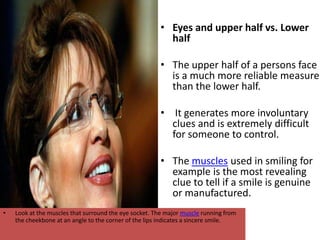
• Eyes and upper half vs. Lower
                                                         half

                                                       • The upper half of a persons face
                                                         is a much more reliable measure
                                                         than the lower half.

                                                       • It generates more involuntary
                                                         clues and is extremely difficult
                                                         for someone to control.

                                                       • The muscles used in smiling for
                                                         example is the most revealing
                                                         clue to tell if a smile is genuine
                                                         or manufactured.
•   Look at the muscles that surround the eye socket. The major muscle running from
    the cheekbone at an angle to the corner of the lips indicates a sincere smile.
Check for Emotional Leaks
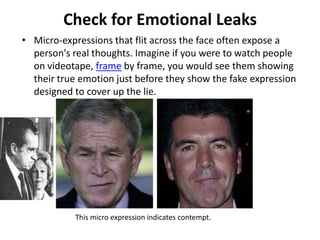
• Micro-expressions that flit across the face often expose a
  person's real thoughts. Imagine if you were to watch people
  on videotape, frame by frame, you would see them showing
  their true emotion just before they show the fake expression
  designed to cover up the lie.


            This micro expression indicates contempt.
Eye Contact


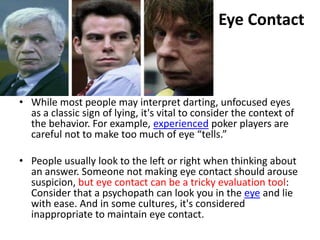
• While most people may interpret darting, unfocused eyes
  as a classic sign of lying, it's vital to consider the context of
  the behavior. For example, experienced poker players are
  careful not to make too much of eye “tells.”

• People usually look to the left or right when thinking about
  an answer. Someone not making eye contact should arouse
  suspicion, but eye contact can be a tricky evaluation tool:
  Consider that a psychopath can look you in the eye and lie
  with ease. And in some cultures, it's considered
  inappropriate to maintain eye contact.
Ask Follow Up Questions...
                                     Quickly


• If you suspect you're being lied too, try this technique, which
  experts say can trip up a liar. Try asking questions quickly—one after
  the other.

• “The initial lie is easy,” explains Kang Lee, director of the Institute of
  Child Study at the University of Toronto, and whose behavioral work
  with children can often be applied to adults.

•    “The follow-up lie is more difficult. When you continue to ask
    questions and put people on the spot, it gets harder to maintain the
    lie.”
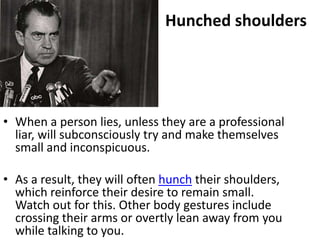
Hunched shoulders


• When a person lies, unless they are a professional
  liar, will subconsciously try and make themselves
  small and inconspicuous.

• As a result, they will often hunch their shoulders,
  which reinforce their desire to remain small.
  Watch out for this. Other body gestures include
  crossing their arms or overtly lean away from you
  while talking to you.
More info than you asked for
             •   A liar might be so paranoid about being
                 untruthful that they'll offer much more
                 information than you asked for - liars know
                 that a good liar tells more details in order to
                 look innocent.

             •   So when your colleague goes off into a
                 tangent about how he never got your
                 message, but he did get a weird message on
                 his answering machine that made him laugh,
                 and that made him think of the other night
                 when... You might have to ask him to revert
                 to the topic at hand. Don't be afraid to ask
                 questions.

             •   The lady doth protest too much, methinks."
                 comes from Shakespeare's Hamlet, Act III,
                 scene II. The phrase has come to mean that
                 one can "insist so passionately about
                 something not being true that people suspect
                 the opposite of what one is saying.
Presentation micro expressions

Presentation micro expressions

  • 1.
    Three Truths anda Fib Jeran Binning
  • 2.
    • Eyes andupper half vs. Lower half • The upper half of a persons face is a much more reliable measure than the lower half. • It generates more involuntary clues and is extremely difficult for someone to control. • The muscles used in smiling for example is the most revealing clue to tell if a smile is genuine or manufactured. • Look at the muscles that surround the eye socket. The major muscle running from the cheekbone at an angle to the corner of the lips indicates a sincere smile.
  • 3.
    Check for EmotionalLeaks • Micro-expressions that flit across the face often expose a person's real thoughts. Imagine if you were to watch people on videotape, frame by frame, you would see them showing their true emotion just before they show the fake expression designed to cover up the lie. This micro expression indicates contempt.
  • 4.
    Eye Contact • Whilemost people may interpret darting, unfocused eyes as a classic sign of lying, it's vital to consider the context of the behavior. For example, experienced poker players are careful not to make too much of eye “tells.” • People usually look to the left or right when thinking about an answer. Someone not making eye contact should arouse suspicion, but eye contact can be a tricky evaluation tool: Consider that a psychopath can look you in the eye and lie with ease. And in some cultures, it's considered inappropriate to maintain eye contact.
  • 5.
    Ask Follow UpQuestions... Quickly • If you suspect you're being lied too, try this technique, which experts say can trip up a liar. Try asking questions quickly—one after the other. • “The initial lie is easy,” explains Kang Lee, director of the Institute of Child Study at the University of Toronto, and whose behavioral work with children can often be applied to adults. • “The follow-up lie is more difficult. When you continue to ask questions and put people on the spot, it gets harder to maintain the lie.”
  • 6.
    Hunched shoulders • Whena person lies, unless they are a professional liar, will subconsciously try and make themselves small and inconspicuous. • As a result, they will often hunch their shoulders, which reinforce their desire to remain small. Watch out for this. Other body gestures include crossing their arms or overtly lean away from you while talking to you.
  • 7.
    More info thanyou asked for • A liar might be so paranoid about being untruthful that they'll offer much more information than you asked for - liars know that a good liar tells more details in order to look innocent. • So when your colleague goes off into a tangent about how he never got your message, but he did get a weird message on his answering machine that made him laugh, and that made him think of the other night when... You might have to ask him to revert to the topic at hand. Don't be afraid to ask questions. • The lady doth protest too much, methinks." comes from Shakespeare's Hamlet, Act III, scene II. The phrase has come to mean that one can "insist so passionately about something not being true that people suspect the opposite of what one is saying.