TOTAL QUALITY MANAGEMENT
Presented By:
Shaik .Ahmed Unisha Affrin
1st year M. PHARM
Dept of Pharmaceutics
G Pulla Reddy College Of Pharmacy
1
Intro...
• Pharmaceutical industry is a very vital segment of the
our health care system, which deals with manufacturing
and marketing of pharmaceuticals and biological
products and medicinal devices, used for the diagnosis
and treatment of diseases as well as conducts research
for development of new products for human welfare.
• maintenance of quality is very necessary to prevent
health hazard as many pharmaceutical products are life
saving products.
2
• Regulatory agencies of various countries noted that there are
deficiencies in conventional quality management systems, so
they start adopting this approach called Total Quality
Management (TQM).
• concept of TQM is very important for maintenance and
improvement of quality and for prevention of defects.
• TQM involves building quality in a pharmaceutical product as
it involve complete records such as standard operating
procedures for every step, validation records, master formula
records and batch production records etc
3
• This includes information about quality, quality
management, current status and need of TQM.
• TQM describes as multifaceted approach for quality
management of pharmaceuticals by utilizing various
quality management approaches such as quality by
design, good manufacturing practices, quality risk
management etc. leading to high quality products.
4
• Quality:As per ISO, it is defined as “Degree to which a set of
inherent characteristics fulfills requirements”.
• Degree refers to a level to which a product or service satisfies.
So, depending upon the level of satisfaction, a product may be
termed as excellent, good or poor quality product.
• Inherent characteristic are those features that are a part of
the product and are responsible to achieve satisfaction.
• Requirements refer to the needs of customer, needs of
organization & those of other interested parties.
5
• The quality can be of two types :
• Specification quality: This is quality from consumer point of
view that how consumer compares it with other products in
the market.
• Conformance quality: It is the measure of degree to which
product or service was produced correctly.
• As per pharmaceutical industry, quality is defined as
conformance to specifications of the product. The
specifications are different for different products depending
upon its therapeutic effect, potency etc.
6
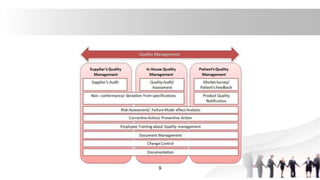
• Quality Management :consist of four main components i.e. Quality planning, Quality
control, Quality assurance, Quality improvement.
• Practices before TQM : Before existence of TQM, traditional quality management tools,
only included final product quality control (FPQC) and on basis of these quality
control tests, it was concluded that whether product obtained is of desired quality or not. If
all parameters of final product were found to be within limit, then it was considered as
quality product but if results were found to be out of specifications then product was said to
be of poor quality and rejected.
• Evolution of TQM :evolution and application of TQM, i.e. every department is concerned
with quality management of product. Quality is checked at every step in the process and if
any problem arrives it is tried to be solved at that moment only. Quality does not depend
only on final product quality control testing it is monitored in every step. So it also
resulted in increase in quality of the product and also saves cost and time involved due
to batch failure or due to solving a problem involved in the process.:
8
9
• Definitions :TQM is a combined effort designed by
organization to improve quality at every level. TQM is about
meeting quality expectations as defined by the customer; this is
called customer-defined quality.
• As per International Organization for Standardization standard
ISO 8402:1994, it is a management approach of an
organization centered on quality, based on the participation of
all its members and aiming at long term success through
customer satisfaction and benefits to all members of the
organization and society.
10
• REQUIREMENTS FOR IMPLEMENTATION OF TQM
• 1. Support from management
• 2. Employee Training and motivation
• 3. Thorough knowledge about cause and effects of the
process
11
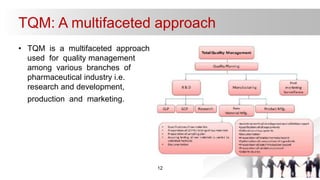
TQM: A multifaceted approach
• TQM is a multifaceted approach
used for quality management
among various branches of
pharmaceutical industry i.e.
research and development,
production and marketing.
12
• 1. Research and development: TQM also plays very vital role in quality
management of research and development process.
• It involves following points:[ a]. GLP: It is also called as ‘Good Laboratory
Practices’. It involves strict control over use of animals in the laboratory for
experimentation.
• TQM in GLP involves following points:
• 1] Preparation of protocol or master schedule sheet for the study,
Maintenance of copy of protocol in the laboratory in which study is to be carried
out, 2]• Periodic inspection of facility in which study is to be carried out,3] • If any
change in approved protocol of the study then there should be documentation
and approval of the change along with the reason for carrying out the
change, and Documentation.
13
• [b]. GCP: It is also called as ‘Good Clinical Practices’. It
involves strict control over use of human beings in clinical trials.
The regulations for GCP are almost similar to that of GLP. The
major difference being that before starting study or involving any
subject or human being into the clinical trials. A complete duly
filled informed consent form should be taken from subjects along
with their signature to make sure that subject is known he/she
is involved in clinical trials. These records should be
maintained. If patient dropout involve during the study then
number of dropouts along with reason of dropout from study
should be documented. 14
• 2.Manufacturing: In production, which include
manufacturing of both raw materials and API, along with
production and packaging of dosage form.
• 3. Post marketing surveillance: It also includes quality
management based on market survey i.e. based on
post marketing surveillance and involves change
control and its documentation if any change is
required in the approved process.
15
Approaches for TQM
[1]Six Sigma Technique
Six Sigma involves two methods:[A]DMAIC [B]DMADV
[2]Quality Risk Management (QRM)
[3]Quality by Design (QbD)
[4]ISO Series
[5]Current Good Manufacturing Practices (cGMP)
[6]International Conference on Harmonization (ICH)
16
• Various approaches as practiced by
industries in TQM of pharmaceutical
process
• [1]Six Sigma Technique: Six Sigma
technique can improve the quality of
process outputs by identifying and
removing the causes of defects (errors)
and minimizing variability in manufacturing
and business processes
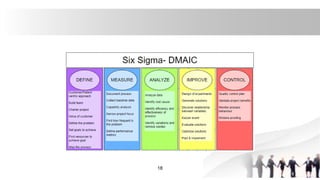
• two methods:1. DMAIC: It is an
abbreviation used for an improvement
cycle, which involves 5 Phases
17
• understand or define what the
problem is,
• then it is measured to receive
existing data at unaltered state,
• once it has been measured the
problem and data is analyzed to
understand the root cause,
• after analyzing improvement
strategies are developed to address
the root cause,
• and lastly is to control the
improvements and look for future
improvements.
18
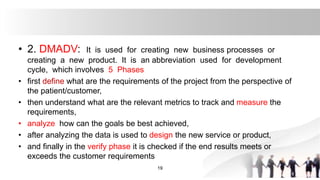
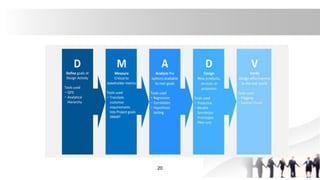
• 2. DMADV: It is used for creating new business processes or
creating a new product. It is an abbreviation used for development
cycle, which involves 5 Phases
• first define what are the requirements of the project from the perspective of
the patient/customer,
• then understand what are the relevant metrics to track and measure the
requirements,
• analyze how can the goals be best achieved,
• after analyzing the data is used to design the new service or product,
• and finally in the verify phase it is checked if the end results meets or
exceeds the customer requirements
19
20
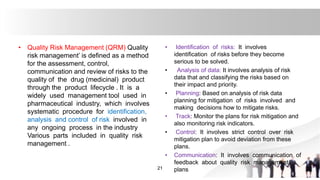
• Quality Risk Management (QRM) Quality
risk management’ is defined as a method
for the assessment, control,
communication and review of risks to the
quality of the drug (medicinal) product
through the product lifecycle . It is a
widely used management tool used in
pharmaceutical industry, which involves
systematic procedure for identification,
analysis and control of risk involved in
any ongoing process in the industry
Various parts included in quality risk
management .
21
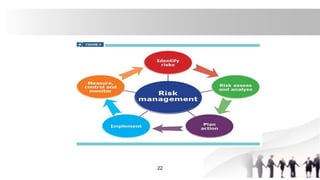
• Identification of risks: It involves
identification of risks before they become
serious to be solved.
• Analysis of data: It involves analysis of risk
data that and classifying the risks based on
their impact and priority.
• Planning: Based on analysis of risk data
planning for mitigation of risks involved and
making decisions how to mitigate risks.
• Track: Monitor the plans for risk mitigation and
also monitoring risk indicators.
• Control: It involves strict control over risk
mitigation plan to avoid deviation from these
plans.
• Communication: It involves communication of
feedback about quality risk management
plans
22
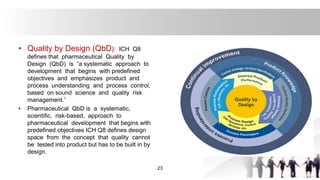
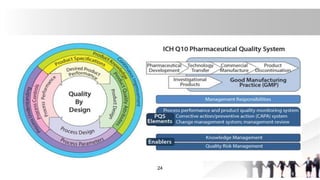
• Quality by Design (QbD): ICH Q8
defines that pharmaceutical Quality by
Design (QbD) is “a systematic approach to
development that begins with predefined
objectives and emphasizes product and
process understanding and process control,
based on sound science and quality risk
management.”
• Pharmaceutical QbD is a systematic,
scientific, risk-based, approach to
pharmaceutical development that begins with
predefined objectives ICH Q8 defines design
space from the concept that quality cannot
be tested into product but has to be built in by
design.
23
24
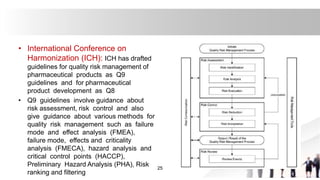
• International Conference on
Harmonization (ICH): ICH has drafted
guidelines for quality risk management of
pharmaceutical products as Q9
guidelines and for pharmaceutical
product development as Q8
• Q9 guidelines involve guidance about
risk assessment, risk control and also
give guidance about various methods for
quality risk management such as failure
mode and effect analysis (FMEA),
failure mode, effects and criticality
analysis (FMECA), hazard analysis and
critical control points (HACCP),
Preliminary Hazard Analysis (PHA), Risk
ranking and filtering
25
ISO Series: ISO 9000 series is a series of standards
developed by International organization for Standardization in
1987 to maintain an effective system for quality assurance and
quality management of manufacturing industries
Current Good Manufacturing Practices (cGMP):This is also a
technique of quality management of pharmaceuticals. Various
agencies have given guidelines for good manufacturing practices
such as US FDA, WHO, European medicines agency schedule M
in India. These include guidance about choosing location,
• facilities, clothing, disposal system, sanitation, testing,
recording of analysis, recording any reprocessing or
recall, filing of change controls if any change in the
process. So it is necessary to have thorough knowledge
about good manufacturing practices involved in the
process to ensure good quality in the product
• CONCLUSION : TQM is the most effective tool in quality
management of pharmaceuticals. It is recommended strictly by many
regulatory agencies but still it is not completely implemented in all the
industries especially in India. As India is one of the largest exporters of
pharmaceutical products across the globe, strict implementation of TQM is
need of the hour in Indian context. Despite of extensive advancement in
product development for real time online production and packaging
monitoring, their limited utilization by majority of industries remains a
major area of concern. In view of producing high quality medicines, this is a
plea for global regulating agencies and pharmaceutical industries for
stricter enforcement and sincere adoption of TQM practices in industrie.
TQM -Modern pharmaceutics

TQM -Modern pharmaceutics

  • 1.
    TOTAL QUALITY MANAGEMENT PresentedBy: Shaik .Ahmed Unisha Affrin 1st year M. PHARM Dept of Pharmaceutics G Pulla Reddy College Of Pharmacy 1
  • 2.
    Intro... • Pharmaceutical industryis a very vital segment of the our health care system, which deals with manufacturing and marketing of pharmaceuticals and biological products and medicinal devices, used for the diagnosis and treatment of diseases as well as conducts research for development of new products for human welfare. • maintenance of quality is very necessary to prevent health hazard as many pharmaceutical products are life saving products. 2
  • 3.
    • Regulatory agenciesof various countries noted that there are deficiencies in conventional quality management systems, so they start adopting this approach called Total Quality Management (TQM). • concept of TQM is very important for maintenance and improvement of quality and for prevention of defects. • TQM involves building quality in a pharmaceutical product as it involve complete records such as standard operating procedures for every step, validation records, master formula records and batch production records etc 3
  • 4.
    • This includesinformation about quality, quality management, current status and need of TQM. • TQM describes as multifaceted approach for quality management of pharmaceuticals by utilizing various quality management approaches such as quality by design, good manufacturing practices, quality risk management etc. leading to high quality products. 4
  • 5.
    • Quality:As perISO, it is defined as “Degree to which a set of inherent characteristics fulfills requirements”. • Degree refers to a level to which a product or service satisfies. So, depending upon the level of satisfaction, a product may be termed as excellent, good or poor quality product. • Inherent characteristic are those features that are a part of the product and are responsible to achieve satisfaction. • Requirements refer to the needs of customer, needs of organization & those of other interested parties. 5
  • 6.
    • The qualitycan be of two types : • Specification quality: This is quality from consumer point of view that how consumer compares it with other products in the market. • Conformance quality: It is the measure of degree to which product or service was produced correctly. • As per pharmaceutical industry, quality is defined as conformance to specifications of the product. The specifications are different for different products depending upon its therapeutic effect, potency etc. 6
  • 7.
    • Quality Management:consist of four main components i.e. Quality planning, Quality control, Quality assurance, Quality improvement. • Practices before TQM : Before existence of TQM, traditional quality management tools, only included final product quality control (FPQC) and on basis of these quality control tests, it was concluded that whether product obtained is of desired quality or not. If all parameters of final product were found to be within limit, then it was considered as quality product but if results were found to be out of specifications then product was said to be of poor quality and rejected. • Evolution of TQM :evolution and application of TQM, i.e. every department is concerned with quality management of product. Quality is checked at every step in the process and if any problem arrives it is tried to be solved at that moment only. Quality does not depend only on final product quality control testing it is monitored in every step. So it also resulted in increase in quality of the product and also saves cost and time involved due to batch failure or due to solving a problem involved in the process.: 8
  • 8.
  • 9.
    • Definitions :TQMis a combined effort designed by organization to improve quality at every level. TQM is about meeting quality expectations as defined by the customer; this is called customer-defined quality. • As per International Organization for Standardization standard ISO 8402:1994, it is a management approach of an organization centered on quality, based on the participation of all its members and aiming at long term success through customer satisfaction and benefits to all members of the organization and society. 10
  • 10.
    • REQUIREMENTS FORIMPLEMENTATION OF TQM • 1. Support from management • 2. Employee Training and motivation • 3. Thorough knowledge about cause and effects of the process 11
  • 11.
    TQM: A multifacetedapproach • TQM is a multifaceted approach used for quality management among various branches of pharmaceutical industry i.e. research and development, production and marketing. 12
  • 12.
    • 1. Researchand development: TQM also plays very vital role in quality management of research and development process. • It involves following points:[ a]. GLP: It is also called as ‘Good Laboratory Practices’. It involves strict control over use of animals in the laboratory for experimentation. • TQM in GLP involves following points: • 1] Preparation of protocol or master schedule sheet for the study, Maintenance of copy of protocol in the laboratory in which study is to be carried out, 2]• Periodic inspection of facility in which study is to be carried out,3] • If any change in approved protocol of the study then there should be documentation and approval of the change along with the reason for carrying out the change, and Documentation. 13
  • 13.
    • [b]. GCP:It is also called as ‘Good Clinical Practices’. It involves strict control over use of human beings in clinical trials. The regulations for GCP are almost similar to that of GLP. The major difference being that before starting study or involving any subject or human being into the clinical trials. A complete duly filled informed consent form should be taken from subjects along with their signature to make sure that subject is known he/she is involved in clinical trials. These records should be maintained. If patient dropout involve during the study then number of dropouts along with reason of dropout from study should be documented. 14
  • 14.
    • 2.Manufacturing: Inproduction, which include manufacturing of both raw materials and API, along with production and packaging of dosage form. • 3. Post marketing surveillance: It also includes quality management based on market survey i.e. based on post marketing surveillance and involves change control and its documentation if any change is required in the approved process. 15
  • 15.
    Approaches for TQM [1]SixSigma Technique Six Sigma involves two methods:[A]DMAIC [B]DMADV [2]Quality Risk Management (QRM) [3]Quality by Design (QbD) [4]ISO Series [5]Current Good Manufacturing Practices (cGMP) [6]International Conference on Harmonization (ICH) 16
  • 16.
    • Various approachesas practiced by industries in TQM of pharmaceutical process • [1]Six Sigma Technique: Six Sigma technique can improve the quality of process outputs by identifying and removing the causes of defects (errors) and minimizing variability in manufacturing and business processes • two methods:1. DMAIC: It is an abbreviation used for an improvement cycle, which involves 5 Phases 17 • understand or define what the problem is, • then it is measured to receive existing data at unaltered state, • once it has been measured the problem and data is analyzed to understand the root cause, • after analyzing improvement strategies are developed to address the root cause, • and lastly is to control the improvements and look for future improvements.
  • 17.
  • 18.
    • 2. DMADV:It is used for creating new business processes or creating a new product. It is an abbreviation used for development cycle, which involves 5 Phases • first define what are the requirements of the project from the perspective of the patient/customer, • then understand what are the relevant metrics to track and measure the requirements, • analyze how can the goals be best achieved, • after analyzing the data is used to design the new service or product, • and finally in the verify phase it is checked if the end results meets or exceeds the customer requirements 19
  • 19.
  • 20.
    • Quality RiskManagement (QRM) Quality risk management’ is defined as a method for the assessment, control, communication and review of risks to the quality of the drug (medicinal) product through the product lifecycle . It is a widely used management tool used in pharmaceutical industry, which involves systematic procedure for identification, analysis and control of risk involved in any ongoing process in the industry Various parts included in quality risk management . 21 • Identification of risks: It involves identification of risks before they become serious to be solved. • Analysis of data: It involves analysis of risk data that and classifying the risks based on their impact and priority. • Planning: Based on analysis of risk data planning for mitigation of risks involved and making decisions how to mitigate risks. • Track: Monitor the plans for risk mitigation and also monitoring risk indicators. • Control: It involves strict control over risk mitigation plan to avoid deviation from these plans. • Communication: It involves communication of feedback about quality risk management plans
  • 21.
  • 22.
    • Quality byDesign (QbD): ICH Q8 defines that pharmaceutical Quality by Design (QbD) is “a systematic approach to development that begins with predefined objectives and emphasizes product and process understanding and process control, based on sound science and quality risk management.” • Pharmaceutical QbD is a systematic, scientific, risk-based, approach to pharmaceutical development that begins with predefined objectives ICH Q8 defines design space from the concept that quality cannot be tested into product but has to be built in by design. 23
  • 23.
  • 24.
    • International Conferenceon Harmonization (ICH): ICH has drafted guidelines for quality risk management of pharmaceutical products as Q9 guidelines and for pharmaceutical product development as Q8 • Q9 guidelines involve guidance about risk assessment, risk control and also give guidance about various methods for quality risk management such as failure mode and effect analysis (FMEA), failure mode, effects and criticality analysis (FMECA), hazard analysis and critical control points (HACCP), Preliminary Hazard Analysis (PHA), Risk ranking and filtering 25
  • 25.
    ISO Series: ISO9000 series is a series of standards developed by International organization for Standardization in 1987 to maintain an effective system for quality assurance and quality management of manufacturing industries Current Good Manufacturing Practices (cGMP):This is also a technique of quality management of pharmaceuticals. Various agencies have given guidelines for good manufacturing practices such as US FDA, WHO, European medicines agency schedule M in India. These include guidance about choosing location,
  • 26.
    • facilities, clothing,disposal system, sanitation, testing, recording of analysis, recording any reprocessing or recall, filing of change controls if any change in the process. So it is necessary to have thorough knowledge about good manufacturing practices involved in the process to ensure good quality in the product
  • 27.
    • CONCLUSION :TQM is the most effective tool in quality management of pharmaceuticals. It is recommended strictly by many regulatory agencies but still it is not completely implemented in all the industries especially in India. As India is one of the largest exporters of pharmaceutical products across the globe, strict implementation of TQM is need of the hour in Indian context. Despite of extensive advancement in product development for real time online production and packaging monitoring, their limited utilization by majority of industries remains a major area of concern. In view of producing high quality medicines, this is a plea for global regulating agencies and pharmaceutical industries for stricter enforcement and sincere adoption of TQM practices in industrie.