
PRESENTATION
ON
ECE – 3rd Year
Sreeparna Sen
Sreyansh Bhupal
Priyankar Sandel
Urmi Bose
Rimon Majumder
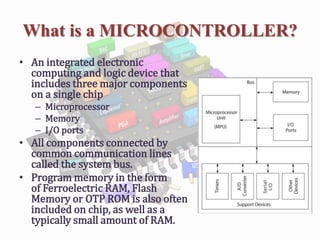
What is a MICROCONTROLLER?
• An integrated electronic
computing and logic device that
includes three major components
on a single chip
– Microprocessor
– Memory
– I/O ports
• All components connected by
common communication lines
called the system bus.
• Program memory in the form
of Ferroelectric RAM, Flash
Memory or OTP ROM is also often
included on chip, as well as a
typically small amount of RAM.
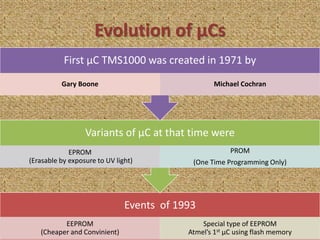
Evolution of µCs
Events of 1993
EEPROM
(Cheaper and Convinient)
Special type of EEPROM
Atmel’s 1st µC using flash memory
Variants of µC at that time were
EPROM
(Erasable by exposure to UV light)
PROM
(One Time Programming Only)
First µC TMS1000 was created in 1971 by
Gary Boone Michael Cochran
µ-Controller Architecture
• Reduced instruction set
computer.
• Simple operation.
• Simple addressing modes.
• Uses pipelining.
• Longer compiled program but
faster to execute.
RISC
(HAVARD)
• Richer Instruction set, some very
simple, some very complex.
• No pipelining.
• Microcode Control.
• Instruction interface with
memory with multiple
mechanism.
• Instruction of variable Size
CISC
(VON
NEUMAN)
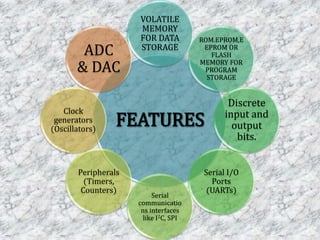
FEATURES
VOLATILE
MEMORY
FOR DATA
STORAGE
ROM.EPROM,E
EPROM OR
FLASH
MEMORY FOR
PROGRAM
STORAGE
Discrete
input and
output
bits.
Serial I/O
Ports
(UARTs)
Serial
communicatio
ns interfaces
like I2C, SPI
Peripherals
(Timers,
Counters)
Clock
generators
(Oscillators)
ADC
& DAC
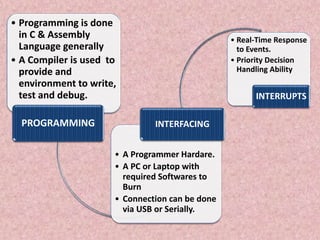
• Programming is done
in C & Assembly
Language generally
• A Compiler is used to
provide and
environment to write,
test and debug.
PROGRAMMING
• A Programmer Hardare.
• A PC or Laptop with
required Softwares to
Burn
• Connection can be done
via USB or Serially.
INTERFACING
• Real-Time Response
to Events.
• Priority Decision
Handling Ability
INTERRUPTS
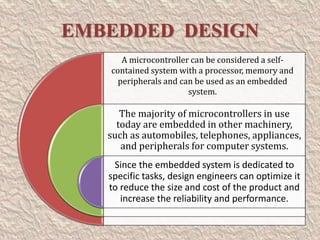
EMBEDDED DESIGN
The majority of microcontrollers in use
today are embedded in other machinery,
such as automobiles, telephones, appliances,
and peripherals for computer systems.
Since the embedded system is dedicated to
specific tasks, design engineers can optimize it
to reduce the size and cost of the product and
increase the reliability and performance.
A microcontroller can be considered a self-
contained system with a processor, memory and
peripherals and can be used as an embedded
system.
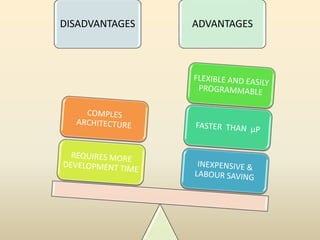
DISADVANTAGES ADVANTAGES
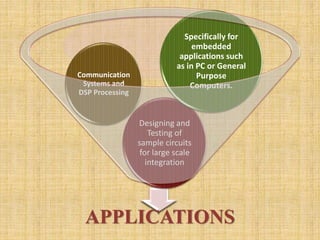
APPLICATIONS
Designing and
Testing of
sample circuits
for large scale
integration
Communication
Systems and
DSP Processing
Specifically for
embedded
applications such
as in PC or General
Purpose
Computers.
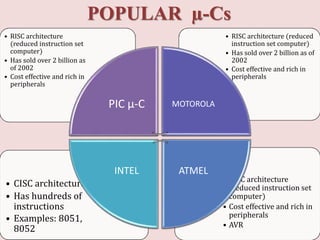
POPULAR µ-Cs
• RISC architecture
(reduced instruction set
computer)
• Cost effective and rich in
peripherals
• AVR
• CISC architecture
• Has hundreds of
instructions
• Examples: 8051,
8052
• RISC architecture (reduced
instruction set computer)
• Has sold over 2 billion as of
2002
• Cost effective and rich in
peripherals
• RISC architecture
(reduced instruction set
computer)
• Has sold over 2 billion as
of 2002
• Cost effective and rich in
peripherals
PIC µ-C MOTOROLA
ATMELINTEL
FUTUTRE ASPECT
• In the future, MRAM could potentially be used in
microcontrollers as it has infinite endurance and its
incremental semiconductor wafer process cost is
relatively low.
• Embedded developers are starting to be aware of the
benefits of migrating to 32-bit microcontrollers. Not
only do 32-bit microcontrollers provide over ten times
the performance but the migration also allows a
reduction in power consumption, smaller program size,
faster software development time as well as better
software reusability
THANKYOU

Microcontrollers

  • 1.
    PRESENTATION ON ECE – 3rdYear Sreeparna Sen Sreyansh Bhupal Priyankar Sandel Urmi Bose Rimon Majumder
  • 2.
    What is aMICROCONTROLLER? • An integrated electronic computing and logic device that includes three major components on a single chip – Microprocessor – Memory – I/O ports • All components connected by common communication lines called the system bus. • Program memory in the form of Ferroelectric RAM, Flash Memory or OTP ROM is also often included on chip, as well as a typically small amount of RAM.
  • 3.
    Evolution of µCs Eventsof 1993 EEPROM (Cheaper and Convinient) Special type of EEPROM Atmel’s 1st µC using flash memory Variants of µC at that time were EPROM (Erasable by exposure to UV light) PROM (One Time Programming Only) First µC TMS1000 was created in 1971 by Gary Boone Michael Cochran
  • 4.
    µ-Controller Architecture • Reducedinstruction set computer. • Simple operation. • Simple addressing modes. • Uses pipelining. • Longer compiled program but faster to execute. RISC (HAVARD) • Richer Instruction set, some very simple, some very complex. • No pipelining. • Microcode Control. • Instruction interface with memory with multiple mechanism. • Instruction of variable Size CISC (VON NEUMAN)
  • 5.
    FEATURES VOLATILE MEMORY FOR DATA STORAGE ROM.EPROM,E EPROM OR FLASH MEMORYFOR PROGRAM STORAGE Discrete input and output bits. Serial I/O Ports (UARTs) Serial communicatio ns interfaces like I2C, SPI Peripherals (Timers, Counters) Clock generators (Oscillators) ADC & DAC
  • 6.
    • Programming isdone in C & Assembly Language generally • A Compiler is used to provide and environment to write, test and debug. PROGRAMMING • A Programmer Hardare. • A PC or Laptop with required Softwares to Burn • Connection can be done via USB or Serially. INTERFACING • Real-Time Response to Events. • Priority Decision Handling Ability INTERRUPTS
  • 7.
    EMBEDDED DESIGN The majorityof microcontrollers in use today are embedded in other machinery, such as automobiles, telephones, appliances, and peripherals for computer systems. Since the embedded system is dedicated to specific tasks, design engineers can optimize it to reduce the size and cost of the product and increase the reliability and performance. A microcontroller can be considered a self- contained system with a processor, memory and peripherals and can be used as an embedded system.
  • 8.
  • 9.
    APPLICATIONS Designing and Testing of samplecircuits for large scale integration Communication Systems and DSP Processing Specifically for embedded applications such as in PC or General Purpose Computers.
  • 10.
    POPULAR µ-Cs • RISCarchitecture (reduced instruction set computer) • Cost effective and rich in peripherals • AVR • CISC architecture • Has hundreds of instructions • Examples: 8051, 8052 • RISC architecture (reduced instruction set computer) • Has sold over 2 billion as of 2002 • Cost effective and rich in peripherals • RISC architecture (reduced instruction set computer) • Has sold over 2 billion as of 2002 • Cost effective and rich in peripherals PIC µ-C MOTOROLA ATMELINTEL
  • 11.
    FUTUTRE ASPECT • Inthe future, MRAM could potentially be used in microcontrollers as it has infinite endurance and its incremental semiconductor wafer process cost is relatively low. • Embedded developers are starting to be aware of the benefits of migrating to 32-bit microcontrollers. Not only do 32-bit microcontrollers provide over ten times the performance but the migration also allows a reduction in power consumption, smaller program size, faster software development time as well as better software reusability
  • 12.

Editor's Notes

  • #4 The Smithsonian Institution says TI engineers Gary Boone and Michael Cochran succeeded in creating the first microcontroller in 1971. The result of their work was the TMS 1000, which became commercially available in 1974. It combined read-only memory, read/write memory, processor and clock on one chip and was targeted at embedded systems. Most microcontrollers at this time had two variants. One had an erasable EPROM program memory, with a transparent quartz window in the lid of the package to allow it to be erased by exposure to ultraviolet light. The other was a PROM variant which was only programmable once, sometimes this was signified with the designation OTP, standing for "one-time programmable". In 1993, the introduction of EEPROM memory allowed microcontrollers  to be electrically erased quickly without an expensive package as required for EPROM, allowing both rapid prototyping, and In System Programming. (EEPROM technology had been available prior to this time, but the earlier EEPROM was more expensive and less durable, making it unsuitable for low-cost mass-produced microcontrollers.) The same year, Atmel introduced the first microcontroller using Flash memory, a special type of EEPROM . Other companies rapidly followed suit, with both memory types. In the future, MRAM could potentially be used in microcontrollers as it has infinite endurance and its incremental semiconductor wafer process cost is relatively low.
  • #5 The Smithsonian Institution says TI engineers Gary Boone and Michael Cochran succeeded in creating the first microcontroller in 1971. The result of their work was the TMS 1000, which became commercially available in 1974. It combined read-only memory, read/write memory, processor and clock on one chip and was targeted at embedded systems. Most microcontrollers at this time had two variants. One had an erasable EPROM program memory, with a transparent quartz window in the lid of the package to allow it to be erased by exposure to ultraviolet light. The other was a PROM variant which was only programmable once, sometimes this was signified with the designation OTP, standing for "one-time programmable". In 1993, the introduction of EEPROM memory allowed microcontrollers  to be electrically erased quickly without an expensive package as required for EPROM, allowing both rapid prototyping, and In System Programming. (EEPROM technology had been available prior to this time, but the earlier EEPROM was more expensive and less durable, making it unsuitable for low-cost mass-produced microcontrollers.) The same year, Atmel introduced the first microcontroller using Flash memory, a special type of EEPROM . Other companies rapidly followed suit, with both memory types. In the future, MRAM could potentially be used in microcontrollers as it has infinite endurance and its incremental semiconductor wafer process cost is relatively low.