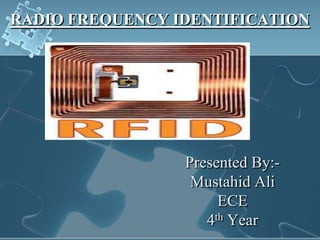

RADIO FREQUENCY IDENTIFICATION

Presented By:Mustahid Ali
ECE
4th Year
PRESENTATION OUTLINE
To Educate and Inform You
1. About RFID system.

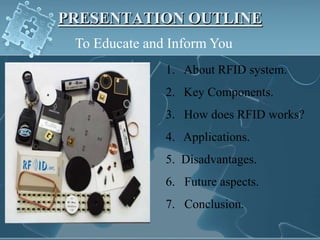
2. Key Components.
3. How does RFID works?
4. Applications.
5. Disadvantages.
6. Future aspects.

7. Conclusion.
BRIEF HISTORY
•Invented and used from (Early 1940’s).
•Commercial Operation begun from 1960’s.
•In 1970s developers, inventors, companies,
academic institution and government sectors had
actively worked on RFID .
WHAT IS RFID SYSTEM ?
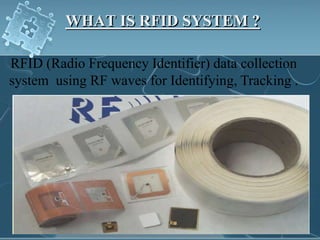
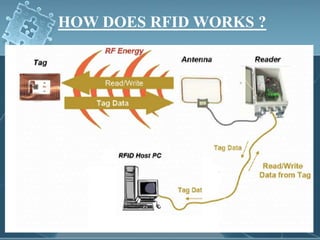
RFID (Radio Frequency Identifier) data collection
system using RF waves for Identifying, Tracking .
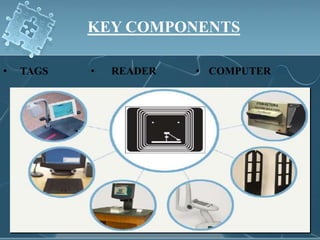
KEY COMPONENTS
•

TAGS

•

READER

• COMPUTER
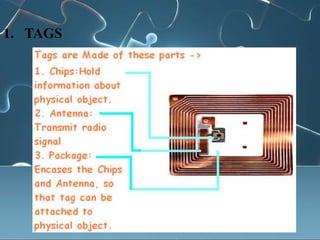
1. TAGS
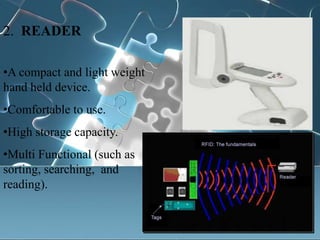
2. READER
•A compact and light weight
hand held device.
•Comfortable to use.
•High storage capacity.
•Multi Functional (such as
sorting, searching, and
reading).
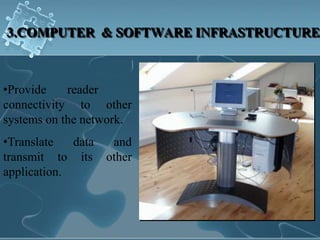
3.COMPUTER & SOFTWARE INFRASTRUCTURE

•Provide
reader
connectivity to other
systems on the network.
•Translate
data
and
transmit to its other
application.
HOW DOES RFID WORKS ?
APPLICATIONS
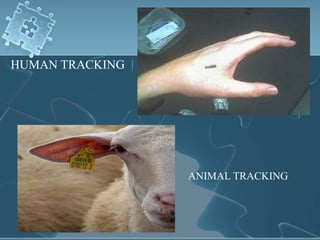
HUMAN TRACKING

ANIMAL TRACKING
IN LIBRARY
INVENTORY MANEGMENT
DISADVANGES
• Does not penetrate or transmit around metals(iron ,steel).
•Large antennas compared to higher frequencies.
•Reader collision occurs when the signals from two or
more readers overlap. The tag is unable to respond to
simultaneous queries.

•Active RFID tags can be repeatedly interrogated to
wear the battery down, disrupting the system.
FUTURE ASPECT
Some vendors have been combining RFID
tags with sensors of different kinds. This
would allow the tag to report not simply the
same information over and over, but
identifying information along with current
data picked up by the sensor.
CONCLUSION
RFID technology is taking off in different areas. Due to its
customizable feature and continuing improvement the
communities are beginning to get involved in its
development. It is easy to envision that, the RFID tags
contents will increase in power, prices are expected to
decline and tag will dramatically improve its efficiency,
security and accuracy.
RFID IS A SUPPORTING TECHNOLOGY……………….
NOT A COMPETING !!!!!!!!

THANK YOU…………

Radio frequency identification

  • 1.
    RADIO FREQUENCY IDENTIFICATION PresentedBy:Mustahid Ali ECE 4th Year
  • 2.
    PRESENTATION OUTLINE To Educateand Inform You 1. About RFID system. 2. Key Components. 3. How does RFID works? 4. Applications. 5. Disadvantages. 6. Future aspects. 7. Conclusion.
  • 3.
    BRIEF HISTORY •Invented andused from (Early 1940’s). •Commercial Operation begun from 1960’s. •In 1970s developers, inventors, companies, academic institution and government sectors had actively worked on RFID .
  • 4.
    WHAT IS RFIDSYSTEM ? RFID (Radio Frequency Identifier) data collection system using RF waves for Identifying, Tracking .
  • 5.
  • 6.
  • 7.
    2. READER •A compactand light weight hand held device. •Comfortable to use. •High storage capacity. •Multi Functional (such as sorting, searching, and reading).
  • 8.
    3.COMPUTER & SOFTWAREINFRASTRUCTURE •Provide reader connectivity to other systems on the network. •Translate data and transmit to its other application.
  • 9.
  • 10.
  • 11.
  • 12.
  • 13.
  • 14.
    DISADVANGES • Does notpenetrate or transmit around metals(iron ,steel). •Large antennas compared to higher frequencies. •Reader collision occurs when the signals from two or more readers overlap. The tag is unable to respond to simultaneous queries. •Active RFID tags can be repeatedly interrogated to wear the battery down, disrupting the system.
  • 15.
    FUTURE ASPECT Some vendorshave been combining RFID tags with sensors of different kinds. This would allow the tag to report not simply the same information over and over, but identifying information along with current data picked up by the sensor.
  • 16.
    CONCLUSION RFID technology istaking off in different areas. Due to its customizable feature and continuing improvement the communities are beginning to get involved in its development. It is easy to envision that, the RFID tags contents will increase in power, prices are expected to decline and tag will dramatically improve its efficiency, security and accuracy.
  • 17.
    RFID IS ASUPPORTING TECHNOLOGY………………. NOT A COMPETING !!!!!!!! THANK YOU…………