General Biology
Biol. 1012
Alemu Chemeda(Asst. Prof)
Arba Minch University
Arba Minch, Ethiopia
Learning Objectives:
• After completing this chapter, you will be
expected to:
Define the term biology
Explain the origin and the nature of life
Explain scientific methods
11/13/2023 2
Unit 1
1.1. The meaning and scope of biology
 Biological Science is the study of life & living organisms.
 It is also called as “Biology” (Greek word).
 „bio-‟ means life & „-logos‟ means study of.
 In the late 1700s P.A. de Monet & J.B. de Lamarck coined
the term biology.
Therefore, Biology is the science of living things.
 That is why Biology is sometimes known as Life Science.
11/13/2023 3
1.2. The origin and nature of life
The mystery of life's origin is still a big debating issue in
science.
The question “what is life?” is so hard to answer.
Several attempts have been made from time to time to explain
the origin of life on earth.
There are a number of theories about the origin of life. of them:
1. Theory of Special Creation:
 All different forms of life that occur today on earth planet have
been created by God, the almighty.
11/13/2023 4
2. Theory of Spontaneous Generation:
• Living organisms could arise suddenly & spontaneously from
any kind of non-living matter.
• One of the firm believers in spontaneous generation was
Aristotle (384-322 BC).
Criticized by: -Lazzaro Spallanzani, Francisco Redi &
Louis Pasteur
-They performed well designed scientific exp‟ts
to disprove this theory
11/13/2023 5
3. Theory of Catastrophism:
• a modification of the theory of Special Creation.
• It states that there have been several creations of life by God,
each preceded by a catastrophe resulting from some kind of
geological disturbance.
• According to this theory, since each catastrophe completely
destroyed the existing life, each new creation consisted of life
form different from that of previous ones.
Critism: -no scientific exp‟t to support hypothesis
-mostly based on imaginary concept.
11/13/2023 6
4. Theory of Cosmozoic:
 also known as “theory of panspermia or spore theory”
 states life has reached this planet Earth from other heavenly
bodies such as meteorites, in the form of highly resistance
spores of some organisms.
 This idea was proposed by Richter in1865 & supported by
Arrhenius (1908) & other contemporary scientists.
 The theory did not gain any support.
 This theory lacks evidence, hence it was discarded.
11/13/2023 7
5. Theory of Eternity of Life:
 This theory assumes that life had no beginning or end.
 believes that life has ever been in existence & it will continue
to be so ever.
 believe that there is no question of origin of life as it has no
beginning or end.
 The theory is also known as steady state theory.
Objection: it could not be able to explain; evidences support
that initially earth forms & then life appeared on it.
o Where life exist before the formation of earth?
11/13/2023 8
6. Theory of Chemical Evolution (modern theory):
 this theory is also known as Materialistic Theory or
Physico-chemical Theory.
 States, origin of life on earth is the result of a slow &
gradual process of chemical evolution that probably
occurred about 3.8 billion years ago.
 This theory was proposed independently by two scientists -
A.I.Oparin in 1923 & J.B.S Haldane in 1928.
11/13/2023 9
Nature and characteristics of life
Life is defined as a "condition" that distinguishes animals &
plants from inorganic materials & dead organisms.
• Life is comprised of processes & is a maintained state.
• The most sophisticated form of life is man as a result of this
we focuses upon the nature of the life & death of man.
11/13/2023 10
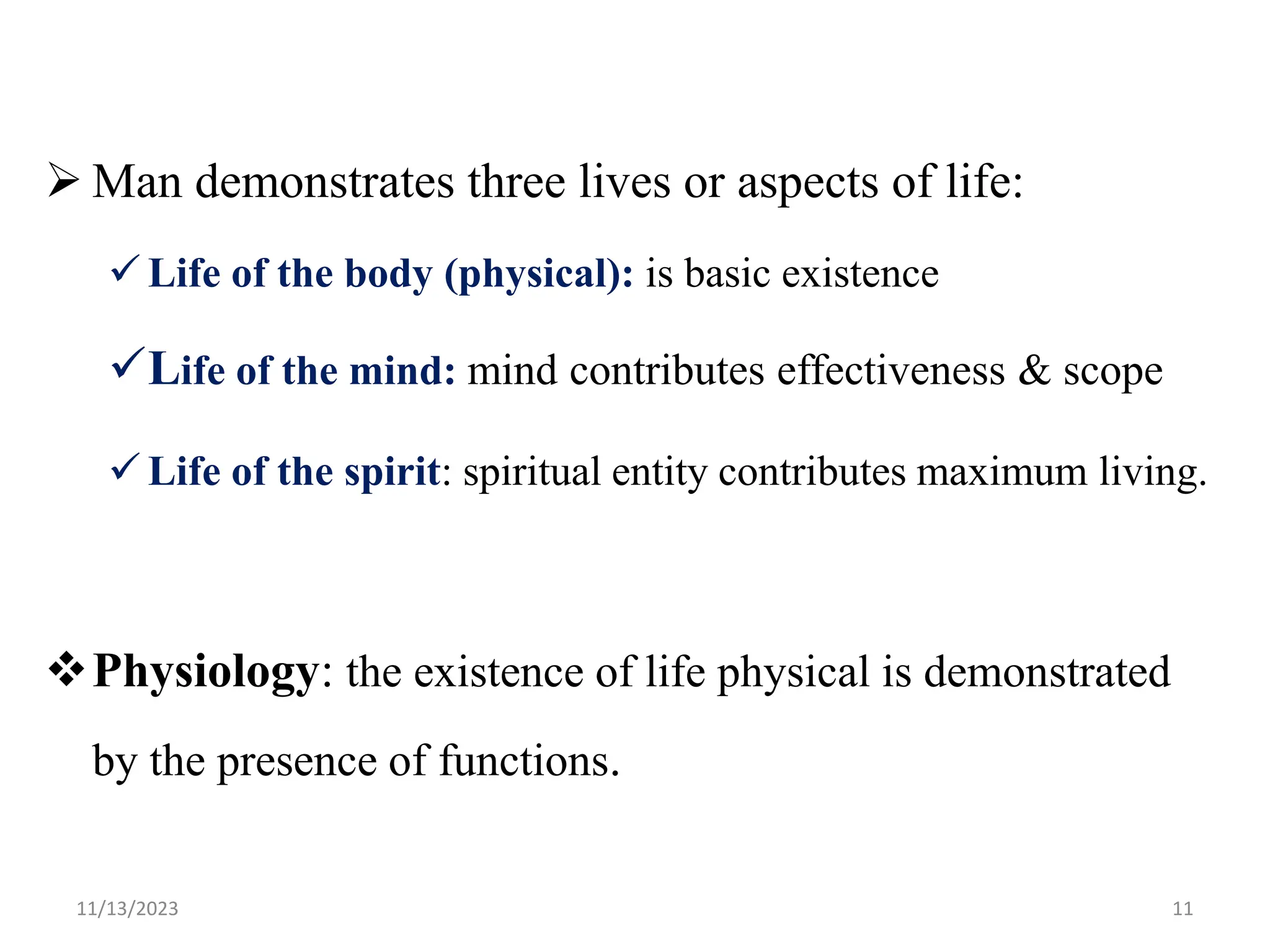
 Man demonstrates three lives or aspects of life:
 Life of the body (physical): is basic existence
Life of the mind: mind contributes effectiveness & scope
 Life of the spirit: spiritual entity contributes maximum living.
Physiology: the existence of life physical is demonstrated
by the presence of functions.
11/13/2023 11
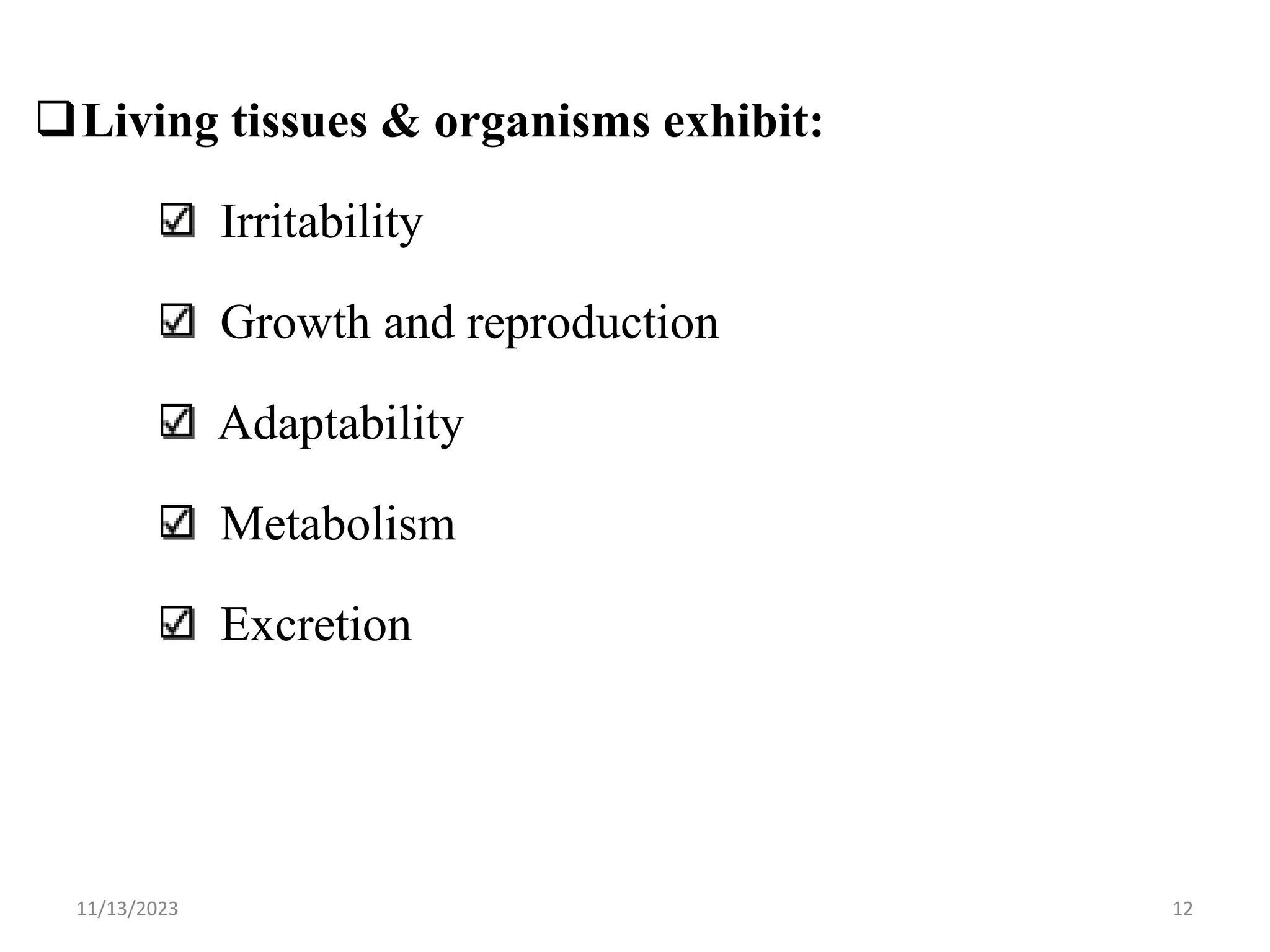
Living tissues & organisms exhibit:
Irritability
Growth and reproduction
Adaptability
Metabolism
Excretion
11/13/2023 12
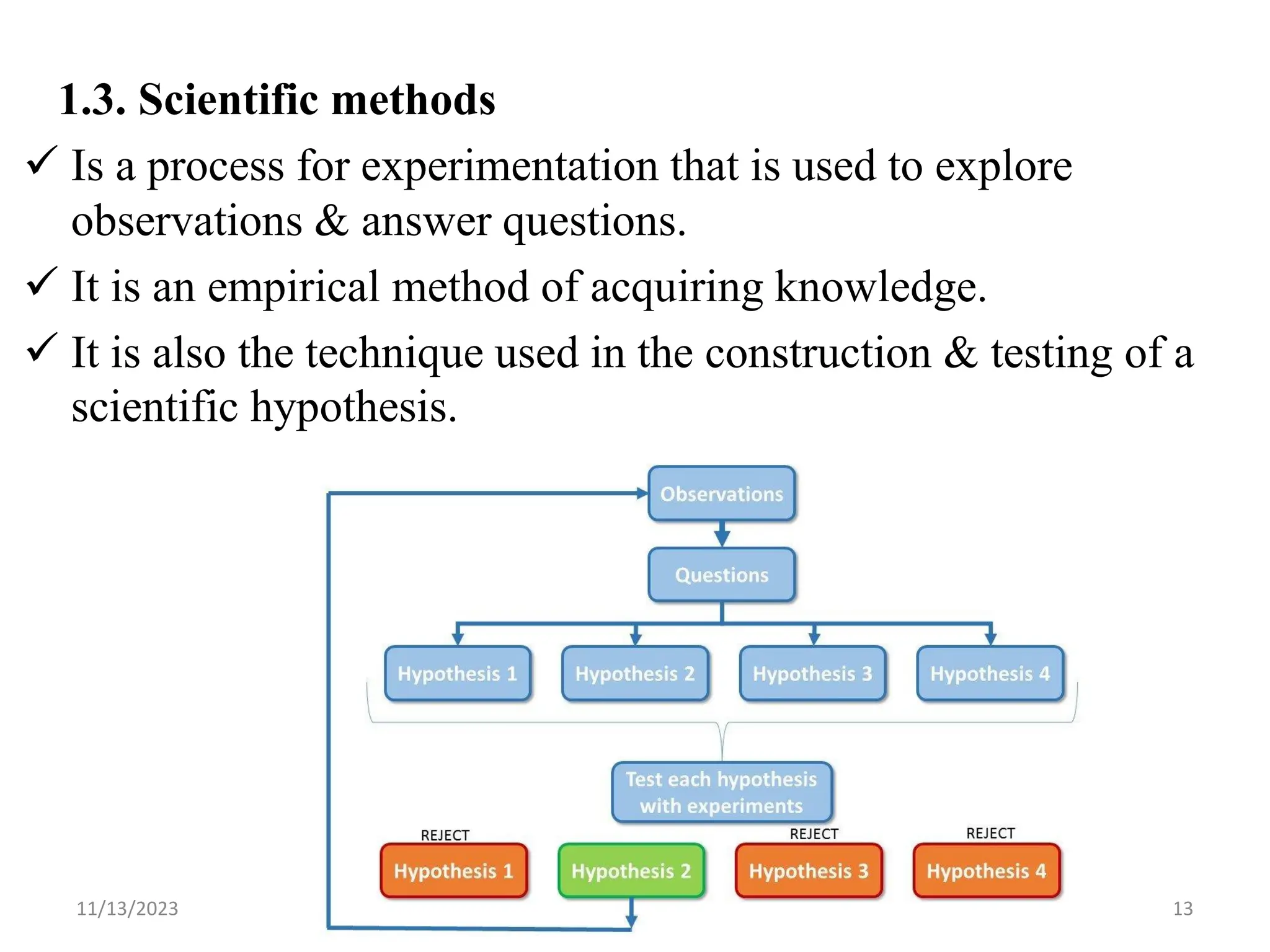
1.3. Scientific methods
 Is a process for experimentation that is used to explore
observations & answer questions.
 It is an empirical method of acquiring knowledge.
 It is also the technique used in the construction & testing of a
scientific hypothesis.
11/13/2023 13
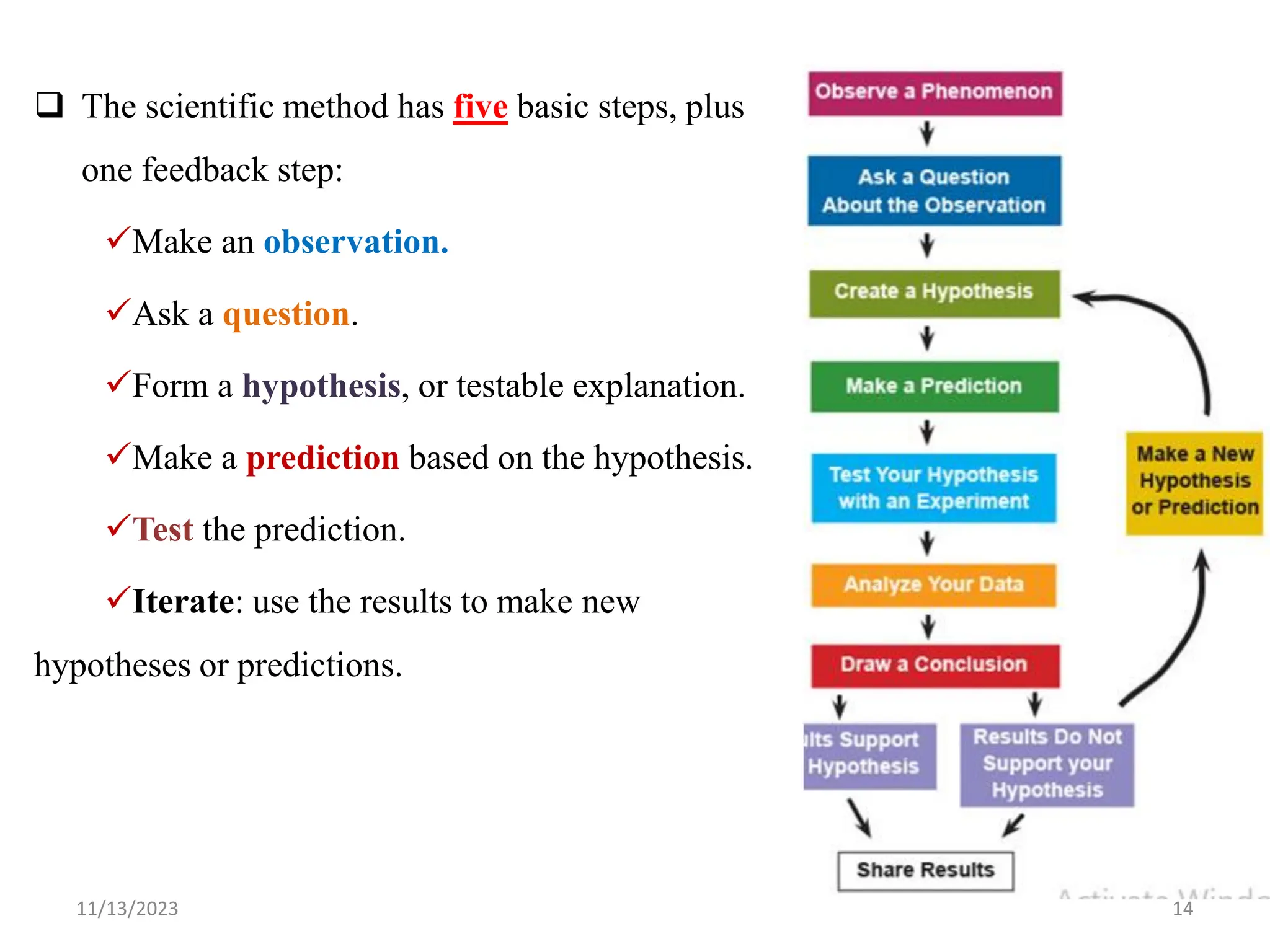
 The scientific method has five basic steps, plus
one feedback step:
Make an observation.
Ask a question.
Form a hypothesis, or testable explanation.
Make a prediction based on the hypothesis.
Test the prediction.
Iterate: use the results to make new
hypotheses or predictions.
11/13/2023 14
Observation- quantitative & qualitative measurements of the
world.
Inference- deriving new knowledge based upon old
knowledge.
Hypotheses- a suggested explanation.
Rejected Hypothesis- an explanation that has been ruled out
through experimentation.
Accepted Hypothesis- an explanation that has not been ruled
out through excessive experimentation & makes verifiable
predictions that are true.
11/13/2023 15
Experiment - a test that is used to rule out a hypothesis or
validate something already known.
Scientific Method - the process of scientific investigation.
Theory - a widely accepted hypothesis that stands the test of
time. Often tested, & usually never rejected.
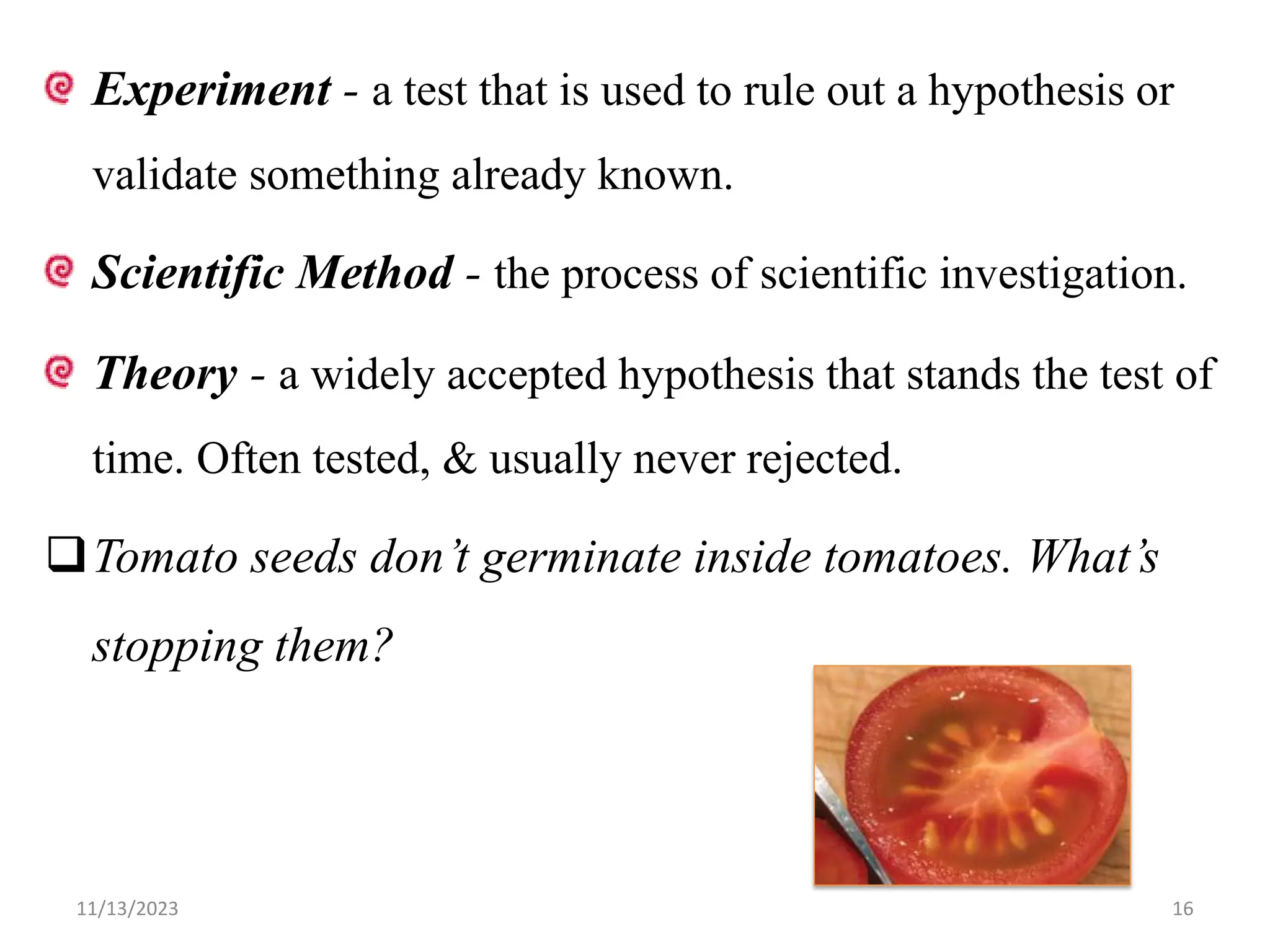
Tomato seeds don’t germinate inside tomatoes. What’s
stopping them?
11/13/2023 16
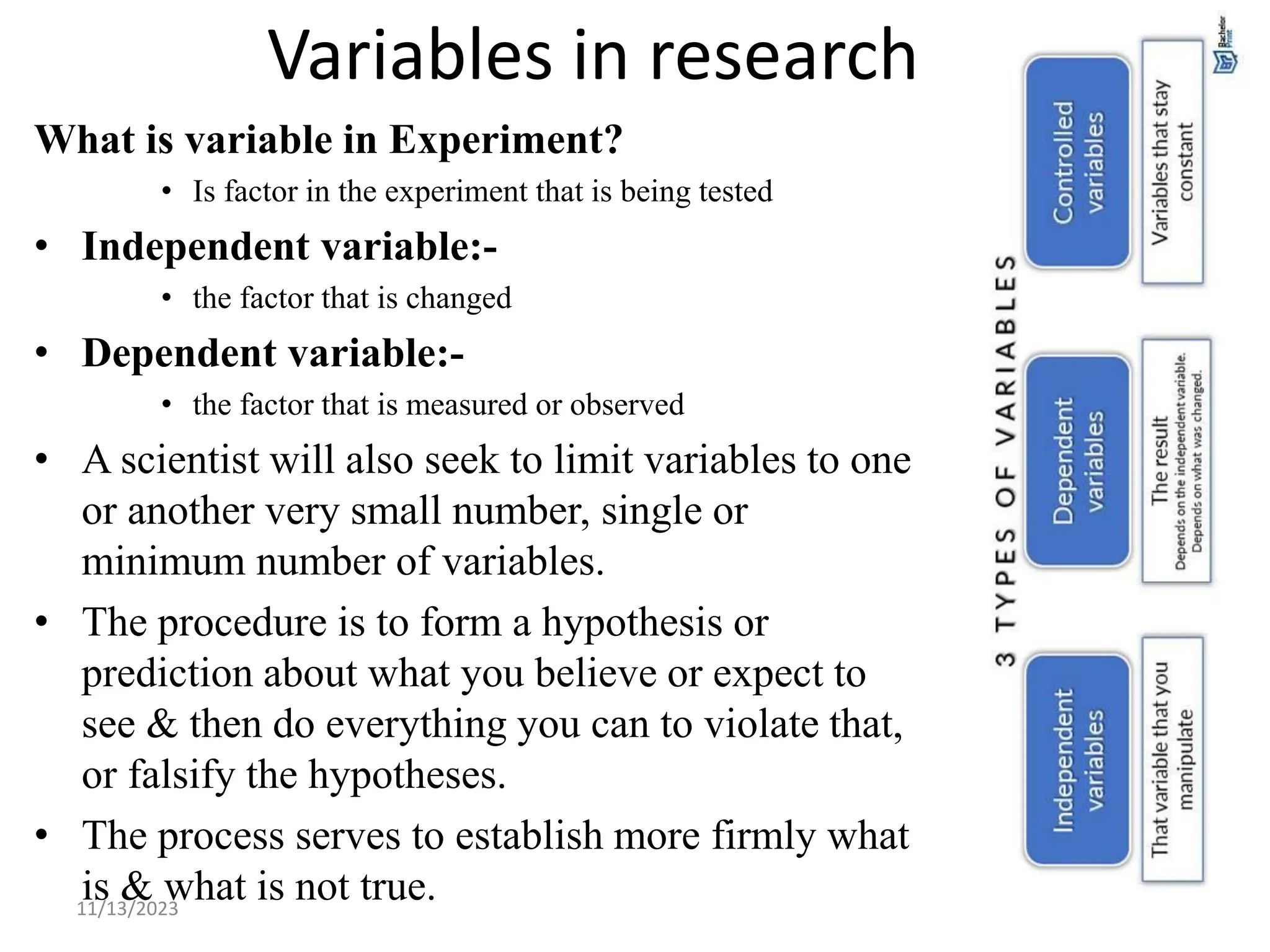
Variables in research
What is variable in Experiment?
• Is factor in the experiment that is being tested
• Independent variable:-
• the factor that is changed
• Dependent variable:-
• the factor that is measured or observed
• A scientist will also seek to limit variables to one
or another very small number, single or
minimum number of variables.
• The procedure is to form a hypothesis or
prediction about what you believe or expect to
see & then do everything you can to violate that,
or falsify the hypotheses.
• The process serves to establish more firmly what
is & what is not true.
11/13/2023 17
Summary of the scientific method
Step 1: Observe behavior or other phenomena
Step 2: Form a tentative answer or explanation (a hypothesis)
Step 3: Use your hypothesis to generate a testable prediction
Step 4: Make systematic, planned observation (data collection)
Step 5: Results & Discussion Use the observations to evaluate
(support, refute, or refine) the original hypothesis
Step 6: Conclusion
Step 7: Recommendation
11/13/2023 18
Chapter review questions
• List dawn all the steps used in scientific methods
• Propose a hypothesis in an attempt to find explanations
for this curiosity
• Explain the differences between control and variable
group
• List down the characteristics common to all living
things
• What is a controlled experiment? Why is it essential to
have a control group in scientific experiment?
11/13/2023 19

Unit- 1 Introduction to general biology.pdf

  • 1.
    General Biology Biol. 1012 AlemuChemeda(Asst. Prof) Arba Minch University Arba Minch, Ethiopia
  • 2.
    Learning Objectives: • Aftercompleting this chapter, you will be expected to: Define the term biology Explain the origin and the nature of life Explain scientific methods 11/13/2023 2
  • 3.
    Unit 1 1.1. Themeaning and scope of biology  Biological Science is the study of life & living organisms.  It is also called as “Biology” (Greek word).  „bio-‟ means life & „-logos‟ means study of.  In the late 1700s P.A. de Monet & J.B. de Lamarck coined the term biology. Therefore, Biology is the science of living things.  That is why Biology is sometimes known as Life Science. 11/13/2023 3
  • 4.
    1.2. The originand nature of life The mystery of life's origin is still a big debating issue in science. The question “what is life?” is so hard to answer. Several attempts have been made from time to time to explain the origin of life on earth. There are a number of theories about the origin of life. of them: 1. Theory of Special Creation:  All different forms of life that occur today on earth planet have been created by God, the almighty. 11/13/2023 4
  • 5.
    2. Theory ofSpontaneous Generation: • Living organisms could arise suddenly & spontaneously from any kind of non-living matter. • One of the firm believers in spontaneous generation was Aristotle (384-322 BC). Criticized by: -Lazzaro Spallanzani, Francisco Redi & Louis Pasteur -They performed well designed scientific exp‟ts to disprove this theory 11/13/2023 5
  • 6.
    3. Theory ofCatastrophism: • a modification of the theory of Special Creation. • It states that there have been several creations of life by God, each preceded by a catastrophe resulting from some kind of geological disturbance. • According to this theory, since each catastrophe completely destroyed the existing life, each new creation consisted of life form different from that of previous ones. Critism: -no scientific exp‟t to support hypothesis -mostly based on imaginary concept. 11/13/2023 6
  • 7.
    4. Theory ofCosmozoic:  also known as “theory of panspermia or spore theory”  states life has reached this planet Earth from other heavenly bodies such as meteorites, in the form of highly resistance spores of some organisms.  This idea was proposed by Richter in1865 & supported by Arrhenius (1908) & other contemporary scientists.  The theory did not gain any support.  This theory lacks evidence, hence it was discarded. 11/13/2023 7
  • 8.
    5. Theory ofEternity of Life:  This theory assumes that life had no beginning or end.  believes that life has ever been in existence & it will continue to be so ever.  believe that there is no question of origin of life as it has no beginning or end.  The theory is also known as steady state theory. Objection: it could not be able to explain; evidences support that initially earth forms & then life appeared on it. o Where life exist before the formation of earth? 11/13/2023 8
  • 9.
    6. Theory ofChemical Evolution (modern theory):  this theory is also known as Materialistic Theory or Physico-chemical Theory.  States, origin of life on earth is the result of a slow & gradual process of chemical evolution that probably occurred about 3.8 billion years ago.  This theory was proposed independently by two scientists - A.I.Oparin in 1923 & J.B.S Haldane in 1928. 11/13/2023 9
  • 10.
    Nature and characteristicsof life Life is defined as a "condition" that distinguishes animals & plants from inorganic materials & dead organisms. • Life is comprised of processes & is a maintained state. • The most sophisticated form of life is man as a result of this we focuses upon the nature of the life & death of man. 11/13/2023 10
  • 11.
     Man demonstratesthree lives or aspects of life:  Life of the body (physical): is basic existence Life of the mind: mind contributes effectiveness & scope  Life of the spirit: spiritual entity contributes maximum living. Physiology: the existence of life physical is demonstrated by the presence of functions. 11/13/2023 11
  • 12.
    Living tissues &organisms exhibit: Irritability Growth and reproduction Adaptability Metabolism Excretion 11/13/2023 12
  • 13.
    1.3. Scientific methods Is a process for experimentation that is used to explore observations & answer questions.  It is an empirical method of acquiring knowledge.  It is also the technique used in the construction & testing of a scientific hypothesis. 11/13/2023 13
  • 14.
     The scientificmethod has five basic steps, plus one feedback step: Make an observation. Ask a question. Form a hypothesis, or testable explanation. Make a prediction based on the hypothesis. Test the prediction. Iterate: use the results to make new hypotheses or predictions. 11/13/2023 14
  • 15.
    Observation- quantitative &qualitative measurements of the world. Inference- deriving new knowledge based upon old knowledge. Hypotheses- a suggested explanation. Rejected Hypothesis- an explanation that has been ruled out through experimentation. Accepted Hypothesis- an explanation that has not been ruled out through excessive experimentation & makes verifiable predictions that are true. 11/13/2023 15
  • 16.
    Experiment - atest that is used to rule out a hypothesis or validate something already known. Scientific Method - the process of scientific investigation. Theory - a widely accepted hypothesis that stands the test of time. Often tested, & usually never rejected. Tomato seeds don’t germinate inside tomatoes. What’s stopping them? 11/13/2023 16
  • 17.
    Variables in research Whatis variable in Experiment? • Is factor in the experiment that is being tested • Independent variable:- • the factor that is changed • Dependent variable:- • the factor that is measured or observed • A scientist will also seek to limit variables to one or another very small number, single or minimum number of variables. • The procedure is to form a hypothesis or prediction about what you believe or expect to see & then do everything you can to violate that, or falsify the hypotheses. • The process serves to establish more firmly what is & what is not true. 11/13/2023 17
  • 18.
    Summary of thescientific method Step 1: Observe behavior or other phenomena Step 2: Form a tentative answer or explanation (a hypothesis) Step 3: Use your hypothesis to generate a testable prediction Step 4: Make systematic, planned observation (data collection) Step 5: Results & Discussion Use the observations to evaluate (support, refute, or refine) the original hypothesis Step 6: Conclusion Step 7: Recommendation 11/13/2023 18
  • 19.
    Chapter review questions •List dawn all the steps used in scientific methods • Propose a hypothesis in an attempt to find explanations for this curiosity • Explain the differences between control and variable group • List down the characteristics common to all living things • What is a controlled experiment? Why is it essential to have a control group in scientific experiment? 11/13/2023 19