Prescribing information for Doctors for Antibiotics
1.
Toolkit 3. HowTo Develop and Implement
an Antibiogram Program
Phase 3. Implementation
Training Slides for
Prescribing Clinicians
Nursing Home Antimicrobial Stewardship Guide
Help Clinicians Choose the Right Antibiotic
www.ahrq.gov/NH-ASPGuide ● May 2014
AHRQ Pub. No. 14-0023-5-EF
2.
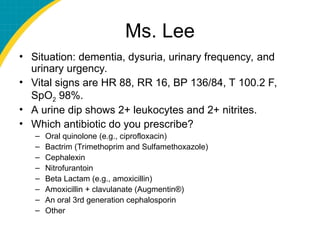
Ms. Lee
• Situation:dementia, dysuria, urinary frequency, and
urinary urgency.
• Vital signs are HR 88, RR 16, BP 136/84, T 100.2 F,
SpO2 98%.
• A urine dip shows 2+ leukocytes and 2+ nitrites.
• Which antibiotic do you prescribe?
– Oral quinolone (e.g., ciprofloxacin)
– Bactrim (Trimethoprim and Sulfamethoxazole)
– Cephalexin
– Nitrofurantoin
– Beta Lactam (e.g., amoxicillin)
– Amoxicillin + clavulanate (Augmentin®)
– An oral 3rd generation cephalosporin
– Other
3.
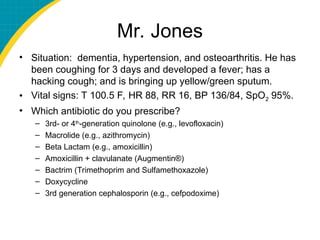
Mr. Jones
• Situation:dementia, hypertension, and osteoarthritis. He has
been coughing for 3 days and developed a fever; has a
hacking cough; and is bringing up yellow/green sputum.
• Vital signs: T 100.5 F, HR 88, RR 16, BP 136/84, SpO2 95%.
• Which antibiotic do you prescribe?
– 3rd- or 4th
-generation quinolone (e.g., levofloxacin)
– Macrolide (e.g., azithromycin)
– Beta Lactam (e.g., amoxicillin)
– Amoxicillin + clavulanate (Augmentin®)
– Bactrim (Trimethoprim and Sulfamethoxazole)
– Doxycycline
– 3rd generation cephalosporin (e.g., cefpodoxime)
4.
Objectives
• Implement anantibiogram at this nursing
home
• Set a goal of improving initial (empiric)
prescribing of antibiotics
• Follow the impact of the antibiogram on
nursing home prescribing
5.
Background: Antibiotic Prescribing
•Antibiotics are frequently prescribed in
nursing homes.
– Broad-spectrum antibiotics are frequently
prescribed.
• Initial antibiotic decisions are empiric;
clinician’s judgment is based on:
– Patient factors (e.g., age, symptoms)
– Nursing home factors (type, historical experience,
formulary)
– Preference/knowledge
6.
Background: Antibiograms
• Anantibiogram is a tool to provide
clinicians with local microbiologic
sensitivity data to assist in their empiric
prescribing.
• Hospitals have used antibiograms to:
– Identify important local resistance patterns.
– Increase recommended antibiotic prescribing
for acute infections.
8.
Key Findings FromAntibiogram
• Most data come from urine cultures:
– Of XX cultures used to make the antibiograms,
• XX % were urine cultures.
• XX % were wound cultures.
• XX % were sputum cultures.
– The antibiograms will be most applicable when selecting
antibiotics to treat urine infections and systemic infections that
may have come from the urine.
– The leading organisms for positive urine cultures were:
• E. coli: XX % of urine cultures
• Enterococcus species: XX %
• Klebsiella pneumoniae: XX %
• Proteus mirabilis: XX %
9.
Key Findings FromAntibiogram
Not all antibiotics are tested
•One antibiotic from each class is usually tested.
•Antibiotics from the same class are likely to have
similar resistance patterns; for example, with
cephalosporins:
– 1st generation: Cefazolin (Ancef) was tested; a
comparable oral agent is cephalexin (Keflex).
– 2nd generation: Cefoxitin (Mefoxin) was tested; a
comparable oral agent is cefuroxime (Ceftin).
– 3rd generation: Ceftriaxone (Rocephin) was tested; a
comparable oral agent is cefpodoxime (Simplicef, Vantin).
10.
Key Findings FromAntibiogram
Urinary tract infections (UTIs) from gram-negative organisms
•XX% of positive urine cultures were due to gram-negative
organisms.
•Significant resistance to commonly used antibiotics is seen
among the gram-negative organisms that frequently cause UTIs
(E. coli, Klebsiella):
– TMP/SMX (Bactrim) sensitivity for E. coli is limited (XX %).
– Quinolones’ sensitivity for E. coli is limited (levofloxacin [Levaquin] XX
%, ciprofloxacin [Cipro] XX %).
– First-generation cephalosporins’ sensitivity for E. coli is limited: cefazolin
(Ancef) XX %.
•Nitrofurantoin (Macrobid) has good sensitivity for E. coli (XX %)
but poor activity against other urinary pathogens.
11.
Key Findings FromAntibiogram
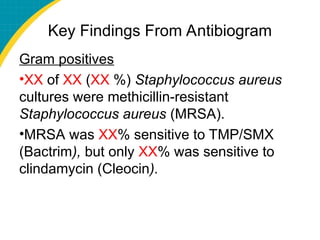
Gram positives
•XX of XX (XX %) Staphylococcus aureus
cultures were methicillin-resistant
Staphylococcus aureus (MRSA).
•MRSA was XX% sensitive to TMP/SMX
(Bactrim), but only XX% was sensitive to
clindamycin (Cleocin).
12.
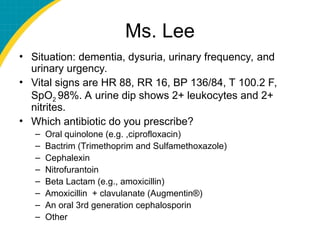
Ms. Lee
• Situation:dementia, dysuria, urinary frequency, and
urinary urgency.
• Vital signs are HR 88, RR 16, BP 136/84, T 100.2 F,
SpO2 98%. A urine dip shows 2+ leukocytes and 2+
nitrites.
• Which antibiotic do you prescribe?
– Oral quinolone (e.g. ,ciprofloxacin)
– Bactrim (Trimethoprim and Sulfamethoxazole)
– Cephalexin
– Nitrofurantoin
– Beta Lactam (e.g., amoxicillin)
– Amoxicillin + clavulanate (Augmentin®)
– An oral 3rd generation cephalosporin
– Other
13.
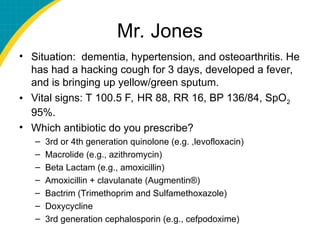
Mr. Jones
• Situation:dementia, hypertension, and osteoarthritis. He
has had a hacking cough for 3 days, developed a fever,
and is bringing up yellow/green sputum.
• Vital signs: T 100.5 F, HR 88, RR 16, BP 136/84, SpO2
95%.
• Which antibiotic do you prescribe?
– 3rd or 4th generation quinolone (e.g. ,levofloxacin)
– Macrolide (e.g., azithromycin)
– Beta Lactam (e.g., amoxicillin)
– Amoxicillin + clavulanate (Augmentin®)
– Bactrim (Trimethoprim and Sulfamethoxazole)
– Doxycycline
– 3rd generation cephalosporin (e.g., cefpodoxime)
14.
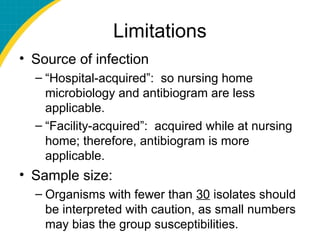
Limitations
• Source ofinfection
– “Hospital-acquired”: so nursing home
microbiology and antibiogram are less
applicable.
– “Facility-acquired”: acquired while at nursing
home; therefore, antibiogram is more
applicable.
• Sample size:
– Organisms with fewer than 30 isolates should
be interpreted with caution, as small numbers
may bias the group susceptibilities.
#1 [Print out copies of the vignettes and antibiograms for all participants. Pass out the vignettes early, then provide the antibiogram when first discussing the antibiogram, but not before.]
Introductions: Trainer’s name; if small group, conduct introductions for all.
The purpose of today’s training is to discuss using an antibiogram to decide which antibiotics to use for residents in a nursing home.
#2 First, I would like to get your thoughts on how to treat Ms. Lee. (Pass out vignettes out to attendees.) How would you treat Ms. Lee? On what basis?
Ms. Lee is a 71-year-old woman who ¡s a long-term resident of your facility, with dementia and no recent hospitalizations. She complains to a nurse of dysuria, urinary frequency and urinary urgency since 8 p.m. last night. You assess the patient and find that her vital signs are HR 88, RR 16, BP 136/84, T 100.2 F, SpO2 98%. A urine dip shows 2+ leukocytes and 2+ nitrites. The patient generally appears well and has some mild suprapubic tenderness.
In addition to ordering a urine culture, which of the following procedures would you follow?
Wait for the urine culture results.
Have the patient transferred to the emergency department for evaluation.
Prescribe an oral antibiotic.
Prescribe an IV antibiotic.
Which of the following do you think is/are the most appropriate antibiotic(s) for the above described symptoms?
Oral quinolone (e.g., ciprofloxacin)
Bactrim (Trimethoprim (TMP) and Sulfamethoxazole (SMX))
Cephalexin
Nitrofurantoin
Beta Lactam (e.g., amoxicillin)
Amoxicillin + clavulanate (Augmentin®)
An oral 3rd generation cephalosporin
Other
#3 Now I would like to do the same thing for Mr. Jones. How would you treat Mr. Jones? What is your rationale for that?
Mr. Jones is a 76-year-old man who ¡s a long-term resident of your facility, with dementia and no recent hospitalizations. His other medical problems include hypertension and osteoarthritis. You are called by a nurse as Mr. Jones has been coughing for 3 days and today developed a fever. He has a hacking cough, is bringing up yellow/green sputum, and his vital signs are T 100.5 F, HR 88, RR 16, BP 136/84, SpO2 95%.
In addition to ordering a chest x-ray, which of the following procedures would you follow?
Wait for the chest x-ray results.
Have the patient transferred to the emergency department for evaluation.
Prescribe an oral antibiotic.
Prescribe an IV antibiotic.
Which of the following do you think is/are the most appropriate antibiotic(s) for the above described symptoms?
3rd or 4th generation quinolone (e.g., levofloxacin)
Macrolide (e.g., azithromycin)
Beta Lactam (e.g., amoxicillin)
Amoxicillin + clavulanate (Augmentin®)
Bactrim (Trimethoprim and Sulfamethoxazole)
Doxycycline
3rd generation cephalosporin (e.g., cefpodoxime)
Other [free text]
#4 We are conducting today’s training with the objectives of using an antibiogram to make initial decisions for antibiotics and to follow the effect of the antibiogram on nursing home prescribing.
#5 Antibiotics are the most frequent medications prescribed, and in some cases they are overprescribed. Antibiotic use can lead to side effects, multidrug resistance, and health care-associated infections such as Clostridium difficile.
Decisions are made by factors such as symptoms, previous history, nursing home factors, and preference and knowledge of antibiotics. Typically, a clinician does not have cultures or test results to identify a specific medication to prescribe.
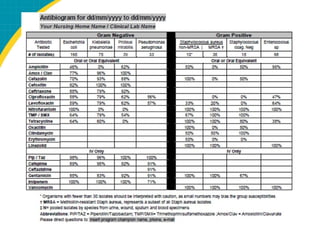
#6 What is an antibiogram? Essentially, it is a one-page document that lists the sensitivity data related to various bacteria strains for a given nursing home.
#7 [Pass out copies of the antibiogram.]
Here is a copy of this nursing home’s antibiogram. What does it mean?
#8 [Edit slide to reflect antibiogram data.]
As you can see, of the cultures used to make the antibiograms, the most common were urine/wound/sputum. Antibiograms are most applicable when selecting antibiotics to treat urinary tract infections (UTIs) or systemic infections resulting from a urine infection. The most common positive urine cultures were….
#9 You will also notice from the antibiogram that not all antibiotics are tested—usually just one from each class. The reason is that antibiotics from the same class are likely to have similar resistance patterns.
#10 Based on this antibiogram, [explain findings, enter in data which are red].
#11 Based on this antibiogram, [explain findings, enter in data which are red].
#12 [Discussion can go back to Ms. Lee and Mr. Jones or go to the other two vignettes of Ms. Williams and Mr. Jackson.]
So, going back to Ms. Lee, would you change anything? [Review the following as necessary]
Ms. Lee, a 71-year-old woman, ¡s a long-term resident of your facility, with dementia and no recent hospitalizations. She complains to a nurse of dysuria, urinary frequency, and urinary urgency since 8 p.m. last night. You assess the patient and find that her vital signs are HR 88, RR 16, BP 136/84, T 100.2 F, SpO2 98%. A urine dip shows 2+ leukocytes and 2+ nitrites. The patient generally appears well and has some mild suprapubic tenderness.
In addition to ordering a urine culture, which of the following procedures would you follow?
Wait for the urine culture results.
Have the patient transferred to the emergency department for evaluation.
Prescribe an oral antibiotic.
Prescribe an IV antibiotic.
Which of the following do you think is/are the most appropriate antibiotic(s) for the above described symptoms?
Oral quinolone (e.g., ciprofloxacin)
Bactrim (Trimethoprim and Sulfamethoxazole)
Cephalexin
Nitrofurantoin
Beta Lactam (e.g., amoxicillin)
Amoxicillin + clavulanate (Augmentin®)
An oral 3rd generation cephalosporin
Other
#13 What about Mr. Jones? Would you change anything for Mr. Jones? [Review the following as necessary]
Mr. Jones, a 76-year-old man, ¡s a long-term resident of your facility. He has dementia and no recent hospitalizations. His other medical problems include hypertension and osteoarthritis. You are called by a nurse, as Mr. Jones has had a hacking cough for 3 days, today developed a fever, and is bringing up yellow/green sputum and his vital signs are T 100.5 F, HR 88, RR 16, BP 136/84, SpO2 95%.
In addition to ordering a chest x-ray which of the following procedures would you follow?
Wait for the chest x-ray results.
Have the patient transferred to the emergency department for evaluation.
Prescribe an oral antibiotic.
Prescribe an IV antibiotic.
Which of the following do you think is/are the most appropriate antibiotic(s) for the above
described symptoms?
3rd or 4th generation quinolone (e.g., levofloxacin)
Macrolide (e.g., azithromycin)
Beta Lactam (e.g., amoxicillin)
Amoxicillin + clavulanate (Augmentin®)
Bactrim (Trimethoprim and Sulfamethoxazole)
Doxycycline
3rd generation cephalosporin (e.g., cefpodoxime)
Other [free text]
#14 What are the limitations? One is that it depends where a resident acquired the infection. An antibiogram is most applicable if he or she acquired the infection while in the nursing home. Also, if fewer than 30 isolates exist, the data should be interpreted with caution as they may not be reliable.
#15 Has anyone used an antibiogram to make decisions? How did that work for you?



![Key Findings From Antibiogram
Urinary tract infections (UTIs) from gram-negative organisms
•XX% of positive urine cultures were due to gram-negative
organisms.
•Significant resistance to commonly used antibiotics is seen
among the gram-negative organisms that frequently cause UTIs
(E. coli, Klebsiella):
– TMP/SMX (Bactrim) sensitivity for E. coli is limited (XX %).
– Quinolones’ sensitivity for E. coli is limited (levofloxacin [Levaquin] XX
%, ciprofloxacin [Cipro] XX %).
– First-generation cephalosporins’ sensitivity for E. coli is limited: cefazolin
(Ancef) XX %.
•Nitrofurantoin (Macrobid) has good sensitivity for E. coli (XX %)
but poor activity against other urinary pathogens.](https://image.slidesharecdn.com/5tk3p3t4-trainingslidesforprescribingcliniciansphase3-250420190551-326fe62e/85/Prescribing-information-for-Doctors-for-Antibiotics-10-320.jpg)