Food Processing, Preservation
and Shelf-Life Study
Introduction
I want eat a mango in
winter season? Is it
possible? Why not ! it is possible
Food Preservation
Food Preservation is a process in which
Food and vegetables are prevented from getting
spoilt
The color, test, and nutritive values of food is also
preserved
Food products lasts for a long period of time:
Shelf life of food product is increased
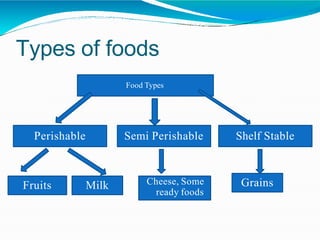
Types of foods
Food Types
Perishable Semi Perishable Shelf Stable
Fruits Milk Cheese, Some
ready foods
Grains
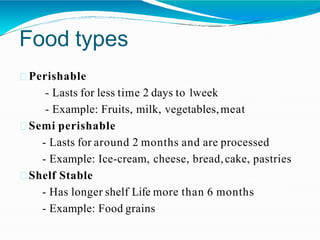
Food types
Perishable
- Lasts for less time 2 days to 1week
- Example: Fruits, milk, vegetables,meat
Semi perishable
- Lasts for around 2 months and are processed
- Example: Ice-cream, cheese, bread,cake, pastries
Shelf Stable
- Has longer shelf Life more than 6 months
- Example: Food grains
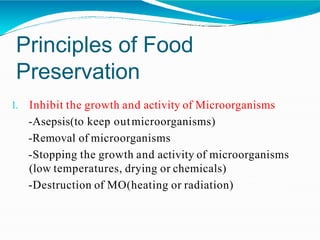
Principles of Food
Preservation
1. Inhibit the growth and activity of Microorganisms
-Asepsis(to keep outmicroorganisms)
-Removal of microorganisms
-Stopping the growth and activity of microorganisms
(low temperatures, drying or chemicals)
-Destruction of MO(heating or radiation)
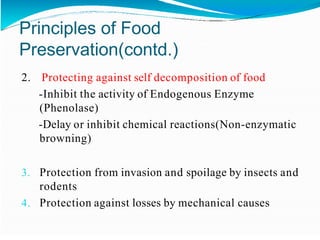
Principles of Food
Preservation(contd.)
2. Protecting against self decomposition of food
-Inhibit the activity of Endogenous Enzyme
(Phenolase)
-Delay or inhibit chemical reactions(Non-enzymatic
browning)
3. Protection from invasion and spoilage by insects and
rodents
4. Protection against losses by mechanical causes
Food Preservation
Methods
Preservation methods vary according to
--------the food items, and
--------quantity of the items to be preserved
Principles of Food preservation can be broadly
classified into twotypes:
1) Bactericidal methods
2) Bacteriostatic methods
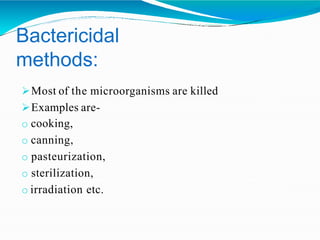
Bactericidal
methods:
Most of the microorganisms are killed
Examples are-
o cooking,
o canning,
o pasteurization,
o sterilization,
o irradiation etc.
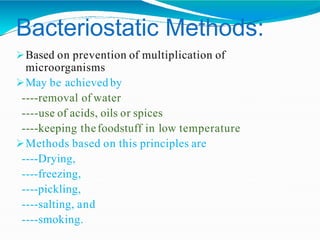
Bacteriostatic Methods:
Based on prevention of multiplication of
microorganisms
May be achieved by
----removal of water
----use of acids, oils or spices
----keeping thefoodstuff in low temperature
Methods based on this principles are
----Drying,
----freezing,
----pickling,
----salting, and
----smoking.
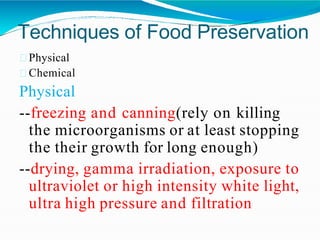
Techniques of Food Preservation
Physical
Chemical
Physical
--freezing and canning(rely on killing
the microorganisms or at least stopping
the their growth for long enough)
--drying, gamma irradiation, exposure to
ultraviolet or high intensity white light,
ultra high pressure and filtration
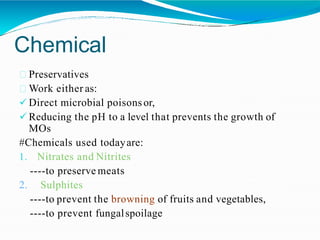
Chemical
Preservatives
Work either as:
 Direct microbial poisonsor,
 Reducing the pH to a level that prevents the growth of
MOs
#Chemicals used todayare:
1. Nitrates and Nitrites
----to preserve meats
2. Sulphites
----to prevent the browning of fruits and vegetables,
----to prevent fungalspoilage
Common food preservation
methods:
Bottling and canning
Pickling
Drying
Salting
Vacuum packing
Cooling and freezing
Waxing
Pasteurization
Boiling
Bottling and Canning
Bottling and canning are processes of
preserving food by heating and then
sealing it in an airtight container.
The food is boiled to kill microorganisms
and then sealed to prevent other
microorganisms from getting in.
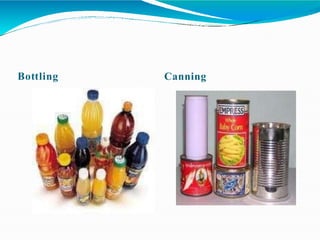
Bottling Canning
PICKLING
Pickling food in vinegar or other acids, makes
it difficult for microorganisms to live.
Commonly pickled food include onions,
parkias, soya beans and chillies.
Sugar can also be used in pickling fruits such
as nutmegs, mangoes and cherries.
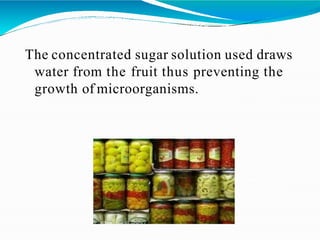
The concentrated sugar solution used draws
water from the fruit thus preventing the
growth of microorganisms.
Drying
Alot of food is preserved by drying under the
sun.
Drying removes most water from food. Most
bacteria die or become inactive when the
food is dried.
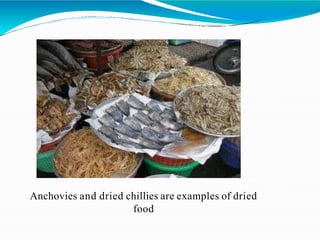
Anchovies and dried chillies are examples of dried
food
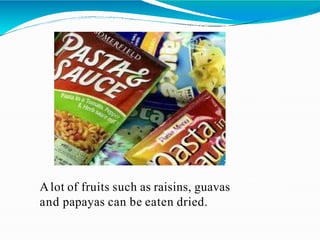
Alot of fruits such as raisins, guavas
and papayas can be eaten dried.
Salting
Salting is an age-old way of preserving
food. The salt draws out moisture and
prevents microorganisms from
growing. In this process, food such as
fresh fish are washed and coarse salt
is rubbed into it.
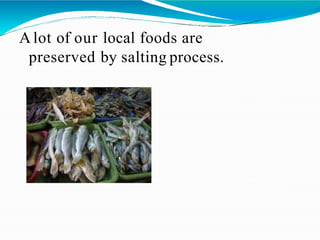
A lot of our local foods are
preserved by salting process.
Vacuum Packing
Vacuum packing keeps food by sucking
air out from its packaging.
Food is thus prevented from spoiling
because there is no air.
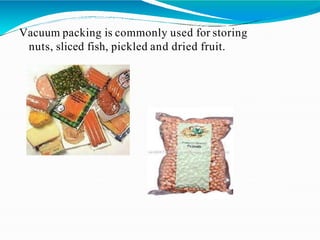
Vacuum packing is commonly used for storing
nuts, sliced fish, pickled and dried fruit.
Cooling and Freezing
Cooling and freezing are the most
common forms of food
preservation.
Cooling slows down the action of
microorganisms, thus it takes longer
to spoil. It allows fruit from different
parts of the world to appear on our
supermarket shelves.(0 to -40 C)
At freezing temperature,
microorganisms become inactive,
thus food cannot spoil when it is
frozen. (-18 0C)
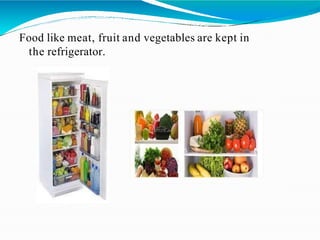
Food like meat, fruit and vegetables are kept in
the refrigerator.
Waxing
Waxing of fruit and vegetables is also common. Apples,
oranges, eggplants and tomatoes are dipped into liqiud
wax to prevent growth of fungi and loss of moisture.
Waxed fruit need to be washed thoroughly or peeled before
eating.
Pasteurization
Pasteurization means heating food to a
certain temperature for some time
followed by rapid cooling. Heating at
such high enough temperature kills
most bacteria. However, it does not
affect the taste and nutritional value of
the food.
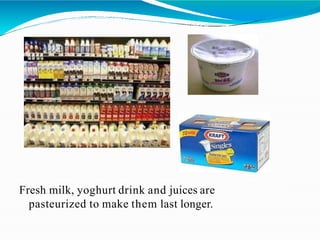
Fresh milk, yoghurt drink and juices are
pasteurized to make them last longer.
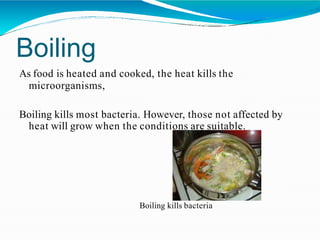
Boiling
As food is heated and cooked, the heat kills the
microorganisms,
Boiling kills most bacteria. However, those not affected by
heat will grow when the conditions are suitable.
Boiling kills bacteria
Smoking
Smoking is the process of drying food with
smoke for a long period of time. This
method is mainly used for fish, meat and
fruit such asbanana.
The drying effects of smoke and the chemicals
produced from the smoke help to preserve
the food.
Smoked banana smoked meat
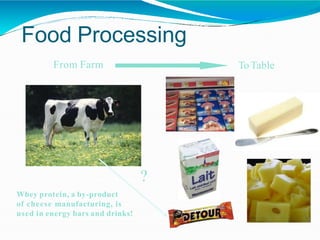
Food Processing
From Farm ToTable
?
Whey protein, a by-product
of cheese manufacturing, is
used in energy bars and drinks!
Aims of Food Processing
1.To extend the shelf life to allow time for distribution,
sales and home storage.
2.To increase variety in the diet by providing a range of
attractive flavours, colours, aromas and textures in food
(collectively known as eating quality, sensory
characteristics or organoleptic quality); .
3.To provide the nutrients required for health (termed
nutritional quality of a food).
4. To generate income for the manufacturing company.
Food Processing
Examples of food processing methods include:
Chopping
Mixing
Homogenizing
Cooking
Pastuerizing
Blanching
Spray-drying
Frying
Baking
Packaging
Dehydration
Dehydration (or drying) is defined as ‘the application
of heat under controlled conditions to remove the
majority of the water normally present in a food by
evaporation’ (or in the case of freeze drying by
sublimation).
The main purpose of dehydration is to extend the shelf
life of foods by a reduction in water activity This
inhibits microbial growth and enzyme activity, but the
processing temperature is usually insufficient to cause
their inactivation.
Dehydration
Drying causes deterioration of both the eating quality and
the nutritional value of the food.
Examples of commercially important dried foods are
coffee, milk, raisins, and other fruits, pasta, flours
(including bakery mixes), beans, nuts, breakfast cereals,
tea and spices.
 There are a large number of factors that control the
rate at which foods dry, which can be grouped into the
following categories
processing conditions
nature of the food
drier design.
Blanching
A few processed vegetables, for example onions and green
peppers, do not require blanching to prevent enzyme
activity during storage, but the majority suffer considerable
loss in quality if blanching is omitted or if they are under-
blanched.
To achieve adequate enzyme inactivation, food is heated
rapidly to a pre-set temperature, held for a pre-set time and
then cooled rapidly to near ambient temperatures.
The factors which influence blanching time are:
• type of fruit or vegetable
• size of the pieces of food
• blanching temperature
• method of heating.
Pasteurisation
Pasteurization is a relatively mild heat treatment, in which
food is heated to below 100ºC. In low acid foods (pH>4.5,
for example milk) it is used to minimize possible health
hazards from pathogenic micro-organisms and to extend
the shelf life of foods for several days.
In acidic foods (pH <4.5, for example bottled fruit) it is
used to extend the shelf life for several months by
destruction of spoilage micro-organisms (yeasts or moulds)
and/or enzyme inactivation
Canning
A method of preserving food by killing all
microorganisms present in the food and then sealing
out air
The food, container, and lid are heated until sterile
As the food cools, the lid makes an airtight seal,
preventing contamination
Extrusion
Aprocess by which the form of a food is changed
Such as changing corn to corn chips
Not a preservation measure
In this process, the food is heated, ground, and pushed
through various kinds of screens to yield different
shapes
Irradiation
Ionising radiation takes theform of Gama-rays
from isotopes or, commercially to a lesser extent,
from X-rays and electrons. It is permitted in 38
countries to preserve foods by destruction of
micro-organisms or inhibition of biochemical
changes.
Chilling
Chilling is the unit operation in which the temperature
of a food is reduced to between 1ºC and 8ºC.
Packaging
Food is packaged for many purposes.
 Some reasons are:
containment for shipping, dispensing, unitizing in to
appropriate sizes, improving the usefulness,
protect from microbial contamination, physical dirt, insect
invasion, light exposure, flavor pickup, flavor loss,
moisture pickup, moisture loss and physical abuse
Food is packaged in metal cans, glass & plastic bottles,
paper &paper board, wide variety of plastic &metallic
films andcombinations of these
 Packaging is done by continuous automatic machines at a
speed of 1000 units permin
 The container forming is dependent on the type of the food
Food Processing and Preservation & Shelf Life.pdf

Food Processing and Preservation & Shelf Life.pdf

  • 1.
  • 3.
    Introduction I want eata mango in winter season? Is it possible? Why not ! it is possible
  • 4.
    Food Preservation Food Preservationis a process in which Food and vegetables are prevented from getting spoilt The color, test, and nutritive values of food is also preserved Food products lasts for a long period of time: Shelf life of food product is increased
  • 5.
    Types of foods FoodTypes Perishable Semi Perishable Shelf Stable Fruits Milk Cheese, Some ready foods Grains
  • 6.
    Food types Perishable - Lastsfor less time 2 days to 1week - Example: Fruits, milk, vegetables,meat Semi perishable - Lasts for around 2 months and are processed - Example: Ice-cream, cheese, bread,cake, pastries Shelf Stable - Has longer shelf Life more than 6 months - Example: Food grains
  • 7.
    Principles of Food Preservation 1.Inhibit the growth and activity of Microorganisms -Asepsis(to keep outmicroorganisms) -Removal of microorganisms -Stopping the growth and activity of microorganisms (low temperatures, drying or chemicals) -Destruction of MO(heating or radiation)
  • 8.
    Principles of Food Preservation(contd.) 2.Protecting against self decomposition of food -Inhibit the activity of Endogenous Enzyme (Phenolase) -Delay or inhibit chemical reactions(Non-enzymatic browning) 3. Protection from invasion and spoilage by insects and rodents 4. Protection against losses by mechanical causes
  • 9.
    Food Preservation Methods Preservation methodsvary according to --------the food items, and --------quantity of the items to be preserved Principles of Food preservation can be broadly classified into twotypes: 1) Bactericidal methods 2) Bacteriostatic methods
  • 10.
    Bactericidal methods: Most of themicroorganisms are killed Examples are- o cooking, o canning, o pasteurization, o sterilization, o irradiation etc.
  • 11.
    Bacteriostatic Methods: Based onprevention of multiplication of microorganisms May be achieved by ----removal of water ----use of acids, oils or spices ----keeping thefoodstuff in low temperature Methods based on this principles are ----Drying, ----freezing, ----pickling, ----salting, and ----smoking.
  • 12.
    Techniques of FoodPreservation Physical Chemical Physical --freezing and canning(rely on killing the microorganisms or at least stopping the their growth for long enough) --drying, gamma irradiation, exposure to ultraviolet or high intensity white light, ultra high pressure and filtration
  • 13.
    Chemical Preservatives Work either as: Direct microbial poisonsor,  Reducing the pH to a level that prevents the growth of MOs #Chemicals used todayare: 1. Nitrates and Nitrites ----to preserve meats 2. Sulphites ----to prevent the browning of fruits and vegetables, ----to prevent fungalspoilage
  • 14.
    Common food preservation methods: Bottlingand canning Pickling Drying Salting Vacuum packing Cooling and freezing Waxing Pasteurization Boiling
  • 15.
    Bottling and Canning Bottlingand canning are processes of preserving food by heating and then sealing it in an airtight container. The food is boiled to kill microorganisms and then sealed to prevent other microorganisms from getting in.
  • 16.
  • 17.
    PICKLING Pickling food invinegar or other acids, makes it difficult for microorganisms to live. Commonly pickled food include onions, parkias, soya beans and chillies. Sugar can also be used in pickling fruits such as nutmegs, mangoes and cherries.
  • 18.
    The concentrated sugarsolution used draws water from the fruit thus preventing the growth of microorganisms.
  • 19.
    Drying Alot of foodis preserved by drying under the sun. Drying removes most water from food. Most bacteria die or become inactive when the food is dried.
  • 20.
    Anchovies and driedchillies are examples of dried food
  • 21.
    Alot of fruitssuch as raisins, guavas and papayas can be eaten dried.
  • 22.
    Salting Salting is anage-old way of preserving food. The salt draws out moisture and prevents microorganisms from growing. In this process, food such as fresh fish are washed and coarse salt is rubbed into it.
  • 23.
    A lot ofour local foods are preserved by salting process.
  • 24.
    Vacuum Packing Vacuum packingkeeps food by sucking air out from its packaging. Food is thus prevented from spoiling because there is no air.
  • 25.
    Vacuum packing iscommonly used for storing nuts, sliced fish, pickled and dried fruit.
  • 26.
    Cooling and Freezing Coolingand freezing are the most common forms of food preservation.
  • 27.
    Cooling slows downthe action of microorganisms, thus it takes longer to spoil. It allows fruit from different parts of the world to appear on our supermarket shelves.(0 to -40 C) At freezing temperature, microorganisms become inactive, thus food cannot spoil when it is frozen. (-18 0C)
  • 28.
    Food like meat,fruit and vegetables are kept in the refrigerator.
  • 29.
    Waxing Waxing of fruitand vegetables is also common. Apples, oranges, eggplants and tomatoes are dipped into liqiud wax to prevent growth of fungi and loss of moisture. Waxed fruit need to be washed thoroughly or peeled before eating.
  • 30.
    Pasteurization Pasteurization means heatingfood to a certain temperature for some time followed by rapid cooling. Heating at such high enough temperature kills most bacteria. However, it does not affect the taste and nutritional value of the food.
  • 31.
    Fresh milk, yoghurtdrink and juices are pasteurized to make them last longer.
  • 32.
    Boiling As food isheated and cooked, the heat kills the microorganisms, Boiling kills most bacteria. However, those not affected by heat will grow when the conditions are suitable. Boiling kills bacteria
  • 33.
    Smoking Smoking is theprocess of drying food with smoke for a long period of time. This method is mainly used for fish, meat and fruit such asbanana. The drying effects of smoke and the chemicals produced from the smoke help to preserve the food. Smoked banana smoked meat
  • 34.
    Food Processing From FarmToTable ? Whey protein, a by-product of cheese manufacturing, is used in energy bars and drinks!
  • 35.
    Aims of FoodProcessing 1.To extend the shelf life to allow time for distribution, sales and home storage. 2.To increase variety in the diet by providing a range of attractive flavours, colours, aromas and textures in food (collectively known as eating quality, sensory characteristics or organoleptic quality); . 3.To provide the nutrients required for health (termed nutritional quality of a food). 4. To generate income for the manufacturing company.
  • 36.
    Food Processing Examples offood processing methods include: Chopping Mixing Homogenizing Cooking Pastuerizing Blanching Spray-drying Frying Baking Packaging
  • 37.
    Dehydration Dehydration (or drying)is defined as ‘the application of heat under controlled conditions to remove the majority of the water normally present in a food by evaporation’ (or in the case of freeze drying by sublimation). The main purpose of dehydration is to extend the shelf life of foods by a reduction in water activity This inhibits microbial growth and enzyme activity, but the processing temperature is usually insufficient to cause their inactivation.
  • 38.
    Dehydration Drying causes deteriorationof both the eating quality and the nutritional value of the food. Examples of commercially important dried foods are coffee, milk, raisins, and other fruits, pasta, flours (including bakery mixes), beans, nuts, breakfast cereals, tea and spices.  There are a large number of factors that control the rate at which foods dry, which can be grouped into the following categories processing conditions nature of the food drier design.
  • 39.
    Blanching A few processedvegetables, for example onions and green peppers, do not require blanching to prevent enzyme activity during storage, but the majority suffer considerable loss in quality if blanching is omitted or if they are under- blanched. To achieve adequate enzyme inactivation, food is heated rapidly to a pre-set temperature, held for a pre-set time and then cooled rapidly to near ambient temperatures. The factors which influence blanching time are: • type of fruit or vegetable • size of the pieces of food • blanching temperature • method of heating.
  • 40.
    Pasteurisation Pasteurization is arelatively mild heat treatment, in which food is heated to below 100ºC. In low acid foods (pH>4.5, for example milk) it is used to minimize possible health hazards from pathogenic micro-organisms and to extend the shelf life of foods for several days. In acidic foods (pH <4.5, for example bottled fruit) it is used to extend the shelf life for several months by destruction of spoilage micro-organisms (yeasts or moulds) and/or enzyme inactivation
  • 41.
    Canning A method ofpreserving food by killing all microorganisms present in the food and then sealing out air The food, container, and lid are heated until sterile As the food cools, the lid makes an airtight seal, preventing contamination
  • 42.
    Extrusion Aprocess by whichthe form of a food is changed Such as changing corn to corn chips Not a preservation measure In this process, the food is heated, ground, and pushed through various kinds of screens to yield different shapes
  • 43.
    Irradiation Ionising radiation takestheform of Gama-rays from isotopes or, commercially to a lesser extent, from X-rays and electrons. It is permitted in 38 countries to preserve foods by destruction of micro-organisms or inhibition of biochemical changes.
  • 44.
    Chilling Chilling is theunit operation in which the temperature of a food is reduced to between 1ºC and 8ºC.
  • 45.
    Packaging Food is packagedfor many purposes.  Some reasons are: containment for shipping, dispensing, unitizing in to appropriate sizes, improving the usefulness, protect from microbial contamination, physical dirt, insect invasion, light exposure, flavor pickup, flavor loss, moisture pickup, moisture loss and physical abuse Food is packaged in metal cans, glass & plastic bottles, paper &paper board, wide variety of plastic &metallic films andcombinations of these  Packaging is done by continuous automatic machines at a speed of 1000 units permin  The container forming is dependent on the type of the food