Food
Preservation
BY–AADVIKGUPTA
VIII-A
What is FoodPreservation
• Foodpreservationis one of themethodsto
protectfoodfromunwantedmicrobial
growth.
• Afterthefoodis produced, we store and
protectby coveringthericeand currywith
lidsto keep awayfliesand otherinsects.
• By this, we are protectingit fromany
infectioncausedby them.
• Thisis a short-termcondition. Food
preservation, on theotherhand,is doneto
preservefoodfor a longertime.
Advantages of Food Preservation
Food preservation can result in several advantages, some of which are substantial. These include:
§ Increased shelf-life
§ Decreased hazards from microbial pathogen
§ Decreased spoilage (microbial, enzymatic)
§ Inactivation of anti-nutritional factors
§ Ensured round the year availability of seasonal foods
§ Perishable foods that can be transported to far-off distances from the site of production
§ Increased availability of convenience foods (e.g. Ready-to-serve beverages, Instant mixes etc.)
§ Increased variety of foods, some with enhanced sensory properties and nutritional attributes.
§ Preservation in some cases produces a different form of the products which are of great importance in various
cuisines.
§E.g. raisins, squash and wines made from grapes.
Objectives of
Food
Preservation
1.To prevent microbial contamination.
2.To kill pathogens.
3.To Minimise food spoilage and food poisoning
Methods of Food Preservation :
1. Chemical Method
2. Sugar
3. Heat and Cold Methods
4. Strong Concentration and Chemical
5. Oil and Vinegar
6. Common Salt
7. Dehydration
8. Irradiation
9. Pasteurization
10.Smoking
11.Canning
12.Sterilization
13.Lyophilization.
14.Radiation
Chemical
Method
 Salt and edible oils are two main preservatives which are used since ages to prevent microbial growth.
 This is why we add extra oil to pickles.
 Preservation by salt is known as salting.
 Salting helps to preserve fruits for a long term.
 Meats and fishes can also be preserved by salting.
 Other synthetic preservatives include vinegar, sodium benzoate, sodium metabisulphite, etc.
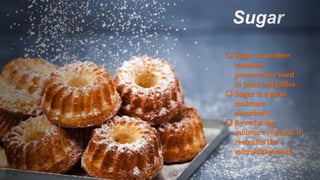
Sugar
 Sugar is another
common
preservative used
in jams and jellies.
 Sugar is a good
moisture
absorbent.
 By reducing
moisture content, it
restrains the
microbial growth.
Heat
and
Cold
Methods
• Heating at high temperature
kills all bacteria.
• Heating is done in canning
industry before packing and
sealing the food.
• Since, microbes do not grow
or multiply below the freezing
point of water.
• Cold treatment is used for
preservation of fishes and
vegetables.
STRONG
CONCENTRATION
AND CHEMICALS
High concentration of
solute causes plasmolysis and
death of any bacteria that
may creep in.
OIL AND
VINEGAR
 Oil has an ability to stop the
moisture from entering the food
and thus it acts as a barrier for
moisture.
 In pickling oil plays a vital role as
pickles have to have a shelf life of
several years.
 Vinegar and all other citric juices
can be used as an antioxidant as a
preservative.
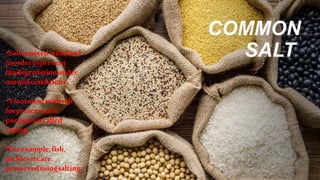
COMMON
SALT
•Saltismixedwithfood
inordertoprevent
biodegradationunder
normalconditions.
•Treatmentwithsalt
forpreservation
purposesiscalled
curing.
•Forexample,fish,
picklesetcare
preservedusingsalting.
DEHYDRATIO
N (DRYING)
 Drying is one of the oldest techniques
used to hamper the decomposition of
food products.
 Vegetables and fruit are naturally
dried by the sun and wind.
IRRADIATION
o Irradiation of food is the exposure of food to ionizing radiation. The two types
of ionizing radiation used are beta particles (high-energy electrons) and
gamma rays.
o Treatment effects include killing bacteria, molds, and insect pests, reducing the
ripening and spoiling of fruits, and at higher doses inducing sterility.
PASTEURIZATIO
N
Pasteurization is exposing (a food, as milk, cheese, yogurt, beer, or wine) to an elevated temperature for a period of time sufficient to
destroy certain microorganisms, as those that can produce disease or cause spoilage or undesirable fermentation of food, without
radically altering taste or quality.
Smoking
 Smoking prevents
dehydration in
fish and meat
and thus
prevents
spoilage.
 The wood smoke
contains a large
number of anti-
microbial
compounds that
slow the
rancidification
of animal fats.
Canning
 The food contents are sealed in
an airtight container at high
temperatures.
 Meat, fish, fruits are preserved
by canning.
Sterilization
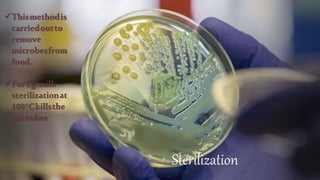
Thismethodis
carriedoutto
remove
microbesfrom
food.
ForEg.milk
sterilizationat
100°Ckillsthe
microbes
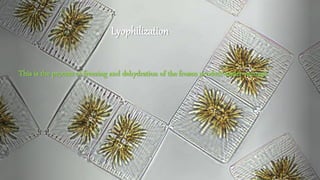
Lyophilization
This is the process of freezing and dehydration of the frozen product under vacuum.
Radiation
 This method is also known as cold sterilization.
 The UV rays, X rays, gamma rays kill all the unwanted microbes present in food.
Th
an
k
Yo
u

Food preservation ppt by aadvik gupta

  • 1.
  • 2.
    What is FoodPreservation •Foodpreservationis one of themethodsto protectfoodfromunwantedmicrobial growth. • Afterthefoodis produced, we store and protectby coveringthericeand currywith lidsto keep awayfliesand otherinsects. • By this, we are protectingit fromany infectioncausedby them. • Thisis a short-termcondition. Food preservation, on theotherhand,is doneto preservefoodfor a longertime.
  • 3.
    Advantages of FoodPreservation Food preservation can result in several advantages, some of which are substantial. These include: § Increased shelf-life § Decreased hazards from microbial pathogen § Decreased spoilage (microbial, enzymatic) § Inactivation of anti-nutritional factors § Ensured round the year availability of seasonal foods § Perishable foods that can be transported to far-off distances from the site of production § Increased availability of convenience foods (e.g. Ready-to-serve beverages, Instant mixes etc.) § Increased variety of foods, some with enhanced sensory properties and nutritional attributes. § Preservation in some cases produces a different form of the products which are of great importance in various cuisines. §E.g. raisins, squash and wines made from grapes.
  • 4.
    Objectives of Food Preservation 1.To preventmicrobial contamination. 2.To kill pathogens. 3.To Minimise food spoilage and food poisoning
  • 5.
    Methods of FoodPreservation : 1. Chemical Method 2. Sugar 3. Heat and Cold Methods 4. Strong Concentration and Chemical 5. Oil and Vinegar 6. Common Salt 7. Dehydration 8. Irradiation 9. Pasteurization 10.Smoking 11.Canning 12.Sterilization 13.Lyophilization. 14.Radiation
  • 6.
    Chemical Method  Salt andedible oils are two main preservatives which are used since ages to prevent microbial growth.  This is why we add extra oil to pickles.  Preservation by salt is known as salting.  Salting helps to preserve fruits for a long term.  Meats and fishes can also be preserved by salting.  Other synthetic preservatives include vinegar, sodium benzoate, sodium metabisulphite, etc.
  • 7.
    Sugar  Sugar isanother common preservative used in jams and jellies.  Sugar is a good moisture absorbent.  By reducing moisture content, it restrains the microbial growth.
  • 8.
    Heat and Cold Methods • Heating athigh temperature kills all bacteria. • Heating is done in canning industry before packing and sealing the food. • Since, microbes do not grow or multiply below the freezing point of water. • Cold treatment is used for preservation of fishes and vegetables.
  • 9.
    STRONG CONCENTRATION AND CHEMICALS High concentrationof solute causes plasmolysis and death of any bacteria that may creep in.
  • 10.
    OIL AND VINEGAR  Oilhas an ability to stop the moisture from entering the food and thus it acts as a barrier for moisture.  In pickling oil plays a vital role as pickles have to have a shelf life of several years.  Vinegar and all other citric juices can be used as an antioxidant as a preservative.
  • 11.
  • 12.
    DEHYDRATIO N (DRYING)  Dryingis one of the oldest techniques used to hamper the decomposition of food products.  Vegetables and fruit are naturally dried by the sun and wind.
  • 13.
    IRRADIATION o Irradiation offood is the exposure of food to ionizing radiation. The two types of ionizing radiation used are beta particles (high-energy electrons) and gamma rays. o Treatment effects include killing bacteria, molds, and insect pests, reducing the ripening and spoiling of fruits, and at higher doses inducing sterility.
  • 14.
    PASTEURIZATIO N Pasteurization is exposing(a food, as milk, cheese, yogurt, beer, or wine) to an elevated temperature for a period of time sufficient to destroy certain microorganisms, as those that can produce disease or cause spoilage or undesirable fermentation of food, without radically altering taste or quality.
  • 15.
    Smoking  Smoking prevents dehydrationin fish and meat and thus prevents spoilage.  The wood smoke contains a large number of anti- microbial compounds that slow the rancidification of animal fats.
  • 16.
    Canning  The foodcontents are sealed in an airtight container at high temperatures.  Meat, fish, fruits are preserved by canning.
  • 17.
  • 18.
    Lyophilization This is theprocess of freezing and dehydration of the frozen product under vacuum.
  • 19.
    Radiation  This methodis also known as cold sterilization.  The UV rays, X rays, gamma rays kill all the unwanted microbes present in food.
  • 20.