Improvement of industrially important strains
What are strains?
• A strain is a genetic variant or subtype of a microorganism (e.g., a virus,
bacterium or fungus).
• Microbial strains can also be differentiated by their genetic makeup using
metagenomic methods to maximize resolution within species.
What are industrial strains?
• Strains which synthesize one component as the main product are preferable,
since they make possible a simplified process for product recovery.
Why is strain development important in industrial microbes?
• Prerequisite for efficient biotechnological processes at industrial scale is the
use of microbial strains which produce high titre of the desired product.
• The process of enhancing the biosynthetic capabilities of microbes to
produce desired product in higher quantities is defined as microbial strain
improvement.
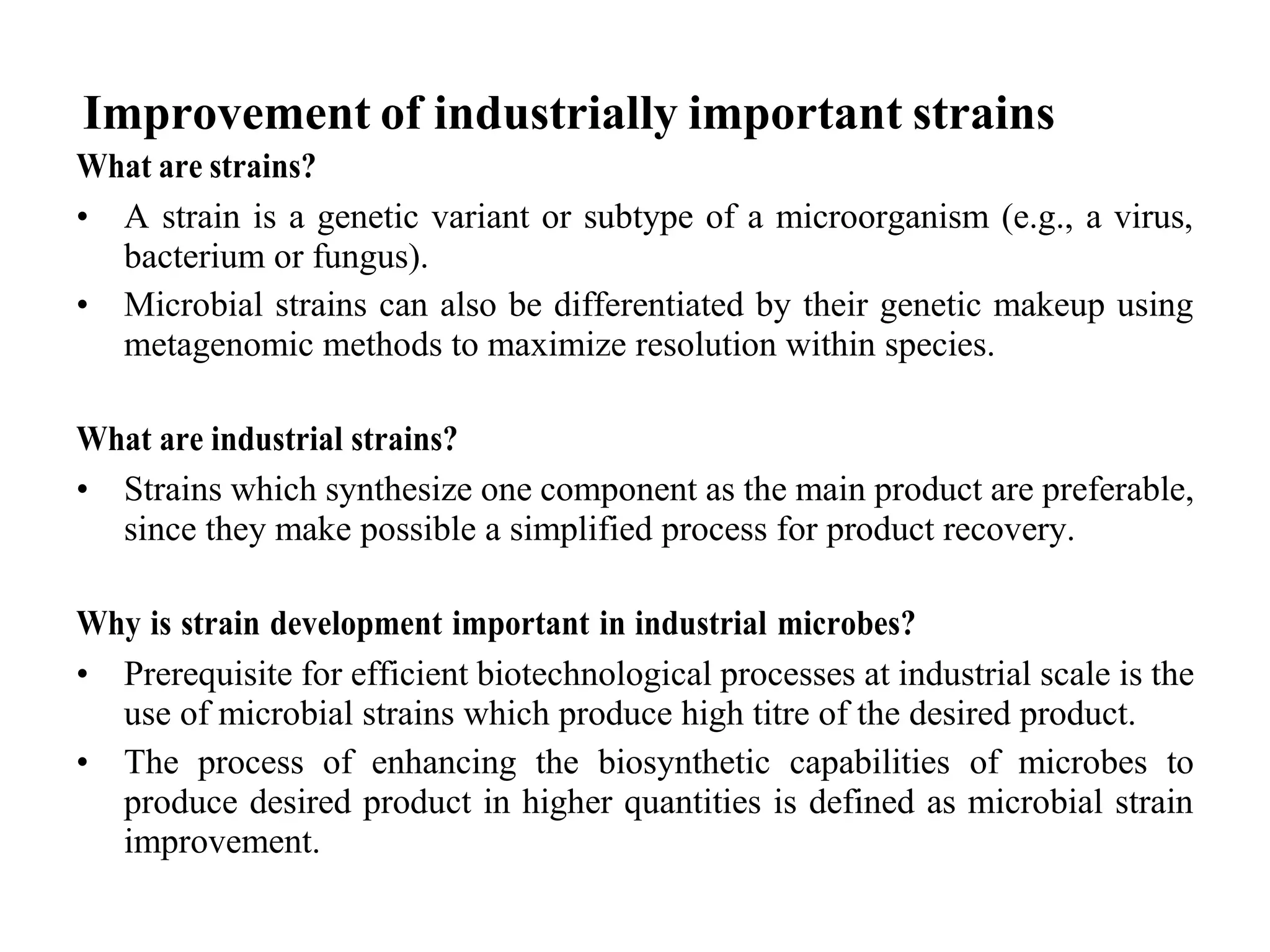
From where we can find industrial
strains?
• The first step in developing
producer strains is the isolation of
concerned microorganisms from
the natural habitats.
• What we are looking?
• From where we can get?
• The procedure of isolation,
detection, and separation of
microorganisms of our interest
from a mixed population by using
highly selective procedures is
called Screening.
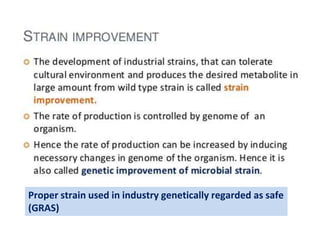
Proper strain used in industry genetically regarded as safe
(GRAS)
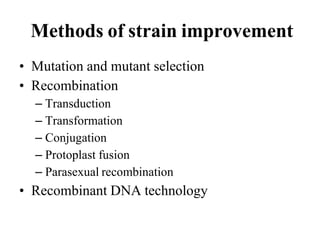
Methods of strain improvement
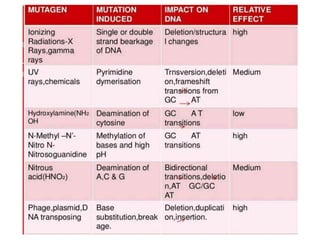
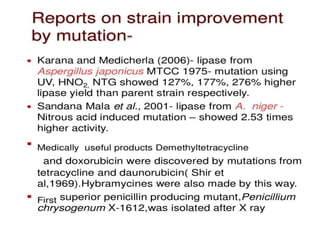
• Mutation and mutant selection
• Recombination
– Transduction
– Transformation
– Conjugation
– Protoplast fusion
– Parasexual recombination
• Recombinant DNA technology
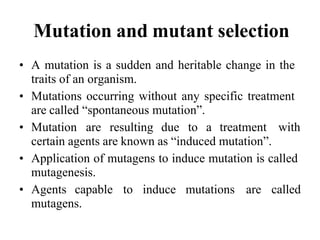
Mutation and mutant selection
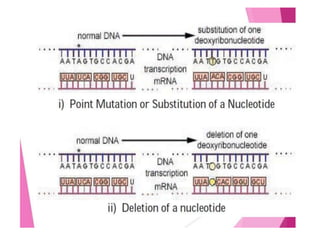
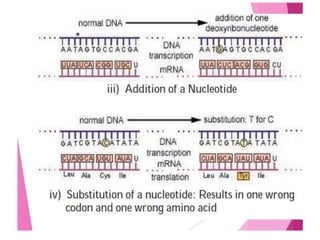
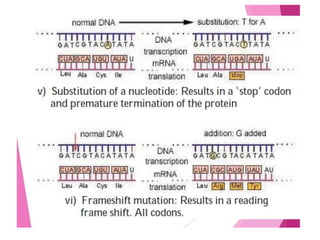
• A mutation is a sudden and heritable change in the
traits of an organism.
• Mutations occurring without any specific treatment
are called “spontaneous mutation”.
• Mutation are resulting due to a treatment with
certain agents are known as “induced mutation”.
• Application of mutagens to induce mutation is called
mutagenesis.
• Agents capable to induce mutations are called
mutagens.
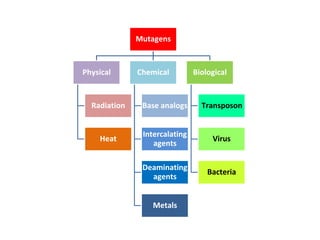
Biological
Chemical
Physical
Mutagens
Metals
Bacteria
Virus
Transposon
Deaminating
agents
Intercalating
agents
Heat
Base analogs
Radiation
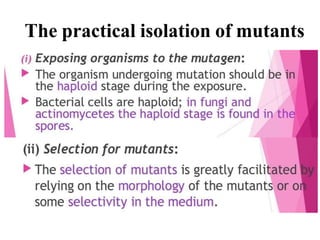
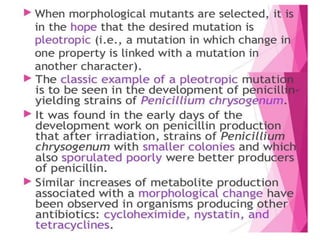
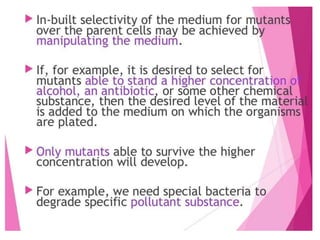
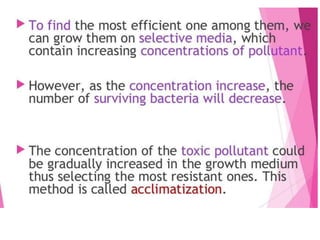
The practical isolation of mutants
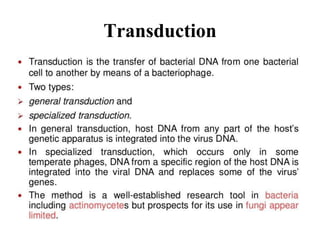
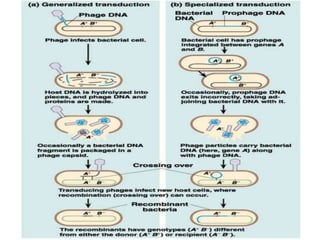
Transduction
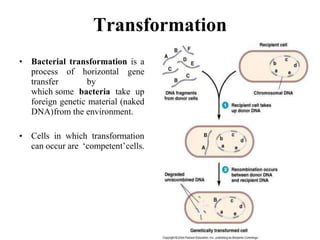
Transformation
• Bacterial transformation is a
process of horizontal gene
transfer by
which some bacteria take up
foreign genetic material (naked
DNA)from the environment.
• Cells in which transformation
can occur are ‘competent’cells.
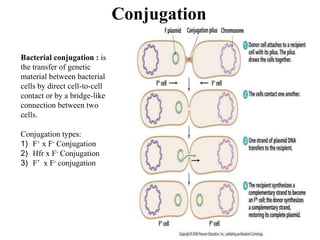
Conjugation
Bacterial conjugation : is
the transfer of genetic
material between bacterial
cells by direct cell-to-cell
contact or by a bridge-like
connection between two
cells.
Conjugation types:
1) F+ x F- Conjugation
2) Hfr x F- Conjugation
3) F’ x F- conjugation
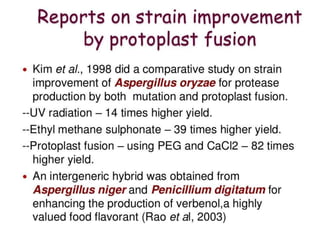
Protoplast fusion
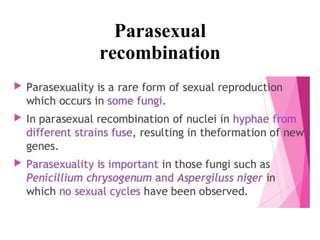
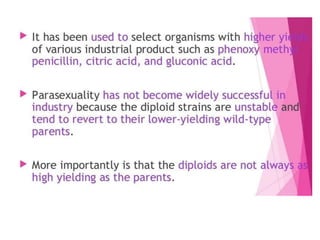
Parasexual
recombination
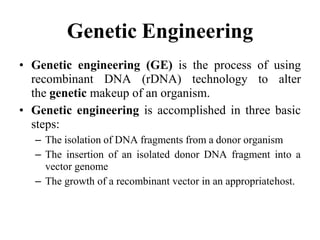
Genetic Engineering
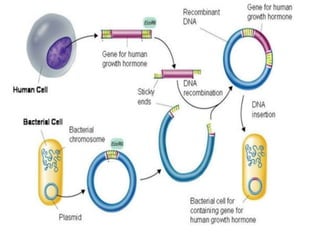
• Genetic engineering (GE) is the process of using
recombinant DNA (rDNA) technology to alter
the genetic makeup of an organism.
• Genetic engineering is accomplished in three basic
steps:
– The isolation of DNA fragments from a donor organism
– The insertion of an isolated donor DNA fragment into a
vector genome
– The growth of a recombinant vector in an appropriatehost.
Improvement of microbial processes by GE
Primary metabolites
• New processes for the production of amino acids and vitamins have been
developed by recombinant DNA technology.
• Escherichia coli strains were constructed with plasmids bearing amino acid
biosynthetic operons.
• Cloning extra copies of threonine export genes into E. coli led to increased
threonine production.
• An engineered strain of Corynebacterium glutamicum producing L -tryptophan
was further modified by cloning in additional copies of its own transketolase gene.
• Biotin has been made traditionally by chemical synthesis but recombinant microbes
have approached a competitive economic position. The cloning of abiotin operon (
bioABFCD) on a multicopy plasmid allowed E. coli to produce 10000times more
biotin than did the wild-type strain.
• Riboflavin production in Corynebacterium moniagenes - was developed by cloning
and overexpressing the organism's own riboflavin biosynthesis genes and its own
promoter sequences.
• A novel process for vitamin C synthesis involved the use of a genetically engineered
Erwinia herbicola strain containing a gene from Corynebacterium sp.
Improvement of microbial processes by GE
• Secondary metabolites
• Studies revealed that many antibiotic biosynthesis genes were arranged in
clusters.
• The entire cephamycin C pathway was cloned and expressed from a
cephamycin-producing strain of Streptomyces cattleya into anothercephamycin
producer, Streptomyces lactamgens , a two- to three-fold improvement was
obtained.
• Microbial enzymes
• Genes encoding many microbial enzymes have been cloned and the enzymes
expressed at levels hundreds of times higher than those naturally produced.
• Scientists at Novo Nordisk isolated a very desirable lipase for use
indetergents from a species of Humicola.
• For production purposes, the gene was cloned into Aspergillus oryzae , where
it produced 1000-fold more enzyme and is now a commercial product.
• The α-amylase gene from Bacillus amyloliquefaciens was cloned using
multicopy plasmid pUB110 in B. subtilis
Improvement of microbial processes by GE
Polymers, fuels, foods and beverages
• Recombinant DNA manipulation of Xanthomonas campestris
increased titers of xanthan by two-fold.
• Alcohol dehydrogenase II and pyruvate decarboxylase genes from
Zymomonas mobilis were inserted in E. coli.
• Beer wort contains barley β-glucans which reduce the filtrability of
beer and lead to precipitates and haze in the final product. The gene
coding for endoglucanase was transferred from Trichoderma reesei
to brewer's yeast and the engineered yeast strain efficiently
hydrolyzed the β-glucans.
Bioconversions
• Recombinant Candida pasteurianum can carry out the conversion of
glycerol to 1,3-propanediol.
Strain development (Autosaved).docx

Strain development (Autosaved).docx

  • 1.
    Improvement of industriallyimportant strains What are strains? • A strain is a genetic variant or subtype of a microorganism (e.g., a virus, bacterium or fungus). • Microbial strains can also be differentiated by their genetic makeup using metagenomic methods to maximize resolution within species. What are industrial strains? • Strains which synthesize one component as the main product are preferable, since they make possible a simplified process for product recovery. Why is strain development important in industrial microbes? • Prerequisite for efficient biotechnological processes at industrial scale is the use of microbial strains which produce high titre of the desired product. • The process of enhancing the biosynthetic capabilities of microbes to produce desired product in higher quantities is defined as microbial strain improvement.
  • 2.
    From where wecan find industrial strains? • The first step in developing producer strains is the isolation of concerned microorganisms from the natural habitats. • What we are looking? • From where we can get? • The procedure of isolation, detection, and separation of microorganisms of our interest from a mixed population by using highly selective procedures is called Screening.
  • 3.
    Proper strain usedin industry genetically regarded as safe (GRAS)
  • 5.
    Methods of strainimprovement • Mutation and mutant selection • Recombination – Transduction – Transformation – Conjugation – Protoplast fusion – Parasexual recombination • Recombinant DNA technology
  • 6.
    Mutation and mutantselection • A mutation is a sudden and heritable change in the traits of an organism. • Mutations occurring without any specific treatment are called “spontaneous mutation”. • Mutation are resulting due to a treatment with certain agents are known as “induced mutation”. • Application of mutagens to induce mutation is called mutagenesis. • Agents capable to induce mutations are called mutagens.
  • 7.
  • 12.
  • 18.
  • 20.
    Transformation • Bacterial transformationis a process of horizontal gene transfer by which some bacteria take up foreign genetic material (naked DNA)from the environment. • Cells in which transformation can occur are ‘competent’cells.
  • 22.
    Conjugation Bacterial conjugation :is the transfer of genetic material between bacterial cells by direct cell-to-cell contact or by a bridge-like connection between two cells. Conjugation types: 1) F+ x F- Conjugation 2) Hfr x F- Conjugation 3) F’ x F- conjugation
  • 23.
  • 25.
  • 27.
    Genetic Engineering • Geneticengineering (GE) is the process of using recombinant DNA (rDNA) technology to alter the genetic makeup of an organism. • Genetic engineering is accomplished in three basic steps: – The isolation of DNA fragments from a donor organism – The insertion of an isolated donor DNA fragment into a vector genome – The growth of a recombinant vector in an appropriatehost.
  • 29.
    Improvement of microbialprocesses by GE Primary metabolites • New processes for the production of amino acids and vitamins have been developed by recombinant DNA technology. • Escherichia coli strains were constructed with plasmids bearing amino acid biosynthetic operons. • Cloning extra copies of threonine export genes into E. coli led to increased threonine production. • An engineered strain of Corynebacterium glutamicum producing L -tryptophan was further modified by cloning in additional copies of its own transketolase gene. • Biotin has been made traditionally by chemical synthesis but recombinant microbes have approached a competitive economic position. The cloning of abiotin operon ( bioABFCD) on a multicopy plasmid allowed E. coli to produce 10000times more biotin than did the wild-type strain. • Riboflavin production in Corynebacterium moniagenes - was developed by cloning and overexpressing the organism's own riboflavin biosynthesis genes and its own promoter sequences. • A novel process for vitamin C synthesis involved the use of a genetically engineered Erwinia herbicola strain containing a gene from Corynebacterium sp.
  • 30.
    Improvement of microbialprocesses by GE • Secondary metabolites • Studies revealed that many antibiotic biosynthesis genes were arranged in clusters. • The entire cephamycin C pathway was cloned and expressed from a cephamycin-producing strain of Streptomyces cattleya into anothercephamycin producer, Streptomyces lactamgens , a two- to three-fold improvement was obtained. • Microbial enzymes • Genes encoding many microbial enzymes have been cloned and the enzymes expressed at levels hundreds of times higher than those naturally produced. • Scientists at Novo Nordisk isolated a very desirable lipase for use indetergents from a species of Humicola. • For production purposes, the gene was cloned into Aspergillus oryzae , where it produced 1000-fold more enzyme and is now a commercial product. • The α-amylase gene from Bacillus amyloliquefaciens was cloned using multicopy plasmid pUB110 in B. subtilis
  • 31.
    Improvement of microbialprocesses by GE Polymers, fuels, foods and beverages • Recombinant DNA manipulation of Xanthomonas campestris increased titers of xanthan by two-fold. • Alcohol dehydrogenase II and pyruvate decarboxylase genes from Zymomonas mobilis were inserted in E. coli. • Beer wort contains barley β-glucans which reduce the filtrability of beer and lead to precipitates and haze in the final product. The gene coding for endoglucanase was transferred from Trichoderma reesei to brewer's yeast and the engineered yeast strain efficiently hydrolyzed the β-glucans. Bioconversions • Recombinant Candida pasteurianum can carry out the conversion of glycerol to 1,3-propanediol.