(FAYE GLEEN
ABDELLAH)
SAIMA HABEEB
PH.D SCHOLAR
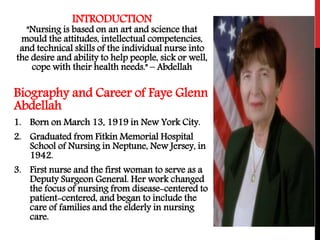
INTRODUCTION
"Nursing is based on an art and science that
mould the attitudes, intellectual competencies,
and technical skills of the individual nurse into
the desire and ability to help people, sick or well,
cope with their health needs." – Abdellah
Biography and Career of Faye Glenn
Abdellah
1. Born on March 13, 1919 in New York City.
2. Graduated from Fitkin Memorial Hospital
School of Nursing in Neptune, New Jersey, in
1942.
3. First nurse and the first woman to serve as a
Deputy Surgeon General. Her work changed
the focus of nursing from disease-centered to
patient-centered, and began to include the
care of families and the elderly in nursing
care.
Her publications include
 Better Nursing Care through Nursing
Research and Patient-Centered Approaches to Nursing.

 Author of more than 150 publications related to nursing
care, education for advanced practice in nursing, health
care administration, and nursing research.
 11 honorary doctorates by various institutions.
 These honors recognized her work in nursing research,
development of first nurse scientist training programme
as well as outstanding contribution to health of nation.
 She was inducted into the National Women's Hall of Fame
in 2000.
INTERNATIONAL SERVICES
 Delegation member to Soviet Union, France and China.
 Consultant to Japanese Nursing Association.
 Consultant in Australia and New Zealand in relation to
nursing education, home care, and research.
 Research consultant to the WHO.
 Charter Fellow of the American Academy of Nursing, has
served as Vice President and President, and received its Living
Legend Award.
 She has been recognized by Sigma Theta Tau as a
Distinguished Research Fellow and was the recipient of the
Excellence in Nursing Award, as well as the first Presidential
Award.
ABDELLAH’S PATIENT - CENTERED
APPROACH
 In 1955, a subcommittee of the National League for Nursing
Committee on Records was charged with developing a
meaningful clinical record for professional student nurses.
 Dr. Abdellah chaired this subcommittee, which soon identified
three barriers to its task:
1. Lack of clear definition of nursing,
2. current philosophy of nursing education was cherished but not
practiced, and
3. Nursing education curricula were not patient – centered.
 Using a typology of nursing problems developed in 1953, the
original 58 problems were refined to 21 and validated with the
assistance of faculty from 40 basic collegiate schools of
nursing.
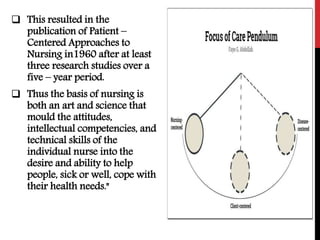
 This resulted in the
publication of Patient –
Centered Approaches to
Nursing in1960 after at least
three research studies over a
five – year period.
 Thus the basis of nursing is
both an art and science that
mould the attitudes,
intellectual competencies, and
technical skills of the
individual nurse into the
desire and ability to help
people, sick or well, cope with
their health needs."
MAJOR CONCEPTS
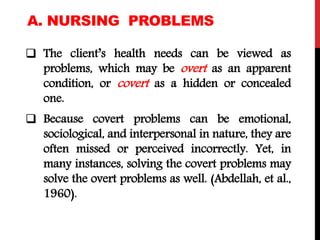
nursing problems problem solving
A. NURSING PROBLEMS
 The client’s health needs can be viewed as
problems, which may be overt as an apparent
condition, or covert as a hidden or concealed
one.
 Because covert problems can be emotional,
sociological, and interpersonal in nature, they are
often missed or perceived incorrectly. Yet, in
many instances, solving the covert problems may
solve the overt problems as well. (Abdellah, et al.,
1960).
TWENTY-ONE NURSING
PROBLEMS (1960)
1. To maintain good hygiene and physical comfort.
2. To promote optimal activity: exercise, rest, and sleep.
3. To promote safety through the prevention of accidents, injury,
or other trauma and through the prevention of the spread of
infection.
4. To maintain good body mechanics and prevent and correct
deformities.
5. To facilitate the maintenance of a supply of oxygen to all body
cells.
6. To facilitate the maintenance of nutrition of all body cells.
7. To facilitate the maintenance of elimination.
8. To facilitate the maintenance of fluid and electrolyte
balance.
9. To recognize the physiological responses of the body to
disease conditions – pathological, physiological, and
compensatory.
10. To facilitate the maintenance of regulatory mechanisms .
11. To facilitate the maintenance of sensory functions.
12. To identify and accept positive and negative expressions,
feelings, and reactions.
13. To identify and accept the interrelatedness of emotions and
organic illness.
14. To facilitate the maintenance of effective verbal and
nonverbal communication.
15. To promote the development of productive interpersonal relationships.
16. To facilitate progress toward achievement of personal spiritual goals.
17. To create and/or maintain a therapeutic environment.
18. To facilitate awareness of self as an individual with varying physical,
emotional, and developmental needs.
19. To accept the optimum possible goals in the light of limitations, physical
and emotional.
20. To use community resources as an aid in resolving problems arising
from illness
21. To understand the role of social problems as influencing factors in the
case of illness.
11 NURSING SKILLS
 Observation of health status
 Skills of communication
 Application of knowledge
 Teaching of patients and families
 Planning and organization of work
 Use of resource materials
 Use of personnel resources
 Problem-solving
 Direction of work of others
 Therapeutic uses of the self
 Nursing procedures
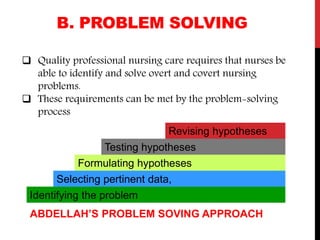
B. PROBLEM SOLVING
Identifying the problem
Selecting pertinent data,
Formulating hypotheses
Testing hypotheses
Revising hypotheses
ABDELLAH’S PROBLEM SOVING APPROACH
 Quality professional nursing care requires that nurses be
able to identify and solve overt and covert nursing
problems.
 These requirements can be met by the problem-solving
process
Metaparadigm
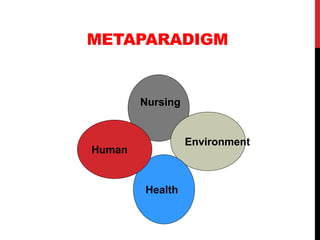
METAPARADIGM
Nursing
Environment
Health
Human
METAPARADIGM
HUMAN:
Characteristics of humans are not identified; the 21 nursing
problems cover biological, psychological, and social areas.
Health
Not specifically defined, although total health needs and a healthy
state of mind and body are included as part of comprehensive
nursing service.
Society / Environment
The focus is on the individual and family; society is served through
serving individuals.
Nursing
Discussed as a comprehensive service, based on art and science,
and aiming to help people cope with health needs.
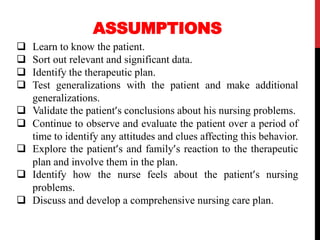
ASSUMPTIONS
 Learn to know the patient.
 Sort out relevant and significant data.
 Identify the therapeutic plan.
 Test generalizations with the patient and make additional
generalizations.
 Validate the patient’s conclusions about his nursing problems.
 Continue to observe and evaluate the patient over a period of
time to identify any attitudes and clues affecting this behavior.
 Explore the patient’s and family’s reaction to the therapeutic
plan and involve them in the plan.
 Identify how the nurse feels about the patient’s nursing
problems.
 Discuss and develop a comprehensive nursing care plan.
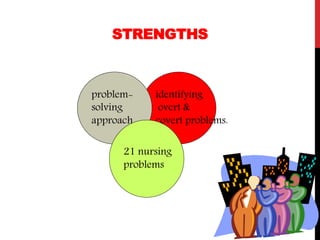
STRENGTHS
identifying
overt &
covert problems.
problem-
solving
approach
21 nursing
problems
Adapted from Fig 6.5
WEAKNESSES
 Lack of continued research to link the effectiveness
of use of the 21 nursing problems to successful
outcomes of nursing care.
 The label of “nursing problems”
CHARACTERISTICS OF THE
THEORY
 Abdellah’s theory has interrelated the
concepts of health, nursing problems, and
problem solving.
 Problem solving is an activity -logical in
nature.
 Framework focus on nursing practice and
individuals.
 The results of testing such hypothesis would
contribute to the general body of nursing
knowledge
 Easy to apply in practice.
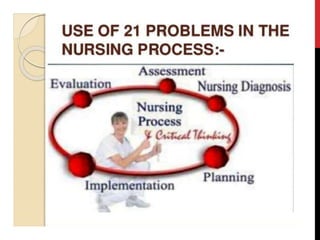
ASSESSMENT PHASE
 Nursing problems provide
guidelines for the collection
of data.
 A principle underlying the
problem solving approach is
that for each identified
problem, pertinent data are
collected.
 The overt or covert nature of
the problems necessitates a
direct or indirect approach,
respectively.
NURSING DIAGNOSIS
 The results of data collection
would determine the client’s
specific overt or covert
problems.
 These specific problems would
be grouped under one or more
of the broader nursing
problems.
 This step is consistent with
that involved in nursing
diagnosis
.
PLANNING PHASE
The statements of nursing
problems most closely
resemble goal statements.
Once the problem has been
diagnosed, the nursing goals
have been established.
IMPLEMENTATION
Using the goals as the
framework, a plan is
developed and appropriate
nursing interventions are
determined.
EVALUATION
The most appropriate
evaluation would be the
nurse progress or lack of
progress toward the
achievement of the stated
goals..
Progressive Patient Care ::
Models of Nursing Care
Delivery
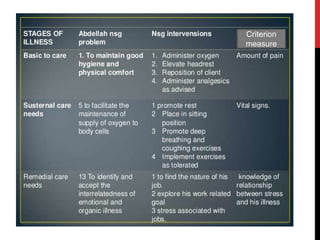
Criterion
measure
CONCLUSION
 Using Abdellah’s concepts of health, nursing problems,
and problem solving, the theoretical statement of
nursing that can be derived is the use of the problem
solving approach with key nursing problems related to
health needs of people. From this framework, 21 nursing
problems were developed.
 Abdellah’s theory provides a basis for determining and
organizing nursing care. The problems also provide a
basis for organizing appropriate nursing strategies.
Abdellahs ppt

Abdellahs ppt

  • 1.
  • 2.
    INTRODUCTION "Nursing is basedon an art and science that mould the attitudes, intellectual competencies, and technical skills of the individual nurse into the desire and ability to help people, sick or well, cope with their health needs." – Abdellah Biography and Career of Faye Glenn Abdellah 1. Born on March 13, 1919 in New York City. 2. Graduated from Fitkin Memorial Hospital School of Nursing in Neptune, New Jersey, in 1942. 3. First nurse and the first woman to serve as a Deputy Surgeon General. Her work changed the focus of nursing from disease-centered to patient-centered, and began to include the care of families and the elderly in nursing care.
  • 3.
    Her publications include Better Nursing Care through Nursing Research and Patient-Centered Approaches to Nursing.  Author of more than 150 publications related to nursing care, education for advanced practice in nursing, health care administration, and nursing research.  11 honorary doctorates by various institutions.  These honors recognized her work in nursing research, development of first nurse scientist training programme as well as outstanding contribution to health of nation.  She was inducted into the National Women's Hall of Fame in 2000.
  • 4.
    INTERNATIONAL SERVICES  Delegationmember to Soviet Union, France and China.  Consultant to Japanese Nursing Association.  Consultant in Australia and New Zealand in relation to nursing education, home care, and research.  Research consultant to the WHO.  Charter Fellow of the American Academy of Nursing, has served as Vice President and President, and received its Living Legend Award.  She has been recognized by Sigma Theta Tau as a Distinguished Research Fellow and was the recipient of the Excellence in Nursing Award, as well as the first Presidential Award.
  • 6.
    ABDELLAH’S PATIENT -CENTERED APPROACH  In 1955, a subcommittee of the National League for Nursing Committee on Records was charged with developing a meaningful clinical record for professional student nurses.  Dr. Abdellah chaired this subcommittee, which soon identified three barriers to its task: 1. Lack of clear definition of nursing, 2. current philosophy of nursing education was cherished but not practiced, and 3. Nursing education curricula were not patient – centered.  Using a typology of nursing problems developed in 1953, the original 58 problems were refined to 21 and validated with the assistance of faculty from 40 basic collegiate schools of nursing.
  • 7.
     This resultedin the publication of Patient – Centered Approaches to Nursing in1960 after at least three research studies over a five – year period.  Thus the basis of nursing is both an art and science that mould the attitudes, intellectual competencies, and technical skills of the individual nurse into the desire and ability to help people, sick or well, cope with their health needs."
  • 8.
  • 9.
    A. NURSING PROBLEMS The client’s health needs can be viewed as problems, which may be overt as an apparent condition, or covert as a hidden or concealed one.  Because covert problems can be emotional, sociological, and interpersonal in nature, they are often missed or perceived incorrectly. Yet, in many instances, solving the covert problems may solve the overt problems as well. (Abdellah, et al., 1960).
  • 10.
    TWENTY-ONE NURSING PROBLEMS (1960) 1.To maintain good hygiene and physical comfort. 2. To promote optimal activity: exercise, rest, and sleep. 3. To promote safety through the prevention of accidents, injury, or other trauma and through the prevention of the spread of infection. 4. To maintain good body mechanics and prevent and correct deformities. 5. To facilitate the maintenance of a supply of oxygen to all body cells. 6. To facilitate the maintenance of nutrition of all body cells.
  • 11.
    7. To facilitatethe maintenance of elimination. 8. To facilitate the maintenance of fluid and electrolyte balance. 9. To recognize the physiological responses of the body to disease conditions – pathological, physiological, and compensatory. 10. To facilitate the maintenance of regulatory mechanisms . 11. To facilitate the maintenance of sensory functions. 12. To identify and accept positive and negative expressions, feelings, and reactions. 13. To identify and accept the interrelatedness of emotions and organic illness. 14. To facilitate the maintenance of effective verbal and nonverbal communication.
  • 12.
    15. To promotethe development of productive interpersonal relationships. 16. To facilitate progress toward achievement of personal spiritual goals. 17. To create and/or maintain a therapeutic environment. 18. To facilitate awareness of self as an individual with varying physical, emotional, and developmental needs. 19. To accept the optimum possible goals in the light of limitations, physical and emotional. 20. To use community resources as an aid in resolving problems arising from illness 21. To understand the role of social problems as influencing factors in the case of illness.
  • 13.
    11 NURSING SKILLS Observation of health status  Skills of communication  Application of knowledge  Teaching of patients and families  Planning and organization of work  Use of resource materials  Use of personnel resources  Problem-solving  Direction of work of others  Therapeutic uses of the self  Nursing procedures
  • 14.
    B. PROBLEM SOLVING Identifyingthe problem Selecting pertinent data, Formulating hypotheses Testing hypotheses Revising hypotheses ABDELLAH’S PROBLEM SOVING APPROACH  Quality professional nursing care requires that nurses be able to identify and solve overt and covert nursing problems.  These requirements can be met by the problem-solving process
  • 15.
  • 16.
  • 17.
    METAPARADIGM HUMAN: Characteristics of humansare not identified; the 21 nursing problems cover biological, psychological, and social areas. Health Not specifically defined, although total health needs and a healthy state of mind and body are included as part of comprehensive nursing service. Society / Environment The focus is on the individual and family; society is served through serving individuals. Nursing Discussed as a comprehensive service, based on art and science, and aiming to help people cope with health needs.
  • 18.
    ASSUMPTIONS  Learn toknow the patient.  Sort out relevant and significant data.  Identify the therapeutic plan.  Test generalizations with the patient and make additional generalizations.  Validate the patient’s conclusions about his nursing problems.  Continue to observe and evaluate the patient over a period of time to identify any attitudes and clues affecting this behavior.  Explore the patient’s and family’s reaction to the therapeutic plan and involve them in the plan.  Identify how the nurse feels about the patient’s nursing problems.  Discuss and develop a comprehensive nursing care plan.
  • 19.
  • 20.
    WEAKNESSES  Lack ofcontinued research to link the effectiveness of use of the 21 nursing problems to successful outcomes of nursing care.  The label of “nursing problems”
  • 21.
    CHARACTERISTICS OF THE THEORY Abdellah’s theory has interrelated the concepts of health, nursing problems, and problem solving.  Problem solving is an activity -logical in nature.  Framework focus on nursing practice and individuals.  The results of testing such hypothesis would contribute to the general body of nursing knowledge  Easy to apply in practice.
  • 23.
    ASSESSMENT PHASE  Nursingproblems provide guidelines for the collection of data.  A principle underlying the problem solving approach is that for each identified problem, pertinent data are collected.  The overt or covert nature of the problems necessitates a direct or indirect approach, respectively. NURSING DIAGNOSIS  The results of data collection would determine the client’s specific overt or covert problems.  These specific problems would be grouped under one or more of the broader nursing problems.  This step is consistent with that involved in nursing diagnosis .
  • 24.
    PLANNING PHASE The statementsof nursing problems most closely resemble goal statements. Once the problem has been diagnosed, the nursing goals have been established. IMPLEMENTATION Using the goals as the framework, a plan is developed and appropriate nursing interventions are determined. EVALUATION The most appropriate evaluation would be the nurse progress or lack of progress toward the achievement of the stated goals.. Progressive Patient Care :: Models of Nursing Care Delivery
  • 28.
  • 30.
    CONCLUSION  Using Abdellah’sconcepts of health, nursing problems, and problem solving, the theoretical statement of nursing that can be derived is the use of the problem solving approach with key nursing problems related to health needs of people. From this framework, 21 nursing problems were developed.  Abdellah’s theory provides a basis for determining and organizing nursing care. The problems also provide a basis for organizing appropriate nursing strategies.