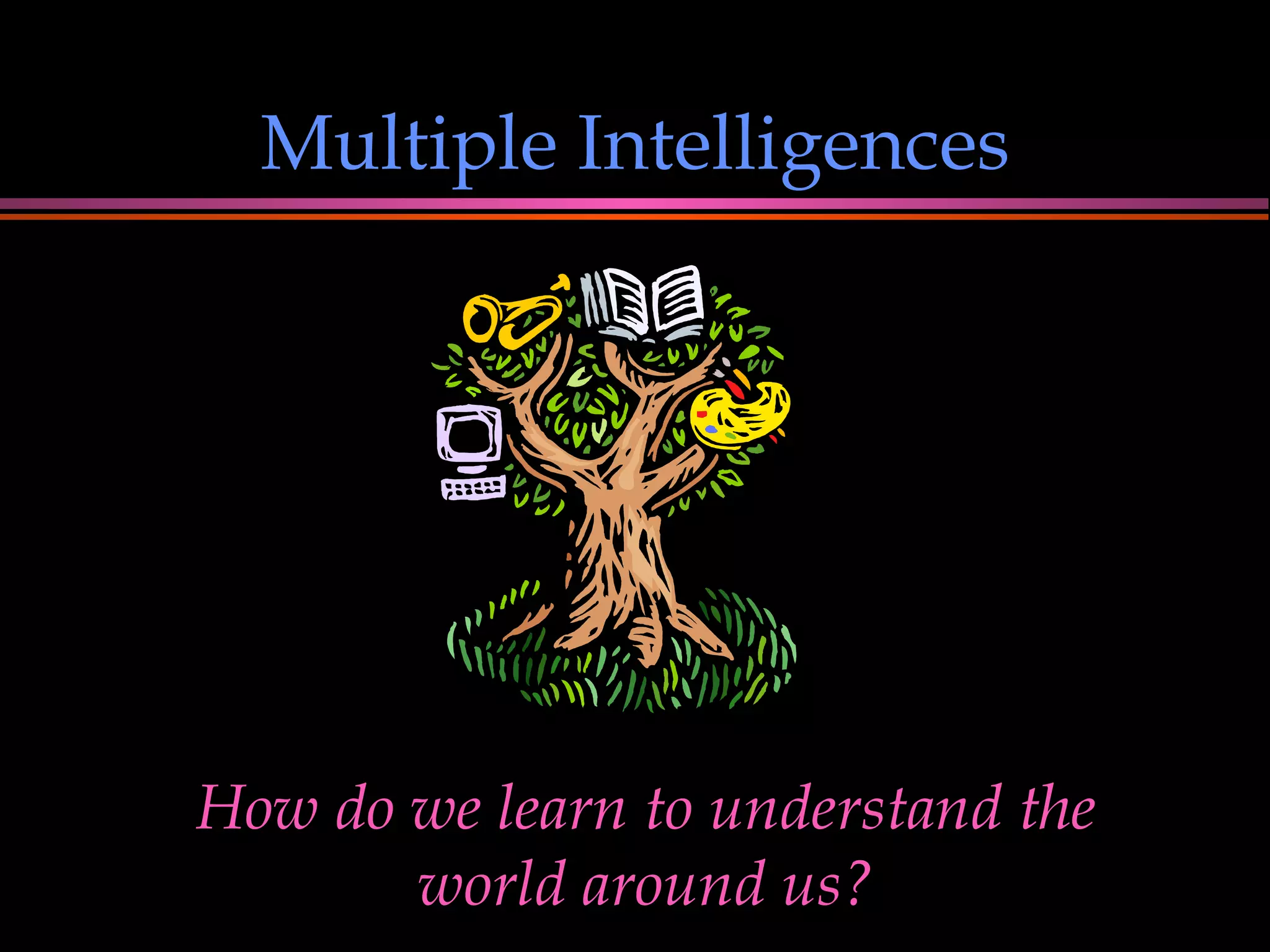
Multiple Intelligences How do we learn to understand the world around us?
How do we teach children with special needs? How do we provide all children with rich educational experiences without speaking a common language? How do we reach and teach the “whole child?”
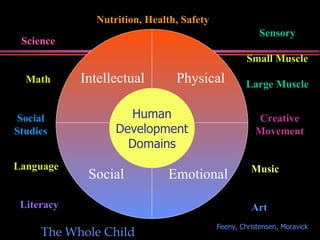
The Whole Child Emotional Physical Intellectual Social Science Math Sensory Small Muscle Large Muscle Music Art Language Literacy Creative Movement Social Studies Literature Nutrition, Health, Safety Feeny, Christensen, Moravick Human Development Domains
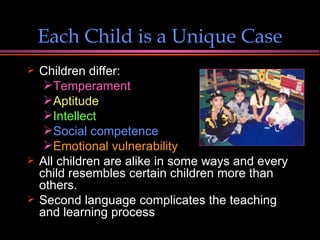
Each Child is a Unique Case Children differ: Temperament Aptitude   Intellect   Social competence Emotional vulnerability All children are alike in some ways and every child resembles certain children more than others. Second language complicates the teaching and learning process
Changes in cognitive skills are related to intellectual growth and age Child’s behavior not just result of external stimuli – but also internal stimuli Social learning actually leads to cognitive development  Individual differences in children should be recognized and addressed Cognitive Development
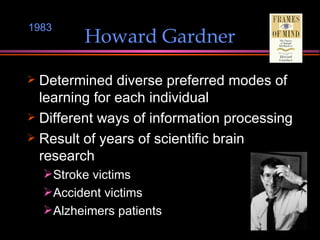
Howard Gardner Determined diverse preferred modes of learning for each individual Different ways of information processing Result of years of scientific brain research Stroke victims Accident victims Alzheimers patients 1983
Frames of Mind “ The ways in which intelligences combine and blend are as varied as the faces and personalities of individuals”  Intelligence is changeable – not stagnant Genetics influences intelligence  BUT providing a nurturing, positive, and stimulating learning environment is very important! Unique Gardner, 1983
Definition of Intelligence The ability to solve problems that one encounters in real life The ability to generate new problems to solve The ability to make something or offer service that is valued within one’s culture Howard Gardner Gardner, 1983
Research Findings Intelligence is not fixed at birth.   It changes and grows through life.   It can be improved and expanded.  Intelligence can be taught and improved by activating levels of perception. Intelligence is a multiple phenomenon that occurs in many different parts of the brain/mind/body system.  A stronger, more dominant intelligence can be used to train (improve or strengthen) a weaker intelligence.  Most persons possess all intelligences – but in varying strengths (at varying times) Gardner, 1983
Eight Intelligences Verbal-Linguistic Intelligence – word player Logical-Mathematical Intelligence - questioner Bodily-Kinesthetic Intelligence - mover Visual-Spatial Intelligence - visualizer Musical-Rhythmic Intelligence – music lover Interpersonal Intelligence - socializer Intrapersonal Intelligence - individualizer Naturalist Intelligence – nature lover Gardner, 1983
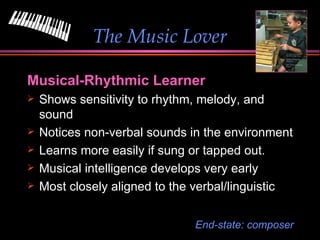
The Music Lover Musical-Rhythmic Learner Shows sensitivity to rhythm, melody, and sound Notices non-verbal sounds in the environment Learns more easily if sung or tapped out. Musical intelligence develops very early Most closely aligned to the verbal/linguistic End-state: composer
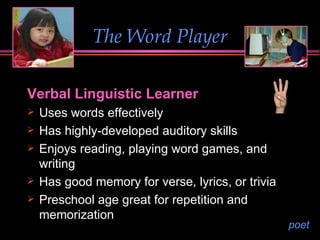
The Word Player Verbal Linguistic Learner Uses words effectively  Has highly-developed auditory skills Enjoys reading, playing word games, and writing Has good memory for verse, lyrics, or trivia Preschool age great for repetition and memorization poet
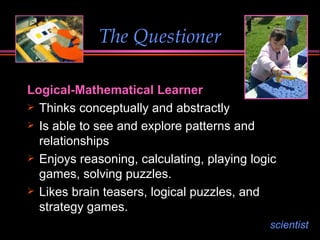
The Questioner Logical-Mathematical Learner Thinks conceptually and abstractly Is able to see and explore patterns and relationships Enjoys reasoning, calculating, playing logic games, solving puzzles. Likes brain teasers, logical puzzles, and strategy games. scientist
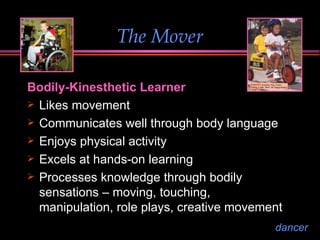
The Mover Bodily-Kinesthetic Learner Likes movement  Communicates well through body language Enjoys physical activity Excels at hands-on learning Processes knowledge through bodily sensations – moving, touching, manipulation, role plays, creative movement dancer
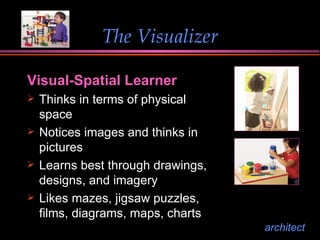
The Visualizer Visual-Spatial Learner Thinks in terms of physical space  Notices images and thinks in pictures Learns best through drawings, designs, and imagery Likes mazes, jigsaw puzzles, films, diagrams, maps, charts architect
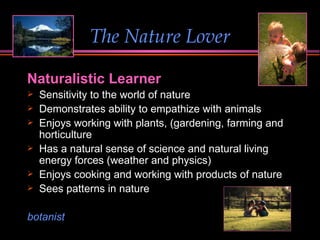
The Nature Lover Naturalistic Learner Sensitivity to the world of nature  Demonstrates ability to empathize with animals Enjoys working with plants, (gardening, farming and horticulture Has a natural sense of science and natural living energy forces (weather and physics) Enjoys cooking and working with products of nature  Sees patterns in nature botanist
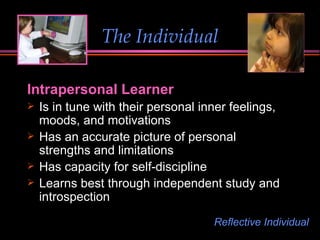
The Individual Intrapersonal Learner  Is in tune with their personal inner feelings, moods, and motivations Has an accurate picture of personal strengths and limitations Has capacity for self-discipline Learns best through independent study and introspection Reflective Individual
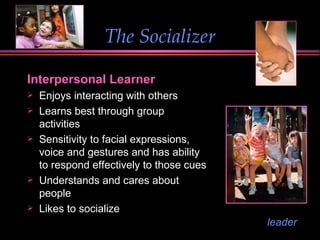
The Socializer Interpersonal Learner Enjoys interacting with others Learns best through group activities Sensitivity to facial expressions, voice and gestures and has ability to respond effectively to those cues Understands and cares about people Likes to socialize leader
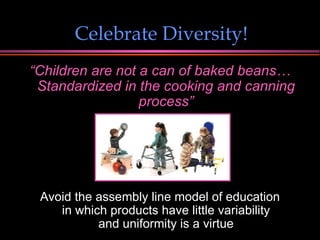
Celebrate Diversity! “ Children are not a can of baked beans… Standardized in the cooking and canning process” Avoid the assembly line model of education in which products have little variability and uniformity is a virtue

Mi325

  • 1.
    Multiple Intelligences Howdo we learn to understand the world around us?
  • 2.
    How do weteach children with special needs? How do we provide all children with rich educational experiences without speaking a common language? How do we reach and teach the “whole child?”
  • 3.
    The Whole ChildEmotional Physical Intellectual Social Science Math Sensory Small Muscle Large Muscle Music Art Language Literacy Creative Movement Social Studies Literature Nutrition, Health, Safety Feeny, Christensen, Moravick Human Development Domains
  • 4.
    Each Child isa Unique Case Children differ: Temperament Aptitude Intellect Social competence Emotional vulnerability All children are alike in some ways and every child resembles certain children more than others. Second language complicates the teaching and learning process
  • 5.
    Changes in cognitiveskills are related to intellectual growth and age Child’s behavior not just result of external stimuli – but also internal stimuli Social learning actually leads to cognitive development Individual differences in children should be recognized and addressed Cognitive Development
  • 6.
    Howard Gardner Determineddiverse preferred modes of learning for each individual Different ways of information processing Result of years of scientific brain research Stroke victims Accident victims Alzheimers patients 1983
  • 7.
    Frames of Mind“ The ways in which intelligences combine and blend are as varied as the faces and personalities of individuals” Intelligence is changeable – not stagnant Genetics influences intelligence BUT providing a nurturing, positive, and stimulating learning environment is very important! Unique Gardner, 1983
  • 8.
    Definition of IntelligenceThe ability to solve problems that one encounters in real life The ability to generate new problems to solve The ability to make something or offer service that is valued within one’s culture Howard Gardner Gardner, 1983
  • 9.
    Research Findings Intelligenceis not fixed at birth.  It changes and grows through life.  It can be improved and expanded. Intelligence can be taught and improved by activating levels of perception. Intelligence is a multiple phenomenon that occurs in many different parts of the brain/mind/body system. A stronger, more dominant intelligence can be used to train (improve or strengthen) a weaker intelligence. Most persons possess all intelligences – but in varying strengths (at varying times) Gardner, 1983
  • 10.
    Eight Intelligences Verbal-LinguisticIntelligence – word player Logical-Mathematical Intelligence - questioner Bodily-Kinesthetic Intelligence - mover Visual-Spatial Intelligence - visualizer Musical-Rhythmic Intelligence – music lover Interpersonal Intelligence - socializer Intrapersonal Intelligence - individualizer Naturalist Intelligence – nature lover Gardner, 1983
  • 11.
    The Music LoverMusical-Rhythmic Learner Shows sensitivity to rhythm, melody, and sound Notices non-verbal sounds in the environment Learns more easily if sung or tapped out. Musical intelligence develops very early Most closely aligned to the verbal/linguistic End-state: composer
  • 12.
    The Word PlayerVerbal Linguistic Learner Uses words effectively Has highly-developed auditory skills Enjoys reading, playing word games, and writing Has good memory for verse, lyrics, or trivia Preschool age great for repetition and memorization poet
  • 13.
    The Questioner Logical-MathematicalLearner Thinks conceptually and abstractly Is able to see and explore patterns and relationships Enjoys reasoning, calculating, playing logic games, solving puzzles. Likes brain teasers, logical puzzles, and strategy games. scientist
  • 14.
    The Mover Bodily-KinestheticLearner Likes movement Communicates well through body language Enjoys physical activity Excels at hands-on learning Processes knowledge through bodily sensations – moving, touching, manipulation, role plays, creative movement dancer
  • 15.
    The Visualizer Visual-SpatialLearner Thinks in terms of physical space Notices images and thinks in pictures Learns best through drawings, designs, and imagery Likes mazes, jigsaw puzzles, films, diagrams, maps, charts architect
  • 16.
    The Nature LoverNaturalistic Learner Sensitivity to the world of nature Demonstrates ability to empathize with animals Enjoys working with plants, (gardening, farming and horticulture Has a natural sense of science and natural living energy forces (weather and physics) Enjoys cooking and working with products of nature Sees patterns in nature botanist
  • 17.
    The Individual IntrapersonalLearner Is in tune with their personal inner feelings, moods, and motivations Has an accurate picture of personal strengths and limitations Has capacity for self-discipline Learns best through independent study and introspection Reflective Individual
  • 18.
    The Socializer InterpersonalLearner Enjoys interacting with others Learns best through group activities Sensitivity to facial expressions, voice and gestures and has ability to respond effectively to those cues Understands and cares about people Likes to socialize leader
  • 19.
    Celebrate Diversity! “Children are not a can of baked beans… Standardized in the cooking and canning process” Avoid the assembly line model of education in which products have little variability and uniformity is a virtue