
 Ashish Singh
 Abhishek Yadav
 Vipin Kumar
 Prateek Verma
 Harsh Basoya
 Eshika Sharma
 Aayush Kumar
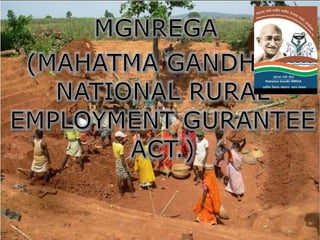
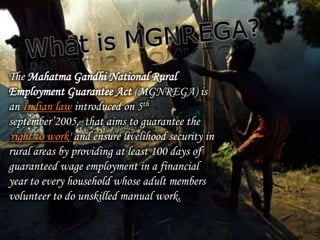
The Mahatma Gandhi National Rural
Employment Guarantee Act (MGNREGA) is
an Indian law introduced on 5th
september’2005, that aims to guarantee the
'right to work' and ensure livelihood security in
rural areas by providing at least 100 days of
guaranteed wage employment in a financial
year to every household whose adult members
volunteer to do unskilled manual work.
root democracy
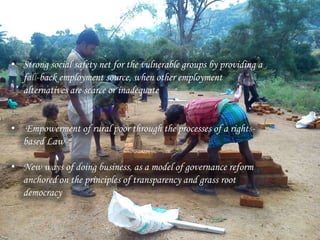
• Strong social safety net for the vulnerable groups by providing a
fall-back employment source, when other employment
alternatives are scarce or inadequate
• Empowerment of rural poor through the processes of a rights-
based Law
• New ways of doing business, as a model of governance reform
anchored on the principles of transparency and grass root
democracy
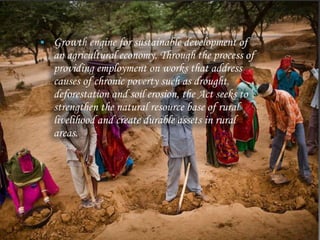
 Growth engine for sustainable development of
an agricultural economy. Through the process of
providing employment on works that address
causes of chronic poverty such as drought,
deforestation and soil erosion, the Act seeks to
strengthen the natural resource base of rural
livelihood and create durable assets in rural
areas.
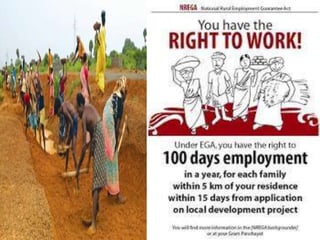
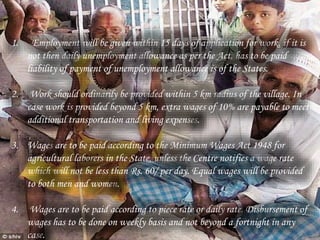
1. Employment will be given within 15 days of application for work, if it is
not then daily unemployment allowance as per the Act, has to be paid
liability of payment of unemployment allowance is of the States.
2. Work should ordinarily be provided within 5 km radius of the village. In
case work is provided beyond 5 km, extra wages of 10% are payable to meet
additional transportation and living expenses.
3. Wages are to be paid according to the Minimum Wages Act 1948 for
agricultural laborers in the State, unless the Centre notifies a wage rate
which will not be less than Rs. 60/ per day. Equal wages will be provided
to both men and women.
4. Wages are to be paid according to piece rate or daily rate. Disbursement of
wages has to be done on weekly basis and not beyond a fortnight in any
case.
.
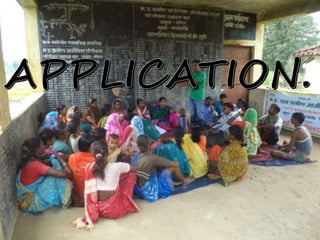
Adult members of a rural household, willing to do unskilled manual work,
may apply for registration in writing or orally to the local Gram Panchayat.
After verification by gram panchayat, they issue a job card which bear the
photograph of all the adult member of household.
Job Card should be issued within 15 days of application. Job Card holder
may submit a written application for employment to the Gram Panchayat
Gram Panchayat will issue a receipt of the written application, which give
guaranteed job within 15 days.
 If job is not given within 15 days then daily unemployment allowance as per
the Act, has to be paid.
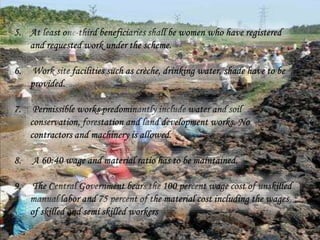
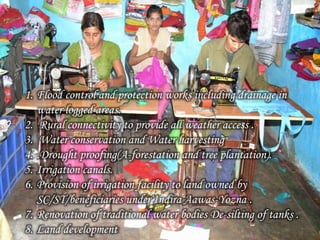
1. Flood control and protection works including drainage in
water logged areas.
2. Rural connectivity to provide all weather access .
3. Water conservation and Water harvesting
4. .Drought proofing(A-forestation and tree plantation).
5. Irrigation canals.
6. Provision of irrigation facility to land owned by
SC/ST/beneficiaries under Indira Aawas-Yozna .
7. Renovation of traditional water bodies De-silting of tanks .
8. Land development
Maximizing Work Opportunities: Livelihood Security :
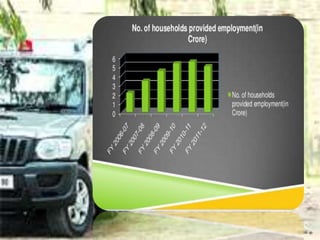
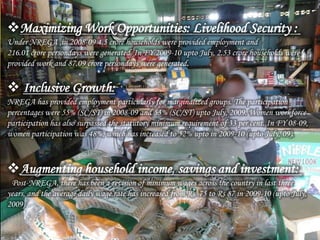
Under NREGA ,in 2008-09 4.5 crore households were provided employment and
216.01 crore persondays were generated. In FY 2009-10 upto July, 2.53 crore households were
provided work and 87.09 crore persondays were generated.
 Inclusive Growth:
NREGA has provided employment particularly for marginalized groups. The participation
percentages were 55% (SC/ST) in 2008-09 and 53% (SC/ST) upto July, 2009. Women workforce
participation has also surpassed the statutory minimum requirement of 33 per cent. In FY 08-09,
women participation was 48%, which has increased to 52% upto in 2009-10 (upto July, 09).
Augmenting household income, savings and investment:
Post-NREGA, there has been a revision of minimum wages across the country in last three
years, and the average daily wage rate has increased from Rs. 75 to Rs 87 in 2009-10 (upto July,
2009)
Financial Inclusion:
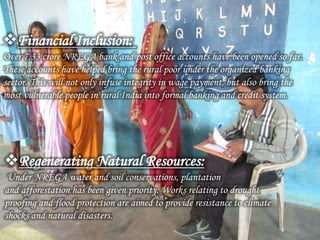
Over 7.33 crore NREGA bank and post office accounts have been opened so far.
These accounts have helped bring the rural poor under the organized banking
sector. This will not only infuse integrity in wage payment, but also bring the
most vulnerable people in rural India into formal banking and credit system.
Regenerating Natural Resources:
Under NREGA water and soil conservations, plantation
and afforestation has been given priority. Works relating to drought
proofing and flood protection are aimed to provide resistance to climate
shocks and natural disasters.
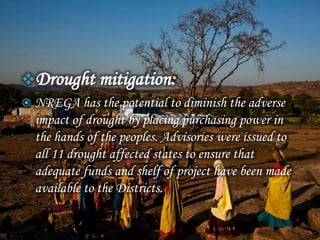
Drought mitigation:
 NREGA has the potential to diminish the adverse
impact of drought by placing purchasing power in
the hands of the peoples. Advisories were issued to
all 11 drought affected states to ensure that
adequate funds and shelf of project have been made
available to the Districts.
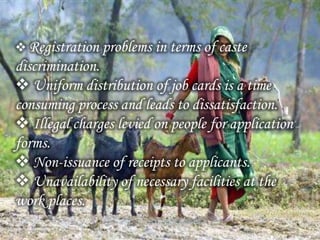
 Registration problems in terms of caste
discrimination.
 Uniform distribution of job cards is a time
consuming process and leads to dissatisfaction.
 Illegal charges levied on people for application
forms.
 Non-issuance of receipts to applicants.
 Unavailability of necessary facilities at the
work places.
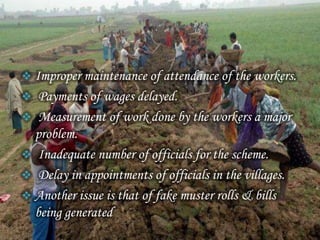
 Improper maintenance of attendance of the workers.
 Payments of wages delayed.
 Measurement of work done by the workers a major
problem.
 Inadequate number of officials for the scheme.
 Delay in appointments of officials in the villages.
 Another issue is that of fake muster rolls & bills
being generated
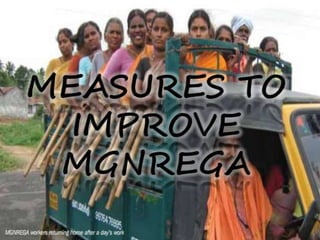
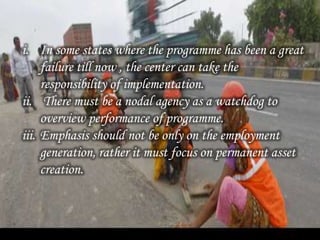
i. In some states where the programme has been a great
failure till now , the center can take the
responsibility of implementation.
ii. There must be a nodal agency as a watchdog to
overview performance of programme.
iii. Emphasis should not be only on the employment
generation, rather it must focus on permanent asset
creation.
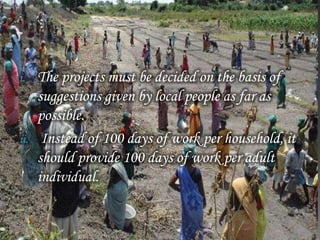
i. The projects must be decided on the basis of
suggestions given by local people as far as
possible.
ii. Instead of 100 days of work per household, it
should provide 100 days of work per adult
individual.
MGNREGA  Economics Project

MGNREGA Economics Project

  • 2.
     Ashish Singh Abhishek Yadav  Vipin Kumar  Prateek Verma  Harsh Basoya  Eshika Sharma  Aayush Kumar
  • 4.
    The Mahatma GandhiNational Rural Employment Guarantee Act (MGNREGA) is an Indian law introduced on 5th september’2005, that aims to guarantee the 'right to work' and ensure livelihood security in rural areas by providing at least 100 days of guaranteed wage employment in a financial year to every household whose adult members volunteer to do unskilled manual work.
  • 6.
    root democracy • Strongsocial safety net for the vulnerable groups by providing a fall-back employment source, when other employment alternatives are scarce or inadequate • Empowerment of rural poor through the processes of a rights- based Law • New ways of doing business, as a model of governance reform anchored on the principles of transparency and grass root democracy
  • 7.
     Growth enginefor sustainable development of an agricultural economy. Through the process of providing employment on works that address causes of chronic poverty such as drought, deforestation and soil erosion, the Act seeks to strengthen the natural resource base of rural livelihood and create durable assets in rural areas.
  • 9.
    1. Employment willbe given within 15 days of application for work, if it is not then daily unemployment allowance as per the Act, has to be paid liability of payment of unemployment allowance is of the States. 2. Work should ordinarily be provided within 5 km radius of the village. In case work is provided beyond 5 km, extra wages of 10% are payable to meet additional transportation and living expenses. 3. Wages are to be paid according to the Minimum Wages Act 1948 for agricultural laborers in the State, unless the Centre notifies a wage rate which will not be less than Rs. 60/ per day. Equal wages will be provided to both men and women. 4. Wages are to be paid according to piece rate or daily rate. Disbursement of wages has to be done on weekly basis and not beyond a fortnight in any case.
  • 10.
  • 12.
    Adult members ofa rural household, willing to do unskilled manual work, may apply for registration in writing or orally to the local Gram Panchayat. After verification by gram panchayat, they issue a job card which bear the photograph of all the adult member of household. Job Card should be issued within 15 days of application. Job Card holder may submit a written application for employment to the Gram Panchayat Gram Panchayat will issue a receipt of the written application, which give guaranteed job within 15 days.  If job is not given within 15 days then daily unemployment allowance as per the Act, has to be paid.
  • 14.
    1. Flood controland protection works including drainage in water logged areas. 2. Rural connectivity to provide all weather access . 3. Water conservation and Water harvesting 4. .Drought proofing(A-forestation and tree plantation). 5. Irrigation canals. 6. Provision of irrigation facility to land owned by SC/ST/beneficiaries under Indira Aawas-Yozna . 7. Renovation of traditional water bodies De-silting of tanks . 8. Land development
  • 18.
    Maximizing Work Opportunities:Livelihood Security : Under NREGA ,in 2008-09 4.5 crore households were provided employment and 216.01 crore persondays were generated. In FY 2009-10 upto July, 2.53 crore households were provided work and 87.09 crore persondays were generated.  Inclusive Growth: NREGA has provided employment particularly for marginalized groups. The participation percentages were 55% (SC/ST) in 2008-09 and 53% (SC/ST) upto July, 2009. Women workforce participation has also surpassed the statutory minimum requirement of 33 per cent. In FY 08-09, women participation was 48%, which has increased to 52% upto in 2009-10 (upto July, 09). Augmenting household income, savings and investment: Post-NREGA, there has been a revision of minimum wages across the country in last three years, and the average daily wage rate has increased from Rs. 75 to Rs 87 in 2009-10 (upto July, 2009)
  • 19.
    Financial Inclusion: Over 7.33crore NREGA bank and post office accounts have been opened so far. These accounts have helped bring the rural poor under the organized banking sector. This will not only infuse integrity in wage payment, but also bring the most vulnerable people in rural India into formal banking and credit system. Regenerating Natural Resources: Under NREGA water and soil conservations, plantation and afforestation has been given priority. Works relating to drought proofing and flood protection are aimed to provide resistance to climate shocks and natural disasters.
  • 20.
    Drought mitigation:  NREGAhas the potential to diminish the adverse impact of drought by placing purchasing power in the hands of the peoples. Advisories were issued to all 11 drought affected states to ensure that adequate funds and shelf of project have been made available to the Districts.
  • 22.
     Registration problemsin terms of caste discrimination.  Uniform distribution of job cards is a time consuming process and leads to dissatisfaction.  Illegal charges levied on people for application forms.  Non-issuance of receipts to applicants.  Unavailability of necessary facilities at the work places.
  • 23.
     Improper maintenanceof attendance of the workers.  Payments of wages delayed.  Measurement of work done by the workers a major problem.  Inadequate number of officials for the scheme.  Delay in appointments of officials in the villages.  Another issue is that of fake muster rolls & bills being generated
  • 25.
    i. In somestates where the programme has been a great failure till now , the center can take the responsibility of implementation. ii. There must be a nodal agency as a watchdog to overview performance of programme. iii. Emphasis should not be only on the employment generation, rather it must focus on permanent asset creation.
  • 26.
    i. The projectsmust be decided on the basis of suggestions given by local people as far as possible. ii. Instead of 100 days of work per household, it should provide 100 days of work per adult individual.