LAYERS OF
RETINA
CONTENT :
1.Introduction
2.Retina
3.Layers of Retina
4.Function of Retina
5.Clinical Significance
7.Bibliography
INTRODUCTION
Eye is like a camera, forms an image
on light sensitive area called RETINA.
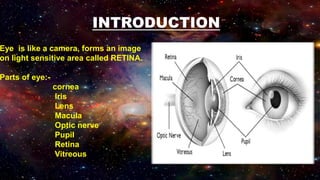
Parts of eye:-
cornea
Iris
Lens
Macula
Optic nerve
Pupil
Retina
Vitreous
Cornea: the clear front White of the eye. It transmits and focuses light into the eye.
Iris: the colored part of the eye. The iris helps regulate the amount of light that enters
the eye.
Lens: the transparent structure inside the eye that focuses light rays onto the retina.
Macula: a small area in the retina that contains special light-sensitive cells. The macula
allows us to see fine details clearly.
Optic Nerve: the nerve that connects the eye to the brain. The optic nerve carries the impulses
formed by the retina to the brain, which interprets them as images.
Pupil: the dark center in the middle of the iris. It changes sizes to accommodate for the
amount of light that is available.
Retina: the nerve layer senses light and creates impulses that are sent through the optic
nerve to the brain.
Vitreous: the clear, jelly-like substance that fills the middle of the eye
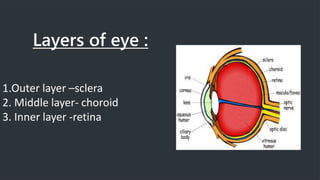
1.Outer layer –sclera
2. Middle layer- choroid
3. Inner layer -retina
Layers of eye :
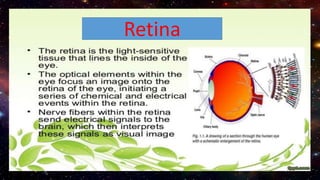
Retina
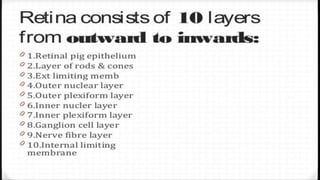
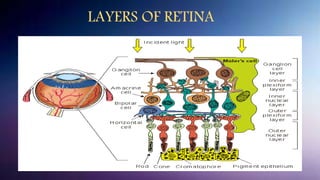
LAYERS OF RETINA
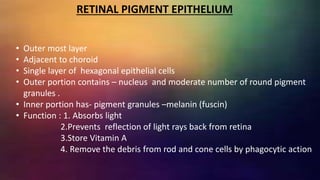
RETINAL PIGMENT EPITHELIUM
• Outer most layer
• Adjacent to choroid
• Single layer of hexagonal epithelial cells
• Outer portion contains – nucleus and moderate number of round pigment
granules .
• Inner portion has- pigment granules –melanin (fuscin)
• Function : 1. Absorbs light
2.Prevents reflection of light rays back from retina
3.Store Vitamin A
4. Remove the debris from rod and cone cells by phagocytic action
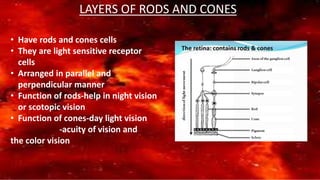
LAYERS OF RODS AND CONES
• Have rods and cones cells
• They are light sensitive receptor
cells
• Arranged in parallel and
perpendicular manner
• Function of rods-help in night vision
or scotopic vision
• Function of cones-day light vision
-acuity of vision and
the color vision
EXTERNAL LIMITING MEMBRANE
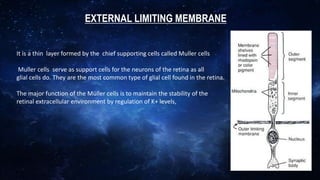
It is a thin layer formed by the chief supporting cells called Muller cells
Muller cells serve as support cells for the neurons of the retina as all
glial cells do. They are the most common type of glial cell found in the retina.
The major function of the Müller cells is to maintain the stability of the
retinal extracellular environment by regulation of K+ levels,
OUTER NUCLEAR LAYER
The outer nuclear layer (or layer of outer granules or external nuclear layer), is
one of the layers of the retina.
Like the inner nuclear layer, the outer nuclear layer contains several strata of oval
nuclear bodies; they are of two kinds, viz.: rod and cone granules, so named on
account of their being respectively connected with the rods and cones of the next
layer.
OUTER NUCLEAR LAYER
OUTER PLEXIFORM LAYER
• Layer of neuronal synapses in the retina of the eye.
• Consists of a dense network of synapses between dendrites of horizontal
cells from the inner nuclear layer, and photoreceptor cells inner segments
from the outer nuclear layer.
• It is much thinner than the inner plexiform layer.
• Contains reticular meshwork , formed by terminal fibers of rods and cones
and dendrites from Bipolar cells.
•
INNER NUCLEAR LAYER
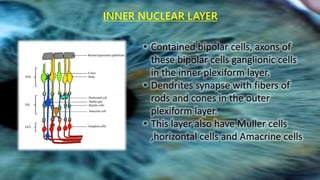
• Contained bipolar cells, axons of
these bipolar cells ganglionic cells
in the inner plexiform layer.
• Dendrites synapse with fibers of
rods and cones in the outer
plexiform layer.
• This layer also have Muller cells
,horizontal cells and Amacrine cells
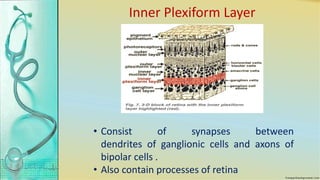
• Consist of synapses between
dendrites of ganglionic cells and axons of
bipolar cells .
• Also contain processes of retina
Inner Plexiform Layer
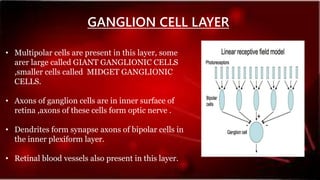
GANGLION CELL LAYER
• Multipolar cells are present in this layer, some
arer large called GIANT GANGLIONIC CELLS
,smaller cells called MIDGET GANGLIONIC
CELLS.
• Axons of ganglion cells are in inner surface of
retina ,axons of these cells form optic nerve .
• Dendrites form synapse axons of bipolar cells in
the inner plexiform layer.
• Retinal blood vessels also present in this layer.
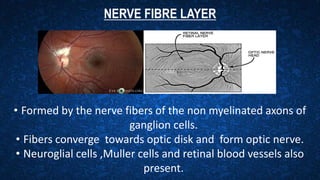
NERVE FIBRE LAYER
• Formed by the nerve fibers of the non myelinated axons of
ganglion cells.
• Fibers converge towards optic disk and form optic nerve.
• Neuroglial cells ,Muller cells and retinal blood vessels also
present.
INTERNAL LIMITING MEMBRANE
• Innermost layer of retina ,separates retina from the
vitreous body.
• It is hyaline membrane formed by opposition of expanded
end of Muller fibers.
Clinical Significance
• Retinitis pigmentosa- group genetic diseases, affects retina and cause loss of night vision and
peripheral vision.
• Macular degeneration- group of diseases causes loss of central vision due to death of cells in
macula.
• Cone –rod dystrophy –vision is lost caused by deterioration of cones and rods in the retina.
• Hypertension and Diabetes mellitus – causes damage to blood vessels that supply
retina,causes HYPERTENSIVE RETINOPATHY and DIABETIC RETINOPATHY .
• RETINOBLASTOMA –cancer of retina
THANK YOU

RETINA

  • 1.
  • 2.
    CONTENT : 1.Introduction 2.Retina 3.Layers ofRetina 4.Function of Retina 5.Clinical Significance 7.Bibliography
  • 3.
    INTRODUCTION Eye is likea camera, forms an image on light sensitive area called RETINA. Parts of eye:- cornea Iris Lens Macula Optic nerve Pupil Retina Vitreous
  • 4.
    Cornea: the clearfront White of the eye. It transmits and focuses light into the eye. Iris: the colored part of the eye. The iris helps regulate the amount of light that enters the eye. Lens: the transparent structure inside the eye that focuses light rays onto the retina. Macula: a small area in the retina that contains special light-sensitive cells. The macula allows us to see fine details clearly. Optic Nerve: the nerve that connects the eye to the brain. The optic nerve carries the impulses formed by the retina to the brain, which interprets them as images. Pupil: the dark center in the middle of the iris. It changes sizes to accommodate for the amount of light that is available. Retina: the nerve layer senses light and creates impulses that are sent through the optic nerve to the brain. Vitreous: the clear, jelly-like substance that fills the middle of the eye
  • 5.
    1.Outer layer –sclera 2.Middle layer- choroid 3. Inner layer -retina Layers of eye :
  • 6.
  • 8.
  • 9.
    RETINAL PIGMENT EPITHELIUM •Outer most layer • Adjacent to choroid • Single layer of hexagonal epithelial cells • Outer portion contains – nucleus and moderate number of round pigment granules . • Inner portion has- pigment granules –melanin (fuscin) • Function : 1. Absorbs light 2.Prevents reflection of light rays back from retina 3.Store Vitamin A 4. Remove the debris from rod and cone cells by phagocytic action
  • 10.
    LAYERS OF RODSAND CONES • Have rods and cones cells • They are light sensitive receptor cells • Arranged in parallel and perpendicular manner • Function of rods-help in night vision or scotopic vision • Function of cones-day light vision -acuity of vision and the color vision
  • 11.
    EXTERNAL LIMITING MEMBRANE Itis a thin layer formed by the chief supporting cells called Muller cells Muller cells serve as support cells for the neurons of the retina as all glial cells do. They are the most common type of glial cell found in the retina. The major function of the Müller cells is to maintain the stability of the retinal extracellular environment by regulation of K+ levels,
  • 12.
    OUTER NUCLEAR LAYER Theouter nuclear layer (or layer of outer granules or external nuclear layer), is one of the layers of the retina. Like the inner nuclear layer, the outer nuclear layer contains several strata of oval nuclear bodies; they are of two kinds, viz.: rod and cone granules, so named on account of their being respectively connected with the rods and cones of the next layer. OUTER NUCLEAR LAYER
  • 13.
    OUTER PLEXIFORM LAYER •Layer of neuronal synapses in the retina of the eye. • Consists of a dense network of synapses between dendrites of horizontal cells from the inner nuclear layer, and photoreceptor cells inner segments from the outer nuclear layer. • It is much thinner than the inner plexiform layer. • Contains reticular meshwork , formed by terminal fibers of rods and cones and dendrites from Bipolar cells. •
  • 14.
    INNER NUCLEAR LAYER •Contained bipolar cells, axons of these bipolar cells ganglionic cells in the inner plexiform layer. • Dendrites synapse with fibers of rods and cones in the outer plexiform layer. • This layer also have Muller cells ,horizontal cells and Amacrine cells
  • 15.
    • Consist ofsynapses between dendrites of ganglionic cells and axons of bipolar cells . • Also contain processes of retina Inner Plexiform Layer
  • 16.
    GANGLION CELL LAYER •Multipolar cells are present in this layer, some arer large called GIANT GANGLIONIC CELLS ,smaller cells called MIDGET GANGLIONIC CELLS. • Axons of ganglion cells are in inner surface of retina ,axons of these cells form optic nerve . • Dendrites form synapse axons of bipolar cells in the inner plexiform layer. • Retinal blood vessels also present in this layer.
  • 17.
    NERVE FIBRE LAYER •Formed by the nerve fibers of the non myelinated axons of ganglion cells. • Fibers converge towards optic disk and form optic nerve. • Neuroglial cells ,Muller cells and retinal blood vessels also present.
  • 18.
    INTERNAL LIMITING MEMBRANE •Innermost layer of retina ,separates retina from the vitreous body. • It is hyaline membrane formed by opposition of expanded end of Muller fibers.
  • 19.
    Clinical Significance • Retinitispigmentosa- group genetic diseases, affects retina and cause loss of night vision and peripheral vision. • Macular degeneration- group of diseases causes loss of central vision due to death of cells in macula. • Cone –rod dystrophy –vision is lost caused by deterioration of cones and rods in the retina. • Hypertension and Diabetes mellitus – causes damage to blood vessels that supply retina,causes HYPERTENSIVE RETINOPATHY and DIABETIC RETINOPATHY . • RETINOBLASTOMA –cancer of retina
  • 20.