WELCOME
This Photo by Unknown author is licensed under CC BY-SA.
GOOD
GOVERNANCE
WHAT IS GOOD
GOVERNANCE....?
 According to UNDP, “Good Governance is, among
other things, participatory, transparent, and
accountable.
 It is also effective and equitable. And it promotes the
rule of law.
 Good governance ensures that political, social, and
economic priorities are based on broad consensus in
society and that the voices of the poorest and the
most vulnerable are heard in decision making over
the allocation of development resources”
According to the world
bank(1992), “Good
governance is central to creating and
sustaining an environment which
fosters strong and equitable
development and it is an essential
complement to sound economic
policies”.
CHARACTERISTICS OF GOOD
GOVERNANCE
This Photo by Unknown author is licensed under CC BY-SA-NC.
Participation
 Rule of law
 Transparency
 Responsiveness
 Consensus Oriented
 Equity and Inclusiveness
 Effectiveness and Efficiency
 Accountability
STEPS TAKEN FOR GOOD
GOVERNANCE IN INDIA
 NREGA (2005)
 SARVA SHIKSHA ABHIYAN
 NATIONAL HEALTH MISSION
 E-GOVERNANCE
 RESERVATION
 RIGHT TO EDUCATION
 GOOD GOVERNANCE INDEX
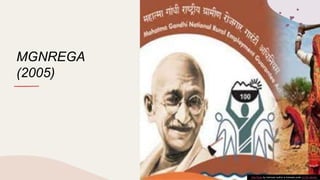
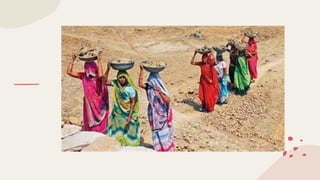
MGNREGA
(2005)
This Photo by Unknown author is licensed under CC BY-SA-NC.
Mahatma Gandhi National Rural Employment
Guarantee Act 2005 or MGNREGA, earlier known
as the National Rural Employment Guarantee
Act or NREGA, is an Indian social welfare measure
that aims to guarantee the 'right to work'.
This act was passed on 23 August 2005[1] and was
implemented in February 2006 under the UPA
government of Prime Minister Manmohan
Singh following tabling of the bill in parliament by the
Minister for Rural Development Raghuvansh Prasad
Singh.
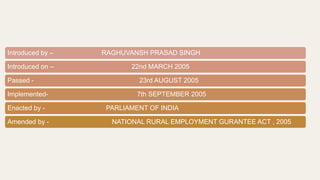
Introduced by – RAGHUVANSH PRASAD SINGH
Introduced on – 22nd MARCH 2005
Passed - 23rd AUGUST 2005
Implemented- 7th SEPTEMBER 2005
Enacted by - PARLIAMENT OF INDIA
Amended by - NATIONAL RURAL EMPLOYMENT GURANTEE ACT , 2005
It aims to enhance livelihood security in rural areas by providing at least 100 days of wage employment in
a financial year to at least one member of every household whose adult members volunteer to do
unskilled manual work.
Women are guaranteed one third of the jobs made available under the MGNREGA.
Another aim of MGNREGA is to create durable assets (such as roads, canals, ponds and wells).
Employment is to be provided within 5 km of an applicant's residence, and minimum wages are to be paid.
If work is not provided within 15 days of applying, applicants are entitled to an unemployment allowance.
That is, if the government fails to provide employment, it has to provide certain unemployment allowances
to those people.
Thus, employment under MGNREGA is a legal entitlement. Apart from providing economic security and
creating rural assets, other things said to promote NREGA are that it can help in protecting the
environment, empowering rural women, reducing rural-urban migration and fostering social equity, among
others."[8]
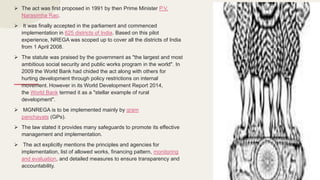
 The act was first proposed in 1991 by then Prime Minister P.V.
Narasimha Rao.
 It was finally accepted in the parliament and commenced
implementation in 625 districts of India. Based on this pilot
experience, NREGA was scoped up to cover all the districts of India
from 1 April 2008.
 The statute was praised by the government as "the largest and most
ambitious social security and public works program in the world". In
2009 the World Bank had chided the act along with others for
hurting development through policy restrictions on internal
movement. However in its World Development Report 2014,
the World Bank termed it as a "stellar example of rural
development".
 MGNREGA is to be implemented mainly by gram
panchayats (GPs).
 The law stated it provides many safeguards to promote its effective
management and implementation.
 The act explicitly mentions the principles and agencies for
implementation, list of allowed works, financing pattern, monitoring
and evaluation, and detailed measures to ensure transparency and
accountability.
HISTORY
Since 1960, 30 years were expended in struggling to find suitable employment schemes in India's vast
rural hinterland. The experiences of these decades provided important lessons to the government.
These included the 'Rural Manpower Programme' which exposed the tribulations of financial
management, the 'Crash Scheme for Rural Employment' on planning for outcomes, a 'Pilot Intensive
Rural Employment Programme' of labour-intensive works, the 'Drought Prone Area Programme' of
integrated rural development, 'Marginal Farmers and Agricultural Labourers Scheme' of rural
economic development, the ‘Food for Work Programme’ (FWP) of holistic development and better
coordination with the states, the ‘National Rural Employment Programme’ (NREP) of community
development, and the ‘Rural Landless Employment Guarantee Programme’ (RLEGP) of focus on
landless households. The Planning Commission later approved the scheme and it was adopted on
national scale.
PROVISIONS
 The registration process involves an application to the Gram Panchayat and issue of job
cards.
 The wage employment must be provided within 15 days of the date of application.
 The work entitlement of 100 days per household per year may be shared between different
adult members of the same household.
 The law lists permissible works: water conservation and water harvesting; drought proofing
including afforestation; irrigation works; restoration of traditional water bodies; land
development; flood control; rural connectivity; and works notified by the government.
 The Act sets a minimum limit to the wage-material ratio as 60:40. The provision of accredited
engineers, worksite facilities and a weekly report on worksites is also mandated by the Act.
 The Act sets a minimum limit to the wages, to be paid with gender equality, either on a time-
rate basis or on a piece-rate basis.
 The states are required to evolve a set of norms for the measurement of works and schedule
of rates.
 Unemployment allowance must be paid if the work is not provided within the statutory limit of
15 days.The law stipulates Gram Panchayats to have a single bank account for NREGA
works which shall be subjected to public scrutiny.
 To promote transparency and accountability, the act mandates 'monthly squaring of
accounts'.
 To ensure public accountability through public vigilance, the NREGA designates ‘social
THE LAW & CONSTITUTION
OF INDIA
 The Act aims to follow the Directive Principles of State
Policy enunciated in Part IV of the Constitution of India.
 The law by providing a 'right to work' is consistent with Article 41 that
directs the State to secure to all citizens the right to work.
 The statute also seeks to protect the environment through rural
works which is consistent with Article 48A that directs the State to
protect the environment.
 In accordance with the Article 21 of the Constitution of India that
guarantees the right to life with dignity to every citizen of India, this act
imparts dignity to the rural people through an assurance of livelihood
security.
 The Fundamental Right enshrined in Article 16 of the Constitution of
India guarantees equality of opportunity in matters of public
employment and prevents the State from discriminating against anyone
in matters of employment on the grounds only of religion, race, caste,
sex, descent, place of birth, place of residence or any of them.
 NREGA also follows Article 46 that requires the State to promote the
interests of and work for the economic uplift of the scheduled castes
and scheduled tribes and protect them from discrimination and
exploitation.
HAVE A NICE DAY
This Photo by Unknown author is licensed under CC BY-SA.

Economic survey pptx

  • 1.
    WELCOME This Photo byUnknown author is licensed under CC BY-SA.
  • 2.
  • 3.
  • 4.
     According toUNDP, “Good Governance is, among other things, participatory, transparent, and accountable.  It is also effective and equitable. And it promotes the rule of law.  Good governance ensures that political, social, and economic priorities are based on broad consensus in society and that the voices of the poorest and the most vulnerable are heard in decision making over the allocation of development resources”
  • 5.
    According to theworld bank(1992), “Good governance is central to creating and sustaining an environment which fosters strong and equitable development and it is an essential complement to sound economic policies”.
  • 7.
    CHARACTERISTICS OF GOOD GOVERNANCE ThisPhoto by Unknown author is licensed under CC BY-SA-NC.
  • 8.
    Participation  Rule oflaw  Transparency  Responsiveness  Consensus Oriented  Equity and Inclusiveness  Effectiveness and Efficiency  Accountability
  • 9.
    STEPS TAKEN FORGOOD GOVERNANCE IN INDIA
  • 10.
     NREGA (2005) SARVA SHIKSHA ABHIYAN  NATIONAL HEALTH MISSION  E-GOVERNANCE  RESERVATION  RIGHT TO EDUCATION  GOOD GOVERNANCE INDEX
  • 11.
    MGNREGA (2005) This Photo byUnknown author is licensed under CC BY-SA-NC.
  • 12.
    Mahatma Gandhi NationalRural Employment Guarantee Act 2005 or MGNREGA, earlier known as the National Rural Employment Guarantee Act or NREGA, is an Indian social welfare measure that aims to guarantee the 'right to work'. This act was passed on 23 August 2005[1] and was implemented in February 2006 under the UPA government of Prime Minister Manmohan Singh following tabling of the bill in parliament by the Minister for Rural Development Raghuvansh Prasad Singh.
  • 13.
    Introduced by –RAGHUVANSH PRASAD SINGH Introduced on – 22nd MARCH 2005 Passed - 23rd AUGUST 2005 Implemented- 7th SEPTEMBER 2005 Enacted by - PARLIAMENT OF INDIA Amended by - NATIONAL RURAL EMPLOYMENT GURANTEE ACT , 2005
  • 15.
    It aims toenhance livelihood security in rural areas by providing at least 100 days of wage employment in a financial year to at least one member of every household whose adult members volunteer to do unskilled manual work. Women are guaranteed one third of the jobs made available under the MGNREGA. Another aim of MGNREGA is to create durable assets (such as roads, canals, ponds and wells). Employment is to be provided within 5 km of an applicant's residence, and minimum wages are to be paid. If work is not provided within 15 days of applying, applicants are entitled to an unemployment allowance. That is, if the government fails to provide employment, it has to provide certain unemployment allowances to those people. Thus, employment under MGNREGA is a legal entitlement. Apart from providing economic security and creating rural assets, other things said to promote NREGA are that it can help in protecting the environment, empowering rural women, reducing rural-urban migration and fostering social equity, among others."[8]
  • 16.
     The actwas first proposed in 1991 by then Prime Minister P.V. Narasimha Rao.  It was finally accepted in the parliament and commenced implementation in 625 districts of India. Based on this pilot experience, NREGA was scoped up to cover all the districts of India from 1 April 2008.  The statute was praised by the government as "the largest and most ambitious social security and public works program in the world". In 2009 the World Bank had chided the act along with others for hurting development through policy restrictions on internal movement. However in its World Development Report 2014, the World Bank termed it as a "stellar example of rural development".  MGNREGA is to be implemented mainly by gram panchayats (GPs).  The law stated it provides many safeguards to promote its effective management and implementation.  The act explicitly mentions the principles and agencies for implementation, list of allowed works, financing pattern, monitoring and evaluation, and detailed measures to ensure transparency and accountability.
  • 17.
    HISTORY Since 1960, 30years were expended in struggling to find suitable employment schemes in India's vast rural hinterland. The experiences of these decades provided important lessons to the government. These included the 'Rural Manpower Programme' which exposed the tribulations of financial management, the 'Crash Scheme for Rural Employment' on planning for outcomes, a 'Pilot Intensive Rural Employment Programme' of labour-intensive works, the 'Drought Prone Area Programme' of integrated rural development, 'Marginal Farmers and Agricultural Labourers Scheme' of rural economic development, the ‘Food for Work Programme’ (FWP) of holistic development and better coordination with the states, the ‘National Rural Employment Programme’ (NREP) of community development, and the ‘Rural Landless Employment Guarantee Programme’ (RLEGP) of focus on landless households. The Planning Commission later approved the scheme and it was adopted on national scale.
  • 18.
    PROVISIONS  The registrationprocess involves an application to the Gram Panchayat and issue of job cards.  The wage employment must be provided within 15 days of the date of application.  The work entitlement of 100 days per household per year may be shared between different adult members of the same household.  The law lists permissible works: water conservation and water harvesting; drought proofing including afforestation; irrigation works; restoration of traditional water bodies; land development; flood control; rural connectivity; and works notified by the government.  The Act sets a minimum limit to the wage-material ratio as 60:40. The provision of accredited engineers, worksite facilities and a weekly report on worksites is also mandated by the Act.  The Act sets a minimum limit to the wages, to be paid with gender equality, either on a time- rate basis or on a piece-rate basis.  The states are required to evolve a set of norms for the measurement of works and schedule of rates.  Unemployment allowance must be paid if the work is not provided within the statutory limit of 15 days.The law stipulates Gram Panchayats to have a single bank account for NREGA works which shall be subjected to public scrutiny.  To promote transparency and accountability, the act mandates 'monthly squaring of accounts'.  To ensure public accountability through public vigilance, the NREGA designates ‘social
  • 19.
    THE LAW &CONSTITUTION OF INDIA
  • 20.
     The Actaims to follow the Directive Principles of State Policy enunciated in Part IV of the Constitution of India.  The law by providing a 'right to work' is consistent with Article 41 that directs the State to secure to all citizens the right to work.  The statute also seeks to protect the environment through rural works which is consistent with Article 48A that directs the State to protect the environment.  In accordance with the Article 21 of the Constitution of India that guarantees the right to life with dignity to every citizen of India, this act imparts dignity to the rural people through an assurance of livelihood security.  The Fundamental Right enshrined in Article 16 of the Constitution of India guarantees equality of opportunity in matters of public employment and prevents the State from discriminating against anyone in matters of employment on the grounds only of religion, race, caste, sex, descent, place of birth, place of residence or any of them.  NREGA also follows Article 46 that requires the State to promote the interests of and work for the economic uplift of the scheduled castes and scheduled tribes and protect them from discrimination and exploitation.
  • 21.
    HAVE A NICEDAY This Photo by Unknown author is licensed under CC BY-SA.