Before presenting my PPT on 
the topic “Working of a 
Human Ear”, I would like to 
thank Anjali Rajpal ma’am for 
inspiring me to increase my 
knowledge about Science.
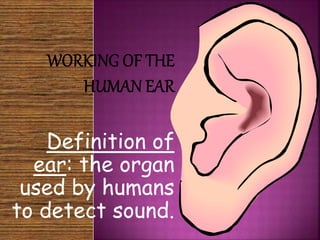
Definition of 
ear: the organ 
used by humans 
to detect sound.
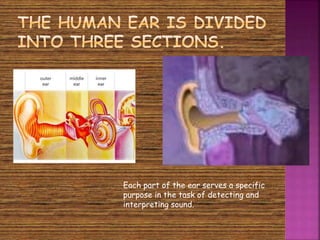
Each part of the ear serves a specific 
purpose in the task of detecting and 
interpreting sound.
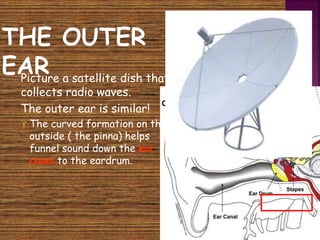
 Picture a satellite dish that 
collects radio waves. 
 The outer ear is similar! 
 The curved formation on the 
outside ( the pinna) helps 
funnel sound down the ear 
canal to the eardrum.
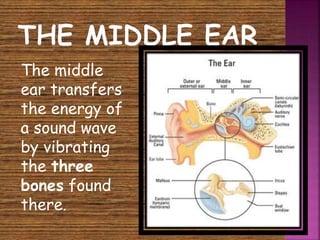
 The middle 
ear transfers 
the energy of 
a sound wave 
by vibrating 
the three 
bones found 
there.
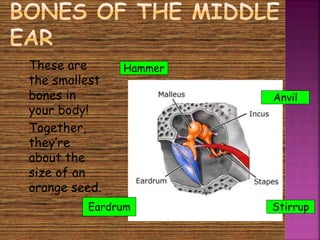
 These are 
the smallest 
bones in 
your body! 
 Together, 
they’re 
about the 
size of an 
orange seed. 
Hammer 
Anvil 
Eardrum Stirrup
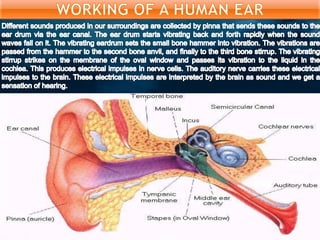
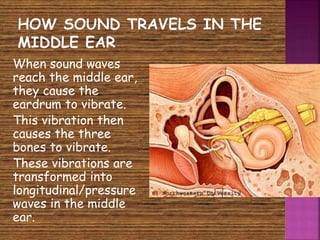
 When sound waves 
reach the middle ear, 
they cause the 
eardrum to vibrate. 
 This vibration then 
causes the three 
bones to vibrate. 
 These vibrations are 
transformed into 
longitudinal/pressure 
waves in the middle 
ear.
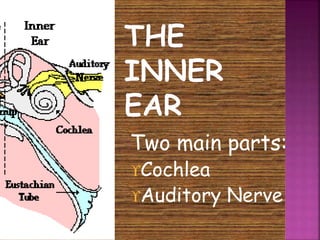
Two main parts: 
Cochlea 
Auditory Nerve
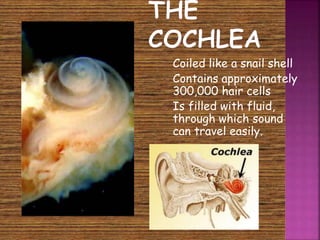
 Coiled like a snail shell 
 Contains approximately 
300,000 hair cells 
 Is filled with fluid, 
through which sound 
can travel easily.
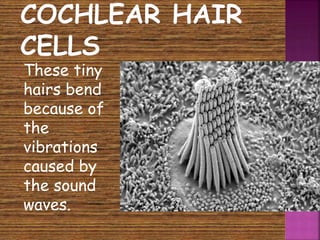
 These tiny 
hairs bend 
because of 
the 
vibrations 
caused by 
the sound 
waves.
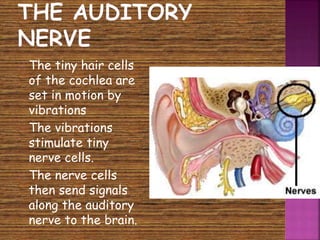
 The tiny hair cells 
of the cochlea are 
set in motion by 
vibrations 
 The vibrations 
stimulate tiny 
nerve cells. 
 The nerve cells 
then send signals 
along the auditory 
nerve to the brain.
homemade dishes

homemade dishes

  • 1.
    Before presenting myPPT on the topic “Working of a Human Ear”, I would like to thank Anjali Rajpal ma’am for inspiring me to increase my knowledge about Science.
  • 2.
    Definition of ear:the organ used by humans to detect sound.
  • 4.
    Each part ofthe ear serves a specific purpose in the task of detecting and interpreting sound.
  • 5.
     Picture asatellite dish that collects radio waves.  The outer ear is similar!  The curved formation on the outside ( the pinna) helps funnel sound down the ear canal to the eardrum.
  • 6.
     The middle ear transfers the energy of a sound wave by vibrating the three bones found there.
  • 7.
     These are the smallest bones in your body!  Together, they’re about the size of an orange seed. Hammer Anvil Eardrum Stirrup
  • 8.
     When soundwaves reach the middle ear, they cause the eardrum to vibrate.  This vibration then causes the three bones to vibrate.  These vibrations are transformed into longitudinal/pressure waves in the middle ear.
  • 9.
    Two main parts: Cochlea Auditory Nerve
  • 10.
     Coiled likea snail shell  Contains approximately 300,000 hair cells  Is filled with fluid, through which sound can travel easily.
  • 11.
     These tiny hairs bend because of the vibrations caused by the sound waves.
  • 13.
     The tinyhair cells of the cochlea are set in motion by vibrations  The vibrations stimulate tiny nerve cells.  The nerve cells then send signals along the auditory nerve to the brain.