*
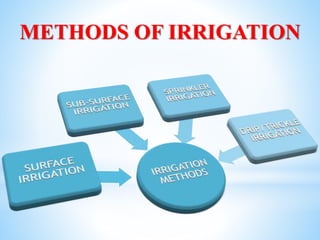
METHODS OF IRRIGATION
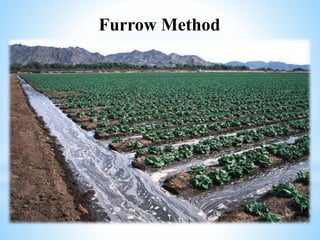
Furrow Method
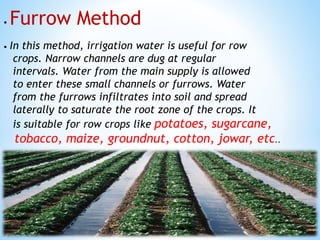
• Furrow Method
• In this method, irrigation water is useful for row
crops. Narrow channels are dug at regular
intervals. Water from the main supply is allowed
to enter these small channels or furrows. Water
from the furrows infiltrates into soil and spread
laterally to saturate the root zone of the crops. It
is suitable for row crops like potatoes, sugarcane,
tobacco, maize, groundnut, cotton, jowar, etc..
ADVANTAGES OF FORROW METHOD
• Less water is required as water comes
in
contact of 1/5 to ½ of the land
surface.
• Evaporation loss is less.
• Labor requirement for land preparation
and
irrigation is less.
• Wastage of water is minimum.
• It is suitable for row crops.
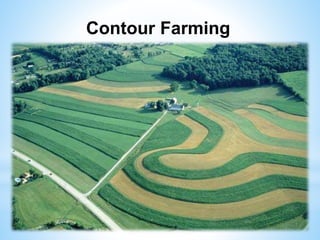
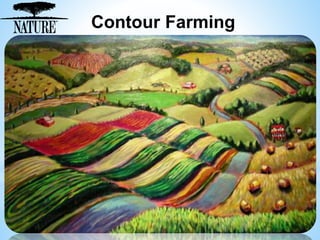
Contour Farming
• Contour farming is practiced in hilly areas
with slopes and with falling contour. The land
is divided into series of horizontal strips called
terraces. Small bunds are constructed at the
end of each terrace to hold water up to equal
height. Contour farming besides producing
crop yields, helps in mitigating indirectly
controlling flood, soil conservation.
Contour Farming
Contour Farming
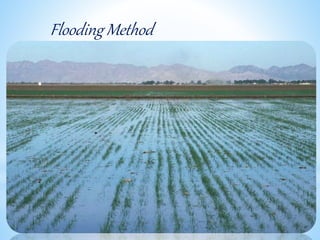
Flooding Method
* The flooding method is subdivided into various
methods as:
• Free Flooding
• With the help of field channels, agricultural land
is divided into small strips . Field channels are
provided with the field regulator. This method is
known as irrigation by plots commonly used in
India.
• In this method when the strips are flooded with
water, surplus water is allowed to enter the
water channel and allowed to discharge in the
water downstream.
Flooding Method
Basin Flooding
Basin Flooding
Basin Flooding
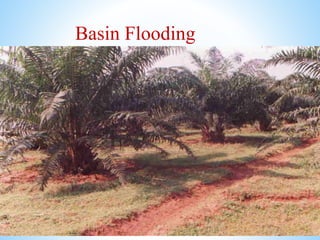
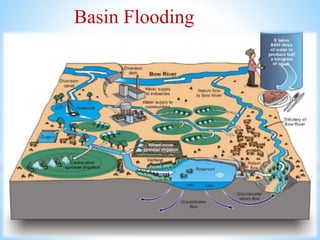
• This method is used frequently to irrigate the
orchards. It is a special type of check flooding
method. Each plant is enclosed by circular
channels which is called basin. Basins are
connected to small field ditches.
• Ditches are fed from the main supply channel.
When the basin are flooded, the supply is
stopped. Portable pipes or large hoses may also
be used in place of ditches to flood the basin
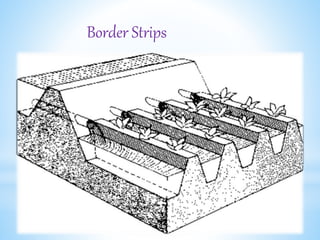
Border Strips
• In this method, the agricultural area is divided
into
series of long narrow strips known as border strips
by levees, i.e. small bunds. The strips are aligned
along the country slope so that the water can flow
easily throughout the area. This method is suitable
when the area is at level with gentle country slope
Or levelled area slope land.
Border Strips
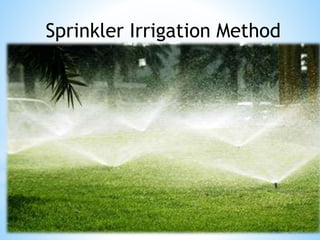
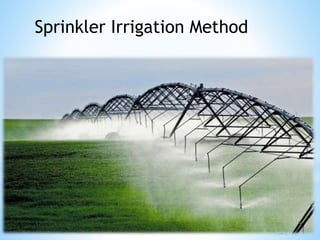
Sprinkler Irrigation Method
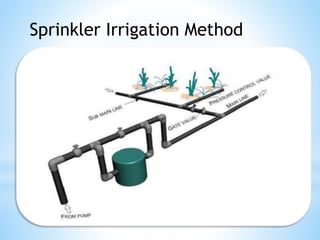
• In this method, water is applied to the crop in the form
of sprinkle or spray with the combination of pump, main
pipe, sub-main pipe, lateral, riser, nozzle, etc..
• It is a kind of artificial rainfall and therefore, it is very
fruitful for crops grown in a farm.
• This method is useful where:
• Surface irrigation method is not sufficient
• Slope of the crop field is higher
• Topography of the crop field is irregular
• Soil is erosive.
• Depth of soil is shallow over gravel and sand.
Sprinkler Irrigation Method
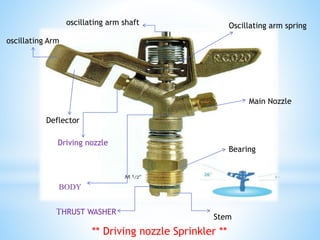
Oscillating arm springoscillating arm shaft
oscillating Arm
Bearing
Stem
Deflector
Main Nozzle
BODY
THRUST WASHER
Driving nozzle
** Driving nozzle Sprinkler **
Sprinkler Irrigation Method
Advantages and Dis-Advantages of
Sprinkler Irrigation
* • Erosion of soil is avoided or controlled
* • It is possible to apply water uniformly
* • Irrigation of water better controlled
according to need of the crops in
their different stages of growth.
* • There is no surface run-off
* • Labor cost is less
* • Damage of crop due to frost is reduced.
* • It is a standby drainage pumping set
* • It can be used even with high water table.
* • Seepage loss like earthen canal are
eliminated
* • Fertilizers can be uniformly applied by
mixing with water.
* • Efficiency is higher,
* • i.e. Efficiency = Water stored in root zone
* Water sprinkled
* • Although this method has number of
advantages, yet it has
* some limitations
* • Wind may disturb or distort sprinkling
pattern
* • A constant water supply is needed for
commercial use of
* equipment.
* • Water is to be clean and free from sand.
* • Heavy soil with pore intake cannot be
irrigated efficiently.
* • Areas with higher temperature increase
evaporation loss
* • They are not suitable for crops requiring
frequent and
* deep water depth.
* • It requires high electrical power
Drip or Trickle Irrigation
• It has been shown that sprinkler irrigation is not suitable in the
region of high temperature, high low pressure.
Therefore a method is established for irrigation farming.
• The regions having scarcity of water and problem of salination of
soil the best suitable method is drip/trickle irrigation.
* This is one of the latest methods of irrigation and also a very
popular method among the actual users of irrigation farming.
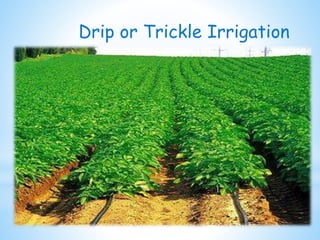
• In this method, Small diameter plastic pipes are used together
with drip nozzles which are known as Emitters or Drippers
They deliver water to land surface near the base of the plant.
• In this method, the use of water is at very low rate which varies
between 2 and 10 lit/per hrs.
This keeps the soil moisture within the desired range for growth of
the plant.
Drip or Trickle Irrigation

Methods of Irrigation Engineering

  • 1.
  • 2.
  • 3.
  • 4.
    • Furrow Method •In this method, irrigation water is useful for row crops. Narrow channels are dug at regular intervals. Water from the main supply is allowed to enter these small channels or furrows. Water from the furrows infiltrates into soil and spread laterally to saturate the root zone of the crops. It is suitable for row crops like potatoes, sugarcane, tobacco, maize, groundnut, cotton, jowar, etc..
  • 5.
    ADVANTAGES OF FORROWMETHOD • Less water is required as water comes in contact of 1/5 to ½ of the land surface. • Evaporation loss is less. • Labor requirement for land preparation and irrigation is less. • Wastage of water is minimum. • It is suitable for row crops.
  • 6.
  • 7.
    • Contour farmingis practiced in hilly areas with slopes and with falling contour. The land is divided into series of horizontal strips called terraces. Small bunds are constructed at the end of each terrace to hold water up to equal height. Contour farming besides producing crop yields, helps in mitigating indirectly controlling flood, soil conservation. Contour Farming
  • 8.
  • 9.
    Flooding Method * Theflooding method is subdivided into various methods as: • Free Flooding • With the help of field channels, agricultural land is divided into small strips . Field channels are provided with the field regulator. This method is known as irrigation by plots commonly used in India. • In this method when the strips are flooded with water, surplus water is allowed to enter the water channel and allowed to discharge in the water downstream.
  • 10.
  • 11.
  • 12.
  • 13.
    Basin Flooding • Thismethod is used frequently to irrigate the orchards. It is a special type of check flooding method. Each plant is enclosed by circular channels which is called basin. Basins are connected to small field ditches. • Ditches are fed from the main supply channel. When the basin are flooded, the supply is stopped. Portable pipes or large hoses may also be used in place of ditches to flood the basin
  • 14.
    Border Strips • Inthis method, the agricultural area is divided into series of long narrow strips known as border strips by levees, i.e. small bunds. The strips are aligned along the country slope so that the water can flow easily throughout the area. This method is suitable when the area is at level with gentle country slope Or levelled area slope land.
  • 15.
  • 16.
  • 17.
    Sprinkler Irrigation Method •In this method, water is applied to the crop in the form of sprinkle or spray with the combination of pump, main pipe, sub-main pipe, lateral, riser, nozzle, etc.. • It is a kind of artificial rainfall and therefore, it is very fruitful for crops grown in a farm. • This method is useful where: • Surface irrigation method is not sufficient • Slope of the crop field is higher • Topography of the crop field is irregular • Soil is erosive. • Depth of soil is shallow over gravel and sand.
  • 18.
  • 19.
    Oscillating arm springoscillatingarm shaft oscillating Arm Bearing Stem Deflector Main Nozzle BODY THRUST WASHER Driving nozzle ** Driving nozzle Sprinkler **
  • 20.
  • 21.
    Advantages and Dis-Advantagesof Sprinkler Irrigation * • Erosion of soil is avoided or controlled * • It is possible to apply water uniformly * • Irrigation of water better controlled according to need of the crops in their different stages of growth. * • There is no surface run-off * • Labor cost is less * • Damage of crop due to frost is reduced. * • It is a standby drainage pumping set * • It can be used even with high water table. * • Seepage loss like earthen canal are eliminated * • Fertilizers can be uniformly applied by mixing with water. * • Efficiency is higher, * • i.e. Efficiency = Water stored in root zone * Water sprinkled * • Although this method has number of advantages, yet it has * some limitations * • Wind may disturb or distort sprinkling pattern * • A constant water supply is needed for commercial use of * equipment. * • Water is to be clean and free from sand. * • Heavy soil with pore intake cannot be irrigated efficiently. * • Areas with higher temperature increase evaporation loss * • They are not suitable for crops requiring frequent and * deep water depth. * • It requires high electrical power
  • 22.
    Drip or TrickleIrrigation • It has been shown that sprinkler irrigation is not suitable in the region of high temperature, high low pressure. Therefore a method is established for irrigation farming. • The regions having scarcity of water and problem of salination of soil the best suitable method is drip/trickle irrigation. * This is one of the latest methods of irrigation and also a very popular method among the actual users of irrigation farming. • In this method, Small diameter plastic pipes are used together with drip nozzles which are known as Emitters or Drippers They deliver water to land surface near the base of the plant. • In this method, the use of water is at very low rate which varies between 2 and 10 lit/per hrs. This keeps the soil moisture within the desired range for growth of the plant.
  • 23.
    Drip or TrickleIrrigation