ESCMID INTERNATIONAL
OBSERVERSHIP 2019
MARMARA UNIVERSITY HOSPITAL
PENDIK , ISTANBUL , TURKEY
β-LACTAMASES Enzymes
Structure , Classification , Detection
Dr Toufik DJERBOUA
Pharmacist assistant master clinical microbiologist
College of medicine Mouloud Maammeri
Belloua Hospital , Nedir Mohammed UH
Clinical biology laboratory
Tizi-Ouzou-ALGERIA
SUMMARY1. Introduction
2. β-lactamin antibiotics : an overview
3. β – Lactamases :
3.1) Definition
3.2) History of emergence
3.3) Nomenclature
4. Structure and biochemical properties
4.1) Enzyme structure
4.2) Functional caracteristics
4.3) β-lactamin / β-lactamase interaction : substrate and inhibition profiles
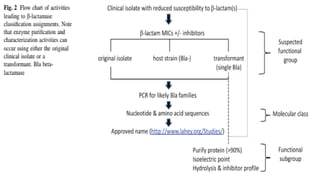
5. Classification of β-lactamases
6. Détection and exploration of β-lactamases
6.1) Phenotypic methods
6.2) Genotypic methods
β-lactam antibiotics are naturally synthetized by many species of filamentous bacteria
and fungi, they are also the most used antibiotics in human health and widely used in
livestock
1. Introduction :
Since the introduction and wide use of the β-lactam antibiotics, the emergence and
spread of these enzymes among commensal and pathogenic bacteria, makes these
enzymes one of the worst threats that public health is experiencing nowdays.
Many envionnemental bacteria harbor resistance mechanism to this family of
antibiotics of which, β-lactamase activity plays a key role in survival specially in
Gram negative bacilli.
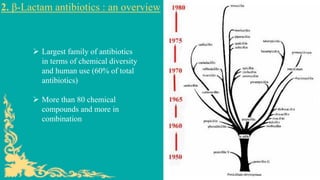
2. β-Lactam antibiotics : an overview
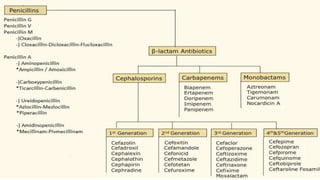
➢ Largest family of antibiotics
in terms of chemical diversity
and human use (60% of total
antibiotics)
➢ More than 80 chemical
compounds and more in
combination
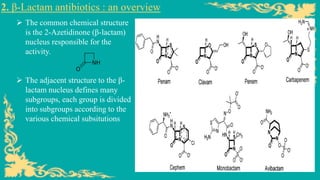
2. β-Lactam antibiotics : an overview
➢ The common chemical structure
is the 2-Azetidinone (β-lactam)
nucleus responsible for the
activity.
➢ The adjacent structure to the β-
lactam nucleus defines many
subgroups, each group is divided
into subgroups according to the
various chemical subsitutions
2. β-Lactam antibiotics : an overview
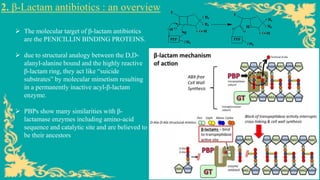
➢ The molecular target of β-lactam antibiotics
are the PENICILLIN BINDING PROTEINS.
➢ due to structural analogy between the D,D-
alanyl-alanine bound and the highly reactive
β-lactam ring, they act like “suicide
substrates” by molecular mimetism resulting
in a permanently inactive acyl-β-lactam
enzyme.
➢ PBPs show many similarities with β-
lactamase enzymes including amino-acid
sequence and catalytic site and are believed to
be their ancestors
2. β-Lactam antibiotics : an overview
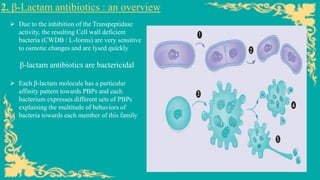
➢ Due to the inhibition of the Transpeptidase
activity, the resulting Cell wall deficient
bacteria (CWDB / L-forms) are very sensitive
to osmotic changes and are lysed quickly
β-lactam antibiotics are bactericidal
➢ Each β-lactam molecule has a particular
affinity pattern towards PBPs and each
bacterium expresses different sets of PBPs
explaining the multitude of behaviors of
bacteria towards each member of this family
β – Lactamases
2. β-Lactamases :Definition
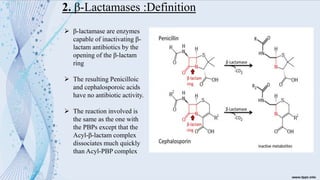
➢ β-lactamase are enzymes
capable of inactivating β-
lactam antibiotics by the
opening of the β-lactam
ring
➢ The resulting Penicilloic
and cephalosporoic acids
have no antibiotic activity.
➢ The reaction involved is
the same as the one with
the PBPs except that the
Acyl-β-lactam complex
dissociates much quickly
than Acyl-PBP complex
2. β-Lactamases :Definition
➢ β-lactamase are wide spread in environnemental bacteria, but most prevalent and efficient
in Gram negativebacteria, some species have a natural chromosomal sometimes inductible
β-lactamase :
- Escherichia coli, Yersinia spp, Enterobacter spp, Serratia spp
- Indol + Proteus spp, Morganella spp , Providencia spp
- Pseudomonas spp
- Acinetobacter spp
- Stenotrophomonas spp
- Kluyvera spp
- Schwanella spp …
2. β-Lactamases :Definition
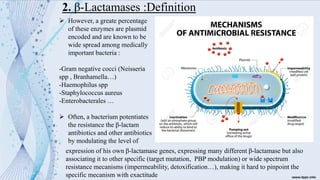
➢ However, a greate percentage
of these enzymes are plasmid
encoded and are known to be
wide spread among medically
important bacteria :
-Gram negative cocci (Neisseria
spp , Branhamella…)
-Haemophilus spp
-Staphylococcus aureus
-Enterobacterales …
➢ Often, a bacterium potentiates
the resistance the β-lactam
antibiotics and other antibiotics
by modulating the level of
expression of his own β-lactamase genes, expressing many different β-lactamase but also
associating it to other specific (target mutation, PBP modulation) or wide spectrum
resistance mecanisms (impermeability, detoxification…), making it hard to pinpoint the
specific mecanism with exactitude
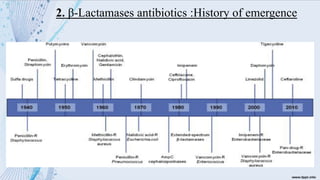
2. β-Lactamases :History of emergence
➢ 1940s :Discovery of enzymatic resistance of Gram negative bacteria to penicillin (AmpC in E.coli)
➢ 1950s :Emergence of Penicillinase producing Staphylococci in 1950s
β-lactam antibiotics are bactericidal
➢ 1960s : emergence of the first broad spectrum transferable β-lactamase in Escherichia coli, called
TEM-1 followed by the identification the SHV enzymes (SHV-1) in Klebsiella pneumoniae
➢ 1980s : Identification of the first extended spectrum β-lactamase in Klebsiella pneumoniae (SHV-2)
➢ Late 1980s : CTX-M pandemic
➢ 1990s : emergence of Classe A Carbapenemases
➢ 2000s : emergence of transferable AmpC like enzymes and Extended spectrum cephalosporinase and
spread of OXA type enzymes
➢ Since 2012 : NDM-1 metallo-beta lactamase pandemic
➢ What for the future …
2. β-Lactamases antibiotics :History of emergence
2. β-Lactamases :Nomenclature
➢ There is no actual consensus n the nomenclature of these enzymes, their names and the
derived abbreviations can originate from :
✓ The producing organism : PSE (Pseudomonas specific enzyme)
✓ The most hydrolyzed substrate : OXA (Oxacillinase)
✓ Particular structure feature : SHV (Sulfhydryl variant)
✓ Place of discovery : CTX-M (Cefotaximase Munich)
✓ The patient from whom the strain was isolated : TEM (Temoneira) , BIL (Bilal)
✓ Some even have two names : MEN enzymes now renamed CTX-M
However, the extreme diversity know now for these enzymes have resulted in a summary
classification and regrooming based on structural similitude and chronological order of
discovery (TEM, SHV, CTX-M, OXA…)
More details: β-Lactamase Nomenclature George A. Jacoby 10.1128/AAC.50.4.1123-1129.2006
2. β-Lactamases : BIOCHEMISTRY
The caracterisation β-lactamase after its identification/ purification follows the classical Protein/Enzyme typing
techniques including :
1) Determination of the localisation : limited use
2) Determination of structural properties : molecular mass, isoelectric point, electrophoretic migration profil,
amino-acid content, amino acid sequence, 3D structure…
3) Determination of kinetic properties : Substrate profil, Inhibition profil , Km, Kcat, Ki/Vmax…
4) Later on , determination of genetic properties : gene sequence, genetic support, gene structure…
2. β-Lactamases : BIOCHEMISTRY
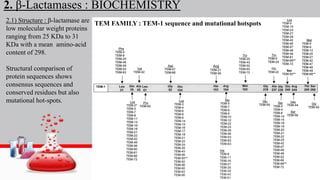
2.1) Structure : β-lactamase are
low molecular weight proteins
ranging from 25 KDa to 31
KDa with a mean amino-acid
content of 298.
Structural comparison of
protein sequences shows
consensus sequences and
conserved residues but also
mutational hot-spots.
TEM FAMILY : TEM-1 sequence and mutational hotspots
2. β-Lactamases: BIOCHEMISTRY
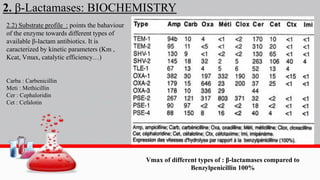
2.2) Substrate profile : points the bahaviour
of the enzyme towards different types of
available β-lactam antibiotics. It is
caracterized by kinetic parameters (Km ,
Kcat, Vmax, catalytic efficiency…)
Carba : Carbenicillin
Meti : Methicillin
Cer : Cephaloridin
Cet : Cefalotin
Vmax of different types of : β-lactamases compared to
Benzylpenicillin 100%
2. β-Lactamases : BIOCHEMISTRY
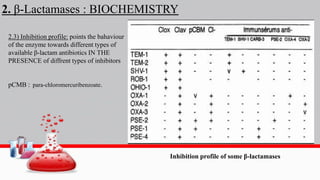
2.3) Inhibition profile: points the bahaviour
of the enzyme towards different types of
available β-lactam antibiotics IN THE
PRESENCE of diffrent types of inhibitors
pCMB : para-chloromercuribenzoate.
Inhibition profile of some β-lactamases
2. β-Lactamases : BIOCHEMISTRY
2.4) Genetic support: many β-lactamases are chromosomal, they might be inducible ( Enterobacter spp
, Serratia spp…) or non inductible (Escherichia coli, Acinetobacter spp)
-The acquired β-lactamases are plasmid encoded and can be inserted in mobile / mobilizable elements
like transposons and integrons. They often are produced innately at at high concentrations and associate
many other resistances to other types of antibiotics (aminoglycosides, fluoroquinolones…)
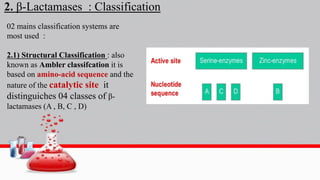
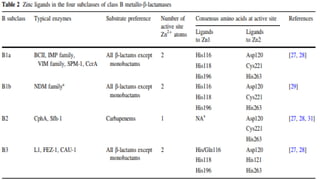
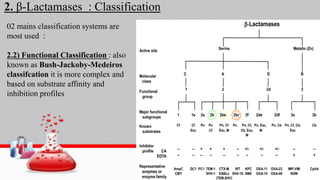
2. β-Lactamases : Classification
02 mains classification systems are
most used :
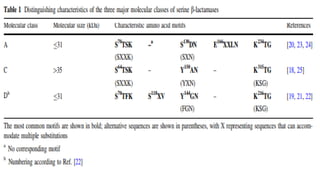
2.1) Structural Classification : also
known as Ambler classifcation it is
based on amino-acid sequence and the
nature of the catalytic site it
distinguiches 04 classes of β-
lactamases (A , B, C , D)
2. β-Lactamases : Classification
02 mains classification systems are
most used :
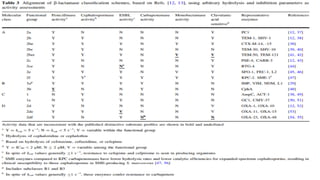
2.2) Functional Classification : also
known as Bush-Jackoby-Medeiros
classifcation it is more complex and
based on substrate affinity and
inhibition profiles
2. β-Lactamases : Classification
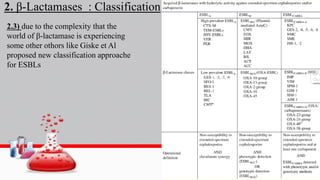
2.3) due to the complexity that the
world of β-lactamase is experiencing
some other othors like Giske et Al
proposed new classification approache
for ESBLs
3. β-Lactamases : Methods of detection
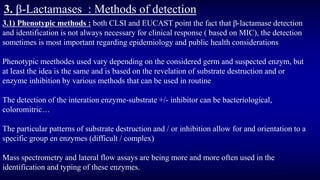
3.1) Phenotypic methods : both CLSI and EUCAST point the fact that β-lactamase detection
and identification is not always necessary for clinical response ( based on MIC), the detection
sometimes is most important regarding epidemiology and public health considerations
Phenotypic meethodes used vary depending on the considered germ and suspected enzym, but
at least the idea is the same and is based on the revelation of substrate destruction and or
enzyme inhibition by various methods that can be used in routine
The detection of the interation enzyme-substrate +/- inhibitor can be bacteriological,
coloromitric…
The particular patterns of substrate destruction and / or inhibition allow for and orientation to a
specific group en enzymes (difficult / complex)
Mass spectrometry and lateral flow assays are being more and more often used in the
identification and typing of these enzymes.
3. β-Lactamases : Methods of detection
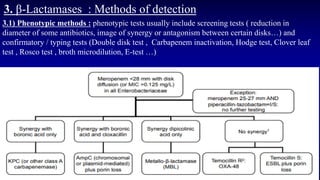
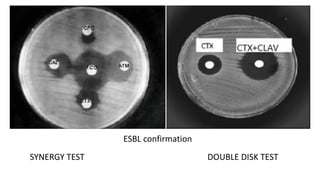
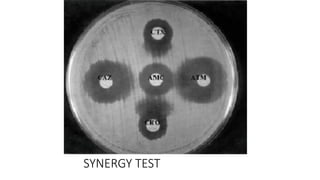
3.1) Phenotypic methods : phenotypic tests usually include screening tests ( reduction in
diameter of some antibiotics, image of synergy or antagonism between certain disks…) and
confirmatory / typing tests (Double disk test , Carbapenem inactivation, Hodge test, Clover leaf
test , Rosco test , broth microdilution, E-test …)
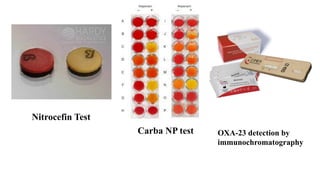
Nitrocefin Test
Carba NP test OXA-23 detection by
immunochromatography
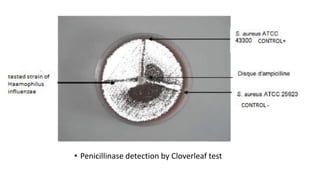
• Penicillinase detection by Cloverleaf test
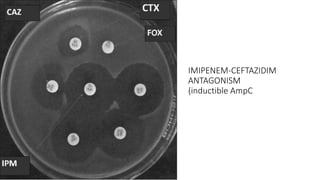
IMIPENEM-CEFTAZIDIM
ANTAGONISM
(inductible AmpC
ESBL confirmation
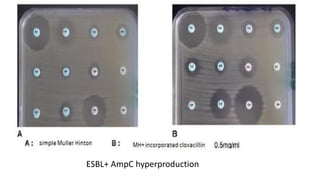
SYNERGY TEST DOUBLE DISK TEST
SYNERGY TEST
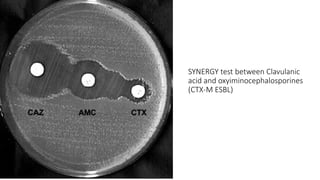
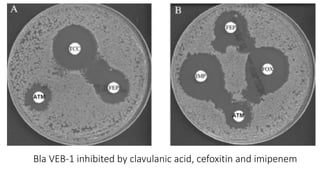
SYNERGY test between Clavulanic
acid and oxyiminocephalosporines
(CTX-M ESBL)
ESBL+ AmpC hyperproduction
Bla VEB-1 inhibited by clavulanic acid, cefoxitin and imipenem
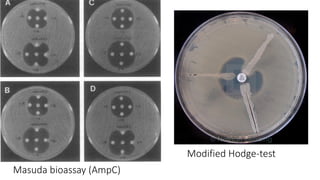
Masuda bioassay (AmpC)
Modified Hodge-test
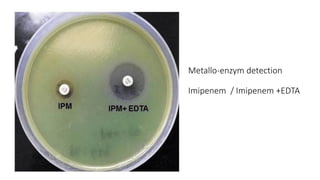
Metallo-enzym detection
Imipenem / Imipenem +EDTA
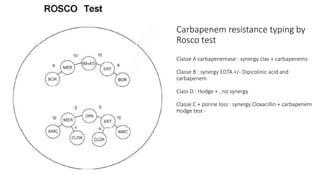
Carbapenem resistance typing by
Rosco test
Classe A carbapenemase : synergy clav + carbapenems
Classe B : synergy EDTA +/- Dipicolinic acid and
carbapenem
Class D : Hodge + , no synergy
Classe C + porine loss : synergy Cloxacillin + carbapenem
Hodge test -
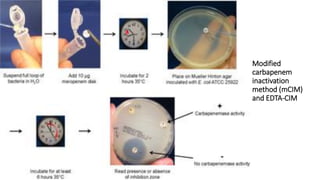
Modified
carbapenem
inactivation
method (mCIM)
and EDTA-CIM
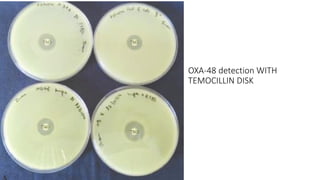
OXA-48 detection WITH
TEMOCILLIN DISK
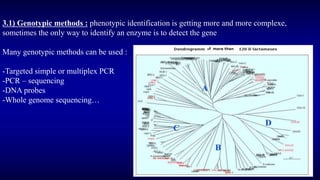
3.1) Genotypic methods : phenotypic identification is getting more and more complexe,
sometimes the only way to identify an enzyme is to detect the gene
Many genotypic methods can be used :
-Targeted simple or multiplex PCR
-PCR – sequencing
-DNA probes
-Whole genome sequencing…
CONCLUDING REMARKS
✓ β-lactamase mediated resistance is widespread among clinically
relevant isolates specially Gram negative bacteria in the community and
hospital settings
✓ Todays classification of β-lactamase is very complexe and needs to be
simplified specially for clinical use and research puropse
✓ While it is not always required for clinical reports , research for these
enzymes is importante for public health considerations
✓ Due to the increasing complexity of antimicrobial resistance
mechanisms , classic phenotypic methods will probably be less used to
the profil of mass spectrometry and other molecular assays

beta lactamases : structure , classification and investigations

  • 1.
    ESCMID INTERNATIONAL OBSERVERSHIP 2019 MARMARAUNIVERSITY HOSPITAL PENDIK , ISTANBUL , TURKEY β-LACTAMASES Enzymes Structure , Classification , Detection Dr Toufik DJERBOUA Pharmacist assistant master clinical microbiologist College of medicine Mouloud Maammeri Belloua Hospital , Nedir Mohammed UH Clinical biology laboratory Tizi-Ouzou-ALGERIA
  • 2.
    SUMMARY1. Introduction 2. β-lactaminantibiotics : an overview 3. β – Lactamases : 3.1) Definition 3.2) History of emergence 3.3) Nomenclature 4. Structure and biochemical properties 4.1) Enzyme structure 4.2) Functional caracteristics 4.3) β-lactamin / β-lactamase interaction : substrate and inhibition profiles 5. Classification of β-lactamases 6. Détection and exploration of β-lactamases 6.1) Phenotypic methods 6.2) Genotypic methods
  • 3.
    β-lactam antibiotics arenaturally synthetized by many species of filamentous bacteria and fungi, they are also the most used antibiotics in human health and widely used in livestock 1. Introduction : Since the introduction and wide use of the β-lactam antibiotics, the emergence and spread of these enzymes among commensal and pathogenic bacteria, makes these enzymes one of the worst threats that public health is experiencing nowdays. Many envionnemental bacteria harbor resistance mechanism to this family of antibiotics of which, β-lactamase activity plays a key role in survival specially in Gram negative bacilli.
  • 4.
    2. β-Lactam antibiotics: an overview ➢ Largest family of antibiotics in terms of chemical diversity and human use (60% of total antibiotics) ➢ More than 80 chemical compounds and more in combination
  • 5.
    2. β-Lactam antibiotics: an overview ➢ The common chemical structure is the 2-Azetidinone (β-lactam) nucleus responsible for the activity. ➢ The adjacent structure to the β- lactam nucleus defines many subgroups, each group is divided into subgroups according to the various chemical subsitutions
  • 7.
    2. β-Lactam antibiotics: an overview ➢ The molecular target of β-lactam antibiotics are the PENICILLIN BINDING PROTEINS. ➢ due to structural analogy between the D,D- alanyl-alanine bound and the highly reactive β-lactam ring, they act like “suicide substrates” by molecular mimetism resulting in a permanently inactive acyl-β-lactam enzyme. ➢ PBPs show many similarities with β- lactamase enzymes including amino-acid sequence and catalytic site and are believed to be their ancestors
  • 8.
    2. β-Lactam antibiotics: an overview ➢ Due to the inhibition of the Transpeptidase activity, the resulting Cell wall deficient bacteria (CWDB / L-forms) are very sensitive to osmotic changes and are lysed quickly β-lactam antibiotics are bactericidal ➢ Each β-lactam molecule has a particular affinity pattern towards PBPs and each bacterium expresses different sets of PBPs explaining the multitude of behaviors of bacteria towards each member of this family
  • 9.
  • 10.
    2. β-Lactamases :Definition ➢β-lactamase are enzymes capable of inactivating β- lactam antibiotics by the opening of the β-lactam ring ➢ The resulting Penicilloic and cephalosporoic acids have no antibiotic activity. ➢ The reaction involved is the same as the one with the PBPs except that the Acyl-β-lactam complex dissociates much quickly than Acyl-PBP complex
  • 11.
    2. β-Lactamases :Definition ➢β-lactamase are wide spread in environnemental bacteria, but most prevalent and efficient in Gram negativebacteria, some species have a natural chromosomal sometimes inductible β-lactamase : - Escherichia coli, Yersinia spp, Enterobacter spp, Serratia spp - Indol + Proteus spp, Morganella spp , Providencia spp - Pseudomonas spp - Acinetobacter spp - Stenotrophomonas spp - Kluyvera spp - Schwanella spp …
  • 12.
    2. β-Lactamases :Definition ➢However, a greate percentage of these enzymes are plasmid encoded and are known to be wide spread among medically important bacteria : -Gram negative cocci (Neisseria spp , Branhamella…) -Haemophilus spp -Staphylococcus aureus -Enterobacterales … ➢ Often, a bacterium potentiates the resistance the β-lactam antibiotics and other antibiotics by modulating the level of expression of his own β-lactamase genes, expressing many different β-lactamase but also associating it to other specific (target mutation, PBP modulation) or wide spectrum resistance mecanisms (impermeability, detoxification…), making it hard to pinpoint the specific mecanism with exactitude
  • 13.
    2. β-Lactamases :Historyof emergence ➢ 1940s :Discovery of enzymatic resistance of Gram negative bacteria to penicillin (AmpC in E.coli) ➢ 1950s :Emergence of Penicillinase producing Staphylococci in 1950s β-lactam antibiotics are bactericidal ➢ 1960s : emergence of the first broad spectrum transferable β-lactamase in Escherichia coli, called TEM-1 followed by the identification the SHV enzymes (SHV-1) in Klebsiella pneumoniae ➢ 1980s : Identification of the first extended spectrum β-lactamase in Klebsiella pneumoniae (SHV-2) ➢ Late 1980s : CTX-M pandemic ➢ 1990s : emergence of Classe A Carbapenemases ➢ 2000s : emergence of transferable AmpC like enzymes and Extended spectrum cephalosporinase and spread of OXA type enzymes ➢ Since 2012 : NDM-1 metallo-beta lactamase pandemic ➢ What for the future …
  • 14.
    2. β-Lactamases antibiotics:History of emergence
  • 15.
    2. β-Lactamases :Nomenclature ➢There is no actual consensus n the nomenclature of these enzymes, their names and the derived abbreviations can originate from : ✓ The producing organism : PSE (Pseudomonas specific enzyme) ✓ The most hydrolyzed substrate : OXA (Oxacillinase) ✓ Particular structure feature : SHV (Sulfhydryl variant) ✓ Place of discovery : CTX-M (Cefotaximase Munich) ✓ The patient from whom the strain was isolated : TEM (Temoneira) , BIL (Bilal) ✓ Some even have two names : MEN enzymes now renamed CTX-M However, the extreme diversity know now for these enzymes have resulted in a summary classification and regrooming based on structural similitude and chronological order of discovery (TEM, SHV, CTX-M, OXA…) More details: β-Lactamase Nomenclature George A. Jacoby 10.1128/AAC.50.4.1123-1129.2006
  • 16.
    2. β-Lactamases :BIOCHEMISTRY The caracterisation β-lactamase after its identification/ purification follows the classical Protein/Enzyme typing techniques including : 1) Determination of the localisation : limited use 2) Determination of structural properties : molecular mass, isoelectric point, electrophoretic migration profil, amino-acid content, amino acid sequence, 3D structure… 3) Determination of kinetic properties : Substrate profil, Inhibition profil , Km, Kcat, Ki/Vmax… 4) Later on , determination of genetic properties : gene sequence, genetic support, gene structure…
  • 17.
    2. β-Lactamases :BIOCHEMISTRY 2.1) Structure : β-lactamase are low molecular weight proteins ranging from 25 KDa to 31 KDa with a mean amino-acid content of 298. Structural comparison of protein sequences shows consensus sequences and conserved residues but also mutational hot-spots. TEM FAMILY : TEM-1 sequence and mutational hotspots
  • 18.
    2. β-Lactamases: BIOCHEMISTRY 2.2)Substrate profile : points the bahaviour of the enzyme towards different types of available β-lactam antibiotics. It is caracterized by kinetic parameters (Km , Kcat, Vmax, catalytic efficiency…) Carba : Carbenicillin Meti : Methicillin Cer : Cephaloridin Cet : Cefalotin Vmax of different types of : β-lactamases compared to Benzylpenicillin 100%
  • 19.
    2. β-Lactamases :BIOCHEMISTRY 2.3) Inhibition profile: points the bahaviour of the enzyme towards different types of available β-lactam antibiotics IN THE PRESENCE of diffrent types of inhibitors pCMB : para-chloromercuribenzoate. Inhibition profile of some β-lactamases
  • 20.
    2. β-Lactamases :BIOCHEMISTRY 2.4) Genetic support: many β-lactamases are chromosomal, they might be inducible ( Enterobacter spp , Serratia spp…) or non inductible (Escherichia coli, Acinetobacter spp) -The acquired β-lactamases are plasmid encoded and can be inserted in mobile / mobilizable elements like transposons and integrons. They often are produced innately at at high concentrations and associate many other resistances to other types of antibiotics (aminoglycosides, fluoroquinolones…)
  • 21.
    2. β-Lactamases :Classification 02 mains classification systems are most used : 2.1) Structural Classification : also known as Ambler classifcation it is based on amino-acid sequence and the nature of the catalytic site it distinguiches 04 classes of β- lactamases (A , B, C , D)
  • 24.
    2. β-Lactamases :Classification 02 mains classification systems are most used : 2.2) Functional Classification : also known as Bush-Jackoby-Medeiros classifcation it is more complex and based on substrate affinity and inhibition profiles
  • 26.
    2. β-Lactamases :Classification 2.3) due to the complexity that the world of β-lactamase is experiencing some other othors like Giske et Al proposed new classification approache for ESBLs
  • 27.
    3. β-Lactamases :Methods of detection 3.1) Phenotypic methods : both CLSI and EUCAST point the fact that β-lactamase detection and identification is not always necessary for clinical response ( based on MIC), the detection sometimes is most important regarding epidemiology and public health considerations Phenotypic meethodes used vary depending on the considered germ and suspected enzym, but at least the idea is the same and is based on the revelation of substrate destruction and or enzyme inhibition by various methods that can be used in routine The detection of the interation enzyme-substrate +/- inhibitor can be bacteriological, coloromitric… The particular patterns of substrate destruction and / or inhibition allow for and orientation to a specific group en enzymes (difficult / complex) Mass spectrometry and lateral flow assays are being more and more often used in the identification and typing of these enzymes.
  • 28.
    3. β-Lactamases :Methods of detection 3.1) Phenotypic methods : phenotypic tests usually include screening tests ( reduction in diameter of some antibiotics, image of synergy or antagonism between certain disks…) and confirmatory / typing tests (Double disk test , Carbapenem inactivation, Hodge test, Clover leaf test , Rosco test , broth microdilution, E-test …)
  • 29.
    Nitrocefin Test Carba NPtest OXA-23 detection by immunochromatography
  • 30.
    • Penicillinase detectionby Cloverleaf test
  • 31.
  • 32.
  • 33.
  • 34.
    SYNERGY test betweenClavulanic acid and oxyiminocephalosporines (CTX-M ESBL)
  • 35.
  • 36.
    Bla VEB-1 inhibitedby clavulanic acid, cefoxitin and imipenem
  • 37.
  • 38.
  • 39.
    Carbapenem resistance typingby Rosco test Classe A carbapenemase : synergy clav + carbapenems Classe B : synergy EDTA +/- Dipicolinic acid and carbapenem Class D : Hodge + , no synergy Classe C + porine loss : synergy Cloxacillin + carbapenem Hodge test -
  • 40.
  • 41.
  • 42.
    3.1) Genotypic methods: phenotypic identification is getting more and more complexe, sometimes the only way to identify an enzyme is to detect the gene Many genotypic methods can be used : -Targeted simple or multiplex PCR -PCR – sequencing -DNA probes -Whole genome sequencing…
  • 44.
    CONCLUDING REMARKS ✓ β-lactamasemediated resistance is widespread among clinically relevant isolates specially Gram negative bacteria in the community and hospital settings ✓ Todays classification of β-lactamase is very complexe and needs to be simplified specially for clinical use and research puropse ✓ While it is not always required for clinical reports , research for these enzymes is importante for public health considerations ✓ Due to the increasing complexity of antimicrobial resistance mechanisms , classic phenotypic methods will probably be less used to the profil of mass spectrometry and other molecular assays