ALCOHOL POISONING
(seminar)
Dr. Nathan Muluberhan(E M
r e s i d e n t )
Emergency And Critical Care
Medicine
JULY 2017
OUTLINE
 Intr oduc tion
 Diagnos tic c riteria
 Ethanol
 Is opr opanol
 Methanol
 Ethylene glyc ol
 Alc ohol w ithdr aw al
INTRODUCTION
 Globally, alcohol consumption results in 3.3
million deaths/year
DIAGNOSTIC CRITERIA(DSM V)
A. Recent ingestion of alcohol.
B. Clinically significant problematic behavioral or
psychological changes that developed during, or
shortly after, alcohol ingestion.
C. One (or more) of the following signs or symptoms developing
during, or shortly after, alcohol use:
1. Slurred speech
2. Incoordination
3. Unsteady gait
4. Nystagmus
5. Impairment in attention or memory
6. Stupor or coma
D. The signs or symptoms are not attributable to another
medical condition and are not better explained by another
mental disorder
DIAGNOSTIC CRITERIA CONT…
 All alcohols cause clinical inebriation
strength of the inebriating effects directly
proportional to the alcohol’s molecular weight
 Ethanol and isopropanol are the most
common alcohols ingested.
 Methanol and ethylene glycol are toxic
alcohols with serious physiologic morbidity.
ETHANOL
 is a colorless, volatile liquid
 most frequently used and abused drug
 Toxicity most commonly occurs from ingestion,
 Also absorbed via inhalation or percutaneous
exposure.
METABOLISM
 Rapidly absorbed after oral administration.
 Peak blood levels about 30 to 60 minutes.
 The volume of distribution of
 0.6 L/kg in men
 0.7 L/kg in women
CINICAL FEATURES
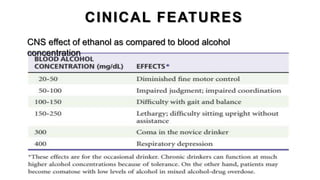
CNS effect of ethanol as compared to blood alcohol
concentration
CINICAL FEATURES CONT…
 CARDIOVASCULAR
 Alcoholic cardiomyopathy
 peripheral vasodilation, tachycardia.
 “holiday heart syndrome”
 RESPIRATORY SYSTEM
 respiratory depression
 decreased airway sensitivity to foreign bodies
 decreased ciliary clearance and aspiration
 increased risk of bacterial infection
CINICAL FEATURES CONT…
 HYPOGLYCEMIA
 usually in children and malnourished individuals
 Increases NADH/NAD+ ratio, which then promotes
the conversion of pyruvate to lactate, diverting
pyruvate away from the gluconeogenesis pathway
CINICAL FEATURES CONT…
Alcoholic Ketoacidosis
 Nausea, vomiting, and abdominal pain are
common
presenting complaints.
 ketonuria, and little or no glucosuria.
 Serum glucose levels are usually less than 200
mg/dL.
Wernicke-Korsakoff Syndrome
 Although they are similar pathologically and
caused by thiamine deficiency.
 Wernicke’s encephalopathy,
 a medical emergency
 mortality rate of 10 to 20%,
 dietary deficiencies
 oculomotor abnormalities
 cerebellar dysfunction
 either an altered mental state or mild memory
impairment
Wernicke-Korsakoff CONT…
 Korsakoff ’s psychosis or amnesic state
 is a disorder with recent memory impairment
 inability to learn new information , recall
previously learned information
 apathy
Wernicke-Korsakoff CONT…
 RBS level.
 Ethanol blood levels are not necessarily
required in cases of mild or moderate
intoxication
 Can cause of an osmolar gap and may be
associated with a mild metabolic acidosis
ISOPROPANOL
 is a colorless, volatile liquid with a bitter,
burning taste and an aromatic odor.
 found in many household products, such as
rubbing alcohol (usually 70% isopropanol).
 a component of a variety of skin and hair
products, jewelry cleaners, detergents, paint
thinners.
 Poisoning usually results from ingestion
 Toxic dose of 70% isopropanol is about
1mL/kg
 The minimum lethal dose for an adult is
approximately 2 to 4 mL/kg
 80% of a dose is absorbed within 30 minutes
of ingestion.
 Its peak blood levels occur 30 to 120 minutes
after ingestion
 CNS
 headache, dizziness, neuromuscular
incoordination, confusion, and nystagmus.
 Pupillary size varies, but miosis is most common
 Severe ingestions may result in CNS depression,
deep coma.
CINICAL FEATURES
 GASTRIC IRRITATION
 nausea, vomiting, abdominal pain, acute
pancreatitis, hemorrhagic gastritis and upper
GI bleeding
CINICAL FEATURES CONT…
 Rhabdomyolysis and renal failure
 hypotension secondary to peripheral
vasodilation.
 Hypoglycemia
 the increased NADH/NAD+ ratio
CINICAL FEATURES CONT…
 primarily are used to exclude other ingestions
 ketosis with little or no acidosis
 “pseudo–renal failure”
labaratory
METHANOL
 the simplest alcohol
 colorless, volatile liquid
 found in automotive windshield cleaning
solution, solid fuel for stoves and chafing
dishes, model airplane fuel, carburetor
cleaner, gas line antifreeze, photocopying
fluid, and solvents.
 Peak blood levels achieved within 30 to 60
minutes,
 volume of distribution of 0.6 to 0.77 L/kg.
 minimum lethal dose is thought to be
approximately 1 gram/kg or 1.25 mL/kg.
 Formic acid’s main mechanism of
toxicity
 binding to cytochrome oxidase
 This leads to anaerobic metabolism and
development of lactic acidosis.
CINICAL FEATURES CONT…
 less inebriating than ethanol,
 Early symptoms of methanol poisoning include
depressed mental status, confusion, and
ataxia.
 in severe cases, coma and seizures may be
seen
Optic neuropathy
 The primary sites of ocular injury are the
retrolaminar optic nerve and retina
 may present as photophobia or blurred or “snow
field” vision,
 clinical findings: papilledema, nystagmus (rare),
and nonreactive mydriasis.
putaminal necrosis
 Acute signs and symptoms may take several days
to develop despite the presence of these
radiographic findings
 occurring in 13.5% of patients
 Cardiovascular toxicity
 tachycardia and hypotension, which may
progress to shock.
 Tachypnea and shortness of breath
 while attempting to compensate for the metabolic
acidosis, and progress to respiratory failure.
 Elevated osmolar gap
 A severe anion gap metabolic acidosis
 onset of acidosis may be delayed 12 to 24
hours
ETHYLENE GLYCOL
 is a colorless, odorless, sweet-tasting liquid
 has many contemporary uses as a glycerin
substitute, preservative, component of
hydraulic brake fluid, foam stabilizer,
component for chemical synthesis, and most
commonly an automotive coolant (antifreeze)
 End-organ damage from ethylene glycol
poisoning
 due direct cytotoxicity of glycolic acid
 tissue damage from precipitation of calcium
oxalate crystals.
 The first (neurologic) stage
 typically begins 30 minutes to 12 hours after
ingestion
 may range from mild depression to seizure and
coma.
 Metabolites effect include
 cerebral edema,
 basal ganglia hemorrhagic infarction
 meningoencephalitis.
 The second (cardiopulmonary) stage
 begins 12 to 24 hours after ingestion
 characterized by tachycardia and possibly
hypertension.
 Glycolate and oxalate crystal deposition in
tissues leads to multiorgan system failure
 The third (renal) stage
 is often delayed 24 to 72 hours after ingestion
and
 is characterized by renal failure due to calcium
oxalate
crystal deposition in the proximal tubules,
DIAGNOSIS
 Laboratory tests include: serum e-; ca+2; BUN;
cr; RBS; serum osm; ABG; ethylene glycol
level; ECG.
 Urine analysis
 calcium oxalate monohydrate/dihydrate crystals
 specific gravity, proteinuria, microscopic
hematuria, pyuria.
ALCOHOL WITHDRAWAL
Diagnostic Criteria
1. Cessation or reduction in alcohol use that has been heavy and prolonged
2. Two (or more) of the following,
I. Autonomic hyperactivity
II. Increased hand tremor.
III. Insomnia.
IV. Nausea or vomiting.
V. Transient visual, tactile, or auditory hallucinations or illusions.
VI. Psychomotor agitation.
VII. Anxiety.
VIII. Generalized tonic-clonic seizures.
3. The signs or symptoms in Criterion B cause clinically
significant distress or impairment in social,
occupational, or other important areas of functioning.
4. The signs or symptoms are not attributable to another
medical condition and are not better explained by
another mental disorder
ALCOHOL WITHDRAWAL
DELIRIUM TREMENS
 affects 5% to 10% of patients
 result of modulation of 2 primary sites
 the γ-aminobutyric acid type A (GABAA)
 N-methyl-D-aspartate (NMDA) receptors
 Tintinalli’s Emergency Medicine 8th edition
 Rosen's Emergency Medicine - Concepts and
Clinical Practice 8th edition
 Global status report on alcohol and health
2014
 Up to date 21.6
REFERRENCE
Alchol poisioning

Alchol poisioning

  • 1.
    ALCOHOL POISONING (seminar) Dr. NathanMuluberhan(E M r e s i d e n t ) Emergency And Critical Care Medicine JULY 2017
  • 2.
    OUTLINE  Intr oduction  Diagnos tic c riteria  Ethanol  Is opr opanol  Methanol  Ethylene glyc ol  Alc ohol w ithdr aw al
  • 3.
    INTRODUCTION  Globally, alcoholconsumption results in 3.3 million deaths/year
  • 5.
    DIAGNOSTIC CRITERIA(DSM V) A.Recent ingestion of alcohol. B. Clinically significant problematic behavioral or psychological changes that developed during, or shortly after, alcohol ingestion.
  • 6.
    C. One (ormore) of the following signs or symptoms developing during, or shortly after, alcohol use: 1. Slurred speech 2. Incoordination 3. Unsteady gait 4. Nystagmus 5. Impairment in attention or memory 6. Stupor or coma D. The signs or symptoms are not attributable to another medical condition and are not better explained by another mental disorder DIAGNOSTIC CRITERIA CONT…
  • 7.
     All alcoholscause clinical inebriation strength of the inebriating effects directly proportional to the alcohol’s molecular weight  Ethanol and isopropanol are the most common alcohols ingested.  Methanol and ethylene glycol are toxic alcohols with serious physiologic morbidity.
  • 8.
    ETHANOL  is acolorless, volatile liquid  most frequently used and abused drug  Toxicity most commonly occurs from ingestion,  Also absorbed via inhalation or percutaneous exposure.
  • 9.
    METABOLISM  Rapidly absorbedafter oral administration.  Peak blood levels about 30 to 60 minutes.  The volume of distribution of  0.6 L/kg in men  0.7 L/kg in women
  • 11.
    CINICAL FEATURES CNS effectof ethanol as compared to blood alcohol concentration
  • 12.
    CINICAL FEATURES CONT… CARDIOVASCULAR  Alcoholic cardiomyopathy  peripheral vasodilation, tachycardia.  “holiday heart syndrome”
  • 13.
     RESPIRATORY SYSTEM respiratory depression  decreased airway sensitivity to foreign bodies  decreased ciliary clearance and aspiration  increased risk of bacterial infection CINICAL FEATURES CONT…
  • 14.
     HYPOGLYCEMIA  usuallyin children and malnourished individuals  Increases NADH/NAD+ ratio, which then promotes the conversion of pyruvate to lactate, diverting pyruvate away from the gluconeogenesis pathway CINICAL FEATURES CONT…
  • 15.
    Alcoholic Ketoacidosis  Nausea,vomiting, and abdominal pain are common presenting complaints.  ketonuria, and little or no glucosuria.  Serum glucose levels are usually less than 200 mg/dL.
  • 16.
    Wernicke-Korsakoff Syndrome  Althoughthey are similar pathologically and caused by thiamine deficiency.  Wernicke’s encephalopathy,  a medical emergency  mortality rate of 10 to 20%,
  • 17.
     dietary deficiencies oculomotor abnormalities  cerebellar dysfunction  either an altered mental state or mild memory impairment Wernicke-Korsakoff CONT…
  • 18.
     Korsakoff ’spsychosis or amnesic state  is a disorder with recent memory impairment  inability to learn new information , recall previously learned information  apathy Wernicke-Korsakoff CONT…
  • 19.
     RBS level. Ethanol blood levels are not necessarily required in cases of mild or moderate intoxication  Can cause of an osmolar gap and may be associated with a mild metabolic acidosis
  • 20.
    ISOPROPANOL  is acolorless, volatile liquid with a bitter, burning taste and an aromatic odor.  found in many household products, such as rubbing alcohol (usually 70% isopropanol).  a component of a variety of skin and hair products, jewelry cleaners, detergents, paint thinners.
  • 21.
     Poisoning usuallyresults from ingestion  Toxic dose of 70% isopropanol is about 1mL/kg  The minimum lethal dose for an adult is approximately 2 to 4 mL/kg
  • 22.
     80% ofa dose is absorbed within 30 minutes of ingestion.  Its peak blood levels occur 30 to 120 minutes after ingestion
  • 24.
     CNS  headache,dizziness, neuromuscular incoordination, confusion, and nystagmus.  Pupillary size varies, but miosis is most common  Severe ingestions may result in CNS depression, deep coma. CINICAL FEATURES
  • 25.
     GASTRIC IRRITATION nausea, vomiting, abdominal pain, acute pancreatitis, hemorrhagic gastritis and upper GI bleeding CINICAL FEATURES CONT…
  • 26.
     Rhabdomyolysis andrenal failure  hypotension secondary to peripheral vasodilation.  Hypoglycemia  the increased NADH/NAD+ ratio CINICAL FEATURES CONT…
  • 27.
     primarily areused to exclude other ingestions  ketosis with little or no acidosis  “pseudo–renal failure” labaratory
  • 28.
    METHANOL  the simplestalcohol  colorless, volatile liquid  found in automotive windshield cleaning solution, solid fuel for stoves and chafing dishes, model airplane fuel, carburetor cleaner, gas line antifreeze, photocopying fluid, and solvents.
  • 29.
     Peak bloodlevels achieved within 30 to 60 minutes,  volume of distribution of 0.6 to 0.77 L/kg.  minimum lethal dose is thought to be approximately 1 gram/kg or 1.25 mL/kg.
  • 31.
     Formic acid’smain mechanism of toxicity  binding to cytochrome oxidase  This leads to anaerobic metabolism and development of lactic acidosis. CINICAL FEATURES CONT…
  • 32.
     less inebriatingthan ethanol,  Early symptoms of methanol poisoning include depressed mental status, confusion, and ataxia.  in severe cases, coma and seizures may be seen
  • 33.
    Optic neuropathy  Theprimary sites of ocular injury are the retrolaminar optic nerve and retina  may present as photophobia or blurred or “snow field” vision,  clinical findings: papilledema, nystagmus (rare), and nonreactive mydriasis.
  • 34.
    putaminal necrosis  Acutesigns and symptoms may take several days to develop despite the presence of these radiographic findings  occurring in 13.5% of patients
  • 36.
     Cardiovascular toxicity tachycardia and hypotension, which may progress to shock.  Tachypnea and shortness of breath  while attempting to compensate for the metabolic acidosis, and progress to respiratory failure.
  • 37.
     Elevated osmolargap  A severe anion gap metabolic acidosis  onset of acidosis may be delayed 12 to 24 hours
  • 38.
    ETHYLENE GLYCOL  isa colorless, odorless, sweet-tasting liquid  has many contemporary uses as a glycerin substitute, preservative, component of hydraulic brake fluid, foam stabilizer, component for chemical synthesis, and most commonly an automotive coolant (antifreeze)
  • 40.
     End-organ damagefrom ethylene glycol poisoning  due direct cytotoxicity of glycolic acid  tissue damage from precipitation of calcium oxalate crystals.
  • 41.
     The first(neurologic) stage  typically begins 30 minutes to 12 hours after ingestion  may range from mild depression to seizure and coma.  Metabolites effect include  cerebral edema,  basal ganglia hemorrhagic infarction  meningoencephalitis.
  • 42.
     The second(cardiopulmonary) stage  begins 12 to 24 hours after ingestion  characterized by tachycardia and possibly hypertension.  Glycolate and oxalate crystal deposition in tissues leads to multiorgan system failure
  • 43.
     The third(renal) stage  is often delayed 24 to 72 hours after ingestion and  is characterized by renal failure due to calcium oxalate crystal deposition in the proximal tubules,
  • 44.
    DIAGNOSIS  Laboratory testsinclude: serum e-; ca+2; BUN; cr; RBS; serum osm; ABG; ethylene glycol level; ECG.  Urine analysis  calcium oxalate monohydrate/dihydrate crystals  specific gravity, proteinuria, microscopic hematuria, pyuria.
  • 45.
    ALCOHOL WITHDRAWAL Diagnostic Criteria 1.Cessation or reduction in alcohol use that has been heavy and prolonged 2. Two (or more) of the following, I. Autonomic hyperactivity II. Increased hand tremor. III. Insomnia. IV. Nausea or vomiting. V. Transient visual, tactile, or auditory hallucinations or illusions. VI. Psychomotor agitation. VII. Anxiety. VIII. Generalized tonic-clonic seizures.
  • 46.
    3. The signsor symptoms in Criterion B cause clinically significant distress or impairment in social, occupational, or other important areas of functioning. 4. The signs or symptoms are not attributable to another medical condition and are not better explained by another mental disorder ALCOHOL WITHDRAWAL
  • 48.
    DELIRIUM TREMENS  affects5% to 10% of patients  result of modulation of 2 primary sites  the γ-aminobutyric acid type A (GABAA)  N-methyl-D-aspartate (NMDA) receptors
  • 49.
     Tintinalli’s EmergencyMedicine 8th edition  Rosen's Emergency Medicine - Concepts and Clinical Practice 8th edition  Global status report on alcohol and health 2014  Up to date 21.6 REFERRENCE

Editor's Notes

  • #5 globally, individuals above 15 years of age drink on average 6.2 litres of pure alcohol per year which translates into 13.5 grams of pure alcohol per day
  • #9 molecular weight 46.07
  • #11 With about 10% excreted in the urine, exhaled breath, and sweat.
  • #12 enhances the inhibitory neurotransmitter γ-aminobutyric acid receptors and blockade of excitatory N-methyl-d-aspartic acid receptors
  • #13 holiday heart syndrome”, characterized by atrial or ventricular tachyarrhythmias and new-onset atrial fibrillation after acute alcohol ingestion
  • #14 chronic alcohol consumption decreases the level of glutathione, promoting inflammation and remodeling of the lung tissue. with consequent bronchitis and pneumonia
  • #17 remains a clinical diagnosis Whereas 80% of patients with acute Wernicke’s encephalopathy have Korsakoff ’s syndrome,
  • #18 oculomotor abnormalities (nystagmus is most common), Deficiency of thiamine-dependent enzyme(transketolase)
  • #19 also called alcohol induced persisting amnestic disorder
  • #21 Molecular weight of 60.10
  • #22 although as little as 0.5 mL/kg may cause symptoms.
  • #23 its volume of distribution is similar to that of ethanol.
  • #24 The major pathway is in the liver by alcohol dehydrogenase (50% to 80%), Acetone is excreted primarily by the kidneys, some excretion through the lungs
  • #25 Isopropanol is a potent CNS depressant, but the mechanism of action is unclear Patients may have a loss of deep tendon, corneal, or protective airway reflexes and have an extensor response to plantar reflex testing.
  • #27 Hypotension, although rare, signifies severe poisoning, with a mortality rate of 45%
  • #28 serum electrolyte values, BUN and creatinine concentrations, osmolality, serum and urine ketones, and arterial blood gas analysis The ketosis is from the metabolite acetone, which can be detected in the blood 15 minutes after ingestion and in the urine 3 hours after ingestion. isolated false elevation of creatinine with a normal BUN concentration. This condition results from interference of acetone and acetoacetate by the colorimetric method of creatinine determination
  • #29 (CH3OH, molecular weight 32.05),
  • #31 Methanol is metabolized in the liver by alcohol dehydrogenase to formaldehyde then by aldehyde dehydrogenase to formic acid
  • #32 blockade of oxidative phosphorylation.
  • #34 Visual disturbances are seen in 50%, the primary sites of ocular injury are the retrolaminar optic nerve and retina
  • #39 molecular weight 62.07]
  • #41 (although the exact mechanism of this is unclear
  • #43 Most deaths occur during this stage.
  • #45 Other findings reflecting tubular dysfunction include decreased