




Transliteracy
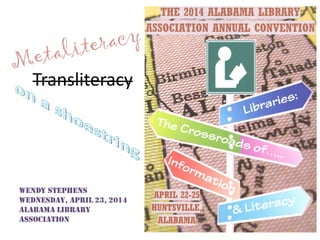
Wendy Stephens
Wednesday, April 23, 2014
Alabama Library
Association
http://simplebooklet.com/publish.php?wpKey=zwTY8mLCC3wV31ORtETcye#page=0
The Transliteracies Research Project defines
transliteracy “as the experience of ‘text-plus’ media
by individuals and groups in digital, networked
information environments. The ‘plus’ indicates the
zone of negotiation—of mutation, adaptation,
cooptation, hybridization, etc.—by which the older
dialogue among print, writing, orality, and
audiovisual media commonly called ‘text’ enters
into new relations with digital media and with
networked communication technologies.”
“Metaliteracy promotes critical thinking and
collaboration in a digital age, providing a comprehensive
framework to effectively participate in social media and
online communities. It is a unified construct that
supports the acquisition, production, and sharing of
knowledge in collaborative online communities.
Metaliteracy challenges traditional skills-based
approaches to information literacy by recognizing related
literacy types and incorporating emerging technologies.
Standard definitions of information literacy are
insufficient for the revolutionary social technologies
currently prevalent online” (Mackey & Jacobson,
Reframing Information as a Metaliteracy, 2011, 62-78)
(plain text is boring)
Mackey & Jacobson, “Reframing Information as a Metaliteracy,”
2011, 62-78
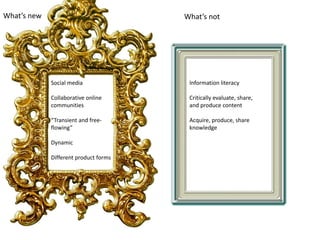
What’s new What’s not
Social media
Collaborative online
communities
“Transient and free-
flowing”
Dynamic
Different product forms
Information literacy
Critically evaluate, share,
and produce content
Acquire, produce, share
knowledge
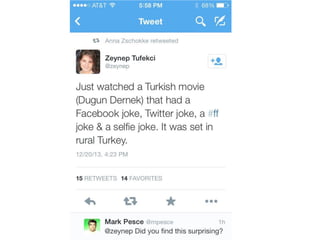
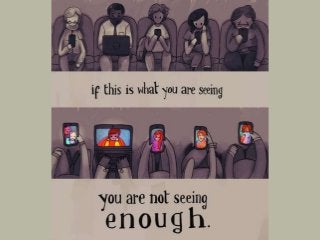
Social media is becoming more visual…
63% of social media involves images
32% of social media involves videos
http://bighugelabs.com/motivator.php
App
smashing
https://audioboo.fm/boos/1991436-fifth-grade-fever-3-14-14-pi-day#t=2m31s
transliteracy as a prism
Why? “Art makes data sticky.”
http://usergeneratededucation.wordpress.com/tag/maslows-hierarchy/
Seminal resources, no longer updated
http://librariesandtransliteracy.wordpress.com/
http://transliteracyresearch.wordpress.com/
http://crln.acrl.org/content/71/10/532.full
http://firstmonday.org/article/view/2060/1908
Mackey, T.P. & Jacobson, T.E. (2011) “Reframing Information Literacy as a
Metaliteracy.” College & Research Libraries 72, 1. 62-78.
http://comminfo.rutgers.edu/~tefko/Courses/e553/Readings/Mackey%20Metalitreac
y%20CLR%202011.pdf
Tools of
Metaliteracy
Carolyn Jo Starkey
SVHS/JCIB/SVTA
Alabama State University
Alabama Library Association Annual Conference
Wednesday, April 23, 2014www.yourspeakeasy.com
http://avalaunchmedia.com/infographics/the-complete-
history-of-social-media
blog.speaksocial.n
et
We
started
talking…
….and
refused
to stop.
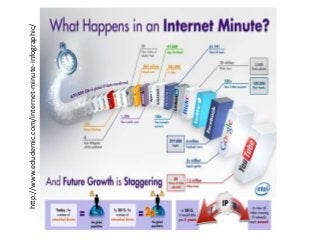
http://www.edudemic.com/internet-minute-infographic/
Developed in 2008 by
Brian Solis, The
Conversation Prism is a
visual map of the social
media landscape. It’s an
ongoing study in digital
ethnography that tracks
dominant and promising
social networks and
organizes them by how
they’re used in everyday
life.
The Conversation Prism 2008
The Conversation
Prism 2009
The Conversation
Prism 2010
The Conversation
Prism 2013
…the information
superhighway has given way
to a collaborative social
network. Information in this
decentered environment is
fragmented and transient,
requiring new approaches to
literacy education.
--Mackey and Jocobson,
(2014), p. 8
As a reframing of
information literacy,
it (metaliteracy)
highlights
metacognition, or
thinking about one’s
thinking, as an
essential reflective
practice for self-
empowerment,
participation, and
cooperation in
today’s open social
media environment.
http://nelig.acrlnec.org/content/2013-annual-
program-abstracts
“This approach leads to expanded
competencies for adapting to the ongoing
changes in emerging technologies and for
advancing critical thinking and empowerment
for producing, connecting, and distributing
information as independent and collaborative
learners.”
–Jacobson and Mackey, 2013
For some students, metaliteracy may be a way to augment
their practice of the tools they already use by encouraging
them to evaluate user feedback and dynamic content
critically, create contexts for user-generated information,
and understand privacy, ethics, and intellectual property
issues in a shifting information landscape. For others, the
framework of metaliteracy creates an imperative for
educators to increase student access to and understanding
of the tools, skills, and knowledge they need to succeed in
the world and to be active participants.
--Stephanie Debner
(http://www.pcc.edu/library/about/metaliteracy)
Every day, I see students who are adept with
mobile technology, but cannot attach a
document to an email or complete tasks on
a computer that would be assumed
competencies in many workplace situations.
Likewise, I also see students who are very
good at finding information and fairly savvy
about evaluating it, but feel disconnected
from the idea that they themselves are
information producers.
--Stephanie Debner
(http://www.pcc.edu/library/about/metaliteracy)
Metaliteracy asks us to think about what
constitutes a literate person in
contemporary American society. It also asks
us how we can reconfigure our pedagogical
philosophy and teaching practices to ensure
that our students leave our institutions
equipped to access and participate in the
many information communities available to
them.
--Stephanie Debner
(http://www.pcc.edu/library/about/metaliteracy)
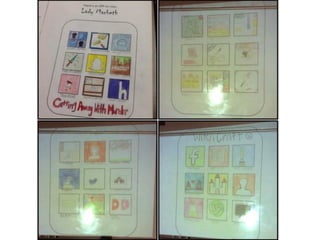
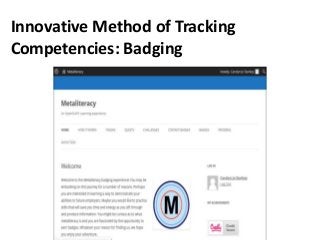
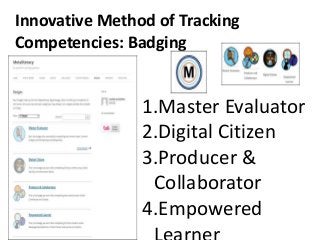
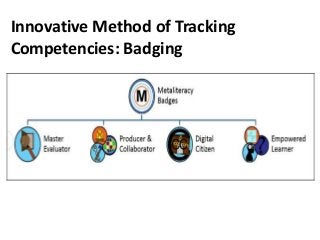
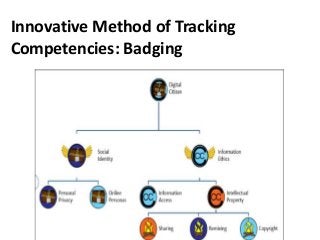
Innovative Method of Tracking
Competencies: Badging
Innovative Method of Tracking
Competencies: Badging
Innovative Method of Tracking
Competencies: Badging
1.Master Evaluator
2.Digital Citizen
3.Producer &
Collaborator
4.Empowered
Innovative Method of Tracking
Competencies: Badging
Innovative Method of Tracking
Competencies: Badging
Innovative Method of Tracking
Competencies: Badging
Innovative Method of Tracking
Competencies: Badging
Innovative Method of Tracking
Competencies: Badging
Innovative Method of Tracking
Competencies: Badging
Questions

Metaliteracy

  • 1.
    Transliteracy Wendy Stephens Wednesday, April23, 2014 Alabama Library Association
  • 2.
  • 3.
    The Transliteracies ResearchProject defines transliteracy “as the experience of ‘text-plus’ media by individuals and groups in digital, networked information environments. The ‘plus’ indicates the zone of negotiation—of mutation, adaptation, cooptation, hybridization, etc.—by which the older dialogue among print, writing, orality, and audiovisual media commonly called ‘text’ enters into new relations with digital media and with networked communication technologies.”
  • 4.
    “Metaliteracy promotes criticalthinking and collaboration in a digital age, providing a comprehensive framework to effectively participate in social media and online communities. It is a unified construct that supports the acquisition, production, and sharing of knowledge in collaborative online communities. Metaliteracy challenges traditional skills-based approaches to information literacy by recognizing related literacy types and incorporating emerging technologies. Standard definitions of information literacy are insufficient for the revolutionary social technologies currently prevalent online” (Mackey & Jacobson, Reframing Information as a Metaliteracy, 2011, 62-78)
  • 5.
  • 6.
    Mackey & Jacobson,“Reframing Information as a Metaliteracy,” 2011, 62-78
  • 7.
    What’s new What’snot Social media Collaborative online communities “Transient and free- flowing” Dynamic Different product forms Information literacy Critically evaluate, share, and produce content Acquire, produce, share knowledge
  • 8.
    Social media isbecoming more visual… 63% of social media involves images 32% of social media involves videos
  • 20.
  • 30.
  • 34.
  • 36.
  • 37.
    Why? “Art makesdata sticky.”
  • 49.
  • 52.
    Seminal resources, nolonger updated http://librariesandtransliteracy.wordpress.com/ http://transliteracyresearch.wordpress.com/ http://crln.acrl.org/content/71/10/532.full http://firstmonday.org/article/view/2060/1908 Mackey, T.P. & Jacobson, T.E. (2011) “Reframing Information Literacy as a Metaliteracy.” College & Research Libraries 72, 1. 62-78. http://comminfo.rutgers.edu/~tefko/Courses/e553/Readings/Mackey%20Metalitreac y%20CLR%202011.pdf
  • 53.
    Tools of Metaliteracy Carolyn JoStarkey SVHS/JCIB/SVTA Alabama State University Alabama Library Association Annual Conference Wednesday, April 23, 2014www.yourspeakeasy.com
  • 54.
  • 55.
  • 56.
  • 57.
  • 58.
    Developed in 2008by Brian Solis, The Conversation Prism is a visual map of the social media landscape. It’s an ongoing study in digital ethnography that tracks dominant and promising social networks and organizes them by how they’re used in everyday life. The Conversation Prism 2008
  • 59.
  • 60.
  • 61.
  • 63.
    …the information superhighway hasgiven way to a collaborative social network. Information in this decentered environment is fragmented and transient, requiring new approaches to literacy education. --Mackey and Jocobson, (2014), p. 8
  • 64.
    As a reframingof information literacy, it (metaliteracy) highlights metacognition, or thinking about one’s thinking, as an essential reflective practice for self- empowerment, participation, and cooperation in today’s open social media environment. http://nelig.acrlnec.org/content/2013-annual- program-abstracts
  • 66.
    “This approach leadsto expanded competencies for adapting to the ongoing changes in emerging technologies and for advancing critical thinking and empowerment for producing, connecting, and distributing information as independent and collaborative learners.” –Jacobson and Mackey, 2013
  • 67.
    For some students,metaliteracy may be a way to augment their practice of the tools they already use by encouraging them to evaluate user feedback and dynamic content critically, create contexts for user-generated information, and understand privacy, ethics, and intellectual property issues in a shifting information landscape. For others, the framework of metaliteracy creates an imperative for educators to increase student access to and understanding of the tools, skills, and knowledge they need to succeed in the world and to be active participants. --Stephanie Debner (http://www.pcc.edu/library/about/metaliteracy)
  • 68.
    Every day, Isee students who are adept with mobile technology, but cannot attach a document to an email or complete tasks on a computer that would be assumed competencies in many workplace situations. Likewise, I also see students who are very good at finding information and fairly savvy about evaluating it, but feel disconnected from the idea that they themselves are information producers. --Stephanie Debner (http://www.pcc.edu/library/about/metaliteracy)
  • 69.
    Metaliteracy asks usto think about what constitutes a literate person in contemporary American society. It also asks us how we can reconfigure our pedagogical philosophy and teaching practices to ensure that our students leave our institutions equipped to access and participate in the many information communities available to them. --Stephanie Debner (http://www.pcc.edu/library/about/metaliteracy)
  • 72.
    Innovative Method ofTracking Competencies: Badging
  • 73.
    Innovative Method ofTracking Competencies: Badging
  • 74.
    Innovative Method ofTracking Competencies: Badging 1.Master Evaluator 2.Digital Citizen 3.Producer & Collaborator 4.Empowered
  • 75.
    Innovative Method ofTracking Competencies: Badging
  • 76.
    Innovative Method ofTracking Competencies: Badging
  • 77.
    Innovative Method ofTracking Competencies: Badging
  • 78.
    Innovative Method ofTracking Competencies: Badging
  • 79.
    Innovative Method ofTracking Competencies: Badging
  • 80.
    Innovative Method ofTracking Competencies: Badging
  • 81.