“Metaliteracy: Reinventing Information Literacy
to Empower Learners”
90-minute workshop
Wednesday, June 25, 2014, 2:30pm Eastern
1
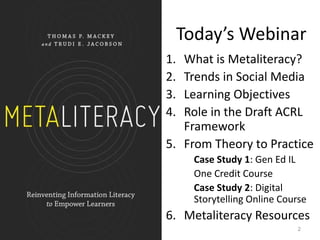
Trudi E. Jacobson Thomas P. Mackey
Welcome!
Today’s Webinar
1. What is Metaliteracy?
2. Trends in Social Media
3. Learning Objectives
4. Role in the Draft ACRL
Framework
5. From Theory to Practice
Case Study 1: Gen Ed IL
One Credit Course
Case Study 2: Digital
Storytelling Online Course
6. Metaliteracy Resources
2
WHAT IS METALITERACY?
3
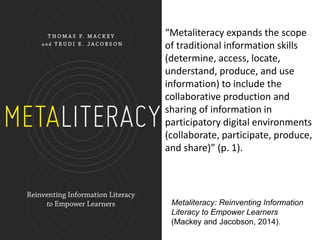
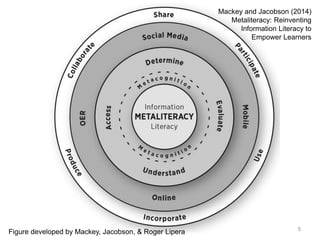
Metaliteracy: Reinventing Information
Literacy to Empower Learners
(Mackey and Jacobson, 2014).
“Metaliteracy expands the scope
of traditional information skills
(determine, access, locate,
understand, produce, and use
information) to include the
collaborative production and
sharing of information in
participatory digital environments
(collaborate, participate, produce,
and share)” (p. 1).
5
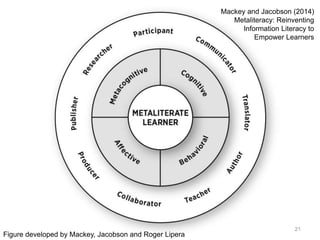
Figure developed by Mackey, Jacobson, & Roger Lipera
Mackey and Jacobson (2014)
Metaliteracy: Reinventing
Information Literacy to
Empower Learners
Metaliteracy: Reinventing Information
Literacy to Empower Learners
(Mackey and Jacobson, 2014).
“Metaliteracy is not about
introducing yet another literacy
format, but rather reinventing an
existing one, information literacy,
the critical foundation literacy that
informs many others while being
flexible and adaptive enough to
evolve and change over time” (p.
1-2).
Metaliteracy: Reinventing Information
Literacy to Empower Learners
(Mackey and Jacobson, 2014).
“While literacy is focused on
reading and writing, and
information literacy has strongly
emphasized search and retrieval,
metaliteracy is about what
happens beyond these abilities to
promote the collaborative
production and sharing of
information” (p. 6).
The meta in metaliteracy
8
“…denoting change, transformation,
permutation, or substitution…”
“…a prefix to technical terms to denote
software, data, etc., which operate at a
higher level of abstraction.”
9
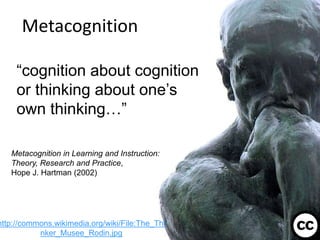
Metacognition
10
“cognition about cognition
or thinking about one’s
own thinking…”
http://commons.wikimedia.org/wiki/File:The_Thi
nker_Musee_Rodin.jpg
Metacognition in Learning and Instruction:
Theory, Research and Practice,
Hope J. Hartman (2002)
TRENDS IN SOCIAL MEDIA
11
Social Media Update
2013
• “73% of online adults now use social
networking sites”
• “42% of online adults now use multiple social
networking sites, but Facebook remains
platform of choice.”
• “71% of online adults are now Facebook users,
a slight increase from the 67% of online adults
who used Facebook as of late 2012.”
http://www.pewinternet.org/Reports/2013/Social-Media-Update/Main-Findings.aspx
Creators and Curators
• Creators: “54% of adult internet users post
original photos or videos online that they
themselves have created.”
• Curators: “47% of adult internet users take
photos or videos that they have found online
and repost them on sites designed for sharing
images with many people.”
http://www.pewinternet.org/Reports/2013/Photos-and-videos/Main-Findings.aspx
Horizon Report 2014: Key Trends
• Growing ubiquity of
Social Media (1-2 years)
• Integration of online,
hybrid and collaborative
learning (1-2 years)
• Rise of data driven
learning assessment (3-5
years)
14
http://cdn.nmc.org/media/2014-nmc-horizon-report-he-EN-SC.pdf
Horizon Report 2014: Key Trends
• Shift from students as
consumers to students as
creators (3-5 years)
• Agile approaches to
change (5+ years)
• Evolution of online
learning (5+ years)
15
http://cdn.nmc.org/media/2014-nmc-horizon-report-he-EN-SC.pdf
Horizon Report 2014: Challenges
• Digital fluency of faculty
• Lack of rewards for
teaching
• Competition from new
models of education
• Scaling teaching
innovations
• Expanding access
• Keeping education
relevant
16
http://cdn.nmc.org/media/2014-nmc-horizon-report-he-EN-SC.pdf
17
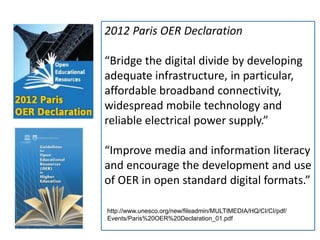
2012 Paris OER Declaration
“Bridge the digital divide by developing
adequate infrastructure, in particular,
affordable broadband connectivity,
widespread mobile technology and
reliable electrical power supply.”
“Improve media and information literacy
and encourage the development and use
of OER in open standard digital formats.”
http://www.unesco.org/new/fileadmin/MULTIMEDIA/HQ/CI/CI/pdf/
Events/Paris%20OER%20Declaration_01.pdf
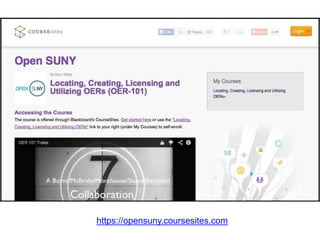
https://opensuny.coursesites.com
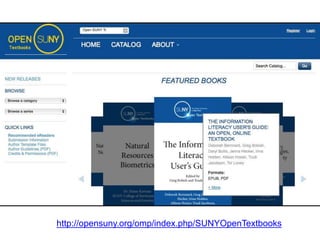
http://opensuny.org/omp/index.php/SUNYOpenTextbooks
METALITERACY LEARNING
OBJECTIVES
20
21
Figure developed by Mackey, Jacobson and Roger Lipera
Mackey and Jacobson (2014)
Metaliteracy: Reinventing
Information Literacy to
Empower Learners
Metaliteracy Learning Objectives
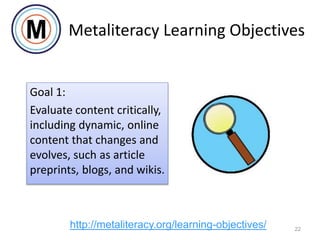
Goal 1:
Evaluate content critically,
including dynamic, online
content that changes and
evolves, such as article
preprints, blogs, and wikis.
22
http://metaliteracy.org/learning-objectives/
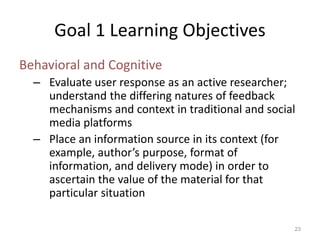
Goal 1 Learning Objectives
Behavioral and Cognitive
– Evaluate user response as an active researcher;
understand the differing natures of feedback
mechanisms and context in traditional and social
media platforms
– Place an information source in its context (for
example, author’s purpose, format of
information, and delivery mode) in order to
ascertain the value of the material for that
particular situation
23
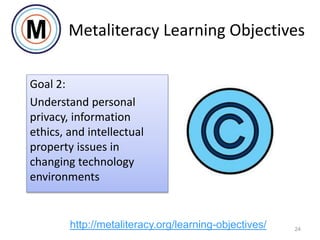
Goal 2:
Understand personal
privacy, information
ethics, and intellectual
property issues in
changing technology
environments
24
http://metaliteracy.org/learning-objectives/
Metaliteracy Learning Objectives
Goal 3:
Share information and
collaborate in a variety of
participatory environments
25
http://metaliteracy.org/learning-objectives/
Metaliteracy Learning Objectives
Goal 3 Learning Objectives
Metacognitive and
Cognitive
Demonstrate the ability to
translate information
presented in one manner
to another in order to best
meet the needs of
particular audiences;
Integrate information from
multiple sources into
coherent new forms
Affective and Behavioral
Effectively communicate
personal and professional
experiences to inform and
assist others; and recognize
that learners can also be
teachers
26
Goal 4:
Demonstrate ability to
connect learning and
research strategies with
lifelong learning processes
and personal, academic,
and professional goals
27
http://metaliteracy.org/learning-objectives/
Metaliteracy Learning Objectives
ROLE IN THE DRAFT ACRL IL
FRAMEWORK
Definition, knowledge practices, dispositions
28
Current Draft
• Elements of metaliteracy learning objectives
integrated into knowledge practices/abilities
and dispositions
• Draft new definition of IL incorporating
elements from metaliteracy
• Metaliteracy is referenced in the new
introduction, as well as in Setting the Context
New Definition (draft)
Information literacy is a repertoire of understandings,
practices, and dispositions focused on flexible
engagement with the information ecosystem,
underpinned by critical self-reflection. The repertoire
involves finding, evaluating, interpreting, managing,
and using information to answer questions and develop
new ones; and creating new knowledge through ethical
participation in communities of learning, scholarship,
and practice.
Sample Knowledge Practices
Scholarship is a Conversation
Learners who are developing their information literate
abilities:
• Contribute to scholarly conversation at an
appropriate level (local online community, guided
discussion, undergraduate research journal,
conference presentation/poster session).
• Critically evaluate contributions made by others in
participatory information environments.
31
Question Break
• Have you applied
elements of
metaliteracy in your
instruction?
• What challenges are
raised by these
changes?
• What are the rewards?
32
FROM THEORY TO PRACTICE
Two case studies
CASE STUDY 1: GEN ED IL COURSE
(ONE CREDIT)
34
35
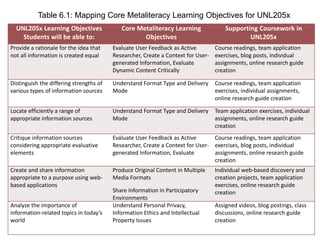
UNL205x Learning Objectives
Students will be able to:
Core Metaliteracy Learning
Objectives
Supporting Coursework in
UNL205x
Provide a rationale for the idea that
not all information is created equal
Evaluate User Feedback as Active
Researcher, Create a Context for User-
generated Information, Evaluate
Dynamic Content Critically
Course readings, team application
exercises, blog posts, individual
assignments, online research guide
creation
Distinguish the differing strengths of
various types of information sources
Understand Format Type and Delivery
Mode
Course readings, team application
exercises, individual assignments,
online research guide creation
Locate efficiently a range of
appropriate information sources
Understand Format Type and Delivery
Mode
Team application exercises, individual
assignments, online research guide
creation
Critique information sources
considering appropriate evaluative
elements
Evaluate User Feedback as Active
Researcher, Create a Context for User-
generated Information, Evaluate
Course readings, team application
exercises, blog posts, individual
assignments, online research guide
creation
Create and share information
appropriate to a purpose using web-
based applications
Produce Original Content in Multiple
Media Formats
Share Information in Participatory
Environments
Individual web-based discovery and
creation projects, team application
exercises, online research guide
creation
Analyze the importance of
information-related topics in today’s
world
Understand Personal Privacy,
Information Ethics and Intellectual
Property Issues
Assigned videos, blog postings, class
discussions, online research guide
creation
Table 6.1: Mapping Core Metaliteracy Learning Objectives for UNL205x
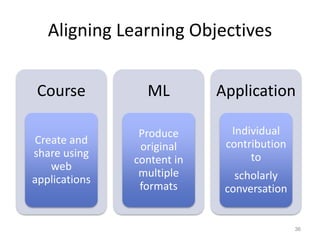
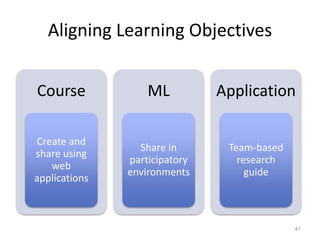
Aligning Learning Objectives
Course
Create and
share using
web
applications
ML
Produce
original
content in
multiple
formats
Application
Individual
contribution
to
scholarly
conversation
36
Assignment
Use a Web-based social media tool such as
Glogster, Voki, Go Animate, Timetoast, or
another tool of your choice to enhance the
information your team has found on its topic.
This project is initially an individual project. Be
creative yet informative in creating a new
information source. Present something new, fill
in gaps, comment, analyze. Do not rehash.
37
Tools Created
• Videos
• Lesson Plan (Fishtree)
• Glogster Page
• Word Cloud
• Timeline
• Survey
• Concept Map
38
Reflection on the Social Media
Project (Metacognition)
What did the process of doing this assignment
feel like? Was it empowering? Traumatizing?
Interesting? Challenging? And will you do
something like this again (or have you done it
before?)
39
SOCIAL MEDIA PROJECT
REFLECTION
Completed on social media
40
Aligning Learning Objectives
Course
Create and
share using
web
applications
ML
Share in
participatory
environments
Application
Team-based
research
guide
41
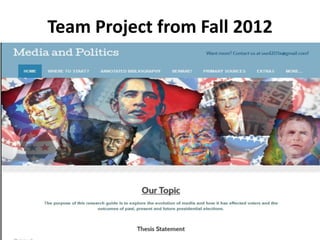
Team Project from Fall 2012
Aligning with the Draft ACRL IL
Framework
• Team assignment connected with the
Scholarship is a Conversation frame
• Students provided with brief definition and
the learning objectives
• Teams were asked to develop a lesson plan
that would teach first year students about this
concept
43
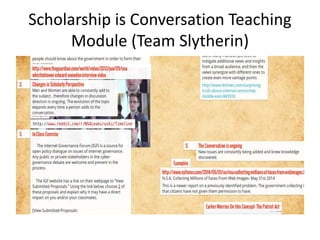
Scholarship is Conversation Teaching
Module (Team Slytherin)
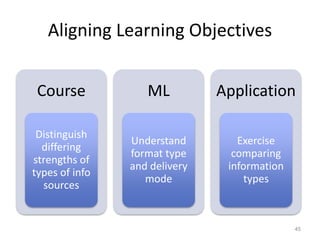
Aligning Learning Objectives
Course
Distinguish
differing
strengths of
types of info
sources
ML
Understand
format type
and delivery
mode
Application
Exercise
comparing
information
types
45
Exercise that didn’t quite work
• Find one text and one visual (infographic)
information source on the increase of
information available with the advent of the
Internet
• You want to make sure that both are sources that
have value. Jot down the criteria you used to
determine their value. (There might be one list
that applies to both, but you might also include
criteria that only apply to text, or to the
visualization).
46
CASE STUDY 2: DIGITAL
STORYTELLING (ONLINE)
47
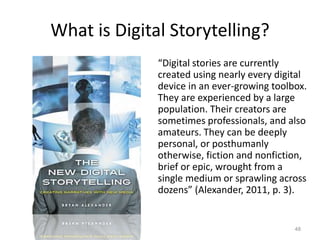
What is Digital Storytelling?
“Digital stories are currently
created using nearly every digital
device in an ever-growing toolbox.
They are experienced by a large
population. Their creators are
sometimes professionals, and also
amateurs. They can be deeply
personal, or posthumanly
otherwise, fiction and nonfiction,
brief or epic, wrought from a
single medium or sprawling across
dozens” (Alexander, 2011, p. 3).
48
49
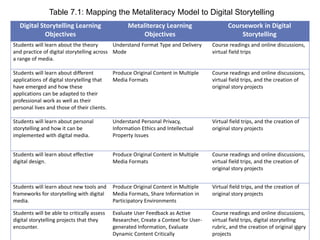
Digital Storytelling Learning
Objectives
Metaliteracy Learning
Objectives
Coursework in Digital
Storytelling
Students will learn about the theory
and practice of digital storytelling across
a range of media.
Understand Format Type and Delivery
Mode
Course readings and online discussions,
virtual field trips
Students will learn about different
applications of digital storytelling that
have emerged and how these
applications can be adapted to their
professional work as well as their
personal lives and those of their clients.
Produce Original Content in Multiple
Media Formats
Course readings and online discussions,
virtual field trips, and the creation of
original story projects
Students will learn about personal
storytelling and how it can be
implemented with digital media.
Understand Personal Privacy,
Information Ethics and Intellectual
Property Issues
Virtual field trips, and the creation of
original story projects
Students will learn about effective
digital design.
Produce Original Content in Multiple
Media Formats
Course readings and online discussions,
virtual field trips, and the creation of
original story projects
Students will learn about new tools and
frameworks for storytelling with digital
media.
Produce Original Content in Multiple
Media Formats, Share Information in
Participatory Environments
Virtual field trips, and the creation of
original story projects
Students will be able to critically assess
digital storytelling projects that they
encounter.
Evaluate User Feedback as Active
Researcher, Create a Context for User-
generated Information, Evaluate
Dynamic Content Critically
Course readings and online discussions,
virtual field trips, digital storytelling
rubric, and the creation of original story
projects
Table 7.1: Mapping the Metaliteracy Model to Digital Storytelling
50
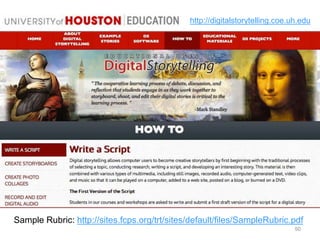
http://digitalstorytelling.coe.uh.edu
Sample Rubric: http://sites.fcps.org/trt/sites/default/files/SampleRubric.pdf
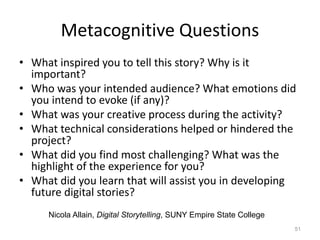
Metacognitive Questions
• What inspired you to tell this story? Why is it
important?
• Who was your intended audience? What emotions did
you intend to evoke (if any)?
• What was your creative process during the activity?
• What technical considerations helped or hindered the
project?
• What did you find most challenging? What was the
highlight of the experience for you?
• What did you learn that will assist you in developing
future digital stories?
51
Nicola Allain, Digital Storytelling, SUNY Empire State College
METALITERACY OPEN EDUCATION
RESOURCES (OERS)
MOOCS, Badging, Blog
52
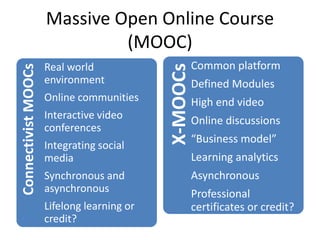
Massive Open Online Course
(MOOC)
ConnectivistMOOCs
Real world
environment
Online communities
Interactive video
conferences
Integrating social
media
Synchronous and
asynchronous
Lifelong learning or
credit?
X-MOOCs
Common platform
Defined Modules
High end video
Online discussions
“Business model”
Learning analytics
Asynchronous
Professional
certificates or credit?
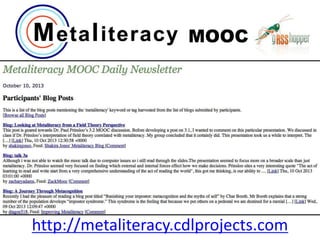
http://metaliteracy.cdlprojects.com
MOOC
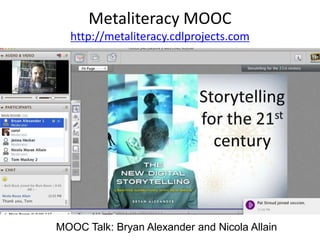
MOOC Talk: Bryan Alexander and Nicola Allain
Metaliteracy MOOC
http://metaliteracy.cdlprojects.com
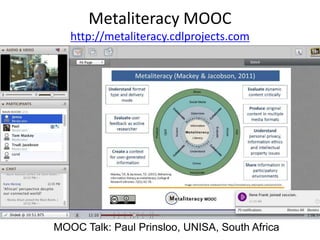
MOOC Talk: Paul Prinsloo, UNISA, South Africa
Metaliteracy MOOC
http://metaliteracy.cdlprojects.com
57
Innovative Instruction
Technology Grant (IITG)
+
“Designing Innovative Online Learning: Integrating
a Coursera MOOC with Open SUNY Badging”
http://commons.suny.edu/iitg/designing-innovative-online-learning-
integrating-a-coursera-mooc-with-open-suny-badging/
Our next project…
58
59
Master
Evaluator
Content
Analysis
Search
Queries
Info.
Sources
Database
Searching
Evaluation
Points
Currency
Relevance
Authority
Accuracy
Purpose
Packaging
& Sharing
Format
Mode
Perpectives
&
Responses
Author's
Voice
Degrees of
Separation
Giving
Credit
Collab-
orative
Creation
Speaking
Out
Informed
Consumer
Individual
Creation
Peer
Review
User
Response
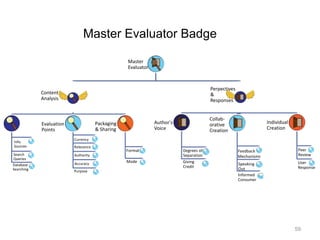
Master Evaluator Badge
Feedback
Mechanisms
60
http://metaliteracy.org
QUESTIONS?
61
62
Trudi E. Jacobson, M.L.S., M.A.
Distinguished Librarian
Head, Information Literacy Department
University Libraries
University at Albany, SUNY
Tom Mackey, Ph.D.
Dean
Center for Distance Learning
Empire State College, SUNY

Jacobson and Mackey: Metaliteracy Workshop

  • 1.
    “Metaliteracy: Reinventing InformationLiteracy to Empower Learners” 90-minute workshop Wednesday, June 25, 2014, 2:30pm Eastern 1 Trudi E. Jacobson Thomas P. Mackey Welcome!
  • 2.
    Today’s Webinar 1. Whatis Metaliteracy? 2. Trends in Social Media 3. Learning Objectives 4. Role in the Draft ACRL Framework 5. From Theory to Practice Case Study 1: Gen Ed IL One Credit Course Case Study 2: Digital Storytelling Online Course 6. Metaliteracy Resources 2
  • 3.
  • 4.
    Metaliteracy: Reinventing Information Literacyto Empower Learners (Mackey and Jacobson, 2014). “Metaliteracy expands the scope of traditional information skills (determine, access, locate, understand, produce, and use information) to include the collaborative production and sharing of information in participatory digital environments (collaborate, participate, produce, and share)” (p. 1).
  • 5.
    5 Figure developed byMackey, Jacobson, & Roger Lipera Mackey and Jacobson (2014) Metaliteracy: Reinventing Information Literacy to Empower Learners
  • 6.
    Metaliteracy: Reinventing Information Literacyto Empower Learners (Mackey and Jacobson, 2014). “Metaliteracy is not about introducing yet another literacy format, but rather reinventing an existing one, information literacy, the critical foundation literacy that informs many others while being flexible and adaptive enough to evolve and change over time” (p. 1-2).
  • 7.
    Metaliteracy: Reinventing Information Literacyto Empower Learners (Mackey and Jacobson, 2014). “While literacy is focused on reading and writing, and information literacy has strongly emphasized search and retrieval, metaliteracy is about what happens beyond these abilities to promote the collaborative production and sharing of information” (p. 6).
  • 8.
    The meta inmetaliteracy 8
  • 9.
    “…denoting change, transformation, permutation,or substitution…” “…a prefix to technical terms to denote software, data, etc., which operate at a higher level of abstraction.” 9
  • 10.
    Metacognition 10 “cognition about cognition orthinking about one’s own thinking…” http://commons.wikimedia.org/wiki/File:The_Thi nker_Musee_Rodin.jpg Metacognition in Learning and Instruction: Theory, Research and Practice, Hope J. Hartman (2002)
  • 11.
  • 12.
    Social Media Update 2013 •“73% of online adults now use social networking sites” • “42% of online adults now use multiple social networking sites, but Facebook remains platform of choice.” • “71% of online adults are now Facebook users, a slight increase from the 67% of online adults who used Facebook as of late 2012.” http://www.pewinternet.org/Reports/2013/Social-Media-Update/Main-Findings.aspx
  • 13.
    Creators and Curators •Creators: “54% of adult internet users post original photos or videos online that they themselves have created.” • Curators: “47% of adult internet users take photos or videos that they have found online and repost them on sites designed for sharing images with many people.” http://www.pewinternet.org/Reports/2013/Photos-and-videos/Main-Findings.aspx
  • 14.
    Horizon Report 2014:Key Trends • Growing ubiquity of Social Media (1-2 years) • Integration of online, hybrid and collaborative learning (1-2 years) • Rise of data driven learning assessment (3-5 years) 14 http://cdn.nmc.org/media/2014-nmc-horizon-report-he-EN-SC.pdf
  • 15.
    Horizon Report 2014:Key Trends • Shift from students as consumers to students as creators (3-5 years) • Agile approaches to change (5+ years) • Evolution of online learning (5+ years) 15 http://cdn.nmc.org/media/2014-nmc-horizon-report-he-EN-SC.pdf
  • 16.
    Horizon Report 2014:Challenges • Digital fluency of faculty • Lack of rewards for teaching • Competition from new models of education • Scaling teaching innovations • Expanding access • Keeping education relevant 16 http://cdn.nmc.org/media/2014-nmc-horizon-report-he-EN-SC.pdf
  • 17.
    17 2012 Paris OERDeclaration “Bridge the digital divide by developing adequate infrastructure, in particular, affordable broadband connectivity, widespread mobile technology and reliable electrical power supply.” “Improve media and information literacy and encourage the development and use of OER in open standard digital formats.” http://www.unesco.org/new/fileadmin/MULTIMEDIA/HQ/CI/CI/pdf/ Events/Paris%20OER%20Declaration_01.pdf
  • 18.
  • 19.
  • 20.
  • 21.
    21 Figure developed byMackey, Jacobson and Roger Lipera Mackey and Jacobson (2014) Metaliteracy: Reinventing Information Literacy to Empower Learners
  • 22.
    Metaliteracy Learning Objectives Goal1: Evaluate content critically, including dynamic, online content that changes and evolves, such as article preprints, blogs, and wikis. 22 http://metaliteracy.org/learning-objectives/
  • 23.
    Goal 1 LearningObjectives Behavioral and Cognitive – Evaluate user response as an active researcher; understand the differing natures of feedback mechanisms and context in traditional and social media platforms – Place an information source in its context (for example, author’s purpose, format of information, and delivery mode) in order to ascertain the value of the material for that particular situation 23
  • 24.
    Goal 2: Understand personal privacy,information ethics, and intellectual property issues in changing technology environments 24 http://metaliteracy.org/learning-objectives/ Metaliteracy Learning Objectives
  • 25.
    Goal 3: Share informationand collaborate in a variety of participatory environments 25 http://metaliteracy.org/learning-objectives/ Metaliteracy Learning Objectives
  • 26.
    Goal 3 LearningObjectives Metacognitive and Cognitive Demonstrate the ability to translate information presented in one manner to another in order to best meet the needs of particular audiences; Integrate information from multiple sources into coherent new forms Affective and Behavioral Effectively communicate personal and professional experiences to inform and assist others; and recognize that learners can also be teachers 26
  • 27.
    Goal 4: Demonstrate abilityto connect learning and research strategies with lifelong learning processes and personal, academic, and professional goals 27 http://metaliteracy.org/learning-objectives/ Metaliteracy Learning Objectives
  • 28.
    ROLE IN THEDRAFT ACRL IL FRAMEWORK Definition, knowledge practices, dispositions 28
  • 29.
    Current Draft • Elementsof metaliteracy learning objectives integrated into knowledge practices/abilities and dispositions • Draft new definition of IL incorporating elements from metaliteracy • Metaliteracy is referenced in the new introduction, as well as in Setting the Context
  • 30.
    New Definition (draft) Informationliteracy is a repertoire of understandings, practices, and dispositions focused on flexible engagement with the information ecosystem, underpinned by critical self-reflection. The repertoire involves finding, evaluating, interpreting, managing, and using information to answer questions and develop new ones; and creating new knowledge through ethical participation in communities of learning, scholarship, and practice.
  • 31.
    Sample Knowledge Practices Scholarshipis a Conversation Learners who are developing their information literate abilities: • Contribute to scholarly conversation at an appropriate level (local online community, guided discussion, undergraduate research journal, conference presentation/poster session). • Critically evaluate contributions made by others in participatory information environments. 31
  • 32.
    Question Break • Haveyou applied elements of metaliteracy in your instruction? • What challenges are raised by these changes? • What are the rewards? 32
  • 33.
    FROM THEORY TOPRACTICE Two case studies
  • 34.
    CASE STUDY 1:GEN ED IL COURSE (ONE CREDIT) 34
  • 35.
    35 UNL205x Learning Objectives Studentswill be able to: Core Metaliteracy Learning Objectives Supporting Coursework in UNL205x Provide a rationale for the idea that not all information is created equal Evaluate User Feedback as Active Researcher, Create a Context for User- generated Information, Evaluate Dynamic Content Critically Course readings, team application exercises, blog posts, individual assignments, online research guide creation Distinguish the differing strengths of various types of information sources Understand Format Type and Delivery Mode Course readings, team application exercises, individual assignments, online research guide creation Locate efficiently a range of appropriate information sources Understand Format Type and Delivery Mode Team application exercises, individual assignments, online research guide creation Critique information sources considering appropriate evaluative elements Evaluate User Feedback as Active Researcher, Create a Context for User- generated Information, Evaluate Course readings, team application exercises, blog posts, individual assignments, online research guide creation Create and share information appropriate to a purpose using web- based applications Produce Original Content in Multiple Media Formats Share Information in Participatory Environments Individual web-based discovery and creation projects, team application exercises, online research guide creation Analyze the importance of information-related topics in today’s world Understand Personal Privacy, Information Ethics and Intellectual Property Issues Assigned videos, blog postings, class discussions, online research guide creation Table 6.1: Mapping Core Metaliteracy Learning Objectives for UNL205x
  • 36.
    Aligning Learning Objectives Course Createand share using web applications ML Produce original content in multiple formats Application Individual contribution to scholarly conversation 36
  • 37.
    Assignment Use a Web-basedsocial media tool such as Glogster, Voki, Go Animate, Timetoast, or another tool of your choice to enhance the information your team has found on its topic. This project is initially an individual project. Be creative yet informative in creating a new information source. Present something new, fill in gaps, comment, analyze. Do not rehash. 37
  • 38.
    Tools Created • Videos •Lesson Plan (Fishtree) • Glogster Page • Word Cloud • Timeline • Survey • Concept Map 38
  • 39.
    Reflection on theSocial Media Project (Metacognition) What did the process of doing this assignment feel like? Was it empowering? Traumatizing? Interesting? Challenging? And will you do something like this again (or have you done it before?) 39
  • 40.
  • 41.
    Aligning Learning Objectives Course Createand share using web applications ML Share in participatory environments Application Team-based research guide 41
  • 42.
  • 43.
    Aligning with theDraft ACRL IL Framework • Team assignment connected with the Scholarship is a Conversation frame • Students provided with brief definition and the learning objectives • Teams were asked to develop a lesson plan that would teach first year students about this concept 43
  • 44.
    Scholarship is ConversationTeaching Module (Team Slytherin)
  • 45.
    Aligning Learning Objectives Course Distinguish differing strengthsof types of info sources ML Understand format type and delivery mode Application Exercise comparing information types 45
  • 46.
    Exercise that didn’tquite work • Find one text and one visual (infographic) information source on the increase of information available with the advent of the Internet • You want to make sure that both are sources that have value. Jot down the criteria you used to determine their value. (There might be one list that applies to both, but you might also include criteria that only apply to text, or to the visualization). 46
  • 47.
    CASE STUDY 2:DIGITAL STORYTELLING (ONLINE) 47
  • 48.
    What is DigitalStorytelling? “Digital stories are currently created using nearly every digital device in an ever-growing toolbox. They are experienced by a large population. Their creators are sometimes professionals, and also amateurs. They can be deeply personal, or posthumanly otherwise, fiction and nonfiction, brief or epic, wrought from a single medium or sprawling across dozens” (Alexander, 2011, p. 3). 48
  • 49.
    49 Digital Storytelling Learning Objectives MetaliteracyLearning Objectives Coursework in Digital Storytelling Students will learn about the theory and practice of digital storytelling across a range of media. Understand Format Type and Delivery Mode Course readings and online discussions, virtual field trips Students will learn about different applications of digital storytelling that have emerged and how these applications can be adapted to their professional work as well as their personal lives and those of their clients. Produce Original Content in Multiple Media Formats Course readings and online discussions, virtual field trips, and the creation of original story projects Students will learn about personal storytelling and how it can be implemented with digital media. Understand Personal Privacy, Information Ethics and Intellectual Property Issues Virtual field trips, and the creation of original story projects Students will learn about effective digital design. Produce Original Content in Multiple Media Formats Course readings and online discussions, virtual field trips, and the creation of original story projects Students will learn about new tools and frameworks for storytelling with digital media. Produce Original Content in Multiple Media Formats, Share Information in Participatory Environments Virtual field trips, and the creation of original story projects Students will be able to critically assess digital storytelling projects that they encounter. Evaluate User Feedback as Active Researcher, Create a Context for User- generated Information, Evaluate Dynamic Content Critically Course readings and online discussions, virtual field trips, digital storytelling rubric, and the creation of original story projects Table 7.1: Mapping the Metaliteracy Model to Digital Storytelling
  • 50.
  • 51.
    Metacognitive Questions • Whatinspired you to tell this story? Why is it important? • Who was your intended audience? What emotions did you intend to evoke (if any)? • What was your creative process during the activity? • What technical considerations helped or hindered the project? • What did you find most challenging? What was the highlight of the experience for you? • What did you learn that will assist you in developing future digital stories? 51 Nicola Allain, Digital Storytelling, SUNY Empire State College
  • 52.
    METALITERACY OPEN EDUCATION RESOURCES(OERS) MOOCS, Badging, Blog 52
  • 53.
    Massive Open OnlineCourse (MOOC) ConnectivistMOOCs Real world environment Online communities Interactive video conferences Integrating social media Synchronous and asynchronous Lifelong learning or credit? X-MOOCs Common platform Defined Modules High end video Online discussions “Business model” Learning analytics Asynchronous Professional certificates or credit?
  • 54.
  • 55.
    MOOC Talk: BryanAlexander and Nicola Allain Metaliteracy MOOC http://metaliteracy.cdlprojects.com
  • 56.
    MOOC Talk: PaulPrinsloo, UNISA, South Africa Metaliteracy MOOC http://metaliteracy.cdlprojects.com
  • 57.
    57 Innovative Instruction Technology Grant(IITG) + “Designing Innovative Online Learning: Integrating a Coursera MOOC with Open SUNY Badging” http://commons.suny.edu/iitg/designing-innovative-online-learning- integrating-a-coursera-mooc-with-open-suny-badging/ Our next project…
  • 58.
  • 59.
  • 60.
  • 61.
  • 62.
    62 Trudi E. Jacobson,M.L.S., M.A. Distinguished Librarian Head, Information Literacy Department University Libraries University at Albany, SUNY Tom Mackey, Ph.D. Dean Center for Distance Learning Empire State College, SUNY

Editor's Notes

  • #3 Trudi
  • #4 Tom
  • #5 Tom
  • #6 Tom This is our visual model to explain Metaliteracy (pause) We see this as a flexible, circular model that builds on information literacy with new technologies and competencies (pause) Metaliteracy expands information literacy to include the ability to produce, participate, share, and collaborate in open learning and social media environments (pause) Metaliteracy also includes a central focus on metacognition, or the ability to think about one’s thinking. Today’s learner moves through these spheres from any direction rather than a traditional linear manner
  • #7 Tom
  • #8 Tom: “Metaliteracy also includes a metacognitive component and openness to format and mode that is less pronounced in information literacy” (p. 6).
  • #9 Tom
  • #11 Tom
  • #12 Tom
  • #18 Timing: Should be done with this slide no later than 3:00 From 2012 Paris OER Declaration: Emphasizing that the term Open Educational Resources (OER) was coined at UNESCO’s 2002 Forum on Open Courseware and designates “teaching, learning and research materials in any medium, digital or otherwise, that reside in the public domain or have been released under an open license that permits no-cost access, use, adaptation and redistribution by others with no or limited restrictions. Open licensing is built within the existing framework of intellectual property rights as defined by relevant international conventions and respects the authorship of the work”;
  • #21 Trudi
  • #22 Trudi: behavioral (what students should be able to do upon successful completion of learning activities—skills, competencies), cognitive (what students should know upon successful completion of learning activities—comprehension, organization, application, evaluation), affective (changes in learners’ emotions or attitudes through engagement with learning activities), and metacognitive (what learners think about their own thinking—a reflective understanding of how and why they learn, what they do and do not know, their preconceptions, and how to continue to learn).  Understands the process of creating and sharing information Recognizes gaps in knowledge Seeks new knowledge to adjust to challenging situations Adapts to changing technologies Continuously self-reflects Demonstrates empowerment through interaction, communication, and presentation Reflects on production and participation
  • #23 Trudi Evaluation is a critical component of being IL, but ML extends this to info environments that are in flux. It requires a more nuanced ability set to be adept at assessing content that changes and accumulates additional layers through participation
  • #25 A ML goal that overlaps with IL at this level, but looking at the objectives within the goal, there are decided differences from traditional understandings of this area.. Two examples: Differentiate between the production of original information and remixing or re-purposing open resources (C) Distinguish the kinds of information appropriate to reproduce and share publicly, and private information disseminated in more restricted/discreet environments (C)
  • #26 Some divergence from IL, this supposes a more communal or social aspect to metaliteracy
  • #28 Much overlap with IL at the goal level, but objectives themselves go beyond those found in traditional definitions of IL, for example Demonstrate self-empowerment through interaction and the presentation of ideas; gain the ability to see what is transferable, translatable, and teachable (learners are both students and teachers)  
  • #33 Tom (should be at this slide no later about 3:10-3:15, take 5 or so minutes)
  • #34 Trudi (should be about 3:20)
  • #35 Trudi
  • #41 Go to http://padlet.com/tjacobson/socialmedia
  • #43 Trudi Here is the landing page of one team’s website. This team of 5 students created this entire resource. I should mention that this course is only 14 hours long, and the students do all the work on the website in class (pause) Greg will put the URL in the chat window in case you would like to explore it. http://mediapolitics.weebly.com/index.html
  • #45 https://padlet.com/nrinaldi/jddi53aepjed
  • #47 One team used Venn diagrams
  • #48 Tom (should be at this slide by 3:35)
  • #53 Tom (until badging) (should be at this slide by 3:40)
  • #55 Stephen Downes and gRSShopper aggretator
  • #58 Tom
  • #59 Trudi
  • #60 Trudi
  • #61 Trudi