Reframing Information Literacy
              as a


Trudi E. Jacobson, M.L.S    Thomas P. Mackey, Ph.D.
 Distinguished Librarian               Dean
   University Libraries    Center for Distance Learning
   University at Albany       Empire State College
          SUNY                        SUNY

                                                      1
Reframing Information Literacy
             as a


    Part of a year-long project “Introduction of Transliteracy
Courses at Belarusian Universities through University Libraries”
  run by the Belarusian State University (BSU) Fundamental
           Library with a support of the US Embassy.


                                                                   2
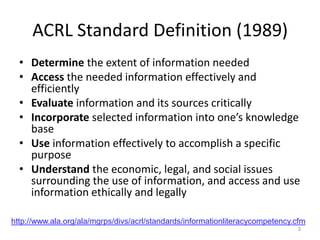
ACRL Standard Definition (1989)
  • Determine the extent of information needed
  • Access the needed information effectively and
    efficiently
  • Evaluate information and its sources critically
  • Incorporate selected information into one’s knowledge
    base
  • Use information effectively to accomplish a specific
    purpose
  • Understand the economic, legal, and social issues
    surrounding the use of information, and access and use
    information ethically and legally

http://www.ala.org/ala/mgrps/divs/acrl/standards/informationliteracycompetency.cfm
                                                                               3
“Participatory culture
shifts the focus of literacy
from one of individual
expression to community
involvement” (p. xiii).


Confronting the Challenges
of Participatory Culture
Media Education for the 21st Century
Henry Jenkins
2009
                                       4
“The new literacies almost
all involve social skills
developed through
collaboration and
networking.” (p. xiii).


Confronting the Challenges
of Participatory Culture
Media Education for the 21st Century
Henry Jenkins
2009
                                       5
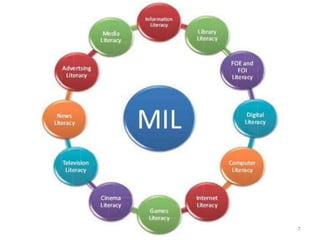
Media and Information Literacy (MIL)
“Information and media literacy enables
people to interpret and make informed
judgments as users of information and
media, as well as to become skillful
creators and producers of information
and media messages in their own right.”
http://portal.unesco.org/ci/en/ev.php-URL_ID=15886&URL_DO=DO_TOPIC&URL_SECTION=201.html


                                                                                          6
7
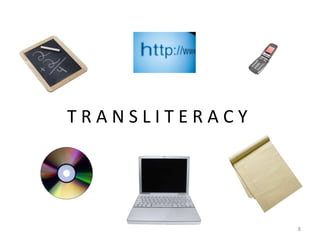
TRANSLITERACY


                8
Transliteracy Research Group

“Transliteracy is the ability to
read, write and interact across a range
of platforms, tools and media from
signing and orality through
handwriting, print, TV, radio and
film, to digital social networks.”
   http://nlabnetworks.typepad.com/transliteracy/
                                                    9
TRANSLITERACY

       “It is not about learning text literacy and
       visual literacy and digital literacy in
       isolation from one another but about
       the interaction among all these
       literacies.”

Tom Ipri. 2010. “Introducing transliteracy What does it mean to academic
libraries?”College & Research Libraries http://crln.acrl.org/content/71/10/532.full

                                                                                  10
“promotes critical thinking and
    collaboration in a digital age, providing a
    comprehensive framework to effectively
    participate in social media and online
    communities. ”

Thomas P. Mackey and Trudi E. Jacobson “Reframing Information Literacy as a
Metaliteracy” College & Research Libraries. January 2011 72:62-78.
http://crl.acrl.org/content/72/1/62.full.pdf
                                                                              11
“Information literacy is central to this
    redefinition because information takes
    many forms online and is produced and
    communicated through multiple
    modalities. ”

Thomas P. Mackey and Trudi E. Jacobson “Reframing Information Literacy as a
Metaliteracy” College & Research Libraries. January 2011 72:62-78.
http://crl.acrl.org/content/72/1/62.full.pdf
                                                                              12
“The ability to critically self-assess one’s
own competencies and to recognize the
need for integrated or expanded literacies
in today’s information environment is a
metaliteracy.”
Mackey and Jacobson (2013)
Metaliteracy: Reframing Information Literacy for a Social Media Age
manuscript


Metaliteracy is Metacognitive                                         13
“This metacognitive approach challenges a
reliance on skills-based information literacy
instruction only and shifts the focus to
knowledge acquisition in collaboration with
others.”
Mackey and Jacobson (2013)
Metaliteracy: Reframing Information Literacy for a Social Media Age
manuscript


Metaliteracy is Metacognitive                                         14
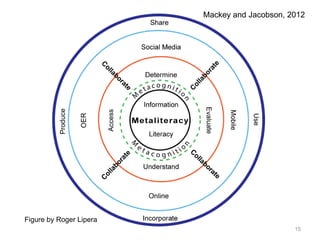
Mackey and Jacobson, 2012


Figure by Roger Lipera
                                               15
“Both metaliteracy and transliteracy
challenge traditional skills-based concepts
of information literacy by recognizing the
role of emerging technologies, suggesting
that information technology is a central
component of students’ learning.”


        “Connectivism: Learning Theory and Pedagogical Practice
        for Networked Information Landscapes”
        Michelle Kathleen Dunaway
        Reference Services Review Vol. 39 Iss: 4
                                                                  16
“Metaliteracy and transliteracy are
frameworks for understanding information
literacy that emphasize the importance of
communities, connections, information
networks, and information technologies;”


       “Connectivism: Learning Theory and Pedagogical Practice
       for Networked Information Landscapes”
       Michelle Kathleen Dunaway
       Reference Services Review Vol. 39 Iss: 4
                                                                 17
Metaliteracy in Practice
  • Understand Format Type and Delivery Mode
  • Evaluate User Feedback as Active Researcher
  • Create a Context for User-generated
    Information
  • Evaluate Dynamic Content Critically


Thomas P. Mackey and Trudi E. Jacobson “Reframing Information Literacy as a
Metaliteracy” College & Research Libraries. January 2011 72:62-78.
http://crl.acrl.org/content/72/1/62.full.pdf
                                                                              18
Metaliteracy in Practice
  • Produce Original Content in Multiple Media
    Formats
  • Understand Personal Privacy, Information
    Ethics and Intellectual Property Issues
  • Share Information in Participatory
    Environments


Thomas P. Mackey and Trudi E. Jacobson “Reframing Information Literacy as a
Metaliteracy” College & Research Libraries. January 2011 72:62-78.
http://crl.acrl.org/content/72/1/62.full.pdf
                                                                              19
Metaliteracy Learning Objectives
   Four main categories:
       1.   Behavioral
       2.   Cognitive
       3.   Affective
       4.   Metacognitive

            Please refer to Learning Objectives document


Developed as part of a SUNY Innovative Instruction Technology Grant (IITG) and
based on Mackey/Jacobson “Reframing Information Literacy as a Metaliteracy” College
& Research Libraries. January 2011 72:62-78 http://crl.acrl.org/content/72/1/62.full.pdf
                                                                                 20
Active Metaliterate Engagement
Basic IL Course:

     • Actual creation of information
     • Presentation of that information using a web-based
       application
     • Migration of individual paper-based research guide to
       team-based guide using wiki or website
     • Addition of data visualization/visual literacy component
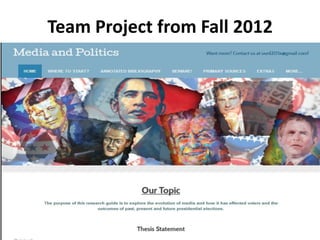
Team Project from Fall 2012
Next MOOC for fall 2013:

             #L4LLL
Literacies for Lifelong Learning
       (a Metaliteracy MOOC)
Thomas P. Mackey, Ph.D.       Trudi E. Jacobson, M.L.S
            Dean                Distinguished Librarian
Center for Distance Learning      University Libraries
                                  University at Albany
SUNY Empire State College
                                         SUNY

  Tom.Mackey@esc.edu           TJacobson@albany.edu

Belarus final

  • 1.
    Reframing Information Literacy as a Trudi E. Jacobson, M.L.S Thomas P. Mackey, Ph.D. Distinguished Librarian Dean University Libraries Center for Distance Learning University at Albany Empire State College SUNY SUNY 1
  • 2.
    Reframing Information Literacy as a Part of a year-long project “Introduction of Transliteracy Courses at Belarusian Universities through University Libraries” run by the Belarusian State University (BSU) Fundamental Library with a support of the US Embassy. 2
  • 3.
    ACRL Standard Definition(1989) • Determine the extent of information needed • Access the needed information effectively and efficiently • Evaluate information and its sources critically • Incorporate selected information into one’s knowledge base • Use information effectively to accomplish a specific purpose • Understand the economic, legal, and social issues surrounding the use of information, and access and use information ethically and legally http://www.ala.org/ala/mgrps/divs/acrl/standards/informationliteracycompetency.cfm 3
  • 4.
    “Participatory culture shifts thefocus of literacy from one of individual expression to community involvement” (p. xiii). Confronting the Challenges of Participatory Culture Media Education for the 21st Century Henry Jenkins 2009 4
  • 5.
    “The new literaciesalmost all involve social skills developed through collaboration and networking.” (p. xiii). Confronting the Challenges of Participatory Culture Media Education for the 21st Century Henry Jenkins 2009 5
  • 6.
    Media and InformationLiteracy (MIL) “Information and media literacy enables people to interpret and make informed judgments as users of information and media, as well as to become skillful creators and producers of information and media messages in their own right.” http://portal.unesco.org/ci/en/ev.php-URL_ID=15886&URL_DO=DO_TOPIC&URL_SECTION=201.html 6
  • 7.
  • 8.
  • 9.
    Transliteracy Research Group “Transliteracyis the ability to read, write and interact across a range of platforms, tools and media from signing and orality through handwriting, print, TV, radio and film, to digital social networks.” http://nlabnetworks.typepad.com/transliteracy/ 9
  • 10.
    TRANSLITERACY “It is not about learning text literacy and visual literacy and digital literacy in isolation from one another but about the interaction among all these literacies.” Tom Ipri. 2010. “Introducing transliteracy What does it mean to academic libraries?”College & Research Libraries http://crln.acrl.org/content/71/10/532.full 10
  • 11.
    “promotes critical thinkingand collaboration in a digital age, providing a comprehensive framework to effectively participate in social media and online communities. ” Thomas P. Mackey and Trudi E. Jacobson “Reframing Information Literacy as a Metaliteracy” College & Research Libraries. January 2011 72:62-78. http://crl.acrl.org/content/72/1/62.full.pdf 11
  • 12.
    “Information literacy iscentral to this redefinition because information takes many forms online and is produced and communicated through multiple modalities. ” Thomas P. Mackey and Trudi E. Jacobson “Reframing Information Literacy as a Metaliteracy” College & Research Libraries. January 2011 72:62-78. http://crl.acrl.org/content/72/1/62.full.pdf 12
  • 13.
    “The ability tocritically self-assess one’s own competencies and to recognize the need for integrated or expanded literacies in today’s information environment is a metaliteracy.” Mackey and Jacobson (2013) Metaliteracy: Reframing Information Literacy for a Social Media Age manuscript Metaliteracy is Metacognitive 13
  • 14.
    “This metacognitive approachchallenges a reliance on skills-based information literacy instruction only and shifts the focus to knowledge acquisition in collaboration with others.” Mackey and Jacobson (2013) Metaliteracy: Reframing Information Literacy for a Social Media Age manuscript Metaliteracy is Metacognitive 14
  • 15.
    Mackey and Jacobson,2012 Figure by Roger Lipera 15
  • 16.
    “Both metaliteracy andtransliteracy challenge traditional skills-based concepts of information literacy by recognizing the role of emerging technologies, suggesting that information technology is a central component of students’ learning.” “Connectivism: Learning Theory and Pedagogical Practice for Networked Information Landscapes” Michelle Kathleen Dunaway Reference Services Review Vol. 39 Iss: 4 16
  • 17.
    “Metaliteracy and transliteracyare frameworks for understanding information literacy that emphasize the importance of communities, connections, information networks, and information technologies;” “Connectivism: Learning Theory and Pedagogical Practice for Networked Information Landscapes” Michelle Kathleen Dunaway Reference Services Review Vol. 39 Iss: 4 17
  • 18.
    Metaliteracy in Practice • Understand Format Type and Delivery Mode • Evaluate User Feedback as Active Researcher • Create a Context for User-generated Information • Evaluate Dynamic Content Critically Thomas P. Mackey and Trudi E. Jacobson “Reframing Information Literacy as a Metaliteracy” College & Research Libraries. January 2011 72:62-78. http://crl.acrl.org/content/72/1/62.full.pdf 18
  • 19.
    Metaliteracy in Practice • Produce Original Content in Multiple Media Formats • Understand Personal Privacy, Information Ethics and Intellectual Property Issues • Share Information in Participatory Environments Thomas P. Mackey and Trudi E. Jacobson “Reframing Information Literacy as a Metaliteracy” College & Research Libraries. January 2011 72:62-78. http://crl.acrl.org/content/72/1/62.full.pdf 19
  • 20.
    Metaliteracy Learning Objectives Four main categories: 1. Behavioral 2. Cognitive 3. Affective 4. Metacognitive Please refer to Learning Objectives document Developed as part of a SUNY Innovative Instruction Technology Grant (IITG) and based on Mackey/Jacobson “Reframing Information Literacy as a Metaliteracy” College & Research Libraries. January 2011 72:62-78 http://crl.acrl.org/content/72/1/62.full.pdf 20
  • 21.
    Active Metaliterate Engagement BasicIL Course: • Actual creation of information • Presentation of that information using a web-based application • Migration of individual paper-based research guide to team-based guide using wiki or website • Addition of data visualization/visual literacy component
  • 22.
  • 23.
    Next MOOC forfall 2013: #L4LLL Literacies for Lifelong Learning (a Metaliteracy MOOC)
  • 24.
    Thomas P. Mackey,Ph.D. Trudi E. Jacobson, M.L.S Dean Distinguished Librarian Center for Distance Learning University Libraries University at Albany SUNY Empire State College SUNY Tom.Mackey@esc.edu TJacobson@albany.edu

Editor's Notes

  • #2 Trudi and Tom intro
  • #3 Trudi and Tom intro
  • #4 TrudiLong the standard for American librarians, but far too detailedCommittee now looking at radical revisions to incorporate much of what we’ll be discussing today (presumably)
  • #5 Tom
  • #6 Tom
  • #7 Tom
  • #8 Tom
  • #9 Tom
  • #10 Tom
  • #11 TomShould have about 20 minutes left of half-hour speaking time
  • #12 Trudi
  • #13 Trudi
  • #14 TrudiTo be metaliterate requires one to understand existing literacy strengths and areas for improvement, and to make decisions about one’s learning.
  • #15 Trudi
  • #16 Tom
  • #17 Tom
  • #18 Tom
  • #19 Trudi Create context: Wikipedia, RSS, GoogleScolar
  • #20 Trudi
  • #21 Trudi
  • #22 Trudi
  • #23 Trudihttp://mediapolitics.weebly.com/index.html
  • #24 Tom