Changing Models, Changing Emphases:
The Evolution of Information Literacy
1
Trudi Jacobson & Tom Mackey
#metaliteracy
Into the Next Generation:
The Future of Information Literacy
DePaul University Library and Moraine Valley Community College Library
Friday, April 25, 2014 8:30am-3:30pm
Today’s Topics
2
Metaliteracy and Badging
Threshold Concepts
IL in the Disciplines
WHAT IS METALITERACY?
3
Key
Elements
of
Metaliteracy
Produce
Collaborate
Participate
Share
Metacognition
4
5
Figure developed by Mackey, Jacobson, & Roger Lipera
Mackey and Jacobson (2014)
Metaliteracy: Reinventing
Information Literacy to
Empower Learners
• “promotes critical thinking and collaboration in
a digital age (p. 62).”
• “comprehensive framework to effectively
participate in social media and online
communities (p. 62)”
• “unified construct that supports the acquisition,
production, and sharing of knowledge in
collaborative online communities (p. 62).”
6
Thomas P. Mackey and Trudi E. Jacobson “Reframing Information Literacy as a Metaliteracy”
College & Research Libraries. January 2011 72:62-78. http://crl.acrl.org/content/72/1/62.full.pdf
“Metaliteracy empowers
learners to participate in
interactive information
environments, equipped
with the ability to
continuously reflect,
change, and contribute
as critical thinkers
(p. 86).”
(Jacobson and Mackey, Proposing
a Metaliteracy Model to Redefine
Information Literacy, 2013)
“Metaliteracy is not about
introducing yet another literacy
format, but rather reinventing an
existing one, information literacy, the
critical foundation literacy that
informs many others while being
flexible and adaptive enough to
evolve and change over time (p. 1-
2).”
Metaliteracy: Reinventing Information Literacy to Empower Learners
(Mackey and Jacobson, 2014).
Metaliteracy: Advancing Learning After Literacy (Jacobson and Mackey, 2014):
http://www.okanagan.bc.ca/Assets/Departments+(Administration)/ILT/ILT+Newsletter+(5$!2c1).pdf
“Metaliteracy promotes a very different teaching
and learning dynamic that needs to be present in
the teaching of both groups. (p. 3).”
Metaliteracy: Advancing Learning After Literacy (Jacobson and Mackey, 2014):
http://www.okanagan.bc.ca/Assets/Departments+(Administration)/ILT/ILT+Newsletter+(5$!2c1).pdf
“Students rarely see themselves as producers of
information, only as consumers, even though they
may be very creative with emerging technologies
outside of school. (p. 3).”
Metaliteracy: Advancing Learning After Literacy (Jacobson and Mackey, 2014):
http://www.okanagan.bc.ca/Assets/Departments+(Administration)/ILT/ILT+Newsletter+(5$!2c1).pdf
“In many cases, they have only produced papers
meant solely for the eyes of their instructors.
Writing for a broader audience, and working in
collaboration with others, requires a new set of
abilities. (p. 3).”
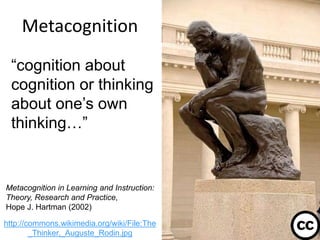
Metacognition
12
http://commons.wikimedia.org/wiki/File:The
_Thinker,_Auguste_Rodin.jpg
“cognition about
cognition or thinking
about one’s own
thinking…”
Metacognition in Learning and Instruction:
Theory, Research and Practice,
Hope J. Hartman (2002)
13
Figure developed by Mackey, Jacobson and Roger Lipera
Mackey and Jacobson (2014)
Metaliteracy: Reinventing
Information Literacy to
Empower Learners
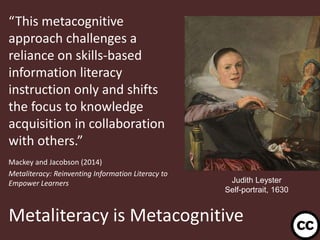
Metaliteracy is Metacognitive
“This metacognitive
approach challenges a
reliance on skills-based
information literacy
instruction only and shifts
the focus to knowledge
acquisition in collaboration
with others.”
Mackey and Jacobson (2014)
Metaliteracy: Reinventing Information Literacy to
Empower Learners
14
Judith Leyster
Self-portrait, 1630
Massive Open Online Courses
cMOOC:
“cMOOCs are discursive
communities creating knowledge
together.”
• “Connectivism and
Connectivist Knowledge
(George Siemens and Stephen
Downes)
• Creativity & Multicultural
Communication
• Metaliteracy MOOC
xMOOC
“Whilst they include discussion
forums…the centre of the course
is the instructor-guided lesson.
Each student’s
journey/trajectory through the
course is linear and based on the
absorption and understanding of
fixed competencies.”
• EdX
• Coursera
• Canvas
15
http://reflectionsandcontemplations.wordpress.com/2012/08/23/
what-is-a-mooc-what-are-the-different-types-of-mooc-xmoocs-and-cmoocs/
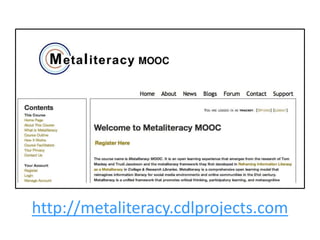
http://metaliteracy.cdlprojects.com
Blackboard Collaborate Session
Conundrum
Intent
• MOOC designed for student
engagement and
connectivity with the
thoughts of others as a
critical mechanism for
learning
Reality
• Students unused to this
model, which emphasizes
self-directed choices that do
not follow a set path; they
severely flounder
18
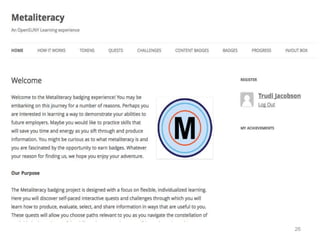
METALITERACY AND BADGING
19
Badging
• Same idea as Scout badges
• Competency-based learning
• Elements of gaming (quests,
challenges)
• Designated badges are
shareable (LinkedIn, online
portfolios or resumes)
• Associated metadata
indicates issuing
organization, describes
knowledge or skills gained
20
http://commons.wikimedia.org/wiki/File:Scout_Badge_Poncho.jpg
Metaliteracy Learning Objectives
Goal 1:
Evaluate content critically,
including dynamic, online
content that changes and
evolves, such as article
preprints, blogs, and wikis.
21
http://metaliteracy.org/learning-objectives/
Goal 2:
Understand personal
privacy, information
ethics, and intellectual
property issues in
changing technology
environments
22
http://metaliteracy.org/learning-objectives/
Metaliteracy Learning Objectives
Goal 3:
Share information and
collaborate in a variety of
participatory environments
23
http://metaliteracy.org/learning-objectives/
Metaliteracy Learning Objectives
Goal 4:
Demonstrate ability to
connect learning and
research strategies with
lifelong learning processes
and personal, academic,
and professional goals
24
http://metaliteracy.org/learning-objectives/
Metaliteracy Learning Objectives
25
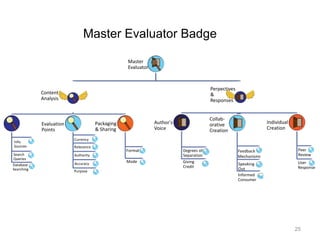
Master
Evaluator
Content
Analysis
Search
Queries
Info.
Sources
Database
Searching
Evaluation
Points
Currency
Relevance
Authority
Accuracy
Purpose
Packaging
& Sharing
Format
Mode
Perpectives
&
Responses
Author's
Voice
Degrees of
Separation
Giving
Credit
Collab-
orative
Creation
Speaking
Out
Informed
Consumer
Individual
Creation
Peer
Review
User
Response
Master Evaluator Badge
Feedback
Mechanisms
26
27
Preliminary Observations
Students
• Student engagement
• Quality of submitted work
• Interest in earning badge
– “something unusual to discuss with interviewers”
Faculty
• Evident interest
• Willingness to take the time to review
28
THRESHOLD CONCEPTS
29
Threshold Concepts
Hofer, Townsend, and Brunetti describe threshold
concepts and their criteria, as based on the work of Jan
Meyer and Ray Land:
…Threshold concepts are the core ideas and processes in any
discipline that define the discipline, but that are so
ingrained that they often go unspoken or unrecognized by
practitioner. They are the central concepts that we want
our students to understand and put into practice, that
encourage them to think and act like practitioners
themselves. (Hofer, Townsend, and Brunetti, 2012, 387-
88)
30
31
Threshold
Concepts Transformative
Integrative
Irreversible
Bounded
Troublesome
(Hofer, Townsend, and Brunetti, 2012, 387-88), quoting Meyer and Land
32
http://acrl.ala.org/ilstandards/
Draft ACRL Framework: Threshold
Concept Units
33
Threshold Concepts
Knowledge Practices
Dispositions
Self-Assessments
Assignments &
Assessments
•Integration into
Curriculum
•Abilities
•Affective
•Habits of Mind
•Assists with
metacognition
•Formative and
summative
Sample Threshold Concepts
• Scholarship is a Conversation
• Research is a Process of Inquiry
• Authority Is Contextual And Constructed
(based on Delphi study conducted by Townsend, Hofer, Lu, and Brunetti)
34
AUTHORITY IS CONTEXTUAL AND
CONSTRUCTED
Authority of information resources depends
upon their origins, the information need, and
the context in which those information
resources were created and will be used.
Dispositions
Are motivated to find authoritative sources, recognizing
that authority may be manifested in unexpected ways
Knowledge Practices (Abilities)
Recognize that authoritative content may be packaged
formally or informally, and may include dynamic user-
generated information.
Self-Assessments
Challenge themselves to find sources whose authority may
be conferred in different ways.
Possible Assessments or Assignments:
• Provide students with two different
information types (with two different goals)
on the same topic by the same unnamed
authoritative creator/author (for example,
scholarly article and blog post). Use this as a
discussion starter with students about
context in relationship to authority. Reveal
authorship later in discussion (might lead to
lesson on information need and locating
sources). (Lower level; one shot
friendly) [Overlaps with threshold concept:
Format as Process]
INFORMATION LITERACY IN THE
DISCIPLINES
Pulling It All Together
38
Opportunities/Challenges in the
Disciplines
• Librarians can’t do it all
• Faculty conceptions of information literacy
• Incorporating goal of metaliterate students
• Interest aroused by threshold concepts
• Potential role for badging
39
Lower level IL requirement for all incoming students
Upper level IL requirement in the major
Department responsibility
New learning objectives
New conversations
40
General Education Competency Requirements
Metaliteracy joins Info Literacy at
UAlbany
New major-based general education learning objectives
2. “Demonstrate the ability to evaluate content,
including dynamic, online content if
appropriate”
4. “Produce, share, and evaluate information in a
variety of participatory environments”
5. “Integrate learning and research strategies with
lifelong learning processes and personal,
academic, and professional goals”
41
General Education
Lower level
Upper level IL
requirement in the major
Badging
More extensive use of
badging
Threshold concept
badging within
disciplines?
42
QUESTIONS?
43
Metaliteracy means that
YOU
can be a Rock Star!
44
45
Trudi E. Jacobson, M.L.S., M.A.
Distinguished Librarian
Head, Information Literacy Department
University Libraries
University at Albany, SUNY
Tom Mackey, Ph.D.
Dean
Center for Distance Learning
Empire State College, SUNY

Changing Models, Changing Emphases: The Evolution of Information Literacy

  • 1.
    Changing Models, ChangingEmphases: The Evolution of Information Literacy 1 Trudi Jacobson & Tom Mackey #metaliteracy Into the Next Generation: The Future of Information Literacy DePaul University Library and Moraine Valley Community College Library Friday, April 25, 2014 8:30am-3:30pm
  • 2.
    Today’s Topics 2 Metaliteracy andBadging Threshold Concepts IL in the Disciplines
  • 3.
  • 4.
  • 5.
    5 Figure developed byMackey, Jacobson, & Roger Lipera Mackey and Jacobson (2014) Metaliteracy: Reinventing Information Literacy to Empower Learners
  • 6.
    • “promotes criticalthinking and collaboration in a digital age (p. 62).” • “comprehensive framework to effectively participate in social media and online communities (p. 62)” • “unified construct that supports the acquisition, production, and sharing of knowledge in collaborative online communities (p. 62).” 6 Thomas P. Mackey and Trudi E. Jacobson “Reframing Information Literacy as a Metaliteracy” College & Research Libraries. January 2011 72:62-78. http://crl.acrl.org/content/72/1/62.full.pdf
  • 7.
    “Metaliteracy empowers learners toparticipate in interactive information environments, equipped with the ability to continuously reflect, change, and contribute as critical thinkers (p. 86).” (Jacobson and Mackey, Proposing a Metaliteracy Model to Redefine Information Literacy, 2013)
  • 8.
    “Metaliteracy is notabout introducing yet another literacy format, but rather reinventing an existing one, information literacy, the critical foundation literacy that informs many others while being flexible and adaptive enough to evolve and change over time (p. 1- 2).” Metaliteracy: Reinventing Information Literacy to Empower Learners (Mackey and Jacobson, 2014).
  • 9.
    Metaliteracy: Advancing LearningAfter Literacy (Jacobson and Mackey, 2014): http://www.okanagan.bc.ca/Assets/Departments+(Administration)/ILT/ILT+Newsletter+(5$!2c1).pdf “Metaliteracy promotes a very different teaching and learning dynamic that needs to be present in the teaching of both groups. (p. 3).”
  • 10.
    Metaliteracy: Advancing LearningAfter Literacy (Jacobson and Mackey, 2014): http://www.okanagan.bc.ca/Assets/Departments+(Administration)/ILT/ILT+Newsletter+(5$!2c1).pdf “Students rarely see themselves as producers of information, only as consumers, even though they may be very creative with emerging technologies outside of school. (p. 3).”
  • 11.
    Metaliteracy: Advancing LearningAfter Literacy (Jacobson and Mackey, 2014): http://www.okanagan.bc.ca/Assets/Departments+(Administration)/ILT/ILT+Newsletter+(5$!2c1).pdf “In many cases, they have only produced papers meant solely for the eyes of their instructors. Writing for a broader audience, and working in collaboration with others, requires a new set of abilities. (p. 3).”
  • 12.
    Metacognition 12 http://commons.wikimedia.org/wiki/File:The _Thinker,_Auguste_Rodin.jpg “cognition about cognition orthinking about one’s own thinking…” Metacognition in Learning and Instruction: Theory, Research and Practice, Hope J. Hartman (2002)
  • 13.
    13 Figure developed byMackey, Jacobson and Roger Lipera Mackey and Jacobson (2014) Metaliteracy: Reinventing Information Literacy to Empower Learners
  • 14.
    Metaliteracy is Metacognitive “Thismetacognitive approach challenges a reliance on skills-based information literacy instruction only and shifts the focus to knowledge acquisition in collaboration with others.” Mackey and Jacobson (2014) Metaliteracy: Reinventing Information Literacy to Empower Learners 14 Judith Leyster Self-portrait, 1630
  • 15.
    Massive Open OnlineCourses cMOOC: “cMOOCs are discursive communities creating knowledge together.” • “Connectivism and Connectivist Knowledge (George Siemens and Stephen Downes) • Creativity & Multicultural Communication • Metaliteracy MOOC xMOOC “Whilst they include discussion forums…the centre of the course is the instructor-guided lesson. Each student’s journey/trajectory through the course is linear and based on the absorption and understanding of fixed competencies.” • EdX • Coursera • Canvas 15 http://reflectionsandcontemplations.wordpress.com/2012/08/23/ what-is-a-mooc-what-are-the-different-types-of-mooc-xmoocs-and-cmoocs/
  • 16.
  • 17.
  • 18.
    Conundrum Intent • MOOC designedfor student engagement and connectivity with the thoughts of others as a critical mechanism for learning Reality • Students unused to this model, which emphasizes self-directed choices that do not follow a set path; they severely flounder 18
  • 19.
  • 20.
    Badging • Same ideaas Scout badges • Competency-based learning • Elements of gaming (quests, challenges) • Designated badges are shareable (LinkedIn, online portfolios or resumes) • Associated metadata indicates issuing organization, describes knowledge or skills gained 20 http://commons.wikimedia.org/wiki/File:Scout_Badge_Poncho.jpg
  • 21.
    Metaliteracy Learning Objectives Goal1: Evaluate content critically, including dynamic, online content that changes and evolves, such as article preprints, blogs, and wikis. 21 http://metaliteracy.org/learning-objectives/
  • 22.
    Goal 2: Understand personal privacy,information ethics, and intellectual property issues in changing technology environments 22 http://metaliteracy.org/learning-objectives/ Metaliteracy Learning Objectives
  • 23.
    Goal 3: Share informationand collaborate in a variety of participatory environments 23 http://metaliteracy.org/learning-objectives/ Metaliteracy Learning Objectives
  • 24.
    Goal 4: Demonstrate abilityto connect learning and research strategies with lifelong learning processes and personal, academic, and professional goals 24 http://metaliteracy.org/learning-objectives/ Metaliteracy Learning Objectives
  • 25.
  • 26.
  • 27.
  • 28.
    Preliminary Observations Students • Studentengagement • Quality of submitted work • Interest in earning badge – “something unusual to discuss with interviewers” Faculty • Evident interest • Willingness to take the time to review 28
  • 29.
  • 30.
    Threshold Concepts Hofer, Townsend,and Brunetti describe threshold concepts and their criteria, as based on the work of Jan Meyer and Ray Land: …Threshold concepts are the core ideas and processes in any discipline that define the discipline, but that are so ingrained that they often go unspoken or unrecognized by practitioner. They are the central concepts that we want our students to understand and put into practice, that encourage them to think and act like practitioners themselves. (Hofer, Townsend, and Brunetti, 2012, 387- 88) 30
  • 31.
  • 32.
  • 33.
    Draft ACRL Framework:Threshold Concept Units 33 Threshold Concepts Knowledge Practices Dispositions Self-Assessments Assignments & Assessments •Integration into Curriculum •Abilities •Affective •Habits of Mind •Assists with metacognition •Formative and summative
  • 34.
    Sample Threshold Concepts •Scholarship is a Conversation • Research is a Process of Inquiry • Authority Is Contextual And Constructed (based on Delphi study conducted by Townsend, Hofer, Lu, and Brunetti) 34
  • 35.
    AUTHORITY IS CONTEXTUALAND CONSTRUCTED Authority of information resources depends upon their origins, the information need, and the context in which those information resources were created and will be used.
  • 36.
    Dispositions Are motivated tofind authoritative sources, recognizing that authority may be manifested in unexpected ways Knowledge Practices (Abilities) Recognize that authoritative content may be packaged formally or informally, and may include dynamic user- generated information. Self-Assessments Challenge themselves to find sources whose authority may be conferred in different ways.
  • 37.
    Possible Assessments orAssignments: • Provide students with two different information types (with two different goals) on the same topic by the same unnamed authoritative creator/author (for example, scholarly article and blog post). Use this as a discussion starter with students about context in relationship to authority. Reveal authorship later in discussion (might lead to lesson on information need and locating sources). (Lower level; one shot friendly) [Overlaps with threshold concept: Format as Process]
  • 38.
    INFORMATION LITERACY INTHE DISCIPLINES Pulling It All Together 38
  • 39.
    Opportunities/Challenges in the Disciplines •Librarians can’t do it all • Faculty conceptions of information literacy • Incorporating goal of metaliterate students • Interest aroused by threshold concepts • Potential role for badging 39
  • 40.
    Lower level ILrequirement for all incoming students Upper level IL requirement in the major Department responsibility New learning objectives New conversations 40 General Education Competency Requirements
  • 41.
    Metaliteracy joins InfoLiteracy at UAlbany New major-based general education learning objectives 2. “Demonstrate the ability to evaluate content, including dynamic, online content if appropriate” 4. “Produce, share, and evaluate information in a variety of participatory environments” 5. “Integrate learning and research strategies with lifelong learning processes and personal, academic, and professional goals” 41
  • 42.
    General Education Lower level Upperlevel IL requirement in the major Badging More extensive use of badging Threshold concept badging within disciplines? 42
  • 43.
  • 44.
  • 45.
    45 Trudi E. Jacobson,M.L.S., M.A. Distinguished Librarian Head, Information Literacy Department University Libraries University at Albany, SUNY Tom Mackey, Ph.D. Dean Center for Distance Learning Empire State College, SUNY